




Abstract
This study examines the influence of individual owner-manager values on the different dimensions of socioemotional wealth in family firms. We argue that values of owner-managers in family firms are one of the underlying motivators for socioemotional wealth behavior and used structural equation modeling to test the assumed connection. The results of our data set with 1,003 cases show, in accordance with Schwartz’s value dimensions, that social- and person-oriented values influence different dimensions of the FIBER scale. Our findings help understand the importance of individual values, advance socioemotional wealth research, and contribute to the understanding of family firm behavior.
Introduction
Once a value is internalized it becomes, consciously or unconsciously, a standard or criterion for guiding action, for developing and maintaining attitudes toward relevant objects and situations, for justifying one’s own and others’ actions and attitudes, for morally judging self and others and for comparing oneself with others.
Sociologists and psychologists agree that values substantially influence the affective and behavioral responses of individuals, fostering behavior that follows their individual values (Kluckhohn, 1951; Rokeach, 1973; R. M. Williams, 1974). Therefore, it is hardly surprising that values have been deemed to be an essential factor in explaining the behavior of organizations (Schein, 1983) and, particularly, family firms (Beckhard & Dyer, 1983). Notably, individuals such as founders and executives are deemed to exert a strong influence on a company in cultivating core values (Porras & Collins, 1994; Schein, 1983). These individuals are unique in family firms, as they are usually in charge over a long period of time (McConaughy, 2000) and, as such, actively influence the values of a company (Anderson & Reeb, 2003; García-Álvarez et al., 2002). Values derived from family ownership have been named to influence the resources, choices, and goals of the firm and the family (Chua et al., 2015; Fletcher et al., 2012; Gómez-Mejía et al., 2007; Pieper, 2010; Rau et al., 2019), build the foundation on which a family firm is based (Davis et al., 2010), and influence the general behavior of family firms (Yuan & Wu, 2018).
However, even though the importance of values in family firms has been acknowledged, empirical research about how values manifest themselves, what values are predominant within a family firm, and how they influence behavior is scarce (Duh et al., 2010; Koiranen, 2002). Oftentimes, values are used as a preferred means to explain a phenomenon, such as a distinctive corporate culture (Fletcher et al., 2012), longevity (Lumpkin & Brigham, 2011), corporate social responsibility (CSR; Marques et al., 2014), or goal-setting (Kotlar & De Massis, 2013), without thoroughly explaining or investigating the values themselves. The mechanisms through which individual and family values influence organizational values and behavior (Bertrand & Schoar, 2006; Duh et al., 2010) remain a question yet to be answered. This is surprising since values are identified as the means or resource to overcome crises and secure continuity, which is crucial for family firms (Fletcher et al., 2012).
With this article, we aim to go beyond existing literature by applying the theory of basic human values developed by social-psychologist Shalom H. Schwartz (1992) to measure the predominant values within owner-managers of family firms and establish a connection to family firm behavior. Schwartz’s value conceptualization is one of the most acknowledged in the field, used across many different academic fields including marketing (Sousa et al., 2010) and political science (Aspelund et al., 2013) and has recently been introduced to the family business literature related to talent attraction in family firms (Hauswald et al., 2016), decision making in top management teams (Vandekerkhof et al., 2018), different strategic behavior (Yuan & Wu, 2018), and family firm heterogeneity (Rau et al., 2019). We used the validated and established Portraits Value Questionnaire (PVQ), which was developed by Schwartz for the European Social Survey (Schmidt et al., 2007; Schwartz & Rubel, 2005). In choosing this value survey, we applied one of the most inclusive scales for capturing meaningful values across different societies (Schmidt et al., 2007; Schwartz & Rubel, 2005).
To understand why we and many others believe that individual values influence the behavior of firms, and especially family firms, it is essential to acknowledge that family firm behavior is unique. The behavior and decision making of family firms is strongly influenced by nonfinancial goals (De Massis et al., 2018; Gómez-Mejía et al., 2007). In the early stages of the family business research stream, agency theory (Cruz et al., 2010; Eisenhardt, 1989) and stewardship theory (Davis et al., 2010; Miller & Breton-Miller, 2006) were primarily used to explain these differences. However, in 2007, the homegrown construct of socioemotional wealth (SEW) was developed by Gómez-Mejía, Haynes, Núñez-Nickel, Jacobson, and Moyano-Fuentes. This theoretical paradigm (Filser et al., 2018) has been widely accepted by family business researchers to soundly explain many of the observable differences. At the same time, SEW has been one of the most discussed and criticized models in recent years (Miller & Le Breton-Miller, 2014; Schulze & Kellermanns, 2015). Often, research is based on assumptions about SEW (Schulze & Kellermanns, 2015); findings contradict each other and the outcomes of SEW are diverse (Miller & Le Breton-Miller, 2014). Ultimately, the questions necessary to understand the complex construct of SEW remain unanswered. Primarily, how does it function, what is the cause and effect, and within whom does SEW reside (Chua et al., 2015; Miller & Le Breton-Miller, 2014; Schulze & Kellermanns, 2015)? Furthermore, Miller and Le Breton-Miller (2014) state that it will be useful for scholars of SEW to be sharper in their characterizations of its nature, sources, and outcomes and to probe more directly the motives of the family members who play active roles in family businesses. (p. 718)
Jiang et al. (2018) recently proposed that many of the challenges the concept of SEW faces can be addressed by looking through a social-psychology lens and, as mentioned, values have long been deemed to be a substantial part of SEW, motivating distinct family firm behavior (Berrone et al., 2012; Gómez-Mejía et al., 2007; Jiang et al., 2018; Ruf et al., 2020). Thus far, and to the best knowledge of the authors, however, no attempt has been made to take a closer look at which values influence and motivate this SEW behavior. This is, however, profoundly compelling as it could aid understanding about the nature of SEW by creating links between subconscious individual cognition and family firm behavior (SEW) while also shedding light on which values are actively lived in family firms. We, therefore, applied the theory of basic human values (Schwartz, 1992) and connected this sociopsychological measurement with the SEW model, measuring the influence of owner-manager values on the FIBER dimensions of SEW (Berrone et al., 2012). Thus, the research question asked in this article is as follows:
We aim to untangle the connection of values and SEW behavior, utilizing a quantitative study performed on our sample of 1,003 family firms in Germany. Primarily, we test our hypothesis that values are the antecedents of SEW behavior. We therefore used partial least squares structural equation modeling (PLS-SEM), utilizing Schwartz’s (1992) higher order values as independent variables and the FIBER dimensions of Berrone et al. (2012) as dependent variables. Our findings show strong support for the presumed connection between values and SEW. Interestingly, opposing value dimensions (Schwartz, 1994) influenced different dimensions of the FIBER scale, and we observed a strong resemblance of conservation values within all FIBER dimensions.
Based on our findings, this article contributes manifold to the family business research stream. First, the novelty of this research is that we are the first to illustrate the connection between individual values and SEW by using quantitative measures and therefore show how individual values of the owner-manager directly influence family firm behavior. Second, it is one of only a few empirical studies that explore values in a structured quantitative manner within the context of family firms. We display all results using the full PVQ questionnaire, a validated measurement grounded in sociopsychological studies. Thus, we are able to identify the predominant values existing in family firms based on the theory of basic human values (Schwartz, 1992). Finally, we contribute to the body of SEW knowledge by displaying empirical data using a robust data set of German family firms. Following this, we offer an introduction to values, SEW in family firms, and their interrelated connection. We derive and formulate our hypothesis out of the existing literature and present our methodology, followed by the results and a discussion section.
Theoretical Framework and Hypotheses
Values and Family Firms
Values aid in understanding individual behavior (Diener, 1984) and psychological (Ryff, 1989) and subjective well-being. Kluckhohn (1951) describes values as an implicit or explicit conception of the desirable, influencing the selection process of the individual from the available modes, means, and ends of action. This explains that nonconforming decisions and behavior will most likely result in guilt, shame, or self-deprecation. Thus, the values of a person act as “personal standards of conduct” (Narasimhan et al., 2010, p. 370). Schwartz (1994) stated that there is a common understanding that values feature five distinguishable attributes, which set them apart from needs and attitudes.
A value is a (1) belief (2) pertaining to desirable end states or modes of conduct, that (3) transcends specific situations, (4) guides selection or evaluation of behavior, people, and events, and (5) is ordered by importance relative to other values to form a system of value priorities. (Schwartz, 1994, p. 20)
While this common concept enables us to distinguish what values are or what they are not, they do not offer a proper categorization. Therefore, Schwartz (1992) developed a conceptual framework to measure and identify different values based on the work of Rokeach (1973). Schwartz classified these values and established relationships among the different existing value types. He identified 10 distinctive values that are additionally clustered into four higher order value types as presented in Figure 1. These four higher order value types oppose each other to a certain extent and form two bipolar value dimensions: self-transcendence versus self-enhancement and conservation versus openness to change. This opposition does not imply an absence of values in certain people but primarily expresses that people emphasize values in different ways and prioritize specific values over others (Schwartz, 1992; R. M. Williams, 1974).
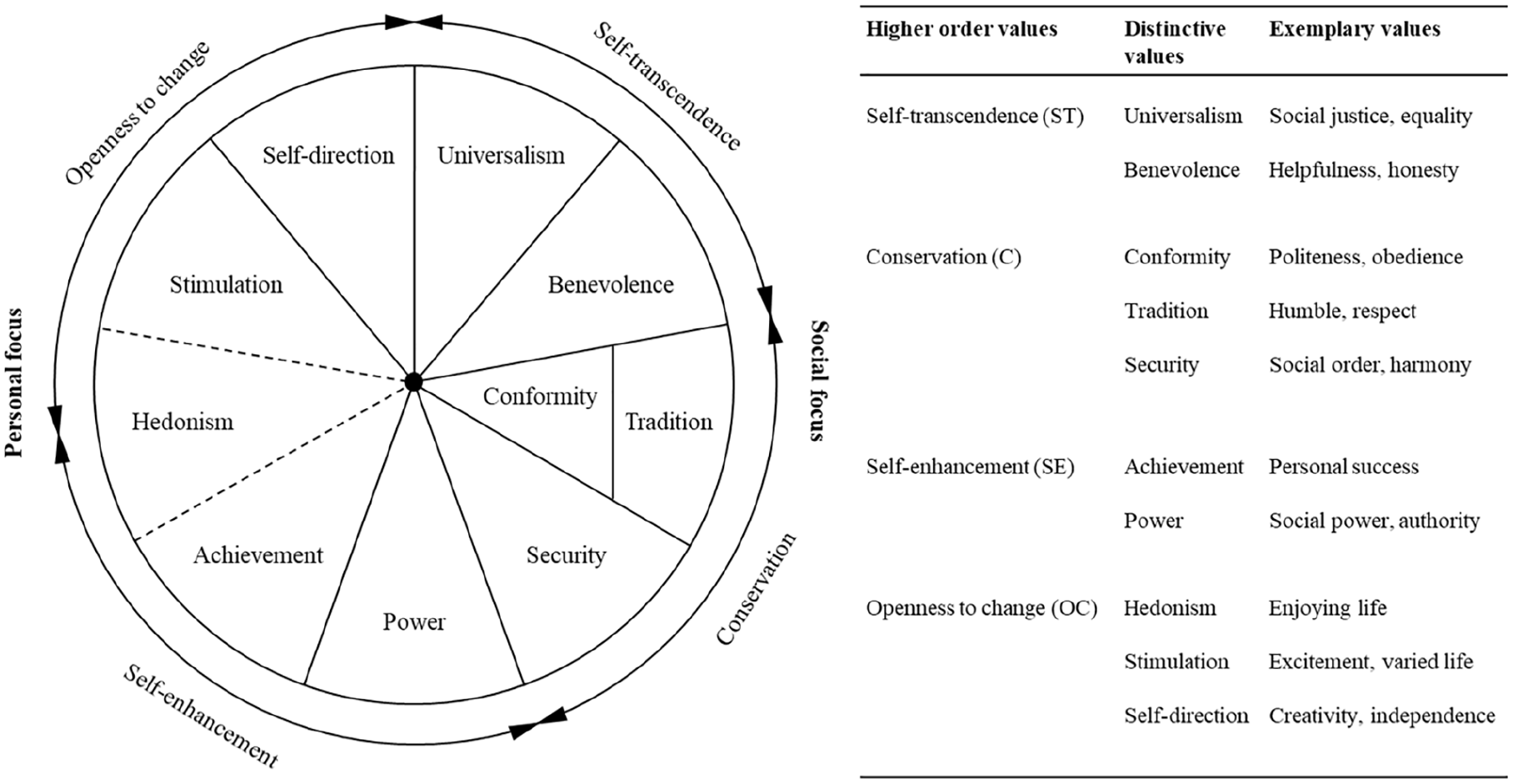
Theoretical model of relations among motivational types of values, higher order value types, and bipolar value dimensions.
Acknowledging the relevance regarding the bipolar relationship of these values, a recent contribution has been made by Yuan and Wu (2018), emphasizing values as the “key determinant of family heterogeneity and family firm behavior” (Yuan & Wu, 2018, p. 284). They propose that family firms may act according to their emphasized value dimension and therefore show differences in behavior. While not solely utilizing the values identified by Schwarz, this assumption is supported by a recent study performed by Rau et al. (2019), wherein they show that family firms differ by prioritizing specific values and distinguish themselves in general from nonfamily firms’ emphasized values.
Moreover, a study by Hauswald et al. (2016) used Schwartz’s value survey to identify why particular job seekers are attracted to family firms. They found that job seekers who show high self-transcendence and conservation values but low openness to change and self-enhancement values prefer working in firms where family influence is stronger (Hauswald et al., 2016). Initial attempts have already been made to expand knowledge about values and their influence on the behavior of family firms and their stakeholders, but no study has yet revealed which values predominate. Similarly, there is little knowledge regarding which values and with what priority they are represented by family members who manage the company. In our opinion, owner-managers of family firms are to a certain extent alike, which is also caused and represented by a similar value prioritization without denying an inevitable value heterogeneity. This leads to the unique and distinguished behavior of family firms, so often observed by family business scholars.
As this study intends to show the influence of values on the behavior of family firms, an in-depth look at the distinguishable idiosyncrasies of family firms is necessary. While many theories were, and still are, used to explain family firm behavior, no established theory has yet offered a wholesome explanation of why family firms act so differently compared with their nonfamily counterparts. As classical concepts, such as agency and stewardship theory, could not solely explain the characteristic behavior of family firms (Schulze & Kellermanns, 2015), the theoretical paradigm of SEW was introduced in 2007. SEW is grounded in the behavioral agency model (Wiseman & Gómez-Mejía, 1998), agency theory (Akerlof, 1970), and prospect theory (Kahneman & Tversky, 1979) to explain the unique orientation on nonfinancial goals next to financial gains. The loss or gain of SEW forms the general guideline that family firms use to make decisions and policies (Berrone et al., 2012). It has become a widely discussed topic within the family business research field and is currently the predominant concept used (Vazquez & Rocha, 2018) with more than 700 peer-reviewed academic articles (Jiang et al., 2018). That SEW is not a one-dimensional concept is acknowledged by multiple authors (e.g., Berrone et al., 2012; Debicki et al., 2016; Gómez-Mejía et al., 2007). Berrone et al. (2012) were the first to develop a multidimensional approach to measure and grasp the different dimensions of SEW. So far, only two other scales, the Socioemotional Wealth Importance scale (Debicki et al., 2016) and the so-called REI scale (Hauck et al., 2016), which is a methodological reduction of the FIBER model, have been introduced. We used Berrone et al.’s (2012) FIBER scale as it is the most inclusive scale to measure the different dimensions and has recently been used, for example, by Filser et al. (2018) to connect family functionality with SEW and innovativeness. The dimensions characterized in the FIBER scale are family control and influence (F), identification of family members with the firm (I), binding social ties (B), emotional attachment of family members (E), and renewal of family bonds (R) to the firm through dynastic succession (Berrone et al., 2012). Family control and influence (F) stands for the will of family members to preserve their control and influence over the family firm (Berrone et al., 2012). One of the main attributes of family firms is the fact that families control strategic decisions directly or indirectly (Chua et al., 1999; Schulze et al., 2003). Remaining in charge is essential for owners and family members, who sometimes even neglect financial considerations as a result (Gómez-Mejía et al., 2007). Identification of family members with the firm (I) is understood as a mix of family and business, creating a unique family firm identity (Berrone et al., 2010; Dyer & Whetten, 2006; Zellweger et al., 2010). Often, family firms are directly associated with the family as it carries the name on the door (Berrone et al., 2012), increasing the internal and external exposure of the family (Felden et al., 2016). Due to this fact, family firms have been observed to have a higher activity level in CSR (Berrone et al., 2010) and maintain a high image of the family’s reputation (Sharma & Manikutty, 2005; Westhead et al., 2001). Emotional attachment of family members (E) describes the emotional bond between the family and the family firm. Oftentimes, a long history with multiple family generations involved resides within the firm (Felden et al., 2016; Gersick et al., 1997). In addition, shared knowledge of events in the firm’s genesis (Kammerlander et al., 2015), where family relationships are dominant, may exist (Berrone et al., 2012). This emotional involvement can be seen as one of the distinct characters of family firms (Eddleston & Kellermanns, 2007; Tagiuri & Davis, 1996) inherently influencing decision making (Baron, 2008). Binding social ties (B) explains the family firm’s social relationships. Social bonds, even though they are the strongest in-between family members, are not exclusively reserved for the family. Research has shown that reciprocal bonds will often be extended to outsiders as well (Miller et al., 2009). The urge to secure the well-being of the family will most likely extend to employees of the family firm, hence strengthening the sense of identity of nonfamily employees (Miller & Le Breton-Miller, 2005). This inclusion even goes so far as to include long-term suppliers, customers (Uhlaner, 2006), and communities (Berrone et al., 2010). Renewal of family bonds (R) by succession is the concluding dimension, according to Berrone et al. (2012). It conveys the predominant need for owners to hand over their family firm to the next generation. This has been noted as one of the essential parts of SEW (Zellweger & Astrachan, 2008; Zellweger, Kellermanns, Chrisman, et al., 2012).
However, while SEW soundly explains the behavior of family firms, it has not reached the point of becoming a theory on its own. This may be because the source and outcomes have not yet been fully explored. Schulze and Kellermanns (2015), for example, argue that a positive theory explaining the core set of beliefs and contributions of the family to the health of the firm is missing. In addition, it is argued that much of the research in this field is based merely on assumptions (Schulze & Kellermanns, 2015), and the findings contradict each other (Miller & Le Breton-Miller, 2014). A substantial number of research projects focused on the influence of SEW on organizational governance, stakeholder relationships, performance, innovation, CSR, and other management practices (Deephouse & Jaskiewicz, 2013; Filser et al., 2018; Rousseau et al., 2018). However, we are not aware of any research so far that focuses on evaluating the factors influencing SEW. Indeed, Jiang et al. (2018) summarized in their article that SEW research neglects “family member’s actual thoughts, feelings, motivations and behaviors, which are believed to be part of the unique SEW-related phenomena” (Jiang et al., 2018, p. 128). Therefore, they introduce a sociopsychological lens that, in their opinion, can lead to a better understanding of the human nature behind the SEW phenomena. They suggest that thoughts, feelings, and behavior are connected to SEW and vary according to the unit of analysis and the situation (Jiang et al., 2018). Following this idea, we believe that one of the main drivers behind the ambivalent and non-financial-oriented behavior within a family firm, as reflected in the SEW concept, is the need to satisfy the owner-manager’s value construct (Kluckhohn, 1951). To elaborate on this assumption and advance the research about values, SEW, and behavior in family firms, we connected Schwartz’s (1992) two-dimensional theory of basic human values with the multidimensional construct of SEW.
Derivation and Classification of the Hypotheses
Value Dimension: Openness to Change Versus Conservation
This value dimension identified by Schwartz (1992) includes the higher order values openness to change and conservation. The values included arrange themselves according to people either pursuing their own emotional and intellectual interests and choosing the unknown over the known, and thus uncertainty, or preserving the status quo. Openness to change includes the distinctive values of self-direction, stimulation, and hedonism. Individuals who are ranked high in openness to change try to live a varied and exciting life, are curious, are creative, and try to choose their own goals (Schwartz, 1992). They value independence and freedom of choice. In general, it is argued that these values have a strong personal focus, regulating the expression of the individual’s own abilities and interests and a growth motivation (Rudnev et al., 2018; Schwartz, 2006). Based on that, we assume that openness to change values only partially influence SEW. As openness to change includes the distinctive value self-direction, consisting of, for example, independence, freedom of choice, and choosing one’s own goals (Schwartz, 1992), maintaining control over the business does have a clear connection to this value dimension as it helps it to stay independent and make own decisions. This is one of the main noneconomic goals described by the F dimension (Berrone et al., 2012). Staying in charge gives owner-managers the freedom to express their need for creativity and a varied and exciting life resulting in a strong identification with one’s actions and consequently the family firm. This is further supported by research, which shows that formal ownership leads to psychological ownership (Chi & Han, 2008), which, in return, can appeal and affirm an individual’s values and self-identity (Avey et al., 2011). We therefore argue that openness to change influences dimension I of the FIBER scale. Conservation, in contrast to openness to change, consists of three distinctive values: security, conformity, and tradition. People who place strong emphasis on conservation normally value safety, harmony, and a stable relationship. Security does not necessarily address the need to protect oneself by staying healthy, for example, but it emphasizes the need for collective security, such as family security and social order. These individuals tend to try and avoid actions that upset or harm social expectations, norms, or other people, which is often expressed by strong self-discipline and obedient and polite behavior. These individuals value shared experiences and practices, respect traditions, and accept their portion in life (Schwartz, 1992). According to Schwartz (2006), values connected to conservation are motivated by protection and anxiety avoidance and have a strong social focus. Therefore, we believe that conservation values, contrary to the opposing openness to change values, influence all dimensions of FIBER. Conservation values, especially tradition and conformity, support the notion of staying in charge of the family firm, represented by dimension F. Dimension I is also influenced, since the family firms’ heritage is oft-mentioned in the context of family business research (Micelotta & Raynard, 2011; Mitchell et al., 2011; Zellweger, Kellermanns, Eddleston, et al., 2012) as a way to brand the company and strengthen its identity. Zellweger, Kellermanns, Eddleston, et al. (2012) note that an organizational identity builds on a firm’s heritage simultaneously setting the course for the future, which is strongly connected to tradition. Previous research has emphasized the distinctive characterization of family firms as caring stewards (Davis et al., 1997; Miller & Le Breton-Miller, 2005). Arguments have been made that the culture of family firms results in employees having a higher commitment, involvement, and loyalty to the family firm (Vallejo, 2008) and that family firms show higher employee participation (Bammens et al., 2015; Covin, 1994) and job security (Block, 2010). This may lead to higher trust and organizational harmony, which is, next to benevolence, intricately connected to values such as security and conformity. Therefore, we argue that conservation also influences dimension B. The connection of conservation values to dimension E is established through building a family legacy. According to Berrone et al. (2012), emotional attachment helps build a family legacy and thus maintain a positive self-concept. Furthermore, we argue that such values as tradition, security, and conformity influence dimension B. Finally, we would like to illustrate the connection between conservation values and the FIBER dimension R. A firm symbolizes the family’s heritage, legacy, and tradition (Tagiuri & Davis, 1992). Thus, managing and preparing the firm for continuity so that future generations can benefit is one of the main goals (Kets de Vries, 1993; Kotlar & De Massis, 2013; R. I. Williams et al., 2019; Zellweger, Kellermanns, Chrisman, et al., 2012). Building on the existing value and SEW literature, we conclude the following hypotheses:
Value Dimension: Self-Transcendence Versus Self-Enhancement
The second value dimension consists of the higher order values self-transcendence and self-enhancement (Schwartz, 1992). This dimension addresses values indicating whether a person deals only with his own personal interests and their protection or promotes and grows the well-being of other people, their surroundings, and the environment. Self-transcendence includes the distinctive values of benevolence and universalism. These two values show strong similarities. In general, people ranking high on benevolence values are motivated by preserving the well-being of close individuals (Kluckhohn, 1951; Schwartz, 1992). People ranking high on universalism values extend this goal to humankind and nature itself. To a great extent, people ranking high in self-transcendence values can, compared with others, best be described as helpful, loyal, honest, responsible, tolerant, understanding, and socially focused (Rudnev et al., 2018). Therefore, we regard the higher order value self-transcendence as a driver of the SEW dimensions B, E, and R. Fundamentally, benevolence focuses on the welfare of people with whom one is in frequent personal contact. Schwartz (2012) stated that relations within the family are most critical but can include other primary groups. As dimension B includes the need to establish and maintain reasonable, long-term relationships with family firm employees, communities, and long-term suppliers (Berrone et al., 2010), a clear connection to self-transcendence values can be observed. The connection to dimension B is supported by the notion of Berrone et al. (2012) that the dimension, through psychological appropriation, is connected to maintaining a positive self-concept, as emotional attachment fosters family legacy and helps understand trust (Steier, 2001), altruism (Eddleston & Kellermanns, 2007), and benevolence (Cruz et al., 2010). Last, we assume a connection between self-transcendence values and the FIBER dimension R. As these dimensions include the need to hand over the business to the next generation, managing and preparing the firm for continuity so future generations can benefit from it is one of the main goals (Kets de Vries, 1993; Kotlar & De Massis, 2013; R. I. Williams et al., 2019; Zellweger, Kellermanns, Chrisman, et al., 2012). Therefore, we argue that the intention to hand over a healthy business to one’s children and maintaining workplaces for long-time employees is based on underlying self-transcendence values. The value category self-enhancement opposes the value category self-transcendence. Self-enhancement consists of two distinctive values—achievement and power. The value achievement is characterized by the need for personal success, which is gained by “demonstrating competence according to social standards” (Schwartz, 1992, p. 8). Power addresses the need for an individual status differentiation within society so that social institutions can function (Schwartz, 1992). Therefore, people ranking high in power are more likely to engage in activities that result in increased social status, prestige, or dominance over others. Self-enhancement values have a constant personal focus. For people high in self-enhancement values, expressing their abilities and interests is regarded as important (Rudnev et al., 2018). They typically can be described as ambitious, successful, capable, and influential; they try to establish and maintain authority and wealth (Schwartz, 1992). Therefore, we assume a coherent connection between the higher order value self-enhancement and the FIBER dimensions F and I. Predominantly, values such as power, authority, and success may lead to the need for maintaining the position as a leader represented by dimension F. This is often observed in family firms when they are suffering from paternalistic and authoritarian governance structures (Dyer, 1988) and the problem of owner-managers resisting encouragement to step down from their position (Handler & Kram, 1988). Identification can be associated with altruism (Marques et al., 2014) as managers identifying with the firm are more likely to engage in unrewarded citizenship behavior (Davis et al., 1997). Therefore, we hypothesize that the values underlying this dimension are predominantly part of self-enhancement. Representing the need to satisfy social standards, the value achievement can be directly linked to the need to maintain the family firm’s reputation and gain social approval. Thus, we formulate the following hypotheses:
Method
Data Set
We collected the data to test our hypotheses by means of an online survey spanning October to November 2018. Initially, we contacted 30,000 companies via email. We chose Germany for our sample because it is seen as a valuable research ground for family business studies (Klein, 2000; Rau et al., 2019) with a high number and long tradition of family firms (Beck & Prügl, 2018). Moreover, international studies have shown that the values for Germany, measured using the PVQ, are rather balanced in the center between the four higher order value dimensions (Schwartz, 2007), which is helpful for the analysis as there is no strong focus on one value dimension influencing the results. The addresses that received this invitation were randomly chosen from the publicly available Amadeus database (Buerea van Dijk, 2019). We restricted the study participants to companies that had existed for at least 10 years to be seen as a family firm with longevity (Zellweger, Nason, et al., 2012) and a dynastic orientation (Bertrand & Schoar, 2006).
Additionally, all relevant missing data and outliers, which were identified as input errors, were excluded. At the conclusion of the participant selection, a filter specifying family firms according to the definition of Chua et al. (1999) was applied. Thus, we only included family firms where at least 50% of the family business is held by the family, at least one family member is actively involved in its management, and observable family characteristics were present, which was validated by self-assessment of the participants. Furthermore, we asked for the respondent’s position and whether they were part of the family that owns the business. Only respondents who were active in management and part of the family that owned the business were included in our final sample. Meeting all these restrictions, the final sample consisted of 1,003 completed questionnaires. Regarding testing for a nonresponse bias, we analyzed whether the responses of the first set differ from those who answered the survey last. We therefore sorted the data set by questionnaire return date and divided it into three groups. Concerning our explanatory variables, we found no statistically significant differences between these three groups (Armstrong & Overton, 1977; Dehlen et al., 2014). To further ensure the representativeness of our sample, we compared the descriptive data from our data set with comparable studies about family businesses in Germany. The results show that variables such as firm age, age of the respondent, gender, industry distribution, and generation were comparable with other representative data sets, strengthening the representativeness of our sample (Dehlen et al., 2014; Hauck et al., 2016; Zellweger, Kellermanns, Chrisman, et al., 2012). Several measures to diminish the probability of common methods biases were used (Fuller et al., 2016). We designed the questionnaire and thereby the order of the questions in a way that the respondents’ answers were not influenced by the researchers’ underlying expectations (Podsakoff et al., 2003) and used randomization of the questions for each participant. Additionally, we assured the anonymity to all respondents to reduce a possible social desirability bias (Podsakoff et al., 2003). Furthermore, we performed a Harman one-factor test (Podsakoff & Organ, 1986) and executed an exploratory factor analysis for the models with all predictor variables from our regression models, leading to a five-factor solution with eigenvalues greater than 1. Taken together, these factors explained 65.19% of the total variance. The first factor explained 17.32% of the variance, which already indicates that common method bias was not a concern in our study since no single factor explains the majority of the variance.
Variables
Dependent Variables
In this study, we used the FIBER dimensions as proposed by Berrone et al. (2012) to measure SEW as dependent variables. To obtain the most comprehensive picture available of SEW, we decided to use the FIBER scale instead of the alternative scales, such as the REI scale by Hauck et al. (2016) or the SEWi scale by Debicki et al. (2016). Particularly against the background of the differentiation of the five dimensions, which we regard as essential components to test our hypotheses, we consider the FIBER scale with five dimensions to be suitable. As this survey was conducted in Germany, the exact questions of each dimension were translated and used in our survey. To ensure reliability, all authors and a native speaking associate cross-checked this translation. The participants had to indicate their approval of a statement on a 5-point Likert-type scale ranging from strongly disagree = 1 to strongly agree = 5. Finally, for each of the FIBER dimensions, mean values for each case were calculated, which represent the dependent variables for further analyses.
Independent Variables
As previously mentioned, we measured values using Schwartz’s PVQ because it was more focused than the original Schwartz value survey, having already been validated and deemed more accessible to participants (Schmidt et al., 2007). More specifically, we used the existing validated German version of the questionnaire (Schmidt et al., 2007). The PVQ consists of 40 questions covering the 10 distinctive values found by Schwartz (1992), as displayed in Figure 1. Methodologically, characteristics of a person were described to the survey respondent, and the respondent was asked to answer on a 6-point Likert-type scale, ranging from very much like me = 1 to not like me at all = 6. The mean values of the subscale responses, which represented the 10 distinctive values according to Schwartz, were then calculated. Additionally, Schwartz summarized these values into four higher order values (Figure 1). To demonstrate the construct validity, we performed a confirmatory factor analysis. The analysis showed that the distinctive values can be well assigned to the respective dimensions and measure the same factor in each dimension, as already shown in many studies that validated this construct (Davidov, 2010; Schmidt et al., 2007; Schwartz et al., 2012; Schwartz & Rubel, 2005). Only the assignment of the value hedonism to the higher order value dimensions was challenging since hedonism loads on both openness to change and self-enhancement to some extent. The higher loading, however, can be found in openness to change. This, as well as Schwartz’s (1992, 1994) recommendation, led to the assignment of hedonism to the higher order value, openness to change. Furthermore, as this study is the first to use the PVQ with family firm owners, it provides evidence that Schwartz’s (1994) construct functions well in this context.
Control Variables
To ensure that other environmental effects did not affect our results, we included several control variables. We used the number of employees as a measure of firm size, which has been noted to have a strong influence on culture (Vallejo, 2008). With the application of the generation variable, we tested for any influence of possible effects through previous generations (Lansberg, 1988). As requested by Berrone et al. (2012), we also controlled for industry using the aggregated version of the top-level assignment by the statistical classification of economic activities in the European Union (Eurostat, 2008). We then collapsed the 10 industries into manufacturing industry, service industry, and a miscellaneous “other” sector and included them as dummy variables. Furthermore, we controlled for the age of the respondents, as values might vary with the age of the respondent (Schwartz, 1992) and thus could influence the results. Studies have shown that experience gained during childhood, especially in the context of family life, is a crucial factor in shaping a person’s beliefs, attitudes, and personality (Bronfenbrenner, 1986). Likewise, a forthcoming succession can influence a person’s behavior and career choice (Zellweger et al., 2011). This results in the behavior and individual characteristics that are developed within the framework of the family business. To control for this effect, we coded a variable that indicated if either the parents or the grandparents had an entrepreneurial background. Finally, we included gender as a dummy variable called female, as significant differences in value orientation between men and women have been observed in previous studies (Beutel & Marini, 1995; Schwartz, 1992).
Data Analysis
SEM has recently received much attention in family business research (Astrachan et al., 2014; Basco et al., 2018; Beck & Prügl, 2018). This might be due to the often complex relationships between latent constructs (Astrachan et al., 2014) in family firms as a result of active family involvement. Generally speaking, SEM is a further developed version of linear modeling, and it was used to check whether the research model and its collected data represent the theory (Lei & Wu, 2007). We concluded by choosing PLS-SEM over covariance-based SEM as the former can handle complex models with multiple exogenous and endogenous constructs, nonnormal data distributions, ordinal and dichotomous variables, and single items (Astrachan et al., 2014; Hair et al., 2017), which are partially used in our analysis. SEM does not merely calculate each path individually as does a regression analysis but has the advantage of “facilitating simultaneous analysis of all structural relationships” (Astrachan et al., 2014, p. 117) and ultimately producing more reliable results. The analysis was performed by applying the software SmartPLS, Version 3. We will display detailed information about the inner and outer models. We used the computational settings in SmartPLS recommended by Hair et al. (2017). For the standard PLS-SEM algorithm, we used the path weighting scheme with the standard start weights, a maximum number of 300 iterations and a stop criterion at 10−7. For the bootstrapping, we used 5,000 subsamples with the complete bootstrapping option, the bias-corrected and accelerated bootstrapping and a two-sided significance test with a .05 significance level.
Results
In Table 1, we show the means, standard deviation, and minimum and maximum values for the dependent, independent, and control variables. In addition, an overview of the individual distinctive values is given. We show that the data set consists of a broad range of firms, starting with microsized firms with two employees up to family firms with 3,500 employees. The generations variable ranged from first to sixth generation and older, and the respondents’ age was between 22 and 94 years. Regarding the FIBER dimensions, we observed that all values were above average. Family control and influence (4.55) and the identification of family members with the firm (4.31) were rated particularly high. The renewal of family bonds through dynastic succession showed the lowest average (3.58). Values for the four higher order values were also above average. Self-transcendence (4.71) showed the highest value and self-enhancement the lowest (3.66). By narrowing down the values to individual distinctive values, we observed that, in particular, self-direction (5.12), benevolence (4.78), universalism (4.64), and security (4.62) were high among our respondents. In contrast, tradition (3.31), stimulation (3.38), and power (3.60) showed the lowest mean values. In comparison to other studies on human values in Germany, we conclude that we achieved comparable results, although some deviation in certain characteristics was found. In a study conducted by Schmidt et al. (2007), significantly lower mean values for conformity (3.02), tradition (2.16), security (3.57), power (2.29), and self-direction (4.21) were obtained, while a higher value for hedonism (4.13) was obtained. We conclude that this can be explained by the general differences between the groups that were analyzed: students in one study and family firm owners in the other. Furthermore, as Schwartz elucidates, a value’s average increases with the age of the respondent, explaining our overall higher results (Schwartz et al., 2001).
Descriptive Statistics.
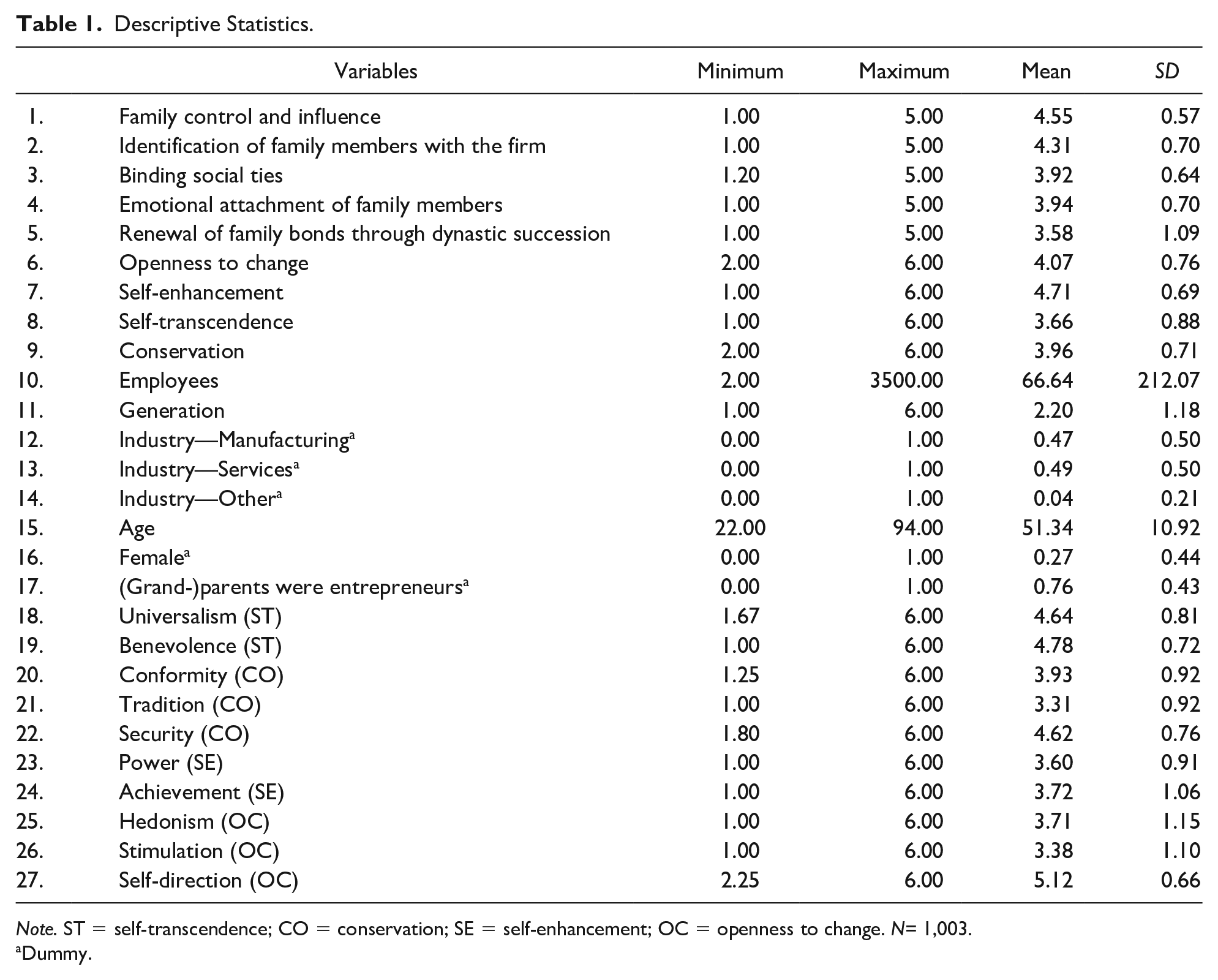
Note. ST = self-transcendence; CO = conservation; SE = self-enhancement; OC = openness to change. N= 1,003.
Dummy.
Table 2 displays the correlation matrix and shows multiple significant correlations of values and the FIBER dimension. That all FIBER dimension values are intercorrelated to a certain extent has previously been observed (Hauck et al., 2016), therefore, this observation was expected due to the close theoretical connection (Berrone et al., 2012).
Correlation Matrix.
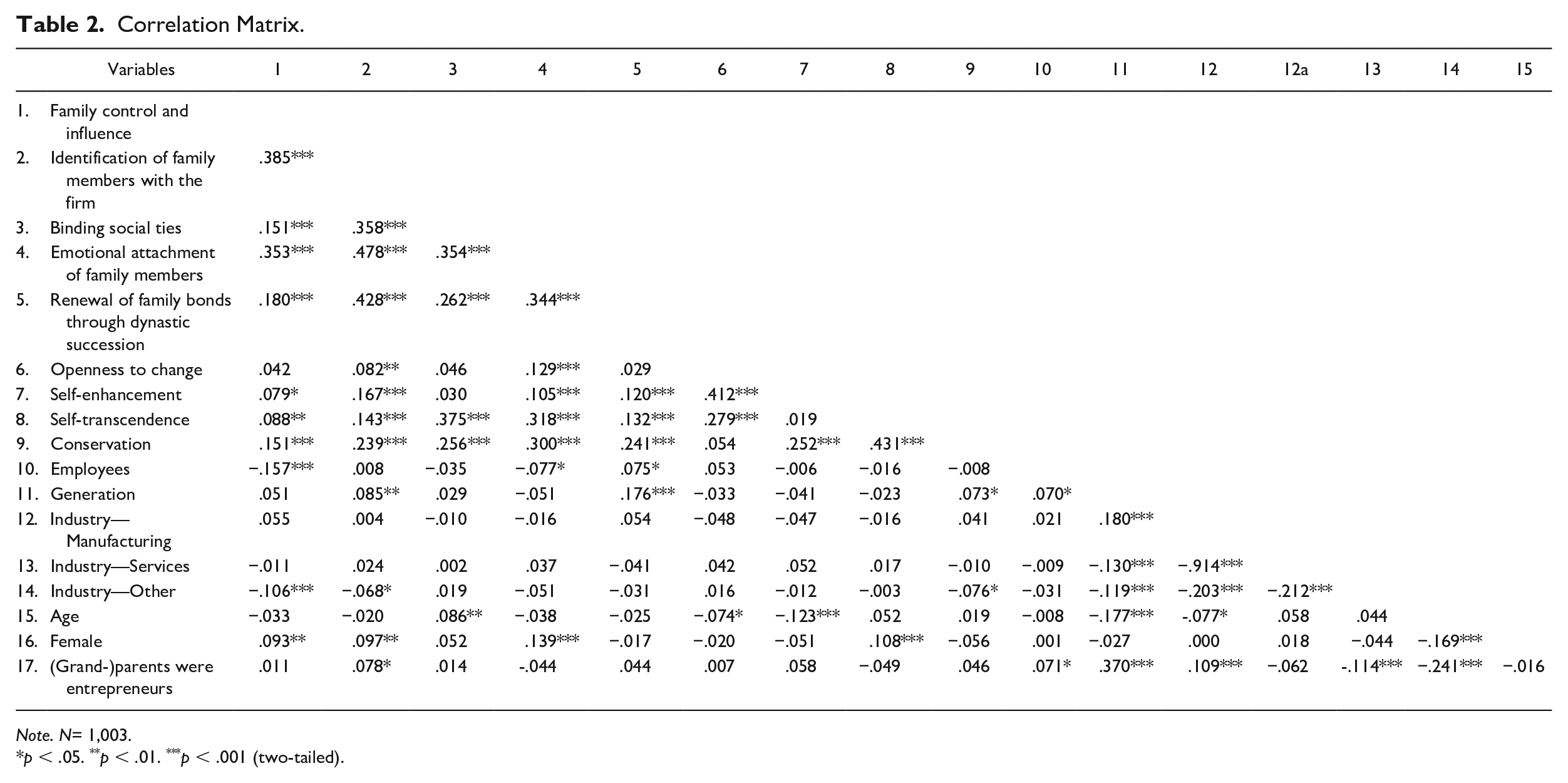
Note. N= 1,003.
p < .05. **p < .01. ***p < .001 (two-tailed).
Our data confirm Schwartz’s (1994) interpretation that the value dimensions are bipolar. Similar value types, such as conservation and self-transcendence (.431), as well as openness to change and self-enhancement (.412), are highly correlated, while self-enhancement and self-transcendence (.019), as well as openness to change and conservation (.054), are not correlated with each other at all.
Table 3 presents the results of the analysis of the reflective measurement constructs in our model. We followed the structured approach proposed by Hair et al. (2019), checking for internal consistency reliability with Cronbach’s alpha, convergent validity with average variances extracted (AVE), and composite reliability and discriminant validity with the heterotrait–monotrait ratio of correlation. Regarding the values dimensions, all the reported measurements were well within the recommended ranges except for the Cronbach’s alpha of the higher order value openness to change (.642). This can be explained by the construct itself, as openness to change consists of three values: self-direction, stimulation, and hedonism. Schwartz (1992) already identified that hedonism is harder to categorize than other values. Theoretically, it could either be included in self-enhancement or openness to change. As mentioned in the factor analysis of the value dimensions, with the assignment to openness to change, we assigned hedonism to the factor with the highest loading and thus followed Schwartz’s (1992, 1994) recommendations for the assignment. However, since there was no improvement in internal consistency reliability by eliminating items with low loadings on the indicator, the literature recommends that the entire construct of indicators be retained (Hair et al., 2017). Furthermore, Hair et al. (2019) argue that for the statistical method, PLS-SEM AVE and composite reliability are more important.
AVE, Composite Reliability, Cronbach’s Alpha: Reflective Measurement Models.
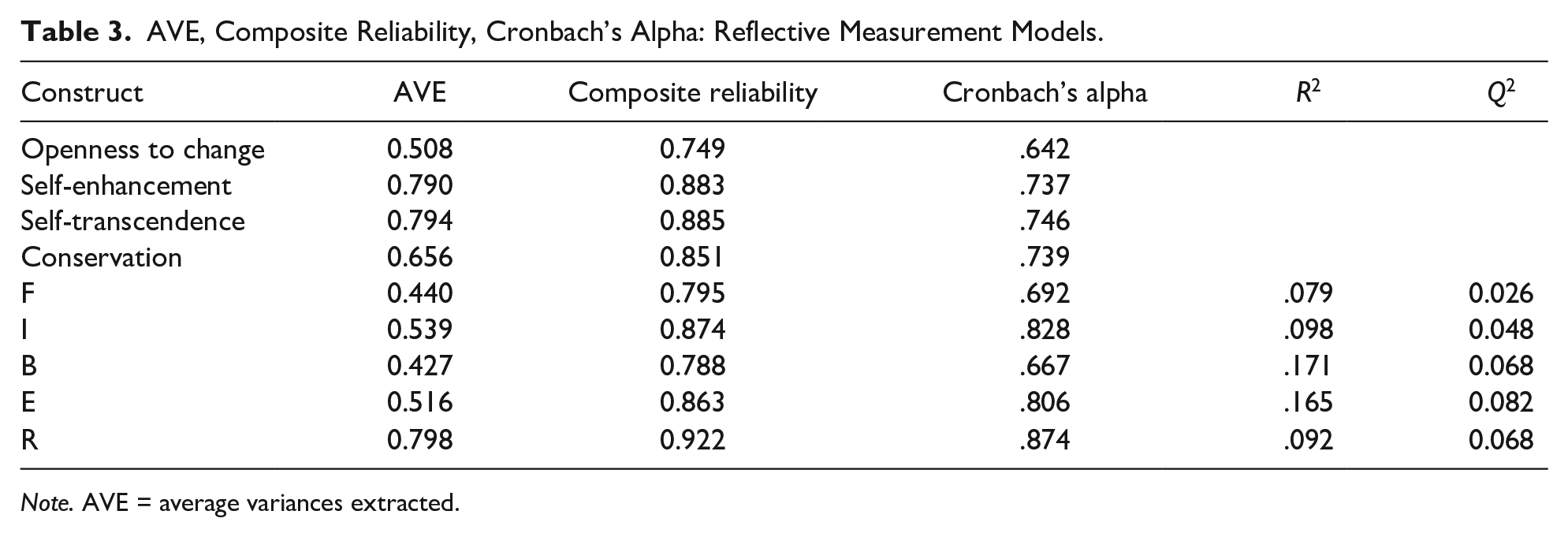
Note. AVE = average variances extracted.
In the case of the FIBER dimensions, some problems arose during the reliability testing. The convergence validity test showed that one indicator had to be excluded from the F subscale and one indicator had to be removed from the R subscale, as they both showed a loading below 0.4 on the construct (Bagozzi et al., 1991). Further variables with loadings between 0.4 and 0.7 were excluded for testing purposes to check whether the internal consistency reliability improved as a result, as recommended by Hair et al. (2017). Since this was not the case, the remaining indicators were retained as in the original construct. This is a known problem of the FIBER scale, which has already been mentioned by Hauck et al. (2016). As in their analysis, the F and B subscales, in particular, showed values that were slightly too low for AVE and Cronbach’s alpha, while the composite reliability and discriminant validity were well within the recommended borders. We decided to keep all subscales of the FIBER scale for the analysis while taking into account the imperfect measurement, especially to be able to present a complete picture of the connection between values and SEW since it appears that a better measurement tool does not yet exist.
To test for discriminant validity, we also used the Fornell-Larcker criterion (Fornell & Larcker, 1981). All cross-loadings were lower than the indicator loadings, which proves the evidence of discriminant validity (Hair et al., 2017). For the structural model, R2 and Q2 were examined and are shown in Table 3. The variance inflation factor ranged from 1.008 to 1.285; thus, multicollinearity was not a problem in our model (Hair et al., 2019). Figure 2 shows the path coefficients and p values of our PLS-SEM model.
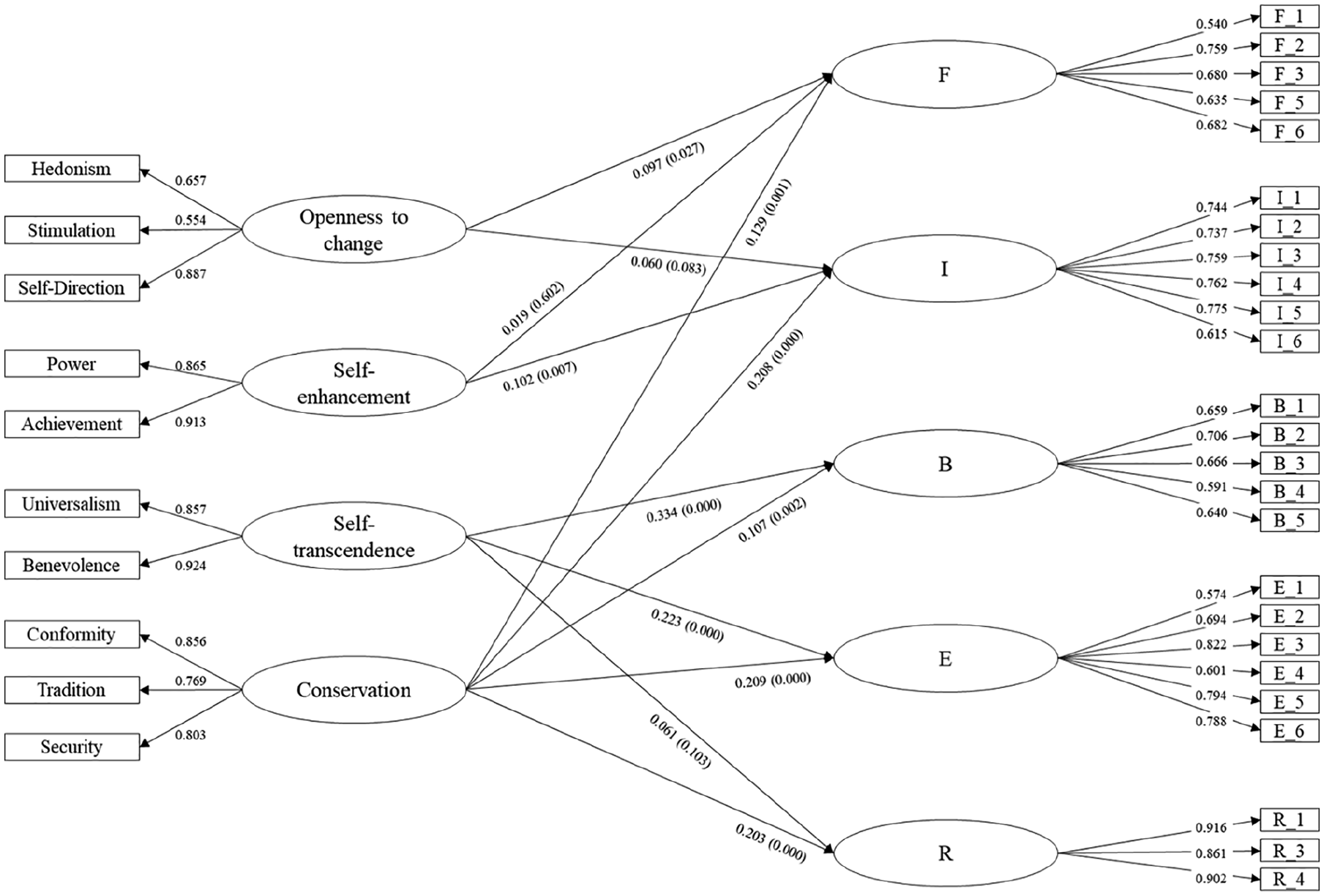
PLS-SEM model M1.
For all FIBER dimensions, a predictive influence of the two higher order value dimensions was found. This supports our initial concept that values are antecedents of SEW behavior. First, we observed that openness to change of family firm owner-managers shows a significant positive effect on the SEW dimension of family control and influence (.097, p < .05) and, at a lower significance level, an effect on identification of family members with the firm (.060, p < .10). Thus, our assumed connection between the higher order values openness to change, family control and influence, and identification of family members with the firm is supported and Hypothesis 1 is accepted.
Second, we observed that conservation of family firm owner-managers has significant positive effects on all SEW dimensions, with family control and influence (.129, p < .01), identification of family members with the firm (.208, p < .001), binding social ties (.107, p < .01), emotional attachment of family members (.209, p < .001), and renewal of family bonds (.203, p < .001). Thus, we conclude that Hypothesis 2 is accepted.
Third, we observed that self-transcendence of family firm owner-managers has significant positive effects on the SEW dimensions binding social ties (.334, p < .001) and emotional attachment of family members (.223, p < .001), while there was no significant effect on renewal of family bonds. Thus, Hypothesis 3 is partially supported.
Fourth, we observed that self-enhancement of family firm owner-managers has a significant positive effect on the SEW dimensions identification of family members with the firm (.102, p < .01), while there was no significant effect on family control and influence. Thus, Hypothesis 4 is also partially supported.
Concerning the control variables, we observed a positive effect of the number of employees on identification, binding social ties, and emotional attachment of family members. We further found that family control and influence and emotional attachment of family members decrease with the generation, while renewal of family bonds increases. Furthermore, we found it noteworthy that a significant positive effect on renewal of family bonds was observed only with regard to manufacturing industries, and the type of industry otherwise had no further effect in our model. In addition, we noted a weak negative effect on family control and influence, which increased with the age of the family firm owner-manager. Moreover, a positive effect on binding social ties was observed if the owners of the family businesses were female. Last, we did not find any effect of childhood experiences observed when the own (grand-)parents were entrepreneurs in our model.
Discussion
Theoretical Implications
The central goal of this study was to investigate how individual values of owner-managers are connected to the concept of SEW and thus influence the behavior of family firms. Therefore, a PLS-SEM model with our final sample of 1,003 family firms (Chua et al., 1999) was performed. To implement our study, we used the FIBER dimensions proposed by Berrone et al. (2012) as dependent variables and the higher order values proposed by Schwartz (1992) as independent variables. Our model shows a significant positive relationship between several higher order values and the FIBER dimensions, thus strongly supporting the oft-mentioned connection between values and SEW (e.g., Berrone et al., 2012; Fletcher et al., 2012; Gómez-Mejía et al., 2007; Marques et al., 2014). Furthermore, we used an established value construct to test which values are predominant among owner-managers of family firms. By investigating the 10 distinctive values proposed by Schwartz (1992), we observed that self-direction, benevolence, universalism, and security are the highest rated values, while tradition, stimulation, and power represent the lowest-rated values. This surprised us as the literature shows that family businesses place a strong emphasis on tradition (Tagiuri & Davis, 1992), keeping the heritage alive, and building a family legacy (Micelotta & Raynard, 2011; Mitchell et al., 2011; Zellweger, Kellermanns, Eddleston, et al., 2012). The limited relevance of power values can also be seen as unexpected, as the need to stay in charge of the business may be the most important decision factor for family businesses mentioned so far (Berrone et al., 2012; Gómez-Mejía et al., 2007). This is particularly noticeable in the FIBER dimension F, which is rated the highest. Looking at the bipolar value dimensions, we note a strong focus on person-oriented values, which are significantly higher-rated in comparison to the social-oriented values.
We observed that the person-oriented values self-enhancements and openness to change (Rudnev et al., 2018) solely affect the F and I dimensions. As hypothesized, both person-oriented values show a significant connection to the FIBER dimension I, even though the connection of openness to change is only significant at a 10% level. Surprisingly, no clear connection between self-enhancement and F could be observed. Based on our theoretical argumentation, the need to stay in charge instilled through values such as power, achievement, and authority should be clearly reflected in the FIBER dimension F. After all, family firms often suffer from paternalistic and authoritarian governance structures (Dyer, 1988). The fact that no connection could be established implies that the need to maintain control over the family firm, represented by F, does not stem from the personal need of an owner-manager to exert power, authority, or display his personal success. This, however, can be seen explicitly in accordance with literature about stewardship theory in family firms, which is oftentimes used to explain behavioral aspects of family firms (Davis et al., 2010), as it “explains situations which the leadership within organizations serves the organizational good and its mission rather than pursuing self-serving, opportunistic ends” (Davis et al., 2010, p. 1093). The clear connection between the value dimension openness to change and F implies rather, that control over the firm is maintained to stay independent in their behavior and to subsequently make their own decisions. This was also stated in the early stages of SEW research (Gómez-Mejía et al., 2007) as one of the main noneconomic goals. Taking a closer look at the social-oriented values conservation and self-transcendence (Rudnev et al., 2018), we can confirm our theoretical derivation that conservation, consisting of the three distinctive values—security, conformity, and tradition (Schwartz, 1992)—is reflected in all FIBER dimensions. The value self-transcendence has a clear connection to the FIBER dimensions B and E but shows no significant connection to dimension R, even though our theoretical derivation indicated a strong relationship. As self-transcendence focuses on the welfare of others, especially the family (Schwartz, 2012), we assumed that handing over the business and, as such, securing employment for one’s own children and the workforce indicates a clear connection between self-transcendence and R. Strikingly, this would imply that only conservation values influence dimension R and therefore the intention to hand over the family firm to the next generation.
The missing connection between self-enhancement and F as well as the missing link between self-transcendence and R was surprising for us, as our review of the theory substantially indicates a strong relationship between these values and the respective FIBER dimensions. We therefore decided to take one step back and reevaluate the existing literature to find possible further explanations for how owner-manager could satisfy their need to express authority, display their success, and exert power, represented by a strong emphasis on self-enhancement values. Similarly, we wondered how only one higher order value influences one of the most important FIBER dimensions—namely, renewal of family bonds through dynastic succession. We found a possible explanation in the pyramid of ownership motivation by Ward (1997). Accordingly, some of the most critical factors, which help sustain long-term family ownership, are connected to actualization and realization expressed by responsible collective stewardship. Owners might believe that they have a personal responsibility to pass on the business to the next generation and feel pride (Kets de Vries, 1993) in doing so. Therefore, one could argue that the feeling of personal success from handing over the family firm successfully is stronger than the loss of authority that comes with it. This would imply a connection between self-enhancement values and the FIBER dimension R. Based on these additional hypothesized connections and in accordance with Hollenbeck and Wright (2017), we decided to include a post hoc analysis section after the discussion section.
In addition to our main findings, we observed some mentionable secondary findings. In our data set, we observed a strong negative effect of generation on F and E, which leads to the conclusion that F as well as E decreases with future generations in charge. However, respondents from family firms in higher generations showed a significant positive relationship with dimension R, thus emphasizing the continuity of the business while simultaneously losing direct control. The positive effect of employees on I, B, and E is also noteworthy as we somehow expected the opposite. Finally, we found that our female variable showed a significant positive relationship with B, indicating that women emphasize this dimension more strongly than their male counterparts.
Post Hoc Analysis
Based on the discussion in our Theoretical Implications section, we post hoc hypothesized a connection between the value self-enhancement and the FIBER dimension R. To test this theoretical derivation, we included the mentioned connection in a post hoc PLS-SEM model (Table 4). Please note that all tests concerning the reflective measurement constructs, internal consistency reliability, convergent validity, AVE, and composite and discriminant validity were performed accordingly and showed no significant differences to our previous model.
Results of Hypotheses Tests Postmodel.
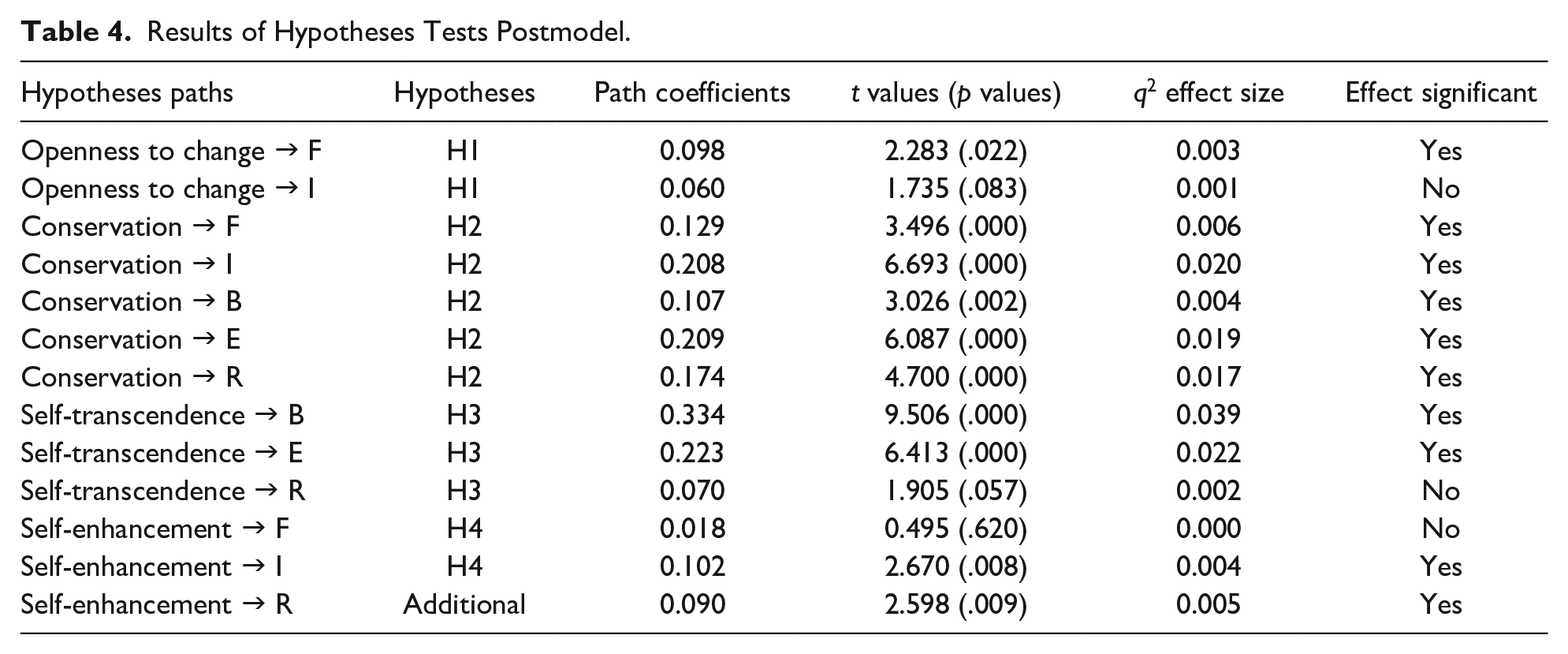
Our post hoc analysis confirms that self-enhancement has a positive and highly significant (.070, p < .01) relationship with the FIBER dimension R. Furthermore, we observed that the previously assumed relationship between self-transcendence and R becomes significant at a 10% level (.090, p < .10) with the inclusion of self-enhancement. Next to that, we noticed a slight model fit improvement indicated by increased values for R2 (.099) and Q2 (.073). The main implication of this post hoc analysis is that self-enhancement indeed influences dimension R and establishes a connection between self-transcendence and R at a 10% level. Therefore, we indicate that handing over the family firm to the next generation by the owner-manager is not primarily driven by social motivation and the need to do something “good” for one’s family or employees but rather by the need to satisfy one’s own person-oriented value construct. Handing over the business and creating a legacy would therefore be a representation of the owner-manager’s requisite to express his need to display personal success, prestige, and influence. This also finds support in theory, as prior research highlights that predecessors often lack the willingness to hand over the business (Handler & Kram, 1988), as it is directly connected with a loss of authority and, often in his or her eyes, with a loss of status within the family itself (Lansberg, 1988; Zellweger & Astrachan, 2008).
Conclusion
In conclusion, we note an observed distinction within the higher order values and their impact on the FIBER dimensions. As displayed in Figure 3, we saw a stronger focus of person-focused values on dimensions F and I, while the general influence of social focused values was stronger on the dimensions B, E, and R.
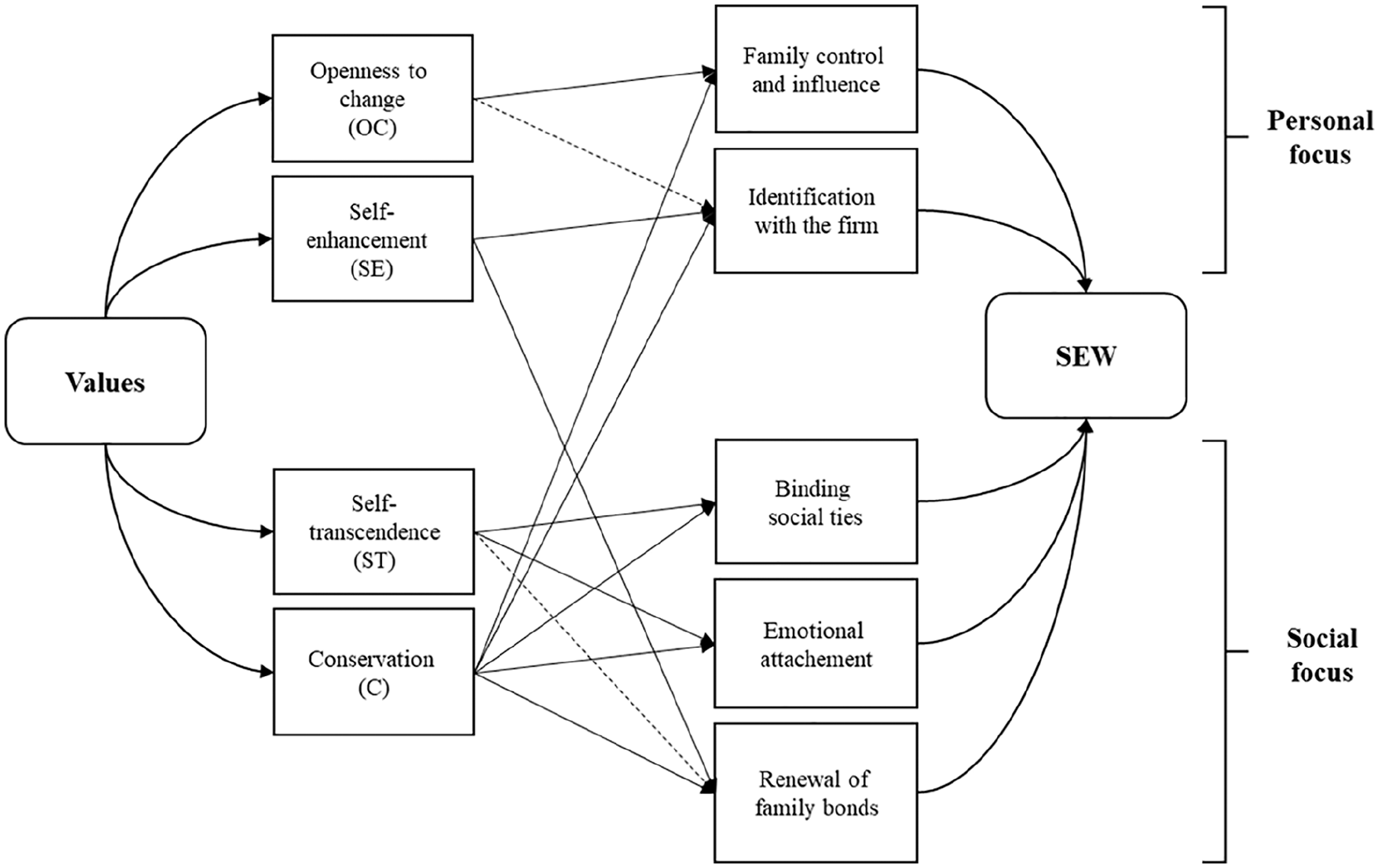
Relations among values and socioemotional wealth (SEW) dimensions.
Our findings also indicate that, depending on the situation, different value constructs of the owner-manager are used to justify their behavior. Actions and behavior in family firms, which are connected to family control and influence and identification with the firm, are subconsciously driven by personally oriented values and, as such, benefit the own need of owner-managers. The behavior, which is connected to emotional attachment and binding social ties is strongly driven by social focused values and the need of the owner-manager to do something good for society. Renewal of family bonds shows a somewhat ambiguous behavior and is influenced by personal as well as socially oriented values. Our study proves that the assumed connection between values and SEW exists and indeed influences behavior in different ways. Therefore, we suggest that values are antecedents of SEW behavior. In our sample of 1,003 German family firms, we found support for this assumption, since higher order values were thoroughly connected to every FIBER dimension.
Research Limitations and Directions for Future Research
Due to the somewhat exploratory nature of this study, our contribution faces some limitations that must be considered when interpreting the results and applying them to a wider context. First, only a single representative per family firm was contacted by our survey. We only focused on the values of the individual owner-manager of the family firm. Obviously, as SEW is a family-related construct, other family members might also influence SEW and should be considered. We therefore recommend that future studies attempt to validate the value assessment by questioning several individuals of the family. Second, as our sample was limited to German companies only, the results may not necessarily be transferable to other countries and cultures. Nevertheless, due to the cultural proximity and already proven similarities of the value constructs in Western countries (Schwartz, 1994), there is sufficient evidence for the transferability of the results. Future research, however, could attempt to validate our results and apply them in other countries and cultures to see if and how the cultural context influences values and decision making in family firms. Third, it was not possible to capture all the conditions that might have an impact on SEW. Thus, the situation of the company, life cycle stage, succession, and external management could be included in future research projects.
Finally, other directions originating from our findings could emphasize the differentiation of family firms according to the mentioned split of values. Possible questions that have only been partly addressed in other studies could be “Can family firms be divided into different groups displaying different predominant values?” “How does the ownership structure influence the values of a family firm?” “Do certain values influence the performance of the family firm more strongly than others?”
Practical Implications
If family firms have a clear understanding of the values they actively pursue, and these values are exemplified by the owners or the owning family, employees’ values can be better aligned with the firm’s values. By publicly displaying the values that the family business lives by to stakeholders and shareholders affords them a better understanding of the firm and, thus, this may be beneficial for creating stronger bonds and building trust. By being aware of the intercorrelation of values and family firm behavior, owners and the steering family members in the firm can actively counteract their behavior and thus make more objectively driven decisions.
Research Questions
What are the predominant basic human values of owner-managers in family firms?
How do the basic human values of owner-managers influence socioemotional wealth in family firms?
Implications for Practice
Publicly demonstrating the values that the family business lives by to stakeholders and shareholders may be beneficial in gaining a better understanding of the company, which can have a positive impact on creating stronger bonds and building trust.
Knowledge of the interrelation between values and the behavior of family businesses enables the owners and managing family members in the company to actively counteract their behavior and thus make more objective decisions.
If family businesses have a clear understanding of the values they actively pursue, and if these values are exemplified by the owners or the owner family, the values of their employees can be better aligned with the values of the company.
Footnotes
Declaration of Conflicting Interests
The author(s) declared no potential conflicts of interest with respect to the research, authorship, and/or publication of this article.
Funding
The author(s) received no financial support for the research, authorship, and/or publication of this article.
