



Abstract
The news media are a primary but limited source of political information for voters. This article examines how the media coverage of members of parliament (MPs) prompts people to seek more information about MPs—an important element of voters’ political knowledge and democratic accountability. I use all available online content from four major Estonian newspapers during 2015–2023 (
Introduction
Citizens’ knowledge of politics is commonly assumed to be essential for representative democracy, and the news media serves as a primary channel for political information. Past works have illustrated the political consequences of the media coverage of politics, including the role of the media in shaping party (Dewenter et al., 2019; Hopmann et al., 2010) and coalition preferences (Eberl & Plescia, 2018), perceptions of issue ownership (Tresch & Feddersen, 2019), successes of far-right parties (Walgrave & De Swert, 2004), and right-wing populists (Murphy & Devine, 2020), as well as anti-immigrant (Boomgaarden & Vliegenthart, 2009) and Eurosceptic (Foos & Bischof, 2022; Van Spanje & De Vreese, 2014) attitudes. While most of this scholarship has focused on parties, leaders, and issue framing, we know less about the consequences of individual legislators’ appearances in the news, particularly outside high-profile roles or campaign periods (e.g., Druckman & Parkin, 2005). Yet, as elected representatives whose work is often less visible to the public, MPs’ appearances in the news may serve as cues for citizens to learn about them. Because news functions as a gateway to political knowledge, MPs’ appearances in the news can prompt citizens to actively seek out additional details about MPs, potentially deepening knowledge about these representatives. Uncovering whether and what type of politicians’ media visibility translates into voters’ further attention to them represents an important step toward understanding the mechanisms through which media coverage shapes democratic representation.
Digital traces of political information-seeking are a relatively new yet fruitful source of data for examining political behavior and public opinion. Wikipedia is an example of that: as a popular, easily accessible, and detailed source of information about parties, politicians’ careers and biographies (Brown, 2011), its viewership statistics allow researchers to measure public attention to specific topics and issues with high temporal granularity. User-generated data on information seeking patterns has previously been used by researchers for a variety of prediction purposes, such as forecasting the outbreak of influenza (Hickmann et al., 2015) or movie box office (Mestyán et al., 2013). In a political context, the intensity of people searching about parties and politicians on the internet has been shown to reflect turnout (Yasseri & Bright, 2016), electoral performance (Smith & Gustafson, 2017; Yasseri & Bright, 2016), interest in election debates (Trevisan et al., 2018), and candidate name recognition (Haman et al., 2024). We know less about the role media content plays in triggering additional searches for information. In a study of Western democracies, Yildirim and Thesen (2024) show that the number of media articles MPs appear in on a monthly basis is positively correlated with Google search queries about them. From communication and psychology research, we also know that the way information is presented has consequences for people’s engagement with it.
Theoretically, I extend the scholarship on the consequences of media coverage of politics by considering how media visibility of members of parliament affects voters’ interest in them as detected through digital traces of information seeking using data from Estonia. Estonia is a suitable case for tackling the question as its open-list electoral system provides incentives for candidates to stand out among co-partisan, making candidate recognition and image among voters an important element in electoral success. Empirically, I use all online content from the four largest Estonian newspapers over two parliamentary terms (2015–2023), resulting in more than 140,000 news articles mentioning MPs. I consider the context of media appearances by applying pre-trained transformer models to classify the sentiment and policy issues of news articles mentioning MPs. By matching data on MPs’ daily media appearances with MPs’ Wikipedia views statistics, the analyses suggest that, first, greater media visibility of MPs is associated with an increase in daily Wikipedia page views. Moreover, negatively toned news articles prompt more information-seeking. Finally, the effect of MPs’ media appearances on voters’ information-seeking depends on the policy domain: party cues interact with economic and socio-cultural contexts to shape the relevance and uncertainty that drive information-seeking.
Background: Political Knowledge and Information-Seeking
Citizens’ political knowledge is commonly assumed to be a necessary characteristic of a functioning representative democracy. For representation to work, citizens are expected to be familiar with events, policies, and politicians to choose among alternatives and hold their representatives accountable. Political knowledge is not just a normative ideal but also correlates empirically with various indicators of political behavior. For example, experimental evidence shows that exposure to objective political information can change party preferences (Fowler & Margolis, 2014). Citizens with greater political knowledge are more likely to search for politically relevant and specific information about candidates (Bernhard & Freeder, 2020). Outside of advanced democracies, studies of low-income countries reviewed by Pande (2011) show that information campaigns increase turnout and reduce electoral malpractice.
Yet, expectations of civic and political literacy are demanding, and in fact, numerous studies conclude that the average voter is not sufficiently skilled in political literacy nor very interested in politics overall (Lupia, 2016). In addition to traditional media outlets that have long been considered a primary if not sole communication channel between politicians and voters, various online options are now available for people to learn about politics. Considering the digital advances in communication, earlier literature has placed hope on “the civic potential of the Internet” (Delli Carpini et al., 2002, p. 129), attributing to it broader opportunities to acquire political knowledge. Indeed, the spread of the Internet and digital technologies has reduced the costs of acquiring political information and transformed how people engage with politics, allowing for more personalized and immediate content (Prior, 2007). In this light, a growing body of literature examines online search and its implications for political attitudes and behavior. As an intentional and goal-oriented activity (Salem & Stephany, 2023), online information-seeking is an important aspect of political knowledge.
Existing works have looked more at the election-related patterns and consequences rather than causes of information-seeking behavior, primarily exploring the appropriateness of such data for electoral forecasting. A survey of Czech voters revealed that legislators’ name recognition strongly correlates with their page viewership statistics on Wikipedia (Haman et al., 2024). As name recognition is essential in electoral systems with the personal vote (Kam & Zechmeister, 2013), such as the Czech one, this finding highlights the potential of using Wikipedia data for election prediction purposes. In European Parliament elections, changes in Wikipedia page viewership often reflect changes in voter turnout (Yasseri & Bright, 2016). Wikipedia pageviews are significantly associated with vote shares in the US Senate elections, and, when included in prediction regression models, decrease the variance left unexplained by public opinion polling and can thus help reduce poll-related errors and bias (Smith & Gustafson, 2017). In addition to the voters’ side, Göbel and Munzert (2018) suggest that politicians also strategically approach the information provided on their Wikipedia pages: not only does parliamentary staff contribute to adding and altering information provided on German legislators’ pages but also the intensity of edits reflects personal vote-seeking incentives as well as the electorate’s and MPs’ characteristics. Beyond its conceptual relevance, the digital footprints of political information seeking offer researchers high temporal granularity, broad coverage of political topics and actors, and global availability and comparability, making them a valuable source for studying political behavior and public opinion (Olshannikova et al., 2017).
Expectations: The Role of Media Coverage
Political information seeking is generally considered a confirmatory rather than exploratory activity (Lau & Redlawsk, 2006), which implies that some events and factors trigger the search. The mass media is one of the key sources of political information for voters, and in light of that, this article focuses on the effect of media coverage of politicians on further information searches about them. At the outset, when MPs are featured in the media through interviews, news reports, or public statements, their visibility among the public increases. Further, public attention to MPs generated by media coverage can lead individuals to seek additional information to reinforce existing attitudes, familiarize themselves with new perspectives, and satisfy curiosity about their background, such as career trajectories and personal life. Previous research has shown that information seeking via Google spikes following candidates’ televised election debates, especially for previously unknown candidates who perform well (Trevisan et al., 2018). Similarly, more political advertisements have been shown to increase online information seeking on the same day (Housholder et al., 2018). Weeks & Southwell (2010) documented that news reports on the rumor that Obama was Muslim during his first presidential campaign led to a significant increase in Google searches about him. As a related mechanism, media coverage of politics can be expected to trigger or intensify further information-seeking behavior.
Using monthly data from five Western European democracies, Yildirim and Thesen (2024) show that MPs’ media visibility is positively associated with Google search volume for those MPs. Cross-national differences in the strength of this association can be interpreted as aligning with electoral context incentives for voters to seek more information about MPs. It is weakest in Belgium, a comparatively party-centered system that offers MPs fewer rewards for cultivating personal recognition, and strongest in the Netherlands, which elects its MPs in a single nationwide district with open-list PR, without clear MP–constituency linkage (Louwerse & Otjes, 2016) and a large share of undecided voters (e.g., Kroet, 2017).
Altogether, I start with a base expectation that media appearances by MPs prompt online information-seeking behavior as voters try to understand the political landscape and the key figures influencing it. In addition, I expect that the effect of media appearances by MPs should be strongest on the same day due to the pace of the online media environment and the ease with which voters can quickly search for information on the internet.
From communication and psychology research, we know that the way information is presented has consequences for perception and engagement. Sentiment and emotionality are among the factors that can influence how a person processes information and the need to look for more details. In communication studies, negativity is commonly viewed as a “news value” because it is used by journalists to gain more attention (Takens et al., 2013), due to its greater impact on shaping public opinion than positive coverage (Soroka & McAdams, 2015). This is linked to the psychological phenomenon known as negativity bias, in which negative information tends to attract more attention and elicit stronger reactions than positive or neutral information, with the underlying mechanisms tracing back to human evolutionary processes (Fridkin & Kenney, 2004). Empirical work in political research, primarily on negative campaigning, has examined how negativity in political communication impacts voters’ political interest and participation. Relevant to this study, Brooks and Geer (2007) conclude that the public shows more interest in politics after being exposed to uncivil messages. Likewise, Trussler and Soroka (2014) find that individuals interested in politics have a preference for negative news content. Nai (2013) suggests that negativity in political communication can have both stimulating and demobilizing effects on voting intentions, depending on whether it was expected or not.
The information-seeking strand of scholarship considers anxiety to be one of the key factors driving the search for more information. Based on a social media experiment, Park (2015) showed a connection between users’ exposure to negative news and their information-seeking behavior. Romanova and Hutchens (2024) suggest that anxiety is not simply associated with information-seeking but is further connected to greater internal political efficacy and political participation. When it comes to political information, Valentino et al. (2008) similarly demonstrated that certain emotions expressed in political communications, most particularly, anxiety, increase people’s information-seeking and learning. Building on the negativity bias argument and evidence from prior literature, I thus expect that negative media coverage is more effective in prompting information-seeking behavior compared to other sentiments, which may not evoke as intense a concern and a need for further investigation.
Besides sentiment, I expect that the policy context of MPs’ media appearances shapes whether citizens seek additional information about them. As Weeks and Southwell (2010) summarize it, individuals’ need for orientation and information search is motivated by two core mechanisms: relevance (how much the discussed topic matters to them) and uncertainty (how much they already know about it). Because news stories typically provide little information about MPs beyond their party affiliation, citizens often rely on party ideological heuristics (Dancey & Sheagley, 2013) to interpret the policy context of an appearance. From a rationalist perspective on voters’ limited resources, such heuristics help them decide whether the topic is worth further attention (Taber & Young, 2013). This tendency is reinforced by motivated reasoning and selective exposure, which predict that individuals are more likely to engage with political information consistent with their pre-existing attitudes (Stroud, 2008; von Sikorski et al., 2020). Empirical work confirms that information-seeking patterns vary systematically with political predispositions (Van Hoof et al., 2024). Together, these insights suggest that party cues should shape how citizens perceive both the relevance and the uncertainty of an MP’s policy position. When the issue context makes the topic personally salient (relevance) but the party cue leaves important details unknown (uncertainty), the combination should be especially likely to prompt further information seeking.
I apply this logic to the economic and socio-cultural dimensions, which are commonly viewed as structuring political competition in European democracies. I expect the relevance and uncertainty logic to work differently for these two domains. Economic issues are typically perceived as more technical and hard (Johnston & Wronski, 2015), and voters therefore rely heavily on party heuristics to form economic stances (Gerber & Huber, 2010). Accordingly, when an MP’s economic stance departs significantly from their party’s typical left–right position, voters should become more uncertain, prompting a stronger motivation to gather information. Although there are concerns about how precisely voters can estimate parties’ economic stances to judge what is congruent and what is not, they are generally able to place parties on a left–right scale and use it as an orienting cue (Jou & Dalton, 2017).
By contrast, socio-cultural issues, such as immigration or minority rights, are closely tied to personality traits (Johnston & Wronski, 2015), contribute to affective polarization (Harteveld, 2021), and can provoke anxiety through emotive framing (Brader et al., 2008). Existing studies from Western European contexts conclude that cultural issues have greater relative weight in assessing parties (Dassonneville et al., 2024; Harteveld, 2021). Because cultural issues are relatively new in the CEE context (Lancaster, 2022), voters need more orientation and information on MPs appearing in cultural news. These features increase both the subjective relevance and the baseline uncertainty surrounding MPs’ stances, making their appearances in cultural news less tied to ideological congruence and prompting information-seeking from both supporters and opponents (e.g., Fernandes & Won, 2023; Selvanathan et al., 2025).
To sum up, I expect that misaligned economic appearances in the media should increase information seeking about the MP, while socio-cultural appearances are likely to prompt information-seeking across party profiles and voters’ stances:
The Estonian Context
Voters’ motivation to seek information about individual MPs should depend on the electoral context, such as whether they vote for a party or candidate(s), the degree of intra-party competition under preferential voting, and the cues provided on the ballot. In Estonia, the 101-member parliament—the Riigikogu—is elected for 4 years through a proportional open-list system in 12 multi-member districts (Riigikogu, 2017). Voters cast a single vote for a candidate on their district’s party list or for an independent. Seats are allocated in three stages. First, candidates who meet the simple quota in their district receive “personal” mandates (about 10–15% of seats in recent elections). Second, “district” mandates are awarded to the candidates with the largest vote totals from parties passing the 5% national threshold, which is the most common route to office, accounting for roughly 65% of seats. Finally, remaining seats are distributed as “compensatory” mandates based on national party vote share, filled according to candidates’ rank on the closed national list (around 20% of seats). From a comparative angle, Estonia’s electoral system was modeled after the neighboring Nordic countries (Lauristin & Hansson, 2019) and closely resembles Finland’s system.
While personal and district mandates depend heavily on individual votes, compensatory mandates hinge entirely on party list position. This creates mixed incentives: candidates benefit from cultivating personal recognition but also from securing favorable placement on party lists. Yet, despite the formal link between candidates and their district, Estonia’s open-list system produces weak MP–constituency ties. MPs’ electoral fortunes rest more on national visibility than on constituency service. Drawing on an older survey, Pettai (2005) concludes that Estonian MPs are more oriented toward national than toward local interests. Tavits (2010) shows that local-level political experience is correlated with more votes and defection from the party line, but birthplace has no effect. Vučićević and Bursać (2025) note that nearly half of Estonian MPs are from the capital, further underscoring the limited scope for constituency-based representation. From a voter’s perspective, this broadens the range of cues beyond local connection, making party affiliation and personal reputation key guides for candidate choice.
Estonian party politics in 2015–2023 can be characterized as going through several shifts and coalition changes in the parliamentary arena. Parliamentary parties ranged ideologically from the Social Democrats, two largest parties—the centrist, catch-all Centre and the liberal Reform, to a center-right Free Party, national conservative Fatherland, and a far-right populist EKRE. EKRE’s entrance into parliament in 2015 and later to the government was a significant shift in the country’s politics, with support for it growing steadily over the examined time frame, reaching second place in the 2023 elections.
Estonia’s media landscape, comprising a mix of public and private outlets, is broadly pluralistic (Lauristin & Hansson, 2019) and consistently scores highly on press freedom indices (Reporters Without Borders, 2022). In comparative perspective, it shares similar patterns of professionalization and market-driven political coverage with Western democracies (Lauristin & Hansson, 2019). When it comes to MPs’ media visibility, journalists pay relatively more attention to party group leaders and committee chairs, as well as rank-and-file MPs who display certain styles of speaking (Lupacheva & Mölder, 2024). Recent evidence shows that more frequent appearances of MPs in national outlets are associated with higher vote shares and better placement on district open lists in subsequent elections, but not with better placement on the closed national list, reflective of the importance of media visibility for candidate-centered electoral gains (Lupacheva, 2025).
In terms of citizens’ internet behavior, Estonia has a highly digitized environment with a wide range of e-services provided to and used by the public. For instance, in 2023, 93.2% of households had an Internet connection at home (Statistics Estonia, 2023), 98% of tax declarations were filed electronically (E-Estonia, 2023), and 51% of votes were cast online in the parliamentary elections (ERR News, 2023). With high internet penetration, an advanced e-governance system, strong press freedom, and the candidate-centered elements of its open-list PR system, Estonia can be considered as a most-likely case for testing whether media coverage drives online information seeking, offering generalizable insights for other digitally advanced, open-list PR democracies.
Data and Methods
Text Analysis of Media Articles
For media data, I rely on a dataset that covers all online news content (approximately 2.5 million articles) from the three largest daily newspapers in Estonia (Postimees, Eesti Päevaleht/Delfi, Õhtuleht) as well as the news website of the public broadcasting company (ERR). I filter the dataset to include only articles mentioning any MPs’ names (N = 142,720). While some of these media outlets also have versions in Russian and English to serve the Russian-speaking population and foreigners, I focus exclusively on the Estonian-language versions. Although the different language outlets may vary in coverage, there is considerable overlap because much of the content is translated from Estonian into Russian or English. Furthermore, although roughly a quarter of the Estonian population speaks Estonian as a second language, Estonian citizenship and voting rights are closely tied to proficiency in Estonian.
To classify the topics of media texts, I use the context version of the manifestoberta—an XLM-RoBERTa-large model fine-tuned on annotated statements from the Manifesto Corpus (Burst et al., 2023). This model provides sentence-level classification according to 56 political topics in the coding scheme. According to the model’s performance report, incorporating surrounding context for each analyzed sentence has been shown to improve classification accuracy. The authors of the model report a classification accuracy of 71.13% (F1 = 0.57) for Estonian party manifestos, which is among the highest scores across the included countries (overall accuracy = 64.23%, F1 = 0.53).
While an overall F1 of around 0.5–0.6 is modest by text-classification standards, it is typical for highly granular schemes such as this 56-category framework. The class imbalance, with some topics appearing frequently and some topics rarely, also tends to lower the overall F1 score. Some topics achieve higher F1 scores (e.g., 0.82 for “Agriculture and farmers: positive”), meaning the model performs better on certain issue areas. Sentence-level classification is also inherently noisy, as short or implicit sentences are harder to label reliably, and potential annotation inconsistencies in the training data further limit accuracy. Taken together, these factors make an F1 in the 0.5–0.6 range unsurprising, even for a state-of-the-art model. Some systematic confusion between related topics may reduce the precision of topic boundaries, but such misclassifications are unlikely to bias relationships in the data. The results can therefore be interpreted as reliable indicators of general patterns of issue emphasis. I also reviewed a subset of the model’s outputs to ensure that the predicted topics were broadly consistent with the underlying text. For future studies, it would be beneficial to manually validate or code parts of the corpus. As in most text-as-data research, there is a trade-off between analytical scope and classification precision. Following sentence-level classification, I calculated the proportion of text belonging to each of the 56 topics, and the most common topic was assigned to each media article. Compared to political texts such as party manifestos or parliamentary speeches, news articles typically focus on a single idea, event, or policy issue, which makes this aggregation approach suitable for classifying media texts. In addition to its usefulness as a predictor variable, aggregating sentence-level classifications at the article level averages out random errors from individual sentence classifications. Figure 1 shows 15 most common topics in the corpus of media texts mentioning MPs. The “political authority” topic, which is described in the coding scheme as references to competence in governance or a strong and stable government, is by far the most common classification category, accounting for approximately 31% of media texts. Bouchaud and Ramaciotti (2025) applied the manifestoberta model to political social media posts from 13 countries and similarly found that political authority constituted the largest share of all topics (26%). To further examine the classification results, I analyzed the most common and distinct words for each classification category based on a smaller, randomly selected version of the media corpus. For example, the topic “101 - Foreign Special Relationships: Positive” includes common words such as Finland, Europe, Latvia, Baltic and distinctive terms such as bilateral, railway. Similarly, for the topic “104 - Military: Positive,” common words include NATO, Russia, Europe, Ukraine, with distinct words such as reassurance and “related to arms control.” Top 15 Policy Issues (Manifesto Coding Scheme) of MPs’ Media Appearances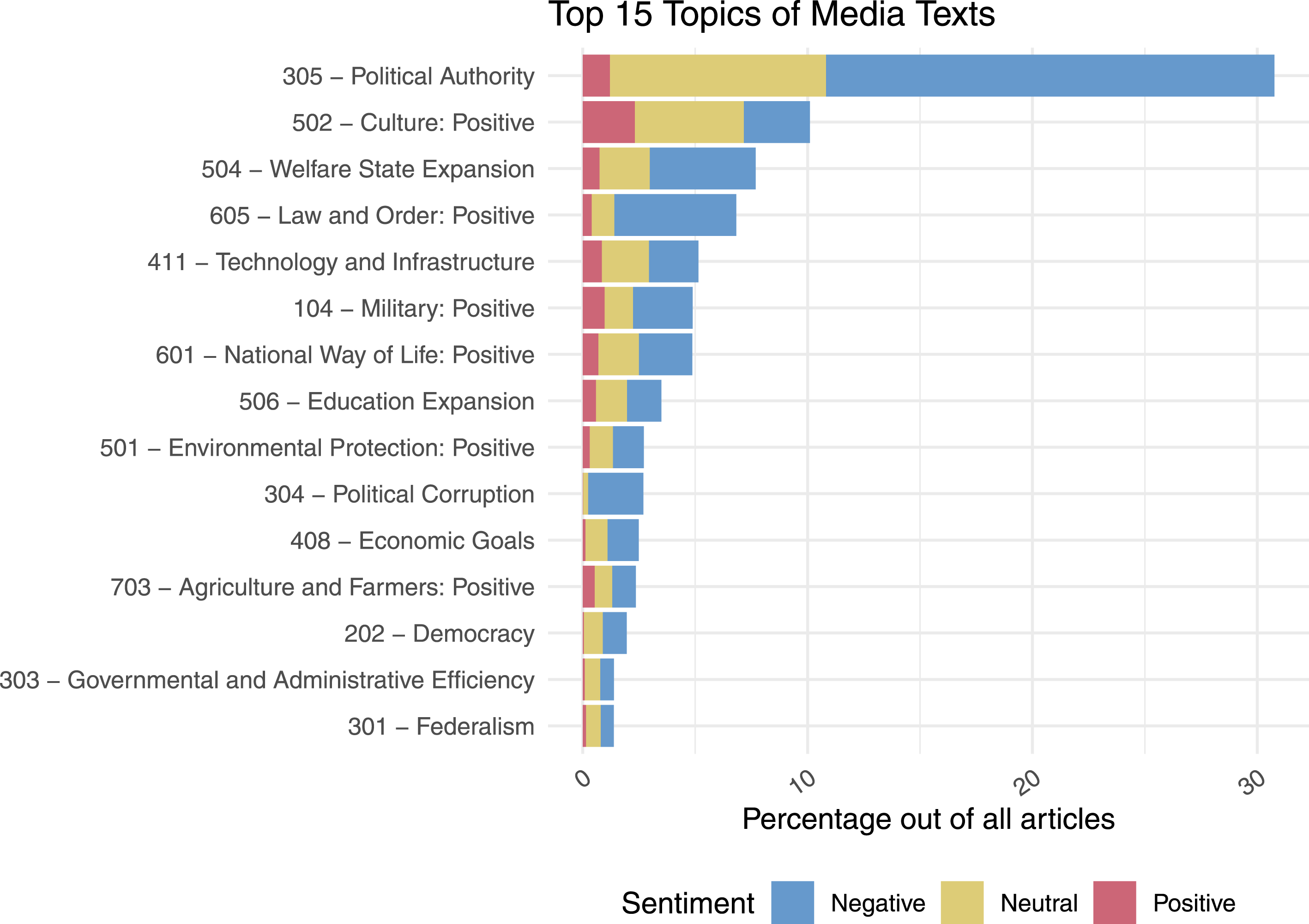
Finally, the topics were aggregated into policy domains and categorized along the economic left-right and socio-cultural progressive-conservative spectrum, following the Manifesto Project classification. Full classification results and descriptive statistics for each policy topic are available in Table 1 in the appendix.
For sentiment analysis, I use a fine-tuned version of the EstBERT model, which is trained to classify texts as negative, positive, or neutral based on Estonian newspaper articles and comments (Tanvir et al., 2021). The authors of the model evaluated the performance of EstBERT against multilingual and other language-specific BERT models. For sentiment classification, EstBERT provides an accuracy score of 74.36%, which is slightly lower than the multilingual XLM-RoBERTa (Tanvir et al., 2020). BERT-based sentiment classification results on media data were compared with the dictionary-based approach (Pajupuu et al., 2016), which confirmed consistent differences in the mean values of negative, positive, and neutral words across the three BERT-based categories of tone. Lüüsi et al. (2024) test how various Estonian-language models, including EstBERT, detect political stances (against, neutral, or supportive) in Estonian news media. The model performs well for detecting negative and neutral tones as a measure of an actual positional stance, but less effectively for positive sentiment. Mets et al. (2024) compare EstBERT with other models (including GPT-3.5, mBERT, and XLM-RoBERTa) for stance classification in immigration-related Estonian news, showing that EstBERT performs well for negative (F1 = 0.69) and neutral (F1 = 0.70) tones, but slightly less than Est-RoBERTa for supportive stances (F1 = 0.53). This implies that the model may be less reliable in detecting substantively positive messages in news coverage. Therefore, it is important to note that, with this approach to detecting sentiment in media texts, negative or positive sentiment does not necessarily equate to direct criticism or approval of the MP in question. As reflected in Figures 1 and 2, the majority of media articles mentioning MPs are classified as negative. Policy Domains by Sentiment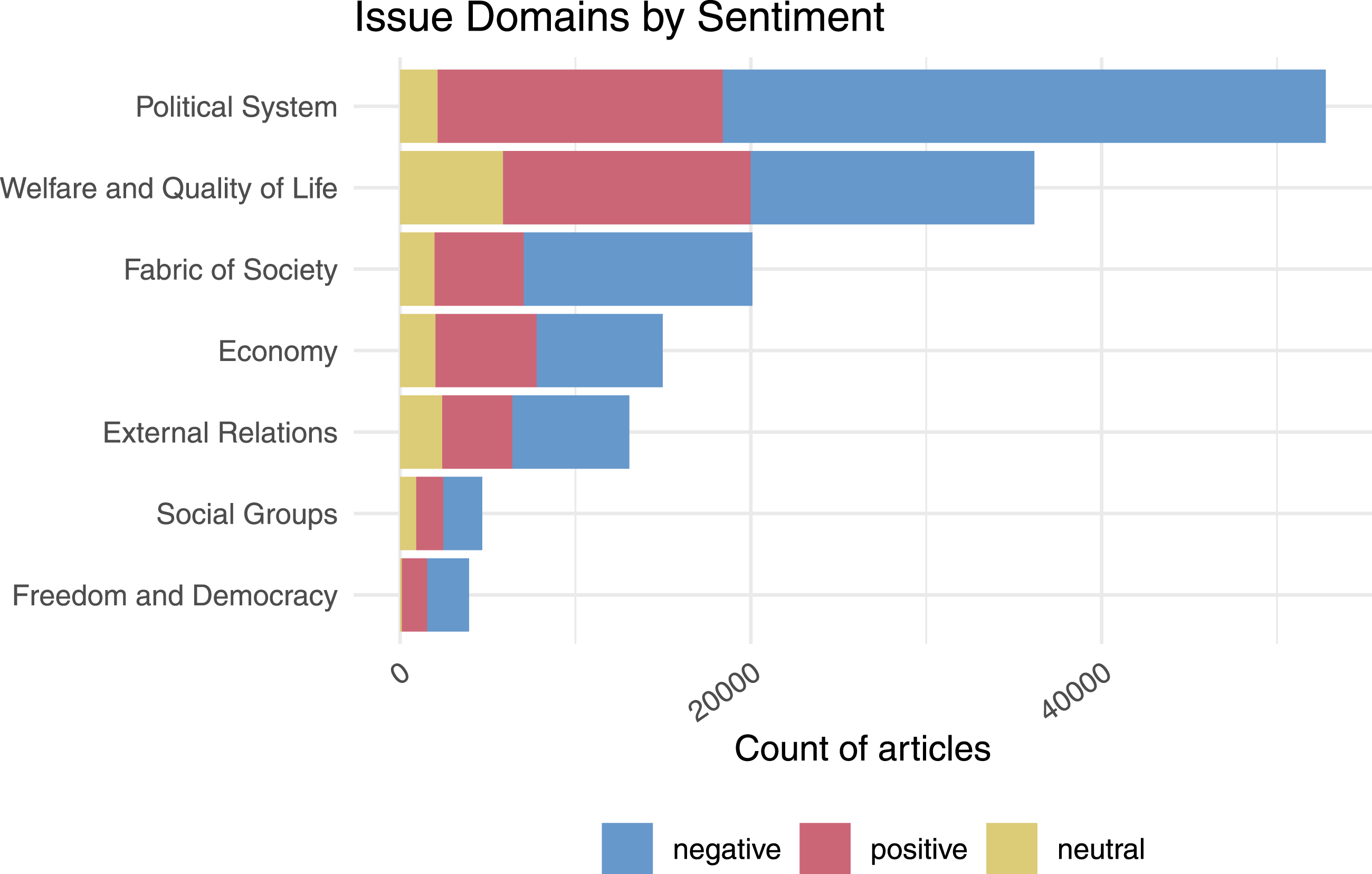
Wikipedia Page Views Data
I use Wikipedia page view statistics as a measure of online information seeking rather than Google Trends data, which is a common alternative proxy (e.g., Yildirim & Thesen, 2024). Wikipedia is a globally popular, easily accessible, and comprehensive source of information on politicians’ careers, stances, and biographies. It is often the first link shown to users if a page on the searched person or topic exists. The decision to avoid using Google Trends statistics is due to several reasons related to the availability and granularity of indicators. Specifically, Google-based indicators return zero if there is insufficient data available, which is common for smaller countries like Estonia, and they vary from 0 to 100, representing relative rather than absolute attention to a search term. Pradel (2021) shows that for German MPs, Google Trends and Wikipedia statistics are highly correlated, supporting the suitability of either measure.
Two implications of using Wikipedia over Google Trends should be discussed. First, a general drawback of using Wikipedia traffic instead of Google Trends is the lack of a method for determining the geographic source of views. This is less of an issue when looking at Estonian-language MPs’ pages: Estonian is spoken primarily within Estonia, and even if views come from abroad, they are likely from Estonian citizens who can vote online and therefore have incentives to remain informed. Second, Wikipedia is likely accessed through a Google search and is arguably among the more neutral and sophisticated sources of information among the other links available in search results. This is particularly relevant given evidence from Puschmann et al. (2025) showing that online searches about female politicians are more likely to focus on their personal lives and physical attributes compared to male politicians. From the voters’ perspective, searching for more specific and politically relevant information about politicians tends to be associated with higher levels of political sophistication (Bernhard & Freeder, 2020). As a result, the impact of media visibility on information seeking might not be uniform across MPs and individuals searching about them. In summary, the current analysis using Wikipedia provides a more conservative test of information-seeking compared to similar studies using Google Trends data.
The pageviews R package (Keyes & Lewis, 2020) was used to collect Wikipedia traffic data, which includes daily statistics on user-generated 1 (not including bot-generated) views of every MP’s page in the Estonian language. It was possible to identify pages for all MPs who served in the legislative office between 2015 and 2023, accounting for name changes for some MPs. Descriptive statistics are available in Appendix 6. While the views are generally modest in number, this is not surprising given the overall small size of the country 2 , and the fact that these are daily data throughout two legislative terms.
An analysis of Wikipedia traffic patterns supports the expectation that political events and media attention prompt online information-seeking. For instance, while Prime Minister Kaja Kallas is likely very well-known among the Estonian public, the viewership of her Estonian-language Wikipedia page still reflects major events. Figure 3 shows the spikes in public attention during the 2023 parliamentary elections and a controversy involving her husband’s involvement in Stark Logistics business, which was widely and critically covered in the media. In comparison, her English-language page traffic records a significant spike in viewership following her party’s confident victory in the parliamentary elections, making headlines in large international media outlets. By contrast, the modest spike in English-language views around the controversy related to her husband’s business reflects the lack of relevance and interest in the topic beyond Estonia and only sparse international coverage of it. An Example of Wikipedia Page Views for Estonian Prime Minister Kaja Kallas in the Estonian and English Languages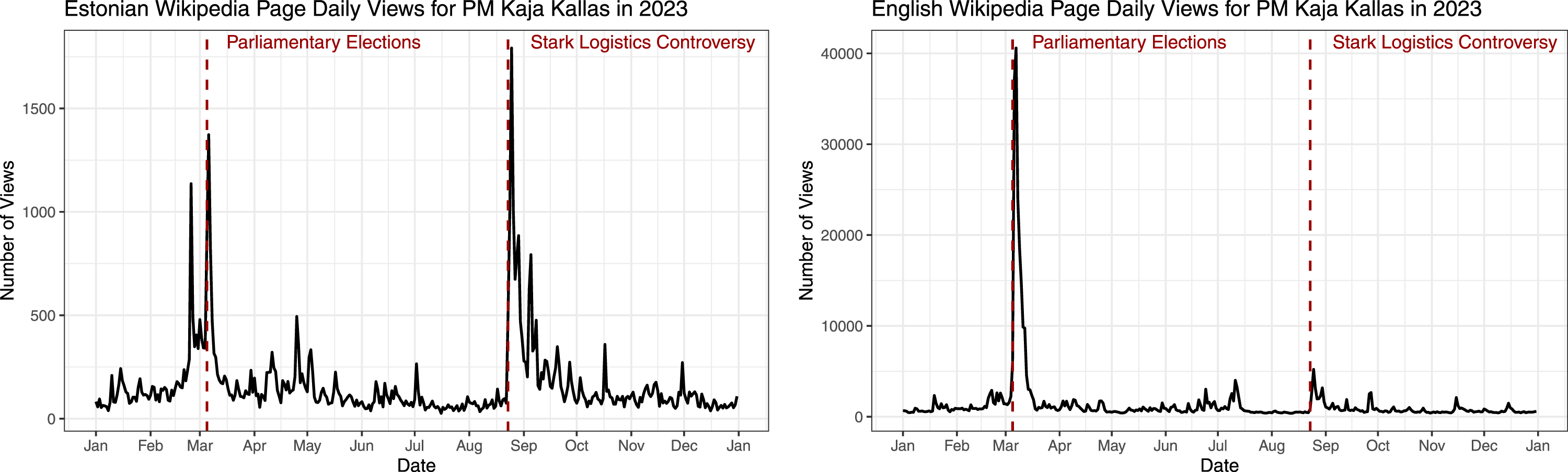
Regression Modeling Approach
The resulting dataset has an MP-day structure, with each row containing information on MPs’ daily Wikipedia views, counts of appearances in media articles, categorized by topic and sentiment. I expect that each additional media appearance yields a smaller increase in expected views as media visibility grows. To address this, all media-related explanatory variables are log-transformed after adding one to account for zero values. I include several control variables related to MP’s party affiliation, roles such as party group leaders and committee chairs, gender, age, and timing in the electoral cycle. In addition, I use MPs’ party affiliation is a proxy for ideological positions, specifically, RILE and progressive-conservative scores from the Manifesto Project (Lehmann et al., 2024) for each party in the elections preceding the parliamentary term. While this is an imperfect measure that simplifies intra-party and temporal dynamics, these are commonly used measures of party policy positions.
As the dependent variable is an over-dispersed count variable, I estimate negative binomial models 3 using the “fixest” R package (Bergé, 2018), which allows for the estimation of fixed-effects models. I use three fixed-effects specifications, each implying different assumptions and interpretations: day FEs (the impact of media appearances on Wiki views across all MPs on a certain day), MP-term FEs (across all days for the same MP in the same legislative term), and party-term FEs (across all days and MPs of the same party in the same term). In negative binomial models, fixed effects help control for unobserved, time-invariant heterogeneity across units by absorbing their constant characteristics, thereby improving causal inference from within-unit variation over time. While the standard fixed-effects specification in negative binomial models relies on distributional assumptions and does not condition out unit effects as cleanly as in Poisson models, it still offers a meaningful way to account for unobserved differences between units and reduce omitted variable bias. The three fixed-effects models differ in the control variables included. Some variables, such as gender, are removed if they are perfectly collinear with the fixed effect (e.g., gender is included in day and party FE models but not in MP FE).
The general regression modeling approach can be summarized as

Results
Temporal Models
I start the analyses by checking the temporal relationship between MPs’ media visibility and their Wikipedia page statistics by creating lags and leads of Wikipedia page views for up to 2 days before and after a media appearance. This allows to check if the association between media visibility and information-seeking is strongest on the same day, as one would expect in a fast-paced online environment. In addition, I look at the lagged effect—whether media visibility today predicts higher views in the following 2 days rather than on the same day—and the lead effect—whether Wikipedia views increase in the days before the media appearance, possibly indicating that journalists are checking on the MP or reflecting a confounding factor. The coefficient of 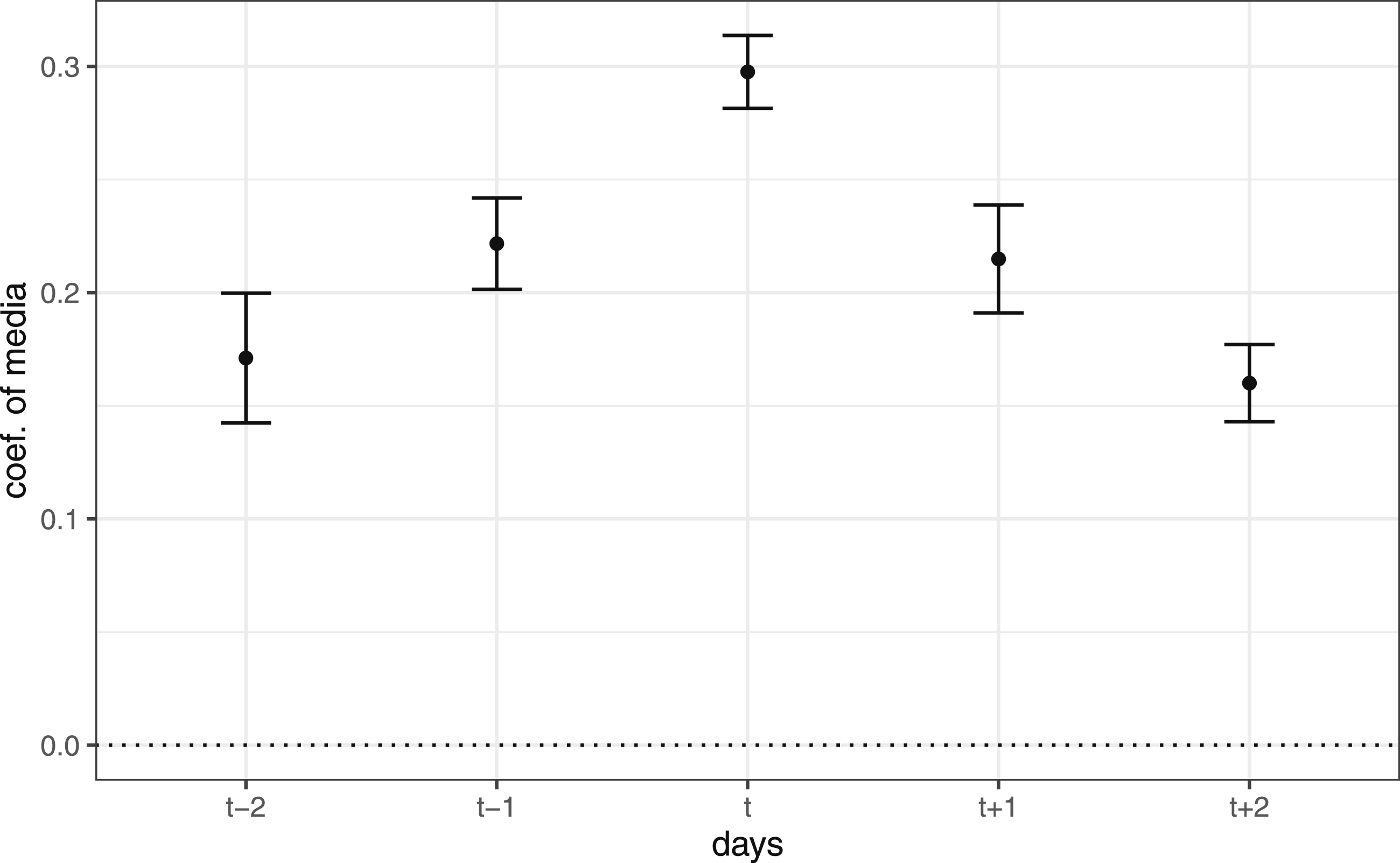
The Impact of Sentiment
Drawing from existing literature that suggests a cognitive bias toward negative information, I hypothesized that media appearances in a negative tone would have a stronger effect on online information-seeking (H2). Figure 5 illustrates the impact of negative, positive, and neutral media appearances (log counts) on MPs’ page views. The results confirm this hypothesis: negative media appearances lead to a significantly larger increase in Wikipedia views compared to positive or neutral media coverage. The effects of sentiment (negative, positive, neutral) remain overall consistent across within-day, within-MP, and within-party variations. While a negative tone does not necessarily mean criticism of the MP in question, the information presented in a negative tone is more likely to engage the reader and prompt further information search.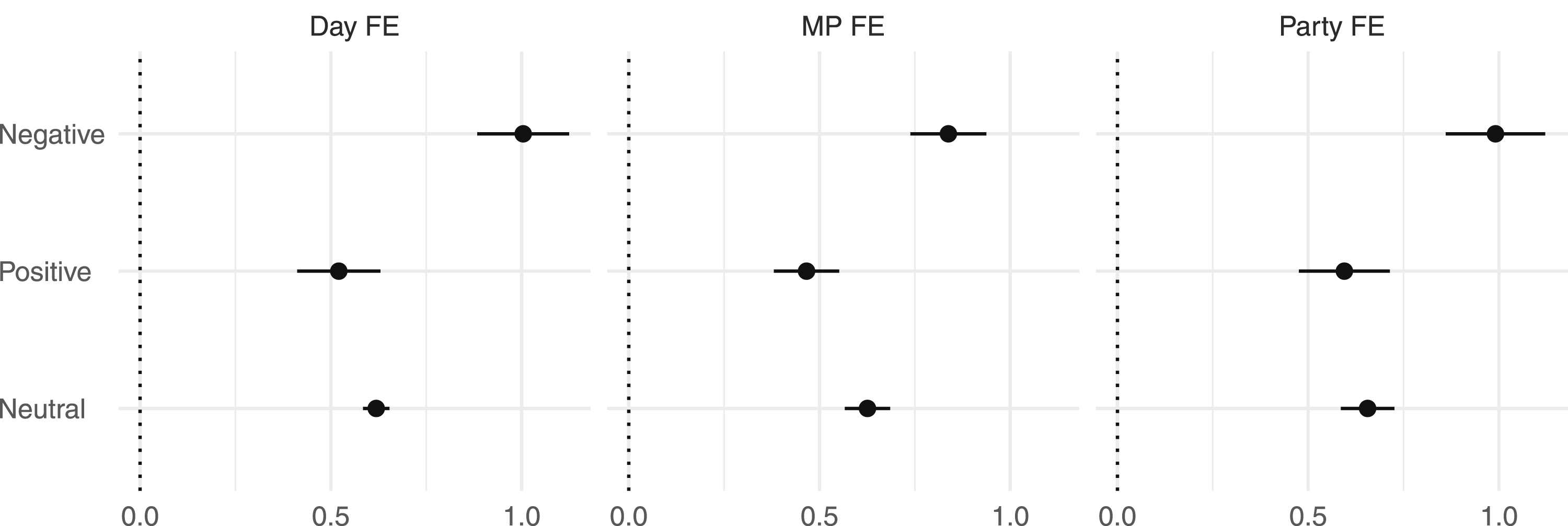
This finding aligns with the notion of “negativity bias” well-documented in political communication research. Negative media content tends to engage readers more, encouraging them to seek additional information. However, this finding contrasts with the null effect of negative sentiment on information-seeking reported in Yildirim and Thesen’s study (2024). Several factors related to case selection and methodological approach may explain this discrepancy. First, Yildirim and Thesen examine the average amount of negativity in media appearances on a monthly basis. In my study, I classify each news article as negative, positive, or neutral and use this categorization as a count variable in the analysis, meaning sentiment is inherently intertwined with media visibility. In addition, their focus on aggregated monthly data as opposed to the daily analysis presented here potentially overlooks the immediate effects of daily media coverage. Thus, this difference speaks to a broader discussion on measuring sentiment analysis in political communication. Second, they focus on older Western European democracies, where populist and far-right movements are more established. By contrast, this study’s Estonian context includes the first parliamentary entry of a far-right populist party. That difference may be relevant for how negativity moderates information-seeking, as the salience of far-right actors can raise perceived political threat and media attention, making negative coverage particularly amplifying.
Figure 6 further explores how the impact of sentiment varies across different policy domains. The domains of external relations and the political system show the most pronounced differences in the effect of negative sentiment compared to positive or neutral sentiment. For topics concerning the political system, negative sentiment appears to reflect conflicts related to party competition, such as the government-opposition divide. The larger impact of negative news may suggest that voters are particularly interested in these conflicts, which could drive further information-seeking as they align with or react to these political divides. In the external relations domain, which includes topics such as military and defense, negative sentiment seems to resonate strongly, likely due to the high relevance of national security issues for Estonians. Given Estonia’s shared border with Russia, its history of Soviet occupation, and rising concerns about regional instability, negativity in this domain may trigger anxiety and fears that prompt voters to seek more information. Interestingly, for topics related to freedom and democracy, positive sentiment has a relatively neutral or slightly negative effect (with significance in the MP fixed-effects model), suggesting that optimistic appeals for democracy and human rights do not generate significant interest in specific MPs. This could be because such issues are less contentious or emotive for voters, and appeals for democracy may not be framed in a way that directly connects with voters’ immediate concerns about specific MPs.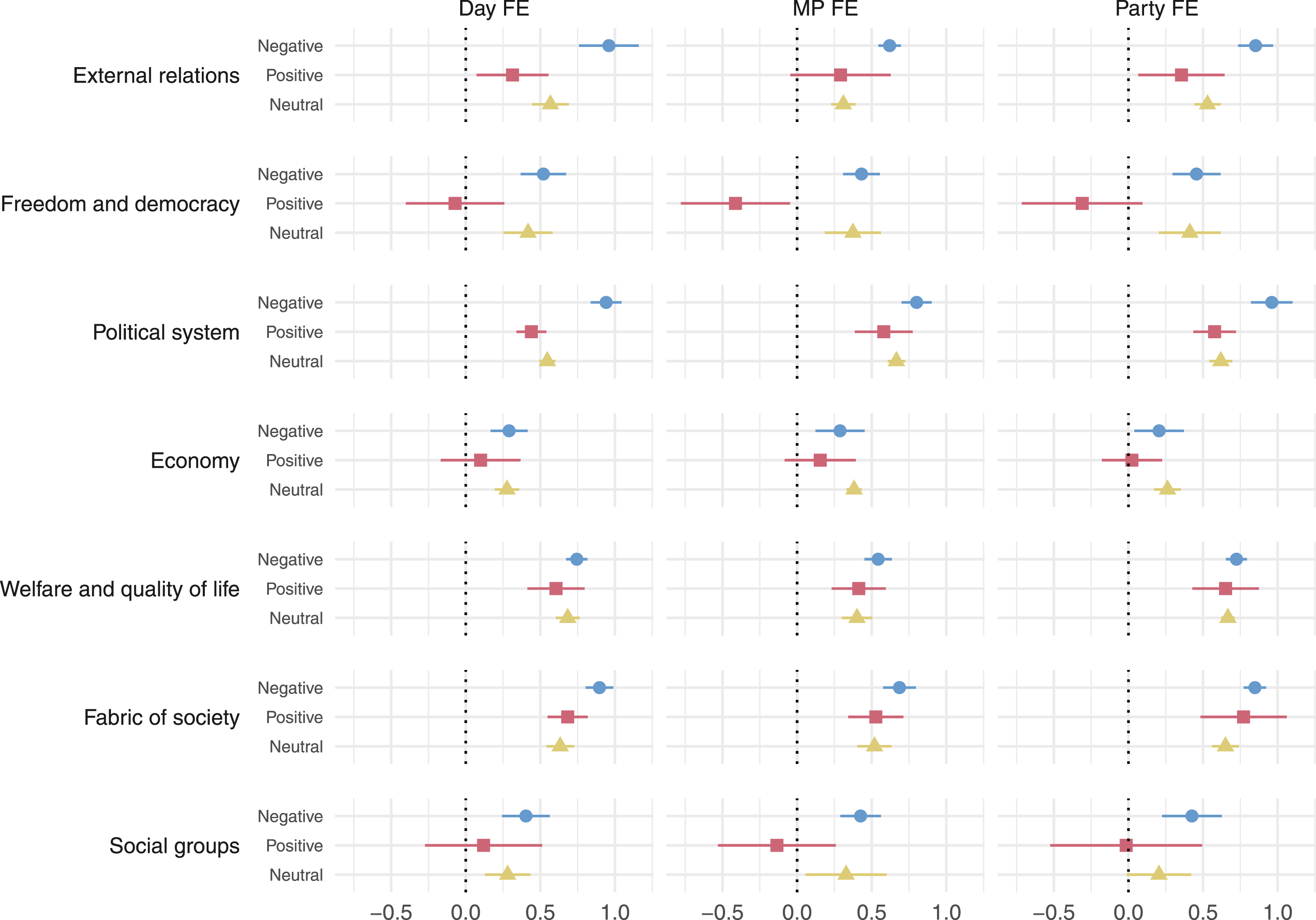
In contrast, sentiment appears to matter the least in the welfare and quality of life domain. Differences between negative, positive, and neutral sentiment are also relatively small in the economy, fabric and society, and social groups domains. In these areas, sentiment might not reflect ideological divides in the same way it does in the political system or external relations domains. For example, criticisms of welfare policies could be framed positively as the need to support vulnerable social groups, softening the impact of sentiment. Furthermore, the relatively minimal role of sentiment in these domains might indicate the overall relevance of the issue itself to voters. If the issue is perceived as less polarizing or emotionally charged, voters may not be as compelled to seek out more information. Another interpretation is that sentiment does indeed reflect ideological divides, but these divides may be less pronounced in these domains, or they may align more closely with broader societal values.
The Impact of Ideological Congruence
Finally, I test the role of policy domain and ideological alignment in shaping voters’ information-seeking about MPs. I expected that misaligned economic appearances in the media would increase information seeking about the MP, while socio-cultural appearances would prompt information seeking regardless of ideological congruence. The results are based on negative binomial models with MP and year fixed effects, including an interaction between media appearances and party ideology (party ideology is excluded as a main effect as it does not vary within MPs) for economic and cultural news separately.
Figure 7 shows marginal effect estimates disaggregated by party ideology and issue domain. For the economic coverage, MPs’ appearances in news classified both as left-wing and right-wing are positively and significantly associated with higher Wikipedia views for MPs, indicating that economic visibility in the media generally leads to information-seeking. However, the interaction between party left-right ideology (RILE score) and right-wing economic coverage is negative and statistically significant: when an MP’s party is more right-leaning, the marginal effect of right-wing coverage on information-seeking weakens. This pattern is consistent with the misalignment effect, meaning that voters are more inclined to search when the economic content is atypical for the MP’s party profile, potentially because unexpected issue associations prompt them to search for more information. Yet, the absence of a corresponding significant interaction for left-wing coverage may reflect that policies such as welfare expansion are not strongly polarizing and enjoy broader voter support.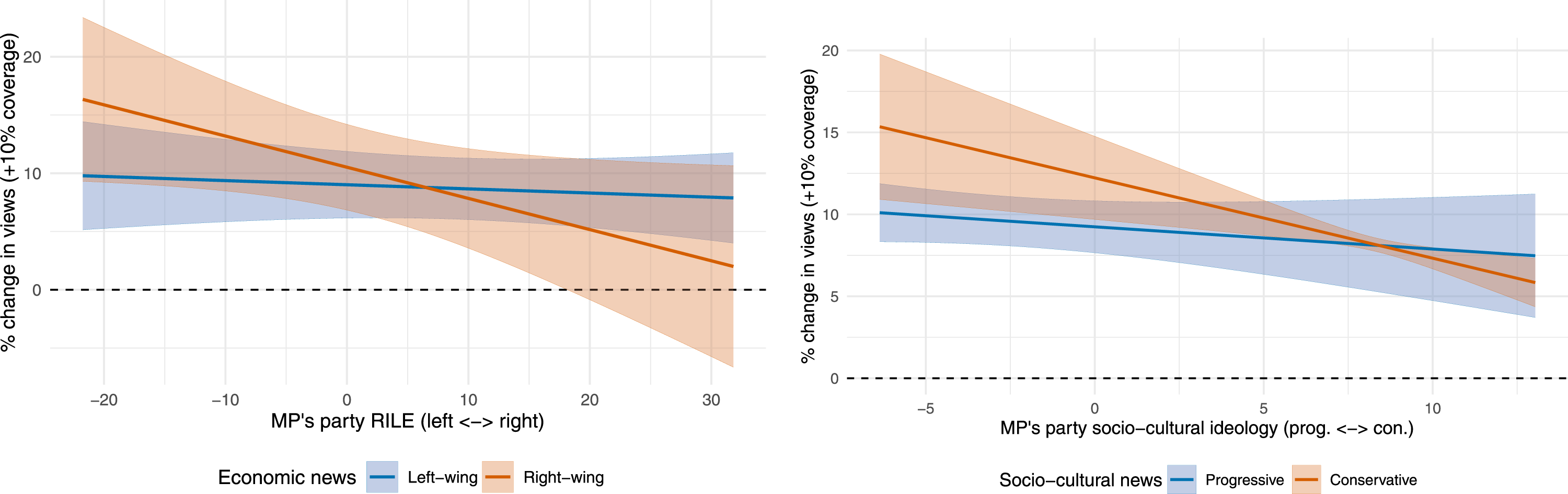
Both progressive and conservative socio-cultural issue coverage are positively associated with information-seeking, likewise supporting the expectation that MPs’ media appearances in the context of these topics increase information-seeking. The interaction between party ideology (progressive–conservative score) and conservative coverage is negative and statistically significant, but no differences are present for progressive news appearances. Specifically, the effect of appearances in conservative contexts is smaller for MPs from more conservative parties and relatively larger for MPs from progressive parties. This pattern is consistent with the misalignment mechanism, as voters may be surprised to see progressive MPs appearing in conservative issue contexts. However, it could also reflect several alternative dynamics. Progressive MPs may often appear in such coverage because they are criticizing them, or conservative-leaning media may feature progressive MPs in conservative issue stories to create contrast. Thus, conservative voters may show antagonistic interest when progressive MPs enter debates on conservative socio-cultural topics, while progressive voters may search to learn more about MPs challenging conservative policies.
For the analyses that looked at different fixed effects specifications, the patterns generally persist when accounting for within-day, within-MP, and within-party fixed effects, but there are minor differences for MP fixed effects compared to the other two models. This is not surprising as factors related to specific MPs and their prior reputation should form a baseline for the need to search about them. MP-level control variables such as being a newcomer or a woman do not appear to be statistically significant in any of the models, but there is a U-shaped effect of age, meaning that younger and older MPs tend to be searched more on Wikipedia. In addition, being a party group leader is associated with more information-seeking, and voters search for more information before and after elections. In terms of the substantial effect of media visibility on Wikipedia views as an indicator of online search, the effect is minor in terms of size, but as it is daily data from a demographically small state, this is not unexpected, and it is suggested to focus on the directional relative impact.
Discussion and Conclusion
In the context of increasing information availability and concerns about the democratic functioning of the media in informing voters, this article examined the consequences of politicians’ media visibility for voters’ information-seeking behavior. By analyzing more than 140,000 articles from four major newspapers and using pre-trained transformer models to classify sentiment and policy issues, the study examines how the tone and content of media coverage affect the frequency of Wikipedia pageviews for MPs. The analyses confirm that, first, media visibility of MPs is associated with an increase in daily Wikipedia views of MPs’ pages. Second, negativity in articles intensifies voters’ interest in learning more about MPs. Third, depending on the policy domain, party heuristics associated with MPs condition the link between media coverage and voters’ information-seeking.
The findings of this research have meaningful implications for understanding political communication in the digital age, having both normative implications for democratic representation and empirical prospects of using digital behavior data. On the one hand, the results imply that voters are responsive to political content available in mainstream news media and follow up by searching for more information. This can be seen as a positive outcome for democratic accountability, as media coverage encourages citizens to engage further with political figures, promoting informed decision-making. Given that increased information-seeking can lead to greater political knowledge and, potentially, more informed voting behavior, these findings contribute to a more optimistic view of media’s role in democratic representation.
On the other hand, there is a clear imbalance across the sentiment of the news. The negativity-bias finding is consistent with the rich literature on political communication and helps clarify the politics–media interplay from the perspective of visibility seeking. Taken together with evidence that negativity in parliamentary communication serves as a visibility strategy for MPs (e.g., Lupacheva & Mölder, 2024; Poljak, 2025) and findings that parties’ negative media coverage can increase electoral support (Vermeer et al., 2022), the results presented here contribute to picturing a politics-media interplay. Strategically negative messages tend to be more newsworthy, receive wider coverage, and attract greater public attention and information seeking, which in turn encourages politicians to continue using negativity. Likewise, the findings regarding ideologically misaligned media appearances imply cross-party search but may also foster polarization that reinforces partisan divides. In such settings, journalists’ decisions on what to cover and how to frame it have implications for public perceptions and potentially electoral choices and participation in democratic processes. In a broader perspective, this points to a challenge in balancing the market-oriented values driving media coverage of politics, the watchdog functions essential for democratic accountability, and a fair coverage of politics.
There are several limitations and follow-up questions worth discussing. First, the article considered only appearances in online mainstream news media and not in other communication channels such as social media. While social media is undoubtedly a very prominent source of political information, we can expect a certain degree of congruence between traditional and social media (Kruikemeier et al., 2018). In addition, the content that individuals are exposed to on social media is more personalized and intentional than news media, possibly making it a less likely case to trigger information-seeking about politicians. Second, I do not speculate on whether information seeking about MPs means agreement or disagreement with the policies, events, and MPs’ stances on them covered in media articles, which is most suitable to tackle in experimental settings. Regardless of the motives and potential implications for MPs’ future electoral prospects, name recognition is a relevant factor for electoral choice in candidate-centered electoral systems, and voters’ learning about politicians bears a positive normative implication for political research. Third, I control for the timing in the electoral cycle but do not distinguish between electoral campaigning and everyday politics. On the one hand, voters have more incentives to learn about MPs close to elections, assuming they wish to inform their voting decision. On the other, if the media is paying more attention to MPs before elections and less during other times, the relative decrease in coverage may make political information more engaging when it does appear.
While this paper provides valuable contributions based on uniquely granular and encompassing data, the single-case design limits generalization of the results in terms of political agenda, issue salience, and electoral system incentives for people to learn about politicians. Estonia is an advanced but relatively young democracy with a small population. In such smaller states, MPs may find it easier to gain media visibility due to a smaller number of political actors and media outlets. Additionally, voters are more likely to know about politicians, which might reduce their need to actively seek additional information online. In contrast, larger countries with bigger legislatures have more candidates competing for attention, making media visibility potentially less concentrated and voters’ information-seeking behavior more necessary and varied. In addition, while the findings about socio-cultural coverage may extend to other contexts, its strength and underlying mechanisms are likely shaped by the comparatively recent politicization of these issues in the Central and Eastern European region. Another case-specific limitation comes from looking at Estonian-language media and Wikipedia pages in a country with a considerable proportion of residents who are not native Estonian speakers. Although Estonian citizenship, and hence, voting rights in parliamentary elections, are strongly linked to the command of the Estonian language, the findings can be most safely attributed to those speaking and consuming media in the state language, which is not uniform across the socio-economic groups of ethnic minorities. Future studies, especially with cross-national designs, could inform the scholarship on media coverage of politics and information-seeking behavior by clarifying the role of contextual and institutional settings.
Footnotes
Acknowledgments
For their helpful comments and suggestions, I thank the two anonymous reviewers, Martin Mölder, and participants of the 2024 COMPTEXT Conference and the 2024 EUI Workshop on Political Behavior in CEE.

Funding
The author received no financial support for the research, authorship, and/or publication of this article.
Declaration of Conflicting Interests
The author declared no potential conflicts of interest with respect to the research, authorship, and/or publication of this article.