




Abstract
Prior research on digital inequality has highlighted the role of sociocultural resources in shaping Internet beneficial use patterns by positively impacting on online literacy. Research on privacy protection online has—at the same time—shown the emergence of a “privacy cynicism,” where concerns about privacy fail to translate into protective actions. This study investigates how education level impacts privacy protection behavior through these two different mediation paths. Using unique data from a sample of 3,156 Italian Internet users, structural equation modeling (SEM) is employed to analyze the linkages between education level, privacy literacy, privacy cynicism, and protective behaviors. Contrary to expectations, the results reveal a moderate negative impact of education level on privacy protection behaviors. This total effect is the results of two different paths exerting opposite effects on protection behaviors. While a higher education correlates with increased privacy literacy, this competence does not translate into proactive protective actions. Surprisingly, individuals with higher privacy literacy exhibit even lower levels of protection behavior, contributing to a negative indirect effect of education on privacy protection. On the other side, the indirect effect of education on behaviors through privacy cynicism operates consistently with the digital inequality framework, partially compensating the negative effect through literacy. An interpretation of privacy protection as an exception within the digital inequality framework is proposed.
Introduction
Research on digital inequality has shown that the more socio-economic resources users have, the more they can exploit Internet use for their benefit (Helsper et al., 2015; van Dijk, 2020). In particular, there is evidence that digital inequality manifests itself in a sequential manner: higher socio-economic resources transform into higher digital literacy, which in turn leads to more capital-enhancing Internet use, which in turn leads to more beneficial outcomes (van Deursen et al., 2017). Education level is one of the most extensively studied factors influencing the activation of this sequential mechanism in adults (Scheerder et al., 2017). It serves as a key predictor for both the acquisition of digital skills (Hargittai, 2008) and the ability to translate those skills into tangible benefits and enhanced well-being (Gui & Büchi, 2021; van Deursen & Helsper, 2018).
The first goal of this paper is to investigate if the same sequential dynamic applies to privacy protection. Only a few studies have analyzed the impact of education level on online privacy protection practices, with mixed results: while some scholars suggest that more education translates into more privacy awareness and protection (Alhazmi et al., 2022; Dutton et al., 2022), others did not find such correlations (Gerber et al., 2018; Park, 2013). More importantly, there is a lack of literature discussing whether the positive impact of education on literacy translates into privacy protective behavior, as highlighted in many fields of digital inequality (Büchi et al., 2021).
A different stream of literature—mainly rooted in psychology—has postulated the existence of a “privacy paradox,” where users’ concerns about privacy do not transform into actual protective behavior or reduced self-disclosure (Baruh et al., 2017; Kokolakis, 2017). Explanations for the privacy paradox include the privacy calculus (Dinev & Hart, 2006), where the perceived benefits of the privacy-related behavior (e.g., convenience, financial rewards, and sociality) outweigh the privacy risks or costs, cognitive heuristics and biases (Liao et al., 2023), as well as a lack of agency due to power imbalances between users and platforms. This last approach argues that users develop resigned attitudes towards privacy, which are variably termed privacy apathy (Hargittai & Marwick, 2016), surveillance realism (Dencik & Cable, 2017), privacy fatigue (Choi et al., 2018), digital resignation (Draper & Turow, 2019; Turow et al., 2015), or privacy cynicism (Hoffmann et al., 2016; Lutz et al., 2020; Ranzini et al., 2023). Privacy cynicism is defined as “an attitude of uncertainty, powerlessness and mistrust towards the handling of personal data by online services, rendering privacy protection behavior subjectively futile” (Hoffmann et al., 2016). To date, few studies have investigated how privacy cynicism affects privacy-related outcomes such as privacy protection behavior (Lutz et al., 2020; van Ooijen et al., 2022), while there is no evidence about how it is socially structured. For this reason, in this paper, we also aim to investigate the role of cynicism as a mediator between education and protective behaviors. It may be the case that, in the specific field of privacy protection, the dynamics linked to the “privacy paradox,” and in particular to “privacy cynicism,” can co-exist with those defined by the usual digital inequality sequence. From a theoretical point of view, it is promising to integrate digital inequality aspects more strongly into privacy research and our study contributes to ongoing efforts in that area (Büchi et al., 2021; Epstein & Quinn, 2020; Hargittai, 2021; Hoffmann et al., 2024; Meier & Krämer, 2024; Park, 2021; Walker & Hargittai, 2021; Wang & Metzger, 2024): using psychologically oriented privacy theory together with sociological perspectives on digital inequality can yield rich insights about how privacy attitudes and privacy protection behavior depend on—or are independent of—someone’s social position (Büchi et al., 2021; Walker & Hargittai, 2021). Such knowledge about its social structuration leads to a more contextualized understanding of privacy and may meaningfully advance privacy theory (Hoffmann et al., 2024; Masur et al., 2025). Our study extends this line of inquiry by investigating the Italian context, explicitly integrating the concept of privacy cynicism, and emphasizing the role of privacy literacy—aspects that have rarely been jointly investigated in prior research. More importantly, shedding light on the path leading to the current low levels of privacy protection behaviors online is of great importance for its practical and policy implications. Policy solutions should differ depending on whether low protection primarily stems from a lack of literacy among less educated individuals or is instead driven by varying levels of privacy cynicism across population segments with different cultural resources.
We make use of unique data from a quota sample of 3,156 Italian Internet users, selected from a non-probability online panel and contacted via CAWI and CATI to participate in the survey Citizens and the value of digital data. Building on both the digital inequality framework (van Deursen et al., 2017) and the privacy paradox (Baruh et al., 2017), we examine alternative pathways linking education level, privacy literacy, privacy cynicism, and protective behaviors using a parallel mediation analysis within a comprehensive structural equation modeling (SEM) framework.
Privacy Literature: Digital Inequality in the Privacy Framework
Digital Inequalities: The Unequal Distribution of Digital Literacy and its Determinants
In the past decade, research on digital inequality has moved beyond the analysis of who does or does not have access to the Internet (Helsper, 2016), shifting the attention on digital skills or, more generally, digital literacy and explanations for its unequal distribution (amongst others DiMaggio et al., 2004; Hargittai, 2002; van Dijk, 2005; Witte & Mannon, 2010; Zillien & Hargittai, 2009).
Digital literacy is defined as “the ability to use ICT in ways that help achieve tangible, high-quality outcomes in everyday life” (Helsper, 2016, p. 176) and includes the ability to access tools and software, the ability to know how to interact with content appropriate to one’s needs and knowing how to translate these activities into personal benefits (Ibidem).
Most research on digital inequalities focuses on individual socio-economic characteristics as determinants of different digital skills. Research shows that education is a consistently strong predictor of digital skills (van Dijk & van Deursen, 2014). Additionally, there is also correlation between gender (Ono & Zavodny, 2008), age, ethnicity (Mesch & Talmud, 2011) and income (Witte & Mannon, 2010), and those resources needed to benefit from Internet use, such as conditions of access, use and skills (Gui & Büchi, 2021; Robinson et al., 2015; van Dijk, 2005; Witte & Mannon, 2010).
Therefore, it has been argued that digital inequality manifests sequentially: higher education levels are likely to result in increased digital literacy, opening up capital-enhancing uses of the Internet, and consequently, leading to more tangible outcomes (e.g., the use of the Internet for job search could result in finding a better job) (van Deursen et al., 2017). Although early studies on privacy protection observed minimal differences in privacy concerns across educational levels (O’Neil, 2001), recent research highlights the significance of education-based digital inequalities also in shaping privacy protection behavior. Specifically, emerging evidence indicates that education positively influences e-privacy management, largely through the mediation of digital skills and Internet use (Maineri et al., 2023; Park & Chung, 2017). Privacy literacy, closely associated with education, may therefore play a crucial role in addressing the privacy paradox, helping to close the gap between privacy concerns and actual privacy-protective behavior (Schubert et al., 2022).
Privacy Paradox: Its Various Explanations and the Concept of Privacy Cynicism
Experiencing life online implies having to deal with privacy issues extensively. Specifically, privacy concerns refer to individuals’ beliefs regarding the risks and potential negative consequences associated with sharing information (Cho et al., 2010; Zhou & Li, 2014). Existing research on privacy protection shows that individuals are concerned about their privacy on the Internet (van Ooijen et al., 2022): disclosure of personal data brings up feelings of vulnerability (Aguirre et al., 2015), intrusiveness (van Doorn & Hoekstra, 2013), and surveillance (Segijn & van Ooijen, 2020).
Nonetheless, several studies have found that Internet users only rarely engage in privacy protection behavior, such as restricting online privacy settings, deleting cookies, restricting location-based services, or changing privacy-invasive default settings on websites (Acquisti, 2004; Boerman et al., 2021; Lanier & Saini, 2008).
Therefore, when people are online, instead of adapting their behavior, they develop coping mechanisms to manage the tension between participating online as a “digital citizen” and the risks posed by digital platforms’ access to personal data (Lutz et al., 2020).
Research found that privacy concerns exert only a weak effect on self-disclosure or online protection behaviors: individuals’ concerns about privacy do not necessarily reflect the privacy management choices they make, inasmuch users disclose substantial amounts of sensitive personal data despite strong privacy concerns (Dienlin & Trepte, 2015; Kokolakis, 2017).
This divergence between privacy concerns, on the one hand and privacy protection behaviors, on the other, is known as “privacy paradox” (amongst others Baruh et al., 2017; Barnes, 2006; Brown, 2001; Dienlin & Trepte, 2015; Kokolakis, 2017; Norberg et al., 2007). Numerous studies have investigated the concept of “privacy paradox,” also criticizing it (Solove, 2021). Kokolakis (2017) offers an interesting perspective arguing that the paradox can be explained by considering several factors. First, privacy calculus and the benefits of self-disclosure, that is, the role of a rational risk-benefit assessment: individuals decide to disclose personal information when potential gains exceed expected losses (amongst others Dinev & Hart, 2006; Xu et al., 2011). Second, social theory-based interpretations: users, to maintain their social lives, must disclose information about themselves online, despite their privacy concerns (amongst others Blank et al., 2014; Zafeiropoulou et al., 2013). Human decision-making is affected by cognitive biases and heuristics, such as optimism bias, overconfidence, affect bias, fuzzy-boundary and benefit heuristics, and hyperbolic discounting (e.g., Acquisti & Grossklags, 2003; Brandimarte et al., 2013). Moreover, many people fail to make a cost-benefit calculation in relation to the disclosure of personal data and do not have access to all the information needed to make informed judgments about privacy decisions, so individuals show a bounded rationality while taking decisions in a limited time and with incomplete information (Acquisti & Grossklags, 2005). Indeed, there are information asymmetries in the marketplace, where consumers have very limited knowledge about how their personal data are used (Buck et al., 2014).
Hoffmann et al. (2016) have proposed the concept of cynicism applied to privacy in order to explain the privacy paradox. Privacy cynicism represents a cognitive coping mechanism for users, allowing them to overcome or ignore privacy concerns, since privacy protection behavior can be rationalized as useless or ineffective (Choi et al., 2018; Hoffmann et al., 2016; Lutz et al., 2020; van Ooijen et al., 2022).
The concept of privacy cynicism allows us to describe users’ attitudes toward data protection and privacy in the context of limited subjective agency. People report a feeling of powerlessness online, given the fact that institutions, other users, and platforms may have access to their data (Hoffmann et al., 2016).
Some studies have also mentioned feelings of digital resignation, that is, “the condition produced when people desire to control the information digital entities have about them but feel unable to do so” (Draper & Turow, 2019, p. 1824), or privacy apathy as an expression of resignation about privacy violations (Hargittai & Marwick, 2016), privacy fatigue, that is, a multi-dimensional concept including exhaustion and cynicism (Choi et al., 2018), and surveillance realism (Dencik & Cable, 2017), which is defined as “a simultaneous unease among citizens with data collection alongside the active normalization of surveillance that limits the possibilities of enacting modes of citizenship and of imagining alternatives” (p. 763).
Individuals resort to cynicism when they perceive that they have limited control over their privacy and their information, and the risks then become unavoidable: this perception encourages inaction and fuels a feeling of resignation (Lutz et al., 2020).
In a research conducted by Hoffman et al. (2024), they also analyze how five types of structural constraints (i.e., interpersonal, cultural, technological, economic, and political) restrict user agency and contribute to the prevalence of privacy cynicism as a common response.
In this field, only a few studies investigate the impact of education level in these dynamics. First, some researchers posit a positive correlation between increased socio-economic resources and heightened awareness of privacy issues and corresponding protective measures (Alhazmi et al., 2022; Dutton et al., 2022). An et al. (2023) conducted a study postulating educational level as a moderator with an extended knowledge-attitude-behavior model of Internet security, using students’ year level as a proxy for the effect of educational level. They found that there was little difference in overall Internet security awareness between graduate and undergraduate students, suggesting that educational level had little effect on these students.
Conversely, other scholars, as evidenced by studies conducted by Park (2013) and Gerber et al. (2018), fail to identify such correlations. Therefore, it has been argued that people’s level of education could have both a negative and a positive effect on protective behavior (Boerman et al., 2021). On the one hand, research has found that the level of education has a negative effect on protective behavior: people with higher levels of education seem to have more knowledge about online behavioral advertising and cookies, express fewer concerns, and are consequently less likely to protect their privacy (McClain et al., 2023; Smit et al., 2014). On the other hand, greater privacy knowledge and literacy has been shown to increase privacy protection (e.g., Baruh et al., 2017; Ham, 2017; Park, 2013). Several studies suggest that education may affect online privacy protection: people with higher educational levels reported higher awareness of online information disclosure and greater adoption of privacy protection behavior (Büchi et al., 2021; Chen et al., 2016; Cotter & Reisdorf, 2020; Dodel & Mesch, 2018; Park, 2013).
Notably, the existing body of privacy literature has not explored the role of cynicism as an intermediary factor between education levels and individuals’ behavioral responses concerning privacy matters.
Hypotheses
To investigate whether the patterns of digital inequality also manifest themselves in the privacy protection domain, we formulated a first set of hypotheses along the primary expectations outlined in the digital inequality framework (e.g., Maineri et al., 2023; Schubert et al., 2022). According to this framework, we first hypothesize that there will be a positive relationship between higher education and privacy literacy (H1). On the one hand, this kind of relationship emerges clearly from decades of studies on the digital divide and digital inequality (van Dijk, 2020). On the other hand a few empirical studies have confirmed this association also in the field of privacy protection (Büchi et al., 2021; Dutton et al., 2022; Meier & Krämer, 2024). In particular, we expect that people who reach a higher school level have more educational resources that enable them to better learn principles and mechanisms of privacy. In addition, as in the digital inequality framework, we hypothesize that there will be a positive relationship between privacy literacy and privacy protection behavior (H2): people who have more privacy literacy have more knowledge and awareness about the potential risks of privacy violation in digital environments. This, in turns, leads to a better protection of their personal data and a more cautious behavior. As a result, adding together these two effects, we expect that a higher education level will predict more protective behaviors through the mediation of privacy literacy (H3).
A second set of hypotheses can be built based on the literature on privacy cynicism (Lutz et al., 2020; Van Ooijen et al., 2022). First, we expect that higher education will have a negative effect on privacy cynicism (H4). Previous research has shown how other forms of cynicism, such as political cynicism (Adriaansen et al., 2010) and police cynicism (Osborne, 2014), are negatively affected by education, so that those with low levels of education are most cynical. We expect the same tendencies to be at play for privacy cynicism. More educated individuals might feel less disenfranchised and more in control. We also hypothesize that privacy cynicism, in turn, has a negative effect on privacy protection behaviors (H5). Such a negative relationship has been found in existing research in other contexts such as Germany (Lutz et al., 2020) and the United States. According to the aforementioned definition, users showing high levels of privacy cynicism regard privacy protection as futile and they will therefore abstain from it or be less engaged in it than users with lower levels of cynicism. Thus we expect to also find a positive indirect effect of education on privacy protection behavior mediated by privacy cynicism (H6).
Finally, in light of the literature presented above, both in the field of digital inequality and that of privacy cynicism, we believe that these two represent the main channels through which the level of education can influence privacy behaviors. Therefore, we expect that—once inserted in the model—privacy cynicism and privacy literacy are full mediators, accounting for all the observed relationship between the two variables (H7) (Figure 1). Representation of the structural portion of our model and our hypotheses.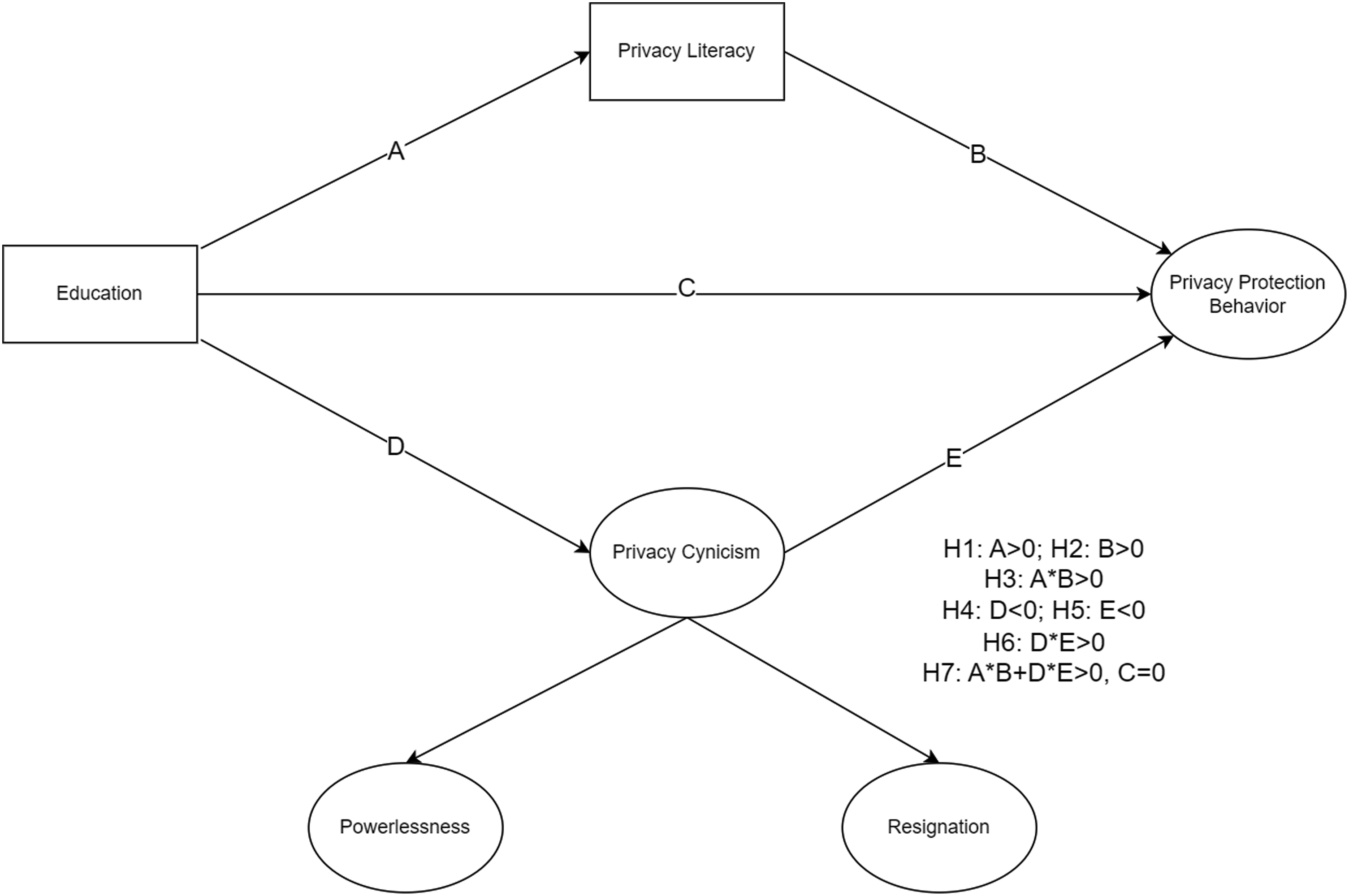
Data
To test our hypotheses, we make use of primary data from the survey Citizens and the value of digital data (N = 3,156), collected within the framework of the V-DATA (The value of digital data: enhancing citizens’ awareness and voice about surveillance capitalism) project. We administered the questionnaire to a quota sample of the Italian Internet population (aged 18 and above), adopting a mixed-mode sequential design. First (from 21st to 28th November 2022), we conducted a CAWI survey on a representative sample (by gender, age, geographic area of residence, and education) of the Opinione.net non-probability online panel members’ (N = 2,249). Then, (from 6th December 2022 to 17th January 2023), in order to reduce the potential coverage and selection bias of the CAWI sample, we carried out a CATI survey on a representative sample (by gender, age, and geographic area of residence) of people who have a phone number (landline or mobile), own/have at their disposal at least one digital device, and use at least three features offered by the digital devices (N = 907). Details on the distribution of the sample and how well it matches the target population are available in section A4 of the appendix. Moreover, descriptive statistics on the sociodemographic traits of the sample, including gender, age, region of residence, income, working status, and marriage status are available in section A5 of the appendix.
Variables and Methods
Following the digital inequality sequence (van Deursen et al., 2017), this study investigates the existence of a path linking education level, privacy literacy, privacy cynicism, and privacy protection behaviors 1 in a full structural equation modeling (SEM) framework.
To reach this goal, we preliminarily evaluated the psychometric properties of the latent constructs measuring privacy cynicism (CY) and privacy protection behaviors (PPB).
CY has been modeled with seven items translated from questions introduced by Lutz and colleagues (2020) measuring two subdimensions of privacy cynicism: powerlessness and resignation. We asked respondents how much they agree with statements regarding the perceived possibility of influencing the protection of personal data online on a 5-point Likert scale, for example: “I cannot effectively protect my personal data from being collected online” (CY.1).
PPB was instead defined by eight items measured on a 4-point Likert scale, partially drawn from Lutz and colleagues’ (2020) and van Ooijen and colleagues’ (2022) works. The questions ask respondents how often they engage in different behaviors to protect their data online, for example: “Refuse cookies when accessing a website” (PPB.2).
Data suitability was first assessed for CY and PPB by looking at the determinant of the correlation matrix (Det), the Kaiser–Meyer–Olkin measure of sampling adequacy (KMO) and Bartlett’s test of sphericity. Principal component and Horn parallel analysis with 5000 iterations were also carried out to inspect eigenvalues and the amount of the total item variance explained by the latent constructs. The internal consistency reliability of the construct was finally evaluated with Cronbach’s α.
Confirmatory factor analysis models (CFA) were then estimated separately for CY and PPB to test whether the observed items effectively covered the best-fitting model specifications that emerged from previous analyses, respecifying the models following modification indexes in case a satisfactory fit was not reached. Then, we evaluated the fit of the two models simultaneously.
An index measuring privacy literacy (PLI), resulted from counting the number of correct answers given to 20 questions measuring their knowledge regarding privacy regulations, adjusting them for straightlining.
Education was measured by asking respondents the highest education level achieved, according to the International Standard Classification of Education (ISCED; Schneider, 2013). Previous evidence on the influence of education on digital literacy suggest the existence of a positive relationship, with those with a tertiary degree being particularly predisposed to present higher literacy scores (Estrela et al., 2023; van Laar et al., 2019). On the other hand, research on online privacy management clearly indicates that having at most a school diploma is associated with higher levels of privacy cynicism and fatigue (e.g., Luzsa & Mayr, 2022). In line with previous research on the socio-demographic determinants of digital inequalities and privacy protection (e.g., Büchi et al., 2021; Van Deursen et al., 2011), respondents’ highest education level was then recoded and analyzed considering the following three reference categories: low (middle school or lower), medium (vocational, high school diploma or equivalent), and high (Bachelor’s, Master’s, and PhD or equivalent).
Gender and age were also included in the model as control variables. Gender was introduced as a dummy variable with males as the reference category. Age was instead recoded into the three categories of Young (younger than 30), Middle age (between 30 and 60), and Old age (older than 60), as previous research suggest that digital skills are significantly lower among older adults, while middle-aged adults present higher levels of internal heterogeneity in their distribution compared to young adults (e.g., Estrela et al., 2023).
We ran a full structural equation model to observe the directions and magnitudes of direct and indirect effects across the variables of interest. The degree of multivariate normality of CY and PPB items was performed through the Henze–Zirkler’s test, indicating a non-normal distribution for all of them (p-value <.001 for all the items). Based on these results, we chose to carry out measurement and structural analyses using the maximum likelihood estimator adjusted for non-normality (MLR), which is well suited for non-normally distributed ordered categorical data (Beauducel & Herzberg, 2006; Bovaird & Koziol, 2012; Liu et al., 2017). To evaluate model fit, we used the Comparative Fit Index (CFI), the Tucker–Lewis Index (TLI), the Root Mean Square Error of Approximation (RMSEA), and the Standardized Root Mean Square Residual (SRMR). To declare the goodness of fit, we used the threshold values indicated by Hu and Bentler (1999) (good fit: CFI>.950, TLI >.950, RMSEA <.050, SRMR <.050; acceptable fit: CFI>.900, TLI >.900, RMSEA <.060, SRMR <.080).
Recent research highlighted the lack of shared best practices in structural equation modeling with ordered categorical variables (Gerosa, 2021; Sass et al., 2014). Therefore, we additionally tested the consistency of our results by replicating all the analyses using the Diagonal Weighted least squares (DWLS) estimator (Kline, 2023). This estimator is better suited for use with categorical non-normally distributed endogenous variables, but cannot handle partially missing data (Edwards et al., 2012). Traditional cutoff values for evaluating model fit related to these indexes have not yet been adequately investigated and should be interpreted with caution when estimating models with DWLS (Xia & Yang, 2019). Results for models estimated with DWLS are reported in section A2 of the appendix. Analyses were conducted using the R package lavaan (Rosseel, 2012).
Results
Measurement Model
Results of the Data Suitability, Dimensionality, and Internal Consistency Tests.
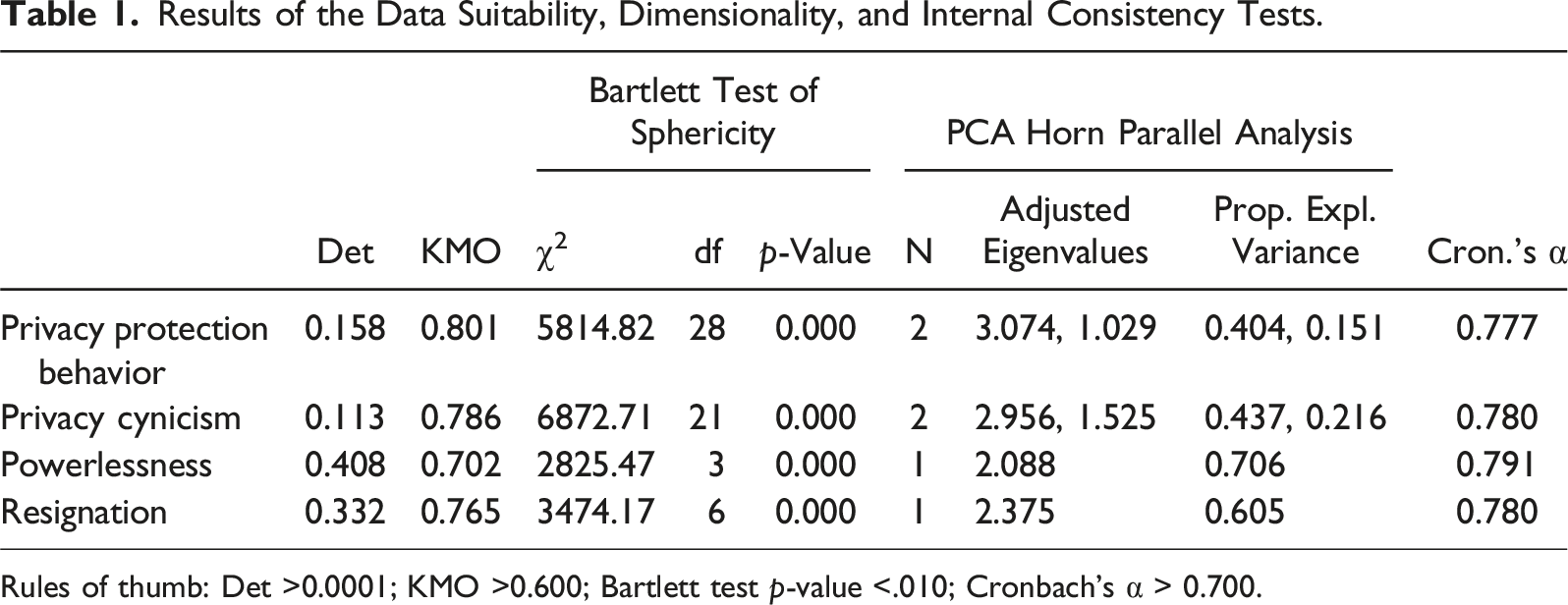
Rules of thumb: Det >0.0001; KMO >0.600; Bartlett test p-value <.010; Cronbach’s α > 0.700.
The construct of privacy cynicism is expected to be defined by the two latent subdimensions of powerlessness and resignation (Lutz et al., 2020), and the results reported in Table 1 confirm our expectations. The two-factor structure of the data was confirmed looking at the unadjusted spectrum of the correlation matrix (
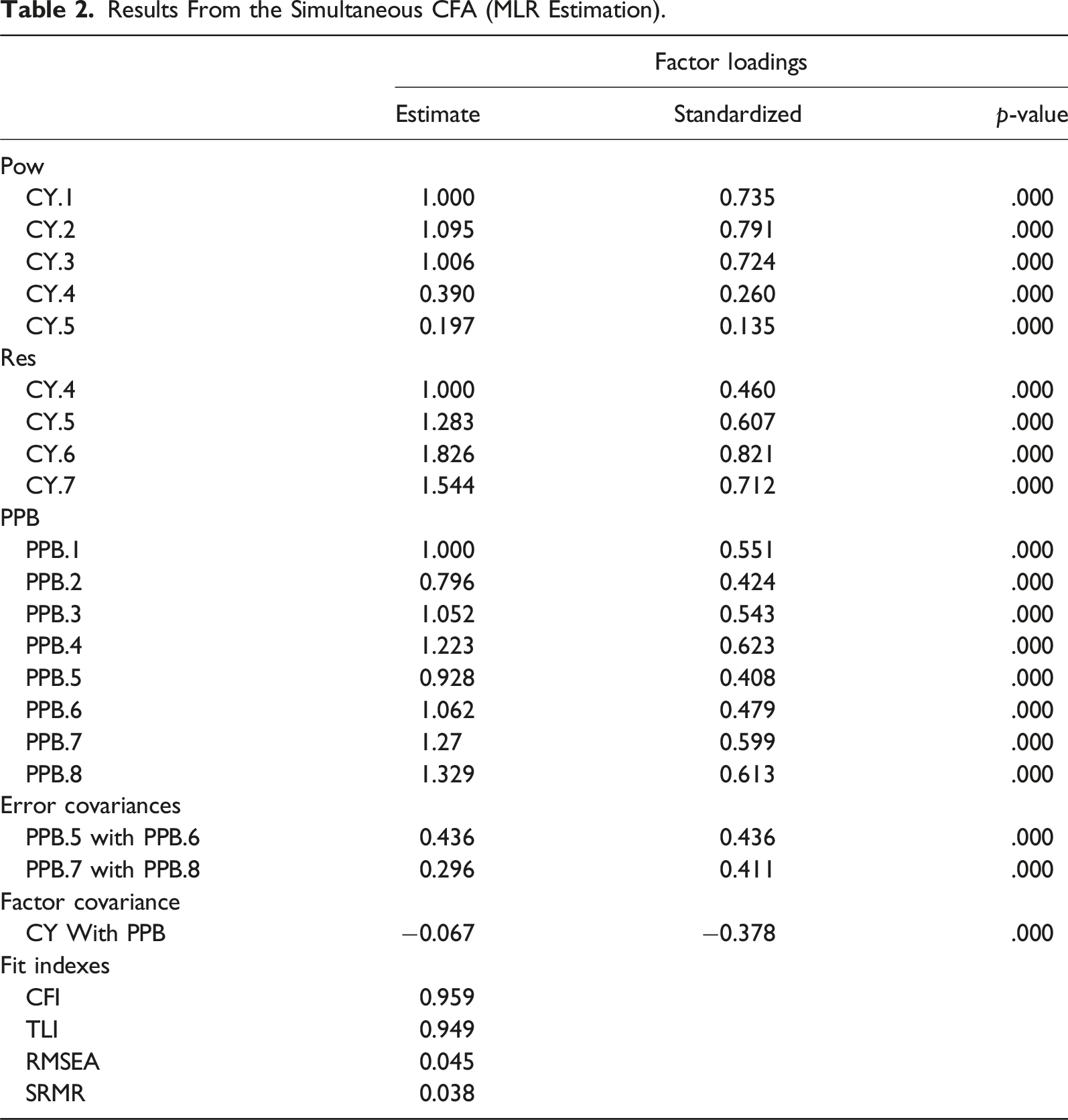
We therefore modeled privacy cynicism as a second-order factor. To identify the model, the two first-order factors have been imposed to have equal loadings on the higher-order factor. We first estimated a model with no cross-loadings, with three items (PPB.1, PPB.2, PPB.3) loading on Powerlessness, and the others on Resignation, but it resulted in an unsatisfactory value of RMSEA (MLR estimation: CFI = 0.954, TLI = 0.926; RMSEA = 0.087; SRMR = 0.053). We then respecified the model following modification indexes by adding two cross-loadings (PPB.4 and PPB.5 on Powerlessness), which led to a significantly better fit (MLR estimation: CFI = 0.984, TLI = 0.969, RMSEA = 0.056; SRMR = 0.026).
Turning to the PPB scale, we estimated a single-factor CFA specification without model constraints. The fit of the model to the data was not satisfactory (MLR estimation: CFI = 0.821, TLI = 0.749; RMSEA = 0.128; SRMR = 0.062), suggesting a respecification of the model. Following modification indexes, we included two error correlations, with item PPB.5 correlating with PPB.6, and item PPB.7 correlating with PPB.8 obtaining a good-fitting model (MLR estimation: CFI = 0.977; TLI = 0.965; RMSEA = 0.048; SRMR = 0.025). As mentioned, the error correlations are theoretically motivated given the items involved. A more detailed discussion on this can be found in section A1.2 of the appendix.
Results From the Simultaneous CFA (MLR Estimation).
Structural Hypotheses Testing
Results From the Full Structural Equation Model (MLR Estimation).
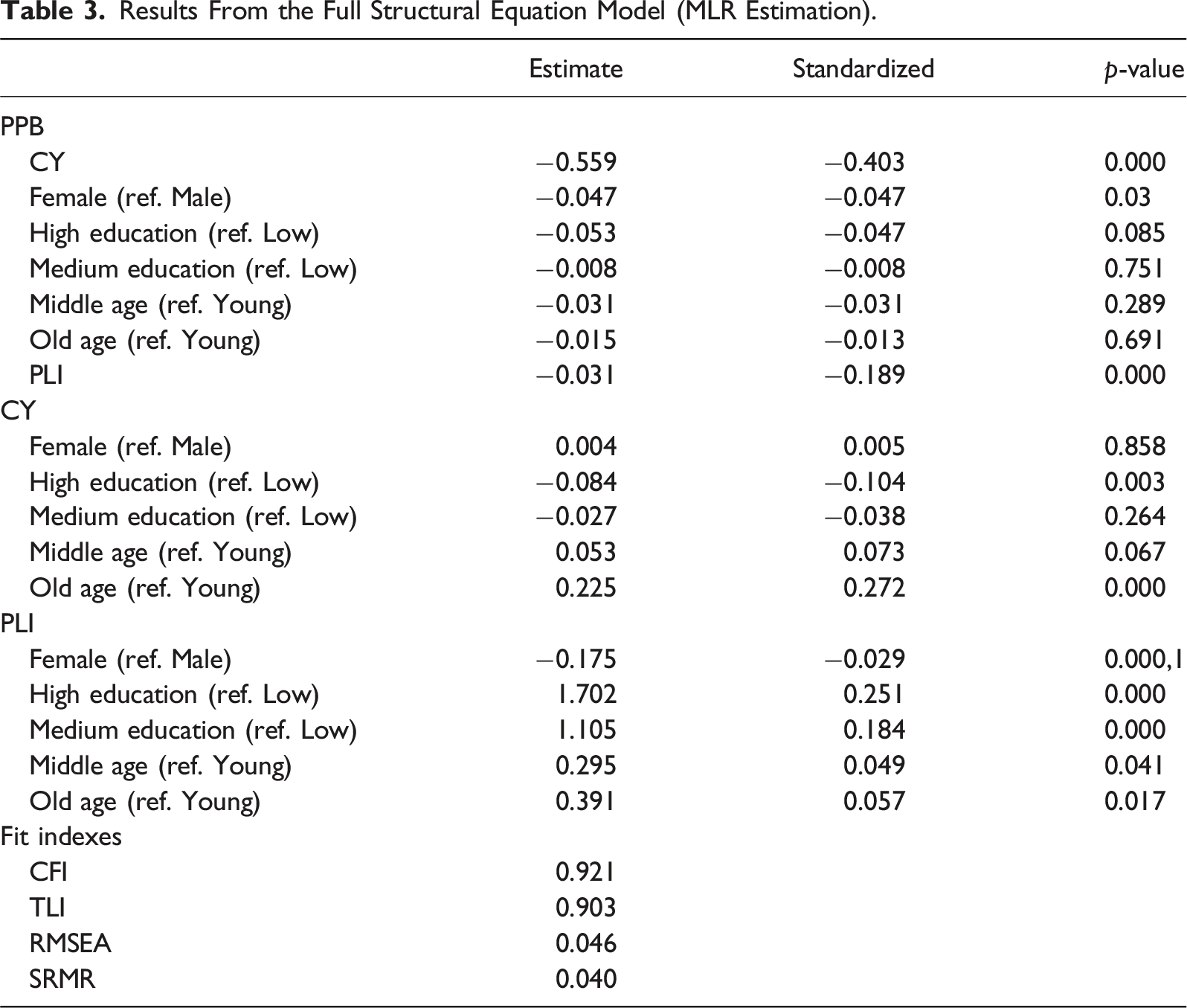
Starting from education, we can see large, positive, and significant associations between medium and high levels of education and privacy literacy. Therefore, according to H1, highly educated individuals performed significantly better on the standardized test concerning privacy regulations. Notice that, given the two variables involved, the unstandardized coefficient is directly interpretable. Compared to the average performance of the less educated (up to middle school) in the privacy literacy test, respondents with a high-school diploma answered 1.105 (p < .001) more questions correctly, while those having a university degree performed even better, with 1.702 (p < .001) more correct answers.
Indirect and Total Effect From the Full SEM Model (MLR Estimation).
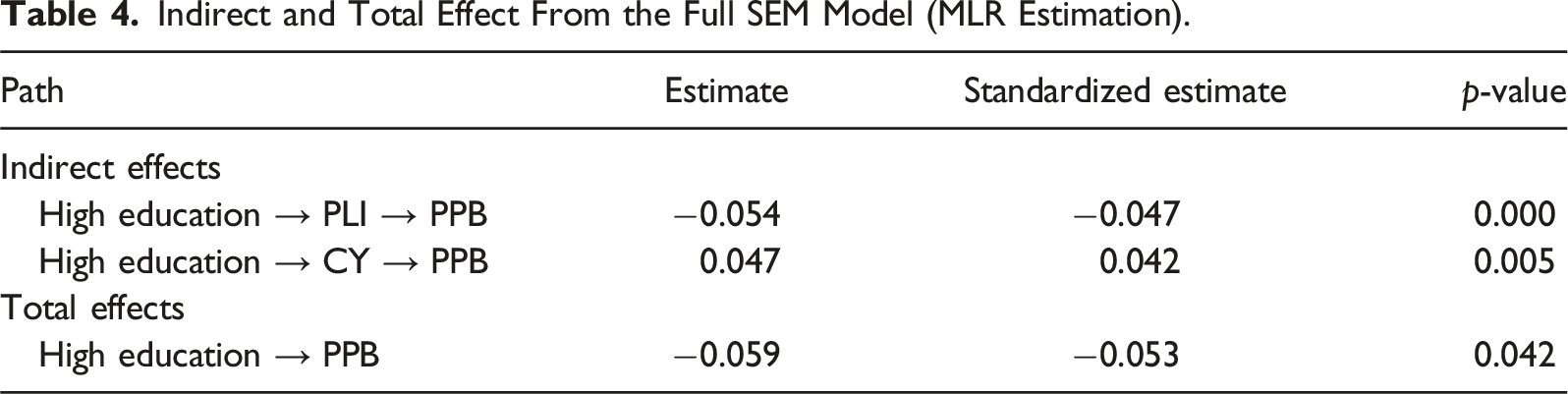
Moving to our second set of hypotheses, we found that education is negatively and significantly associated with CY. Overall, according to H4, having a university degree is associated with a reduction in CY of −0.084 (p = .003) compared with having a middle school degree. Also, in line with Lutz and colleagues’ (2020) findings, privacy cynicism measured through powerlessness and resignation has a very strong, significant, and negative association with privacy protection behavior. Indeed, we registered one standard deviation change in CY corresponds to a reduction of 0.559 (p < .001) standard deviations in PPB, an effect even higher than that found by previous studies (Lutz et al., 2020). Moreover, looking at the indirect path of the relationship between education and PPB passing through CY, we found a positive and significant effect of 0.047 (p = .005). These further results allow us to retain both H5 and H6.
Finally, the overall parallel mediation model resulted in a small but significant total effect of education on PPB equal to −0.059 (p = .042) which is fully mediated by the indirect effects passing through PLI and CY (Table 4). That means that, in line with our initial expectations, we can also retain H7.
Summary
The positive effect of education on privacy literacy (H1) aligns with our expectations and previous research. Specifically, Epstein and Quinn (2020), who use a comparable privacy literacy measure to ours in their US-based study, found that education has a significant positive influence on privacy literacy. In a recent study from Germany, Meier and Krämer (2024) used Trepte et al.’s (2015) online privacy literacy scale and also identified a positive association between education and privacy literacy. This is not surprising as privacy is a complex topic that covers different areas, from more institutional and legal aspects to information about the digital society more broadly, including the role of online services (Trepte et al., 2015), something individuals learn more about the longer they engage with the education system. Thus, our resource-based explanation of this relationship turned out to be reflected in the data.
By contrast, we did not find support for hypothesis 2. The counter-intuitive result that privacy literacy relates negatively to privacy protection behavior could have several explanations. Individuals with higher privacy literacy might have a clearer understanding of the risks and benefits of certain online activities and therefore feel more confident engaging in them without additional protective measures. Alternatively, these people might believe that their literacy protects them and thus they feel less need for active protective behaviors. Finally, there might be a link via trust in technology. Those with higher levels of privacy literacy might trust technology such as digital platforms more because they understand it better. This trust, in turn, could lead to a higher sense of security and therefore less urgency to engage in privacy protection behavior. While little research has investigated how privacy literacy affects privacy protection behavior, Ma and Chen (2023) found no significant effect for “objective privacy literacy” (measured similarly to us based on factual knowledge rather than subjective self-evaluation) on privacy protection behavior in their study of Chinese digital natives. Similarly, Choi (2023), in a survey of US-based Facebook users, did not identify a significant effect of privacy literacy on “privacy rule adaptation”, which corresponds with privacy protection behavior. There are some exceptions, however. Epstein and Quinn (2020), also using an “objective” knowledge-based measure of privacy literacy, found a positive effect of privacy literacy on privacy protection behavior. Bartsch & Dienlin (2016), although using a subjective measure, also found a positive effect. Taken together, the findings from our sample suggest that, while users with educational attainments show a higher level of privacy literacy, this is not transformed into actual behavior. This knowledge-action gap in our data seems to depict privacy protection as an exception in the digital inequality framework. Indeed, a significant theoretical challenge to that framework arises when even individuals equipped with superior educational resources and high privacy literacy choose to refrain from active protective measures. However, the findings might seem counterintuitive only if we assume that protective behaviors directly lead to favorable outcomes. Building on the initial wave of digital inequality studies, we are currently positing that these behaviors represent “capital-enhancing” activities (DiMaggio et al., 2004). However, there is a lack of empirical evidence demonstrating the translation of online privacy protective behaviors into “tangible outcomes” of Internet use (Helsper et al., 2015). It is plausible that our scale measuring privacy protection behaviors encompasses two distinct constructs: on the one hand, practical behaviors that are more likely to be adopted by conscious users, and on the other, practices that hold theoretical value but offer marginal impact on users’ lives, with benefits potentially outweighed by their costs upon closer examination. Future research should aim to untangle this seemingly contradictory evidence concerning the determinants of online privacy protection.
Education has a limited role in shaping privacy protection behavior. We did not find any direct effect of education on privacy protection. This is in line with other studies, for example, Epstein and Quinn (2020), who failed to detect significant effects of education on both horizontal and vertical privacy protection behavior. The same is true for Boerman et al. (2021) in their two-wave study in the Netherlands. Finally, in the United Kingdom and in the context of smart speakers, Lutz and Newlands (2021) revealed non-significant effects of education on two of three privacy protection behaviors (technical and social), while there was only a small and weak—but significant—effect on data privacy protection behavior. However, we showed significant indirect effects of higher education on privacy protection behavior through privacy literacy (H3) and privacy cynicism (H6). The indirect effect through privacy literacy is negative, while the one through privacy cynicism is positive (the direct negative effect of education on cynicism supports our H4).
Secondly, the role of privacy cynicism shows that more cynical users are much less likely to protect their privacy online. The direct effect of privacy cynicism on privacy protection behavior was the largest in standardized terms (−0.404), supporting H5. These findings are in line with earlier research, for example, Lutz and colleagues (2020) in Germany and van Ooijen et al. (2022) in the USA. Thus, this result seems to generalize, at least in Western countries. Summing up our results, two opposite and independent paths emerge through which education level impacts privacy protection behavior: one exhibiting a negative impact on protective behaviors (mediated by privacy literacy) and the other demonstrating a positive influence (mediated by privacy cynicism). While the second goes along our expectations, the first represents a challenge both for digital inequality and privacy studies. The two paths fully mediate the relationship between education and privacy protective behavior (H7), signaling their centrality in explaining how resources coming from a higher education level pour into the field of privacy protection (Figure 2). The parallel mediation model with standardized regression coefficients. Note. *p < .05; **p < .01; ***p < .001.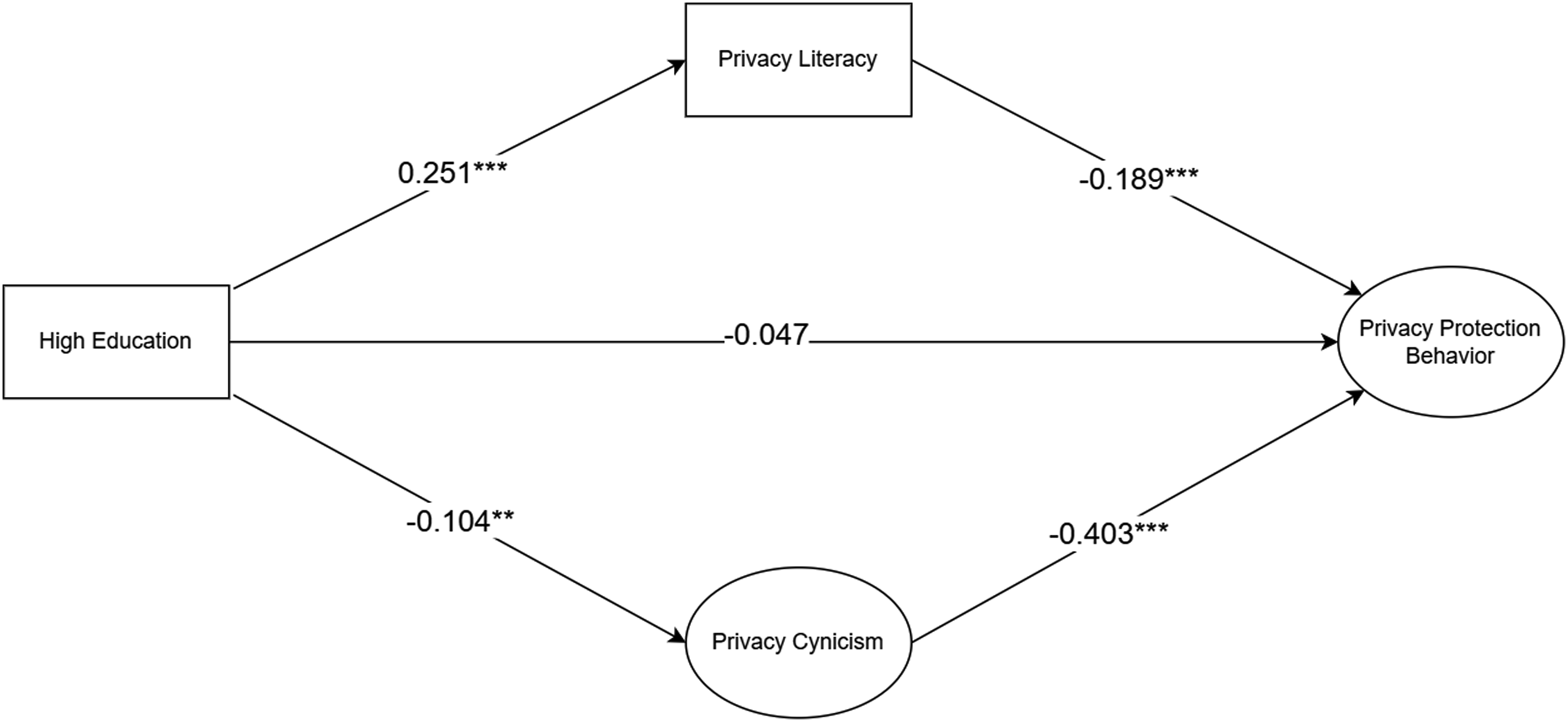
Implications
Our findings have implications for different stakeholders. For fellow researchers, we make a theoretical contribution that connects privacy research, which often operates with a psychological scope, with digital inequality research, which is more rooted in sociology. Thus, we provide an interdisciplinary contribution, showing how bringing together different schools of thought can be useful. It is relevant to note that the study is one of the first to look at the social structure of privacy cynicism, thus heeding the calls by Draper et al. (2024) and Hoffmann et al. (2024) to connect scholarship on privacy (cynicism) more strongly to digital inequality.
For users, our findings show drivers of privacy protection behavior and privacy cynicism. When it comes to privacy protection behavior, users might reflect on the importance of privacy and its protection more strongly. Items PPB.7 (Cover the camera of my devices) and PPB.8 (Turn off access to my device’s microphone) had particularly skewed values and low frequencies. Given the increased integration of sensors and Internet-of-Things devices into our daily lives, reflecting and acting on less obvious but intrusive streams of data collection and privacy risks (such as visual or audio data) might make users feel more aware, in control, empowered and eventually more willing to protect their privacy (van Deursen et al., 2022). However, we should avoid the trap of only relying on user self-responsibilization (Obar, 2015).
Indeed, our results may suggest the existence of some structural limitations that prevent users—even those with high literacy—to gain tangible benefits from protective behaviors. The challenging result concerning the negative effect of privacy literacy on protective behaviors signals a knowledge-action gap that has to be filled. From this point of view, interventions aimed at reducing cynicism among users without facing these structural limitations may result in ineffectiveness. Therefore, data collectors and policymakers have an important role to play as well. Data collectors should make privacy protection easy, accessible, and not hidden or inconvenient. Thus, privacy-by-design should become more prioritized, and this could lower users’ privacy cynicism. 2 Policymakers should communicate more clearly what privacy rights users have and—maybe even more importantly—how they can have them enforced. This comprehends rights enshrined in the GDPR such as the right to erase or the right to access their own data. Urgent measures should also include technological solutions, such as privacy-enhancing technologies and privacy-by-design, as well as legal solutions in the form of stringent data protection laws (Tamò-Larrieux, 2018).
Finally, educators could put privacy more strongly on their curricula and agenda. On the one hand, we found that those with higher education are less cynical about their privacy. These results align with the digital inequality literature, especially research on the third-level digital divide and the compound nature of inequalities (van Deursen et al., 2017), so that those who are more disadvantaged tend to be more at risk. The indirect effects also suggest that higher education, through privacy cynicism, can boost privacy protection behavior. Privacy should be conveyed as relevant and fun, so that students and children from a young age learn about its importance. On the other hand, even if awareness could not currently translate directly into beneficial action because of structural problems, the important function of media education remains that of cultivating the conditions for media reforms in younger generations (Buckingham & Sefton-Green, 1997).
Limitations and Future Research
Our study has limitations that point to avenues for future research. First, while our analysis relied on large-scale, current and high-quality data, we conducted the survey in Italy. Thus, our conclusions might not apply to other countries, especially countries with a different Internet eco-system or education system such as those in the Global South. Future research should study the social structuration of privacy protection behavior, the role of education, privacy literacy, and privacy cynicism in other countries. Comparative studies would be particularly fruitful. Second, our survey is cross-sectional, so that strong causal claims cannot be made. Future research could employ longitudinal design such as panel studies or experiments. However, manipulating central variables in our study such as privacy literacy and privacy cynicism might turn out to be challenging. Thus, qualitative and narrative accounts are very useful too.
Third, our measure of privacy protection behaviors primarily captures active engagement, such as the use of privacy-enhancing technologies, or conscious opt-out choices, for example, refusing cookies when accessing a website. However, privacy protection can also take more subtle forms. For example, we may have overlooked the “chilling effects”, where individuals safeguard their privacy through less visible actions—such as restricting the personal information they share or modifying search terms on sensitive topics—due to concerns about governmental and corporate surveillance (Büchi et al., 2020; Penney, 2017). Our specific measurement approach may have influenced the findings, particularly the unexpected negative relationship between privacy literacy and protection behaviors.
Finally, due to space constraints and our scope, we could not include all potential antecedents of privacy protection behavior. For example, situational or contextual aspects such as specific Internet use modalities could not be integrated. Future research should include context-specific data collections with different contextual integrity norms (Nissenbaum, 2010), for example, in areas such as education, healthcare, and work.
Supplemental Material
Supplemental Material - Lower Cynicism, Not Higher Literacy, Promotes Protective Behavior: Exploring the “Privacy Exception” in the Digital Inequality Framework
Supplemental Material for Lower Cynicism, Not Higher Literacy, Promotes Protective Behavior: Exploring the “Privacy Exception” in the Digital Inequality Framework by Chiara Respi, Marco Gui, Gaetano Scaduto, Miriam Serini, Dario Pizzul, Tiziano Gerosa, and Christoph Lutz in Social Science Computer Review
Footnotes
Declaration of Conflicting Interest
The author(s) declared no potential conflicts of interest with respect to the research, authorship, and/or publication of this article.
Funding
The author(s) disclosed receipt of the following financial support for the research, authorship, and/or publication of this article: “The value of digital data: enhancing citizens’ awareness and voice about surveillance capitalism (V-DATA),” authorship, and/or publication of this article: this work was supported by the Fondazione Cariplo (Bando 2020, Ricerca Sociale: Scienza Tecnologia e Società).
Ethical Statement
ORCID iDs

Data Availability Statement
Supplemental Material
Supplemental material for this article is available online.
Notes
Author Biographies
References
Supplementary Material
Please find the following supplemental material available below.
For Open Access articles published under a Creative Commons License, all supplemental material carries the same license as the article it is associated with.
For non-Open Access articles published, all supplemental material carries a non-exclusive license, and permission requests for re-use of supplemental material or any part of supplemental material shall be sent directly to the copyright owner as specified in the copyright notice associated with the article.
