



Abstract
Digital disconnection has emerged as a response to constant connectivity and the perceived harms to well-being that technology overuse may cause in a digital society. Despite the apparent conflict with expectations of constant availability, there has been limited research on the role of social norms in individuals’ regulation of their digital media use. The present study applied a nuanced conceptualization of social norms—by differentiating referent groups (i.e., family, friends, and everyday contacts) as well as injunctive and descriptive norms—and examined the associations of disconnection and availability norms with disconnection behavior across two generations of digital media users. Drawing on an online survey based on a stratified population sample (N = 1163), we found perceptions of injunctive disconnection norms to differ across generations, with younger digital media users perceiving digital disconnection but also availability to be more important to their social environment. This conflict of contradictory norms was also reflected in an interactional effect on own disconnection behavior in this group, where positive correlations between disconnections norms and behavior were countered by availability norms. Overall, our findings demonstrate the social complexity of the individual decision to (dis)connect and, on the societal level, that social norms of disconnection are in transition with disconnection behavior becoming and being perceived as more and more important.
Digital media have become an integral part of many people’s everyday life, allowing them to be online and connected with others anytime and anyplace (e.g., Karsay & Vandenbosch, 2021; Vanden Abeele et al., 2018; Vorderer et al., 2017). One important driver of the constant use of digital media are social norms and expectations, specifically norms of social connectedness that come along with a feeling of pressure to be available to others (Bayer et al., 2016). Recent studies found that perceived availability pressure is related to increased communication load (Reinecke et al., 2017) and failure in self-control over one’s digital media use (Halfmann, 2021; Halfmann & Rieger, 2019). Such perceived overuse of digital media has been found to be accompanied by negative affect (Halfmann & Rieger, 2019), sleep disturbances (Thomée et al., 2011), and stress (Freytag et al., 2021; Karsay et al., 2019).
In light of the perceived negative consequences of digital media use to well-being, a public discussion has arisen about the need for digital disconnection, that is, a conscious self-regulation of digital media use (Nguyen, 2021; Vanden Abeele & Mohr, 2021). This discussion is, for instance, reflected in discourses on Instagram under the hashtag #socialmediadetox (Jorge, 2019), newspapers framing disconnection as a solution to digital media overuse (Vanden Abeele & Mohr, 2021), or self-help books on “digital minimalism” (Newport, 2020). Acknowledging its social relevance, digital disconnection is also gaining scholarly attention as demonstrated by recent special issues (e.g., Karsay & Vandenbosch, 2021; Lomborg & Ytre-Arne, 2021; Treré et al., 2020; Vanden Abeele & Nguyen, 2022). While this state of research provides insightful perspectives and maps a variety of motivations for disconnection (e.g., Baumer et al., 2013; Morrison & Gomez, 2014; Nguyen et al., 2021) as well as strategies to manage digital media uses (e.g., Light & Cassidy, 2014; Mannell, 2019; Nguyen, 2021), the role of social norms has been understudied thus far (cf. Luqman et al., 2018). This is surprising given that the question of (dis)connection is inherently a social one, as it directly relates to the management of social interactions and expectations of others, and apparently conflicts with social norms of availability: Media users that digitally disconnect might meet social norms of a more conscious digital media use and expectations of being more present in face-to-face interactions, but at the same time violate availability norms toward digital contacts.
The present study aims to provide a detailed understanding of social norms of digital disconnection, their influence on disconnection behavior, and their interaction with availability norms. Drawing on social norms theory and an online survey of Swiss digital media users (N = 1163), the article makes two contributions in addition to the analysis of conflicting social norms. First, to reflect on the complexity of social norms toward digital media use, the present study connects to the most recent social norms research (Legros & Cislaghi, 2020; Shulman et al., 2017) and differentiates between descriptive and injunctive norms as well as different referent groups, that is, family, friends, and everyday contacts. This is complementary to the current state that has conceptualized social norms about digital media use in terms of a rather unspecified perceived social pressure (e.g., Halfmann, 2021; Reinecke et al., 2017). Second, while studies on digital media use has often focused on younger media users (e.g., Luqman et al., 2018), we take into account that the question of digital (dis-)connection and the role of norms in this regard is contingent on digital socialization (Reinecke et al., 2017) and examined the associations between norms and digital disconnection between younger and older digital media users.
Digital Disconnection
Digital disconnection is often discussed in response to the widespread permanent use of digital media in many societal groups and domains. Digital media encompass devices and a range of Internet-based services, such as social media (i.e., social networking sites and instant messengers), as well as information, entertainment, and commercial services (see also Dienlin & Johannes, 2020).
The use of digital media can have both positive and negative effects on well-being (Büchi, 2021; Dienlin & Johannes, 2020; Meier & Reinecke, 2021). Digital well-being can thus be conceptualized as the “state of optimal balance between connectivity and disconnectivity” (Vanden Abeele, 2021, p. 932). Recent scholarship has called for a nuanced perspective on the association between digital media use and well-being (Schneider et al., 2021; Vanden Abeele, 2021). It is striking, however, that, according to their own experiences, crucial parts of the population perceive an imbalance between connectivity and disconnectivity. This is not only reflected in the public discourse but also in surveys of digital media users. A U.K. report found that 41% of Internet users feel they spend too much time online (Ofcom, 2016), and, in a representative Swiss sample, 27% agreed with the statement that they spend more time online than they would like (Büchi et al., 2019). As a consequence, digital media users try to regulate their own digital media use—three in four adults occasionally disconnect from digital media according to a study of Swiss digital media users (Comparis, 2018).
Digital disconnection refers to practices of the voluntary and reflective non-use of digital media for varying periods of time and can take different forms in everyday life (Vanden Abeele & Mohr, 2021, pp. 1538–1539). Disconnection can be practiced as general refusal of digital technologies, which is different from non-use due to reasons that go beyond one’s control (Portwood-Stacer, 2013). People may also engage in “digital detox interventions” as a form of disconnection pertaining to a period of time during which a person refrains from using digital devices or online services such as social media (Radtke et al., 2021; Syvertsen & Enli, 2020). However, as digital media have “become a core part of the ‘kit’ that is necessary for contemporary life” (Bayer et al., 2016, p. 129), people may rather employ a range of micro-strategies to selectively limit their connectivity, such as turning off notifications, using do-not-disturb functions, and adjusting privacy settings (Light & Cassidy, 2014; Mannell, 2019; Nguyen, 2021). Given that longer breaks from digital media might not be feasible or desirable in everyday life in today’s digital society, the present study conceptualizes digital disconnection as the conscious self-regulation of digital media use through strategies that selectively limit users’ connectivity.
Social Norms of Digital Media Use
With the increasing public attention to digital disconnection, social norms toward digital media use have emerged that define disconnection as an effective and socially acceptable way to maintain well-being (Jorge, 2019; Valasek, 2021). At the same time, we live in a social structure where being available is a ubiquitous norm defining anytime, anyplace connectivity as a typical and socially approved phenomenon (Bayer et al., 2016; Ling, 2014). Both disconnection and availability norms are likely to be correlated with digital disconnection behavior in contrary ways.
The influence of social norms on individual behavior has been theoretically well-established, most prominently, in the theory of planned behavior (TPB; Ajzen, 1991), the focus theory of normative conduct (FTNC; Cialdini et al., 1990), and the theory of normative social behavior (TNSB; Rimal & Real, 2005). Compared to the latter two, the TPB is a more general behavioral theory that considers attitudes (i.e., the subjective overall evaluation of the behavior) and perceived behavioral control (i.e., the individual’s perception of the extent to which performance of the behavior is easy or difficult) as behavioral predictors next to social norms (Ajzen, 1991). Social norms have been conceptualized as subjective norms in the TPB, that is, the perceived social pressure from significant others. Complementary to the TPB, the FTNC and TNSB focus on social norms and their behavioral influences; these theories have established the differentiation between descriptive and injunctive norms to uncover distinct nuances of normative influences. Descriptive norms refer to perceptions of what is done (Cialdini et al., 1990), while injunctive norms pertain to perceptions of what ought to be done and thus show some parallels to the concept of subjective norms (Cialdini et al., 1990). Descriptive norms are influential as they indicate what an effective action is (“information-based influence”), and injunctive norms influence behavior because of people’s motivation for affiliation with relevant others (“affiliation-based influence,” Lapinski & Rimal, 2005). The distinction between descriptive and injunctive norms has been proven meaningful (e.g., Park & Smith, 2007), is commonly applied in contemporary social norms research (Legros & Cislaghi, 2020; Shulman et al., 2017), and is also considered crucial in the present study.
Disconnection Norms
Descriptive and injunctive norms refer to perceptions about behaviors in specific reference groups. In the context of disconnection, especially friends and family serve as relevant reference groups whose norms provide orientation for the individual, as they are people whom one trusts and identifies with (Legros & Cislaghi, 2020; Shulman et al., 2017). Thus, friends’ and family’s digital media use practices, including disconnection behaviors and respective attitudes, convey the information that the conscious regulation of digital media use might be “a sensible thing to do” (Cialdini et al., 1990, p. 1015). In the specific case of digital disconnection during in-person meetings, friends and family are supposed to be especially important in normative influences as disconnecting from digital media implies interacting more attentively with them face-to-face. Supporting this idea, research found that “phubbing,” the use of the smartphone in copresent interactions, is not socially accepted and that perceived phubbing norms in the personal environment affect individuals’ phubbing behavior (Leuppert & Geber, 2020; Schneider & Hitzfeld, 2021).
While there is strong accumulative evidence on behavioral influences of social norms across a variety of behavioral domains (Manning, 2009; Rhodes et al., 2020), empirical evidence on social norms and disconnection behavior is scarce. Initial empirical evidence found subjective norms, that is, perceived social pressure from important others to stop using social networking sites (SNS), to be correlated with users’ intention to disconnect from SNS (Luqman et al., 2018), but does not reflect the different nuances of social norms as discussed, especially the meaning of different reference groups. It is very likely that for some digital media users the friends and for others the family might be the more relevant reference group. Thus, the distinct analysis of social norms of varying reference groups promises to be insightful, especially when it comes to generational differences in associations between norms and digital media use. Applying a nuanced conceptualization of norms differentiating friends and family norms, we hypothesize that:
Perceived norms of disconnection (i.e., descriptive and injunctive norms) of the family and friends are positively correlated with disconnection behavior.
Availability Norms
Availability norms, on the other hand, refer to perceptions about the prevalence and social approval of being available anytime and anywhere. With regard to these norms, everyday contacts—the friends and family members with whom one is in regular contact—are the most relevant referents, as being not accessible heavily affects these contacts by disrupting their ability to coordinate and interact with the person in question (Ling, 2014). To cover the meaning of availability norms comprehensively, we again differentiate between perceptions about descriptive and injunctive availability norms (Cialdini et al., 1990). Perceived descriptive availability norms refer to the perception that everyday contacts are permanently available, and perceived injunctive norms to the perception that everyday contacts find it important to be constantly available. As perceptions of availability norms primarily refer to the people one is in contact with and the specification of the social relationship is only of secondary importance, no distinction is made here between friends and family.
It is likely that these availability norms are associated with disconnection behavior in two ways. First, it is plausible that they are negatively correlated with disconnection efforts, because to meet norms of availability, people need to stay online and connected and thus cannot engage in disconnection behavior. We thus state that:
Perceived norms of availability (i.e., descriptive and injunctive norms) of everyday contacts are negatively correlated with disconnection behavior. Second, we assume that availability norms interact with disconnection norms in the sense that they mitigate the positive association between disconnection norms and behavior: The more people perceive that their everyday contacts are permanently available and have reciprocal expectations, the smaller the positive correlation between perceived disconnection norms and disconnection behavior. Interestingly, a recent qualitative study by Ytre-Arne et al. (2020) found that, facing rapid technological change, digital media users experience “tensions between different norms for phone use” (p. 1727), reflecting the idea about conflicting normative influences. Thus, in light of the theoretical considerations and the initial empirical evidence, we state that:
The positive correlation between perceived disconnection norms and disconnection behavior is mitigated by perceived norms of availability.
Generations of Digital Media Use
People from different generations have different experiences regarding the adoption of digital media into their lives (Taipale et al., 2017). The most crucial differentiation of generations in this regard is the one between the younger generation of digital media users who have grown up in a technology-rich environment, also referred to as Digital Natives, and the older generation who is learning and adopting new technology, known as Digital Immigrants (Prensky, 2001). The core idea of generations of digital media users relates to cohorts of individuals born at a similar time with corresponding formative technology experiences. More specifically, following Prensky (2001), the younger generation of digital media users comprise people born after the 1980s who were exposed to digital technologies at a very early stage of their lives (i.e., Digital Natives), while the older generation represent individuals who were born before the 1980s and thus before the existence of digital technology (i.e., Digital Immigrants). Although members of the older generation are users of digital devices or information and communication technology, they started using these digital devices and technologies during their adult lives. Studies distinguishing between younger and older generations of digital media users reveal generation gaps in various technology-related dimensions, such as attitudes toward technology, use patterns of technology, and digital skills (Ahn & Jung, 2016; Kesharwani, 2020). Overall, these studies suggest that the generational perspective is instructive and allows learning about the transformative potential of the ongoing digitalization of the media environment.
Having said this, we note that there is a body of academic research that has questioned the validity of the distinction between Digital Natives and Digital Immigrants and the underlying digital native concept (e.g., Helsper & Eynon, 2010). This is because Digital Natives also reveal significant differences in their digital skills and thus should not be regarded as a homogenous group in this regard (e.g., Hargittai, 2010), but also because it is not clear what the actual factor behind “nativeness” is—age, experience, or expertise (Helsper & Eynon, 2010). In addition, generation labels can promote stereotypes because they encourage assigning a distinct character to generations (Cohen, 2021). Given this criticism on the one hand and the state of research demonstrating generational gaps on the other, this study applies the differentiation between younger and older generations of digital media users but refrains from using the labels of Digital Native and Digital Immigrants. We acknowledge that the differentiation between younger and older generations only serves as a rough proxy that does not account for heterogeneity within the groups. Nevertheless, we expect such a proxy to be helpful in exploring whether there are significant differences in the digital society regarding the role of norms in digital media use.
It is very likely that younger and older digital media users differ in their perceptions of disconnection and availability norms and the extent to which they align their disconnection behavior with such normative perceptions. In this regard, the differentiation and distinct analysis of social norms of varying reference group promises to be particularly meaningful. Most social norms research focuses on young people (i.e., adolescents and young adults) and influences of perceived norms of their peers (Shulman et al., 2017), because of the high importance of peer acceptance among young people. The family, on the other hand, might become a more relevant reference group in older groups. Interestingly, in the context of digital media use, Nguyen et al. (2021) concluded that technology experiences reported in qualitative interview by older adults are not that different from those of younger users. At the same time, they identified some disconnection practices which had to do with influences from family members. A quantitative survey among Internet users, on the other hand, found perceived social pressure from friends to be stronger correlated with the communication patterns of younger digital media users than older users (Reinecke et al., 2017). Overall, these studies suggest that a generational perspective on the role of social norms in digital media use can reveal differences across generations. We thus pose the following question:
Are there differences in the perceptions of disconnection and availability norms (RQ1a) and in the correlations between these norms and disconnection behavior (RQ1b) between generations of digital media use?
Methods
Procedure and Sample
The present analysis of social norms of digital disconnection was part of a larger project on disconnection strategies (Nguyen et al., 2022), in which we conducted an online survey in Switzerland. Ethical review for this study was waived by the authors’ university on the basis of an ethics checklist for research involving human beings. For data collection, we contracted with the social and market research company Bilendi, which is committed to the ethics and guidance code of the European Society for Opinion and Marketing Research (ESOMAR).
The data collection was conducted from November 11 to 14, 2020. Members of the research panel received an email invitation to participate in a survey on “digital media use in everyday life” in exchange for a financial compensation (2 CHF). Quotas were set for age, gender, and education level to ensure a diverse sample.
Sample Characteristics (Demographics and Digital Experience).
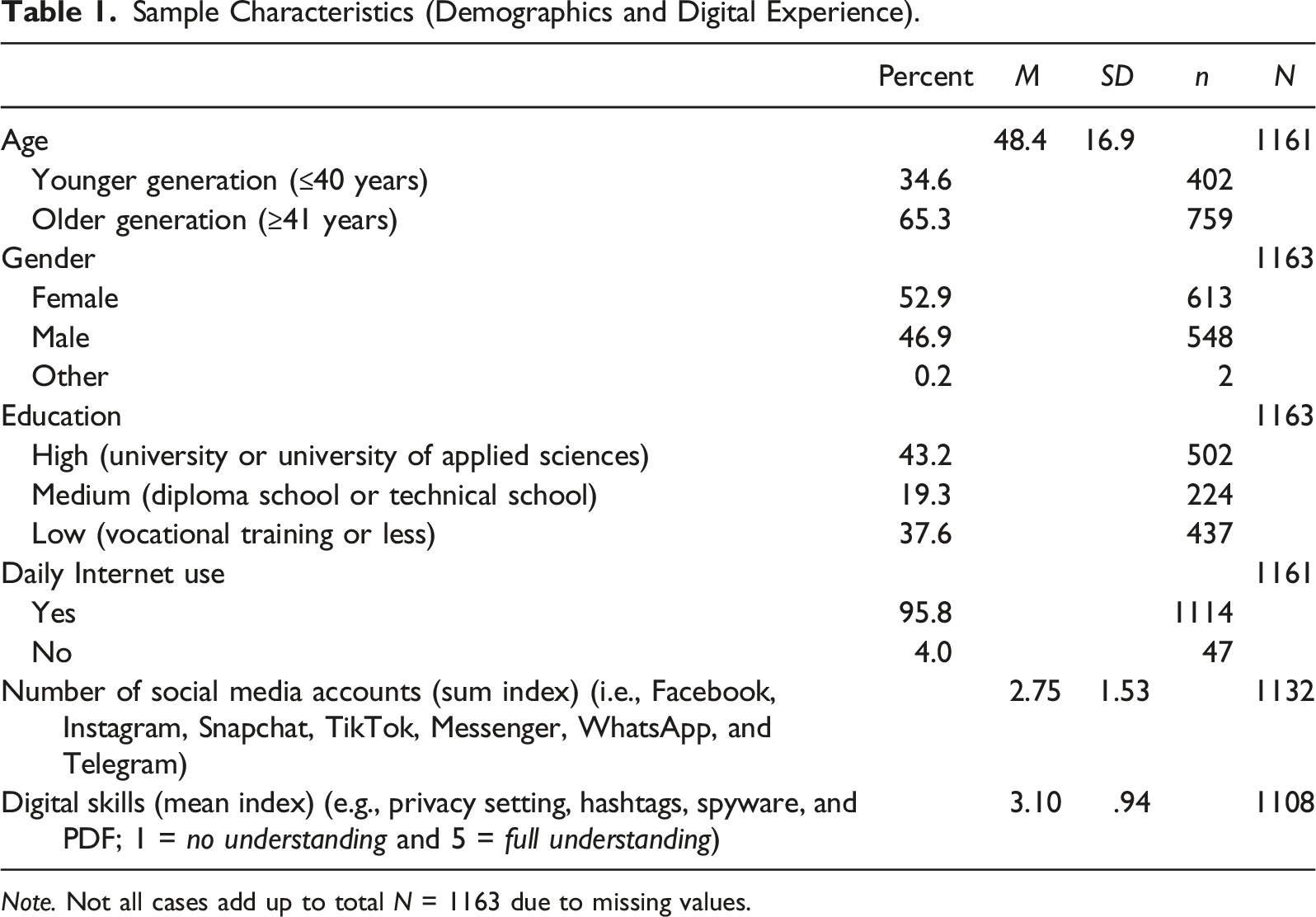
Note. Not all cases add up to total N = 1163 due to missing values.
Measures
Disconnection Behavior
We measured disconnection behavior by asking participants: “Overall, how often do you use strategies to regulate your digital media use?”, with answer options ranging from 1 (never) to 5 (always; M = 2.57, SD = .99). We provided a list of disconnection strategies beforehand to give an idea of what disconnection can look like in everyday life (e.g., turning off notification of social media accounts, putting digital devices away when being engaged in other activities, and deleting or deactivating accounts from websites and apps; for more details, please see Nguyen et al., 2022).
Social Norms of Digital Media Use
We measured social norms of digital media use—friends’ disconnection norms, family’s disconnection norms, and everyday contacts’ availability norms—with one item each for descriptive and injunctive perceptions, thus six items in total. The item for descriptive norms measured the perceived share of people within the reference group showing the behavior (“What do you think, how many of people of…”, scale: slider ranging from 0% to 100%), and the item for injunctive norms captured the perceived importance that others ascribe to the behavior (“What do you think, how important is it to people of…”, scale: 1 = not important at all and 7 = very important). This wording meets the core of the concepts’ meaning of perceived prevalence (descriptive norms) and social approval of a behavior (injunctive norms; Cialdini et al., 1990; Lapinski & Rimal, 2005) and is comparable to one-item measures that have been applied in previous surveys (e.g., Geber et al., 2021; Siegel et al., 2022).
Friends’ Disconnection Norms
More specifically, to assess friends’ descriptive disconnection norm, we asked participants about their perception of how many people in their circle of friends and acquaintances use strategies to regulate their digital media use (M = 37.09, SD = 22.23). To measure friends’ injunctive disconnection norm, we asked participants what they think how important it is to people from their circle of friends and acquaintances to regulate their digital media use (M = 3.51, SD = 1.54).
Family’s Disconnection Norms
We measured family’s disconnections norms by asking participants to indicate what they think how many of their family members (again in percentage) use strategies to regulate their digital media use (family’s descriptive disconnection norm, M = 34.44, SD = 26.56) and how important it is to their family members to regulate their digital media use (family’s injunctive disconnection norm, M = 3.69, SD = 1.72).
Everyday Contacts’ Availability Norms
We defined everyday contacts as friends and family members with whom one is in regular contact and measured the perceived descriptive availability norm by asking respondents what they think how many of their everyday contacts are always available using the metric percent slider (M = 56.65, SD = 27.02). To measure the perceived injunctive availability norm, we asked participants to assess the item “My everyday contacts find it important that I am always available” on a 7-point Likert scale (M = 3.29, SD = 1.64).
Generations
To divide survey participants into meaningful groups of younger and older digital media users, we applied the definition of Digital Natives/Immigrants by Prensky (2001). The younger generation comprised participants born since 1980 who were aged between 16 and 40 at the time of data collection. They made up 35% of the sample (n = 402). The older generation encompassed participants born before 1979, who were aged between 41 and 97 years and accounted for 65% of the sample (n = 759).
Control and Descriptive Variables
Demographics
The survey included the gender options female, male, and other, which we recoded into a female category (1 = female and 0 = others). For education level, we asked respondents to report their highest level of school completed out of 13 options ranging from not having completed primary education to having completed a university degree. These options were recoded into three categories for the sample description: high = university or university of applied sciences, medium = diploma school or technical school, and low = vocational training or less. For the main analysis, we recoded the three categories into two dummy variables (i.e., high education vs. low and medium vs. low).
Attitude and Perceived Behavioral Control
Following the proposition of the TPB that, in addition to social norms, attitudes toward disconnection behavior and perceived control to perform digital disconnection are behavioral correlates, we integrated both components as control variables to contextualize and isolate the correlations between social norms and disconnection behavior. In line with common measures (Ajzen, 2011), we measured the attitude toward disconnection behavior with the item “I find it important to regulate my digital media use” (M = 4.53, SD = 1.78) and perceived behavioral control with the item “It’s easy for me to regulate my own digital media use” (M = 4.84, SD = 1.65), both on a scale ranging from 1 (do not agree at all) to 7 (fully agree).
Digital Experience
We included three variables to describe the experiences with digital media of the two generations. First, one variable measured daily Internet use with 1 = yes and 0 = no (M = .96; SD = .02). Second, we asked participants whether they had an account for a series of social media and messenger platforms that they used at least sometimes (i.e., Facebook, Instagram, Snapchat, TikTok, Messenger, WhatsApp, and Telegram; 1 = yes and 0 = no), which we summed up in an index ranging from 0 = none of the accounts to 7 = all the accounts (M = 2.75, SD = 1.53). Third, we asked participants about their digital skills (Hargittai, 2020). Specifically, participants ranked their level of understanding of a set of 12 Internet- and social media–related terms (such as privacy setting, hashtags, spyware, and PDF), each on a scale ranging from 1 (no understanding) to 5 (full understanding). We combined the items in a mean index (Cronbach’s alpha = .91; M = 3.10, SD = .94).
Data Analysis
To address the research question RQ1a about generational differences in perceptions of social norms, we did one-way analyses of variance (ANOVAs), with the two generational groups as independent variable (IV) and the normative perceptions as dependent variables (DVs). If the Levene test indicated that the groups did not have equal variances, we used the non-parametric Kruskal–Wallis test instead of the ANOVA.
Zero-Order Correlations for the Study’s Constructs.
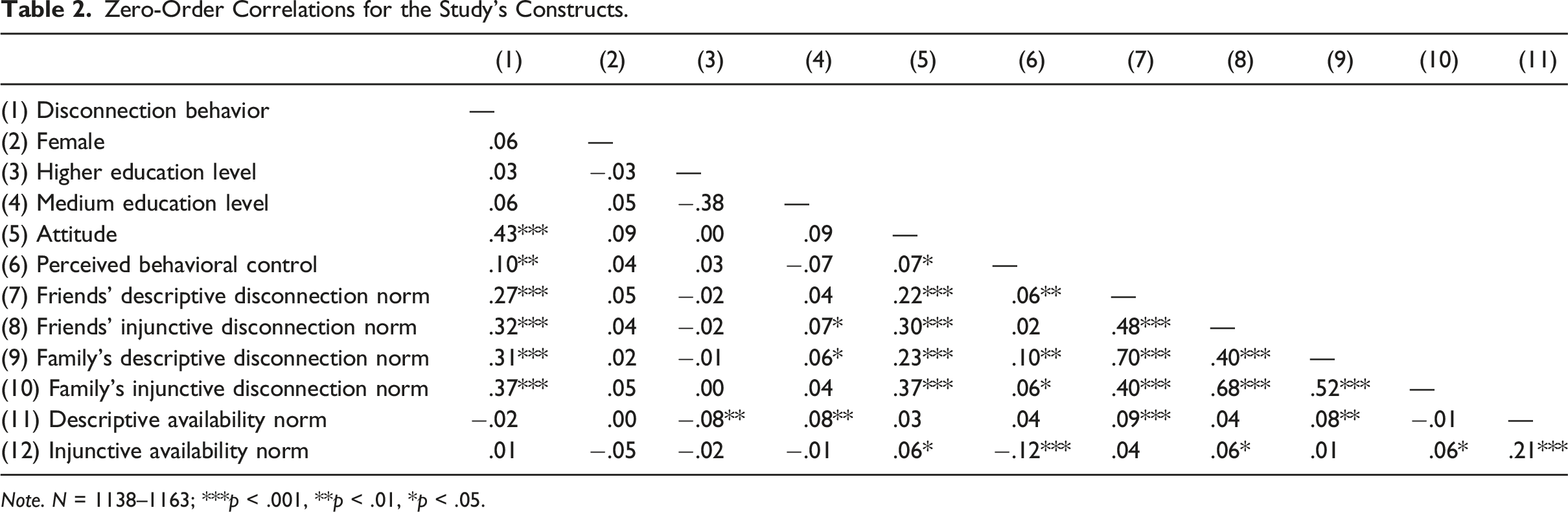
Note. N = 1138–1163; ***p < .001, **p < .01, *p < .05.
H3 was tested by adding interaction terms between disconnection and availability norms to the regression models. The differentiation between descriptive and injunctive dimensions of disconnection and availability norms in combination with the friend/family distinction of disconnection norms resulted in eight interaction terms 1 . To avoid multicollinearity among interaction terms, we tested them stepwise, meaning that we only included one interaction term to the multiple regression model at a time.
We performed all analyses in R (R Core Team, 2021) and used the jtools package to plot and probe the interaction effects (Long, 2020). The data and analysis code are shared on the Open Science Framework (link: https://osf.io/26wt7/).
Results
Means and Standard Deviations Across Generations.
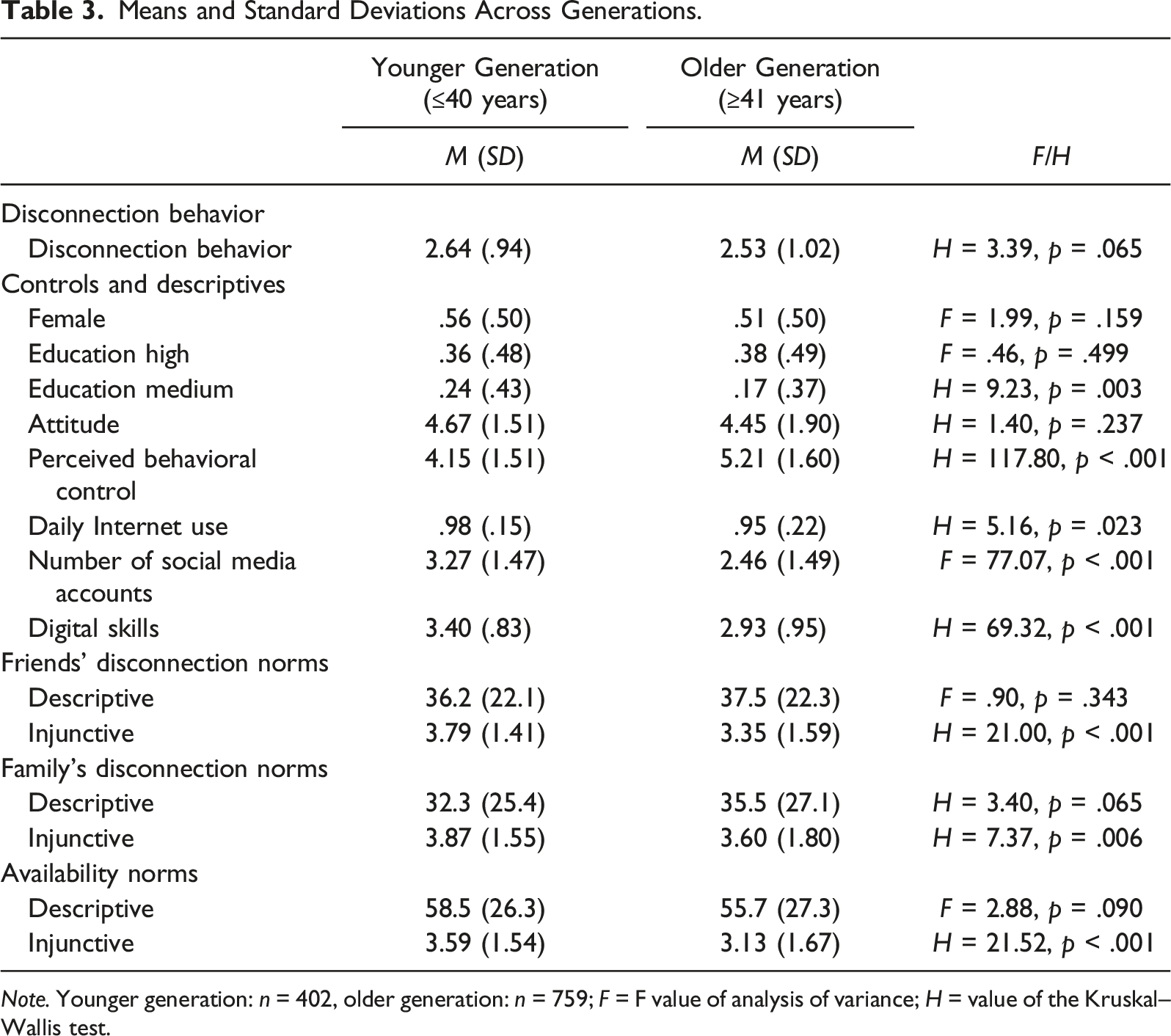
Note. Younger generation: n = 402, older generation: n = 759; F = F value of analysis of variance; H = value of the Kruskal–Wallis test.
Associations Between Social Norms and Disconnection Behavior Across Generations.
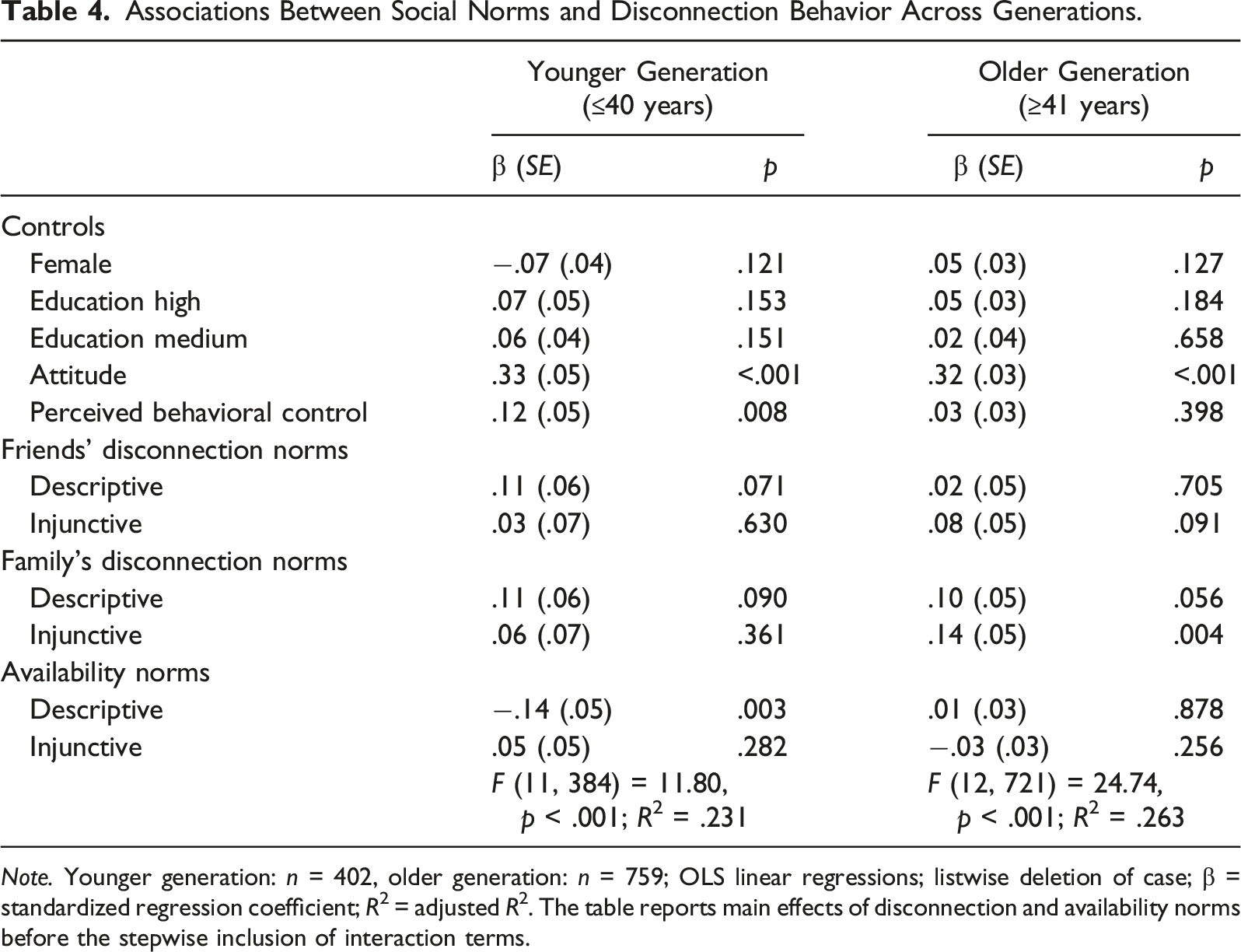
Note. Younger generation: n = 402, older generation: n = 759; OLS linear regressions; listwise deletion of case; β = standardized regression coefficient; R2 = adjusted R2. The table reports main effects of disconnection and availability norms before the stepwise inclusion of interaction terms.
With regard to H2, we found support for negative correlations of availability norms among younger but not older digital media users, which again highlights generational differences (RQ1b). The more the youngest digital media users perceived that their everyday contacts were constantly available (i.e., descriptive availability norm), the less they used strategies to disconnect from digital media.
The test of H3 revealed an interaction between disconnection norms and availability norms only for the younger generation: The association between the friends’ injunctive disconnection norm and individual disconnection behavior depended on the perceived injunctive availability norm (β (SE) = −.11 (.04), p = .009, ΔR
2
= .012). The interaction plot and Johnson-Neyman plot illustrate this moderation effect (Figure 1): Only when participants perceived a relatively low injunctive availability norm (≤1.60 on a 7-point scale), the perceived injunctive disconnection norm among the friends was associated with more frequent disconnection. This was the case for about 10% of the younger digital media users in our sample who responded to the question about injunctive availability norm on a 7-point scale with 1. In cases of perceptions about higher availability expectations, disconnection norms were not significantly correlated with the use of disconnection strategies. Moderation of the correlation of friends’ injunctive disconnection norm with disconnection behavior by injunctive availability norm. Note. Younger generation: n = 396; β (SE) = −.11 (.04), p = .009, ΔR
2
= .012. A. Interaction plot: slope of friend’s injunctive disconnection norm when (a) injunctive availability norm = −1SD: β (SE) = .08 (.05), p = .09; (b) injunctive availability norm = 1SD: β (SE) = −.05 (.05), p = .33. B. Johnson-Neyman plot: when injunctive availability norm is outside [1.60, 7.64], the slope of friend’s injunctive disconnection norm is p < .05.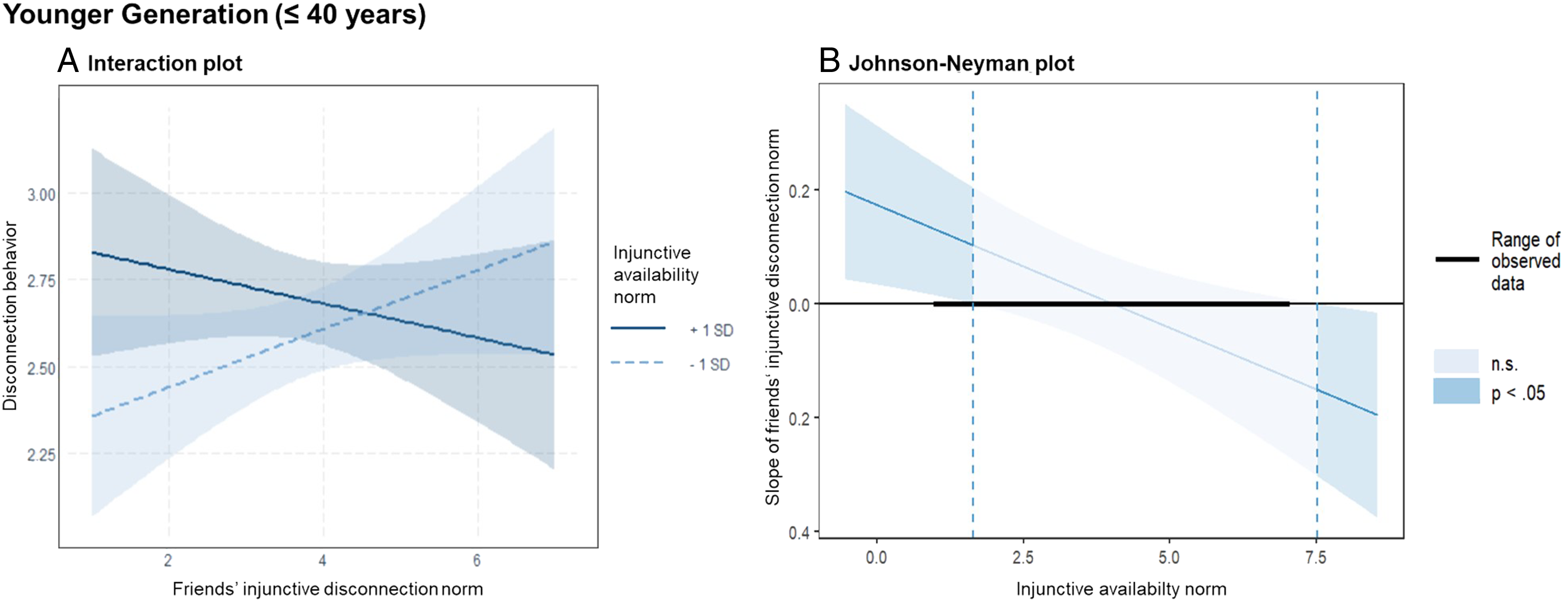
As for the control variables, our results showed that gender and education level played no significant role in disconnection behavior. The attitude toward disconnection, on the other hand, was an important correlate of digital disconnection in both generational groups, and perceived behavioral control was correlated with disconnection behavior among younger digital media users.
Discussion
Drawing on a survey of 1163 Swiss digital media users, this study examined associations between social norms and people’s digital disconnection behavior across generations. We built on theoretical frameworks of normative influences and looked at how different dimensions of norms of disconnection practices (i.e., descriptive and injunctive) and different reference groups (i.e., friends and family) covaried with people’s own self-regulation of digital media use in everyday life. Moreover, we examined how conflicting norms of constant availability and norms of digital disconnection interacted in their associations with disconnection behavior.
Overall, our study suggests that, though digital disconnection is discussed as a growing trend in the public and academic discourse (Karlsen, 2020), it has not (yet) affected digital media use in daily life substantially. The respondents of our survey reported to apply disconnection strategies not on a regular basis but rather from time to time. Furthermore, disconnection behavior was not perceived as a majority norm and as being of significant importance to friends and family. Nevertheless, the results reveal some interesting differences between the younger and older generation regarding their normative perceptions as well as in the correlations between those disconnection norms and their regulation of digital media. In what follows, we will first discuss generational differences as inquired about in RQ1 and then highlight overall patterns.
Generational Patterns
Before turning to social norms of digital media use, we note that our study confirmed differences between younger and older generations in several technology-related dimensions that speak to the meaningfulness of this generational distinction (Prensky, 2001) and that are in line with previous studies (Ahn & Jung, 2016; Kesharwani, 2020). While daily Internet use is a common pattern across these generations, the younger generation was found to have more social media and messenger accounts and to have higher digital skills than the older generation of digital media users.
Younger Generation of Digital Media Users
Younger digital media users differed from the older ones also regarding some normative aspects of digital disconnection. First, they perceived a higher injunctive norm of disconnection among friends and family and, at the same time, a higher injunctive norm of being available. Although these differences were not large, they proved to be statistically significant and thus speak to a specific characteristic of this generation. The finding of relatively high perceived disconnection and availability norms at the same time confirms the experience of ambivalence in digital media use as identified in qualitative interviews with digital media users (Ytre-Arne et al., 2020). It is notable that this normative conflict is also reflected in the interaction between influences of friends' disconnection norms and everyday contacts’ availability norms. This interaction shows that disconnection norms only unfold their positive effects on disconnection behavior in cases of very low perceived availability expectations; otherwise, the positive effect of disconnection norms is overridden by perceived expectations of availability. In addition to this interaction, we found that descriptive perceptions about disconnection behavior among everyday contacts reduced disconnection behavior. Together, these normative influences suggest that for young people, whose everyday lives are deeply interwoven with technology as some feel they should be constantly available, the perceived benefits of being connected largely outweigh those of being disconnected.
Although not the main research question of this study, the significant effect of perceived behavioral control on disconnection behavior is noteworthy and provides a more comprehensive picture of the disconnection behavior among younger digital media users. While perceived control over the performance of digital disconnection is the lowest in this group, it is a significant predictor, suggesting that digital disconnection is not only a normative and attitudinal question but also a question of self-control in this generation (Halfmann, 2021).
Older Generation of Digital Media Users
Older digital media users differed from younger users regarding the significance of family norms. While in the younger generation, the disconnection norm of friends was influential, the disconnection behavior of this group was correlated with injunctive and descriptive disconnection norms of the family (though we note that the effect of the descriptive norm slightly missed the significance level). The more important disconnection was perceived to be to their family, the more frequently they used disconnection strategies. This is in line with the finding of Nguyen et al. (2021), according to which, among older users of digital media, the family sphere (e.g., children and grandchildren) plays part in their motivation to disconnect from digital media. Given that many in this age group may have been parents or grandparents, this finding could also be related to parental mediation, that is, strategies “to mitigate the negative effects that they believe communication media have on their children” (Clark, 2011, p. 323). More concretely, the results suggest that people belonging to the older generation want to serve as role models that adhere to the rules of digital media use which have been negotiated and set within the family. These rules might include the avoidance of family phubbing and define the non-use of digital media in copresent family interactions as a standard (Kadylak, 2020).
General Pattern
In general, normative perceptions and their behavioral relevance turned out to differ across generations, in terms of which is the relevant reference group and whether it is the availability or disconnection norm which is meaningful. Taken together, however, there is a notable general pattern: When it comes to disconnection, it seems that the injunctive norm aspect rather than the descriptive one is crucial. The generational differences in perceptions of injunctive norms suggest that the what-ought-to-be done aspect is currently in transition with disconnection being perceived as more and more desirable, while, on the other hand, the descriptive what-is-done component is more stable with disconnection being perceived as a minority behavior. In line with this observation, it was the injunctive disconnection norm that exerted influences on individual disconnection. The more important disconnection was perceived to be for friends (i.e., for the younger generation) and family (i.e., for the older generation), the more frequently people applied disconnection strategies in their own daily life. The findings suggests that disconnection is more and more perceived as the way how it should be done and that social influences on disconnection behavior are primarily morally driven but still need to counter availability norms. Thus, in a digital society where everyone is permanently online and permanently connected (Vorderer et al., 2017), disconnection seems to become less and less a question of what is done; it rather seems to become a question of what ought to be done and what is socially legitimized by the most important referents. More generally, this finding points to the importance of social expectations in a society where digital media are a taken-for-granted part of the social structure (Ling, 2012, 2014).
Implications
The role of social norms in the context of digital disconnection has received limited scholarly attention thus far. This is noteworthy, as regarding the permanent use of digital media—the flip side of digital disconnection—scholarship has moved the concept of norms of social connectedness and perceived social pressure into the focus of its theoretical (Bayer et al., 2016; Ling, 2014) and empirical investigations (e.g., Halfmann, 2021; Reinecke et al., 2017). This line of research suggests that because of the taken-for-grantedness of digital media as part of our social structure and the related social expectations, “we do not have the option to not use them” (Ling, 2014, p. 182). Complementary to this notion, the present study found availability norms to be correlated with disconnection behavior only among the youngest digital media users. Thus, the perception that everyday contacts expect us to be available did not systematically affect the decision to disconnect from time to time. To some extent, this finding refutes the idea that connectivity is without alternatives. However, at the same time, our results underline the importance of social expectations toward digital media use as they point to the crucial role of injunctive disconnection norms, indicating that disconnection becomes more and more socially legitimized in a digital society.
On a more general level, our findings suggest that the trend of digital disconnection makes it necessary to investigate different forms of social norms related to digital media use, including norms of disconnection and availability. To comprehensively understand such normative influences and their potential conflicts, research needs to apply a nuanced conceptualization of social norms with regard to reference groups (i.e., friends and family; Shulman et al., 2017) as well as dimensions of descriptive and injunctive norms (Cialdini et al., 1990). Our results demonstrate that such differentiations are insightful as we not only found different reference groups to vary in their roles, but also injunctive and descriptive norms to differ in their importance. We note that the significance of injunctive norms is—to a certain extent—a specific feature of disconnection behavior and the aforementioned discussed ubiquitous social expectations (Ling, 2014); however, it is also in line with the recent meta-analysis by Rhodes et al. (2020) on social norms appeals that found injunctive norms to be potentially more effective in changing behavior than previously thought.
Furthermore, the distinction between younger and older digital media users turned out to be meaningful and insightful as both generations not only differed with respect to their digital experience but also regarding perceptions and influences of norms of digital media use. At the same time, we note that not all variations that we found were most likely related to digital nativeness but were also discussed against the background of life phases and the related social settings (Helsper & Eynon, 2010). This suggests that future research should integrate more specific variables on people’s social context, such as family roles, as well as on time-based variations to complement the generational perspective and disentangle age, period, and cohort effects (Rudolph et al., 2021).
Limitations and Outlook
The study has four main limitations that need to be considered. First, while we applied a differentiated conceptualization of social norms that takes into account distinct norm dimensions (i.e., descriptive/injunctive) as well as reference groups (i.e., family, friends, and everyday contacts), the social norms were each measured by single items (as well as the control variables attitude and perceived behavioral control). The use of single-item measures has been criticized in the last decades, and it is only recently that scholarly discussion has pointed out that “single-item measures can provide valid and reliable assessments of important psychological phenomena” (Allen, Mark et al., 2022, p. 1). In the present case, the single items directly meet the core of the meaning of social norms by capturing respondents perceived prevalence and approval of digital disconnection and online availability (Cialdini et al., 1990). Thus, we believe that the use of single items was appropriate in the present study and that the analysis of these measurements has produced vital findings on a timely topic.
Second, the cross-sectional design of our study did not allow for testing causal effects of disconnection and availability norms on individual disconnection behavior. Though social norms theories such as the TPB (Ajzen, 1991) and the TNSB (Rimal & Real, 2005) suggest that social norms predict behavior, our data can only provide empirical evidence on associations between social norms and disconnection behavior. However, the primary aim of the study was to examine differences across generations in the behavioral relevance of social norms; thus, the causality issue does not affect the study’s main contribution. Nevertheless, it would be worthwhile to combine the cross-generational perspective with a longitudinal design to see how social norms toward disconnection develop over time in different societal groups and to test normative influences in terms of causality and temporality.
Third, the data was collected through an online panel. Online panels can be considered as having an above-average affinity for digital media which might have biased the results on digital disconnection and respective normative influences (Herzing & Blom, 2019). However, as the study’s primary aim was to learn about differences in normative influences on digital disconnection across generational groups, this limitation does not concern the study’s main aim (as it may have affected generations comparably). In this context, we also note that the study was conducted in Switzerland, which is characterized by high levels of digital media uptake with well over 90% of the population using the Internet (Festic et al., 2021). Thus, generalizations of the findings to regions with different digital infrastructures and cultures should be done with careful consideration. Future research on digital disconnection could focus on cross-national comparisons between countries with different digital infrastructures to understand how this can impact normative influences on disconnection behavior.
Fourth, it must be considered that the present study took place during the COVID-19 pandemic. For some people, the pandemic could have meant that they were less likely to disconnect, because they were more dependent on digital media. On the other hand, the increased uptake of digital media during this time could also have led to feelings of information overload, prompting people to consciously reduce their digital media use. The same might have applied to normative perceptions, meaning that digital media users may have perceived others to disconnect more or less often during this time. Thus, it is difficult to make assumptions about the extent to which our findings on normative perceptions and individual digital media use generalize to other circumstances. Nonetheless, we see no reason why the differences in normative influences across generations found in the present study should be substantially different in other times.
Conclusion
The present study examined associations between social norms and digital disconnection across generations, while considering conflicting norms of disconnection and availability. Injunctive disconnection norms turned out to be the most relevant social correlate of people’s conscious self-regulation of digital media, highlighting the importance of social expectations in a society where digital media is taken for granted (Ling, 2012, 2014). Conflicts between norms were found among the youngest in our sample, where positive associations between disconnection norms and behavior were countered by normative perceptions of having to be digitally available at all times. These findings suggest that the discussion on digital disconnection needs to continue, not only in the public but primarily in the social environment of digital media users. Perceptions that relevant others consider it important to digitally disconnect may increase the conscious self-regulation of digital media use and thus indirectly positive outcomes of such disconnection, such as improved subjective well-being (Franks et al., 2018; Nguyen, 2021). Ultimately, if we understand digital disconnection as an ongoing societal trend, research will need to monitor disconnection behavior, well-being, and the role of constantly evolving social norms in the long term.
Footnotes
Declaration of Conflicting Interests
The author(s) declared no potential conflicts of interest with respect to the research, authorship, and/or publication of this article.
Funding
The author(s) disclosed receipt of the following financial support for the research, authorship, and/or publication of this article: The authors are grateful to the Department of Communication and Media Research (IKMZ) and the Digital Society Initiative at University of Zurich for supporting the data collection.
