



Abstract
Social scientists often study comments on YouTube to learn about people’s attitudes towards and experiences of online videos. However, not all YouTube comments are relevant in the sense that they reflect individuals’ thoughts about, or experiences of the content of a video or its artist/maker. Therefore, the present paper employs Supervised Machine Learning to automatically assess comments written in response to music videos in terms of their relevance. For those comments that are relevant, we also assess why they are relevant. Our results indicate that most YouTube comments are relevant (approx. 78%). Among those, most are relevant because they include a positive evaluation of the video, describe a viewer’s personal experience related to the video, or express a sense of community among the video viewers. We conclude that Supervised Machine Learning is a suitable method to find those YouTube comments that are relevant to scholars studying viewers’ reactions to online videos, and we present suggestions for scholars wanting to apply the same technique in their own projects.
Introduction
People’s daily use of social media has made interpersonal communication via such platforms a frequently studied topic among social scientists. A specific focus within this research is the study of online user comments written on social media and on YouTube in particular. It has been shown, for example, that people’s attitudes towards and experiences of videos depend on the comments that accompany these videos (e.g., Hsueh et al., 2015; Möller et al., 2021; Shi et al., 2014; Waddell & Sundar, 2017; Walther et al., 2010; Ziegele et al., 2018). Other studies focused on how viewers use comments to converse about the content that they are watching (e.g., Dubovi & Tabak, 2020; Poché et al., 2017; Song et al., 2015).
One central challenge for researchers in this field is the sheer abundance of available social media comments. Research has shown that many of the available social media comments are not relevant to researchers or social media users as many comments might be spam created by bots, or just off-topic comments written by users (Poché et al., 2017). These irrelevant comments might require unnecessary processing and storage capacities, and can seriously bias study findings (Poché et al., 2017; Serbanoiu & Rebedea, 2013). It is thus indispensable for researchers studying social media comments to distinguish between relevant and irrelevant user comments. With “relevance” we refer to comments that reflect individuals’ experiences of, or opinions or thoughts about (the content of) a video, or the artist/maker of the video. Moreover, we consider a comment as relevant if the comment relates to the social experience of watching a video on a social media platform (e.g., referring to other users, asking for information).
Understanding the extent to which YouTube comments reflect viewers’ reactions to or experiences of videos is a necessary step if we want to advance our theoretical knowledge about online interpersonal communication on social media platforms. For example, various content analyses of YouTube comments detected the sentiment of comments to learn more about viewers’ opinions and attitudes (e.g., Siersdorfer et al., 2010; Song et al., 2015; Thelwall, Sud, et al., 2012). However, if we assume that large amounts of comments are irrelevant and not related to the respective video, sentiment analysis might falsely categorize these comments as meaningful and might draw a biased picture of the public opinion on the video. Hence, the first aim of this study is to explore the occurrence of relevant comments on YouTube. Moreover, we set out to develop specific categories of relevant comments.
As the number of comments present on YouTube is seemingly infinite, it is impossible to manually analyze even a small fraction. Therefore, this study employs a Supervised Machine Learning (SML) approach. In short, SML refers to a technique whereby a computer automatically categorizes texts. For example, Vermeer et al. (2019) used it to analyze online reviews and to automatically determine if a review required a company to write a response or not. SML has made its entrance as a popular research method in social sciences relatively recently (Baden et al., 2022; Breuer et al., 2020; Van Atteveldt & Peng, 2018). In an article identifying social scientists’ needs when it comes to the usage of computational techniques such as SML, Baden et al. (2022) have called for more resources and guidance in applying this relatively novel technique in their work. Replying to this call, the second aim of this study is to formulate a set of guidelines based on a detailed description of the steps taken in using SML to analyze YouTube comments that scholars can use for future research projects.
This study takes an exploratory approach by focusing on one popular genre of YouTube videos, namely, music videos. Music videos are the most popular form of videos on YouTube and trigger high user engagement (Liikkanen & Salovaara, 2015). In addition, by using SML, this study uses a method that is relatively novel within communication science in particular and for which the procedures are not as standardized as other more established methods in this field. Hence, this study explores how SML can best be used to analyze social media comments. By setting up guidelines for using SML to analyze YouTube comments, future scholars can use this method to investigate the relevance of YouTube comments written in response to videos other than music videos, such as news videos, product reviews, or vlogs, thereby moving beyond the exploratory nature of the current work.
The Importance of Studying Relevant User Comments on YouTube
User comments on social media provide a rich source of information about the opinions, sentiments, evaluations, and experiences of social media users (e.g., Thelwall, 2018). Particularly YouTube is characterized by its large number of public comments, and active user engagement in the comment section (Khan, 2017). YouTube comments have been previously studied to understand attitudes and opinions of users (Alhujaili & Yafooz, 2021), to examine user discourse about specific topics (e.g., Schneider, 2016), or to understand the influence of these comments on users (e.g., Möller et al., 2021; Walther et al., 2010). When conducting studies on user comments, it is indispensable to first identify and eliminate irrelevant comments as these might seriously bias study results.
From a social science perspective, the extent of irrelevant comments has not yet been studied. However, a few studies from computer science and related fields examined the extent of spam among user comments. For example, Dubovi and Tabak (2020) examined knowledge co-construction of science video comments. Of the 1530 comments in their manual content analysis, approximately 25% of comments were discarded as irrelevant (e.g., ads, spam). Similarly, Poché et al. (2017) automatically classified user comments of coding tutorials in respect to whether these comments are useful for the creator of the tutorials. In a first manual coding step, they found that only about 30% of the comments might provide useful information to the video creators, all other comments were coded as “miscellaneous” and “uninformative.” However, in their classification, Poché et al. (2017) also coded evaluative comments (e.g., “This video is trash”) as useless comments which might be considered useful in other contexts.
To further understand the degree of relevance of a comment, Serbanoiu and Rebedea (2013) proposed a relevance-based ranking of YouTube music video comments. In a first step, they removed all irrelevant comments using a neural network classifier. In this approach, textual features of each comment were used for the classification of relevancy. For example, it was assumed that spam comments have a higher number of capital letters, digits, and punctuation marks. By only using these textual features, they classified around 30% of comments as irrelevant. However, it is likely that such a solely text-based approach might erroneously classify relevant user comments as spam. For example, using the classification above, a comment such as “LOVE IT 4EVER!!!!!” might be classified as spam, although the comment does express a user’s genuine expression about the music video which makes it relevant for social scientists.
In sum, whereas scholars have previously worked on relevance detection of YouTube comments, this has led to varying results because different definitions of relevance were used in these studies (see Online Appendix A for an overview of various definitions of relevance used in the literature). These definitions were either specific to the context of the videos that were studied (e.g., comments are relevant if they are useful for the creators of tutorial videos; Poché et al., 2017) or based on the textual features of comments which limits our understanding of why comments are relevant (i.e., Serbanoiu & Rebedea, 2013). To further advance research on the usage and effects of user comments, a thorough understanding of the relevance of comments is required that can be applied to different types of videos and that can capture the different reasons why a comment may be relevant for social scientists to study.
Towards a Thorough Understanding of the Relevance of Comments
Although the studies discussed above provide useful information on the detection of irrelevant comments on YouTube, they do not further examine why comments can be relevant. We thus lack an understanding of the types of topics that users discuss in relevant comments. In the current study, we therefore set out to develop an initial categorization of relevant comment categories. To develop such a categorization, it is valuable to examine the motivations of users to post these comments. The Uses and Gratifications theory (Katz et al., 1973; Rubin, 2009) can be a useful framework for this. Specifically, it has been shown that motivations for active engagement, such as writing a comment, differ from those of passively using social media (Khan, 2017; Shao, 2009). For posting comments on YouTube, Khan (2017) identified three main motivations: information sharing, information seeking, and social interaction with other users. We assume that these three categories of motivations should also be reflected in the content of user comments.
Whereas the categories for information sharing and seeking are rather straightforward, the motivation to socially interact with others on YouTube can take various forms. A qualitative study by Schneider (2016) identified nostalgia—sentimental feelings towards one’s own past experiences—as a central motive for sharing comments about music videos on YouTube. Similarly, Areni et al. (2022) established that sharing own experiences in YouTube comments of old TV commercials is a way for users to cherish one’s own past experiences and thereby establishing connections with other viewers with similar past experiences. This can be seen as a form of social interaction as it might trigger other users to share their own experiences or relate to similar situations. Viewers of music videos on YouTube also frequently try to create a sense of community among viewers by directly reaching out to other viewers to share their experiences, or by referring to the moment in time someone is listening to a specific song (e.g., “Anyone listening to this song in 2022?”).
Next to sharing or requesting information, describing viewers’ personal experience related to the video, or creating a sense of community among the viewers of a video, YouTube comments also frequently have a strong evaluative character (Schultes et al., 2013). Although YouTube provides the option of assigning “likes” to videos, many viewers of entertainment videos additionally voice their positive or negative evaluation of a music video in the comment section. In sum, we argue that relevant comments likely belong to one of the following categories: positive video evaluation, negative video evaluation, providing information, requesting information, description of a viewers’ personal experience related to the video, or creating a sense of community among the viewers of a video. We pose the following two research questions:
To what extent are user comments written in response to online music videos posted on YouTube relevant?
To what extent do relevant user comments belong to the sub-categories of positive evaluation, negative evaluation, providing information, requesting information, describing viewers’ personal experience related to the video, or creating a sense of community among the viewers of a video?
Previous Research Based on Automated Content Analyses of User Comments
As discussed above, the increasing volume of user comments on YouTube has made it considerably more difficult for scholars to identify relevant comments. Ongoing advances in computational methods and natural language processing can help to tackle this challenge. This emerging discipline is often referred to as Computational Social Science (Lazer et al., 2009) or Computational Communication Science (Shah et al., 2015). Computational tools and methods offer new opportunities to identify and analyze the vast size of user comments on YouTube. Computational methods prove particularly fruitful when the dataset of interest is so large that it is not feasible to code each unit manually. There are different methodological approaches varying from counting and dictionaries to (un)supervised machine learning (for an overview see, for example, Boumans & Trilling, 2016; Van Atteveldt et al., 2021). Computational methods can help, for instance, to confirm what scholars might already have suspected based on qualitative or small-scale quantitative research.
Various scholars are already applying computational methods to study user comments on YouTube. For instance, Ksiazek et al. (2015) selected 515 news videos and collected 28,341 user comments to study hostility and civility on YouTube. To assess civility and hostility in user comments, they used Linguistic Inquiry and Word Count (LIWC) to develop custom word dictionaries. For example, abuse*, annoy*, frustrat*, punish*, worthless*, are included in the hostility dictionary. More recently, Möller et al. (2019) have examined the amount and valence of online entertainment videos’ social information and compared this to the social information of online political videos. They used the SentiStrength algorithm (Thelwall, Buckley, et al., 2012) to assess the valence of each comment. In a different study, Ji et al. (2022) collected 107 YouTube videos and their corresponding 56,912 comments about gene-edited babies. They used sentiment polarity, sentiment divergence, and the number of topics (using IBM Watson Natural Language Understanding), among other things, to study the factors that influence video popularity and diverse opinions.
Although dictionary-based approaches (or sentiment analysis tools that rely on dictionary-based approaches to determine the sentiment of posts based on lists of words with negative or positive valence) can be applied to detect the presence of certain words, machine learning techniques can handle more complex meaning compared to dictionary-based approaches. Vermeer et al. (2019) tested and compared the efficacy of various sentiment analysis, dictionary-based approaches, and machine learning techniques to detect relevant electronic word-of-mouth (eWOM). They used a dataset of approximately 60,000 Facebook user comments and 11,000 user tweets about 16 different brands to study eWOM in social media. Their results show that machine learning techniques—deciding whether eWOM is relevant for the brand to respond to, and distinguishing seven different types of eWOM (e.g., question, complaint)—can achieve considerably higher accuracy compared to any kind of sentiment analysis. More recently, Van Atteveldt et al. (2021) compared various methods of sentiment analysis. They relied on a dataset including economic and financial news from a total of 10 newspapers and five websites published between 1 February and 7 July 2015. The results indicate that machine learning, especially deep learning, substantially outperforms dictionary-based methods but falls short of human performance.
Unlike pre-trained dictionary-based approaches or sentiment tools that look for the valence of a text, a SML algorithm learns from human coders’ classifications and allows scholars to solve the classification problem for an unlimited amount of user comments. While requiring manual labor initially, as training a SML algorithm requires an existing dataset of YouTube comments and their classification (e.g., relevant, or not), this approach can be highly useful for coding latent variables (e.g., social influences processes) in a large dataset. Moreover, as SML does not start with pre-existing assumptions, this approach is generally able to handle complex meaning. As such, using SML does not only increase efficiency, but also transparency and reproducibility (Boumans & Trilling, 2016). The classifiers can be used by other scholars to study YouTube comments over and over again. Various scholarly fields are already applying machine learning techniques to study user comments. For instance, in the field of journalism studies, Stoll et al. (2020) test and compare different SML techniques to predict impoliteness and incivility in online discussions on German news media outlets on Facebook. More recently, Jakob et al. (2022) combined LIWC dictionaries with machine learning to study destructive incivility in online user comments on news websites, Facebook, and Twitter.
Although the usage of computational methods, and machine learning in particular, is increasing within the field of social sciences in general, it is not often used by scholars taking a media psychological perspective to study YouTube comments. This is striking as entertainment scholars studying the effects that YouTube comments may have on video viewers base their work on the assumption that the comments that video viewers see are actually relevant (e.g., Möller et al., 2021; Walther et al., 2010). Relying on SML, we demonstrate how such models can help filter relevant user comments on YouTube before proceeding with classifications that allow us to predict the underlying meaning of comments. In doing so, we pose the following research question:
To what extent can SML help to detect relevant YouTube comments?
Method
Sample Selection and Data Collection
To answer our research questions, user comments posted in response to music videos on www.youtube.com were collected and analyzed. To determine the sample for this study, we first referred to YouTube’s automatically updated list of the approximately 500 most viewed videos on the platform (YouTube, 2022). From this list, we selected only those videos that are music videos. Second, as we only wanted to analyze comments written in English, songs that are sung in English or songs without lyrics were selected. Third, to avoid including duplicate songs in our sample, we only selected music videos that were uploaded by the artist(s) performing in them (either directly or via the YouTube channel VEVO which is dedicated to uploading music videos on YouTube). Finally, as it is not possible to write a comment in response to YouTube videos aimed at children, we excluded all videos of nursery rhymes or children's songs. This resulted in a list of 309 videos.
To download the accompanying comments, we used a Python script developed by Van de Velde (2017) that employs the Google Application Programming Interface (API) to search for and collect data associated with YouTube videos. Using the unique ID-number that YouTube assigns to each video, we collected the data of the videos in three steps. First, we searched for the following meta-data belonging to each video: (1) the video title, (2) the day on which the video was uploaded on YouTube, (3) the name of the YouTube channel that uploaded the video, and (4) the video description as provided by the uploader. Second, we requested the API to provide us with the 600 most recent comments written in response to each video as well as the date on which each comment was uploaded. For the current project, we only focused on top-level comments, and we did not collect replies written in response to comments. After entering the 309 ID-numbers belonging to the selected videos, the API returned the data of 305 videos while the data of four videos were not returned by the API.
In the third and final step of the data collection, we collected the lyrics of the songs. The lyrics were collected as some comments on YouTube consist of the lyrics sung in the video that they accompany. Hence, adding the lyrics to the information used to categorize comments can clarify the link between a comment and its video that may otherwise remain unclear. The lyrics were gathered by scraping the Genius website (www.genius.com). Using Regular Expressions, we compiled a list of URLs leading to the webpage within Genius corresponding to each individual song based on the video title as provided by the Google API. We then stored the lyrics of each song performed in the 305 YouTube videos. Through this procedure, 182,367 comments were collected as well as the meta-data, and the lyrics of the video that these comments were written in response to. These data were collected between 22 April and 29 April 2022.
Applying SML requires a sample of comments that is annotated by human coders which can be used as the training material for the computer to understand how to automatically assign comments to categories. We estimated that with the time and budget available for the current project, it would not be possible to manually annotate all 182,367 comments that we collected. Therefore, we selected a random sample of 40% of the downloaded comments (i.e., to 72,947 comments) to be coded manually.
Codebook Development
To create an annotated sample, we developed a codebook for the categorization of comments. The preliminary codebook asked coders to indicate whether a comment (1) is written in English, and (2) is relevant. Finally, if a comment was deemed relevant, coders were asked to indicate (3) to what category or categories it belonged (i.e., positive evaluation, negative evaluation, providing information, requesting information, personal experience, and/or community). If a comment was deemed relevant but did not belong to any of the six categories, coders were asked to assign it to a seventh category labeled “other.” In four sessions, one of the authors together with two research assistants coded comments using the preliminary codebook. By coding comments and discussing them together, the codebook was adjusted and finalized: general instructions were refined, definitions of the various categories were clarified, and examples for each category were added (the final codebook is available on the Open Science Framework, see: https://osf.io/x8vgt/.
Data Annotation
Distribution of Comments Across Categories in the Annotated Sample. 1
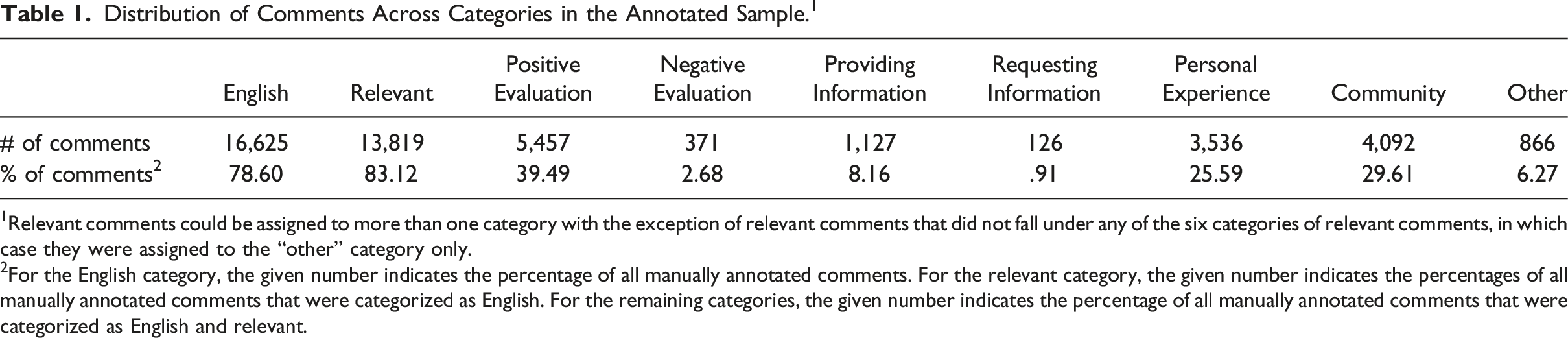
1Relevant comments could be assigned to more than one category with the exception of relevant comments that did not fall under any of the six categories of relevant comments, in which case they were assigned to the “other” category only.
2For the English category, the given number indicates the percentage of all manually annotated comments. For the relevant category, the given number indicates the percentages of all manually annotated comments that were categorized as English. For the remaining categories, the given number indicates the percentage of all manually annotated comments that were categorized as English and relevant.
Intercoder Reliability Score.

Data Preprocessing
To prepare the data for the SML process, we did not modify the text of the comments (as is often done when using SML, see: Van Atteveldt et al., 2019), but instead fed it to the machines exactly how it was also presented to the coders because this offers the most direct comparison between the classification of our machines and that of the human coders. In addition, we added additional information to the text of the comments. We decided to include everything that the coders based their annotation on, namely, (1) the unique ID-number of the comment, (2) the date on which the comment was published, (3) the ID-number of the video that the comment was written in response to, (4) the title of the comment’s video, (5) the date on which the comment’s video was published, (6) the name of the channel that uploaded the comment’s video, (7) the description of the comment’s video, (8) the lyrics of the comment’s video, and (9) the text of the comment.
Finally, we compared two different types of vectorizers, a count vectorizer and a term frequency—inverse document frequency, or tf•idf vectorizer. Whereas a count vectorizer simply counts how often each word occurs, a tf•idf vectorizer weighs the number of term frequency by the number of documents in which the term occurs at least once (Van Atteveldt et al., 2022). We wanted to learn which vectorizer would lead to the best performance of the machine. Hence, we trained our machines twice, once using a count vectorizer and once using a tf•idf vectorizer.
Supervised Machine Learning
Using the Scikit Learn package in Python (https://scikit-learn.org/), we trained and tested several SML models. Frequently used models within social sciences that use SML are Multinomial Naïve Bayes (NB), Logistic Regression (LR), K-nearest neighbor (KNN), C4.5 decision tree, and Support Vector Machine (SVM) (e.g., Kaiser & Bodendorf, 2012; Meppelink et al., 2021; Van Zoonen & Van der Meer, 2016; Vermeer et al., 2019). We thus trained five machines, one for each of these models. This allowed us to compare machines with different underlying models and determine which machine performs best. Seeing that we also compared the performance of models receiving different vectors as input, we trained 10 machines in total (2: count vectorizer or tf•idf vecorizer × 5: Multinomial NB, LR, KNN, C4.5 decision tree, or SVM). Each machine can indicate the value of a comment for one category (i.e., one machine can indicate if a comment belongs to one specific category). Seeing that we have a total of nine variables or categories (i.e., one variable indicating if a comment is English, one variable indicating if a comment is relevant, and seven variables indicating why a comment is relevant), 90 models were trained in total. These models were trained using a randomly selected 80% of the manually annotated data (i.e., the training set). The remaining 20% of the manually annotated data was used as the test set. For the test dataset, the categorization of the SML models was compared to that of the coders so that the performance of the models could be assessed.
To evaluate the performance of SML models, we report various metrics, namely, accuracy, precision, recall, and the F1-score. The accuracy score indicates in how many cases the classifier was correct in predicting a score. Precision indicates the number of positive category predictions made by the machine that indeed belong to that category. Recall quantifies the number of positive category predictions made by the machine out of all the cases that belonged to that category. Finally, the F1-score is the harmonic mean of precision and recall. While we report each of these metrics for all our machines in the results section, we will predominantly use the F1-score to evaluate our models.
Our choice to focus on the F1-score is based on several factors. First, the accuracy score is not very informative in our case, as we are dealing with class imbalance, meaning that the distribution of comments across the different categories is not equal (Guo et al., 2008). For example, with 13,815 comments being labeled as relevant, irrelevant comments are relatively rare in our dataset (see Table 1). If a machine categorizes all comments as relevant, it will achieve a relatively high accuracy score simply because relevant comments often occur in the dataset, but this does not necessarily indicate that the machine is performing well. Second, when it comes to the precision and recall score of a machine, the answer to the question of which metric is most relevant depends on what the results of a machine will be used for. If it is important that a machine only makes correct predictions, precision seems to be the main indicator of a machine’s performance. However, if a machine is being used to identify as many of the positive cases as possible, recall seems to be the best indicator of a machine’s performance. Seeing that the development of the machine is, in itself, a goal of the present project, we decided to focus on the harmonic mean of precision and recall, or the F1-score, when evaluating our models.
The values for a model’s precision, recall, and F1-score are applicable to each value of a category. For example, an F1-score can be obtained for the comments that a machine classified as relevant and for those comments that the machine classified as not relevant. To assess the performance of a model, the average of both values is an informative metric. Specifically, we take the weighted average of the precision, recall and F1-score. This number takes class imbalance into consideration by weighing the average of a measure by support (i.e., the number of true instances for each value).
Results
Evaluation Metrics of the Classifiers.
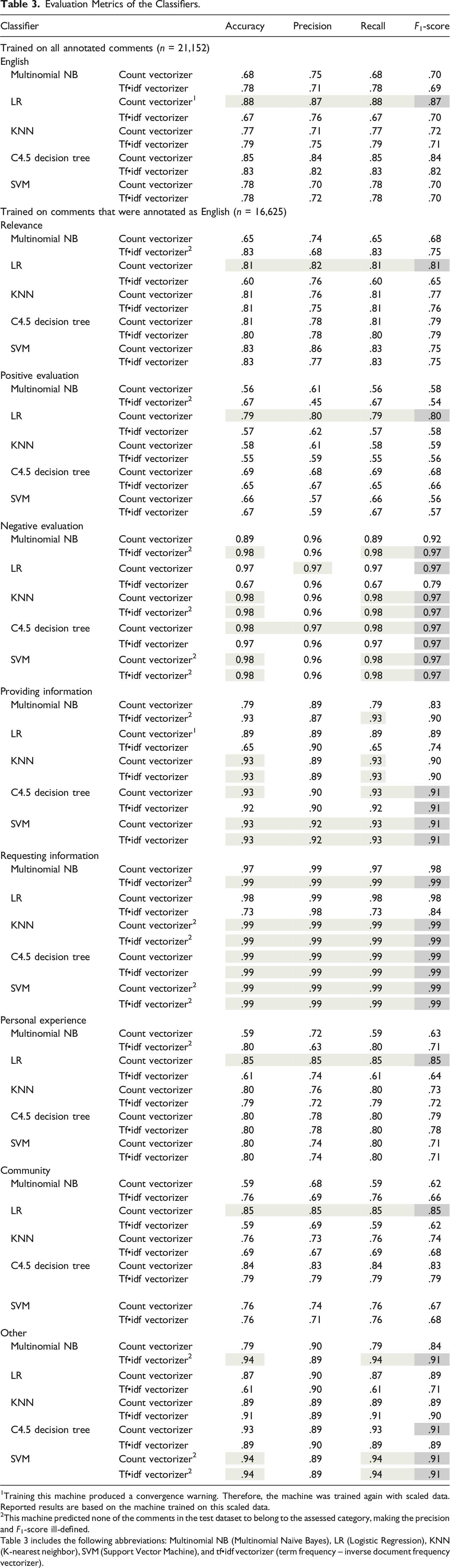
1Training this machine produced a convergence warning. Therefore, the machine was trained again with scaled data. Reported results are based on the machine trained on this scaled data.
2This machine predicted none of the comments in the test dataset to belong to the assessed category, making the precision and F1-score ill-defined.
Table 3 includes the following abbreviations: Multinomial NB (Multinomial Naïve Bayes), LR (Logistic Regression), KNN (K-nearest neighbor), SVM (Support Vector Machine), and tf•idf vectorizer (term frequency – inverse document frequency vectorizer).
Distribution of Comments Across Categories in the Automatically Categorized Sample (n = 161,215). 1
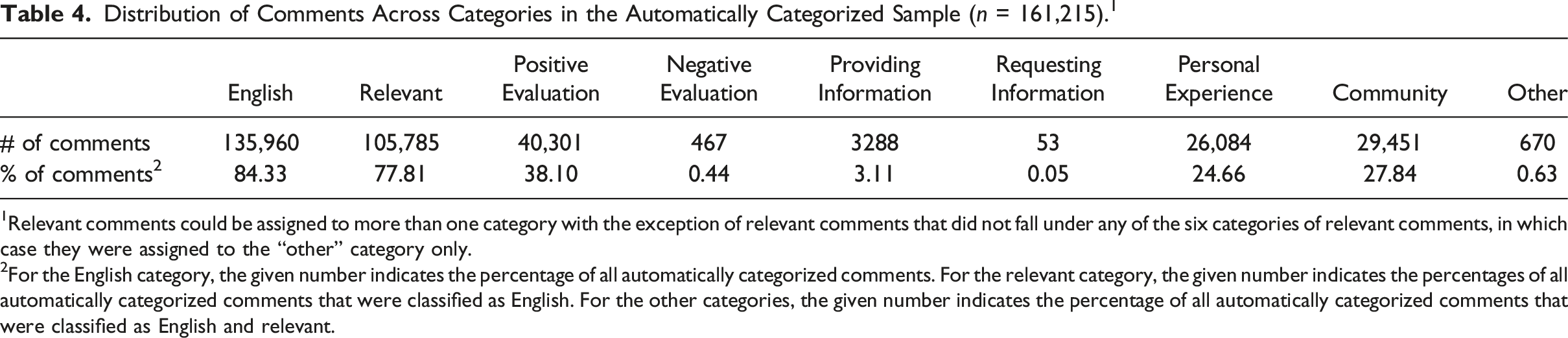
1Relevant comments could be assigned to more than one category with the exception of relevant comments that did not fall under any of the six categories of relevant comments, in which case they were assigned to the “other” category only.
2For the English category, the given number indicates the percentage of all automatically categorized comments. For the relevant category, the given number indicates the percentages of all automatically categorized comments that were classified as English. For the other categories, the given number indicates the percentage of all automatically categorized comments that were classified as English and relevant.
Comparing the results of the automated classifications (see Table 4) to those of the manual categorization of comments (see Table 1) shows that the similarity between the two results varies depending on the occurrence of comments within specific categories. Looking at the percentages of comments in the categories that occurred often (i.e., categories to which more than 10% of the manually annotated comments belonged), the automated classification yields results that are in line with those of the human coders (e.g., in the manually annotated sample, 39.49% of the comments could be categorized as positive evaluation, compared to 38.10% in the automatically classified sample). However, for categories that do not occur often in the manually annotated data (i.e., categories to which less than 10% of the manually annotated comments belonged), the results of the machines deviated from the results of the human coders. For example, while in the manually annotated sample, .91% of the English and relevant comments included a request for information, among the automatically classified comments, only .05% of the English and relevant comments included a request for information. Thus, whereas the results of the automated classification resemble those of the manual annotation when it comes to categories to which many comments belong, this similarity decreases as fewer comments belong to a category.
Ten Most Characteristic Features for Each Category of Comments and Their Weights.
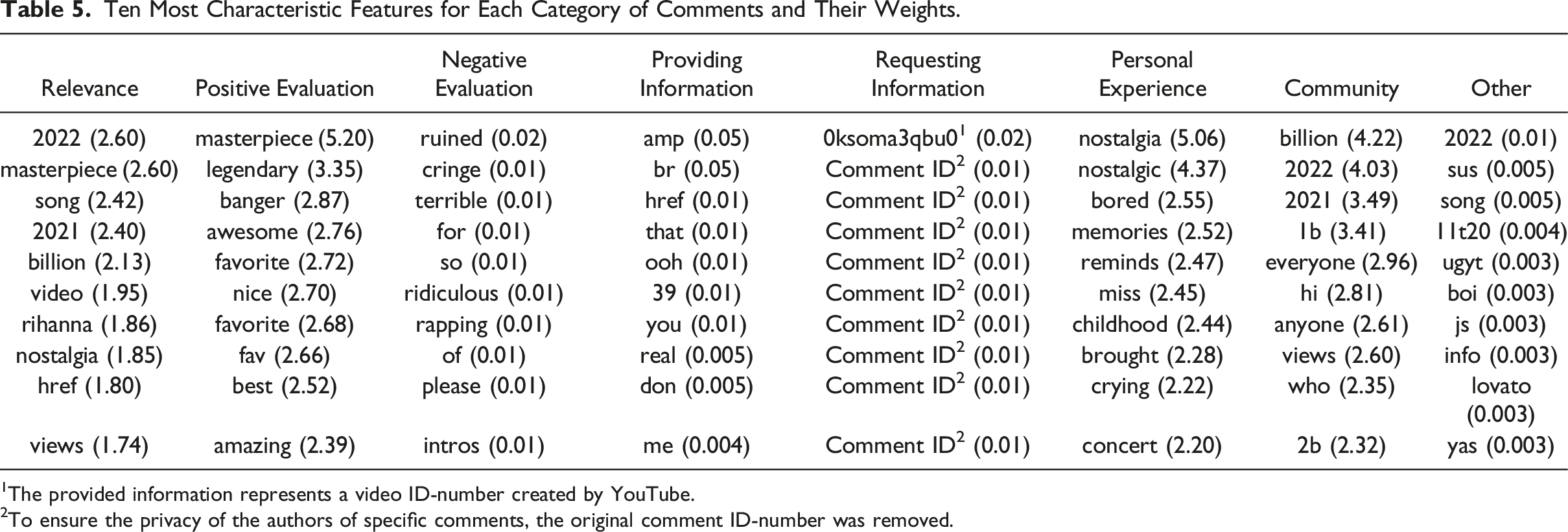
1The provided information represents a video ID-number created by YouTube.
2To ensure the privacy of the authors of specific comments, the original comment ID-number was removed.
The results for the three remaining categories (i.e., providing information, requesting information, and other), however, warrant more elaboration. As can be seen in Table 5, both the providing information and the other categories consist of comments that not only contain specific words (e.g., “that” for providing information and “song” for other), but also of numbers and meaningless words (e.g., “sus” for other) as well as parts of the time stamp of comments (e.g., “11t01”). These are not features that the coders typically looked at when manually annotating the data (see the Open Science Framework for the codebook and instructions that coders used: https://osf.io/x8vgt/). In addition, for the requesting information category, Table 5 shows that specific comments were more likely to be assigned to this category than others, but no general features such as words were used to determine if a comment contained a request for information. Finally, for all three categories, the weights that the models assigned to particular features are relatively close to zero, meaning that even the top 10 defining features of each category are not well able to mark comments that belong to that category.
Discussion
The present paper investigated to what extent comments written in response to music videos on YouTube are relevant in the sense that they reflect viewers’ experiences of, or opinions or thoughts about (the content of) a video, or its artist/maker. By gathering and analyzing 182,367 YouTube comments and their meta-data using SML, we found that between 78% and 83% of English comments is relevant and can be used by scholars to learn more about viewers’ experiences of and reaction to music videos. This large number of relevant comments is striking compared to previous work where the proportion of irrelevant comments ranged from 25% to 70% of the collected samples (Dubovi & Tabak, 2020; Poché et al., 2017; Serbanoiu & Rebedea, 2013). The difference between our finding and that of previous studies is likely due to the difference in definition of relevance: whereas we considered a rather broad definition of relevance, previous studies assessed relevance by examining the textual properties of comments (e.g, Serbanoiu & Rebedea, 2013), or adopted a definition of relevance that is applicable to the specific type of videos included in those studies only (e.g., Poché et al., 2017). This leads us to conclude that for researchers studying comments and reviewing past studies on user comments, it is crucial to understand which definitions of relevance previous studies used as this definition impacts what comments are included in their analyses.
Another reason for the difference in proportion of irrelevant comments between our study and previous work could be the development of the YouTube algorithm over time—which automatically detects spam based on the text of a comment, or by the behavior from a particular commenter. The improvement in YouTube algorithms for detecting spam might lead to larger filtering of irrelevant comments. In line with this idea, the number of comments that were removed by YouTube in 2022 due to them not complying with YouTube’s guidelines was higher compared to that number in 2018 (Ceci, 2023). However, additional research comparing the proportion of irrelevant comments that are available on YouTube over time is necessary to confirm this notion.
Our findings also revealed that most comments could be assigned to at least one of six content categories. The three most commonly occurring categories are comments that contain a positive evaluation, describe a personal experience of the commenter, or are written to create a sense of community. The tone of the comments for music videos was therefore positive and supporting. On the one hand, this finding contradicts previous work on (YouTube) comments in which scholars focused on the potential of YouTube and other social media platforms to facilitate the publication of comments containing hostility and insults (e.g., Döring & Mohseni, 2020; Murthy & Sharma, 2019). On the other hand, our finding is in line with previous research based on the Uses and Gratifications framework (Katz et al., 1973; Rubin, 2009) finding that posting comments on YouTube is often motivated by a need for social interaction (Khan, 2017). Specifically, our findings suggest that individuals who post comments on YouTube do so because they are looking for positive social interactions with others by sharing compliments on other people’s work, and by sharing personal experiences and connecting to the community of video viewers.
Based on the good performance of our models, it seems that SML is a good method for classifying comments into categories that occur relatively frequently. This conclusion is based on three results, namely, the high scores of the machines on the performance metrics, the comparison of the results of the manual annotation and of the automated classification of the data, and the features that the models used to categorize comments. Regarding the first finding, our results show that even the machines with the lowest scores on the performance metrics still performed relatively well. Regarding the second finding, we see that the results of the automated classification resembled those of the manual annotation but only for the automated classification of comments to categories to which many comments were assigned in the manual annotation. Hence, it seems that the classifiers are able to classify comments when it comes to frequently occurring categories, whereas they do not perform as well when it comes to categories that are rarer.
The above may be explained based on two limitations of the current work. First, the distribution of comments across categories was rather skewed. Hence, for categories to which fewer comments were assigned, the machines received fewer examples of comments that are relevant to those categories and thus, fewer examples to learn from. This notion seems to be largely in line with our third finding regarding the comment features that the models used to categorize comments. Namely, for categories to which many comments were assigned, the computer used distinctive words to indicate if a comment was likely to belong to a category (e.g., “masterpiece” as a word that makes it likely that a comment contains a positive evaluation). However, for categories to which few comments were assigned based on the manual annotation, the computer did not always use words with a clear meaning to indicate if a comment was likely to belong to a category (e.g., mentioning a specific comment ID makes it more likely that a comment contains a request for information). In these cases, the computer failed to identify meaningful features to categorize comments. Future studies could solve this by ensuring that their training data contains sufficiently large number of comments for each category, for example, by collecting and coding more data.
A second limitation of the present study is based on the low intercoder reliability of some variables. Although the intercoder reliability for most of our variables was satisfactory, this was not the case for three variables, namely, for the variables indicating if a comment was relevant, provided information, or if a comment fell in the “other” category. Two of these variables, namely, providing information and “other” are also among the variables for which the results of the automated classification deviate from those of the manual annotation (i.e., relevance, providing information, “other,” and requesting information). Hence, for these two variables, the low intercoder reliability may have had consequences for how well the machines were able to learn to detect what we actually aimed to detect when annotating comments (Van Atteveldt et al., 2019). To address this limitation, future research could include additional rounds of coder training to ensure that the intercoder reliability of all variables is sufficient.
Interestingly, although the intercoder reliability of the variable indicating if a comment contained a request for information was sufficient, we did find that the results of the automated classification of comments to this category (i.e., .05% of the English and relevant comments belonged to the category) deviated from the manual categorization of comments to this category (i.e., .91% of the English and relevant comments belonged to the category, which is more than 18 times as much compared to the automated classification of comments). This indicates that while it may have been relatively straightforward for humans to understand when a comment contains a request for information even though such comments occurred seldomly, this task proved to be more difficult for the computer. Our investigation of what specific comment features increased the likelihood of comments being assigned to the request information category by the computer corroborates this notion. Here, we found that the 10 features making it more likely that a comment was assigned to this category were unique comment ID-numbers. In other words, specific comments were more likely to be assigned to the requesting information category than others. This implies that the model was not able to find words that comments requesting information typically contain. Hence, whereas for humans it is evident when a comment contains a request for information, this is not the case for our model. This shows that although higher intercoder reliability scores for variables of the manually annotated data may make it more likely that a machine can learn to detect what researchers aim to detect, it offers no guarantee for this.
A final limitation of our study pertains to our sample not being representative for all YouTube comments in general. This is due to two reasons. First, we only collected comments written in response to music videos while on YouTube, many different videos are available, such as news videos, instruction videos, or unpacking videos. Second, we only collected the top-level comments for each video, meaning that replies to comments were not gathered or analyzed. Because of the above, generalizing our findings to comments written in response to other types of videos and to replies to comments warrants caution. Moreover, it means that the machines that we trained are only suitable to analyze top-level comments written in response to music videos on YouTube, but not to analyze (replies to) comments written in response to other types of videos (Baden et al., 2022; Burscher et al., 2015; Van Atteveldt & Peng, 2018). Hence, scholars who want to analyze the relevance of comments from a different population than the one used in the present study need to repeat the process of manually annotating comments and training machines based on these data.
Based on the present project, we formulate several recommendations to scholars who aim to use SML to analyze comments or other textual social media data. First, there are many common practices using SML to analyze (social) media data, but to increase the transparency of the literature, it is important that scholars explain why they choose to follow a specific practice. For example, while it is common to remove stop words before feeding text as training data to a machine, the choice to do so is often not explained (Baden et al., 2022) and based on our results, it does not always seem necessary. In addition, our findings indicate that the specific vectorizer used has implications for the performance of machines. Hence, if researchers choose to use one pre-selected vectorizer in SML instead of comparing multiple vectorizers, their choice for that particular vectorizer should be clearly motivated. Explaining why specific steps are (not) taken in SML makes projects clearer and more transparent, and it allows future scholars to make informed decisions when they use SML in their next projects.
Second, although scholars often predominantly focus on the evaluation of machines, we argue that another focus that is at least as important is the manual annotation of the data. This is because the quality of the classification made by a machine can only be as good as that of the annotations that they were trained with. Third, as discussed above, our machines seem to perform well when it comes to assigning comments to frequently occurring categories, but they perform less well when it comes to assigning comments to categories that are relatively rare. Hence, it seems that setting up categories that can be assumed to cover many cases rather than creating categories to which only a few cases apply will contribute to creating well performing machines. The trade-off here, however, is that setting up categories that cover many cases may also be theoretically less informative as they may be more general. To future scholars, we thus recommend considering the question of how broad the categories that they want to classify can be for them to still be theoretically meaningful in their decision of whether to use SML.
The present project applied SML to select those YouTube comments that are relevant for social scientists. This resulted into new insights into the relevance of comments on YouTube as well as guidelines for scholars who want to use SML in the future. As interpersonal communication is often used as a theoretical background in computational studies (Van Atteveldt & Peng, 2018), the present work can be used as an additional resource for scholars working in this field. However, the findings of this project also give rise to new questions. First, as this project focused on comments written in response to music videos, it remains unclear how different contextual genres affect the performance of SML algorithms (Baden et al., 2022; Burscher et al., 2015; Van Atteveldt & Peng, 2018). Various types of videos may evoke different reactions among viewers (Möller et al., 2019) that may be harder or easier to classify. Only by validating machines using samples from different populations can this question be answered. Second, while we focused on detecting relevant comments in an entertainment context, the question of how relevant social media comments are is important to scholars working in other fields as well. For example, this method might help political communication scholars to analyze the spread of misinformation on YouTube. It might also be relevant for health communication scholars to understand the power of YouTube comments to hinder important health discussions. Hence, we call for more collaboration between scholars from different subdisciplines as the algorithms developed for one discipline can offer substantial contributions to other disciplines as well. Moreover, as Brady (2019) and Van Atteveldt and Peng (2018) point out, with the introduction of computational methods in the field of social science, the requirements for scholars to develop programming skills also rise. Our field can only make optimal use of the opportunities that computational methods offer through collaboration—we aim for the current work to be a contribution to that.
Supplemental Material
Supplemental Material - Cutting Through the Comment Chaos: A Supervised Machine Learning Approach to Identifying Relevant YouTube Comments
Supplemental Material for Cutting Through the Comment Chaos: A Supervised Machine Learning Approach to Identifying Relevant YouTube Comments A. Marthe Möller, Susan A. M. Vermeer, Susanne E. Baumgartner in Social Science Computer Review.
Footnotes
Declaration of Conflicting Interests
The author(s) declared no potential conflicts of interest with respect to the research, authorship, and/or publication of this article.
Funding
The author(s) disclosed receipt of the following financial support for the research, authorship, and/or publication of this article: This work was supported by the Digital Communication Methods Lab (University of Amsterdam).

Supplemental Material
Supplemental material for this article is available online.
Author Biographies
References
Supplementary Material
Please find the following supplemental material available below.
For Open Access articles published under a Creative Commons License, all supplemental material carries the same license as the article it is associated with.
For non-Open Access articles published, all supplemental material carries a non-exclusive license, and permission requests for re-use of supplemental material or any part of supplemental material shall be sent directly to the copyright owner as specified in the copyright notice associated with the article.
