




Abstract
The international rise of populism has been attributed, in part, to digital media. These media allow the backers of populists to share and distribute information independent of traditional media organizations or elites and offer communication spaces in which they can support each other and strengthen communal ties irrespective of their societal standing. Can we identify these functions in distinct usage patterns of digital media by supporters of populists? This could find expression through posting content that comports with the central tenets of populist ideology, higher activity levels, use of distinct vocabularies, and heightened levels of community building. We investigate differences along these dimensions on the online forum Reddit by comparing linguistic patterns and content of comments in two subreddits focusing on a populist, Donald Trump (/r/The_Donald), and a center-left politician, Hillary Clinton (/r/hillaryclinton), during the 2016 U.S. presidential election campaign. Contributors to /r/The_Donald expressed more strongly parts of the populist ideological package, specifically anti-elitism and exclusionism, but failed to express people-centrism; used the platform more intensively; used vocabularies different than those used in other partisan publics; and engaged more strongly in community building.
Keywords
The perceived importance of digital media in enabling the rise of challengers to the political status quo features strongly in current academic and public debate (Aalberg et al., 2017; Jungherr et al., 2019; Schradie, 2019; Schroeder, 2018; Stier et al., 2017). Digital media provide spaces in which supporters of political groups and movements can meet, exchange information, express validation, and coordinate. This is especially important for groups such as populists that feel unrepresented or that they are treated with hostility in mainstream discourse in media or society. In reaction, these groups turn to digital media to form, find, and maintain alternative spaces for information exchange, discourse, and communal interaction. This makes digital spaces potentially powerful elements in the formation, maintenance, and amplification of challenger partisan publics such as populists and raises the question of whether there is something distinct in their use of digital services from other partisan publics.
Examining discursive patterns in political publics raises some fundamental challenges. While elite communication is comparatively easy to capture, talk among supporters remains elusive. Only recently, the use of digital media for political talk and coordination has opened a window into political talk of publics mediated by channel-specific affordances and usage practices (Jungherr et al., 2016; Neuman, 2016; Posegga & Jungherr, 2019). Yet, even if data-documenting political talk on social media platforms have become available, the challenge of how to identify the political allegiance of speakers remains. It might be easy to identify the partisan alignment of some speakers by their use of signifiers—such as words or phrases specific to selected parties or politicians, links to content of obvious partisan alignment, or interactions with openly partisan actors. But these procedures are error-prone, difficult to validate, and likely to identify only strong partisans willing to exhibit their political allegiances in public. Finally, it is not enough to examine communication by supporters of populists. Instead, as some of populism’s features are common in politics (such as strong differentiation between in- and out-groups or anti-elite rhetoric), it is necessary to establish a comparison with communicative patterns among partisans of different political leanings. Only by comparison, we can be sure that discourse in populist publics is distinct from partisan discourse in general. These are significant challenges, but we will show that the social news aggregation, web content rating, and discussion website Reddit.com offer researchers a promising window into the discursive practices of various publics.
Reddit enables users to post links to content on the web, ask questions, and comment on and rate contributions by others in topically focused spaces called subreddits. The subreddits are moderated following a set of rules set by the community of users. Moderators can ban those not adhering to the rules from publishing in subreddits. Reddit allows the use of stable pseudonymous profiles. This allows tracking of user contributions and associated ratings by community members through user profiles and offers a transparent measure of reputation over time even though users do not have to reveal their identities.
In combination, Reddit’s features allow for analysis of discursive practices of populist publics. For one, topical subreddits capture user discourses with shared political views over long periods in significant volume. Second, given the enforcement of subreddit rules by moderators and public ratings by the community, we can expect authors active in a subreddit dedicated to supporting a given politician or party to comment and behave in ways accepted by actual supporters of said politician or party. Finally, at least in the case of the United States, with subreddits in support of a broad range of U.S. political actors, it is possible to compare the activities of partisan publics that support different types of actors. This allows for comparing the activities of populist publics with other partisan publics.
Nevertheless, Reddit as a research environment has several disadvantages. Its user base is a comparatively low and skewed share of the general population (Barthel et al., 2016). This makes generalizing any findings to the general public potentially fraught. In addition, Reddit is a very specific digital media service with very specific affordances. This means that generalizing Reddit usage patterns to other services is difficult, as partisans and political elites use various digital media differently depending on their affordances. Yet, as our goal is not to identify universal patterns but rather to analyze and compare political talk among populist and partisan publics, the opportunities Reddit provides outweigh these limitations.
Specifically, we compare comments posted in 2016 in two subreddits dedicated to the support of two candidates in the U.S. presidential election. We take comments posted in the subreddit /r/The_Donald as evidence of a populist public and compare them to comments posted in the subreddit /r/hillaryclinton, a partisan but nonpopulist public. Donald Trump is a politician who routinely emphasizes elements from the populist ideological package (Oliver & Rahn, 2016; Weyland & Madrid, 2019). This makes a populist public of contributors to a subreddit that explicitly supports Trump.
During the 2016 presidential campaign, /r/The_Donald developed into a highly popular, controversial, but also influential forum for Trump supporters on the political fringes to congregate, interact, and coordinate (Lagorio-Chafkin, 2018, pp. 381–394). Beyond dedicated Trump supporters, the subreddit also attracted and gave space to anti-Semites, misogynists, racists, trolls, and White nationalists, while its moderators did little to curb their content (Collins, 2016; Flores-Saviaga et al., 2018; Khalid, 2017; Koebler, 2016). This escalated after the election, in 2019, when Reddit placed the subreddit “under quarantine” and warned visitors to the site that the subreddit insufficiently reported and addressed threats of violence against individuals and public officials (Haskins, 2019). Irrespective of this deeply problematic usage culture, /r/The_Donald was taken very seriously by the Trump campaign, leading to a highly featured “Ask Me Anything” event in which Trump engaged directly with contributors on the subreddit (Koerner & Hall, 2016). Even well beyond the 2016, Trump’s communications team continued to pick up and publicly reference memes and slogans from the subreddit (Schreckinger, 2018). Despite its controversial and sometimes downright toxic culture, /r/The_Donald developed into a space where interactions by contributors were watched by journalists and campaigners (Graham, 2017; Warzel, 2016, 2017). Despite or because of its much less controversial culture, the subreddit /r/hillaryclinton never developed similar popularity or influence.
We compare comments in both subreddits with respect to how they correspond to constituent features of populist ideology, general activity level, word use, and contribution to community building, using a mixed-methods approach combining manual content coding and large-scale quantitative text analysis. With this article, we fill an important research gap in the understanding of how populists use digital media by focusing on the behavior of their supporters compared to those of a center-left politician and by providing an in-depth analysis of Reddit’s use by political partisans for political talk and community building.
What to Expect of Talk in Populist Publics?
Populist Ideology in Political Talk
Contemporary populism offers little in the way of a strict political ideology. Parties and politicians widely identified as populists do not necessarily share the same underlying political views. Accordingly, populist ideology has been defined as a: …thin-centered ideology that considers society to be ultimately separated into two homogeneous and antagonistic camps, “the pure people” versus “the corrupt elite,” and which argues that politics should be an expression of the volonté générale (general will) of the people. (Mudde & Kaltwasser, 2017, p. 6)
Various studies have shown that these features of populist ideology tend to manifest in political discourse through, for example, speeches by political leaders (Hawkins, 2009) or party manifestos (Pauwels, 2011). Accordingly, in one of the most systematic comparative research projects on populist communication, three constituent expressions of populist ideology in communication are proposed: (a) references to the “people” as the source of legitimacy and to populists as the arbiters of the general will; (b) attacks on established elites in politics, business, and media as enemies of the public; and (c) the use of exclusionary language contrasting a normatively good in-group and a normatively bad out-group (Aalberg et al., 2017). While this approach sees anti-elitism and exclusionism as optional, references to the people (people-centrism) are seen as foundational in order to speak of populist communication (de Vreese et al., 2018). 1
As this or similar frameworks have been used successfully to analyze elite discourse (Aalberg et al., 2017; Hawkins, 2009; Jagers & Walgrave, 2007), it provides a promising way to identify likely differences between contributions in a public in support of a populist candidate and other partisan publics. The underlying mechanism might be either supporters of populists sharing the full populist ideological package and expressing it in political talk or those supporters picking up on signals from the discourse of political leaders and mirroring them in political talk.
It should be noted, though, that this three-part conceptualization has been most successfully applied to populism in Europe and South America (Moffitt, 2020). It has been argued that Trump’s specific brand of populism is distinct because it is based mainly on ethno-nationalism, anti-elitism, and authoritarianism (Bonikowski, 2019). Accordingly, people-centrism might turn out to be of lesser importance than suggested by the literature that focuses on other cases of international populism. Still, as anti-elitism and exclusion can be expected to feature in political communication irrespective of political allegiance, we see references to the people as a source of legitimacy as a decisively distinct expression of populist ideology in political talk (de Vreese et al., 2018; Wuttke et al., 2020).
Two Functions of Digital Media for Populist Publics: Alternative Information Spaces and Community Building
Like any political outsider, populists stand to profit from the use of digital media compared to actors in the political mainstream. Importantly, digital media allow political outsiders to circumvent the gatekeeping power of traditional media and established political organizations to select which political positions reach wider publics (Jungherr, Schroeder, & Stier, 2019). They also allow outsiders to form communities of mutual support against a political mainstream widely perceived as hostile. Both these functions can be expected to matter considerably for supporters of populist parties and candidates.
Hostility toward mass media and contemporary political elites is a common trope among populists. They feel misrepresented by mainstream media, which they claim suppress stories supporting populist narratives (Sehl et al., 2019). Digital media provide them with a powerful tool to circumvent these gatekeepers by allowing populists to publish, distribute, and find information beyond the confines of accepted discourse. Under some circumstances, the apparent public interest in these alternative information and discourses can lead mainstream media to adjust their coverage, thereby allowing populist publics to shape the media agenda (Chadwick, 2017; Jungherr, Posegga, & An, 2019; Jungherr, Schroeder, & Stier, 2019; Schroeder, 2018; Toepfl & Piwoni, 2018). This function should be quite visible in the use of digital media by supporters of Donald Trump, given their claims of being misrepresented by mainstream media. Digital spaces such as /r/The_Donald can thus be seen highly important for supporters. This should be especially true for supporters of the populist candidate from the often ugly fringes of this political discourse. For example, anti-Semites, misogynists, racists, and White nationalists supporting Trump were reportedly very active in /r/The_Donald (Ward, 2018). This, in fact, led to the quarantine of the subreddit in 2019 (Robertson, 2019).
Digital media also allow populists and their supporters to form publics. From the earliest days of the public Internet, authors have identified and sketched the power of online communication spaces for building, maintaining, and coordinating communities (Rheingold, 1993). This can be achieved by activity directed inward toward members of the group itself or outward at an environment perceived as hostile. The inward directed forms of community building can take positive shapes, such as in the public expression of care. For online communities, this behavioral pattern has been examined closely in the literature on patient support groups online that identifies various expressions of care, such as public validation, offers of tangible assistance, or emotional support (Braithwaite et al., 1999; Coulson et al., 2007; Coursaris & Liu, 2009).
Yet, community building can also turn negative. Many online communities have developed into spaces where membership and internal validation depend on an aggressive performance of group identity in opposition to others. This often takes the form of a heightened impoliteness or even incivility toward others (Coe et al., 2014; Theocharis et al., 2016). This is especially relevant in the case of /r/The_Donald, a subreddit whose contributors openly condoned violence toward others and featured heavily misogynistic, racist, and anti-Semitic content (Ward, 2018).
Finally, communities often develop shared idioms as expressions of a shared sense of identity. Often, these idioms are designed to alienate or offend outsiders. They can take the form of shared memes, slogans, or symbols within communities (Blanchard & Markus, 2004; Gal et al., 2016; McMillan, 1996; Miltner, 2014).
In combination, the practices of public expression of care, hostility toward others, and the expression of shared identity through shared idioms can be seen as indicative of populist publics.
Materials and Methods
We compare contributions to an online communication space by a populist and a center-left partisan public during the 2016 U.S. presidential race. By focusing on an election campaign, we are able to examine partisan publics during a period of highly intense and ongoing activity by a wide set of users. We thus get a window into the behavior of partisan publics online at their most active (Jungherr, 2015).
We treat supporters of Donald Trump as a populist public because he ran on a platform representing the populist ideological package of people-centrism, anti-elitism, and exclusionism (Oliver & Rahn, 2016). In addition, he presented himself as speaking on behalf of a supposedly marginalized section of the U.S. electorate and sought the support of the political fringe of the far right in American politics (Bonikowski, 2019). At the same time, he and his supporters routinely expressed that they were being misrepresented and vilified by political elites, the wider public, and the media (Smith, 2019). Trump’s opponent, Hillary Clinton, offers a clear contrast by providing an example for a center-left candidate. We treat her supporters accordingly as a partisan center-left public. The comparison of political talk by both supporter publics is thus promising to establish whether Trump supporters, the populist public, used the online space differently than supporters of the center-left public in line with the theoretical expectations above.
Specifically, we focus on comments published on the online forum Reddit.com. Reddit enables users to post links to content on the web, ask questions, comment on, and rate contributions by others in topically focused spaces called subreddits. The subreddits are moderated following a set of rules set by its community of users. Moderators can ban those not adhering to these rules from publishing in subreddits. Reddit’s features allow for the analysis of discursive practices of populist publics. First, topical subreddits capture the discourse among users with shared political views over long periods of time in significant volumes. Second, given the enforcement of subreddit rules by moderators and public ratings by the community, we can be reasonably sure that authors active in a subreddit dedicated to supporting a given politician or party are actual supporters of said actor or party. Finally, at least in the U.S. case, there are subreddits in support of a broad range of political actors, and so it is possible to compare the activities of partisan publics that support different political camps.
That being said, the research environment Reddit has several disadvantages. Its user base is a relatively small and skewed share of the general population (Barthel et al., 2016). One of the few available surveys among Reddit users reported that only 7% of adults in the United States used Reddit in 2016, of which 69% were male, 56% were between the ages of 18 and 29, 44% identified as liberal, and 19% identified as conservative. Of all Reddit users in any given week, 45% were using the service to get election news (Barthel et al., 2016, p. 7). While these findings make it difficult to generalize to the broader public, they nonetheless show that political news plays a vital role for Reddit users. Second, Reddit is a very specific digital media service with very specific affordances. Generalizing from Reddit usage patterns to other services is challenging, as partisans and political elites use different digital media in different ways depending on their affordances. Yet, as our goal is not to identify universal patterns but rather to test whether populist and partisan publics use the digital service differently, the opportunities provided for us by Reddit outweigh the limitations.
For both supporters of the right-wing populist Donald Trump as well as supporters of the center-left Hillary Clinton, Reddit offered an attractive space for exchanging political news and discussion. For example, on Election Day in 2016, the subreddits /r/The_Donald and /r/hillaryclinton, two subreddits by and for supporters of Trump and Clinton, listed 273,677 and 35,002 subscribers, respectively. Already this difference points to Reddit being of greater importance to supporters of the populist than to supporters of the center-left candidate. This difference in usage intensity is particularly interesting, given that Reddit’s user base in general reportedly skews to the political left (Barthel et al., 2016) and is, therefore, a first strong indicator of the relevance of the communication space for populist publics.
Both subreddits have a clear policy of allowing each candidate’s supporters to post while banning and removing users who post content critical to the other candidate. Thus, we can expect authors active in a subreddit dedicated to supporting a given politician or party to comment and behave in ways accepted by actual supporters of said actor or party. Using comments published on these subreddits, we can thus compare communicative patterns in a populist and a center-left partisan public in politically homogeneous communication environments (An et al., 2019).
We base our analysis on a Reddit data set collected by Jason Baumgartner and published on Pushshift.io (Baumgartner et al., 2020). This ongoing collection includes all publicly available submissions and comments on Reddit beginning in December 2005. 2 We extracted all comment threads to submissions posted to the two subreddits between January 1, 2016, and December 31, 2016. Our data set thus covers a large portion of the 2016 U.S. presidential campaign period (culminating on Election Day, November 8, 2016) and its aftermath. In this, we consider 1,341,417 comments posted by 39,294 active users in /r/hillaryclinton and 11,635,535 comments posted by 298,464 active users in /r/The_Donald. 3 This includes comments posted directly in reaction to submissions and comments nested in comment threads. By focusing exclusively on comments, we avoid comparing contributions following diverging production logics, such as submissions and comments.
We rely on manual coding to identify the interpretatively demanding concepts populist ideology (Hypothesis 1) and community building (Hypothesis 3). The demands raised by this approach mean we can only examine comparatively small samples of comments in both subreddits.
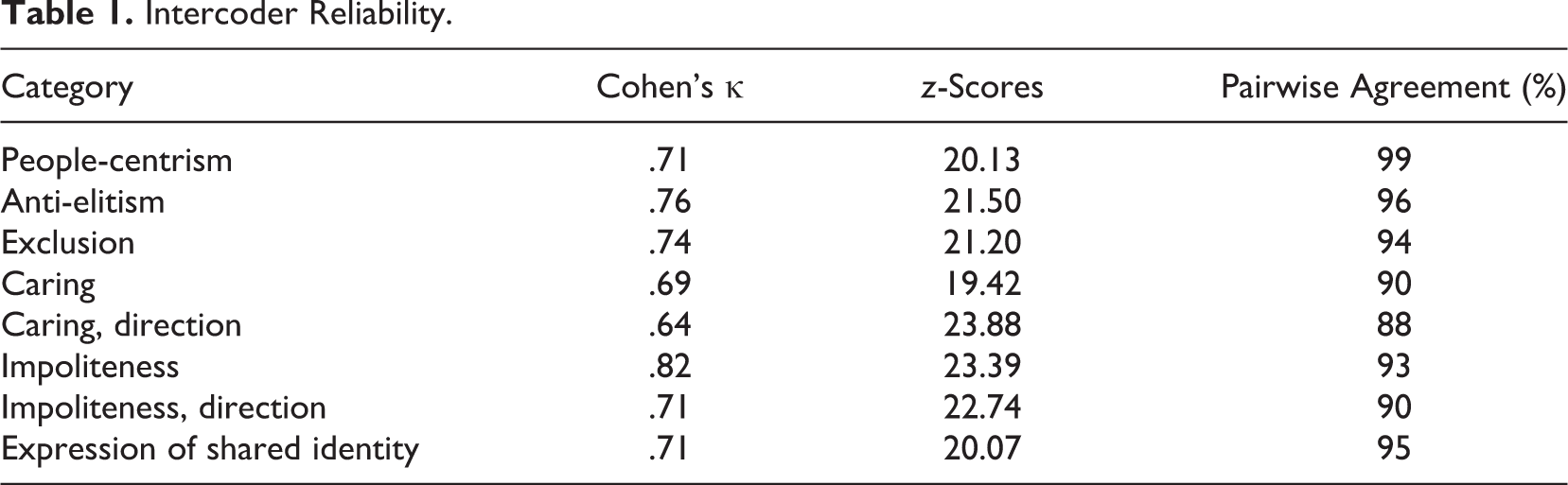
For the manual analysis, two of the authors coded a total of 5,000 comments drawn randomly from the two subreddits /r/The_Donald (n = 2,481) and /r/hillaryclinton (n = 2,519). The coding scheme categorized comments according to four characteristics linked to our hypotheses: Did the comment express support or caring toward discussion partners, groups, or persons of interest (such as politicians or journalists)? Did the comment contain impoliteness directed against discussion partners, groups, or persons of interest? Did the comment use group-specific memes, slogans, and symbols in an expression of shared identity? Did the content of a comment conform with central populist ideas (i.e., contain people-centrism, anti-elitism, or exclusion of other groups)? 4 To establish intercoder reliability, both coders coded the same 800 comments. Table 1 reports the intercoder reliability for these shared codes. The reported values point to acceptable agreement between both coders.
Intercoder Reliability.
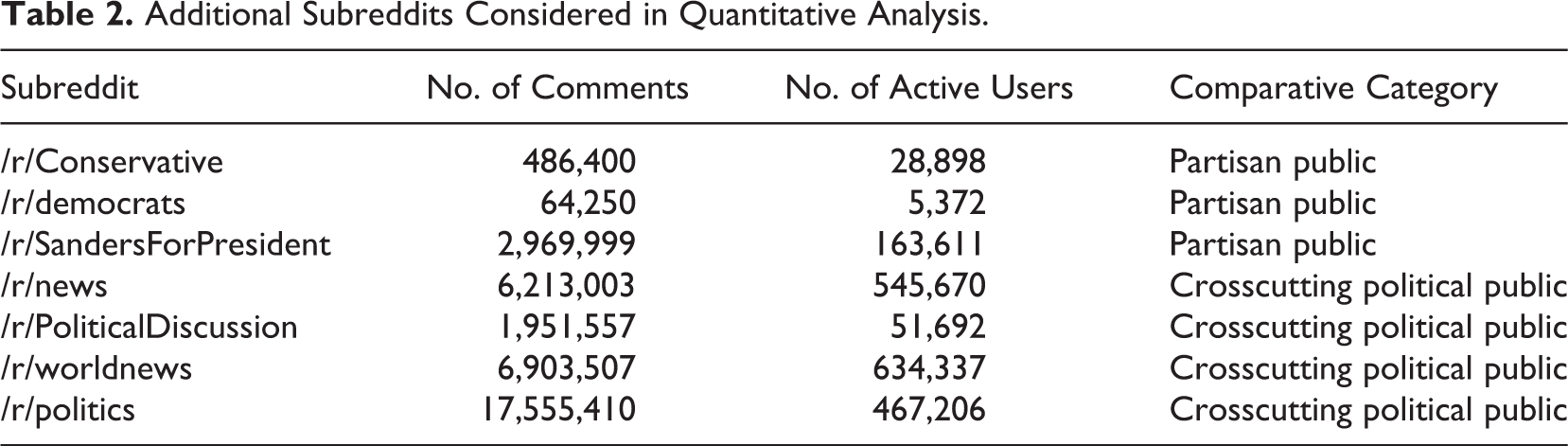
In our automated content analyses, we also consider a set of additional subreddits as points of comparison to assess the strength of differences between the subreddits /r/hillaryclinton and /r/The_Donald. We are considering the subreddits r/Conservative, r/democrats, and r/SandersForPresident to account for the relationship of/r/hillaryclinton and /r/The_Donald to other partisan publics on the U.S. political right and left. Beyond this, we also consider subreddits focused on political talk and news without explicit partisan affiliation, thereby offering politically crosscutting communication environments (An et al., 2019). Here, we consider r/news, r/PoliticalDiscussion, r/politics, and r/worldnews. See Table 2 for the number of, respectively, considered comments and users per subreddit.
Additional Subreddits Considered in Quantitative Analysis.
To test our second hypothesis, we identify topical similarity between subreddits. We focus on the degree of shared important words. To do so, we calculate the Jaccard similarity between important words in all comments of each subreddit. For each subreddit, we removed common stop words and replaced the URL with its domain name. To identify important words, we use term frequency-inverse document frequency (TF-IDF; Hand et al., 2001, p. 463 ff.). The TF-IDF value of a word increases proportionally if the word appears often in a comment. This is then offset by the frequency the word’s appearance across all comments in a corpus. This filters out common, semantically less-significant words. We treat each comment as a document and each subreddit as a corpus.
For each subreddit, we extract the top k words with the highest TF-IDF values and compute the Jaccard similarity between subreddits. The Jaccard similarity is defined as
Results
Activity Over Time and Engagement Levels
Let us start with a comparison of the activity and engagement levels in /r/The_Donald and /r/hillaryclinton.
Plots A and B in Figure 1 show the comment activity over time in both subreddits. In Plot A, we see that the activity levels in /r/The_Donald are much higher than in /r/hillaryclinton, so much so that the activity volume in the populist public dwarfs that in the partisan center-left public. Given that Reddit’s user base skews to the left (Barthel et al., 2016), the difference is a first strong indicator of the relevance of the communication space for populist publics. To get a sense for the temporal dynamics of both, we have to turn to the log plot in Plot B. Comments in both subreddits largely follow the same temporal dynamics, albeit to different degrees. Both subreddits tend to spike on the same days, likely in reaction to campaign events. Similar patterns are known from political talk on Twitter during political campaigns (Jungherr, 2014). Yet, the reactivity to events is much higher in the populist public. Plots C and D speak to the engagement levels in both subreddits. Here, again we see that the engagement in the populist public, expressed in the number of comments per submission and per user, is much stronger than that in the partisan center-left public. This first descriptive analysis shows that supporters of Donald Trump used their subreddit much more actively than supporters of Hillary Clinton used their corresponding one. We thus find a much more vibrant online public of supporters of the populist than of the political center-left.
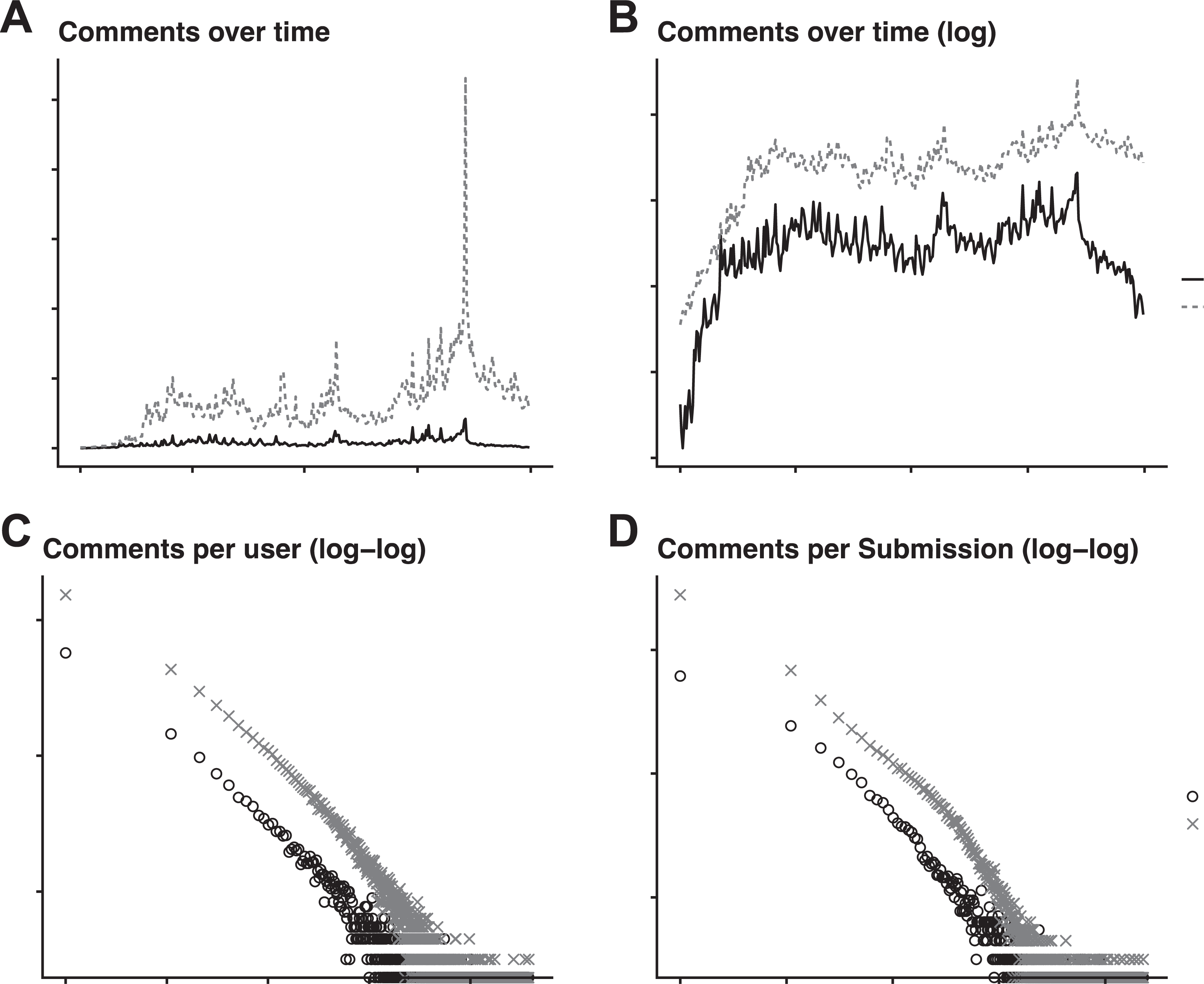
Activity and engagement. (A) Comments over time. (B) Comments over time (log). (C) Comments per user (log–log). (D) Comments per submission (log–log).
Populist Ideology: People-Centrism, Anti-Elitism, and Exclusion (Hypothesis 1)
We first examine whether contributions to both publics diverge based on an underlying populist political ideology. We, therefore, examine whether the comments in /r/The_Donald corresponded with populism’s central ideological tenets more systematically than those in /r/hillaryclinton (Hypothesis 1). To do so, we checked for the expression of people-centrism, anti-elitism, and exclusion by hand coding 5,000 comments from both subreddits. By coding the same number of comments in both subreddits, these analyses are robust to the differences in total comment volume across the subreddits considered.
We found that of 2,519 coded comments in /r/hillaryclinton, 427, or 16.95%, corresponded with at least one of the three elements of populist ideology. Of 2,481 coded comments in the subreddit /r/The_Donald, 674, or 27.17%, did so. Supporters of the populist-right candidate, Donald Trump, were thus more frequently posting content aligned with aspects of populist ideology than were supporters of the center-left candidate, Hillary Clinton. That said, the one element identified in the literature as specific to and constitutive of populist communication, people-centrism, is all but absent from comments in both subreddits, while anti-elitism and exclusion feature prominently in both subreddits. This can be seen in Figure 2, which documents the share of comments coded as populist communication for each subreddit.
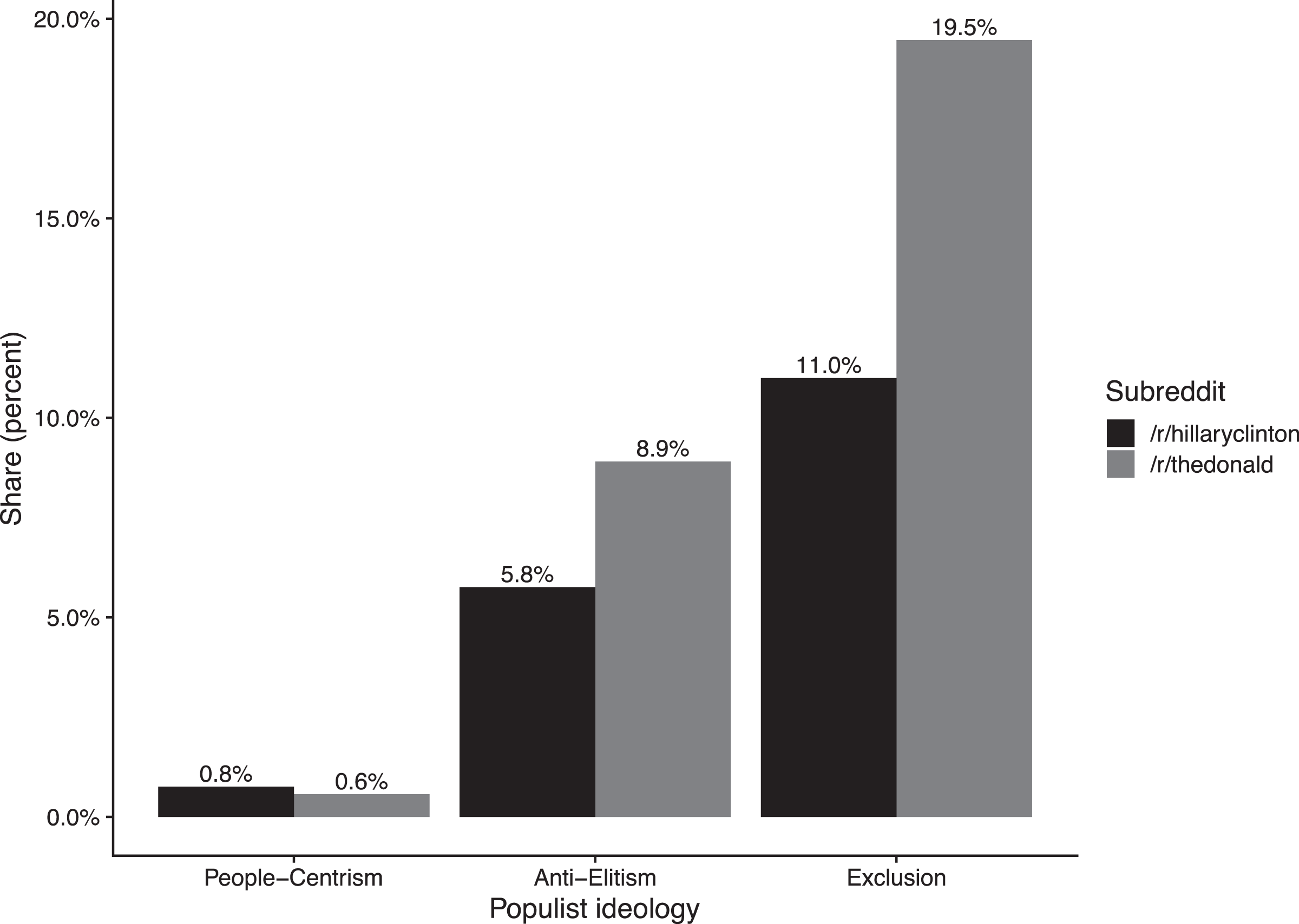
Populist communication.
Figure 2 shows that elements of populist ideology featured highly unevenly in comments in both subreddits, with exclusion making up the majority of all corresponding comments, anti-elitism coming in a distant second, and reference to the people as the source of political legitimacy all but absent. Exclusion and anti-elitism are clearly more prominent in /r/The_Donald than in /r/hillaryclinton, but the populist public does not hold a monopoly on these sentiments. Rather than an expression of populist ideology, which would demand a much stronger presence of people-centrism in the comments, we seem to be witnessing in the populist public an expression of a sense of marginalization and hostility toward wider publics that manifests in anti-elitist and exclusionary comments.
This leaves us with mixed findings with respect to our first hypothesis. On the one hand, we do not find conclusive evidence of distinctive expressions of populist ideology in the subreddit that focused on Donald Trump. On the other hand, we find that users in /r/The_Donald posted more comments containing anti-elitist and exclusionist content in line with populists’ constitutive sense of marginalization and hostility toward general political discourse. That said, both these characteristics were also very prominent, albeit to a lesser extent, among users in /r/hillaryclinton, pointing to anti-elitism and exclusion being common features in political talk in partisan publics irrespective of political leaning.
Vocabularies (Hypothesis 2)
In our second test of whether our populist public, /r/The_Donald, shows specific usage patterns, we examine whether the content of its comments deviates from that of other partisan publics and those focused on political talk more general, that is, /r/Conservative, /r/democrats, /r/hillaryclinton, /r/news, /r/PoliticalDiscussion, /r/politics, /r/SandersForPresident, and /r/worldnews. While the sheer volume of comments makes a close reading unfeasible, automated text analysis allows us to identify convergent and divergent patterns between the subreddits in aggregate. Here, the vocabularies used by contributors are telling indicators (Piper, 2018; Underwood, 2019).
If, on the one hand, members of the populist public would by and large use a vocabulary shared with contributors to other partisan or political issue publics, we could assume that they react similarly to stimuli provided by the campaign environment and mostly share a similar discourse. On the other hand, however, diverging vocabularies are evidence that they reacted to this environment differently, pointing to /r/The_Donald functioning as a place for dissemination and discussion of alternative information or narratives (Hypothesis 2). To assess the closeness of the vocabularies between subreddits, we calculate the Jaccard similarity between the top k words in two subreddits ranked by their importance for each corpus according to TF-IDF. Thereby, we ensure that frequent but unimportant words do not drive the calculated similarity. We interpret the resulting values in comparison. Therefore, we calculate the Jaccard similarity of vocabularies used in comments /r/The_Donald and /r/hillaryclinton with other topical subreddits.
If our hypothesis is correct, we should find comments in the partisan public /r/hillaryclinton and other political issue publics to be closer to each other than to the populist public, /r/The_Donald. These analyses are robust to the differences in comment volume across the considered subreddits.
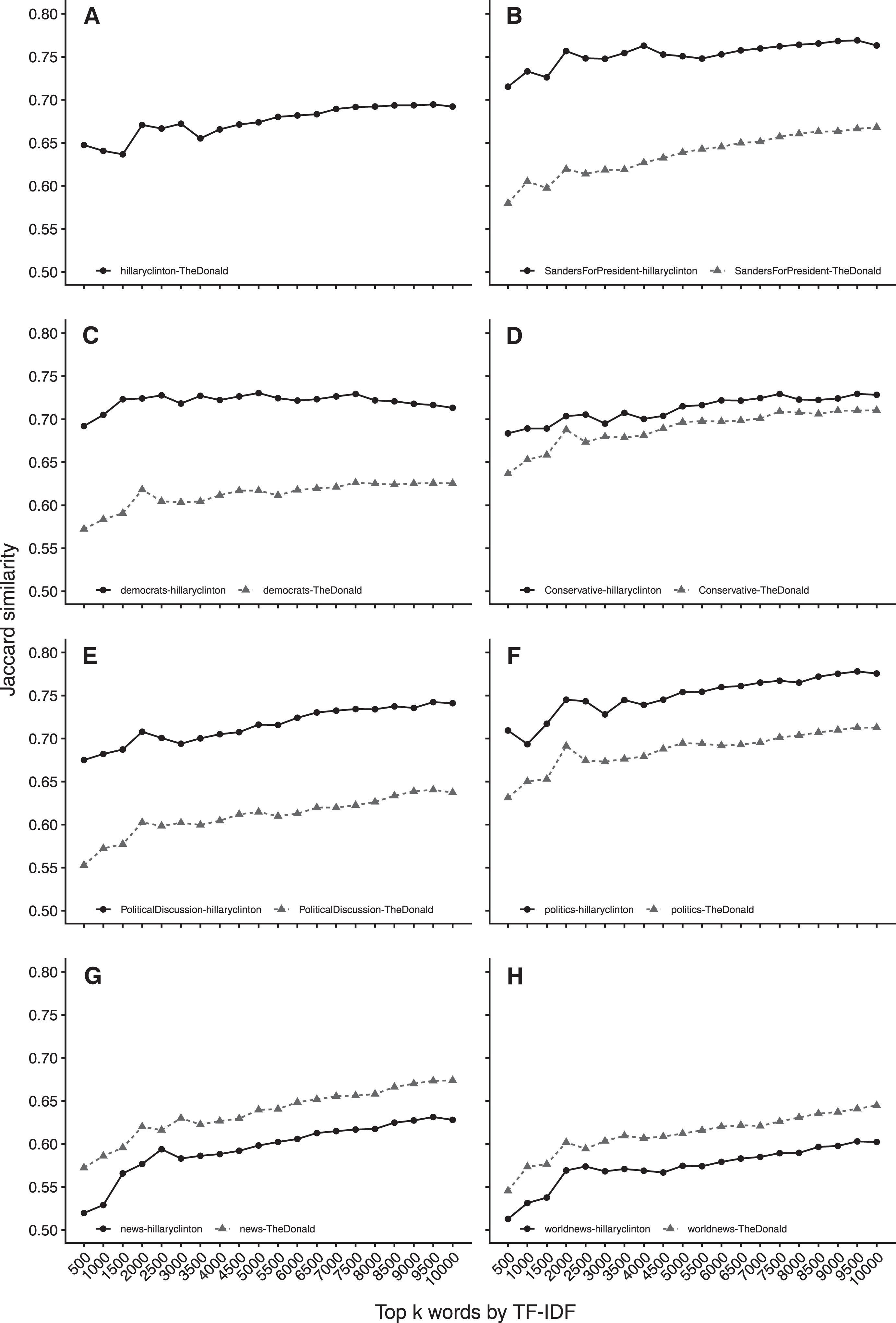
Plot A in Figure 3 shows that the two subreddits /r/The_Donald and /r/hillaryclinton have a Jaccard similarity between 0.64 and 0.69 for the top k words (ranging from k = 500 to k = 10,000) ranked by their TF-IDF value. The difference between these words is more pronounced for small sets of words (i.e., k ≤ 1,500) and grows larger with an increasing number of considered words, slowly converging against 0.70.
Alternative information.
To interpret these differences meaningfully, we have to examine the differences between the vocabularies used in both subreddits with those focusing on other related topics. Plots B and C show that /r/hillaryclinton, unsurprisingly, shared more words with other subreddits focusing on Democratic Party politics or its candidates (such as Clinton) than /r/The_Donald. More surprising is that both /r/The_Donald and /r/hillaryclinton share similar degrees of difference with the vocabulary used in /r/Conservative (Plot D). This finding indicates that the behavior of contributors to /r/The_Donald differs from those engaging with more traditional varieties of political conservatism. Further, it supports the reading that the public in support of the populist Donald Trump behaves differently than traditional conservative publics.
Going beyond directly partisan differences, Plots E and F show that /r/hillaryclinton shared more vocabulary with subreddits focused on general political debate than did /r/The_Donald. This could be because our populist public diverged from the general political discourse or could be driven by the generally more left-leaning Reddit user base (Barthel et al., 2016). An indicator of this is the relationship of /r/Conservative with /r/politics and /r/PoliticalDiscussion shown in Figure 4. This comparison shows that the vocabulary used in the dedicated conservative subreddit is extremely close to the vocabulary used in both politically crosscutting subreddits. The differences between these subreddits and /r/The_Donald thus are driven by something other than the supposed left-leaning ideology of most Reddit users. Going back to Plots G and H in Figure 3, we see that both /r/The_Donald and /r/hillaryclinton share much less vocabulary with subreddits focused on the news in general.
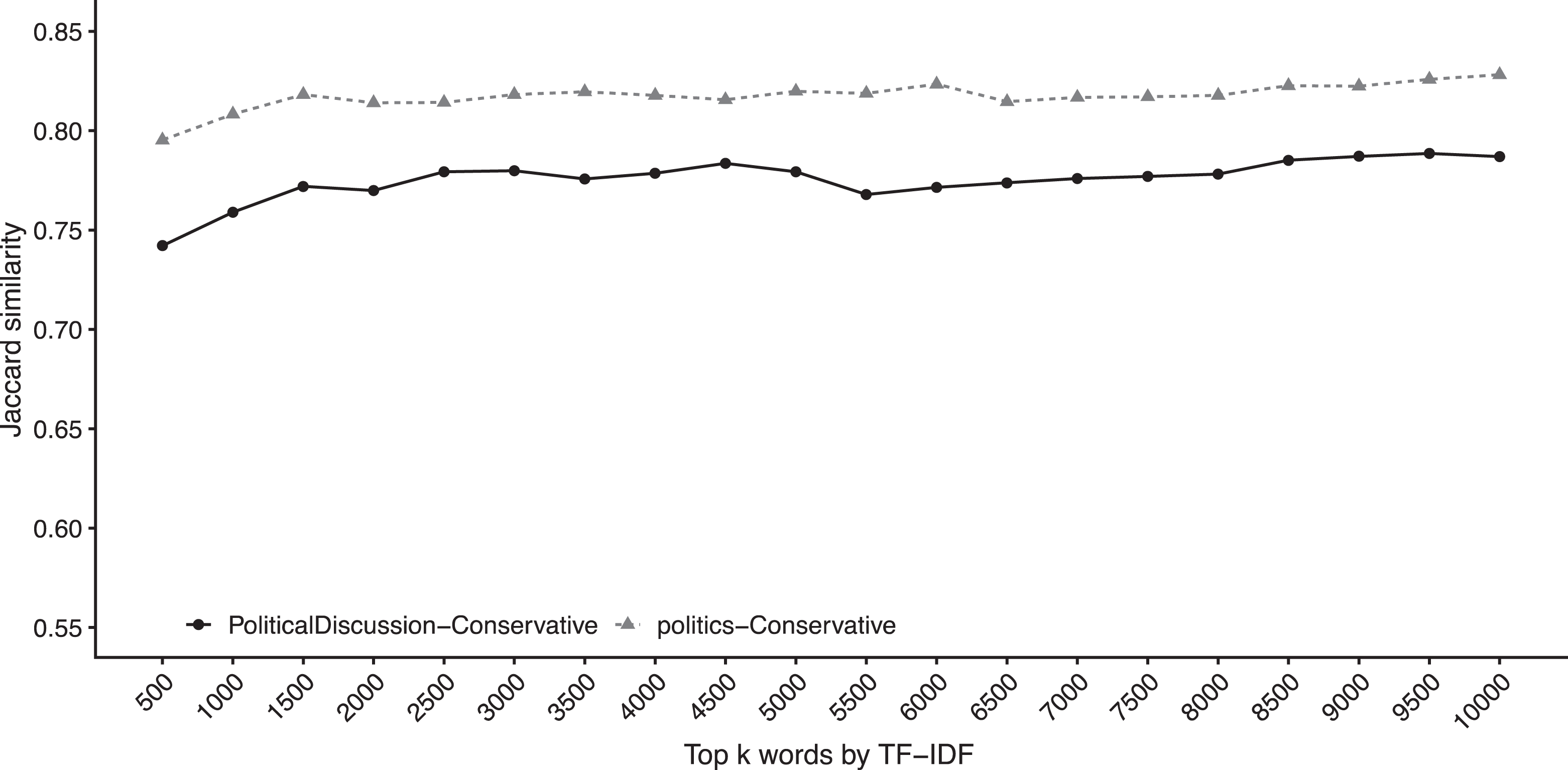
/r/Conservative compared to /r/PoliticalDiscussions and /r/politics.
In combination, we take this as support of Hypothesis 2. /r/The_Donald indeed seems to function as a space to post, disseminated, and discuss information different from that featured in left-leaning political publics, a right-leaning political public, and publics interested in general political discussions.
Community Building (Hypothesis 3)
We also expect a populist public to engage in community building on Reddit more strongly than other partisan publics (Hypothesis 3). In our analysis, we focus on public expressions of caring toward members of one’s own community, impoliteness toward political others, and public expressions of shared identity by use of a shared idiom in Reddit comments. We checked for this by hand coding 5,000 comments. By coding the same number of comments in both subreddits, these analyses are robust to the differences in total comment volume across the considered subreddits.
We found that of 2,519 coded comments in the subreddit /r/hillaryclinton, 1,000, or 39.70%, corresponded with expressions of community building. Of 2,481 coded comments in the subreddit /r/The_Donald, 1,380, or 55.62%, did the same. We thus find our populist public to engage more strongly in community building than our center-left public.
Plot A in Figure 5 shows the share of different expressions of community building of all coded comments in both subreddits. We see that the difference in the intensity of community building between both subreddits is largely driven by much higher levels of impoliteness and expressions of shared identity in /r/The_Donald than in /r/hillaryclinton. Expressions of caring were slightly more prominent in /r/hillaryclinton than in /r/The_Donald.
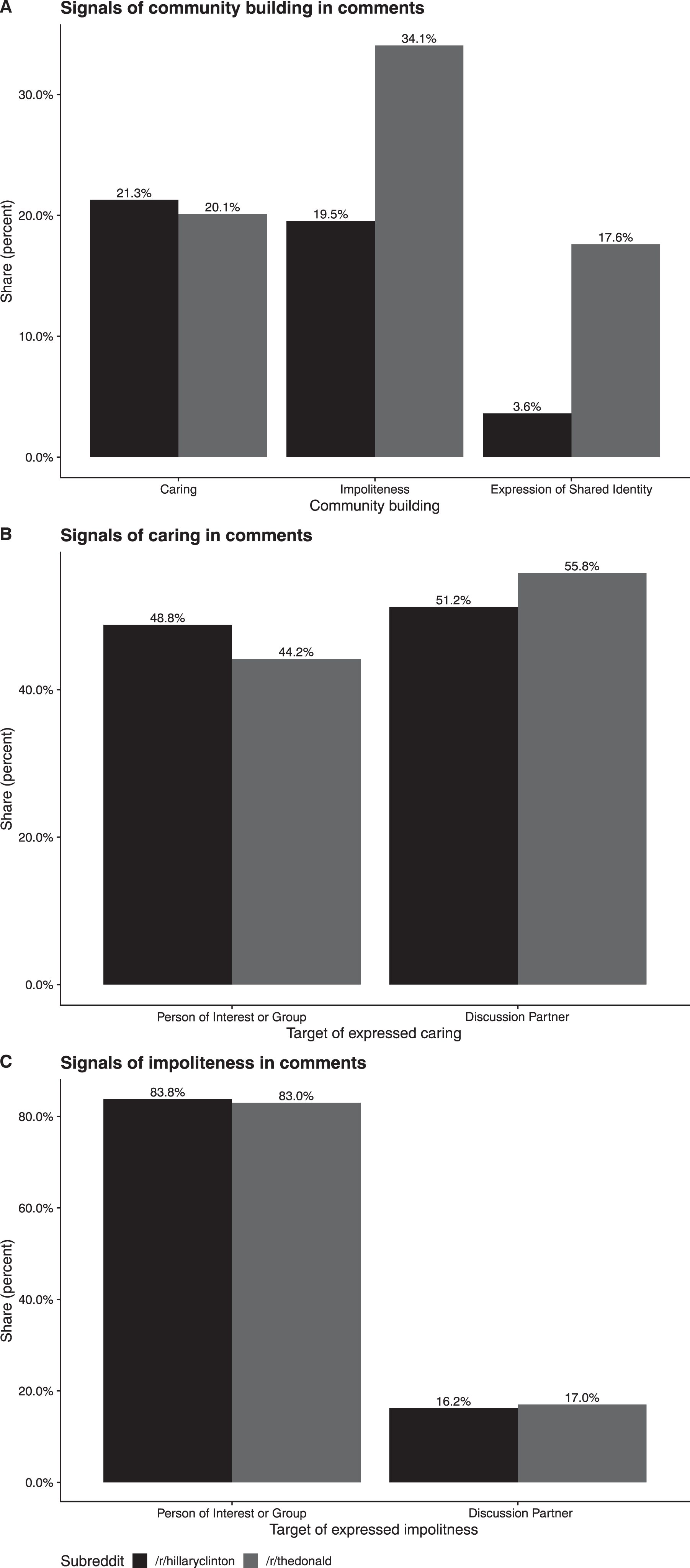
Community building. (A) Signals of community building in comments. (B) Signals of caring in comments. (C) Signals of impoliteness in comments.
While this comparison speaks to the function of impolite comments and expressions of shared identity, we should be careful not to read this as a sign of these functions finding equivalent expressions in both subreddits. This becomes especially apparent if we examine expressions of shared identity in both subreddits. While in /r/hillaryclinton, these are typically less offensive, as, for example, in the delimitation toward aggressive supporters of Bernie Sanders, the so-called Bernie Bros, shared identity in /r/The_Donald is expressed by terms such as “Cucks” (a slang term for weak of servile man, often used pejoratively by people on the far right to refer to supporters of the political left or progressives), by “MAGA” (an abbreviation of the Trump campaign slogan “Make America Great Again”), or “Pepe” (a cartoon frog often associated with the far right). These terms are deeply linked with misogyny, racism, or White nationalism (O’Neill, 2016). While technically serving the same function of community building, the expression of shared identity in /r/The_Donald is clearly more problematic and potentially contributes to the normalization of toxic ideologies.
Beyond this, the different levels of impoliteness point to a significant difference in the usage culture between the two subreddits. While both subreddits contain substantial amounts of impolite comments, it is clear that members of our populist public use them much more frequently than those of our center-left public. This indicates that it is not Reddit as a channel per se that determines levels of impoliteness in political talk but rather that impoliteness is driven by different cultures in different publics. Future comparative research will have to explore whether this culture of impoliteness is specifically connected with /r/The_Donald or instead applies to populist publics in general.
We can gain further insights into community building practices in both publics by examining to whom public expressions of caring and impoliteness are directed. In Plots B and C in Figure 5, we show the share of comments in both subreddits that directed caring or impoliteness at a discussion partner or person of interest or group of people not directly present in the discussion. Plot B shows that there are some differences in the direction of caring between both subreddits. But for both /r/hillaryclinton and /r/The_Donald, expressions of caring are directed somewhat more predominantly at discussion partners than at persons of interest or groups not present in the discussion, with this difference being somewhat more pronounced for /r/The_Donald.
Plot C shows that with respect to the direction of impolite comments, the differences between the two subreddits disappear completely. The interesting finding here is that for both subreddits, about 80% of impolite comments were directed at persons of interest or groups not directly present in the discussion. Well below 20% of comments were directed at discussion partners. 5 This supports our reading of impoliteness as being at least partially about the performance of group belonging and not exclusively about directly attacking and silencing others.
In combination, we read these findings as supporting our third hypothesis. We find that our populist public engaged more strongly in communicative behavior associated with community building. This difference was driven primarily by different levels of impoliteness toward others and public expressions of shared identity, while public expressions of caring were found in both publics to a similar degree. Further, we found largely similar behavior in both publics with respect to caring or impoliteness.
Discussion
We compared the content of selected subreddits to identify whether supporters of a right-wing populist, Donald Trump, used Reddit differently from supporters of a center-left candidate. Our comparison of /r/The_Donald and /r/hillaryclinton indicates that there is, indeed, a difference. At a very fundamental level, we saw much greater activity and engagement in /r/The_Donald than in /r/hillaryclinton. Supporters of the political right were thus engaged in a much more vibrant online public than those of the center-left. More to the point, while we did not find conclusive evidence of distinctive expressions of populist ideology in /r/The_Donald, we found that users posted more comments containing anti-elitist and exclusionist content in line with the constitutive sense of marginalization and hostility toward mainstream political discourse in populist publics. We found that the vocabulary used in the populist public diverged strongly from other distinctly partisan or politically crosscutting publics. We take this as evidence that /r/The_Donald indeed served as a space for the dissemination and discussion of alternative information and narratives that exist outside of the general political discourse. We also found, corresponding to the needs of populist publics, that contributors to /r/The_Donald engaged more strongly in communicative behavior associated with community building. This difference was driven primarily by different levels of impoliteness toward others and public expressions of shared identity through a shared idiom. In combination, we take this as strong evidence that supporters of the populist-right candidate Donald Trump were using Reddit differently than supporters of the center-left candidate, Hillary Clinton, in order to establish a space to develop and maintain a challenge to a political mainstream perceived by them as hostile.
While these findings offer a fascinating window into the usage practices and communication patterns in a populist public, we should be careful not to generalize from this specific context to others. For one, we focused only on one digital service, Reddit. While specific features of Reddit offer advantages for researchers—such as its openness, rich textual data, and affordances that allow for the emergence of subreddits that are largely homogenous with respect to politics—it also has limitations. For one, we know little about the actual demographics of users in the subreddits included in our analysis. Given the gendered nature of much political discourse during the 2016 election, the strong Reddit activity by Trump supporters, and that Reddit’s user base in general skews heavily male and to the politically liberal side, it would be fascinating to be able to compare both subreddits and comments in demographic terms. Unfortunately, this information is not available.
In addition, Reddit’s role during election campaigns is probably limited to a very specific subset of highly active political partisans. In our view, this does not invalidate work on Reddit, but it raises the challenge of replicating our findings in other digital services such as Facebook, Twitter, Instagram, or YouTube. Also, while we are interested in the characteristics of usage practices of populist publics in general, our findings can speak only to patterns among supporters of a very specific populist candidate, Donald Trump, in the United States. Nevertheless, we believe our findings have clear exploratory value, and this limitation should be easily remedied by studies into communicative behavior in other populist publics across the political spectrum and in other countries.
Our findings regarding the near absence of expressions of people-centrism in the populist public merit further attention in particular. This might be an artifact of looking at a strand of populism specific to the United States, which might put weaker emphasis on people-centrism in general. Alternatively, this finding could also indicate that the so-called populist attitudes do not necessarily find expression in political talk by political supporters. While our analysis cannot answer this question, it points to an important research gap, as a consistent lack of people-centrism among supporters of populists would raise serious questions as to the usefulness of treating them as supporters of “populism” in its fuller meaning, rather than more narrowly as, say, supporters of ethno-nationalism or authoritarianism. This also suggests caution in measuring “populist attitudes” or “populist communication” as indexes (Wuttke et al., 2020). This practice risks hiding the very real differences across the prevalence between the considered dimensions. This risks treating sets of attitudes and behaviors as “populist” when, in fact, they might be lacking the element widely seen as constitutive of populism—people-centrism—and simply be expressions of partisan competition.
Our findings indicate that supporters of populism use digital media differently than other partisan and political publics. This finding is interesting. It shows that digital media help serve the specific purposes of political challengers, which finds expression in supporters of challengers adapting specific usage patterns to capitalize on these opportunities. Going forward, it will be crucial to identify whether these asymmetric benefits emerging from the use of digital media are connected to the specific needs of challengers, such as being driven by and supporting distrust in established institutions (Gurri, 2018), or whether we are simply seeing a competitive edge of challengers driven by their need to capitalize on any advantage to maintain their challenge to the status quo (Jungherr et al., 2020). If the first case were true, digital media would provide an edge to challengers to the political status quo that the political mainstream would have to counterbalance using different tools and approaches. The second reading would indicate that forces of the political status quo could also benefit information distribution or community building through digital media but would have to start putting more attention and resources into the use of these tools to counter challengers. In any case, identifying different usage patterns and their drivers between supporters of the political status quo and its challengers is vital in furthering our understanding of the effects on democratic exchange and competition.
Supplemental Material
Supplemental Material, sj-pdf-1-ssc-10.1177_0894439321996130 - Populist Supporters on Reddit: A Comparison of Content and Behavioral Patterns Within Publics of Supporters of Donald Trump and Hillary Clinton
Supplemental Material, sj-pdf-1-ssc-10.1177_0894439321996130 for Populist Supporters on Reddit: A Comparison of Content and Behavioral Patterns Within Publics of Supporters of Donald Trump and Hillary Clinton by Andreas Jungherr, Oliver Posegga and Jisun An in Social Science Computer Review
Footnotes
Authors’ Note
We thank Scott Cooper, Valeska Gerstung, Ralph Schroeder, Sebastian Stier, Yannis Theocharis, and two anonymous reviewers for their valuable feedback.
Data Availability

Declaration of Conflicting Interests
The authors declared no potential conflicts of interest with respect to the research, authorship, and/or publication of this article.
Funding
The authors disclosed receipt of the following financial support for the research, authorship, and/or publication of this article: VolkswagenStiftung has generously supported the research underlying this article.
Software Information
Automated text analysis was done in Python (Version 3.7.1). We used the Python libraries nltk Version 3.4 (Bird et al., 2009) for text preprocessing, scikit-learn Version 0.21.2 (Pedregosa et al., 2011) for term frequency-inverse document frequency vectorization, and gensim Version 3.4.0 (Řehůřek & Sojjka, 2010) for training word embeddings. Descriptive analyses of the data set and the coded comments were performed in R Version 3.6.1 (R Core Team, 2019). We used the R packages cowplot Version 1.0.0 (Wilke, 2019), data.table Version 1.12.6 (Dowle & Srinivasan, 2019), dplyr Version 0.8.3 (Wickham et al., 2019), dtplyr Version 0.0.3 (Wickham, 2019a), forcats Version 0.4.0 (Wickham, 2019b), ggplot2 Version 3.2.1 (Wickham, 2016), purrr Version 0.3.3 (Henry & Wickham, 2019), readr Version 1.3.1 (Wickham et al., 2018), readxl Version 1.3.1 (Wickham & Bryan, 2019), scales Version 1.0.0 (Wickham, 2018), stringr Version 1.4.0 (Wickham, 2019c), tibble Version 2.1.3 (K. Müller & Wickham, 2019), tidyr Version 1.0.0 (Wickham & Henry, 2019), and tidyverse Version 1.2.1 (Wickham, 2017) for visualization.
Supplemental Material
The supplemental material is available in the online version of the article.
Notes
Author Biographies
References
Supplementary Material
Please find the following supplemental material available below.
For Open Access articles published under a Creative Commons License, all supplemental material carries the same license as the article it is associated with.
For non-Open Access articles published, all supplemental material carries a non-exclusive license, and permission requests for re-use of supplemental material or any part of supplemental material shall be sent directly to the copyright owner as specified in the copyright notice associated with the article.
