




Abstract
The introduction of robotic process automation (RPA) into the public sector has changed civil servants’ daily life and practices. One of these central practices in the public sector is discretion. The shift to a digital mode of discretion calls for an understanding of the new situation. This article presents an empirical case where automated decision making driven by RPA has been implemented in social services in Sweden. It focuses on the aspirational values and effects of the RPA in social services. Context, task, and activities are captured by a detailed analysis of humans and technology. This research finds that digitalization in social services has a positive effect on civil servants’ discretionary practices mainly in terms of their ethical, democratic, and professional values. The long-term effects and the influence on fair and uniform decision making also merit future research. In addition, the article finds that a human–technology hybrid actor redefines social assistance practices. Simplifications are needed to unpack the automated decision-making process because of the technological and theoretical complexities.
Keywords
The once-futuristic view of automated decision making has become the accepted view in many areas of the public sector (Sun & Medaglia, 2019; Wirtz et al., 2018). The technology used is often termed robotic process automation (RPA) or software robots. Even though RPA is “weak artificial intelligence (AI),” it still drives fundamental shifts in organizational contexts (Wirtz et al., 2018). Technology suppliers, legislators, and administrative agencies drive this development. In Sweden, for example, the Swedish Association for Local Authorities and Regions (SALAR, 2018b) promotes RPA in the public sector and in social services.
RPA has changed the understanding of decision making in the public sector. Before the digitalization of selected public services, citizens generally thought that independent civil servants made public sector decisions in a way that was free of bias and personal preferences (Lipsky, 2010; Tummers & Bekkers, 2014). Decades ago, Lipsky (2010) introduced the term “street-level bureaucrats” to describe public servants’ capacity of exercising discretion in the decision-making process. Early in the transition to digital practices in public services, Bovens and Zouridis (2002) observed a shift from street-level to system-level bureaucracies, where judgment is delegated to computer systems, ultimately leading to automated decision making. Automated decision making has led to reconsiderations of bureaucrats’ role and of digital discretion (cf. Bullock, 2019; Busch & Henriksen, 2018; Dworkin, 2013).
From a paradigmatic perspective, the increased focus on digitalization is driven by the logic of digital era governance (Dunleavy et al., 2006). The emphasis is on how public services are delivered and administered; digital era governance has legitimized an increasing digitalization of administrative activities. Digitalization has also affected citizens’ relationship with public services by decreasing face-to-face human interaction (cf. Lindgren et al., 2019; Lipsky, 2010). In a recent study, Zouridis et al. (2020) revisited the system-level bureaucracy. Their original caveat in 2002 was that system-level bureaucracy discretion is delegated to the people who program the systems. The 2020 study suggests that the increased use of automated decision making (system-level bureaucracy) could mean the end of decision-making discretion. This study therefore explores the split between human and technological agency in discretionary practices.
Discretionary practices have become central to the study of automated decision making in public administration (Busch & Henriksen, 2018; Petersen et al., 2020; Zouridis et al., 2020). Discretion is the right of civil servants to participate in decision making consistent with their duty to follow public laws and regulations (Dworkin, 2013). Although policymakers guarantee this right, the discretion of civil servants is needed because there are no wholly schematic rules (Lipsky, 2010). Some of the rules may even contradict each other (Dworkin, 2013).
The human–machine relationship has been studied for more than half a century (Burton et al., 2019). However, the recent capabilities in computing call for a closer look at the latest contributions to the debate. Automated decision making has caught attention in numerous disciplines including law, public administration, and social services, but there is a need for more knowledge about the role of technology and humans (Lindgren et al., 2019).
One stream of research has focused on automated decision making, discretion, and public sector norms: In studies of how technology influences discretionary processes in a Norwegian juridical court, Busch (2017) found that technology does not unduly influence street-level bureaucratic discretion because institutional factors moderate its use. The factors identified include the social complexity of the cases, the advocacy skills of the caseworkers and others, and the technology used. Wihlborg et al. (2016) conducted a case study on the effect of automated decision making on professionals in Sweden’s national public agencies. They recommended framing automation in public organizations around norms of “rules of law and ethics of justice.”
Automated decision making in the public sector requires the use of algorithms with varying degrees of complexity (Janssen & Kuk, 2016; Ranerup & Henriksen, 2019). Brauneis and Goodman (2017), who studied the use of algorithms in state government in the United States, concluded that norms of openness, impartiality, equality, and predictability require transparency in the use of algorithms. However, Ananny and Crawford (2018) challenged the transparency ideal as a “panacea” for algorithmic accountability. Like Kitchin (2017), they argue that we will improve our critical thinking about algorithms if we unpack the entire socio-technical group of human and nonhuman actors and address their agency. The objective is to help us better understand how accountability and discretion function in automated decision making.
Another research theme addresses the transformative impact of digital discretion in different public sector contexts. Examples include the distinction between “human” and “artificial discretion,” their effects (Bullock, 2019), and criteria such as effectiveness, equity, and manageability (Young et al., 2019). A further aspect is differences in contexts, tasks, and their relevance for human or artificial discretion (Bullock, 2019). This might take the form of areas of a high level of codification of processes and rules such as tax authorities versus hospitals and schools (Busch & Henriksen, 2018). This stream of research suggests that more theoretical and empirical research is needed to understand the situation in environments with tasks with different levels of complexity (Bullock, 2019; Busch & Henriksen, 2018). One such context is decisions about economic support in form of social assistance in social work.
De Witte et al. (2016) defined two worlds of technology use in public social services: the database and face-to-face interaction. The latter preserves the relational and narrative way of working with citizens. Ranerup and Henriksen (2019) analyzed the aspirational value positions in a case study of automated decision making in public social services. They found aspirational values of improving supply of public services through technology, whereas clients looking for help experienced contradictions between values. Devlieghere and Roose (2018) found that standardized documentation processes used in technological platforms improve transparency despite certain pitfalls (e.g., writing styles that exert a negative influence). Petersen et al. (2020) studied discretionary practices in the digitalization of social work. They suggested that automation is still a myth exactly due to contradictory rules and case complexity in social services. They argue that discretion in social work is a collaborative effort, which cannot be codified and translated into machine-readable programs.
In contrast to more theoretical perspectives (cf. Bullock, 2019; Young et al., 2019; Zouridis et al., 2020), our empirical study addresses the lack of digital discretion in automated decision making in social services. This context centers on individual clients’ encounters with automated services (De Witte et al., 2016; Petersen et al., 2020). The empirical study combines this aspect with aspirational values of efficiency, effectiveness, standardization, and service (Devlieghere & Roose, 2018; Ranerup & Henriksen, 2019). Discretion here is not an all-or-nothing situation and is therefore a promising avenue for research (Busch & Henriksen, 2018). In order to capture digital discretion in this context and these types of tasks, we will explore the details of the interaction between humans and technology (Janssen & Kuk, 2016; Kitchin, 2017). This leads to our research question: How does human and technological agency influence digital discretion and shape aspirational values in social services?
Our study of automated decision making in public social services focuses on the Trelleborg Municipality, a town in southern Sweden. We focus on decision making in social assistance (e.g., economic support under the Social Services Act).
The remainder of the article is organized as follows. The next section introduces the theoretical lens and our classification scheme in relation to public service values and to the roles of humans and technology, which guide our analysis (Table 1). The empirical case and our research methodology are then presented. This is followed by the analysis, discussion, and finally the conclusion of human–machine agency and discretionary practices in social services.
Theoretical Framework
Digital discretion can be evaluated based on frameworks emphasizing criteria such as effectiveness, efficiency, equity, and manageability (Young et al., 2019) or task complexity (Bullock, 2019). In their systematic literature review, Busch and Henriksen (2018) examined 44 articles on digital discretion and street-level bureaucracies, where civil servants have direct contact with citizens. The review focused on whether information technologies (IT) influence public policy outcomes and civil servant discretion. They organized their review around the ethical, democratic, professional, and people dimensions proposed by Kernaghan (2003). Public value theory has been widely used for discussing other aims with digital technologies than administrative efficiency (Panagiotopoulos et al., 2019). In their review of digital discretion, Busch and Henriksen (2018) examined the societal problems described in the articles and the purpose and desired effects of IT in addressing these problems. The technologies they identified in the articles included telephones, multifunctional computers, databases, websites, case management systems, and other automated systems. In short, they examined a combination of traditional and advanced technologies. In contrast to other value frameworks of digital discretion (cf. Bullock, 2019; Young et al., 2019), this framework combines the connection to public value theory with a qualified view of the agency of technologies and humans.
For our research, we adapt Busch and Henriksen’s (2018) framework. Table 1 lists the nine representative categories (of 16) that we use here. This set of categories encompasses a reasonable span of values and focuses on a range of the technologies employed by the municipality.
Digital Discretion Parameters.
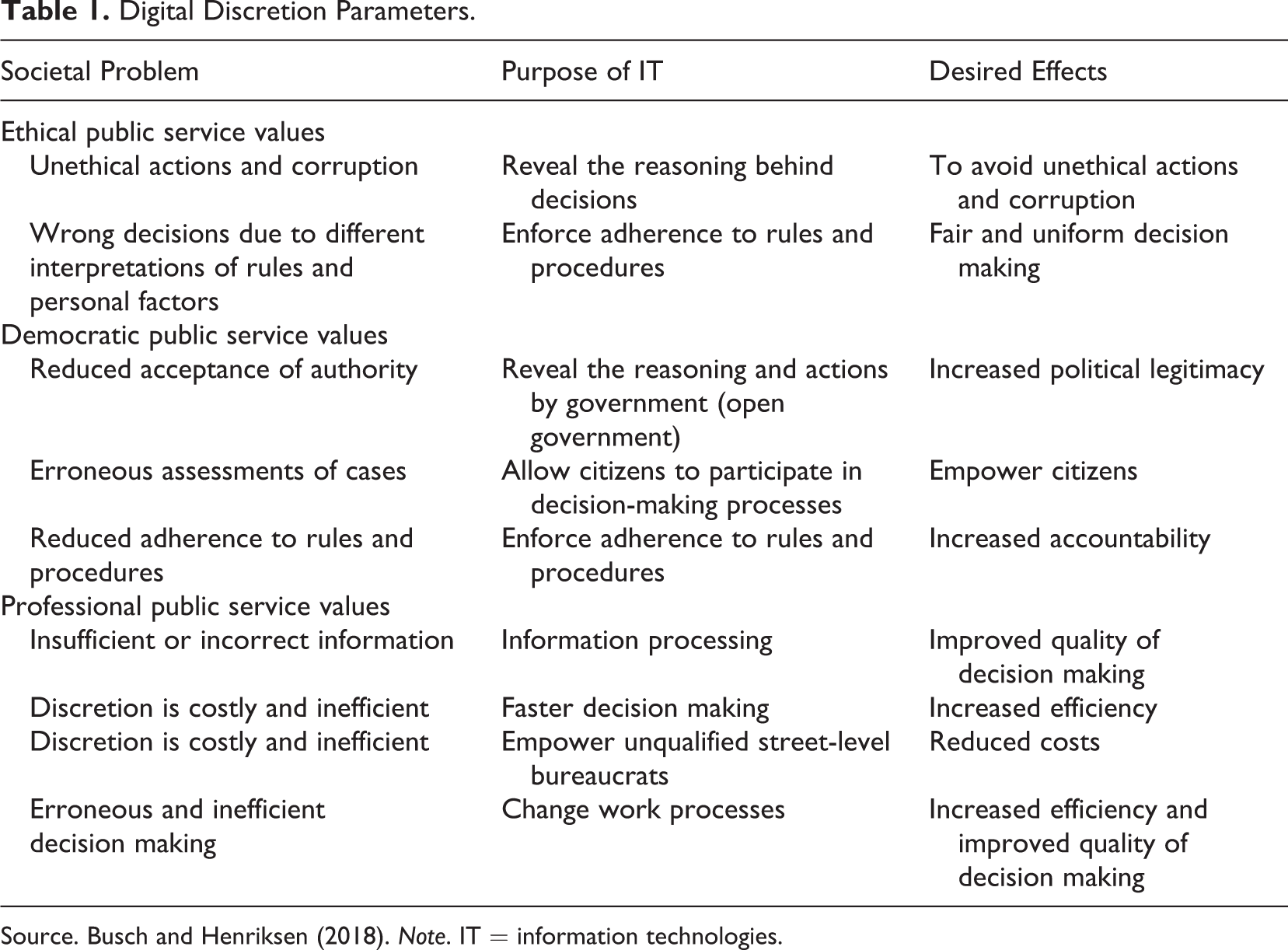
Source. Busch and Henriksen (2018). Note. IT = information technologies.
Against the background of previous research (Ananny & Crawford, 2018; Janssen & Kuk, 2016; Kitchin, 2017) and our framework (Busch & Henriksen, 2018), we unpack the human and technological agency in digital discretion when social services are automated by digital technology. In line with Janssen and Kuk (2016) and Kitchin (2017), actor-network theory (ANT) emphasizes the importance of humans and of nonhumans (“artifacts”) that are capable of acting on behalf of humans. ANT is an ideal way to unpack human–technology agency. We therefore apply the classical concepts of generalized symmetry and human and technological agency (Callon, 1986) in ANT as our analytical perspective.
Method
The Case Study Context
This article presents a qualitative interpretive case study (Walsham, 2006). The article describes Trelleborg, the first municipality in Sweden to use automated decision making for social assistance decisions. This innovation project, the Trelleborg Model, is a management model now used in many other municipalities in Sweden. Trelleborg, Sweden’s southernmost town, is an industrial town of around 45,000 people. In 2017 and 2018, 12 Swedish municipalities were part of a dissemination project related to the model (Rakar, 2018). In 2019–2020, another project with a more direct focus on the use of automated decision making in social services is taking place. Leading actors from the Trelleborg initiative are involved in this project. Therefore, our study is also concerned with “travel of ideas” (Czarniawska & Sevòn, 2005).
Empirical Data
Our empirical data consist of qualitative interviews with key stakeholders in the original management model used at Trelleborg: two politicians, three civil managers, and two caseworkers from the Labor Market Agency. All interviewees work with social assistance including the decision making for social assistance applications and appeals. Initial interviews were conducted from September to November 2017. Follow-up interviews (with one manager and two caseworkers) were conducted in October 2018 and August 2019. Eleven interviews were conducted, each lasting 40–60 min. All interviews were recorded and transcribed.
The interview questions focused on the origins, format, and design of the management model that Trelleborg uses for social assistance. We asked open-ended questions about the management and use of the technology. Our intention was to unpack (Ananny & Crawford, 2018; Kitchin, 2017) the human agency and the technological agency (Callon, 1986) to explain the agency of citizens, caseworkers, and technology. Most of our questions concerned the digital application process and its current layout. We asked only a few questions about the history or future layout of the technology. In addition, we interviewed four representatives of SALAR (spring 2018, autumn 2019) to learn their standpoints and activities related to RPA.
Our secondary data came from 12 internal reports prepared by the Labor Market Agency for 2014–2019. These reports describe the political aims and results of the new management model. We also consulted four reports on the model and the application process (prepared for external dissemination).
Other data sources were the civil servants’ oral and PowerPoint presentations of the Trelleborg Model. We examined the municipality’s online instructions that described the platform with its partially automated routines for social assistance and tried the online application process. We also used a few reports about SALAR and its RPA (cf. SALAR, 2018a, 2018b).
With this triangulation of data sources, we strengthened the validity of our data. However, we did not interview or survey any citizens who use, or plan to use, the digitalized application.
Data Analysis
We began our analysis with a review of the actors and goals connected to the Trelleborg Model: national regulations and SALAR, the local Labor Market Agency, and local politicians. Both groups of actors provide the context for the details of the new management model. (See “Context of the Application Process” subsection in the Findings section.)
In the second step, the collected data guided a symmetric analytical focus (Callon, 1986) in the unpacking (Ananny & Crawford, 2018; Kitchin, 2017) of the social assistance application process. The interactions among the human (civil servants and citizens) and technological (digital and automated routines) actors were identified. In the spirit of ANT, we “follow the actors” and their descriptions of the process. The municipal website, the researchers’ “walk-through” of the application process, and interviews provided the technology data. The only coding was the separation of human from technological actors. This is in contrast to approaches where data are treated inductively, gradually using analytical software, constructing a holistic scheme of what could be described as initial open codes (cf. Hwang, 2008). We studied the actions of the human and technological actors from application to decision. Finally, the description was double-checked for accuracy by an involved interviewee, resulting in the removal of a few minor flaws. (See “A Symmetric Description of the Application Process” subsection in the Findings section.)
In the third step, we applied the digital discretion parameters (cf. Table 1; Busch & Henriksen, 2018). Both authors methodologically reviewed the categories of purposes of using IT (Table 1) in relation to the description of the application process and the additional data collected. Our intention was to find empirical expressions of the value parameters and counterarguments or critical aspects in data and literature. (See “Digital Discretion in the Application Process” subsection in the Findings section.)
In the fourth and last step, we discussed the methodological consequences and limitations of our analytical approach. (See Methodological Considerations: Unpacking the Actors section.)
Findings
Context of the Application Process
Sweden’s parliament passed the Social Services Act in 2001 (Ministry of Health and Social Affairs, 2001). This act governs the processes in case management of social assistance in the country’s municipalities. The premise of the Social Services Act is that the law should “strengthen economic and social security, equal opportunities and active participation in society” (§ 1). The individual’s resources and responsibilities of citizens are emphasized. Social assistance consists of short-term public support. The intention is for people to rely on social assistance when the usual forms of economic support are unavailable or are too limited to meet their needs. The individual’s obligations and rights are: To be eligible to receive social assistance, individuals must do what they can to support themselves including looking for work. […] Social assistance consists of two parts: one part applies to the whole country (the national norm); the second part deals with reasonable compensation for personal expenses. (The National Swedish Board of Health and Welfare, 2013, p. 20; translated from Swedish)
In 2015, the Labor Market Agency in Trelleborg and local politicians introduced the Trelleborg Model for social assistance. A promotional feature of the model is that, owing to a streamlined application process, citizens receive decisions within a few days. Since 2015, citizens have been able to submit their applications for social assistance digitally.
The Trelleborg Model focuses on the steps that citizens need to take to become self-supporting (Trelleborg Municipality, 2015). Since the early spring of 2017, RPA, and thus automated decision making, has been part of the process. Recent municipal reports state that 85% of the digital applications for social assistance are handled at least partly by the RPA (information and calculation) and 30% are handled entirely by the RPA (Trelleborg Municipality, 2017, 2019).
A Symmetric Description of the Application Process
Applying for social assistance
Citizens
Citizens can apply for social assistance using a (paper) form or the municipality’s website. The website has a section for digital self-services of which one is the “platform for applications for social assistance.” A citizen starts the online application by logging onto the platform with a personal e-ID. A help desk at City Hall can provide assistance with e-IDs. In 2017, 75% of the applications were submitted through the platform (Trelleborg Municipality, 2017).
Platform for applications
The platform requests information about family members, family income, and personal expenses (e.g., rent, broadband, medicine, childcare, and home insurance). Information is also required about living arrangements and the number of people living in the household.
If the user clicks on a question mark, additional information is provided about the legal requirements for benefits. Instructions are in Swedish, English, and Arabic. However, the application must be completed in Swedish. Figure 1 illustrates the application process.
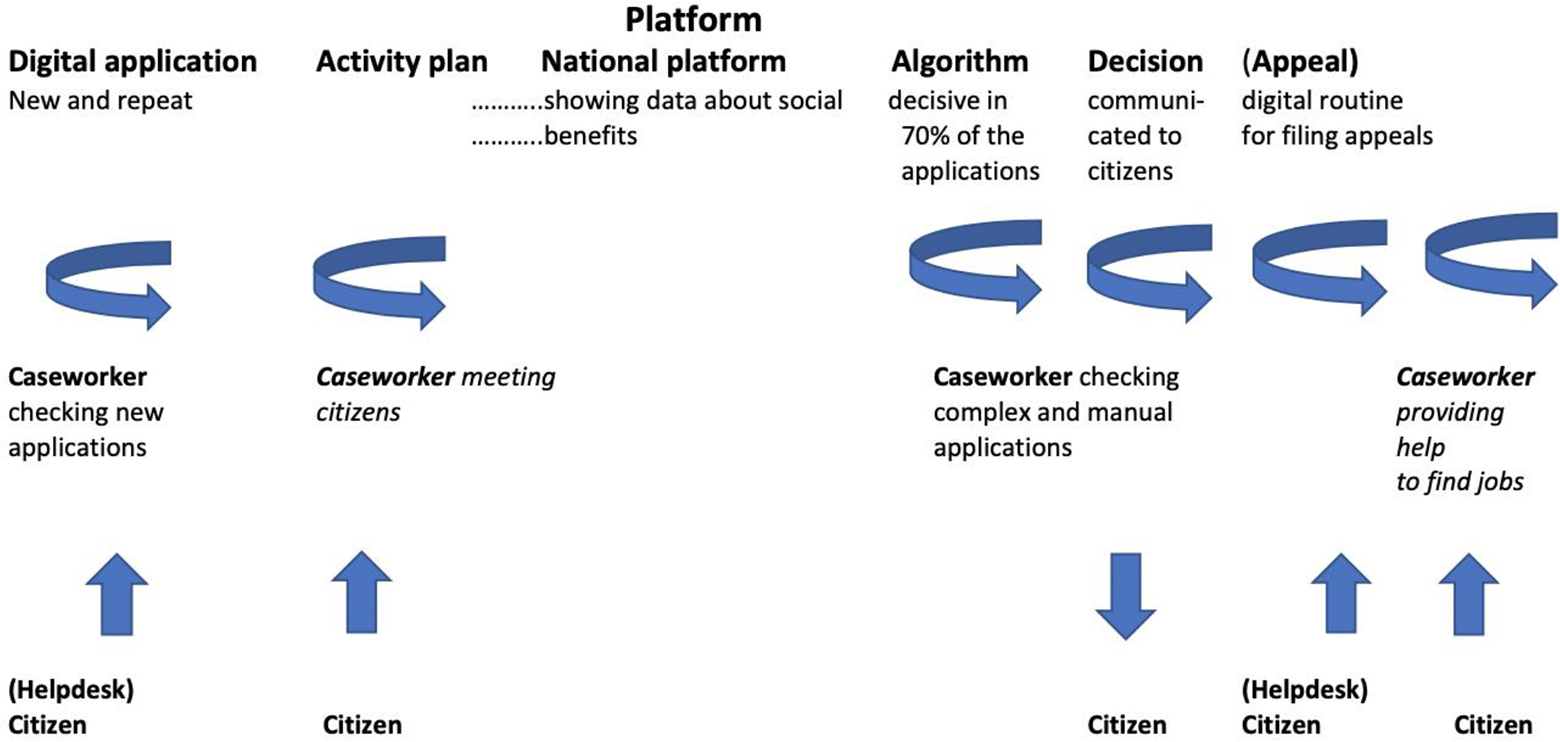
An overview of technological and human agency in the management model process: Context-specific types of relevance to the specific model for social assistance in italics.
Citizens
Citizens are not required to provide proof of their expenses or income. A politician explains: Now we trust the individual. We believe that people want to do their very best. (Politician No. 2, September 25, 2017) Normally, we check every tenth application. Then these citizens must send in their documents, which is why the decision process might take longer than normal. (Manager No. 2, September 26, 2017) One idea is that the applicant should attach a document such as a rent contract or an invoice for rent […] We know that people cannot always provide a formal rent contract. (Manager No. 1, October 9, 2018)
Platform for applications
The digital platform registers the citizens’ information and generates possible times for a next-day appointment with a caseworker who works with labor market issues.
Citizens
Citizens choose an appointment time. This completes this part of the application process.
Additional help
Citizens
Citizens who are unable to complete the application by themselves can request assistance at the City Hall help desk. Civil servants with an academic degree and special training provide this assistance. With the introduction of online applications, the number of citizens seeking this help has gradually diminished.
Civil servant at the help desk
A civil servant offers help with the application when, for example, citizens have difficulties in understanding what the application requires. Some citizens are unsure about what to write on the application. They may make mistakes. (Civil servant at the help desk, October 9, 2018)
Platform for applications
The platform asks for the required information and offers times for an appointment.
Citizens
Citizens schedule an appointment. This complete this part of the application process.
Applying for social assistance (continued)
Citizens
Citizens attend their first meeting with a caseworker.
Caseworker (who works with labor market issues)
A caseworker explains: There are two parts. First, we must determine if applicants have tried to obtain work. We check to see if they are registered at the unemployment agency, have applied for work, and have a resumé they can show employers […] We try to keep this part as brief as possible. Second, we try to focus on how to get a job. We base this part on the individual citizens’ competences, plans, and needs. (Caseworker who works with labor market issues, November 29, 2017)
Citizens
Citizens answer the caseworker’s questions and discuss additional activities.
Caseworker (who works with labor market issues)
We review the necessary issues with the citizens and make a plan for additional activities. However, a politician explains: Not all citizens appreciate the plan to become active in the labor market. But they are given the plans, nevertheless. (Politician No. 1, September 26, 2017)
Decisions on social assistance application
Platform for applications: The separate routine for decisions
The platform has information about a citizen’s activity plan and how it should be followed up on a regular basis. The routine checks the application to review the citizen’s economic situation and activity plan. A manager explains: The robot is programmed as a caseworker. After a caseworker was filmed, the film was programmed into the robot. A citizen’s application form is copied and entered into the system. Then the robot logs into our case management system ProCapita as a caseworker, copies the information from the form as a caseworker would, and transfers the information to an Excel document to facilitate checking with the Social Insurance Board or another agency [i.e., the national Platform]. This process is preliminary to the assistance decision. (Manager No. 1, September 26, 2017) The robot checks if citizens have an operational activity plan. […] If citizens are unable to work, they must provide a certificate. […] Citizens might be in contact with a clinic for drug addiction or for another issue. (Caseworker who works with labor market issues, November 29, 2017)
National platform for information on social benefits
Some information that is relevant to the citizen’s economic situation is provided by the national Platform. (See “Context of the Management Model” subsection in the Findings section.)
Citizens, caseworkers, and technologies
The final decision on applications is made jointly by a caseworker and the technology: We think the meeting between people [i.e., the citizen and the caseworker who works with labour market issues] should also be [considered as] an important part of the decision-making process. (Manager No. 1, August 12, 2019)
Platform for applications: the separate routine for decision
The routine generates a decision that can be positive, partly positive, or negative. The RPA makes the decision in many of these situations. The routine that deals with negative decisions, which is more complex, is not yet fully developed. A positive decision is much easier to programme. Negative decisions are much more complex. One might receive a partly negative decision when it should be a positive decision. There are many reasons for negative decisions. Our responsibility is to be very clear about our reasons. They must be justified. We also need to be clearer about how the robot makes decisions. (Manager No. 1, October 9, 2018) We are not influenced by our emotions. […] We are neutral. We make a decision based on the rules and regulations. That is what our work is based on. We have laws that we must follow. We can concentrate on that instead of focusing on applicants who may be disappointed, angry, or threatening. (Caseworker who works with social assistance, October 9, 2018) From the perspective of legal, appeal-proof decisions, the RPA is an objective decision-maker. The decisions are correct because they are based on the rules. (Trelleborg Municipality, 2017, p. 3) [The RPA] is legal. It is exactly in line with the Board’s principles. (Manager No. 2, September 26, 2017)
Platform for applications
The platform receives decisions from the separate routine. A text message and an email inform citizens about the decisions. Information about how to appeal negative decisions is also provided.
Citizens
Citizens can log onto their accounts in the platform and read their decision. If the decision is negative, they have the right to appeal.
Appeal against negative decisions
Citizens
A citizen can file an appeal against a negative decision.
Civil servant at the help desk
Assistance with the appeal is available at the help desk.
A civil servant has a template to use with appeals. As one civil servant explains: We print the decision so that the citizens really understand the basis for their negative decision and the argument for their appeal. We explain how to make an appeal, but we don’t write it. We cannot be held responsible if the appeal is unsuccessful. (Civil servant at the help desk, October 9, 2018)
Platform for applications
In July 2019, a function for making an appeal was added to the platform. Formerly, appeals had been submitted on paper.
Regular activities in the management of applications
Caseworkers (who work with labor market issues) and citizens
Citizens (who have filed social assistance applications) must attend municipality-sponsored “Open Houses,” where caseworkers help them prepare for job interviews, make job applications, contact employers, and the like. Citizens and caseworkers can also meet several times over an extended period. These shorter meetings consist of a decision meeting, activities meetings focused on career advice and job applications, and follow-up meetings when citizens need additional social assistance. (Oral presentation by Manager No. 3, October 17, 2018)
The end of the process consists of education/work. Municipal reports indicate an increase in the number of people who have become self-supporting. At the same time, the cost of social assistance has decreased (Trelleborg Municipality, 2017, 2019).
Digital Discretion in the Application Process
Based on the findings presented in our symmetric description, we analyze digital discretion (Table 1) in the new application process.
Ethical values
Digital discretion facilitates avoiding unethical actions and corruption. At Trelleborg, contact between the citizens and caseworkers who manage the social assistance decisions is by mail, telephone, or the digital platform. These communication modes are used in a process governed by rules and procedures that are carefully built into the technology. This process safeguards fair and uniform decision making (Zouridis et al., 2020). At Trelleborg, RPA alone makes about one third of the decisions. Many more decisions are made partially by automation (Trelleborg Municipality, 2017). There is a continuous development of the texts explaining the motivations for all decisions, positive and negative.
Our study suggests that the use of standardization in the digital application process supports adherence to rules and procedures that can be codified in the RPA. The human factor is diminished when citizens do not meet with caseworkers face-to-face, reducing the risk of unethical behavior. Nevertheless, caseworkers and the help desk continue to provide assistance to citizens as needed.
The caseworkers expressed discomfort with the possibility they might be held responsible for negative decisions if they take too active a role when citizens appeal such decisions. Smith (2011) also emphasized the importance of caseworkers’ attitudes about their decisions. In sum, we found that the civil servants at Trelleborg in the present form of digital discretion perceived that they exercise their discretion in a way that is consistent with their ethical values.
We did not investigate if the decision making in social services assistance applications and appeals (whether made by automated routines or by caseworkers) at Trelleborg is fair and uniform according to legal requirements (Petersen et al., 2020). This determination was beyond the scope of our research.
Democratic values
Digital discretion, derived from technology users’ involvement with and choice of decision alternatives, is intended to empower citizens by giving them a more active role in decisions affecting their lives and rights. At Trelleborg, digital discretion allows citizens to take an active role in the application process via interaction with the technology and with the caseworkers. The aim is for citizens to become self-supporting. Several interviewees emphasized the importance of focusing on citizens’ needs, of providing them with support, for example in making appeals, obtaining a bank ID, and assisting them with the activity plans. Thus, digital and manual assistance helps citizens become more independent and self-confident in dealing with governmental bureaucracy. However, other aspects of the digital divide and digital literacy (Bélanger & Carter, 2009) were not addressed in detail. Democratic values are therefore favorable from the municipality’s perspective but not necessarily for the citizens.
Our theoretical framework indicates that one desired effect of digital discretion is to increase governments’ political legitimacy. From a municipal perspective, this legitimacy increases when citizens find employment and become self-supporting as a result of governmental programs. At that point, government policy is perceived as valid (Trelleborg Municipality, 2015, 2017, 2019). Ultimately, support increases for governmental digitalization programs when decisions are standardized, rules and procedures are followed, and potential biases and preferences are eliminated. However, it must be remembered that RPA in decision making about social assistance can have aims other than increasing the number of self-supporting citizens. One such aim is reducing costs to enable budget cuts, which is discussed next.
Digital discretion, which facilitates adherence to rules and procedures, means decision-making accountability increases. At Trelleborg, although the caseworkers worked in close cooperation with automated decision making, they understood that they had been relieved of some decision responsibility. As Lipsky (2010) observed, street-level bureaucrats are greatly concerned with their own accountability. Over time that accountability has become embedded in the system. The automation process began in late 2016 and early 2017. By 2018, the process had reached the point at which the digital platform could explain negative decisions. In contrast to cases that involve children in need (Petersen et al., 2020), decisions about social assistance are more standardized.
The caseworkers still have significant responsibility for the activity plans that they design, explain, and follow-up on together within conjunction with the citizens who can thus become potentially empowered. However, a concern is that some citizens disapprove of the activity plans, considering them disciplinary and punitive rather than beneficial and humanitarian. Citizens may feel pressured to enter a labor market for which they feel unprepared (Umney et al., 2018). Thus, in some respects, this new management model lacks the acceptance it seeks.
Professional values
Digital discretion may mean that applications are submitted digitally. At Trelleborg, the e-applications are less ambiguous for the caseworkers. The automated routine process for applications is standardized, and the citizen-provided information is easier to read. This suggests that professional public service values and improvements in the quality of decisions are supported. This finding contrasts with research about social workers’ controversial use of recommended text fields in new ways (Devlieghere & Roose, 2018) or citizens’ ability to enter correct data (Henriksen, 2018).
The streamlined digital process at Trelleborg developed several years before digitalization was introduced. Digital discretion in form of streamlining means less internal processing and increased efficiency (Zouridis et al., 2020). By 2019, when RPA was well-established, the caseworkers were less involved in the application decisions. When the face-to-face case management of social assistance decisions decreased, many caseworkers could focus on labor market issues. Furthermore, as trust in citizens was an important aspect in the layout of digital discretion, fewer income and expense documents were submitted to caseworkers for verification. As a result, civil servants state that they now have more time for tasks other than routine processes and decisions (“easy cases”). They have time to analyze the activity plans, expert opinions, and appeals (“hard cases”; Zouridis et al., 2020). They can also assist with the development of the technology used for negative decisions. However, early in the process, some civil servants have resisted this reallocation of their responsibilities (Trelleborg Municipality, 2015) that undermines their professionalism.
Preventing errors is also related to the new management model in terms of digital applications, algorithms for decisions, and the ongoing development of motivations communicated in both positive and negative decisions. Yet caseworkers are still needed for the review of complex negative decisions and for complicated applications.
Nevertheless, we note that when some governmental tasks are automated, especially in large municipalities, it may be possible to hire street-level caseworkers with less education at a lower salary. Technology can thus achieve the desired effect of reducing the costs of case management. Reddick’s (2005) manuscript on citizen interaction with e-government warns against the possibility of chaos if such changes in staffing are made. Essential competencies and experience may be lost.
In contrast to Reddick’s possible outcome, our case shows that a group of qualified caseworkers is still needed to review negative decisions and to manage citizens’ appeals. A repeated theme in this article is that technology is not simply a technical issue. Even when automated processes replace manual ones, experts are still needed, not least to oversee the use and development of the automation. This echoes the findings of Petersen and colleagues (2020). In the management model used in our case, follow-up meetings on activity plans between applicants and caseworkers also are important. Furthermore, we point to the possibility that the reduction in costs in our case is also attributable to the increased self-support by citizens and not just to the administrative savings (Trelleborg Municipality, 2017, 2019). We have not made a quantified investigation of this possibility. Anecdotal evidence from other municipalities indicates that reduced costs for the administration of applications through RPA could be used for budget cuts in social assistance at large.
Methodological Considerations: Unpacking the Actors
As we examined the human and technological actors in our research, we realized we needed to focus more on level and detail when thinking critically and researching algorithms (Kitchin, 2017). We could have included more information about the national political and technological actors. We also could have devoted more attention to the ways in which technological actors are allowed to “speak” (Callon, 1986) and how they are studied empirically. Given our methodological approach, we have relied on (a few) people’s descriptions of technology and of their own agency in technical and other matters, complemented by factual descriptions and a researcher walk-through of the case management process.
We prepared a detailed, symmetric account of automated decision making that includes experiences from several groups of human actors and several digital and automated routines (Figure 1). Such an approach can easily become overwhelming if the objective is to present a detailed analysis of digital discretion. In addition, of the 16 categories of digital discretion connected to technology and public service values parameters, we used only nine representative categories (Table 1). This suggests the necessity for some simplification even in the limited empirical context of a single municipality where the focus is social assistance decisions. A complete analysis of digital discretion would require the inclusion of additional, and in many instances, quantitative data, however, that is beyond the scope of our research.
Finally, our symmetric analytical perspective reveals how civil servants, technologies, and citizens connect with issues of empowerment and accountability. However, critics may find this perspective controversial because discretion, as a core concept, is limited to civil servants (Lipsky, 2010). Our analysis of digital discretion (Busch & Henriksen, 2018; Table 1) is thus more inclusive and pragmatic with its descriptions of the consequences for citizens who are closely involved with technology. We think our analysis strengthens the perception of civil servant discretion as an essential element of the citizen–civil servant encounter (Lindgren et al., 2019) involving citizens.
Discussion and Conclusions
Our analytical framework had a focus on digital discretion parameters like the agency and purpose of technology and humans as well as the effects in terms of public values in specific contexts and tasks (Busch & Henriksen, 2018). According to our analysis, many aspects of ethical, democratic, and professional values are identifiable in the processes of digitalization and automated decision making in social services when viewed from the municipal perspective. This is in contrast to ethical and democratic values as the primary candidates to be strengthened by digital discretion (Bullock, 2019; Busch & Henriksen, 2018). As a result of these processes, despite some changes in their professional roles, caseworkers remain in close contact with citizens who apply for social assistance and who appeal denials of their applications. Caseworkers in social services in the area of decisions about social assistance also provide help during regular obligatory meetings with a focus on becoming self-supporting and with an array of job-related activities from interview coaching to employer contacts. However, it is clear that the primary role of caseworkers as decision makers has diminished (Zouridis et al., 2020). Although caseworkers still have the final responsibility for decisions, RPA has an increasing role in daily practice. However, social services as a whole contain other tasks that have more to do with “the face-to-face interaction world” (De Witte et al., 2016) with considerable case complexity (Petersen et al., 2020).
Thus, a hybrid model involving humans and technology (Callon, 1986) can be used for core decisions for social assistance. We observe that RPA, as a new standardization tool, has a place in the search for balance between human and technological discretionary practices and other concerns such as legality, security, and transparency (Brauneis & Goodman, 2017). However, some unanswered questions should be explored in further research (Zouridis et al., 2020): How much decision-making authority (without human involvement) should technology have? Which steps of the process should technology be involved in? and further, what is its effect on fair and uniform decision making?
In line with Petersen et al. (2020), our study illustrates that discretion in the context of social services is a collaborative rather than an individual phenomenon. On the one hand, a hybrid model for the core decision, and the application process itself, illustrates a possible arrangement for collaborative digital discretion. On the other hand, our case shows that applications with positive outcomes are accommodated by the RPA and efforts are made to handle the negative decisions. This supports the conclusion that discretion is likely to diminish in importance. However, the question of whether it is negative from a discretionary point of view that the human does what technology rejects (Zouridis et al., 2020) must be judged against the background of the tasks to which they have been assigned. In social work, there is also a repertoire of other tasks to be performed.
The study of automated decision making requires simplification because of the technological and theoretical complexity of the subject. For example, we have limited our coverage of the categories of digital discretion (Busch & Henriksen, 2018). However, given our theoretical framework and our symmetric analytical approach, we have presented adequate support for our findings that contribute to the discussion about digital discretion in technology use (cf. Busch, 2017; Petersen et al., 2020; Young et al., 2019). In contrast to more theoretical contributions (e.g., Bullock, 2019; Young et al., 2019; Zouridis et al., 2020), our findings address the interactions between technology and civil servants in RPA in social services and the unfamiliar situation for citizens when they enter the digitalized public services environment.
Practical Contributions
Our study presents factual, detailed experiences from an innovative case of automated decision making in the public sector. We demonstrate how local governmental entities can use “AI-Lite” in the form of RPA instead of more advanced and futuristic views of AI (cf. Sun & Medaglia, 2019; Wirtz et al. 2018) in complex contexts such as social services. Our study also illustrates that digital discretion is made up of constellations of humans and technology instead of a civil servant and the RPA. Through our analytical approach, we show a repertoire of technologies and civil servants with different competences and roles toward citizens. This principal insight is of value for public sector managers.
Limitations and Future Research
Our research does not address the agency of citizens in the social assistance application and appeal processes. Future research could explore citizens’ actions and responsibilities in these contexts. However, such research would require respect for ethical and privacy considerations. Official ethics approval is recommended for such research. Our findings derive from a single case study in a Swedish municipality with an innovative character and focused interest. However, comparative studies may broaden the scope of our findings.
Footnotes
Declaration of Conflicting Interests
The authors declared no potential conflicts of interest with respect to the research, authorship, and/or publication of this article.
Funding
The authors disclosed receipt of the following financial support for the research, authorship, and/or publication of this article: This work was supported by the Swedish Research Council for Health, Working Life and Welfare (2019:00710).