




Abstract
This article explores how individuals use online coping strategies after experiencing a negative life event. Many studies have shown that online coping is of rising importance. However, these studies have not provided all pieces of the puzzle because they tend to focus on one particular online venue (e.g., an online support group or social network site [SNS]) and on a limited number of coping strategies. This article aims to provide a more complete picture, by simultaneously examining multiple online and off-line coping strategies, using a survey administered to a representative sample of the 16+ population of the Netherlands. Furthermore, we analyze what kind of Internet activities are related to online coping and whether online coping is associated with well-being. Some 57% of our sample mentioned some form of online coping. Using the Internet for mental disengagement, active coping and planning were the most reported online coping strategies, whereas strategies aimed at emotional coping were reported less frequently. Online coping encompassed several activities: online gaming, which was associated with mental disengagement; searching for information, which was associated with problem-focused coping; and SNS and online support groups, which were associated with mental disengagement, problem-focused coping, and socioemotional coping. Finally, we examined the correlations between online coping and well-being. Controlling for off-line coping, we found online mental disengagement and online socioemotional coping to be inversely related to life satisfaction, self-esteem, and optimism, whereas correlations between online problem-focused coping and well-being were nonsignificant. The implications of these findings are discussed.
The question of how people cope with problems has been studied for almost 50 years (Lazarus, 1966) but seems more relevant than ever, as the prevalence of several negative life events—including getting a divorce (Amato, 2010) and being faced with a mental health issue (Collishaw, Maughan, Goodman, & Pickles, 2004)—has increased since Lazarus’ pioneering work. Although many studies have examined the effectiveness of different coping strategies, few have looked specifically at the role of the Internet in coping. This is surprising considering the extent to which many people use Internet, especially social media, in everyday life. The current exploratory study takes a step toward filling that gap by (1) creating and testing a measurement instrument for online coping after negative life events, (2) assessing the prevalence of online coping, (3) determining what Internet activities facilitate online coping, and (4) examining correlations between online coping, off-line coping, and well-being.
Analogous to off-line coping (see Folkman & Moskowitz, 2004), we define online coping as thoughts and behaviors facilitated by the Internet that people use to manage stressful situations. We are not the first to examine online coping. Studies of support provided through online support groups have a relatively long history (see Rains & Young, 2009; Wright & Bell, 2003). Moreover, there has recently been a rise in studies examining the role of social network sites (SNS, mostly Facebook) in providing support (Damian & Van Ingen, 2014; Frison & Eggermont, 2015; Oh, Ozkaya, & LaRose, 2014). Another extensively studied topic is the search for health information on the Internet (Cline & Haynes, 2001; Koch-Weser, Bradshaw, Gualtieri, & Gallagher, 2010; Wang, Walther, Pingree, & Hawkins, 2008). However, studies on these topics provide only fragmented information about online coping, as they investigate a particular form of online coping (though often labeled differently) and a particular form of Internet usage. Online gaming, for instance, has been examined in relation to mental disengagement; online information searches have been linked to problem-focused coping; the role of SNS has been examined in relation to socioemotional coping strategies; and online support groups have been studied in association with problem-focused and socioemotional coping strategies.
The current study extends this research by examining connections between a range of Internet uses and a variety of strategies for online coping after negative life events. Hence, our first research question is: How can online coping after negative life events be measured?
In addition, we start from a general population sample rather than a group of users of a particular Internet application, though this latter approach is common among existing studies. This is important because a sample of users of a certain online application likely represents those for whom online coping is working, which may paint a more optimistic picture of online coping than warranted. Our data include those who tried to mobilize online help at some point but quit doing so because they did not find it helpful or found it to be inefficient. Hence, our second research question is: How prevalent is online coping (after negative life events)? To the best of our knowledge, ours is the first study to provide a full picture of the prevalence of online coping using a nationally representative sample.
Since most previous studies examine online coping on one particular platform, we have little knowledge about what types of Internet usage are more effective than others in producing coping resources. The current study uses a more general approach, which allows us to answer the third research question: How is the use of online coping strategies related to type of Internet usage?
Furthermore, few studies have examined the relation between use of online coping strategies and well-being. Our study explores that relation. Another advantage over previous research is that we control for off-line coping. After all, online and off-line coping strategies are likely correlated. Thus, studies that examine the effects of online coping in isolation will probably find effects that are spurious or at least partially spurious. Our fourth and final research question is: How are online coping and well-being correlated, when controlling for off-line coping?
Background
An extensive literature exists on how people cope with stressful situations and life events. Lazarus (1966) distinguishes three stages in people’s reactions to stress. Stage 1 is the perception of a threat to oneself (primary appraisal). Stage 2 is coming up with a potential response (secondary appraisal). Stage 3 is coping, consisting of the actual execution of a response. It is not our aim to review all the literature on coping here (several good overviews are available, see, e.g., Folkman & Moskowitz, 2004; Taylor & Stanton, 2007). Instead, we focus on connecting the relevant literature on Internet usage and its outcomes to different coping strategies.
To examine online coping, we developed an inventory based on Carver’s (1997) Brief COPE, which consists of 14 dimensions, each reflecting a different strategy for coping with stress or a problem. Based on theoretical arguments as well as previous studies (both introduced below), we propose that Internet activities can facilitate seven of these strategies: planning, active coping, seeking instrumental support, seeking emotional support, venting emotions, positive reinterpretation, and mental disengagement.
Coping With the Aid of the Internet
A foremost reason why the Internet may help people to deal with stressful situations is that it provides a wealth of information. When confronted with difficult questions, it is routine nowadays to turn first to search engines such as Google or Yahoo (Sparrow, Liu, & Wegner, 2011). Websites and online support groups provide information on virtually any topic, from health to work and relational problems. Younger and highly educated people are especially likely to turn to the Internet first before taking additional action, for example, when faced with a health issue (Koch-Weser et al., 2010). After gathering information online, individuals are better able to understand their problem and take appropriate action (Barak, Boniel-Nissim, & Suler, 2008). In other words, they are more likely to make optimal decisions. The Internet can thus play a role in planning and active coping, which are two closely related strategies (Carver, 1997).
An additional advantage of using the Internet for planning and active coping is the option to remain anonymous. This is especially valuable if an individual fears he or she may be stigmatized by a health issue or other dilemma (Wright & Bell, 2003) or if they do not want to worry or burden loved ones. In such cases, the Internet may offer a platform for analyzing one’s problem and finding possible remedies (Barak et al., 2008).
Seeking emotional and instrumental support are two other coping strategies that can be facilitated by the Internet, using applications designed especially for this purpose or those designed for other purposes. Eichhorn (2008) found that members of online support groups receive emotional support from other group members. However, evidence also suggests that people obtain social support from SNS such as Facebook (Deters & Mehl, 2013; Frison & Eggermont, 2015). Although providing tangible support is difficult, problem sufferers can easily consult others online who have experienced similar issues. Most of the COPE items are in some way related to exchanges of experiences with similar others. Especially for those suffering from rare diseases (see e.g., Gundersen, 2011), the Internet makes it easier to find such similar others (Wright & Bell, 2003). This is advantageous because similar others are often capable of showing empathic understanding, giving appropriate information and advice, and functioning as a role model (Thoits, 2011). This is likely a prominent reason for the overwhelming success of online support groups: they are reservoirs of others with similar experiences.
The Internet is also a place where people can vent their emotions. “Pseudonymous” online environments offer a safe place to openly discuss negative feelings (Wright & Bell, 2003). Expression of such emotions can contribute to greater experienced personal empowerment (Barak et al., 2008). Again, the mechanism of interacting with similar others may play a role here, as friends and family members who have not had similar experiences may not understand one’s anger and find it unacceptable. In contrast, fellow participants of an online support group are likely to understand where these frustrations are coming from and to acknowledge the importance of venting negative feelings.
Discussions in online support groups might furthermore facilitate a positive reinterpretation of one’s situation (Mo & Coulson, 2010). A sufferer might reevaluate the severity of their problem after observing that others are worse off, and they may become more optimistic upon reading how others have successfully coped with their situation. Mikal, Rice, Abeyta, and DeVilbiss (2013) suggest that “receiving inspiration” is one of the potential benefits of computer-mediated social support. Furthermore, the act of helping others—by providing useful content and support—may be experienced as a positive, productive activity, thus contributing to feelings of self-worth and esteem (cf. Thoits, 2011). Gundersen (2011) found that searching the Internet for information improved the “emotional well-being” of parents with children with a rare genetic disorder by altering their assessment of the situation (making it more manageable and less stressful).
Finally, the Internet offers many opportunities for mental disengagement—including watching videos, listening to music, visiting profiles of online “friends,” and playing games. Seeking distraction, moreover, is sometimes a response to a stressor. Reinecke (2009) found that some people play games after a stressful experience and concluded that this sometimes helps to reduce stress. Studies of online gaming suggest that “immersion” and “escapism” are motives of players (Cole & Hooley, 2013). Nonetheless, gaming motivated by escapism has a rather poor reputation in the literature. It is found to correlate positively with Internet addiction and negatively with off-line social support and well-being (Cole & Hooley, 2013; Kaczmarek & Drazkowski, 2014). However, some caution is warranted in interpreting these results, since most studies are based on cross-sectional survey data using convenience samples. Online gaming is not the only domain of mental disengagement on the Internet. Participants in online support groups for breast cancer, arthritis, and fibromyalgia studied by Van Uden-Kraan et al. (2008) also reported participating for purposes of relaxation, to catch up with others, and for amusement.
Not every coping strategy has a meaningful equivalent on the Internet. This is the case for 7 of the coping strategies included in Carver’s (1997) Brief COPE: behavioral disengagement, turning to religion, acceptance, denial, self-blame, humor, and substance abuse. Behavioral disengagement involves giving up attempts to solve a problem, which is characterized by doing nothing rather than using the Internet. Turning to religion, humor, acceptance, denial, and self-blame are primarily cognitive and intrapersonal strategies, which do not involve the services of the Internet. Substance abuse is also an off-line strategy.
An Inventory of Online Coping
Since publication of the COPE inventory, its validity has been discussed extensively. A shared criticism is that COPE includes too many dimensions (see e.g., Lyne & Roger, 2000), and many studies find that the items load on fewer factors (e.g., Coolidge, Segal, Hook, & Stewart, 2000; Cooper, Katona, & Livingston, 2008; Kapsou, Panayiotou, Kokkinos, & Demetriou, 2010; Litman, 2006). In order to answer our first research question (How can online coping after negative life events be measured?), we derive 4 possible models from the literature, including models that contain fewer dimensions than the original Brief COPE: a seven-dimension model (as discussed in the Coping With the Aid of the Internet section) with 21 items (Table 1); a seven-dimension model using only 14 items; a three-dimension model with problem-focused coping, emotion-focused coping, and dysfunctional coping (14 items); and a three-dimension model with problem-focused coping, socioemotional coping, and disengagement (14 items).
Dimensions of Coping, With Online and Off-line Versions.
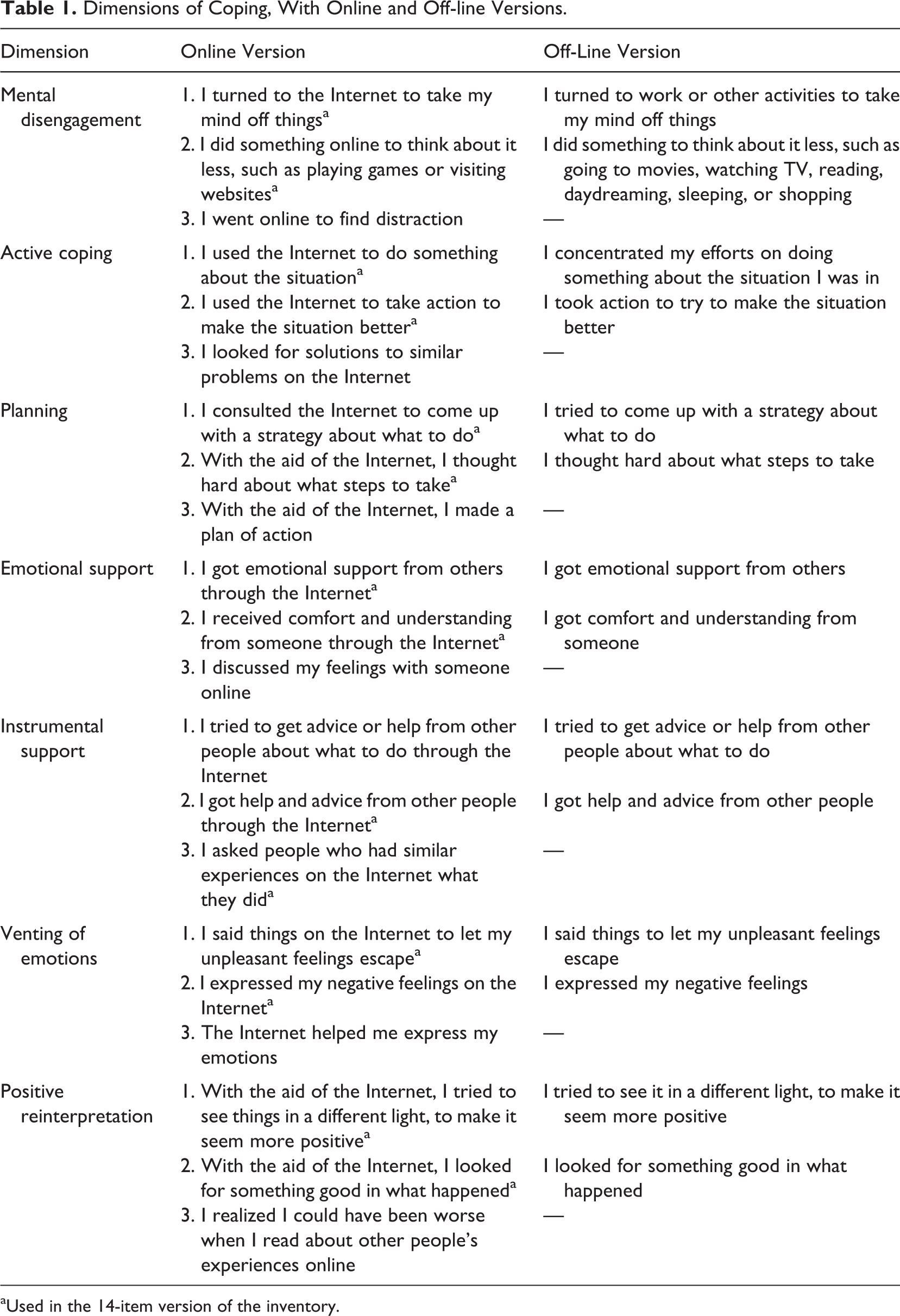
aUsed in the 14-item version of the inventory.
Model I is an extended version of the Brief COPE, which uses all the 21 items we measured (see Table 1 and Online Coping section). Model II includes the same seven dimensions but estimates these using 14 items, analogous to the original Brief COPE. Model III is an attempt to create a more parsimonious coping model, based on Carver et al. (1989) distinction between problem-focused, emotion-focused, and dysfunctional coping. This model has been used by Coolidge, Segal, Hook, and Stewart (2000) and Cooper, Katona, and Livingston (2008; see footnote to Table 2) in the case of off-line coping. Model IV is another three-dimension specification that has been proposed by a number of scholars (e.g., Kapsou et al., 2010; Litman, 2006). It furthermore has the advantage of being similar to other coping scales (see Lyne & Roger, 2000). We labeled its dimensions problem-focused coping (active coping, planning, and positive reinterpretation), socioemotional coping (instrumental support, emotional support, and venting of emotions), and disengagement (in our case, mental disengagement). In addition to these 4 models, we test a fifth, exploratory model similar to Model IV but with some improvements. We added a few parameters that make sense theoretically and which drastically improve the model’s fit (see Different Online Coping Models section).
Model Fit of Different Online Coping Scales.
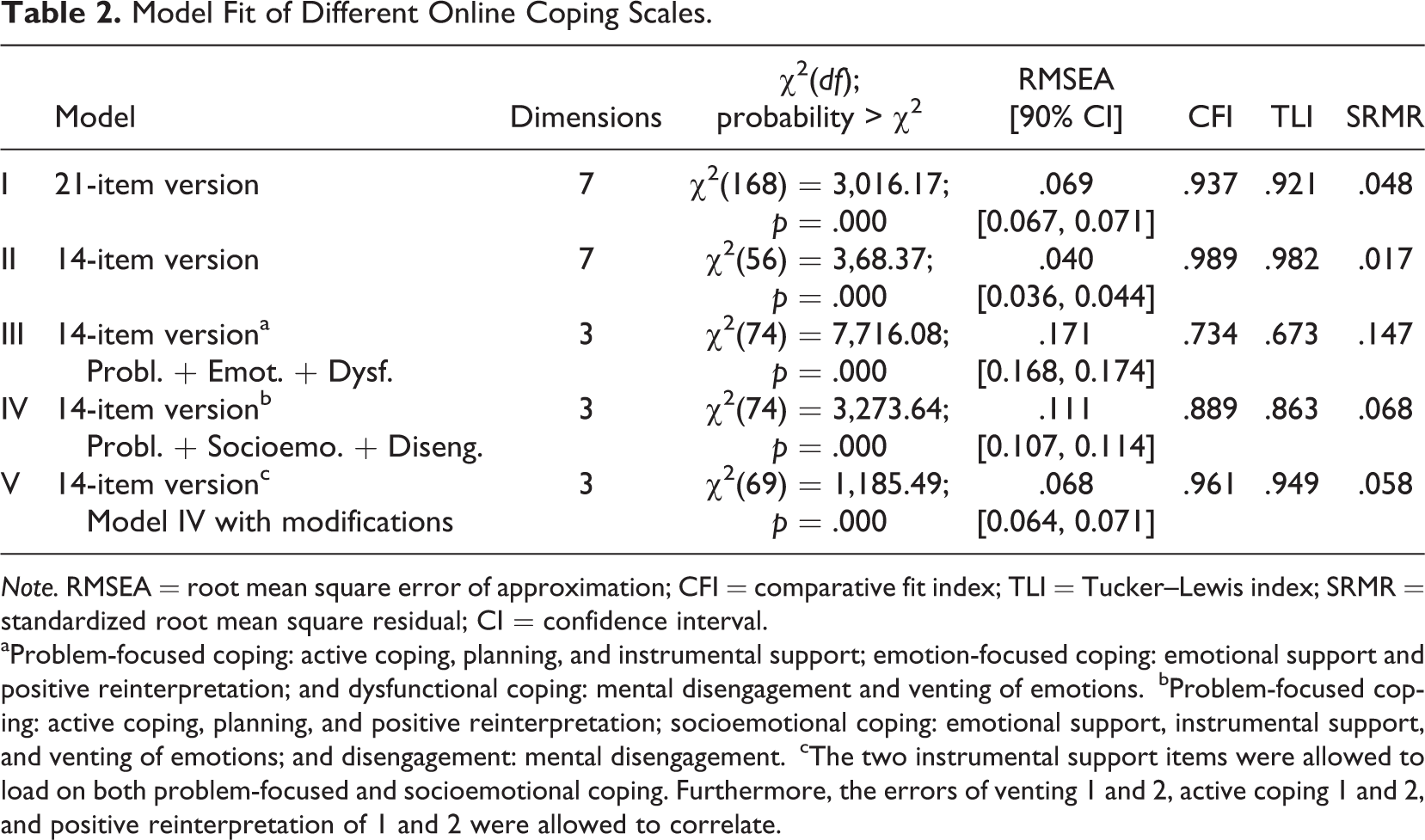
Note. RMSEA = root mean square error of approximation; CFI = comparative fit index; TLI = Tucker–Lewis index; SRMR = standardized root mean square residual; CI = confidence interval.
aProblem-focused coping: active coping, planning, and instrumental support; emotion-focused coping: emotional support and positive reinterpretation; and dysfunctional coping: mental disengagement and venting of emotions.
bProblem-focused coping: active coping, planning, and positive reinterpretation; socioemotional coping: emotional support, instrumental support, and venting of emotions; and disengagement: mental disengagement.
cThe two instrumental support items were allowed to load on both problem-focused and socioemotional coping. Furthermore, the errors of venting 1 and 2, active coping 1 and 2, and positive reinterpretation of 1 and 2 were allowed to correlate.
Once we know how to measure online coping, we can answer our second and third research question, on the prevalence of online coping after negative life events and on its relation to several types of Internet usage.
Internet Use and Well-Being
The relation between Internet use and well-being has been the topic of many Internet studies. Most studies focus on some quantitative measure of Internet usage (e.g., users versus non-users, frequency of usage, or time spent on the Internet) in relation to indicators like loneliness or life satisfaction. Since our study is about the use of online coping strategies rather than about quantitative measures of usage, we do not review all of these individual studies here, but discuss a few meta-studies. Huang (2010) performed a meta-analysis of research on Internet usage and well-being indicators (depression, loneliness, self-esteem, and life satisfaction), finding a small negative effect. No differences were found between the effects of different types of Internet usage. In contrast, Rains and Young (2009) found positive effects of Internet usage on well-being in a meta-analysis that focused exclusively on online support groups. With an even narrower focus on web-based depression interventions, Cowpertwait and Clarke (2013) reported online participation to have positive effects on well-being. Similarly, Spek et al. (2007) reported positive effects of Internet-based cognitive behavior therapy, even when this was without therapist support. A less optimistic picture emerges from a meta-study of Facebook-related research: Song et al. (2014) found a correlation between Facebook usage and loneliness, although they claim that loneliness is more likely a cause than a consequence of Facebook use. As far as we know few studies have linked use of online coping strategies to well-being (like we do in our fourth research question How are online coping and well-being correlated, when controlling for off-line coping?). However, there are a few studies that examine perceived (i.e., hypothetical) support and well-being. Using experience sampling, Oh, Ozkaya, and LaRose (2014) found that social support obtained from SNSs had a direct effect on positive affect and indirectly boosted life satisfaction (through positive affect). Liu and Yu (2013) examined access to social support via Facebook and found that it enhanced well-being, after general social support was controlled for. Finally, Frison and Eggermont (2015) found that perceived online support reduced depression symptoms among adolescents. Summarizing, we can conclude that the few studies on online coping and well-being focused on social support exclusively (not on other coping strategies) and that they generally find positive effects of perceived online support on well-being.
Data and Method
Participants and Procedure
Our participants were drawn from a panel representative of the population of the Netherlands aged 16 years and older (Longitudinal Internet Studies for the Social Sciences). The yearly retention rate is about 90% (Binswanger, Schunk, & Toepoel, 2013), and refreshment samples are drawn to maintain the panel’s representativeness. Questionnaires are answered online. The panel also includes non-Internet users who were equipped with a computer and Internet access and who received guidance in using them. This is important because research has shown that—even in the Netherlands, with one of the highest Internet adoption rates in the world (see below)—adding nonusers to an Internet panel improves the quality of the data (Leenheer & Scherpenzeel, 2013). Monthly surveys are conducted lasting 15–30 min, and respondents are paid 15 euros/hr to complete the questionnaires.
The Netherlands has one of the highest Internet penetration rates in the world (94%, www.Internetworldstats.com/stats9.htm#eu). It can thus be considered a country with a pioneering role in Internet uses, which makes it an excellent place to test our hypotheses. In January 2014, a questionnaire about online coping was administered to the panel. The response rate was almost 83%, or N = 5,734 participants (46% men and 54% women, mean age 50.4 years).
The coping items were preceded by retrospective questions regarding 5 types of negative life events: (1) physical health problems, (2) mental health problems, (3) involuntary job loss, (4) being divorced or widowed, and (5) other events with a lasting impact on one’s daily activities. Respondents who reported experiencing such an event in the previous 3 years were asked how they coped with it. Those who experienced multiple events were asked to consider the one with the largest impact on their daily activities. The share of the sample that mentioned at least one event was 62%. To assess potential differences between the group that registered an event (and hence answered the coping items) and the group that did not, we performed a logistic regression with the selection variable as outcome (0 = no, 1 = yes). The only variable that tested significant was age, but its effect was very small (odds ratio = 1.007). Time spent using a computer (hours per week), income, education, gender, and partner status did not have an effect on participation in the questionnaire.
Respondents were also asked whether their partner or one of their children living at home had suffered from one of the life events mentioned. Our analyses include all respondents who registered a negative event within the family—72% had experienced an event themselves, 23% was selected because of an event experienced by the partner; 5% was selected because of an event affecting a child—with the exception of the analyses of Table 5 (which include only respondent events). Respondents were explicitly instructed to think about what they did (not their partner or child) in response to the problem. Auxiliary analyses showed that results were identical to those based on models with respondent events only.
Correlations Between Different Online Coping Factors, Correlations Between Corresponding Online and Off-line Coping Factors, and Reliability.
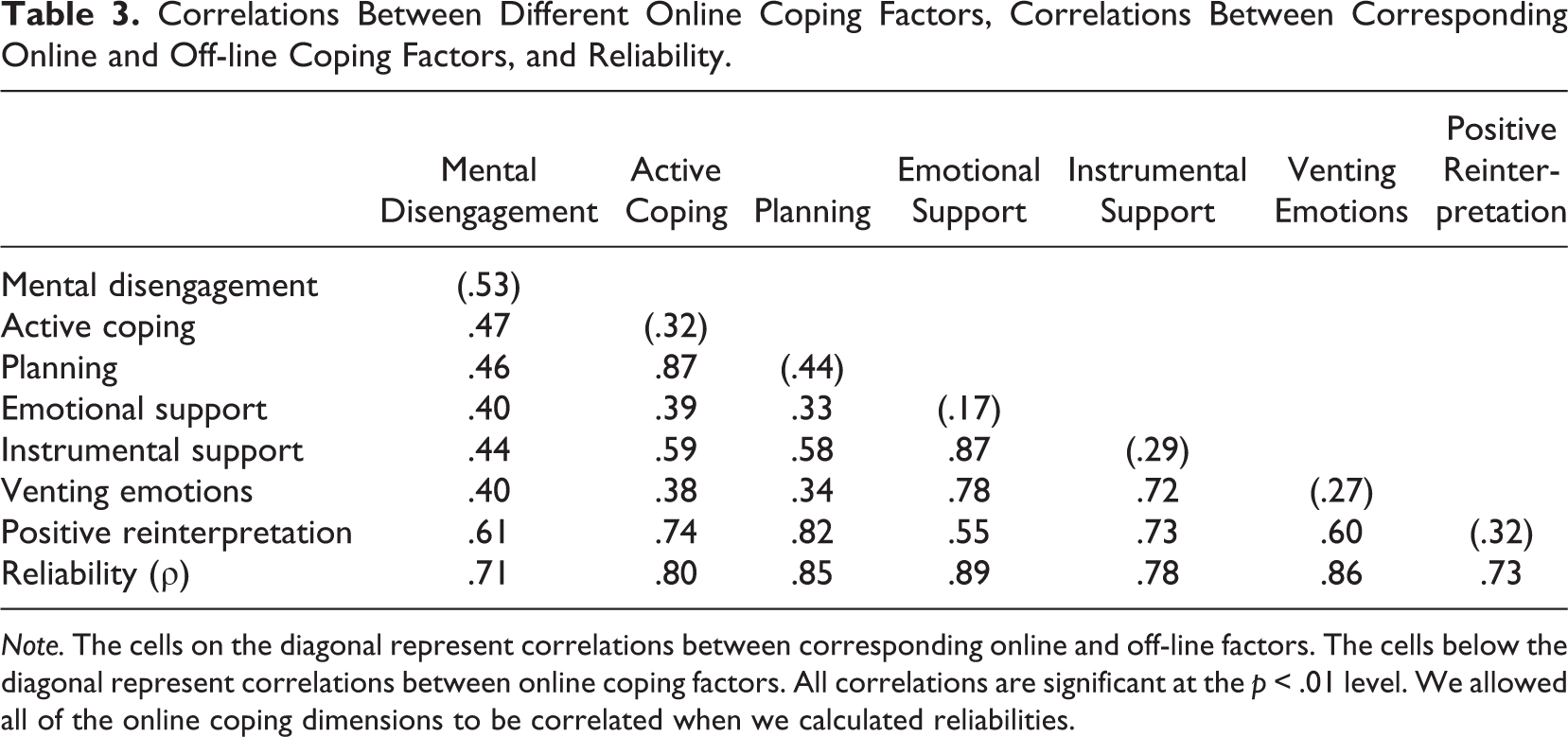
Note. The cells on the diagonal represent correlations between corresponding online and off-line factors. The cells below the diagonal represent correlations between online coping factors. All correlations are significant at the p < .01 level. We allowed all of the online coping dimensions to be correlated when we calculated reliabilities.
Structural Equation Model (SEM) of Three Online Coping Factors and Time Spent on Internet Activities (Standardized Path Coefficient and z Scores).
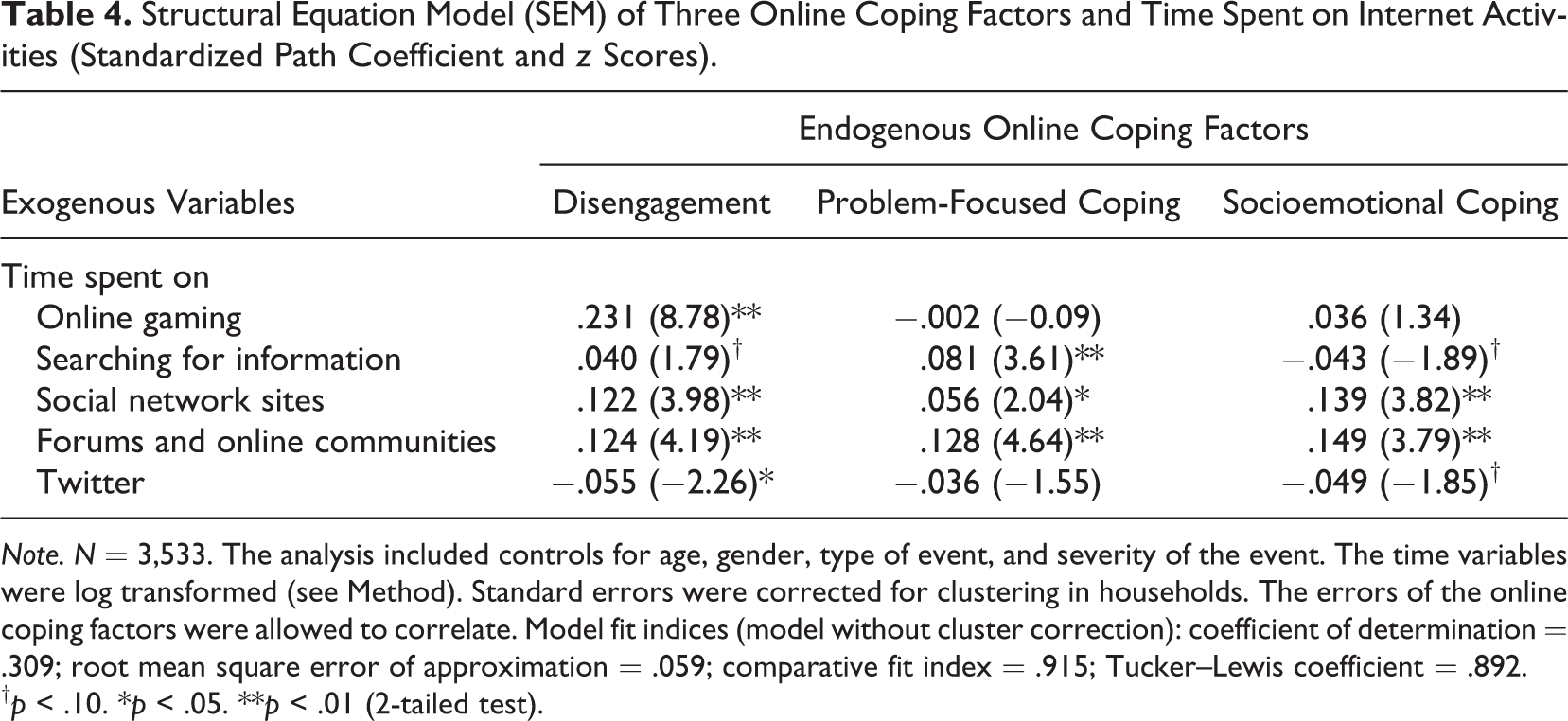
Note. N = 3,533. The analysis included controls for age, gender, type of event, and severity of the event. The time variables were log transformed (see Method). Standard errors were corrected for clustering in households. The errors of the online coping factors were allowed to correlate. Model fit indices (model without cluster correction): coefficient of determination = .309; root mean square error of approximation = .059; comparative fit index = .915; Tucker–Lewis coefficient = .892.
†p < .10. *p < .05. **p < .01 (2-tailed test).
Partial Correlations of Three Online Coping Dimensions and Well-Being.
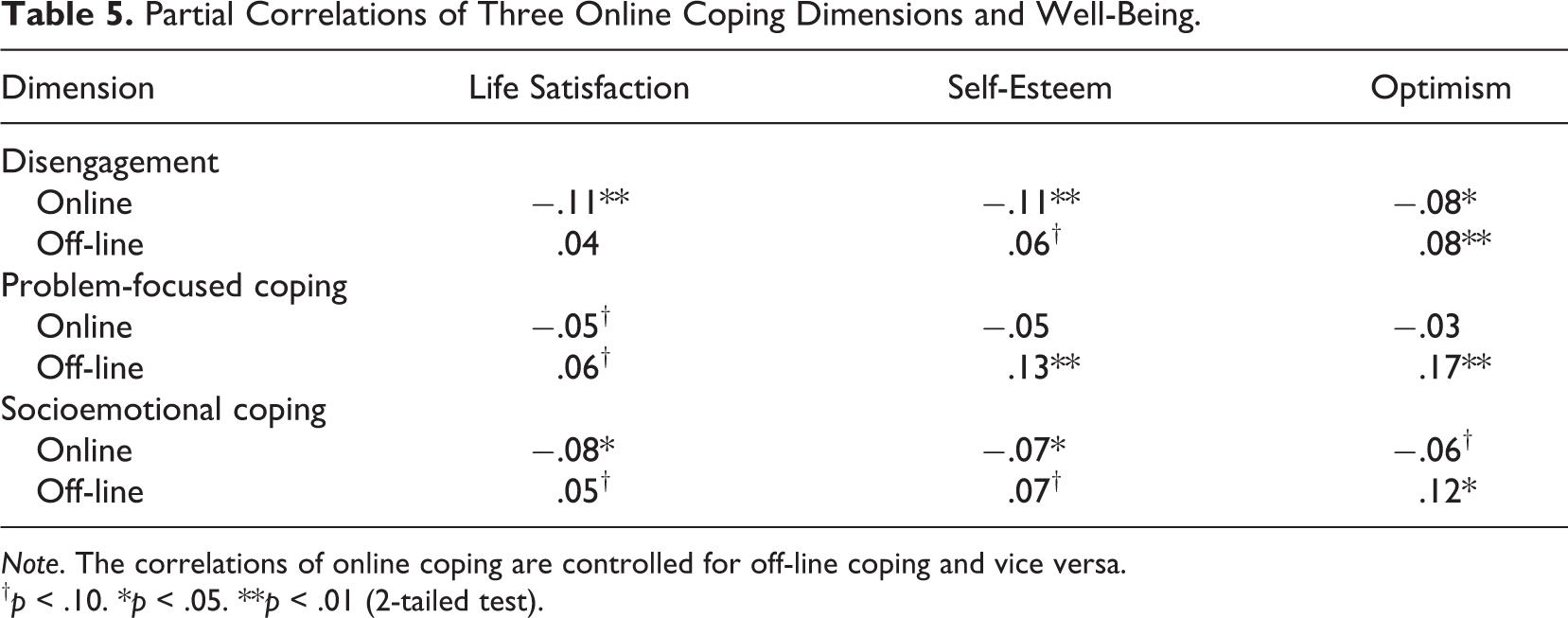
Note. The correlations of online coping are controlled for off-line coping and vice versa.
†p < .10. *p < .05. **p < .01 (2-tailed test).
Online Coping
To assess online coping, we created a measurement instrument using the 7 dimensions from Carver’s (1997) Brief COPE, as introduced earlier (An Inventory of Online Coping section). We first revised the relevant items (14) to refer explicitly to the Internet. For example, “I turned to work or other activities to take my mind off things” became “I turned to the Internet to take my mind off things.” We then complemented this set of items with a third item for each dimension, to provide greater flexibility in the further creation and analysis of the online coping instrument, thus obtaining 21 items in total. For planning, emotional support, and instrumental support, we drew items from the full COPE that could easily be converted to refer to the Internet. For mental disengagement, active coping, venting of emotions, and positive reinterpretation, we formulated additional items referring to the Internet and in line with the purpose of the relevant dimension. For instance, we added as the third mental disengagement item: “I went online to find distraction.” Table 1 presents the complete list of items.
Participants were instructed to think exclusively about how they used the Internet to deal with their problems. All the items had four answer categories: (0) “this doesn’t apply to me at all,” (1) “this applies to me a little bit,” (2) “this applies to me a medium amount,” (3) “this applies to me a lot.”
For one of the items (the first for instrumental support), different wording was used for the items measuring online and off-line coping. Originally, we formulated the online item “I tried to get advice or help from other people about what to do through the Internet,” but unfortunately the last part (“ … through the Internet”) was omitted from the Dutch translation. This meant that respondents could have interpreted the question as referring to advice or help in general, despite the instructions to think exclusively about use of the Internet. Fortunately, in the 14-item versions of the inventory, we had the opportunity to drop it, and substitute, “I asked people who had similar experiences on the Internet what they did,” improving the reliability of this dimension from ρ = .42 to ρ = .78. This item is equivalent to an instrumental support item in the full COPE inventory (see Carver, Scheier, & Weintraub, 1989), and it correlated .61 with the other instrumental support item.
Off-line Coping
We used 14 items to measure off-line coping (Table 1). Here we provided explicit instructions for respondents to consider only off-line coping strategies: “The next questions do
Time Spent on Internet Activities
Respondents were asked whether they ever spent time on a list of Internet activities (yes or no), and subsequently how many hours per week they usually spent on these activities. For the present analyses, we focus on time spent searching for information (M = 3.21; SD = 4.58), online gaming (M = 0.96; SD = 3.16), using SNSs (M = 1.80; SD = 4.92), participating in forums and online communities (M = 0.31; SD = 1.48), and using Twitter (M = 0.32; SD = 2.50). The searching variable is a combination of 2 items: searching for information and searching for and comparing products or product information. The SNS variable is also a combination of 2 items: time spent on SNSs and chatting. They are combined because chatting is done mainly via SNSs nowadays. A few respondents registered highly unlikely values on the Internet activity variables (e.g., 168 hr per week). Since these outliers could affect the results, we recoded the variables to a maximum of 56 (7 × 8) hr per week for each Internet activity. We then transformed these variables (by adding one and taking the log of the resulting values), since their distributions were highly skewed.
Life Satisfaction, Self-Esteem, and Optimism
Life satisfaction was measured using the 5-item scale developed by Diener, Emmons, Larsen, and Griffin (1985). Respondents rated their agreement with items such as “in most ways my life is close to my ideal,” on scales ranging from (1) strongly disagree to (7) strongly agree. The scale (M = 5.07; SD = 1.11) exhibited excellent internal consistency (α = .89). Self-esteem was measured using Rosenberg’s (1965) scale, which includes 10 items such as “I feel that I have a number of good qualities.” Answers were given on a 7-point scale ranging from (1) totally disagree to (7) totally agree. The scale (M = 5.60; SD = 1.00) was again internally consistent (α = .90). Optimism was measured by the Life Orientation Test - Revised (LOT-R) scale (Scheier, Carver, & Bridges, 1994), which includes 6 items such as “in uncertain times, I usually expect the best,” with answer categories ranging from (1) strongly disagree to (5) strongly agree. The Cronbach’s α of the scale (M = 3.42; SD = 0.56) was .70.
Analytical Strategy
We test the models introduced in An Inventory of Online Coping section using confirmatory factor analysis (using the SEM command of Stata 13). After establishing a measurement model for online coping (see Table 2), we create a similar model for off-line coping and calculate correlations between online and off-line coping dimensions (Table 3). We then estimate a structural equation model (again using Stata 13) using the 3-dimension specification, and we regress the coping dimensions on time spent on different Internet activities (see Table 4 for details). Finally, we compute partial correlations between online coping and well-being, controlling for off-line coping.
Results
We now turn to answering our research questions. The four sections that follow each provide the answer to one research question.
Different Online Coping Models
Table 2 presents model fit statistics for the five models discussed. We interpret model fit values as follows: root mean square error of approximation (RMSEA) < .08 reasonable fit, < .05 excellent fit; comparative fit index > .90 reasonable fit, > .95 excellent fit; standardized root mean square residual < .08 reasonable fit < .05 excellent fit (Acock, 2013; Hooper, Coughlan, & Mullen, 2008).
Model II with 7 dimensions and 14 items has the best fit. Judging from the confidence intervals, RMSEA is significantly better here than in other models, meaning that this would be the recommended model for measuring online coping judged by the data alone. The standardized factor loadings of this model are all high and significant. The extended model with 21 items (Model I) performs worse, although it still has good fit. This is good news from a practical point of view because the 14-item version obviously requires less questionnaire space.
Models III and IV of Table 2 are models with considerably fewer dimensions of coping (3 instead of 7). From the model fit statistics, it is clear that Model IV performs far better than Model III, although its fit cannot be classified as “reasonable” according to the criteria mentioned earlier. However, Model IV approaches the thresholds of reasonable model fit, and it has other desirable substantive and practical characteristics: its structure is very similar to other coping instruments (Lyne & Roger, 2000) and it combines factors that are theoretically similar. Therefore, we explored whether Model IV could be improved by inspecting modification indices. This revealed a few modifications that made sense intuitively and substantially improved model fit. We allowed instrumental support to also load on problem-focused coping (in addition to socioemotional coping). This makes sense because searching for instrumental support is a social activity as well as an active attempt to address one’s problem. Furthermore, we found that the error terms of the venting items were still highly correlated after controlling for the socioemotional coping factor. Given the similarity in meaning of the 2 items, this is hardly surprising. For instance, they both stress negative feelings, which may not be part of the socioemotional coping factor (or not greatly). Allowing these errors to be correlated thus makes sense. For similar reasons, we allowed the errors of the active coping items, and the items on positive reinterpretation to correlate. The 5 degrees of freedom we sacrificed in comparison to Model IV substantially improved model fit. Since Models IV and V are nested, we can perform a likelihood ratio test, and this test also indicated that Model V has superior fit, Likelihood Ratio, LR χ2(5) = 2088.14; p = .000.
Given the other advantages of this model (in line with other coping models in the literature; factors are combined that are very similar; more parsimonious), Model V can also be considered a good candidate for many research applications. Depending on the purpose of the study, a choice can be made between a more general (V) and a more detailed (II) model. Both are models with good fit.
The bottom row of Table 3 shows the reliability of the factors from the 7-dimension model (Model II). All of the dimensions have good reliability, although their exact values vary somewhat, with mental disengagement (ρ = .71) having the lowest reliability and emotional support (ρ = .89) the highest.
We see from Table 3 that the correlations between the online coping factors have medium to large effect sizes. Especially, strong correlations were found for active coping and planning and for instrumental and emotional support. This provides another reason to prefer a model with fewer factors such as Model V: in applications where researchers want to examine the effects of online coping strategies simultaneously multicollinearity will likely be a problem. The highest correlations were between those dimensions that were combined in Model V.
Table 3 shows (on the diagonal) correlations between similar online and off-line dimensions of coping. All correlations are positive and significant. Interestingly, the magnitude of these correlations varies. The weakest correlation (r = .17) is that between online and off-line emotional support, and the strongest correlation (r = .53) is between online and off-line mental disengagement. In comparison to the correlations among online factors, the correlations between online and off-line dimensions are relatively low, which is supportive of our decision to distinguish between online and off-line coping.
Additional analyses (available from the authors) showed that (1) a confirmatory factor analysis with separate online and off-line factors had much better model fit than a model with one factor for both and (2) an exploratory factor analysis with all online and off-line items distinguishes between the online and off-line items first before further distinctions are made between dimensions of online and off-line coping. All of these findings subscribe to the importance of distinguishing between online and off-line coping.
Prevalence of Online Coping
Our next step was to explore the prevalence of online coping and to compare it with the prevalence of off-line coping. Figure 1 shows the shares of respondents who use a certain coping strategy. Some 57% mentioned using an online coping strategy after experiencing a negative life event. In contrast, and unsurprisingly, off-line coping was much more common. Nearly everyone (96%) mentioned some form of off-line coping. Furthermore, we found large variation in prevalence of the various strategies for online coping. Mental disengagement was the most commonly reported. Some 42% said they had used the Internet to find distraction from a problem. Active coping (32%) and planning (30%) were also relatively frequent, followed by mobilizing Internet resources for positive reinterpretation (21%), for instrumental support (15%), and for emotional support (13%). Venting emotions was less common: only 8% of our respondents reported this.
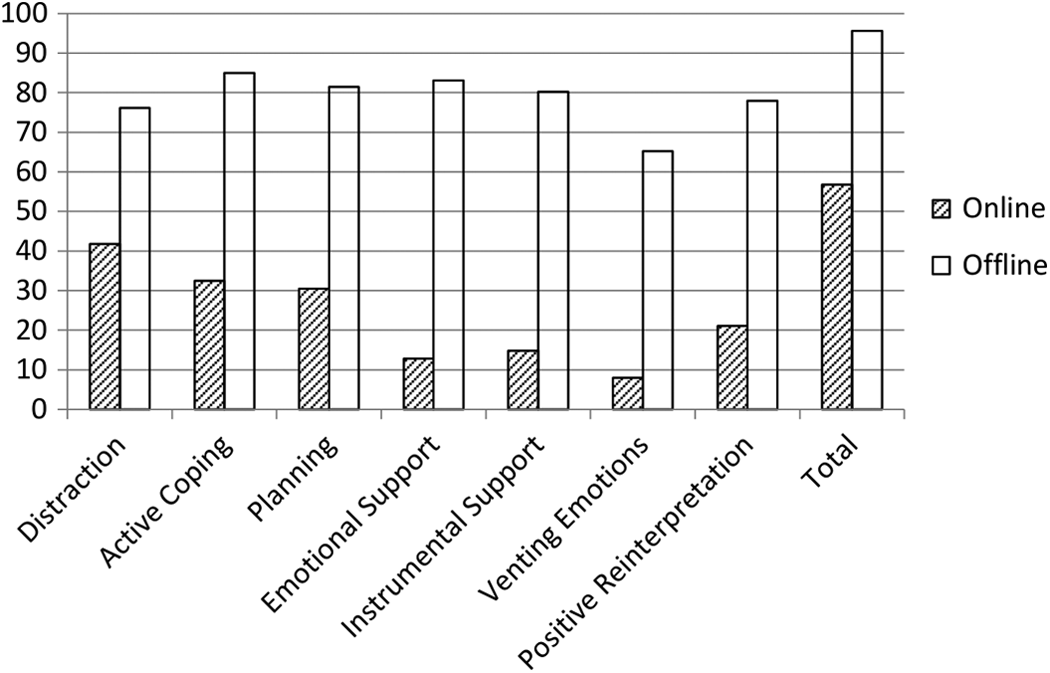
Prevalence of online and off-line coping (percentage of respondents with at least some use of coping strategy X).
Internet Activities and Online Coping
Table 4 presents a structural equation model with three dimensions of online coping (similar to model V in Table 2) and five types of Internet usage. We use the three dimensions specification in order to reduce the amount of information, as well as to facilitate comparisons with previous research.
We see from Table 4 that online gaming is associated with disengagement. The standardized path coefficient is β = .231, which tests highly significant (z = 8.78). We found no relation between online gaming and the other dimensions of coping.
The only significant effect of time spent searching for information online was on problem-focused coping. This is in line with the findings of previous studies and is theoretically intuitive, as information is a necessary input for making plans and taking action.
Time spent on SNSs was associated with all 3 coping dimensions. In line with previous findings on Facebook and social support, our findings show that the more hours respondents spent on SNSs, the greater the extent of socioemotional coping. SNSs seem to play a lesser role in problem-focused coping, judging from the smaller standardized path coefficient. Time spent on SNS was also positively associated with mental disengagement, demonstrating the different uses and gratifications of SNS.
Time spent on forums and online communities—including online support groups—contributed to all three coping dimensions. The more time respondents spent on these activities, the greater the extent of problem-focused coping, socioemotional coping, and disengagement.
The effects of Twitter appear different from the effects of SNSs, like Facebook. Only the effect on disengagement was significant, indicating that time spent on Twitter is inversely related to the use of Internet for distraction purposes. However, the effect was small; hence Twitter does not seem to have a major role in online coping.
Online Coping and Well-Being
To get an idea of whether online coping represents a functional strategy for dealing with stressful events, we computed correlations with three well-being measures: life satisfaction, self-esteem, and optimism. The correlations are partial; for example, the correlation between online disengagement and life satisfaction was controlled for off-line disengagement. The overall picture of online coping that emerged is not optimistic (Table 5). Although some of the correlations were not significant, their signs were consistently negative in the case of online coping, whereas the signs of the off-line coping correlations were positive. The negative associations between online disengagement and well-being were the most consistent ones; that is, those who reported higher levels of online disengagement reported lower levels of life satisfaction, self-esteem, and optimism. Online problem-focused coping was not linked to well-being. Off-line problem-focused coping, on the other hand, was clearly linked to self-esteem and optimism and to a lesser extent to life satisfaction. Most surprising are the negative correlations between online socioemotional coping and well-being. Although these correlations are small, this dimension of online coping was found to be inversely related to life satisfaction, self-esteem, and optimism.
Discussion
In order to answer our first research questions—How can online coping after negative life events be measured?—we developed a new inventory encompassing seven online coping strategies, based on Carver’s (1997) Brief COPE. For many applications, inclusion of the equivalent off-line items (14 items) is recommended. Furthermore, an alternative model with three dimensions also showed good model fit. Depending on the goal of the research, future studies might elect to use the more general (three dimension) or the finer-grained (seven-dimension) instrument. The two models we propose can be applied in relation to a variety of online platforms and stressful life events, thereby opening multiple avenues for future research. Finally, due to its brevity, the inventory can be incorporated into questionnaires where space is limited.
How prevalent is online coping (after negative life events)? Our analyses examined the use of online coping strategies in a large, nationally representative sample of the Dutch (16+) population. To our knowledge, our study is the first to analyze actual online coping on such a large scale. Our comparison between online and off-line coping demonstrated off-line coping to be more prevalent, though this should come as no surprise (it would worry us if it were the other way around). More than 90% of those who registered a negative life event indicated having mobilized some form of off-line coping, compared with 57% reporting using online coping strategies. This implies that in general online coping complements off-line coping.
There was considerable variation in the prevalence of the different strategies. Mental disengagement was the most prominent online coping strategy, indicating that the Internet—despite its potential for providing helpful support and information—also tempts users to engage in coping strategies that are sometimes found to be dysfunctional (Carver, 1989). Active coping and planning were the second and third most prevalent online coping strategies. This finding is intuitive, given the abundance of information available on the Internet and the strong link between these two coping strategies and information provision.
Online coping strategies involving emotions were the least reported. This is surprising, because the Internet’s anonymity or “pseudonimity” is said to enable users to vent emotions. Perhaps respondents were reluctant to admit it, or perhaps it is because nowadays “anonymous” (Zhao, Grasmuck, & Martin, 2008) online environments such as SNSs, which reveal users’ identities via the profile pages they include, are more popular than anonymous environments. It is worthwhile to note that, despite its negative image, venting emotions online is in some cases viewed as an acceptable and potentially therapeutic activity (see Barak et al., 2008), and online venting has been found to play a role in stress relief (Wendorf & Yang, 2015). This makes it an interesting area of further study, despite the fact that it is not the most commonly used coping strategy.
How is the use of online coping strategies related to the type of Internet usage? We found several associations. Mental disengagement was the only coping strategy that was predicted by playing games, clearly demonstrating that games are used to escape from everyday problems, in line with previous findings (e.g., Kaczmarek & Drążkowski, 2014). Searching for information on the Internet was associated with problem-focused coping strategies. Time spent on SNSs and time spent on forums and online communities were both positively related to all 3 forms of online coping. As expected, SNSs were more strongly related to socioemotional coping than to problem-focused coping (Deters & Mehl, 2013; Vitak & Ellison, 2012). Less well-documented is our finding that—in response to problems—individuals spend time on SNSs for the sake of mental disengagement.
Future research may consider looking more closely at how SNSs serve these different coping strategies. Use of online groups or private messages is expected to be closely related to seeking emotional support, whereas reading an entertaining newsfeed or playing casual games will likely relate more to disengagement. Our study found a positive, but small association between SNS activity and problem-focused coping. Future research might examine whether this effect is moderated by the type of life event experienced. For example, Facebook and SNSs might be more useful for finding leads on a new job than information on a severe disease. A similar picture emerges for online communities, but here the relations with the three forms of online coping were similar in strength. This confirms earlier research demonstrating that online forums can provide both instrumental and emotional support (Tanis, 2008). Furthermore, our findings show that online support groups are also used for distraction.
Given the rapid rise in the use of the Internet for coping, another important research question is to what extent do individuals benefit from using online coping strategies (in terms of personal well-being). Our analyses are exploratory in this regard, which is why we explicitly refrain from drawing conclusions about causality in our findings. Nonetheless, the correlations we found show interesting patterns and provide a preliminary answer to our fourth research question How are online coping and well-being correlated, when controlling for off-line coping?
Whether mental disengagement is a functional or dysfunctional coping strategy is a topic of debate. Carver, Scheier, and Weintraub (1989) considered it a dysfunctional strategy. However, more recent research has found that playing games can relieve stress (Reinecke, 2009). The negative partial correlations we found between online disengagement and well-being seem to support the more pessimistic views that consider mental disengagement a dysfunctional strategy. Further research is needed to determine under what circumstances online entertainment has positive versus negative effects.
Problem-focused coping is often considered the most effective strategy for dealing with stress. Our analyses indeed showed a positive association between off-line problem-focused coping and well-being. However, we found no association between online problem-focused coping and well-being. This is remarkable in light of the positive effects of online support groups reported in the literature (e.g., Rains & Young, 2009). One implication of this finding might be that the benefit of online coping in terms of well-being is dependent on the type of Internet activity performed. Next to participation in online support groups, online problem-focused coping may involve searching the Internet for health-related information and even using SNSs to try to come up with a plan of action. These activities may produce both reliable and unreliable information (Wang et al., 2008). Moreover, some individuals will use information fruitfully, whereas others will be incapable of managing or interpreting it (Cline & Haynes, 2001). Another possibility—as suggested by one of our anonymous reviewers—would be that online coping precedes off-line coping (e.g., an individual first consults the Internet and then goes to a doctor). In this scenario, online problem-focused coping could still have a positive indirect effect. Unfortunately, our data do not allow us to examine the causal order in the online–off-line coping relation. However, we think this could be territory worth exploring for future research.
Much previous research has found an ambiguous relation between socioemotional coping and well-being (see e.g., Folkman & Moskowitz, 2004). Our study adds to that ambiguity, as we found opposite results for online and off-line socioemotional coping. Somewhat surprisingly, the former was negatively associated with well-being. This is not first study to report negative effects of online support. For example, Burke and Kraut (2013) report increased stress after respondents talked about their job loss online. Future research might seek to determine whether the associations we found represent causal effects and, if so, what the direction of causality is likely to be. This will enable us to determine whether online coping is indeed generally more dysfunctional than off-line coping.
The current study shows many good reasons for distinguishing empirically between online and off-line coping. We found online and off-line activities for the same coping strategy to be positively correlated, but the correlations are not extremely high (they range between .17 and .53). In addition, confirmatory factor analyses with separate online and off-line factors had much better model fit than models with 1 factor for both, and exploratory factor analyses distinguish between online and off-line items before making distinctions between dimensions of coping. Furthermore, we demonstrated that the prevalence of online and off-line coping, as well as their correlations with well-being measures, are different.
The overall picture of online coping that emerges from our study is less optimistic than that from many previous studies. For instance, distraction is the coping strategy most often reported by our respondents, and we found several negative correlations between types of online coping and well-being. This may to some extent be due to the fact that we analyzed a national sample and that we measure online coping across multiple Internet applications. Studies based on samples of online support group participants are likely to select those users for whom online coping is a success and who are using the most effective online coping strategies. Our data also include those who tried to mobilize online help at some point but quit doing so because they did not find it helpful or because they found it an inefficient way of coping. In addition, as indicated above, Internet applications are likely to differ in terms of the effects they have on online coping, and it seems plausible that online support groups are among the most productive applications.
A few limitations of our study deserve to be discussed. One limitation is that our data are cross-sectional, which means that we cannot analyze the causal direction of the relations between our variables. As a result, when we state that Internet use has an effect on online coping, this is a theoretical interpretation of the association, not something that follows from the data. Another limitation is that we rely on retrospective data, going back 3 years. It is unlikely that respondents were able to perfectly reconstruct how they coped with their problems. However, major life events should be among the easiest things to remember. In a worst case scenario, respondents’ answers reflect how they usually cope with problems rather than how they coped with the particular life event they reported, which should not be a major threat to the validity of our conclusions.
With this study, we hope to inspire other researchers to further examine online coping. Our results showed the relevance of distinguishing between online and off-line coping, and it is likely that online coping will only get more important in the future.
Footnotes
Declaration of Conflicting Interests
The authors declared no potential conflicts of interest with respect to the research, authorship, and/or publication of this article.
Funding
The authors disclosed receipt of the following financial support for the research, authorship, and/or publication of this article: This research was supported by The Netherlands Organization for Scientific Research (NWO; Grant 451-12-019).