




Abstract
Drawing on 30 interviews with volunteers and employees in community-based organizations, this study theorizes volunteering as the evolution of attachments throughout one’s career, rather than a decision to “give time” driven by fixed motivations. Our theorizing combines insights from interactionism with those of the communicative constitution of organization (CCO) perspective, complemented by Hennion’s notion of attachment. Our analysis reveals that volunteers become attached to tasks, people, and causes through situated interactions, and that these attachments are repeatedly tested in moments of trial. Vignettes illustrate how involvement deepens, shifts, or unravels as individuals navigate organizational constraints, personal identities, and collective commitments. This approach moves beyond psychological models of motivation to show volunteering as a relational accomplishment shaped by organizational environments and power dynamics.
Keywords
Why people become involved in social causes as activists, volunteers, or through other forms of engagement has been abundantly studied (e.g., Aguirre & Bolton, 2013; Carpenter & Myers, 2010; Snyder & Omoto, 1992). Mostly, research explores why people get involved and profiles them based on the motivations that act as independent variables causing their involvement (e.g., Degli Antoni, 2009; Nencini et al., 2016; Yeung, 2004). In adopting such an approach, though, literature has tended to focus on people’s initial drive for volunteering but has overlooked the possibility that what keeps people involved may change throughout their volunteer “career.” By focusing on internal motivations, research has also contributed to giving the impression that volunteering is a vocation, and that people either “have it in them” or don’t. Literature also classifies volunteers based on whether their motivations are altruistic or self-centered, even though research tends to show that such a distinction does not translate into different levels of commitment and that a same person may have both types of motivations at once (Mustonen, 2007; Veludo-de-Oliveira et al., 2015).
The fact is, however, that once they are involved with an organization, volunteers may discover new opportunities or new constraints to their activity. For instance, structural research on volunteering shows that scarcer resources impede non-profits’ ability to criticize the governments they depend on, and limit occasions for activism (Arvidson et al., 2018). The evolution of institutional settings has also fragmented volunteering into an individual, rather than collective, experience (Hustinx, 2001). Moreover, there is a growing pressure for volunteers’ professionalization, limiting involvement to the more skilled (Ganesh & McAllum, 2012). Considering such pressures, research should strive to account for a more complex articulation of the dynamic experience of volunteer work. It is imperative to consider how volunteer careers and trajectories unfold over time, beyond the initial motivations that may draw people to this type of work.
Indeed, volunteer retention studies show motivations evolve; people do not remain involved for the same reasons that initially led them to volunteer. People stay because they feel their voice is heard and that they are being respected, and because their role seems important to them (Boezeman & Ellemers, 2008; Cuskelly et al., 2006; Garner & Garner, 2011). Kewes and Munsch (2019) note that, in order to understand those changing motivations, research on volunteer retention should adopt a processual approach, such as that offered by the narrative analysis of volunteers’ accounts of their trajectory (although other methods may allow similar conclusions; see Merrilees et al., 2020). In that sense, collecting volunteers’ stories allows for thinking in terms of their entire life course or “career” so far, and to identify the ebbs and flows in their participation (Hogg, 2016; Weeks & MacQuarrie, 2011).
Some studies have indeed invited researchers to consider volunteering as a career, through an approach where participants “tell the story” of their volunteer work (see Agrikoliansky, 2017). Focusing on stories reveals that the intensity, frequency and style of volunteering change throughout each participant’s relationship with their social involvement. This is particularly the case when it comes to activists, whose interest for a cause translates into a “long-lasting social activity articulated by phases of joining, commitment, and defection” (Fillieule, 2010, p. 1). Over the course of time, although activists may remain committed to ideological and political principles, they may find themselves taking on different roles and responsibilities depending on the organizational circumstances they find themselves operating within. To that last point, Fillieule (2010) has found that volunteer work and involvement is contingent upon more than a strong belief in “the cause.” More specifically, within certain organizational circumstances, activists may dissociate themselves from the host organization or even become “apostates” that altogether disavow the cause (or its interpretation by the organization). To account for these many volunteer trajectories, this stream of literature suggests adopting an interactionist approach to analyze people’s life stories, taking inspiration from the work of Mead (1934) and that of Goffman (1959). At the moment, though, the proposal to think of volunteering as a career from an interactionist perspective remains a conceptual proposal, as no empirical studies have picked up on that suggestion.
Yet, such an interactionist perspective seems very fitting to look at the way people themselves deal with the many factors that make volunteering a “complex social phenomenon” (Butcher & Einolf, 2017). Volunteers “embrace a vast array of quite disparate activities” in a range of organizations and sectors (Wilson, 2000, p. 233), and their experience depends on their “wealth, education, values, religion, and social capital”, as well as on governments’ varying relationship to civil society (Butcher & Einolf, 2017, p. 4). Therefore, instead of trying to pinpoint one of those factors as the most relevant, an interactionist perspective recognizes that they are all at once part of individuals’ experience. Research adopting an interactionist perspective has shown how volunteers navigate tensions between their mission and growing pressure to adopt a market logic (Vásquez et al., 2023), how they negotiate authority among themselves (Routhier & Vásquez, 2023), or how they deal with discrimination and injustice (Sénac & Bencherki, 2024). To the extent that people collectively handle tensions by comparing, confronting and relating various demands and pressures through their conversations and other communicative practices (Cooren et al., 2013; Ganesh & McAllum, 2012), they also communicatively constitute volunteering as it takes place in their specific situation (see also Carius et al., 2024).
The idea that volunteering is something constituted by communicatively assembling different factors that lead them to feel, think, speak or act in a certain way—or “figures,” as Cooren (2012) refers to them—builds on the tradition of the “communicative constitution of organization” (CCO) (Basque et al., 2022). The CCO tradition, itself, builds on the interactionist tenet that people constitute their social order as they make their actions and responses accountable to each other (Cooren, 2007; Robichaud & Cooren, 2013). The social order corresponds to that which must be true to justify actions. For instance, if a customer asked for a refund, the clerk could say, “I must decline your request because of our policy,” thus affirming the existence of the policy, but also the importance of obeying it. If the person had said, “the policy says we must decline your request, but I’m sure we can make an exception,” then they would have participated in weakening that policy, to the benefit, say, of a more personalized customer experience (see also Cooren, 2010).
In this paper, we thus take inspiration from the CCO tradition and from an interactionist perspective on volunteering, more generally, to look at how people themselves articulate the various elements that make up their volunteering experience. Such an approach acknowledges volunteering’s complexity but also recognizes the agency of volunteers in the co-constitution of their organization and in the processes of sensemaking around their activities. Instead of thinking that our role as analysts is to single out one factor among the many that affect people’s volunteering careers, we must instead understand the communicative practices through which they make a career for themselves by juggling with those figures. By observing how they manage such complexity, we complement the question, “Why do people get involved?” with the question, “How are they involved?”
To answer this question, we analyzed interviews we conducted with people involved in and around community-based and philanthropic organizations, as well as with some of those organizations’ employees. We justify our reliance on interviews by drawing on examples of studies that used CCO and interactionist methods to analyze interviews (e.g., Long et al., 2018). We included employees given that, in the non-profit sector, workers regularly need to volunteer as funding becomes scarcer until their contract can be renewed, meaning that a same person may alternate between the two kinds of roles (Mutchler et al., 2003). Furthermore, given the professionalization of volunteering, volunteers and paid workers often accomplish similar function, leading to blurry boundaries between them in terms of experience, expertise and decision-making power (McAllum, 2018b). We also did not distinguish between those who identified as volunteers or activists, or who used other terms to refer to their involvement, so long as they conducted unpaid work with an organization. Literature itself is hard-pressed to draw the line between those concepts. For instance, Gilster (2012, p. 770) suggests that while volunteers only offer services, activists “view the social structure as a target of intervention, not a framework within which to work,” while Cronin and Perold (2008) note that volunteering and activism overlap, since teaching someone to read or raising awareness about HIV, for example, may potentially change structures while also offering services. In that sense, we acknowledge that there are distinct problems and research traditions when it comes to volunteering and activism; however, for the purpose of our study, and given our emphasis on the volunteer’s own experience of their evolving journey, we felt it was not our place to reject participants based on the way they described their involvement.
To interpret our results, we complemented our CCO and interactionist perspective with the notion of “attachment,” which we borrow from French sociologist Antoine Hennion (2017b; Hennion and Gomart, 1999). For Hennion, while the term may bring to mind ropes or chains, attachments correspond to the way a relational field may reveal itself to bind elements together when it is “tested.” In that sense, attachments are what we are tied to and what ties us, outside of the limited scope of choice. In this paper, we take an interest in those moments of trial, where relational fields are tested to reveal how attachments are formed, in the context of our participants’ volunteer experiences (Hennion & Vidal-Naquet, 2015).
Latour (1988) noted that studying moments of trial is also a way of avoiding reductionist thinking. As he wrote, “Whatever resists trial is real” (p. 158), and cannot be reduced to something else. In that way, the use of attachment is also helpful to understand how volunteers can detach from aspects of their work, and reattach to others, without necessarily experiencing a change of (initial) motivation. In other words, our analysis shows that sometimes, an attachment is broken or unmade during the trial, and others are tied, whether the volunteer wanted that to happen or not. Rather than reducing volunteering to a single motivation or to the act of giving time, our analysis suggests that volunteers develop attachments in relation to three dimensions: the tasks they perform, the people they meet, and the cause they support. These attachments combine differently across situations and organizations, creating unique relational fields that constitute the volunteering experiences. Complementing communicative and interactionist analysis with the notion of attachments also allows to tease out the critical implications of our study, chief among them being that volunteers actively define these attachments both for themselves and others, as they navigate evolving situations, making volunteering a collective accomplishment rather than just an individual choice. Furthermore, this perspective also offers critical insights about power relations, showing how some people may feel trapped in their volunteering when structural conditions leave them no choice but to volunteer.
From Motivation to Interaction and Attachment
From “Why” People Become Involved to “How”: Volunteering and Interacting
Answering the question of “why” people become involved in volunteer activities requires us to assume that there are specific causes for involvement that we can identify, which alongside their effects remain relatively constant through time. When it comes to such considerations, scholarship has pointed out the ways in which people’s motivations to volunteer are differentiated along lines of gender, values and community size (Balish et al., 2018; Dekker & Halman, 2003). Activism, for its part, seems to be motivated by a different set of reasons and beliefs. Literature suggests that people become activists because they attribute the cause of a problem to social structures (Poorisat et al., 2019) and because they are more closely impacted by that problem, while their personal circumstances and propensities (such as distrust in government decision-making and regulatory processes) encourage them to act (Willow, 2020).
Yet, research has shown that that the factors that allegedly lead people to volunteering or activism may not influence their involvement trajectory in a coherent and stable way. For instance, volunteers who are just starting out may decide to remain in an organization when they discover they are given the opportunity to participate in decision-making on issues that matter to them (Eriksson, 2018). Where salary and compensation are concerned, research has shown that some people volunteer in non-profits before they are made aware that paid positions exist in that sector, showing that even a factor as seemingly straightforward as getting paid, in fact, depends on individual knowledge and circumstances (Nelson, 2018). In a similar vein, some people volunteer in the hope of being offered a paid position, in what has been called “hope labour” (Allan, 2019), or while waiting for their organization to obtain the funding needed to get them back on the payroll (Baines et al., 2014), thus blurring the lines between volunteering and working in a nonprofit (Benería, 1999).
In that sense, research suggests that, in fact, people do not merely choose to be a volunteer or an activist, because of some prior preference or interest. People’s life experiences, the people they meet and come to care about, and the ideas they tinker with, all account for their “trajectories of participation” (Corrigall-Brown, 2012). Thus, people participate in activities, develop relationships, acquire knowledge that reinforces their beliefs, lend a hand to organize events, therefore gradually committing themselves to their organization (Munson, 2010). In other words, it is through their involvement that people discover what exactly they have enlisted into and what role they can play in the collective. In forging those relations, volunteers and activists may be encouraged to pursue their involvement or may face challenges that drive them away (Warren, 2010). In the spirit of Hennion (2017a), we could say that it is through the practices of their involvement that people come to “test” their attachments. Crucially, this theoretical stance allows us to understand how involvement—or more aptly, attachment—exceeds the frame of motivation. Attachments are the relations that stay solidly knotted on the other side of trials: it is how we are buoyed, through our experiences. Our perspective, then, is one that centers the contingent and dynamic nature of volunteer careers and trajectories.
To understand differing volunteering trajectories, we must examine how people (inter)act with each other, as well as with the various elements that compose the situation in which they find themselves and which they contribute to shaping. Indeed, the recursive relationship between people’s (and other-than-human elements’) actions and the situation (or social order) is a key component of interactionist approaches (from Mead, 1934; to the « dramaturgic » approach of Goffman, 1959), and has also been key in the development of the CCO approach. As Taylor and Robichaud (2004, p. 397) explain, a central tenet in CCO is that conversations produce “texts” that become the environment for future conversations. In this sense, conversations are an iterative process of “co-orientation,” through which, in our case, volunteers, in their encounters with peers, documents, tasks, and other situational elements, form a collective understanding of their commitment and their purpose. Indeed, co-orientation “aims to produce coordination of belief, action, and emotions with some mutually understood object” (Taylor & Robichaud, 2004, p. 401). When conversations produce texts that are themselves reinterpreted in conversations, repeatedly, then they “laminate” to constitute an organization—or, for our purpose, the experience of volunteering. Lamination, a concept initially suggested by Goffman (1967), is “a translation from one imbricational level to another […] that involves a layering of successive interpretations” (Taylor & Van Every, 2011, p.124).
For both interactionist and CCO perspectives, communication tends toward self-reproduction. To Goffman (1967), this means that participants work jointly to preserve their shared definition of the situation at hand, and their respective roles in it, through what he calls “saving face.” Furthermore, it means that participants feel compelled to maintain an interaction until they have “neutralize[d] the potentially offensive implications of taking leave of others” (Goffman, 1967, p. 120). An interactional perspective thus draws attention to the fact that people will work together to ensure that their relationships endure and may even feel compelled to do so. CCO scholars reach a similar conclusion via a different path, one that shifts the focus away from exclusive attention on human agents (see Bencherki et al., 2024). Borrowing from systems theory, they suggest that communication reproduces itself through autopoiesis (Schoeneborn, 2011). Conversations self-organize into a system that gains autonomy through textuality: “this phenomenon of the emerging organizational self [is] a logical implication of the theory of self-organizing, which predicates ‘self-ness’ as an effect of the coupling of an autopoietic system to an observer” (Taylor, 2001, p. 137). Goffman and interactionists thus account for the continuation of a single interaction between individuals, while CCO allows extending this logic to account for the way interactions relate to each other to form a system that self-organizes and reproduces, to constitute, for example, a volunteering experience or even the formal organization that is host to that volunteering.
Conceiving of each situation as being defined by the many agencies that participate in it has important implications for organizational communication research into volunteering. People don’t get into a situation fully equipped with stable interests, a social position, and a clearly defined role, that the researcher can use as a variable. Since situations and social order are built on the go, then so are the identities available to participants, whether human or not. As Manning (2008, p. 678) explains, the “Goffman-like actor is a person who seeks to be treated as he or she treats others; who reciprocates when responded to; who is as open as the interaction necessitates”. When expanded to include the diversity of elements that make up each situation, this description of the Goffmanian actor provides us guidance on what we must look at to understand how social relations and social order are constituted.
To account for how, through their interactions with each other and with the elements that surround them, volunteers become more (or less) involved in an organization or a cause, we need to explain not only how they constitute situations in which they have specific roles to play, but also how those situations may come, so to speak, to “hold” them in place. As we have seen, this phenomenon has been described by some researchers as “attachment,” a notion that will help us complement our interactionist perspective.
Volunteering as Attachment
Observing how people weave, through their interactions, relations that keep them in place, means looking at how people attach (or get attached) to each other, but also to the things that surround them, the ideas that animate them and to the organizations that they constitute together (Hennion & Gomart, 1999; Latour, 1999). This perspective, instead of considering that actors have interests that motivate them, suggests moving “from actors to attachments” (Latour, 2005, p. 213). In his research on fans and addicts, the French sociologist Antoine Hennion (2017b; Hennion & Gomart, 1999) describes attachments as relationships in which the things to which we bind ourselves also bind us in return. Hennion considers that they have little to do with morality or preference—since it is entirely possible to be attached in a way that is detrimental to us and others, which Hennion explores through the lens of drug addiction.
Hennion’s theorization borrows, semantically, from the world of business, in which the attachment is akin to a liability: it is “an obligation from the past that is brought to bear on the present” (Hennion, 2017b, p. 112). This is particularly helpful for our analysis, because it allows us to keep a distance from the initial (moral) motivations that may bring people to volunteering. Attachment allows us to account for the myriad circumstances that may constitute a volunteer’s career, with specific attention given to their unfolding over time. Moreover, attachments being only perceptible a posteriori, Hennion’s theory aligned with an understanding of volunteering trajectories as dynamic, relational, and contingent. The concept of attachment, then, is one way of understanding communication’s constitutive power since it allows us to focus on (repeated) moments of trial where the relationship is sustained (or unmade). Understood this way, the metaphor of attachment hints at the possibility of detachment (Hennion, 2017a). By drawing from the work of Hennion and his colleagues, we thus give a stronger theoretical grounding to the metaphor of attachment and detachment that has been occasionally used in discussing volunteering (Del Fa et al., 2016; McAllum, 2018a), which usually alludes, in a general sense, to volunteers’ emotional ties to their organization or to the recipients of care.
In this paper, we are also interested in attachment’s critical implications, insofar as how we are attached bears on the roles we may take on in interactions with others or with the objects we are bound up with. In that sense, attachments affect how we are positioned socially, and how we encounter others—they play a part in shaping the environment where the attachment can be experienced. That is why, while Hennion’s work has typically been used in organizational research to study creative work (e.g., Gardiner, 2019), it has also allowed tackling crucial issues of identity, subjectivity, and affect (e.g., Deville, 2012; Driessen, 2018). Who we are, then, including whether we are a volunteer, an activist, or an “engaged citizen,” depends on how we become entangled, intentionally or not, in relational webs of attachments.
In sum, thinking in terms of attachment does not seek to explain who gets involved (their age, values, etc.) or where they get involved (the institutional features of their sector), but rather to document their volunteer career. Doing so, we may also uncover how their identities change in the process, and how the organizations and communities to which they contribute are also altered on the same occasion. However, attachment and detachment themselves are changing. Indeed, as we will see in our analysis below, attachments evolve and take new shapes as people progress in their involvement. We therefore introduce an evolutive element in the research question that guides this study: How do people become attached to, or detached from, their volunteering and activism, and how do these attachments evolve and alter the nature of their involvement?
Methods: Studying the Relational Weaving of Attachments
Data Collection
We became interested in this research question as we led a project whose initial aim was to understand volunteer recruitment issues in community-based organizations in Montréal, Canada. We first conducted observations in two organizations that had put in place “citizen committees” to allow volunteers to participate in various activities, debate the organizations’ actions, and provide their unique perspective on their neighborhood’s reality. Our observations revealed that citizen committees blurred the traditional categories of participation in community-based organizations (e.g., volunteers, activists, paid workers, etc.), which led us to explore this theme further through interviews with participants from an expanded list of organizations.
We interviewed 30 people: 16 of them were currently volunteers and 14 of them were paid employees of a community organization but had also recently been volunteers (either in that same organization or elsewhere). We did not explicitly collect demographic data and instead let our participants tell us about themselves in ways they felt were relevant to their volunteer career. We thus learned that 21 of our participants were women and 9 were men. Two student members of the research team carried out the interviews during the summer and fall of 2020. Given the COVID 19 pandemic, the interviews took place through the Zoom videoconferencing software and were recorded. Interviews took place in French, and we translated the excerpts we reproduce below. Keeping with our interest in the way people interactionally negotiate their roles, we prepared an interview guide, but only loosely followed it, encouraging instead people to tell their own story (see Alvesson & Ashcraft, 2012). Each interview lasted about 30 min, during which participants told us about joining the organization, being presented with opportunities to get involved (whether in an unpaid or paid capacity), contributing to the organization and working alongside other people. They were also asked about the milestones that marked their involvement and encouraged to provide as many specific examples as possible.
Interviews are a typical way of collecting data when researching volunteering, especially when it comes to accessing people’s life experiences (e.g., Dymarczyk, 2023; McAllum, 2018b). Although interviews may seem at odds with our interactionist perspective, which usually focuses on naturally occurring data, they can be used as opportunities to reveal communication and interaction practices; that is what Langley and Meziani (2020, p. 380) refer to as the “discursive genre” of interviewing. While some researchers analyze interviews that happen independently of them and treat them as naturally occurring data (e.g., Pälli & Lehtinen, 2014), researcher-initiated interviews can also be designed to encourage participants to reflect on their communication and interaction practices, and be analyzed as windows to people’s embeddedness in symbolic and interactional meshes. Using this second understanding, interactional researchers have analyzed, among other things, how graduate students who are also parents constitute their parenthood while dealing with various discourses about who and how they should be (Long et al., 2018) or how bike commuters deal with car-centric discourse in the U.S. (Wilhoit & Kisselburgh, 2019).
Analytical Strategy
All members of our research team collectively analyzed the interviews; each one having read some of them and then comparing our insights during a series of data analysis meetings. Our initial interest was in the vocabulary people used to describe their involvement, for instance by labeling themselves either as volunteers or activists. During this first phase, it became obvious that, within a same interview, vocabulary evolved as people described how they became gradually more involved in their organizations and causes, or, on the contrary, disenchanted with them.
This has led us to pay attention to the way our participants described their interactions with other people, with organizations, but also with ideas and causes. Our analysis was guided by the concepts of framing and footing, which drew our attention to the changing situations in which people interacted, and the identities they mobilized for themselves and attributed to others in those situations. We also echoed Goffman’s (1967) insight that people will work together to ensure their interaction endures as we looked at how participants either made efforts to continue their ongoing activity or, on the contrary, to leave. This last idea pushed us, in turn, to look at the concept of attachment to account for the ways in which their entanglement in a mesh of relations may make it difficult for people to abandon their involvement (Hennion & Gomart, 1999). Finally, we also followed CCO’s suggestion that people may interact not only with fellow humans, but also with organizations and other entities, and adopted a generous understanding of interactions to include any situation where participants described talking to, hearing from, or acting with others, irrespective of the nature of those others.
After initially coding quotes and organizing them into a series of tables based on the themes they revealed, we opted to present our data by building vignettes that introduced our participants and reported on interactions where attachments were felt, tested, made and unmade. The vignettes were written by the first author by drawing on the interviews themselves and from our notes, and then read by the second author, who checked for a balance between their consistency with the data and their stand-alone understandability, and challenged the first author’s interpretation. In doing so, we ensured that our vignettes leave out details of lesser significance for the study to preserve the narrative thread, without sacrificing accuracy (Sturdy et al., 2009). We also took the opportunity to anonymize the vignettes by using pseudonyms and altering information that could help identify our participants, including the names of organizations and, in some cases, the description of niche causes.
Getting Attached to People, to Activities, and to the Cause
During our interviews, participants tended to make distinctions between what we have called ideological or moral engagement and the practices of “giving time.” This led us to consider how they navigated their willingness and ability to give time or their support for the organization’s mission, throughout their volunteering career. Keeping in mind an interactionist perspective to the experience of volunteers, we set out to look for how they talked about various encounters and the roles they took in them. For instance, in Vignette A below, Reginald Partridge describes how he had “encountered” volunteering during his teenage years but was introduced to an organization rallied around the environment during his studies in environmental science. In that sense, his involvement in his university’s student environmental committee was new, but also a chapter in a longstanding interest for volunteering and keen concern for climate change. Mr. Partridge also explained that the kind of tasks that were required of him (involving a lot of travel to different regions of the country and quick mobilization whenever a new issue arose) were not within everyone’s reach, but that he was able to accommodate his schedule to such an intensive effort and fast pace. One can sense that Mr. Partridge is proud to be that involved. Finally, he also met people with whom he likes to “chill,” and who give him the feeling to be surrounded by “the right people.” Mr. Partridge’s story thus suggests that his current involvement results from the prior interaction with volunteering in general, and then with the cause of the environment in particular, but that, once involved, he interacted with tasks that made him realize he enjoys being an activist, and with people with whom he felt he belonged.
Vignette A: Mr. Reginald Partridge, Student Environmental Organization
Reginald Partridge is a man in his twenties who is involved in a student organization centered around environmental causes. Despite his young age, his volunteer trajectory began several years ago: “I’ve done volunteering in the broad sense for many types of organizations since I was 12.” More specifically, his current involvement with the student organization began during his studies: “The environment has been dear to me since I started college. I studied in environment. Climate change is the main issue that led me to become involved with the environmental cause.” The choice of the student organization was also motivated by the fact that he believed he has the personal resources to do so: “There aren’t many people who could do it, unfortunately. […] It’s not accessible to many people. […] I told myself, I’m new in the activist world, I’ve got time, I’ve got energy, I can go and do that.” Beyond the importance he was giving the cause, Mr. Partridge developed friendships with members of the organization, which led him to become involved: “I’m already going to college every day, and there’s that gang I like to chill with in the student union’s room.” He stresses the importance of having good relationships with those with whom one gets involved: “Surround yourself with the right people. […] Do it with people you love, because activism can be exhausting.”
The idea that people discover their role (or their “footing”) through interaction is evident in Mr. Partridge’s discovery of his identity as an activist while being involved in high-intensity activities. Maryam Khaled’s testimony in Vignette B provides us with a different example. While Ms. Khaled initially joined an organization mostly in the hopes of interacting with people, to help with her integration in the country as a new immigrant, she also discovered that she could play a particular role as a hijab-wearing Muslim woman, but also a youth. She could embody the organization’s mission and its message that newcomers can be innovative and contribute to society. It seems that, having found that role for herself, she now embraces the cause fully, to the point of describing it as her “joy in life.”
Vignette B: Maryam Khaled, Citizen’s Network
Ms. Khaled is a woman in her twenties, who is involved with a community-based organization that aims at strengthening ties between residents of her neighborhood by facilitating access to local resources and offering workshops on improving community relations. Khaled began her journey with the organization because she wanted to be close to her fellow community members: “My first objective was integration. When you’re a newcomer, you need to integrate. […] And, for me, integrating was really to get involved.” As a new immigrant to Québec, finding opportunities to contribute as a member of her community allowed her to build a network for herself: “[Getting involved] opens doors. I’m sure that it opens many. All of my network […] it’s my friends.” Yet, as Khaled spent time in the organization, she also discovered that she cared for the cause it defended: “The way I was involved, personally, at the beginning it was really to meet people, build my network, but now it’s more and more […] to show that I am a woman wearing a hijab, an immigrant that’s only been here four years.” Her involvement is anchored in her personal identity but also resonates with society at large: “We can innovate. In fact, we’ll do something; we only want […] to be a vector of change. […] We, the young people, we just want to shake everything up, to have the best.” More pragmatically, she presents her involvement as sway for her to relate with her world: “My involvement, it’s my way of living. […] It became my joy in life. […] You do it while having fun, because it’s really something that you hold to your heart.”
Like Ms. Khaled, Mrs. Stevens also found her calling after she began her involvement. As she tells in the story summarized in Vignette C, Mrs. Stevens initially began volunteering in her own mother’s long-term care residence. However, after meeting other residents and realizing that they were all but abandoned by their own family, she felt the urge to do more and to fight for the cause of isolated elderly people. Like Mr. Partridge said regarding his high-intensity activism, Mrs. Stevens also discovered that she was particularly well suited for the kind of tasks she turned out to carry out, since, unlike others, she has time and is willing to take care of elderly people who are losing autonomy. She also takes pride in being good at what she does and at feeling “useful to society [by] using [her] abilities and [her] skills.”
Vignette C: Roberta Stevens, Lockheart Elderly Housing
Mrs. Stevens is a woman in her seventies who is active in multiple organizations defending the rights of older people. When she started her involvement in 2010, her mother was a user of many of those services. “At the very beginning, my mother was placed there. She spent the very last year of her life there. […] I hadn’t really thought about it, but it’s for that reason that this volunteering is important to me; because I’ve been engaged in it for a long time.” Yet, the relation with her mother is not the only one that matters to Mrs. Stevens. Indeed, according to her, volunteering allows her to devote herself to a crucial cause: “For me, volunteering at the residence is very important. Yes, I think it grows more important because it’s elderly people who are losing autonomy and who are almost parked there. Sometimes, their family just forgets them there. I think they are society’s forgotten people: we don’t talk about them enough. And, y’know, for me, there’s always my role among those who are the most rejected, seen as less important… Surely I could volunteer anywhere else, but here, I’m thinking: it’s hard enough to find retired people who’ve got time, but who also want to take care of elderly people who are losing autonomy!” Beyond those considerations, Mrs. Stevens gets a lot of satisfaction from helping: “Each time I got involved in something, it was to feel useful to society by putting… by using my abilities and my skills. […] I must say that I believe in volunteering, I’ve believed in it for a long time. It gives you wings […] the more you do it, the more you want to do it.”
We can see, across the three vignettes in this section, that people discover that they are attached to tasks—such as high-intensity activism or caring for elderly people—to people—friends they “chill” with, others like them in their community, or people whose family has abandoned them—or to a cause—the environment, the integration of newcomers, or defending society’s “forgotten people.” They make that discovery not through introspection or by virtue of pre-existing motivating factors, but by interacting with those tasks, people, and causes. Some of those interactions may have happened prior to the involvement we are considering, as Mr. Partridge’s prior experience of volunteering and his discovery of climate change issues during his studies, but nevertheless, these are concrete situations during which he tinkered with tasks and ideas and discovered that he enjoyed them and that he was attached to them.
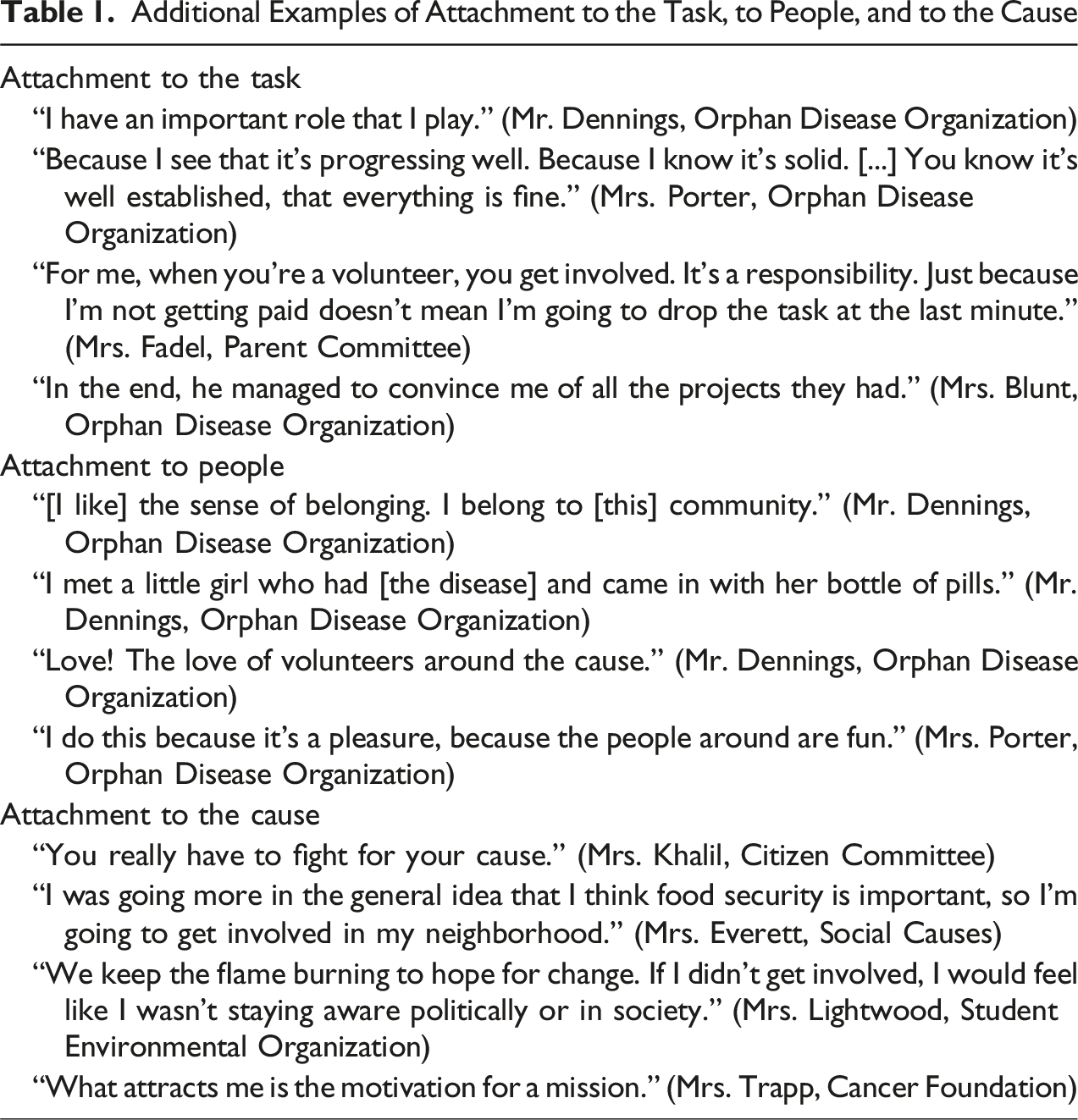
Over the course of our interviews, when participants told us about their attachment to the task, they evoked the feeling of having found a place where they are useful, the pride of being trusted with a valuable job, and the satisfaction of realizing that they were part of an efficient organization. When it came to their attachment to the people, our participants did not hesitate to speak of love, of their feeling of belonging, of the mutual help among the volunteers and activists they met in their organization, but also of their affection for the people they helped through their involvement. Finally, attachment to the cause was expressed when people stated their commitment to it, their desire to work hard to defend it, but also the need to do something meaningful to them. Importantly, the interviews did not refer only to values or beliefs that participants had before they started getting involved; they also describe attachments that were woven during their involvement.
The three forms of attachments that make up the dynamic character of involvement can each be activated—alone or simultaneously—throughout a person’s volunteering career, without assuming a hierarchy between forms of attachment, i.e., without considering that one is nobler or more authentic than the others. Our analysis also makes salient that there are not “types” of people, as some psychological research on intrinsic motivation could suggest (e.g., Yeung, 2004), but rather, following the interactionist approach, people who, depending on their experience and circumstances, navigate along the three dimensions, and perform different roles.
Moving From Exceptional Individuals to Organizational Environments
Another key finding that emerged from our interviews concerned the ways in which attachments were influenced by the organizational environments where the volunteering took place. In this sense, participants often told us about the difficulty of remaining volunteers (or retaining volunteers) even when they still “believed in the cause.” In fact, the organizational environments played a significant role in the volunteers’ ability to maintain their activities, whether that be caused by internal conflicts, resource scarcity on a structural level or individual (and collective) ability to dedicate themselves to volunteering. These types of organizational conflicts are apparent in Vignette D, where Naima Idrissi recounts having to step away from her volunteer position at The Tenants’ Association because of an internal crisis between members.
Vignette D: Naima Idrissi, The Tenants’ Association
Naima Idrissi, in her fifties, is involved in a community-based organization that aims at improving housing conditions in her neighborhood and at defending tenants’ rights. She decided to get involved after she benefited from the organization’s services. She also wanted to improve citizen’s mobilization around housing issues in her area: “The neighborhood is important to me. […] It seems like no-one cares about us. The organization is like a substitute for a city committee, where there is less participation, and I thought it was important that people get engaged.” Even though she still believed in the cause, she had to stop her involvement in the organization, because an internal crisis caused psychological distress among members. “That’s why I left, because I felt it was going beyond my skills. I had to put a limit and say that this situation required the help of a professional. And like, come on! It wasn’t okay!”
One result from our analysis is that people consider their active participation in volunteering activities separately from their engagement with the cause or ideas underlying those activities. For some people, while they were directly affected by the cause and cared very much about it, they could not contribute their time or efforts to it. This was the case of Naima Idrissi, as we can see in Vignette D. While Ms. Idrissi was herself a tenant who had required help from the Tenants’ Association and had become involved in the organization afterwards because she sincerely believed that tenants were ignored by governments and other decision-makers, she found herself unable to continue her involvement. In her case, the issue was not so much the lack of time, as one might expect, but rather the fact that the organization was experiencing an important crisis (due to the retirement of the director who had been there for over 40 years) that she felt she could not handle. She thus stopped her participation to safeguard her own mental health. Ms. Idrissi thus considers that she had no choice but to stop her participation in the organization, without for that much wavering in her engagement towards the cause of tenants’ rights.
For Delphine Carver, there are other factors at play that influenced volunteers’ ability to participate in the activities of the organizations they are a part of. In fact, she spoke more specifically to the physical demands of volunteer work, which can often be overlooked when it comes to analyzing who is doing what type of volunteering.
Vignette E: Delphine Carver, Housing Rights Committee
Delphine Carver is in her sixties and has been involved with her local housing rights committee for many years. In her work, she has found that most volunteers have previously benefitted from the committee’s services and get involved because they feel the need to “give back.” In her mind, this type of involvement is at the heart of the committee’s activities: so long as people experience hardship when it comes to housing, the committee will have both its reason to be and its volunteer pool. “If no one wants to be a part of the committee, it isn’t worth it to have one. If there are no more run-down apartments, if relationships with landlords become better overnight, if everyone respects each other, if we have ample social housing units to house everyone, then we won’t have a reason to exist. […] You know, when people come to us, we ask them if they liked our services and then we ask them to join.” However, Delphine is aware of the constraints that may limit the members involvement in the committee’s activities, such as marches and protests: “Maybe it’s cold outside, or a bunch of other issues. If the protest is during the day, people are working, so that’s hard. We also have an aging population, so that’s harder because people have more difficulty walking. Maybe a protest is harder for our members for those reasons.”
Additional Examples of Attachment to the Task, to People, and to the Cause
Discussion
Our analysis suggests that explaining the way people are involved in organizations and causes that matter to them can go beyond attributing an initial decision to psychological and institutional factors. As illustrated in Vignette B (Maryam Khaled), initial motivations such as integration were later overshadowed by attachments to identity and cause, showing that involvement evolves beyond initial psychological factors. The volunteering career can be viewed in a richer manner, as a dynamic process that situationally “attaches” people to aspects of their experience. As our analysis has shown, the ability to “give time,” to which volunteering is often reduced in the literature, is but one of its facets, and is a distinct issue from the person’s engagement with the cause at stake. For instance, Naima Idrissi’s withdrawal (Vignette D) exemplifies a trial where attachment to the cause persisted, but attachment to the organization broke under strain. Such analytical results led us to clarify that, in fact, we could conceive of volunteering as hinging on the way people attach to the tasks they accomplish, to the other people they meet, and to the cause they are fighting for—each of them independently. In that sense, our study extends research that has used attachment and detachment as a metaphor for people’s psychological disengagement from the organization (McAllum, 2018a), offering a stronger theoretical grounding in the literature on the notion of attachment (e.g., Hennion & Gomart, 1999) and a communicative analytical approach that extends the suggestion that volunteer’s career must be understood from an interactionist approach (Fillieule, 2010).
Our study therefore contributes to constitutive approaches to communication, by showing communication constitutes not only organizations but also the volunteering career. Through the stories participants shared, we observed how conversations, interactions, and situated practices do more than reproduce organizational structures, as CCO typically theorizes (see Basque et al., 2022). They actively shape the roles, identities, and attachments that define a person’s involvement over time. Each vignette illustrates how volunteers discover, negotiate, and sometimes abandon their place within an organization, but also more broadly within a cause, through communicative encounters with tasks, people, and causes. These processes laminate into a narrative that participants recognize as their “career,” showing that careers are not pre-given paths but emergent accomplishments of ongoing co-orientation. By foregrounding this dynamic, our study extends the CCO perspective beyond organizational boundaries to include the constitution of individual trajectories, revealing volunteering as a communicative achievement that unfolds through repeated trials of attachment.
From Initial Motivation to Situational Attunement
As a second contribution, breaking isolation or feeling valued, among others, are important reasons why people get involved (e.g., Nencini et al., 2016), but our data has shown that while some people gave an initial reason for joining an organization as a volunteer, the story they told us later modulated according to the relationships they established along the three forms of attachment. For example, Partridge’s career started with an interest in the environmental cause but evolved as he met people and discovered he was particularly fit for the tasks expected of him. That was also the case, among others, of another respondent who indicated they started volunteering to garnish their résumé and extend their network, but that along the way they met people like them and eventually realized that “you’ve got to fight for your cause.” This illustrates that while an initial motivation may have pushed someone to volunteer—here, in terms of accomplishing a task that may look good on their résumé—they also discovered other aspects that turned out to matter to them, leading them to deepen their involvement and even change as a person, to the point of becoming an activist. Thus, our analysis recasts in interactional and processual terms the idea that the reasons why people continue to get involved are not always the same as those that pushed them to do so initially, formulated in the literature on volunteer retention (e.g., Naskrent & Siebelt, 2011).
Taken together, our vignettes, but also the data that we could not include here, indicate that the three forms of attachment can also overlap and combine to constitute the volunteering situation. This was particularly true, in our data, for organizations defending patients’ rights or carrying out fundraising for research on a disease. In those cases, attachment to the cause and attachment to people—especially those affected by the disease—could be hard to distinguish: for instance, a person became initially involved because a family member had a cancer, but then met other patients, to the point that, for them, fighting against cancer also meant fighting for those people. In other cases, such as environmental organizations, the three forms of attachment were more clearly distinct, as the cause was not confused with the people met during the involvement, nor with the organization through which the involvement took place. This may account for the fact that, for many committed environmental activists, an organization may just be a temporary vehicle to promote deeply held beliefs (Driscoll, 2018). The idea that attachments can combine or, on the contrary, remain distinct, goes against the tendency to reduce volunteering to one specific motivation. While some literature has recognized that multiple motivations may occur together, it has generally been to suggest that those combined motivations were found within people and that they corresponded to volunteer profiles (e.g., Yeung, 2004). Instead of insisting that different “kinds” of people are fit for different kinds of volunteering opportunities, our findings reveal that people will interact with several elements of their volunteering opportunity and, through those interactions, combine them into situations to which they may be more or less attached.
In that sense, our respondents’ stories indicate that every moment in a volunteer’s journey can be conceived as a “dosage” of attachments to tasks, to people, and to the cause—and rather than assuming that the context where involvement takes place is a well-delimited organization (e.g., Hustinx, 2005; Nencini et al., 2016), it is more useful to consider how a relevant situation is continuously recreated. At different points in the story of their volunteering journey, our respondents told us of the people they liked and those they didn’t appreciate so much, of the aspects of the work that suited them and others that irritated them, and the values or ideas related to the cause that stimulated them or not. Such configuration of the three forms of attachment makes up the situation—that is, the state of affairs at the present moment—that guides the action of the person and that of her peers, and therefore leads her to get involved or, on the contrary, to demobilize (on situations, see Follett, 1940; see also Bourgoin et al., 2020).
In telling their story, though, our respondents did not merely position themselves as passive observers but played an active role in their volunteering experience. This means that each person contributes to defining the situation and therefore her own but also other people’s experience of volunteering: each person is the “context” of others’ involvement (just as each motorist is the traffic of others). Acknowledging each person’s ability to affect and alter their own and others’ volunteering situation goes counter the tendency to consider volunteers individually. Instead, thinking in terms of attachment provides an integrated framework to the scarce literature that considers volunteers as interacting with each other and as sharing the meaning of their workplace (Amsden et al., 2013) and a sense of their collective identity (Gray & Stevenson, 2020), and as persuading others of the importance of their work and cause (Ronel, 2006). In other words, if a person attaches herself, it is also because others have contributed to attach her. Our findings thus extend the suggestion that volunteering is better understood from an interactionist perspective (Agrikoliansky, 2017; Fillieule, 2010) not only by recognizing that people define their volunteering situation together, but by also recognizing that they also do so by interacting with non-human elements, such as tasks and ideas. Our study therefore encourages a richer and more inclusive understanding of the interactional scene when it comes to studying volunteering.
Are People Overly Attached?
Third, the concept of attachment allows for making a genuinely communicative contribution to the still-emergent field of critical volunteering studies (Eikenberry et al., 2024). Critical perspectives on volunteering often focus on power imbalances between volunteer tourists in the Global South, who often do not actually consider the needs and the autonomy of their hosts (e.g., Klaver, 2015). They denounce dwindling funding to non-profit organizations, as pressure from funders encourage many of them to “professionalize” their work (Ganesh & McAllum, 2012; Hwang & Powell, 2009) and to view volunteers as affordable labour, copying human resource models. However, while critical studies often give “an explicit attention to structure” (Eikenberry et al., 2024, p. 2), thinking in terms of attachment also locates power relations in the interactions that take place as part of people’s volunteering experience.
In particular, our analysis shows how some people remained attached to aspects of their volunteering experience despite trials. Indeed, the stories of our respondents reveal trials of strength: Ms. Idrissi’s (Vignette D) withdrawal marks a broken attachment to her tasks and to the organization, which was undergoing important turmoil, without dwindling her attachment to the cause; while Ms. Carver’s (Vignette E) persistence despite a difficult context shows an attachment to all facets of volunteering that resists trial. Arguably, Patridge’s (Vignette A) willingness to accomplish difficult tasks is justified by his youth and energy, but can also be read as the belief that, if he doesn’t do it, no-one will. The same may be true for Mrs. Stevens’ (Vignette C) among elderly people.
Our analysis thus points at the risk of there being cases where people may feel they have no choice but to remain attached to their volunteering, even when they may want to detach from it. That may be because, without their involvement, their organization’s services may not be available to people they care about, such as when a mom told us about her obligation to contribute her daughter’s skating club or when family members raise funding for cystic fibrosis or cancer research on behalf of their child, sibling or parent (see also Spade, 2020). Such situations have often been described as consequences of changes in structural conditions. For instance, when governments disengage from social services such as caring for terminally ill patients, the responsibility of taking up formerly paid roles often befalls volunteers and family members (Emanuel et al., 1999). In that sense, people may feel they have no choice but to carry out volunteer activities, even when they would prefer them to be accomplished by paid workers (e.g., Baines et al., 2014). Thinking in terms of attachment offers empirical grounding to that impression of lack of choice. We may observe how people may be solidly attached to those elements and have difficulty untying the knot that keep them in place, to the point that they must volunteer, thus defeating the very notion of “volunteering.” It is no accident that Hennion and Gomart (1999) conducted research on drug addicts, since indeed people may be solidly attached to resources that have become part of who they are, and cannot stop engaging with them. Because some people are similarly “addicted” to the resource an organization provides, they may be trapped in unpaid work. A critical perspective on volunteering can therefore use the notion of attachment to ask how attaching or detaching concretely takes place and whether some people are, in fact, forced to attach to their volunteer involvement.
In conclusion, a key lesson from our study is that involving people should not be only thought of as a movement from the outside to the inside, which stops once the person sets a foot inside the organization, as the notion of recruitment suggests. Involvement consists of a multiplicity of movements. The volunteer who initially was only interested in giving a few hours to a community-based organization might learn more about the cause; the one who came in to meet people may enjoy their new tasks. People may attach themselves more strongly and in more ways. Involving people is therefore not only about getting them to take the first step within the organization, but also about thinking about their whole journey. For example, programs designed to give teenagers a first volunteer experience, which are becoming increasingly popular, could think ahead about the ways in which they may continue their involvement beyond that first contact. That said, we must also keep in mind that these attachments take place in every situation, every day, and there is only so much that can be planned ahead.
Footnotes
Acknowledgements
The authors would like to thank Jeanne Barbeau, Emmanuelle Brindamour, Samuel Lamoureux, Camille Nicol, Gabrielle Phaneuf, Vincent Potvin, Fé Routhier, Coline Sénac, as well as Consuelo Vásquez and the whole Volunteering on the Move team. We are also indebted to the Research Group on Communicating as Organizing (RECOR) at the Université du Québec à Montréal. We are grateful for the comments we received from our respondent, Shiv Ganesh, and from audience members when we presented an earlier version of this article during the 2023 International Communication Association conference in Toronto.

Funding
The authors disclosed receipt of the following financial support for the research, authorship, and/or publication of this article: This research is part of the “Non-profit marketization and the transformation of volunteering practices: a communicational approach” project, headed by Consuelo Vásquez and supported by funding from the Social Sciences and Humanities Research Council of Canada (SSHRC grant number 435-2017-1094).
Declaration of Conflicting Interests
The authors declared no potential conflicts of interest with respect to the research, authorship, and/or publication of this article.