




Abstract
This study examined remote socialization of knowledge workers who began work remotely and the immediate and more distal effects on their organizational assimilation (OA) and other outcomes. We identify potential aftereffects as reported from interviews with 21 workers collected soon after entry and also approximately a year later to understand these longer-term effects. The data demonstrate their job competency and recognition were least affected, their ability to develop familiarity with others and role negotiation were moderately affected, and involvement and acculturation were significantly affected. Remote socialization reduced organizational identification when participants felt less connection, linked to turnover. Early-career (vs. mid-career) newcomers reported more disappointments, which led to breaches of their psychological contracts and premature turnover. We discuss theoretical and practical implications for remote socialization and the longer-term distal effects on their OA and connection to their organization.
In 2020, recently-hired knowledge workers were socialized remotely when many organizations were forced to close their offices due to the COVID-19 pandemic. These newcomers did not meet their supervisors or coworkers in person or physically enter the organization until many months after they joined (Parker et al., 2022). Instead, starting their new job meant picking up a new laptop—often in a parking lot—watching live or recorded training sessions via Zoom or Microsoft Teams, participating in online meetings, connecting with teammates via Slack, and getting to know coworkers in online coffee meetings or happy hours. This represented a major shift in how newcomers established work arrangements and were socialized into their new organization.
Organizational newcomers are introduced to the culture, policies, and members of the organization, and trained for performing their work roles through organizational socialization (OS) (Van Maanen & Schein, 1979). Often referred to as “onboarding,” OS benefits organizations by helping newcomers become productive more quickly and reducing uncertainties about the organization and their new roles, thus facilitating their adjustment and integration (Davis & Myers, 2019). Importantly, OS includes initial and ongoing conversations with supervisors and coworkers over several months to help newcomers learn about the organization, its culture, and their role (Chong et al., 2021; Jablin, 2001). The conceptual distinction between being engaged in work and OS is important to note. OS occurs during the first few days, weeks, and even months of work, meaning that while members are engaged in work, they are continuing to learn and be socialized by that work. The distinction between remote OS and remote work is significant because the learning and adjustment associated with OS enables individuals to fulfill their roles as remote workers. Over time, OS facilitates members’ organizational commitment and identification (Chong et al., 2021; Morrison, 1993) and reduces premature turnover (Carr et al., 2006).
Although remote work has existed for many years, remote onboarding is somewhat new. While organizations have long utilized workers who work from afar and rarely come to the office, many remote workers occasionally visit or work onsite and the vast majority are initially trained in the physical bounds of the office before they begin performing remote work (Bouchrika, 2023). Those who are hired with the intent to be fully remote likely have different OS expectations than someone who joins the organization intending to work in person. For decades, organizations have utilized distributed or virtual teams, especially for special projects and to collaborate on issues that involve customers in worldwide locations (Mohrman, 2008). Members of virtual teams are socialized to team practices and teammates’ behaviors to effectively collaborate and coordinate activities (Furst et al., 1999; Rosen et al., 2006). However, in most situations, distributed team members are also members of their organization and their team membership is only one facet of their organizational role. As a consequence, most investigations of OS have presumed that training occurs in person at locations where questions can be quickly addressed, where newcomers learn from watching others, and where bonds between individuals are created through informal interpersonal interaction (Bouchrika, 2023).
The widespread adoption of remote work during the pandemic created an opportunity to investigate the long-term implications of the mostly new and potentially more common fully remote OS. This study investigates how the remote socialization of knowledge workers (workers who perform non-routine work and contribute based on their knowledge, Drucker, 1967) affected their organizational assimilation (OA), not only at entry, but months into their organizational tenure. Drawing on data from individuals who were interviewed shortly after joining their organizations in 2020 and again a year and a half later, we examined their OA (getting to know others, acculturation, becoming involved, feeling recognized, developing job competency, and role negotiation) as well as more distal perceived effects, including on their organizational identification and turnover. Our findings demonstrate how remote socialization shaped immediate perceptions of organizational membership soon after hire, and, importantly, more than a year later. We found differences in how early-career (vs. mid-career) newcomers perceived effects of remote socialization on their assimilation, with more negative effects for those new to their careers. We offer theoretical implications for understanding distal effects of OS on OA, organizational identification and turnover, and practical implications for managers and organizational members.
Organizational Socialization and Assimilation
Through OS, newcomers learn about their organization and their organizational role (Miller & Jablin, 1991) such as the tasks they will be required to perform (Madllock & Chory, 2014) and workplace culture, including shared values and norms and their place in the organizational hierarchy (Myers, 2006). New workers also learn about their coworkers, including their coworkers’ expectations of them (ter Hoeven et al., 2017) and on whom they should rely for support (Morrison, 1993). The information also helps them form a psychological contract—their understanding of the nature of their exchange with the organization (Rousseau, 1995)—primarily developed at the beginning of their organizational tenure (Delobbe et al., 2015). Their psychological contract gives them working knowledge (based on their perceptions) about how they are expected to contribute to the organization and what they will receive in return (De Vos et al., 2003). A breach in psychological contract can disrupt a new worker’s adjustment (Woodrow & Guest, 2020).
As newcomers learn about their organization through OS, one objective is to become assimilated 1 (Waldeck & Myers, 2007). Organizational assimilation (OA) is defined by Jablin (2001) as “the processes by which individuals become integrated into the culture of an organization” (p. 755). A commonly cited model of OA specifies seven processes that are desired outcomes of OS (Gailliard et al., 2010; Myers & Oetzel, 2003). The first two processes involve gaining familiarity with supervisors and others in the organization, as newcomers come to understand how to coordinate tasks and develop supportive friendships. The third process is acculturation, or knowing the culture of the organization, which helps newcomers know what to expect and what they should and should not do to fit in. The fourth process is feeling recognized, which can involve recognition from others or a newcomer recognizing themselves as a valuable contributor. The fifth process is involvement, or a newcomer’s participation in aspects of the organization beyond minimum requirements. Sixth is job competency, or learning how to perform required tasks. The seventh process is role negotiation, or personalizing how the role is performed, such as negotiating how one performs tasks, including how one structures their day.
In order to assimilate and cope with the anxiety of joining an organization (Saks & Gruman, 2011), newcomers strive to manage uncertainties during OS (Miller & Jablin, 1991). For example, they may monitor patterns of workplace activity to understand the values and norms of the organization and to adapt their behaviors to fit into its culture (Ellis et al., 2015). This helps newcomers deal with anxiety about whether they are accepted as valuable members of the organization and workgroup (Myers, 2006). Even under normal circumstances, seeking information and striving for OA as a newcomer is daunting. Undergoing training in entirely remote format during the pandemic added additional layers of complexity.
Remote Socialization and Organizational Assimilation
Prior to 2020, 57% of American workers said they never or rarely worked from home (Parker et al., 2022). Due to the COVID-19 pandemic, about 71% of American workers who could work from home suddenly were mandated to work remotely through most of 2020 (Parker et al., 2022). According to the Bureau of Labor Statistics, in July 2020, 47% of workers with bachelor’s degrees worked from home (Bureau of Labor Statistics, 2020). Thus, nearly half of the workers who were performing white collar work were privileged—compared to those without degrees—in that they were able to isolate themselves from the COVID virus. While remote work presented challenges for many workers, those who joined organizations during the pandemic joined without ever entering the physical environment. Thus, these workers were required to proactively learn about their organizational roles from their kitchen tables or childhood bedrooms (Woo et al., 2023). Often, management had little infrastructure in place to orient and train newcomers remotely.
Despite existing literature on the social dynamics of remote work in general (e.g., Gibson et al., 2011; Hinds et al., 2002), research on newcomers’ OS has assumed that at least part of their onboarding occurs inside the physical boundaries of the organization (Hart & Miller, 2005). Observation is an important source of learning, including observing how coworkers use equipment (Filstad, 2011), seeing how roles are performed (Miller & Jablin, 1991), and developing working relationships as a source of information and support (Zorn & Gregory, 2005). Although many companies employed remote workers prior to the pandemic, most companies required those newcomers to attend some training at the organization’s location (Bouchrika, 2023). In these visits, newcomers could access centrally-located training resources, better understand the organizational environment and culture (i.e., offices, branding, equipment), engage with their supervisor and coworkers, and, in some cases, get to know their cohort of newcomers to strengthen bonds with them (Zorn & Gregory, 2005).
Research that has explored newcomers’ experiences in virtual environments suggests that remote socialization poses challenges for many newcomers, with 68% of employees preferring to have at least some training in the workplace (Bouchrika, 2023). Ahuja and Galvin (2003) found that newcomers in virtual groups often sought task-related information from group members, but rarely acquired information about their group’s values and expectations or how to adhere to organizational rules. In remote situations, informal communication with coworkers is affected in terms of reducing the number of impromptu conversations and the number of casual conversation partners (Viererbl et al., 2022). Without such encounters, newcomers may struggle to enact organizational norms (Furst et al., 1999) or meet clients’ expectations (Blaising et al., 2019). Similarly, Schinoff et al. (2020) found that without any amount of co-presence, newcomers had more difficulty developing friendships due to fewer cues about socioemotional compatibility. Most research assumes that even if newcomers virtually access work-related information in their socialization, they maintain access to richer sources of information through in-person interaction (Lee et al., 2019; Waldeck et al., 2004). In fact, in their study of technology use and newcomer socialization, Waldeck et al. (2004) found that face-to-face communication remained the strongest predictor of OA. Recently, Woo et al. (2023) investigated newcomer uncertainty during mandated remote work and found that workers were most uncertain about workplace relationships, organizational norms, and task performance.
When remote work was mandated, organizational leaders, members, and scholars speculated about the potential short- and long-term effects on members’ OA, including both learning and adjustment and relationships to their new employer (Weisman et al., 2023). What remains unclear are the potentially lasting effects of less immersive experiences, both on employees’ understanding and adaptation to the organization and on others’ ability to value their contribution and accept them as members. The small body of research on remote socialization suggests it may have an enduring effect on newcomers’ OA because of their limited access to particular types of information in the virtual environment. Remote socialization may also affect dimensions of OA differently. For instance, newcomers may find they have sufficient task-related information to obtain job competency, but lack cultural information needed to advance in the organization that is often communicated informally (Ahuja & Galvin, 2003). Understanding the immediate and distal impacts of remote socialization on OA remains relevant for the many organizations that onboard employees remotely or in hybrid situations. To investigate the effects of remote socialization on OA, we ask:
How does remote socialization affect workers’ perceived immediate and more distal OA?
It is unclear how remote socialization affects other long-term outcomes associated with organizational membership. Early research on OS found that institutional tactics—including formal training that typically occurs in classroom settings and collective socialization in which groups of newcomers are socialized together—often result in higher levels of commitment and lower intentions to quit (Madllock & Chory, 2014). Accordingly, learning through online classes or pre-recorded videos and without the organization’s physical structures and resources might affect the member’ connection to the organization. Members’ OA has long been associated with a type of connection called organizational identification, defined by Mael and Ashforth (1992) as “the perception of oneness with or belongingness” with a collective (p. 104). In the field of communication, Tompkins and Cheney (1985) proposed that members identify with their organization when the individual “desires to choose the alternative that best promotes the perceived interests of that organization” (p. 194). Gailliard et al. (2010) found strong relationships between certain processes of OA and organizational identification. They found involvement and recognition to have strong and moderate correlations to organizational identification. They also found weaker, but still significant, correlations between identification and all other assimilation dimensions. Employees who lack organizational identification are more likely to consider leaving the organization (Myers & Oetzel, 2003; Van Dick et al., 2004). To explore the relationship between OA and other outcomes that represent members’ present commitment and future relationship to their organization following remote socialization, we ask:
How does remote socialization affect members’ perception of their relationship with their organization, including their organizational identification and intent to stay?
Finally, some studies conclude that individuals with previous work experience have less anxiety and can assimilate more easily than those without work experience (Harris et al., 2020), especially when they can draw on knowledge from similar organizational roles they have previously held (Dailey, 2016a). Other studies offer mixed results with newcomers feeling that the knowledge and skills they bring to their new organization are not valued (Carr et al., 2006; Endacott & Myers, 2019).
Remote socialization may hinder early-career members’ ability to form the connections they need to be successful in their industry and profession (Martyniuk et al., 2021). It may also decrease opportunities for sensegiving from others (Harris et al., 2020), which may be especially valuable for less experienced newcomers. To inductively explore how remote OS affects early-career newcomers’ short- and long-term OA and other outcomes relative to more experienced newcomers, we ask:
What are the perceived more distal effects of remote socialization on OA, organizational identification, and turnover intentions between early- and mid-career newcomers?
Method
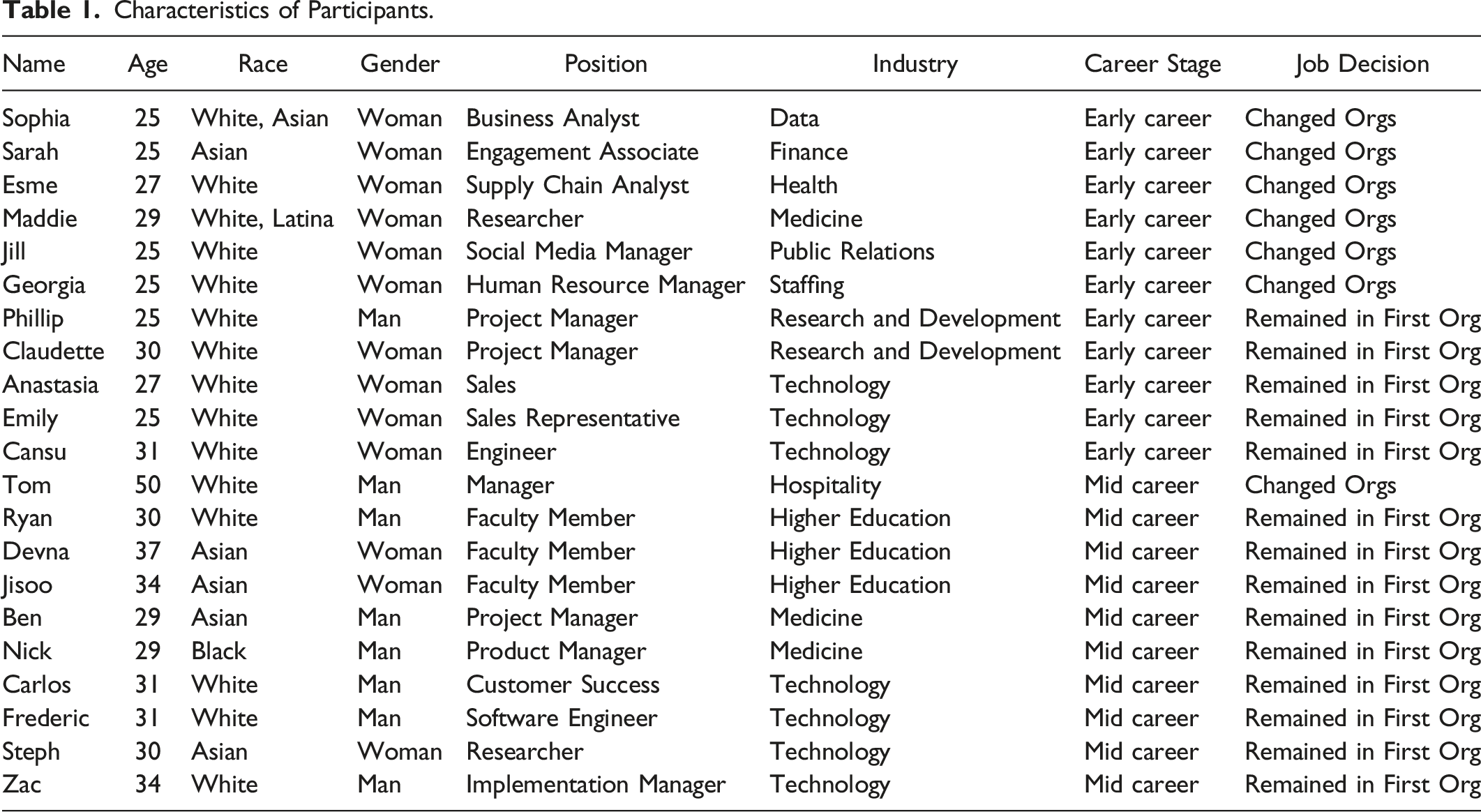
Characteristics of Participants.
Data Collection
Given the requirement that participants must have joined their organizations and been remotely socialized between February and November 2020, we relied on snowball sampling for our first interviews after initial recruitment efforts through social media and email. Of the 30 individuals who participated in a first-round interview, 21 agreed to participate in a follow-up interview. In the first round of interviews, we asked about participants’ experiences of remote socialization, including (1) processes of learning while remote, (2) how joining remotely shaped their initial experiences, and (3) how they sought information while being socialized remotely.
The sample for the second set of interviews was also narrowed because participants were required to be available for follow-up interviews February-July 2022. While the result was 21 participants and a fairly homogenous sample in terms of age and race, our method followed guidelines for information power suggested by Malterud et al. (2016, p. 1753) and we found that the sample held rich information relevant for the goals of our study. We also grouped participants into two groups in order to compare early-careerists just beginning their careers and mid-careerists who had previously held full-time jobs. Participants came from a variety of industries, including technology, healthcare, higher education, and research and development. Seven of the 21 participants had changed organizations by the time of their second interview.
In the second set of interviews, we focused more explicitly on what participants believed were the effects of remote socialization on their OA. Our semi-structured interview protocol was organized into three sections: (1) their current work situation, including reflections on the return to in-person work when relevant, (2) their perceptions of their OA, and (3) their perceptions of their future organizational membership. Interviews lasted between 25 and 45 minutes and were conducted via video-conferencing or phone. Twenty of 21 participants gave permission to record their interviews, which were transcribed. For one interview, we recorded detailed notes instead. The interviews yielded approximately 250 pages of single-spaced data.
Data Analysis
Our data analysis utilized both etic (drawing on concepts defined in the literature) and emic (grounding analysis in the data themselves) approaches, allowing us to identify themes related to the dimensions of OA (RQ1) as well as broader emergent themes about participants’ organizational membership as it related to entering jobs remotely and how they felt about their membership nearly two years post entry (RQ2, RQ3).
To address RQ1, we took an etic approach to coding, using existing conceptualizations of OA to guide our analysis (Tracy, 2019). By exploring participants’ perceptions of OA along the dimensions identified by Myers and Oetzel (2003), our analysis was guided toward a range of participant perceptions about their membership shaped by remote socialization. First, all authors read and coded each interview to highlight participant comments related to the dimensions of OA identified by Myers and Oetzel (2003). For our analysis, we collapsed the dimensions of familiarity with coworkers and supervisors (Galliard et al., 2010) into one dimension for a total of six OA dimensions (familiarity with others, acculturation, recognition, role negotiation, involvement, and job competency). Our approach grounded our findings in existing theoretical conceptualization of OA while allowing how OA was affected by remote socialization to emerge from the data. Next, we engaged in data reduction by summarizing participants’ experiences with each OA dimension at Time 1 and Time 2, compiling our summaries into a spreadsheet and exploring patterns to understand perceived common changes in OA over time. Each interview and its corresponding OA summaries were reviewed by more than one author. This method allowed us to explore both how each participant’s responses compared between Time 1 and Time 2 as well as differences in more distal outcomes among participants.
To address RQ2 and RQ3, we took a more emic approach to coding using participants’ own descriptions of their organizational experiences to guide our analysis. Our coding process was similar to that used for RQ1 in that the entire research team read each interview and took extensive notes on emerging themes. After initial coding, we met several times to consolidate and refine these notes. We also crafted case summaries of each participant’s experiences with remote onboarding, their current and anticipated future relationship with their employer, and their expectations for work flexibility. This data reduction technique allowed us to both assess common themes across participants and understand their longer-term adjustment and connections to their organization. Using our combined notes and case summaries, we identified several themes related to participants’ relationship with their organization and their expectations for work. We explain these findings in detail below.
Results
Brief Description of Remote Socialization
In the first round of interviews, participants discussed their remote socialization (see Woo et al., 2023, for description). Mandated remote work caused by the pandemic forced many organizations to rush to develop remote OS programs. Training sessions consisted largely of informal Zoom meetings delivering content that previously would have been offered in office. While individuals introduced themselves and discussed work-related topics with others in their workgroups, members were not able to have impromptu, informal, one-on-one conversations and rarely felt like they knew one another. Participants said these online sessions often felt impersonal and unsatisfying. They could not learn their roles by observing coworkers performing tasks, enjoy organizationally-provided meals, get settled into an office workspace, or learn the cultural norms of the organization. Although these concerns might be considered peripheral, some new members believed they had been cheated out of some early professional experiences. Without their physical presence inside the workplace, newcomers were bored and isolated and did not feel like organizational members. To make matters worse, newcomers often had no one to ask when they had questions that required quick responses.
Within a few weeks or months, organizations attempted to respond to these issues, with larger organizations typically capable of responding more quickly. Many organizations created training videos newcomers could watch and re-watch at their own pace. In an effort to help members socialize with others, most organizations scheduled online lunches, coffee meetings, or happy hours with coworkers. Within a short period of time, most members grew tired of these online events, seeing them as a waste of time and resenting the additional screen time. Finally, to help members feel more supported and develop more connection to the organization, many organizations mailed or delivered organizationally-branded items such as coffee mugs, T-shirts, or hoodies. To enhance online coffees and lunches, some organizations delivered food and drinks via food delivery companies.
This description summarizes our participants’ initial training and period of socialization. By the time of the second interviews, many of our participants were working hybrid schedules, often mandated to work in the office from one to three days a week. While they may have felt like newcomers on their first days in the office, their uncertainty with the office environment seemed to go unnoticed by others. None of the participants received any sort of socialization connected to entering the office, but a few mentioned that they were given informal tours. Left to figure things out on their own, most focused their efforts on getting to know their colleagues. What follows are our participants’ perceptions about how their remote socialization shaped their organizational experience and membership following their remote socialization.
RQ1: Remote Socialization: Immediate and Distal OA of Members
The first research question asked about how newcomers perceived their OA was affected by remote socialization, both immediately and longer-term. To structure the findings, we used dimensions from the model of OA (Galliard et al., 2010; Myers & Oetzel, 2003) arranged from least to most affected by remote socialization.
Job Competency
Most participants perceived that job competency was least shaped by being socialized remotely. Most said they were able to obtain a high degree of job competency, albeit more slowly than in face-to-face socialization. This slowing stemmed from two limitations of the virtual environment: not being able to observe others and delays in getting questions answered. Emily pointed out that not being able to observe her coworkers slowed her learning: “There are some things that I think I would have learned sooner if I were in the office, just from learning and seeing other people.” Many expressed that working remotely made it more difficult to quickly obtain answers to questions. Georgia said that she often had questions about her projects: “I can’t just pop over to somebody’s desk and ask, ‘Hey, what did you mean by that again?’” Similarly, Emily said, “With Slack or Zoom, it’s hard because I don’t get an instant response. Whereas, if I were in the office, I could just physically see, ‘Oh, now is a good time to ask.’” Despite this, by the second interview, most participants said that they eventually felt competent in their organizational roles. As Nick said, being onboarded remotely did not affect his “knowledge,” even though it “definitely slowed things down a little bit.”
Recognition
Most of our participants saw remote socialization as slowing their ability to be recognized, but not completely inhibiting it. In the year and a half between their first and second interviews, 12 of our 21 participants received a promotion with a change of job title or were given more responsibility with larger or more significant projects. They appeared to be recognized much like they would be if they had worked in the office. Some attributed their success to the increased focus and decreased interruptions remote work afforded. However, because others could not directly observe their work, some affirmed the importance of touting their accomplishments and objectively demonstrating their value. Sarah said, “You don’t have those random encounters where you bump into someone in the elevator and they ask you what you’re working on.” To counteract this, Sarah said, “You have to be really intentional about sharing what you’re working on and making that noticeable.” She further explained: Numbers have been helpful to show impact, but also at the end of meetings it doesn't hurt ... to step up in, be like, ‘Hey, I have a shout out for this team member.’ ... You shout someone out, maybe they'll shout you back.
This proactive approach to gaining recognition was important in an environment where there was such little direct observation of one’s progress.
Some participants talked about the importance of informal recognition. Phillip talked about showing his sense of humor to others by leading a memorable icebreaker that was in sharp contrast to the impersonal nature of most virtual meeting interactions: For like 12 months, I led like a big division monthly alignment meeting ... I started each of those meetings with an icebreaker and I got to lead these ridiculous icebreakers. One was “Drag Queen Lip Sync.” So I said, “We're gonna sing, ‘I Will Always Love You’ by Whitney Houston.” I made everyone lip sync along ... I became famous for that.
A few participants did not feel particularly recognized and a lack of feedback from others caused them to feel undervalued. This was Georgia’s reason for leaving her company before the second interview. She served in a leading support role to the sales team that travelled to New York for an important meeting, but she was not invited to join. She felt excluded and undervalued. It was not until she announced her exit that coworkers appeared to recognize her worth: When I put in my two weeks was really a time where I was like, so many people were reaching out to me, “We're gonna miss you.” “What are you doing? Don't leave.” And so it was almost like, as I was leaving, I finally felt that like I am valued and like wanted here as an employee, which is like a very unfortunate thing for my company because if you had done this, you know, six months ago, I might not even be putting in my two weeks. I wouldn't be leaving.
As these examples show, difficulties gaining information about one’s own performance, including praise from others, was a barrier to some participants’ OA. Many learned how to self-promote their accomplishments, but others never felt recognized and quit.
Familiarity with Others (Coworkers and Supervisors)
Getting to know others was one of the most challenging aspects of remote assimilation. Many eventually formed a few genuine connections. However, without informal conversations, relationship development took longer and typically was limited to a small group. This was often the immediate workgroup, because Zoom meetings mostly involved members of one’s workgroup and supervisor. Ryan, a new professor, described the challenge of getting to know his coworkers virtually: It’s just so hard to simulate it through technology, as far as like team building goes… there's what, like 20 faculty members probably, but there are five I've really talked to for any great amount of time. And I know a lot about them and the rest, I have no clue.
Similarly, Esme said she made one close friend but did not get to know the majority of her coworkers. She explained that most of her coworkers were just “professional acquaintances” and that “it was really like a slow burn, a slow start these relationships.” Another member, Devna, began to meet up with a few coworkers for lunch, but “to feel like my department is my main community, my main inner circle—I don’t feel that way yet.”
Despite these challenges, and much like the participants in Viererbl et al.’s (2022) study, many members felt close to their supervisors as well as their workgroup early in their tenure. Phillip described a strong working relationship with his manager, which he credits to her “making it clear, right from the get-go, that I never had to hesitate about asking her any questions.” Several described forming mentor-like relationships with supervisors giving them opportunities for promotion and leadership. Even in the first interviews, many participants also talked about how they had started to develop productive, supportive relationships with others in their workgroup. For example, Emily explained how Slack facilitated interactions in her workgroup: “I have one Slack channel with like part of the people from my team on it. It’s like some of us made a little group and then we ask each other questions in it all the time.” In addition to building the strongest relationships within the workgroup, we noticed that participants often said they built stronger connections with coworkers who joined at the same time or who were at a similar age or career stage. For instance, Emily said she formed friendships with a cohort of new members when she joined her large tech company: “When I first got hired, there were a ton of us and we would all hang out and we all met each other and that was really fun.” Sophia expressed a similar sentiment about connecting with other young women in her age group: “I definitely stick to the younger girls I can find at the company. We kind of have banded together … and we’ve started our own little culture.” In the remote environment with limited information about one’s coworkers, these findings suggest that newcomers gravitate toward people they perceive as similar to themselves, oftentimes choosing to connect with those people in-person outside of work when possible.
Going into the office, even on a hybrid basis, had a variety of effects on work relationships as reported in many second interviews. On one hand, returning to the office emphasized the lack of familiarity members had with their colleagues, despite working at the organization for over a year. Sophia explained that she had a harder time recognizing her coworkers in person, even though she had had many virtual encounters with them: “When I started going back in the office, people would have their masks on and I couldn’t really tell who they were, even if I worked with them every day over Zoom.” Other participants described how the transition back to the office positively affected their workplace relationships. Anastasia felt invigorated by the change, saying, “It felt exciting because if you were to run into people, you would either a hundred percent not know them or recognize their face from Zoom.” Some members saw meeting their coworkers in the office as a turning point (Bullis & Bach, 1989). For example, although Frederic felt satisfied by the relationships he had developed working remotely, he acknowledged a difference when meeting coworkers in person for the first time: Meeting them in person was definitely on another dimension… It feels like people are more open and can leave their guard down a little bit. Once you've met them, it's like, “Oh, you're a regular person.”
Overall, during remote socialization, most participants initially forged strong relationships with their supervisors and some close relationships with workgroup members, but many acknowledged difficulties personalizing these connections. They recognized that in-person interactions both deepened connections and exposed them to others outside their workgroup. By the second interviews, most had not yet connected with individuals outside their workgroup.
Role Negotiation
Nearly all participants negotiated their roles by structuring their workday as they pleased. Some reported taking very early morning calls from clients who were on a different time zone and then taking a break (or a nap!) before resuming their work. While some of this was related to increased autonomy, participants tested limits to determine whether their supervisor would object to their changing their schedules or availability. Some performed more intense work at the times of the day when they worked best. Others enforced quiet time without interruptions from supervisors or coworkers, such as Anastasia, who turned off Slack so she could concentrate without interruptions. Emily described the autonomy she felt: “My manager is very hands off, so the way that I like structure my day is very on me … It’s also very much on me to manage my time and make sure everything gets done.” Being socialized remotely made it easier for these newcomers to engage in negotiations early on, rather than having to wait for or earn such flexibility. They expected to retain some elements of this flexibility even after they returned to the office.
Involvement
Participants’ involvement in the organizations was one of the dimensions of OA most affected by remote socialization. For many, interest in and prioritization of involvement in their organization did not become central to their membership. Some explained that they initially demonstrated their involvement in their organizations by engaging in proactive learning (for example, Emily reported that she spent her breaks studying), attending online webinars, or joining virtual affinity groups. However, these efforts faded over time, and many did not prioritize this dimension of assimilation even as opportunities for in-person involvement returned. Some of this lack of enthusiasm may be attributed to Zoom fatigue, especially in later stages of the pandemic (Anh et al., 2023; Bergmann et al., 2023). Maddie explained that while she initially joined her organization’s virtual events, gradually she became less interested. She said, “Once I got into the actual work of it, I thought, ‘I don’t want to do your coffee hour, I’ll never talk to these people, even in the office.’” Similarly, Cansu, whose company began bringing workers back on a hybrid schedule, noted that she was less inclined to attend in-person events than the virtual events she had participated in from home. She explained that most of the events are on days when her team works from home and she isn’t going to “go into work just for this one random event, plus I don’t know if my teammates will go or not.” She explained that while she prefers having team meetings in-person, attending any organization-wide events where she knows few people sounds daunting because, “It would feel awkward to be the only person from my team.” Such quotes illustrate the ambivalence participants had toward being involved with the organization, even when they were enthusiastic about contributing to their teams. By the second interviews, little had changed for most participants and it seemed like this pattern of low involvement established in remote environments would probably endure.
Acculturation
Becoming acculturated in a remote context was often cited as the most challenging aspect of OA. It could be argued that the newcomers were acculturating to the norms and culture of the online dimension of their organizations (e.g., timing for entering Zoom meetings, which communication media to use for various tasks, appropriateness of emailing after hours) but not the entire organization; participants found this to be unsatisfying. Observation and informal conversations, two of the best sources of information about organizational culture (Viererbl et al., 2022; Woo et al., 2023), were severely restricted in remote environments. Participants discussed being unable to learn about the culture by observing coworker attire or watching coworker interactions. In her first interview, Maddie described difficulty in learning the norms of her workplace: I often found myself asking my colleagues, like, is this normal? Or like, do we always do it like this? Or like, how is this different if I was having this meeting face to face? I still don't know that I could tell you because I never had a meeting face to face.
Others also struggled to understand the workplace culture. Sarah wondered if she would understand the culture better if she was in the office: “It might not be that different, but like, it makes me wonder … the fact that I’m remote that I can’t see the full picture.” Without in-person interactions, it was hard to know how their team or they themselves fit into the organization.
Prior to their return to the office, some participants told us that their organizations tried to acculturate newcomers and maintain culture by promoting virtual coffees, lunches, happy hours, and other social events; these were met with mixed responses. Some participants saw these efforts as fruitful, like Zac, who believed his company did a good job of maintaining culture by hiring “culture ambassadors” to promote connectivity through Slack. Frederic also described feeling connected to his company’s culture through routine virtual meetings and interactions with colleagues. However, other participants found organizational efforts to acculturate them while remote ineffective and annoying. Sarah said her company’s online social events, such as virtual game nights or cocktail classes, were fun at first, but she eventually lost interest: “In the beginning, I tried more and my team tried more to get to know each other on a personal level, but then that started to change. There’s less of that.” As time went on, she explained, “it’s hard, it becomes less productive and the whole meeting fatigue kicks in.” Companies also attempted to acculturate their employees by mailing swag such as coffee mugs and sweatshirts. These organizational efforts, though appreciated, did not help members understand the company culture.
Finally, many participants began working in the office before their second interviews. None mentioned any amount of socialization provided by their organizations for this transition. Many described uncertainty and anxiety because they were still so unfamiliar with organizational culture, despite working at their companies for months. Cansu explained how stressful navigating the workplace was: Unexpectedly, lunch has become a stress point, because I didn't really know what people did for lunch and it's not like, “Oh, it’s my first day so someone is showing me the ropes.” I could have asked them, about this or that. But I felt awkward to be like, “Hey, I've been here almost two years and I have no idea what people do.”
Others shared similar concerns and wondered about how people dressed or what to do for lunch, but, like Cansu, felt that the time they could ask such questions had passed. Maddie said that she saw the return to the office as a huge area of uncertainty when deciding whether to stay or leave her organization, explaining, “It was really hard to know what even is my option going to be, because I knew we would go back to the office someday and I didn’t know what that someday would look like.” Although they were technically no longer newcomers, they were newcomers to the office, and said that they were still low in acculturation.
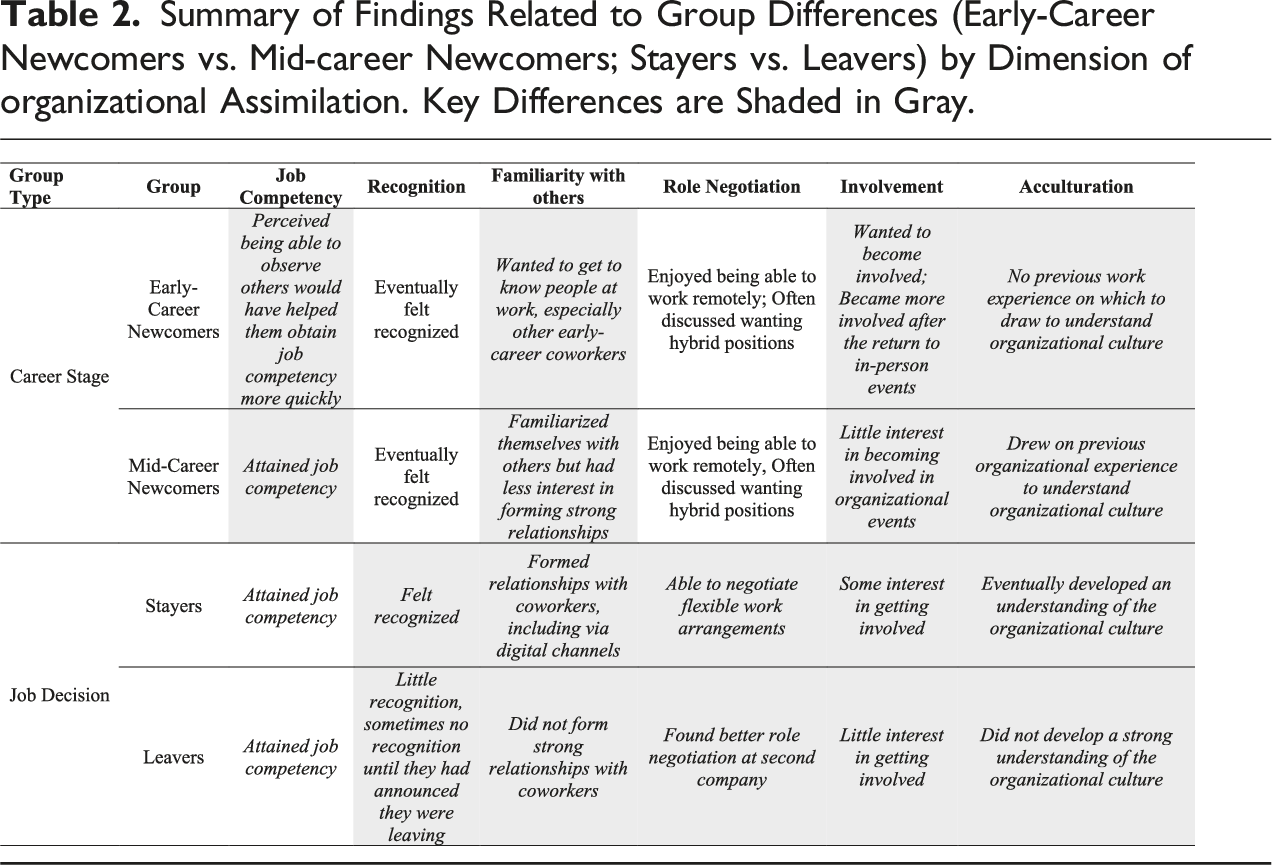
Overall, it appeared that participants described differential effects that remote socialization had on aspects of OA. While many participants were initially concerned about developing job competency, after about 18 months, job competency and recognition appeared to be least affected of all six dimensions. Remote socialization moderately affected developing familiarity with others because they had fewer relationships than they expected. It also had a moderate effect on role negotiation as participants had more ability to structure their work and schedules. Both involvement and acculturation were significantly curtailed by remote socialization. When individuals feel less connection to their colleagues and their organization, they felt less inclined to become involved in non-required activities. Overall, few participants believed they had acculturated to any extent. For some, this was extremely stressful, making them feel anxious about going into the office.
RQ2: Remote Socialization and Workers’ Relationship to the Organization
Our second research question explored participants’ identification with their organization and intent to stay. Several participants expressed intent to stay at their current organization. In his second interview, Phillip said he had been encouraged to apply to another company, but realized he wanted to stay because “I think that there’s a lot of growth opportunity [at my current organization] and I really like what I do and like all the people that I’ve met through it.” Frederic expressed a similar view: “I like what I do … it aligns with my ambitions. That’s not to say I would never change the company … but I’m very happy.” However, when asked about their relationship to the organization, participants often talked about their preference for remote or hybrid schedules rather than their organizational commitment. Claudette, for example, said that she thought about quitting her job because she and her partner were moving out-of-state, but in order to retain her, her employer assured her she could continue to work remotely in the foreseeable future. Zac’s employer offered mid- and senior-level employees an option to permanently work remotely and said: “I’m very happy being permanently remote … I probably wouldn’t even take another job if it requires me to go to the office again.”
When asked how they would describe their identification with the organization and their intent to stay, only a few said that they strongly identified with their organization. For example, Anastasia said, “I love what we do. I love that we’re a company that creates mutually beneficial business opportunities, which I think is rare. I think I’ll always have a place in my heart for [organization].” Still, many participants found responding to questions about their organizational identification difficult and often discussed their relationships with supervisors or workgroups as a source of identification. Maddie’s response demonstrates this link: I didn’t feel like a strong sense of belonging or identification with the organization necessarily. I did feel like I had one or two or three really strong work relationships that I had built, but I think they’re more interpersonal and kind, and not focused on the organization as a whole.
Similarly, Jisoo said she felt she was developing an understanding of the culture of her department, but did not feel a connection to the larger organization even after a year of employment: “This organization is a huge organization with so many different subparts where I don’t even know how things are connected and who’s even at the organization itself.” As described previously, participants’ responses about their involvement, or lack thereof, also indicated that they did not feel committed enough to participate beyond job requirements.
Regarding their intent to stay, several participants said that they likely would not remain in the organization for the long-term. Sophia expressed this sentiment: “I told the HR lady that I felt more comfortable leaving the position to pursue this new job at [organization] because I had never gone into the office. I didn’t really know my coworkers except from Zoom calls.” However, because many were in the early stages of their career, they likely saw their first job as a stepping stone. Claudette said, “I don’t think I’ll be in this role forever. I think of it more like a five-year type of position. I’m still trying to figure out where I want to go next.” Of our 21 participants, seven had quit by their second interview. While it could be argued that their leaving makes it difficult to ascertain the long-term effects of their remote OS, their exit is a distal effect that likely demonstrates that they were not strongly assimilated.
In sum, when asked about their organizational identification, only a few participants discussed their connections to their organizations, instead mentioning identification with their workgroup. Those who stayed often attributed their decision to not get involved beyond their role requirements to a lack of connection (identification) with the organization. Most, including those who had already quit, explained that they felt little connection to the people or the culture of the organization from which they departed.
RQ3: the Effect of Career Stage in Members’ Organizational Assimilation Following Remote Socialization
The third research question asked about differences based on career stage by comparing OA of those who had previous work experience (“mid-career newcomers”) to those who were just beginning their careers (“early-career newcomers”). Many early-career newcomers had long dreamed about becoming working professionals and felt cheated by the remote socialization and work. They developed psychological contracts imagining themselves joining offices in which they would develop friendships with coworkers with whom they could go to lunch, take breaks, and spend time away from work. Remote work simply was not conducive to developing personal relationships that extended beyond cordial greetings in meetings and via emails/chats. In our first interviews, most early careerists talked about the disappointment of launching their careers from their childhood bedrooms. By her second interview, Georgia described how she felt dissatisfied with the situation: “Me being 25 now and having never worked in an office culture, an office space, it was just not good for my professional development. It wasn’t what I wanted for myself.”
Even those early career newcomers who eventually were brought back to the office continued to feel the effects much more than mid-career newcomers. When Sarah, an early-career worker, began working in the office, she felt disconnected: “The people I talk to on a day-to-day basis are not necessarily the people that I am seated with in the office … I talk to the same people that I work with and then I go in to the office and I feel like I’m on a stranded island because I don’t know half of these people around me.” By contrast, those who had previous work experience were more relaxed about not being able to experience the office or in-person interactions. For example, Jisoo commented: “Even if I feel like I lack familiarity [with coworkers], I’m just okay … not everybody has to be best friends with each other at work.” Carlos, also a mid-career newcomer, admitted that in-person socialization would have better enabled asking questions to learn job tasks. However, he eventually adapted, and now that he and his coworkers were working hybrid schedules, he was happy, able to interact in person, and had been promoted.
As mentioned earlier, a few participants—all early careerists—were frustrated by their isolation. They pushed the limits of remote work by arranging meetups with coworkers to get to know them through in-person interactions. Participants like Anastasia said this was a turning point in her OA because it allowed her to pursue close friendships (Bullis & Bach, 1989). Another way early-career participants felt cheated was missing events and perks that were traditionally provided by their organizations. Sarah envied workers who were hired before the pandemic: “They were telling me about these cool events that they went to in person when they started and I didn’t get to do any of that. Maybe that’s why I don’t feel that I’m assimilated.” In contrast, mid-careerists did not discuss missing these events as frequently. Devna, a mid-career newcomer, explained that her department usually hosted a retreat for employees on campus, but that it was hosted virtually. Rather than missing the opportunity for in-person event, she understood colleagues’ desire to “not have to be on campus.”
Third, early-career newcomers quit more easily than did mid-careerists. Six of 11 early-careerists quit during our study. Most explained that they did not feel connected to others in the organization, which made quitting easier. Ryan offered his perspective, highlighting how he would leave his organization if a better choice was offered: “I feel like I’m less connected to [the organization] than I would be if I had had everything … I’m a pretty loyal person, [but] if somebody makes me a little bit sweeter offer …” They often sought out new employment opportunities, believing they could find more favorable circumstances. Regarding her decision to leave a few months after starting, Maddie confirmed that she spoke with her supervisor on occasion, but “the only time I really interacted with anyone else from the organization was like HR for requesting time off … I didn’t really interact with anybody else.”
Mid-careerists, in contrast, often described a desire to remain at their organization and were more circumspect about the possibility of a better offer. Carlos, a mid-career newcomer, described his intent to stay at the organization, despite frustrations with his remote socialization: “I don’t see myself changing anything right now. I’m good. I’m comfortable with what I’m doing. I like what I do and I think I get a paid a fair amount for what I do. So, I imagine I’ll stay.” Relationships—or lack thereof—did not seem to figure into his desire to stay.
Summary of Findings Related to Group Differences (Early-Career Newcomers vs. Mid-career Newcomers; Stayers vs. Leavers) by Dimension of organizational Assimilation. Key Differences are Shaded in Gray.
Discussion
In this study, we explored how remote socialization shaped members’ OA and other outcomes such as identification and turnover intentions. By interviewing newcomers who were socialized remotely soon after they joined and then again just over a year later, we were able to identify what participants perceived as immediate as well as more distal effects of remote socialization on members’ OA.
Our findings suggest that the dimensions of OA are not affected equally by remote socialization. Some dimensions of OA—job competency and recognition—were delayed, but not dramatically affected overall. Role negotiation was enabled by remote socialization, because without direct oversight participants were able to tailor elements of their schedules and how they approached work to suit their preferences. Other dimensions, however, were more inhibited by remote socialization. Participants’ ability to familiarize themselves with others—an initial step in developing relationships — was moderately affected, with many respondents noting that they eventually developed solid relationships with their supervisor and a few coworkers in their workgroup. However, they noted the lack of in-person interactions, which inhibited side conversations, spontaneous chats, or deeper conversations. Most affected was becoming acculturated and involved in the organization. Acculturation was hindered by not being able to observe the workplace, especially colleagues’ behavior and interactions. Even after entering the physical workplace, and more than a year after joining the organization, many were not confident with their acculturation. With few exceptions, most did not attempt to participate in organizational activities beyond their job requirements. For those whose work remained remote or in hybrid formats, they perceived a lack of involvement in the organization beyond their immediate job duties. While it is possible that their lack of involvement and identification may have been due to larger cultural factors (for example, in response to mass organizational layoffs during the pandemic or because of generational trends toward less organizational allegiance, Twenge, 2023), our findings indicate that participants themselves attributed at least part of their low involvement to remote socialization.
We also found differences between early- and mid-career response to OS and noteworthy findings related to participants’ relationships with their organization. Specifically, mid-career newcomers appeared to be less affected by remote socialization than early-career newcomers, with six of eleven early-career newcomers quitting. While a few participants expressed their desire to remain at their organization in the foreseeable future, most participants did not have strong identification with their organization. This lack of connection seemed related to a lack of acculturation and relationship development with colleagues and the organization.
Implications
This study contributes to theorizing about OS that extends beyond the forced remote work that occurred during the pandemic. First, our study has implications for understanding short- and longer-term effects of remote socialization and OA when members cannot readily interact with and observe coworkers. More than a year after joining, members have typically settled into how they will perform their role, or those who were most dissatisfied may have quit (Schneider, 2018). These findings suggest that remote socialization may shape the meaning newcomers assign to their OA, as well as how it should be measured as a construct. In remote environments, some dimensions, like involvement, may not be salient aspects of membership. When members do not feel connected to the larger organization, and do not see the value of performing extra tasks, they do not participate in extra activities even a year after joining. At the same time, they may acutely feel the negative effects of weaker social connections, as well as their inability to understand and participate in the organizational culture. These constraints may result in a lowered sense of OA and more willingness to leave.
Second, past work experience is an important resource on which newcomers can draw to make sense of an organization’s culture in new contexts (Carr et al., 2006; Endacott & Myers, 2019). The advantage of drawing on past experience may be enhanced when richer information about an organization is not available (Harris et al., 2020). This reliance on past experience seemed to help more experienced newcomers manage uncertainties about the virtual office environment as they drew on their knowledge of general organizational practices (Dailey, 2016b). For early career newcomers without the advantage of previous work experience, uncertainty about the workplace can pose more of a challenge. Thus, how one perceives the constraints of remote work can depend on one’s career stage. For newcomers seeking to initiate rather than only maintain knowledge of organizations and social networks, remote work may not offer the requisitely rich information needed for acculturation and developing strong ties.
The differences in psychological contracts between early- versus mid-careerists appears to affect OA. Early careerists who join their organizations not expecting remote OS or to work remotely have psychological contracts, for example, in which they expect to form close relationships with coworkers or participate in office social events. If they expect their remote socialization to facilitate the same degree of integration, they can be disappointed and more inclined to leave (Coyle‐Shapiro & Kessler, 2002). In the current study, participants mostly attributed their leaving to disappointments that breached their psychological contracts. Thus, expectations for work and socialization may not yet align with remote arrangements, reflecting dominant meanings about what real work entails (Clair, 1996). If new graduates join organizations expecting remote socialization and remote work, this effect on turnover may weaken. Future research may yield different findings in contexts where remote work was not mandated as such arrangements likely offer fewer breaches of psychological contracts.
These findings offer several practical implications for members and management. Participants struggled the most to garner familiarity with their colleagues and make sense of the organizational culture. However, in follow-up interviews, some members did not view interpersonal relationships at work as essential as they had before. We speculate that the importance of relationships beyond their supervisor and workgroup might not seem as relevant for some who works remotely. Only if they perceive other working relationships or recognition from others to be important would they make extra efforts. Our most assimilated participants demonstrated some helpful behaviors towards this end, including facilitating memorable ice breakers or activities in virtual meetings and, when possible, leveraging in-office workdays for building closer relationships, especially for those who desire those connections.
We observed that much of participants’ anxiety centered on acculturation, including concerns about learning about organizational culture (Woo et al., 2023). Remote work makes it difficult to observe company norms, values, and rituals; this becomes particularly anxiety-provoking if members are required to return to the office. For example, workers may have uncertainty about simple but important issues such as where and with whom to take their lunch break or when to clock out. To ameliorate some of these concerns, management should attempt to communicate tacit cultural norms and expectations more explicitly. Managers can preemptively advise their teams about formal expectations and informal norms to better equip members for these transitions. Management also can attempt to improve remote workers’ OA by initially inviting newcomers who will work remotely to the office and periodically thereafter to meet coworkers. This can help newcomers learn about organizational culture and help them become more invested in organizational processes, likely increasing their involvement. If individuals who have previously worked remotely begin to work in the organization’s location, management should help them learn about aspects of the workplace that they missed while working remotely, for example, by assigning them a “buddy” who can provide one-on-one OS.
Finally, our study demonstrates the importance of quickly-delivered, sometimes immediate, information during socialization. Newcomers found it difficult to get answers to their questions during onboarding due to the asynchronous nature of communication in remote work. Managers should consider remedies to these information-seeking limitations, such as advising members on how to locate information and best to reach out for support. At the outset, it would be beneficial for managers to establish frequent check-ins so members can get more immediate feedback. Management should consider leveraging digital tools and forums like enterprise social media to give members remote information-seeking opportunities.
Limitations and Future Directions
Our interview-based study was designed to elicit participants’ descriptions of how they perceived their own OA. Our sample’s homogeneity in terms of race (primarily White) and age (primarily young) is a limitation, especially considering the disparate effects of the pandemic on Black and Hispanic adults’ work outcomes (Jason et al., 2023). We also note that although we believe this study offers implications for any workers who are remotely socialized, forced remote OS due to the pandemic may have shaped their OS and OA. Future research should examine these dynamics among workers who have not been forced into remote arrangements due to a pandemic.
Our methodology was also limited in its ability to capture the communicative processes of OA, as we relied on participants’ recall of their own and others’ actions. An observational approach that captures newcomers’ mediated and face-to-face interactions with others would be useful in understanding how OA occurs in flexible work arrangements (Putnam et al., 2014). An experimental design comparing remote OS to traditional OS could provide additional insight into the disparate effects of work arrangements. Future research should assess how growing familiarity with remote work shapes people’s expectations for their OA, especially early career members with little organizational experience.
Conclusion
This research begins to address the implications of widespread remote onboarding and work enduring after the COVID-19 pandemic. Our findings offer insight into how remote assimilation processes differ in the short- and longer-term from in-person onboarding. We demonstrate how remote socialization appears to affect OA processes. Additionally, we found that many workers failed to attach to the broader organization, leading to turnover, especially with early careerists. Scholars should continue to investigate how changing expectations for work amidst increasing remote and hybrid arrangements may impact organizations and their members.
Footnotes
Declaration of Conflicting Interests
The author(s) declared no potential conflicts of interest with respect to the research, authorship, and/or publication of this article.
Funding
The author(s) disclosed receipt of the following financial support for the research, authorship, and/or publication of this article: This work was supported by the University of California, Santa Barbara.
