




Abstract
This paper investigates how companies approach corporate social responsibility in polarized landscapes. Polarization makes the dominant dialogical approach to CSR potentially inconclusive. Indeed, companies cannot orient societal CSR meanings through an all-stakeholder-inclusive dialogue because, in a polarized world, stakeholders form alternative meanings in separate and mutually delegitimizing conversations. To understand how companies try to appear responsible under these circumstances, we examine Italian telecom companies’ CSR reports issued throughout the launch of 5G technologies, a polarizing topic that sparked fake news and conspiracy theories. The findings show that, in such polarizing circumstances, companies may adopt a partisan approach to CSR, i.e., engaging with only one conversation to shape CSR views within it while ignoring the other. Through this approach, companies may further exacerbate polarization and shape CSR meanings to align with their core business, rather than the opposite. These implications, we argue, might jeopardize the very essence of CSR.
Keywords
“We fight as one claiming a constitutional right, to defend our health and our lives […]. Because 5G is a real attack on the planet.” (Alleanza Italiana Stop5G,
1
01/2020) “Italians and the Italian economy need 5G” (La Repubblica,
2
19/04/2020)
Organizational research has shown that companies have to be perceived as responsible to succeed in the contemporary landscape (Morsing et al., 2008; Schultz et al., 2013). The dominant discourse is that today’s stakeholders want companies to not only be economic entities, but also contribute to societal well-being (Scherer & Palazzo, 2011). Accordingly, companies are expected to comply with their corporate social responsibility (CSR), referring to stakeholders’ expectations of companies regarding their social and ethical role in society (Carroll, 1979; Golob et al., 2013).
To address social responsibility expectations, many companies establish a dialogue with stakeholders (see Morsing & Schultz, 2006) in order to listen, influence, and eventually meet their social and ethical expectations (Colleoni, 2013; Du & Vieira, 2012; Scherer & Palazzo, 2011). In other words, companies develop a dialogical approach to CSR, which consists of establishing strategic CSR communication (Du et al., 2010) aimed at participating in the CSR conversation. Participating in this conversation, wherein different stakeholders interact to co-construct responsibility-related meanings, enables companies to see and orient CSR-related understandings, and eventually shape their activities accordingly.
Despite its popularity, the constitutive view of CSR as a set of meanings regarding the expected social and ethical behaviors of companies constituted in and through stakeholders’ communicative interaction (Schultz & Wehmeier, 2010) emphasizes that a dialogical approach to CSR should not be idealized (Verk et al., 2021), especially when opinions populating the stakeholders’ CSR-related conversation differ. In its idealized version, the dialogical approach to CSR assumes that a coherent set of meanings about corporate responsibilities will emerge from the dialogue with stakeholders, thereby allowing companies to address these expectations by embedding them into their CSR activities (Colleoni, 2013; Morsing & Schultz, 2006). However, the social sphere may be populated by disparate views, such that the CSR conversation constituting CSR-related expectations may be polyphonic and messy (Castelló et al., 2013). In this sense, the CSR meanings co-constructed in this messy interaction will not converge into a set of coherent understandings (Schultz et al., 2013). Therefore, when opinions differ, meanings may not emerge as common understandings widely shared among all the stakeholders, and an idealized form of dialogue may be inconclusive as companies would not be able to satisfy the contrasting CSR-related demands (Schultz & Wehmeier, 2010).
Empirical work backs these conceptual concerns regarding the implementation of an idealized form of dialogical approach to CSR. It illustrates that, especially when the interaction constituting CSR meanings is polyphonic, companies enter the conversation not through idealized dialogical approaches, but rather by leveraging power (Shao & Janssens, 2022) or escalating the issue (Dawson & Brunner, 2020) to co-orient meanings through interaction. Therefore, the dialogical approach to CSR should not be understood as a completely democratic and enlightened exchange, but rather as a strategic discursive struggle to orient societal CSR-related meanings through “moral reasoning” (Scherer et al., 2013, p. 267). However, if the constitutive view of CSR and empirical works show that a dialogical approach should not be idealized when the social sphere is populated by different views, the polarization of today’s environment may make establishing a dialogue on CSR with all stakeholders impossible.
Polarization is about the separation of the population into multiple sets of actors who hold certain views and do not establish a dialogue with one another (McCoy et al., 2018; Waisbord, 2018). Dynamics such as mistrust in institutions and experts and the introduction of social media (Foroughi et al., 2019) have resulted in the formation of polarized sides that embrace different sets of assumptions to establish something as factual or truthful (Waisbord, 2018), thereby developing “alternative facts” and truth about the same topic (Knight & Tsoukas, 2019; Meyer & Vaara, 2020). Accordingly, they develop separate conversations that do not interact with one another in a “you got your truth, I got mine” fashion (Waisbord, 2018, p. 30). Thus, today’s contrast of opinion may develop as not only a polyphonic and messy conversation, but also different and mutually delegitimizing meanings constituted in separate conversations that do not interact with each other. In this sense, any sort of overarching all-inclusive stakeholder dialogue about CSR—whether idealized or not—seems inapplicable for companies under polarized circumstances, as one overarching CSR conversation in which all stakeholders interact to co-construct corporate responsibility-related meanings cannot exist.
Although recent studies have illustrated companies’ dialogical strategies adopted when multiple opinions populate the stakeholders’ CSR conversation, we do not know how companies approach their social responsibility when multiple conversations about the social roles of business develop separately in society, thereby making establishing an all-stakeholder dialogue impossible. In this paper, we explore how companies try to appear responsible under these circumstances by focusing on their communication efforts to understand how they engage with mutually delegitimizing conversations about CSR. More specifically, we ask: How do companies approach CSR when polarization produces separate and mutually delegitimizing conversations about their social responsibility?
We explore this question by investigating telecom companies’ CSR approach during the years in which 5G technologies were introduced. The case provides a useful context in which to study the repercussions of polarization. For some parts of the population, 5G technologies represent great progress for humankind; for others, they represent a major threat. Whereas the former believe that 5G will bring about several advantages such as the development of driverless cars and smart cities, the latter think that 5G is a means of control and a concrete threat to the health and livelihood of people. Both sides embrace alternative facts and believe that the opposite opinion is based on fake news and misinformation. Consequently, no constructive interaction exists between the two conversations about 5G.
Overall, our research shows that, in polarized environments, companies may address responsibility expectations through a partisan CSR approach. We introduce this concept to refer to an approach to CSR in which companies do not try to establish a dialogue with all stakeholders, but rather take a clear stand, endorsing one side of polarized conversations and promoting certain views within that conversation. Indeed, through our analysis, we show how companies engage with only one side of polarized conversations, ignoring the other side—whose views, facts, and assumptions barely emerged in our analysis. This novel approach to CSR in a polarized world implies a changing reach and scope of companies’ CSR communication that may further polarize views and even result in shaping the very notion of CSR, allowing companies to represent their core business as CSR. We conclude that a partisan approach to CSR, potentially producing further polarization and helping any companies’ core business appear as an act of responsibility, may jeopardize the very essence of CSR, undermining its fundamental purpose of companies benefitting society.
This paper is organized as follows. We first review existing literature on CSR, problematizing any sort of dialogical approach to CSR in a polarized world. We then describe the examined case, setting, and methodological approach. Finally, we present the findings and discuss their implications.
Literature Review
The Dialogical Approach to CSR
Corporate social responsibility (CSR) can be considered the sum of expectations that stakeholders have of organizations regarding their role in society (Carroll, 1979; Golob et al., 2013). Traditionally, research on CSR has focused on how companies could meet these demands by engaging in different ethical and social activities (Du et al., 2010). Indeed, CSR has generally been regarded as a resource to gain a wide array of benefits (Schultz et al., 2013). On one side, research has delved into the reputational and image-related advantages of addressing stakeholders’ social and ethical expectations (see Du et al., 2010; McWilliams & Siegel, 2011). On the other side, research has shown how addressing these expectations helps companies gain or maintain legitimacy (Colleoni, 2013; O’Connor & Gronewold, 2013).
As engaging in strategic CSR corporate communication activities generates financial returns in the long run (Barnett, 2019; Scherer & Palazzo, 2011), research has explored how companies could approach CSR, meaning how CSR communication efforts should be organized and managed to address stakeholders’ social and ethical expectations. Morsing and Schultz (2006) identified three main approaches to it, which differ in the degree of stakeholder involvement. The first strategy consists of informing stakeholders about the company’s CSR actions. The second strategy consists of asking stakeholders for their expectations and showing that these are integrated into the company’s CSR activities. The third strategy consists of establishing a dialogue—meant as a two-way symmetrical interaction—with all stakeholders to co-construct and co-shape the company’s engagement in CSR.
Overall, establishing a dialogue with all stakeholders is considered the ideal approach to CSR. Indeed, engaging in a two-way symmetrical interaction with stakeholders to explore and co-construct beneficial actions could align corporate CSR activities with stakeholders’ expectations (Colleoni, 2013; Morsing & Schultz, 2006) and even influence them (Scherer & Palazzo, 2011). Establishing a dialogue with stakeholders helps companies recognize their expectations, reach a mutual understanding, and eventually mold their CSR activities (Morsing & Schultz, 2006).
The dialogical approach to CSR is so well established in the literature that it has also been included in international CSR standards guidelines for practitioners (see GRI standards,2022 3 ). However, recent work on the ontology of CSR suggests that a dialogical approach to it should not be idealized under certain circumstances.
How Differences of Opinion Challenge an Idealized Dialogical Approach to CSR
Proponents of the dialogical approach to CSR have suggested that establishing a two-way symmetrical dialogue with stakeholders is an effective way to meet their social and ethical expectations (Colleoni, 2013; Morsing & Schultz, 2006). However, scholars have recently delved into the nature of CSR, and the resulting insights show that such an idealized dialogical approach may be inconclusive.
Indeed, scholars have recently investigated the ontology of the CSR notion and, building on the communicative constitution of organization (CCO) frameworks (Taylor & Van Every, 2000), conceptualized CSR as “a social construct that emerges out of communication” (Schultz & Wehmeier, 2010, p. 10). In other words, the ethical and social expectations towards companies are “communicatively constituted in complex and dynamic networks” wherein “different actors such as corporations, government institutions, the media, and consumers organize and negotiate knowledge about the meaning and expectations to corporate responsibility” (Schultz et al., 2013, p. 685). The notion of social responsibility is thus constituted in the conversation about the role of businesses in society among various social actors, including organizations (Schoeneborn & Trittin, 2013), which also shape CSR discourse (Scherer & Palazzo, 2011) through their related communications (Christensen et al., 2013; Schoeneborn et al., 2020).
However, an understanding of CSR as constituted in interaction implies that disparate voices with different interests may partake in the conversation (Schoeneborn & Trittin, 2013). When opinions are sharply different, the CSR conversation constituting the social and ethical expectations on businesses may be messy and polyphonic as social actors propose different views on demanded corporate responsible behaviors (Dawson & Brunner, 2020; Golob et al., 2013; Schultz et al., 2013). Therefore, the societal conversation about CSR can result in a dynamic and never-ending debate from which widely shared and crystallized CSR-related meanings do not emerge (Castelló et al., 2013; Christensen et al., 2013). This makes an idealized dialogical approach to CSR inconclusive, as these messy conversations do not provide companies with a consistent set of suggestions on how to comply with stakeholders’ CSR expectations.
An ideal dialogical approach to CSR assumes that dialogues with stakeholders result in a coherent set of shared understandings about corporate responsible behavior. Indeed, “the co-creation of shared understandings by company and stakeholder” is “the essence of stakeholder dialogue” (Johnson-Cramer et al., 2003, as cited in Morsing & Schultz, 2006, p. 325). The emergence of shared understandings across stakeholders of responsible behavior is necessary for companies to identify overall concerns and address them through their CSR activities (Colleoni, 2013; Du & Vieira, 2012). Yet as we have seen, achieving consensus on CSR-related expectations may be challenging when the CSR conversation is messy and polyphonic (Schultz et al., 2013). When CSR is constituted in the interaction of disparate voices, the “dialogue with stakeholders might lead to paralyzing effects on organizations and their stakeholders, preventing them from reaching consensus and [taking] action” (Schultz & Wehmeier, 2010, p. 21).
Recent works have demonstrated that companies do not approach CSR through an idealized form of two-way symmetrical dialogue when the CSR conversation lacks consensus and is characterized by contrasting opinions. Dawson and Brunner (2020), for example, analyzed how Patagonia engaged in CSR when different views populated the conversation. Confronted with a highly debated and politicized issue, Patagonia decided on “immersion in the conflict” (p. 79)—not to establish a democratic deliberation over the issue, but rather to generate affective mobilization and politicization of the issue. In other words, they tried to show their responsibility by engaging in confrontational communication aimed at generating “heat, movement, and responses” (p. 78). Shao and Janssens (2022) illustrated how companies leverage power to shape the CSR conversation under such circumstances, showing that companies in their CSR approach can assume different archetypal roles—such as the hero, missionary, or architect—to make stakeholders feel dependent on corporations. Carlos and Lewis (2018) showed how companies may decide to engage in strategic silence when confronted with potentially contrasting reactions to their behaviors. Scherer et al. (2013) discussed manipulation strategies to shape stakeholders’ legitimacy standards.
Expanding the lens to the management literature as a whole, we see that scholars have also addressed the issue of companies facing incoherent external pressure. Brunsson (1986, p. 171), for example, illustrated that companies, when confronted with inconsistent pressure, may fruitfully engage in strategic hypocrisy, which consists of “creating inconsistencies between talk, decisions, and products”; in other words, between what they claim and what they actually do. Meanwhile, Oliver (1991, p. 151) illustrated “acquiescence, compromise, avoidance, defiance, and manipulation” strategies.
Hence, when contested and ever-changing meanings characterize the CSR-related conversation, companies do not establish an idealized form of dialogue about the expected role of businesses in society with stakeholders. As prior work shows, they actually lean towards more asymmetrical types of conversations, thereby corroborating “the existence of an overall tension between an idealization of the CSR stakeholder dialogue versus a realistic execution of CSR stakeholder dialogue” (Høvring et al., 2018, p. 640).
In the next section, we will problematize dialogical approaches further, illustrating how an all-stakeholder CSR dialogue seems to be impossible in today’s polarized environment.
Approaching CSR in a Polarized World
A constitutive view of CSR emphasizes that an idealized dialogical approach may be problematic when the polyvocality of the conversation does not let a coherent set of meanings emerge; and prior empirical work shows that companies usually adopt less idealistic forms of dialogue-based approaches to CSR. However, today’s landscape poses an even more fundamental challenge to any form of dialogical approach to CSR.
The success of a dialogical approach depends on the co-orientation towards shared understandings, which may be achieved through non-idealized forms of dialogue when the conversation is messy and polyphonic. However, the viability of adapting this approach to CSR depends on the existence of one overarching CSR conversation wherein all stakeholders interact with one another. In fact, research has suggested that the dialogical approach to CSR refers implicitly or explicitly to a Habermasian view of deliberation, in which different voices—albeit contrasting—can engage with one another in a constructive conversation about companies’ behavior (Colleoni, 2013; Morsing & Schultz, 2006).
The polarization of today’s society, however, sometimes makes such overarching conversation impossible. Our time is characterized by an increasing mistrust in experts that makes them lose their role as the ultimate judge of the truth (Harsin, 2018). This dynamic, together with the introduction of digital technologies fragmenting the conversation, makes alternative facts and truths emerge in separate communities of beliefs or bubbles of judgments (Foroughi et al., 2019; Waisbord, 2018). The different positions, thus, do not differ simply because of contrasting framings of the issue, but rather because of differences in assumptions and facts (Meyer & Vaara, 2020). Therefore, stakeholders relying on different assumptions and facts do not share a common ground on which to construct a conversation (Knight & Tsoukas, 2019), leading conversations about CSR to develop separately in today’s polarized landscape.
Despite the important contributions of papers showing how companies approach CSR through different forms of all-stakeholder dialogue when a messy and polyphonic conversation exists, we do not yet know how companies approach responsibility when CSR conversations develop separately and in opposite directions, thereby making establishing and participating in an overarching dialogue impossible. Indeed, polarization creates a different configuration of the interaction that constitutes CSR meanings. If companies have thus far faced a messy and polyvocal conversation about their responsibilities, polarization turns this confusing conversation into (at least two) separate highly homogeneous conversations.
As Knight and Tsoukas (2019) would put it, historically the CSR conversation has been populated by contrasting voices playing the same language game—i.e., having the same framework of basic assumptions to assess whether something is true or false. In this sense, the contrasts used to be about matters of priority or interests (Meyer & Vaara, 2020). Today, the polarized sides instead establish different language games. This fundamental difference in the way they assess the factuality of claims hinders any sort of overarching conversation, as they do not share a common ground or rules to co-construct meanings (Knight & Tsoukas, 2019). Indeed, by creating groups with radical views on a topic, polarization suppresses the differences within groups and decreases the ability to interact between groups (McCoy et al., 2018) by not only claiming that the other view is wrong, but also delegitimizing it (Knight & Tsoukas, 2019). In other words, stakeholders can engage in dialogue with each other on CSR without considering the ongoing CSR conversation among other stakeholders and vice versa. Therefore, the polarization of opinions renders CSR expectations not only incoherent among different stakeholders, but also (a) detached in (at least two) separate CSR conversations that do not interact with one another, and (b) reliant on contrasting and mutually delegitimizing basic assumptions.
In sum, although scholars have shown the different dialogical strategies by which companies may decide to enter the CSR conversation when disparate views populate it, we do not yet know how companies approach corporate responsibility when separate and mutually delegitimizing CSR conversations exist, making an all-stakeholder dialogical approach to CSR impossible. In the study that follows, we investigate how companies try to appear responsible under these circumstances.
Methods
To answer our research question, we established a case-based qualitative analysis of companies’ CSR communication. By doing so, we mimicked relatable papers in terms of both theory (Koschmann, 2013) and content (Høvring et al., 2018). In the following sections, we first describe the empirical setting and then present our approach to data collection and analysis.
Empirical Setting
To explore our question, we focus on the CSR communication of the major Italian telecom companies launching 5G-based services. The companies included in the analysis are TIM, Vodafone, WindTre, Fastweb, and Tiscali. The first four companies are the leading telecom companies operating in Italy. 4 Tiscali is a smaller entity, but highly involved in the launch of 5G.
We chose this industry as setting for our study because the introduction of 5G technologies has sparked a great polarization of public opinion. Indeed, the introduction of 5G has been linked with conspiracy theories, misinformation, and fake news. For example, some people have claimed that 5G towers would transmit viruses, linking the introduction of 5G with the simultaneous outbreak of the coronavirus. 5 In addition, 5G has been linked with a plan supposedly designed by Bill Gates to microchip and, thus, control people. 6 Because of these and other similar ideas circulating in the public sphere, alternative facts and truths emerged, resulting in the sharp polarization of opinions about 5G. Some people believe that 5G represents great progress for humankind, whereas others argue that it is a huge threat to people. Specifically, in Italy, approximately 60.4% of the population believe that 5G should be available everywhere as soon as possible. However, another 19.9% of the Italian population believe that 5G is “a sophisticated mind-controlling tool”, and 14% consider 5G to be dangerous for human health. 7
Both sides of the polarized debate claim to have indisputable facts on the matter, which has implications for the CSR expectations raised against telecom companies. Those who believe that 5G reflects progress and is necessary for the development of society also believe that responsible telecom companies should facilitate its availability. However, those who believe 5G is a threat to humankind reckon that responsible telecom companies should limit the spread of 5G. Therefore, companies operating in this industry face two separate and irreconcilable views regarding their social responsibility, providing an ideal case for our investigation.
Data Collection
The data comprise telecom companies’ CSR reports, semi-structured interviews with telecom managers, and interviews and articles reporting on stakeholders’ views about the introduction of 5G.
As we aimed to explore companies’ approach to CSR, the main object of our analysis is the CSR reports of the major telecom companies in Italy. We collected 18 CSR reports from the aforementioned companies issued from 2018 to 2021. This timeframe refers to the years in which telecom companies introduced 5G technologies in Italy and in which the polarization of opinions about it peaked. We could not collect two annual CSR reports in the considered timeframe: one from Fastweb (2019) and one from WindTre (2021). Each CSR report consists of 122.3 pages on average, constituting a 2202-paged written corpus.
We argue that CSR reports provide the most comprehensive vantage point for examining companies’ approaches to CSR for four reasons. First, CSR reports furnish exhaustive accounts of companies’ understandings of stakeholders’ CSR expectations, explicitly signifying this comprehension through the identification of pivotal topics pertaining to their responsibility. Second, these reports explicitly portray the stakeholders with whom companies engage in dialogue and, thus, the entities influencing their CSR-related understandings and decisions (Hess, 2008). Third, the reports illustrate companies’ responses to CSR concerns and/or their planned future courses of action. Lastly, the reports elucidate how companies actively participate in and try to influence the CSR conversations, given their role as the principal means of CSR communication (Lock & Seele, 2017).
As complementary data, we also conducted three semi-structured interviews with telecom managers. The interviews helped us validate our insights and interpretations regarding companies’ CSR approach. The interviews lasted approximately 45 minutes on average. Parts of these interviews were dedicated to other research projects.
Source, Details, and Use of Data Sets.
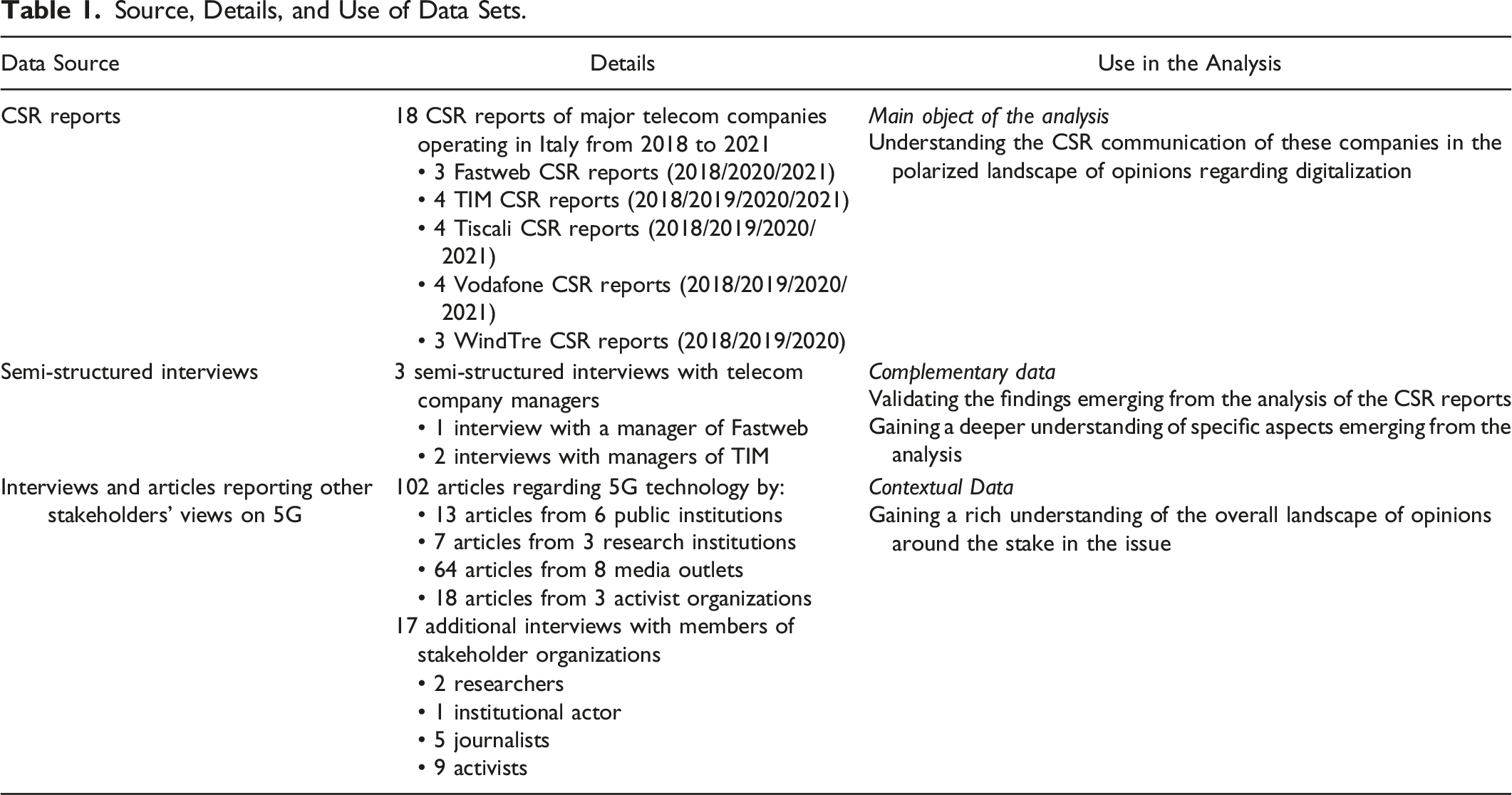
We present the collection of data, followed by their analysis, separately for the sake of clarity. However, the methodological process was highly iterative, such that the collection of data sources and their analysis overlapped throughout.
Indeed, the initial insights regarding the polarized views on 5G and their potential impact on CSR emerged during the semi-structured interviews we conducted with relevant stakeholders of the 5G case between January and February 2022. These initial insights motivated us to conduct an interview with one of the telecom managers specifically to explore corporate views on how the contrasting opinions on 5G could affect their approach to relevant CSR activities. As the interview validated and expanded our initial interpretation, we decided to delve more deeply into the subject with the analysis of companies’ CSR reports, which was carried out from April to October 2022. The two remaining semi-structured interviews with telecom managers were conducted in July and October 2022 to validate emerging findings from the CSR reports throughout the process.
Data Analysis
To analyze the telecom companies’ CSR reports, we established a thematic analysis (Braun & Clarke, 2006). Specifically, we implemented a three-step coding process inspired by Gioia et al. (2013). In the following subsections, we describe the three coding steps in detail.
Step 1: Coding 5G and Digitalization Links to CSR
The semi-structured interviews we conducted with 5G stakeholders revealed a polarized sentiment about 5G in society. Yet, some stakeholders perceived its development to be a responsibility topic. To delve into this insight, we conducted the first interview with a telecom manager and, then, approached the analysis of CSR reports with the objective of identifying any explicit or implicit links between 5G and responsibility. In this process, we observed strong connections between references to 5G, responsibility, and digitalization. 5G was frequently conceptualized as a means to achieve digitalization and, consequently, foster a more sustainable and inclusive future. We were intrigued by companies’ portrayal of these controversial topics as acts of responsibility. Hence, we expanded our coding scope to encompass all references to digitalization as a form of responsibility. Notably, we also included data related to 5G and digitalization that resonated with unsympathetic views, although these were almost missing in the reports.
In this phase, we focused on inductively coding data linking 5G and digitalization to CSR without seeking discursive dynamics or specific thematization. We coded in vivo whenever possible, while paraphrasing for other instances. As a result, we accumulated approximately 500 diverse codes, which broadly linked 5G and digitalization to corporate responsible behaviors. These codes spanned from statements like “we help society contribute to digital revolution” to “pandemic sparked fake news about 5G”.
Step 2: Theory-Free Sensemaking of the Empirical Codes
Data Structure.
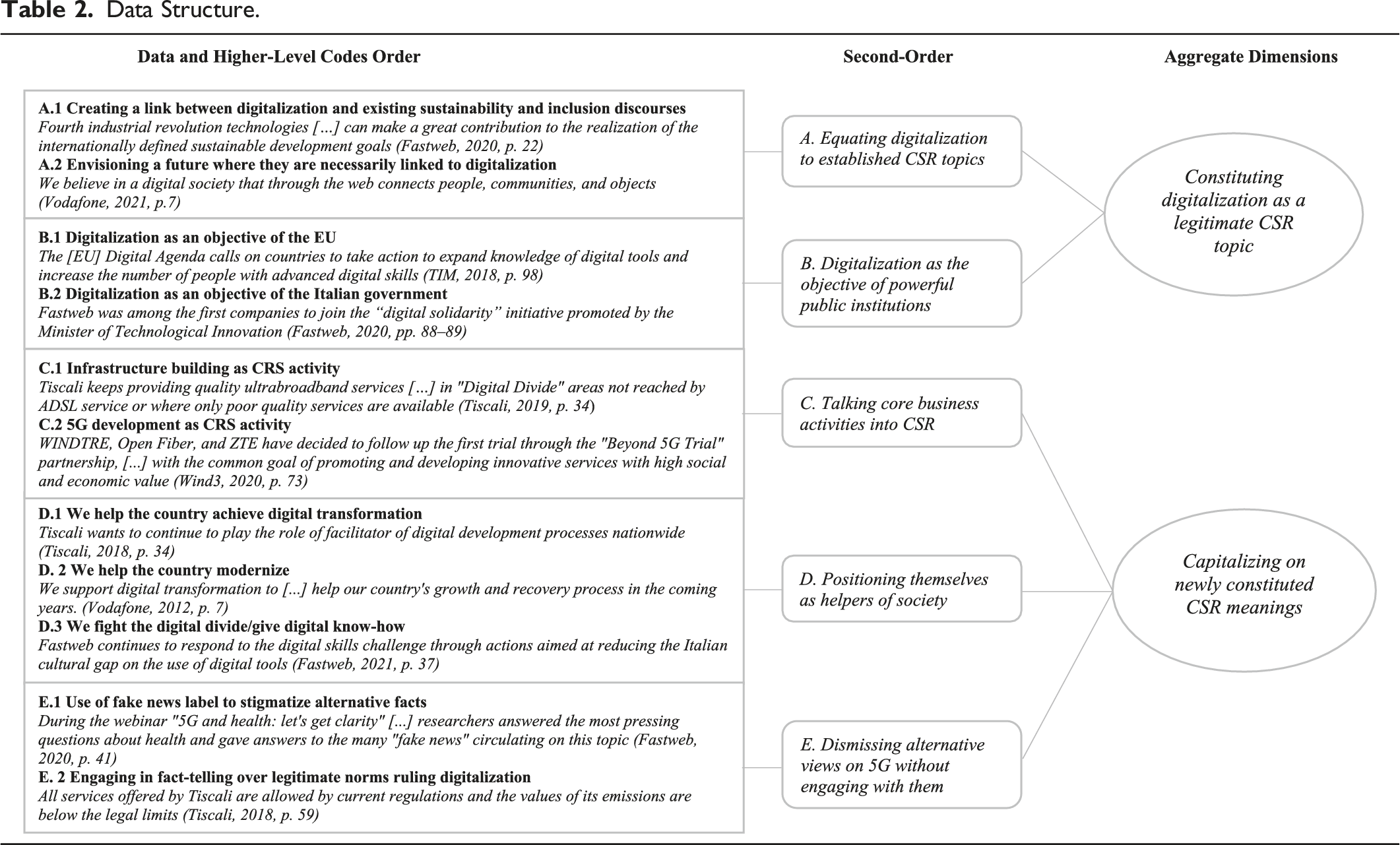
This phase involved a highly recursive process wherein we iteratively grouped, ungrouped, and regrouped the initial codes. For instance, the higher-level code “5G will make the country a better place” is not reported, as we had sorted the codes under this label in different higher-level codes (“5G development as CSR activity” and “we help the country modernize”) by the conclusion of this phase.
Step 3: Progressive Theory-Informed Abstraction of the Emerging Higher-Level Codes
After completing this categorization, we proceeded to interpret the emerging categories at a more abstract level. At this stage, we sought to identify patterns and discursive dynamics among the higher-level codes through an increasingly theory-informed lens. This work, thus, involved considering the empirical higher-level codes from an increasingly abstract perspective and entailed the emergence of second-order themes. For instance, higher-level codes like “infrastructure-building as CSR activity” and “5G development as CSR activities” were subsumed under the second-order code “talking core business into CSR”, a concept which draws from Schoeneborn et al.’s (2020) notion of formative CSR talk.
As we identified the second-order codes, we transitioned “firmly into the theoretical realm” to ascertain how these categories and their further abstraction could address our research question, illustrate the phenomenon under study, and engage with the existing literature (Gioia et al., 2013, p. 20). These efforts prompted an iterative process from theory to data, which ultimately led to the emergence of aggregate dimensions. For instance, the second-order codes “equating digitalization to established CSR topics” and “digitalization as the objective of powerful public institutions” were aggregated under the theoretical reading of “constituting digitalization as a legitimate CSR topic”. This interpretation draws from communicative dynamics rooted in the constitutive view of communication (see Taylor & Van Every, 2000).
Conversely, the analytical process for both the telecom managers’ interviews and the contextual data did not follow a structured three-wave coding approach. They were analyzed thematically, by grouping together the relevant pieces of texts that shared the key theme (e.g., “5G-related fake news” or “importance of 5G for economy”). No theoretical abstraction was applied to these pieces of data. The categorization based on themes served as a valuable supporting tool, facilitating the generation of raw insights and contributing to clarifying and validating the analysis of the reports.
The overall understanding of the 5G debate and stakeholders’ opinions gained through stakeholders’ interviews and articles was useful to spark initial insights and subsequently inform and focus our interpretations of the CSR reports. Meanwhile, the interviews with telecom managers, on the one side, helped us clarify and develop initial insights and provided an overall characterization of the 5G case from the corporate point of view. On the other side, these interviews validated emergent insights gained from analyzing the CSR reports.
Findings
Our analysis focused on how telecom companies approach CSR under circumstances of a polarized landscape of opinions, wherein separate conversations about responsibility take place.
The analysis indicated that the telecom companies under investigation have adopted a similar approach to social responsibility. Overall, these companies approach CSR by referring to one of the polarized conversations and ignoring the other. Specifically, these companies refer only to those who already consider 5G to reflect progress whereas those who consider 5G to be a threat are essentially ignored. All of the analyzed reports claim that stakeholder dialogue is a crucial part of their CSR approach (see Fastweb, 2020), which the interviews also confirmed (telecom manager 1). The CSR reports presented lists of stakeholders with whom the companies established a dialogue, providing various categorizations. However, none of these lists mentioned anti-5G activists (see Tiscali, 2019). As the telecom managers told us, they did not enter into dialogues with those who believe 5G is a threat (interviews, telecom managers 1, 2, and 3). The stakeholders with whom they engage consider 5G to be a key driver of progress and well-being.
Evidence of this one-sided engagement can also be found in the themes identified as important for stakeholders. For example, WindTre (2019, p. 128) listed the theme “5G for the future of cities” as key for stakeholders. In a similar vein, Fastweb (2020, p. 107) mentioned “5G as enabling technology”, and TIM (2019, p. 38) noted “investments in 5G infrastructure development” as important themes for stakeholders. TIM also listed “electromagnetic impact” in 2019 (p. 38) and “communicating electromagnetic impact” in 2020 (p. 39), which may resonate with anti-5G sentiments. However, on the list of 17 topics, the themes ranked second to last in 2019 and last in 2020 by stakeholder relevance, whereas “investments in 5G infrastructure development” and “support the technological development” ranked fourth and first, respectively. Accordingly, TIM did not consider the electromagnetic impact to be a risk (see TIM, 2020, p. 60). Vodafone also listed “electromagnetism”, but did not relate it to 5G.
As we illustrate in the following sections, alternative views of 5G being dangerous for human health were given little or no space at all in the reports. Indeed, the beliefs and opinions of the other side of the polarized conversations did not emerge in the companies’ CSR communicative efforts as they tended to ignore this alternative CSR conversation going on among stakeholders that see 5G as a threat (e.g., anti-5G activists or alternative media outlets online). When these alternative views emerged, they were dismissed as fake news (see Fastweb, 2021). Thus, the reports almost exclusively referred to those already considering 5G as progress and ignored others.
References to specific social actors further reinforce this view. For example, reports referred to the EU and its Digital Agenda (Tiscali, 2019), the Italian government’s strategic plans in which digitalization is key (Vodafone, 2021, p. 8), or the support for local administrations in terms of digitalization (WindTre, 2020, p. 53). Following Kuhn’s (2008) notion of intertextual saturation, mentioning and voicing other social actors in companies’ texts show the influence of these organizations on companies and signal that a dialogue goes on between them. At the same time, the absence of references to institutions and organizations embracing an alternative view of expected telecom companies’ CSR and their ideas signals that they had no visible influence on them and that no constructive dialogue was going on between companies and these entities. Thus, the examined companies engaged in CSR and established a dialogue only with one side of polarized opinions.
In the following sections, we show that, by relying on the dominant discourses and the positions of public institutions, telecom companies promoted a specific CSR framework of meanings. Indeed, by building on the favorable view of 5G, they constituted a new conceptualization of social responsibility that considered digitalization, as a consequence of the introduction of 5G, as a CSR topic. Telecom companies could then capitalize on these shaped CSR meanings by talking core business activities into the CSR realm, positioning themselves as helpers of society, and dismissing alternative views of 5G. We label this approach as “partisan CSR”.
We next elaborate on the partisan approach to CSR by first illustrating how telecom companies constructed digitalization as a legitimate CSR topic and, then, showing how they capitalized on these shaped CSR meanings.
Constituting Digitalization as a Legitimate CSR Topic
By referring to stakeholders who have a favorable view of 5G and new technological advances, telecom companies could constitute digitalization as a CSR topic in their CSR reports. Indeed, they created a strong link between the two concepts, where 5G is the enabler of a digital revolution. In this view, 5G is built as a necessary condition to digitalize society. For example, TIM (2020, p. 82) introduced 5G as “the new telecommunications paradigm that will produce a radical evolution […], to help the digitalization of the country”. In this sense, 5G technologies will help “meet the future demands of the digital society” (TIM, 2021, p. 90). In a similar vein, Fastweb (2018, p. 34) claimed that “5G [is a] technology that promises to digitally revolutionize the way we live, produce and work”. In sum, 5G is a “key asset” for the “digitalization of the country” (Vodafone, 2019, p. 15).
These companies, thus, built on the existing view of 5G to create a connection between its introduction and the digitalization of society. As they created this link, their CSR reports engaged in constituting digitalization as a CSR topic. The telecom companies achieved the constitution of digitalization as a legitimate CSR topic through two intertwined communication acts. First, the companies equated digitalization to established CSR topics such as environmental sustainability and inclusion. Second, they showed how digitalization is an objective of powerful public institutions.
Equating Digitalization to Established CSR Topics
Throughout the CSR reports, the telecom companies equated the notion of digitalization to established CSR topics, such as environmental sustainability and inclusion. They did so by creating a link between digitalization and existing sustainability and inclusion discourses and by envisioning a future where the three are necessarily linked. For example, they usually referred to digitalization as a means to achieve the Sustainable Development Goals (SDGs) set by the UN to “end poverty, protect the planet, and ensure that by 2030 all people enjoy peace and prosperity” 8 . Among these goals, climate action, the elimination of poverty, and gender equality take center stage, and several times in our data we noted how companies regarded digitalization as a means to achieve them. For instance, according to WindTre (2020, p. 97), “ICT solutions can greatly accelerate social, cultural, environmental and economic changes, becoming an extraordinary tool for the transformation envisioned by the SDGs”. Fastweb (2018, p. 25) concluded that “an increase in digitalization, such as more people and connected devices, is linked to a positive increase toward achieving the SDGs”. In addition, when telecom companies did not refer to specific responsibility-related external goals like the SDGs, they connected digitalization to broader CSR principles. For example, TIM (2019, p. 55) promoted “digitalization and dematerialization to achieve energy savings and reduced atmospheric CO2 emissions”.
The telecom companies also equated digitalization to established CSR topics by envisioning a future in which goals such as inclusion and sustainability are necessarily linked to the digitalization of society. For example, Fastweb (2021, p. 13) has: a vision that puts people at the center to support everyone to participate in the future redesigned by the ongoing digital transformation. Ours is a renewed commitment that goes through the development of key infrastructure for the digitalization of the country and the pursuit of the highest standards of social responsibility and environmental sustainability….
Another example came from TIM (2021, p. 62), which claimed that digital solutions “can promote new sustainable ways of working, learning, traveling, and living”. According to WindTre (2019, p. 23), “new digital technologies will help […] establish a sustainable economic development model” in the cities of the future. Vodafone (2019, p. 3) concluded that the “transformation” brought about by 5G technologies will help them expand their “ability to create a more sustainable and inclusive digital society”.
Thus, by creating a link between digitalization and existing responsibility discourses and by envisioning a future where digitalization is a necessary condition for the achievement of inclusivity and sustainability, telecom companies equate digitalization to established CSR topics.
Digitalization as the Objective of Powerful Public Institutions
Telecom companies’ reports also constituted digitalization as a legitimate CSR topic by showing that it is a goal of powerful public institutions. For example, the companies referred to the European Digital Agenda, showing that digitalizing society is an explicit goal of the European Union. For instance, Tiscali claimed that: for years, European and national policymakers have identified strategies aimed at digitalization. The Digital Agenda for Europe, in particular, defines a Europe-wide strategy to overcome digital “barriers” and create opportunities for economic, social and environmental benefits. (2019, p. 46)
Similarly, it was claimed that digitalization is “one of the major goals of [not only] the EU recovery plan” (WindTre, 2020, p. 15), but also the Italian government, as “the development of the country depends to a large extent on access to new technologies” (Tiscali, 2019, p. 46). Indeed, according to WindTre (2020, p. 14), the priority of PNRR, a strategic document defining the Italian government’s recovery agenda, is “precisely digitalization and innovation”. As Vodafone (2021, p. 8) emphasized, the digitalization of society through the introduction of 5G is part of both institutions’ plans: “The nationwide rollout of 5G will enable the country to meet the goals of the European Digital Compasses and will be an important pillar for many of the digitalization initiatives contained in the PNRR”. According to the reports, digitalization was also a goal of local municipalities. As TIM (2019, p. 19) noted, “the promotion of digital transformation initiatives” and “the promotion of digital culture” were “among the key themes under discussion with local institutions”.
In sum, telecom companies communicatively constituted the notion of digitalization as a legitimate CSR topic. They did so by equating digitalization with established CSR topics and conveying that powerful public institutions promote digitalization as their objective as well. In their reports, they shaped CSR meanings by referring to the polarized side of the population that views 5G as progress. Indeed, these reports not only supported and shared these stakeholders’ views, but also built on them to constitute the broader notion of digitalization as a CSR topic.
Capitalizing on Newly Constituted CSR Meanings
In their CSR reports, the telecom companies constituted digitalization as a legitimate CSR activity, relying on existing CSR discourses and favorable views on 5G. In doing so, they were able to capitalize on these shaped CSR meanings by (a) talking core business activities into CSR (i.e., communicating core business activities as CSR activities), (b) positioning themselves as helpers of society, and (c) dismissing alternative views on 5G without engaging with them. In this section, we discuss each of these communicative acts.
Talking Core Business Activities into CSR
The constitution of digitalization as a legitimate CSR topic allowed these companies to talk their core business activities into CSR activities. In other words, the constitution of digitalization as a CSR topic legitimized their description of core business activities, such as the construction of infrastructures for telecommunication and the development of their products (e.g., 5G technologies), as not only business-related activities, but also acts of corporate responsibility.
For instance, in the chapter “Sustainability pillars and key themes”, Fastweb (2018, p. 30), stated regarding the construction of infrastructures for digitalization that one of the “key element[s] of the company’s strategy is the strengthening and development of next-generation infrastructures to facilitate the digitalization of the country”. Vodafone (2019, p. 37) claimed that the “growth of its mobile network infrastructure” results in “actively contribut[ing] to the growth of the social and economic fabric of Italian cities”. Similarly, 5G development also became a CSR activity. Among its “[sustainability] commitments for the future”, Fastweb (2020, p. 28) listed “by 2025, 90% population coverage with 5G mobile services”, as they aimed to “bring the whole country to a new speed, through 5G technology” (p. 2). In its 2019 (p. 17) sustainability report, Vodafone also listed “development and deployment of new mobile 5G connections” as an objective.
As these data show, telecom companies talked their core business activities into the CSR realm, reflecting an understanding that the telecom industry is a CSR-based industry: Telecommunications are a key pillar for economic growth and social development. The digital[ization] represents the new factor of collective progress: digital and mobile technologies are changing the way we live and work and constitute a change not only for the entire economic and productive system, but also for the social system. (Tiscali, 2021, p. 50)
Positioning Themselves as Helpers of Society
The constitution of digitalization as a CSR topic results in telecom companies’ perception of themselves as a CSR-based industry whose core business activities consist of acts of responsibility. As further evidence of this perception, one of the companies under investigation, Fastweb, even “adopted the Benefit Company status”. 9 According to the organization issuing it, this status describes businesses that “integrate into their corporate purpose, in addition to profit goals, the purpose of having a positive impact on society and the biosphere”. 10
Given their CSR-based business status, these companies positioned themselves as helpers of society, assisting the country in achieving digital transformation. For example, Vodafone (2018, p. 9) defined itself as “digital enabler” that: has always had a substantial and concrete influence on the progress of society. [...] This influence [has been] increasing in recent years as the company is establishing itself as an “accelerator” of digital change to create new and better opportunities for inclusion through innovative technologies.
Similarly, in a paragraph entitled “Fastweb for the country”, Fastweb (2020, p. 2) claimed that their “initiatives and […] projects play a key role in accelerating Italy’s digitalization”; they subsequently stated that they want to be “a reference point for accelerating the country’s digitalization” (p. 25).
These companies also helped the country fight the digital divide. In the chapter “Inclusion for all”, Vodafone (2018, p. 15) claimed that they “believe that the opportunities of the digital future should be accessible to everyone”. Therefore, they “work to reduce inequality and facilitate access to digital skills for all generations”. Another piece of evidence was provided by one of TIM’s (2020, p. 3) most important CSR projects, Operation Digital Renaissance. This project stemmed from an articulated desire to “concretely address the issue of the digital skills gap in our society, because we believe that overcoming the cultural digital divide represents” one of the “challenges our country faces in terms of innovation”.
However, these companies also help the country on a broader level. For instance, Fastweb (2018, p. 3) defined itself as “an entity that creates value not only for its shareholders and employees but also for the country as a whole” through its activities, including 5G development and the promotion of digital culture. The industry has also been key during emergencies: The telecommunications industry has assumed a key role in managing the implications of the pandemic in many aspects of the economic and social system, serving as a facilitator and guarantor of business continuity and essential social rights. (WindTre, 2020, p. 12)
Dismissing Alternative Views of 5G Without Engaging with Them
Finally, by establishing digitalization as a CSR topic, the telecom companies could also dismiss alternative views of 5G without engaging with them. As digitalization was framed as an act of responsibility, 5G was almost exclusively referred to as its enabler.
These companies did not argue against the views that describe 5G as a threat to human health or a means of control, which indeed barely emerged in our analysis. In the few paragraphs in the CSR reports on concerns regarding the introduction of 5G, the companies either labeled these concerns as deriving from fake news or engaged in fact-telling by pointing to the strict norms and regulations about electromagnetic emissions. Fastweb (2021, p. 52) dismissed 5G-related concerns by claiming that, “during the global pandemic, fake news about 5G spread around the world, casting doubt and instilling fears about the possible harmful effects of electromagnetic fields emitted”. Meanwhile, TIM (2021, p. 63) claimed that, “although Italian regulations on electromagnetic emissions are among the most restrictive in the world, with limits much lower than the European average […] the electromagnetic emissions generated are within the legal limits”. Similarly, Vodafone (2019, p. 66) allocated two paragraphs to electromagnetism, claiming that they would design and build “all network installations in full compliance with Italian regulations on human exposure to electromagnetic fields, which set limits up to 100 times lower than those defined by ICNIRP […] and applied in the rest of Europe”. WindTre (2019, p. 76) further emphasized that they would respect these strict limitations, elaborating on “the extremely precautionary approach taken by our country for all radio technologies”. As can be seen, the actual 5G-related concerns were neither directly nor extensively addressed.
In sum, we see that telecom companies approached CSR by referring to those with a favorable view of 5G and essentially ignoring those who considered it a threat. By building on shared discourses about CSR and relying on dominant institutions’ positions within the conversation, they have promoted a highly relevant aspect of their core business—digitalization—as a CSR topic. Constituting digitalization as a matter of responsibility has allowed them to capitalize on the new meanings in three different ways. They (a) talk their core business activities into CSR activities, (b) position themselves as helpers of the country, and (c) dismiss alternative views about the 5G without fully engaging with raised concerns.
Thus, our data illustrate a novel approach to CSR common to all the telecom companies under investigation. When confronted with a highly polarized landscape, wherein separate and mutually delegitimizing stakeholders’ conversations about social and ethical expectations towards them exist, companies may engage in what we call “partisan CSR”. This approach to social responsibility is characterized by companies not trying to establish a dialogue with all stakeholders, but engaging with one side of the polarized stakeholders’ expectations while ignoring the other side’s expectations. Within this conversation, companies build on the highly homogeneous meanings to promote certain views aimed at expanding further CSR meanings. They are, thus, able to capitalize on these newly shaped meanings.
Discussion and Conclusion
Our analysis shows that, in circumstances of polarization about corporate responsibility meanings, companies may approach CSR by referring to only one of the polarized conversations. The studied telecom companies did not try to please everyone, but focused their CSR-related efforts on one set of stakeholders, engaging in dialogue only with them. Specifically, they almost exclusively referred to those stakeholders already viewing 5G as progress, whilst ignoring other stakeholders who saw it as a threat. By building on existing views, they can shape CSR-related meanings (i.e., constituting digitalization as a legitimate CSR topic) and capitalize on them by positioning themselves as a CSR-based industry while dismissing alternative views on 5G. We believe that these insights make two contributions to prior literature.
No Longer an All-public Moral Communication: CSR Communication Contributing to Polarization
Our study contributes to the literature on CSR by illustrating how companies may approach CSR in a highly polarized environment. It thus offers an empirical account of the theoretical issues that arise in the literature. In doing so, our study also illustrates the changing reach and scope of CSR communication under polarized circumstances and its ensuing implications for the further polarization of stakeholders’ social and ethical expectations.
Scholars have advocated for dialogue as the ideal approach to address the increasing CSR-related pressure on organizations (Colleoni, 2013; Du & Vieira, 2012). This approach suggests that companies should actively participate in the CSR conversation to understand, co-construct, and ultimately meet the demands of stakeholders (Morsing & Schultz, 2006). However, idealized forms of dialogical approaches are often impractical because the CSR conversation is frequently characterized by conflicting perspectives, preventing the emergence and crystallization of a consistent set of meanings (Castelló et al., 2013; Schultz et al., 2013). Therefore, rather than democratic deliberations, prior literature describes these dialogues as companies’ discursive efforts to actively influence understanding and eventually establish favorable society-wide legitimacy standards through moral reasoning (Dawson & Brunner, 2020; Scherer et al., 2013).
Alternatively, the literature proposes a different approach for companies when the CSR conversation becomes complex and polyvocal, which consists of engaging in strategic silence (Carlos & Lewis, 2018). In such environments, companies may indeed choose not to engage in dialogue with stakeholders to avoid potential confrontations, such as being accused of greenwashing. Therefore, the literature illustrates two dominant approaches to CSR: either entering the conversation to win the discursive struggle and orient understandings, or adopting a silent approach to avoid confrontation.
In polarized circumstances, the existence of multiple and mutually delegitimizing conversations about CSR paves the way for a novel approach that we label “partisan CSR”. This approach involves actively engaging in only one ongoing conversation while dismissing the other, essentially interacting within a specific conversation to endorse and promote certain views while remaining silent in the opposing conversation. Importantly, partisan CSR not only describes a different approach to CSR that companies may pursue, but also reveals a changing reach and scope of CSR communication in a polarized environment, which, notably, may even result in even greater polarization.
First, partisan CSR indicates that CSR communication is no longer an all-public communication in a polarized world, suggesting its potential targeted nature. Instead of aiming to establish a dialogue with all stakeholders as in dialogical approaches (Colleoni, 2013), companies focus on a subset of stakeholders while disregarding others. This understanding extends the work of Morsing et al. (2008), who proposed a two-step process for CSR communication of addressing expert stakeholders who will convey the message to other stakeholders. Our research suggests that CSR communication may prioritize certain stakeholders while ignoring others, emphasizing the targeted nature of CSR communication in polarized environments.
Second, partisan CSR not only adds to the changing reach of CSR communication in a polarized landscape, but also implies a shift in its content. When communicating in a conversation filled with disparate views, companies have to engage in moral reasoning and the legitimation of fundamental beliefs (Dawson & Brunner, 2020; Scherer et al., 2013). In partisan CSR, companies communicate with stakeholders who already share similar views. This allows them to concentrate on further channeling specific stakeholders’ expectations rather than struggling to shape society-wide legitimacy standards, as illustrated by Scherer et al. (2013). Thus, CSR communication in polarized circumstances revolves around reinforcing existing meanings to leverage them rather than engaging in society-wide moral discussions about what constitutes desirable corporate behaviors.
In this sense, partisan CSR is also interesting from a strategic point of view, as it integrates the advantages derived from the two previously discussed CSR approaches. As Figure 1 illustrates, when navigating a complex and polyvocal CSR conversation, companies face the choice of either actively engaging and endeavoring to prevail in discursive struggles or abstaining from participation to minimize confrontation. Through partisan CSR, companies can strategically select conversations in which favorable meanings predominate while avoiding engagement in those dominated by unsympathetic views. This selective approach enables them to nurture conversations in their favor and circumvent confrontations with actors holding contrasting perspectives, thereby combining the benefits of both approaches. Moreover, partisan CSR also demonstrates the importance of dismissing conversations harboring unsympathetic meanings without direct engagement. By avoiding interactions with contrasting views, companies prevent potential backfires (Fackler, 2021) that could reinforce contrasting viewpoints. Therefore, this approach not only safeguards companies against confrontation (Carlos & Lewis, 2018), but also discourages unproductive interactions, effectively inhibiting the reinforcement of opposing perspectives (Fackler, 2021). Changing approach to CSR and CSR communication in polarized environments.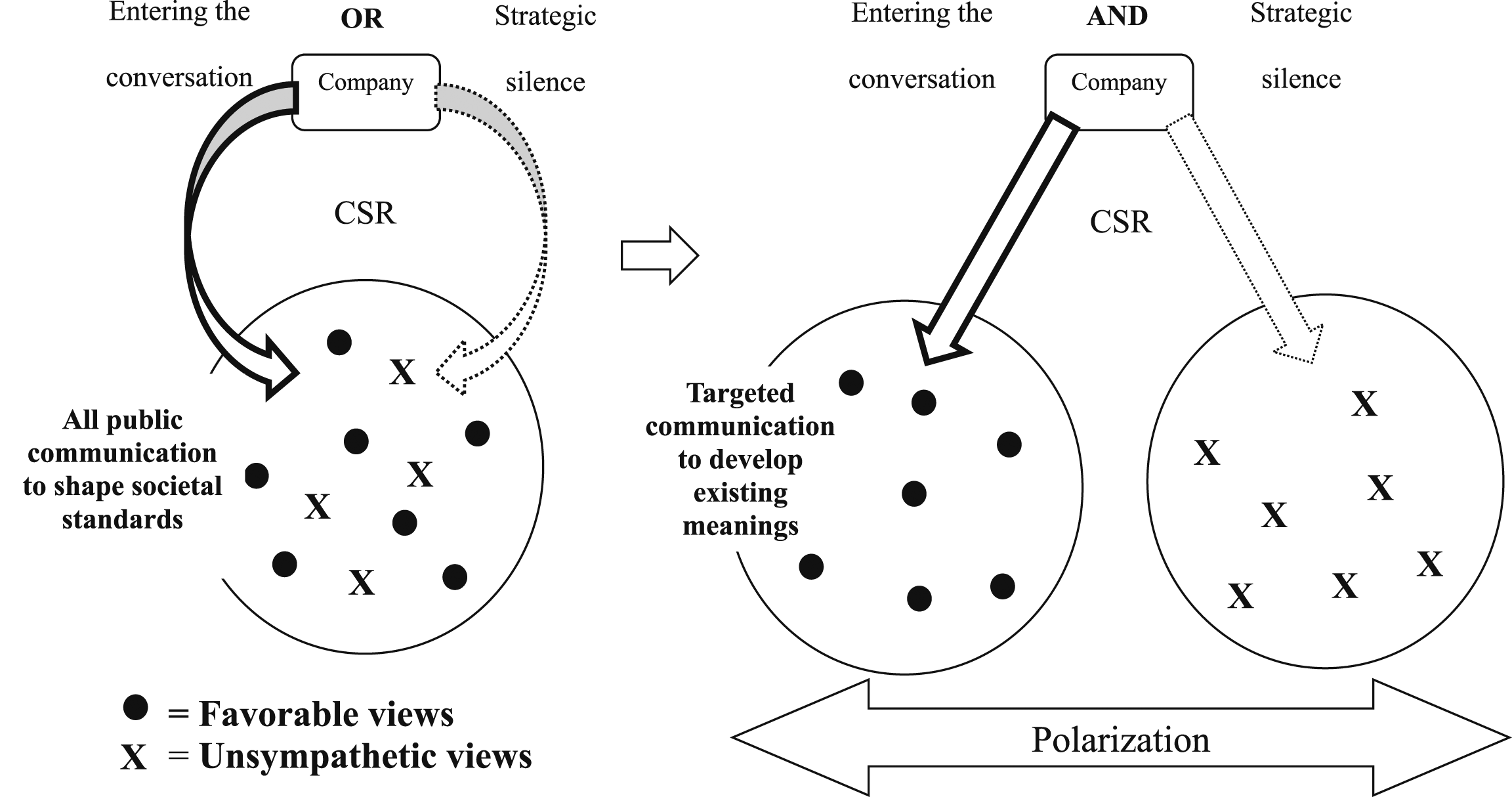
Figure 1 provides a visual account of the partisan approach to CSR. This approach implies a CSR communication that, in polarized times, (a) is no longer an all-public communication aimed at pleasing and/or convincing everyone, but rather a targeted communication that endorses one side while ignoring the other; and (b) is no longer about moral reasoning to legitimize basic assumptions, but rather a communication strategy that reinforces and further develops existing favorable meanings while dismissing unsympathetic ones. Importantly, Figure 1 also illustrates that companies not only operate within a polarized society but also contribute to its polarization when adopting a partisan approach to CSR.
In unitary CSR conversations, even in the messiest and most polyphonic debates addressed with non-idealistic communication practices (see left side of Figure 1), the communicative efforts of companies consist of interacting with different actors to negotiate moral and ethical standards. Such conversations entail the pursuit of common ground across society in an effort to align everyone towards the midpoint of contrasting opinions in order to seek a compromise. Conversely, in a polarized landscape where alternative conversations develop separately (see right side of Figure 1), companies embracing partisan CSR direct their communication efforts towards further developing certain meanings—not towards a midpoint, the metaphorical mean of the contrasting opinion, but towards the other extreme. Indeed, through partisan CSR, companies not even an attempt to interact with those stakeholders having alternative views to alter them; the focus lies solely on the development of favorable meanings, and alternative views are taken into consideration at best to delegitimize them. Partisan CSR, thus, exacerbates the divergence of alternative conversations, thereby intensifying the polarization within an already polarized debate.
From Shaping Business for Responsibility to Shaping Responsibility for Business
We also contribute to the CSR literature by extending the discourse on the traditional financial–social interests’ conflict of CSR. Scholars have stressed the inherently paradoxical nature of CSR, as corporate social activities contrast with the economic interests of corporations (Dawson & Brunner, 2020). Indeed, by engaging in CSR activities, companies may improve their social performance as they pursue social interests, but this may decrease their financial performance as they come with a financial cost (Haffar & Searcy, 2017).
This financial–social conflict for organizations engaging in CSR has been solved by acknowledging that CSR activities, although costly, are financially beneficial in the long term, providing legitimacy and reputation-related returns (Barnett, 2019; for contrasting views, see Haffar & Searcy, 2017). Indeed, the “business case for CSR” implies that companies add CSR activities pursuing societal interests to their business models to gain favorable goodwill and, thus, financial return in the long run. This understanding corresponds to what Cornelissen (2020) defined as promotional and strategic CSR. However, the idea of doing well by doing good (Drucker, 1984) has gone even further. Some more advanced approaches to CSR have resulted in companies embedding responsibility issues at the core of their business models (Van Marrewijk & Werre, 2003). Concepts like created shared value (CSV; Porter & Kramer, 2011) and the transformational approach to CSR (Cornelissen, 2020) refer to business models designed to generate revenues from ethically and socially driven economic activities that, consequently, advocate for societal interests.
In sum, companies try to gain both financial and social returns by shaping their core business according to the framework of meanings constituting CSR expectations, whether they add CSR-related activities to their business model or embed CSR meanings in the core of their business model. Our analysis shows that companies may try to gain both financial and social returns differently. Indeed, they may not add or modify the core business model according to CSR-related meanings, but rather engage in shaping the CSR meanings according to their business model. By embracing polarization, companies may try to manipulate what corporate responsibilities are to match their business model. By constituting digitalization as a CSR topic, telecom companies are able to make responsibility fit with their core business activities. Thus, they solve the social–financial conflict not by shaping the business according to CSR meanings, but rather by shaping CSR meanings according to their business.
This alternative approach to resolving the social–financial interest conflict of CSR carries significant implications for understanding the drivers that shape CSR expectations. The conventional approach to tackling this conflict, the “business case”, relies primarily on societal interests as the foundation for defining responsibility expectations. Indeed, during CSR debates, social actors contribute to the construction of CSR-related meanings by deliberating over which behaviors companies ought to adopt to serve societal interests. These constructed CSR expectations subsequently shape business practices, either as supplementary components or as integral parts of business models. In this vein, companies align their operations with CSR meanings influenced by societal interests. Through partisan CSR, companies instead mold CSR meanings in accordance with their business objectives. As a result, the financial interests that underpin businesses indirectly affect the constitution of the CSR framework. Therefore, although societal interests still play a significant role in shaping CSR expectations and the corresponding framework of meanings, it is worth acknowledging that financial interests can also exert an influence on this process in a polarized world.
Limitations and Concluding remarks
This paper is based on a single study with specific characteristics. Partisan CSR has emerged in a situation of polarized opinions sparked by the introduction of a technology that is core to the business activities of the industry under investigation. In this sense, the telecom industry has distinctive characteristics that position it at the forefront of polarizing circumstances. Nevertheless, this phenomenon is not exclusive to the telecom sector. Industries dealing with technological and scientific innovations, such as the pharmaceutical industry, are also significantly affected by polarization in relation to their core business activities. Thus, although the current impact of polarization on telecom companies may appear more pronounced than in other sectors, similar situations exist across multiple industries, supporting the analytical generalizability of the conclusions drawn from our research. Furthermore, it is worth noting that other industries may experience polarization indirectly. For instance, businesses involved in the production chain of technology/science-based companies might also be affected by the polarizing dynamics. Future research could investigate how companies approach CSR under circumstances of polarization when the object polarizing the opinions is only tangentially associated with their business operations, if at all.
Moreover, the scope of our research focuses on how telecom companies approach CSR, but does not allow us to elaborate on the reception of corporate voices by other social actors. Therefore, we do not know how companies’ voices influence the overall meaning construction. Longitudinal studies may shed light on that while also generating insights into how the communicative constitution of an institution like CSR (Schultz & Wehmeier, 2010) influences the communicative constitution of organizations, thereby linking a CCO-based understanding of CSR (Schoeneborn & Trittin, 2013) with the literature on communicative institutionalism (Cornelissen et al., 2015).
Despite these limitations and ways to address them, we believe the importance of our paper lies in acknowledging that CSR expectations are constituted into fragmented, separate conversations in polarized debates, and that companies embracing this polarization further shape corporate responsibility expectations. By approaching CSR through the identified partisan approach, CSR communication becomes targeted, shifts content-wise, and contributes to the further polarization of CSR conversations. Moreover, this approach may lead companies to shape CSR meanings according to their business objectives, rather than accommodating their business to this framework of meanings.
The partisan CSR approach, we believe, highlights an important overarching dynamic that affects CSR and, broadly speaking, business–society relationships. Specifically, we argue that further polarization of CSR conversations that companies’ behaviors (also) produce in pursuing CSR and the act of shaping CSR meanings according to companies’ business (instead of doing the contrary) might jeopardize the very essence of CSR, meant to contribute to societal well-being, by turning it into a purely strategic corporate communication activity. On the one hand, with increasing polarization, corporations will only favor certain stakeholders and not society as a whole. As companies establish a dialogue not with all social actors populating the environment but only with certain stakeholders, they may label activities as “CSR” when they actually embody only the expectations of some strategically relevant stakeholders and, thus, only meet their expectations rather than societal expectations. In keeping with Barnett’s (2019, p. 170) ideas, this would turn CSR from corporate social responsibility into “critical stakeholder responsiveness”, thereby failing to address societal interests and serving only key stakeholders’ interests. On the other hand, this continuous stretching of responsibility meanings may blur the notion of CSR into countless applications that may increasingly serve business objectives rather than societal interests. As shown, in polarizing circumstances, companies can more easily mold CSR expectations and, therefore, may be increasingly tempted to approach CSR from a utilitarian point of view, labeling any corporate activity as a responsible act. Consequently, the focus shifts further away from benefiting society towards serving business interests. In essence, companies embracing polarization in their pursuit of addressing CSR expectations can deplete the significance of CSR, making it a purely strategic tool.
Considering these implications, there is an urgent need to investigate how the interests of society as a whole factor into the formation of CSR meanings and subsequent expectations. Given the ethical and social nature of CSR, the prevailing assumption in the literature is that the framework of CSR meanings is constituted by societal interests. However, our study suggests that this assumption may not necessarily hold in an increasingly polarized world in which key stakeholders and corporate interests prevail. Therefore, we encourage future research to elucidate how the interests of any part of the population, transcending groups’ interests and organizations’ goals, are incorporated into the CSR conversation(s), how they affect the formation of meanings, and which actors are instrumental in elevating these interests to the forefront.
Footnotes
Acknowledgments
We wish to express our gratitude to our Editor, Professor Matthew Koschmann, our Guest Associate Editor, Professor Matthias Wenzel, as well as the three anonymous reviewers for their supportive and constructive feedback. We also thank Professor Jeanne Mengis for her valuable input on the first draft of the present study.
Declaration of Conflicting Interests
The author(s) declared no potential conflicts of interest with respect to the research, authorship, and/or publication of this article.
Funding
The author(s) received no financial support for the research, authorship, and/or publication of this article.
