




Abstract
This study advances organizational communication scholarship by introducing the notion of an occupational identity gap as a misalignment among the personal, relational, communal, and enacted frames of identity. Despite knowledge that occupational identity gaps exist, scholars know little about how people manage them. Interviews with 31 graphic designers explain how occupational identity gaps were forged by personal frames (e.g., “I am a creative person”) that contradicted enacted (e.g., “I do boring template work”) and relational frames (e.g., “It’s the client’s decision which [design] he or she will like”). Workers managed this misalignment by employing two novel strategies—reappraising and repositioning—that bridged personal-enacted and personal-relational occupational identity gaps. Our analysis contributes to scholarship by a) theorizing these two occupational identity gap bridging strategies, (b) extending CTI research, and (c) offering a novel conceptualization of occupational identity.
People often think they know in advance what being a member of certain occupations will be like. Before entering an occupation, outsiders develop a sense of what membership entails. Research has shown, for example, how television shows (Hoffner et al., 2008), online searches (Buzzanell et al., 2012), and work-related information on social media (Kou & Gray, 2018) offer a peek behind occupational curtains. Occupational communities today are seemingly open systems, markedly more visible from how occupational communities were theorized before the proliferation of the Internet (see, for example, Van Maanen & Barley, 1982). Moreover, research has demonstrated that people aspire to occupations based on identity preconceptions (Aley & Levine, 2022). Therefore, employees enter organizations with a strong set of beliefs about their occupation, and they expect their work to match the occupational identity they have read about or seen.
Yet people often find themselves doing organizational work that lies at odds with the occupational identity forged by their occupational ideals, preconceptions, or long-held beliefs of what their work should look like and be. New organizational entrants to an occupation are particularly prone to this phenomenon. For example, teachers may have to deal with students’ food insecurity (of which they were only marginally schooled) because they teach in a low-income neighborhood, highlighting a gap between their identity as a motivated educator, guiding student learning, and the daily reality of addressing basic needs. Or, consider a hair stylist, whose sense of self is tied to artistry and high-end fashion, but finds himself working in a children’s salon, giving buzzcuts and doling out lollipops. In each of these cases, a component of the employees’ existing occupational identity conflicts with one or more realities they must enact in the unique context of their organization.
We call this misalignment an occupational identity gap, which draws on language from the communication theory of identity (Hecht, 1993). In this study, we investigate how workers manage occupational identity gaps through a study of corporate graphic designers. By focusing on designers who work for a specific organization, rather than ones who run their own consultancy or work in a design agency, we were able to explore identity gaps exactly because the organizational culture and their organizational membership cast in doubt their occupational identity. Through interviews with graphic designers, we demonstrate how workers bridge the gap that arises when parts of their occupational identity are misaligned with work practices that they encounter and in which—due to expectations of clients, colleagues, and supervisors—they must participate. We ground our study in the literature on occupational identity, which currently conceptualizes the multiple components of occupational identity as being in sync.
Occupational Identity
Meisenbach (2008) defines occupational identity “as the shifting, material, and discursive framing of image and practices associated with a particular type of work” (p. 263). By this prevailing definition, occupational image and occupational practice together constitute an occupational identity. The first component of occupational identity, occupational image, includes a person’s perceptions about an occupation. 1 Ashcraft (2007, p. 13) defined an occupational image as the “public discourses of occupational identity, manifest in popular, trade, and even mundane conversational representations of the essence of a job and those who perform it.”
Occupational practice, the second component of occupational identity, entails the day-to-day enactment of work or “micro-practices” in an occupation (Ashcraft, 2007, p. 12). Occupational practice involves role performances and duties, as well as how people make sense of the work they do (Ashcraft, 2007). Organizational practice does not consist of objective activities that employees undertake; rather, occupational practice or “what we do” at work is socially constructed (Ashcraft, 2013, p. 10). For example, most organizational routines do not simply involve carrying out a set of prescribed activities but instead involve gaining and applying tacit knowledge and creating and following norms that are continually reconstituted through social interactions.
Although occupational practices ideally correspond with occupational images, the socially constructed nature of practice often renders it amorphous and uniquely situated in context, which means that practices can differ by organizations and work groups. To explain this rift, we propose that scholars interested in occupational identities consider a new way of thinking about occupational identity—one that more fully describes the complexity and misalignment that occurs when occupational image does not match occupational practices. We employ the phrase identity gaps from the communication theory of identity (CTI) to build the foundation for this new way of thinking about occupational identity.
Occupational Identity Gaps
CTI suggests that identity is an inherently communicative practice. Rather than viewing identity as a product of communication, CTI conceptualizes identity as communication by suggesting that identity is constituted through social interactions and symbolic messages (Hecht, 1993; Hecht et al., 2003). Like most theories of social identity, CTI recognizes that individuals do not have just one identity. People have multiple identities, and CTI sees identity as built upon the confluence of them. Specifically, CTI delineates four “frames” as being constituent of identity: 1) the personal frame (a person’s self-image), 2) the relational frame (including a person’s role in relation to other people and a person’s internalization of how others view them), 3) the communal frame (how one’s collective views itself), and 4) the enacted frame (a person’s performed identity). Because two or more of these four frames might at times be in conflict, Jung and Hecht (2004, p. 268) conceptualized “identity gaps” to describe “discrepancies between or among the four frames of identity.”
Building on this insight that the constituent components of one’s identity may be in conflict, we conceive that in the context of occupational identity, the four frames of one’s occupational identity might not always sync. Specifically, there may be incongruence between the personal frame (i.e., a person’s self-image in relation to the occupation), the relational frame (i.e., communication with others about the occupation), the communal frame (i.e., a shared identity among workers in the occupation), and the enacted frame (i.e., how the occupation is performed in the organization). We conceptualize an “occupational identity gap” as the misalignment among the personal, relational, communal, or enacted identity frames people hold in the context of their occupation. In this study, we seek to understand differences specifically in how people’s personal, relational, or communal occupational identities might deviate from their enacted occupational identity. What do employees do when an organization requires them to perform their occupation (enacted frame) in a way that departs from how they or others view themselves in that occupation (personal, relational, and communal frames)?
Although prior occupational identity research has not explored specific gaps between identity frames, examples of identity misalignment, more broadly, exist in communication and management literatures (e.g., Kuhn & Nelson, 2002; Meisenbach, 2008; Nelson & Irwin, 2014; Pratt et al., 2006). For example, in Leonardi and colleagues’ (2009) study, students conceived of software engineering as a solo endeavor, which proved counterproductive to the occupational reality of coding in teams that students faced upon organizational entry. Likewise, commercial airline pilots simultaneously maintain and resist historically-situated occupational identities from the early 20th century—which portray the occupation as masculine and glamorized, like in the film Catch Me If You Can—with contemporary practice, such as the evolution towards egalitarian work crews that dismantle some of pilots’ status and the rise of cockpit automation that usurps some pilot tasks (Ashcraft, 2007).
Conceptually, occupational identity gaps are unique from related research on role dialectics, role conflicts, or identity tensions. Much of the work on tensions centers on contradictions within a particular role (e.g., Apker et al., 2005) or within an occupation (e.g., Norander et al., 2011), focusing on different elements of identity that seem to conflict and need reconciliation within that role or occupation. By studying occupational identity gaps, we are not focusing on the content of the role or occupation alone, but discrepancies between the four CTI frames (personal, relational, communal, and enacted). For example, there might be variance between what a person conceives of an occupation (personal frame) and the identity that the organization allows the worker to perform (enacted frame). In conceptualizing occupational identity through CTI’s identity frames, rather than as the combination of occupational image and occupational practice, we are able to explore more nuanced ways in which identity gaps occur and the effects of occupational identity frame misalignment.
Only a handful of researchers have employed CTI to study identity gaps in the context of organizations. Most recently, Stewart (2022) used CTI to understand students’ STEM identities. His interviews with students demonstrate the personal (e.g., being intelligent), relational (e.g., perceptions of STEM students being able to fix things), communal (e.g., being “STEM people” collectively), and enacted (e.g., doing school projects) layers involved in constructing STEM identities. Stewart’s (2022) analysis also identified identity gaps present within STEM identities, such as the personal-enacted gap, which often existed between a student’s competence and their performance in STEM courses. In addition, Compton (2016) coded interviews with gay and lesbian employees to show how workers managed their sexual identities through coworker communication (relational frame) and organizational policies (communal frame), which resulted in mixed messages (relational-communal gaps).
More broadly, CTI research has found that identity gaps are negatively correlated with feeling understood, communication satisfaction, appropriateness, and effectiveness (Jung & Hecht, 2004; Jung, 2011). Although identity gaps have yet to be understood in the context of occupational identities, we suspect that parallel organizational behaviors would follow, such as decreases in job satisfaction, role clarity, and work engagement. Thus, how (and to what extent) workers minimize or bridge occupational identity gaps should be of interest to scholars and practitioners.
Unfortunately, researchers understand little about how people manage occupational identity gaps. To our knowledge, no research has sought to understand how workers manage such gaps to (re)gain comfort with their identities at work and avoid or relieve negative psychosocial outcomes. Filling this research lacuna is crucial, because occupational identity gaps pose huge threats to retention for employers and soul-crushing potentialities for workers. To understand how employees face this challenge, we pose the following research question: How do workers bridge or resolve occupational identity gaps?
Method
Research Sites and Samples
Prior research has suggested corporate design work as a setting in which workers contend with identity demands as conflicts arise between workers’ creative desires and firms’ profit needs (Gotsi et al., 2010). Thus, occupational identity seemed a fruitful concept to explore in this field. Graphic designers can choose from three types of work: in-house, agency, and freelance. In-house graphic designers are employed in an established organization and produce content for the company’s brand and internal projects. Although in-house design offers the most stable work environment, workers must follow strict brand guidelines to produce and maintain a consistent work product. Agency and freelance designers, on the other hand, produce content for outside clients, free from guidelines because they are designing across multiple organizations and brands.
We studied in-house graphic designers in a multinational firm called GlobalConsult (a pseudonym), where we soon learned that the corporate setting and culture of the firm were at odds with several aspects of graphic designers’ occupational identity frames. By exploring in-house designers, rather than ones who freelance or work in an agency, we were able to capture strategies used to bridge identity gaps created by the mismatch between occupational identity frames and corporate organizational practices. At the large consulting firm, consultants worked across several areas of expertise (e.g., supply chain, technology implementation, and accounting) and required a variety of printed and digital marketing materials to communicate information and promote their services to clients. To help consultants produce such materials, GlobalConsult dedicated an entire marketing services division to graphic design. Some designers provided collateral for consultants to secure new business, including brochures, industry reports, and interactive PowerPoint decks, whereas other designers were dedicated to internal marketing efforts, such as creating company newsletters, videos featuring executive management, or designs for the GlobalConsult training website. GlobalConsult stationed the bulk of the marketing services division in India with approximately 40 full-time employees and maintained a smaller office in Poland with 12 full-time employees.
Data Collection
The authors conducted 31 interviews with graphic designers at GlobalConsult’s marketing service divisions located in India (n = 23) and Poland (n = 8) before the COVID-19 pandemic. At both sites, participants joined us in conference rooms, located at a bit of a distance (well out of earshot or line of sight) from the designers' work area. Most interviews were conducted in this face-to-face manner, apart from three interviews by phone with graphic designers from the India office who worked from home. We interviewed 23 men and 8 women. This sample appears to be reflective of the gender breakdown of graphic designers in India and Poland, which, unlike the US, is skewed male from our observations. Although we cannot speculate on the effect of gender, there is no theoretical reason to think that one gender might be more likely to experience identity gaps than another, and none of our participants related their gender to their occupational identity. Pseudonyms were chosen that matched in spirit their actual names except if doing so would reveal them (e.g., male names replaced with male names, but an Italian name not replaced with an Italian one if it would reveal the informant).
We followed a semi-structured protocol (Kvale, 1996) to ask questions about what motivated GlobalConsult workers to pursue their occupations, how they learned to become designers, how they defined graphic design as an occupation, and their everyday work tasks. For example, we inquired, “In your own words what is a ‘designer?’ What do you do here? What made you want to become a graphic designer? How did you learn how to be a designer?” Employees were also asked to provide demographic information in the interviews, which lasted approximately 45 minutes to 1 hour. Interviews were conducted in English, audio-recorded, and transcribed verbatim. We spoke with as many designers in the India and Poland offices as possible and felt confident that we reached data saturation after 31 interviews.
Data Analysis
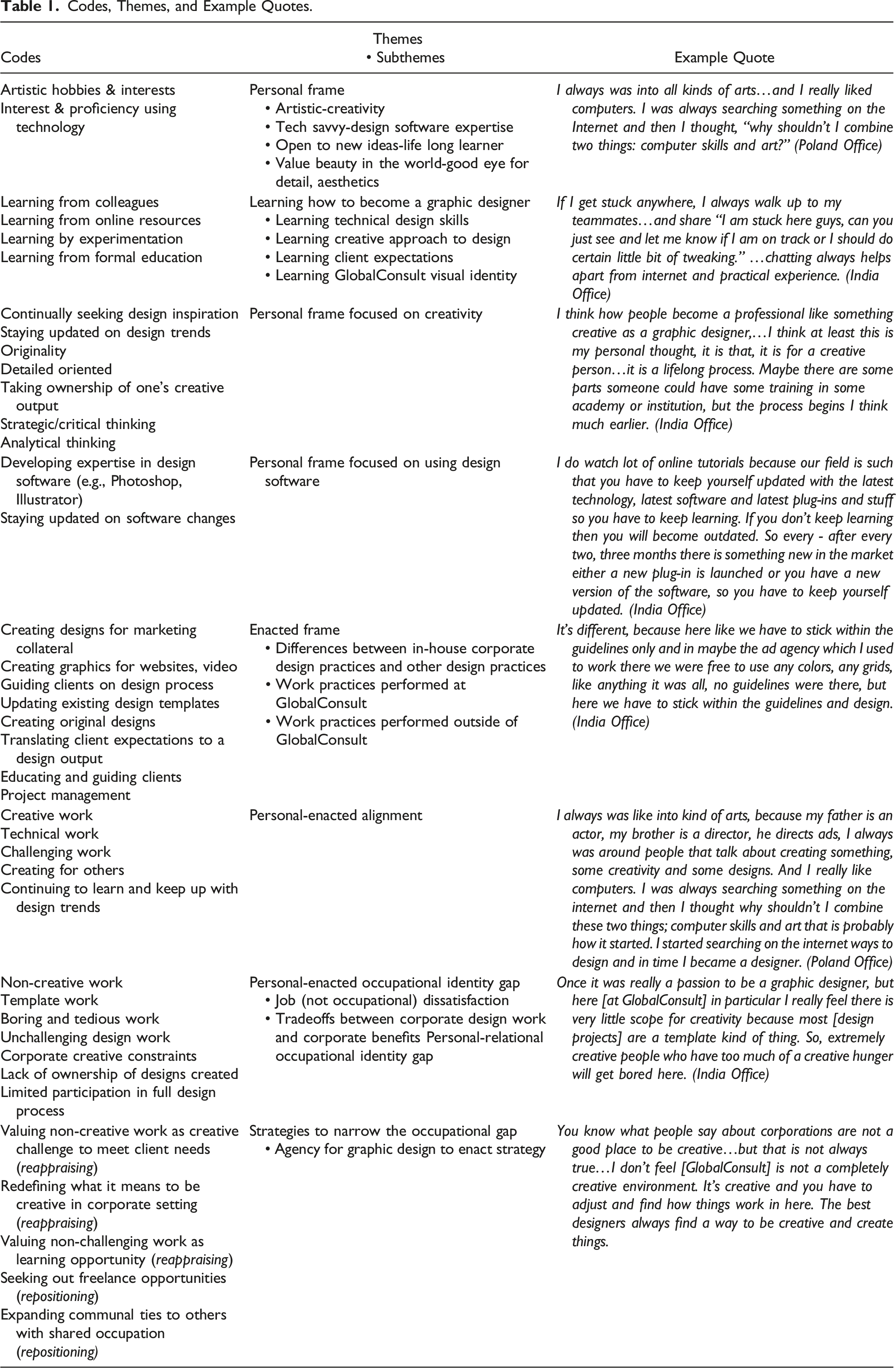
Interviews were part of a larger project focused on occupational identity, and while conducting interviews, we engaged in peer-debriefing, discussing emerging findings amongst ourselves as we ate lunch and dinner together. Although we went into this project interested in socialization and identity, we noticed early in our interviews that participants had experienced a mismatch between various identity frames within their occupation. Thus, we began analyzing the data with this identity-gap lens, using a grounded-theory inspired approach (Glaser & Strauss, 1967). To begin, we engaged in open line-by-line coding (Strauss & Corbin, 1998) related to our research question examining the incongruence between graphic designers’ personal, relational, and communal identity frames and their everyday experience of work (i.e., the enacted frame). Because all graphic designers interviewed had worked at other organizations, we also paid attention to any differences between their experiences prior to and during their employment at GlobalConsult. Despite data being collected from different countries, codes did not emerge related to any cultural differences—likely because we were looking at whether designers saw an occupational identity gap, not whether we as researchers noticed identity gaps.
Codes, Themes, and Example Quotes.
Findings
We present the findings in four sections. The first section describes the graphic designers’ personal frame that largely constructed their occupational identity. The second and third sections detail how they experienced two different occupational identity gaps at GlobalConsult. The fourth section describes two bridging strategies graphic designers used to reconcile occupational identity gaps.
Personal Frame Centered on Creativity and Technical Skills
In our findings, graphic designers discussed personal creativity as a core part of their occupational identity. Their personal identity as being an inherently creative person was influenced by their artistic hobbies and cultural activities, which started at an early age and continued into adulthood. Designers shared similar histories that described “an inclination towards drawing on everything since my childhood” (Arjun, India office) or growing up in an artistic household where they were surrounded by “people that talk about creating something, something creative” (Filip, Poland office). Additionally, participants’ creative identities were defined not only by their lifelong passions for artistic endeavors, but by their tech savvy and innovative approaches to solving problems by “improvising on the spot” or exploring new ideas by “experiment[ing] with different things” (Divya, India office).
The deep connection to creativity in their personal identities was also reflected in how participants viewed their work. For instance, Aleksander, a graphic designer in the Poland office, described his occupation as “a search for beauty in this world, and making this world more attractive, more beautiful, more organized, more useful, more pretty [sic].” Graphic designers’ personal identities that were tightly coupled with their artistic capabilities were also reflected in their occupational identities as being creative people. Raj, a graphic designer in the India office, emphasized how he defined the occupation exclusively for creative individuals and that “[creativity] is quite an inner thing.” He continues to explain how this creativity needs to be developed prior to becoming a graphic designer as it is a “lifelong process,” underscoring the importance of creativity in his occupational identity. While graphic designers recognized that their occupation as being creatives meant that they needed to create aesthetically appealing visuals, they also recognized the importance to communicate their designs in an organized and useful way to their audiences. Hence, the graphic design occupation was not just for satisfying their own artistic pursuits, but also being able to relate their creative work to a purpose beyond themselves.
In addition to sharing their creativity with others, being adept at using specific advanced design software, such as Photoshop and Illustrator, were also important to graphic designers’ occupational identity. Ramit (India office) explained: “I do watch a lot of online tutorials because our field is such that you have to keep yourself updated with the latest technology, latest software and latest plug-ins and stuff so you have to keep learning.” Furthermore, Ramit shared how continuing to develop strong technical skills was important to graphic designers’ occupational identity because graphic design “is a different kind of creative profession” that is not limited to “training in some academy or institution.” As such, graphic designers in in our interviews did not define their occupational identity by studying a specific major or completing a particular training program, but rather the aptitude and desire to continually learn new design technologies and techniques.
In sum, the quotes summarized above describe how participants’ occupational identities were built upon the personal frame of their innate creativity and technical skills. The following section suggests how the realities (i.e., the enacted frame) of being of corporate graphic designer were at odds with the personal frame. This in turn presented two occupational identity gaps: a personal-enacted occupational identity gap and a personal-relational occupational identity gap.
Personal-Enacted Occupational Identity Gap
The first occupational identity gap involved a discrepancy between participants’ personal frame (i.e., their self-image in relation to the occupation) and enacted frame (i.e., how the occupation is performed in the organization). Graphic designers at both the India and Poland offices noted specific work tasks that contradicted their personal frame. Many of the work tasks undertaken by graphic designers restricted their creative options, involved simplistic template work, and entailed tasks that did not engage designers in the full creative process.
Specifically, designers cited the restrictive corporate design guidelines as the main culprit for limiting creativity in their work. These guidelines—which specified fonts, colors, sizing, photographs, and other design elements, as well as how to use the corporate tagline and logo—were developed by the firm’s central global marketing group to maintain a uniform corporate identity and establish GlobalConsult’s aesthetic. Graphic designers were expected to ensure that their work adhered to the design guidelines and to stay updated when headquarters revised the guidelines. Designers referred to the guidelines as the “GlobalConsult way.”
Although design guidelines are commonplace in design work, graphic designers in our study indicated that their previous work experiences at smaller design agencies offered more “authority or some freedom on thinking fairly creatively” (Priya, India office) compared to GlobalConsult because “there [weren’t] any rules apart from basic guidelines” (Sneha, India office) in their prior firms. Because many graphic designers, especially in the India office, had experienced working under more flexible design guidelines, many struggled in transitioning to the GlobalConsult way because it conflicted with their previously enacted frame. As Shreya (India office) reflected on her early experiences at GlobalConsult: [The] hardest part of my job is … when I [was learning the GlobalConsult] guidelines, I was feeling like I didn’t know anything because with only two, three shapes and a few color palettes what should I create? … That was like a very big challenge at that time.
The graphic designers understood that the purpose of the guidelines was to create a uniform “visual identity” for the company, but they believed the guidelines limited their creative autonomy that underscored their personal frame, a loss they incurred for the sake of appealing to a corporate audience.
In addition to adhering to restrictive corporate design guidelines, graphic designers also explained how particular projects, such as simplistic template work requests were also misaligned with their personal frame. Graphic designers preferred working on unique, new projects—such as creating infographics or animations—to challenge and showcase their creativity. However, few designers were able to work on these more advanced projects and much of the design work that graphic designers prepared for their clients was template based, which involved updating text or images in a pre-designed document. This template work was described as “boring work” that required doing “the same things, same old stuff” (Advik, India office).
This sentiment was especially common among those designers who, as designated document specialists, were tasked with generating layout guides in Word documents or PowerPoint slide decks for consultants to reuse. Because document specialists utilized only basic (not advanced) design software and had limited latitude to modify the artifacts that they created, they believed their creative and technical skills were not fully leveraged; consequently, they felt that their creative zeal waned. As Raj (India office) described the lack of creative work: Once it was really a passion to be a graphic designer, but here [at GlobalConsult] in particular I really feel there is very little scope for creativity because most [design projects] are a template kind of thing. So, extremely creative people who have too much of a creative hunger will get bored here.
Raj and other graphic designers working on similar template projects commented that such tedious, routine work did not fulfill their “creative hunger.” Although they were tasked to work on template projects, they still regarded themselves as “extremely creative people.” As such, template work requests were plentiful, yet they were misaligned with graphic designers’ personal frames.
Personal-Relational Occupational Identity Gap
The second occupational identity gap involved a discrepancy between participants’ personal frame (i.e., their self-image in relation to the occupation) and relational frame (i.e., communication with others about the occupation).
Graphic designers took full creative responsibility for their design outcomes, but their work ultimately rested on their clients’ taste and feedback, which determined their occupational worth. To this point, Nira (India office) pointed out: Design liking/disliking depends [on the client]. What I think is an absolute Oscar-winning thing, somebody else may think is absolute trash. So ultimately, it’s the client’s decision which [design] he or she will like.
Nira added that clients should not micromanage the design process to the extent that graphic designers “don’t have to think and just do what [the client] is saying” because the designers will “lose interest in the work.” This example and others suggested that even though GlobalConsult owned the designs and set the design guidelines, graphic designers still claimed creative intellectual ownership of their work. Thus, as Deiani (India office) pointed out, graphic designers should take pride in their work, even if their client may not like the first iterations of their designs.
Designers in the Poland office thought they worked on “higher end” projects (e.g., copywriting, motion design) as compared to their peers in the India office, but they nonetheless shared similar sentiments concerning the lack of control of the creative process in the GlobalConsult corporate environment. Aleksander, a designer in the Poland office, explained how the creative process at GlobalConsult compared to his previous experiences working in smaller design agencies: In a [design] agency you feel like you are part of the bigger picture, and you are involved from the beginning to end. Where here in GlobalConsult, that is not how it works… While in an agency you meet the client, sometimes you talk with the client, you get the bigger picture, generally. There are more creative sessions in an agency. People are sharing ideas all the time and there are far more meetings and talks about how to build a tool for the client, how to build the website; should it look like that or maybe should it look in a completely different way, people share ideas. While here [at GlobalConsult], that is not the creative process.
As Aleksander summarized, being a graphic designer in a corporate work setting like GlobalConsult meant relinquishing some of their creative personal frame. Because the corporate structure limited their client interactions compared to working at a design agency, graphic designers did not always get to engage in the full creative process with their clients. This created a personal-relational occupational identity gap. As such, graphic designers felt that projects were handed to them without being granted full creative control over the project. These examples suggest that Global Consult’s designers valued the creative process in the personal frame but were limited in how they could participate in it in the relational frame of their occupational identity. The process of idea sharing, for example, was innate to the creative process but graphic designers commented how their interactions with their clients were focused on fulfilling deadline-driven project requests rather than freely exploring new creative ideas.
Graphic designers’ involvement in the creative process was further limited in that they were unable to see the final implementation of their work. While they understood that GlobalConsult owned the rights to their designs, they still valued, as creative people, seeing the ultimate product of their work. However, few graphic designers saw the final artifacts that were developed from their designs. Our informants mentioned that they rarely saw the final version of the marketing collaterals that they created, especially for the designs that would be printed as a physical deliverable because the India office did not have a printer that could print according to their clients’ color and size specifications. For some designers, the only opportunities they had to see their work was if their clients visited the office or mailed a final version, either of which might entail a long wait. Being disconnected from the final design outcomes further exacerbated graphic designers’ personal-relational occupational identity gap in that they were unable to access and see how their clients used the products of their creative and technical efforts. Thus, graphic designers saw themselves as corporate cogs in the design process, not as creative, technically accomplished workers with full autonomy in the design process.
Bridging Occupational Identity Gaps
As we have explained thus far, designers experienced personal-enacted and personal-relational occupational identity gaps. But how did workers bridge or resolve occupational identity gaps? Perhaps the most obvious resolution strategy would entail simply leaving their employer for another opportunity that closely matched their personal frame. As many of the previous quotes suggested, graphic designers had experiences working for smaller design agencies that afforded enacted frame opportunities to engage in more desirable creative projects and relational frame opportunities to strategically partner with clients. While changing employers may seem like a plausible strategy to resolve their occupational identity gap, it was an unlikely alternative for the designers, who valued the prestige and job security GlobalConsult provided. Thus, if graphic designers were to accept the tradeoff between the benefits working for a global corporate employer and the downsides not working on desirable creative projects, they needed to resolve the personal-enacted and personal-relational frame misalignment without leaving the company. As described below, graphic designers drew upon two gap-bridging strategies: reappraising the value of their everyday reality and repositioning to different work opportunities.
Reappraising the Value of Their Everyday Reality
The reappraising strategy entailed when graphic designers shifted work tasks to align within the scope of their personal frame. In other words, participants reappraised their enacted frame so that it better matched their personal frame. The graphic designers enacted three different practices as part of the overall reappraisal strategy: (1) reframing existing undesirable work as new learning opportunity, (2) redefining what it means to be a creative graphic designer, and (3) revaluing new types of corporate design work.
Reframing existing undesirable work as new learning opportunity
One of the ways graphic designers used the reappraisal strategy was reframing undesirable work tasks, such as reframing the restrictions of the corporate environment from a limitation on their creativity to an opportunity for learning. For instance, Aleksander (Poland office) shared how he was initially worried about working as a creative person in a corporate setting, but then reappraised those constraints to have a new, positive meaning: You can say that I was worried. You know what people say about corporations are not a good place to be creative… but that is not always true… I don’t feel [GlobalConsult] is not a completely creative environment. It’s creative and you have to adjust and find how things work in here. The best designers always find a way to be creative and create things.
Aleksander’s quote exemplifies how graphic designers recognized that GlobalConsult as a corporation would present challenges for creatives but presents a different creative setting. GlobalConsult indeed presents creative constraints, such as fully engaging in the creative process as Aleksander’s quotes described in the preceding section. However, such constraints could be reappraised to be a learning opportunity in which “the best designers [can] find a way to be creative” and not “look for an excuse” not to be creative, but still does creative work by adjusting to how things work in a corporate setting like GlobalConsult.
With regards to the restrictive corporate design guidelines, Divya (India office) explained how designers could reappraise them as a learning opportunity. Specifically, she suggested GlobalConsult graphic designers needed to learn “the [design] guidelines to the core” so that they could then experiment with new ways of being creative: At some point the guidelines stop creativity, but when we are used to it and know the guidelines to the core, then I think creativity comes. Because when we know the guidelines well, we can put our creativity into the guidelines accordingly and convert our work into a beautiful graphic representation.
Rather than viewing the corporate design guidelines as a hindrance to their creativity, as Divya’s quote suggests, graphic designers could reappraise the guidelines as an opportunity to learn how to be creative in a different way. As Divya recognizes, the design guidelines are indeed a constraint that can “stop creativity;” however learning the guidelines can offer new creative opportunities to still create “beautiful” designs.
Graphic designers in both Poland and India offices indicated that they made a good effort not to intentionally break the design guidelines. In fact, the designers were adamant in advising clients against design suggestions that did not strictly follow the guidelines. Rather than disregard the corporate design guidelines, graphic designers used the reappraisal strategy to reconcile the enacted frame with the personal frame. They did so by reframing the corporate design guidelines as a way they could improve—not completely abandon—their creative thinking at work.
Redefining what it means to be a creative graphic designer
Second, graphic designers used the reappraisal strategy to redefine what it means to be a creative graphic designer within a corporate setting. While their identity as creative individuals did not change, they did redefine what creativity meant working for GlobalConsult. As one graphic designer commented, working within the corporate design guidelines required being “creative within the box” (Nira, India office). In this way, designers could still be creative, but they had to do so within a corporate box. Nira goes on to explain that graphic designers who are able to successfully showcase their creative skills within the box were actually more creative because having unlimited creative freedom without the design guidelines was actually an easier creative challenge.
Echoing a similar view, Shreya (India office) also noted smaller design agencies that were deemed to have more flexible design guidelines, may have offered a false sense of being creative: …while working for small firms I was thinking okay, I can do whatever I want. I am the king… I was very upset when I joined GlobalConsult in my early days. I was very upset [thinking], “What are these guidelines?”… I was not liking [the work] because I was unable to do what I wanted to do, but down the line I realized that in a sense [the guidelines are] helping us, because otherwise we might go wild. At times we need to know where we should stop, which is also very important.
“Going wild” with their designs was a repetitive theme among graphic designers as they realized their “creative hunger” needed to be controlled, not gratified with endless design options. Therefore, the corporate design guidelines were not necessarily restrictions to graphic designers’ occupational identity as creative professionals. Instead, using the reappraisal strategy, creative constraints working in a corporate setting like GlobalConsult could be redefined as the necessary creative challenge for graphic designers to improve their creative problem-solving identity.
Another example of how graphic designers reappraised being a graphic designer for GlobalConsult specifically was redefining their lack of creative autonomy in the creative design process as just “limited creativity.” For instance, Vihaan (India office) shared his frustrations with the loss of creative autonomy under the corporate guidelines but recognized working at GlobalConsult required using a different level of creativity: A designer actually is meant to express their feelings through creativity. Designing is something you can show people what you think about something, but here [at GlobalConsult] there are lots of restrictions as per the [design guidelines]. We have to maintain the [design guidelines]. We can’t use our creativity; we have to use our limited creativity. There are just a lot of restrictions here.
Vihaan’s quote echoes other graphic designers’ sentiment that they still perceived their occupation was inherently creative in that a graphic designer should express something personal, that is, “their feelings through creativity.” However, the corporate environment at GlobalConsult restricted the ways in which they could express their full creativity that aligned with both their personal frame. In spite of these corporate restrictions, graphic designers found ways to still use their creativity, albeit using their “limited creativity” while being bound to following “a lot of restrictions.” The descriptions of using this limited form of creativity in the findings suggest the ways in which graphic designers recognized that some of their work would always be limited in creative scope in a corporate work setting. While this type of restrictive work may have initially been situated in the occupational gap, graphic designers could instead redefine that the undesirable type of corporate design work required a different degree of creativity, rather than no creativity at all.
Revaluing new types of corporate design work
Furthermore, graphic designers recognized the ways in which their work at GlobalConsult was unique to their corporate context, just as they had encountered different occupational norms at previous agencies. In the final reappraisal practice, graphic designers revalued different types of corporate design work. This strategy is another example of how graphic designers reappraised their enacted frame. In particular, graphic designers commented how they needed to be strategic working with their clients just as much as they needed to be creative. Their experiences working with clients over time on different projects around the world helped them to combine the artistic elements of their creative identity with the strategic problem solving required for their actual work. For example, Hanna (Poland office) reflected on how she came to appreciate the strategic aspects of her job as another way to enact her creativity: Being a strategist is just a part of this job, and that is why it is also exciting because I can combine the strategic thinking and analytical view with the creative, because most of us are creative and then I certainly miss that and also it has this kind of opportunity to actually produce the things.
By reappraising their everyday work reality as a challenge that required creative strategy, graphic designers focused less on the visual aspects of creativity and more so on the improvisational aspects required for creative thinking.
In sum, designers who referred to the reappraising strategy practices did not necessarily revise their definition of creativity nor did they view themselves as being less creative. Hence, the reappraising strategy allowed the designers to resolve their occupational identity gap by shifting their enacted frame so that existing work tasks would be aligned with their personal frame.
Repositioning to Different Work Opportunities
Our findings indicated that graphic designers used a second strategy to reconcile their personal-enacted and personal-relational occupational identity gap: repositioning to different work opportunities that are not part of the primary GlobalConsult job. Whereas the previous reappraisal strategy narrowed the occupational gap by reframing existing work tasks (i.e., the enacted frame) to match their personal frame, the repositioning strategy filled both the personal-enacted and personal-relational occupational identity gaps with new work tasks and communication outside the organization. The new tasks included as part of the repositioning strategy are not just merely picking up hobbies for the sake of fulfilling their individual artistic or creative pursuits. The graphic designers enacted two different practices as part of the overall repositioning strategy: (1) accepting creative work outside GlobalConsult and (2) expanding relational ties to others within their occupation.
Accepting creative work outside GlobalConsult
Graphic designers sought out short-term freelance work from online design crowdsourcing sites, such as 99Designs and Fiverr. Although freelancing was a way for designers to earn additional income, many commented they could not take on freelance projects or had stopped doing so due to the additional time commitment outside their normal working hours at GlobalConsult. Designers who did freelance, however, found additional perks beyond the financial benefits. For one, freelance work offered a greater variety of design projects that had more flexible design requirements compared to work projects at GlobalConsult. Vihaan (India office) enjoyed freelance work because “there are no restrictions.” In other words, the enacted frame was different when freelancing; it aligned with graphic designers’ personal frame. Shreya (India office) further pointed out that freelancing allowed designers to take back the reins in the design process, as freelance work circumvented the oversight of a project manager mediating the client-designer communication: I feel that direct communication with the clients is very important. So, in freelancing that is one of the best things. And so many other projects [at GlobalConsult]… all designers are not that fortunate [to be in] direct touch [with their clients]. But I think if you are not directly working with the client, so many messages are not coming to you. Few of them are not coming because [the project manager] is passing something to you… so [the] exact thing is not coming to you. So, direct communication is very important and that is one of the best things in freelancing.
In short, freelancing afforded designers to work in ways that gave them the creative flexibility they did not have in a corporate setting: being able to directly communicate with their clients on the creative process and not having to contend with restrictive design guidelines.
Freelancing not only relaxed the creative restrictions for designers, but it also provided a way for designers to improve their skills and stay current on design trends, traits that were important to their creative personal frame. For instance, Tarun (India office) reasoned that GlobalConsult also benefited from designers doing freelance work because they would become better designers in their day jobs: Then I have started freelancing, which helps me a lot to learn more from there, because there I can totally I have to take decisions by my own that what I have to do, how do I have to follow, so this freelancing work, this freelancing job helps me a lot to develop a confidence and to proceed further, which helps me a lot to work in the company.
Freelancing was also common among designers in the Poland office, where many of the Poland designers freelanced so that they would remain strong in their field and “recognized on the market,” as Antoni (Poland office) explained: Every person here is some kind of freelancer, because if you are a graphic designer there is no way to do everything here. [Designing] is not a job where after eight hours, you can close your computer and you are going home. There is no way to do that because you are not developing your skills, you are not recognized on the market, and there is no way to look up for new trends.
As Antoni’s quote highlights, graphic designers did not see their occupational identity tied to just one employer during normal working hours. In fact, graphic designers saw that their occupation could in fact be organizationally agnostic; they could still be graphic designers without being associated with GlobalConsult. The repositioning strategy still benefited graphic designers’ jobs at GlobalConsult. For graphic designers, taking on freelancing encourages designers to keep up with new design trends and refine their design skills which helps them to be better designers at GlobalConsult.
Freelancing as a repositioning practice afforded graphic designers the agency to design work “outside the box” without having to quit their jobs at GlobalConsult. Perhaps more importantly, repositioning to different work opportunities through freelancing allowed graphic designers to burnish two salient aspects of their personal frame: working on creative projects and developing technical skills.
Expanding relational ties to others within their occupation
Additionally, such repositioning allowed designers to participate in a broader, global design community via online communities for designers. This allowed participants to resolve their personal-relational occupational identity gap. Because their freelance work was digitized, others could easily access examples of their work online, which allowed designers to share their freelance designs with their GlobalConsult colleagues and other designers across geographic boundaries. In this way, freelancing served to bolster designers’ relational frame. As discussed earlier, designers valued sharing their creative ideas with others and wanted to be immersed in a creative, collaborative environment. Although online freelancing did not necessarily provide the same prestige as working for a large corporation like GlobalConsult, it did provide an outlet for designers to work on creative projects, improve their design skills, stay current on design trends and share ideas with like-minded creative workers, all of which buttressed their occupational identity while allowing them to remain employed at GlobalConsult.
Discussion
This study demonstrated how misalignments among aspects of graphic designers’ occupational identities and everyday work realities created occupational identity gaps. Our findings offer contributions by (1) theorizing two occupational identity gap bridging strategies, (2) extending CTI research, and (3) offering a new conceptualization of occupational identity.
Theorizing Bridging Strategies
Graphic designers viewed themselves as creative people, but restrictive corporate design guidelines limited their ability to produce designs that reflected what they believed to be their true creativity. Thus, designers engaged in two strategies to bridge their personal-enacted and personal-relational occupational identity gaps, thereby lessening the cognitive dissonance they experienced.
First, some graphic designers reappraised the value of their everyday reality, which entailed a shift of changing how they viewed their daily endeavors. By altering how they thought about performing their job, graphic designers changed the meaning of their enacted frames—from being constrained by corporate design guidelines to leveraging creativity within their template work—to match their creative personal frames. Reappraising allowed participants to manage the gap by thinking differently about their guidelines-constrained work (e.g., “I am creative within the box”).
Second, some designers repositioned to different work opportunities, which entailed finding freelancing jobs that aligned with their creative identities. Repositioning allowed designers to manage the gap by finding other outlets for their creativity while retaining their positions at GlobalConsult (e.g., “I am creative outside the box”). Repositioning helped bridge both personal-enacted and personal-relational occupational identity gaps.
Importantly, every designer in our study employed one of these strategies, both of which helped them to reconcile occupational identity gaps without changing their personal frame. This finding contrasts with previous organizational and management studies. For example, prior research has shown that when physicians’ perceptions of their role did not match their work, physicians shifted their occupational expectations (i.e., their personal frame) (Pratt et al., 2006). Likewise, when librarians’ occupational identity became threatened by the Internet, they chose to incorporate the technology into their self-image in relation to the organization (Nelson & Irwin, 2014). In the current study, none of the graphic designers altered their personal frames; instead, they used reappraising and repositioning strategies to manage the gap between personal-enacted and personal-relational frames. The reappraising strategy is similar to the social affirmation reframing technique of workers in stigmatized occupations, whereby dirty workers infuse the stigma “with positive value, thus transforming it into a badge of honor” (Ashforth & Kreiner, 1999, p. 421). Corporate designers reappraised their in-house work as something that required them to be even more creative, which helped them bridge expectations for what an occupation should be and the realities of the work practices required to do the job. Whereas Ashforth and Kreiner (1999) suggest the social affirmation reframing technique as a way to shape “occupational ideologies” or belief systems about an occupation, here, we show how workers can change perceptions of work on an individual level to manage occupational identity gaps.
Extending CTI Research
Finally, this study also makes a strong theoretical contribution to CTI research. Although, across a variety of contexts, numerous studies have used CTI to explore identity gaps (e.g., Colaner et al., 2014; Jung, 2011; Scarduzio & Geist-Martin, 2008), just a handful of scholars have investigated how people manage identity gaps. Nuru (2014) and Wagner et al. (2016) are some of the few studies that have offered specific bridging strategies; however, their findings were unique to identity gaps that transgender people faced. Together, those two studies identified five ways that transgender people navigate identity gaps: 1) closeted enactment, 2) passing, 3) disengagement, 4) label changing, and 5) hyper-engagement. Again, all of these strategies are very specific to transgender identities.
But workers must also manage gaps in their occupational identities. For some workers, leaving the occupation may be one way to cope with occupational identity gaps. For example, McDonald and Kuhn (2016) analyzed conflicting discourses among an occupational branding campaign targeted towards women in information technology (IT) and the actual experiences of women working in IT. Although official texts of the campaign portrayed women working in IT as valued leaders, women felt that the IT culture was inhospitable to women, leading many to exit the occupation (McDonald & Kuhn, 2016). Yet, as graphic designers in our study illustrate, not all employees who face occupational identity gaps have the freedom or perhaps even the desire to change organizations. This is why, we argue, we found that workers bridge or resolve occupational identity gaps through reappraising and repositioning. Both of these strategies fail to directly address or combat the performance of occupational identity (the enacted frame), which allows organizations to maintain control of the work performed by that occupation in their organization.
Finally, our study makes a significant theoretical contribution to CTI because the two bridging strategies that we identified—reappraising and repositioning—likely manifest in other occupational contexts. For example, primary care physicians, who serve as the first contact for health concerns, value patient relationships and might consider their personal frame as one of a caregiver. However, they might experience an occupational identity gap if they cannot spend adequate time with their patients because of ever-increasing clinical documentation and administrative duties that encroach on consultative time. Thus, how does a physician who values her patient relationships adjust to interacting with electronic medical records more than engaging with her patients in person? Our findings suggest that physicians could reappraise and think of providing care for their patients in a different way, such as leveraging healthcare online portals to electronically stay in touch with their patients, which would allow them to maintain their personal frame as caregivers. Or, the physician could reposition and take on volunteer opportunities, such as working in a rural clinic or providing care to disaster victims, to live out their caregiving personal frame. As this example suggests, these two bridging strategies can have conceptual relevance beyond just graphic designers.
A New Conceptualization of Occupational Identity
Finally, this project contributes to theory by reconceptualizing occupational identities. Previous scholarship defines occupational identity as a combination of occupational image and occupational practice (Ashcraft, 2007; Meisenbach, 2008). Occupational image involves a person’s expectations and perceptions about an occupation, and occupational practice entails the day-to-day enactment of work or “micro-practices” in an occupation. CTI offers a more nuanced view of occupational identity: instead of occupational identity consisting of occupational image and occupational practice, a CTI-based conceptualization considers occupational identity as comprised of four frames: personal, relational, communal, and enacted. The enacted frame—how the occupation is performed in the organization—aligns nicely with the traditional conceptualization of occupational practice. The other three frames (personal, relational, and communal) all relate more closely to the notion of occupational image. Ashcraft (2007) defined occupational image as “public discourse,” (p. 13), which jives with the communal frame—a shared identity among workers in the occupation. But the personal frame (i.e., a person’s self-image in relation to the occupation) and relational frame (i.e., communication with others about the occupation) also contribute to occupational images and are crucial to our conceptualization of occupational identity. Particularly because our participants did not alter their personal frame when they confronted occupational identity gaps, this aspect of identity is important to scholars’ understanding of occupational identity. Moving forward, we encourage more work to a CTI-based approach to occupational identity, which accounts for personal, relational, communal, and enacted frames when studying occupational identity.
Practical Contributions
Findings from this study suggest that practitioners should understand that personal-enacted and personal-relational occupational identity gaps likely exist. Organizations could acknowledge and even help bridge such occupational identity gaps by authorizing employees to create their own occupational titles (i.e., reappraising) that account for both their personal and enacted frames. For example, instead of “Graphic Design Associate,” a designer could adopt the title, “Graphic Design and Template Associate” to make sense of their work as “being creative within the box.” In line with research that found employees who created their own job title experienced less emotional exhaustion (Grant et al., 2014), employees who can self-define their work might also effectively manage occupational identity gaps. Likewise, employers could encourage repositioning by allowing employees to take on projects inside the organization that are outside of their typical role. For example, Googlers spend a significant percentage of their time on (compensated) side projects within the company, which boosted the firm’s bottom line (Robinson, 2020); in addition to benefitting the organization, our research suggests that allowing workers to take on side projects can help them equilibrate their occupational identity.
Our findings also have implications for personnel recruitment and selection. Currently, organizations might not want to buy into occupational identity because they want to have flexibility to change their job roles based on the current or future work that needs to be done. However, if organizations are open about employees having to manage occupational identity gaps, employers may attenuate high turnover rates or low job satisfaction. When hiring for a specific occupation, managers should consider personal, relational, and communal frames and identify the extent to which the everyday reality of the role (i.e., the enacted frame) aligns with this identity, and potentially include this information as part of applicants’ realistic job previews (Phillips, 1998).
Although the model of vocational anticipatory socialization includes “personal experiences” (e.g., job shadowing) and “personal factors” (self-efficacy, exposure, and resilience) as inputs to occupational choices (Myers et al., 2011, pp. 109-110), the model offers no discussion of identity. Our work clearly shows the role of the personal frame in the process of vocational anticipatory socialization. Scholars and practitioners should more strongly consider the central role of identity in the process of socialization.
Limitations and Future Directions
Although this project holds many theoretical and practical implications, we studied occupational identity in the single context of graphic design. Despite this limited focus, we expect that people in many occupations might not actually do what they thought they would be doing in their work. People who work in the academy, for example, may consider themselves researchers but find their time consumed with teaching or service. Because many occupations experience occupational identity gaps, we recommend that future scholars explore this construct in other contexts. Reappraising or “being creative within the box” might be a common technique (e.g., “teaching within my area of research”), as might repositioning or “being creative outside the box” (e.g., becoming affiliated secondarily with an external research institute). Or there may be novel strategies that workers employ in other occupations to manage personal-enacted and personal-relational occupational identity gaps.
Furthermore, because participants in the current study all worked for a large, multinational company, future work should examine how workers manage occupational identity gaps in other work settings, such as family-owned businesses, gig employment, or temporary work. Because geographic and symbolic space influences how workers frame their occupational identities (Larson & Pearson, 2012), exploring other contexts is important. Additional research might find that workers use bridging strategies differently when occupations do not span geographic boundaries or workers are not managed directly by a corporate entity.
Conclusion
In conclusion, this study extends occupational identity research by using CTI to explore occupational identity gaps and bridging strategies. As occupational identities grow more amorphous, the gap between “who we are and what we think we do” and “what we actually do” will likely magnify. We encourage continued exploration of occupational identity gaps and how workers manage them.
Footnotes
Acknowledgment
We would like to thank editors Rebecca Meisenbach, Matthew Koschmann, and the anonymous reviewers for their valuable feedback and guidance on this manuscript. We are also grateful to Stacey Connaughton for her constructive comments as a respondent when we presented our paper at the National Communication Association’s 2015 convention in Las Vegas.
Declaration of conflicting interests
The author(s) declared no potential conflicts of interest with respect to the research, authorship, and/or publication of this article.
Funding
The author(s) disclosed receipt of the following financial support for the research, authorship, and/or publication of this article: This work was supported by the National Science Foundation (IIS-1111237).
