




Abstract
This paper examines the resistance rhetoric that media workers use to publicly organize trade unions online in a social movement genre of strategic communication activism: the critical manifesto. The paper provides a genre analysis of the rhetorical strategy, form, and devices of 30 online Why We’ve Organized statements of the Writers Guild of America, East as a case study of a labor movement organization’s resistance rhetoric. Through a promulgation strategy, the statements reproduce and modify the critical manifesto, using resistance rhetoric to strategically negotiate power relations. The statements outline a selective history of workers’ grievances, a solution to them, and proposals to resist them. This rhetorical form and key rhetorical devices inform the content of the organizing statements, revealing important issues affecting work, workers, and employers. This paper contributes a novel framework to understand resistance rhetoric within this genre, better positioning researchers to analyze social movement genres of organizational communication.
Introduction
On June 3, 2015, workers at Gawker Media (now Gizmodo Media) voted to join the Writers Guild of America, East (WGAE). By June 2021, workers at more than 200 digital-native, print, and broadcast media companies organized trade unions in the United States, representing over 7200 workers (Cohen & de Peuter, 2020; Salamon, 2022; Wells, 2018). These companies include VICE, HuffPost, and Hearst Magazines Media. Media workers have joined the WGAE, The NewsGuild (TNG), or the Screen Actors Guild-American Federation of Television and Radio Artists. Workers have also organized in information and technology sectors at other digital-native companies since 2015, including Google employees (Koul & Shaw, 2021), Amazon warehouse workers (Weise & Corkery, 2021), Uber and Lyft rideshare drivers (Dolber et al., 2021; Johnston & Land-Kazlauskas, 2018), and video game industry workers (Weststar & Legault, 2019). When unionizing, organizing committees have publicly posted Why We’ve Organized statements on campaign websites. These public statements are persuasive texts that address other workers and employers, creating an opportunity to consider how social movement organizations, such as unions in the labor movement, strategically use resistance rhetoric.
In this paper, I examine the online resistance rhetoric media workers use to organize unions within a social movement genre of organizational communication. Grounded in critical organizational communication, industrial relations, and rhetorical studies, I conduct a genre analysis of the rhetorical strategy, form, and devices of 30 online statements of the WGAE as a case study of a labor movement organization’s resistance rhetoric. I develop an approach to understanding resistance rhetoric within a social movement genre of organizational communication: the critical manifesto genre. Following Routledge (1997), resistance refers to “any action, imbued with intent, that attempts to challenge, change, or retain particular circumstances relating to societal relations, processes, and/or institutions” (p. 69). Resistance rhetoric is the outcome of the rhetoric of agitation: “Agitation exists when (1) people outside the normal decision-making establishment (2) advocate significant social change and (3) encounter a degree of resistance within the establishment such as to require more than the normal discursive means of persuasion” (Bowers et al., 2010, pp. 3–4). Resistance rhetoric is expressed by a social movement: “organized … large in scope, promotes or opposes changes in societal norms and values, encounters opposition in a moral struggle, and relies primarily on persuasion to bring about or resist change” (Stewart et al., 2012, p. 23). Social movements express resistance rhetoric in an organizational communication genre: “typified communicative action invoked in response to a recurrent situation” that “includes the history and nature of established practices, social relations, and communication media within organizations” (Yates & Orlikowski, 1992, p. 301). The critical manifesto is a social movement genre based on contradictory elements: “self-critique and self-reflexivity, displacement and intermixture” (Weeks, 2013, p. 229). Researchers could better understand social movement genres of organizational communication vis-à-vis resistance rhetoric by examining how unions reproduce and modify the critical manifesto genre.
Research on union organizing in U.S. information and technology sectors since 2015 raises implications for further studying resistance rhetoric and organizational communication genres. For example, this body of literature surveys macro-level industry-wide changes, workers’ organizational structures, and resistance strategies among traditional unions in the news media industry (Cohen & de Peuter, 2020; Wells, 2018); the emergence of “minority and independent unionism” among gig workers (Johnston & Land-Kazlauskas, 2018, p. 10); and social factors shaping workers’ collective mobilization across the video game industry (Weststar & Legault, 2019). More research is needed on unions’ strategic uses of communication to organize and develop rhetorical strategies within an organizational communication genre. Accordingly, three research questions guide this paper:
RQ1: What rhetorical strategies, forms, and devices of resistance do unions employ in online organizing statements?
RQ2: What issues affect work, workers’ interests, and employers’ interests over which unions express resistance rhetoric?
RQ3: How do virtual unions reproduce and modify a social movement genre for strategic communication activism to negotiate labor-management power relations? In what follows, this paper critically reviews literature on social movement organizations’ strategic communication activism, organizational rhetoric and resistance, and organizational communication genres. It then analyzes the rhetorical form and devices informing the content of WGAE organizing statements by illuminating key issues affecting work, workers, and employers. This paper contributes a new framework to understand social movement genres of organizational communication by examining how unions express resistance rhetoric online and reproduce and modify the critical manifesto genre.
Literature Review
Social Movement Organizations’ Strategic Communication
In this subsection, I review literature on social movement organizations’ strategic uses of communication for activism and uses of online communication to build virtual unions to publicly express their collective voice and organize unions. For Hallahan et al. (2007), the “essence of strategic communication” is “the purposeful use of communication by an organization to fulfill its mission,” implying that representatives engage in “deliberate communication practice on behalf of organizations, causes, and social movements” (p. 3). Strategic communication researchers have focused on how nonprofit social movement groups engage in strategic communication activism. For example, groups have used public relations to organize against gender-based violence (Ali et al., 2016) and around grassroots indigenous ethnic and religious minority groups, and radical left-wing political groups (Banks, 2018; Foust et al., 2017; Lee & Kahn, 2020; Soriano, 2015; Stewart et al., 2012). The labor movement has strategically used communication to organize around political and social goals. Unions have voiced workers’ desired employment conditions, becoming a “source of worker power” (Freeman & Medoff, 1984, p. 11).
Unions have also strategically leveraged online communication for activism, including websites, email, and social media networking sites (Diamond & Freeman, 2002; Lazar et al., 2020), including journalists’ unions (Cohen, 2016; Salamon, 2016, 2020). Unions have adopted the internet to “bridge the gap between individualistic workers and collective voice and action” (Diamond & Freeman, 2002, p. 583). They have expanded the “scope and focus of collective action,” launching online campaigns over a single issue” and forming “virtual unions … that exist on the web but lack company recognition” (Diamond & Freeman, 2002, pp. 579, 592). Virtual unions have hosted electronic campaigns over issues, including unfair pay rates, with an organizational identity that is distinct from that of an established union (Salamon, 2016; Saundry et al., 2007). Workers have created “counterinstitutional Web sites,” establishing virtual unions to voice their grievances (e.g., overtime pay) publicly and anonymously (Gossett & Kilker, 2006). They have also launched public campaign websites, including blogs and streaming videos, to share information and build public support (Banks, 2010). Additionally, virtual unions have leveraged the portable-visibility of social media platforms to campaign for a fair minimum wage (Frangi et al., 2020) and union recognition (Lazar et al., 2020). Ultimately, virtual unions have strategically used online communication to bypass legacy news media publications, building direct ties to the public to express their collective voice (Drew, 2013; Stewart et al., 2012).
The impacts of strategic communication activism on union organizing vary depending on unions’ strategic orientations. Hyman (2001) identifies three strategic orientations and ideal types of trade unionism that shape organizing: first, “business unions” are focused on “labor market functions”; second, “integrative unions” are “vehicles for raising workers’ status in society,” while “advancing social justice”; and third, “radical-oppositional unions” are focused on the “struggle between labor and capital … to advance class interests” (pp. 1–4). At the center of unions’ strategic orientation and purpose, there is a tension between “society,” “market,” and “class,” forming an “eternal triangle” (Hyman, 2001, p. 4). A union tends to lean toward a mixture of two of the three ideal types and one side of the eternal triangle. Editorial media workers’ unions are arguably a mixture of business and integrative unions, emphasizing the tension between society and market (Banks & Hesmondhalgh, 2016; Mosco & McKercher, 2008). Based on this discussion of social movement organizations’ strategic communication, it is likely that evidence of this business-integrative union mixture will emerge in the messages of the online union organizing statements that I investigate below.
Organizational Rhetoric and Resistance
In this subsection, I review literature on how rhetorical communication shapes social movement organizing, as trade unions express resistance rhetoric in written texts through rhetorical strategies and devices to facilitate organized collective action (Bowers et al., 2010; Foust et al., 2017; Stewart et al., 2012). Union organizers have used texts to express resistance rhetoric in flyers, booklets, and small posters (Brimeyer et al., 2004), lockout newsletters (Cloud, 2005), and newspaper articles, union magazines, newsletters, telephone information hotlines, emails, and letters on union websites (Real & Putnam, 2005). These texts frame conflict issues in labor-management relations (Putnam & Fuller, 2014), the rhetoric of agitation and of control (Bowers et al., 2010; Brimeyer et al., 2004), and labor organizations’ resistance (Cloud, 2005; 2011; Real & Putnam, 2005). Texts shape how “people talk about and construct knowledge about the dialectical relationship between control and resistance” (Putnam et al., 2005, p. 9).
Social movement organizations, such as unions, have expressed resistance rhetoric in texts to achieve their objectives, relying on key rhetorical strategies—identification, promulgation, polarization, and solidification—using rhetorical devices as key tactics to facilitate a larger rhetorical strategy (Bowers et al., 2010; Brimeyer et al., 2004; Stewart et al., 2012). Identification attempts to “establish common ground with an audience” (Stewart et al., 2012, p. 144). A key identification tactic is the “implied we,” subtly establishing “a common purpose and struggle” (Stewart et al., 2012, p. 145). Conversely, Bowers et al. (2010) write, “Promulgation is a strategy where agitators publicly proclaim their goals and it includes tactics designed to win public support for the agitators’ positions” (p. 23). To guide promulgation, unions have used “straightforward explanation” as a rhetorical device to “portray the union as honest and empowering for the workers” (Brimeyer et al., 2004, p. 59). Additionally, unions have “co-opted company rhetoric,” using company messages, for instance, to “expose hypocrisy” (Brimeyer et al., 2004, p. 58). Thus, co-opting company rhetoric aligns with “content adaptation”—another identification tactic—using examples that audiences “easily understand to emphasize similarity between persuader and audience” (Stewart et al., 2012, p. 146).
Despite the differences between solidification and polarization rhetoric, agitating groups use metaphors as a key rhetorical tactic to facilitate both rhetorical strategies. They employ solidification rhetoric to “unite followers—to create a sense of community that may be vital to the success of the movement” and produce or reinforce “the cohesiveness of its members, thereby increasing responsiveness to group beliefs, values, and ideologies” (Bowers et al., 2010, p. 29). By contrast, “[p]olarization assumes that any individual who has not committed to the agitation supports the establishment,” so polarization aims to “move the individual into the agitation ranks” (Bowers et al., 2010, p. 40). To guide solidification and polarization rhetoric, union organizers have used metaphors as a key rhetorical device (Cloud, 2005; Real & Putnam, 2005). According to Real and Putnam (2005), “Metaphors involve the use of words that tie the unfamiliar to the familiar through projecting an abstract idea onto a concrete concept” (p. 95). Unions have used battle or military metaphors to “legitimate a defense and prepare the troops for an impending battle” (Real & Putnam, 2005, p. 105). Overall, unions have used these rhetorical strategies and devices as tactics to win workers’ support (Brimeyer et al., 2004), build public and company support for workers (Cloud, 2005), and internally criticize union leadership (Real & Putnam, 2005).
Focusing on rhetoric reveals how unions translate agitation into organized and collective action (Bowers et al., 2010; Putnam et al., 2005). Professional workers, such as airline pilots, have used resistance rhetoric to preserve or regain professional standards, rights, and workplace control (Real & Putnam, 2005). The consequences of agitation and resistance include “voicing interests, changing structural relationships, and altering subjectivities” to renegotiate workplace arrangements (Putnam et al., 2005, p. 13). Social movement organizations, including unions, have demanded that powerful establishments redistribute their legitimate power. Through agitation, the U.S. labor movement has advocated for higher pay, better working conditions, the “legitimate power of collective bargaining and to make legitimate the coercive power of threatened strikes and labor walkouts” (Bowers et al., 2010, p. 17).
By strategically using resistance rhetoric, unions can perpetuate consensual and non-coercive hegemonic relations of domination between employers and workers through the process of concertive control (Barker, 1993; Papa et al., 1997) and agitation based on vertical deviance (Bowers et al., 2010). Concertive control explains how workers’ resistance rhetoric can reshape working conditions, but it also paradoxically demonstrates how employers incorporate workers’ demands and restructure the work process to sustain control over workers. Agitation based on vertical deviance can further perpetuate concertive control. Such agitation occurs “when the agitators accept the value system of the establishment but dispute the distribution of benefits or power within that value system” (Bowers et al., 2010, p. 7). The U.S. labor movement’s agitations have leaned toward vertical deviance because workers and employers have accepted the capitalist system, agreeing to work within it. They have disagreed over how to distribute the benefits—pay and job security—leaning toward the society and market side of the eternal triangle as business-integrative unions (Bowers et al., 2010; Hyman, 2001). Rhetoric reveals processes that facilitate concertive control and agitation based on vertical deviance. Based on this discussion of organizational rhetoric and resistance, it is possible that unique combinations of resistance rhetoric strategies and devices will emerge in the online union organizing statements that I examine below. Furthermore, it is possible that these combinations will serve to sustain concertive control.
Organizational Communication Genres
In this subsection, I review literature on how rhetorical communication shapes organizational communication genres, determining the structuring of communicative practices that guide a community’s organizing process. I also review literature on one longstanding example of a critical genre that social movement actors have used to organize resistance: the critical manifesto genre. Through rhetoric, genres of organizational communication can make visible concertive control and agitation based on vertical deviance. A genre is marked by similar substance and form. Substance consists of the “social motives, themes, and topics being expressed in the communication,” while form is focused on the “observable physical and linguistic features of the communication” (Yates & Orlikowski, 1992, p. 301). Form consists of structural features (e.g., document style and format), communication medium (e.g., pen and paper, face-to-face communication, or email), and language or symbol system (e.g., formality or specialized vocabulary or jargon). By foregrounding a “genre taxonomy,” we can analyze genres according to “the why (purpose), what (content), when (timing), where (location), who (participants), and how (structure and medium) of communication” (Yoshioka et al., 2001, p. 433).
Organizational communication genres can reveal the structuring of communicative practices within a community that shape its organizing process (Orlikowski & Yates, 1994). Genres have illuminated practices workers adopt (e.g., status reports and update notifications) to structure temporal coordination in geographically dispersed virtual teams over time (Im et al., 2005; Yoshioka et al., 2001). Other genres have a strategic end, going beyond the organizational community producing them. For instance, press releases are “preformulated” by public relations practitioners, making them readily available for journalists to use (Jacobs, 1999), while organizations strategically employ the issues management genre to influence public policy (Kuhn, 1997). Organizational communication genres reveal the “recurrent and situated nature of discursive practices and provide … robust methodological tools for studying the production, reproduction, and change of discourse” (Levina & Orlikowski, 2009, p. 675). By reproducing and modifying genres, actors articulate rhetorical strategies, forms, and devices that can reproduce and transform power relations.
The manifesto is one written textual genre that social movement actors have used for strategic communication activism. In the 19th century, Marx and Engels’s The Communist Manifesto became the model for the modern critical manifesto genre (Caws, 2001; Puchner, 2006; Weeks, 2013). As a promulgation strategy, organizations like unions have reproduced the manifesto’s rhetorical form and devices to establish a minority speaking position and a distinct social subject identity against a dominant organization (Lyon, 1991, 1999). In the manifesto, a selective history traces a dominance or oppression that has led to a moment of rupture and grievances, and proposals are advanced to resist this dominance. As a rhetorical device, the declarative pronoun “we” interpellates the ideal audience, simultaneously suggesting that a group has come to a consensus around a solution that challenges the dominant culture. In the digital era, the manifesto also articulates digital media businesses’ sources of power and dominant speaking positions. Web 2.0 business manifestos speak in “multiple registers,” articulating an individualist capitalist rhetoric, despite appropriating the countercultural “spirit of communalization” of grassroots virtual communities (Van Dijck & Nieborg, 2009, pp. 858, 870). Because online resistance can take public forms (Mumby et al., 2017), in what follows, I analyze the resistance rhetoric in WGAE unions’ online public organizing statements. These statements could establish a visible and open power relationship of agitation and control between a dominant group (management) and subordinate group (employees). Considering this discussion of organizational communication genres, it is likely that based on my analysis of the online union organizing texts, the critical manifesto genre’s rhetorical form and devices will be reproduced and modified.
Context: News Media Industry and Employment Conditions
Before analyzing WGAE unions’ organizing statements, in this section, I situate them within the context of news media industry and employment conditions that have evolved in the United States since the 1970s. Post-Fordism has been the dominant system of production organization in advanced capitalist economies since then (Cohen, 2016; 2019; Mosco & McKercher, 2008; Neff, 2012; Salamon, 2020). Risks that are associated with employment have shifted from governments and employers to workers. These conditions have marked work as precarious and include job insecurity, economic instability among workers due to underpaid or unpaid work, and an overall declining unionization rate since 1983. News media companies’ revenues have also decreased sharply since the 21st century, as digital advertising and subscription revenues have failed to redress the legacy media business model’s losses (Cohen, 2019; Gasher et al., 2016; Pew Research Center, 2019; Pickard, 2020). To minimize spending, media companies have reduced print publication cycles, become online-only publications, cut in-house production, aggregated media content, produced cheap and clickable stories, or adopted a converged multiplatform business model. These business and technological solutions have shaped companies’ employment conditions.
Under these structural conditions, newsroom employment decreased by 26 percent between 2008 and 2020, and an increase in digital-native employees has not offset the decrease in legacy news company employment (Walker, 2021; Williams, 2017). Most newsroom employees have also earned less than other college-educated workers (Grieco, 2018). Additionally, most newsroom employees are white and male and less diverse than other workers (Cohen, 2016). These industry structure and labor market characteristics are indicative of a journalism crisis (Gasher et al., 2016; Pickard, 2020).
To contest such conditions, media workers have organized unions. Editorial newspaper workers organized TNG in 1933, while film, television, and radio workers launched the WGA in 1954 (Banks, 2010; Mosco & McKercher, 2008; Salamon, 2022). Guilds like TNG and WGAE are “craft unions,” protecting the pay and professional status of workers who have entered a selective field, while prioritizing the “artistry of the profession” (Banks & Hesmondhalgh, 2016, pp. 270, 273). Within an anti-union environment, some news media workers have questioned the benefits of unionization, which has arguably “diverted journalists from their ‘true’ professional tasks” (Davidson & Meyers, 2016, pp. 601–602). This sense of the “individual professional autonomy of journalists” (Davidson & Meyers, 2016, p. 602) is inconsistent with the collectivization of trade unionism (Cohen, 2016; Mosco & McKercher, 2008; Salamon, 2016, 2020). In what follows, I examine how these broader structural and employment factors mediate the resistance rhetoric of WGAE unions’ organizing statements.
Materials and Method
Why We’ve Organized Statements of WGAE Union Organizing Committees.
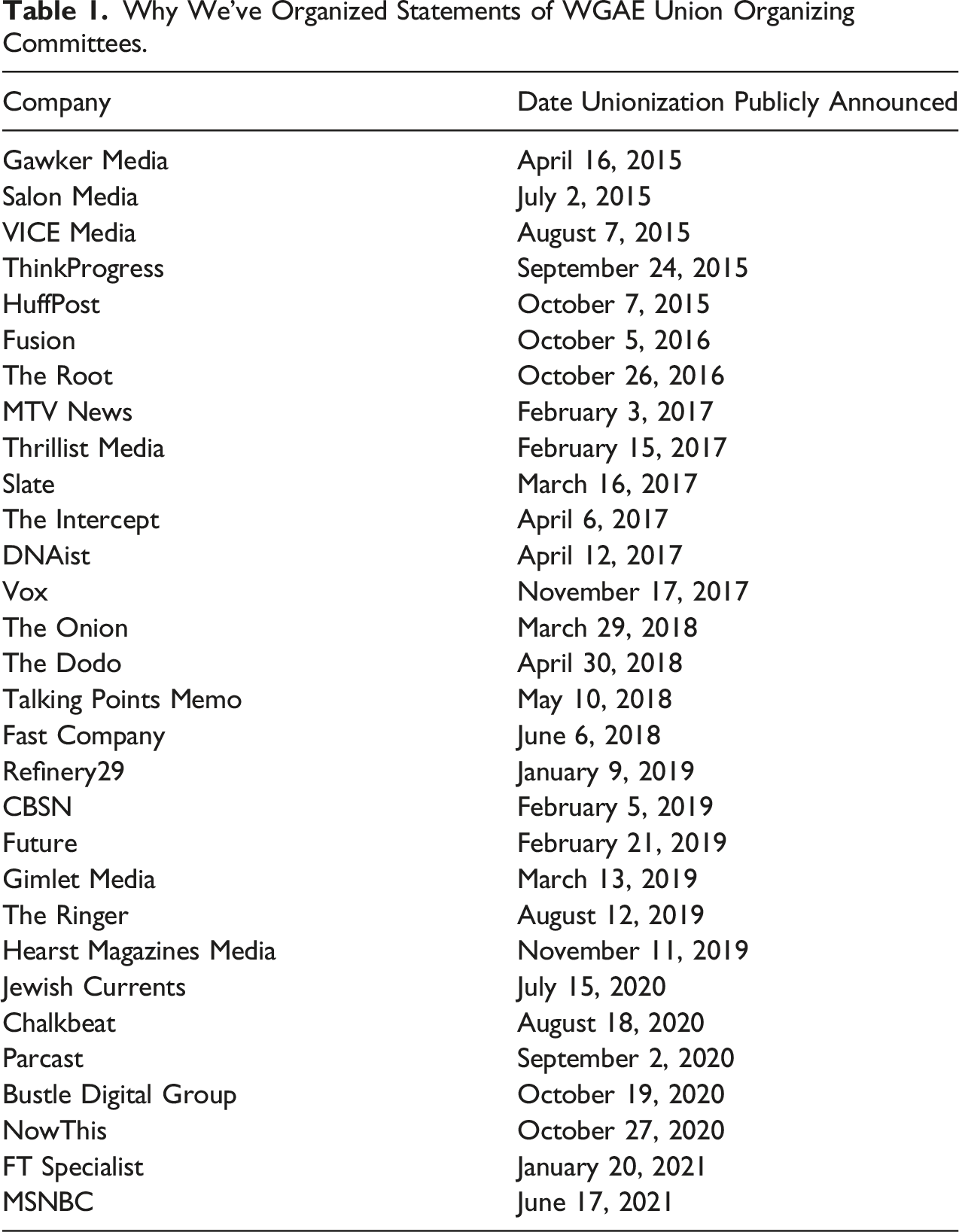
Each organizing statement was read thrice and then analyzed as part of a genre. Grounded in organizational communication genre analysis (Yates & Orlikowski, 1992), this study aimed to identify the underlying resistance rhetoric, foregrounding the rhetorical strategy, form and devices which inform the substance of the organizing statements. I used ATLAS.ti software to code and identify the rhetorical strategy, form, devices, and issues across these statements to document my “analytic decisions in a transparent, reflexive, rigorous and systematic way” (Paulus & Lester, 2016, p. 424). Thus, I could store and work with my data in one place, do initial searches to narrow my analytic focus, and trace similarities across my data to establish the relationships among key actors, grievances, proposals, and solutions (Lyon, 1999). This approach can reveal how organizing statements adopt a distinctive rhetorical form and use devices to express resistance rhetoric. This procedure led to 61 first-order descriptive codes, which I folded into three rhetorical formal features and five rhetorical devices.
Framed by the analytic category of promulgation (Bowers et al., 2010) discussed earlier, I analyzed the online union statements’ rhetorical strategy as promulgation and expressions of resistance rhetoric. I examined how the union statements use a contradictory rhetorical strategy of solidification through polarization to gain public support among workers and management. To characterize this promulgation strategy, I considered how the union statements adapt and modify features of the critical manifesto’s rhetorical form, devices, and substance (Lyon, 1999) to develop a genre variant online (Orlikowski & Yates, 1994).
Findings
Promulgation Strategy of Unions’ Why We’ve Organized Statements.
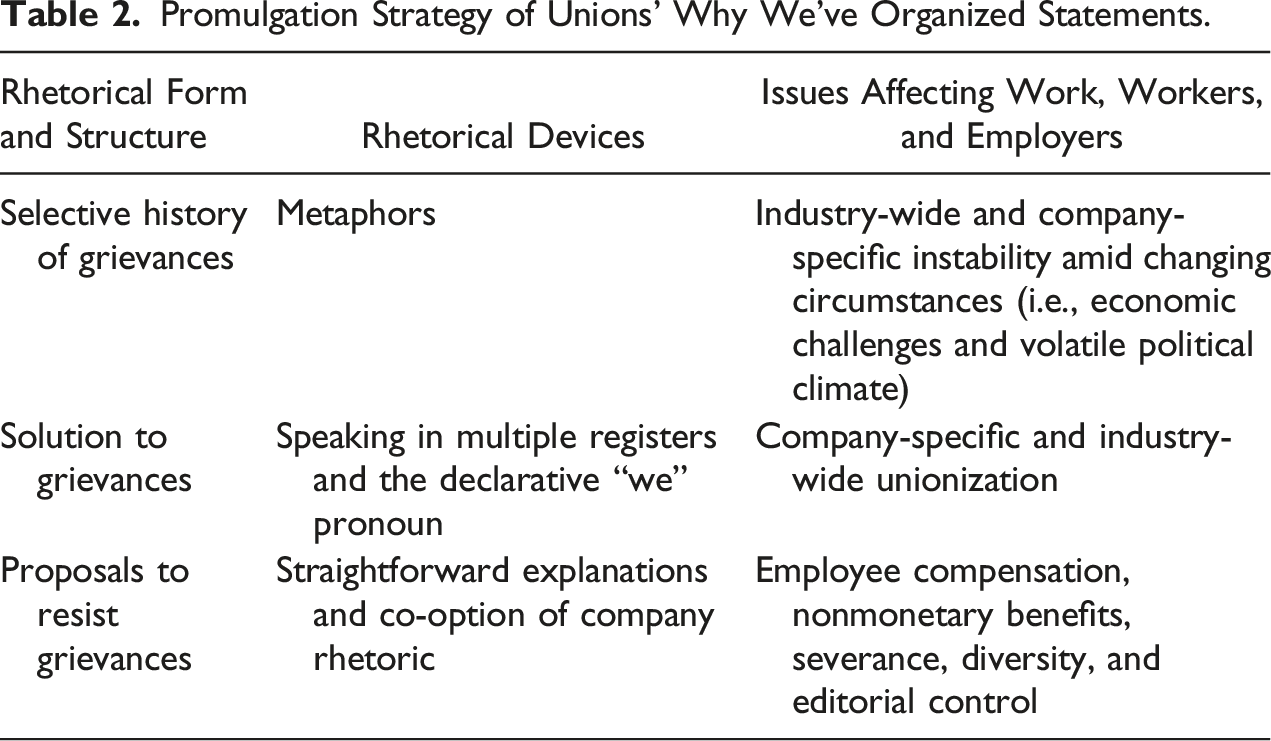
Selective History of Grievances
In this subsection, I establish the first feature of union statements’ rhetorical form: outlining a selective history of workers’ grievances, tracing an oppression or crisis that has led to a moment of rupture at which they organized their workplaces (Lyon, 1999). To serve this rhetorical function, these statements rely on solidification rhetoric to build group cohesion, implying that workers are victims of this crisis to establish the foundations for their actions. By invoking the rhetorical device of crisis metaphors (Nünning, 2012), unions ground their organizing campaigns in the underlying structural forces that shape the news media industry. Tracing a moment of rupture, the union statements describe issues affecting work, workers, and employers at the macro political-economic level: a “volatile industry,” as Ringer Union wrote in 2019 (WGAE, 2019f), within a “digital media landscape [that] is growing at an unprecedented pace,” according to the Dodo Union in 2018 (WGAE, 2018a). For Nünning (2012), “[M]etaphors and narratives of crises” play an active and “creative role in shaping our cultural awareness and in constructing the ideological fictions that provide the mental framework of the cultural imagination or collective consciousness … that stands behind historical developments” (pp. 84–85).
This relationship among industry volatility, digital media growth and change, and the need for union protection is evident across union statements. For Slate Union, “Digital media is an industry in constant flux, and given Slate’s recent growth … now is the time to solidify certain protections and rights” (WGAE, 2017c). Fast Company Union grounds its unionization efforts in “a tumultuous time in digital media” (WGAE, 2018b). After Donald Trump was elected President of the United States in November 2016, union statements maintain that his administration exacerbated such digital media industry volatility. For The Intercept Union, “[W]ith freedom of the press under direct attack from the Trump administration, it is an appropriate time to take new steps to strengthen our workplace culture and worker protections to better ensure fulfillment of the principles that guide our journalism” (WGAE, 2019d). VICE Union also views union protection necessary under a Trump administration and conditions of “international political turmoil”: “Under the new Trump administration, in which journalists have been branded as enemies and protections for employees are jeopardized, it is all the more imperative that VICE demonstrate robust support for its employees” (WGAE, 2015c). By linking unionization efforts to industry volatility and political turmoil, union statements perpetuate a longstanding idea of an industry-wide crisis and the need to organize to resolve it (Gasher et al., 2016; Pickard, 2020).
To construct workers as victims of this crisis, the statements invoke a labor of love metaphor as a rhetorical device to further facilitate solidification. The labor of love refers to language about media workers’ love or passion for the work they do. It also refers to workers feeling proud of the work they do and the pleasure and satisfaction they get from doing it. While in some cases labor of love terminology is implicit, some union statements also explicitly connect the organizing efforts to workers’ love for their jobs and their companies. Gimlet Media Union writes, “We love our work, and we’re deeply invested in Gimlet’s success,” (WGAE, 2019c), while The Root Editorial Union maintains, “This is not a declaration of war. We love The Root” (WGAE, 2016b). Future Union even explicitly clarifies, “Because we love our jobs … [we] have all decided to organize” (WGAE, 2019b). Accordingly, these statements further facilitate solidification, challenging widespread entrepreneurial terminology that has foregrounded creative individuals working for their own benefit and pleasure (Davidson & Meyers, 2016), rather than workers uniting to advocate based on collective interests (Cohen, 2016; Neff, 2012; Salamon, 2016, 2020).
Solution to Grievances
In this subsection, I focus on a second aspect of the union statements’ rhetorical form: proposing a solution to workers’ grievances. The statements do this by relying on two rhetorical devices which I address in turn: first, speaking in multiple registers, and second, using the declarative “we” pronoun. The union statements capture a tension between capital and labor and create counter-cultural solutions by speaking in multiple registers (business rhetoric and counterculture rhetoric) and by using the “we” pronoun (Caws, 2001; Van Dijck & Nieborg, 2009).
First, the statements link the selective history of industry and work, as mentioned earlier, to the issue of unionization, associating organizing with a cross-organizational and industry-wide solution. They explicitly recognize a history of media workers’ unionization (Cohen, 2016; Mosco & McKercher, 2008; Salamon, 2022), adopting a register associated with labor movement language (Bowers et al., 2010). ThinkProgress Union writes, “Traditional print media has a long history of unionization — which secured many of the rights and privileges we enjoy today — and a growing number of newer, online outlets have recently decided to carry on that tradition by organizing” (WGAE, 2015b). Some union statements also highlight the history that unions have played in defending the First Amendment—the key legal principle guiding U.S. journalism (Pickard, 2020). According to The Intercept Union, History demonstrates that journalists can most effectively defend the First Amendment by uniting with their colleagues …. With official hostility to core First Amendment principles reaching a fever pitch, it’s essential that we unite with our colleagues in other newsrooms in order to protect our values. (WGAE, 2019d).
By grounding recent organizing actions in this history of organizing, the union statements further establish unions as a cohesive group of media workers (Bowers et al., 2010).
While speaking in multiple registers, union statements align an integrative- and business-oriented union solution (Hyman, 2001). They aim to imagine a future for quality journalism, and workers are central to navigating organizational and industry change. Unionization is a key way to navigate organizational growth and “take risks,” as Vox Media Union suggests (WGAE, 2017e). According to Dodo Union, “As our company rapidly grows, union protections are some of the most effective mechanisms we have as employees to remain empowered as workers and valuable contributors to the company’s continued success” (WGAE, 2018a). For Thrillist Union, organizing can facilitate change and stability in the workplace: “Unionizing is our declaration of a commitment to fostering positive, progressive change that will help Thrillist become a more stable, diverse, and inspiring workplace into the future” (WGAE, 2017d). Organizing becomes an opportunity to use resistance rhetoric to advocate for and protect workers, employers, and the industry. As Fast Company Union puts it, “By organizing, we want to make sure that our voices are part of the major decisions required to navigate this industry” (WGAE, 2018b).
To facilitate change, union statements present organizing as a partnership between workers and management. For instance, Gimlet Media Union writes that organizing is “a proactive effort to work with management to shape the future of the company …. [WGAE is] our best partner in navigating this rapidly changing sector” (WGAE, n.d.-g). Similarly, Future Union states that unionization could “help … as our company plots a forward course through the ever-changing economies of digital media” (WGAE, 2019b). Likewise, Slate Union believes that unionization “will help to create better industry standards and make Slate more competitive in the field” (WGAE, 2017c). Collectively, these statements illuminate that union power is central to quality journalism and to organizational and industry change because, as Salon Editorial Staff (2015) puts it, “collective bargaining can commit management, editors and writers to work together in a new way.”
By speaking in multiple registers simultaneously, the union statements articulate an individualist capitalist rhetoric and a countercultural “spirit of communalisation” of grassroots virtual communities (Van Dijck & Nieborg, 2009, pp. 858–870) and of the labor movement (Bowers et al., 2010). The FT Specialist Guild captures this tension: “‘capitalism needs to be reset.’ Our union will ensure that editorial employees, thanks to their greater sense of ownership and control, will be empowered to help FT Specialist discover and deploy more efficient and effective tactics to meet its business goals” (WGAE, 2021). The union statements articulate what Boltanski et al. (2018) call the “new spirit of capitalism” that has weakened anti-capitalist critique, incorporating libertarian and left-leaning language into conciliatory market-oriented business practices.
Second, the union statements use the declarative “we” pronoun to demonstrate the labor movement register and to facilitate solidification, articulating their organizing actions as a “wave” of unionization across the news media industry. The statements refer to the success of workers in established digital-native media unions, especially Gawker Media Union. For example, the Salon Editorial Staff (2015) suggested that Gawker’s successful unionization campaign inspired organizing actions at other digital media outlets that could establish industry-wide standards: “In the wake of the Gawker staff’s vote to organize with the WGAE, we see an opportunity to help establish standards and practices in Internet journalism.” In 2018, Onion Union also justified its organizing efforts, referring to Gawker Media: “We’ve seen the positive effects of unions across digital media newsrooms, especially at our Gizmodo Media Group sister sites, and believe Onion Inc. will similarly benefit” (WGAE, 2018c). Other unions, such as Talking Points Memo Union, see themselves joining this “broader unionization movement across digital media publications” (WGAE, 2018d). When more workers organized, they were recognized in later union statements, for instance, ThinkProgress Union’s statement: “[O]rganizing drives at Gawker, Salon, Vice, The Guardian, and Al Jazeera have inspired us, because we know their fight for a voice in the workplace is our fight too” (WGAE, 2015b). The statements construct this wave of unionization, invoking the declarative “we” and “us”—the objective case of we—which CBSN Union describes as consisting of “thousands of other digital media professionals” (WGAE, 2019a).
By posing such “we-speak,” as Caws (2001) puts it, “against some other ‘they,’ with the terms constructed in a deliberate dichotomy, the manifesto can be set up like a battlefield” (p. xx). While this manifesto we-speak begins as a “credo” of the speaker, it shifts “toward the ‘you’ of the listener or reader, who should be sufficiently convinced to join in” (Caws, 2001, p. xx). Thus, the manifesto’s rhetorical form and devices construct a collective and cohesive minority speaking position and social subject against a dominant social subject. This dominant subject is sometimes implied to be the media company or the media industry writ large.
Proposals to Resist Grievances
In this subsection, I examine a third feature of union statements’ rhetorical form: proposals to resist workers’ grievances. The statements articulate resistance proposals, negotiating to raise workers’ status in society and support business priorities by adopting two rhetorical devices: using straightforward explanations and co-opting company rhetoric (Brimeyer et al., 2004).
The statements use a straightforward rhetorical approach when listing their proposals—the issues that led them to unionize. The statements include headings or lists of demands including improving workers’ pay and nonmonetary benefits to build sustainable digital media companies. For example, Fast Company Union associates “equitable and fair compensation” with “respectable salary floors” that are indexed to a “reasonable” cost of living and with a “clear and consistent” system for pay raises (WGAE, 2018b). Statements also often include a heading for “benefits” so that companies support “employees in ways that go beyond the paycheck” (WGAE, 2015c). Demands for benefits include overtime compensation or comp time for long work hours, especially considering that union members work in a “creative industry that demands nontraditional schedules” (Hearst Media Union, 2019). Other nonmonetary benefits include parental leave, childcare, family leave, sick leave, healthcare, disability leave, and a pension plan (Hearst Media Union, 2019, WGAE, 2015c, WGAE, 2016a, WGAE, 2016b, WGAE, 2019c, WGAE, 2019f).
While straightforward advocacy around pay and nonmonetary benefits has been common practice for unions (Mosco & McKercher, 2008), severance has been important for WGAE-affiliated unions because they “work in a volatile industry,” as Ringer Union puts it (WGAE, 2019f). Other WGAE union statements demand a severance package policy with a minimum amount of money and benefits when employees are terminated (WGAE, 2017c, WGAE, 2017d, WGAE, 2018b, WGAE, 2019b). This policy could ensure that workers are “treated equally and respectfully” (WGAE, 2017c). Refinery29 Union writes that a “clear severance” plan is also germinal to employee “security” (WGAE, 2019e).
Another straightforward way that union statements propose to resist grievances is to advocate for more diversity, offering critiques of media companies for their lack of diversity. For example, HuffPost Union writes, “HuffPost has taken a strong editorial stance in favor of diversity, but this diversity is not reflected among the staff. We would like to formalize our commitment to inclusivity in hiring, and keep HuffPost accountable to that commitment” (WGAE, 2015a). Likewise, Onion Union wants to recruit and retain people from backgrounds who are “often underrepresented in our industry” (WGAE, 2018c). By obtaining a collective bargaining agreement, unions could satisfy “[c]oncrete and ambitious diversity initiatives,” according to Gimlet Union (WGAE, 2019c).
Some union statements associate diversity with the underrepresentation of historically marginalized groups—women and people of color. For example, Refinery29 Union advocates for “an intentional focus on both hiring people from historically underrepresented communities and on promoting these employees within the company” (WGAE, 2019e). As a women’s publication, there is an overarching link between unionization and gender empowerment: “[U]nionizing is the best way, and the feminist answer, to address our workplace issues. This way we’ll be able to continue publishing stories and creating content that serve as a catalyst for women to see, feel, and claim their power” (WGAE, 2015a). Likewise, Fast Company Union writes of its “strong commitment to diversity in hiring, and the end of any gender wage gaps that may exist across positions” (WGAE, 2018b).
Other union statements connect diversity to intersecting social identities. For instance, Future Union links “Fair Compensation” to both gender and race: “It’s important to us as well to rectify any gender- or race-based pay inequities that may exist at Future” (WGAE, 2019b). VICE Union and Hearst Media Union take intersectionality further, highlighting diversity and inclusivity in recruiting, hiring, promoting, and leadership decision-making regarding race and ethnicity, gender identity, sexual orientation, religion, socioeconomic background, age, immigration status, and disability (Hearst Media Union, 2019, WGAE, 2015c).
Additionally, union statements take a straightforward rhetorical approach to illustrate the issue of editorial control: workers demand relative control over the editorial process to codify a separation between the editorial and business sides of production. Some statements contain a heading or reference to preserving “editorial standards,” “editorial freedom,” or “editorial independence” (WGAE, 2017a, WGAE, 2018b). Hearst Media Union (2019) writes that the company should maintain “a clear division between editorial and advertising to a transparent e-commerce strategy.” VICE Union also demands this separation: “expectations for any work on the branded content should be a clearly delineated part of work agreements that VICE employees are a part of forming, not duties added to existing job responsibilities without consultation and negotiation” (WGAE, 2015c). Statements also foreground how workers organize to gain more power by improving “editorial communication and transparency” (WGAE, 2017b). For instance, Fusion Union states that journalists should “have freedom to pursue stories without fear of undue influence, intervention, or retaliation” (WGAE, 2016a). Thus, workers could leverage their power, ensuring that writers are included in the editorial process “from conception, execution, and publication” (WGAE, 2017b), and as Onion Union articulates it, attain “independent oversight of the editorial … work they produce” (WGAE, 2018c). This straightforward approach can also make union messages seem trustworthy and facilitate worker solidification (Bowers et al., 2010).
As a second rhetorical device to articulate resistance to grievances, some union statements co-opt their company’s business-oriented rhetoric to reverse company messages and explain the benefits of unionizing for the companies (Brimeyer et al., 2004; Stewart et al., 2012). For example, demanding fair compensation, Future Union adopts business terminology around profit making: “Our goal is to establish clear, liveable base salaries for compensation across positions along with consistent cost-of-living increases,” so that workers can receive “their fair share” of the company’s profits (WGAE, 2019b). According to the statements, media companies could also benefit from unions’ proposals. For instance, MTV News Union links “Healthcare and Benefits” to quality work and organizational improvement and protection: “Without adequate healthcare, we cannot take care of ourselves as we do our work; without benefits, we cannot prepare for our own future as we prepare for the future of MTV News. In order to do our best work, we must secure our own safety” (WGAE, 2017b). Additionally, Thrillist Union suggests that the best way for media companies to attract “top-level talent” is to offer their employees an equitable salary and benefits (WGAE, 2017d).
Union statements further co-opt business language when proposing more workplace diversity. Some statements maintain that media organizations should satisfy diversity initiatives to accurately reflect U.S. population demographics and produce quality editorial content. For Thrillist Union, “[T]he editorial workforce should reflect the diverse demographics of this country and our readership” (WGAE, 2017d). Likewise, Dodo Union writes that an “inclusive workforce” should reflect the “diversity of our audience” (WGAE, 2018a). Unions also suggest that companies should strive for workplace diversity to maintain essential journalistic standards. For instance, Future Union links diversity to broader aims of “transparency and accountability” and “upholding and preserving editorial standards” (WGAE, 2019b). The journalism business has long been driven by this need to serve audiences, reflect the demographics of the communities that publications serve, and be grounded in principles of accountability and transparency (Cohen, 2019; Gasher et al., 2016; Pickard, 2020).
Some union statements acknowledge that employers are already committed to diversity initiatives. For instance, the Root Union and Fusion Union recognize that their companies may be more diverse than others. Yet they still maintain that workers should organize, as Fusion Union puts it, to formalize the “processes to increase and maintain diversity of its employees and ensure more opportunities for women and people of color to advance within the company” (WGAE, 2016a). Unionizing could strengthen companies’ long-term commitments to diversity.
Union statements also co-opt business rhetoric when proposing more editorial control. As digital media companies adopt “branded” projects, Thrillist Union demands “editorial independence,” acknowledging that “advertising and branded content remain [their employers’] core source of revenue,” while recognizing that commercial interests should not compromise “editorial integrity” (WGAE, 2017d). For Future Union, the company should “ensure editorial staff has rules in place to distinguish them from advertising and ecommerce” to maintain “editorial standards” (WGAE, 2019b). Additionally, the Intercept Union suggests that the company create “new forums for staff members to contribute to the organization’s editorial direction” (WGAE, 2019d). Overall, the union statements articulate workers’ aim to participate in establishing editorial policies with editors, producers, and management, as MTV Union puts it (WGAE, 2017b). By organizing, media workers could “create and uphold a rigorous system of internal accountability” (WGAE, 2018a) and “editorially independent journalism” (WGAE, 2015b). For HuffPost Union, such editorial freedom and independence is the “only way” to ensure that journalists “can hold the monied and powerful accountable” (WGAE, 2015a), recalling journalism’s traditional watchdog role (Gasher et al., 2016; Pickard, 2020).
By co-opting business rhetoric, union statements reverse a traditional message of agitation among labor union organizers (Bowers et al., 2010; Stewart et al., 2012). Unions use such rhetoric to “develop their own message of empowerment” (Brimeyer et al., 2004, p. 69). Overall, these calls for pay, nonmonetary benefits, severance, diversity, and editorial control are couched in polarization rhetoric. Yet they facilitate solidification among workers and their employers, taking a straightforward rhetorical approach and co-opting business rhetoric.
Discussion and Conclusion
This paper aimed to understand how unions reproduce and modify a social movement genre for strategic communication activism, using online resistance rhetoric to negotiate power relations with employers. WGAE-affiliated unions express resistance rhetoric, publicly posting Why We’ve Organized statements on a union website as a promulgation tactic to win support for unionization. In response to RQ1, the organizing statements consist of a rhetorical strategy that negotiates between solidification and polarization to secure workers’ and employers’ support. They outline a selective history of workers’ grievances, a solution to address these grievances, and proposals to resist them. To facilitate this rhetorical strategy, the statements use five rhetorical devices: metaphors, the declarative “we” pronoun, straightforward explanations, co-option of company rhetoric, and speaking in multiple registers.
Regarding RQ2, the rhetorical form and devices inform the semantic content of the organizing statements about several issues affecting work, workers, and employers: industry-wide and company-specific instability amid changing circumstances, including economic challenges and a volatile political climate (e.g., Trump’s presidential victory). Based on this selective history of underlying structural issues, the statements propose a solution to workers’ grievances: the issues of company-specific and industry-wide unionization. To resist grievances, the statements highlight the following employment and workplace issues: better pay; nonmonetary benefits (parental leave, childcare, family leave, sick leave, healthcare, disability leave, and a pension plan); severance plans; diversity (race, ethnicity, gender identity, sexual orientation, religion, socioeconomic background, age, immigration status, and disability); and editorial control.
Regarding RQ3, WGAE organizing statements reproduce the critical manifesto genre’s rhetorical form and structure, but they modify the critical manifesto’s rhetorical devices and the genre rules in substance. They adapt the form and structure, outlining a selective history, solution, and proposals to resist worker grievances (Lyon, 1991, 1999). However, WGAE union manifestos use five key rhetorical devices in total (metaphors, the declarative “we” pronoun, straightforward explanations, co-option of company rhetoric, and speaking in multiple registers), unlike traditional critical manifestos, which tend to use only two key rhetorical devices to facilitate their rhetorical strategy (metaphors and the declarative “we” pronoun). Despite some overlap, WGAE union manifestos use crisis metaphors rather than battle metaphors (Real & Putnam, 2005). Additionally, by co-opting company rhetoric and speaking in multiple registers, WGAE union manifestos use two longstanding identification tactics of social movement organizations: the “implied we” and “adapting language to audiences” (Stewart et al., 2012, pp. 145–146). Yet the Digital Media Shops section of WGAE’s website becomes a “virtual union” (Diamond & Freeman, 2002), concretizing and setting the boundaries around who is included in the “implied we”: the website establishes an organizational identity around digital media organizing campaigns that is distinct from other union activities (Saundry et al., 2007). Considering the virtual union’s public nature and affordance of visibility (Lazar et al., 2020; Mumby et al., 2017), WGAE’s online manifestos adapt language, co-opting company rhetoric and speaking in multiple registers to appeal to different audiences—employers and other workers. By speaking in both business and labor movement registers, WGAE manifestos also adapt a rhetorical device of Web 2.0 business manifestos (Van Dijck & Nieborg, 2009). Finally, by focusing on pay and nonmonetary benefits, WGAE manifestos reproduce the manifesto genre rules in substance, but they modify the genre by also foregrounding severance (Lyon, 1999; Mosco & McKercher, 2008).
These reproductions and modifications of the manifesto genre provide insight into how unions attempt to negotiate power relations. Virtual unions’ online resistance rhetoric in a social movement genre for strategic communication activism might not disrupt the status quo (Cloud, 2005, 2011). Manifesto resistance rhetoric is the site of struggle through which WGAE unions negotiate power relations publicly online (Mumby et al., 2017), but their rhetorical strategy reveals how unions facilitate concertive control and agitation based on vertical deviance (Barker, 1993; Bowers et al., 2010; Papa et al., 1997). The manifestos invoke common industry and work metaphors of crisis (Gasher et al., 2016; Pickard, 2020) and language around a labor of love and passion work (Cohen, 2016; Neff, 2012) and the “individual professional autonomy of journalists” (Davidson & Meyers, 2016, p. 602). Union manifesto rhetoric confirms how professional workers prioritize the “artistry of the profession” through unionization (Banks & Hesmondhalgh, 2016, p. 273), negotiating and struggling for control over professional standards and workplace rights (Real & Putnam, 2005).
WGAE manifestos also co-opt company-type rhetoric, speaking in a business-oriented register, arguably weakening their labor-oriented register that could be a force for radically transforming power relations. They articulate a union that leans toward the society and market side of the eternal triangle as a mixture of business and integrative unions (Hyman, 2001). While unions become channels for raising workers’ status in society—advocating for better pay, nonmonetary benefits, and social justice around a diverse workforce—they accept the established value system but dispute how benefits and power are distributed within this system (Bowers et al., 2010). As Slate Union puts it, workers want “a seat at the table” (WGAE, 2017c), while for Future Union, workers want “their fair share” of their company’s profits (WGAE, 2019b).
Overall, this research contributes a pioneering framework to articulate unions’ resistance rhetoric in a social movement genre for online strategic communication activism. WGAE union organizing committees participate in a website campaign to organize workers, forming a virtual union and publishing manifestos online (Diamond & Freeman, 2002). The analysis presented here suggests that unions express resistance rhetoric and facilitate strategic communication activism, using a unique rhetorical form and devices to reproduce and modify the critical manifesto genre. By focusing on workers, this research challenges the employer-centric approach to genre analysis: employers reproduce organizational communication genres, which reveal aspects of a community’s organizing process and the evolution of genres over time (Im et al., 2005; Orlikowski & Yates, 1994), modifying genres to strategically serve external ends, including journalistic practice (Jacobs, 1999) and public policy (Kuhn, 1997). Conversely, this study also suggests that labor movement organizations reproduce and modify a genre, blending business and integrative union resistance rhetoric as a strategic, “deliberate communication practice” (Hallahan et al., 2007, p. 3), and “source of worker power” (Freeman & Medoff, 1984, p. 11). As Weeks (2013) reminds us, the critical manifesto is inherently contradictory and characterized by “displacement and intermixture” (p. 229), making it an ideal fit for union organizing. Union manifestos might also modify the genre in this conciliatory way, considering the precariousness of the news media industry and employment conditions (Cohen, 2019; Pickard, 2020; Salamon, 2016, 2020).
Limitations of this paper could be addressed in future research. As I analyzed the statements of only one media workers’ parent union, future research could explore resistance rhetoric in other social movement genres for strategic communication activism in relation to other industry-wide collective action, including resistance rhetoric among app-based gig workers (Johnston & Land-Kazlauskas, 2018) or video game workers (Weststar & Legault, 2019). Additionally, future research could examine impacts of resistance rhetoric in these social movement genres to understand if agitators win meaningful material gains (Cloud, 2005), like in BAmazon Union’s failed organizing effort (Weise & Corkery, 2021). Future studies could also consider other social movement groups. For example, researchers could look at historically marginalized racial, ethnic, and/or class groups to understand how the Black Lives Matter (Banks, 2018; Lee & Kahn, 2020; Soriano, 2015) and Fight for $15 (Frangi et al., 2020) movements use resistance rhetoric in social movement genres for strategic communication activism.
This research has theoretical and practical implications. By developing my approach to understanding online resistance rhetoric, researchers are better positioned to examine the rhetorical strategy, form, and devices in social movement genres of organizational communication for strategic communication activism. This research also raises practical implications regarding the extent to which activist-oriented organizing could contribute to organizational change and disrupt the status quo. For example, my analysis suggests that organizers should carefully consider how their rhetorical strategy could lead to meaningful resistance to improve their status in society and advance social justice rather than facilitate concertive control.
Footnotes
Declaration of Conflicting Interests
The author(s) declared no potential conflicts of interest with respect to the research, authorship, and/or publication of this article.
Funding
The author(s) received no financial support for the research, authorship, and/or publication of this article.
