




Abstract
Uncertainty is at the forefront of many crises, disasters, and emergencies, and the COVID-19 pandemic is no different in this regard. In this forum, we, as a group of organizational communication scholars currently living in North America, engage in sensemaking and sensegiving around this pandemic to help process and share some of the academic uncertainties and opportunities relevant to organizational scholars. We begin by reflexively making sense of our own experiences with adjusting to new ways of working during the onset of the pandemic, including uncomfortable realizations around privilege, positionality, race, and ethnicity. We then discuss key concerns about how organizations and organizing practices are responding to this extreme uncertainty. Finally, we offer thoughts on the future of work and organizing informed by COVID-19, along with a list of research practice considerations and potentially generative research questions. Thus, this forum invites you to reflect on your own experiences and suggests future directions for research amidst and after a cosmology event.
Karl Weick has long directed attention to how people navigate the liminalities of changing circumstances. An important premise of his work is that changes in our circumstances—or “ecological changes” (Weick, 1979, p. 130)—have the potential to bring about substantial uncertainty, ambiguity, and equivocality, such that the world we thought we knew no longer makes sense (Weick, 1993). These sudden and/or large changes trigger cosmology events (1993) or occasions for sensemaking (1995) in which old interpretations and responses suddenly become obsolete, and people must reinterpret their surroundings and craft new understandings of and solutions to a new set of problems.
As COVID-19 began spreading, many of us faced it as a collective cosmology event. Both short- and long-term outlooks for the professional and quotidian aspects of our lives were shrouded in a fog of uncertainty. Would we have to close our campuses? Would we be able to continue our local and international collaborations? Would people have to work from home? Would there be enough toilet paper for everyone? Would we die? Moreover, a unique challenge with COVID-19’s onset was that it was more than just one disaster—it was multiple, cascading disasters (Franchina et al., 2011; Little, 2002; Pescaroli & Kelman, 2017) all in one. COVID-19 constitutes both a health crisis and an economic crisis, and is occurring alongside more common natural disasters (e.g., tornadoes, hurricanes, wildfires, floods) and social challenges (e.g., inequality, racism, poverty). In short, we have more questions than answers, and the only way for many of us, and for our communities and organizations, to sense the contours of this crisis is to walk straight into the fog and discover whatever is/was there.
In this forum, we have assembled a group of scholars whose prior research relates to sensemaking, health, and crisis from communication perspectives. We engaged in some collective sensemaking around COVID-19, and as we wrote this piece in April of 2020, the pandemic was still unfolding. As we revised the essay, three of us (Stephens, Sutton, & Xie) had NSF RAPID grants funded, and several other authors launched research studies around COVID-19. Because this disaster has affected the entire globe, radically altered how people live and work, and devastated economies, it is crucial to make sense of this emotional and academically important context.
We reference Weick’s organizing framework of enactment, selection, and retention stages as we reflexively make sense of the COVID-19 crisis both as scholars and as humans. We begin by reflecting on things that happened to us personally and professionally during the first months of the crisis. We then share our views on how COVID-19 is changing organizational practices and organizational communication research. Finally, we offer our perspectives on the future of work in the wake of this global crisis. We hope our attempts to oscillate between sensemaking and sensegiving (Gioia & Chittipeddi, 1991) will help others to reflect on their own experiences and provide future directions for research amidst and after this cosmology event.
Pandemic Sensemaking
Weick’s (1979) model of organizing begins with ecological changes that reconfigure the world as we know it. In response to this ambiguity, organizational actors venture into the unknown to sense new information that can help them better understand their surroundings. Weick’s (1979, 1995) concept of enactment refers to actors directly engaging with unfamiliar circumstances to generate (not just gather) data that helps them interpret unfolding events. Next, actors pick tentative explanations (referred to as “cause maps,” Weick, 1979, p. 131) to simplify their environment (i.e., reduce “equivocality”) and explain past actions in a process called selection. During this period of retrospective sensemaking, individuals often experience multiple versions of a double-interact in which they repeatedly engage in cycles of acting, responding, and adjusting, to determine how new interpretations (or what Weick called assembly rules) reduce or increase confusion. Finally, retention refers to the prevailing interpretation that organizational actors retain from the entire process of encountering a cosmology event, after enacting their uncertainty to develop explanations for their surroundings, and winnowing down the possible interpretations to select the most viable one (Weick, 1979).
One moment of sensemaking is often connected to another, and even as we started our collective retrospective sensemaking, we found ourselves sharing stories of prior cycles of sensemaking that reflect Weick’s theorizing. For example:
Jody
One of the most vexing challenges I encountered working as a wildland firefighter for eight seasons was knowing when to “make the call.” Many of the wildfires I worked on were so large and moved so quickly that spread potential was difficult to comprehend. This type of uncertainty led me (and others, too, as I discovered through my research) to question whether I was seeing the situation clearly, and to truly struggle with voicing dissent and defying orders when there was so much pressure to act. Each firefighting season, I encountered at least one major close call (e.g., aircraft and vehicle malfunctions, rolling rocks and stumps). These experiences were scary, of course, but they were also empowering because narrowly missing a serious injury (or worse) made it clear that getting hurt or killed was not just an abstract possibility; it was just one unmindful decision away. Facing such a realization and these close calls over and over helped me develop a resolute voice in which I became comfortable making decisions that erred on the side of safety. When it was my responsibility to “make the call”—whether to work aggressively, back off, or decline an assignment—the only source of certainty I often found amidst all the uncertainty was that looking out for everyone’s safety was always the right move.
Thus, Jody shared her own prior sensemaking, explaining how she had to enact various fires and decisions about when to speak up, and then created and selected rules for how to proceed “over and over” until she developed a strong voice and a viable rule that “safety was always the right move,” which she felt she could retain for use in the future. As detailed below, Jody used this experience developing the confidence to “make the call” about safety as a resource for her own sensemaking during the pandemic’s onset. Thus, we dive into our various experiences of the pandemic as a cosmology event and impetus for sensemaking.
Wait! What? Initial Moments of Pandemic Sensemaking
Jody
As COVID-19 began spreading in the US, the feeling of uncertainty about what we (in my department) should do was bizarre, but felt all too familiar. Colleagues privately voiced concerns about endangering their health or safety by continuing in-person teaching. In the same breath, they expressed reluctance to ask for permission to move to a remote classroom format because they did not want to “out” their health issues or look less committed to their job. We were managing a tension between our commitment to continue business-as-usual and our ability to advocate for our best interests by calling for a halt. I felt I could support my academic community by listening to colleagues’ concerns, encouraging them to interpret the emerging pandemic for themselves, and empowering them to “make the call” that was right for them. I felt lucky because my institution supported such decisions.
Bo
I’ve been following the COVID-19 crisis since January, and I have been deeply troubled, and exhausted emotionally, by seeing what happened in China to my medical school friends and former classmates—many of them are on the frontlines in Wuhan and other cities in China. My awareness of my worry and uncertainty about their well-being pushed me into a cycle of sensemaking. To cope (in what Weick might call my selection process), I started drafting an opinion paper and worked with a team of dedicated collaborators to fully write it in a week. We argued that global health crises also are information crises requiring special attention from information scientists (Xie et al., 2020). Our opinion paper was published online on Friday, March 13. This was the same day President Trump declared a national emergency over COVID-19, the same day our University of Texas at Austin community learned our university president’s wife tested positive, and the same day my husband and I decided to keep our kids at home.
We have been staying at home since. Managing four young children at home while trying to maintain productivity as an academic is challenging. But it is not comparable to the great surprises I have felt by the spread of COVID-19 in Europe and the US, and my worries about the implications of this pandemic on all aspects of society and individual lives, including the US-China relationship. I have been reflecting. How could this be? What went wrong? What could I, as an information scientist, have done that I did not do? What can and should I do now to make a difference, and what should I do in the future to help prevent and manage future pandemics? My attempts at sensemaking feel nonstop.
Keri
I took a picture of my graduate class on Monday, March 9, 2020 because I knew, in my gut, that it would be our last time together for quite a while. I’d been washing my hands so much I had dry patches, and attending meetings that week was uncomfortable. I made the decision to stay home on Thursday, and on Friday, our university president announced we would not return to campus after spring break. So while the students had a 2-week spring break, the faculty and instructional support staff scrambled to rapidly move our courses online.
This experience started me down the path of wanting—needing—to stay busy. People who know me know I often say, “Control what you can control,” and that was a key assembly rule I reenacted during those first few weeks. My daughter had to return to her university because she was a resident advisor in her dorm, and I cried as she got into her car to drive back. I was petrified she would be in Chicago, air travel would be shut down soon, and she would get sick and have to go to the hospital. So I controlled what I could and vacillated between being unproductive and overworking (and feeling guilty that I’m privileged to do this when many of my former advisees have babies at home, and many friends have lost their ability to pay their bills). I couldn’t sleep well, and then my daughter called to say she was dreadfully lonely, had finished all her work, and would be coming home. On April 4, 2020 she left Chicago at 4:30 a.m. and arrived in Austin, Texas right before midnight.
It was wonderful having our family together, and for 1 week, everything went fairly well. Then, my daughter got very sick. We were terrified of going to the emergency room because we felt it was the formula for guaranteeing COVID-19. After my daughter laid on the bathroom floor for 3 days, I posted a message on Facebook asking if anyone had advice for going to the ER, and in 15 minutes a friend messaged me that there was a “clean hospital” in Austin. This meant that they did not accept COVID-19 patients. I had to drop my daughter off at the emergency room entrance because no visitors were allowed. Shortly after, she had emergency surgery and was admitted into the hospital. For 3 days, all we had were our mobile phones to keep us connected. After surgery her throat hurt, so all we could do was text for a day. It was heartbreaking, and I felt absolutely useless as a parent. Working was a joke when I was so worried.
Stephanie
I used to treasure my days of working from home alone, using the silence and solitude to do higher-level thinking. Making the switch to working from home with the whole nuclear family unit in residence was tough, and the first week of confinement was a circus that required abandoning my prior sensemaking. My husband became a permanent fixture at the dining room table on video calls as his company tried to stop losing clients. This was a palpable miasma of stress. My children approached the situation like a free-for-all screen fest. I grappled with figuring out how to put my courses online, decided I was too much a luddite to attempt teaching by Zoom, and, anyway, we probably didn’t have enough institutional licenses yet. I was distraught and sleepless with the knowledge that many of my students were socially isolated and struggling, especially the international students who had decided to stay put. Research was put on a back burner.
However, as the weeks progressed, new routines took root, generating new meaning structures and rules. We established work stations for everyone by cobbling together office furniture and monitors from various sources (what a mark of privilege). Our kids’ schools started sending home activities and assignments via five different platforms before starting to consolidate messages. (Of course, “All assignments are optional” because not everyone has such privilege, and nobody really knows how to address the digital divide between the have-lots and have-less students). And as the dance between homeschooling and university work became an everyday reality, guilt emerged as a constant companion: can’t get enough work done, can’t make sure the kids are learning and taken care of, cook, watch Netflix, try to sleep, repeat.
Jeannette
While I’m incredibly thankful to be joining a wonderful new university in the fall, the uncertainty associated with a new job is magnified when you add a cross-country move into the middle of a pandemic. I’m working now from the optimistic belief (my new preferred selection of meaning) that, eventually, some things will return to a “normal” level of operating. But I first had to let go of my pre-pandemic plan to focus on the move in March, April, and May. As I searched for new meaning structures, I recalled the days surrounding September 11, 2001, when realtor friends told me that on September 10 they had contracts moving through the system and by September 12 they were all cancelled. I could see that we were likely to face similar conditions with this slow-moving disaster. In this way, I think I was throwing out my original sensemaking around the move and picking up bits of another prior sensemaking process to help me understand what this move may be like.
Thinking beyond the move itself, to the uncertainties of starting a new position in a new university, is daunting. Processes that an incoming faculty member expects to experience—employee orientation, learning new systems for teaching, understanding new administrative duties, transitioning existing research funds, setting up a lab, finding research assistants—also require new sensemaking processes and become much more difficult when the entire university system is flipped upside down. My strategy is similar to Keri’s: stay exceedingly busy with work, and hope things will open up a bit in a few weeks.
Pui
Like many, my spring break was nothing I had planned for it to be, due to the quarantine. The most fun trip my husband and I took was to Walmart, where we found toilet paper and some good steak. We cancelled our house-hunting trip (I was also moving for a new position) and we were still waiting to see when we would be able to start visiting houses in person. I absolutely agree with Jeannette about the added stress of moving to another city and transitioning to a new job during this pandemic. Our lender suddenly became stricter about documentation and requirements. We discussed doing some virtual tours, but they wouldn’t be the same as being there physically. As of April 2020, we still didn’t know if face-to-face instruction would resume in the fall or if all classes would remain online for the rest of the year. And if they stayed online, should we move out of our current house or wait to move until next year? I find myself hoping that things will reopen soon and that we will have a chance to properly say goodbye to our friends before we leave this city. With this pandemic, I’m making some sense of it by thinking of it as a waiting game.
Eric
Though I can work without interruption and do not have children, some days I feel useless, albeit in a different way. I cannot be there for young people in my community who depend on me. The public schools and the local nonprofits I volunteer for have shut down indefinitely due to COVID-19. Thus, I cannot be a mentor for at-risk boys or teach inner-city youth the principles of entrepreneurship and business. Communities are suffering because this service work is going undone. On the other side of the coin, now that work and home are fully integrated, I sometimes wonder whether or not I will have enough bandwidth for any third place involvement.
Rahul
In February 2020, I was on sabbatical and visiting my parents in Kolkata, India. COVID-19 was still an obscure mention in the daily news, both in India and the US, and the first time I was directly affected was when my Cathay Pacific flight home to Detroit was cancelled. I had to rebook, had a lengthy layover in Hong Kong, and stayed an extra night in New York City. I was annoyed more than scared, but the Hong Kong I encountered during my layover was very different from the fun, bustling city I’d loved 10 years ago. In a precursor to what was to happen in the US, most people were staying home, and schools had moved instruction online. At the airport, medical professionals, wearing what looked like hazmat suits, aimed their temperature guns at everyone walking past, and the crowds were much thinner than what I remembered. My existing frameworks for what Hong Kong and airports in general are like did not fit what I was seeing.
Making Sense of Race, Intersecting Identities, and Privilege
Rahul
The state of Michigan, where I live, was among the first to declare shelter-at-home orders, but the death toll, as well as cases of COVID-19, surged anyway. One of the first things I realized was how privilege has shaped both the way this crisis is playing out and my positionality as an observer/scholar/resident. As an immunocompromized individual, these days not only do I take incredible care cleaning my home and washing my hands with soap (for 20 seconds!), but I am also careful about what information I divulge about my situation with others (echoing the concerns of Jody’s colleagues). Married to a small business owner, I understand all too well the financial uncertainty he is going through, and I feel grateful that my tenured faculty position at a research-intensive university provides us some stability in the precarious months ahead—especially as the promised Paycheck Protection Program, meant to assist small businesses, remains elusive for those most in need. In addition to my sabbatical, which meant I did not have to scramble to transfer any courses online, my tenured faculty rank and union membership also provided me with a shield not available to the vast majority of untenured, non-tenure track, and non-unionized faculty across the nation. In terms of citizenship, my green card affords me a certain protection that those on H1B visas lack, especially given the federal government’s hostility to “foreign” workers and students.
But the biggest recognition of privilege—and the key disjuncture at stake—was when I looked around me at the devastation this crisis was causing in Detroit, Michigan. From the relative safety of my home in the suburbs, I received news almost daily of friends and their families falling sick, being hospitalized, and succumbing to the virus. I heard and empathized with their shock and anger at the harm caused by our society’s long-term ignoring of “underlying conditions” afflicting Black and Brown bodies, and the racist rhetoric and actions that both our federal government and some medical authorities often suggested—such as the two French doctors “testing” potentially dangerous drugs like hydroxychloroquine on Black people in Africa until the WHO censured them. On the same day I received news that a friend—someone I’d met while working on a research project about Detroit’s local entrepreneurs, and whom I knew to be a tireless advocate for underserved communities—had died of COVID-19, a group of “protesters” gathered at the state capitol in Lansing. Acting against the Governor’s shelter-in-place orders, they blocked hospital routes, violated physical distancing guidelines, and endangered both themselves and others, all while carrying AK-47s and signs with racist symbols, including Nazi swastikas. Even now, as I write this, my grief and rage are mixed. Each gives the other potency, so I must pause awhile before carrying on.
Pui
I feel fortunate that I have not experienced any outright discrimination during this pandemic. A subtle racism that I perceived was a weird look from an older gentleman at a grocery store. However, as a Thai native, it saddens me to learn about the COVID-19 related hate crimes my fellow Asian Americans are facing. According to a recent media article, rumors that the virus originated in China and use of the term “the Chinese Virus” coined by President Donald Trump have “placed undue stigma on Chinese Americans and other Americans of Asian descent” (Buscher, 2020, para 3). This stigma results in a dramatic increase in anti-Asian incidents, ranging from verbal abuse and ethnic intimidation to vandalism and violent attacks on persons and Asian-owned businesses. I still recall how empty the most popular Chinese restaurant in town was even weeks before our city’s shelter-in-place order. Two Asian stores here have been temporarily closed. It is as though someone has to be blamed for this highly uncertain and devastating global problem. And for this pandemic, it is the Asians.
Eric
Pui and Rahul raise important perspectives on privilege and stigma that should not be overlooked. As a six-foot, two-inch, 260 pound Black man, I have a slightly different take. Last week, I decided to get some fresh air and go for a walk in the nearby park. Despite the sunshine and blue skies, the temperature was a bit brisk, so I wore a hooded sweat suit, sunglasses, and a homemade mask sewn by one of my colleagues. As I left my house and walked toward the park, I passed a police squad car, possibly positioned to catch speeders. I was overcome with anxiety as I wondered if the officers in the car would perceive me as just another person trying to get some exercise, or a potential threat. Ever since my teenage years, when I was repeatedly stopped on suspicion of “stealing” my mother’s car or bent over the hood of a police car for “fitting the profile” of a wanted criminal, I have always been uneasy during my encounters with law enforcement. Mandates to wear masks as a means to slow the spread of COVID-19 exacerbate this uneasiness for me and people who look like me.
The U.S. government’s guidance for citizens to wear masks conveniently ignores the country’s history of associating perceived criminality with people of color generally, Black and Brown men specifically (Skolnick, 2007). Cases such as the arrest of Dr. Henry Louis Gates for trying to enter his own home, frequent police shootings of unarmed Black men, and the recent rash of Black men having the police called on them for non-criminal activities, like barbequing in the park or meeting in a Starbucks, paint a vivid picture of how racial profiling is woven into the fabric of America. Starting in mid-April of 2020, The Centers for Disease Control (CDC) advised citizens to use bandanas to create protective face coverings, yet police routinely associate bandanas worn by Black and Brown men as symbols of gang affiliation. Officials and citizens in this country have created assembly rules about race, immigration, and gender that are going to intersect with wearing masks in public in devastating ways. It is a sad irony that measures designed to make the population safer may in fact have the opposite effect on certain demographic groups who lack the protection of white privilege (Delgado & Stefancic, 2017).
Making Sense of Work-Life in a Time of COVID-19
Eric
Working from home is not new for me, and in general, it has been a smooth transition. However, I was not prepared for the increased workload that would come with converting two classes from classroom to online in real time. Scripting, recording, and posting lectures took more time and effort than I thought they would. I had to figure out what assignments and activities would work and what to omit through daily trial and error. The number of—what Weick would call—double-interacts I worked through was mind-boggling in itself. There is also the invisible labor (Weidhaas, 2017) of becoming my students’ de facto IT help desk. I easily spend 12 hours, 7 days a week in this chair. And it feels like every day is Tuesday.
Jeannette
You are right, Eric, the days run together. Finding a routine, like going for a walk every morning, has been really important. Recommitting to a hobby, off-screen reading, or some other creative outlet at the end of the day has been a good way to disengage while being in the same space.
Pui
The biggest challenge for me has been the lack of structure. Although I enjoy autonomy in my work, I have realized that I do far better with a degree of regimentation. Having too much “freedom” is kind of counterproductive to me. There have been days when I felt super motivated and days when I just wanted to binge watch my Thai dramas. Also, I miss a little change of environment (traveling between campus and home) and I miss the real time, face-to-face interactions with my students. What I have found helpful is to have a virtual work partner to keep me accountable: We share our plans for the day and update each other on our progress. I’ve been remaking sense out of my work time through these practices. Like Jeanette recommended, finding a healthy personal wellness routine is also important. My husband and I both find ourselves more productive and happier when we get to walk twice a day and take a drive once a day.
Eric
I’ve also been thinking that whether we work at home or in an office, this pandemic, coupled with the impending sector-wide enrollment dip predicted to hit in 2026, will also create a higher education landscape much different than the one to which we have grown accustomed. As more universities are forced toward financial exigency, some faculty will meet the harsh reality that not even tenure protects them from being laid off. For those of us still employed in academia, what our jobs expect of us is also likely to change beyond these months of the initial crisis.
Stephanie
I’m intrigued by work-life practices amidst such conditions (Kirby et al., 2003). The meaning of work-life has fractured during the pandemic along class and gender lines, and it seems the balance between one’s worklife and one’s private life has never been so salient. The demarcation between the two gets blurred for those of us lucky enough to be still employed and working from home. Our home lives may literally be on display to work colleagues, and the stylized backdrop images I keep seeing (on Zoom!) serve to create visual privacy and a semblance of frontstage-backstage. Similarly, as Eric and Jeanette point out, the days blend together, and we have to intentionally delineate the end of the work day or week, just as a commute might previously have done. On the other hand, it seems from my social media feeds that, beyond worries about financial security, many people not working during the pandemic are craving the meaning work gives to their lives (Cheney et al., 2010; Mitra & Buzzanell, 2017), and posting how much they miss colleagues or students. Overall, I know I’m going to need to radically change my working practices to be a successful teacher and scholar.
I’ve also thought about the particular precarity of work-life balance for women in health care, where women make up more than 75% of the workforce (Boniol et al., 2019) but are concentrated in low-paid jobs as essential workers. Many of these women have become the sole breadwinners in their families, working long hours for low pay, and are constantly exposed to the virus. An essential worker friend on social media has children who have had to adapt to new childcare environments to allow people like her to keep working. She has been posting photos of herself with her children that celebrate the precious and rare hours they get to spend together. These are occasionally punctuated by photos of herself, alone and exhausted, on an empty commuter train. She is desperately bearing witness to the profound imbalance this crisis has wrought in her life.
This imbalance also runs in the other direction, where family obligations encroach deeply onto work. I’ve been surprised, and pleased, that my male colleagues were the first and most vocal about their “productivity limitations” at work (see Golden, 2009), given that they have young children at home, no childcare, and can work at most 2 hours a day. However, early submission data suggest that, overall, COVID-19 will negatively hit the research productivity of women academics harder than men (Flaherty, 2020). Time will tell if these crisis realities lead to gains in gender income parity, as they did (at least temporarily) after both World Wars, and if we see a greater valuation of care work in general.
Keri
I’ve always worked from home 2 days a week, and I thought the transition to fully at home would be easy. But I’ve realized that in the past, I took breaks to help my mind reset and work through problems (my students know I often go sit in a hot car to be a bit uncomfortable because that state makes me the most creative). In the past, if I were not productive one morning, I’d stop working and go run errands. It’s amazing how those breaks help me be more industrious. But now, stuck at home, I have no errands to run; no excuse for a break. Though I am thankful that my husband, kids, and I are all getting along and sharing much of the cooking, I still feel trapped at home a lot, and I’ve noticed I don’t take as many breaks as I should, and sometimes I waste a lot more time than in the past. The sensemaking process is clearly ongoing for me, and I wonder what practices I and our field will retain about our work practices from this time.
Organizational and Societal Sensemaking
In this section, we explore how we have seen organizations respond to uncertainty and how these practices might help them—and organizing in general—make productive sense out of our new circumstances.
Organizational Responses to Uncertainty
Jeannette
The communication patterns we are seeing from public officials have really shifted along with the pandemic. At the early onset, there were fewer organizations participating in risk communication about the threat. Then there was an acute period where the nation seemed to take notice of the immensity of the situation and focused on what individuals could do to protect themselves. But we quickly (or not quickly enough?) saw that this is not an individual-level effort but a collective one, and thus requires sustained, community-level messages (Sutton et al., under review). As we get tired of social distancing and become eager to interact with our friends and neighbors again, the campaigns and other strategies encouraging us to keep up with safe practices will become even more important. The ongoing uncertainty we experience about the virus and its effects on human health is but one of the messages that public-facing organizations must address. Uncertainty (Vaughan & Tinker, 2009) about housing, food, education, and businesses is high and will continue long term.
Keri
I agree, Jeannette! While there is a long history of advising organizations how to communicate with stakeholders during a crisis (e.g., Coombs, 2012, 2016; Seeger, 2006), less empirically-generated advice exists around disasters, and there is almost no advice for pandemics (exceptions include Liu et al., 2020; Seeger et al., 2008). But now we are living in a pandemic and communication feels like a constant experiment! Anecdotally, my son showed me that, at the top of his SnapChat and Instagram feed, there is a link to get more information from the CDC. I’m also seeing these messages on Facebook, and my own employer shares health information, often in the same email containing logistical information. Employers are finding themselves needing to communicate health and safety information differently than before. Along with those messages, they want to be compassionate, but they also have to get work done. I’m curious if other people find these messages overwhelming, because I received over 300 different emails from my employer in less than 1 month. There seems to be a fine line between supportive communication and burnout, a concept organizational scholars have explored (Boren, 2014). I’ve thought a lot about the concept of overload (Stephens et al., 2017), and now there are times I can’t open my email because it makes me so stressed.
Stephanie
Organizations in the private sector face uncertainty on so many fronts, from their revenue stream to their client base to their employees being available or not for work. Governments imposed shut down restrictions differentially, depending on jurisdiction, making it doubly hard for organizations with activities in more than one jurisdiction to figure out how to do business. Government aid packages were promised to organizations, but many companies either felt they couldn’t wait or couldn’t easily figure out if they qualified. For instance, the company of a close family member preemptively decided early on in the crisis to cut salaries by 20% for most employees, 25% for management, and 30% for the owners. This move was lauded by employees for minimizing layoffs, especially when it turned out the company did not qualify for government aid, but also was criticized as being too drastic before there was an actual drop in revenue or profits. Overall, organizational stakeholders were forced to (re)make sense of (i.e., reselect) their situations day after day, but were stripped of their usual capacity to rely on short-cuts and routine operating procedures. For many people, this led to accumulated sensemaking fatigue and a feeling of being ineffective (Ballard & McGlone, 2016).
Another area where organizations are flying in the dark is the distribution of resources to fight the pandemic. In Canada’s public sector, provincial health care systems channeled their resources, especially protective gear, into acute and intensive hospital care, while disastrously overlooking the vulnerable patients and care workers in chronically understaffed long-term care facilities. Protective equipment was in short supply. In the hardest hit province of Quebec, this resulted in a two-tiered crisis, where loss of life and dignity was most acutely felt in long-term care organizations, even while the “curve was being flattened” and ICUs had sufficient ventilators to meet needs. Media coverage of these tragedies engendered collective outrage and lament, and heated debate about which crucial experts were or were not included at the table during early days. However, this crisis may foster a rethinking of how healthcare resources are distributed in the future. That is, in the next pandemic, organizations may enact and select in new and better ways.
Pui
I was impressed and reassured by many organizations offering help to their clients and broader publics to deal with uncertainties caused by COVID-19. In academia, many publishers extended trial periods of their e-textbooks to help professors and students reduce the anxiety of suddenly moving classes online and allowed them free access to their online features. Many airlines, travel companies, and hotels offered a full refund or allowed cancellations of COVID-19 affected trips. Kahoot! an online game-based learning platform, upgraded its features and gave free premium-level access to all teachers and schools for the rest of the school year. Surely, some of these companies are turning this crisis into an opportunity that generates rapid growth in their revenues (Idowu et al., 2017). Still, adaptability, flexibility, goodwill, and generosity are what society needs and these good business practices will likely benefit them in the long run.
Eric
Telework is another concept organizations are revisiting their sensemaking around as a result of COVID-19. Though there are several benefits to telework, including increased job satisfaction (Fay 2017; Fonner & Roloff, 2010) and innovation (Vega et al., 2015), prior research shows that managers, in general, have eschewed telework out of distrust of their employees (Kaplan et al., 2018). Now that telework is mandated, managerial misgivings may be challenged: Managers may be forced to trust their employees more.
COVID-19 is also forcing organizations to innovate and learn on the fly. A reliance on technology to support telework has exposed multiple skill gaps. All organizations are facing learning curves with respect to adopting collaboration and web-conferencing software such as Slack, Zoom, or MS Teams. These struggles are intergenerational, affecting everyone from the digital natives of Gen-Z to Boomers. Even beyond using the technology, many are being forced to re-learn the “soft” skills necessary to effectively plan, lead, and organize in a virtual workplace. Problem-solving, creativity, teamwork, adaptability, coaching, and emotional intelligence become more of a challenge when communicating through leaner media (Daft & Lengel, 1986).
The dependence on technology also invites new cybersecurity concerns. Zoom-bombing, or disruptions to video meetings from uninvited participants, continues to plague organizations in all sectors. Cyberbullying, though more prominent among children and teens, also exists in the workplace and may occur more frequently in a virtual environment (Inocencio-Gray & Mercado, 2013). Additionally, while many organizations were somewhat vulnerable to cyberattacks from hackers before COVID-19, that vulnerability is only exacerbated by employees working from home on WIFI networks that may not be sufficiently encrypted. Organizations are crafting new policies to allow for safer telework and leaning heavily on their information technology requirements for protection against cyberviolence.
Meanwhile, COVID-19 is forcing smaller companies out of their technology comfort zones. Last summer, I did some informal consulting work for a small restaurant. One of my first recommendations was for the client to set up a website and partner with a food-delivery vendor. They initially ignored that advice. Ironically, they have recently re-engaged to explore their e-commerce options. Social distancing is forcing many small businesses, particularly in the food and beverage industry, to expand their digital footprint sooner than they thought necessary.
Keri
The forced work at home is revealing how much organizational power and control over technology use is actually happening. For example, organizations are expecting employees to use their own personal mobile devices with no reimbursement (Stephens, 2018), even for employees who cannot afford to pay for these services themselves.
Like Stephanie, I also keep thinking about the work-life issues of frontline responders. In my research on Hurricane Harvey (Stephens, 2020), I talked about responders doing “double duty” by working to help others and then going home, if they were allowed to, and taking care of their families. This is painfully obvious with COVID-19, but now, as those frontline responders—or essential workers—go home, they also risk bringing the virus to their friends and family.
Bo
Managing a pandemic requires interdisciplinary cooperation and collaboration, even more so than we have been promoting in the past. It also requires us to be digitized. This is a topic we have been researching for decades by now, but we all know our society has not really been digitized in fundamental ways until now. We already had the technology, and capacity, to move all classes online, for example, but we didn’t do it for years. Telehealth was already feasible, but it was not mainstreamed previously. Many new research questions emerge amidst these changes.
Pui
Self-organizing support groups also are quite interesting to observe. Soon after schools, companies, and other types of organizations started to transition to the work from home mode, multiple support groups emerged on social media. On Facebook, for example, there are COVID-19 related groups that exchange ideas and resources on online teaching, homeschooling, health and safety tips, federal stimulus checks, emotional and mental support, wedding disaster support, and food recipes.
Eric
Some organizations will emerge from COVID-19 with irreparable financial damage, while others may not make it at all.
Jody
In terms of managing disasters with possibly more limited resources, I wonder if 2020 will be a turning point at which the US becomes more proactive in preparing for disasters.
The Future of Organizational Research Post-Cosmology Event
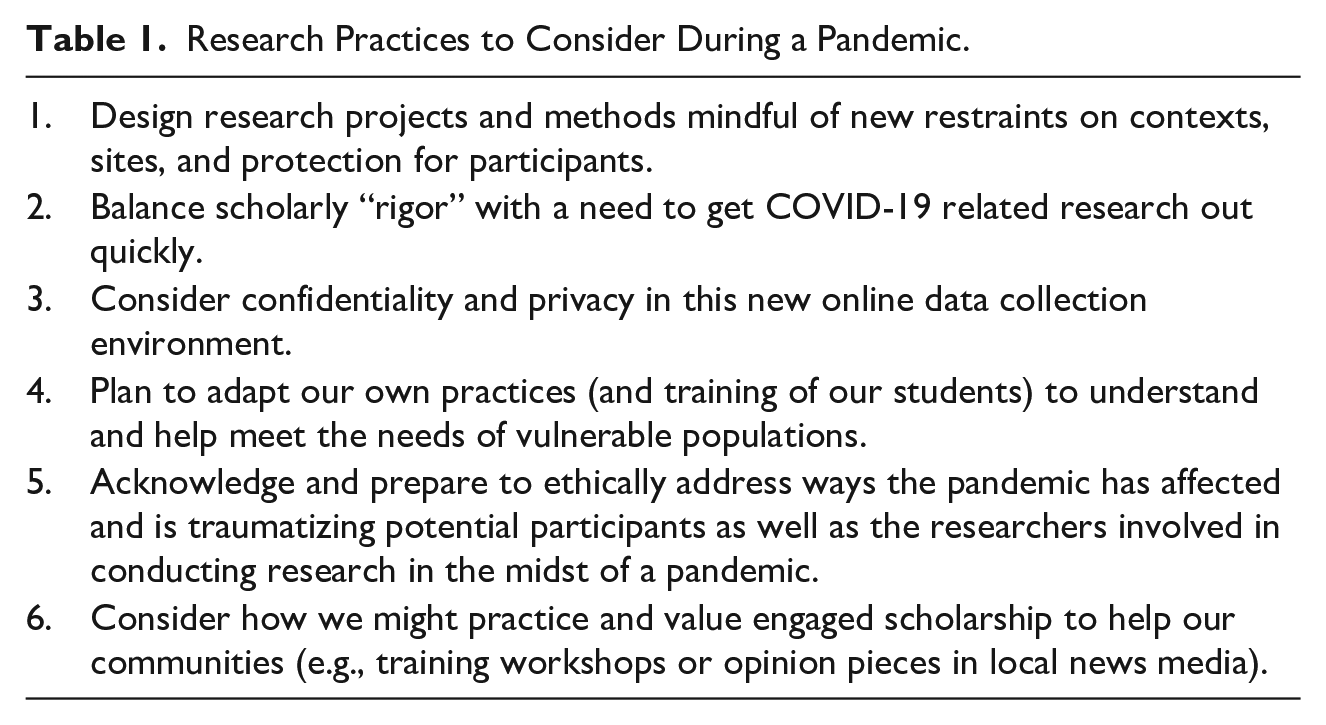
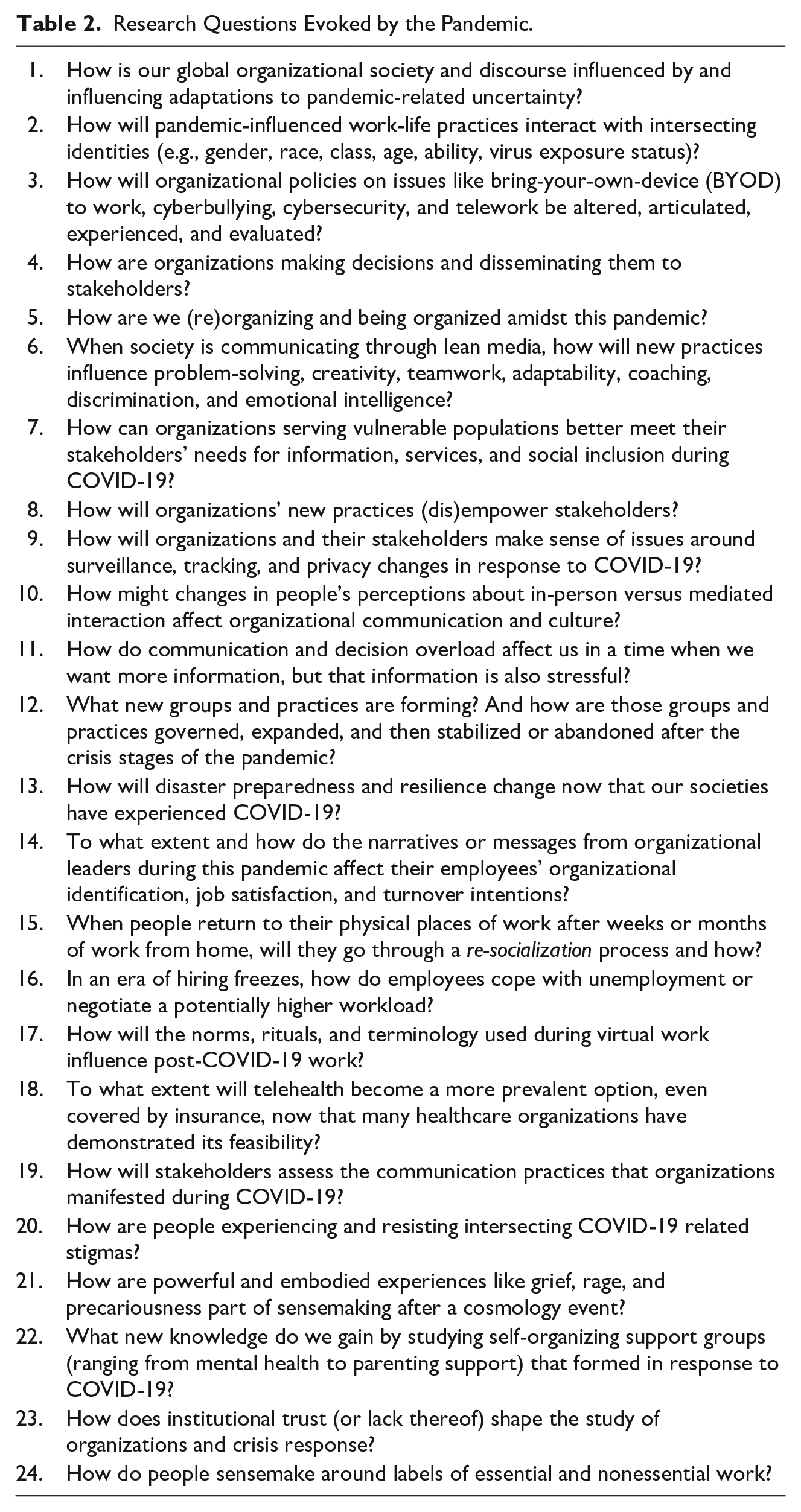
Here, we discuss some plausible futures and their attendant assembly rules for organizational scholars generated through our observations and prior research. These are only ideas and assembly rules to test out for ourselves as part of the double-interacts likely to constitute sensemaking processes about our research in the near future. To guide future research, Table 1 suggests a list of research practice considerations helpful during and after this pandemic. Table 2 provides a list of potential research questions based on our conversation that may spark new directions of research in organizational communication scholarship.
Research Practices to Consider During a Pandemic.
Research Questions Evoked by the Pandemic.
Doing Research through a Pandemic
Keri
Currently, I’m drawing from my past experiences with online research to develop more online data collection methods. I’m also planning to collect interview and observational data using web-conferencing platforms. I feel like those of us who already do this type of research need to teach others the possibilities of conducting research fully online. I’m planning seminars around online experimental design to help our graduate students, who need to redesign their dissertation data collection if they are to finish their degrees without substantial delays.
Rahul
I think it’s okay to also shift the focus and outputs of our research right now. Since 2018, my research lab has been exploring how community leaders organized to address water insecurity in Detroit, especially the mass shutoffs that began in 2014 and have since affected more than 142,000 households (Mesmer et al., 2020). As COVID loomed in March 2020, close to 4,000 residences were without access to running water (and no way to wash their hands), and a further 5,200 were in danger of new shutoffs. Sadly, given the lack of adequate sanitation, low-income residents were particularly vulnerable to the virus, which spread like wildfire throughout Detroit. Our community partners rapidly switched gears to provide COVID relief to Detroit’s most vulnerable residents, donning masks and other protective equipment they produced themselves, and they delivered water, food, and clothing to people who lacked them—often endangering themselves. Many of them contracted the virus.
Our research project pivoted to support our partners. Although, from the start, we’d included community engagement and research translation (such as leading public discussions, educational workshops, creating a blog and sharing data with community partners, Kreps, 2020), I realized we needed to become more public with our work and its implications—even if it meant “being political” and perhaps threatening our legitimacy as researchers. So we embraced social media on a larger scale, amplified our partners’ and research participants’ voices on health disparities, and commented ourselves on how our data indicated structural racism and how water infrastructure and public health were interconnected. I wrote an opinion piece in a prominent local magazine on why addressing water insecurity through short-, medium-, and long-term measures was crucial to not only protect us from COVID-19 but also to safeguard against future risks.
Bo
I couldn’t agree with Rahul more. During COVID-19, we need to pay special attention to vulnerable populations. In any crisis, the people who are most likely to be affected, and are most in need of help, are people who are already underserved and disadvantaged. In my own research, I’ve been studying older adults’ learning and use of technology for health information to make informed decisions. In times like this, older adults are in triple jeopardy: more likely to develop serious conditions, less likely to know how to use online services (e.g., shopping online for groceries and essential supplies, using telehealth), and more likely to experience social isolation as a result of social distancing (Xie, et al., 2020). Other groups may face similar challenges, including individuals with disabilities and homeless people, to name just a few.
Rahul
A trend I see, especially for ethnographic research with populations particularly susceptible to Coronavirus, is greater reliance on virtual techniques (Hallett & Barber, 2014). Projects already underway must likely shift to completing interviews via Zoom or Skype. For researchers beginning new projects, this means negotiating entry into online spaces that might have earlier been deemed the “back end” of organizing, compared to the “front end” of face-to-face open forums where they could more easily have gained confidence (Gajjala, 2002). Scholars will find it useful to (re)learn the methodological and axiological precepts of virtual ethnography. This might involve tracing the ongoing intersections of online and offline practices and being attuned to the social cues, privileges, and barriers therein (Boellstorff et al., 2012).
I hope we will see scholars using a variety of data collection methods. Gaining in popularity may be photo-video methods (PVMs) and mapping, where participants take pictures or film video (Wilhoit, 2017; see also, Wilhoit, this issue, and Gist-Mackey & Kingsford, this issue), and/or produce maps of their organizing and organizational spaces (de Oliveira D’Antona et al., 2008). Screen capture tools installed on participants’ devices prior to online organizational meetings can help scholars understand both verbal and nonverbal communication practices, even as mediated shadowing (using wearable technology or geographic information system mapping) can uncover movements and spaces inaccessible to researchers due to the pandemic. Concurrently, more scholars might adopt personal narrative, hand-drawn or photographic images, poetic writing, or autoethnography to analyze and re-present organizing and organizational experiences. Although several monographs and edited volumes (e.g., Herrmann, 2017) showcase the strengths of such research practices, few peer-reviewed articles using them have been published in the field’s top journals, including MCQ.
Stephanie
One thing is clear: Many of us will need to come up with creative ways of conducting research. In my case, our research team just got a grant to study how compassionate communication is practiced in long-term care homes amidst the usual constraints, but COVID-19 has changed the game completely, both for care providers and for those of us trying to get access to our research sites. Once access restrictions ease, it’s possible the overall landscape of field sites (in our case long-term care facilities) might have shifted so much that it will be necessary to rethink what participation could be like, especially when it comes to action research. I’ve seen this uncertainty and adaptation echoed on my institution’s research ethics board, where we are seeing, as Rahul evokes, other researchers rapidly rethinking data collection for studies already underway or planned to begin soon. A particular concern at the moment is how to best maintain confidentiality during data collection, including cyber security concerns with platforms such as Zoom and Skype that substitute for in-person interviews and observations.
Jody
The pandemic has delayed my research plans with wildland fire participants and sites. I’ve decided to use this time to critically reflect on how my existing research can be helpful to my wildland fire constituents. I’ve reached out to various interagency fire folks to see what opportunities exist to contribute content to blogs, newsletters, classes, and other venues. But an individual scholar’s ability to switch to such outputs is tied up in their job security and what their organization values in retention, promotion, and tenure decisions. I feel grateful for this pause in research because I can reflect on the issues that have always motivated my work, and translate what I’ve learned over the past 14 years into insights and tips. It reminds me that a powerful gift we, as organizational communication researchers, can share is language to articulate the challenging, deeply personal, alienating, and scary aspects of their organizational lives. We can help generate new ways to enact and select their experiences. Once people can label what they are experiencing, they can begin to deal with it—and we can help with that journey, too!
Pui
This pandemic has prompted me to ask questions I would not otherwise have thought of asking when conducting research. Generally, I tend to approach research from the post-positivist paradigm and get curious about relationships between variables that contribute to more or less effective communication within organizations. With the complexity and massive consequences of this pandemic, I’ve found myself pondering issues traditionally addressed within the interpretive or critical realms. I crave stories people have to tell about their COVID-19 experiences. I want to hear their voices, emotions, metaphors, struggles, and successes navigating their work-life during this pandemic. For instance, I see the face mask as a rhetorical artifact whose meaning has shifted from a visual racist trope (“an Asian with a mask has coronavirus”) to a CDC-recommended protective gear (“Wear a mask to slow the spread of COVID-19”) to a community building exercise (“Donate homemade fabric face masks to your local hospitals”). Amidst the stresses, I see a unique opportunity to move beyond my comfort zone and realize the importance of viewing the world through multiple lenses. Indeed, this crisis is too big for a researcher to address from one view alone. It requires us to integrate our paradigms, to acknowledge our individual values and emotions, and to work collaboratively to offer more holistic solutions to the many new organizational and social problems this pandemic gives rise to.
Jeannette
Most of my research is conducted online. Because I primarily study risk communication on social media, I’ve been able to continue this work, but I shifted my focus to risk communication about the pandemic. My research team moved quickly and we were awarded funding from the National Science Foundation to carry out this work. The challenge I face is a feeling of obligation: This event requires immediate and sustained research attention because lives are at stake. But I also feel incredibly fortunate because I can make a contribution to crisis, disaster, and organizational communication practices in a meaningful way right now.
Bo
Early in my career, I conducted research both online and offline. It will be interesting to revisit the findings from my earlier online research to examine what has changed and what has not (Kazmer & Xie, 2008). I know my goals have changed. In 2015, my collaborators and I received a RAPID research grant from the National Science Foundation to study clinicians’ health information behaviors during the Ebola crisis. The findings were published in a peer-reviewed journal (Xie et al., 2019). So, funding, check; publication, check; as a researcher, my work was done—but was it, really? This time around, I want to see an impact on the real world, to make a real difference. Writing an opinion paper is just a necessary first step taken to gather a group of researchers interested in dedicating years or maybe even decades to work on these topics. In our opinion paper (Xie et al., 2020), we called for measuring the real world impact of our research. Clinicians such as doctors and nurses working on the frontline are valued by the direct impact they have on the patients, as it should be. For researchers in information science (like me), should we try to promote the concept of “information clinicians” in which our work would be assessed in terms of contributions to positive changes on the frontline during global health crises?
Eric
Organizational responses to COVID-19, particularly in terms of culture change, innovation, learning, and technology adoption, are of particular interest to me and can be further explored from a distance. However, I worry about these findings’ potential obsolescence by the time they hit the press. I’ve observed our colleagues in the hard science disciplines getting their COVID-19 related research published as soon as a few weeks after submission. Communication scholars should consider additional methods to quickly get their most meaningful work in front of those who can readily benefit from it. Additionally, our discipline as a collective might consider measures to promote the expedited dissemination of time-sensitive research and recognize the scholars whose work contributes to tangible, accessible solutions.
Pui
This pandemic will likely get us to re-envision many old organizational problems. Specifically, there are several important research directions to consider around organizational culture, organizational identification, and socialization as we onboard new employees and return to what will likely be old workspaces with new meanings attached.
Eric
Yes, I think organizational cultures are going to evolve as a result of COVID-19, inviting researchers to revisit the work of Schein (1992) and Keyton (2005) through the lens of telework. While mission, vision, and values can easily be shared on a website, scholars may be prompted to examine other cultural elements of the virtual organization, such as new norms and the impact of virtual rituals on physical spaces.
Similarly, Lewis’ (2011) work on organizational change may enjoy renewed interest in the wake of COVID-19. The equivocality that follows the disruption of unplanned change will be met with affected stakeholders sharing concerns, varying perspectives, and stories about their experience. These joint efforts to determine “what is really going on” and “what do I do now” inherently refer to sensemaking. Scholars may investigate the stories stakeholders share, detailing their unique experiences pertaining to COVID-19 induced changes.
Research to Practice: Service and Translation
Rahul
For me, Weickian modes of selection and retention, and epistemological frames of research methods and participant engagement are blurred, perhaps because I study not so much formal organizations but processes of organizing by social actors in our communities. I see a growth in opportunities for organizational communication scholars to engage with community organizing and collective action to address new questions in response to COVID. We can explore how to be better research partners (Mitra, 2020). We also need to consider how to better account for powerful emotions like grief and rage that are part of making sense of this new context of organizing. Finally, given the social polarization around us based on political affiliation, location, race, and class (to mention but a few), we should ask how institutional trust (or lack thereof) shapes the study of organizations and crisis response. After all, lack of trust extends not just to political and media organizations, but also to scholarly institutions—both among the general population and, more worryingly, among vulnerable Black and Brown communities, for whom the COVID response brings fears of a new Tuskegee (Jaiswal, 2019).
Stephanie
Rahul’s framing of research as service to the communities studied really speaks to me. I think the post-crisis era will bring a lot of opportunities for partnership between academia, governments, and the private sector, echoing what happened after World War Two. We may indeed find that researcher service to collective efforts at rebuilding or to helping communities in need may become a new and important measurement by which our contributions as scholars will be evaluated by our institutions.
Eric
Rahul and Stephanie make salient points about our roles as not only researchers, but also community partners and servants. The post-COVID-19 crisis world represents an opportunity for organizational scholars to develop the depth and relevance of our expertise, and make a substantial positive impact on the world. For instance, physical distancing increases our dependence on communication technologies to build and maintain social relationships with family, friends, and coworkers (Galea et al., 2020), which will highlight the global inequalities of the digital divide (van Deursen & van Dijk, 2019).
Stephanie
Through the notion of “essential service,” the COVID-19 crisis has brought to the fore of collective consciousness the importance of previously invisible contributions by undervalued workers such as hospital cleaners and orderlies, care workers, online shopping and delivery personnel, and migrant agricultural laborers. The crisis has laid bare the fact that they provide the bedrock infrastructure allowing the economy to function (Lucas, 2011). An undercurrent I see in this growing awareness is a call for deep structural change, for collective political effort to realign the distribution of wealth through more equitable pay that could raise such workers from situations of extreme precarity. Similarly, the income supplements given to citizens during the crisis have fueled debate about a universal basic income guarantee versus conservative concerns that such initiatives could undercut the incentive to work. The inevitable changes will likely play out differently across countries and regions, and their meaning will be studied by organizational scholars for decades to come.
Jody
I want to add to Stephanie’s point that the economy truly depends on frontline workers risking their lives to help keep the economy churning. There has been a persistent shortage of basic personal protective equipment (PPE) in the US during this crisis—even for medical personnel. I fear that COVID-19 sets a dangerous precedent that employers can compel employees to perform their jobs without the necessary PPE and not be held accountable.
Eric
When the economy opens and hiring begins to pick up, companies will have a better sense of the work that can be completed remotely and the associated cost savings. As a result, job hunters hoping for a lucrative relocation package or travel budget may be disappointed. Learning and development within organizations may shift to more e-learning as managers realize onboarding and skills training can be facilitated remotely. COVID-19 is challenging the notion that one must be in the office to be a significant contributor to organizational performance.
Expect some shifts in academia as well. We are currently observing universities freezing hiring or rescinding job offers. Schools seeking to hire newly minted PhDs for tenure track positions may expect to see CV lines detailing online teaching experience and demonstrated skill with Zoom, MS Teams, or Adobe Connect. Universities may re-assess their current Learning Management System selections, some opting for a more robust platform that can provide an efficient, high quality online learning experience.
Jody
With COVID-19 comprising multiple crises at once, I am curious to see whether and how disaster response, particularly to wildfires, will change this season. This includes things like incident command systems (ICS) adapting to social distancing requirements and how the federal government might staff large, long-duration fires without using traditional close quarters “fire camps” with high touch surfaces, tight spaces, and hygiene problems even under the best of circumstances. Further, with all the potential changes to wildland firefighting practice resulting from attempts to avoid spreading the virus, I can’t help but wonder what unintended consequences there might be to fireline safety.
Keri
I find this conversation regarding expanding the goal of academic research into the community and partnering with practitioners to be exciting, and a bit concerning. I truly believe this is how our work will get recognized by the general public, and then they will not treat us as scholars stuck in esoteric thought exercises. This is precisely the type of work many funding agencies want to see, and from my own experience, it has been my most meaningful work. My concern is for junior scholars whose promotions rely on publishing in specific academic journals and conducting research making scholarly contributions. We can’t be naïve and act like doing engaged scholarship takes the same amount of time as traditional academic work, and many academic organizations explicitly do not count engaged scholarship toward tenure and promotion. So I hope many of us will share our best practices for accomplishing all of these tasks: being an academic, helping the community, working with practitioners, involving our undergraduate and graduate students, and being happy people. We want to watch out for sensemaking in the academy around this crisis creating expectations that academics can just add engaged scholarship in on top of everything else they are doing. Perhaps COVID-19 will be the wake-up call we need to open the eyes of academic decision makers who have the power to reward more translational and engaged work.
In the midst of this pandemic, we also cannot abandon the important research that is already ongoing that does not focus on COVID-19. If we do, there are potential intellectual losses in our knowledge growth as a field. We may need to shift how we conduct research, but organizational scholars already have meaningful research agendas that should (continue to) be pursued.
Summary
In our efforts to both sensemake and sensegive, our team shared personal and research stories, explored how organizations are responding during this cosmology event, and selected ideas for research where our field may have new opportunities. We summarize some projected research practices and considerations post-COVID-19 crisis in Table 1, and offer a list of research questions surrounding this pandemic in Table 2. These lists are not meant to be authoritative nor exhaustive, but to provide potential directions for investigating organizational communication during and after this global crisis.
Through our reflections, four takeaways became clear. First, this pandemic is a cascading disaster affecting us in unimaginable ways. Second, this pandemic is likely to permanently change organizations and organizing practices. Third, this pandemic calls for interdisciplinary, long-term research efforts employing creative approaches. Fourth, however feasible this may be, COVID-19 is a wake-up call for us, as organizational scholars, to join forces with our community partners to translate our work into practical solutions that make a meaningful change. Writing this piece was therapeutic for us; it helped us make sense of the uncertainty and facilitated our realizations that there are things we can control even in the midst of chaos. But more important, we hope that our collaborative agenda-setting serves a sensemaking function for you, as well, and sparks ideas for the discipline as we face a new personal and professional future.
Footnotes
Declaration of Conflicting Interests
The author(s) declared no potential conflicts of interest with respect to the research, authorship, and/or publication of this article.
Funding
The author(s) received no financial support for the research, authorship, and/or publication of this article.
