




Abstract
This study examined the extent to which having colleagues as friends on Facebook influences departmental and organizational identification by blurring the boundaries between work and private life. Based on social identity theory and proxy efficacy, we argue that work-related friends on Facebook may affect employee identification with different levels of the organization. The results of an online panel study among Dutch employees (N = 1,002) show that the perceived quality of online relationships with work-related Facebook contacts increases departmental identification, whereas the perceived authority of such contacts strengthens identification with the organization. Therefore, we suggest that blurring boundaries between work and private life through social media can have positive effects on organizational functioning.
The boundaries between work and private life are blurring, and social media has contributed to this process (Ollier-Malaterre, Rothbard, & Berg, 2013). Recent studies have addressed the issues surrounding achieving a work–life balance in relation to social media use (see Qualman, 2012, for an overview), stressing the spillover effects between different areas of life (Fieseler, Meckel, & Ranzini, 2015; Kinnunen, Feldt, Geurts, & Pulkkinen, 2006). We contribute to this body of research by exploring the consequences of work-related connections on Facebook. Because work is not a solely rational endeavor, emotions are important for understanding the relational dynamics at work, and because people do not set aside their personal feelings as soon as they “clock in” at work, their work life can be influenced by their affective states.
Relationships are so important that they serve as ends in themselves (Gersick, Dutton, & Bartunek, 2000) but are also the means through which work is accomplished. Sometimes the organizational context blurs with relational dynamics. As Gottman (2007) has shown, informal conversations at work between organization members of different hierarchical levels can, for example, make status differences less salient: “I notice you, independent of your position” (Gottman, 2007, p. 49). Hence, informal connections may have spillover effects from the work context into private life and vice versa (Kinnunen et al., 2006). It is, therefore, reasonable to assume that friendly relationships have important consequences for work. Aside from the economic outcomes of friendships (Uzzi, 1996), affectivity generally leads to trust, sympathy (Ingram & Zou, 2008), identification (Hogg & Hains, 1998), creativity, career development (Sias, Gallagher, Kopaneva, & Pedersen, 2012), and blurred boundaries between work and private life (Pedersen & Lewis, 2012). In general, satisfaction with colleagues and friendships at work can strongly influence an individual’s job and life satisfaction (Simon, Judge, & Halvorsen-Ganepola, 2010).
Although a body of research on the impact of social media in a professional context has emerged over the past few years (Berkelaar & Buzzanell, 2015; Cao, Guo, Vogel, & Zhang, 2016; Leftheriotis & Giannakos, 2014; Moqbel, Nevo, & Kock, 2013; van Zoonen, Verhoeven, & Vliegenthart, 2016), less is known about the role of work-related Facebook contacts when it comes to developing a strong identification with one’s organization. Facebook is a social medium used for both private and work-related content (Ollier-Malaterre et al., 2013) and recent research has shown that Facebook is important for work-related employee evaluations (Batenburg & Bartels, 2017; van Prooijen, Ranzini, & Bartels, 2018). We argue, therefore, that befriending colleagues on Facebook may also have important implications for identification processes. Consistent with this notion, the current study investigated how work-related friends on Facebook may affect employee identification with different levels of the organization. More specifically, we explored how the perceived quality of online relationships with work-related Facebook contacts and the perceived authority or power of such contacts is associated with identification with one’s department (i.e., close colleagues) and with the overall organization. The paper is structured as follows: we derive formal, testable hypotheses and introduce a conceptual framework with the key concepts of organizational identification, perceptions of the quality of communication, and contact authority. Based on this framework, we describe our survey study, present the results, and discuss the theoretical and managerial implications.
Literature Review
Organizational Identification
The answer to the question “Who am I now?” is crucial to people’s understanding of their selves and their surroundings (Taylor, 1989). The importance of this understanding is reflected in the width, length, breadth, and depth of recent reviews on the topics of identity and identification (e.g., Ashforth, 2016; Brown, 2019; He & Brown, 2013). Communication scholars have theorized (Scott, Corman, & Cheney, 1998) and shown (Kuhn & Nelson, 2002) how identification is a communicative accomplishment. Although the “perception of oneness” might be considered a cerebral endeavor, the system of identification (cf. Scott et al., 1998, pp. 301-311) is created, maintained, and changed through interactions. Through a range of connections, people attach themselves to different organizational foci, which vary across time and place (Stephens & Dailey, 2012).
Mirroring the duality of structure in structuration theory, Scott et al. (1998) made a distinction between identity and identification. Here, identity is the structural marker for a sense of self, while identification covers the dynamic process of identity negotiation through interactions. It may be confusing that what is generally perceived as identification in management and organization literature does not refer to identification from a structuration perspective but to social identity, as it indicates perceived membership in a social collective (Scott et al., 1998, p. 304).
In the present study, we follow the traditional approach where “organizational identification” refers to the relationship between individuals and the organization. This conceptualization of identification refers to “the perception of oneness with or belongingness to an organization, where the individual defines him or herself in terms of the organization(s) of which he or she is a member” (Mael & Ashforth, 1992, p. 104). We do not label this as social identity because we use organizational identification scales in our study. Moreover, rather than examining how employees communicatively construct their identities via virtual communication with Facebook friends, we focus on explaining how virtual relationships influence feelings or perceptions of oneness. This line of research indicates that organizational identification is an important factor in explaining employee behavior (Ashforth, Harrison, & Corley, 2008; Bartels, Pruyn, de Jong, & Joustra, 2007; Bolinger, Klotz, & Leavitt, 2018; van Vuuren, Teurlings, & Bohlmeijer, 2012). Stronger identification leads to higher levels of job satisfaction, more extra-role behaviors, lower intentions to leave the organization, and less employee absenteeism. In other words, employees who identify strongly with their organization are more willing to “go the extra mile.”
Employees’ positive organizational behaviors also affect the organization’s culture. Research has shown that job satisfaction among employees may lead to positive behaviors toward customers, which in turn enhances customer satisfaction (Maxham, Netemeyer, & Lichtenstein, 2008; Wieseke, Kraus, Ahearne, & Mikolon, 2012). Thus, employees’ identification with their organization eventually leads to positive evaluations of the organization by the external environment—that is, customers.
Multiple Organizational Identifications
It is important to note that employee identification may have different foci. Ashforth and Johnson (2001) introduced different organizational identification foci as a consequence of modern working relations that are often temporary (hence, job insecurity). Since then, several studies have found that employee identification with different levels of an organization can have a different set of determinants (Bartels et al., 2007; Scott, 1997) and different consequences (Riketta & van Dick, 2005), which requires different strategies for managing them (Larson & Pepper, 2003). These “targets” of identification are important for understanding how the different attachments can become compatible, conflicting, competing, or colliding. But the identification source—the resources that lead to the structuring of identities (cf. Scott et al., 1998)—is relatively underexplored. Meisenbach and Kramer (2014) showed how the activities of choir members lead to identification, oftentimes more with the activity of singing than with the choir itself. They called for research investigating how different types of activities fuel organizational and other types of identification.
The current study takes these activities into the virtual realm. For many people, online connections become as real as offline ones. Thus, being Facebook friends with colleagues could become a resource for further identification with different targets. More precisely, we argue that the perceived quality of online relationships with work-related Facebook contacts is likely to increase departmental identification, while the perceived authority of such contacts may strengthen identification with the overall organization.
Perceived Quality of Online Relations and Departmental Identification
Although the importance of offline communication in organizations for employee identification has been evident for some time (Bartels et al., 2007; Wiesenfeld, Raghuram, & Garud, 1999), empirical research into the employee-identification consequences of employees’ social media use is scarce (Fieseler et al., 2015; van Zoonen, Bartels, van Prooijen, & Schouten, 2018). A crucial question is whether online relationships with colleagues serve the same roles as offline relationships. The current study conceptualizes perceived relationship quality as relational ties with an exchange partner (Palmatier, 2008). Relationship quality is multifaceted, focusing on, for example, commitment, trust, and reciprocity norms (De Wulf, Odekerken-Schröder, & Iacobucci, 2001). Positive experiences with colleagues strengthen satisfaction at work (Simon et al., 2010). This is consistent with affective events theory (Weiss & Cropanzano, 1996), which states that the subjective experience with interactions influences one’s attitude toward the broader environment. This may have positive consequences—e.g., having a good laugh with colleagues in a bar may affect the working relationship the next day—but also negative ones—e.g., bullied organization members are likely to have weaker identification with the work unit (cf. Branch, Ramsay, & Barker, 2012).
In short, affective experiences may influence identification, and this influence may occur in both online and offline interactions. Therefore, we expect that affective experiences online (i.e., positive evaluation of the contact quality with colleagues on Facebook) will lead to stronger identification with one’s department (i.e., with one’s close colleagues). Sias, Pedersen, Gallagher, & Kopaneva (2012) demonstrated the affective capacity of online relationships. Specifically, they found that employees were able to initiate friendships with coworkers in the absence of physical proximity. Consistent with this, we hypothesize that the friendship effect also holds true for informal communication with work-related Facebook contacts because the platform creates a virtual interaction space where ties can develop (Lee, Mazmanian, & Perlow, in press).
Moreover, Bartels, Peters, de Jong, Pruyn, and van der Molen (2010) found that positive perceptions of horizontal informal communication with colleagues were more strongly connected to employee identification with a closer entity (e.g., a profession) than to an overall identity (e.g., the entire organization). We assume that horizontal informal communication with colleagues leads to similar identification processes when employees evaluate their quality of contact with colleagues online. Therefore, we hypothesize the following:
We do not expect relationship quality to have a direct effect on overall organizational identification because earlier research in an offline context has shown that the quality of informal horizontal communication has no relationship with organizational identification (Postmes, Tanis, & de Wit, 2001). However, work-related Facebook contacts may affect identification with the overall organization through a different process, as explained below.
Perceived Contact Authority and Organizational Identification
A significant characteristic of social media is its anarchistic nature; social media tends to blur the boundaries between people who would not easily approach each other in real life (van Zoonen et al., 2016). The online world is anarchistic in that anyone can contact anyone. Online platforms provide an opportunity to contact people at work who are higher up in the hierarchy or are perceived as more powerful. Although friendship and identification are correlated because of the effects of cohesiveness and similarity (Hogg & Hains, 1998), authority issues confound these effects. Contact authority refers to the extent to which network partners have unique knowledge, skills, and capability to influence resource decisions (Anderson, Hakansson, & Johanson, 1994). An employee with contacts that include important decision makers could have better access to valuable organizational information. More attractive network partners provide access to and control over more valuable information and resources, which supports increased value creation from network ties (Baum, Calabrese, & Silverman, 2000).
Research suggests that workplace friendships are less likely to emerge in more bureaucratic organizations, (Mao, Chen, & Hsieh, 2009). However, because status differences are less visible online than offline, it is easier for people to bypass the organizational structure and contact people in authority positions online than to walk into the office of someone higher up in the organization’s hierarchy. Having a person with perceived authority as a friend on Facebook may help people identify more closely with the overall organization because proximity to those in power leads to identification in a similar way as proximity to skilled others can lead to confidence (cf. Bandura’s 2002 proxy efficacy). Consistent with the notion of group prototypicality (Hogg, 2001), proximity to the central figure of a relevant category strengthens one’s identification with that category. Moreover, having online Facebook friends who are influential in the organization may also lead to feelings of having more control over important organizational decisions. These feelings are often connected to positive evaluations of procedural justice or with the feeling of being “treated fairly.” Previous research on organizational justice has found a strong positive relationship between procedural justice and organizational identification (McFarlin & Sweeney, 1992; Olkkonen & Lipponen, 2006). Thus, although friendship leads to departmental identification via interpersonal liking (H1), we propose that the perceived authority or power of work-related Facebook contacts increases identification with the overall organization. Therefore, we hypothesize the following:
Method
Context
To test our hypotheses, we conducted an online cross sectional survey among a convenience sample of Dutch employees N = 1,002. Data were collected via a market research company in February 2016. We instructed the market research company to select participants who had a full-time job (for the Netherlands, meaning more than 32 hours per week) and a Facebook account. All participants completed an online questionnaire to determine their perceptions of online contacts and their commitment to the organization.
Measures
The quality of the Facebook relationships was measured using a four-item scale based on Palmatier (2008). An example item was “I think that colleagues I am friends with on Facebook are long-term relationships” (Cronbach’s α = .90). Contact authority (i.e., the decision-making capability of relational contacts) was measured using a three-item scale (Palmatier, 2008; Cronbach’s α = .92). An example item was “Colleagues that I am friends with on Facebook deal with the important decision makers in our company.” Employee identification with the department and with the organization were both measured using the three-item solidarity subscale of social identification by Leach et al. (2008). An example item was “I feel a bond with my department/organization.” The scales were reliable (Cronbach’s αdepartment = .97 and Cronbach’s α organization = .96). Because of high correlations between department and organizational identification, we conducted additional analyses to check whether both constructs were perceived as distinct. The results showed that both constructs were not one-factor constructs. The one-factor solution did not fit (χ2/df = 194.43; CFI =.794; TLI = .656; RMSEA = .440; SRMR = .095), while the correlated two-factor solution had an adequate fit (χ2/df = 7.42; CFI = .994; TLI = .989; RMSEA = .080; SRMR = .008).
The following control variables were included in the study:
Demographics: Age, gender, income, and education.
Facebook usage: General Facebook usage, number of Facebook contacts, and number of colleagues on Facebook. General Facebook usage was measured using a four-item Likert scale based on Ellison, Steinfeld, and Lampe (2007; 1 = totally disagree, 7 = totally agree). An example item was “I use Facebook on a daily basis.” The scale was reliable (Cronbach’s α = .80).
Type of contract: Number of years working at the organization, temporary versus permanent contract, supervisor role, and full- versus part-time employment.
Organizational characteristics: Number of employees and industry type.
Intention to leave the organization was measured with a Likert scale with one item: “How likely would you leave your current organization within the next two years?” (1 = very unlikely, 7 = very likely).
Data Analysis
To test our hypotheses, we conducted structural equation modeling in AMOS SPSS 23.0 (Arbuckle, 2014). We used the following fit statistics: chi-square estimate with degrees of freedom (χ2/df), comparative fit index (CFI), Tucker-Lewis index (TLI), and the root mean squared error of approximation (RMSEA). The criteria for acceptance of χ2/df vary across studies, ranging from less than 2 (Ullman, 2001) to less than 5 (Bentler, 1989; Schumacker & Lomax, 2004). Hu and Bentler (1999) further recommended using a cut-off value over 0.90 or 0.95 for CFI and TLI, respectively, and a value of less than 0.08 for the RMSEA.
Three alternative models were used to compare the hypotheses with possible alternative explanations (see Figure 1). We tested these three models cross-sectionally. The hypothesized model relates quality of Facebook relationships only to departmental identification and contact authority only to organizational identification. In alternative model I, contact authority is related to departmental identification, whereas quality of Facebook relationships is related to organizational identification. Finally, in alternative model II, both quality of Facebook relationships and contact authority are related to departmental and organizational identification. We included quality of Facebook relationships, contact authority, departmental identification, and organizational identification as the latent variables with the observed items as manifest variables.
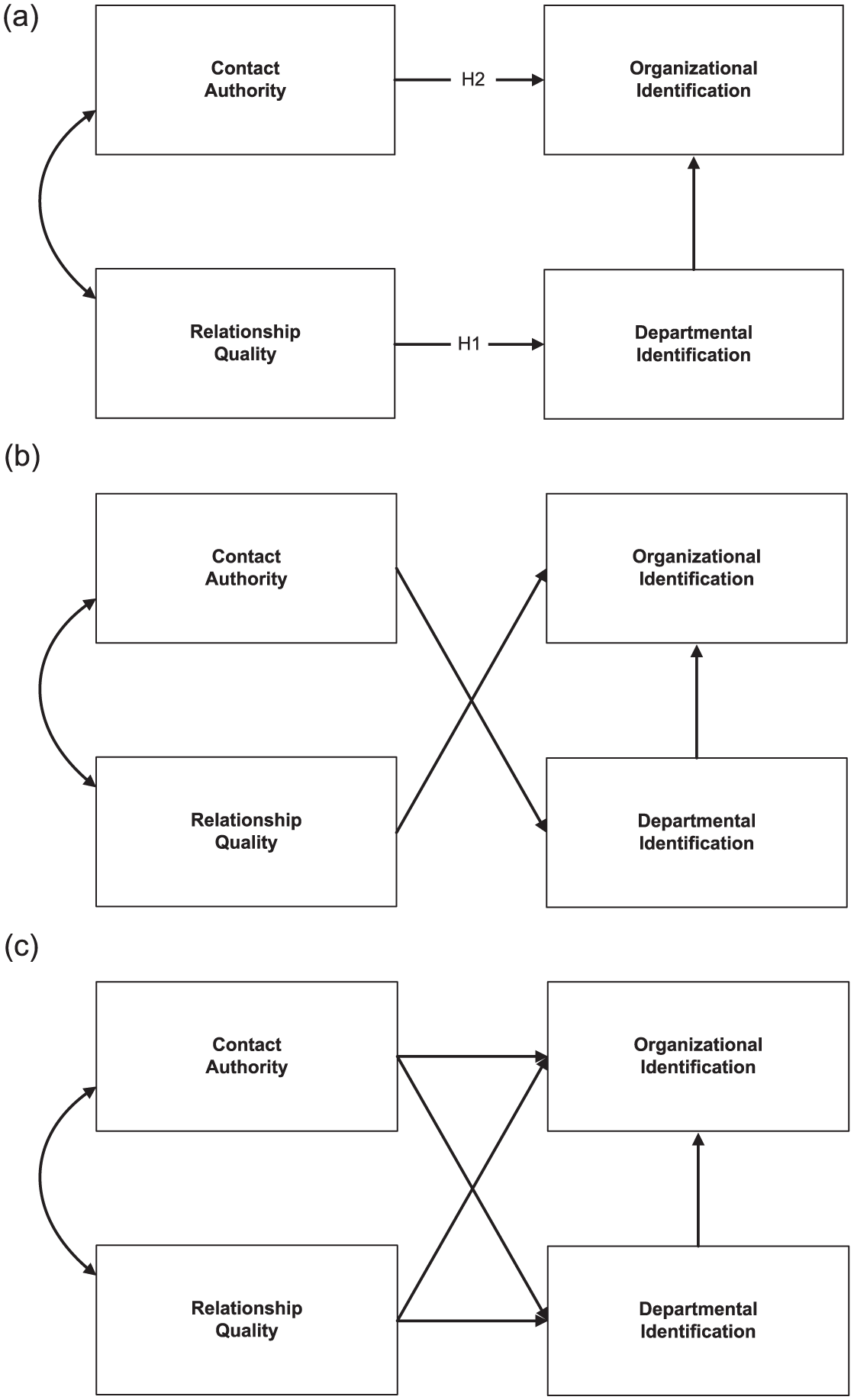
(a) Hypothesized model, (b) alternative model I, and (c) alternative model II.
Results
Descriptive Statistics
Table 1 shows the means, standard deviations, and correlations of all the variables. Departmental identification (M = 5.34) was higher than organizational identification (M = 5.03). A paired t-test demonstrated that this difference was significant (t = 7.85, df = 514, p < .001). The respondents identified more strongly with their department than with the organization. There was a strong positive correlation between departmental and organizational identification (r = .80; p < .001).
Descriptive Statistics and Intercorrelations Among Study Variables (N = 1,002).
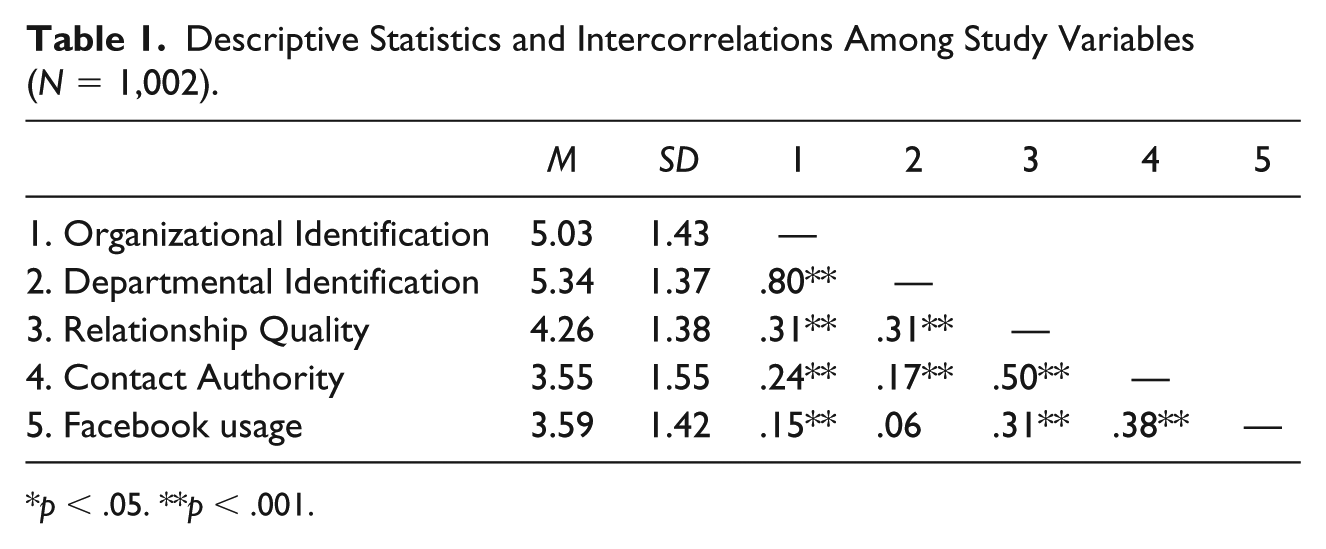
p < .05. **p < .001.
Measurement Model Variables
Using a first-order confirmatory factor analysis, the measurement model estimated the extent to which the observed items loaded onto their respective latent variables. All latent constructs, but no observed error variances, were allowed to covary with one another. The measurement model without control variables generated a good fit (χ2/df = 5.08; CFI = .983; TLI = .977; RMSEA = .064; SRMR = .035).
We checked whether the control variables had an effect on the fit of the measurement model. In Table 2, the comparisons of the fit statistics of the different measurement models are shown. The measurement model without control variables is in Row 1, with age, gender, education, and income in Row 2, Facebook usage, number of Facebook contacts, and number colleagues on Facebook in Row 3, type and duration of employee contract in Row 4, number of employees in the organization and industry type in Row 5, and employees’ intention to leave the organization in Row 6.
Fit Statistics Measurement Models Without and With Control Variables.
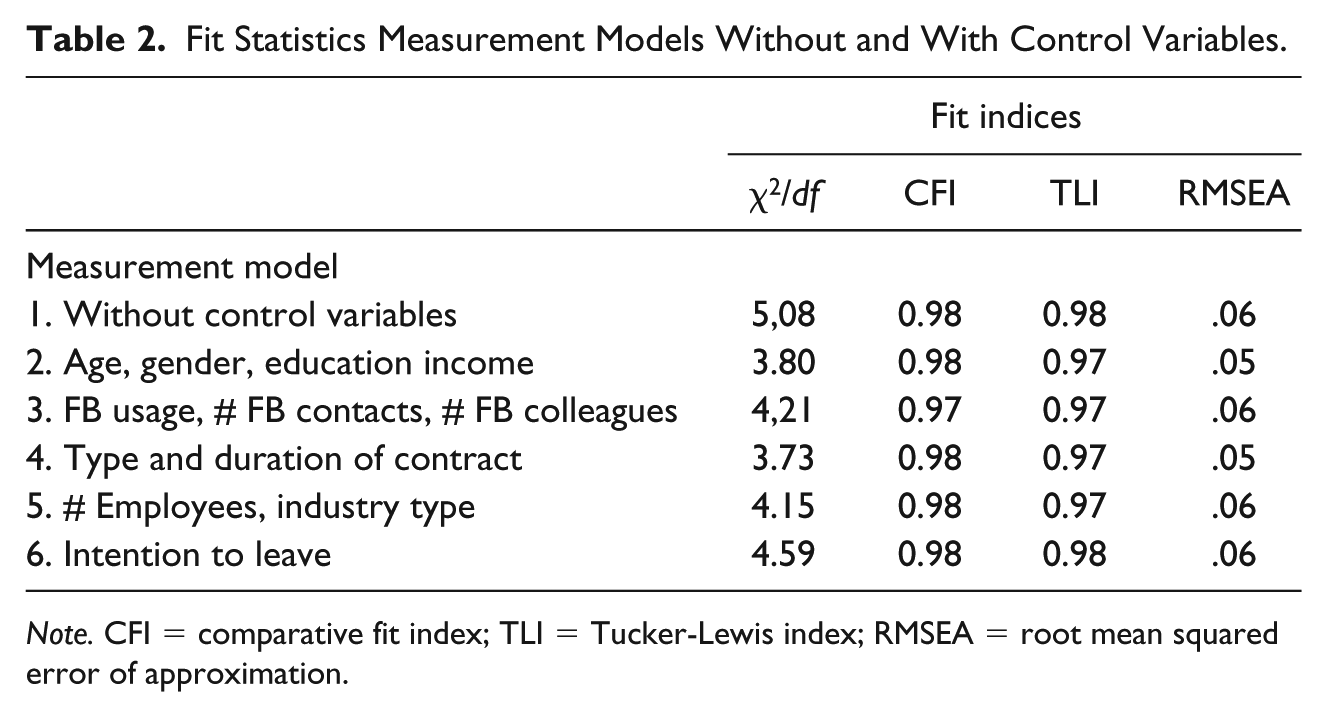
Note. CFI = comparative fit index; TLI = Tucker-Lewis index; RMSEA = root mean squared error of approximation.
Because the measurement models with control variables did not clearly improve the fit statistics, we estimated the structural model without the control variables.
Hypotheses Testing
The proposed structural model had a good fit (χ2/df = 4.93; CFI = .983; TLI = .978; RMSEA = .063; SRMR = .035). Alternative model I, in which quality of Facebook relationships was related to organizational identification and contact authority was related to departmental identification, fit the data (χ2/df = 6.11; CFI = .978; TLI = .971; RMSEA = .063; SRMR = .078). Both relationships were significant at p <.01. Alternative model II, in which the quality of Facebook relationships and contact authority were both connected to departmental and organizational identification, fit the data (χ2/df = 5.08; CFI = .983; TLI = .977; RMSEA = .064; SRMR =.035). However, the relationships of the hypothesized model were only significant in alternative model II.
We used the Akaike information criterion (AIC) to compare the hypothesized model with alternative models I and II. The AIC is a measure of the relative quality of statistical models (Burnham & Anderson, 2004) in which the model with the lowest AIC value has the best fit. The hypothesized model had the lowest AIC value (AIC = 386.51) compared with alternative model I (AIC = 458.73) and alternative model II (AIC = 389.59). Finally, the hypothesized structural model with Facebook usage as a control variable had a much higher AIC (AIC = 660.52) than without the control variable. Based on the AIC values, the hypothesized model without the control variable seems to hold. In this model, the perceived quality of Facebook relationships with colleagues had a positive relationship with departmental identification (β = .26; p < .01). Contact authority had a positive relationship with organizational identification (β = .13; p < .01). Thus, the results confirm hypotheses 1 and 2. The final model can be found in Figure 2.
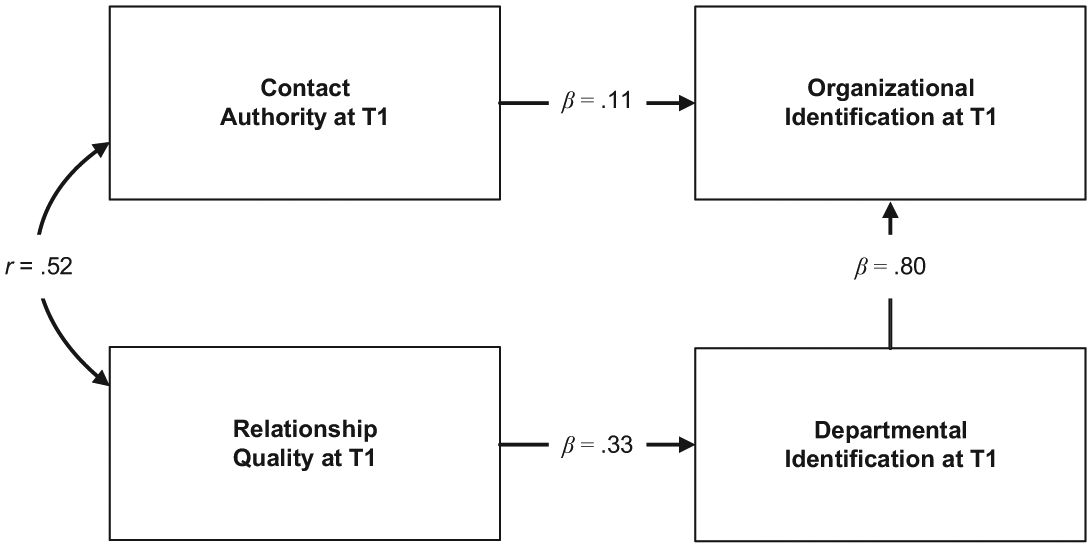
Final model.
Discussion
Conclusion and Discussion
The current study investigated the role of professional Facebook contacts on employee identification with the department and organization. The current study contributes to research on social media use in organizational contexts by suggesting that positive perceptions of having colleagues on Facebook can lead to stronger employee commitment at different organizational levels. More specifically, the results showed that first, if employees experience their online colleagues on Facebook as “real” friends, they are more committed to the department (H1) and, second, having a colleague on Facebook who tends to have some form of power in an organization is associated with greater employee commitment to the overall organization (H2).
The current study extends previous research in four ways. First, previous work on friendship behaviors in an offline context has shown that having coworkers as friends produces positive effects on an employee’s well-being (Branch et al., 2012; Simon et al., 2010). Our results suggest there may also be a spillover effect: online professional friendships affect employees’ positive feelings toward the organization. In other words, the mere fact of being friends on Facebook can have agency as a resource that serves as further identification, as Scott et al. (1998) proposed. Integration of online and offline environments is not limited to webshops and advertising; it also influences the core motivation of stakeholders. Second, the results confirm the role of proxy efficacy (Bandura, 2002) in an online context. Hence, if an employee has colleagues on Facebook who seem to have some power in the organization, this could lead to the employee feeling more a part of that organization.
Third, the current study extends work on contact authority and power perceptions in an online employee context. When explaining customer value, contact authority has been primarily restricted to the relationships between an organization and its external relational contacts (Palmatier, 2008); here, contact authority refers to the extent to which a network partner has a unique expertise in being able to influence decisions (Anderson et al., 1994). Higher contact authority (more power) means that relational contacts have higher decision-making capabilities (e.g., better access to more valuable information and resources; Baum et al., 2000) and hence become more attractive. Our results indicate that perceptions of power may also have a positive impact within an online employee context.
Finally, the current study contributes to the growing body of research emphasizing the importance of explaining the role of social media in an organizational context (Batenburg & Bartels, 2017; Fieseler et al., 2015; van Prooijen et al., 2018; Weber, Fulk, & Monge, 2016). Aside from the possible negative impacts of social media on organizational life (Andreassen, Torsheim, & Pallesen, 2014; van Zoonen et al., 2016), our results suggest that the online blurring of boundaries may also have positive effects in the form of employee identification with different levels of the organization.
Practical Implications
Social media has become pivotal in society and organizational life. Therefore, organizations must pay closer attention to developments in the social media sphere. Instead of focusing on the possible negative counterproductive work behaviors related to social media use in organizations (Landers & Callan, 2014; Lim, 2002), the current study shows that active use of Facebook, for example, may enhance employee commitment. More specifically, perceiving colleagues as online friends is linked with stronger identification with the department or organization. In turn, this could lead to positive work outcomes and more satisfied employees. Therefore, managers should consider encouraging the use of social media to further online personal relationships that could then lead to more friendship-based relationships in an offline and online context.
To enhance employee identification with the overall organization, managers could create a positive communication climate within the organization. Research has already shown that positive perceptions of the vertical communication within an organization lead to stronger organizational identification (Bartels et al., 2010). Creating an atmosphere that supports accepting a supervisor’s Facebook request could improve employee commitment to the overall organization. However, managers should be careful in implementing these strategies. Previous research indicates that some employees simply do not wish to be befriended by “their boss” online (Peluchette, Karl, & Fertig, 2013). Management should accept that employees can reject Facebook requests. Moreover, there may come the question of whether management has a hidden agenda in inviting their employees on a social media website. In short, the use of Facebook as a tool for improving internal relationships seems to be a delicate, but also a potentially fruitful, enterprise.
Limitations and Future Directions
Confirmation of our hypotheses suggests a link between identification and social media behavior. Given the influential dynamics underlying these crucial factors, it becomes even more important to critically assess the outcomes of the current study. Therefore, we identify a few potential threats to the present study’s validity. First, since we tested the hypotheses cross- sectionally, the current study could not rule out common method bias (Podsakoff, MacKenzie, Lee, & Podsakoff, 2003). However, Harman’s single factor tests showed that both the independent variables and the dependent variables were correlated but perceived as distinct constructs. Moreover, we tested an alternative model with department and organizational identification as independent variables and contact quality and contact authority as dependent variables. This model did not meet the fit criteria. However, the use of cross-sectional data prevent definitive claims of causality.
Second, it was assumed that employees did engage in online relationships with their colleagues via Facebook, but there may also be a possibility that employees intentionally separate private life and work life using different boundary management strategies (Batenburg & Bartels, 2017; Ollier-Malaterre et al., 2013). The current study does not present strong conclusions about these strategies, instead merely suggesting that including colleagues on Facebook will lead to positive effects for both employees and organizations. People may accept others as “friends” on social network sites (SNSs) regardless of closeness, because rejecting or ignoring a friendship request is perceived as risky behavior (boyd, 2008). Future research should include employees’ boundary management strategies in explaining their commitment to the organization. More specifically, offline and online segmentation and integration preferences between private life and work life could influence the relationship between the perceptions of having colleagues on Facebook and employee identification. The reasons for accepting or rejecting friendships were investigated in a qualitative research study by Peluchette et al. (2013), who found completely different reasons for accepting a boss’ friendship request than for rejecting such a request. The arguments for accepting a request were generally focused on the status and power aspects (e.g., better job opportunities). On the other hand, the arguments for rejecting a request focused mainly on dividing private and work life. The current study did not focus on these different arguments. However, future research could further empirically investigate these different reasons. For example, future research could focus on the effect of offering different scenarios (and risks) of the consequences of accepting or rejecting a Facebook request from a supervisor or colleague.
Third, although the sample comprised a variety of organizations, we did not account for organizational culture or more specific social norms. Because much research shows that social norms play an important role in behavior (Cialdini, Reno, & Kallgren, 1990; Postmes, Spears, & Lea, 2000), one might wonder how these norms influence the acceptance or rejection of colleagues’ Facebook requests and, in turn, influence employee perceptions of their Facebook contacts. More specifically, Blanchard and Henle (2008) found that employee perceptions of their coworkers’ and supervisors’ norms influenced online behaviors during work hours. Future research could investigate how these social norms influence the relationship between perceptions of the quality of Facebook contacts and employee identification. Finally, we tried to explain the processes concerning Facebook contacts in a professional context in predicting departmental identification and organizational identification. Identifying the link between employee identification and positive offline behaviors toward the organization (Feather & Rauter, 2004; Riketta & van Dick, 2005), future research could also focus on the online citizenship behavior of employees. More specifically, research could investigate the relationship between professional Facebook contacts and positive electronic word of mouth about the employee’s organization (Eisingerich, Chun, Liu, Jia, & Belle, 2015) and the possible mediating role of employee identification in this relationship.
Conclusion
The current study extends previous knowledge on the role of social media in a professional context. Employees with positive perceptions of the quality of their online relationships and who are associated with people with a degree of power will identify more strongly with the organization. Blurring the boundaries between work life and private life via social media can lead to positive outcomes. Thus, when a colleague is also an online Facebook friend, this relationship may eventually lead to a better work environment for both employees and their organization.
Footnotes
Acknowledgements
The author(s) wish to acknowledge three anonymous reviewers and the editor for their valuable feedback on earlier versions of this article.
Declaration of Conflicting Interests
The author(s) declared no potential conflicts of interest with respect to the research, authorship, and/or publication of this article.
Funding
The author(s) disclosed receipt of the following financial support for the research, authorship, and/or publication of this article: The first author received financial support for the research from Vrije Universiteit Amsterdam, Department of Communication Science, The Netherlands.
