



Abstract
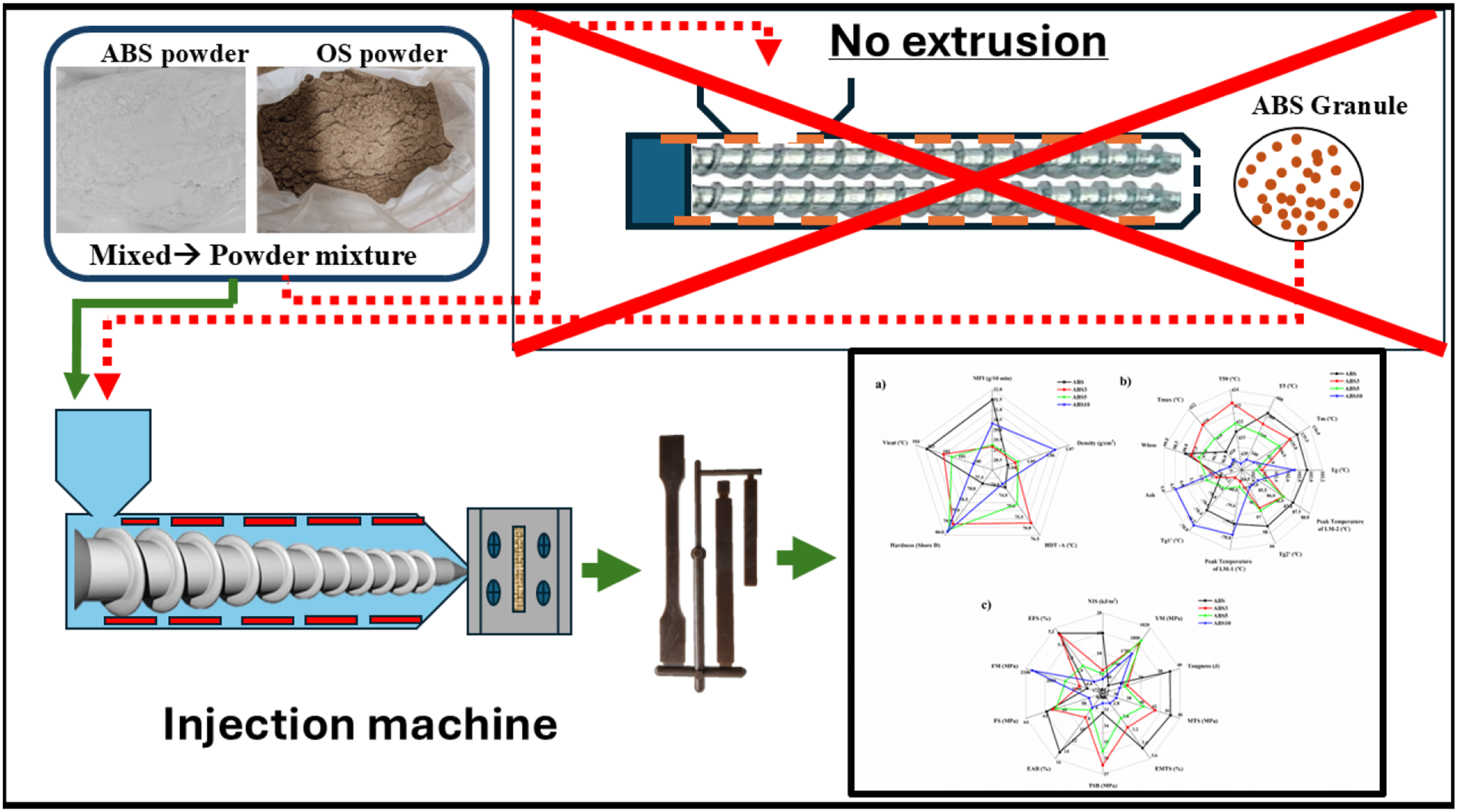
This study investigates the development of novel biocomposites by blending powdered acrylonitrile-butadiene-styrene (ABS) with olive stone (OS) filler via an efficient direct injection method. A comprehensive evaluation of the resulting materials was conducted to ascertain their thermal, mechanical, structural, and visual properties. Thermal analyses indicated strong stability; thermogravimetric analysis (TGA) showed only minor fluctuations (1°C to 3°C) in the maximum decomposition temperature, while differential scanning calorimetry (DSC) and dynamic mechanical analysis (DMA) revealed no substantial changes in glass transition or melting temperatures. From a mechanical standpoint, the integration of OS filler into the material resulted in a notable enhancement in several key mechanical properties, including the storage modulus, Young’s modulus, flexural modulus, and tensile strength at break. However, structural evaluations using Fourier-transform infrared spectroscopy (FTIR) and X-ray diffraction (XRD) confirmed that the matrix-filler interaction was purely physical, lacking chemical bonding. Consequently, scanning electron microscopy (SEM) revealed distinct voids and weak interfacial adhesion between the ABS matrix and OS filler, which accounted for a general decline in other mechanical performance parameters. Furthermore, visual and physical assessments demonstrated that elevated OS concentrations systematically augmented the composite’s overall density and darkened its color. While direct injection has been demonstrated to be a viable manufacturing approach for these biocomposites, the findings of this study highlight the necessity of future research focused on incorporating surface treatments or compatibilizers to enhance interfacial adhesion and fully realize the material’s mechanical potential.
Get full access to this article
View all access options for this article.
References
Supplementary Material
Please find the following supplemental material available below.
For Open Access articles published under a Creative Commons License, all supplemental material carries the same license as the article it is associated with.
For non-Open Access articles published, all supplemental material carries a non-exclusive license, and permission requests for re-use of supplemental material or any part of supplemental material shall be sent directly to the copyright owner as specified in the copyright notice associated with the article.
