



Abstract
Product engineering is a highly complex process faced with many challenges. To meet today’s challenges of society, such as climate change, energy production and demands, and demographic shifts, and to achieve economic success for companies, technical solutions in products and systems must evolve and advance. Hereby, university research provides a potent source of cutting-edge technologies and knowledge that companies can use as input to advance their solutions. However, many challenges and barriers hinder the process of transferring new technologies, concepts, and knowledge from research to corporate engineering. In this article, we present 22 recommendations to improve the usability of research results for the activities and processes of corporate product engineering. These recommendations address the three relevant target groups: (I) corporate engineers and companies, (II) researchers and research facilities, and (III) funding agencies and (research) policymakers. First, we offer recommendations for corporate engineers and companies to integrate research results more efficiently. Second, we present recommendations for researchers and research facilities to support the promotion and transferability of their research results. Third, we provide recommendations for funding agencies and (research) policymakers to positively influence the usability of research results in corporate engineering. We expect that implementing one or more of our recommendations will enhance the efficiency of knowledge and technology transfer into corporate product engineering. We anticipate this will lead to faster technological advancements for companies and social benefits by addressing today’s major challenges more effectively.
Keywords
Introduction (background and motivation)
Currently, Nvidia’s growth appears to be limitless. 1 The company specializes in producing microchips and holds a prime position in the field of AI applications. Microchips are the brain for various applications, including 5G, autonomous driving, and artificial intelligence. The main challenge for engineers is to increase these chips’ performance, energy efficiency, and cost-effectiveness. 2 Therefore, they aim to reduce the size of the chips. For this, laser technology must be improved to establish finer structures. A collaborative project between German companies and research institutions TRUMPF Lasersystems for Semiconductor Manufacturing, ZEISS, and Fraunhofer Institute for Applied Optics and Precision Engineering IOF has developed extreme ultraviolet light (EUV) lithography technology. This technology enables the production of “higher-performance and more energy-efficient and cost-effective microchips than ever before in this decade and the next”. 2 Nowadays, EUV technology is a core component within ASML microchip machinery. The collaboration led to more than 2000 patents, the German Federal President’s German Future Prize 2020 (Deutscher Zukunftspreis), and enormous economic success for the partners. This collaboration between research and industry generated over one billion euros in annual turnover and created over 3000 high-tech jobs.2,3 Other examples of successful technology and knowledge transfer from research to industry include Boston Dynamics and their humanoid robots, which originated as a spin-off of MIT’s “Leg Lab.”,4,5 and Apple’s development of their natural language assistant, Siri, based on the technology of a research project led by SRI International.6,7 An example for the relevance and potential of technology and knowledge transfer from research to industry in the area of fiber-reinforced composites is the project SMiLE which is a lighthouse project of the BMBF (German Federal Ministry of Education and Research). 8 SMiLE stands for system-integrative multi-material lightweight construction for electromobility. In this project, German automotive OEMs such as Volkswagen and Audi collaborate with material (e.g., BASF) and machinery (e.g., DIEFFENBACHER) experts as well as research institutions such as Fraunhofer and Karlsruhe Institute of Technology to leverage the potentials of fiber-reinforced composites for automotive bodies in electric mobility.9–11
These examples demonstrate the importance and advantages of close interaction between research and corporate product engineering to promote innovation. It is crucial to have an efficient transfer of technology and knowledge from research to companies to deal with the complexity and speed of current technological and societal challenges, such as those in the fields of climate, energy, or demographic shift. 12 However, many challenges still hinder this transfer. Such challenges include poor communication, lack of resources, or IP issues.12–16 Therefore, this contribution aims to provide recommendations for improving the transfer of technologies and knowledge developed in research institutions into companies.
Throughout this paper, we use the term ‘research' to refer to the activities of research facilities, such as universities or other research institutions, like the Fraunhofer Society. We do not consider activities conducted in corporate R&D departments.
We based this contribution on ALBERS’ work, which introduced the model of SGE – System Generation Engineering17,18 (formerly known as the model of PGE – Product Generation Engineering 19 ) and its core element, the reference system, 20 to explain and model each type of development of new products or systems based on already existing elements as input, known as reference system elements. 20
In the following, we present the scientific background that underlies our work. The research profile section details our research goal and methodology. Next, we present our results in the following two sections (measures and recommendations), followed by a discussion section of our results. Finally, we conclude and provide an outlook in the final section.
Reuse of knowledge, technologies, and other (sub-)systems in product engineering
Classical product engineering categorizes design into three main types: original design, adaptive design, and variant design. Original design tackles new engineering challenges by combining known solution principles or newly devised ones. Adaptive design maintains established solution principles while adjusting the embodiment to meet new design requirements. Variant design involves rearranging and resizing existing parts and subsystems within predefined limits while upholding the solution principle. However, drawing precise boundaries between these types for a specific system design is challenging.21,22 Additionally, genuinely original design projects are rare in corporate product engineering, with only about 10% of design activities falling into this category. 21 According to IYER et al., approximately 80% of planned original designs can be achieved by modifying or directly reusing existing designs. 23 ALBERS et al. support these findings, reporting that only 7% of engineering activities are dedicated to original designs, resulting in the majority of activities involving the reuse of existing elements. 19 Leveraging existing solution principles or designs has advantages such as reducing technical and economic risks,24,25 shortening development times, and increasing design flexibility.23,26
The literature presents various approaches for describing a design process that involves reusing existing (sub-)systems, technologies, and knowledge. Under the term “Design Reuse”, the topic originates from informatics and software engineering.
27
It is summarized as “the process of using previous design artifacts in future designs”.
28
Here, the Design Reuse Model explains design by reuse as a process that searches knowledge resources for useful knowledge, retrieves and applies it to the new design.
29
The Flexible Design Model explicitly starts with an existing product and analyzes the market to identify relevant other products. These products serve as input for the new design based on a function analysis and comparison of their technical fulfillment.
30
However, the core elements of these models and processes still lack formalization.
27
With for example, Case-Based Reasoning (CBR) and Model-Based Reasoning (MBR), they offer methodical support for reusing knowledge. CBR aims to provide existing designs to reuse in new designs directly or as the starting point for new designs. MBR generalizes existing designs to provide more general design knowledge as input compared to CBR.29,31 Contrary to the Design Reuse and Flexible Design Model, the C-K-Theory is a highly formalized but abstract design theory using mathematical relations.32,33 The C-K-Theory distinguishes two spaces (sets in a mathematical sense), the
To establish a solid foundation for design research and design support development, ALBERS et al. developed the model of SGE – System Generation Engineering. 19 Therefore, based on the observation of real engineering projects, the model of SGE combines aspects of both the approaches of design reuse and the C-K-Theory. It incorporates a hierarchical and structural concept of the system theory (cf. 34 and 35 ) and the description of the relations of already existing elements as references to the new design on a mathematical basis. The model of SGE can describe and model each type of development of a new system as a new system generation based on a reference system. 19
The reference system within the model of SGE – System Generation Engineering
The reference system comprises all kinds of physical and non-physical – tangible and intangible – elements that engineers use as “the basis and starting point for the development of the new [system] generation”.
20
These elements are modeled as reference system elements.
20
The reference system is a complex system itself that many factors influence.
36
ALBERS et al. further discuss the internal structure of the reference system.
35
Figure 1 illustrates the basic principles of the model of SGE. The reference system within the model of SGE – System Generation Engineering. Each new system generation Gi is developed based on its reference system Ri through carryover variation (CV), attribute variation (AV), and principle variation (PV). The example shows how the first Tesla Roadster 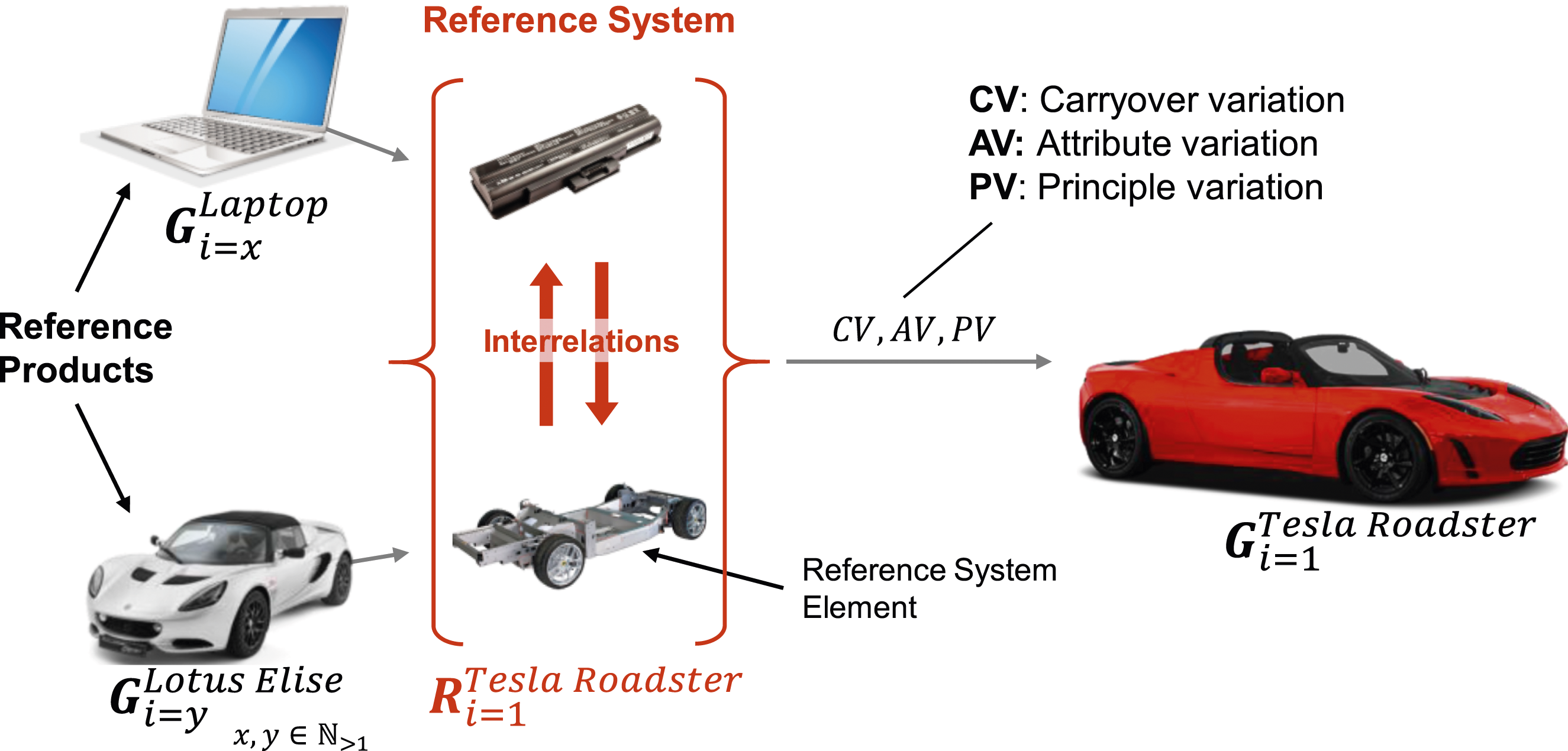
The model of SGE explains how a new system generation (Gi = n) is developed based on the corresponding reference system (Ri = n). The variable i counts the system generations, where i = n represents the system generation in development that will be introduced to the market next. The model of SGE describes the design process as the projection of the reference system elements to the next system generation using a variation operator with three types of variation. First, carryover variation (CV) maintains the reference system elements without any changes. However, if necessary, interfaces are adjusted during the integration into the system in development. Second, attribute variation (AV) preserves the solution principle of the reference system element but modifies attributes such as the embodiment when integrated into the system in development. Third, principle variation (PV) alters the solution principle of the reference system element when integrated into the system in development (e.g., combustion engine vs electric engine).19,20
According to ALBERS et al., reference system elements “originate from already existing or already planned socio-technical systems and the associated documentation”.
20
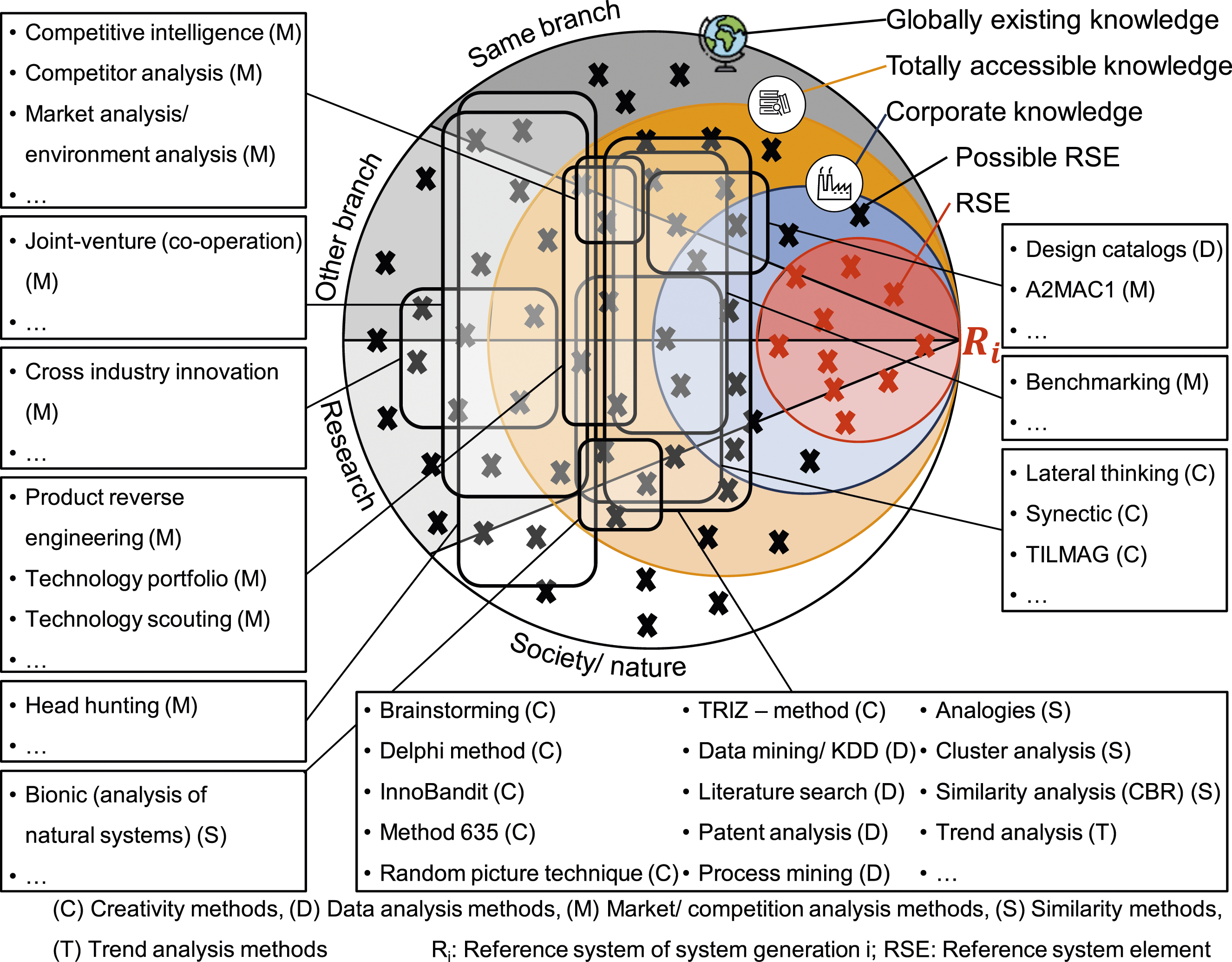
This definition also includes knowledge elements or technologies from research. Most reference system elements originate from previous system generations or further projects known to the engineering team.37,38 However, reference system elements can originate from various sources, including competitors, clients, suppliers, research (as discussed in the next section), nature, or society.20,39,40 Figure 2 presents a systematic analysis of possible sources for reference system elements. A total of 12 knowledge spaces offer potential reference system elements. Additionally, Figure 2 provides an overview of various methods and tools for harvesting these knowledge spaces.
40
12 knowledge spaces offer possible reference system elements (RSEs). Various methods and tools can be used to harvest these knowledge spaces. Reference system elements can originate from the same branch, a different branch, research, or society/ nature. These elements may already be part of the corporate knowledge (internal knowledge), part of the total accessible knowledge, or part of the globally existing knowledge. (based on
40
).
Here, research is a source for potential reference system elements of particular interest.
Research results as reference system elements
Research offers cutting-edge technologies and knowledge.41,42 These advances are essential for corporate product engineering to develop solutions to significant technological and societal challenges, such as those related to climate change, energy, or demographic shifts.
12
In general, efficient usage of research results in corporate product engineering is a primary factor for the success and technological progress.12,13,15,41–43 While corporate engineers know about the value of research results and want to use them more, the integration of research results into their engineering activities needs improvement.
43
The literature describes identifying reference system elements in research and analyzing and managing them as core challenges of using research results as reference system elements.23,27,37 University-company collaboration is one way to transfer knowledge and technology from research into corporate product engineering. These collaborations face, i.a., “transaction-related barriers” and “orientation-related barriers”,
44
as well as company-internal barriers.
15
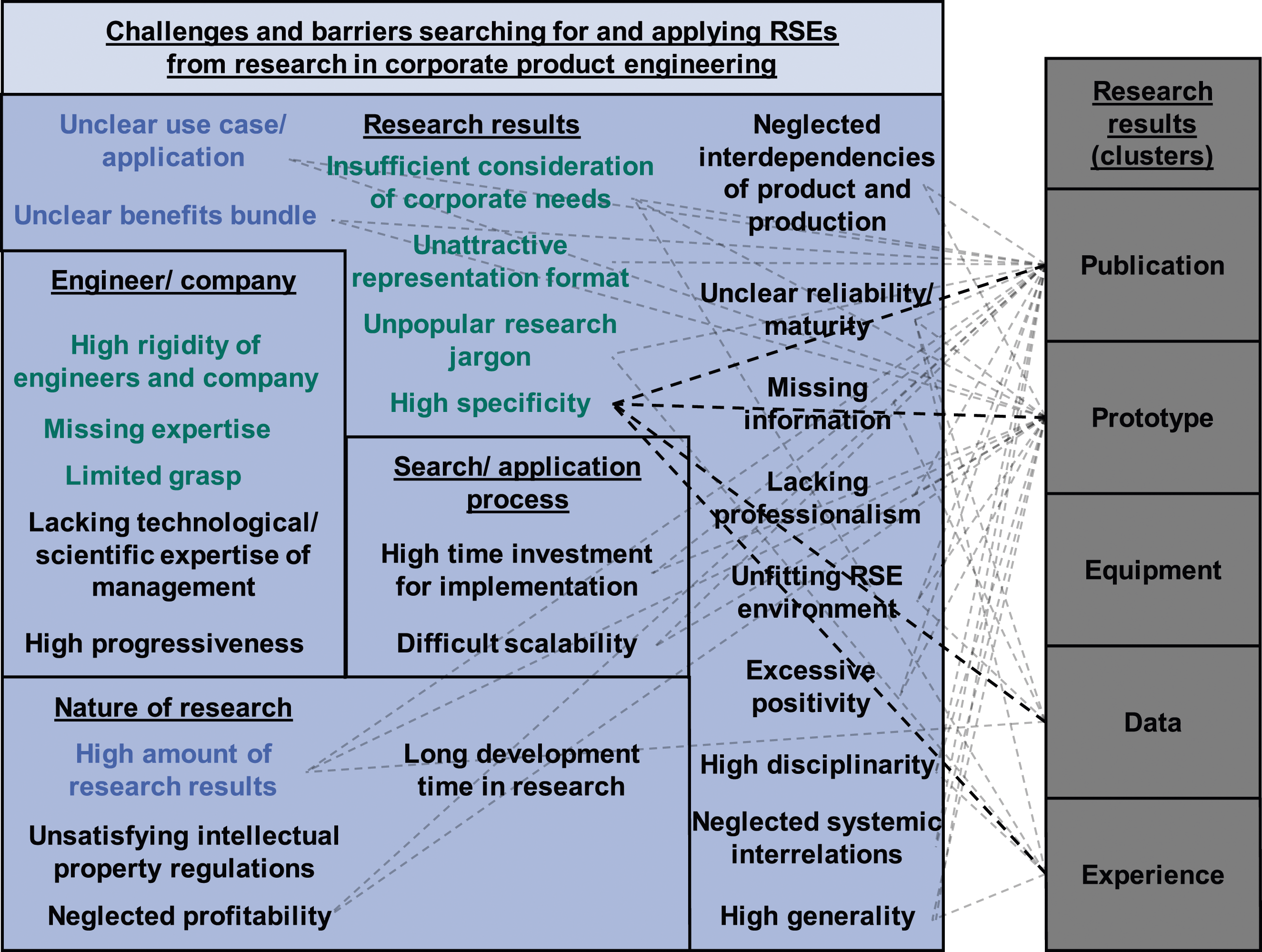
Using research results without direct collaboration offers further challenges. Figure 3 shows an overview of 26 barriers and challenges corporate engineers have to face when searching for reference system elements in research or using them.
16
KEMPF et al. identified challenges and barriers related to the corporate engineer or company, the specific research results, the nature of research, and the search or application process or reference system elements from research. Furthermore, they link these challenges and barriers to different types of research results.
16
Overview of 26 challenges and barriers corporate engineers have to face when searching for reference system elements (RSE) in research or using them. The challenges and barriers affect different research result types (based on
16
).
These challenges and barriers hinder using research results as reference system elements in corporate product engineering. Therefore, they can slow down potential technological advancement. The goal of this contribution is to address the presented challenges as we present in the following.
Research profile – aims and methodology
Research aim and research questions
As presented in the introduction, research is a valuable source for corporate product engineering to search for reference system elements as input for developing new systems and products. However, many challenges exacerbate searching and using research results as reference system elements in corporate product engineering. Thus, the main goal of our paper is to improve the usability of research results as reference system elements in corporate product engineering. Therefore, this contribution aims to provide targeted recommendations to the relevant stakeholders of the knowledge and technology transfer from research into corporate product engineering. We provide recommendations for the three target groups: corporate product engineers and companies, researchers and research facilities, and funding agencies and (research) policymakers. To reach this goal, we formulated the following two research questions, which we answer in this paper: 1. What measures addressing the relevant stakeholders help to overcome the challenges and barriers in using research results as reference system elements in corporate product engineering? 2. How can the three target groups improve the usability of research results as reference system elements in corporate product engineering?
Answering these research questions, we formulate targeted recommendations to improve the usability of research results as reference system elements in corporate product engineering for all three target groups.
Research approach
We followed a two-stage approach to answer the presented research questions and reach the formulated research aim, as presented in Figure 4. Two-stage research approach to answer the research questions. In the first stage, we conducted an on-site workshop with 43 participants in the world-café style to answer the first research question. Based on the first stage, we developed the first version of recommendations, which we validated and refined iteratively in a two-step sounding board. We developed the final set of 22 recommendations to improve the usability of research results as reference system elements in corporate product engineering, answering the second research question.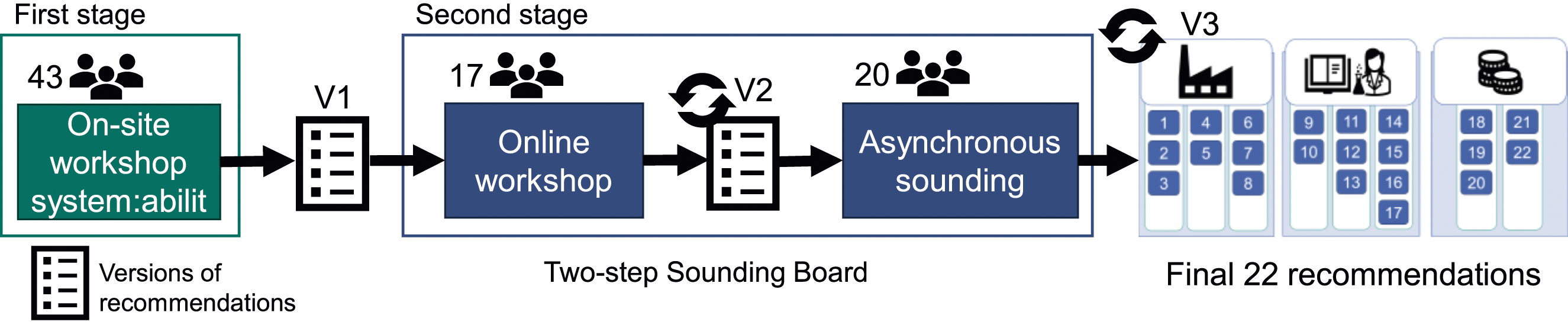
In the first stage, we conducted a 90-min on-site expert workshop with 43 participants from corporate product engineering, research, and research funding and management during the system:ability conference 2023 to answer the first research question. The participants were all associated with research projects funded by the BMBF (German Federal Ministry of Education and Research) within the initiative “Handling the complexity of sociotechnical systems – a report on Advanced Systems Engineering for the value creation of tomorrow (PDA_ASE)” of the “Innovations for Tomorrow’s Production, Services, and Work” research program.
Based on the challenges and barriers of using research results as reference system elements in corporate product engineering, as KEMPF et al. 16 presented, the participants derived and collected measures to overcome these barriers and challenges. To do so, we divided all participants into three groups and organized each group as an independent world-café setting (cf. 45 or 46 ) with two rounds. Thus, we split groups one and two into three teams working on measures addressing one of the three target groups: corporate product engineers/ companies, researchers/ research facilities, and funding agencies/ (research) policymakers. Due to the total number of participants, we split Group 3 into only two teams. As a result, group three did not work on measures and ideas for corporate product engineers/ companies. Each team began by developing and collecting measures addressing one of the target groups during the first round of 30 minutes and documented them on a poster. For the second round, one team member remained with the poster while the others reviewed the results of another team in their group. During a 30-min timeframe, they discussed the results of the first round and added their comments and further input. Finally, in the third step, one team per group presented their findings to all participants for one of the target groups and collected final comments from the plenary within 20 minutes. After the workshop, we condensed the results of all teams, removing duplications, resulting in a total of 66 measures. We present the results of this first stage in the next section.
Based on the set of 66 measures and our expertise, we developed the first version of 24 recommendations by combining similar and related measures. Here, we divided the recommendations into three target groups and eight fields of action. In the second stage, we used a two-step sounding board (cf. 47 or 48 ) approach to develop further and initially validate our set of recommendations with 37 participants in two iterations to answer the second research question. In the first step of the sounding board approach, we conducted a one-hour online workshop with 17 participants using an online whiteboard tool. Here, the 17 participants were all design/ engineering science researchers focused on engineering methods and part of our research groups. All of them had experience in industry-academia collaboration, too. In the workshop, we split the participants into two groups to review and sound 12 out of 24 recommendations per group within 40 minutes. The participants submitted their feedback in writing on sticky notes and providing oral comments. During this period, we engaged in answering questions and receiving oral feedback. The workshop concluded with 10 minutes of open discussion. We used all feedback to revise and develop the second version of the recommendations.
In the second step of the sounding board, we asked an expert group of 20 participants to sound the second version of the recommendations in written form. Here, the participants could choose between online form-based and document-based sounding to meet their preferences. The 20 participants in the second step do not overlap with the previous participants. Eight of the 20 participants were leading German design/ engineering science researchers. Another eight were leading experts in German medium-sized and large companies in the automotive, automation technology, and industrial engineering sectors. Four were part of the German funding agencies working for the BMBF and an industry-driven network. We split the participants into two groups, sounding 13 of the 24 recommendations each (two were sounded by both groups). Figure 5 shows the allocations of the participants to the recommendations. Allocation of the participants into two groups and allocation of recommendations to the groups. Based on the feedback, we rejected the initial recommendations 6 and 21.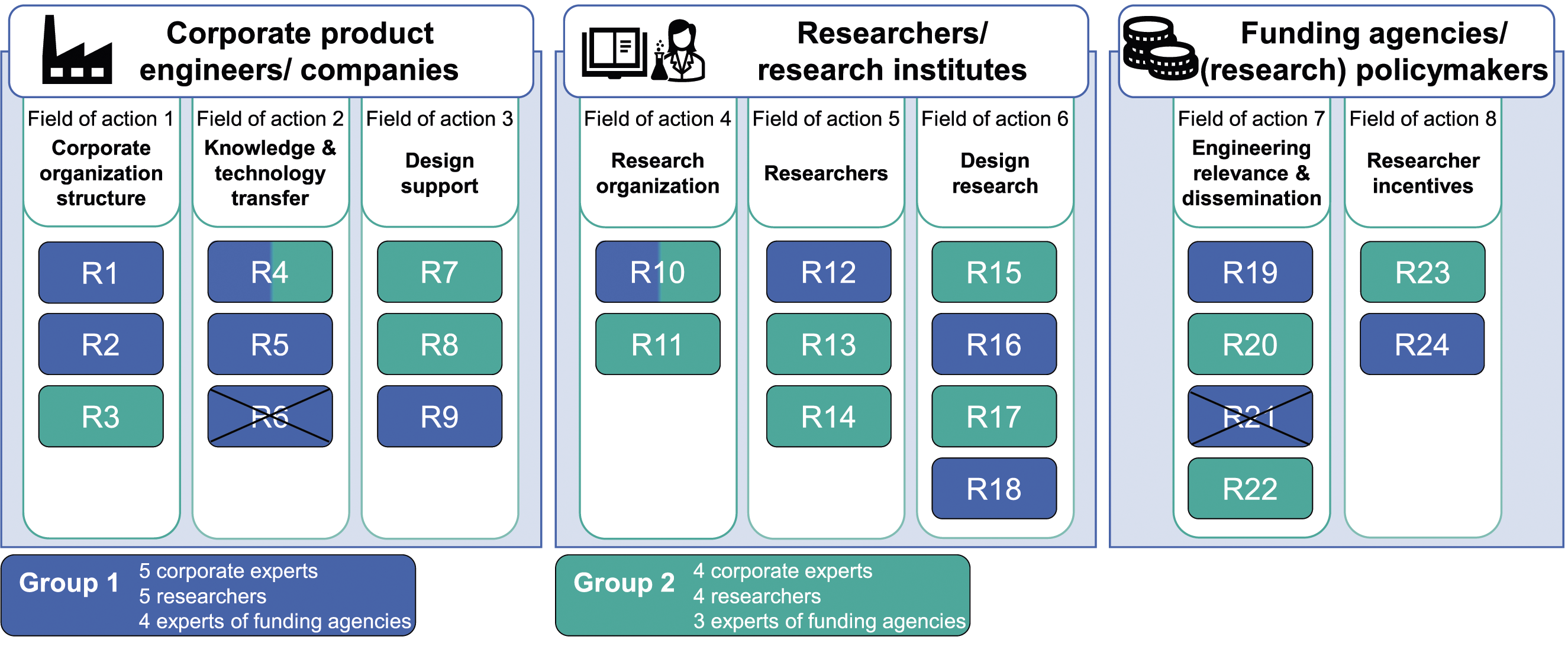
Three participants of the group of funding agencies, one of the researchers, and one of the corporate experts did sound all the recommendations. As guiding questions, we asked the participants to comment on the strengths and weaknesses and to add potential missing aspects or recommendations. Furthermore, we asked the participants to rate the relevance of the recommendations on a six-point Likert scale ranging from 1 – non-relevant to 6 – very relevant. For this round of sounding, we translated the recommendations into German. Based on the sounding board’s feedback, we rejected the initial recommendations 6 and 21 because the sounding board deemed them already implemented or irrelevant. Finally, we developed the final version of 22 recommendations, as presented in the after next section (recommendations).
Following our recommendations, we developed short video clips to present them in an attractive and easily accessible format.
The two-step sounding board was designed and conducted during a master thesis. 49
Measures to overcome the challenges and barriers to using research results as reference system elements in corporate product engineering
Measures to overcome the challenges and barriers in using research results as reference system elements in corporate product engineering developed during the world-café at the system:ability conference.
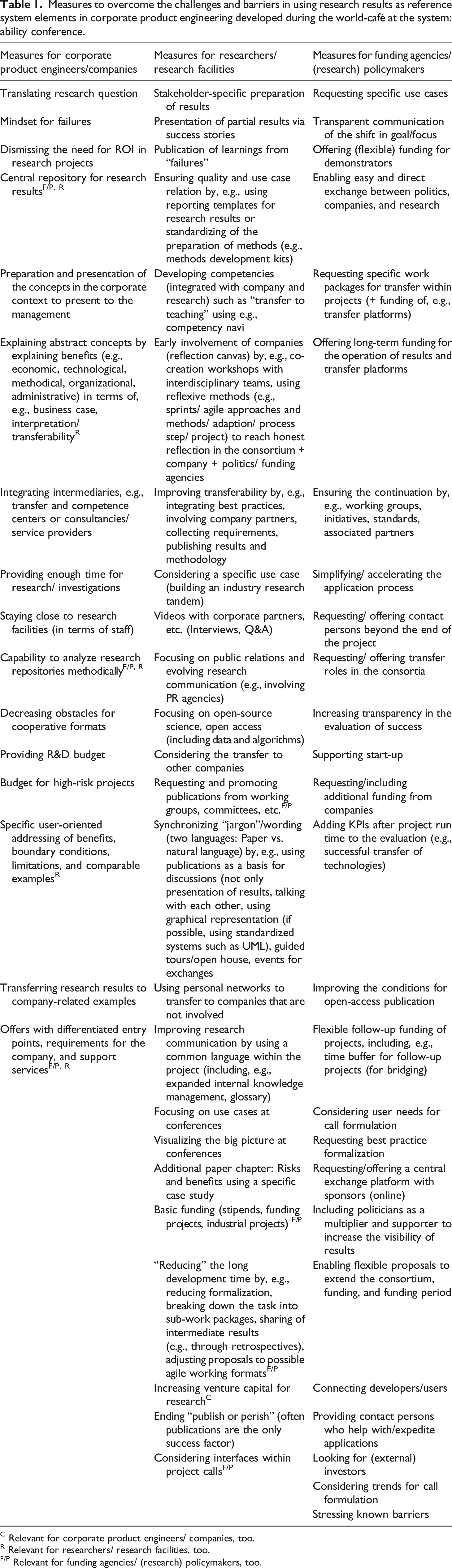
C Relevant for corporate product engineers/ companies, too.
R Relevant for researchers/ research facilities, too.
F/P Relevant for funding agencies/ (research) policymakers, too.
Reviewing the ideas for measures to improve the usability of research results as reference system elements, we observed that some of the participants’ ideas were better suited for a different target group. We marked these inputs with the exponents C, R, and F/P to indicate the fit within the respective target group. Furthermore, we discovered that the participants had difficulties elaborating their ideas in further detail, but they provided us with many ideas for measures covering a wide variety of aspects. These ideas range from presenting research results in alternative formats to soft and hard skills and adjustments to the corporate and research organizations and resources.
Recommendations to improve the usability of research results as reference system elements
Based on the measures presented in the previous section, we developed 22 recommendations for the three target groups: corporate product engineers and companies, researchers and research institutes, and funding agencies and (research) policymakers. We developed eight fields of action that consist of two to four recommendations each. Figure 6 illustrates the allocation of the recommendations to the fields of action. Overview of the 22 final recommendations to improve the usability of research results as reference system elements in corporate product engineering. We allocated the interconnected recommendations to eight fields of action addressing the target groups: corporate product engineers and companies, researchers and research institutes, and funding agencies and (research) policymakers.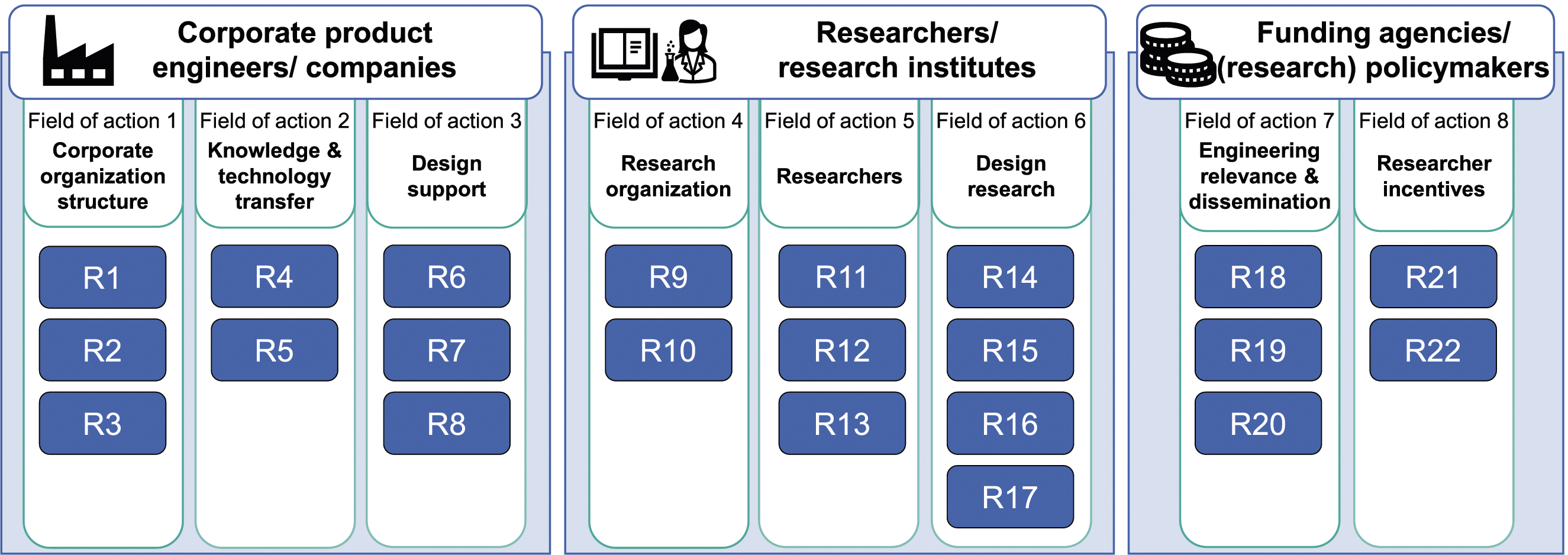
We present the individual recommendations for each target group in the following three subsections. The recommendations presented are the result of the research approach as presented before. In addition to the following explanation, we created short video clips to present all recommendations visually (following our recommendation 12). 50
Recommendations for corporate product engineers/companies
In total, we developed eight recommendations for corporate product engineers and companies to improve the usability of research results within their engineering projects. As shown in Figure 7, we clustered the recommendations within three fields of action. Overview of the recommendations for corporate product engineers and companies. The first three fields of action contain recommendations one to eight addressing the corporate side to improve the usability of research results as reference system elements within their engineering projects.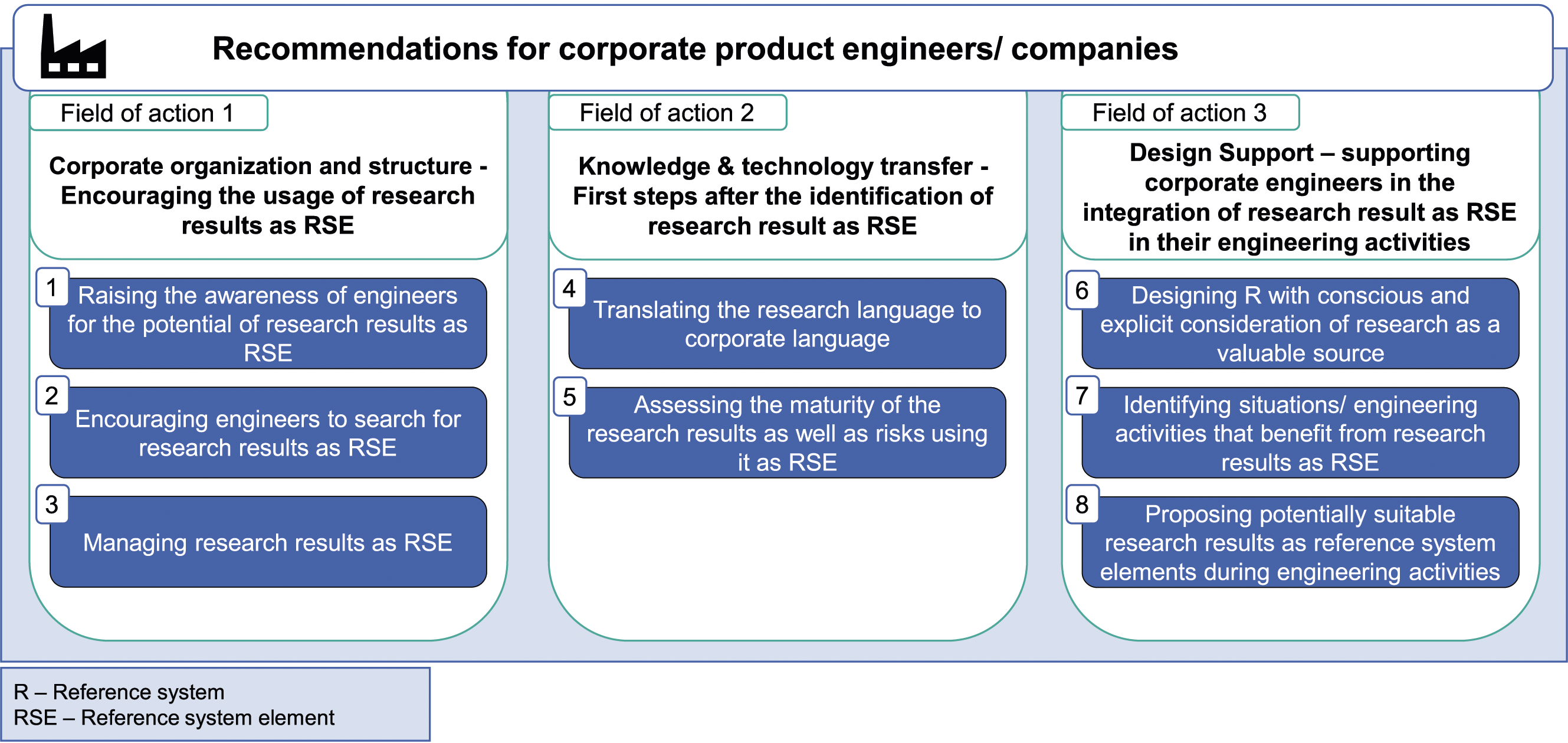
In the following subsections, we present the recommendations for each field of action.
Field of action 1: Corporate organization and structure - encouraging the usage of research results as reference system elements
The first field of action collects recommendations that address the organization and structure of a company. These recommendations aim to create an encouraging environment for product engineers to use research results as reference system elements in their engineering activities.
Recommendation 1: Raising the awareness of engineers for the potential of research results as reference system elements
Companies should regularly (e.g., quarterly) publish updates on the successful integration of technologies, process elements, knowledge elements, etc., from research into their (sub-)systems within the company. E.g., they can post success stories on the intranet or organize internal events. Here, they should include how the company benefited as well as the learnings of the colleagues involved. In addition, companies should share interesting research results with their engineers via regular updates. Even if the persons who identified the research results (e.g., through scouting activities) do not have an application yet, it may trigger another engineer.
Recommendation 2: Encouraging engineers to search for research results as reference system elements
Companies should encourage their engineers to look for research results that can serve as reference system elements. To make this possible, companies should 1. provide their product engineers with a dedicated budget and time to search for valuable and relevant research results. These resources give engineers the freedom to harvest research despite their daily work. 2. Install an open-minded management with a scientific background that encourages the engineers to refer to research results in their engineering activities. 3. Send their engineers to participate in (scientific) conferences to stay up to date on research developments. Furthermore, they should strengthen their networks; novel approaches can spark their association and creativity. 4. Strengthen their collaboration with research facilities (e.g., by conducting collaborative workshops). Thereby, the transfer of concrete research results can be supported. Furthermore, the participating corporate engineers benefit from the researchers’ influence and stay open-minded about the potential of research.
Recommendation 3: Managing research results as reference system elements
Companies should set up a research results management system to centrally coordinate the knowledge and associated information gathered from research. Therefore, the company should collect 1. Research results already used within the company. These research results should be linked to the (sub-)systems they were the basis for or integrated into. 2. Research results with potential that were identified but have not been implemented yet. Initial ideas or potential applications of the research results can be linked to these research results. 3. The research facilities/ researchers and involved partners that developed the research results and link them to the respective research results. 4. Interesting research facilities/ researcher contacts even though they have not used their research results yet. 5. The contacts of the corporate engineers who identified and/ or used the research results and link them to the research results. 6. The in-house contact persons for different research facilities/ researchers and link them to the research facilities/ researchers. 7. The best practices and challenges of the involved product engineers and link them to the research results and/ or research facilities/ researchers.
Field of action 2: Knowledge and technology transfer - first steps after the identification of research results as reference system elements
The second field of action’s recommendations aim to support corporate product engineers in the first steps after they identify potentially valuable and interesting research results.
Recommendation 4: Translating the research language to corporate language
The corporate engineers should translate the uncommon research-specific language used in the research result or its description into a language common to the company (e.g., by reformulating research questions as a description of the topic and goal of the research result). If not described already, corporate engineers should derive 1. The possible use cases and/ or applications of the research results. 2. An (initial) description of the expected benefits of using the research results in their (sub-)systems. Therefore, they should consider the benefit a. For themselves (the company) as a provider of a (sub-)system by using the research result. b. Generated for customers of the (sub-)system when the research result is used in it. c. For the users of the (sub-)system when the research result is used in it.
Recommendation 5: Assessing the maturity of the research results as well as risks using it as reference system elements
Corporate engineers should analyze the maturity and validity of the research result. For example, the Technology Readiness Levels (TRLs – cf. 51 or 52 ) concept can help to analyze the maturity. Furthermore, the corporate engineers should execute a risk assessment (e.g., using an FMEA or Gartner hype cycle) to identify possible risks of using the research result as input for their engineering activities. Finally, the corporate engineers should identify the next steps for using the research result in their engineering activities. Necessary steps can be, for example, validation activities.
Field of action 3: Design support - supporting corporate engineers in the integration of research results as reference system elements in their engineering activities
The third field of action collects recommendations for design support (tools) that companies should implement to support their product engineers in using research results as reference system elements within their engineering activities.
Recommendation 6: Designing the reference system with conscious and explicit consideration of research as a valuable source
The design of the reference system is a complex and creative task that the engineers should consciously conduct throughout the entire development process of a new (sub-)system generation. Corporate engineers should be aware of this and specifically consider research as a valuable source for reference system elements.
Recommendation 7: Identifying situations/engineering activities that benefit from research results as reference system elements
Corporate engineers/companies should analyze their engineering activities to identify situations where using reference system elements from research could be beneficial. This analysis serves as the basis for the development/implementation of design support, which makes corporate engineers look into research at the right moments. Including researchers in identifying such situations for scientific assistance will be beneficial (cf. Recommendation 14).
Recommendation 8: Proposing potentially suitable research results as reference system elements during engineering activities
The company should implement a tool that suggests research results (e.g., stored and characterized according to Recommendation 3) as reference system elements on the fly during engineering activities. e.g., this could be an AI tool that compares the present engineering activity with the characteristics of the research results. A prerequisite for this recommendation is to know about the relevant situations, as explained in Recommendation 7.
Recommendations for researchers/research facilities
In total, we developed nine recommendations for researchers and research institutes to improve the usability of their research results within corporate engineering projects. As shown in Figure 8, we clustered the recommendations within three fields of action. Overview of the recommendations for researchers and research facilities. The fields of actions four to six contain recommendations 9 to 17 addressing the research side to improve the usability of their research results as reference system elements within corporate engineering projects.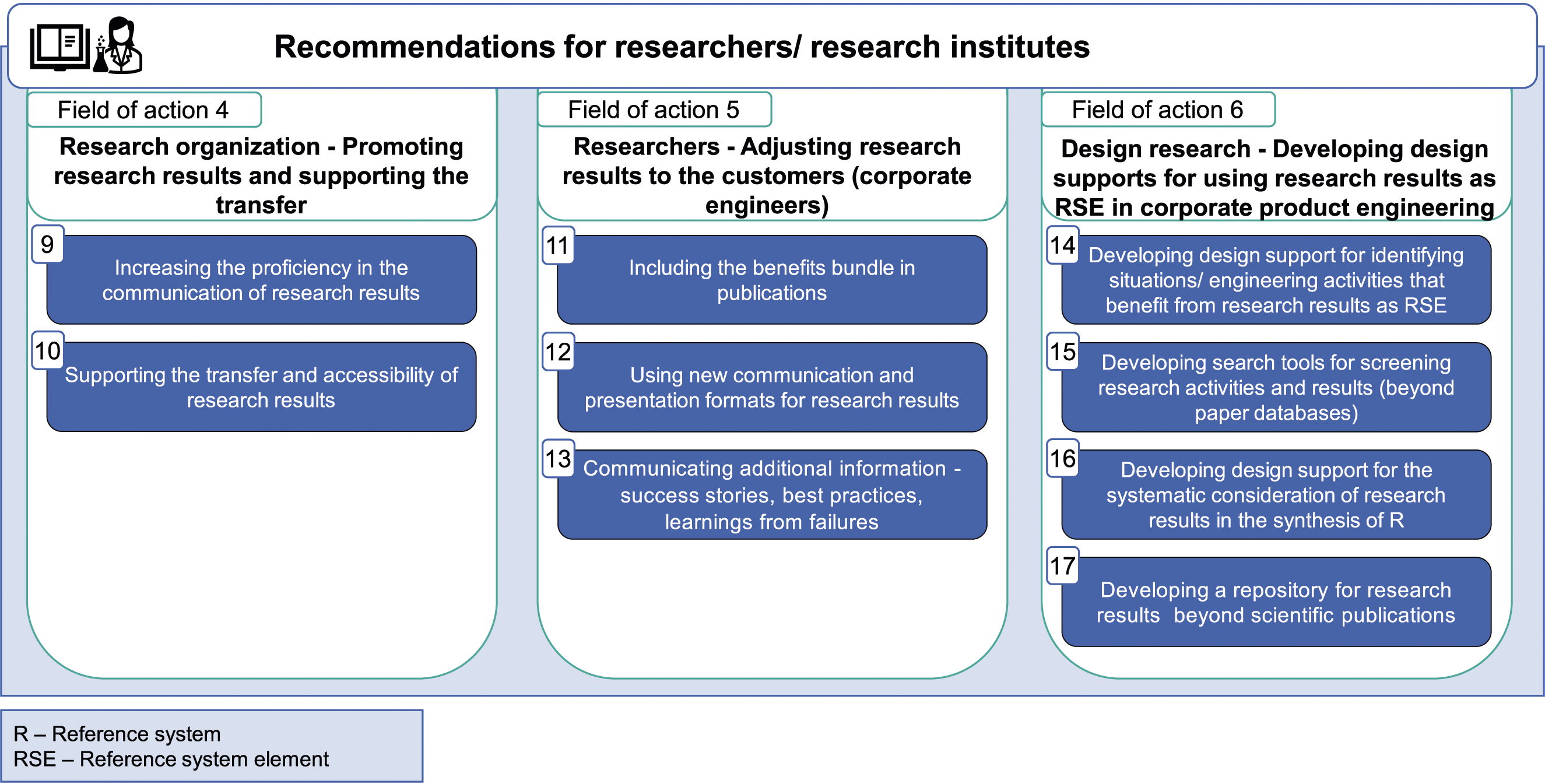
In the following subsections, we present the recommendations for each field of action.
Field of action 4: Research organization - promoting research results and supporting the transfer
The fourth field of action contains recommendations for research organizations to support and coach their researchers in communicating and transferring their research results.
Recommendation 9: Increasing the proficiency in the communication of research results
Research facilities should support the researchers in disseminating and promoting their results in up-to-date and attractive formats beyond text-based publications, e.g., short clips on the state of research. To this end, they should engage PR experts and develop a social media strategy. They should offer various options for presenting research results to address specific stakeholders’ needs. Based on this strategy, the research facilities should offer coaching to the researchers. In addition, the research facilities can set up a presentation space. The presentation space offers researchers a professional environment to produce promotional and presentation material (e.g., photos, videos) or welcome interested industrial partners to present their results.
Recommendation 10: Supporting the transfer and accessibility of research results
The research facility should provide a transfer-friendly environment by supporting spin-offs, patent strategies, etc. Furthermore, research facilities should provide (long-term) repositories of research results. A well-structured overview and collection of research results will help interested parties to find them. In accordance, a well-described presentation of the research activities of the research facility also increases the findability of corresponding expertise.
Field of action 5: Researchers - adjusting research results to the customers (corporate engineers)
The goal of the fifth field of action’s recommendations is to directly support the researchers in presenting their results in a way that adjusts to the needs of corporate product engineers.
Recommendation 11: Including the benefits bundle in publications
Researchers should address the (expected) benefits bundle in their results (e.g., scientific publications). Here, researchers should describe the potential benefits for 1. The corporate engineers/companies that use the research result as a reference system element in developing their (sub-)system. 2. The customers of a (sub-)system when the research result is used in it. 3. Users of a (sub-)system when the research result is used in it.
Additionally, the researchers should describe potential use cases or applications for their research results. Based on a risk assessment (e.g., SWOT) and description of the maturity (e.g., RRL, TRL), researchers should outline the next steps for using their research results in corporate engineering activities (cf. Recommendations 4, 5, and 18).
Recommendation 12: Using new communication and presentation formats for research results
Researchers should adapt to the changing ways in which information is consumed. Thus, they should use social media and more visual (e.g., video, photo) ways of presenting and explaining their research results (cf. Recommendatoin 9 and 19). Additionally, the researchers should keep the language common in practice in mind (cf. Recommendation 4) and/ or provide a glossary.
Recommendation 13: Communicating additional information - success stories, best practices, learnings from failures
In addition to presenting classical research results, researchers should communicate success stories and best practices for using their research results within corporate engineering activities. Besides the positive learnings, researchers should communicate failures and corresponding learnings within research as well as the transfer and use of research results in corporate engineering activities. To do so, cooperation with corporate partners is necessary and increases the validity of such learnings.
Field of action 6: Design research - developing design supports for using research results as reference system elements in corporate product engineering
The sixth field of action comprises recommendations for researchers to develop new design supports. These design supports will assist corporate product engineers in using research results as reference system elements within their engineering activities.
Recommendation 14: Developing design support for identifying situations/engineering activities that benefit from research results as reference system elements
In cooperation with corporate product engineers, researchers should develop design support to identify the situations and engineering activities in product engineering that can benefit from considering research results. Such design support (e.g., a method or tool) can help raise awareness of the potential of research results and target efforts. In addition to general findings, such support needs to be specified for the individual companies, as it will depend on, for example, the sector, the position in the value chain, and the position in the competition (cf. first mover vs follower).
Recommendation 14 corresponds to Recommendation 7: Identifying situations/engineering activities that benefit from research results as reference system elements and forms the basis for Recommendation 8: Proposing potentially suitable research results as reference system elements during engineering activities and Recommendation 16: Developing design support for the systematic consideration of research results in the synthesis of reference systems.
Recommendation 15: Developing search tools for screening research activities and results (beyond paper databases)
Researchers should develop support for corporate product engineers to search for research results systematically. Scientific databases for publications do allow systematic analysis. However, otherwise, the search for research results is mainly unsystematic (personal networks, conference participation, etc.). Methods and tools for searching for knowledge, technologies, etc., are rarely explicitly linked to research. Researchers could develop a “meta-crawler” harvesting different sources for research results.
Recommendation 16: Developing design support for the systematic consideration of research results in the synthesis of reference systems
Researchers should develop support for the systematic consideration of research results in the synthesis of the reference system. Here, the range spans from, e.g., making the reference system explicit and systematically modeling the reference system (e.g., using MBSE) to identifying and working with valuable research results. Creating a reference system is a complex and creative endeavor that generally has not yet received sufficient systematic support. That makes the process of synthesizing a reference system a research area that needs to be explored further. (cf. Recommendation 6).
Recommendation 17: Developing a repository for research results beyond scientific publications
Researchers should develop a repository for researchers to share their research findings. Although the academic community effectively organizes and shares written research publications and data, other data formats, such as videos, digital models, and physical demonstrators, are not consistently archived and distributed across the research community. A repository can help to systematically complete the picture of research activities and results from research facilities and researchers.
Recommendations for funding agencies/(research) policymakers
In total, we developed five recommendations for funding agencies and (research) policymakers to influence the research ecosystem in a way that fosters the usability of research results as reference system elements in corporate engineering projects. As shown in Figure 9, we clustered the recommendations within two fields of action. Overview of the recommendations for funding agencies and (research) policymakers. The fields of actions seven and eight contain recommendations 19 to 22 addressing the public governance side to improve the usability of research results as reference system elements within corporate engineering projects.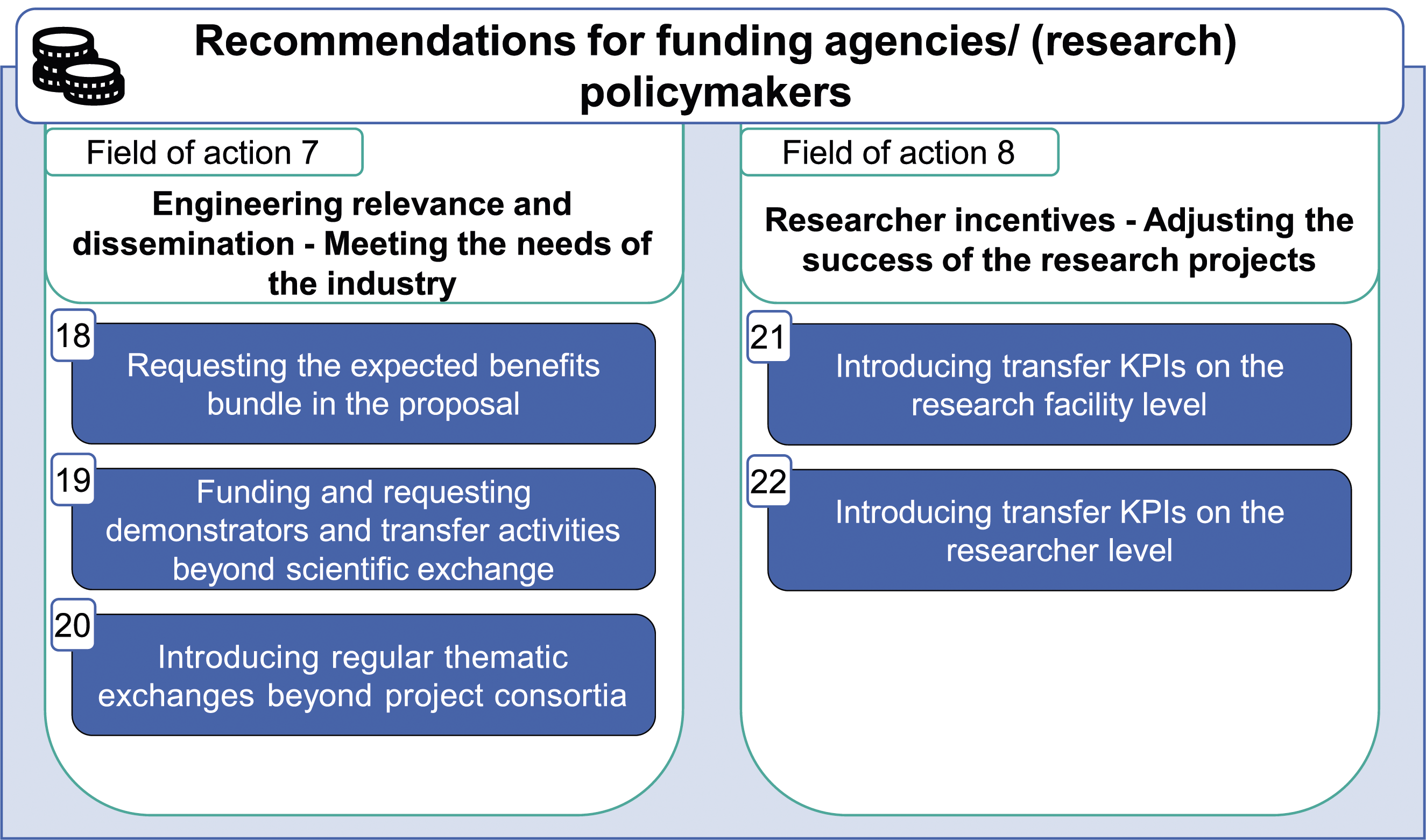
In the following subsections, we present the recommendations for each field of action.
Field of action 7: Engineering relevance and dissemination - meeting the needs of the industry
Field of action seven collects recommendations for funding agencies and (research) policymakers that foster the accessibility of research results.
Recommendation 18: Requesting the expected benefits bundle in the proposal
Funding agencies should consider the expected benefits bundle of the proposed research when selecting projects for funding. To do so, they should ask the applicants to describe the expected benefits of their research results. The applicants should 1. Describe the benefits for the corporate engineers/companies that use the research results as reference system elements in developing their (sub-)system. 2. Explain the potential benefits created for the customers of a (sub-)system when the research results are used in it. 3. Outline the potential benefits created for users of a (sub-)system when the research results are used in it.
In addition, the applicants should describe potential use cases or applications for their research results.
Recommendation 19: Funding and requesting demonstrators and transfer activities beyond scientific exchange
Funding agencies should request demonstrators to showcase the functionality of the research results and as a vehicle for transfer. The format of the demonstrators is highly dependent on the specific research project. Funding agencies should provide the necessary funding to enable the development of demonstrators. Furthermore, the demonstrators should be integrated into additional transfer activities (cf. Recommendations 9 and 10). As a result, funding agencies should request researchers to outline transfer activities in their project proposals beyond participation and publication in scientific conferences and journals. The active participation of researchers in standardization activities can be such a measure.
Recommendation 20: Introducing regular thematic exchanges beyond project consortia
The funding agencies should support and organize regular thematic exchange meetings. Linking members of related project consortia and interested third parties can help to promote (and further develop) the research results and activities. This approach allows funding agencies to direct the audience and ensure the research results are disseminated within a local area, in addition to the usually global scientific conferences or journals. Partnering with, e.g., standardization organizations is beneficial to encourage productive meeting settings and goals. The format of the exchange meetings can vary (e.g., presentation vs working sessions) and require thorough preparation and agenda to keep the stakeholders interested.
Field of action 8: Researcher incentives - adjusting the success measurement of research projects
The last field of action’s recommendations aim to provide measurables (KPIs – Key Performance Indicators) for funding agencies and (research) policymakers to monitor and motivate researchers and research facilities to emphasize transfer activities. The instrument of KPIs is highly sensible because it can foster misuse, too. Thus, funding agencies and (research) policymakers should pay special attention to this field if implemented.
Recommendation 21: Introducing transfer KPIs on the research facility level
Funding agencies and research policymakers should increase the significance of transfer key performance indicators (KPIs) for research facilities. Focus should emphasize, for example, spin-offs, patents, or companies participating in research projects.
Recommendation 22: Introducing transfer KPIs on the researcher level
Funding agencies and research policymakers should increase the significance of transfer key performance indicators (KPIs) for researchers. Focus should emphasize, for example, patents, standards, open access publications, companies involved in research projects, and transfers of research results to companies.
Discussion
We developed the final set of 22 recommendations incorporating the feedback of both sounding board steps as presented in the previous section. In the second round of the sounding board, we also asked the participants to rate the relevance of the recommendations. Figure 10 shows the results of this rating. All of the final 22 recommendations were rated rather relevant to very relevant, which is why we kept them all. Average relevance of the final 22 recommendations on a six-point-Likert scale (1 – non-relevant to 6 – very relevant).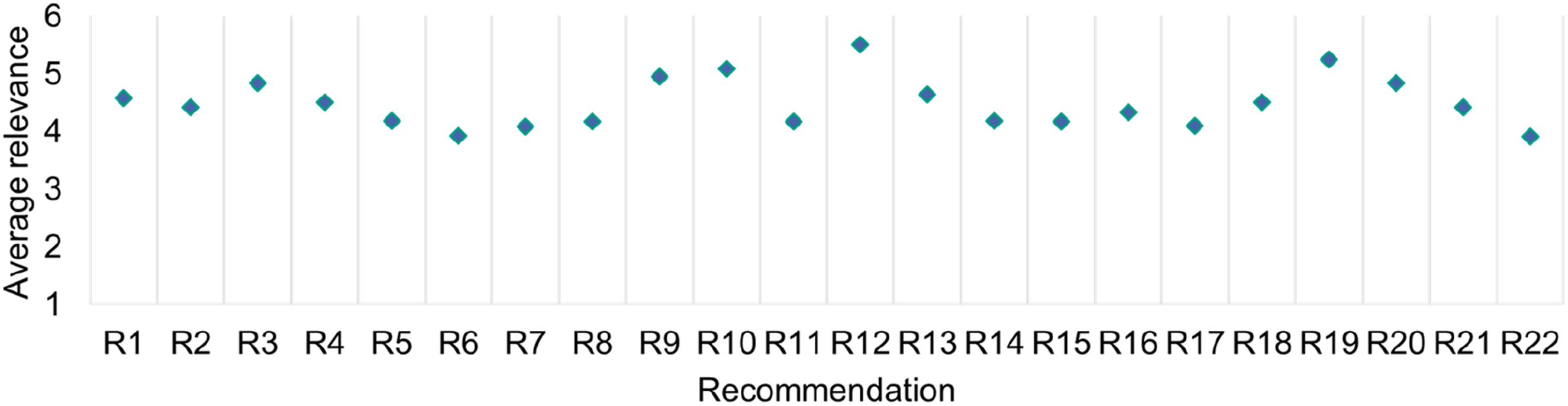
Of the initial 24 recommendations, we rejected two based on feedback from experts of the sounding board who deemed them too trivial and already implemented (cf. the research approach subsection).
Following the presented research approach, we believe the set of 22 final recommendations is highly relevant and addresses the most critical challenges of using research results as reference system elements in corporate engineering. Especially the second step of the sounding board with 20 selected experts from all three relevant stakeholder groups ensures the validity and relevance of the recommendations. However, it is important to note that our results are limited to the German industry-academia situation, as the experts we consulted are primarily from these communities. Furthermore, the validation by the sounding board approach must be considered initially, as we did not validate all aspects of our recommendations (such as the applicability – cf. DRM, 53 e.g.). In the following, we discuss the recommendations on a general and specific level.
“Every engineering process is unique and individual”. 54 In the same way, the situation in every company, research facility, and funding agency/funding program is unique and individual. It is crucial to understand that we provide a set of 22 recommendations as a baseline to improve the usability of research results as reference system elements in corporate engineering. It is obvious that the current situation in the different entities is totally individual. Thus, every addressee of the recommendations needs to select the most valuable recommendations for their specific needs, for example, assessing a field with significant potential for improvement. The implementation of our recommendations naturally requires additional effort during implementation. Therefore, addressees must carry out a cost-benefit assessment. While some entities might already follow some of our recommendations, our validation showed that others do not. Thus, not all recommendations will be new to all addressees. Looking at the field of action 4 (Research organization - Promoting research results and supporting the transfer), e.g., various research facilities are already taking action and/ or providing support for their researchers. However, this is not a standard yet.
Additionally, different entities have different goals and boundary conditions (e.g., funding agencies focused on basic research without industry collaboration vs with industry collaboration, IP rights, strategic goals, etc.). Accordingly, not all recommendations will apply to everybody in the same way. The addressees have to adjust the recommendations according to their current situation. In the recommendations, we propose the what but only examples of the how. Addressees should best apply and incorporate our recommendations within their existing tooling and process landscape. We do not recommend introducing multiple new tools or processes if it does not seem necessary.
We designed the recommendations as stand-alone recommendations. Thereby, addressees can select individual recommendations to implement or start with. However, as indicated by the many interconnections of the recommendations, the full potential can only be lifted by the holistic improvement of all affected stakeholders. Furthermore, for some recommendations, we strongly recommend that corporate and research partners collaborate. The development of design support, in particular, as described in the fields of action 3 and 6, requires such a collaboration.
The corporate side finds it easier to use research results as reference system elements in their engineering activities in the early phases, or advance engineering instead of serial engineering. However, research results can also be valuable input for serial development, even though more rigorous boundary conditions and validation criteria might be in place. In the third recommendation, we propose a research results management system. Managing corporate knowledge is a highly relevant task in corporate practice, anyway. Thus, we recommend adding the used or potentially valuable research results and allocated knowledge and experience to the knowledge management system. Of course, such a management system has to deal with a heterogeneous composition of knowledge. Research results serving as reference system elements for process development differ from technical systems’ development (cf. 35 ). The first recommendation is to raise engineers’ awareness of the potential of reference system elements from research in a low-threshold manner. Therefore, companies should use their established intranet to inform the engineers about, for example, success stories. Of course, the concrete design of such “posts” is a non-trivial activity itself. The companies must fulfill different, partly opposing goals. There will be, most likely, two groups of readers. One is a probably relatively small group that is really interested in the solution and implementation of the research result and needs in-depth information. The second, probably quite a big group, is only meant to be informed about the success, needing a high-level post.
Of the recommendations addressing researchers and research facilities, the sounding board members heavily discussed recommendation 17 (developing a repository for research results beyond scientific publications). Many participants argued that many repositories for research results exist already. However, we decided to keep this recommendation. While repositories to share written research results (e.g., scientific papers) and raw data (e.g., measured or simulated data) within the communities exist, comparable repositories for other formats, such as digital models or physical demonstrators, are unknown to us.
Looking at recommendation 18 (requesting the expected benefits bundle in the proposal), the sounding board members criticized that it would not be possible to specify a benefits bundle during the proposal phase of research projects in all cases. The concern is that this recommendation would hinder the acceptance of qualitative proposals. In this recommendation, we recommend that funding agencies ask for the specification of the expected benefits bundle in the proposal. As indicated before, the concrete elaboration of this recommendation depends on the concrete situation. Thus, a benefits bundle specified in a proposal submitted to a funding agency focused on basic research without industry collaboration (as, e.g., in many DFG - German Research Foundation projects) will look totally different from the specified benefits bundle in a proposal for a research project submitted to a funding agency focused on collaborative industry-academia research projects (as, e.g., in many BMBF - German Federal Ministry of Education and Research funded research projects). However, we believe it is beneficial for the quality of all proposals if the applicants specify the potential benefit of their project. The research results do not always have to benefit corporate activities directly. However, they can form the basis for further research, too, still aiming for a benefit for engineering at some point. The last field of action (Researcher incentives - adjusting the success measurement of research projects) contains the recommendations discussed most controversial by the sounding board. KPIs allure to optimize according to these numbers losing sight of the overall quality/ situation. However, they offer an objective instrument to assess the performance of research facilities (e.g., research institutes, research groups, etc. – cf. Recommendation 21) or individuals (cf. Recommendation 22). Not all essential activities of research facilities (e.g., basic research) directly add to these KPIs. Thus, we stress that if KPIs are implemented, it is essential to use these numbers as additional guidance or steering instruments only. The main focus must remain on the research proposals’ overall quality and expected benefit.
Conclusion and outlook
In this contribution, we presented 22 recommendations to improve the usability of research results as reference system elements in corporate product engineering. Therefore, we formulated eight recommendations addressing corporate engineers and companies within three fields of action. Nine recommendations address researchers and research facilities clustered in three fields of action. Five recommendations address funding agencies and (research) policymakers within two fields of action. We have designed all of the recommendations to be individually applicable. This way, the addressees can select recommendations that best fit their current situation and goals. Thereby, we intend to lower the starting barrier. However, many recommendations are interconnected and do influence each other. Addressees must consider these relations when implementing more recommendations.
Furthermore, many recommendations do have links to recommendations of other target groups. Thus, collaboration is beneficial and recommended for these recommendations. Following the recommendations implies extra effort, at least in the development and introduction phase. However, we believe that the potential benefit of an easier integration of research results in corporate engineering activities and processes outweighs these efforts in the long run. To reduce the necessary effort, we recommend integrating our suggestions into already existing systems and tools (especially on the corporate side) rather than developing new ones. At the same time, this integration will likely increase the acceptance. While we believe all recommendations are precious and not sufficiently followed in the broad range of engineering companies, research facilities, and funding agencies, individual entities already fulfill some of our recommendations. Thus, each addressee must decide on the recommendations most valuable for them in their specific situation and boundary conditions.
Due to the design of our study, we have confidence in the validity of our recommendations. We collected measures from 43 experts involved in industry-academia collaboration projects to overcome the challenges of using research results as reference system elements in corporate product engineering. These participants covered all three of our target groups. We then condensed these measures to 24 recommendations. We improved and validated these recommendations using a sounding board approach in two iterations. For the first round, we invited 17 selected experts in design research, and for the second round, we invited 20 selected experts representing all three target groups of the recommendations. As a result, we designed the final set of 22 recommendations.
Although we believe in the soundness of our methodological approach, it is important to recognize the limitations of this study. Firstly, we can only consider the validation as initial, as we only validated the content of the recommendations. We did not explicitly validate or test their applicability beyond relying on the experts’ and our own expertise. Secondly, our study only included experts from German communities. The research and engineering culture in other regions is quite different. Thus, it is impossible to generalize about the global interaction of the three target groups. However, we believe the situation in Germany is somewhat representative, and our results can also be applied to other regions.
Following our recommendations can improve the usability of research results as reference system elements in corporate product engineering activities and processes. This, in turn, supports the technical advancement of technical systems and products and the efficiency of engineering processes by improving the transfer of knowledge and technologies from research to companies, reducing the gap between them. Closing this gap is essential for facing challenges such as climate change, energy usage, and demographic shifts, as well as preserving or even increasing the prosperity of our societies.
Based on the results presented in this contribution, we will continue our research by developing implementation strategies for the recommendations. Furthermore, we will research and develop the suggested design supports as described in the recommendations (cf. Field of action 3 and 6).
Footnotes
Acknowledgements
The research documented in this manuscript/presentation has been funded by the Deutsche Forschungsgemeinschaft (DFG, German Research Foundation), project number 255730231, within the International Research Training Group “Integrated engineering of continuous-discontinuous long fiber reinforced polymer structures” (GRK 2078). The support by the German Research Foundation (DFG) is gratefully acknowledged.
Declaration of conflicting interests
The author(s) declared no potential conflicts of interest with respect to the research, authorship, and/or publication of this article.
Funding
The author(s) disclosed receipt of the following financial support for the research, authorship, and/or publication of this article: This work was supported by the Deutsche Forschungsgemeinschaft (DFG, German Research Foundation), project number 255730231.
