




Abstract
This study focused on investigating the effects of micro-scale carbon fibers (CF) and nano-scale graphene nanoplatelets (GNP) on the morphological, rheological, mechanical, thermo-mechanical and thermal properties of polyamide 11/poly (lactic acid) (PA11/PLA) blend. A twin-screw extruder and an injection molding machine were utilized to produce the samples. The amount of GNPs was varied up to 5 wt% for a fixed CF fraction of 20 wt%, and the composites were characterized. SEM micrographs of hybrid composites revealed stronger interfacial interactions between the matrix and CF and improved dispersion of GNPs. The pseudo solid-like behavior transition and high modulus detected in the rheological study with the addition of GNP confirmed the strong matrix-filler interactions in hybrid composites. The synergistic effects of multi-scale fillers have been observed in mechanical and thermo-mechanical properties. In comparison to 20CF, hybrid composites’ tensile strength and modulus increased by 8%–4.8% and 4.5%–17%, respectively, by adding 0.5–5 wt% GNP. Dynamic mechanical analysis revealed that the tan δ peak shifted to higher temperatures in low GNP containing hybrid composites, indicating an increase in Tg. Also, differential scanning calorimetry confirmed the Tg increment and synergistic effect of fillers on crystallization. The thermogravimetric analysis demonstrated that hybrid composites exhibited enhanced thermal stability. As a consequence, these hybrid composites offer an inventive viewpoint for environmentally friendly composites in the automobile industry thanks to their enhanced mechanical and thermal characteristics.
Introduction
Carbon fiber (CF) reinforced polymer matrix composites (CFRPC) have recently replaced metals and metal alloys thanks to their low density, high stiffness and strength, high service temperature, superior corrosion and chemical resistance, ease of manufacture and long service life. Therefore, they are widely utilized in the automotive, aircraft, aviation, rocket, sports goods, and military industries.1–4 Numerous studies have been and are being conducted by researchers using thermoset or thermoplastic matrices and short or continuous fiber reinforcement.1,5 Thermoplastics have advantages over thermosets including recyclability, easy and fast processing, suitability for mass production, less harmful chemical content, and less environmental impact.1,6 Among the various thermoplastics, polyamides (PA6, PA66, PA12) are widely utilized in construction, textile, automotive and advanced engineering applications. Furthermore, bio-based polymers like PA11, which are made from renewable materials (castor oil), have begun to attract attention as environmental consciousness has grown.7,8 Another thermoplastic often favored to minimize environmental impact is poly (lactic acid) (PLA), which is fully bio-based and biodegradable. Although PLA has a higher modulus and strength than PA11, it needs to be improved in terms of toughness and thermal stability. The blending properties of these two polymers were previously investigated by us and as a result, it was observed that the properties of both polymers improved with blending. It was determined that the composition of 60/40 (wt/wt) PA11/PLA had the optimum properties, however, those properties still needed to be enhanced. Therefore, short CF reinforced PA11/PLA composites were prepared and investigated. The findings demonstrated that the mechanical and thermal properties of the PA11/PLA blend were enhanced by the addition of CF. 9
Even though short CF reinforced thermoplastics are widely utilized and highly recognized, their ultimate characteristics still need to be enhanced, particularly for advanced engineering applications, electrical/thermal conductivity, etc.3,10–12 Their characteristics are mainly influenced by component properties, fiber amount, fiber-matrix interfacial interactions, fiber dispersion and orientation within the matrix and process conditions.13,14 It is possible to enhance the ultimate performance by managing these factors. The optimization of the fiber amount and the interfacial interactions play a crucial role on the properties of fiber reinforced composites. High fiber amounts are often required to attain the desired enhanced properties. On the other hand, excessive amounts (≥30 wt%) can lead to a deterioration in the mechanical properties of the composite, an increase in density or agglomeration.9,15 Also, weak interfacial interactions and the presence of matrix-rich regions in the gaps between the fibers, both cause inefficient stress transfer and thus have an adverse effect on the properties of the composite. Therefore, various strategies have been attempted in order to reduce the amount of fiber and, particularly, to improve the interactions between the fiber and the matrix.3,11 These include fiber surface treatment, matrix modification, interface modification and multi-scale (hybrid) reinforcement methods. Although treating the surface of fibers with techniques like plasma treatment, acid treatment, and coating is very effective at improving interfacial adhesion and thus properties, particularly mechanical ones, there are drawbacks, such as the need for multiple manufacturing steps and the use of chemicals. Furthermore, the existence of matrix-rich regions endures. In this regard, the preparation of hybrid composites by multi-scale (micro/nano) reinforcement method is highly successful at reducing matrix-rich regions and improving interfacial interactions.1,3,14
Hybrid polymer composites can be defined as systems in which two or more reinforcing materials are added to the polymer matrix. Hybridization is the deliberate combination of micro- or nano-scale fillers of different or identical geometries to create a new material with new properties not necessarily found in the individual components. As a result, the components might have hybrid effects on the matrix that are either negative or positive (synergistic). The key drivers for hybrid composites are improved performance, multi-functionality and cost reduction, through synergy.16–18 Depending on the desired property of the hybrid composite, the fillers used may be single-scale (all nano or micro) or multi-scale. Multi-scale hybrid composites outperform single-scale one in terms of strength, toughness, and modulus.10,18 In this regard, it is highly favorable to incorporate nano-scale fillers such as carbon black, clay, expanded graphite, CNT and GNP into polymer/CF systems to improve the properties.3,8,10,14,19 Two alternative methods can be used to produce such multi-scale composites. Nanoparticles can be placed or growth on the surface of a fibre using a variety of processes, including coating, chemical/thermal vapour deposition, and electrophoretic deposition. These are frequently used with thermosets and their application to high viscosity thermoplastic systems is limited. Another method is to add all components directly to the matrix by melt blending. 10 The melt blending approach was employed in this study to produce the hybrid composites since it is a more practical technique for mass production.
Meanwhile, in addition to FRPCs, polymer nanocomposites have also attracted attention due to the unique properties of nanoparticles and have been extensively researched in recent years. Among various nanoparticles, graphene is a high aspect ratio 2D nanofiller that has attracted much interest thanks to its outstanding mechanical properties. 2 Graphene nanoplatelets (GNP) can be considered as the combination of single and multiple graphene layers and have a number of desirable properties, including low cost, suitability for mass production, high aspect ratio, huge surface area, and mechanical strength that is comparable to graphene. GNP is used to improve the properties of the polymer matrix thanks to all these properties.16,20 In an ideal scenario, large surface area GNPs will interact well with the matrix and fulfill the reinforcement role by transferring the stress effect throughout the matrix. However, in the case of agglomeration, as the size of the nanofillers in the matrix increases, the interface between the filler and the matrix becomes narrower and these agglomerates form stress points in the matrix, adversely affecting the mechanical properties. GNPs tend to form agglomerates and/or stacks due to their high surface energy and strong interlayer π-π interactions and Van der Waals forces.16,18 The effects of GNPs on the characteristics of the PA11/PLA have also been previously studied by us. 20 In this study it was observed that GNPs improve mechanical strength, elongation and thermal properties at low loadings, but cause poor dispersion/agglomeration and therefore poor properties at 5 wt% and higher. As a result, the above-mentioned hybridization technique appears as a potential solution to overcome these drawbacks of GNPs. 10
In the case of hybrid reinforcement, the fiber can improve the dispersion of the nanoparticles by preventing agglomeration in the matrix, while the nanoparticles can improve the interaction between the fiber and the matrix. It also reduces the amount of expensive nanofillers that need to be used to achieve the desired property improvement, thereby reducing the cost of the end product.10,11,17 When CF and GNPs in two different sizes and geometries are used together, GNPs can increase interfacial interactions by locating in the interfacial space between the CF matrix. As a result, an improvement in mechanical properties can be achieved by improving stress transfer in the matrix.3,11 Several researchers have focused on the synergistic effects of CF and GNP. The effects of CF and GNP on the mechanical and thermal behavior of poly (arylene ether nitrile) (PEN) were investigated by Yang et al. 3 It has been argued that the presence of GNP enhances PEN/CF interfacial interactions. They found that the flexural strength and modulus of the composites increased significantly with hybridization. Another study on the combined effects of CF and GNP was conducted by Karataş et al. 11 By using the melt blending method, 0.1, 0.3, and 0.5 wt% GNP were added to PA6,6/CF composite that contained 10 wt% CF. The tensile strength of the PA6,6/CF composite was reported to be around 140 MPa, and the addition of GNP increased this value by 8%–11%. There was a 50%–60% increase in tensile strength compared to the composite containing GNP alone. This was explained by the fact that GNP localized on the CF surface enhanced matrix-fiber interactions and that the use of CF increased the homogeneity of GNP dispersion. Seki et al. also investigated the effects of synthetic graphite (SG) and GNP on the mechanical, thermal, physical and electrical properties of PA4,6/CF composite. 8 It has been reported that hybrid fillers have synergistic effects on crystallinity, tensile and flexural modulus, thermal and electrical conductivity.
Based on all this information, this study focused on improving the mechanical, thermo-mechanical and thermal properties of the PA11/PLA through micro-scale CF and nano-scale GNP reinforcement. The samples were analyzed by SEM, as morphological features are the key factor influencing material properties. In order to figure out the effects of hybrid fillers on the processing of the material, the rheological behavior of the composites was also examined. This study presents for the first time the properties of PA11/PLA/CF/GNP composites that can be easily processed by conventional methods (extrusion/injection molding) and have advanced properties.
Experimental
Materials
Graphene nanoplatelets (xGNP M-5) with surface area 120–150 m2/g, average particle size of 5 μm, and thickness 6–8 nm were provided from xG Sciences, US. Carbon fiber having the length of 6 mm was supplied from DowAksa, Turkey with PA sizing and bulk density of 575 g/L. Polyamide 11 (Arkema, Rilsan BESNO P40 TL) having >89% renewable carbon ratio was procured in the form of pellets by Gültekin Plastik Profil San. ve Tic. Ltd. Sti. Istanbul, Türkiye. Its density is 1.04 g/cm3 and melting temperature is 181°C. The PLA (Ingeo 2003D) having a density 1.24 g/cm3 and melting temperature of 155°C was supplied from NatureWorks, USA.
Sample preparation
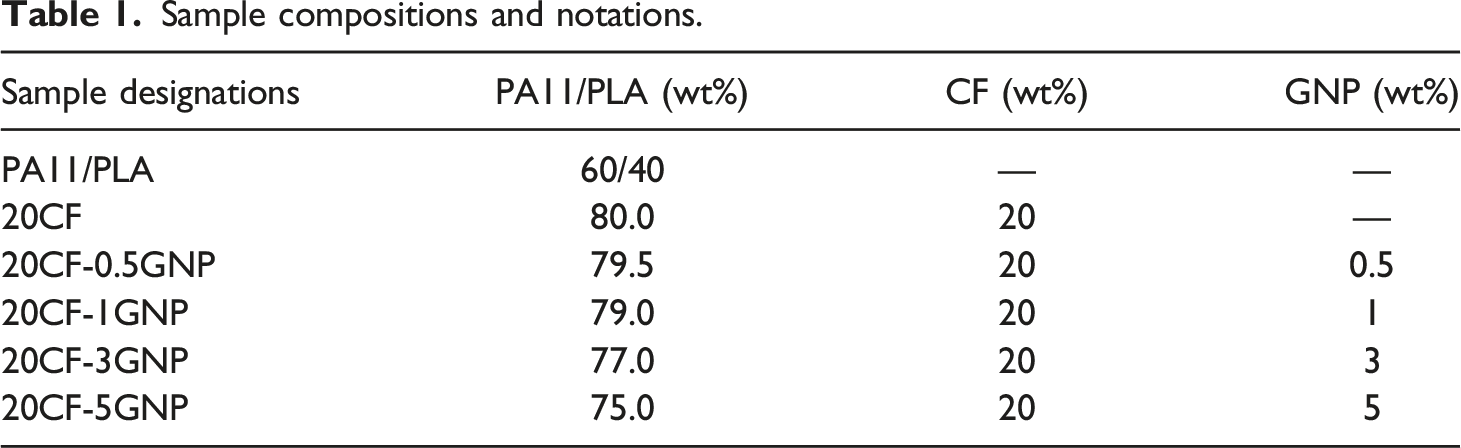
Before processing, the fillers and polymer pellets were dried at 80°C for 12 h under vacuum to remove moisture. A laboratory scale co-rotating twin-screw extruder (Xplore MC-15) was used to blend PA11/PLA/CF/GNP hybrid composites. The compounding process was carried out at 210°C, with screw speed of 75 rpm for 8 min. In the extrusion process, PA11, PLA and GNP were fed to barrel and mixed for 7.15 min. At the end of this time, CF was fed and components were mixed for another 45 s. The composite extrudate melts were molded by using a micro-injection molder (Xplore IM-12) at 25 and 210°C mold and melt temperatures and 10 bars injection pressure into dumbbell-shaped specimens.
Characterization studies
The internal structure of samples including distribution and dispersion of fillers, and interfacial adhesion of matrix and fillers, were investigated through scanning electron microscopy (SEM) (QUANTA 400 F) observations of the cryo-fractured surfaces. An Au surface coating was applied to samples before observations.
An Anton Paar Modular Compact Rheometer (MCR102) with parallel plate geometry (25mm diameter) was utilized at a temperature of 210°C to analyze the flow properties of PA11/PLA and composites. A gap of 2 mm was utilized for all measurements. Isothermal frequency sweep measurements in the range 0.1-628 rad/s were carried out under flowing nitrogen at 1% shear strain.
The tensile behavior of the samples was measured using Instron universal testing machine as per the ISO 527-2 5A method. The constant strain rate was 5 mm/min. Minimum of five dog-bone samples were tested and average data were presented.
Thermomechanical properties were studied using a dynamic mechanic analyzer (Metravib DMA50). The test was carried out in tension mode at an oscillation frequency of Hz. Data were taken from 25°C to 130°C at a scanning rate of 2°C/min. The storage modulus, loss modulus and damping factor curves were obtained from the DMA. Besides the evaluation of the basic DMA curves, the reinforcement coefficient (C-factor), which shows the reinforcement efficiency of the fillers, was calculated according to equation (1).
In addition, the degree of entanglement (N), which gives information about the dispersion of the fillers in the matrix and the matrix-filler interactions, was determined according to equation (2).
The differential scanning calorimetry (DSC) test was proceeded by Mettler Toledo DSC-1 instrument under flowing nitrogen (30 mL/min) with a heating and cooling rate of 10°C/min. The samples were heated from 25°C to 210°C and maintained for 3 min to remove thermal history, then cooled to 25°C, and reheated to 210°C. Glass transition temperature (Tg), melt and cold crystallization temperatures (Tc, Tcc), melting temperature (Tm), and degree of crystallinity (Xc %) were stated. The Xc % was calculated by using equation (3):
The thermal stabilities of the composites were determined utilizing a Mettler Toledo TGA-1 under flowing nitrogen. The test sample was weighed about 5–10 mg and placed in an alumina crucible. The test was performed from room temperature to 600°C with a heating rate of 10°C/min. The temperatures at which the samples lost 5% (Td5), 50% (Td50) weight loss and the temperature at which the maximum degradation took place (Tmax) were determined.
Results and Discussion
Scanning electron microscopy
Scanning electron microscopy (SEM) was conducted on the cross-sections of fractured samples to explore the effect of micro- and nano-filler addition on the composite microstructure. Before the fracture, the samples were frozen in liquid nitrogen. The micrographs are presented in Figures 1 and 2. SEM micrograph of the PA11/PLA blend, which is the matrix of the composites, was presented in our previous study.
20
Here, it was observed that there was no phase separation in the PA11/PLA blend, and the blend had a co-continuous morphology. As mentioned in another study in detail;
9
the CF distribution within the matrix is homogenous, with no obvious agglomeration, as seen by the 20CF micrograph. There was no void between the CF and the matrix, and the fiber surfaces were covered with PA11/PLA. Although a number of short CFs pull out of the matrix and create some holes, the interfacial adhesion between the CF and the PA11/PLA matrix is strong. SEM micrographs of PA11/PLA composites filled with CF and hybrid fillers (100 μm). Magnified SEM micrographs of PA11/PLA blends filled with hybrid fillers (20 μm).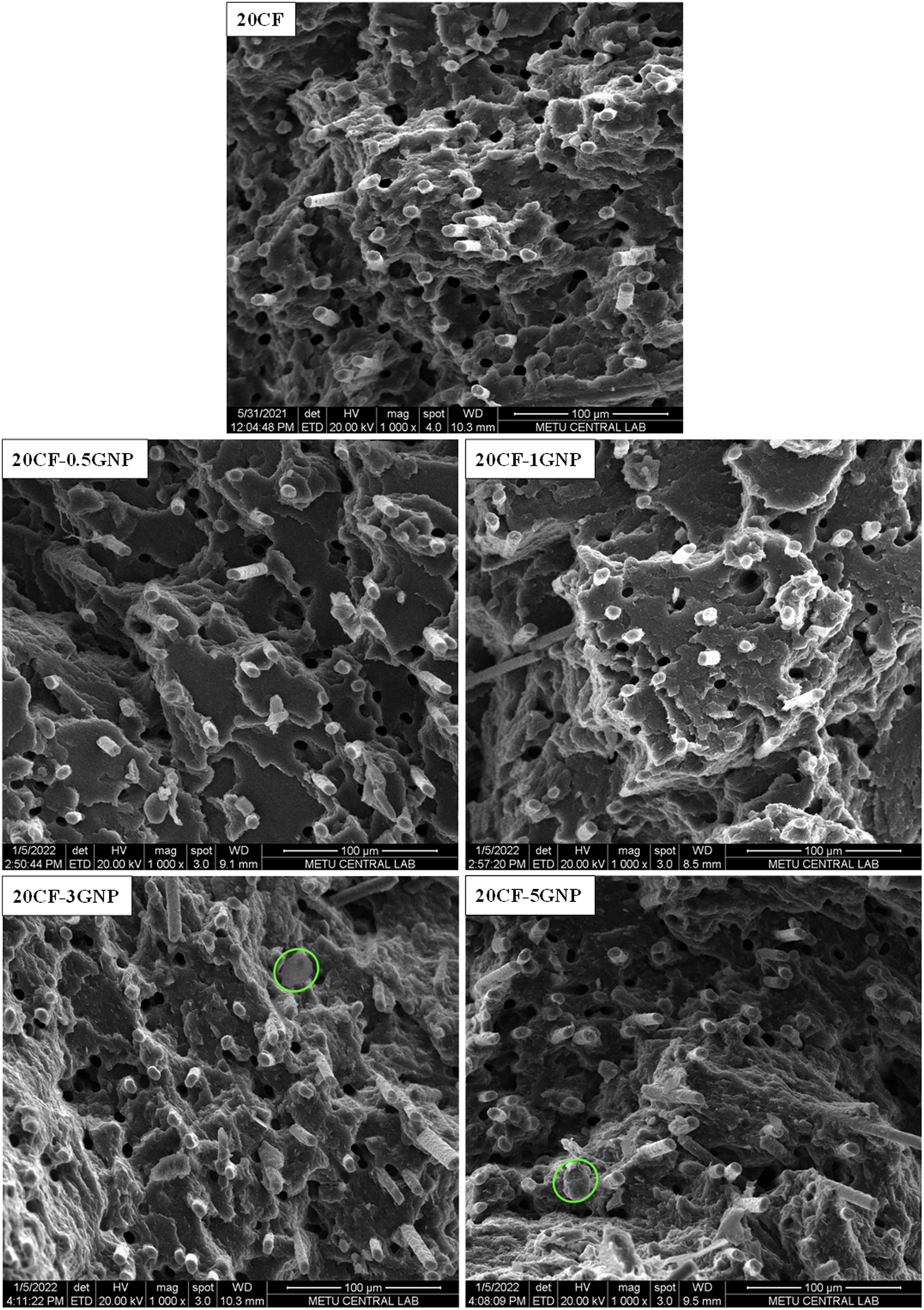
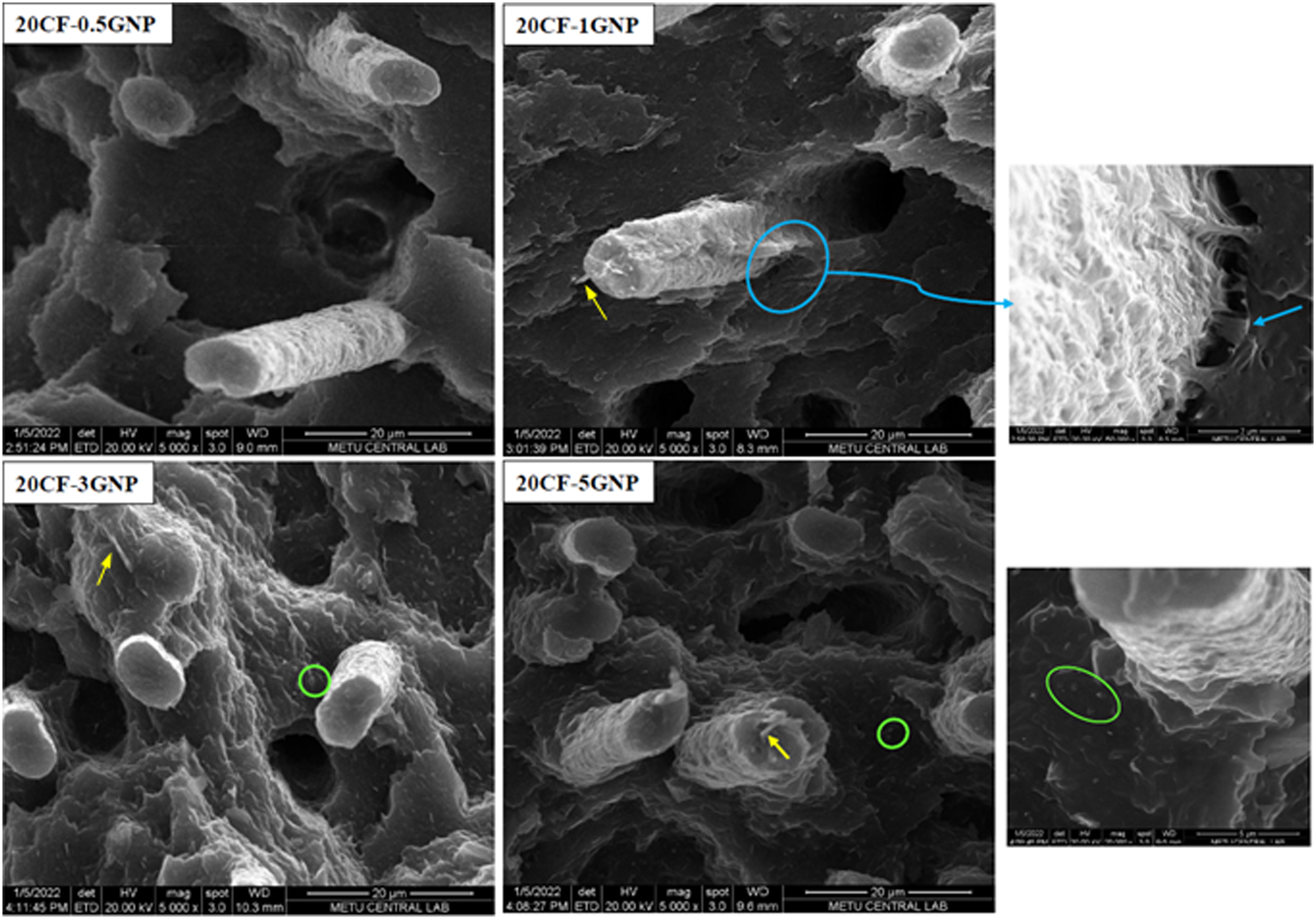
Micrographs of CF/GNP hybrid composites reveal that the matrix-fiber interfacial adhesion is strong. The fiber surfaces are coated with the PA11/PLA/GNP and the fibers are embedded in the polymer matrix. The blue arrow indicates the adhesion between CF and PA11/PLA in the magnified micrographs of 20CF-1GNP in Figure 2. The CF distribution in the matrix became more homogeneous with the addition of GNP. In our earlier research, 20 the micrographs of composites containing GNP showed the presence of GNP agglomerates. At 0.5 and 1 wt% GNP concentrations, there are no obvious agglomerations in hybrid composites. Small aggregates circled in green can be seen when the GNP amount reaches 3 and 5 wt%. Furthermore, the regions marked with yellow arrows in Figure 2, which are thought to be graphene layers showing the good distribution of GNPs, are also notable. A number of holes were observed in the structure due to the pulling of the fibers and the formation of some GNP agglomerates. It is important to note, however, that all fibers are coated with a PA11/PLA/GNP, possibly indicating enhanced interactions between components of the composites.
Melt rheological behavior
Rheological measurements present information about the molecular structure of the materials, the interactions between the components, and the dispersion state of the fillers. Therefore, the rheological analysis was performed at extrusion temperature to figure out the effects of fillers on the flow behavior of the matrix, dispersion states and polymer-filler network. Viscosity and modulus are the main parameters in the rheological properties of polymers. In general, the complex viscosity (η*) exhibits a steady decrease with increasing frequency, indicating shear thinning, while the storage modulus (G′) and loss modulus (G′′) increases with increasing frequency, displaying a flattening indicating a transition from liquid-like to solid-like behavior. 24
Figure 3 depicts complex viscosity curves of composites as a function of angular frequency. The curves show that all samples exhibit classical shear thinning behavior with increasing frequency. The addition of 20 wt% CF to the PA11/PLA matrix led to a significant increase in viscosity by restricting polymer chain mobility. Similar results for numerous fibre reinforced composites have been reported.15,25,26 The complex viscosity of the 20CF composite continued to rise when GNP was added, though not as dramatically as when CF was. The η* gradually increased with increasing filler amounts. This effect is more pronounced at low frequencies due to the shear thinning. GNP caused a transition to pseudo solid-like behavior, increasing the viscosity.
15
The higher complex viscosity of the hybrid composites can be associated with the immobilization effect of GNPs on the polymer chains due to the large surface areas. Moreover, polymer chains can become trapped between graphene layers, which limit mobility and complicate the flow. This immobilization effect was also confirmed by the increment in Tg, which will be discussed in the following sections.7,15,25 The η* value of the matrix at 0.1 rad/s (804 Pa.s) increased by 1845% with the addition of 20 wt% CF. The increment in η* was 2546% when 30 wt% CF was added to the matrix.
9
In hybrid composites, the increment in η* of 20CF-5GNP compared to the matrix was 10,000%. Interestingly, higher η* values were observed in hybrid composites when the total amount of filler was 25 wt% compared to 30 wt% CF.
9
GNP increased viscosity more than CF due to the large surface areas. Accordingly, it is clear that the filler surface area is the feature that dominates the rheological properties.
15
Besides the increase in complex viscosity, the slope of the curve also increased with the addition of CF and GNP. Although the viscosity of the matrix is also frequency dependent, the frequency dependence of the viscosity increased in the composites and thus stronger shear thinning was observed. The stronger shear thinning of the composites indicates that the homogeneous dispersion of fibers in the matrix.
27
On the other hand, the drastic rise in complex viscosity will make processing the material challenging. Complex viscosity with respect to angular frequency of samples.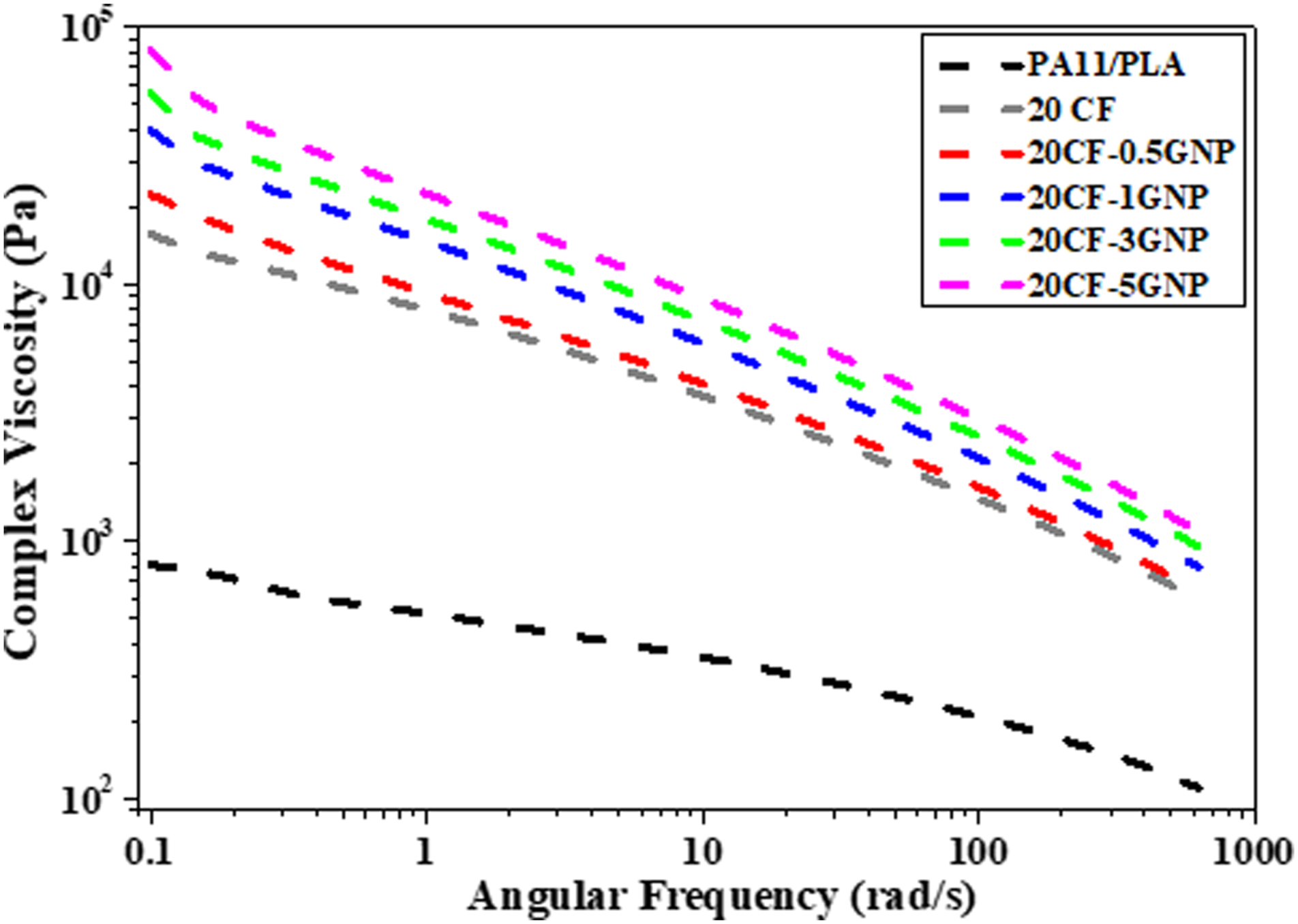
The storage and loss modulus curves with respect to angular frequency are given in Figure 4(a) and (b). The modulus of PA11/PLA and all composites tend to increase with frequency. This is typical polymer behaviour in accordance with linear viscoelastic theory. Both modules of the matrix were increased by the addition of stiff CF. Similar to η*, the G′ and G′′ increased with the inclusion of GNP. This increment is due to the restriction of polymer chain mobility and thus the transition to a more rigid structure. Furthermore, enhanced filler-matrix interfacial interactions are responsible for this increase.15,28 The G′ and G′′ of both 20CF and CF/GNP hybrid composites continue to be frequency dependent. The slopes of the modulus curves were not significantly affected by filler type or amount. Given the persistence of the frequency dependency and the absence of a plateau region, it can be argued that the rheological percolation threshold could not be reached.29,30 Storage modulus (a) and Loss modulus (b) with respect to angular frequency of samples.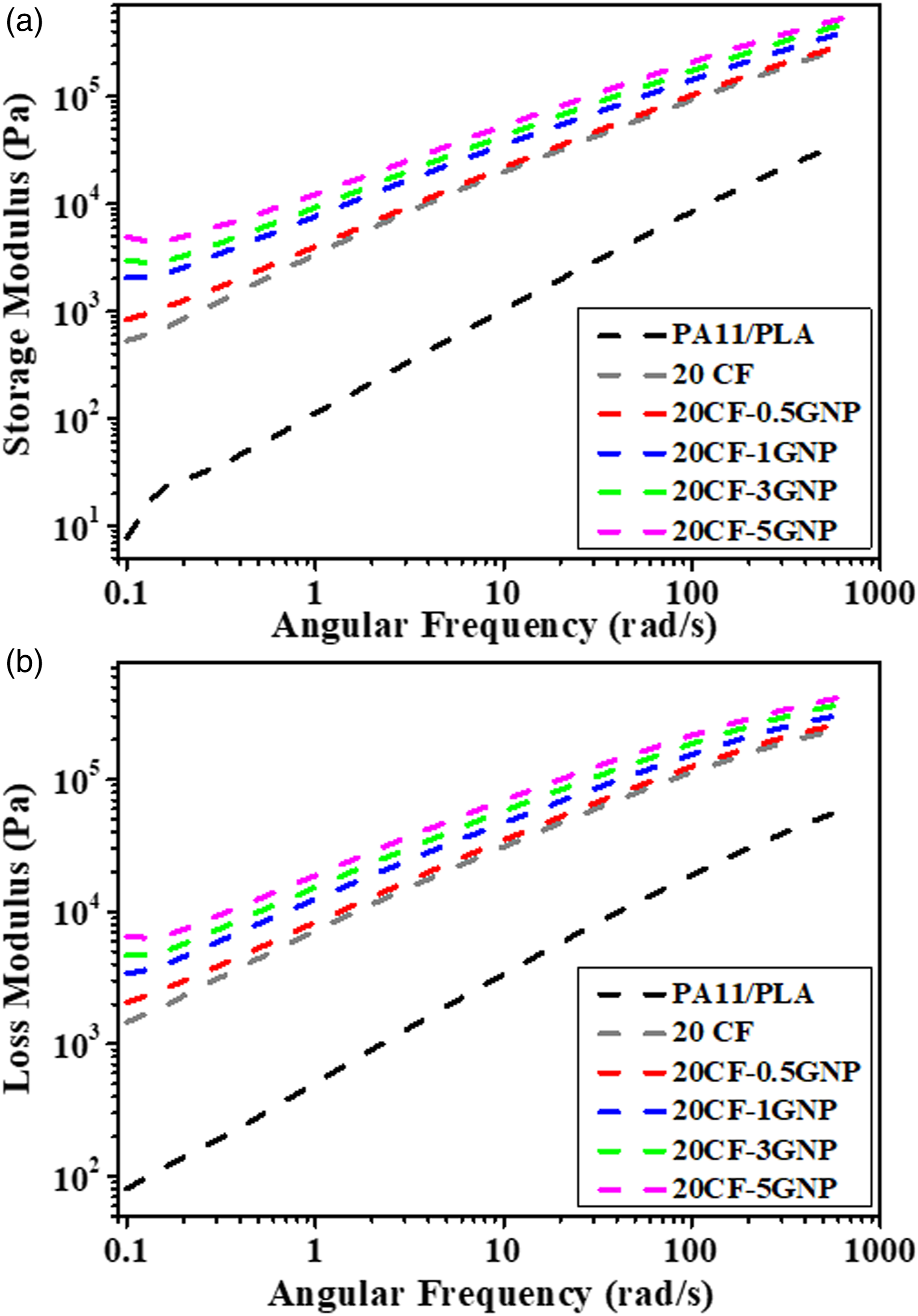
Mechanical characteristics
The tensile test was used to investigate the effects of the fillers on the mechanical properties of PA11/PLA matrix. Since GNP is working on improving the matrix-dominated properties of the CF-reinforced composite, it is also important to know the effects of nanofiller on the properties of the matrix itself. The mechanical properties of GNP-reinforced PA11/PLA nanocomposites were reported in our earlier research. 20 According to the data in this study; the tensile strength increased up to the addition of 3 wt% GNP and showed a decrease at 5GNP. This reduction is due to the restacking of the graphene layers, the agglomeration of the GNPs and the poor interfacial interactions between the matrix and GNPs. The modulus behaved inversely, first decreasing, and then increasing at 5GNP. Weak interfacial interactions between the GNP and matrix are thought to be responsible for the decrease in modulus. The increase in 5GNP suggests that the GNP aggregates support the carrying of the stress applied during the tensile test. The elongation at the break of the matrix increases with the addition of 0.5 wt% GNP. This can be attributed to the fact that GNPs with large surface areas and two-dimensional layered structures promote the slippage of polymer chains.20,31
The hybrid effect of micro- and nano-fillers on the mechanical behaviour of composites is presented in Figure 5(a)–(c). The tensile strength of the 20CF composite was measured to be 75.1 MPa as shown in Figure 5(a). The addition of 20 wt% CF to PA11/PLA resulted in a 57% enhancement in tensile strength. The enhanced tensile strength of the 20CF can be attributed to strong interfacial adhesion between the fibers and the matrix, as confirmed by SEM micrographs.
32
Tensile strength was further increased by adding hybrid fillers. The addition of 0.5–5 wt% GNP led to an increase in tensile strength of 8%–4.8% compared to the 20CF composite. The highest tensile strength was seen in 20CF-3GNP as 83.1 MPa, and the strength decreased slightly when the GNP amount was 5 wt%. However, this value was still higher than 20CF and also PA11/PLA/GNP single filler composites. Suresha et al. achieved a similar result for PA66/thermoplastic copolyester elastomer/CF/GNP composites at 3 wt% GNP.
6
They connected this observation to the weak matrix-GNP contact, the weak Van der Waals attraction of GNP, and the bending effect of graphene in the matrix, based on the research of Tang et al.
33
Considering that GNPs impair tensile strength on their own, the synergistic effects of CF and GNP can be emphasized. These findings are in good agreement with the studies of others.3,11,26,34 Mechanical properties of hybrid composites (a) tensile strength (b) modulus (c) strain at break.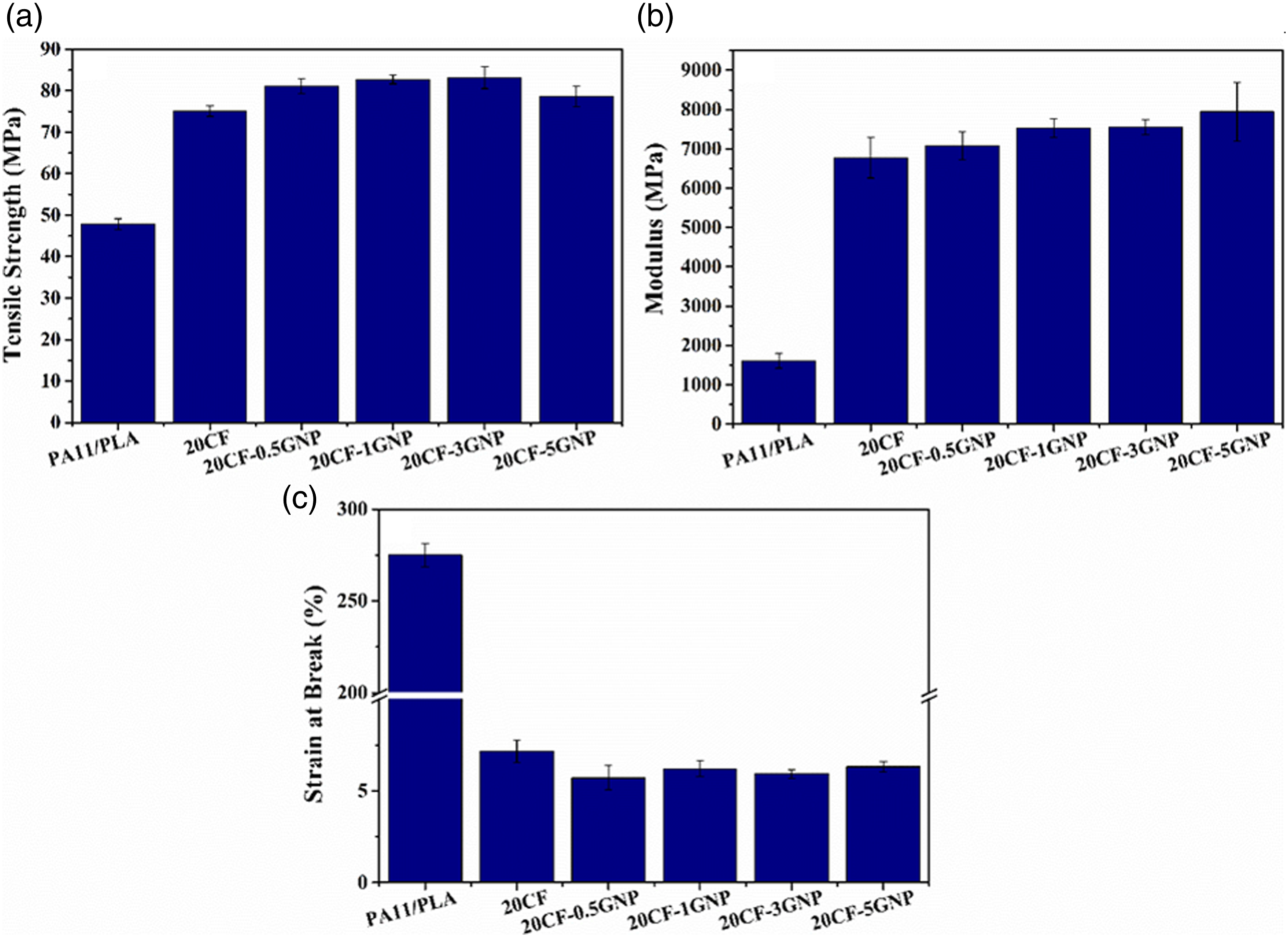
The mechanical properties of polymer composites are well established to be dependent on the properties of each component, the nature of interface, and interactions between the filler and matrix. Thus, there are a number of possible explanations for why hybrid fillers may improve tensile strength. First, GNP aggregation may have been inhibited by the presence of fibers. The morphological improvement that may have enhanced the reinforcing effects of fillers is further clarified by the SEM findings.3,11,17 The interfacial interactions of matrix and fillers are another factor to consider. It has been reported that nanofillers can have a bridging effect through the formation of a new interphase between the fiber and the polymer matrix.17,26 Consequently, the CF and matrix interact more effectively at the interface, reducing the stress concentration. Accordingly, the expected improvement in mechanical properties was observed in the tensile strength and modulus of PA11/PLA/CF/GNP hybrid composites. Because of the 2D layered structure of graphene in CF/GNP hybrids, matrix-filler and fiber-graphene interactions and contact points are expected to be greater, which improves mechanical characteristics. On the other hand, the tensile strength drop in 20CF-5GNP can be attributed to the aggregation of the GNPs, acting as stress concentration zones.17,35,36 The shortened average fiber length may also have contributed to the reduction in tensile strength.
It is apparent from the modulus data in Figure 5(b) that the inclusion of 20 wt% CF raised the modulus of the PA11/PLA blend fourfold, from 1614 MPa to around 6700 MPa. This increase is due to the inherent stiffness of CF as well as robust interfacial adhesion between the matrix and fibers which may provide effective stress transfer.37,38 The modulus of 20CF increased with the addition of GNP, demonstrating the synergistic effects of GNP and CF. The modulus increased up to 7944 MPa at 20CF-5GNP. As the planar GNPs cover the structure at high filler amounts, the matrix-rich regions are diminished, which can enhance the reinforcing effect. 3 Papageorgiou et al. reported a similar outcome for poly (ether ether ketone)/CF/GNP composites. 26 Another factor is the improvement of the fiber-matrix interface due to the addition of GNP. The geometrical differences between nanofillers and fibers can in some cases cause voids that can lead to the deterioration of the mechanical properties of hybrid composites. 36 On the other hand, the nature of the interface changes with the addition of nanofillers. The presence of GNP in the free volume between the fibers and the matrix can improve interfacial interactions. This is supported by the GNPs on the CF surface that were seen in SEM micrographs. Thus, the stress transfer in the matrix is improved and the concentration of stress in the interface layer is greatly reduced. Moreover, the reinforcing effect can be further enhanced by the large specific surface area of the nanofillers compared to microfibers.3,36 Meanwhile, hybrid composites gave significantly higher modulus than PA11/PLA/GNP nanocomposites as a result of the simultaneous presence of GNPs and CFs. 20 Although there was a reduction in the tensile strength of the 20CF-5GNP composite, no reduction in modulus was observed. That is caused by the calculation of modulus from the linear elastic region of the tensile strain-stress curve and tensile strength from the region having more damage accumulation and high strain. A similar circumstance was seen in PA11/PLA/GNP nanocomposites. 20
The effects of fillers on the strain at the break of composites are given in Figure 5(c). The strain at the break of the ductile matrix was greatly reduced by the addition of 20 wt% CF. The reduction is a result of the addition of rigid fibers to the structure, which restricts polymer chain movements. Hybrid composites maintained their brittle behaviour with the inclusion of GNP. The elongation of the composite was not significantly altered by the inclusion of hybrid fillers. The results are similar to polypropylene/graphite/CF composites. 34
Dynamic mechanical analysis
Dynamic mechanical analysis (DMA) is a technique for observing the effects of molecular changes, such as molecular relaxations and rearrangements, on the material properties of polymers.
39
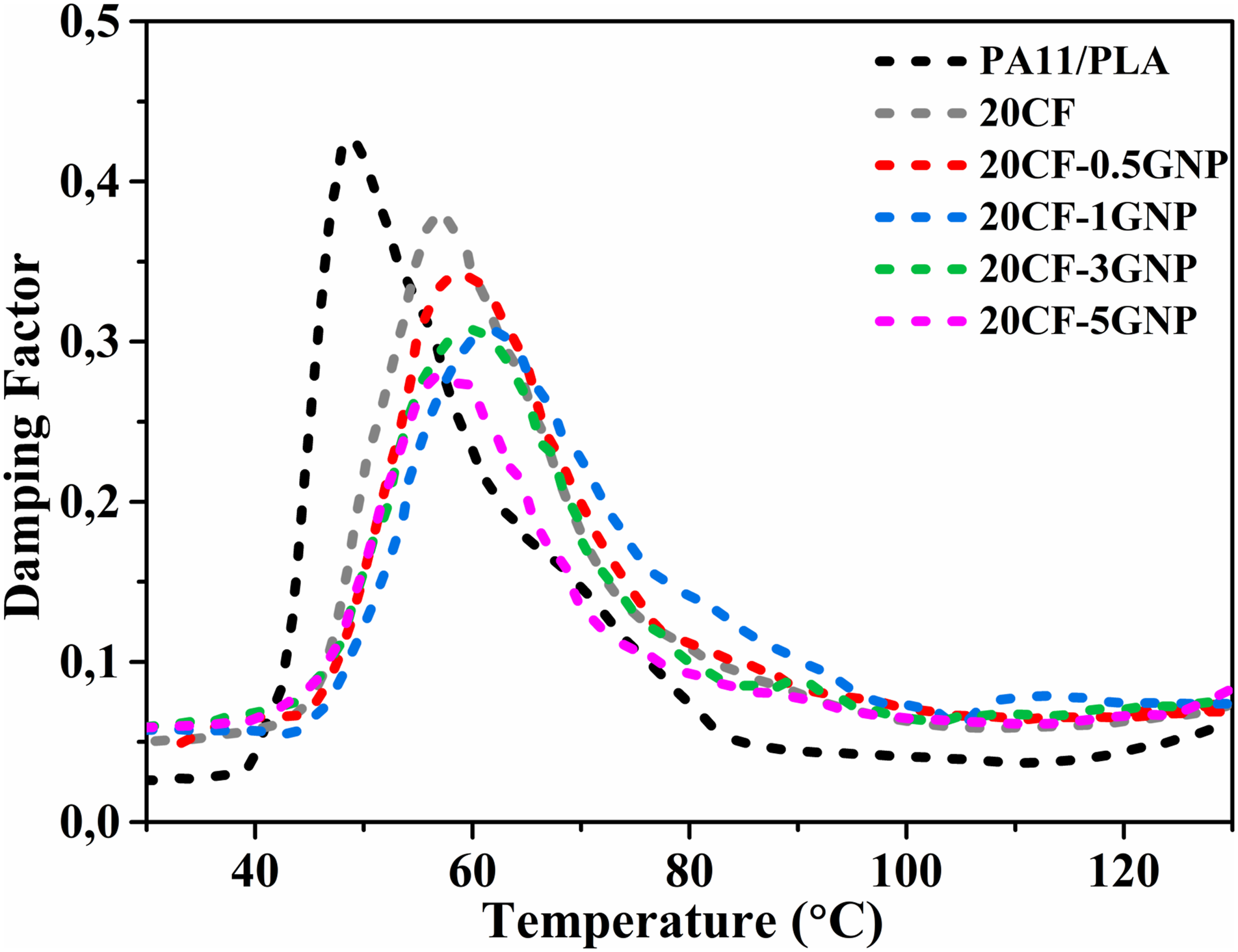
Figures 6 and 7 show the curves of the loss modulus (E′′), storage modulus (E′), and damping factor (loss tangent, tan δ) of hybrid composites as a function of temperature. DMA curves of PA11//PLA, 20CF and hybrid composites (a) storage modulus (b) loss modulus. Damping factors of the samples.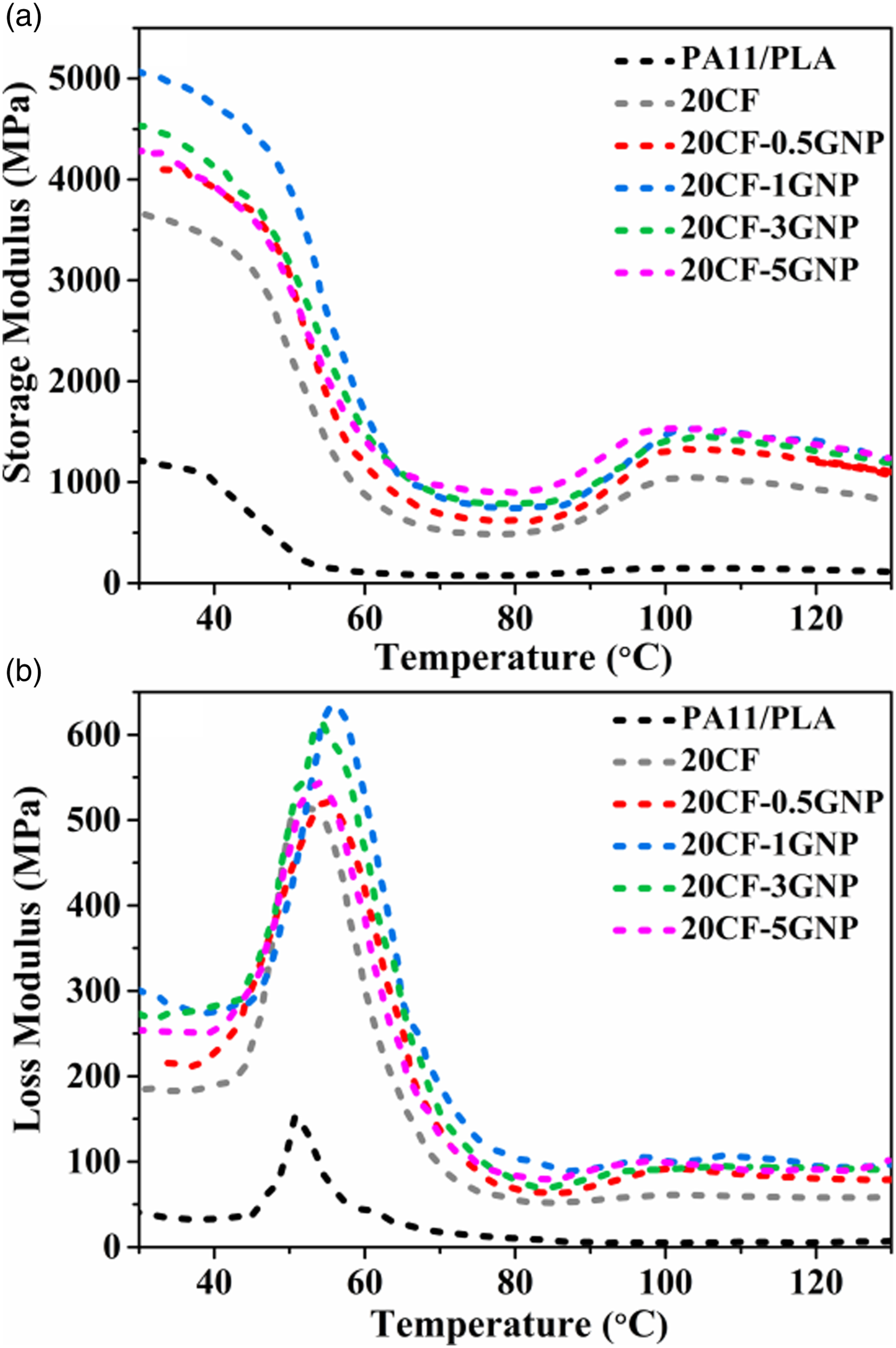
The storage modulus curves in Figure 6(a) clearly confirm that the presence of CF provides an enhancement of the E′ in both the glassy and rubbery regions. The E′′ of the matrix (1200 MPa at 30°C), increased to 3650 MPa by adding 20 wt% CF which was also reported our earlier research. 9 The phenomenon occurs due to the addition of stiff CF to the structure, which increases the material’s stiffness and energy storage capacity. Furthermore, the effective stress transfer resulting from the CF’s strong adhesion to the matrix is responsible for the modulus improvement. 40 The E′ increased with the addition of GNP to the 20CF composite, regardless of the GNP amount. 20CF-1GNP composite exhibited the highest E′ value around 5000 MPa. As the amount of GNP increased, E′ decreased in the glassy region. This may be related to the formation of regional agglomerations caused by the high GNP amount. The composite cannot withstand the sinusoidal deformation applied during the test because agglomeration limits the effective interface area between the matrix and the GNP. The aggregates may also act as stress-concentrating zones. As a result, the material’s capacity to store energy diminished.40,41 Despite the decline in the case of high addition, the E′ values of the hybrids of PA11/PLA/CF/GNP are much higher than those of both the 20CF and PA11/PLA/GNP 20 composites.
The E′′ in glassy and rubbery regions increased dramatically with the addition of 20 wt% CF to PA11/PLA, similar to E′, as shown in Figure 5(b). Additionally, the peak height of E′′ increased and the curve widened. The rise in peak height with the addition of CF is owing to an increase in energy dissipation caused by frictional action at the polymer-filler interface. Furthermore, CF hindered the polymer matrix’s relaxation process, resulting in peak broadening. 9 An increment in the E′′ of 20CF was observed with the addition of GNP. Hybrid composites have a higher E′ and wider curves than 20CF. The increase in E′′ in the glassy and rubbery regions shows improved energy dissipation and is connected with the energy released as internal friction increases. 42 The widening of the loss modulus peaks shows that the addition of GNP prevents polymer chain relaxation. The highest E′′ value was observed in 20CF-1GNP, which is similar to the storage modulus indicating superior dynamic mechanic properties.
The temperature-dependence damping factor curves of the PA11/PLA blend and composites are presented in Figure 7. The damping factor (tan δ), which provides information about the elastic and viscous behavior of the polymeric material, is also an effective tool for assessing molecular mobility in the structure. Because tan δ is primarily impacted by variables such as the composite’s filler content and type, the interfacial interactions between the filler and the matrix, and the relaxation of the fillers and the matrix. Among these factors, interfacial interactions or adhesion have a major effect on the damping property of composite as stress transfer and energy dissipation occur at the matrix and matrix-filler interface.11,40 Accordingly, the peak height of the tan δ curve is used to assess the tendency of the composite to dissipate mechanical energy. The energy dissipation, and therefore peak height, is reduced when there is strong adhesion and interactions at the matrix-filler interface. 11 Figure 7 demonstrates that the tan δ peak height of PA11/PLA decreased with the addition of CF as previously reported by us. 9 This implied that molecular mobility becomes more difficult in the 20CF composite, and less energy was required to overcome the friction between the polymer segments.43,44 Due to the strengthening effect seen in the mechanical property data, CF decreased the matrix’s tendency to dissipate mechanical energy. Furthermore, it was clearly demonstrated in our earlier research that adding GNP alone to the PA11/PLA matrix reduced peak heights. 20 Here, the restrictive effect of GNP on polymer segmental mobility was emphasized. Regarding the tan δ curves of hybrid CF and GNP reinforced PA11/PLA composites, it can be seen that the peak heights decreased with increasing amount of GNP. The tan δ peak heights of hybrid composites are lower than both 20CF and PA11/PLA/GNP composites. These findings signify that the simultaneous incorporation of multi-scale fillers into the matrix improves matrix-filler interfacial interactions while making molecular mobility more challenging.15,40 For polypropylene/glass fiber/GNP hybrid composites, a comparable decline was noted, and Pedrazzoli et al. attributed this decline to the strengthening effect of fillers, improved matrix-fiber adhesion, and matrix-GNP physical interactions. 15
Reinforcement factors calculated from DMA measurements.
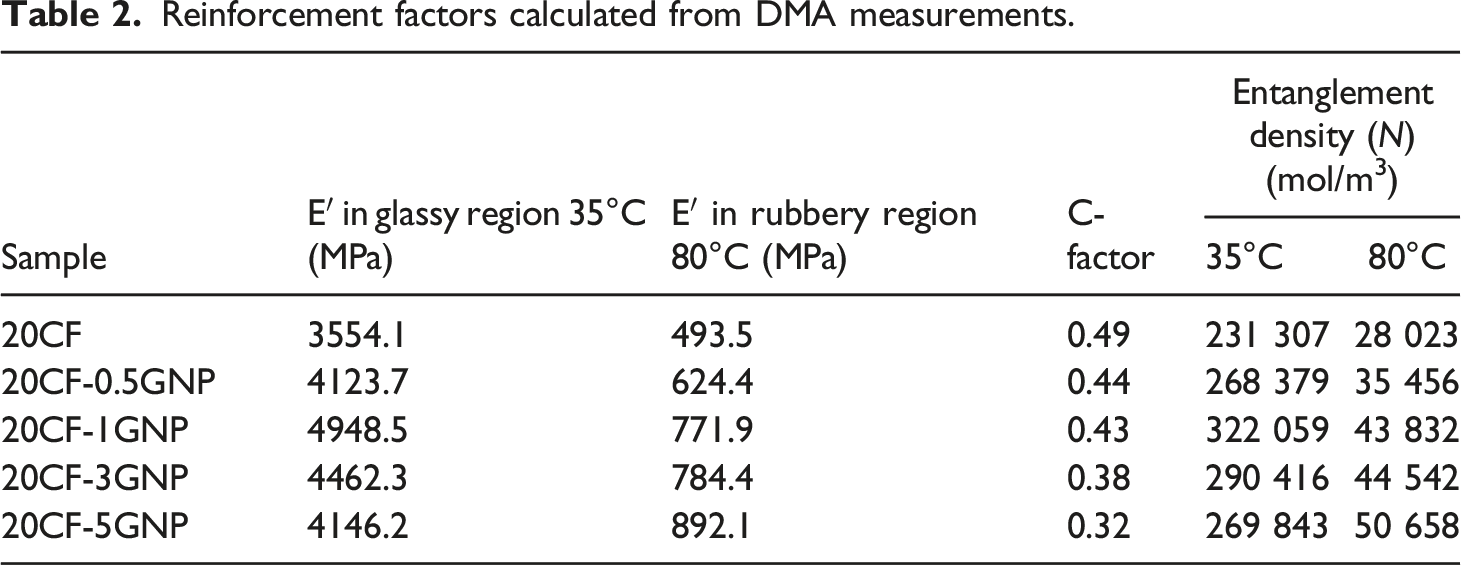
Table 2 displays the E′ values of 20CF 9 and hybrid composites in the glassy and rubbery regions, the C-factor, and the degree of entanglement (N). The modulus decrease with rising temperature is evaluated by using the C-factor. A lower C factor indicates that the filler causes less modulus drop in the matrix and the reinforcement effectiveness of the filler is high. 21 The addition of GNP to the 20CF composite resulted in a decrease in C-factor. All hybrid composites have lower C-factor values than 20CF and PA11/PLA/GNP 20 composites. In other words, the reduction in storage modulus after the glass transition point decreased for hybrid fillers. Hybrid fillers improved the reinforcement effect by creating a more rigid and stable composite structure. So, C-factor values verified the synergistic effect of hybridization. A similar hybridization was reported for polycarbonate (PC)/recycled CF (rCF)/biocarbon (BC) hybrid composites. However, in the corresponding study, the C-factor values of hybrid composites are lower than those of PC/BC composites but higher than those of PC/rCF composites. 21 In our study, the inclusion of GNP improved the reinforcing effect of CF on PA11/PLA, whereas the inclusion of BC did not improve the reinforcing effect of rCF on PC.
The degree of entanglement (N) infers information about the filler’s interactions and degree of dispersion in the polymer matrix. When 20CF was added to PA11/PLA, the N value of the matrix showed a jump-like increase. 9 The addition of GNP to the 20CF composite resulted in an increase in N. The addition of filler to the polymer matrix increased the entanglement of the polymer chains and reduced the interfacial tension. The N values of hybrid composites are also considerably higher than those of single-filled composites. 20 In the case of hybrid reinforcement, the entanglement density increases even more as both filler-filler and filler-polymer interactions are effective. Increased entanglement raises the possibility of a more efficient stress transfer. 45 This implies that the mechanical and melt stability of the material also improves. The increment in mechanical and thermo-mechanical modules of hybrid composites supports effective stress transfer. Likewise, a rise in chain entanglement will result in a rise in Tg. The damping factor curves show that all composites have higher Tg than the matrix. Furthermore, at 35°C in PA11/PLA/CF/GNP composites, 20CF-1GNP displayed the highest degree of entanglement, which is also consistent with the storage and loss modules values.
Differantial Scanning Calorimetry (DSC)
The data of DSC thermograms of samples.
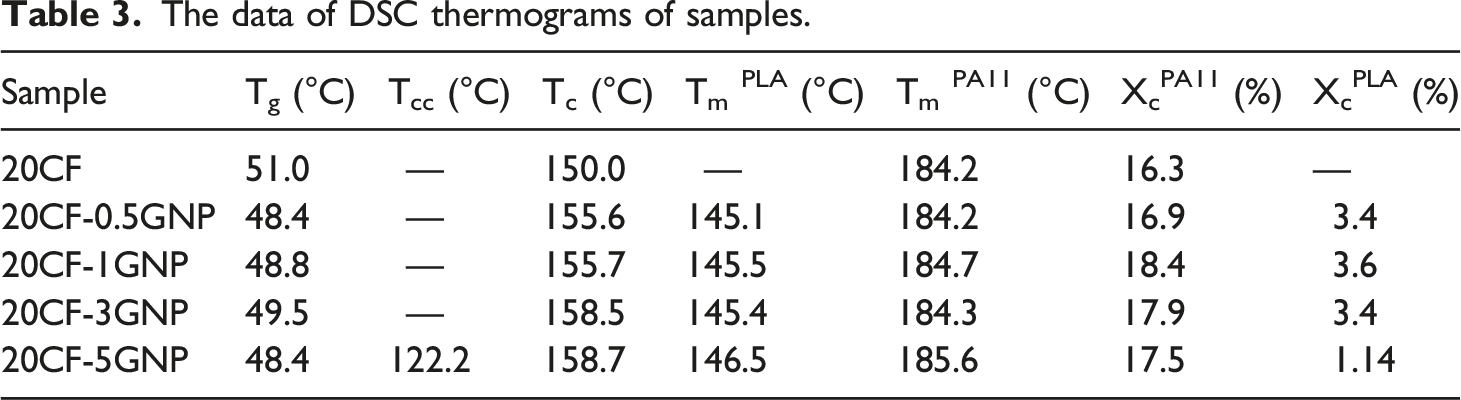
The cold crystallization peak of the PA11/PLA blend disappeared with the inclusion of 20 wt% CF 9 and the CF/GNP hybrid composites also did not exhibit it until the addition of 5 wt% GNP. This indicates that the crystallization characteristic of PLA phase has changed. CF and CF/GNP fillers facilitated the crystallization of PLA throughout the cooling process from the melt, resulting in products that had higher crystallinity. Thus, no crystallization peak occurred throughout the reheating process.20,46 The Tcc peak at 122°C observed in 20CF-5GNP indicates that high amount of GNP slows down the crystallization of the PLA phase by hindering the packing of polymer chains. In the cooling process, the blend and composites displayed melt crystallization behaviour similar to pure PA11. 9 The addition of CF did not significantly alter the Tc of the matrix, whereas the addition of GNP raised the Tc of 20CF by 5 to 8°C. The increment in Tc with the addition of hybrid fillers can be attributed to the nucleating effect of GNP on PA11.20,29 For injection moulding applications, a high Tc value is desirable. The material will begin to crystallize earlier throughout the moulding process.
Considering the melting behavior of hybrid composites, the PLA melting peak, which had disappeared after the addition of 20 wt% CF to the PA11/PLA as reported our earlier research, 9 was observed again with the addition of GNP. It can be said that the PLA chains that crystallized during the cooling process dissolved during the second heating step. According to our earlier research; it is seen that the crystallinity of PA11, which was 12.9% in the PA11/PLA blend, increased significantly with the inclusion of CF. 9 Adding GNP to 20CF enhanced crystallinity regardless of the amount. The highest % Xc value in CF/GNP hybrids was seen in 20CF-1GNP and slightly dropped with rising GNP. However, they still showed higher Xc % compared to 20CF. The addition of up to 3 wt% GNP increased the crystallinity of the blend, whereas the addition of a large amount resulted in some reduction due to agglomeration. The degree of crystallinity of the polymers increases due to the increasing number of nucleation sites at low filler loadings. On the other hand, with increasing loading amount of filler, the mobility of the polymer chains begins to slow down and the crystal growth decreases.11,47 The thermal properties of PA11/PLA/GNP nanocomposites were investigated in our previous study. 20 When the crystallinity of hybrid composites is compared to nanocomposites containing only GNP, it is observed that the addition of 1GNP offers the highest crystallinity in both, while GNP alone raises the crystallinity of PA11 more. However, in PA11/PLA/GNP nanocomposites, crystallinity declined more as the GNP amount increased. In hybrid composites, the inclusion of 3 and 5 wt% GNP provided higher crystallinity. This implies that CF improves the dispersion of GNP and prevents agglomeration, albeit slightly. The synergistic effect of CF and GNP on crystallization was also noted, and the maximum thermo-mechanical modulus was demonstrated by the 20CF-1GNP composite with the highest crystallinity, supporting the findings.
Thermogravimetric properties
The effects of micro- and nano-fillers on the thermal degradation of the PA11/PLA matrix were assessed by utilizing TGA. Figures 8 and 9 displays the sample weight loss as a function of temperature and the derivative (DTG) of this weight loss. The corresponding thermogravimetric data of the composites are detailed in Table 4. TGA curves of PA11/PLA blend and composites. DTG curves of PA11/PLA blend and composites. Thermal stabilities of the composites.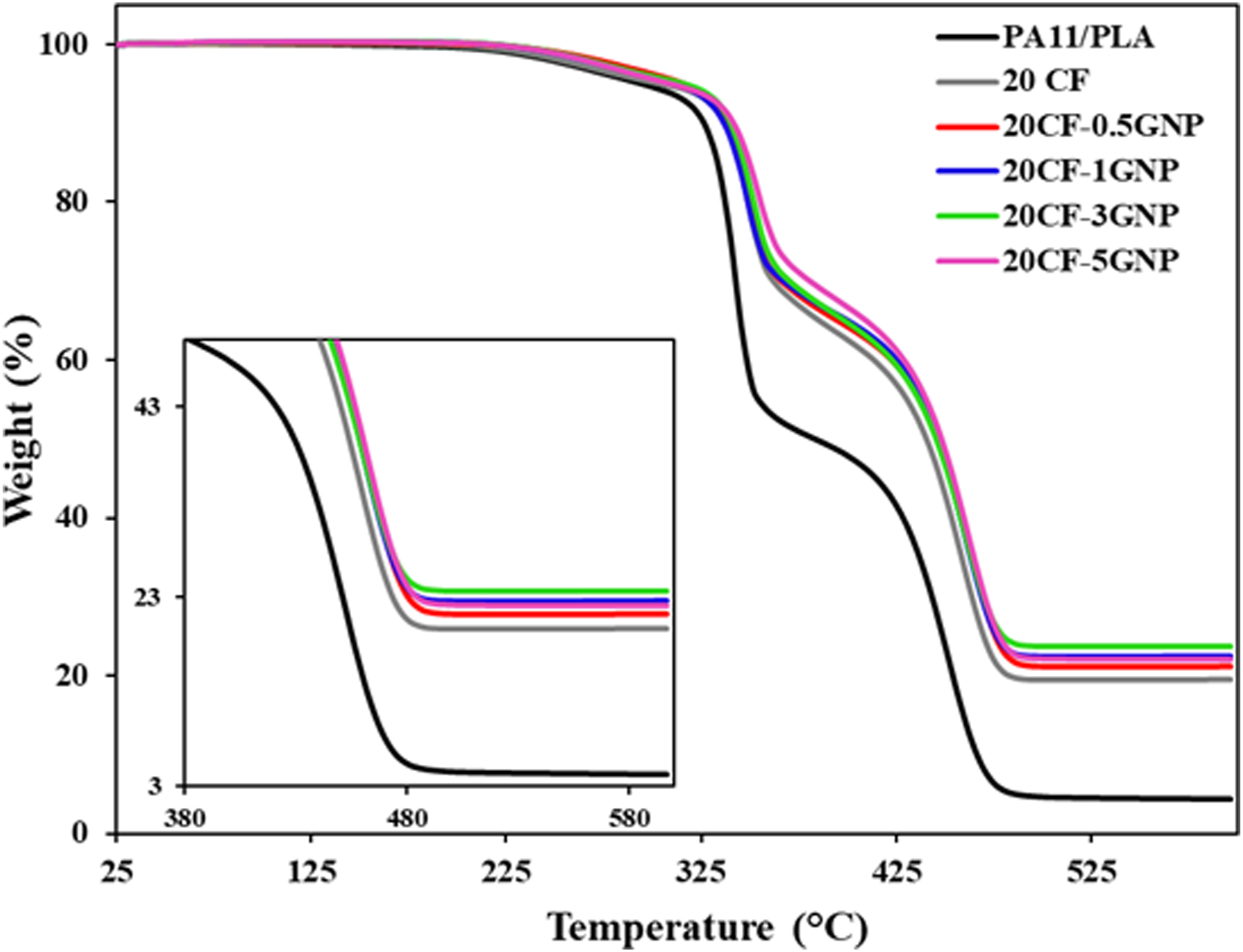
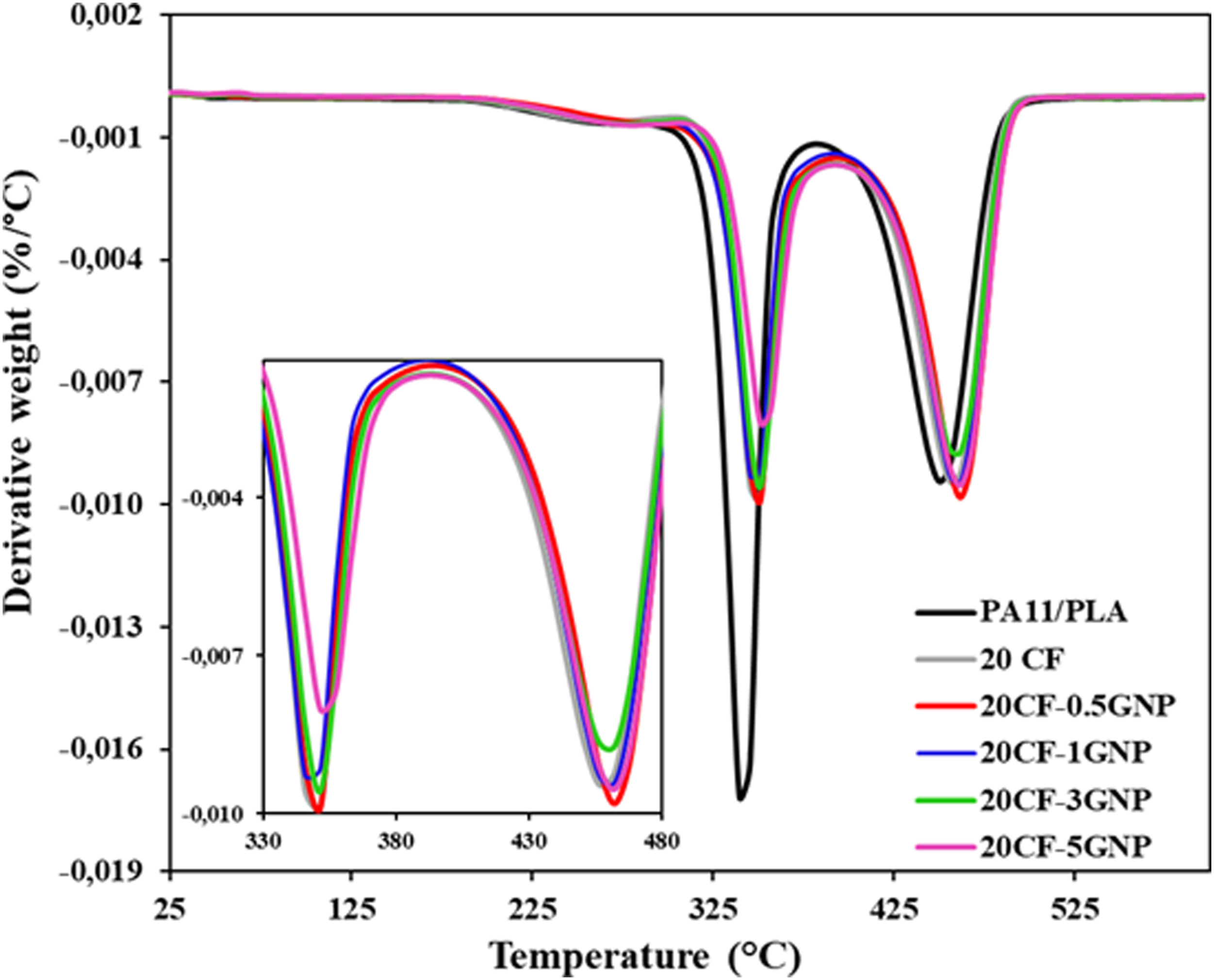
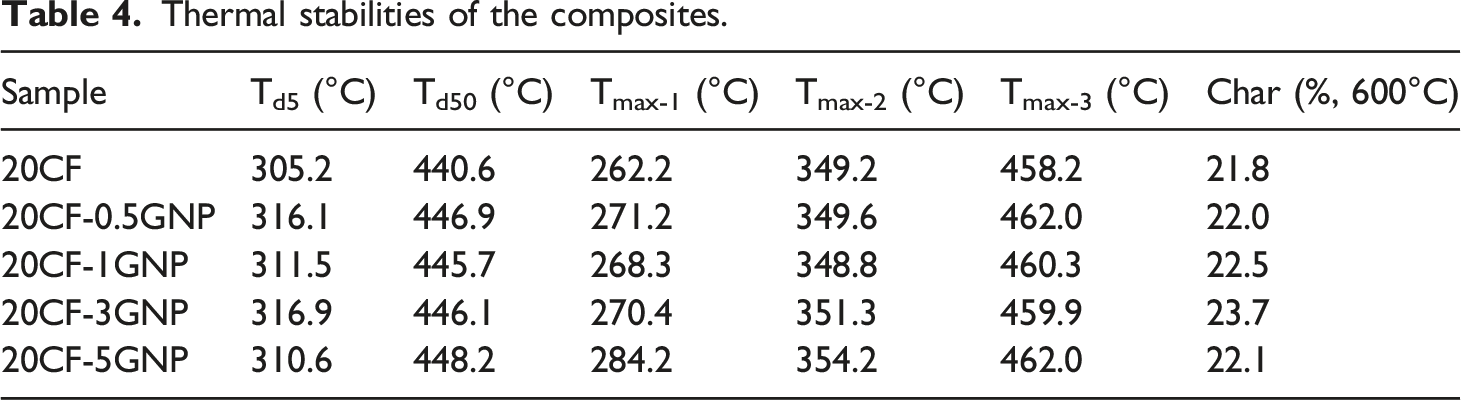
According to our previous research; 48 the degradation of the PA11/PLA blend took place in three stages which implies the degradation of PA11 and PLA phases. The peak temperatures Tmax-1, Tmax-2 and Tmax-3 obtained from the DTG curves in Figure 9 correspond to the plasticizer in the structure of PA11, the main chain degradation of PLA and PA11, respectively. Blending increased the first-stage degradation temperature of PA11, improved the thermal stability of PLA and the char residue of the blend was higher than both polymers.20,48 This improvement could be attributed to the “labyrinth effect” of the PA11 phase, which serves as a protective layer to the PLA evaporation products. 49 The same test procedure utilized for polymers was employed to look into the thermal stability of GNP and CF. The results were reported in our previous studies.20,48 CF showed a weight loss of 2% starting at 420°C, while GNP showed a weight loss of 9.1% starting at 347°C. This weight loss in carbon fillers can be attributed to the degradation of the surface functional groups whose presence was detected in the FTIR spectrum for GNP 20 and the degradation of the sizing agent polyamide for CF. 48 Considering the thermal behaviour of 20CF composites, it was observed that the amount of char increased to 21.8% as well as the increment of all decomposition temperatures with CF reinforcement. The Td5 value of the matrix increased by CF by 11°C, while the Tmax values increased by 5 to 7°C. The findings demonstrate that CF significantly enhanced the thermal stability of the PA11/PLA blend as mentioned previously. 48 There are several reasons for this enhancement, including the high thermal stability of CFs, their ability to absorb heat, and their good interaction with polymer matrix.8,50 Furthermore, it has been reported that CFs prevent the diffusion of decomposed products, as well as reduce heat dissipation.34,50 The decline observed in the peaks of the DTG curves in Figure 9 also indicates that the degradation process has slowed down.
As GNP was added to 20CF, the degradation temperatures continued to rise. Compared to 20CF, the Td5 value increased by 5°C–10°C and the Td50 value by 5°C–8°C with the increasing amount of GNP. In general, GNP improved thermal stability by delaying the onset of degradation. Char at 600°C was also generally higher for hybrid composites. This is due to the increase in carbon composition in the structure. 8 So, the residual char percentage of the hybrid composites was in good agreement with the amount of carbon filler in the structure. The improvements in thermal stability caused by the addition of hybrid micro-nano-fillers are, on the one hand, due to the intrinsic properties of these materials, such as their thermal resistance, thermal conductivity, barrier effects, and geometrical characteristics. On the other hand, improved matrix-filler interfacial interactions are regarded to be the key contributing reason.3,51 Accordingly, improving thermal stability can be achieved by increasing the thermal conductivity of the matrix via conducting filler or by slowing down the diffusion and thus degradation processes via good dispersion and interactions of fillers.8,34 Seki et al. observed that adding graphene to PA46/CF/synthetic graphite composites raised the degradation onset temperature by 10°C, citing homogenous distribution and higher thermal conductivity as the reasons. 8
The rate of the degradation process can be evaluated by the peak heights of the DTG curves. Examining DTG curves reveals that the peak height, which indicates the degradation in the PLA phase in the matrix at around 350°C, 20 decreased with the increasing amount of GNP. In other words, the inclusion of GNP to the 20CF delayed the degradation of the PLA phase. GNP is known to act as a radical scavenger against free radicals generated during the depolymerization process. It can inhibit free radical reactions and delay the decomposition and transfer of volatile compounds. 52 The slowing of polymer degradation by GNP is also due to the ’tortuous path effect’. GNPs generate tortuous path in the matrix and successfully serve as mass transfer barriers against volatile pyrolyzed products because of their large surface area, high aspect ratio, and layered structure.3,51 When combined with CF, these effects were considerably more effectively seen which implies synergistic effects of CF and GNP. The inclusion of hybrid micro-nano-fillers with varying geometric characteristics can create an internal three-dimensional network in the matrix which increases the viscosity of liquid destructs. It has been reported that due to the solidification processes, these high viscosity destructs produce a carbonized insulating layer on the surface of the burning samples, reducing the rate of degradation.52,53 Furthermore, the high amount of fillers in the matrix hinders polymer chain mobility.34,52 According to Papageorgiou et al., 51 the simultaneous presence of glass fiber (GF) and GNP forms a well-dispersed network structure by covering a significant portion of the volume of the composite, which restricts the mobility of PP macromolecules and improves thermal stability. Moreover, they stated that this phenomenon was consistent with rising Tg and also higher crystallinity of the sample. Compared to the other compositions, only 20CF-5GNP showed a small decline in Td5 value and residual char percentage. In the PA11/PLA/CF/GNP hybrid composites, it was found that the sample containing 5 wt% GNP had a lower Tg, percentage crystallinity (Table 3) and degree of entanglement (Table 2). This explains why the 20CF-5GNP had a lower Td5 value and less residual char percentage. Li et al also observed a decrease in Td5 value at high graphene nanosheet amount in PP/GF/GNS hybrid composites. 54 On the other hand, in contrast to PLA, the inclusion of GNP slightly increased the peak height at 450°C, which shows the degradation of PA11. The increased peak height suggests that GNP, which has a good thermal conductivity at high temperatures (>300°C), promotes the degradation of the PA11 phase. 55 A similar outcome was seen in nanocomposites of PA11/PLA/GNP that only contain GNP. 20 When all TGA findings are considered, the CF/GNP hybrid filler is found to have a synergistic effect on the thermal characteristics of the PA11/PLA matrix.
Conclusion
The combined effects of micro- and nano-fillers on the properties of PA11/PLA/CF/GNP hybrid composites were studied as a function of GNP amount. The morphological observations showed an improved dispersion of GNPs and matrix-CF interfacial interactions in hybrid composites. Considering the rheological properties, the immobilization effects of CF and CF/GNP on PA11/PLA chains resulted in an increase in complex viscosity. It has been observed that the effect of multiscale fillers on rheological properties was dominated by surface area, and GNPs increased viscosity more than CF. The hybrid composites showed increased tensile strength and modulus compared to 20CF and PA11/PLA/GNP nanocomposites due to the bridging effect of GNPs. On the other hand, it was observed that the flexibility of the composite was dominated by CF, and all 20CF and hybrid composites exhibited a brittle structure. DMA results demonstrated that the tan δ peak heights of hybrid composites were lower than both 20CF and PA11/PLA/GNP nanocomposites due to the inhibited chain mobility and improved interfacial interactions. Consequently, C-factor values verified the synergistic effect of hybrid multi-scale fillers. DSC analysis confirmed the synergistic effect of CF and GNP on crystallization and 20CF-1GNP hybrid composites exhibited maximum Xc %. 20CF-1GNP also had the highest storage and loss modules due to its high crystallinity. The TGA revealed that the inclusion of GNP in the 20CF improved thermal stability and increased the residual char percentage. As a consequence, it can be said that adding GNP to a PA11/PLA/CF composite has a synergistic influence on the mechanical and thermal properties. It has been seen that the inclusion of hybrid filler is an effective and simple technique to increase the properties of polymers for advanced engineering applications and that it can be produced easily using the industrial extrusion method. These hybrid composites are also promising for application in automotive structural components that need mechanical strength (such as bumpers, ceilings, and chassis). By altering the production processes, it is possible to do more research beyond this one on the characteristics of hybrid composites. Thus, new functional qualities (thermal/electrical conductivity) can be imparted to the material while the properties required for the usage area are progressively improved. It is anticipated that this will pave the way for new areas of use.
Footnotes
Declaration of conflicting interests
The author(s) declared no potential conflicts of interest with respect to the research, authorship, and/or publication of this article.
Funding
The author(s) disclosed receipt of the following financial support for the research, authorship, and/or publication of this article: This work was supported by Kocaeli University Scientific Research Projects Unit (KOUBAP). (Project no: FDK-2021-2783).
