




Abstract
Polypropylene (PP) has a wide range of engineering applications in automobile, biomedical, energy, machine parts, electronic packaging etc. However, PP lacks some desired engineering properties such as good thermal properties and mechanical strength. For instance, PP is known for its low melting temperature, high flammability and low heat resistance. This has resulted in continuous improvement in various properties of PP via modification of its matrix. One of the ways this has been achieved is by incorporation of foreign bodies in form of reinforcements in the PP matrix. The recent discovery of carbon nanotubes (CNTs) has further paved the ways for advancing the properties of PP via the development of PP-CNTs composites. Such composites have not only shown improved engineering properties but retain the lightweight and flexibility of PP. The advanced engineering properties recorded by various studies using PP-CNTs composites are due to the good properties of PP in conjunction with the excellent properties of CNTs such as high thermal conductivity, strength, electron mobility and formation of conductivity networks in the PP matrix. Although the development of PP-CNTs composites faces challenges of high agglomeration and incompatibility of CNTs in the matrix, the moves towards addressing the hurdles and achievements recorded so far are encouraging. Therefore, this review investigated the contribution of CNTs on various advanced engineering properties of PP-CNTs composites. Various results drawn from previously published literature within the decade were tabulated for future academic references and industrial purposes. Current hurdles faced by PP-CNTs composites, future prospect and their advanced engineering applications were discussed.
Introduction
Polypropylene (PP) is one of the most widely used thermoplastic polymer available in the market for various engineering applications. 1 Its easy processing, low cost, lightweight, thermal, mechanical and chemical inert behaviours have paved its way into various engineering applications such as battery cases for automotive, products packaging, fibres, pipes, toys, plastic bottles etc. PP belongs to the partial crystalline polyolefins’ family, which is made from the polymerisation of propylene monomer. However, PP has relatively low melting and working temperature, beyond which it losses its mechanical properties. 2 This makes PP low heat resistance material and high flammability, in conjunction with its low mechanical strength and low resistance to crack propagation. 1 To enhance such properties to meet many advanced engineering applications, various approaches have been adopted by different researchers such as the incorporation of ceramic fillers in PP matrix3–7 and blending of PP with other polymers.8–10 However, the development of PP-CNTs composites has shown superior properties in terms of heat resistance, low flammability, electrical, thermal, mechanical properties etc. 11 compared to previously developed PP-based composites due to the excellent properties of CNTs.
CNTs is classified as 1-dimensional hexagonal carbon-based nanomaterial. CNTs was first discovered in 1991 by Iijima. 12 CNTs has excellent properties which include thermal conductivity of about 3000 W/mK, elastic modulus of about one TPa, tensile strength of about 11–63 GPa, shear modulus of about 70–378 GPa, electrical conductivity of about 106 S/m and high thermal stability. 13 CNTs is also characterised by its high aspect ratio and surface area, which give it the potentials to significantly change the physical, thermal and mechanical properties of polymer matrix with little or no changes in the chemical properties of the polymer matrix. Various studies have used CNTs in the design and development of materials for various engineering applications due to its excellent properties. 14 For instance, CNTs has been used to improve properties of epoxy, 15 polypropylene, 16 poly(vinylidene fluoride) 17 to mention but few. CNTs is more preferred in enhancing mechanical, thermal and electrical properties of polymers due to its higher aspect ratio compared to other conventional fillers.
The development of PP-CNTs composites has shown various improved engineering properties considered as advanced materials for future engineering applications. For instance, Mertens and Senthilvelan 18 reported improved tensile strength, young modulus and wear behaviour of PP-based composites reinforced with CNTs up to 1wt%. Beyond this concentration, the composites showed a decrease in properties, which was attributed to an increase in CNTs agglomeration level. Bao and Tjong 19 also reported improved thermomechanical properties of PP composites using CNTs below 1wt%. The study showed enhanced engineering properties at high temperature, which can be attributed to the high thermal properties of CNTs. This makes CNTs a good nanomaterial in improving the thermal and flammability performance of the PP matrix. 20 Such composites do not only indicate improved properties but also high flexibility and lightweight, giving them high potential application in flexible electronic, auto-parts, aero-parts, machine parts etc. The ability of CNTs to form conductive network configuration in the polymer matrix (with improving thermal and electrical conductivity), impediment of the polymer molecular chains (with improving mechanical properties) and formation of mini-capacitors (with improve energy storage density), gave CNTs edge over ceramic fillers.
Despite the advanced engineering properties shown by PP-CNTs composites, they often faced challenges in fabrication due to agglomeration and incompatibility of PP matrix and CNTs.21–23 These often result in the reduction of the expected properties of PP-CNTs composites. The hurdles faced by PP-CNTs composites fabrication are due to the bond that hold individual CNTs together and the pristine nature of CNTs without functional groups to interact with the PP matrix. Although significant efforts have been made in the fabrication of well-dispersed PP-CNTs composites via surface modification of CNTs or the use of compatibilizer (such as polymer grafted maleic anhydride), no particular approach has been satisfied to give optimal dispersion of CNTs in the PP matrix. Hence, various properties of PP-CNTs composites reported by various studies depend on the degree of CNTs dispersion, as well as CNTs size, CNTs orientation in the matrix and fabrication approach of PP-CNTs composites. Therefore, this present article discussed various approaches employed by researchers to ensure good dispersion of CNTs in the PP matrix and PP-CNTs fabrication routes. Various advanced engineering properties recorded with PP-CNTs composites were drawn from open literature and tabulated for comparison and discussion. Current challenges, possible solutions and future applications of PP-CNTs composites were also included. To the best of our knowledge, a similar review on PP-CNTs composites was done a decade ago (2010) by Bikiaris. 1 No recent review has been conducted on PP-CNTs composites in the previous 10 years despite a lot of research carried out on this class of composites. Hence, the present review is vital in bringing recent research findings together around PP-CNTs composites for research and industrial referencing.
Fabrication of PP-CNTs Composites
The final properties of PP-CNTs composites are dependent on the fabrication method and the dispersion level of CNTs, which is directly related to the microstructure of the composites.
1
The discrepancy in fabrication techniques and the degree of dispersion of CNTs in the PP matrix reported by various researchers are some of the reasons for obtaining lower mechanical properties compared to the theoretically predicted values.
24
There are practically three methods of fabricating PP-CNTs composites, namely, solution mixing, in situ polymerisation and melt compounding. For details on the fabrication of such polymer composites, reference can be drawn from our previous studies.25,26 Solution mixing technique in fabricating PP-CNTs composites involves the dispersion of PP and CNTs in an organic solvent(s) such as xylene and toluene at elevated temperature to allow PP to dissolve, followed by evaporation of the solvent to form PP-CNTs composites film as shown in Figure 1(a). Although this technique can well-dispersed CNTs in polymer matrix without the use of sophisticated equipment,25,27 it is limitedly used in the fabrication of PP-CNTs composites due to the difficulties faced in dissolving PP in most organic solvents.
1
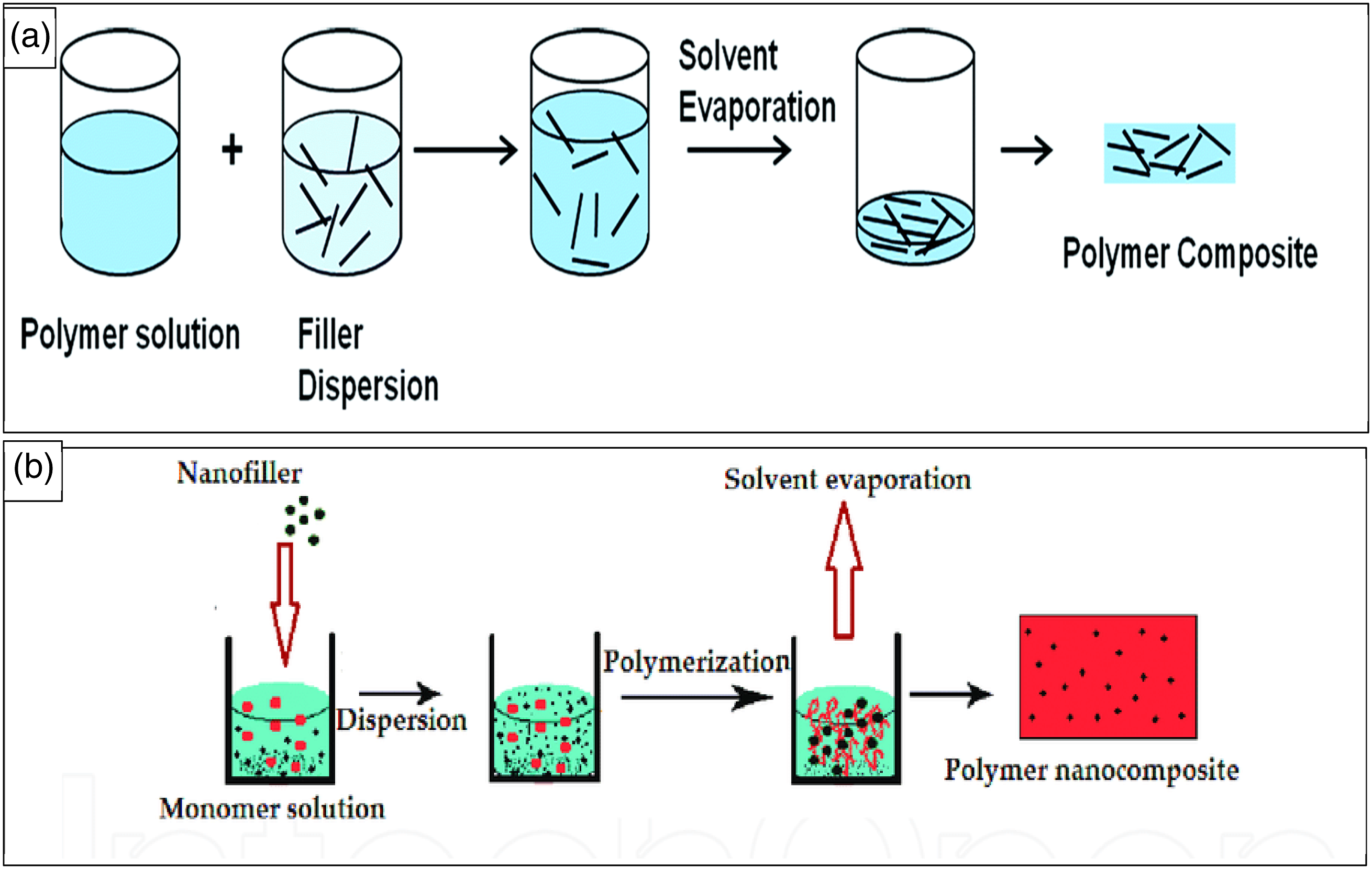
Fabrication of PP-CNTs composites by in situ polymerisation involves the polymerisation of propylene monomer incorporated with CNTs in the presence of a catalyst as illustrated Figure 1(b). It is the more effective way of producing well-dispersed CNTs in the PP matrix with strong interfacial adhesion between PP and CNTs. Although this technique can be challenged by incomplete polymerisation reaction or high viscosity during the process, 30 it has been extensively used by researchers due to its high capability of producing homogeneously mixed PP-CNTs composites.31–33 More pronounced dispersion and good adhesion of CNTs and PP matrix can be achieved via in situ polymerisation after functionalizing CNTs compared to non-functionalized CNTs. 23
Melt compounding is one of the common methods used in the fabrication of PP-CNTs composites, which is more suitable for commercial production. 34 This process produces such composites by mixing PP and CNTs at some temperature slightly above the melting temperature of PP using melt compounding equipment. This technique uses high temperature and shear force in melting and mixing polymer composites,25,35 which can lead to thermal degradation of the composites if not properly controlled. Also, residual stresses and viscous drag on the reinforcements can be observed due to the applied shear force.25,35,36 Many studies have reported PP-CNTs composites fabricated through melt compounding with significant improvement in various properties.18–20,37–39 Due to the poor dispersion capability of CNTs in a polymer matrix, various studies have preceded fabrication of PP-CNTs composites methods by surface modification of CNTs, solvent and dry mixing, the use of compatibilizer etc. These approaches employed by different studies to ensure good dispersion of CNTs in the polymer matrix are discussed in the next section. However, these approaches introduce defects in the structure of CNTs with deterioration in mechanical, thermal, electrical, electronic properties etc.
Schematic illustration of solvent mixing of PP matrix and CNTs preceding melt compounding is presented in Figure 2 as illustrated by Esawi, Salem.
24
The solvent mixing approach typically involves dissolving PP in xylene or toluene solvents at a temperature above 120oC,34,40 followed by mixing with CNTs using ultrasonicator, mechanical or magnetic stirrer before melt compounding. On the other hand, dry mixing basically involves the mixing of PP and CNTs without solvent. It is done with the aid of a mechanical mixer such as a tubular mixer, followed by melt compounding. These routes result in various degree of dispersion of CNTs in a polymer matrix with different properties of the final composites. Esawi, Salem
24
noted that, although homogenous dispersion was obtained using solvent mixing technique, a lower weight fraction of CNTs could be used to improve mechanical properties of the PP matrix when processed by dry mixing compared to solvent mixing. This observation can be attributed to the higher introduction of defects on the basal structure of CNTs during solvent mixing compared to its counterpart, in addition to the difficulties associated with the complete removal of the mixing solvent from the composites. Schematic illustration of solvent mixing of PP matrix and CNTs preceding melt compounding. Adopted from
24
with permission from john wiley and sons.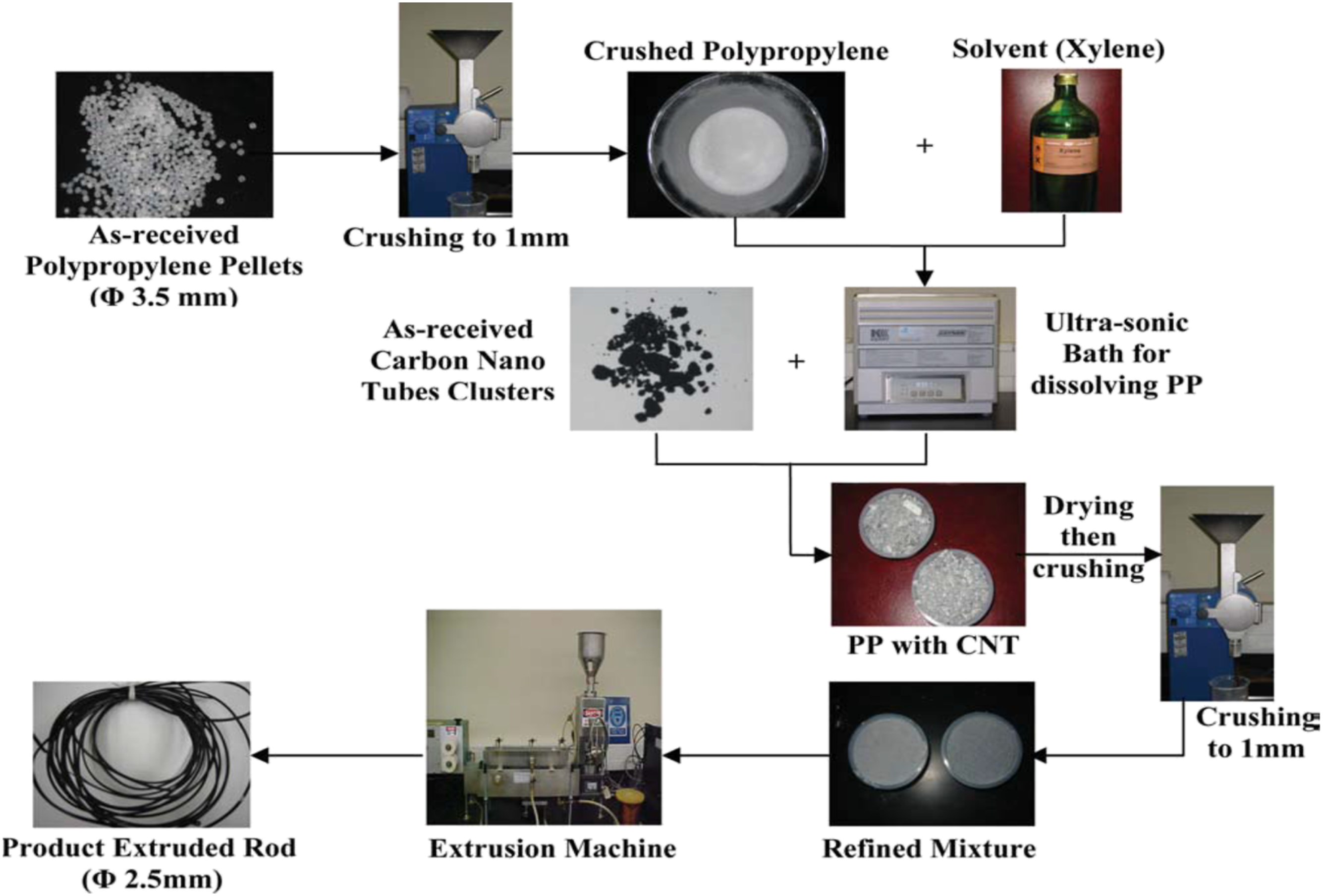
Challenges Associated with the Fabrication of PP-CNTs Composites
CNTs exhibit hydrophobic characteristics when incorporated in the PP matrix. This is due to the high surface area and tension of CNTs that lead to phase separation in a polymer matrix. The Van der Waals force of attraction, high surface energy and π-π bond holding individual CNTs prevent its homogeneous dispersion in the polymer matrix as the particles tend to come together. 32 This often results in high agglomeration and incompatibility of CNTs with the polymer matrix. This has been the major hurdle facing the successful fabrication of PP-CNTs composites with highly improved properties since the final properties of a composite depends on dispersion and compatibility of reinforcement(s) and the matrix. 41 Notwithstanding, various efforts have been made to address this challenge. Some of the strategies employed by researchers to ensure good dispersion of CNTs in the polymer matrix include surface modification of CNTs, the addition of maleic anhydride, liquid phase and mechanical exfoliation of CNTs.
Surface Modification of CNTs
Various modifications such as covalent modification42–44 and non-covalent modification45–47 have been successfully employed by various researchers to the enhance dispersion of percolative fillers such as CNTs in the polymer matrix. Modification of percolative fillers attaches functional groups such as epoxide, hydroxyl, carboxyl and carbonyl on them.48,49 These functional groups interact with functional groups in the polymer matrix to form strong interfacial interaction with good dispersion.50–52 Successful modification of carbon-based percolative fillers has been achieved with the use of organic modifiers53,54 and inorganic modifiers.55,56 Oxidation of CNTs can also be considered as modification/functionalisation since it also introduces functional groups on CNTs.57,58 This technique involves oxidation of CNTs in the presence of an oxidant such as H2O4, KMnO4, H2O2, HNO3 etc. Such modification introduces defect sites or domains on the conjugal structure of the fillers, which deteriorates their excellent engineering properties. 59 This approach is widely used by researchers in promoting dispersion and adhesion of CNTs and other reinforcement with the PP matrix.57,60–62
The use of Polymer Grafted Maleic Anhydride
Maleic anhydride (MA) is a polar organic compound with hydrophilic characteristic. It is grafted on various polymer molecular chains to induce hydrophilic characteristic to enhance compatibility with hydrophobic fillers. They are various polymer grafted MA such as polyethylene grafted MA, polyisoprene grafted MA, polypropylene grafted MA etc. MA has a hydroxyl functional group generated during the hydrolysis of MA which anchors with the percolative fillers to improve their affinity with the polymer matrix. 63 It is very difficult to obtain good interfacial bonding between polymer and CNTs without the help of polymer grafted MA or surface modification of CNTs. MA aids in the reduction of the surface energy of CNTs, making it compatible with the polymer matrix. MA can be grafted on polymer chains by using benzoyl peroxide and toluene with proper control of concentration, reaction time and temperature.64–66 Therefore, MA can be called dispersant or dispersion-aid for most polymer nanocomposites. MA also improves thermal, mechanical, dielectric properties of polymer composite materials.67,68 For instance, Zhou, Xie 69 fabricated PP-CNTs composites using MA grafted styrene-ethylene/butylene-styrene copolymer as a compatibilizer and reported enhanced mechanical and thermal properties. The presence of such a compatibilizer improved the formation of the percolative network of the CNTs in the PP matrix. In the same way, Szentes, Varga 38 improved thermal conductivity of PP-CNTs composites fabricated using olefin-g-MA copolymer and olefin-g-MA-ester-amide as compatibilizer in aiding dispersion of CNTs in the PP matrix.
Liquid Phase and Mechanical Exfoliation of CNTs
The liquid phase exfoliation method is used in the separation of small CNTs bundles into individual CNTs. The process involves the dispersion of CNTs in a solvent with similar surface energy such as N-methyl pyrrolidone (NMP) and DMF.70,71 A surfactant can also be used to attach functional groups on the CNTs to assist in exfoliation. The CNTs suspension can be subjected to ultrasonication, which uses ultrasound and shear stress to exfoliate lumps particles into few or individual particle. The major mechanism in this process involves the formation and breaking of bubbles in the solvent due to the pressure, which acts on the CNTs and loosens the Van der Waals forces holding individual particles together. 72 On the other hand, the mechanical exfoliation method used in the exfoliation of CNTs involves the application of external force to overcome the Van der Waals force of attraction holding individual CNTs. The external force is often applied with the use of ball milling. In most cases, CNTs can also be mixed with a little amount of solvent as an external agent to induce stability. The mixture is further processed by ball milling or tubular mixing over a long duration. During this process, perpendicular and/or shear forces are applied on the lumps of CNTs to overcome the Van der Waal force. However, the process also faced the challenges of particles defect, long exfoliation time and energy consumption. 73
Previous Works on PP-CNTs Composites
Mechanical Properties
Mechanical properties are physical properties, which determine the response of materials on the application of external force. Such properties include tensile, compressive, and flexural strength, elastic and Young Modulus, hardness, toughness etc. Various PP-CNTs composites reported by different researchers showed variation in mechanical properties, which can be attributed to different processing techniques, CNTs concentrations, CNTs-types, CNTs particles sizes, state of CNTs dispersion in PP matrix, interfacial interaction of CNTs and PP matrix. Notwithstanding, various studies have reported significant improvement in mechanical properties of PP-CNTs composites compared to the pure PP matrix due to the excellent mechanical properties of CNTs. CNTs in the PP matrix has shown good load-bearing capability when a load is transferred from the matrix to the CNTs.
39
When CNTs is incorporated in a matrix, applied normal load can be in the direction of CNTs or parallel to CNTs as shown in Figure 3.
74
Composite materials consisting of CNTs will show higher strength and bridging of crack propagation when the applied load is in the CNTs direction compared to the parallel direction.
75
However, in practical application, it is often difficult to align CNTs in a specific and uniform direction in a matrix. CNTs in a matrix will tend to agglomerate or entangle due to their high surface energy.
32
Therefore, applied load on PP-CNTs composites can be in both normal and parallel direction to CNTs or at angles to CNTs since it is randomly distributed in the matrix in most cases. This is one of the reasons for the discrepancy of mechanical strength of reported CNTs composites even at similar concentration, as a composite with the majority of its CNTs in the normal direction to the applied load will result in higher strength. (a) Schematic illustration of normal and parallel load transfer to CNTs. Adopted from
74
with permission from Taylor and Francis.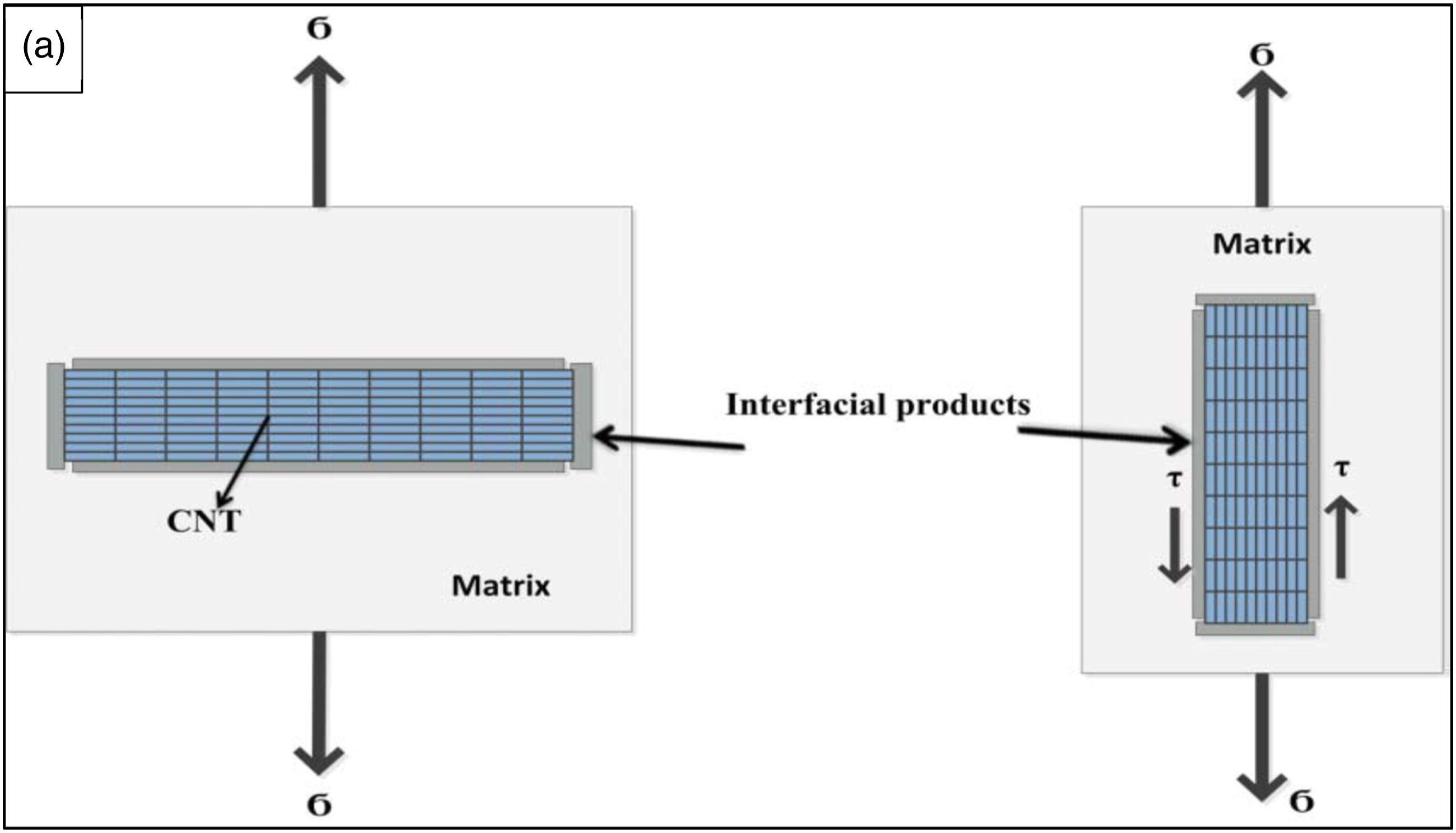
Gao, Liu 39 stated various ways CNTs can improve the strength of a polymer matrix, which include promoting crystalline structure of the matrix, uniform distribution of load to CNTs, good load transfer from matrix to CNTs, pulling, fracturing and bridging of CNTs in the matrix. The authors prepared PP-CNTs composites by solution mixing, followed by melt compounding. Tensile strength and elongation at break of the composite, respectively, increased from 18.61 MPa and 13% for pure PP to 34.71 Mpa and 27% for PP-3wt%CNTs and decreased to 23.25 Mpa and 16% for PP-5wt%CNTs. The increase was attributed to the fracturing of the CNTs in the PP matrix, where many of the CNTs left in the matrix after fracture was in proximity to the critical fracture length of CNTs as was observed using a scanning electron microscope (SEM). However, CNTs pull out noted on the fractured surface of PP-CNTs composites could be an indication of low interfacial bonding or interaction between PP matrix and CNTs.23,76,77 On the other hand, the decrease in mechanical response as CNTs was increased to 5wt% was accounted for an increase in agglomeration of CNTs in the PP matrix. The agglomeration level of CNTs in the PP matrix can be affected by the processing technique. For instance, on the investigation of the effect of PP-CNTs composites’ processing routes on their mechanical properties, Esawi, Salem 24 recorded that PP-CNTs composites processed by solvent mixing – melt compounding route has more capability to dispersed CNTs in the PP matrix compared to dry mixing – melt compounding route. Hence, the authors obtained optimal yield strength and hardness of about 25(±3) Mpa and 0.066(±0.002) Gpa, respectively, for PP-0.5wt%MWCNTs composite processed by dry mixing – melt compounding route. Although 25(±7) MPa and 0.064(±0.007) GPa were accordingly measured for PP-1wt%MWCNTs composite processed by solvent mixing – melt compounding route. As also previously observed, the mechanical properties of composites were decreasing as MWCNTs was increasing in the PP matrix.78,79
Also, Stan, Sandu 80 evaluated the mechanical properties of reprocessed PP-MWCNTs composites (that is mechanical recycling and injection moulding of PP-MWCNTs composites stored for 2 years at normal environmental condition). Although the reprocessed composites did not show a significant change in tensile strength and Young Modulus when compared to the virgin PP-MWCNTs composites, the reprocessed composites showed an increase in elongation at break. This was attributed to the good dispersion of MWCNTs in the PP matrix achieved by breaking agglomerated MWCNTs formed in the matrix during the reprocessing. A similar increase in ductility of PP-MWCNTs composites has been previously reported. 75 Jia, Peng 81 in their study reported enhanced tensile strength, Young modulus, creep and recovery capability of PP by adding MWCNTs prepared via melt compounding technique. The study recorded high creep, Young modulus and tensile strength percentage increase of 73%, 32% and 10.8%, respectively, which was credited to the significant influence of MWCNTs in improving mechanical properties of the PP matrix. The study noted that the effect of MWCNTs on the recovery was more pronounced as temperature increases, which confirmed the previous report on the effect of MWCNTs in the PP matrix. 19 CNTs improves the mechanical properties of polymers by the impediment of their molecular chains and restriction of polymer chains mobility when a load is applied.19,80,82
CNTs has often shown high segregation and incompatibility in polymer matrix due to the pristine nature and lack of functional groups (such as oxygen, hydroxyl, epoxy etc.) on CNTs to anchor with polymer molecular chains. This became an issue of challenge on the fabrication of PP-CNTs composites. However, efforts have been made in tackling the challenge through the use of polymer grafted maleic anhydride (g-MA) with enhanced electrical, mechanical and thermal properties.69,83,84 For instance, Mertens and Senthilvelan 18 used PP-g-MA to enhance the compatibility of CNTs and PP matrix processed by melt compounding. The study reported an improved dispersion of CNTs and bonding with the PP matrix due to the presence of PP-g-MA. This compatibilizer serves as an intermediary between the PP matrix and CNTs by grafting PP molecular chains and the surfaces of CNTs. However, the study noted the formation of small CNTs bundles as CNTs was increased beyond 1wt% in the PP matrix. Optimal stress and Shore-D hardness of about 40 MPa and 75.4 (±0.4%) Shore-D were measured when 5wt% CNTs was loaded into the PP matrix. The improved properties were because of the PP-g-MA in promoting the dispersion of CNTs in the PP matrix.
Also, Hemmati, Shariatpanahi 85 fabricated PP-SWCNTs composites by melt compounding method with aid of PP-g-MA as compatibilizer and CNTs dispersion-aid. The study recorded a good dispersion state of the SWCNTs in the PP matrix with more improved mechanical properties compared to PP-g-MA free composites. Optimal tensile strength, Izod impact energy and elongation at break of 19.5 MPa, 28.71 J/m and 1050% were, respectively, recorded for 0.5wt%SWCNTs loading. These improved properties, in conjunction with the recorded enhanced tensile and storage modulus, were due to the good dispersion of SWCNTs in the matrix, assisted by PP-g-MA. The mechanical properties were decreasing as SWCNTs was increasing. This could be due to an increase in CNTs agglomerations in the matrix with an increase in CNTs content,86,87 which act as stress concentration and crack initiation sites with a reduction in tensile strength.21,23 Although the decrease in elongation or ductility can be a result of the formation of network configuration by the CNTs in the PP matrix, in addition to the large difference in modulus of PP matrix and CNTs 88 and formation of CNTs aggregate that serves as stress concentration zone, crack initiation and propagation.89,90
Comparison of thermal, mechanical, electrical and dielectric properties of published reports on PP-CNTs composites between 2010–2020.
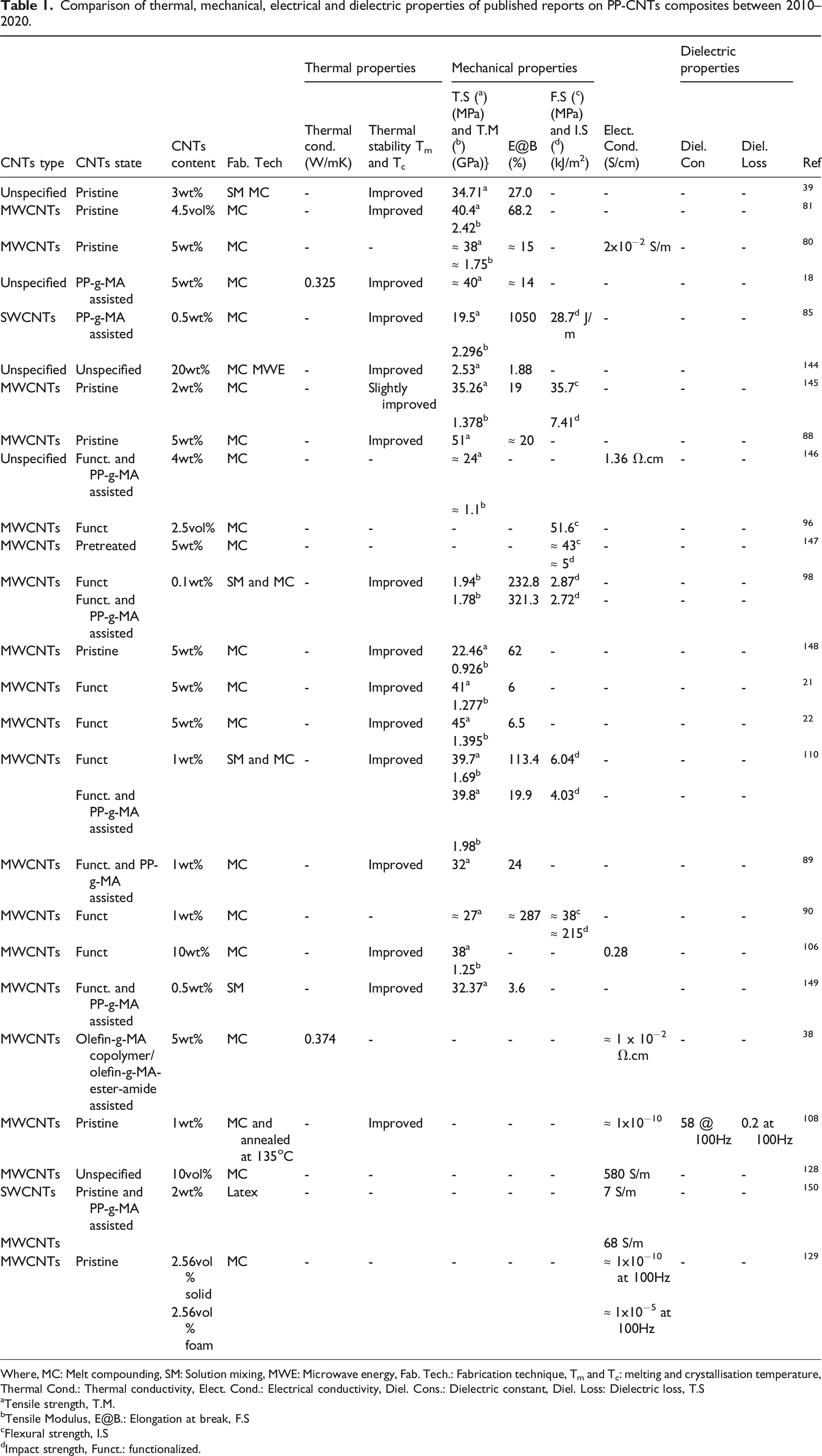
Where, MC: Melt compounding, SM: Solution mixing, MWE: Microwave energy, Fab. Tech.: Fabrication technique, Tm and Tc: melting and crystallisation temperature, Thermal Cond.: Thermal conductivity, Elect. Cond.: Electrical conductivity, Diel. Cons.: Dielectric constant, Diel. Loss: Dielectric loss, T.S
aTensile strength, T.M.
bTensile Modulus, E@B.: Elongation at break, F.S
cFlexural strength, I.S
dImpact strength, Funct.: functionalized.
Thermal Properties
The thermal properties of a material reveal the material’s response or behaviour to applied heat. Polymeric materials often exhibit poor thermal properties due to their amorphous structure. Thermal properties of polymers can be tailored by incorporation of foreign bodies or modification of their matrices. In this nanotechnological era, thermal properties of various polymers are being tailored using nanofillers such CNTs to meet various advanced engineering applications. CNTs can enhance the thermal properties of polymers even at low concentration by improving their crystalline structure and formation of conduction networks in the matrix as shown in Figure 4 due to the high aspect ratio and high surface area of CNTs.
99
Annealing at elevated temperature of such composites enables alignment of CNTs via diffusion or rearrangement of CNTs with improving thermal or electrical conductivity.100,101 However, the concentration and state of CNTs (modified or pristine) has a great effect on the thermal properties of PP-CNTs composites.
102
It has been demonstrated that incorporation of CNTs in the PP matrix often results in thermal stability (increase in thermal decomposition temperature),20,103,104 crystallisation and melting temperature105,106 as shown in Figures 4(b) and (c). On that regard, Jia, Peng
81
significantly enhanced thermal stability and crystallisation temperature (Tc) at 2.8vol% MWCNTs loading into PP matrix, while melting temperature (Tm) showed a slight increase compared to pure PP matrix. The improved thermal properties can be credited to the enhanced crystallinity, where 59.6% crystallinity (Xcc) was obtained for PP-4.4vol%CNTs composite and 56.3% for pure PP. 15oC increase in onset Tc compared to pure PP matrix was obtained by Miltner, Grossiord,
107
which resulted from the promoted crystallinity of the PP-CNTs composite. It has been reported from different studies that the improvement in Xcc and Tc of PP matrix with the addition of CNTs is due to the transformation from homogeneous to heterogeneous nucleation.89,107 This is in agreement with the results obtained by Kazemi, Kakroodi.
108
The authors measured improved Tm, Tc and Xcc from 162.8oC to 165.4oC, 117.2oC–132.2oC and 47.1%–51.6% for pure PP and PP-5wt%MWCNT composite, respectively. This shows the positive effect of CNTs in enhancing the thermal response of the PP matrix, which is required in advanced engineering applications.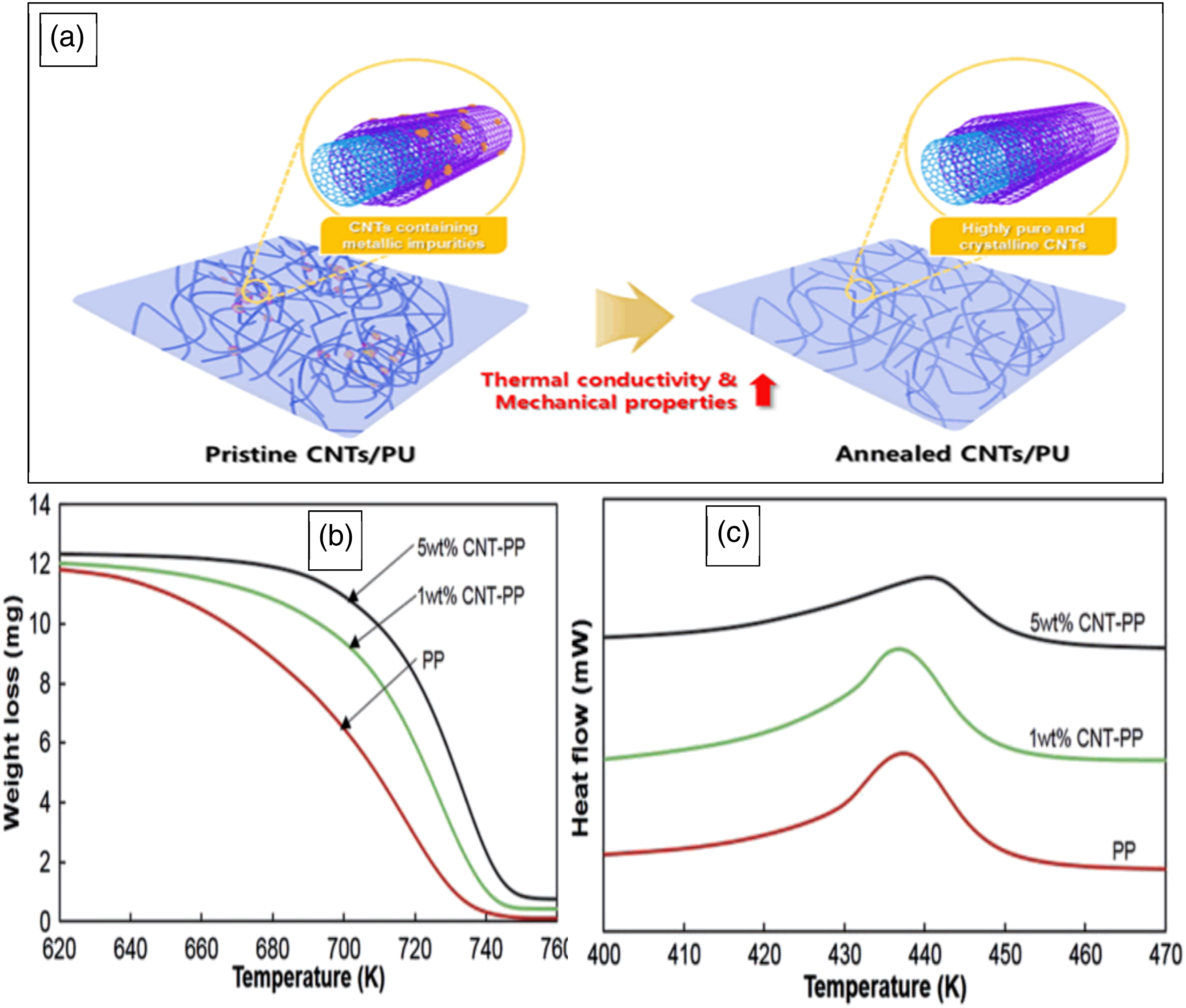
Thermal properties of PP-CNTs composites are also affected by the dispersion degree and compatibility of CNTs with the polymer matrix. This is previously agreed by various studies on the poor dispersion and incompatibility of CNTs in the PP matrix. Therefore, different authors have enhanced dispersion and thermal behaviours of PP-CNTs composites by modification or functionalisation of CNTs,76,109 use of maleic anhydride compatibilizer38,85 or both in fabrication of such composites.77,84 As demonstrated by Zhou, Wang, 76 functionalization of CNTs can decrease its thermals stability compared to pristine CNTs due to the low-temperature resistance of attached functional groups and introduction of defect on CNTs conjugal structure during the modification process. However, when incorporated into a polymer matrix, it increases the thermal decomposition temperature of such polymer by enhancing interfacial bonding and distribution of CNTs in the polymer matrix. As a result of such a phenomenon, 50oC increase in thermal decomposition temperature compared to pure PP was obtained by Jin, Kang. 84 This indicates the higher efficiency of homogeneous dispersion of f-CNTs in heterogeneous nucleation and improvement of thermal properties of polymer matrix compared to pristine CNTs. 109 Hence, the later authors recorded a higher thermal decomposition temperature of about 400oC for PP-0.1wt%f-MWCNT compared to 370°C and 385oC for pure PP and PP containing 0.1wt% pristine MWCNTs, respectively, at 10% mass loss. In addition to the benefits of good adhesion between PP matrix and CNTs, it is believed that PP-CNTs composites with such features require higher decomposition energy to thermally break it down compared to composite with a loose bond between PP matrix and CNTs. 77 Hence, the authors obtain significant improvement in thermal stability, Tm, Tc and Xcc by achieving a well-dispersed and compatible PP matrix and MWCNTs as was also recorded by Hemmati, Shariatpanahi, 85 Ghoshal, Wang. 110
Also, thermal conductivity is one of the thermal properties of a material that reveals its ability to conduct heat. This property is often recorded low in polymeric materials due to their imperfect crystalline structure. However, the introduction of CNTs in a polymer matrix significantly improve the thermal conductivity of such polymer through the perfection of its crystalline structure. 33 Also, the formation of conductive paths in the polymer matrix by the entanglement of CNTs in the polymer matrix tends to improve its thermal conductivity as shown in Figure 4(a). When conductive network structures are formed in the polymer matrix, they bridge the amorphous or semi-crystalline regions of such polymer, thereby improving its thermal conductivity. 111 The thermal conductivity of PP-CNTs composites is a function of CNTs particles size, content, type and dispersion level, among others. It often increases with an increase in CNTs content due to the increase in interaction among CNTs particles in the polymer matrix until a percolative threshold is attained. 61 However, they are only few available recent reports on thermal conductivity of PP composites reinforced with CNTs. Szentes, Varga 38 measured an increase in thermal conductivity from 0.238 W/(mK) for pure PP to 0.374 W/(mK) for PP-5wt%MWCNTs composite. The improvement is about 57% increase, which can be attributed to the efficiency of CNTs in improving the thermal conductivity of the PP matrix. Also, Mertens and Senthilvelan 18 recorded approximately 50.5% increase in thermal conductivity by adding 5wt%CNTs in PP matrix (that is thermal conductivity of 0.216 W/(mK) for pure PP and 0.325 W/(mK) for the composite). It can be noted that thermal conductivity obtained by Szentes, Varga 38 and Mertens and Senthilvelan 18 are in close proximity with above 50% increment. It is also believed that during the application of heat on PP-CNTs composites, the formed network structures in the matrix by CNTs impede the mobility of the polymer molecular chains with enhanced thermal and heat resistance. 112
Electrical Properties
The electrical response of a material measures its capability to conduct or resist the flow of electric current. It is measured in terms of the material’s electrical resistivity or conductivity. Comparing with metallic materials, most of polymeric materials have very low electrical conductivity. However, it has been demonstrated that polymers can be transformed into semi-conductor or conductor materials by the introduction of conductive fillers in their matrices. This transformation is more pronounced with the incorporation of carbon-based conductive fillers such as CNTs even at low concentration94,113–116 compared to other conventional conductive fillers. This is due to the capability of CNTs in perfecting polymers’ crystalline structure and the formation of a conductive network in the polymer matrix (see Figure 5(a)).38,94 The incorporation of CNTs in the PP matrix significantly increase the electrical conductivity of the PP matrix due to the formation of 3D network structures in the polymer matrix, especially when there is good compatibility between PP and CNTs.94,117 This increase in electrical conductivity follows the percolation theory as presented in Figure 5(a). Typically, it involves the transition of the insulative polymer matrix to conductive polymer matrix with addition and gradual increase in CNTs content. In the plot of electrical conductivity against filler concentration presented in Figure 5(b), it can be seen that at a certain CNTs content (percolation threshold), beyond which the electrical conductivity shows a significant increase.118–120 However, at higher CNTs content above the percolation threshold, there no further significant increase in electrical conductivity with a continuous increase in CNTs content. This point can be referred to as a saturation point where optimal network structures have been formed in the polymer matrix for easy mobility of charge carriers.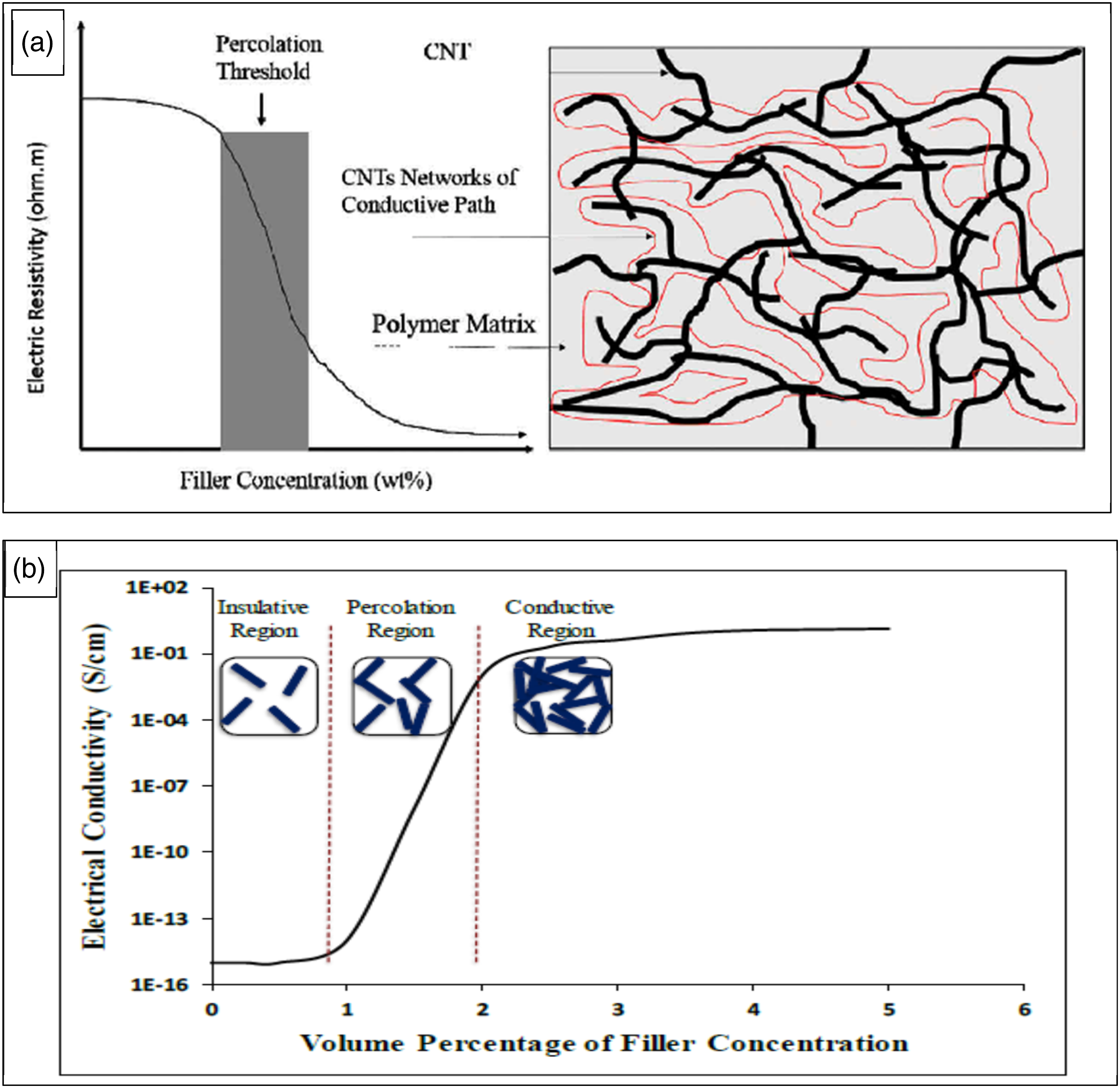
Generally, electrical conduction in percolative polymer composites (such as PP-CNTs) is often by the release of produced delocalised π-orbital electrons,
121
movement of the electrons through the conductive network structures (above percolation threshold)
122
or jumping of electrons from one conductive filler to another through the bulk insulative polymer (below percolation threshold).
123
These often results to improve the electrical conductivity of such percolative polymer composites. Therefore, the conductivity of percolative polymer composites can be broadly grouped into ohmic conduction and non-ohmic conduction. The ohmic conduction involves direct contact of the percolative fillers (such as CNTs) in a polymer matrix and movement of electrons through such direct contact in percolative conduction, especially above the percolation threshold.
124
Although non-ohmic conduction involves indirect contact of percolative fillers in the polymer matrix and movement of electrons through tunnelling across polymer matrix to adjacent percolative fillers, especially below the percolation threshold.
25
It is believed that ohmic conduction produces higher electrical conductivity compared to non-ohmic conduction in a polymer matrix due to easier mobility of electrons in the former than the later. Ohmic and non-ohmic conduction can be explained using power-law as presented in equations (1) and (2), respectively, where electrical conductivity (δc) will increase as the percolative fillers (wc) content continue to increase above the percolation threshold (wp) in the case of ohmic conduction (Equation (1)). Although electrical conductivity (δc) will significantly increase as the percolative fillers (wc) content approaches the percolation threshold (wp) for non-ohmic conduction (Equation (2)). This is due to the formation of more conductive network structures and reduction of adjacent distance between individual percolative filler in the matrix as the fillers content increases
125


Various studies have taken the advantages of the above-explained electrical conductivity mechanisms and excellent electrical properties of CNTs in enhancing the electrical conductivity of the PP matrix. For instance, Lecocq, Garois 128 recorded electrical conductivity as high as 580 S/m by incorporating 10vol% MWCNTs in a PP matrix via melt compounding. This can be credited to the excellent electrical properties of CNTs and its ability to form conductive paths in the polymer matrix. In most cases, the electrical conductivity of the PP-CNTs composites depends on the CNTs content in the matrix as explained earlier in terms of the percolation threshold. This was demonstrated by Stan, Sandu, 80 as they measured electrical conductivity for PP-5wt%MWCNTs composite to be about eight folds higher than that of PP-1w%MWCNTs composite due to higher formation of conductive paths as the MWCNTs content increases. In addition to the roles of CNTs content on the electrical conductivity of PP-CNTs composites, the state of dispersion of CNTs and its compatibility with the PP matrix cannot be ignored. A study carried out by Xin and Li 106 showed that well-dispersed MWCNTs in the PP matrix can form well-connected network configuration with high electrical conductivity output, which can be achieved by proper modification of CNTs. The authors obtained higher electrical conductivity of 0.28 S/cm by adding 10wt% surface-treated MWCNTs in the PP matrix compared to 1.5x10⁻³ S/cm measured for untreated MWCNTs at a similar concentration. Hence, the role of surface modification on well dispersion and compatibility can be noted in the variation in electrical conductivity of the composites. Process followed or type of PP-CNTs composites has a significant influence on their electrical properties. This was revealed by Ameli, Kazemi, 129 where the authors measured electrical conductivity of approximately 1x10⁻¹⁰ S/cm and 1x10⁻⁵ S/cm at 100Hz for solid and foamed PP-MWCNTs composites, respectively, at 2.56vol%. The higher electrical conductivity recorded for the later composite can be attributed to the higher interconnectivity of the MWCNTs in the PP matrix during the foaming process and faster mobility of the charge carriers compared to the solid PP-MWCNTs composite. Various other studies have also revealed the escalation of electrical conductivity of PP matrix using CNTs as reported by Chu, White, 109 Ma, Wu 130 and also presented in Table 1. Due to the excellent electrical properties of PP-CNTs composites, they can find applications as electrical conductors and electromagnetic interference shielding materials. For electromagnetic interference shielding’s capability of PP-CNTs composites, one can refer to previous work by Lecocq, Garois, 128 Poothanari, Abraham. 131
Dielectric Properties
Dielectric properties are related to the electric charge storage and dissipation ability of a material. It is measured in terms of dielectric constant, dielectric loss, dielectric breakdown strength and polarisation. These are useful parameters in various electrical and electronic applications such as capacitors, microelectronics, electronic packaging, electromagnetic shielding, insulator core rods etc. Although polymeric materials generally show high dielectric breakdown strength and low dielectric loss, they are low dielectric constant materials. In some applications such as dielectric capacitors, both high dielectric constant (εr) and breakdown strength (E) are required at a low dielectric loss for high energy storage density (ESD) as shown in equation (3). The equation indicates that ESD of a material is directly proportional to εr and E, therefore, their enhancement implies increase in the ESD. Recently, the incorporation of percolative fillers such as CNTs in a polymer matrix has proven to magnificently improve the dielectric constant of such polymer near the percolation threshold.115,132,133 It is believed that the increase in the dielectric constant of such composites is due to the formation of many mini-capacitors by the percolative fillers within the polymer matrix. Such mini-capacitors are formed in the polymer matrix when thin polymer separates adjacent percolative fillers
48
as illustrated in Figure 6. In this case, the percolative fillers act as conductive electrodes, while the thin polymer acts as dielectric material in the formation of percolative filler-polymer matrix-percolative filler sandwich structure. Many of such mini-capacitors can be formed in the polymer matrix as the percolative fillers increase with a significant increase in dielectric constant
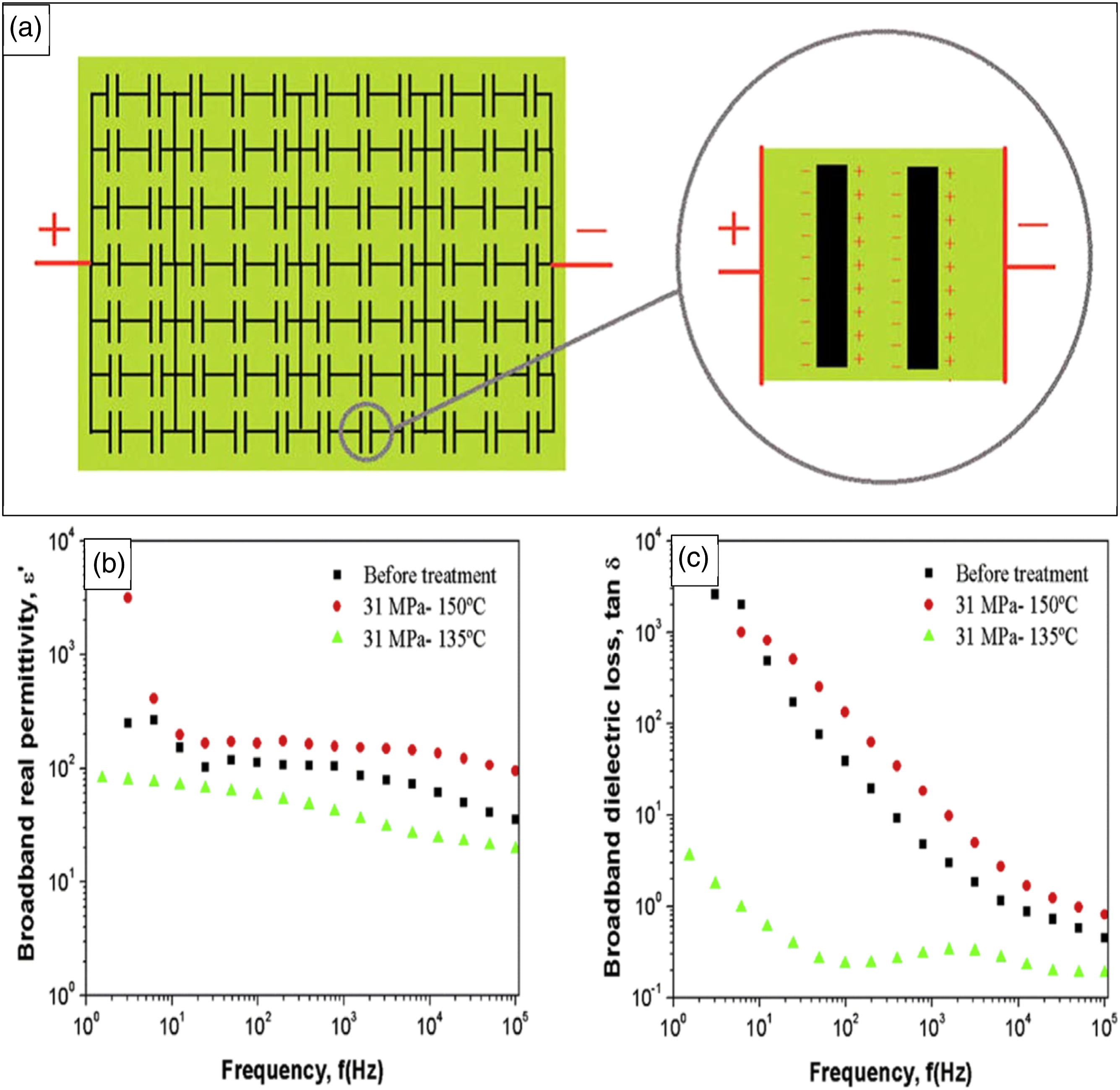
However, such many mini-capacitors are encouraged by good interfacial adhesion and dispersion of the percolative fillers in the polymer matrix. On application of electric field on such composites, there is a heterogeneous accumulation of electric charges on the interfaces of the percolative fillers and polymer matrix (Figure 6(a)) following Maxwell Wagner Sillars polarisation theory, which is due to conductivity difference between the fillers and the matrix.
134
Dielectric constant and loss of such composites often depend on frequency as shown in Figures 6(b) and (c), respectively. This is due to higher equilibrium relaxation of the interfacial accumulated charges at low frequency compared to the high frequency on the application of the electric field. The dielectric constant of percolative polymer composites is often affected by fillers’ content. At high fillers’ content, the composites show higher dielectric constant output due to (i) formation of many mini-capacitors in the matrix135,136 and (ii) reduction in the polymer thickness or distance (d) between individual percolative filler electrode, which can be related to the mini-capacitance (Cmini) of the mini-capacitor as shown in equation (4) [131]. The expression also shows that the mini-capacitance is dependent on the surface area of the percolative fillers (A) and dielectric constant of the polymer matrix (εp)
Different authors have demonstrated improvement in dielectric properties of PP using CNTs. For instance, Kazemi, Kakroodi 108 recorded a higher dielectric constant and loss of about 58 for PP-1wt%MWCNTs composite at 100 Hz compared to that of pure PP matrix generally around 2.2. The PP-1wt%MWCNTs composite prepared by melt compounding and annealed at a temperature of 135oC and pressure of 31 MPa under supercritical carbon dioxide (scCO2) showed low dielectric loss of about 0.2 at the same frequency. Although the study showed that the dielectric constant increased significantly when the annealing temperature was raised to 150oC, the dielectric loss also notably increased alongside, which may not be suitable for dielectric energy storage but suitable for other applications such as electromagnetic interference shielding. Although Koval’chuk, Shchegolikhin 31 have earlier observed simultaneous increase in dielectric constant and loss with increase in MWCNTs content in the PP matrix at high frequency, which shows potential as microwave or electromagnetic interference absorption materials. Although various other studies have recently reported enhanced dielectric properties of PP matrix using CNTs,138,139 further study is required in the area of dielectric properties and suitable applications of PP-CNTs composites. Despite the excellent potential of such percolative fillers in improving the dielectric constant of polymeric materials, experimental results have shown that such percolative composites often show high dielectric loss and low breakdown strength. This is due to the formation of conductive network paths in the polymer matrix, which makes such composites electrically conductive for easy passage of current (or current leakage), high energy dissipation (dielectric loss) and low breakdown strength.56,82,140 These have led to some efforts in the reduction of dielectric loss and improvement of breakdown strength of percolative polymer composites containing CNTs via insulation of CNTs in the polymer matrix.141,142 Notwithstanding, further studies are required in this area for an optimal route(s) to ensure efficient compromised dielectric parameters for advanced engineering applications.
Current Hurdles Faced by PP-CNTs Composites, Future Prospect and Applications
Various advancements have been made on the study of engineering properties of PP-CNTs composites for different engineering applications such as structural, mechanical, electrical and electronic components. Despite the good mechanical, thermal, electrical and dielectric properties reported on PP-CNTs based composites, such composites as well as other polymer-CNTs composites are still on a research-level. This is due to lack of optimal agreement among various studies on modification of CNTs, dispersion of CNTs in the polymer matrix, PP-CNTs fabrication routes as well as materials testing for industrial production of PP-CNTs based engineering components. For instance, a high concentration of CNTs is needed for high dielectric constant, thermal and electrical conductivity, while such high CNTs content in the PP matrix results in poor mechanical properties and high dielectric or energy loss as a result of poor dispersion of CNTs in the matrix at a high concentration as reported in various studies. The challenges still run around the fabrication of such composites as it is related to the lack of optimised process to uniformly disperse CNTs in the PP matrix for industrial production of components to take place. Therefore, it becomes imperative for materials’ scientists and engineers to focus on the optimisation route for the fabrication of PP-CNTs based composites with optimal properties. In addition, advance PP-CNTs fabrication techniques should be developed that will enhance the dispersion of CNTs in the PP matrix, since it has been reported that engineering properties exhibit by PP-CNTs depends on the degree of dispersion of CNTs in the PP matrix. Various approaches can be adopted to achieve that, such as high power ultrasonication, ball milling and advanced modification of CNTs. These should be done in a way that the destruction of CNTs will be minimal to avoid major reduction in its engineering properties. There is still need for advance study on the interfacial relationship between CNTs and PP matrix and further ways to promote it for enhance properties. When this is achieved in the nearest future, such composites materials will find various advanced engineering application as outlined below.
Polypropylene has unique features such as high resistance to chemical attack, flexibility, toughness, commercially processible, availability as well as cost-effectiveness. These features made PP suitable for many engineering applications. Some of the common uses of PP include but not limited to containers, food packaging, electrical insulator, electronic component, pipes, sportswear etc. On the other hand, CNTs are characterised with essential engineering properties such as high thermal, mechanical, electrical, electronic, thermomechanical and other physical properties. On that regard, research attention has been drawn to the improvement of polymers’ properties using CNTs, which several achievements have been reported in the literature. The dispersion of CNTs in the PP matrix as well as other polymer matrix in the development of composites has incorporated new features and significantly improve existing properties of PP suitable for various advanced engineering applications. Some of the qualities pronouncedly improved with PP-CNTs composites include different mechanical, thermal, electrical, dielectric, properties etc. These enhanced properties have positioned PP-CNTs composites for higher engineering applications such as aerospace components, automobile parts, industrials machine parts, medical equipment, electromagnetic wave absorption, flexible electrical and electronic components (printed circuit boards, sensors and actuators transistors, flexible energy scavenging, capacitors, batteries etc.) and other applications as shown in Figure 7. Since a lower concentration of CNTs is used to significantly improve various properties of PP compared to conventional fillers, the flexibility of PP is maintained after adding CNTs. Hence such composites can find a wide range of applications in the area where flexible, high mechanical strength, thermal and electrical conductivity are prerequisite. Advanced and future applications of PP-CNTs composites. Adopted from
143
with permission from royal society of Chemistry.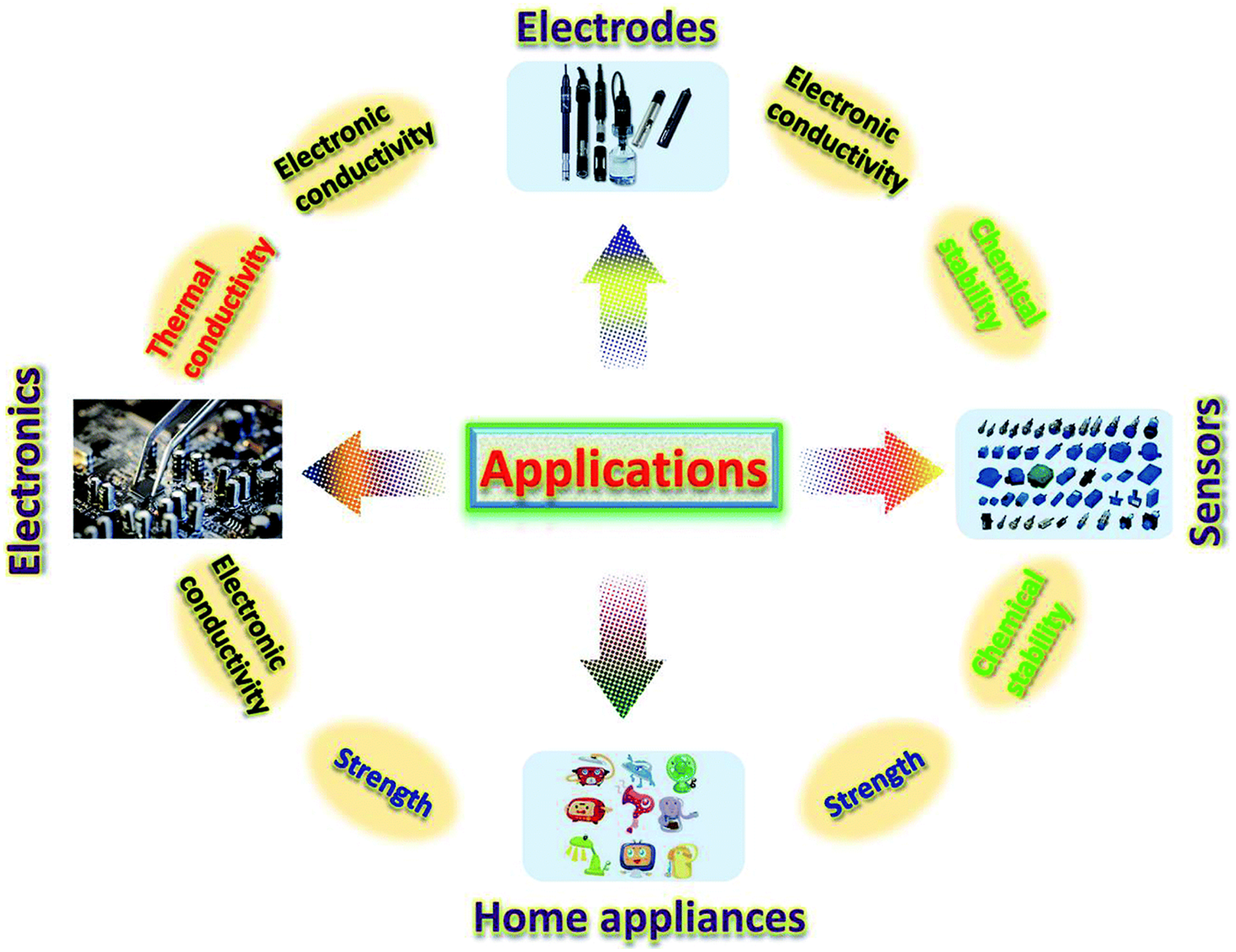
Conclusion
This review has been able to investigate various published properties of PP-CNTs composites, with respect to mechanical, thermal, electrical and dielectric properties. The results obtained by various studies based on these properties were tabulated for comparison and future referencing. CNTs can significantly improve the engineering properties of the PP matrix, especially when good dispersion and compatibility of CNTs are achieved in the PP matrix. The routes previously employed by various researchers in achieving well-dispersed CNTs in the polymer matrix were discussed, which include surface modification of CNTs, the use of polymer grafted maleic anhydride, liquid phase and mechanical exfoliation of CNTs. Current challenges facing PP-CNTs composites in terms of the fabrication process and industrial production of PP-CNTs based components for advanced engineering applications were included. Prospect and advanced engineering applications of PP-CNTs based composites were also outlined. The review earlier discussed the different techniques used in synthesising CNTs, which include arc discharge, laser ablation and chemical vapour deposition. It is believed that this review will provide insight on the synthesis and modification of CNTs, fabrication of PP-CNTs, various properties of PP-CNTs, advanced applications of PP-CNTs and current hurdles faced by PP-CNTs composites for further research and industrial production of PP-CNTs based components for different engineering applications.
Footnotes
Acknowledgements
We appreciate the Faculty of Engineering and the Built Environment and the Centre for Energy and Electric Power, Tshwane University of Technology, South Africa for their supports
Declaration of conflicting interests
The author(s) declared no potential conflicts of interest with respect to the research, authorship, and/or publication of this article.
Funding
The author(s) received no financial support for the research, authorship, and/or publication of this article.
Data availability
Data sharing does not apply to this article because no datasets were generated during the current study as it is a review article based on published literature
