



Abstract
Biodegradable poly(butylene adipate-co-terephthalate)/poly(lactic acid) (PBAT/PLA) composites were prepared by melt blending, and chain extender was used to improve the compatibility of PBAT/PLA blends through the chemical reaction. The influence of PLA and chain extender contents on mechanical properties, morphology, and rheological properties of PBAT/PLA composites was systematically investigated. The results revealed that the Young’s modulus and stress values gradually increased under the same strain, whereas the elongation at break decreased with the increase of chain extender content for PBAT/PLA (80/20) composites. Noteworthy, the presence of chain extender improves the interfacial compatibility between PLA and PBAT phases. At the chain extender content of 0.4, 0.6, and 0.8 wt.%, the extensional viscosity of the composites exhibited an increasing trend, whereas an obvious strain-hardening phenomenon emerged in the uniaxial extensional curves.
Keywords
Introduction
In recent years, the widespread utilization of non-degradable plastics has caused severe white pollution, which is extremely harmful to the environment. Therefore, biodegradable materials are being rapidly developed for environmental protection. 1 The utilization of biodegradable materials can reduce the dependence on petroleum resources and is conducive to the sustainable development of social resources. Among biodegradable materials, polymers obtained from renewable resources, for example, poly(butylene succinate) (PBS), poly(lactic acid) (PLA), and poly(butylene adipate-co-terephthalate) (PBAT) have been extensively used. 2 PBAT is a remarkable biodegradable co-polyester because of its high elongation at break (≥600%) and convenient processing, thus it is extensively used in environment-friendly bags, agricultural mulching films, etc.3–6 However, its low tensile strength, low modulus, and poor melt strength limit the practical applications.7,8
The blending modification technique is one of the most direct and effective methods to improve the properties of polymeric materials. PLA is a renewable and environment-friendly material prepared by the polymerization of starch, which can get completely degraded in the natural environment. 9 Moreover, PLA possesses high tensile strength and modulus.10–13 Some existing studies have shown that the utilization of PLA to blend PBAT could improve the tensile strength and modulus of PBAT to a certain extent. Unfortunately, PLA and PBAT are almost incompatible, and the mechanical properties of materials prepared by simple blending of PLA and PBAT are poor.6,14 Moreover, the compatibility between different polymeric materials also directly affects the melt properties of materials. 15 Therefore, it is necessary to adopt some effective methods to improve the compatibility between PBAT and PLA, for example, MAH, 15 MDI, 16 and organic-modified montmorillonite 17 have been used to improve the compatibility between PLA and PBAT. Moreover, a multi-functional epoxy chain extender was also used as compatibilizer to enhance the interfacial effect by reacting with the terminated hydroxyl groups of PLA and PBAT.18–20 The Joncryl ADR chain extender synthesized by BASF has excellent compatibilization effect on biodegradable polyester.21,22 Al-Itry et al. 23 studied the compatibilization effect of Joncryl ADR chain extender on PLA/PBAT (80/20) blend and demonstrated that the in situ compatibilization reaction of ADR significantly improved the compatibility between PBAT and PLA phases. Arruda et al. 19 also found similar results in blown films of PLA/PBAT blends with compositions of 40/60 and 60/40. However, systematic report on the effect of Joncryl ADR chain extender on mechanical properties and melt strength of PLA/PBAT composites, with PLA as the dispersed phase and PBAT as the matrix phase, has rarely been presented.
Herein, Joncryl ADR-4468 was used as a reactive compatibilizer to study the effect of Joncryl ADR-4468 and PLA content on mechanical properties, rheological properties, and melt strength of PBAT.
Experimental
Materials
The PBAT (Ecoflex-F-Blend-C1200) was purchased from Badische Anilin Soda Fabrik Ga (BASF, Germany), and its melt flow index was 2.7–4.9 g/10 min (190°C, 2.16 kg), and the melt temperature was about 115°C. The Joncryl-type ADR-4468 chain extender was also provided by BASF, Germany. The PLA (3D870) was purchased from Naturework Company, USA, and its melt flow index was 9.0–15 g/10 min (210°C, 2.16 kg), and the melt temperature was about 165°C.
Sample preparation
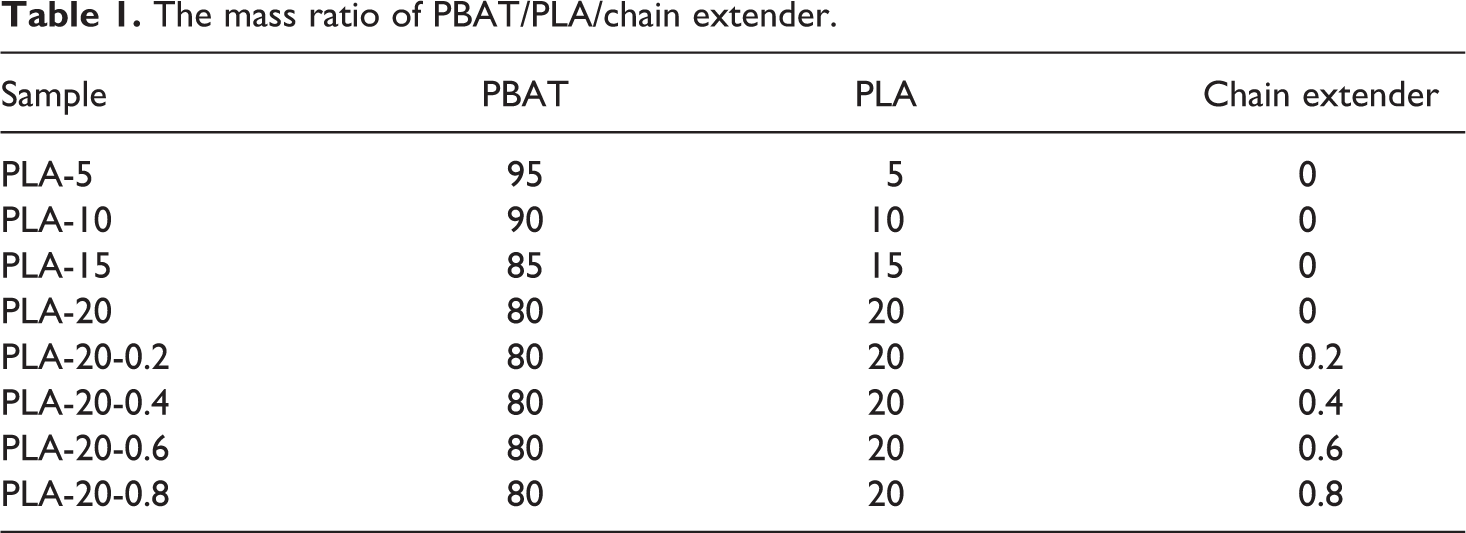
The PLA and PBAT were dried in a vacuum oven at 80°C for 12 h prior to processing. Then, the PBAT, PLA, and chain extender were evenly extruded according to the given mass ratio (Table 1) using a CET-20 twin-screw extruder (Nanjing Jieya Extrusion Equipment Co., Nanjing, China, diameter of screw was 20 mm, L/D was 40). The temperature of the extruder from the feed zone to the die was set at 100, 195, 200, 200, and 190°C, respectively. Finally, the standard specimens were molded using a plastic injection molding machine at 190°C.
The mass ratio of PBAT/PLA/chain extender.
Tensile properties testing
The tensile properties of specimens were tested using a tensile testing equipment (CMT6104 model, China) according to the GB/T1040.2-2006 standard at a crosshead speed of 300 mm min − 1 . Each test was carried out for at least five specimens and the average value was calculated.
Microstructural analysis
The molded composites were cooled in liquid nitrogen for 2 h and cryo-fractured. Then, the sample was dried at 70°C for 4 h. After spraying gold on the fracture surface of the sample, the fracture morphology of the sample was observed by field-emission scanning electron microscopy (FESEM, Quanta 250 FEG).
Rheological properties
The rheological properties were investigated by rheometry (MARS60, Haake), using a parallel-plate geometry with a diameter of 25 mm. The samples were tested for frequency scanning using a rotary rheometer at 170°C in a frequency range of 0.1 to 100 Hz with an amplitude of 1%.
Uniaxial extensional viscosities
The extruded composite particles were dried at 70°C for 8 h prior to use, the particles were molded at 190°C into specimens with dimensions of 20 mm × 10 mm × 1 mm. The uniaxial extensional viscosities were tested by rheometry (MARS60, Haake) at 165°C under different strain rates of 0.01, 0.05, 0.1, and 0.3 s− 1 , respectively.
Results and discussion
Mechanical properties
Figure 1 shows the tensile stress–strain curves of PBAT and PBAT/PLA composites with or without chain extender, and the test results of mechanical properties are summarized in Table 2. The neat PBAT exhibited high elongation at break. Herein, the PBAT was not broken due to the limited stroke of the tensile machine, the yield strength and tensile modulus of PBAT were 8.1 and 85.2 MPa, respectively. Figure 1(a) exhibits that the yield strength and tensile modulus of PBAT/PLA composite specimens gradually increase with increasing amounts of PLA. The yield strength of PBA-20 specimen was 11.0 MPa when the PLA content was 20 wt.%, which is 35.8% higher than that of neat PBAT. All PBAT/PLA composite specimens were not broken within the stroke of the tensile machine, and the elongation at break was greater than 580%.
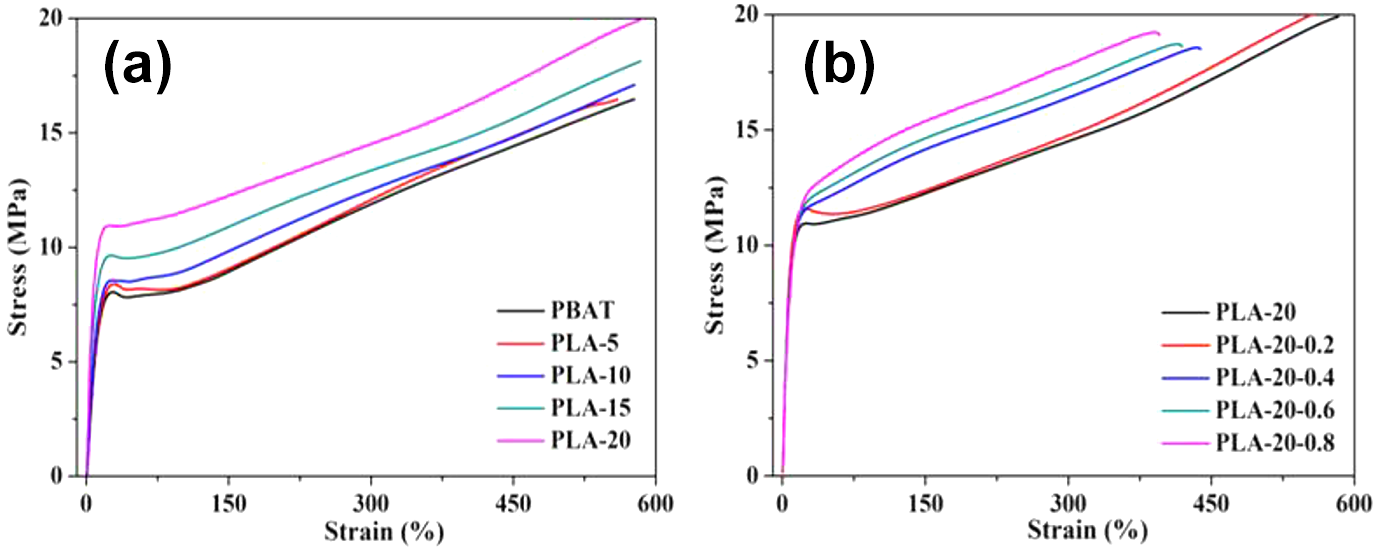
(a) and (b) The influence of PLA and chain extender contents on stress–strain curves of PBAT and PBAT/PLA (80/20) composites.
Mechanical parameters for PBAT and PBAT/PLA (80/20) composites.
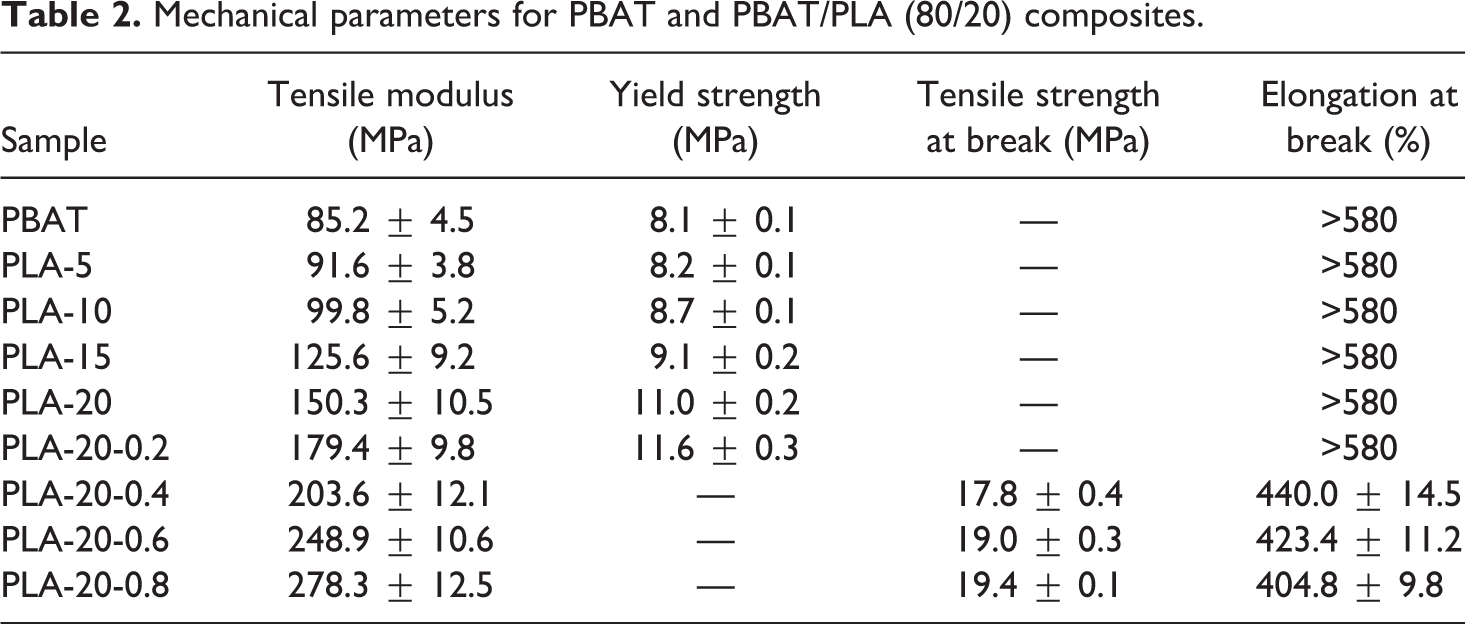
Figure 1(b) demonstrates that when 0.2 wt.% chain extender was added into PBAT/PLA (80/20) system, the tensile modulus and yield strength of PLA-20-0.2 specimen slightly increased and the specimen was not broken to fracture. However, when the content of chain extender was increased to 0.4 wt.%, the tensile modulus of PLA-20-0.4 specimen gradually increased and the yield point of the specimen disappeared; however, the elongation at break significantly decreased to 440.0%. With a further increase in the content of chain extender, the tensile modulus and stress value under the same strain gradually increased, whereas the elongation at break gradually decreased. This is mainly attributed to the fact that the ends of molecular chains of PBAT and PLA contain –COOH and –OH functional groups, while the Joncryl chain extender (ADR-4468) contains multiple epoxy groups on the molecular chain. Previous studies have shown that the epoxy groups on the chain extender can react with hydroxyl and carboxyl groups.23,24 The chain extender reacts with the PBAT and PLA molecular chains, thereby improving the interfacial compatibility between the PLA dispersed phase and the PBAT matrix. The reaction mechanism is shown in Figure 2. At the same time, the chain extension reaction can generate some long-branched chains on the main molecular chains of PBAT and PLA, and increase the molecular weights of PBAT and PLA. Therefore, the chain extension reaction can proceed more sufficiently with the increase of chain extender content, resulting in a gradual increase in the tensile modulus of the material. Consequently, the stress value of material increases and the elongation at break decreases under the same strain. When the content of chain extender is less than 0.2 wt.%, the PBAT/PLA (80/20) composite exhibits an obvious yield point. This is mainly attributed to the fact that PBAT and PLA are crystalline polymers, and the appearance of yield points is related to the transformation and destruction of the spherulite structure during the tensile process.25–27 When the content of chain extender is higher than 0.2 wt.%, the chain extension reaction destroys the regularity of molecular chains of PBAT and PLA, and thus, reduces the crystallinity and structural integrity of PBAT and PLA. As a result, the yield point of specimens disappears.
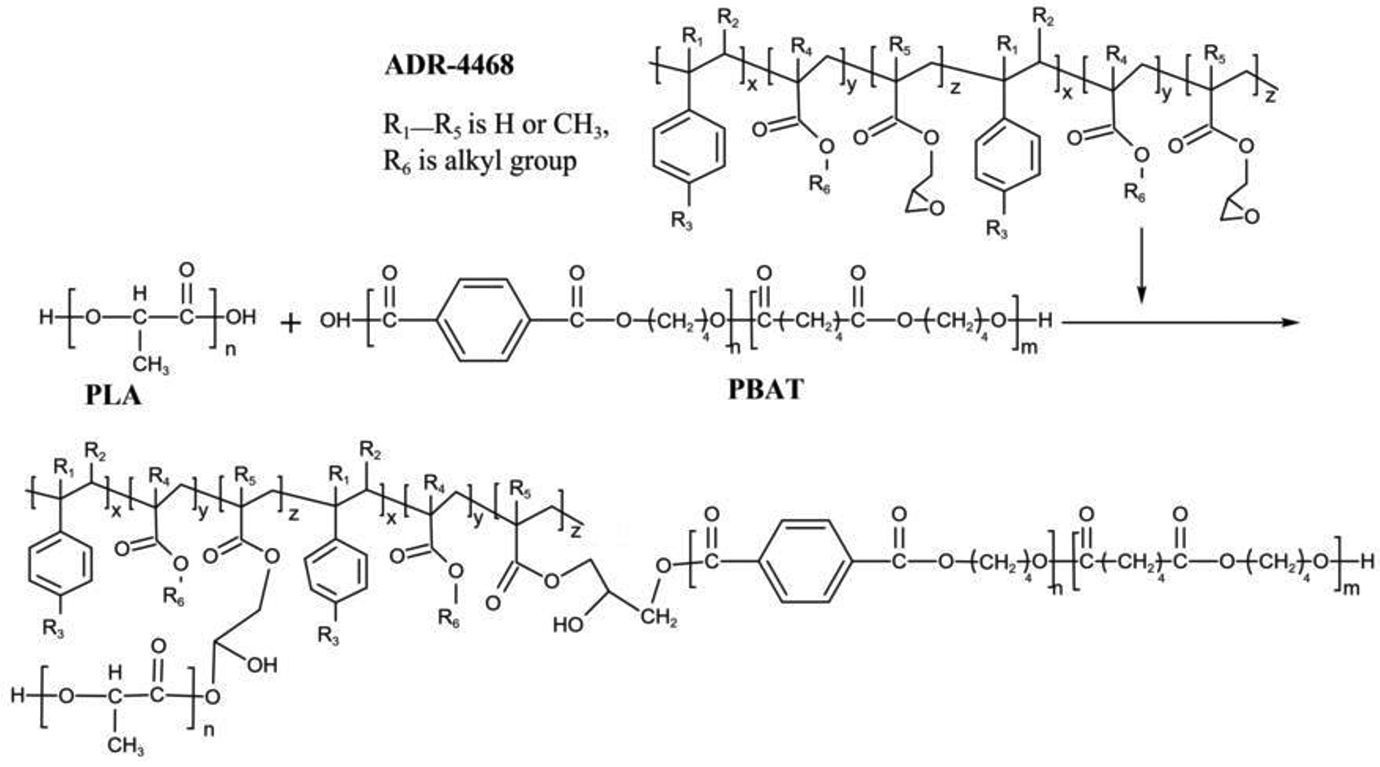
Predicted reaction among PLA, PBAT, and chain extender (ADR-4468).
Morphological analysis
Figure 3 shows SEM images of PBAT/PLA composites with different PLA contents of 5, 10, 15, and 20 wt.%. Figure 4 presents the SEM images of PBAT/PLA (80/20) composites with different chain extender contents. Figure 3 illustrates that the PLA dispersed phases in the PLA-5, PLA-10, PLA-15, and PLA-20 specimens are distributed in the PBAT matrix in an island-like shape, and the interface between PLA phase and PBAT matrix phase is very distinct, indicating poor compatibility between PLA phase and PBAT matrix. When 0.2 wt.% chain extender is added into the PBAT/PLA (80/20) composite, the SEM image of PLA-20-0.2 shown in Figure 4 exhibits that the boundary between PLA dispersed phase and PBAT matrix becomes slightly fuzzy, and the boundary between the PLA dispersed phase and the PBAT matrix gradually becomes blurred with increasing content of extender. When the content of chain extender is 0.8 wt.%, the boundary between PLA and PBAT phases becomes extremely fuzzy and indicates that the incorporation of chain extender improves the interfacial compatibility between PLA and PBAT phases, which is consistent with the results of mechanical properties. This is mainly because the added chain extender reacts with the molecular chains of PBAT and PLA, improving the interfacial compatibility between PLA dispersed phase and PBAT matrix.
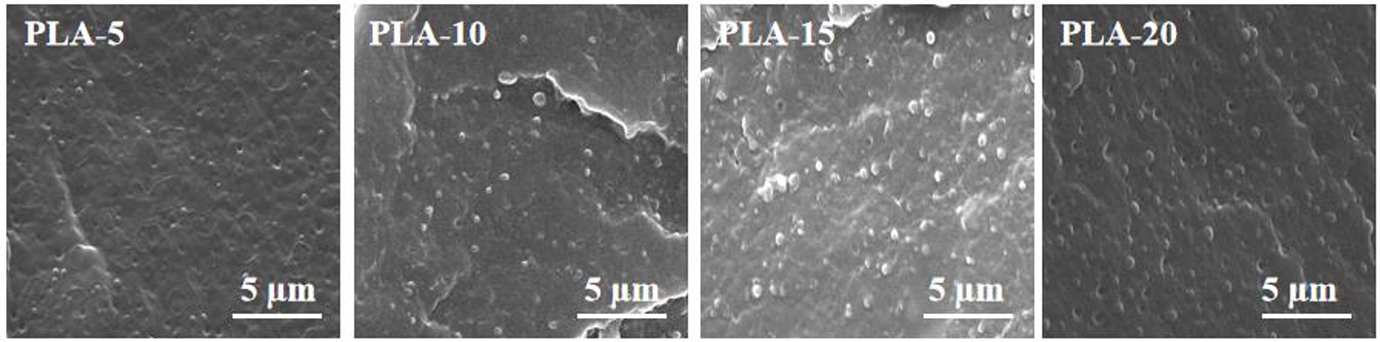
SEM images of PBAT/PLA composites with different amounts of PLA.
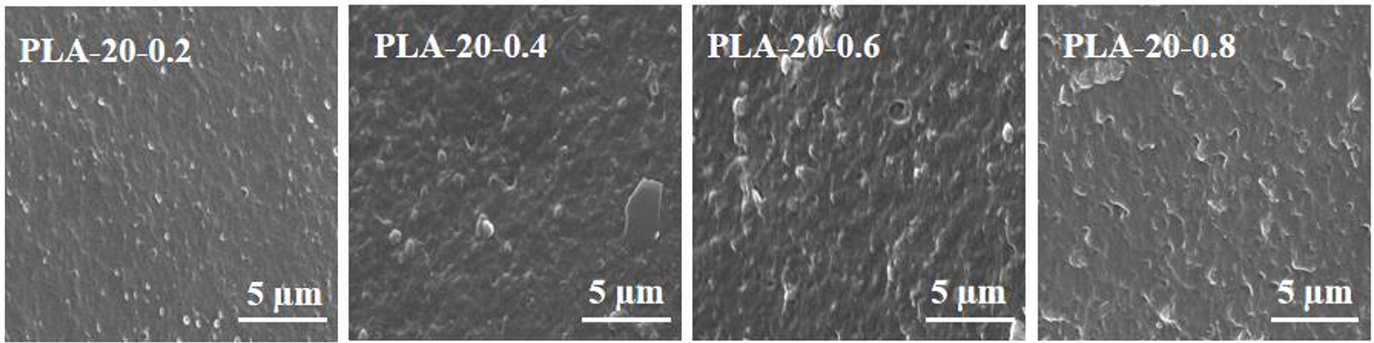
SEM images of PBAT/PLA (80/20) composites with different amounts of chain extender.
Rheological properties
Figure 5(a)–(c) shows the variation curves of storage modulus (G′), loss modulus (G″), and complex viscosity (η*) of neat PBAT and PBAT/PLA composites with respect to shear frequency (f), respectively. Figure 5(a) exhibits that the G′ curves of neat PBAT and PBAT/PLA composites with four different PLA contents are similar in shape. When 5 wt.% PLA is added to PBAT, the G′ value of PLA-5 specimen is lower than that of neat PBAT in the entire shear frequency range. With the increase of PLA content, the G′ value of PBAT/PLA composites gradually increases; however, the G′ value is always lower than that of the neat PBAT. This is mainly attributed to the fact that the viscosity of PLA melt is lower than that of the PBAT at the experimental test temperature of 170°C. Therefore, the addition of PLA can reduce the viscosity of PBAT and improve the kinematic ability of PBAT molecular chains. Consequently, the elastic deformation relaxation effect of PBAT/PLA composite gets accelerated, leading to the decrease of G′ value. Owing to the poor compatibility between PLA and PBAT, the addition of PLA does not change the structure of PBAT molecular chains. Moreover, the mutual entanglement effect between PLA and PBAT chains is weak. Therefore, the increase of PLA content does not significantly influence the G′ curve shape of PBAT.
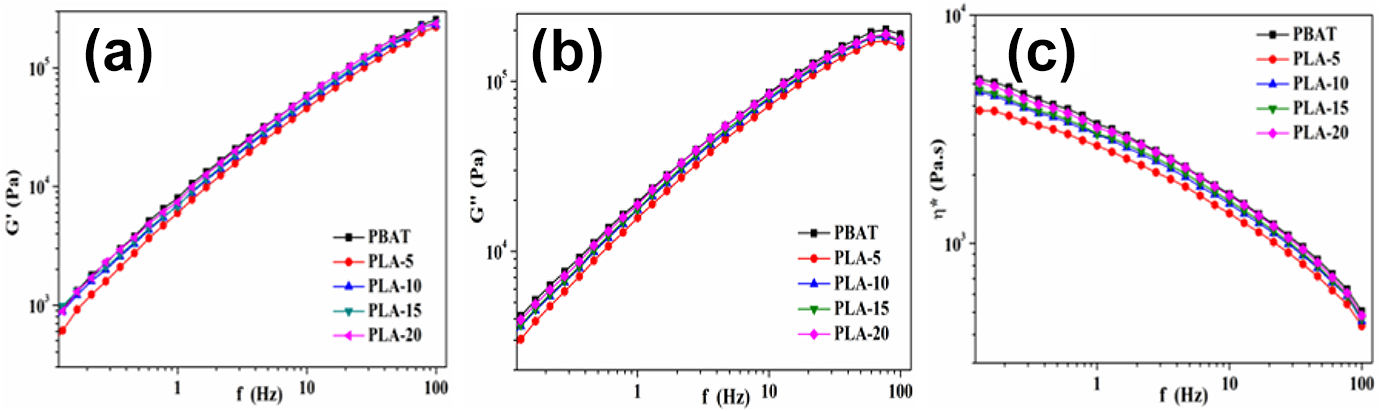
The (a) storage modulus (G′), (b) loss modulus (G″), and (c) complex viscosity (η*) of PBAT and PBAT/PLA composites.
Figure 5(b) and (c) displays that the shapes of G″ and η* curves of all PBAT/PLA composites are similar to that of the neat PBAT, and the addition of PLA reduces the G″ and η* values of PBAT/PLA composites due to the poor compatibility between PLA and PBAT as well as the weak entanglement effect.
Figure 6(a)–(c) shows the variation curves of storage modulus (G′), loss modulus (G″), and complex viscosity (η*) of PBAT/PLA (80/20) composites with different amounts of chain extender. Figure 6(a) demonstrates that when 0.2 wt.% chain extender is added into PBAT/PLA (80/20) composite, the G′ value of PLA-20-0.2 system increases. With increasing chain extender content, the G′ value of the PBAT/PLA (80/20) system continues to increase and the sensitivity of G′ value to the frequency in the low-frequency region decreases. When the chain extender content is 0.8 wt.%, the PLA-20-0.8 sample shows a higher elasticity because the chain extension reaction between chain extender and molecular chains of PBAT and PLA can generate some long-branched chains. Consequently, the formation of such long-branched chains facilitates the entanglement of PLA and PBAT chains and restricts the movement of PBAT and PLA molecular chains. Therefore, the G′ value of PBAT/PLA (80/20) composites gradually increases with the increase of chain extender content.
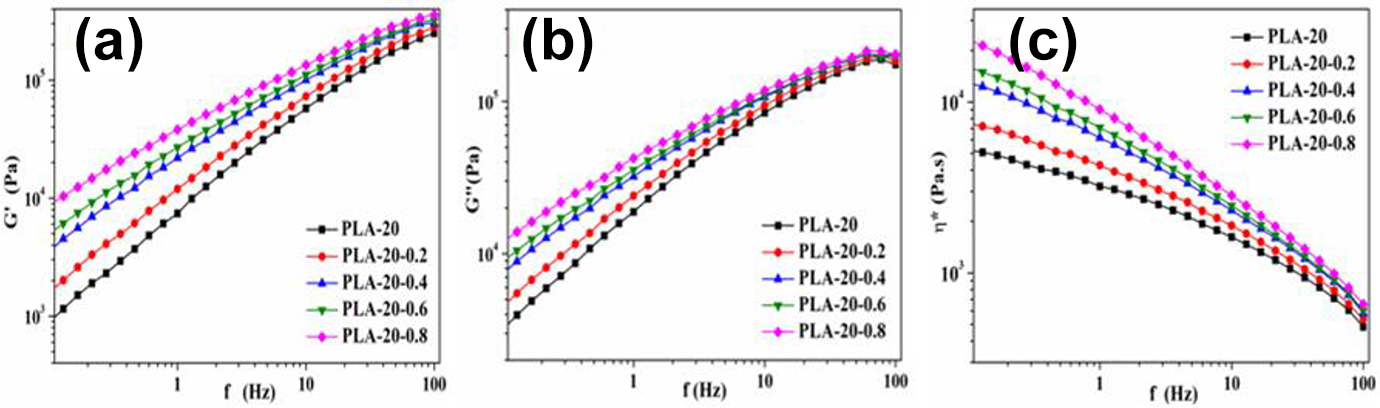
The (a) storage modulus (G′), (b) loss modulus (G″), and (c) complex viscosity (η*) of PBAT/PLA (80/20) composites with different amounts of chain extender.
Figure 6(b) shows that the G″ value of PBAT/PLA (80/20) composites gradually increases with the increase of chain extender content due to the chain extension reaction between chain extender and molecular chains of PLA and PBAT, generating long-branched chains on the main molecular chains of PBAT and PLA. Consequently, PLA and PBAT molecular chains get more easily entangled with each other, and the movement of PBAT and PLA molecular chains gets significantly limited, leading to the loss of more energy per unit time during the slippage of molecular chains in the composite materials. Figure 6(c) exhibits that all composites show shear-thinning behavior. In the entire shear frequency range, the η* value of PLA-20 composite is the lowest and the dependence of η* value on ω is relatively weak. In the case of different amounts of chain extender, the PLA-20-0.8 system exhibited highest η* value and more obvious shear-thinning phenomenon, where η* value demonstrated the strongest dependence on f.
Uniaxial extensional viscosities
The extensional viscosities of polymer melt are related to the microscopic morphologies of molecular chains, reflecting the melt strength of polymeric materials.
Figure 7 shows the uniaxial extensional viscosities of PBAT/PLA (80/20) composites with different chain extender contents as a function of time at 165°C under a strain rate of 0.01 s−1. Figure 7 illustrates that for the PBAT/PLA (80/20) composite without chain extender, the extensional viscosity of PLA-20 sample slightly increases in the initial stage of stretching process. However, the extensional viscosity drops sharply at the stretching time of about 3 s, the extensional viscosity of PLA-20 fluctuates significantly with a further increase in stretching time, indicating the poor melt strength of the PLA-20 sample. The extensional viscosity of all PBAT/PLA (80/20) composites with chain extenders was higher than that of PLA-20. When 0.2 wt.% chain extender was added into PBAT/PLA (80/20) composite, the extensional viscosity of PLA-20-0.2 sample slightly increased compared to PLA-20, and the extensional viscosity slightly fluctuated in the later stage of stretching process. When the content of chain extender was 0.4, 0.6, and 0.8 wt.%, the extensional viscosity of PBAT/PLA (80/20) composites obviously increased, and an obvious strain-hardening phenomenon occurred in the uniaxial extensional curves. This indicates that the incorporation of chain extender improved the melt strength of PBAT/PLA (80/20) composites. This is attributed to the fact that the epoxy groups on the chain extender reacted with hydroxyl and carboxyl groups at the end of the PLA and PBAT molecular chain, forming the long-branched chain structure on the PBAT and PLA molecular chains, which resulted in the easier entanglement between PBAT and PLA molecular chains during the stretching process.
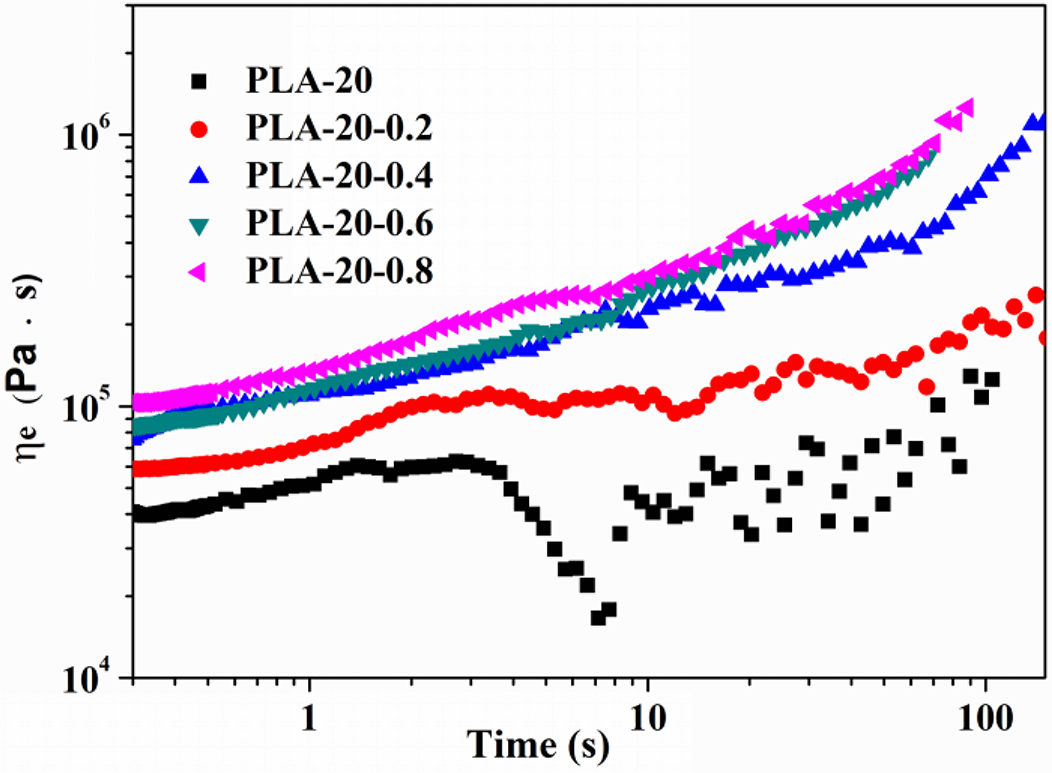
Uniaxial extensional viscosities of PBAT/PLA (80/20) composites with different chain extender contents as a function of time at strain rate of 0.01 s−1.
Figure 8 shows the uniaxial extensional viscosities of PBAT/PLA/chain extender (80/20/0.8) composites as a function of time at different strain rates (0.01, 0.05, 0.1, and 0.3 s−1). The extensional viscosity of PLA-20-0.8 composites steadily increased with the extension of stretching time at four different strain rates. Moreover, the strain-hardening phenomenon of PLA-20-0.8 composite occurred and became more obvious with the increase of strain rate. This is attributed to the rapid entanglement of the molecular chains of PLA-20-0.8 composite at higher strain rates in a shorter time. Moreover, a higher strain rate can produce a stronger entanglement effect between molecular chains. Consequently, the strain-hardening phenomenon of composites occurred earlier and became more obvious with the increase of strain rate.
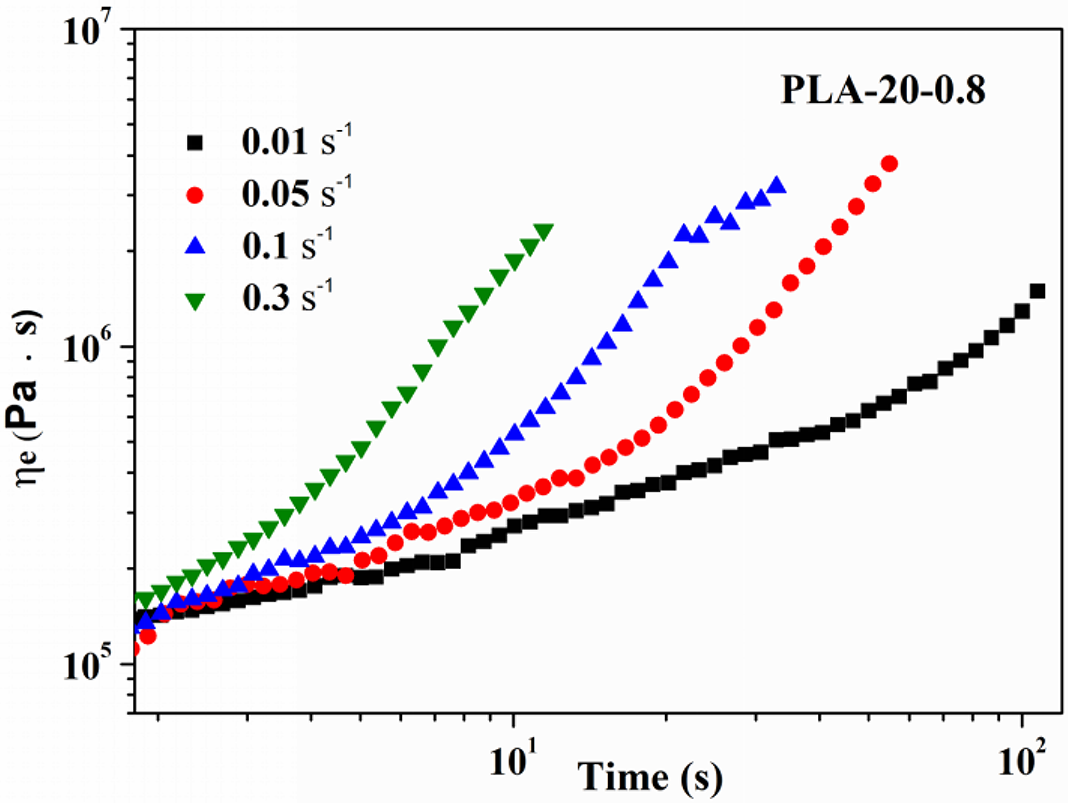
Uniaxial extensional viscosities of PBAT/PLA/chain extender (80/20/0.8) composites as a function of time at different strain rates.
Conclusions
Biodegradable PBAT/PLA composites were prepared by melt blending. The tensile modulus of PBAT/PLA (80/20) composites gradually increased with increasing chain extender content. When the content of chain extender was greater than 0.4 wt.%, with the increase in the content of chain extender, the elongation at break for PBAT/PLA (80/20) composites gradually decreased, and the breaking strength gradually increased. The addition of chain extender improved the interfacial compatibility between PLA and PBAT phases, which was found to be directly related to the chain extender content. With the increase of chain extender content (0.4, 0.6, and 0.8 wt.%), the melt viscosity of composites significantly increased and an obvious strain-hardening phenomenon emerged during the later stages of stretching process. Therefore, the addition of chain extender improved the melt strength of PBAT/PLA (80/20) composites. Moreover, the occurrence time of strain hardening was advanced and it became more obvious with the increase of strain rate.
Footnotes
Funding
The author(s) disclosed receipt of the following financial support for the research, authorship, and/or publication of this article: The authors gratefully acknowledge the financial support from the Guizhou Provincial Natural Science Foundation (Grant no. ZK[2021]General253), the National Natural Science Foundation of China (Grant no. 52063007), the Guizhou Provincial Science and Technology Project (Grant nos. [2021]General320, [2020]2Y022), and the Guiyang Baiyun District Science and Technology Plan Project (Grant nos. [2020]31, [2020]27, [2020]35).
