The goal of this study was to investigate the optical properties of the prepared polyvinyl chloride (PVC)/zinc oxide (ZnO) nanocomposite films. The PVC/ZnO nanocomposite films consist of the addition of different concentrations with both non-annealed ZnO nanoparticles and ZnO nanoparticles annealed at temperature of 700°C. The PVC/ZnO nanocomposite films by weight concentrations of (0 wt.%, 2.5 wt.%, 5 wt.% and 10 wt.%) have been prepared by the casting method. The optical absorbance and transmittance values of the composites films were measured in the wavelength range between (250 to 1100 nm) at room temperature by using the UV-1800 Shimadzu spectrophotometer. The optical properties (absorption coefficient, dielectric constant, refractive index, and optical conductivity) have been investigated by the ultraviolet (UV) spectrophotometer. The optical parameters (direct optical energy gap, excitation energy for electronic transitions, the dispersion energy, static refractive index, static dielectric constant, optical oscillator strengths, the moments of optical spectrum, linear optical susceptibility, third-order nonlinear optical susceptibility, nonlinear refractive index, high-frequency dielectric constant, the carrier concentration to the effective mass ratio, the long wavelength refractive index and the plasma frequency) were calculated. The results showed that the optical properties behavior of the PVC/ZnO nanocomposite films was found to be dependent on the ZnO concentration, and photon wavelength. In addition, the results of the study show that the optical parameters can be influenced by alter the concentration of the nonannealed and annealed a ZnO nanoparticle in the PVC polymer matrix.
The optical properties of composite materials can be improved by the addition of various semicoductive ceramic nanoparticles materials into the polymer matrix in order to create materials with desired physical properties for technological and optoelectronic applications in the UV region.1–4
The ZnO nanopowders with particles nanosize of around 200–250 nm has been used as a filler in this research paper. ZnO is often called II-VI semiconductor material that has several favorable properties such as good transparency in the UV region, high electron mobility, high refractive index, wide band gap energy of 3.37 eV, and classify as n-type electrical conductivity.5–9
In this study, poly (vinyl chloride) is a thermoplastic polymer that has been studied intensively because it owns desired properties such as good rubbery, wide band gap, easy processing, transparency, and has low melt viscosity.10–13
In literature, few research papers have been published about the optical properties of the ZnO nanoparticles polymer composites. Al-Taa’y et al.14 concluded that the optical properties of a PVC films were enhanced by adding the ZnO nanoparticles. Kumar et al.15 reported that the interaction between the ZnO nanoparticle and the PVC matrix had induced change in the value of the optical energy gap of the composites. Al-Taa’y et al.16 reported that the size of the ZnO nanoparticles filled PVC can effectively enhanced its optical properties. Guedri et al.17 concluded that the nanosize ZnO could effectively doped PVC and enhance its optical properties. Abou-Kandil et al.4 reported that the UV-Vis measurements show that the ZnO nanocomposites can be used effectively and efficiently in UV absorption applications and they also reported that the ZnO nanocomposites showed the best UV absorption properties and highest transparency in the visible region. Wildner and Drummer3 reported the influence of the nanoparticles on transparent nanocomposites and they reported that optical properties such as UV absorption can be included with very low filler contents enabling to maintain the nanocomposites transparency. So, the aim of the present research work is to investigate the effect of the nonannealed and annealed ZnO nanoparticles on the optical properties of PVC/ZnO nanocomposite films in the UV-wavelength ranges from 250 to 1100 nm.
Experimental
Materials and composites preparation
Polyvinyl Chloride (SABIC® SPVC-57 S) was purchased from SABIC®. It is a free flowing vinyl chloride homopolymer resin with low molecular weight. It is manufactured by suspension polymerization with apparent bulk density of (560 kg/m3). PVC is an easy processing product for rigid applications since it has low melting viscosity. We used commercially available ZnO nanopowders (Alfa Aesar, 99.99% purity) (ZnO with a primary particle size range 200–250 nm) was annealed at 700°C in a quartz tube furnace in a H2/Ar (1:1) atmosphere at a total flow rate of 2 slm for 80 min. These conditions have been previously identified to yield maximum luminescence intensity.5 The PVC/ZnO were prepared by casting method in the chemistry laboratory, Faculty of Engineering Technology, Al-Balqa Applied University, Amman-Jordan. PVC and ZnO powders with 25 ml toluene solvent were mixed at 80°C with mechanical stirring for 2 h. After completion of the mixture dissolution, the composite films were prepared by casting technique,18 the mixture poured in a glass mold of 5 cm diameter. Digital oven with vacuum was applied for evaporation process and the mixture was degassed at 80°C for 2 h. With the above protocol, formulations with ZnO content ranging from 0 to 10 wt% were prepared in a form of thin composite films of thickness 0.5 µm.
Optical properties measurements
The optical absorbance and transmittance values of the PVC/ZnO composites films were taken in the wavelength range (250 up to 1100 nm) at room temperature and measured by using the UV-1800 Shimadzu spectrophotometer.
Theoretical background and basic equations
The optical properties and optical parameters are calculated using the following fundamental physical laws and basic equations. The absorption coefficient can be calculated using the relation:
where is the absorbance, and I and are the incident and transmitted intensity, respectively, and l is the sample thickness. A powerful method for determining the band gap energy is the plot of the absorption coefficient data with photon energy as:
where; is Planck’s constant, is the photon’s frequency, is the optical band gap and is a proportionality constant.19,20 The dependence of absorption coefficient on the photon energy gives the nature of optical transition by the value of the exponent . It was found that for the tested composites for the direct allowed transition for electrons energy in k-space. Plotted versus photon energy (ω), that obtain a good straight line, with extrapolation of the linear portion of these lines gives (). The complex refractive index is given by:
Where; n the refractive index and k the extinction coefficient and can be calculated from the following equations21,22:
where; is the reflectance calculated from the absorbance and transmission spectra.23 The real part of the complex permittivity (dielectric constant) is expressed as:
The refractive index is expressed by a single effective oscillator dispersion equation of the form24,25:
where is the incident photon energy, is the average excitation energy for electronic transitions and is the dispersion energy. The static refractive index, no (i.e. when photon energy is zero), was evaluated from Eq. (7) as:
The static dielectric constant is computed from the static refractive index using26:
And, also optical oscillator strengths f for optical transitions is defined as absorption of a photon by the electron between the initial state and the final state is given by2:
The high-frequency dielectric constant and the carrier concentration to the effective mass ratio (i.e. is the electronic charge) can be calculated from this equation2,27,28:
where is the wavelength, e is that the charge of the electron, N is that the free charge-carrier concentration, is the permittivity of the free space, the effective mass of the charge carriers (kg), and c is that the velocity of light in vacuum. The plasma resonance frequency for one kind of free carriers is calculated from the relation:
The moments of optical spectrum and were computed from the following relations29,30:
where and are interband transition strength moments of the imaginary part of the optical spectrum. The linear optical susceptibility could be computed from the relation
which gives the linear optical susceptibility for long wavelengths
For optically isotropic glasses, the second order non-linear susceptibility is zero. Additionally, for the region far from resonance the third-order lowest nonlinear optical susceptibility is equal to:
for , we can obtain
The value of , so is estimated utilizing the following formula2,31,32:
The nonlinear refractive index is found from this relation2,27,33:
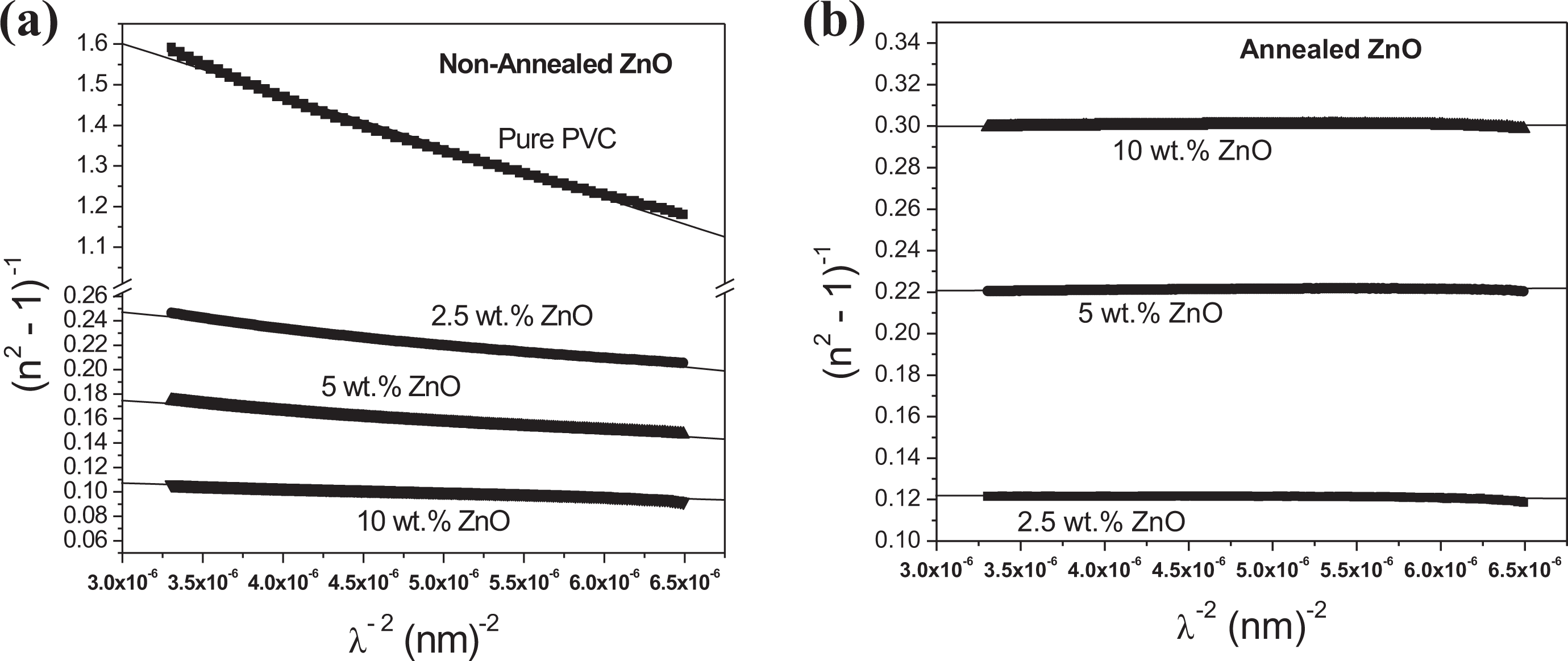
where represents the average oscillator wavelength and oscillator strength parameter. Relation 20 can also be transformed as:
where is the refractive index at infinite wavelength . The oscillator strength parameter is equal to27,33:
The optical conductivity , that measure the movement of the charge carriers by alternating electric field of the incident electromagnetic waves is given by the equation below23:
where n is that the refractive index, c is that the speed of light in vacuum.
Results and discussion
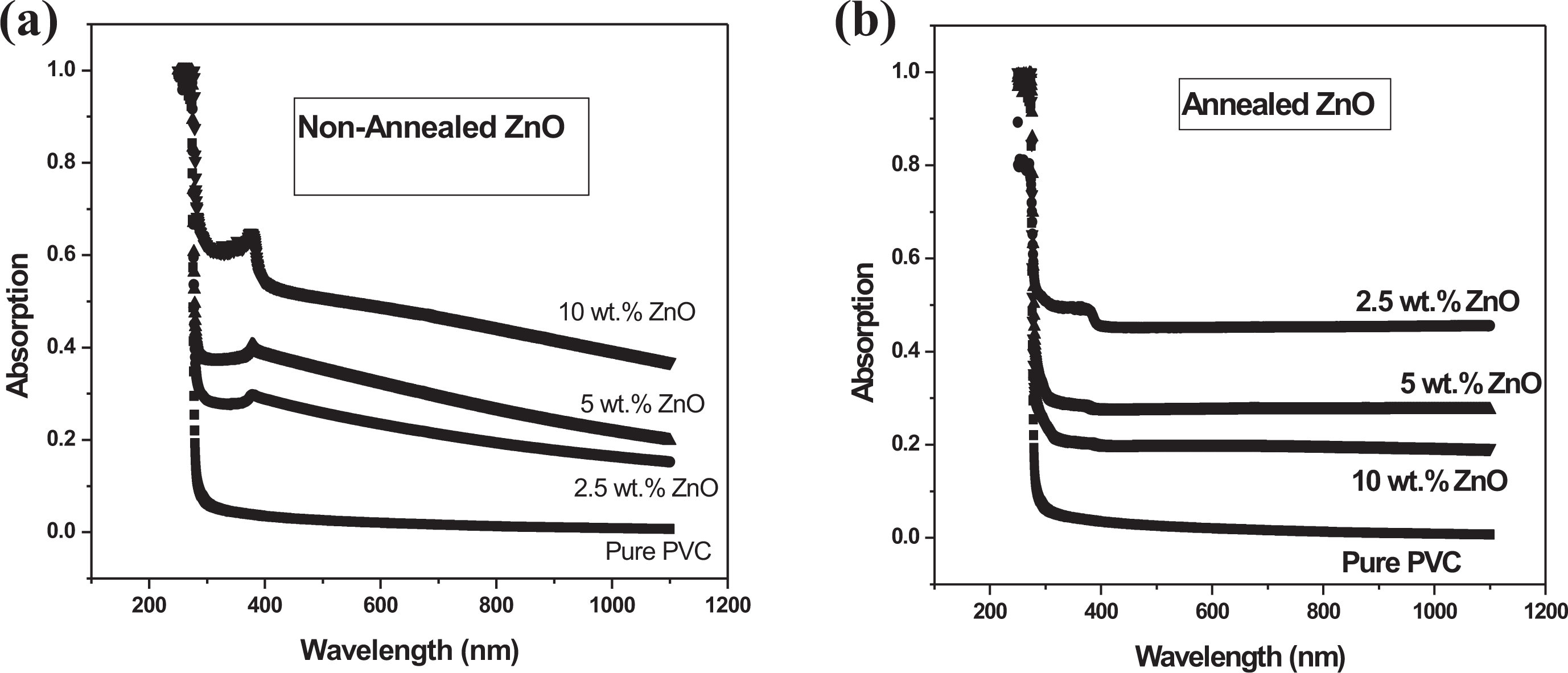
Absorption spectroscopy is an analytical technique for studying the interactions between electrons in the composite films materials and radiation which can be interpreted through variations in the absorption spectra.34 The optical absorption spectra of the PVC/ZnO composite films for non-annealed and annealed ZnO nanoparticles was taken in the wavelength range (250 up to 1100 nm) at room temperature, as shown in Figure 1. The adding of the non-annealed ZnO nanoparticles lead to an increase in the value of the optical absorption spectra as shown in Figure 1(a).7 Incoming photons have sufficient energy to excite electrons that resulting in an increase in the absorption values that also could be increased with increasing the nonannealed ZnO nanoparticles. This means that the non-annealed ZnO nanoparticles caused an increase in the density of charge carriers which lead to an increase in the absorption spectra. In other words, the adding of the annealed ZnO nanoparticles lead a reduction in the value of the optical absorption spectra with increasing the amount of the annealed ZnO nanoparticles as shown in Figure 1(b). The results found for the annealed ZnO, can be attributed to the fact that the ZnO nanoparticles had changed the crystalline structure, morphology and optical properties of the ZnO nanoparticles and in addition, cause structural defects, like oxygen vacancies and zinc interstitial.35
The optical absorption spectra of the PVC/ZnO composite films for non-annealed and annealed Zno nanoparticles as a function of the wavelength.
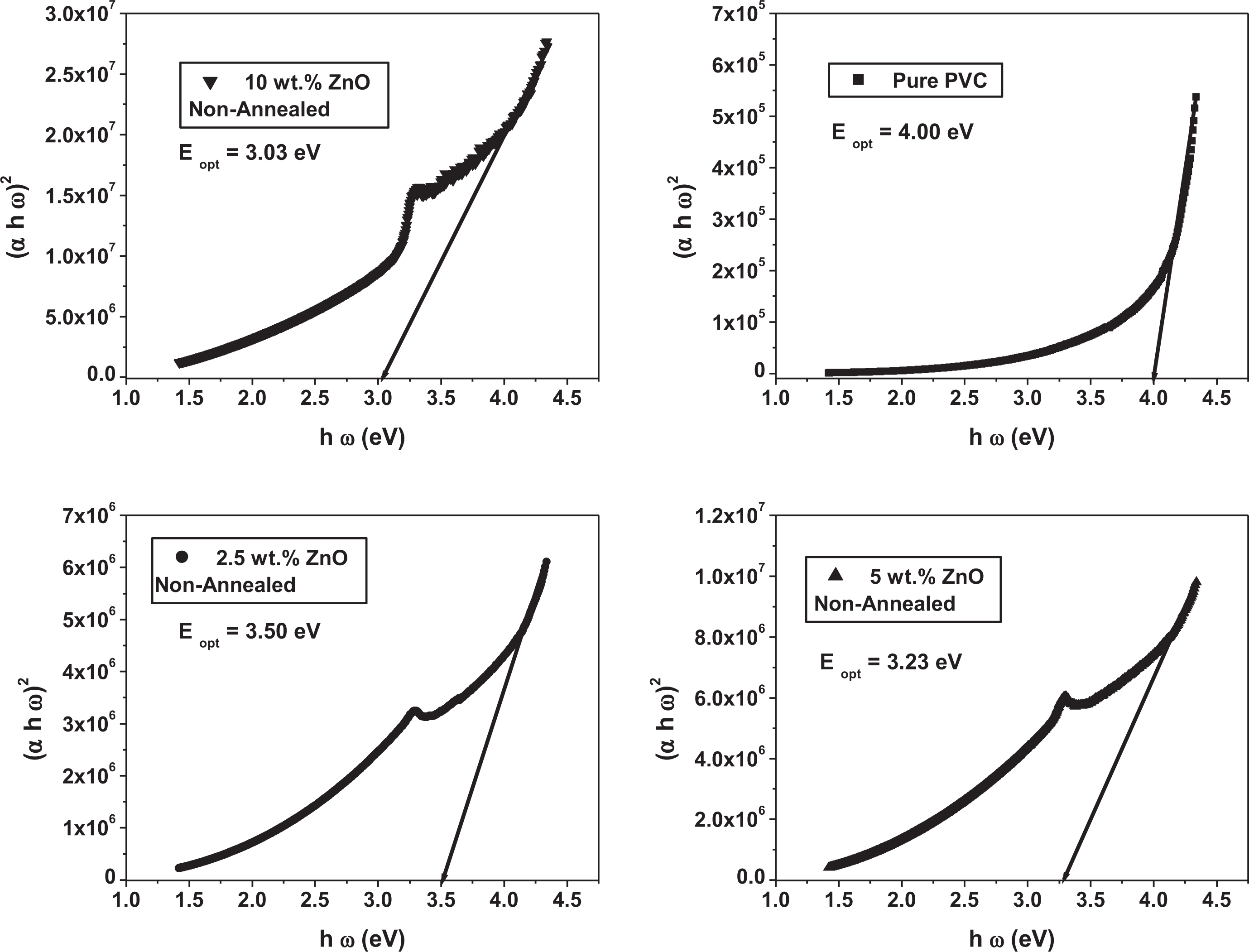
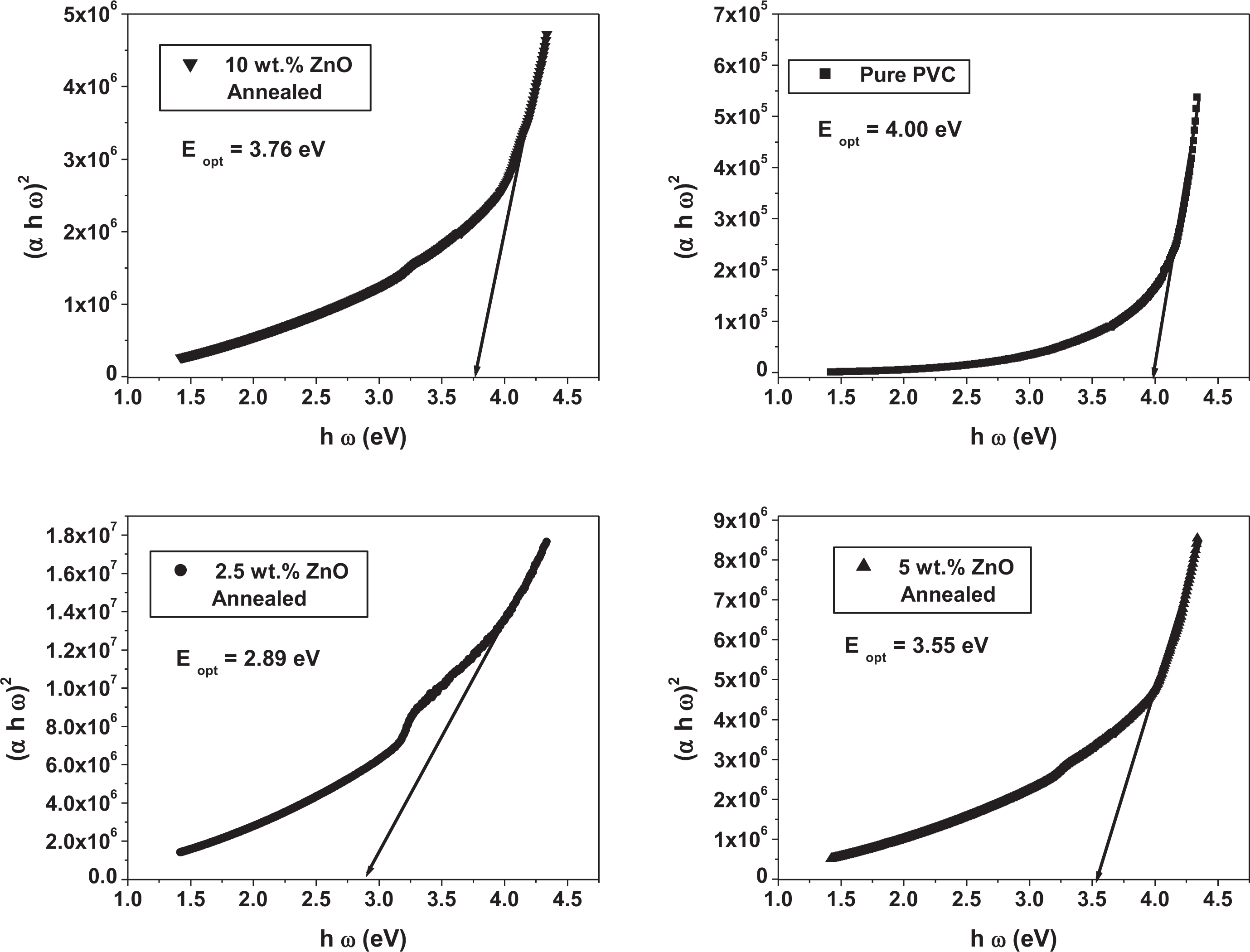
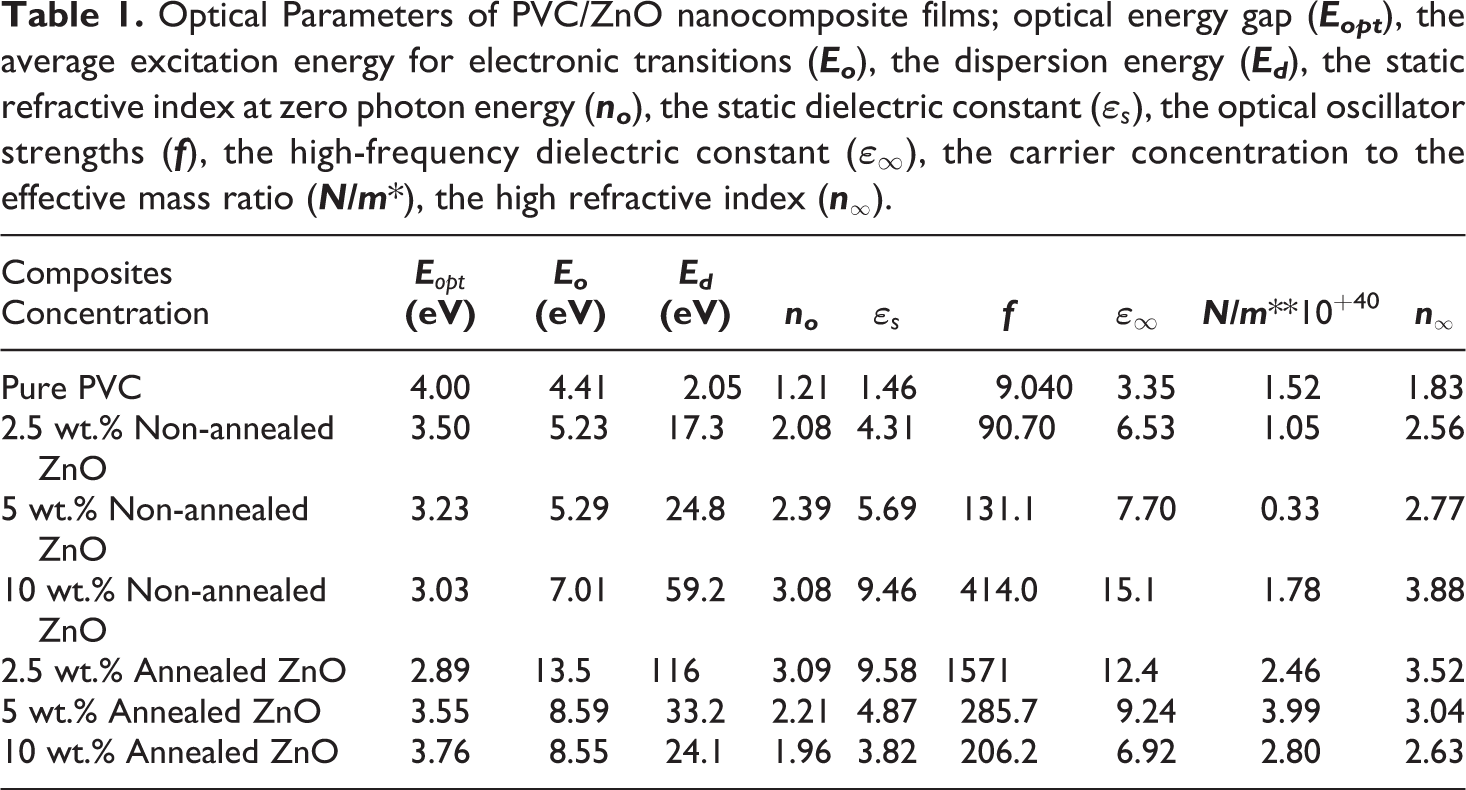
The absorption coefficient values are calculated from the absorbance, the incident and transmitted intensity data by using equation (1). Equation (2) was used to calculate the direct optical band gap , from the absorption coefficient data by plot versus photon energy () that obtain a good straight line, with extrapolation of the linear portion of these lines gives () for nonannealed ZnO nanoparticles as shown in Figure 2 and annealed ZnO nanoparticles as shown in Figure 3 for all PVC/ZnO nanocomposite films. We found that the optical energy gap was 4.0 eV for pure PVC, also we found that the optical energy gap value was 3.5 eV for 2.5 wt.% nonannealed ZnO nanoparticles, dropped to 3.03 eV for 10 wt.% nonannealed ZnO nanoparticles. This means that the increasing of the amount of nonannealed ZnO nanoparticles could increase the charges in the PVC/ZnO nanocomposite films and behave as semiconducting materials. The decrease in the optical energy gap was due to creation of localized energy states act as defects plays an important role in the electronic transitions by adding the nonannealed ZnO nanoparticles in the nanocomposite films.36,37 We found that the optical energy gap value is 2.89 eV for 2.5 wt.% annealed ZnO nanoparticles (Figure 3), it jumped to 3.76 eV for 10 wt.% annealed ZnO nanoparticles which means that the annealed temperature of the ZnO nanoparticles had changed the crystalline structure that had taken place during formation of the nanocomposite films. In addition, the increase in the optical energy gap values with increasing the annealed ZnO nanoparticles concentration might be due to some kind of structural changes occur in the nanocomposite films,38 and might be due to the quantum confinement effect.39 The optical energy gap values for all PVC/ZnO nanocomposite films were recorded in Table 1.
A plot of the absorption coefficient data with photon energy for nonannealed ZnO nanoparticles for all nanocomposite films.
A plot of the absorption coefficient data with photon energy for annealed ZnO nanoparticles for all nanocomposite films.
Optical Parameters of PVC/ZnO nanocomposite films; optical energy gap (Eopt), the average excitation energy for electronic transitions (Eo), the dispersion energy (Ed), the static refractive index at zero photon energy (no), the static dielectric constant (), the optical oscillator strengths (f), the high-frequency dielectric constant (), the carrier concentration to the effective mass ratio (N/m*), the high refractive index ().
Composites Concentration
(eV)
Eo(eV)
Ed(eV)
no
f
N/m**10+40
Pure PVC
4.00
4.41
2.05
1.21
1.46
9.040
3.35
1.52
1.83
2.5 wt.% Non-annealed ZnO
3.50
5.23
17.3
2.08
4.31
90.70
6.53
1.05
2.56
5 wt.% Non-annealed ZnO
3.23
5.29
24.8
2.39
5.69
131.1
7.70
0.33
2.77
10 wt.% Non-annealed ZnO
3.03
7.01
59.2
3.08
9.46
414.0
15.1
1.78
3.88
2.5 wt.% Annealed ZnO
2.89
13.5
116
3.09
9.58
1571
12.4
2.46
3.52
5 wt.% Annealed ZnO
3.55
8.59
33.2
2.21
4.87
285.7
9.24
3.99
3.04
10 wt.% Annealed ZnO
3.76
8.55
24.1
1.96
3.82
206.2
6.92
2.80
2.63
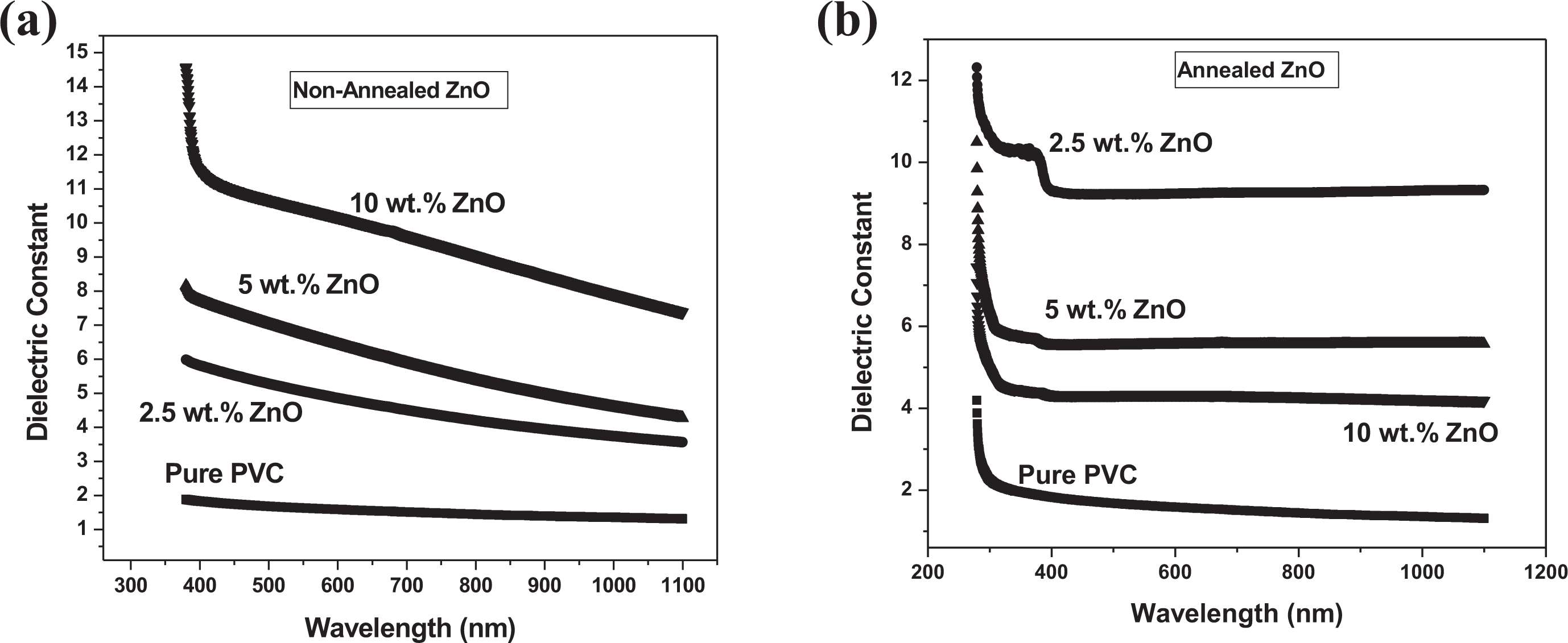
The dielectric constant values for the PVC/ZnO nanocomposite films were obtained from the refractive index n and k the extinction coefficient values by using the equation (6). The dielectric constant relates to dispersion of the incident wave in a medium.27Figure 4(a) and (b) showed the variations of dielectric constant with the incident photon wavelength for both nonannealed and annealed ZnO nanoparticles nanocomposite films. From Figure 4(a) it was found that the dielectric constant value is 1.83 for neat PVC at 400 nm dropped to 1.31 at 1100 nm, and the dielectric constant value for 2.5 wt.% of nonannealed ZnO is 5.81 at 400 nm, raised to 11.5 at 400 nm for 10 wt.% of nonannealed ZnO, and dropped to 3.56 and 7.37 at 1100 nm, for 2.5 wt.%, and 10 wt.%, respectively. The behavior of the dielectric constant was increased with nonannealed ZnO concentrations and decreased with the incident wavelength revealed that the nonannealed ZnO nanocomposites had worked as semiconducting materials, while, from Figure 4(b) it was found that the dielectric constant value was high for 2.5 wt.% of annealed ZnO, lowering values for 5 and 10 wt.% of nonannealed ZnO. This could be because the annealed ZnO nanocomposites behaved as insulator materials.
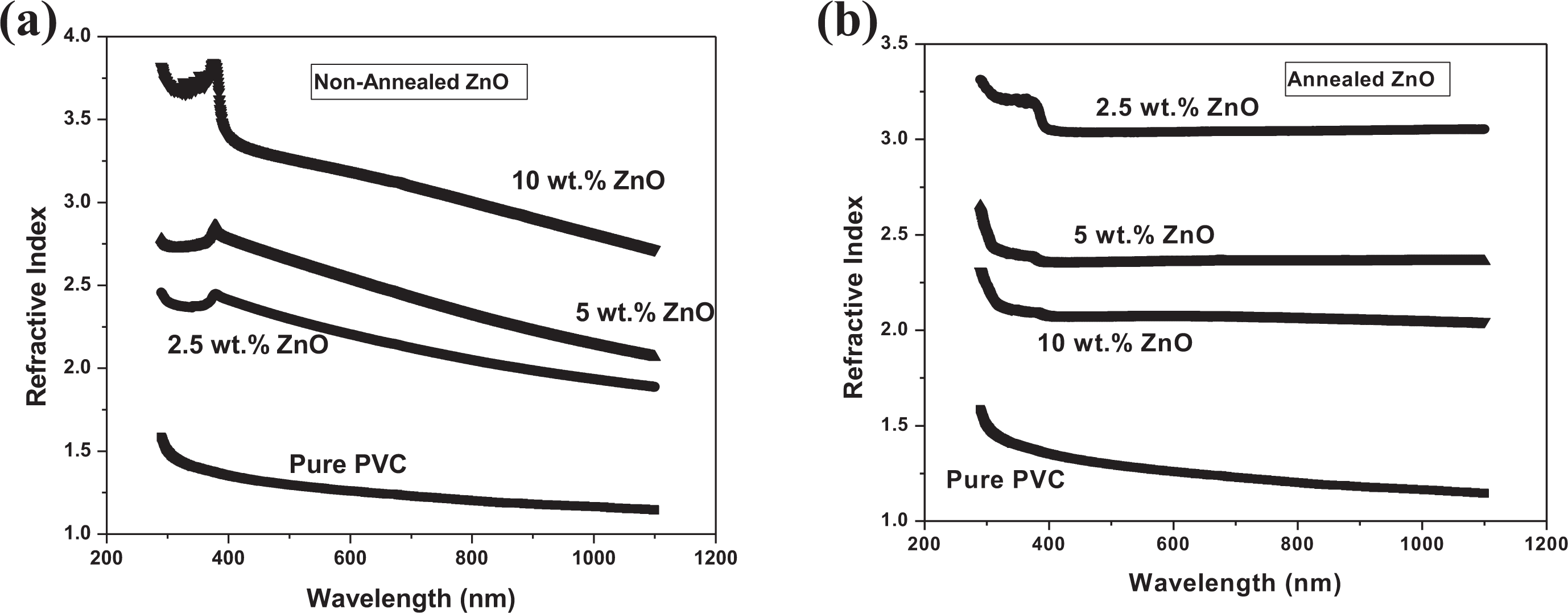
The refractive index as a function of the wavelength; (a) for nonannealed ZnO nanocomposite films; (b) for the annealed ZnO nanocomposite films.
The complex refractive index of the nanocomposite films were calculated from the refractive index n and k the extinction coefficient values by using the equation (3). The extinction coefficient k and the refractive index n values were calculated by using equations (4) and (5), respectively. The refractive index as a function of the wavelength for nonannealed ZnO nanocomposite films were shown in Figure 5(a) and (b) for the refractive index of the annealed ZnO nanocomposite films. As seen in Figure 5(a) and (b), the refractive index dispersion was influenced by the concentrations and the incident light wavelength for both nonannealed and annealed ZnO nanoparticles. It was found that the refractive index values are increased with increasing the amount of nonannealed ZnO nanoparticles. The refractive index values were decreased with increasing the amount of annealed ZnO nanoparticles. A small quantity of annealed ZnO nanoparticles caused a big change in the refractive index. From this figure, we found that the refractive index values of these nanocomposite films for both types of ZnO nanoparticles were higher than that of a pure PVC film. This might be due to the condensation of smaller filler molecules into larger clusters.2 The refractive index is very important in optical communication designing for the optical devices; therefore, it is important to determine dispersion parameters of the films in details using a single oscillator dispersion equation and other theoretical models.40
The variations of dielectric constant with the incident photon wavelength; (a) for nonannealed ZnO nanocomposite films; (b) for the annealed ZnO nanocomposite films.
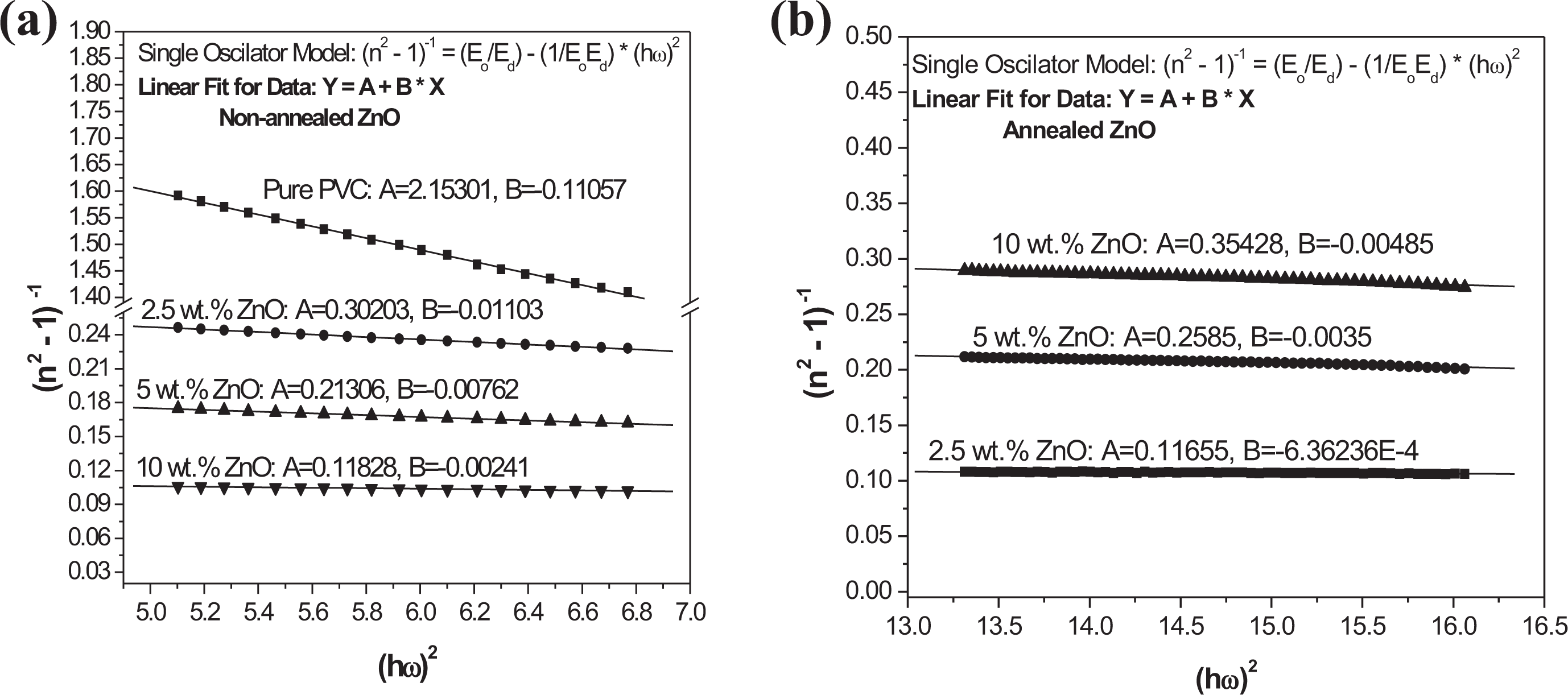
The dispersion parameters and of the PVC/ZnO nanocomposite films were evaluated by using equation (7) according to the single oscillator model. According to the single oscillator model,25 each electron is assumed to behave as an oscillator.41 The values of and could be obtained from the intercept equal to and slope equal to of the linear fitted lines by plotting versus shown in Figure 6. The average excitation energy for electronic transitions and the dispersion energy were calculated from Figure 6(a) for the nonannealed ZnO nanocomopsite films and from Figure 6(b) for the annealed ZnO nanocomopsite films and the values were listed in Table 1. It was found that the average excitation energy values is 5.23 eV for 2.5 wt.% of the non-annealed ZnO raised to 7.01 eV for 10 wt.% of the non-annealed ZnO, and dropped from 13.5 eV for 2.5 wt.% of the annealed ZnO to 8.55 eV for 10 wt.% of the annealed ZnO. The average excitation energy and the dispersion energy values had proved the behavior of the optical properties that investigated in this study.
The variation between (n1)−1 and ; (a) for nonannealed ZnO nanocomposite films; (b) for the annealed ZnO nanocomposite films.
The static refractive index no was calculated from the dispersion parameters and by using equation (8), and is reported in Table 1. It was found that the static refractive index, was raised from 2.08 for 2.5 wt.% of non-annealed ZnO to 3.08 for 10 wt.% of non-annealed ZnO, and dropped from 3.09 for 2.5 wt.% of annealed ZnO to 1.96 for 10 wt.% of annealed ZnO.
The static dielectric constant, was computed from the static refractive index no by using equation (9), and was presented in Table 1. It was found that the static dielectric constant was raised from 4.31 for 2.5 wt.% of non-annealed ZnO to 9.46 for 10 wt.% of non-annealed ZnO, and had dropped from 9.58 for 2.5 wt.% of annealed ZnO to 3.82 for 10 wt.% of annealed ZnO. The optical oscillator strengths f for optical transitions was calculated from the single oscillator parameters and by using equation (10), and listed in Table 1. It was found that the optical oscillator strengths was raised from 90.7 for 2.5 wt.% of non-annealed ZnO to 414 for 10 wt.% of non-annealed ZnO dropped from 1571 for 2.5 wt.% of annealed ZnO to 206.2 for 10 wt.% of annealed ZnO. The variation of the optical properties and parameters could be interpreted as that during the nanocomposite films preparation and formation some defects may form, these defects produce localized states in the band structure of nanocomposite films.42
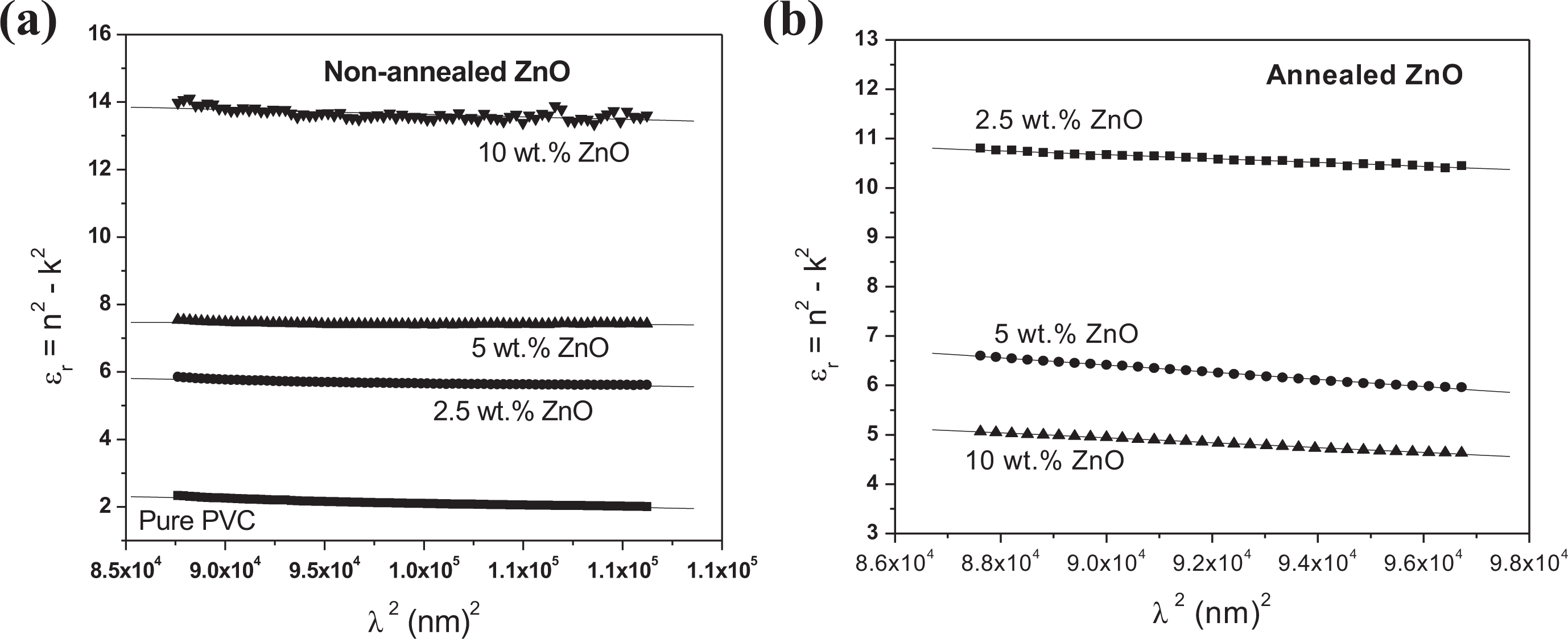
Figure 7(a) and (b) showed the variation between the and for nonannealed and annealed ZnO nanoparticles, respectively. From Figure 7(a) and (b), the high-frequency dielectric constant, , and the carrier concentration to the effective mass ratio were obtained by using equation (11). The infinite refractive index, , was calculated from the high-frequency dielectric constant and all of these parameters were listed in Table 1.
The variation between and ; (a) for nonannealed ZnO nanocomposite films; (b) for the annealed ZnO nanocomposite films.
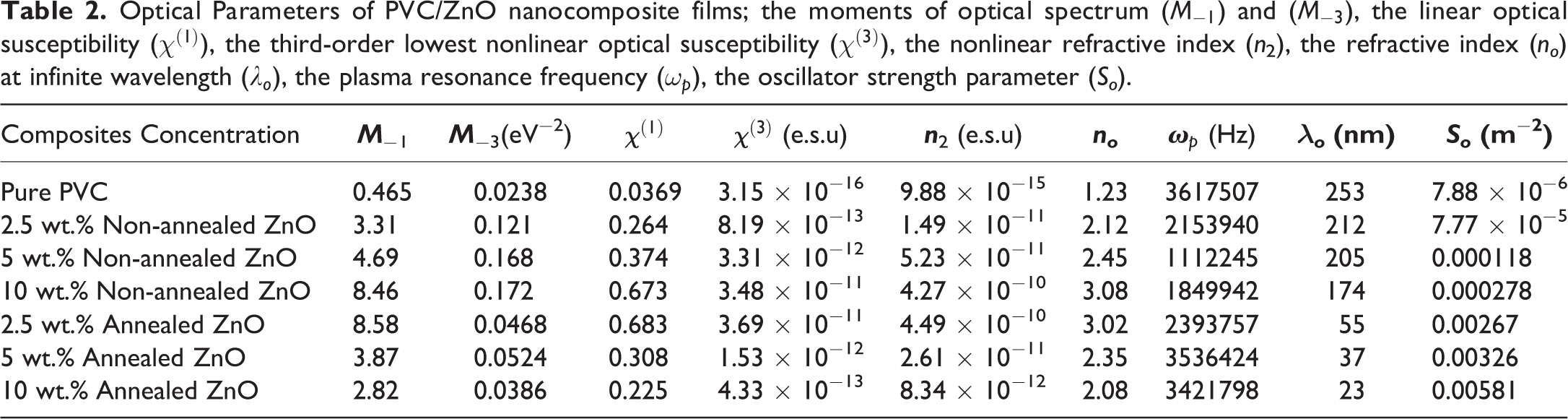
The plasma resonance frequency for one kind of free carriers was calculated from equation (12). The moments of optical spectrum and were computed from equation (13). The linear optical susceptibility for long wavelengths was calculated from equations (14) and (15). The third-order lowest nonlinear optical susceptibility was calculated from equations (16) to (18). The nonlinear refractive index was found from equation (19). The optical parameters (, , , and ) were observed to increase by increasing the amount of nonannealed ZnO nanoparticles while these parameters were observed to decrease by increasing the amount of annealed ZnO nanoparticles. All of these parameters were listed in Table 2.
Optical Parameters of PVC/ZnO nanocomposite films; the moments of optical spectrum () and (), the linear optical susceptibility (), the third-order lowest nonlinear optical susceptibility (), the nonlinear refractive index (n2), the refractive index (no) at infinite wavelength (), the plasma resonance frequency (), the oscillator strength parameter (So).
Composites Concentration
M−1
M−3(eV−2)
(e.s.u)
n2 (e.s.u)
no
(Hz)
o(nm)
So(m−2)
Pure PVC
0.465
0.0238
0.0369
3.15 × 10⁻¹⁶
9.88 × 10⁻¹⁵
1.23
3617507
253
7.88 × 10⁻⁶
2.5 wt.% Non-annealed ZnO
3.31
0.121
0.264
8.19 × 10⁻¹³
1.49 × 10⁻¹¹
2.12
2153940
212
7.77 × 10⁻⁵
5 wt.% Non-annealed ZnO
4.69
0.168
0.374
3.31 × 10⁻¹²
5.23 × 10⁻¹¹
2.45
1112245
205
0.000118
10 wt.% Non-annealed ZnO
8.46
0.172
0.673
3.48 × 10⁻¹¹
4.27 × 10⁻¹⁰
3.08
1849942
174
0.000278
2.5 wt.% Annealed ZnO
8.58
0.0468
0.683
3.69 × 10⁻¹¹
4.49 × 10⁻¹⁰
3.02
2393757
55
0.00267
5 wt.% Annealed ZnO
3.87
0.0524
0.308
1.53 × 10⁻¹²
2.61 × 10⁻¹¹
2.35
3536424
37
0.00326
10 wt.% Annealed ZnO
2.82
0.0386
0.225
4.33 × 10⁻¹³
8.34 × 10⁻¹²
2.08
3421798
23
0.00581
The Figure 8(a) and (b) showed the variation between the and , for nonannealed and annealed ZnO nanoparticles, respectively. By using this figure, the average oscillator wavelength, , oscillator strength parameter, So and the refractive index, at infinite wavelength were calculated using the oscillator model equations (20) to (22), and the obtained values are reported in Table 2.
The variation between ()−1 and ; (a) for nonannealed ZnO nanocomposite films; (b) for the annealed ZnO nanocomposite films.
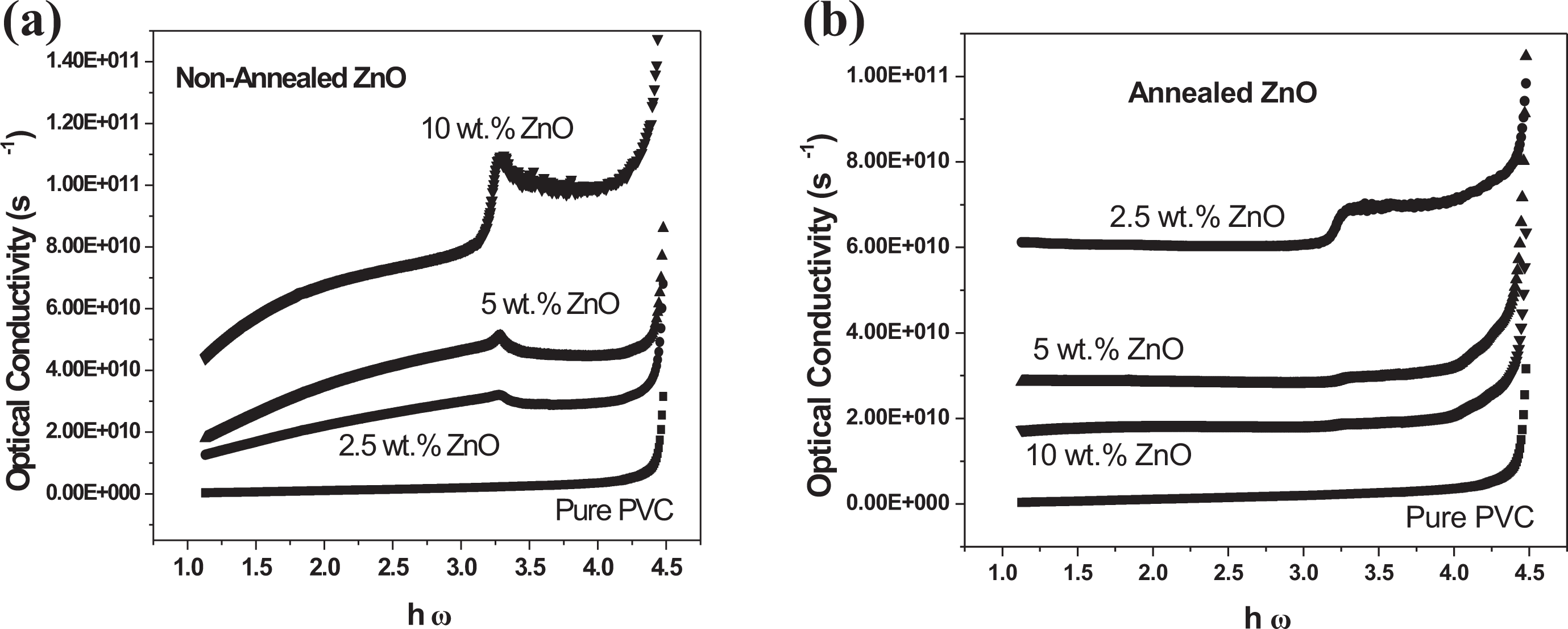
The optical conductivity was dependent on the absorption coefficient and refractive index of a material and caoul be estimated from the relation 23. The Figure 9(a) and (b) showed the optical conductivity for nonannealed and annealed ZnO nanoparticles, respectively. It was seen from the Figure 9(a) and (b) that the optical conductivity increased with increasing the incident photon energy. This increase in optical conductivity was due to the electrons excited by photon energy.41 In addition, it was seen from the Figure 9(a) and (b) that the optical conductivity increased with increasing the nonannealed ZnO nanoparticles, and decreased with increasing the annealed ZnO nanoparticles. This increase in the optical conductivity with increasing the nonannealed ZnO nanoparticles content was due to the formation of new levels within the band gap that facilitate the crossing of the electrons from the valence band to these local levels to the conduction band.36,43 We found that the output optical parameter values for PVC/ZnO nanocomposite films in present study were consistent with the behavior of the optical properties and the dispersion parameters found in literature for PVC/metal oxide nanocomposites, these outputs of the optical dispersion parameters are important in the field of optoelectronic materials applications.13,43,44
The optical conductivity as a function of photon energy; (a) for nonannealed ZnO nanocomposite films; (b) for the annealed ZnO nanocomposite films.
Conclusions
In conclusion, we have studied the effect of nonannealed and annealed ZnO nanoparticles on the optical properties and optical dispersion parameters of PVC/ZnO nanocomposite films that prepared by casting method. In this research paper we are concluded that the optical properties and optical dispersion parameters of the prepared PVC/ZnO nanocomposite films had been affected by the nonannealed and annealed ZnO nanoparticles concentration and with the incident photon wavelength. The obtained optical parameters (average excitation energy , the dispersion energy , the static refractive index no, the static dielectric constant, , the optical oscillator strengths f, high-frequency dielectric constant, , the effective mass ratio , the infinite refractive index, , the moments of optical spectrum and , the linear optical susceptibility , third-order lowest nonlinear optical susceptibility , the nonlinear refractive index , the average oscillator wavelength, , oscillator strength parameter) values had proved the behavior of the optical properties that investigated in this study. The optical band gap decreased with increasing the nonannealed ZnO nanoparticles concentration and increased with increasing the annealed ZnO nanoparticles. The results show that the optical properties behavior of the nonannealed ZnO nanoparticles PVC nanocomposit films is different as the behavior of the annealed ZnO nanoparticles PVC nanocomposit films. The output results can be considered important in the field of optoelectronic materials applications.
Footnotes
Acknowledgements
The studied ZnO nanoparticles were fabricated by Hydrogen-Argon annealing by Prof. Dr. Ulrich Herr research group at Institute of micro and nanomaterials at University of Ulm/Germany.
Funding
The author(s) received no financial support for the research, authorship, and/or publication of this article.
ORCID iD
Ali F Al-Shawabkeh
References
1.
KhalfallahBChaabouniFAbaabM. Studies on the optical properties of ZnO nanostructured thin films synthesized by RF magnetron sputtering. Mater Sci Indian J2015; 13(1): 22–31.
WildnerWDrummerD. Nanofiller materials for transparent polymer composites: influences on the properties and on the transparency—a review. J Thermoplast Compos Mater2019; 32(11): 1547.
4.
Abou-KandilAIAwadAMwafyE. Polymer nanocomposites part 2: optimization of zinc oxide/high-density polyethylene nanocomposite for ultraviolet radiation shielding. J Thermoplast Compos Mater2015; 28(11): 1583.
5.
MahmoodUARiedmüllerBSedhigiK, et al.A quantitative study of ZnO materials as possible down-shifters for solar cell applications. Energy Proc2014; 60: 23–31.
6.
ElimatZM. AC-impedance and dielectric properties of hybrid polymer composites. J Compos Mater2015; 49(1): 3–15.
KumarRSinghRSinghM, et al.ZnO nanoparticle-grafted PLA thermoplastic composites for 3D printing applications: tuning of thermal, mechanical, morphological and shape memory effect. Published Online First May 18, 2020. J Thermoplast Compos Mater2020; DOI.org/10.1177/0892705720925119.
9.
AwadAAbou-KandilAIElsabbaghI, et al.nanoparticles synthesized via novel calcination method Polymer nanocomposites part 1: structural characterization of zinc oxide. J Thermoplast Compos Mater2015; 28(9): 1343.
10.
StelescuMD. Polymer composites based on plasticized PVC and vulcanized nitrile rubber waste powder for irrigation pipes. ISRN Mater Sci2013; 2013: 1–5.
11.
MallakpourSJarahiyanA. Surface treatment of copper (II) oxide nanoparticles using citric acid and ascorbic acid as biocompatible molecules and their utilization for the preparation of poly(vinyl chloride) novel nanocomposite films. J Thermoplast Compos Mater2017; 30(9): 1267.
12.
SakuldeemeekiatTLuamsriNWootthikanokkhanJ, et al.The effects of thermochromic pigments on optical, mechanical, and heat insulation properties of plasticized PVC window film. J Thermoplast Compos Mater2020; 33(9): 1196.
13.
TahaTAHendawyNEl-RabaieS, et al.Effect of NiO NPs doping on the structure and optical properties of PVC polymer films. Polym Bull2019; 76: 4769.
14.
Al-Taa’yWAbdul NabiMRahimiMY, et al.Effect of nano ZnO on the optical properties of poly vinyl chloride films. Int J Polym Sci2014; 2014: 1–6.
15.
KumarARajaWHBhattMK, et al.Study of electrical and optical properties of PVC composites filled with zinc-oxide (ZnO) nanoparticles, synthesized by sol-gel and dropwise mixing process. Int J Nanotechnol Applicat2018; 12(1): 13–24.
16.
Al-Taa’yWAmeerAAAl-DahhanWH, et al.Optical constants of poly(vinyl chloride) doped by nano ZnO. J Chem Pharmaceut Res2015; 7(8): 536–541.
17.
GuedriAZaabatMBoudineB, et al.Synthesis, characterization, structural, and optical properties of polyvinyl chloride/zinc oxide nanocomposite films for photocatalysis application. J Inorgan Organomet Polym Mater2020; 30: 4884–4894.
18.
ElimatZMAl-HussamiSAZihlifAM. Effect of carbon black on the thermoelectrical properties of poly(ethylene-oxide) composites. J Compos Mater2012; 47(28): 3525–3534.
19.
DavisEAMottNF. Conduction in non-crystalline systems V. Conductivity, optical absorption and photoconductivity in amorphous semiconductors. Philos Mag J Theor Exp Appl Phys1970; 22(179): 0903–0922.
20.
TaucJ. Amorphous and Liquid Semiconductors. New York, NY: Plenum, 1974.
21.
YahiaISFaragAAMCavasM, et al.Effects of stabilizer ratio on the optical constants and optical dispersion parameters of ZnO nano-fiber thin films. Superlattices Microstructs2013; 53(1): 63–75.
22.
El-NahassMMAfifyHAGadallahAS, et al.Effect of thermal annealing on structural and optical properties of titanyl phthalocyanine thin films. Mater Sci Semiconduct Process2014; 27: 254–260.
23.
PankoveJI. Optical processes in semiconductors. New York, NY: Dover Publications Inc., 1975.
24.
SinghSPotopowiczJRVan UitertLG, et al.Nonlinear optical properties of hexagonal silicon carbide. Appl Phys Lett1971; 19: 53.
25.
WempleSH. Refractive-index behavior of amorphous semiconductors and glasses. Phys Rev B1973; 7(8): 3767.
26.
QasrawiAFGasanlyNM. Refractive index, static dielectric constant, energy band gap and oscillator parameters of Ga2SeS single crystals. Phys Stat Sol (a)2007; 204(9): 3165–3169.
27.
El-MetwallyEGAbou-HelalMOYahiaIS. Optical constants of the thermally evaporated a-Se70Ge30 Thin Films. J Ovonic Res2008; 4(2): 20–34.
28.
WakkadMMShokrEKhMohamedSH. Optical and calorimetric studies of Ge-Sb-Se glasses. J Non-Crystalline Solids2000; 265: 157–166.
29.
WempleSH. Interband optical transition strengths in SiO2, GeO2, SnO2 and TiO2. Solid State Commun1973; 12: 701–704.
30.
DeghiedyNMEl-SayedSM. Evaluation of the structural and optical characters of PVA/PVP blended films. Opt Mater2020; 100: 109667.
31.
TicháHTichýL. Semiempirical relation between non-linear susceptibility (refractive index), linear refractive index and optical gap and its application to amorphous chalcogenides. J Optoelectron Adv Mater2002; 4(2): 381–386.
32.
FrumarMJedelskyJFrumarovaB, et al.Optically and thermally induced changes of structure, linear and non-linear optical properties of chalcogenides thin films. J Non-Crystall Solids2003; 326&327: 399–404.
33.
YakuphanogluF. Heat treatment effect on the single oscillator parameters and optical band gap of an organic thin film. Opt Mater2006; 29: 253–256.
34.
AliasANZabidiZMAliAMM, et al.Optical characterization and properties of polymeric materials for optoelectronic and photonic applications. Int J Appl Sci Technol2013; 3(5): 11–38.
35.
EtcheverryLPFloresWHda SilvaDL, et al.Annealing effects on the structural and optical properties of ZnO nanostructures. Mater Res2018; 21(2): e20170936.
36.
MansourAFMansourSFAbdoMA. Enhancement of structural and electrical properties of ZnO/PVA nanocomposites. IOSR J Appl Phys2015; 7(2): 97–106.
37.
ChitraMMangammaGUthayaraniK, et al.Band gap engineering in ZnO based nanocomposites. Phys E Low Dimens Syst Nanostruct2020;119: 113969
38.
JoshiGPMangalRSaxenaNS, et al.Band gaps of nanocomposites. Indian J Pure Appl Phys2002; 40: 297–300.
39.
AnandanKRajendran. Solvents effect of quantum sized SnO2 nanoparticles via solvothermal process and optical properties. Mater Sci Res India2010; 7(2): 389–397.
40.
OboudiSFAbdul NabiMTAl-Taa’yWA, et al.Dispersion characterization of conductive polymer. Int J Electrochem Sci2015; 10:1555–1562.
41.
ShehapAMAkilDS. Structural and optical properties of TiO2 nanoparticles/PVA for different composites thin films. Int J Nanoelectronics Mater2016; 9: 17–36.
42.
CaglarYIlicanSCaglarM. Single-oscillator model and determination of optical constants of spray pyrolyzed amorphous SnO2 thin films. Eur Phys J B2007; 58: 251–256.
43.
TahaTAAhmed Saleh. Dynamic mechanical and optical characterization of PVC/fGO polymer nanocomposites. Appl Phys A2018; 124(600): 2–12.
44.
TahaTAIsmailZElhawaryMM. Structural, optical and thermal characterization of PVC/SnO2 nanocomposites. Appl Phys A2018; 124(307): 2–13.