




Abstract
This review, overviews the development and applications of shear deformation (SD) laminated composite plate theories. The present overview mainly focuses on theoretical models based on SD theories of laminated composite plates. This comprehensive review has been categorized with an equivalent single-layer laminate and layerwise laminate theories. An equivalent single-layer laminate theory includes classical laminated plate theory, first-order shear deformation laminated theory, second-order shear deformation laminated theory, third-order shear deformation laminated theory, parabolic shear deformation laminated theory, trigonometric shear deformation laminated theory, hyperbolic shear deformation laminated theory, and higher order shear deformation laminated theory. The layerwise laminate theories include discrete-layer theories and zig-zag theories. In addition, the 3D elasticity solutions theory, the mixed (hybrid) plate theories, unified theories, advanced shear deformation theories, and the recently developed smart composite are also reviewed.
Keywords
Introduction
The substantial application of composite laminated materials in robotics, automotive engineering, shipbuilding structure, submarines, aerospace, medical instruments, astronavigation, and many other industries is a courageous attempt in the accurate prediction of the structural behavior. These composite structures develop microdamage either during manufacturing or during the service life. Based on structural analysis, the deformation of transverse shear has been advantageous for laminated materials because of high ratio of in-plane modulus with respect to low modulus of transverse shear. The advantageous features such as good stiffness and strength to weight ratio of laminated composite materials make them excellent candidates for high-performance applications of unidirectional fiber composites.
A number of books and monographs in the literature are available that cover both the theoretical and the mathematical aspects of the mechanics of laminated composite materials.1–40
Literature review related to mechanics of structure of laminated plates, beams, and shells has been presented by Habip, 41 Bert and Egle, 42 Dong and Tso, 43 Grigolyuk and Kogan, 44 Bert and Francis, 45 Bert, 46 Reddy,47–50 Reissner, 51 Kapania, 52 Noor and Burton,53,54 Noor, 55 Mallikarjuna, T Kant, 56 Liu and Li, 57 Khandan and Noroozi, 58 Ghugal and Shimpi, 59 and Liew et al. 60 The laminated composite based on structural analysis has been discussed by Teters, 61 Whitney, 62 Varadan and Bhaskar, 63 and Reddy. 64 In line with this, Srinivas and Rao, 65 Kapania and Raciti, 66 Noor and Burton, 67 Khdeir, 68 and Liew et al. 69 developed the natural frequency of composite laminated plates.
The past 50 years have seen the development and tremendous application of the composite materials because of their high strength and low-weight specifications. The composite materials used in marine and aerospace engineering have shown good endurance characteristics and high corrosive resistance. These materials have good design flexibility based on the variation of sequence of stacking the fiber and matrix.70,71 The physical structure and mechanical behavior of the laminated composite are based on the fiber orientation, layer size, shape, and thickness of lamina. Therefore, accuracy and efficiency of structural analysis of the laminates depend on the orientation of fibers within the material. 72
For many aspects, the normal and transverse shear stress distributions of the composite materials are considered important. First, if the in-plane stress exceeds the yield of the fiber materials, then the interlaminar shear stress fails due to tangential slips that occur between the layers arranged relative to each other. Second, tremendous bonding failure occurs because of increased transverse normal stress, where two layers separate each other due to each other’s pull. Detailed analyses of transverse shear stress and transverse normal stress failure in the plate thickness direction have been discussed by Engblom and Ochoa 73 and Fox. 74
In general, laminated composite structural theories are discussed in two different ways: (1) single-layer theory, where the structure of the laminated layers is considered to be an equivalent single layer (ESL), and (2) layerwise theories (LWTs), where each layer has been analyzed separately. The stress-based and displacement-based plate deformation theories have been discussed by Karama et al. 75 and Aydogdu, 76 respectively.
Shear deformation (SD) theories based on displacement and stress laminates have been categorized as classical laminated plate theory (CLPT), the first-order shear deformation laminated theory (FSDLT), second-order shear deformation laminated theory (SSDLT), third-order shear deformation laminated theory (TSDLT), and more higher order shear deformation laminated theories (HSDLTs).
Figure 1 shows that the deformation of elemental plate for Kirchhoff–Love classical plate theory (CPT) and Reissner–Mindlin elemental deformation theory with the actual shell element deformation based on strain variation of Noor. 55
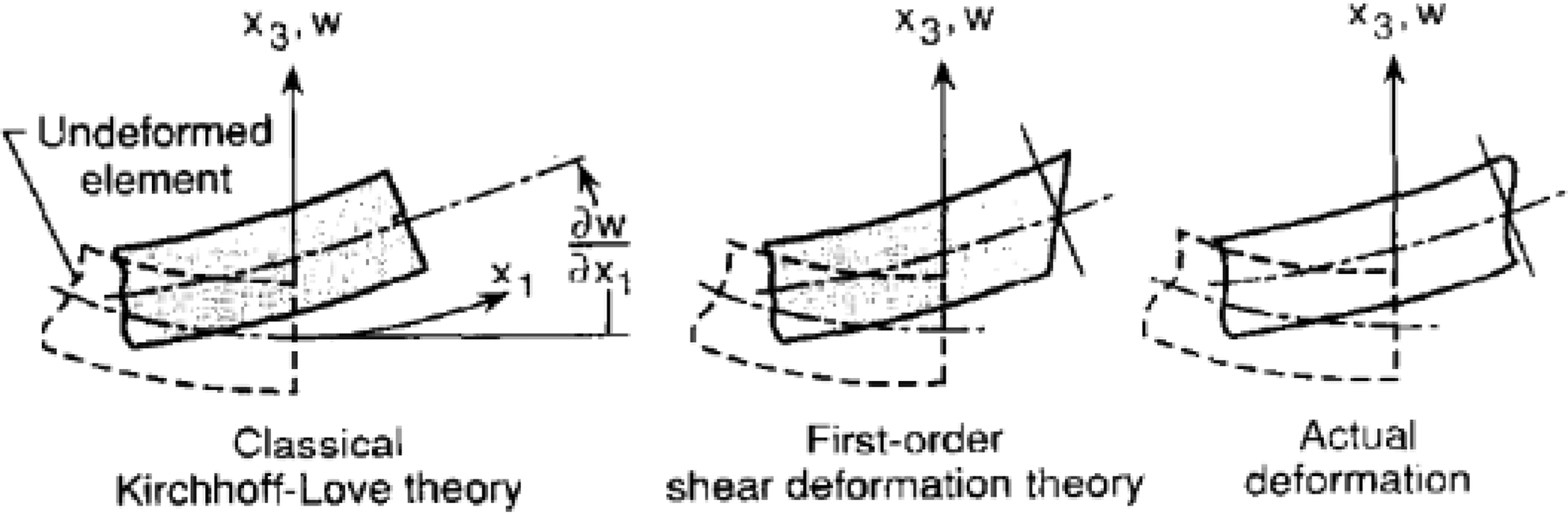
Elemental deformation. 55
The aim of this present overview has been provided with a contemporary consistent survey based on the SD theories of laminated composite plates. In the earlier review articles, various theories have been discussed to identify different problems and behaviors of laminated composite plates, as well as to more precisely identify definite types of problems. This article focused on the overall development and applications of SD theories of laminated composite plates, and conclusions have been drawn based on these articles. This review paper will guide scientists and researchers in assisting them to locate appropriate articles from the existing literature.
Development of mathematical models based on SD theory
The plate analysis is basically classified into two types: thin plate and thick plate. Thin plate analysis identifies two-dimensional (2D) problems, whereas thick plate identifies multidimensional issues. The thin plate problems have been derived with acceptances concerning the kinematic deformation of the orthotropic plate. Various methods are available for reducing the multidimensional elasticity equations to 2D plate theory problems. The Goldenveizer
77
discussed the different mathematical models which are classified into different groups: The method of hypotheses: This method was developed based on Kirchhoff–Love hypotheses which imposes some assumptions to reduce multidimensional problem to 2D problem. The method is further subdivided into: the semi-inverse technique, the technique of trigonometric functions, and the expansion based on Fourier series. The expansion technique based on thickness: Initial functions technique. Symbolic integrations technique. An expansion method based on asymptotic analysis. The successive approximations method. The mixed variational technique.
All the above mathematical techniques are based on thickness coordinates, except for the asymptotic expansion method. Goldenveizer, 77 Donnell, 17 Noor and Burton,53,54,67 and Jones 38 discussed the expansion method using Taylor series, McLaurin series, and Legendre polynomials for the analysis of SD theories of orthotropic laminated materials with merits and demerits.
Laminate theories
Numerous laminate theories have been developed so far. Laminated composite plates are initially taken from thin, moderately thick, and very thick homogeneous isotropic plates which are developed based on new refined theories such as zig-zag theories (ZZTs), discrete layer theories, and the mixed (hybrid) plate theories. Different SD theories based on single-layer and layerwise approaches have been developed for laminated composite plates with the exact analysis of structural composite. In single-layer theories approach, the layers are considered as one ESL, whereas in layer-wise approach, each layer is considered as a function for the analysis.
Equivalent single-layer theories
The classical plate and SD theories have been used for the analysis of laminated composite plates developed by Vinson and Chou. 16 They used the ESL approach by power series expansion method based on thickness.
The main simplification of ESL theories has reduced the 3D problems into 2D problems. Owing to this simplification, the ESL approach cannot accurately represent the layerwise continuity displacement and the transverse shear stress fields.
Classical laminated plate theory
The 2D CPT was developed by Kirchhoff78,79 in the 19th century, which used the Kirchhoff hypothesis that the midplane normal before and after deformation remains a straight line. The kinematic assumption taken by the CPT is that the transverse shear stresses and strains are considered zero.
Kirchhoff 79 developed the displacement function for 2D plate theory, which is shown in the following equation:
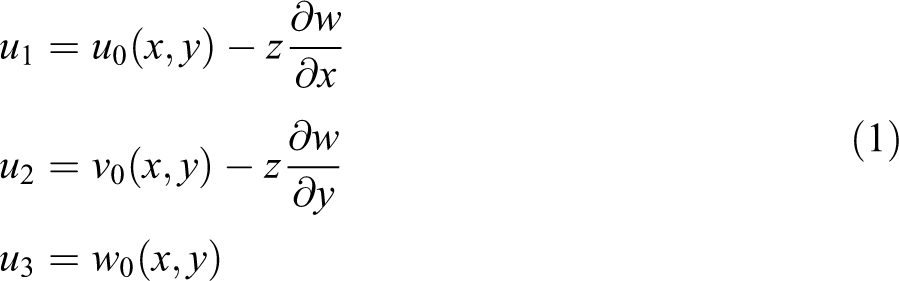
where u1, u2, and u3 are the displacements of a coordinate point (x, y, z) in the plate element and u0, v0, and w0 represent the corresponding deformation of midplane in the x, y, and z directions.
Based on this theory, the boundary value problem has been developed using the principle of virtual work to calculate the transverse displacement of laminated orthotropic plates. According to this theory, controversy against the number and nature of proper boundary conditions was resolved by Kirchhoff78,79 with the addition of Kirchhoff’s78,79 boundary condition. This theory neglects the normal and transverse shear stresses that lead to the reduction of three-boundary condition and permits per-edge two-boundary conditions. Volokh 80 presented the improved version of this theory.
CPT is widely used in the thin plates for the analysis of static extension, stability, bending, and vibrations of homogeneous structure based on the structural mechanics application. This theory is also used in numerous applications as explained in studies by Love, 81 Timoshenko and Goodier, 3 and Dym and Shames, 13 Szilard. 82
After the development of CPT for homogeneous and isotropic materials, CLPT has been developed for analysis purposes of laminated composite materials.
CLPT is based on the 2D displacement field of the ESL laminated plate. The principal assumption of Kirchhoff’s78,79 theory is that a line originally straight and runs through the middle surface remains straight and normal which has not undergone any stretching in the thickness direction. This acceptance shows the simple fundamental equations and ignores transverse normal and shear strain deformation of 2D elastic structure. Reissner and Stavsky, 83 Stavsky, 84 Dong et al., 85 Yang et al., 86 Ambartsumyan, 87 Whitney and Leissa, 88 Reddy, 39 and Whitney 89 have considered a simple 2D method of elastic structure theory for laminated composite thin structure.
CLPT that has been used for thin laminates in the analysis of stress composite is quick and simple. The main simplifying assumption of CLPT for the 3D thick plate or shell structural composite is that they are considered as 2D plates or shells located in the midplane, resulting in significant reduction in the total number of constants and their equations. The governing equation of CLPT is easier to solve and is accurate for closed-form solutions, which normally uses physical and practical explanation.
Reddy in his study has reported that using thick and moderately thick plate composite layers, the ratio of longitudinal-to-transverse shear elastic modulus is relatively large compared to isotropic materials, thereby increasing the induced error of the.90,91
Pagano92,93 and Wang et al. 94 showed the inadequacy of CLPT based on linear displacement for the thick laminated plate analysis across the whole laminate composite by neglecting the theory of SD. They analyzed the bending of laminated orthotropic composites of finite elemental strip method on 2D CLPT.
Based on the review of articles in the literature, it is concluded that CLP theory basically works for thin plate structures made of a symmetric and balanced composite laminate that undergo pure tension and bending, with the error persuading by neglecting the stress in the transverse shear direction. Thus, CLP theory works only for thin plates.
First-order shear deformation laminated theory
CLPT ignores the transverse normal, while SD is inadequate for moderately thick and thick plate analyses. However, different theories have proposed the development of thick composite laminated plates considering the transverse shear effect. The fiber-reinforced composite laminates are more pronounced in the development of transverse SD effects in comparison with isotropic plates due to high ratio of in-plane modulus to transverse shear modulus. These high ratios make CLPT inadequate for the analysis of composite fiber-reinforced structures.
The development of FSDLT theory began with the conventional plate theories invented by Reissner 95 and Mindlin 96 basically known as the SD laminated plate theory. This theory is an improved version of the classical thin plate theory. According to this theory, the transverse shear stress is constant in the thickness direction and the shear correction factor97–99 satisfies the plate boundary condition in both the upper and the lower surfaces. The transverse shear stress of FSDLT is adjusted by the different values of shear correction factors. The main drawback in using this theory is problem-dependent shear correction factors.
The conventional first-order SD theory based on displacement field was developed by Reissner 95 and Mindlin 96 :

where u1, u2, and u3 are the displacement of a coordinate point (x, y, z) in the plate element, u0, v0, and w0 represent the corresponding displacements of middle plane in the x, y, and z directions, whereas ϕx and ϕy are the transverse normal to midplane rotations about the two axes, respectively.
Timoshenko100,101 first developed the beam theory based on the SD and rotatory inertia effects. This extended work of Timoshenko100,101 has been used to analyze the static behavior of thick homogeneous isotropic plate by Reissner 95 and Mindlin 96 and extended their work to composite laminated plates by Donnell et al. 102 Green, 103 Yang et al. 86 Whitney and Pagano, 104 Chow,105,106 Wang and Chou, 107 Sun and Whitney, 108 and Reissner. 109
Frederick 110 used Reissner 95 identified the theory of thick circular plate bending rest on the elastic foundation. Medwadowski, 111 Nelson and Lorch, 112 and Dobyns 113 have analyzed the force behavior of laminated orthotropic composite and included their analysis to transverse shear, transverse normal, and quadratic displacement. Pryor and Barker 114 and Roufacil and Tran-Cong 70 have used the laminated composite plate and developed finite element formulation based on Reissner 95 and Mindlin 96 theory. They assumed that the transverse displacement is constant in the thickness direction and two normal direction displacement very linearly about each lamina. Ha 115 has developed a finite element model (FEM) based on the FSDLT approach for the analysis of sandwich plates. The closed form solution of cross-ply and angle-ply laminated composite plates on FSDLT was developed by Turvey. 116
An FEM formulation used on FSDLT for symmetric and unsymmetrical cross-ply laminated composite plates is developed by Reddy and Chao, 117 Owen and Li, 118 Rolfes and Rohwer. 119 Kabir 120 presented an analytical solution based on FSDLT approach of shear flexibility of rectangular arbitrary laminates.
Reddy and Wang 121 developed the relationship between the CPT, first-order and third-order SD plate theory for the solution of deflection, buckling load, and natural frequency. Xiang and Reddy 122 developed the natural frequency of rectangular plates using the Levy equation and the state-space technique with connection of first-order SD laminated plate theory.
Liew et al. 123 have used the EFG method to the calculation of free vibration analysis, and piezoelectric sensor or actuator is used as a vibration suppression of composite laminate plates based on FSDLT theory. Peng et al. 124 used the EFG method for the analysis of stiffened plates based on the first-order SD laminated plate theory.
Shimpi et al. 125 invented the two new displacement-based FSDLTs called NFSDT-I and NFSDT-II. These theories involve two unknown functions against three unknown functions of Reissner and Mindlin’s theories.
Phung-Van et al.126,127 developed the smooth cell-based discrete shear gap (CS-FEM-DSG3) method using three-node triangular elements based on FSDLT theory for the static and natural vibration analysis of isotropic Mindlin plates. The composite plates are integrated with piezoelectric sensor and actuators. The discrete shear gap method (DSG3) used five degree of freedom (DOF) per node in FEM to increase the accuracy of the numerical results. Luong-Van et al. 128 proposed a cell-based FEM based on the FSDT theory using three-node (CS-FEM-MIN3) Mindlin plate element for the analysis of static and dynamic response. The dynamic response of laminated composite and sandwich plates resting on viscoelastic foundation subjected to moving mass has been calculated.
Eisentrager et al. 129 discussed the application of first-order SD laminated composite theory for the analysis of glass laminated structure and photovoltaic panels that are composed of three layers.
Medani et al. 130 and Guessas et al. 131 have developed the static and dynamic behavior of functionally graded carbon nanotubes (FG-CNT)-reinforced porous sandwich (PMPV) polymer plates based on first-order SD theory for the analysis of natural vibration and bending. Two types of porous sandwich plates are studied, one FG-CNT and the other uniformly arranged carbon nanotube (UD-CNT)-reinforced plates.
Draoui et al. 132 invented a theory based on the first-order SD theory for static and dynamic behavior of carbon nanotubes-reinforced composite sandwich plates. Two types of sandwich plates are used: (1) sandwich with reinforced face sheet and homogeneous core and (2) sandwich with homogeneous face sheet and reinforced core. The face sheet or core plates are reinforced by single-walled carbon nanotubes.
In view of the FSDL theory, some authors invented simple FSDL theory that has more realistic development than conventional FSDL theory, because the number of unknown constants is reduced by one.
However, neglecting the effect of cross-sectional deformation leads to a constant variation of the transverse shear stresses through the laminate layer thickness. Because of this limitation, it needs a shear correction factor to satisfy the boundary conditions on the lower and upper surfaces of the laminate plate. The shear correction factor increases the accuracy of the result of transverse shear stiffness, and therefore, the main drawback of this theory is that the accuracy of the results increase significantly depending on the shear correction factor.
Second-order shear deformation laminated theory
SSDLT was developed to overcome the limitations of CLPT and FSDLT. This theory has been developed by Whitney and Sun. 133 The displacement field of this theory was developed by Whitney and Sun 133 :

where u1, u2, and u3 are the displacement of a coordinate point (x, y, z) in the plate element, u0, v0, and w0 represent the corresponding displacements of middle plane in the x, y, and z directions, and ϕx, ϕy, and ϕz are the rotational functions about y- and x-axes, respectively, to the midplane normal to the undeformed plane. The remaining terms correspond to the higher order rotation.
The analysis based on static and dynamic of composite laminated orthotropic plates of second-order refined theory is developed by Whitney and Sun 133 and Nelson and Lorch. 112 The FEM formulation for the static analysis of cross-ply laminated composite was developed based on SSDLT by Engblom and Ochoa 134 and Sadek. 135 A parabolic SD theory has been developed by Kwon and Akin 136 without using shear correction factor. A new 2D laminated composite thick plate theory for the effect of transverse normal strain as well as transverse shear stress deformation analysis have been developed by Tessler 137 and Fares. 138
Khdeir and Reddy 139 developed the generalized Levy-type solution for the natural frequency of antisymmetric cross-ply and angle-ply thin, medium thick, and thick laminated plates by the use of SSDLT. Shahrjerdi et al. 140 developed the free vibration analysis of functionally graded solar quadrangle plates using second-order SD plate theory with the use of temperature-dependent material properties. Panyatong et al. 141 developed the SSDLT composite plate theory of free vibration analysis of the functionally graded nanoplate embedded in the elastic medium on Eringen nonlocal elasticity.
Third-order shear deformation laminated theory
First, Vlasov 142 proposed the method to simulate the plates using only displacement variables and with the use of TSDLT, followed by subsequent analysis of the same by Schmidt, 143 and finally, Jemielita 144 developed the method. Later, Reddy 145 extended this theory to laminated plate theory called third-order SD laminated composite plate.
TSDLT on displacement fields has been proposed by Reddy 145 :

where u1, u2, and u3 are the displacement of a coordinate point (x, y, z) in the plate element, u0, v0, and w0 represent the corresponding displacements of middle plane in the x, y, and z directions, and ϕx, ϕy, and ϕz are the rotational functions about y- and x-axes, respectively, to the midplane normal of the undeformed plane. The remaining term corresponds to the higher order rotation.
The third-order SD laminated plate theory has been proposed by Reissner. 51 TSDLT to the other higher order theories was proposed by Reddy. 39 This theory is also called parabolic SD laminated plate theory by some well-known references. In this theory, the thickness direction shear stress distribution is parabolic.
Phan and Reddy 146 and Bhimaraddi and Stevens 147 developed the deflection, the bending stress, the buckling load, and natural frequency of composite laminated plate using TSDLT, which satisfies transverse SD of the outer surface without using the shear correction factor.
TSDLT uses thick laminate for the bending analysis, as proposed by Ambartsumyan, 148 Murthy, 149 Reddy,150,151 Krishna Murty,152,153 Liu and He, 154 and Nair et al. 155 Sun and Shi 156 have designed the natural frequency, bending deflection, and buckling load using TSDLT of symmetric cross-ply laminates from CLPT. In TSDLT, the in-plane displacement of laminated composite plate is in the thickness direction showing cubic expression, while the out-of-plane displacement is a quadratic expression as discussed by Pandya and Kant. 157
Carrera 158 developed three models based on third-order SD theory. The first model used five displacement variables. In the second model, reduced 3D function by imposing homogeneous stress condition has been obtained using three displacement variables with respect to the upper plate surface. The third model imposes nonhomogeneous functions of stress condition to obtain the three displacement variables.
Idlbi et al. 159 compared the behavior of CLPT, FSDLT, and TSDLT of orthotropic laminated sandwich plate for the analysis of bending. Lee and Reddy 160 obtained the static and dynamic deflection of composite laminate plate using TSDLT based on Von Karman nonlinearity for the analysis of bending and transverse response using finite element method. Aghababaei and Reddy 161 have formulated TSDLT using nonlocal linear elasticity of Eringen. This theory developed the analytical solution of bending and natural frequency of simply supported rectangular plate. Nami et al. 162 invented the thermal buckling analysis of functionally graded rectangular nanoplates. This investigation considered the size effect of nanoplates and nonlocal elasticity theory using TSDLT.
Phung-Van et al. 163 presented a simple and effective formulation based on isogeometric analysis (IGA) and TSDLT for the analysis of static and dynamic behavior of functionally graded reinforced composite carbon nanotube material plates with the use of nonuniform rational B-spline (NURBS) basic functions.
Phung-Van et al. 164 proposed a theory based on nonlinear transient response of porous functionally graded plates in hygro–thermal–mechanical environments. The geometrically nonlinear transient behavior is defined by the Von Karman nonlinear strain and the equations are solved using Newmark time integration method based on TSDLT and IGA.
According to the observations, the TSDL theory relaxes the normality restriction as well as kinematic hypothesis by assuming that the middle plane normal before deformation becomes a cubic curvature after deformation.
Parabolic shear deformation laminated theory
The parabolic shear deformation laminated theory (PSDLT) has been used by Pagano 93 to accurately calculate the stability and vibration response of orthotropic laminated plates. Lo et al. 165 developed PSDLT for bending analysis of laminated composite plates. Doong et al. 166 developed a seven-variable parabolic theory and proved that this theory is more accurate than an eleven-variable SD theory developed by Lo et al. 165
Parabolic SD theory has been developed by Krishna Murty, 153 Nair et al., 155 Liu and He, 154 and Reddy150,151 for the analysis of bending stress, buckling load, natural frequency, and displacement of laminate plates, respectively. The CLPT, FSDLT, and TSDLT of laminated composite plates for the mixed variational formulation are invented by Reddy. 167 Phan and Reddy 168 developed the parabolic SD theory of displacement field:
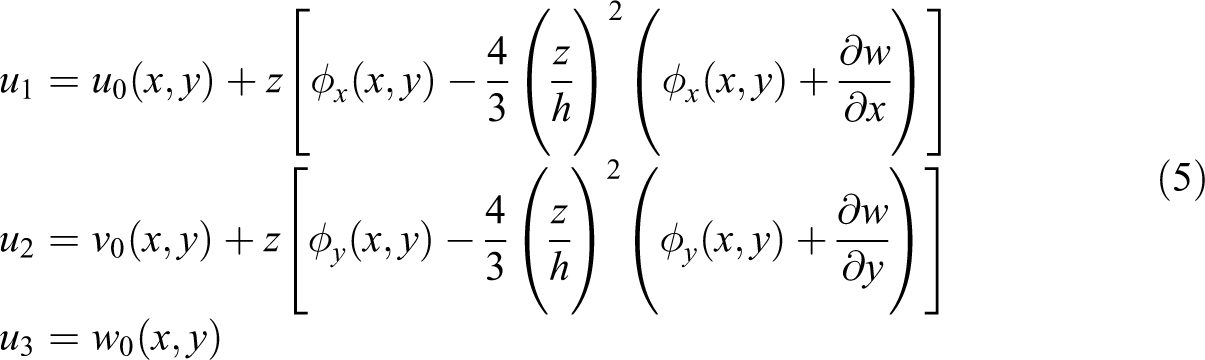
where u1, u2, and u3 are the displacement of a coordinate point (x, y, z) in the plate element, u0, v0, and w0 represent the corresponding displacements of middle plane in the x, y, and z directions, and ϕx, ϕy, and ϕz are the rotational functions about y- and x-axes, respectively, to the midplane normal of the undeformed plane.
Reddy, 145 Librescu et al., 169 Khdeir and Reddy, 170 Shu and Sun, 171 and Bose and Reddy172,173 developed the FEM solutions using SD laminated plate theory by parabolic functions. Valisetty and Rehfield 174 and Ren175,176 developed refined SD theory of parabolic function of semi-inversion method for laminated composite thick plates. Mukoed 177 developed the nonlinear analysis of orthotropic laminated plates using FSDLT and parabolic SD theories.
Amara et al. 178 presented the post-buckling of a simply supported FGM beam based on various theories such as CBT, FSDBT, parabolic SD beam theory (PSDBT), and ESDBT. The Hamilton principle was used to develop the governing equations of FGM beam for post-buckling analysis, and Navier solution has been used to solve the post-buckling problems.
Therefore, it is concluded that PSDLT satisfies the transverse shear stress-free boundary conditions on the bottom and top surfaces of the plate and hence obviates the need for shear correction factor. The main drawback is that the mathematical complication of parabolic semi-inversion method is more cumbersome than other HSDL theories.
Trigonometric shear deformation laminated theory
The trigonometric functions (i.e. sine, hyperbolic sine, and cosine functions) are used to describe the fiber rotation of plates by warping thickness for considering the transverse shear distribution as a sine function has been developed by Touratier,179–181 Becker,182,183 and Shimpi and Ghugal. 184
The trigonometric SD theory based on displacement field by Touratier 179 is as follows:
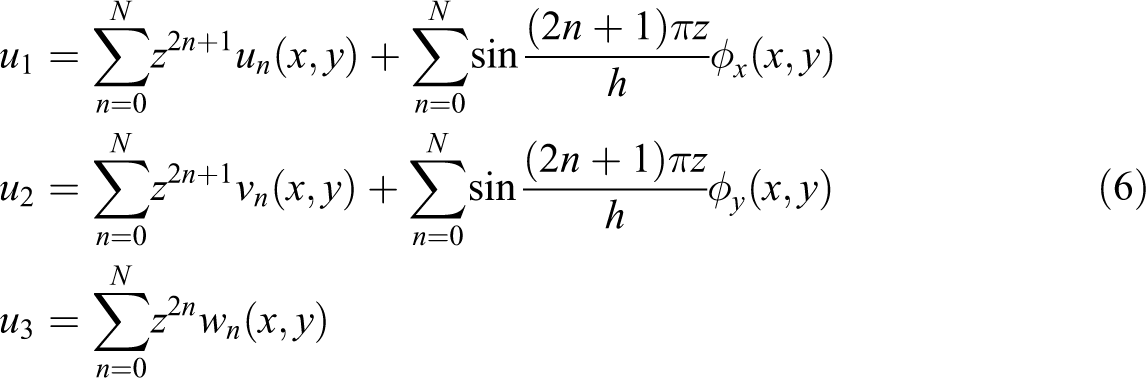
where u1, u2, and u3 are the displacement of a coordinate point (x, y, z) in the plate element, u0, v0, and w0 represent the corresponding displacements of middle plane in the x, y, and z directions, and ϕx, ϕy, and ϕz are the rotational functions about y- and x-axes, respectively, to the midplane normal of the undeformed plane.
Stein and Jegley 185 identify the transverse shear effect of cylindrical bending of laminated composite thick plates. They observed that this theory accurately analyzed the displacement and axial stress as compared to other theories. The analytical methods have been presented by Kassapoglou and Lagace186,187 and Kassapoglou 188 for the determination of interlaminar stresses in a symmetric composite laminated plate under uniaxial loading.
Becker 182 has analyzed the warping deformation of a symmetric cross-ply laminate under closed-form solution. Webber and Mortan 189 developed an analytical method for the thermal stress of laminated composite plates using the approach proposed by Kassapoglou and Lagace 186 and Becker. 183
Lu and Liu 190 developed the shear stress between the laminar continuity models directly from the constitutive equation. The authors also developed the theory of interlayer shear slip for transverse shear deflection, in-plane stress in both symmetrical and unsymmetrical laminates.
According to Lu and Liu, 190 in the conventional theory of composite laminate plates, the laminate layers are always rigidly bonded because of the low shear modulus and poor bonding; thus, the composite interface is always nonrigid. Therefore, TSDLT accurately determines both the displacement and each laminar stress on the composite interface by considering the transverse shear effect. This theory is advantageous for finite element formulation and also directly obtains the interlaminar shear stress from the constitutive equation instead of the equilibrium equations.
Hyperbolic shear deformation laminated theory
Soldatos 191 developed the hyperbolic SD theory of plates transverse SD for the static and/or dynamic analysis. Ramalingeswara and Ganesan 192 have considered cross-ply laminated composite structures of parabolic and hyperbolic caps of uniform pressure externally and a simply supported cylindrical shell to an internal sinusoidal pressure. Karama et al. 75 have developed a new multilayered laminated structure of exponential model for the transverse stress of the free vibration, bending, and buckling of the laminated composite.
Grover et al.193,194 have developed a numerical model using the inverse hyperbolic SD laminated theory analysis of natural frequency, static, and buckling response of composite laminated and sandwich plates.
Bouazza et al. 195 proposed a theory based on hyperbolic SD laminated theory for post-buckling analysis of a thick FGM rectangular beam by applying Hamilton principle and Navier solution to solve the problems.
Singh and Singh 196 proposed a new HSDLT theory for buckling and free vibration analysis based on trigonometric deformation theory (TDT) and other part based on trigonometric–hyperbolic deformation theory (THDT). Both theories satisfy the traction free boundary condition at the top and bottom surface of the plates and hence requires no shear correction factor.
Higher order shear deformation laminated theories
HSDT is based on nonlinear stress and strain variation through the thickness, including correct warping cross-section in the deformed arrangements. However, few HSDT models never satisfy the continuity condition of transverse SD at the associated layers of structures.
Basset 197 first proposed the refined HSDLTs of plates based on power series expansion for the determination of displacement with respect to thickness coordinate. Then Teregulov 198 developed a generalized method for higher order refined SD theories of shells and plates based on a generalized variational principle of the nonlinear elasticity theory.
Poniatovskii 199 developed the Legendre polynomials series based on refined HSDLTs in the thickness direction using Castigliano’s principle. Reddy, 91 Touratier, 179 and Soldatos 191 proposed the different functions of higher order theories to calculate shear stress of laminated materials.
The higher order SD theory is based on displacement field by Reddy 91 :

where u1, u2, and u3 are the displacement of a coordinate point (x, y, z) in the plate element, u0, v0, and w0 represent the corresponding displacements of middle plane in the x, y, and z directions, and ϕx, ϕy, and ϕz are the rotational functions about y- and x-axes, respectively, to the midplane normal of the undeformed plane. The remaining terms correspond to the higher order rotation.
Whitney and Sun, 133 Nelson and Lorch, 112 Lo et al.,165,200 and Soldatos and Timarci 201 developed the HSDLTs for dynamic analysis of laminated composite based on power series expansion.
The free vibration as well as FEM analysis on the HSDLT invented by Kant and Pandya, 202 Pandya and Kant, 203 Mallikarjuna and Kant, 204 Kant and Mallikarjuna,205,206 Mohan and Naganaragana, 207 Maiti and Sinha 208 are acceptable for symmetric and unsymmetrical laminated structures.
Rohwer 209 and Baser et al. 210 presented different SD theories with displacement functions and stress distributions showing both advantages and limitations of the different theories. Tseng and Wang 211 presented a higher order SD plate theory in the analysis of laminated orthotropic plates with the use of finite strip method.
Karama et al. 75 and Aydogdu, 212 have used HSDLTs to analyze the symmetric cross-ply plates for bending and stress under transverse load, free vibration, and buckling. Kant and Swaminathan,213–215 Swaminathan and Ragounadin, 216 Swaminathan et al., 217 and Swaminathan and Patil 218 have used HSDLT to calculate the natural frequency of antisymmetric angle-ply composite and sandwich orthotropic plates.
A higher order 2D theory was proposed by Matsunaga219,220 to analyze the buckling effect of thick elastic plates applied to in-plane loading. The author observed that the effect of natural frequency and buckling loads of an extremely thick plate is more accurate compared to other refined theories and CLPT. The transverse shear stress effect of rotary inertia and the normal deformation has been shown by Matsunaga221,222 based on higher order theories for the free vibration and stability problem of composite laminated orthotropic angle-ply and cross-ply plates. Further, studies on thermal buckling, model displacement, and optimization in angle-ply laminated plates and sandwich plates were conducted by the author.223,224 A new global–local HSDLT for angle-ply laminated composite plates has been evolved by Wu et al. 225
Pradhan, 226 Reddy, 227 and Pradhan and Phadikar 228 have reformulated the CLPT, FSDLT, and HSDLT using the nonlocal constitutive relations of differentiation of Eringen. To develop equation of equilibrium of nonlocal theories, Navier’s approach has been used to study the generalized displacement and buckling characteristic of plates.
Kumar et al.229,230 developed FEM of C0 continuity of static analysis of natural frequency of skew composite cylindrical shells based on HSDLT. In this analysis, the authors used different shells geometry, ply orientation, boundary condition, and skew angles.
Phung-Van et al.231–233 proposed an improved model of cell-based smoothed discrete shear gap method (CS-DSG3) based on higher order SD theory of C0-type FEM for the static and natural vibration of functionally graded plates resting on viscoelastic foundation subjected to a moving sprung vehicle.
Phung-Van et al.234,235 developed a geometrically nonlinear model of functionally graded plates based on C0-type HSDLT using smooth cell-based three-node plate element (CS-MIN3). The CS-MIN3 model is extended to geometrically nonlinear functionally graded plates subjected to thermomechanical loading.
Bouazza et al. 236 have proposed nonlinear theory of composite beam based on higher order SD laminated plate theory (HSDLPT) in post-buckling behavior of composite beam due to temperature variation and moisture concentration. The governing differential equations were developed based on three nonlinear partial differential equations on the basis of midplane axial and lateral displacement in addition to generalized displacement.
Javed et al.237–239 analyzed free vibration of antisymmetric cross-ply and angle-ply laminated composite plates with variable thickness derived for simply supported and clamped–clamped boundary conditions. The solution obtained was approximate in terms of Bickley-type cubic spline, which is used to calculate the eigenvalues.
Tran et al. 240 developed stability and equilibrium equations based on NURBS-based IGA and HSDLPT for nonlinear bending and post-buckling analysis of functionally graded material plate under thermal environment.
Javed 241 used composite laminated conical shells for the free vibration characteristic calculations based on HSDLT. Shi et al. 242 invented a new higher order theory of SD known as hyperbolic tangent higher order SD theory. This theory analyzes the natural frequency and buckling analysis based on NURBS of laminated composite plates.
Phung-Van et al.243–245 identified the nonlinear transient dynamic size-dependent effect of functionally graded carbon nanotubes-reinforced composite (FG-CNTRC) nanoplates. The governing equations are derived from Hamilton’s principle and using HSDLPT associated with isogeometric approach. The nonlinear governing equations are formulated using the Von Karman nonlinear strain and solved the analysis using Newmark time integration method to obtain geometrically nonlinear response. The nonlinear theory and IG approaches have been good, efficient, and strong candidates for analysis of FG-CNTRC nanoplates.
Benahmed et al. 246 proposed a theory based on higher order SD nonlocal beam theory of functionally graded nanobeam with porosities matrix embedded with FG materials. The differential equation of nonlocal elastic behavior is constitutive with Eringen model. The Hamilton’s principle is used to derive the governing equations of the nanobeams.
Phung-Van et al.247,248 have proposed an effective and simple computational optimization technique for size-dependent IGA of FG sandwich nanoplates based on combination of NURBS formulation and four-variable refined plate theory. The governing equation is derived and obtained for free vibration of the FG sandwich nanoplates. The present formulation is based on C2 continuity equations of finite element analysis.
According to the observation, the increasing concentration has been made to the HSDLTs and their relevant areas, many improvements have been achieved as discussed in the articles. The conclusion has been made that the unknown functions depend on the number of laminate layers of HSDLT. Therefore, accurate transverse stresses have not been obtained directly from constitutive equations. The 3D equilibrium equation essentially be applied to obtain the satisfactory results. However, there are still many interesting research aspects that should be established, which may be the future drifts.
Layerwise theories
In recent years, many researchers have developed LWTs to achieve more accurate results. These are categorized into two types based on the number of unknowns.
LDTs or DLTs
According to these theories, the number of unknowns is a function of the number of layers. Accordingly Reddy, 249 Reddy et al., 250 Noor and Burton, 53 Cho et al., 251 Lee and Liu, 252 Robbins and Reddy, 253 Nosier et al., 254 Wu and Chen, 255 Carrera, 256 Fares and Elmarghany, 257 Plagianakos and Saravanos, 258 and Barbero et al. 259 have developed individual layer theories for the analysis of displacement, bending stress, and natural frequency in the laminated composite orthotropic plates.
Phung-Van et al.260,261 extended an elemental model of (CS-FEM-DSG3) to layerwise deformation theory of laminated composite and sandwich plates for dynamic response of Mindlin plates rest on viscoelastic foundation supported by spring–mass–dashpots system.
These theories achieve more accurate result for the calculation of displacement and stress (both in-plane and transverse) compared to other theories. In general, the number of unknowns increases with an increase in the number of laminate layers. Thus, the computational cost is very high. But the number of unknowns depends upon the number of layers, and this becomes impractical for engineering application. To overcome these limitations, the layer independent theory (LIT) or ZZT is inevitable.
LITs or ZZTs
LIT is also called ZZT. The ZZT was proposed by Di Sciuva262,263 to satisfy the shear stress in transverse directions at the layer interface and shear free surface based on continuity equations. The multilayered general quadrilateral plate elements formulated with 40 DOF was used by Di Sciuva 264 and with 56 DOF plate elements was used by Di Sciuva and Icardi 265 who proposed the third-order independent layer plate theory. The in-plane displacement through the thickness of the plates was invented to predict the gross response as well as the stress distribution of laminated composite by Chow and Carleone, 266 He et al., 267 and Bisegna and Sacco. 268
Fiedler et al. 269 investigated the square laminated composite multilayer plates of buckling analysis subjected to unidirectional in-plane load of a generalized HSDLT for the effects of thickness and shear-wise deformation.
The basic idea about this theory is that the displacement and stress in each layer has reduced the number of unknown variables with compatibility equations at the interface, therefore the number of unknown is not dependent on the number of laminated layers that has been demonstrated when compared with same number of unknown as first-order SD theory by Lee et al. 270 and Cho and Parmerter. 271
According to ZZT, the compatibility equation satisfies the displacement and interface stresses between the two adjacent layers. Han and Hao 272 proposed 3D, eight-node multilayer composite FEM for the analysis of displacement and stresses of composite laminated plates.
Sahoo and Singh273,274 have developed a new HSDLT for the assessment of inverse trigonometric zig-zag function for the stability analysis of orthotropic composite laminated and sandwich plates. This article has used a C0 continuity isoparametric element for the analysis of FEM.
The disadvantages of conventional SD theories are thick-layered composite plates, mainly in the boundary of the free edges, holes, and corners where the interlaminar shear stress and stacking sequence have more important parameters. Due to this, mismatch in elastic properties arises between the two consecutive interface layers. These limitations have been overcome by ZZTs and that the displacement compatibility and thickness direction transverse shear stresses interlaminar equilibrium equations are defined by a model called unified C0z continuity theory.
3D elasticity solution theory
The 3D elasticity theories have been mostly useful for the assessment of SD theories with accuracy and validity of composite plates. Pagano 93 first developed the exact 3D elasticity solution with pinned edges rectangular laminated composite plates. Spencer and Mian 275 developed a large class of exact solution of 3D elasticity solution for laminated elastic materials. Vel and Batra 276 proposed an exact 3D solution of a linear multilayered elastic anisotropic rectangular laminated plates with arbitrary boundary conditions on its edges. They have used the Eshelby–Stroh generalized formula to develop the exact solutions with each lamina as a different boundary condition. Reddy et al. 277 developed the generalized plate bending element by exact 3D elasticity solution for transverse SD and layerwise solution of laminated composites. Cho and Parmerter 278 developed an FEM of triangular plate bending element based on higher order SD theory laminated composite plates and compared with 3D solutions. Chattopadhyay and Gu 279 developed 3D exact solution for the buckling analysis of orthotropic plate on simply supported condition based on cylindrical bending. Vel and Batra 280 presented exact 3D elasticity analytical solution for thick laminated rectangular plates by the generalized Eshelby–Stroh formulations. Chen and Lue 281 developed 3D free vibration cross-ply laminated rectangular plates based on 3D elasticity solution. The semi-analytical method is used which is based on combined state space approach and different quadrature technique. Santos et al. 282 invented an FEM of the semi-analytical axisymmetric laminated shell with piezoelectric layers using 3D elasticity solution theory (3D-EST). Alibeigloo and Shakeri 283 developed the exact 3D elasticity solution of laminated cylindrical panels using state space method and differential quadrature method for the calculation of natural frequency. Kant et al. 284 proposed the 3D elasticity solution for composite laminated sandwich and cross-ply plates. Setoodeh et al. 285 developed a 3D elasticity-based FEM solution approach for low-velocity impact analysis in layerwise laminated composite plates. Hasheminejad and Mirzaei 286 developed an exact 3D elasticity solution for calculating the natural frequency of an eccentric hollow sphere cavity of laminated composite. Kulikov and Plotnikova 287 proposed a new and efficient method of sampling surfaces (SaS) to develop the exact 3D elasticity solutions of angle-ply and cross-ply composite laminated plates. Hashemi et al. 288 developed an exact 3D analytical analysis of Mindlin rectangular nanoplates for natural frequency with Levy-type boundary conditions.
Bouazza et al. 289 developed mathematical model for the thermal effect on axially compressed buckling of a multiwalled carbon nanotubes based on the gradient elasticity theory. The critical buckling behavior plays an essential role with large aspect ratios under axial compression coupling with temperature change.
Vescovini and Dozio 290 presented a Levy-type unified application for the exact refined buckling analysis when compared with 3D elasticity solution for laminated composite plates under different loading conditions. Xin 291 developed an exact 3D elasticity solutions for a rib stiffened plate merged with fluid covered by acoustic coating layers. The layers have been bonded by rib stiff plates calculated with acoustic equation of fluid motion. Kulikov et al. 292 developed a 3D vibration analysis of laminated composite plates. The SaS application has been applied to calculate the analytical formulation for FG plates and composite layers.
Rakrak et al. 293 proposed a model for the free vibration of chiral double-walled carbon nanotubes (DWCNTs) embedded in elastic medium based on the nonlocal elasticity theory and Euler–Bernoulli beam theory. The governing equations are of nonlocal Euler–Bernoulli beam theory; boundary conditions are derived, and vibration mode number, the small-scale coefficient, the Winkler parameter, and chiral DWCNTs on the frequency ratio are also discussed.
Moleiro et al. 294 developed advanced FEM based on 3D elasticity solution for the analysis of natural frequency of smart multilayered piezoelectric composite structures. Salehipour et al. 295 invented an exact 3D elasticity solution based on static deformation of rectangular micro/nano-homogeneous and FG plates with couple stress theory. The plate rest on Winkler–Pasternak foundation and modulus of elasticity varied exponentially along thickness directions. Yang et al. 296 developed 3D elasticity closed-form solutions for calculating the natural frequency of composite laminated box and sandwich beam by layerwise plate theory. Houmat 297 proposed a 3D solution for the analysis of free vibration composite laminated rectangular structures with variable stiffness combined with p-version FEM method.
Bensattalah et al. 298 developed Timoshenko beam model based on nonlocal elasticity solution theory for the analysis of critical buckling of triple-walled carbon nanotubes (TWCNTs) embedded in an elastic medium under axial compression with chirally and small-scale effects as well as effect of the surrounding elastic medium on a Winkler model and van der Waals force model between the inner and the middle nanotube surfaces and also between the middle and the outer nanotube surfaces are considered.
Dihaj et al. 299 have proposed a theory of the transverse free vibration of chiral DWCNTs embedded in elastic medium based on nonlocal elasticity theory and Euler–Bernoulli beam theory. The governing equations are derived, and vibration mode number, the small-scale coefficient, the Winkler parameter, and chiral DWCNTs on the frequency ratio are also discussed.
Thai et al. 300 developed C0-type model of higher order SD theory of sandwich and laminated composite plates and the results are compared with the 3D elasticity solutions. Kumari and Kar 301 proposed 3D elasticity solution of composite laminated cylindrical panels for the bending analysis with end supports were arbitrary oriented. Mitchell and Gau 302 developed an exact 3D elasticity solution of 3D Navier–Lame equation for a linear elastic, isotropic, and composite curved beam with rectangular cross-section subjected to arbitrary dynamic loading.
Tlidji et al. 303 developed a quasi-three dimensional (quasi-3D) beam theory for free vibration analysis of functionally graded microbeams. The modified couple stress theory (MCST) is used to incorporate the microbeam size dependency using Hamilton’s principle and Navier solutions to derive the governing equation of motion and obtained natural frequency of the beam.
Moleiro et al. 304 invented 3D exact elasticity solution for fiber metal and composite laminate and sandwich plates under mechanical loading based on hygro-thermal environment. Shaban and Mazaheri 305 developed 3D closed-form elasticity solution of high-performance smart structure for the bending analysis of sandwich cylindrical panel with laminated orthotropic soft core. Ye et al. 306 developed higher order SD theory of semi-analytical solution to analyze the bending behavior of angle-ply laminated fiber-reinforced shells. The result of bending response compared with 3D elasticity solutions is based on scaled boundary FEM method.
Thai et al. 307 presented a model based on NURBS basic functions integrated with quasi-3D SD theory included with MCST of multilayer functionally graded graphene platelet-reinforced composite (FG-GPLRC) for the analysis of buckling and natural frequency of microplates.
Unified theories
The main aim of unified C0z theory has been to choose the appropriate approach from equivalent single-layer models, layerwise zig-zag models, and other theories.
Tessler et al. 308 proposed a zig-zag refined approach on FSDLT for the analysis of laminated composite plates. Daghia et al. 309 approached a hybrid model of composite plates based on FSDLT. This model developed four-node quadrilateral FEM as a primary variable of hybrid stress formulation for compatible displacements and elementwise stress functions. If the number of parameters is less, then transverse shear stress through the composite layer thickness is reconstructed using 3D equilibrium equations. Reissner 310 formulated a mixed variational theorem known as Reissner’s mixed variational theorem (RMVT) for the three components of displacement and three components of stresses out of six components of stress in 3D linear elasticity of anisotropic laminated plate. He further proposed this theorem311,312 into two parts. In the first part, he derived a comparable result from a statement of general equation of displacements and all stresses. In the second part, he derived an approximate 10th-order linear bending theory and stretching of orthotropic nonhomogeneous materials.
Carrera313,314 developed the Carrera unified formulation (CUF) for multilayered anisotropic composite plates and shells. His fast paper reviewed all the available modeling for layered flat and curved structures. His second paper has been divided into four parts. In part I, the author discussed the availability of the review articles related to the multilayered composite plates and shells. In part II, he discussed the expansion in the thickness directions with 2D modeling of zig-zag effect and interlaminar continuity effect. In part III, he developed governing equation and FE matrices to give closed-form solution and finite element result for bending and vibration of composite plates and shells. In part IV, the author discussed the detailed numerical investigation with performance of unified theories (UTs) and finite element modeling by building about 40 tables and 16 figures. These UTs have been compared with 50 available theories and finite elements for laminated composite plates and shells.
Carrera and Ciuffreda 315 developed unified formulae to compare the 40 theories for multilayer laminated cross-ply and sandwich plates with various geometric layouts.
Demasi316–320 introduced mixed plate theories based on generalized unified formulation (GUF) in five parts. His first part, presented the theoretical aspects and governing equation of GUF from Reissner’s mixed variational statement is used. Now a days, it is a common method to calculate the displacement and stresses of laminated structures. In this formal technique, each of the displacement functions and the out-of-plane stresses are independently considered, and also different orders of expansion can be chosen for the different unknowns. Since infinite combination can be freely chosen for the in-plane displacements and out-of-plane transverse shear stresses, the GUF model can be easily implemented in a single FEM code. In the second part, the GUF was applied and each layer considered was modeled independently using the LWTs. The compatibility condition of the displacement and the equilibrium of the transverse stresses between the two contiguous layers are enforced a priori. Infinite combination of the order of displacement and out-of-plane stresses can be freely chosen. In the third part, GUF was applied to mixed HSDLTs. The displacement has an ESL approach and the shear stresses have a layerwise description. The compatibility of the displacement function and the equilibrium of the transverse stresses between two continuous layers are enforced a priori. The results were obtained by neglecting the out-of-plane stresses and displacement-based “classical” higher order SD theories were calculated. In the fourth part, the GUF was applied to advanced mixed higher order ZZTs by adopting Murakami’s ZZT. An ESL is adopted to calculate displacement and out-of-plane stresses based on layerwise category. Finally, the numerical results of the model have been presented.
Moleiro et al. 321 developed an FEM of mixed least squares for the static analysis of composite laminated plates with the principle of least-squares variation. This is an alternative approach to the mixed weak form of FEMs. This model considered the FSDT to evaluate the generalized displacement and shear stress resultants as independent variables with equal-order C0 Lagrange interpolation functions, with the use of full integration to develop the discrete FEM.
Bhar and Satsangi 322 have developed a technique of least square of error for accurate assessment of thickness direction displacement of transverse shear stresses in thick composites and sandwich laminates with displacement-based C0 higher order SD theory. The 3D equilibrium equations for transverse shear stress in laminated composite have been used at the post-processing phase and then finite element analysis was performed using HSDT. The numerical results were compared from 3D elasticity solution of FSDT for cross-ply orthotropic laminates to HSDT for antisymmetric angle-ply orthotropic laminates.
Nguyen et al. 323 proposed a new unified approach based on HSDLT to model and analyze orthotropic laminated plates. The major objective of the article, one, unified all the higher order SD theories to convert a unique formulation by single polynomial form and, second, proposed new HSDLT models symmetrically based on unified formulation.
Therefore, the Carrera’s UT for multilayer laminated composite plates is a stratified formulation to define and implement various plate theories and also finite element formulation in a unified manner with fundamental nuclei. All the SD theories have been easily developed by the use of CUF through Taylor’s series expansion by expending the displacement variables in the thickness direction.
Advanced shear deformation theories
The advanced shear deformation theories (ASDTs) have been developed due to increase in the multifunctional demand of composite materials and structures in the present market.
Gibson 324 prepared a review article based on a recent research in multi-structural, integrated, and nonstructural functions of composite laminated structures. Shooshtari and Razavi 325 developed the nonlinear equation of motion for the calculation of natural frequency of composite laminated plated based on closed-form solution. They used Galerkin approach for the calculation of differential equation with stiffness matrix.
Fazzolari and Carrera 326 developed a solution of advanced kinematics used by Galerkin and Rayleigh–Ritz method on the principle of virtual displacement for the analysis of stability and natural frequency of laminated composite an-isotropic plates. Bosco and Banerjee 327 developed plate dynamic element stiffness method based on first-order SD theory to calculate the natural frequency of plate assembly. They used Wittrick–Williams algorithm technique to solve the differential equations.
Oktem and Soares 328 proposed an analytical solution of cross-ply rectangular plated and doubly curve panels using advanced higher order SD theory. The static analysis based on analytical solution of discontinuous boundary of double Fourier series method has been used to solve the partial differential equations which have five highly coupled values developed by higher order laminated shell theory.
Demasi 329 developed a theory called ZZT or higher order advanced SD theory based on GUF. Mantari and Soares330,331 derived static governing equations of exponentially laminated plates with boundary conditions using a new trigonometric higher order SD theory. They also developed a hybrid quasi-3D generalized theory of advanced laminated composite plates for the analysis of bending. Mantari et al. 332 proposed a theory for three different material properties of plates, such as isotropic, laminated composite, and sandwich, which are used for bending analysis of plates by a new trigonometric SD theory.
Isbilir and Ghassemieh 333 developed a 3D FEM of carbon fiber-reinforced composite plate based on higher ASDT using different orientations of ply and delamination.
Kameyama et al. 334 discussed the damping behavior of symmetrically laminated cantilever plates based on first-order SD theory. They investigate that the transverse shear is independent of damped stiffness matrix. Suganyadevi and Singh 335 presented the higher order closed-form new SD theory for the calculation of sandwich and laminated composite plates. They used new SD theory based on algebraic, exponential, hyperbolic, trigonometric, and logarithmic theories.
Mantari and Soares 336 developed finite element analysis of higher order SD theory with generalized method for bending analysis of advanced laminated composite plates. In generalized method, the higher order SD theory discussed the nonlinear and constant in-plane and transverse plane displacement. Sciuva et al. 337 developed higher order C0 continuity elemental equation of composite and sandwich elemental beam based on refined ZZT.
Ovesy et al. 338 presented the first-order SD theory of compressed composite laminated plates with the analysis of delamination growth of plates. Endo 339 developed a mathematical–physical interpretation concept of new first-order SD theory based on transverse deformation as the summation of bending and transverse shear deflections applied to the plates, beam, and cylindrical shell. Thai et al. 340 proposed a theory based on moving Kriging interpolation function method for refined plate theory to analyze the static, buckling, and natural frequency of isotropic plates applied with two variables. The method has been applied by higher order SD theory.
Abdelmalek et al. 341 have proposed mathematical model based on refined nth-order SD theory for the natural vibration effect of isotropic and orthotropic composite plates under the hygrothermal environment. This theory affects the parabolic distribution of transverse shear strain through the thickness of the plate.
Phung-Van et al. 342 developed simple and effective mathematical formulation based on generalized higher order shear deformation laminate theory (GHSDLT) and IGA of functionally graded carbon nano-reinforced composite nanoplates (FG-CNTRC) for the analysis of stiffness and natural frequency of the nanoplates.
Tornabene et al. 343 developed a mathematical model of damage mechanics for laminated composite plates and shells. This model defined the 2D smooth function approach which are based on Gaussian and ellipse shape. The numerical results are obtained through generalized differential quadrature method and different higher order SD theories are used to calculate the natural frequency.
Cherif et al., 344 Bensattalah et al., 345 and Belmahi et al. 346 investigated the natural vibration of single-walled carbon nanotubes embedded in a polymer matrix using nonlocal elasticity theory with the effect of arbitrary boundary conditions. A Winkler-type elastic foundation is used to model the interaction of nanobeam and the surrounding elastic medium. The governing equation is derived based on the nonlocal Euler–Bernoulli beam theory.
Belkacem et al. 347 have studied the carbon/glass hybrid laminated composite plates using refined higher order SD theory for the critical buckling analysis of laminated plates. In this study, the most interesting feature is that the hybrid laminated composite has different laminated combinations, which is different from traditional laminated composite plates.
Arbind et al. 348 developed the higher order 1D general theory and also developed FEM for calculating the large deformation of curved tubes or rod of thin or thick section. The materials used for these calculations are incompressible neo-Hookean solid.
Sayed and Ghugal 349 developed a closed-form higher order theory for the analysis of free vibration and bending using generalized higher order shell theory of composite laminated and sandwich spherical shells.
Thai et al.350,351 proposed a four-variable advanced refined plate theory using NURBS formulation and advanced HSDLT for free vibration analysis of multilayer FG-GPLRC microplates. The graphene platelets are made of polymer matrix either uniformly or nonuniformly including different patterns of the matrix.
Vinyas et al. 352 presented a theory of 3D free vibration response of skew magneto-electro-elastic plated with the use of higher order SD theory. The theory has been discussed by the finite element method by the use of Hamilton’s principle.
Phung-Van et al. 353 and Nguyen et al. 354 developed simple and effective mathematical formulation based on generalized C0-type advanced HSDLT in association with isogeometric approach based on an isogeometric Bezier finite element formulation of piezoelectric FG porous plate for the analysis of static and natural vibration of porous FG nanoplates. The Eringen’s nonlocal elasticity equations are used to analyze the length scale effects.
Smart composites
In the last two decades, there has been tremendous increase in the research interests of smart composite (SC) materials, known as shape-memory polymer composites (SMPCs) because of their advanced applications such as actuators, nanocomposite, biomedical devices, micro-mechanical, and micro-electro-mechanical systems. However, the SMPCs started to develop around 1940s by Lester et al. 355 They have proposed the discovery of “shape memory” (SM) in the biomedical science and got an US patent on dental materials known as methacrylic ester resin. The next development of SM polymers was in the 1960s by Rainer et al. 356 and Perrone 357 who used the heat-shrinkable polyethylene composites. In last two decades, there were so many books, monographs, and review papers358–366 published by the researchers on SMPCs. Lee and Sun 367 developed a new technique for the analysis of nonlinear free vibration of sandwich composites skins and viscoelastic core embedded with 55-nitinol shape-memory alloy (SMA) wires. Ghomshei et al. 368 invented a model based on finite element method for the analysis of the transient response of SMPC actuator. The actuator has a composite cantilever beam embedded with polycarbonate layer matrix and two layers of SMPC ribbons. Roh and Kim 369 developed a theory of hybrid SC plates for sensing and controlling subjected to low-velocity impact. The sensor is attached to the opposite side of the velocity impact of SMPC fibers and is embedded with layer of composite plates to form hybrid SC with the use of first-order SD theory. Park et al. 370 developed a theory based on first-order SD plate theory of nonlinear finite element methods for the analysis of free vibration composite plates laminated with SMA fibers. Ghomshei et al. 371 investigated nonlinear transient response FEM of a thick beam of composite materials bonded with SMPC alloy for the analysis of elasto-dynamic response. Balapgol et al.372,373 studied the response and deflection of composite laminated plates embedded with SMA using first-order SD theory. They also developed FEM of composite laminated SMP alloy for the analysis of free vibration with the use of first-order SD theory. Leng et al. 374 developed a fabrication of SM polymer nanocomposites with nanoparticles and fiber fillers to investigate the electrical properties of the fibrous material. Ibrahim et al. 375 investigated the buckling analysis of SM alloy of hybrid composite plate subjected to acoustic and thermal load based on nonlinear FEM using first-order SD theory. Shokuhfar et al. 376 developed a theory to optimize the volume fraction, location of thickness direction, and orientation of metals of the SMPC wires to maximize and minimize the transverse deflection of the composite plates for low-velocity toughness. Leng et al. 377 discussed the SMPCs material considerations, application in composite, and composite laminate in SMAs. Rauscher et al. 378 fabricated and developed SMP materials with the process of making sensors, sensor geometry, and resin quality from laboratory development to commercial production. Simkevitz and Naguib 379 studied the fabrication of SMP bonded with porous and nanocomposite materials with varying material density to analyze the response time, recovery force, and temperature effect. Yu et al. 380 developed a new concept based on SMPCs and reinforced composites for the design and application of morphing wing. Lu et al. 381 developed an SMPC material embedded with carbon nanofiber and carbon nano-paper to analyze that the addition of carbon nano-fiber and carbon nano-paper improved the thermal and electrical conductivity. Panda and Singh 382 presented the numerical investigation of nonlinear FEM thermally post-buckling vibration of composite laminated shell bonded with SM alloy fibers based on higher order SD plate theory. Qiao et al. 383 developed a mathematical model for the buckling analysis of the SMPCs laminate. The FEM is used to calculate the validity of the theoretical applications. Asadi et al. 384 developed a nonlinear equation of the thermally stable and geometrically imperfect laminated composite plates reinforced with SMA to form hybrid SMLCs plates subjected to uniform thermal loading using higher order SD theory. Rasid385,386 developed an FEM based on FSDLT on the laminated composite plates bonded with SMA. The free vibrations are analyzed with the effect of hybrid SM composite alloy. Malekzadeh et al. 387 also discussed the development of natural frequency of hybrid SM composite alloy plates using FSDLT to calculate the governing equation of hybrid SM composite plates. Abbas et al. 388 modeled the static, dynamic, and time response of composite plates embedded with SMA sheet based on Ritz method of HSDLT with developing nonlinear SD governing equations. Phung-Van et al.389–391 developed a simple and efficient approach for dynamic analysis of smart piezoelectric composite plates based on IGA in conjunction with generalized unconstrained approach. The nonlinear formulation is used based on Lagrange approach and Von Karman nonlinear strains. The NURBS basic function has been used to handle the degree of smoothness through the choice of the interpolation function with easily calculated C 1 continuity finite element function for plate elements stemming from the HSDLT to analyze the static and dynamic behavior of composite plates.
Bodaghi et al. 392 proposed a theory based on shape adaptive composite plates surface embedded with SM ribbons to analyze the thermomechanical behavior of hybrid composite plates. Lelieveld et al. 393 presented a theory of SMPC and has investigated the thermomechanical behavior of SMPC. The investigation shows that 90° bending occurs in the current materials. Samadpour et al. 394 developed a theoretical model based on SMA composite plate. Based on this composite model, the nonlinear free vibration analysis is investigated with the use of FSDLT and Von Karman nonlinear equations. Babaevskii et al. 395 developed an experimental setup and to investigate the results of sandwich structure developed by the combination of thin-layer polymer fabric composites and polyether urethane cellular plastic core to form SMPC. The test data obtained from the experiment indicated that the sandwich structure under microgravity used in international space station have same behavior as ground station. Mahabadi et al. 396 developed a mathematical model based on first-order SD theory of laminated composite plates embedded with SMA to calculate the natural frequency of hybrid laminated composite plates. Parhi and Singh 397 presented a theory based on HSDLT of nonlinear FEM laminated composite shells reinforced with SM polymer alloy to analyze the nonlinear free vibration. Kamarian and Shakeri 398 calculated the critical buckling load of rectangular composite plates bonded with SMA based on FSDLT and GDQ method. Pyo et al. 399 designed and fabricated a 4D printing technology of SMPC actuator based on 3D printing technology. Karimiasl et al.400,401 investigated the free and forced vibration as well as buckling and post-buckling nonlinear response of multi-scale laminated composite cylindrical shell reinforced with SMA under hygro-thermal environment based on TSDLT and Von Karman nonlinear strain to calculate the governing differential equations. Zhu et al. 402 studied the free vibration of piezoelectric nonlocal nanoplates by the loading of thermo-electro-mechanical system. The Hamilton principle is used to derive the governing equations, and the solutions are based on Navier equations.
Based on the above articles, the SC structures made from smart materials have a large variety of fascinating applications. The potential applications have been explored tremendously and even several smart materials are available commercially for industrial applications. At present, our knowledge of this smart material is still limited and more research is required for the development of different SMP composites and their unique applications.
Conclusions
The development and applications of different models for the SD theories of laminated composite plates are overviewed and discussed in this article. This comprehensive overview discussed on how precisely and methodically the transverse shear effects are developed based on the SD theories, the 3D-EST, UTs, and SCs. In view of the present literature, review of laminated composite plates based on SD theories have concluded that the following are the general remarks from the current literature survey:
So far, more research of SD theories have been done for symmetric and antisymmetric cross-ply and angle-ply laminated composite plates with simply supported or clamped boundary condition on all edges subjected to cylindrical bending. The development of analytical models based on nonlinear behaviors is necessary on unsymmetrical laminated plates.
For the development and applications of different ESL theories, CLPT has been used enormously to accurately calculate the linear, nonlinear, and post-buckling behavior of laminated composite thin plates. The CLPT model becomes the easiest one to calculate the effect of geometric nonlinearity function. Since CLPT predictions for the thin laminate the effects of transverse SD and rotary inertia can be neglected.
FSDLT and SSDLT have been used enormously in the field of laminated composite plates among the other SD theories. Because these two SD theories were invented long time ago compared with other HSDLTs.
LITs satisfies the continuity equation between the laminar interfaces, which un-accurately calculate the transverse shear stresses directly from constitutive relations.
The currently developed exact 3D elasticity solutions theory based on different SDLTs of laminated composite plates/shells are limited to geometrically linear problems. Thus, the analytical approaches of nonlinear problems based on 3D elasticity solutions should be done to accurately evaluate the bending, buckling, and free vibration analysis.
It is to be found that the UTs based on CUF are superior to RMVT in the global representation of composite laminated plates/shells.
The ASDT models are the simplified version of HSDLTs, are very attractive and challenging for the development of geometrically complex structures, and, more importantly, are limited to geometrically linear problems. However, more research is needed to assess the ASDT models based on geometrically nonlinear problems.
Recently, researchers have developed SC structures based on SMAs and SMPCs, which have a wide range of applications, requires more deterministic knowledge about interlaminar shear stresses, coupling between bending and twisting to stretching.
