




Abstract
Post-buckling analysis of functionally graded material (FGM) plates resting on Winkler and Pasternak elastic foundations subjected to thermomechanical loadings with circular cut-outs at centre and random material properties is presented. The material properties of each constituent’s materials, volume fraction index, thermal expansion coefficients, foundation stiffness parameters and thermal conductivities are taken as independent basic random input variables. The basic formulation is based on applying Reddy’s higher order shear deformation theory, which requires C1 continuous element approximation. A modified form C0 continuity is applied in the present investigation. A serum-free expansion medium with mean-centred first-order regular perturbation technique for composite plates is extended for FGM plates to solve the random eigenvalue problem. Typical numerical results are presented to examine the second-order statistics for effect of the volume fractions index, plate length-to-thickness ratios, plate aspect ratios, types of loadings, amplitude ratios, support conditions and various shape and size of holes with random thermomechanical properties. The results obtained by the present solution approach are validated with published papers and the robust method of simulation. It is found that the laminates with round cuts (FGM plates resting on Winkler and Pasternak elastic foundations) have a significant influence on the post-buckling response under Thermomechanical loading conditions. Present investigations are useful for the applications and further research.
Introduction
Functionally graded materials (FGMs) consisting of metal and ceramic possess some outstanding thermomechanical properties as fracture toughness and temperature resistance by maintaining the desired integrity. Laminates with circular, square and rectangle cuts are available as part members to further reduce the weight of machines. However, the sizing of structural members with various shaped cut-outs is often determined by stability (buckling) constraints. The buckling behaviour of geometrically nonlinear FGM plates resting on elastic foundations subjected to in-plane loadings with temperature dependent and independent properties is of utmost importance in the design and development of high-performance structural components from the stability point of view. To predict the structural response in terms of stability accurately and to enable a better understanding of the characterization of the actual behaviour under mechanical and thermal loading with various shaped cut-outs are important problems to be paid special attention for reliability of the design.
However, FGMs display inherent uncertainties due to lack of perfect knowledge for fabrication processes. This uncertainty is attributed to temperature variations. As a result, the buckling characteristics of FGM plates become stochastic variables and can be quantified probabilistically. The probabilistic method is a powerful mathematical tool used to incorporate and handle the structural system uncertainties, so that the structural response may not differ from the actual response and the final structures may be safe.
Earlier research works that applied the deterministic approach are available in the literature.1–18
Relatively little efforts have been made in the past by researchers and investigators on the prediction of post-buckling response statistics of the structures made of laminated composites and FGMs having random system properties. Yang et al. 19 and Onkar et al. 20 investigated the generalized buckling of the laminated composite circular cut-out plate with random material properties using classical plate theory combined with first order perturbation technique (FOPT). Singh et al. 21 investigated the effect of uncertain parameters on the post-buckling of laminates with elastic foundation using higher order shear deformation theory (HSDT) and serum-free expansion medium (SFEM). Jagtap et al. 22 presented uncertainties in natural frequency of FGMs laminates resting on supports with independent (TID) and dependent (TD) material properties based on HSDT with von-Karman strains using modified C0 continuity.
Kar and Panda23–28 investigated the post-deformed response of FGM curved shell with edge compression.
Duc et al.29–47 investigated buckling, post-buckling of plates, vibrations, static and dynamic response of cylindrical shell panels, curved panels, carbon nanotube (CNT)-reinforced panels and piezoelectric circular cylindrical shells with elastic foundations effects analytically.
It is evident from the published papers mentioned above that investigation of stochastic post-buckling response of FGM plates resting on elastic foundations subjected to temperature combined with mechanical force loadings involving randomness in material properties of constituent materials with circular cut-outs using computationally efficient direct iterative based C0 nonlinear finite-element method (FEM) in combination with mean-centred first-order regular perturbation technique (FORPT) is not dealt with by researchers to the best of the author’s knowledge.
The results are presented with a new concept in the form of tables, which can suit as a benchmark for future research.
Mathematical formulations
Consider a rectangular FGM plate with holes consisting of metal and ceramic at the top and bottom layers of length a, width b, and total thickness h, defined in (x, y, z) system with x- and –y-axes located in the middle plane and its origin placed at the corner of the plate. Let
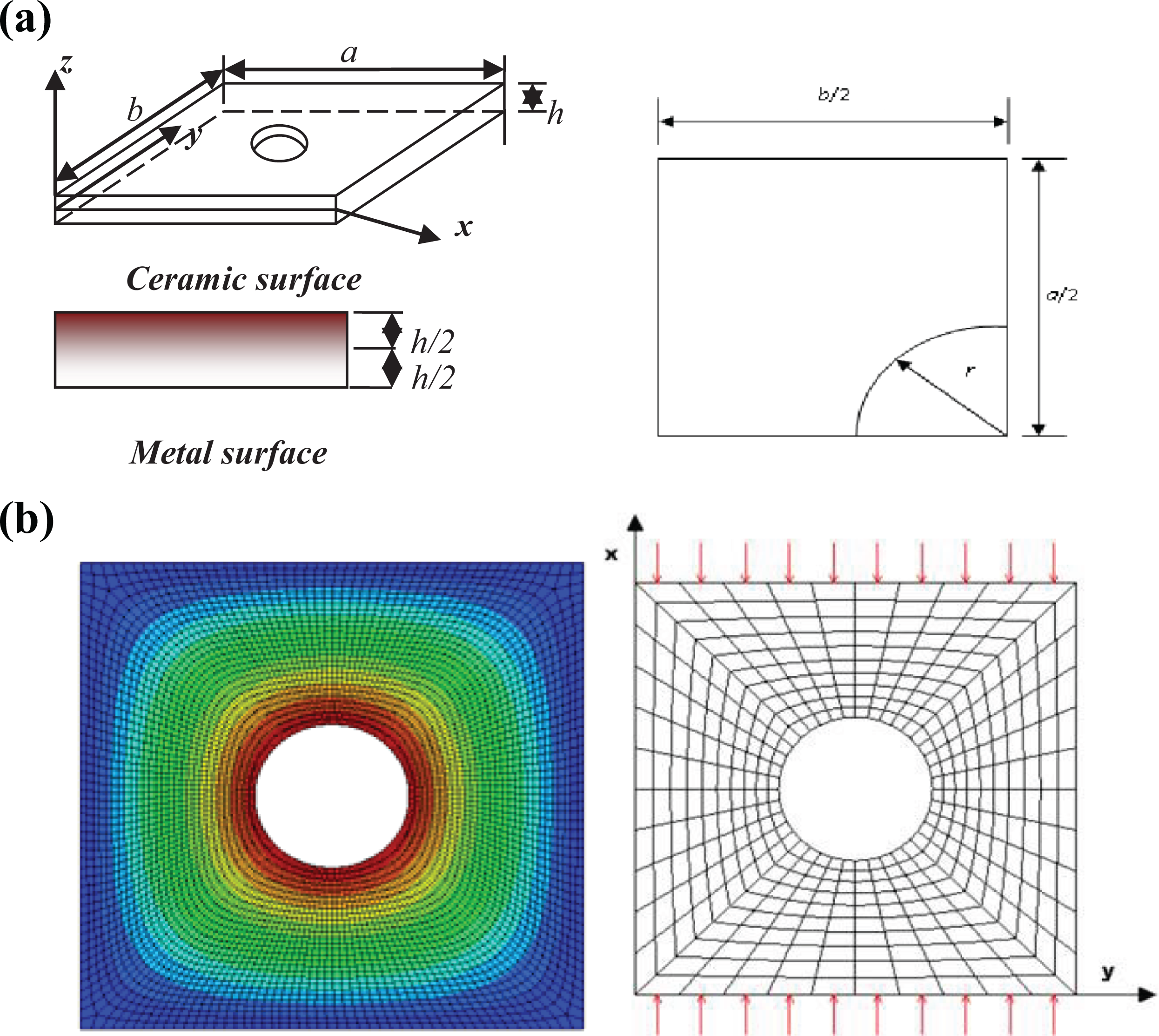
(a) Geometry of rectangular FGM plate with cut-outs. (b) Quarter of functionally graded laminates with circular cut-out.

where P is the foundation reaction per unit area,
The properties of the FGM plate are assumed to vary according to power law through the thickness of the plate only, such that the top surface z = h/2 is ceramic-rich and the bottom surface z = −h/2 is metal reach. The effective thermomechanical properties of the functionally graded plate within the plate domain are expressed as

where t and b represent the hybrid laminate, respectively, while E, α and k are the effective Young’s modulus, thermal expansion coefficient and thermal conductivity, respectively. The ceramic metal volume fraction VC is the function of coordinate in the thickness direction, z and is expressed as

where n is the volume fraction index and is always positive. For n taken as zero, the plate is fully ceramic and for n taken as one, the composition of ceramic and metal is linear. Poisson’s ratio v depends weakly on temperature change and is assumed to be constant. 48
Displacement field model
In the present study, the assumed displacement field is based on Reddy’s 49 higher order shear deformation plate theory, which requires C 1 continuous element approximation. Singh et al. 50 slightly changed the model proposed by Shankara and Iyengar 51 to make the suitability of C0. The parameters for the x-, y-, and z-axes for FGM laminates is now written as

where

The displacement vector for the modified C0 continuous model can be written as

where comma (,) denotes partial differential.
For the FGM plate considered here, the vector consisting of (in term of midplane shape change, rotation of normal and higher terms) von-Karman type and thermal vectors associate with the displacement are expressed as

where
From equation (6), this can be written as

where Hmn is the related to z expressed in Appendix 1, equation (2), and

Assuming that the strains are much smaller than the rotations (in the von-Karman sense), one can rewrite the non-linear part
The temperature field for non-uniform temperature change is expressed as in the literature. 48

where T0 is initial temperature and can be expressed as

where T(z) is the temperature distribution along z direction, t and b are referred as the top and bottom surfaces and parameter η(z) can be written as

where
Here k, z and n indicate thermal conductivity, distance from central axis and volume fraction, respectively, with ktb= kt − kb.
For uniform temperature change, equation (10) can be written as follows:

For uniform and non-uniform temperature rise, the initial (T0) and bottom (Tb) temperatures of the plate are assumed to be 300 K and Tc as 600 K, respectively, throughout the analysis, unless otherwise mentioned.
Constitutive relations
The constitutive law of thermoelasticity for material under consideration relates the stresses with strains in a plane stress state for anisotropic layer of a laminate is expressed as

where
The strength of the FGM laminate consisting of two types of strengths undergoing deformation is written as

where

From equation (15) the nonlinear strain energy (
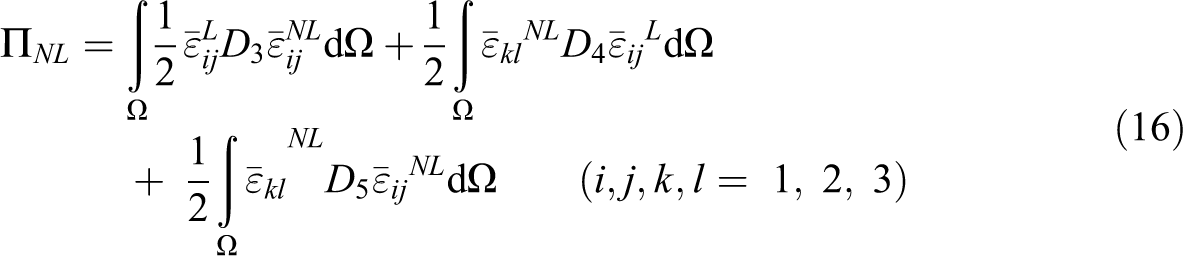
where Ω,
Equation (16) is expressed as
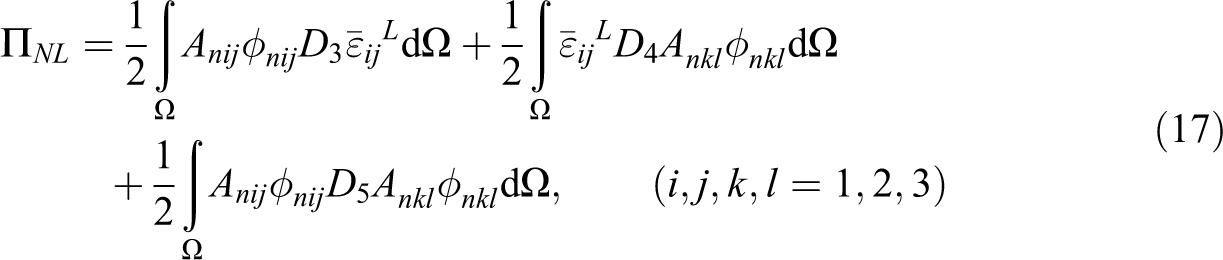
where D3, D4 and D5 are the laminate stiffness matrices of the plate expressed in Appendix 1, equation (4A). The (

where Nxtm, Nytm and are written as Nxm − Nxt, Nym, − Nyt and Nxym − Nxyt respectively. For mechanical application, in the above expression, Nxt, Nyt, Nxyt are assumed as zero.
Forces causing change in dimensions due to temperature can be expressed as
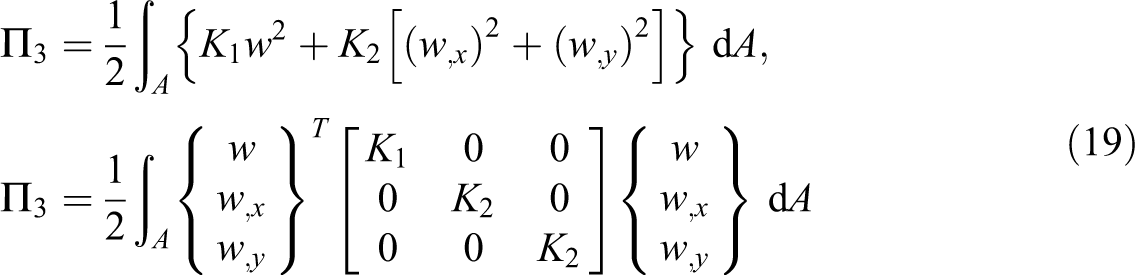
Finite element models
Strain energy of the plate element
In the present study, a C0 nine-noded isoparametric FE with 7 DOFs per node is employed.

Following this and applying FEM model this can be written as


where
FE model is written as

where
The solution procedure adopted for post-deformed investigations of FGM laminates resting on supports and undergoing thermomechanical loadings can be derived using mathematical principle, which is generalization of the principle of virtual displacement. For the displacement field of the buckling, the minimization of π(π1+π2+π3) with respect to generalized displacement vector and after simplification, using this, equations (22) and (23) can be represented following Reddy JN, as 52

For the critical buckling state corresponding to the neutral equilibrium condition, the second variation of total potential energy (π) must be zero. Following this condition, one obtains the standard eigenvalue problem

Using this, equation (24) can be rewritten as

The plate stiffness matrix
Direct iterative-based SFEM application
The full procedure is explained in Lal et al. 53
The detailed DISFEM solution procedure for post-buckling analysis is shown in the flowchart of Figure 4.
Solution approach: Perturbation technique
In the present analysis, the material properties of constitute materials such as
For formulation,
In general, without any loss of generality, any arbitrary random variable can be represented as the sum of its mean and zero mean random part, denoted by superscripts ‘d’ and ‘r’, respectively asin Zhang et al. 54

where
Zeroth-order perturbation equation

First-order perturbation equation

Here, equation (28) is the deterministic equation relating to the mean eigenvalues and the corresponding mean eigenvectors, which can be determined by conventional eigen-solution procedures. Equation (29) is the random equation, defining the stochastic nature of the mechanical and thermal buckling, which cannot be solved using the conventional method. For this, further analysis is required.
Variance of post-buckling load
The above expression is used to obtain the eigenvalue with respect to the basic random variables, which are then used to the post-deformation due to force covariance.
To obtain the statistics of critical post-buckling load, multiply both sides of equation (29) by mean eigenvector

Since both
The expression for the first-order derivative of the eigenvalue is then written as

Using equation (22), the variances of the eigenvalue can now be expressed as in the work by Singh et al. 21

where
Numerical results and explanation
A computer program has been developed in MATLAB [R2010a] environment to compute the second-order statistics of post-buckling response of the FGM plates resting on Winkler and Pasternak elastic foundation subjected to thermomechanical loading with circular cut-outs using the proposed DISFEM probabilistic method. The validity and efficacy of the proposed algorithm is examined by comparing the results with those available in the literature and the independent method of simulation (MCS). A 567-noded laminate is used for the HSDT study for discretizing the laminate. For the computation of results, non-uniform temperature with TID and TD material properties have been considered.
For the computation of results, full integration schemes (3 × 3) are used for thick plate and selective integration scheme (2 × 2) for thin plate. In the present analysis, foundation stiffness parameters, various support conditions, volume fraction index and hole sizes are used to check the efficacy of the present model. However, the formulation and code are useful tools.
Throughout the analysis, it is assumed that the materials are perfectly elastic during the deformation.
In the present study, the following sets of boundary conditions are used.
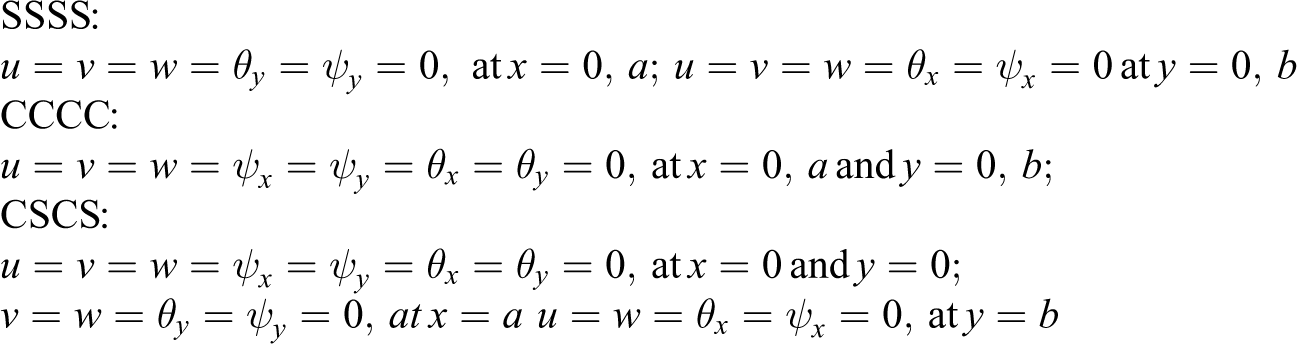
[TD] FGM laminates are investigated. COV is defined as the coefficient of variation. The dimensional mean is represented as dimensional post-buckling thermomechanical critical load. Being the linear nature of variations of COV as mentioned earlier and passing through origin, the results are only presented by coefficient of correlation (COC) of system properties equal to 0.1. However, the investigated outcomes for standard deviation revealed that the DISFEM approach is of 0.2.54,55
Ti-6Al-4V/ZrO2 and SUS304/ Si3N4 types of FGM properties for TID and TD material properties are used for computation. 16 The assumed basic random input variables (bi) are sequenced.

where
In the present analysis, mean-centred first-order perturbation technique has been used to compute the numerical results, keeping in mind the complicity and difficulty of using higher order perturbation at the cost of very little improvement in results, especially for the non-linear problem. It is also noted that the results are presented for lower amplitude ratios (Wmax/h = 0.2 to 0.8) due to convergence and computational time for holes. For the computation of results, the following dimensionless post-buckling parameters are used and expressed:
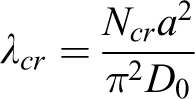
where
It is noted that the values given in parenthesis in the tables are the dimensionless mean values of thermomechanical post-buckling load and temperature. Throughout the analysis, both type of loadings, uniaxial and biaxial compression without considering shear effect, have been used. For numerical illustration, the following parameters are taken as plate thickness ratio (a/h = 10, 15, 40, 50, 60, and 100), plate aspect ratio (a/b = 1 and 1.5), amplitude ratio (Wmax/h = 0.2, 0.4, 0.6 and 0.8) and volume fraction index (n = 0.5, 1, 5 and 10).
Validation study for mean post-deformed behaviour
To assure the accuracy and proficiency of the present outlined stochastic formulation, three test examples are analyzed for post-deformed behaviour of FGM plates resting on elastic foundations. For validation purposes, the plates studied are subjected to uniaxial force application with uniform or non-uniform thermal condition distribution. The characteristics of constituents (metal and ceramic) are studied at 300 K.
We first consider the accuracy of the present deterministic FEM by comparing the results with those available in the literature. The results of initial buckling load and temperature with and without cut-out are validated through numerical examples.
Validation study of buckling load parameter (Ńcr = Ncra2/π2D0) of the SSSS and CCCC supported square Al/ZrO2 plate with circular cut-out under uniaxial compression with a/h = 100, with those available in the study by Zhao et al. 16 and Lal et al. 53 as shown in Tables 1 and 2 and Figure 2. From these tables and Figure 2, it can be seen that the SFEM applied is in very good agreement.
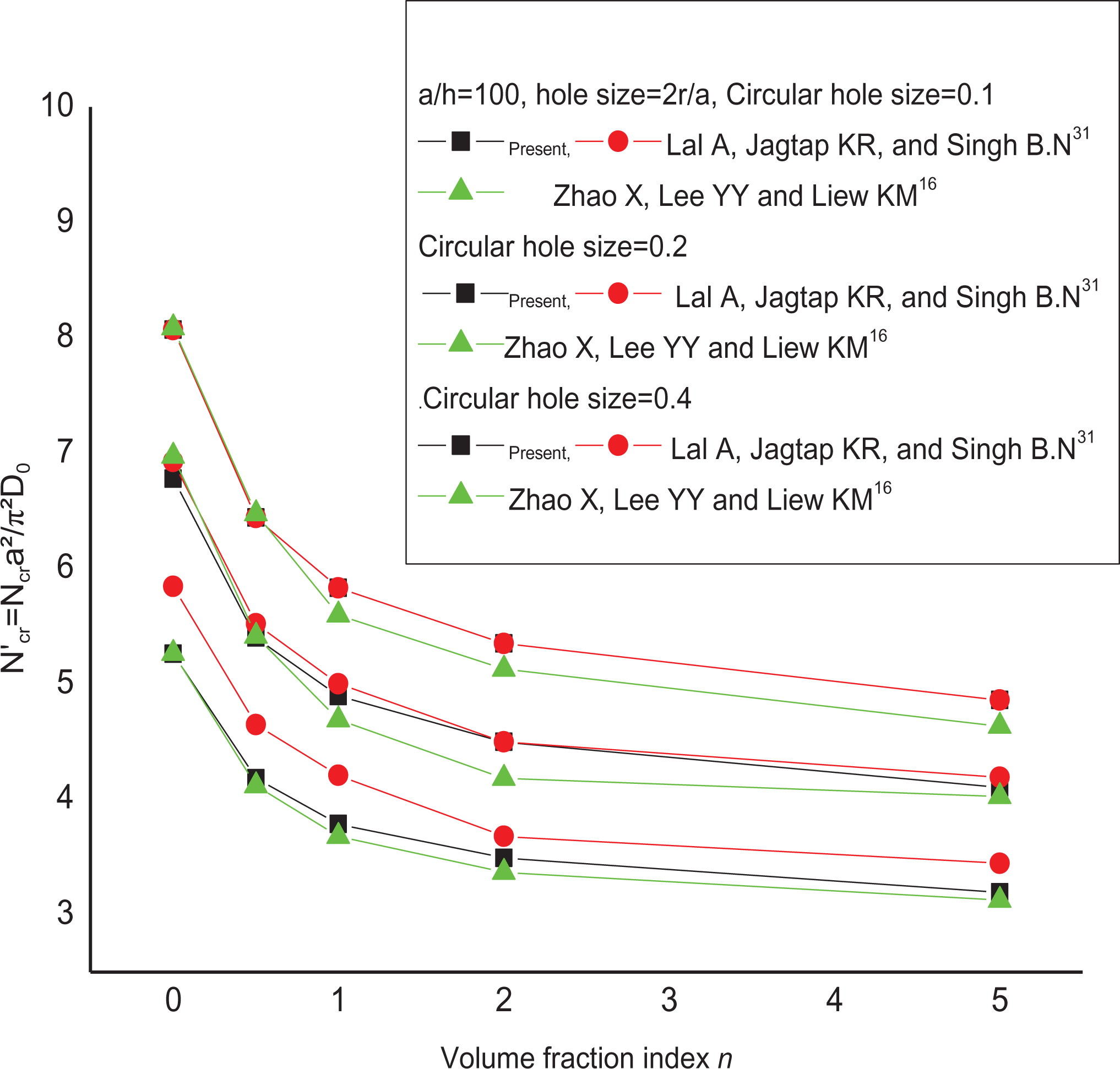
Validation of mean post-buckling loading forces of clamped square FGM plates subjected to thermomechanical loading, simple support and biaxial compression.
Validation study of buckling load parameter ŃCR = Ncra2/π2D0 of the clamped square Al/ZrO2 plate, under uniaxial compression with a/h = 100, mode = 1 and hole size = 2r/a circular hole; SSSS support.
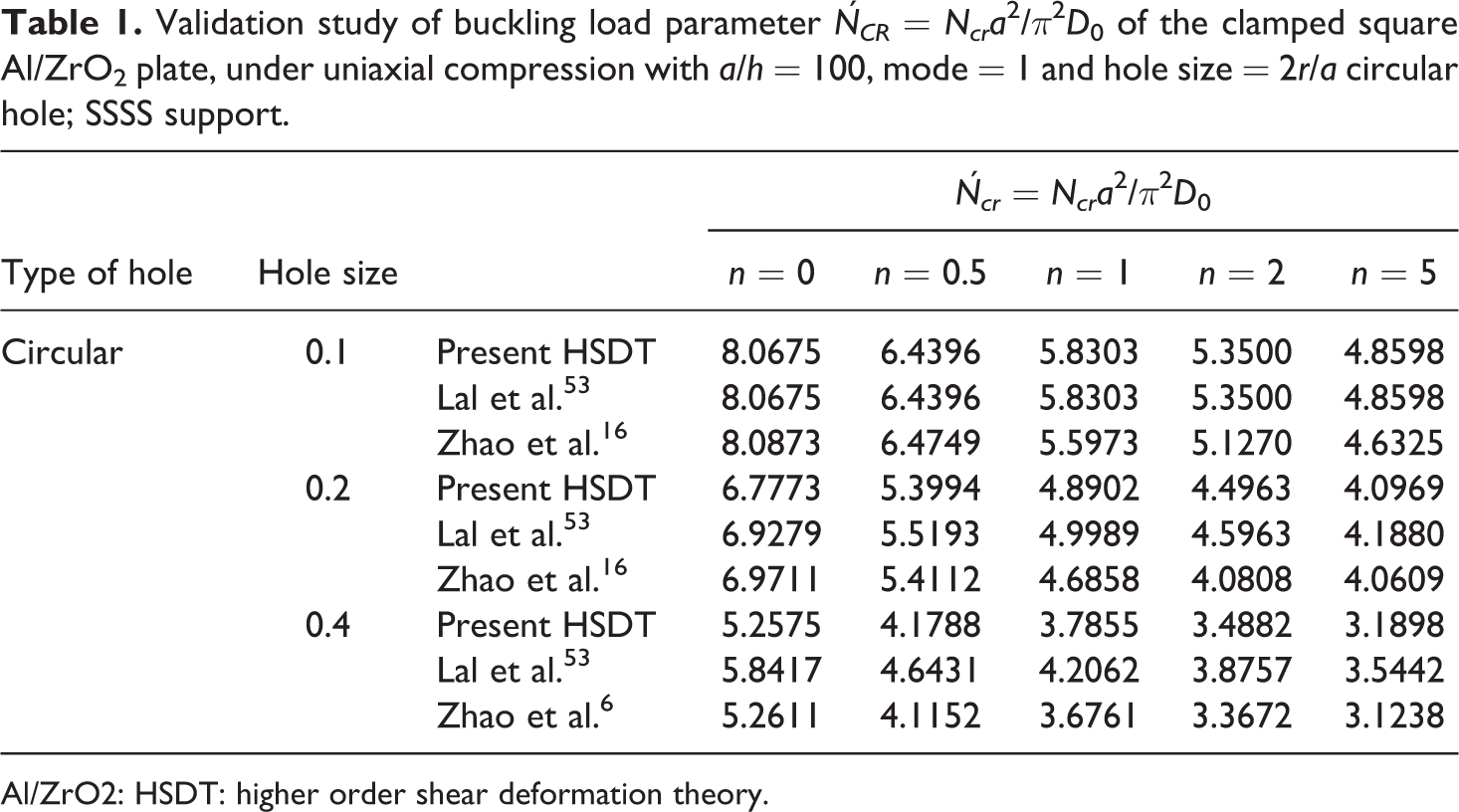
Al/ZrO2: HSDT: higher order shear deformation theory.
Validation study of buckling load parameter ŃCR = Ncra2/π2D0 of the simply supported square Al/ZrO2 plate with circular hole under uniaxial compression, a/h = 100, mode = 1, hole size = 2r/a circular hole; CCCC support.
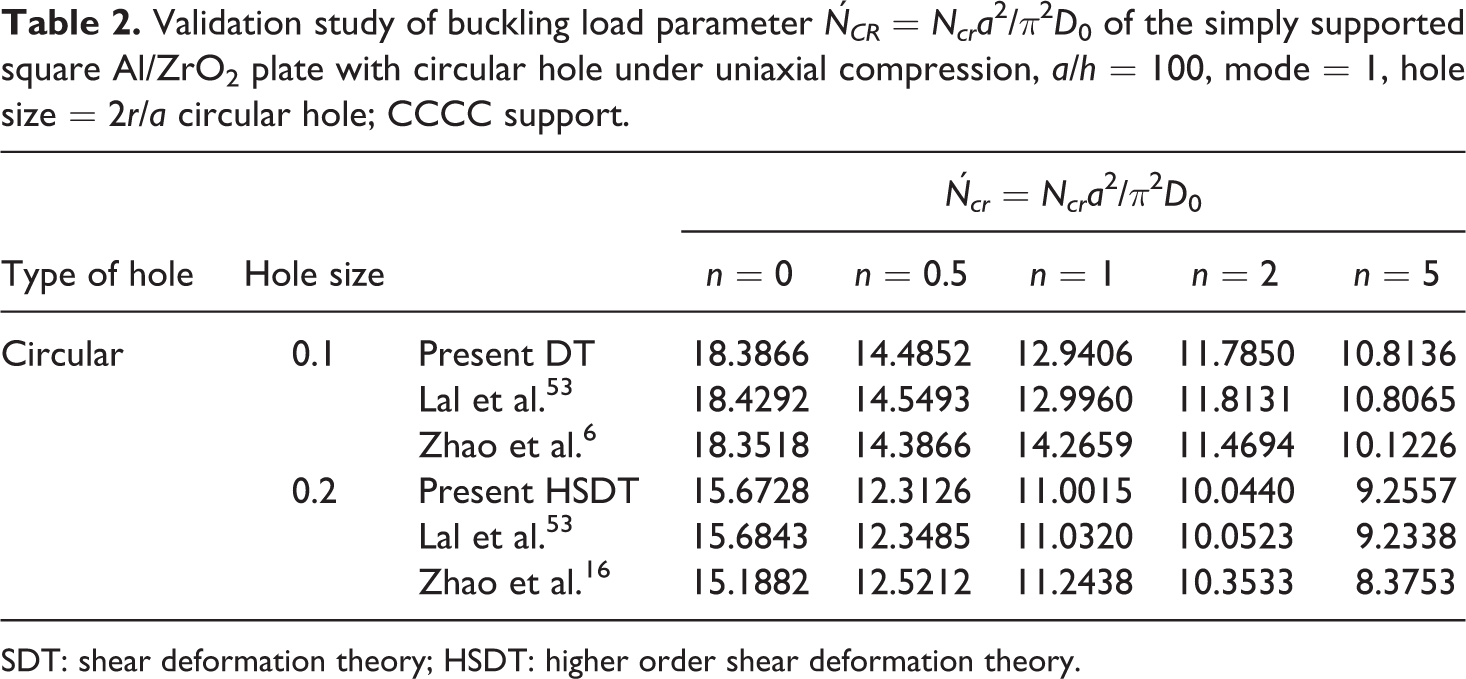
SDT: shear deformation theory; HSDT: higher order shear deformation theory.
Table 3 explains using the following data: *D = Eh 3 /12(1 − υ), E1 = 130.0 GPa, E2 = E3 = 10.0 GPa, G12 = G13 = 5.0 GPa, ν12 = ν13 = ν23 = ν32 = 0.35. The plate dimension considered is 2000 × 2000 mm2. The thickness of each layer of this eight-layer laminates is 1.5 mm. It is clear from the table that the present FEM [HSDT] results are in good agreement with those of the theoretical and ABAQUS results of Al Qablan et al. 29
Comparison of buckling load between theoretical method and finite element model for isotropic plate without cut-outs.
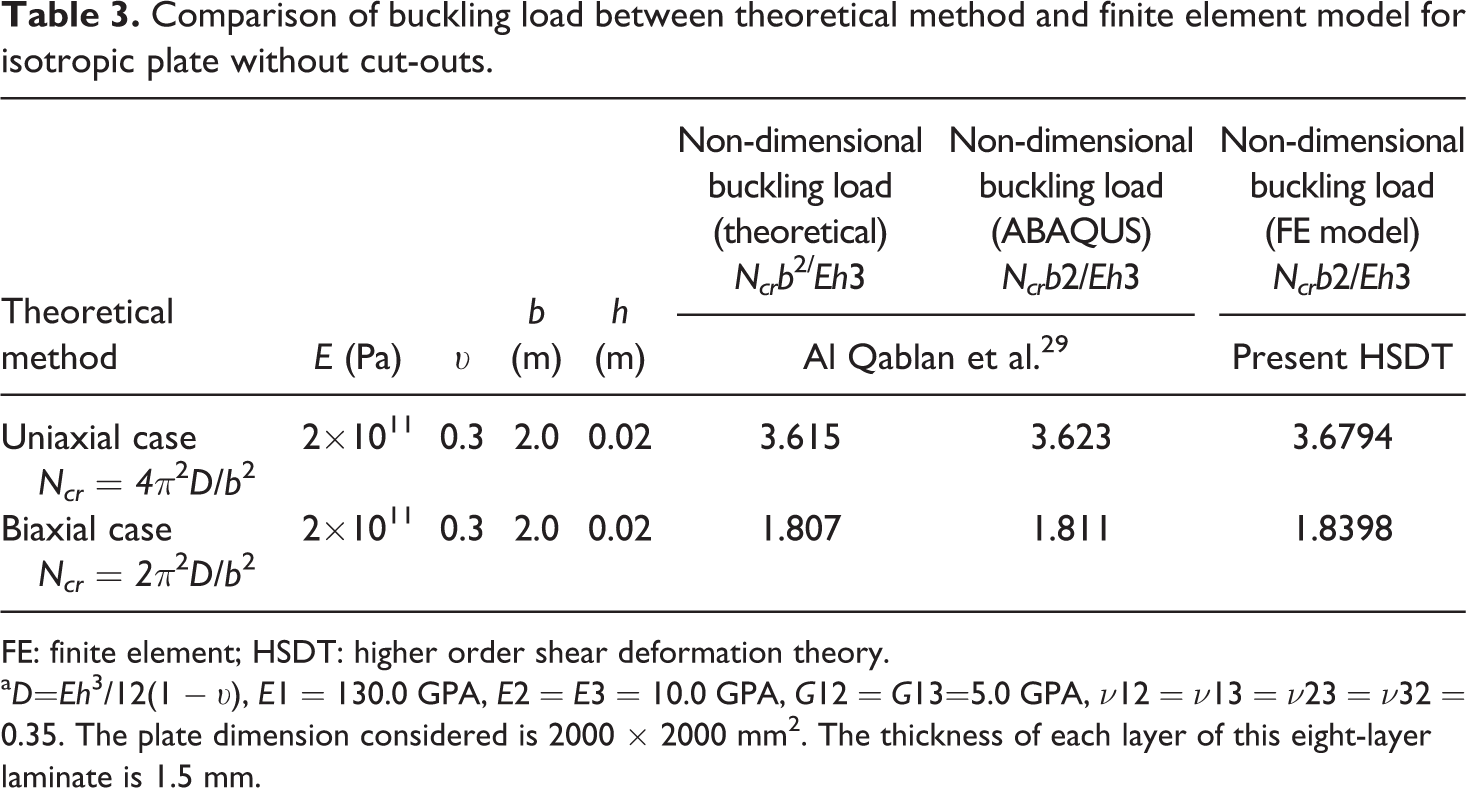
FE: finite element; HSDT: higher order shear deformation theory.
aD=Eh3/12(1 − υ), E1 = 130.0 GPA, E2 = E3 = 10.0 GPA, G12 = G13=5.0 GPA, ν12 = ν13 = ν23 = ν32 = 0.35. The plate dimension considered is 2000 × 2000 mm2. The thickness of each layer of this eight-layer laminate is 1.5 mm.
Validation study for stochastic post-buckling response
Figure 3 shows the compared results of DISFEM with independent MCS. For the MCS approach, the sample values are generated using MATLAB software to fit the desired mean and standard deviation (SD) using Gaussian probabilistic distribution function. The applicability of MCS outcomes is utilised by taking the different numbers. Material properties Ec, which are given as input to the present deterministic equation (28) post-buckling load is calculated. The MCS approach is used only for validation purposes.
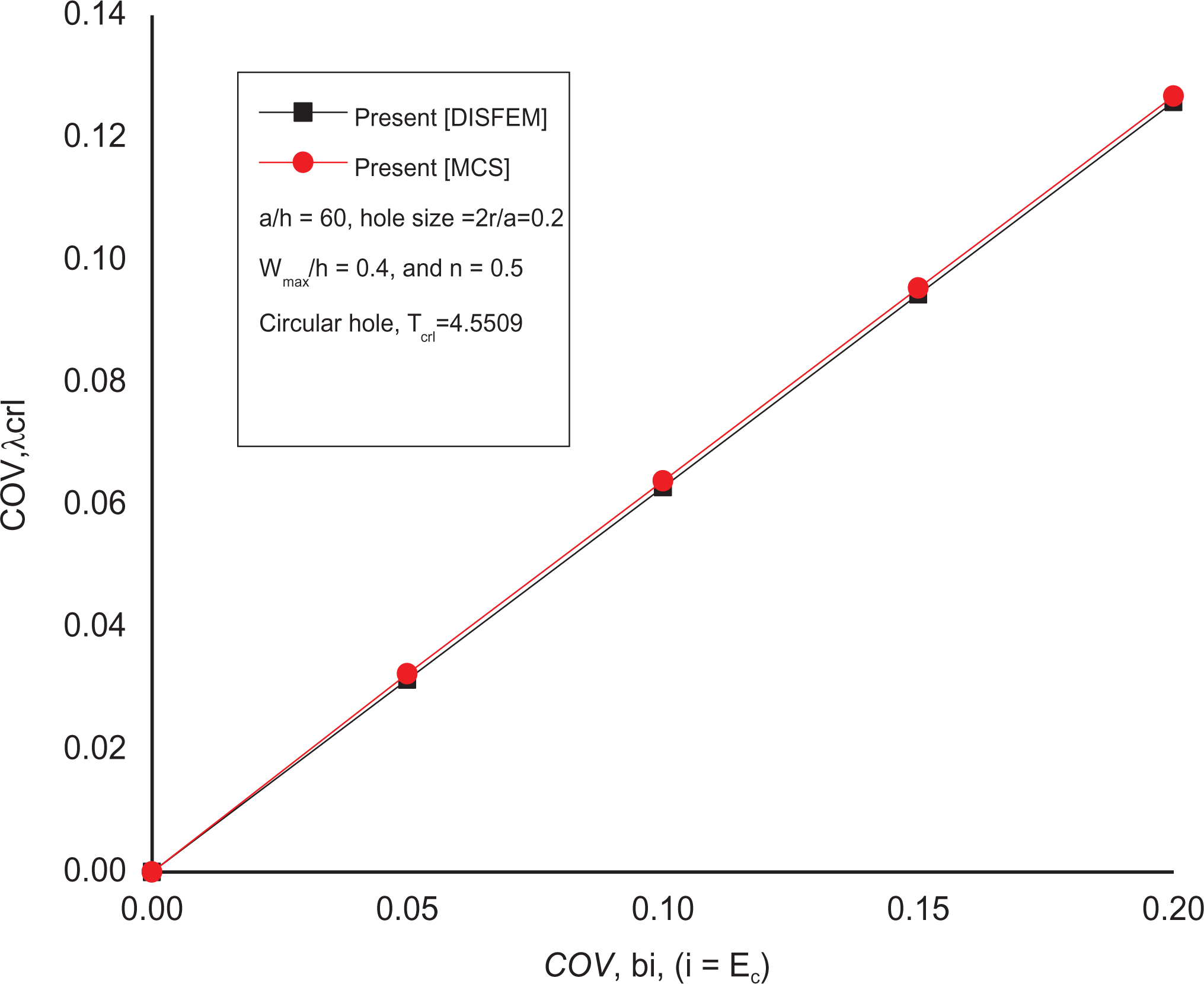
Validation for the coefficient of variations due to uncertainties in properties (bi, I = 1,…, 4) for CCCC support, biaxial compression, Al/ZrO2 laminate with n = 0.2 and 0.8 and a/h = 10.
Figure 4 shows the validation of dimensionless mean post-deforming loading force (Ńcr = Ncra2/π2D0) of square Al/ZrO2 plate with circular cut-out under bixial compression with a/h = 100 of clamped square FGMs circular cut-out laminate under combined temperature and mechanical loading, clamped support, biaxial compression with those available in the literature.16,53
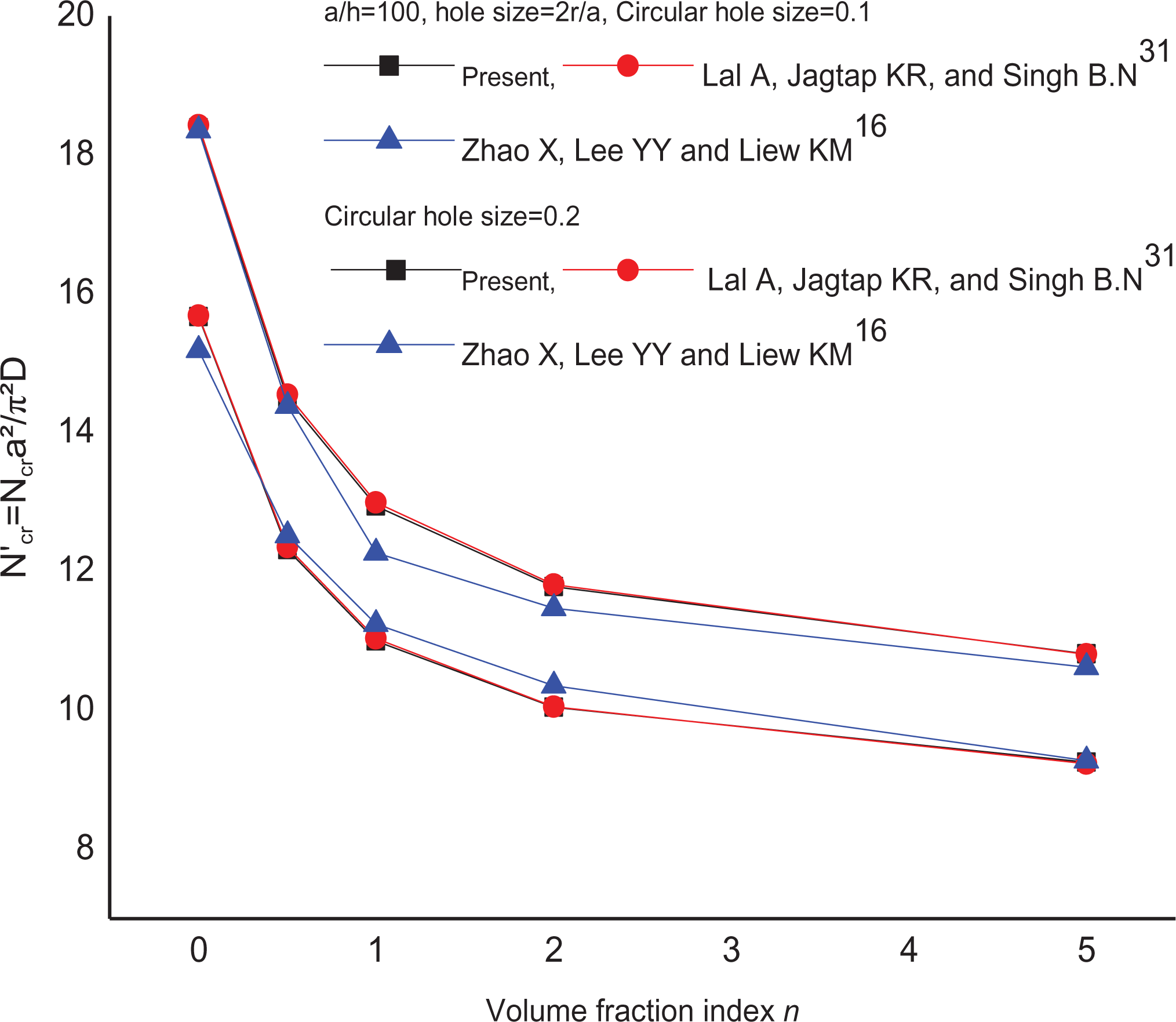
Validation of dimensionless mean post-deforming loading force of clamped square FGM circular cut-out laminates under combined temperature and mechanical loading, clamped support and biaxial compression.
Flow chart of the solution expression of stochastic procedure is given in Figure 5.
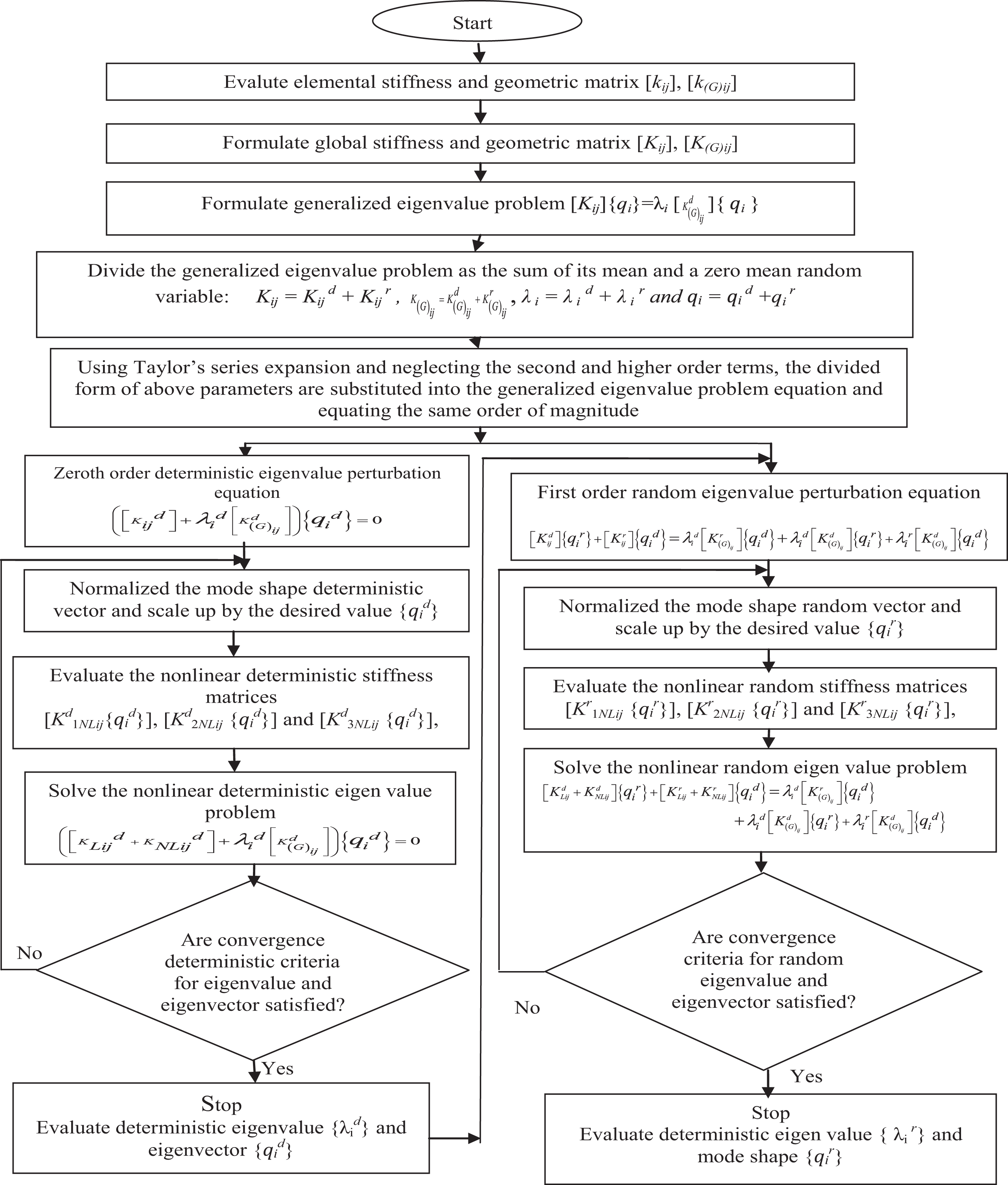
Flow diagram of stochastic procedure for post-buckling.
Parametric study for second-order statistics (dimensionless mean and COV) of post-buckling response
It is observed that plate with TID and TD material properties and Pasternak elastic foundations increase the mean and COV compared to Winkler elastic foundations and plates without foundation (Table 4). TD conditions have significant effects when the volume fraction index is increased.
Effect of thermomechanical loading, volume fraction index with random material properties {bi (i = 1,…, 7) = 0.1} on the dimensionless mean and COV of post-buckling load and temperature of SSSS-supported FGM square plate without and with Winkler (k1 = 100, k2 =0) and Pasternak (k1 = 100, k2 = 10), elastic foundations, circular hole (hole size = 0.1) having TID and TD material properties, a/h = 50, and Wmax/h = 0.4.a
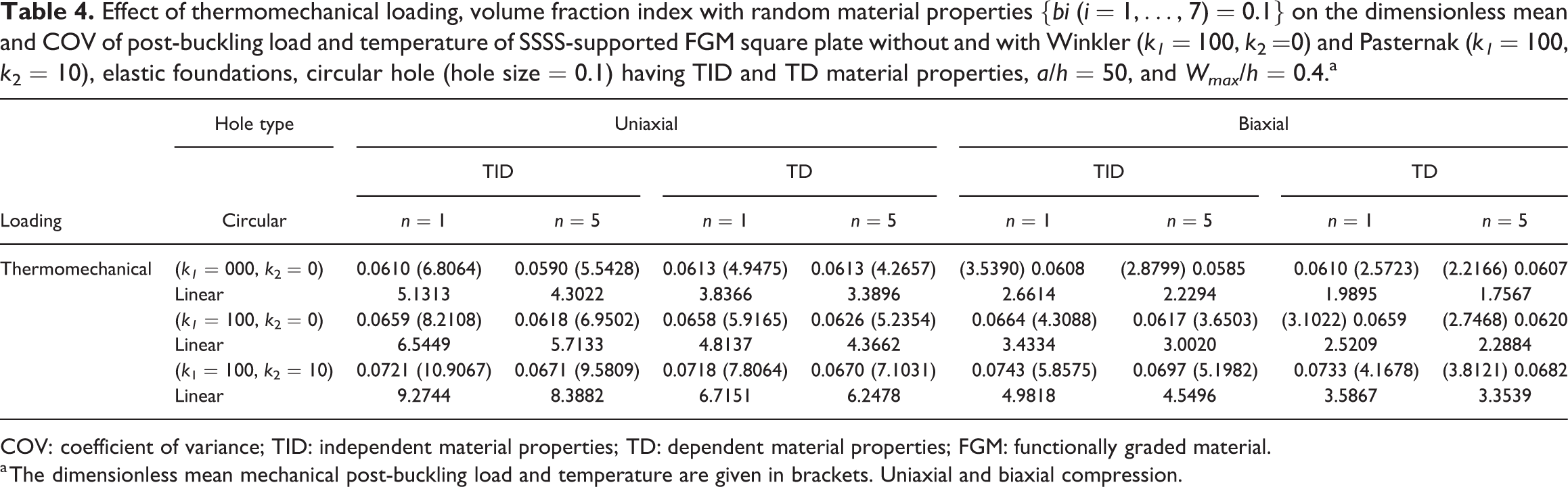
COV: coefficient of variance; TID: independent material properties; TD: dependent material properties; FGM: functionally graded material.
a The dimensionless mean mechanical post-buckling load and temperature are given in brackets. Uniaxial and biaxial compression.
The dimensionless mean thermomechanical post-buckling load and temperature are given in brackets (Table 5). It is seen that there is significant biaxial compression on the pates without support and with support when there is increase in the volume fraction index. The mean and COV values for uniaxial and Pasternak supports are more differentiated with biaxially compressed laminates. It is observed that the laminate with circular hole shows appreciable increase in COV and the corresponding higher average post-deformed force and temperature. This is because the stress concentration in the circular holed plate is lower.
Effect of thermomechanical loading, volume fraction index and various hole sizes with random material properties {bi (i = 1,…, 7) = 0.1} on the dimensionless mean and COV of post-buckling load and temperature of SSSS-supported FGM square plate without and with Winkler (k1 = 100, k2 = 0) and Pasternak (k1 = 100, k2 = 10) elastic foundations, circular hole having TD material properties, a/h = 10, and Wmax/h = 0.4.a
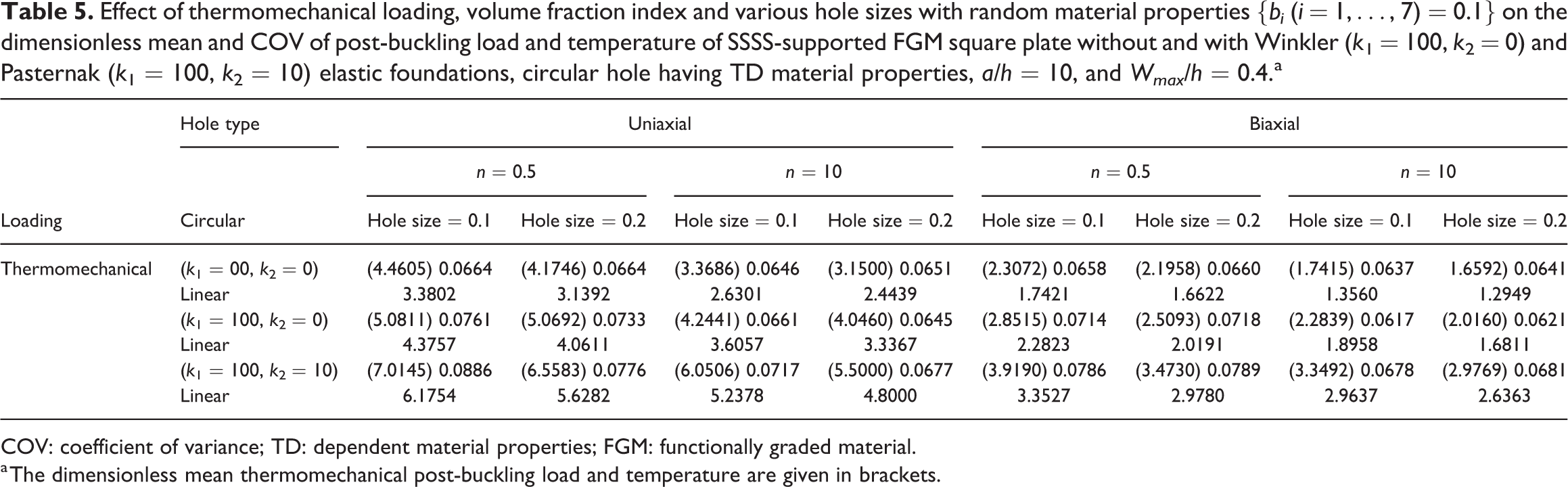
COV: coefficient of variance; TD: dependent material properties; FGM: functionally graded material.
a The dimensionless mean thermomechanical post-buckling load and temperature are given in brackets.
It is noticed that when the amplitude ratios are increased, the mean values and COV decrease for uniaxially and biaxially compressed plates without elastic foundations (Table 6). The plates resting on Pasternak elastic foundations have significant effects on mean and COV when there is increase in amplitude ratios; however, these values decrease for biaxially compressed plates.
Effect of thermomechanical loading and amplitude ratios with random material properties {bi (i = 1,…, 7) = 0.1} on the dimensionless mean and COV of post-buckling load and temperature of SSSS supported FGM square plate without and with Winkler (k1 = 100, k2 = 0) and Pasternak (k1 = 100, k2 = 10) elastic foundations, circular holes having TD material properties, a/h = 60, hole size = 0.2 and n = 5.a
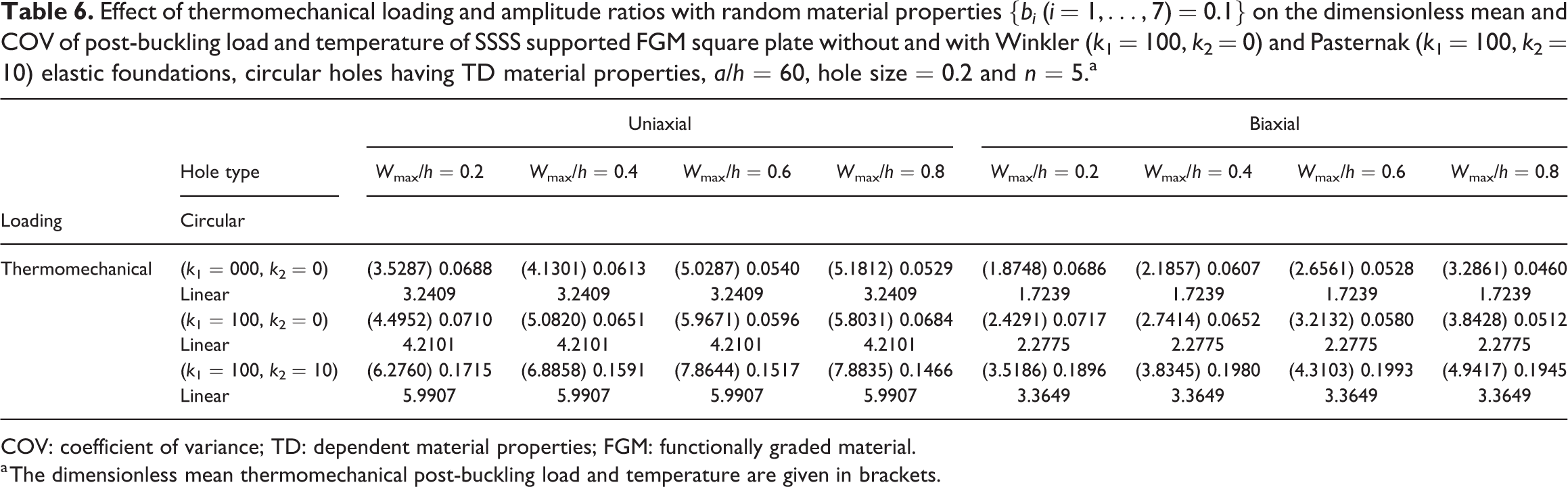
COV: coefficient of variance; TD: dependent material properties; FGM: functionally graded material.
a The dimensionless mean thermomechanical post-buckling load and temperature are given in brackets.
It is seen that on varying the plate thickness ratios and volume fraction index with increase in hole size the mean value decreases, while COV increases for plates without foundations (Table 7). When plates are resting on Winkler and Pasternak elastic foundations, the mean values increase on increasing the volume fraction index. COV is significant for thin plates compared to thick plates. It is also expected that laminates with holes show less dimensionless average and the corresponding COV of deformed load and thermal condition. This is because post-buckling stiffness of the plate decreases for holed plates. It is concluded that from the reliability point of view, circular holed plates are preferred for small hole sizes.
Effect of combined temperature and mechanical loading, n, a/h and various hole sizes with uncertain characteristics {bi (i = 1,…, 7) = 0.1} on the dimensionless mean and COV of post-deforming force and temperature of SSSS-supported, biaxial compressed FGM circular plate without and with Winkler (k1 = 100, k2 = 0) and Pasternak (k1 = 100, k2 = 10) elastic foundations circular hole, TD, Wmax/h = 0.4.a
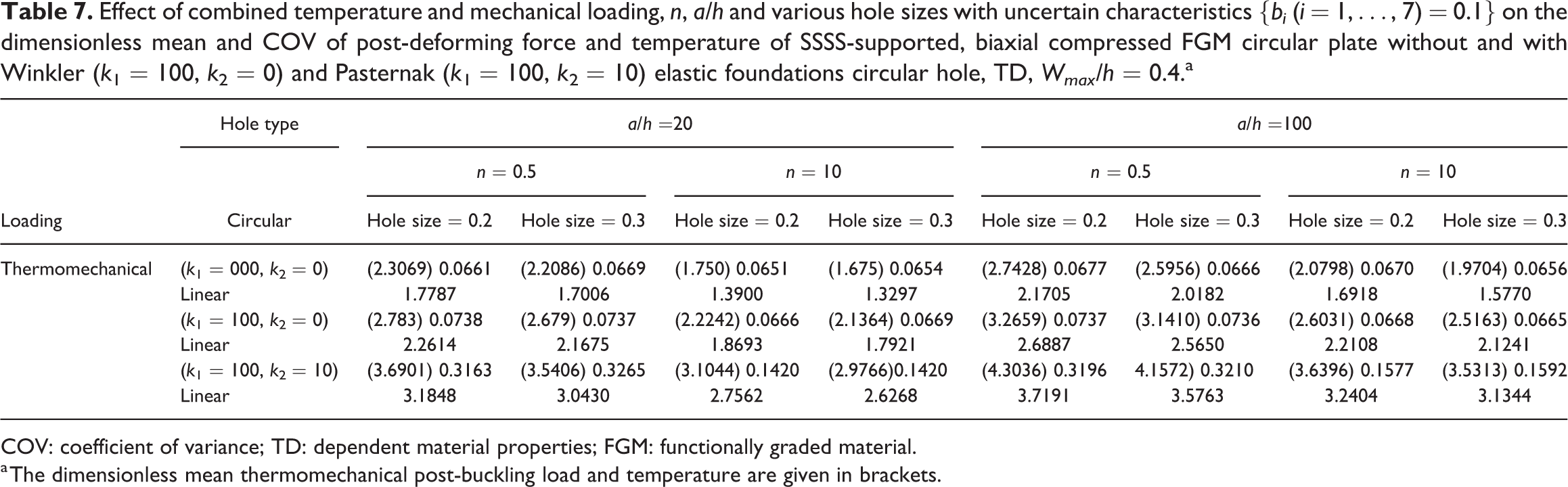
COV: coefficient of variance; TD: dependent material properties; FGM: functionally graded material.
a The dimensionless mean thermomechanical post-buckling load and temperature are given in brackets.
For a/b = 2, n = 10), and cut diameter of 0.3, the COV varies for Pasternak support changes because of stress concentration near the round cut, which is responsible for decrease of post-buckling internal resisting force, with increase in round cut size (Table 8). Here the round cut size, aspect ratio, fraction index and supports matter much.
Effect of combined temperature and mechanical loading, n, a/b and various hole sizes with uncertain properties {bi (i = 1,…, 7) = 0.1} on the dimensionless mean and COV of post-buckling load and temperature of SSSS, uniaxial compressed, functionally graded laminate (k1 = 100, k2 = 0) and (k1 = 100, k2 = 10) elastic foundations, circular hole, TD properties, a/h = 50, Wmax/h = 0.4.a
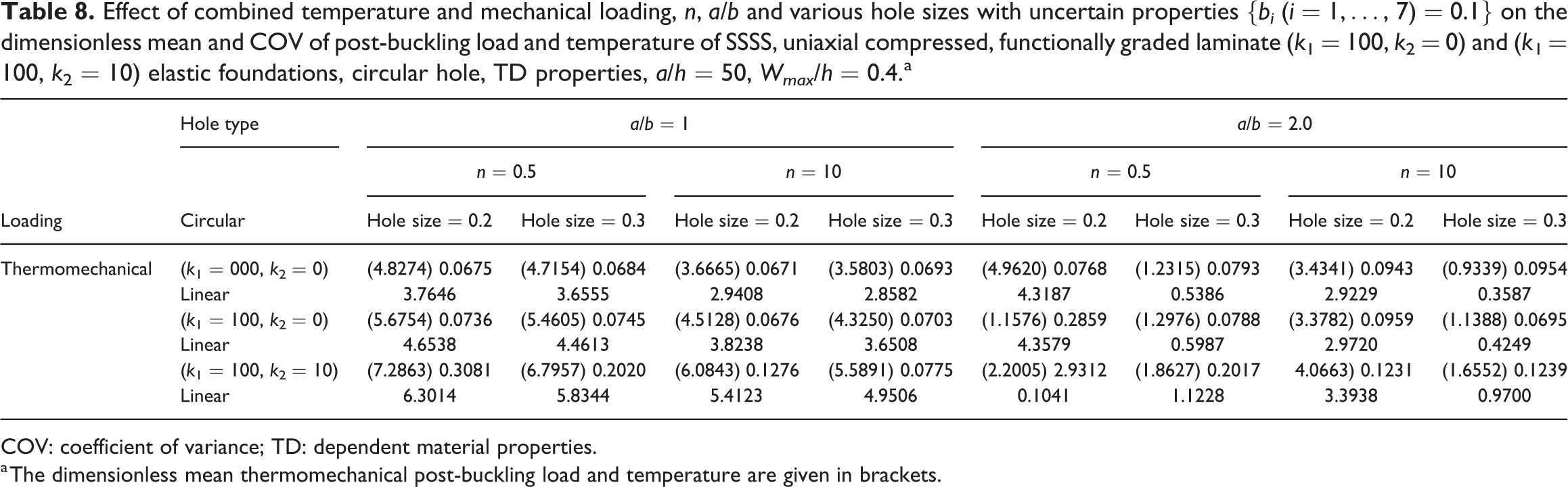
COV: coefficient of variance; TD: dependent material properties.
a The dimensionless mean thermomechanical post-buckling load and temperature are given in brackets.
It is observed that Pasternak support clamped with fraction index 0.5 and round cut of 0.3 have significance on the laminates compared to SSSS (Table 9). Average and coefficients of variations rise for laminates on supports. It is noticed that for the same compressed laminate and hole, the dimensionless average post-deformation force raised the corresponding COV. This is because of the amplitude ratio, and because of increase in boundary constraints that significantly increases the internal properties of the laminate.
Effect of thermomechanical loading, volume fraction index, support conditions and various hole sizes with random material properties {bi(i = 1,…, 7) = 0.1} on the dimensionless mean and COV of post-buckling load and temperature of uniaxial compressed FGM square plate without and with Winkler (k1=100, k2=0) and Pasternak (k1=100, k2=10) elastic foundations, circular hole having TD material properties, a/h = 15, Wmax/h = 0.4.a
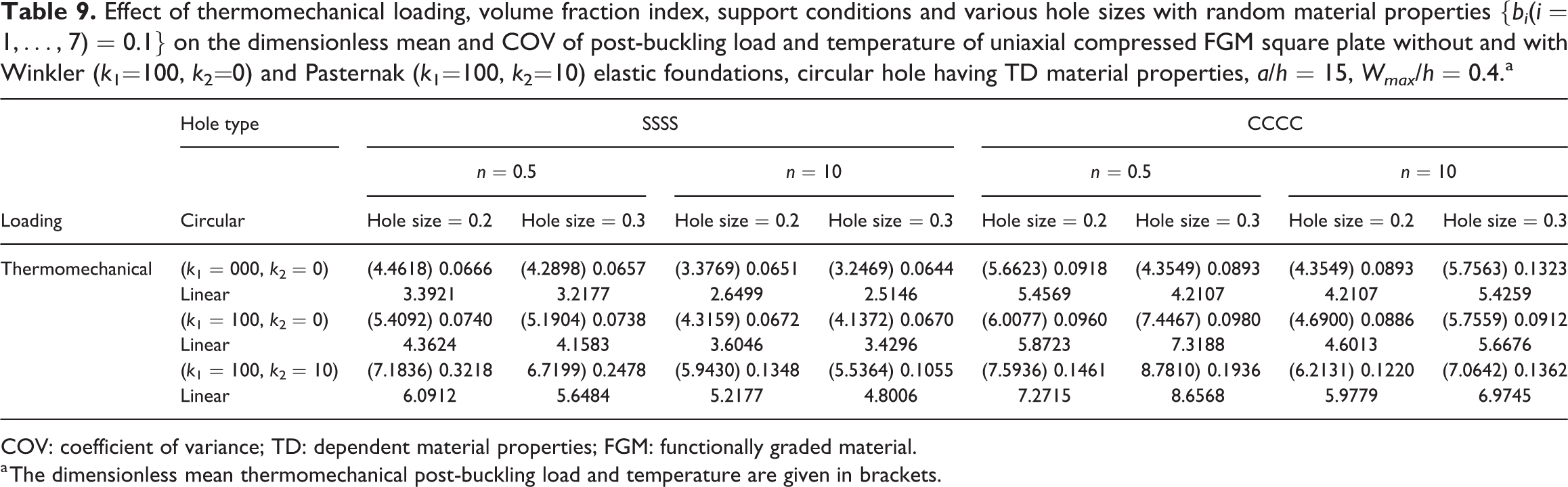
COV: coefficient of variance; TD: dependent material properties; FGM: functionally graded material.
a The dimensionless mean thermomechanical post-buckling load and temperature are given in brackets.
Findings and concluding remarks
The mean dimensionless thermomechanical post-buckling load and temperature and the corresponding COVs of FGM plate subjected to uniaxial and biaxial compression decrease with increase in cut-out size. The dimensionless mean post-buckling load and temperature and corresponding COV are lower for cut-out laminates without support compared to laminates resting on supports. Laminate is most sensitive with uncertain change in Ec and Em of functionally graded laminate with Pasternak support circular cut-out.
In general, as Wmax/h increases the dimensionless average deforming force increases, while COV becomes less. However, increase in the volume fraction index results in decrease in dimensionless mean post-buckling load. The mean and COV of post-deforming force and thermal condition of FGM laminate changes with the volume fraction index, a/h, a/b, types of force application, supports, stiffness and types of materials used where stability is of utmost importance.
Thin plate with circular cut-out is more sensitive than thick plate with respect to dimensionless mean and COV of post-buckling load and temperature subjected to uniaxial and biaxial compression. Therefore, for stability and reliability point of view, rectangular plate with circular cut-out having low volume fraction and Pasternak elastic foundation should be considered. For stability and reliability point of view, clamped supported plates with various shapes and cut-outs would be desirable.
Supplemental material
Supplemental Material, Highlights - Thermomechanically induced post-buckling analysis of functionally graded material plates with circular cut-outs resting on elastic foundations
Supplemental Material, Highlights for Thermomechanically induced post-buckling analysis of functionally graded material plates with circular cut-outs resting on elastic foundations by Rajesh Kumar in Journal of Thermoplastic Composite Materials
Footnotes
Authors’ note
Rajesh Kumar is now affiliated with Department of Mechanical Engineering, SET, IIMT University, Meerut, U. P., India.
Funding
The author(s) received no financial support for the research, authorship and/or publication of this article.

Supplemental material
Supplemental material for this article is available online.
Nomenclature
Appendix 1
where
where,
with
where
References
Supplementary Material
Please find the following supplemental material available below.
For Open Access articles published under a Creative Commons License, all supplemental material carries the same license as the article it is associated with.
For non-Open Access articles published, all supplemental material carries a non-exclusive license, and permission requests for re-use of supplemental material or any part of supplemental material shall be sent directly to the copyright owner as specified in the copyright notice associated with the article.
