




Abstract
Nonlinear buckling and postbuckling analysis of functionally graded graphene-reinforced composite (FG-GRC) laminated toroidal shell segments subjected to external pressure surrounded by elastic foundations and exposed to thermal environment are presented in this article. Governing equations for toroidal shell segments are based on the Donnell shell theory taking into account geometrical nonlinearity term in von Kármán sense with shell–foundation interaction modeled by Pasternak’s elastic foundation. Three-term solution form of deflection and stress function are chosen, and Galerkin method is applied to obtain the nonlinear load–deflection relation. Numerical investigations show the effects of graphene volume fraction, graphene distribution types, geometrical properties, elastic foundation, and thermal environments on the linear and nonlinear buckling and postbuckling behaviors of FG-GRC laminated toroidal shell segments.
Keywords
Introduction
In recent years, many authors are mostly interested in the linear and nonlinear buckling and postbuckling behavior of many types of revolution shells as cylindrical shells and toroidal shell segments made by isotropic and traditional composite materials. Dutta et al. 1 studied the nonlinear axisymmetric stability of toroidal pipe-reducer system. Numerical solutions are obtained using the multi-segment method of integration, and critical pressure buckling loads of the toroidal reducers are determined according to the Thompson’s theorems I and II. Shen 2 –4 investigated the nonlinear large deflection buckling analysis of stiffened laminated composite cylindrical shells of finite length subjected to thermal loads, combined external pressure and thermal loading, and combined external liquid pressure and axial compression using the singular perturbation technique and the boundary layer theory. A numerical study of linear elastic and elastoplastic buckling behavior of circular and elliptical cross-sectional steel toroidal shells subjected to uniform external pressure with closed cross-sections was proposed by Blachut and Jaiswal. 5 Du et al. 6 manufactured a whole welding steel toroidal model with the ring stiffeners, tested it until collapse in pressure chamber, and analyzed it using nonlinear finite element method, and the cause and collapse mode of tested stiffened toroidal shell model were discussed. Large deformation-free vibration of toroidal shells was investigated by Senjanović et al. 7 using the Rayleigh–Ritz energy method and Fourier series. Using the first-order shear deformation theory, Masumi et al. 8 studied the thermoelastic stress analysis in composite cylindrical vessel with metallic liner. Using three-dimensional elasticity theory and generalized differential quadrature method, the free vibration response of sandwich cylindrical shells with functionally graded material (FGM) face sheets resting on Pasternak foundation was studied by Kamarian et al. 9 Bouazza et al. 10,11 studied the thermal buckling of FGM plates under uniform temperature rise and linear temperature rise through the thickness using classical plate theory.
FGMs and functionally graded carbon nanotube-reinforced composites (FG-CNTRCs) are the advanced composite materials in which thermomechanical properties are continuously varied through the thickness of structure. Research on thermomechanical behavior of FGM structure has been an exciting field in the last decade. Huang and Han 12,13 studied the nonlinear buckling and postbuckling of FGM cylindrical shells under axial compression and radial pressure using Donnell shell theory and three-term solution form. The nonlinear static and dynamic buckling behavior of imperfect orthogonal eccentrically stiffened FGM cylindrical shells subjected to axial compression was considered in the work of Bich et al. 14 The dynamic critical buckling loads of shells under step loading of infinite duration were found corresponding to the load value of sudden jump in the average deflection and those of shells under linear-time compression were investigated according to Budiansky–Roth criterion. Dung and Nam 15 investigated an analytical approach of orthogonal eccentrically stiffened FGM cylindrical shells surrounded by Pasternak’s elastic foundation and subjected to external pressure. The approximate three-term solution of deflection shape was chosen and the frequency–amplitude relation of nonlinear vibration was obtained in explicit form. Recently, Nam et al. 16 and Phuong et al. 17 studied the nonlinear buckling and postbuckling of FGM and multilayer FGM cylindrical shells reinforced by orthogonal and spiral stiffeners in thermal environment subjected to torsional load with and without elastic foundation. Ninh and Bich 18 –20 investigated the nonlinear buckling and vibration of FGM ring and stringer stiffened and unstiffened FGM cylindrical shells and toroidal shell segments under thermal and mechanical loads surrounded by Pasternak’s elastic foundation using Donnell shell nonlinear theory with Stein and McElman assumption and Galerkin procedure. Thang and Trung 21 studied the nonlinear dynamic response of sigmoid FGM and FGM toroidal shell segments reinforced by ring and stringer stiffeners, respectively. Donnell shell theory, Galerkin procedure, and Runge–Kutta method were used. Hieu and Tung 22 investigated the nonlinear buckling of FG-CNTRC cylindrical shell surrounded by an elastic medium and subjected to mechanical loads in thermal environments. The nonlinear stability of FG-CNTRC cylindrical panels with elastically restrained straight edges subjected to combined thermomechanical loading conditions is investigated in the work of Trang and Tung. 23 Bouazza et al. 24,25 investigated the thermal buckling and free vibration of traditional laminated composite plates using refined hyperbolic shear deformation theory and two-variable simplified nth-higher-order theory.
In recent years, with the extraordinary properties, graphene has attracted more attention of many authors in the world. Based on the idea of FGM, graphene is used to reinforce in the polymeric matrix, and a new material, namely, functionally graded graphene platelet (FG-GPL), is formed. Barati and Zenkour 26 analyzed the free vibration behavior of FG-GPL-reinforced cylindrical shells with uniform, symmetric, and asymmetric porosity distributions. Wang et al. 27,28 investigated the eigenvalue buckling and torsional buckling of FG-GPL-reinforced cylindrical shell with cutout through finite element method. Bouazza et al. 29,30 investigated the thermal buckling of nanoplates with and without the elastic foundation effects.
A more complex composite reinforced by graphene is piecewise functionally graded graphene-reinforced composite (FG-GRC) laminated structure, where the GRC layer is reinforced by zigzag or armchair graphene sheet with strong orthotropic behavior in two transversal directions. Shen et al. 31 –33 studied the nonlinear thermal buckling, vibration, and bending of FG-GRC laminated plates resting on elastic foundation by two-step perturbation technique. Shen and Xiang 34 –36 and Shen et al. 37 investigated the postbuckling behavior of FG-GRC laminated circular cylindrical shells subjected to axial compression, external pressure, and thermal load, respectively. Kiani and Mirzaei 38,39 and Kiani 40,41 studied the buckling behavior and free vibration of FG-GRC laminated beams, plates, and conical shells under mechanical and thermal loads.
To the best of the author’s knowledge, research studies on the analytical solution for FG-GRC shells have so far been limited. Previous studies only mentioned about FG-GRC cylindrical shells. A more complex structure is considered in this article: the nonlinear buckling analysis of FG-GRC laminated toroidal shell segments surrounded by Pasternak’s elastic foundations, exposed to thermal environments, and subjected to uniform external pressure is investigated by an analytical approach. The equilibrium and compatibility equations are established according to the Donnell’s shell theory with von Kármán nonlinearity sense and Stein and McElman assumption. 42 The prebuckling and linear and nonlinear postbuckling terms are considered in deflection solution form, and the Galerkin procedure is applied to obtain the critical buckling load expression and the nonlinear external pressure–deflection relation. The effects of graphene volume fraction, distribution types, geometrical parameters, temperature conditions, and elastic foundations on the linear and nonlinear buckling behavior of FG-GRC laminated toroidal shell segments are numerically investigated and discussed.
FG-GRC laminated toroidal shell segments surrounded by elastic foundation
This article investigates the nonlinear buckling behavior of FG-GRC laminated toroidal shell segments subjected to external pressure load of uniform distribution intensity
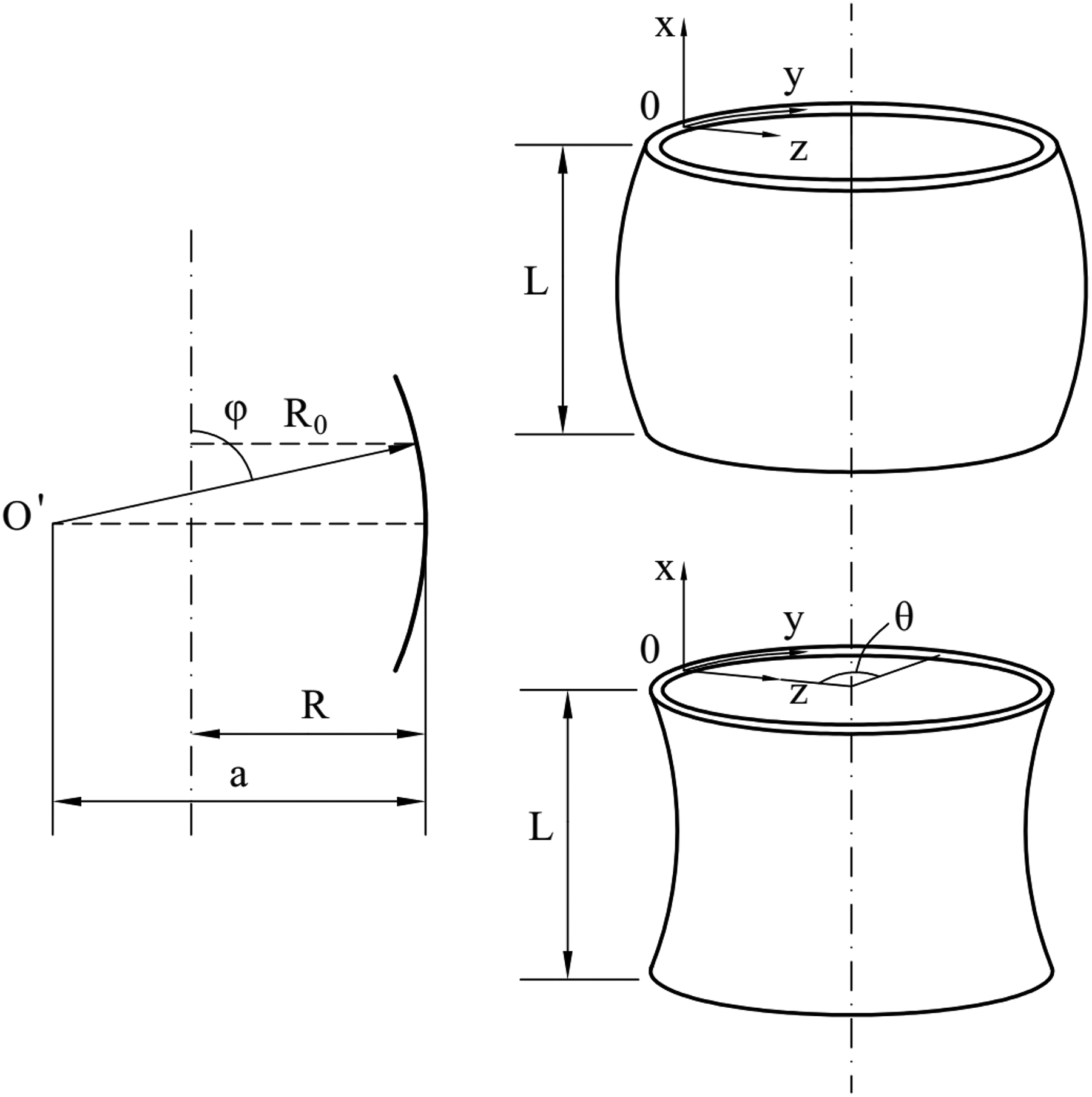
Configuration and coordinate system of FG-GRC laminated toroidal shell segments.
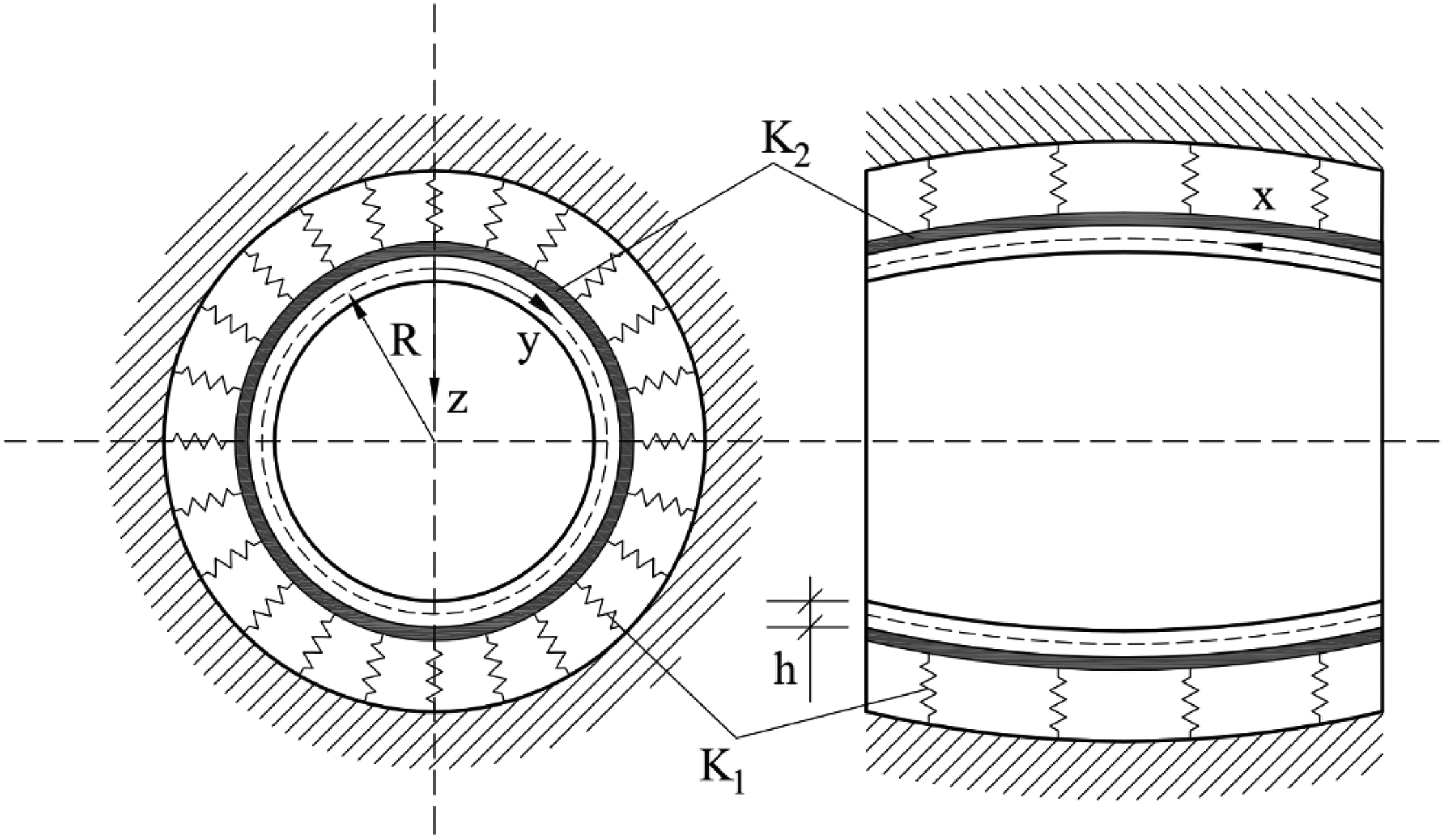
Two-parameter Pasternak foundation model of toroidal shell segments.
The radius of parallel circle R 0 can be expressed as

with the shallow toroidal shell along the meridian, the angle

The origin of coordinate O locates on the midplane and at the end of the shell, and

where K 1 (N m−3) is Winkler foundation modulus and K 2 (N m−1) is the shear layer foundation stiffness of Pasternak’s elastic foundation model.
The graphene reinforcement in the
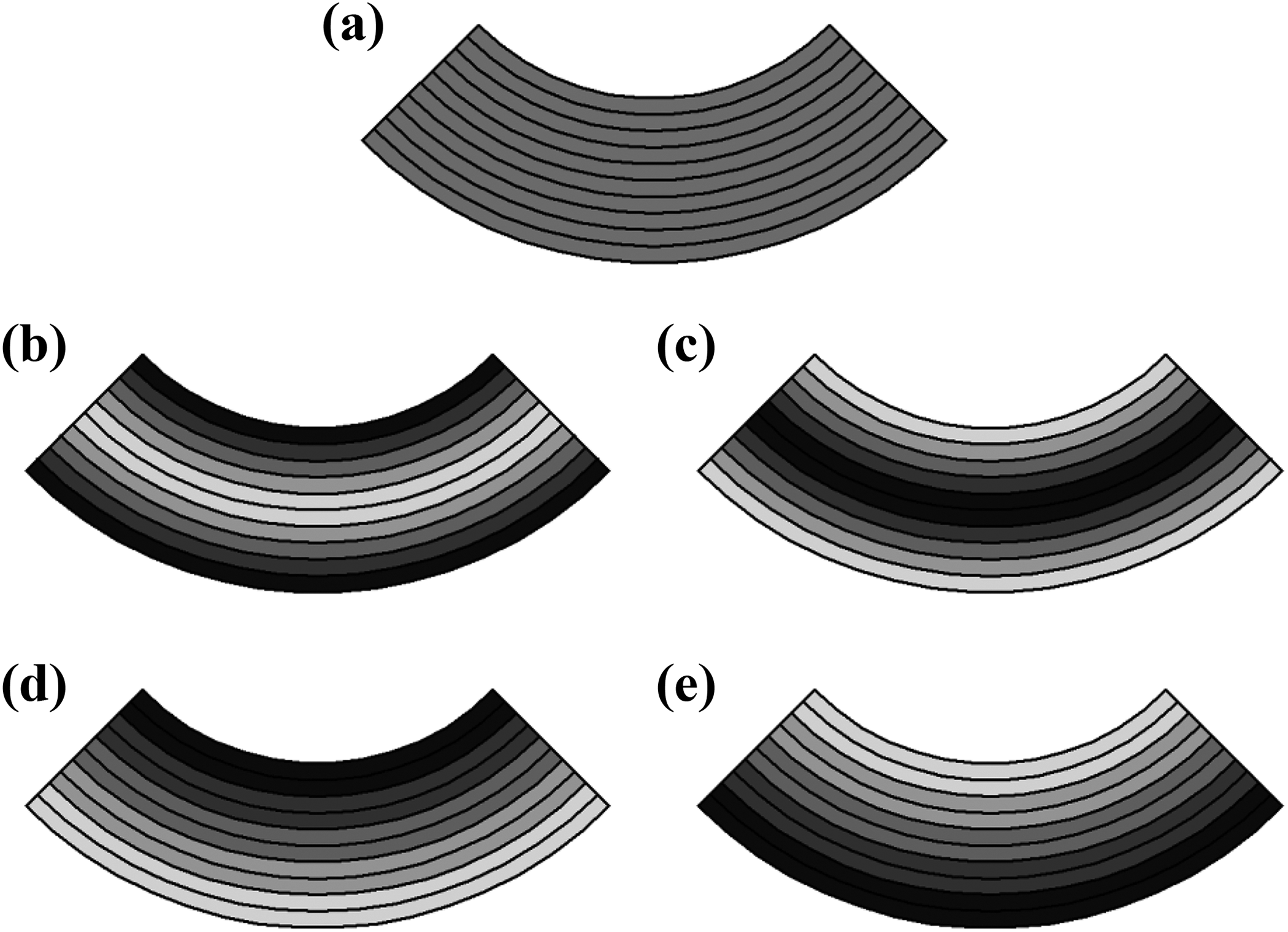
Distribution types of graphene-reinforced composite laminates: (a) UD, (b) FG-X, (c) FG-O, (d) FG-V, and (e) FG-Λ.
Young’s moduli and shear modulus of the FG-GRC layer are estimated according to the extended Halpin–Tsai model, expressed as
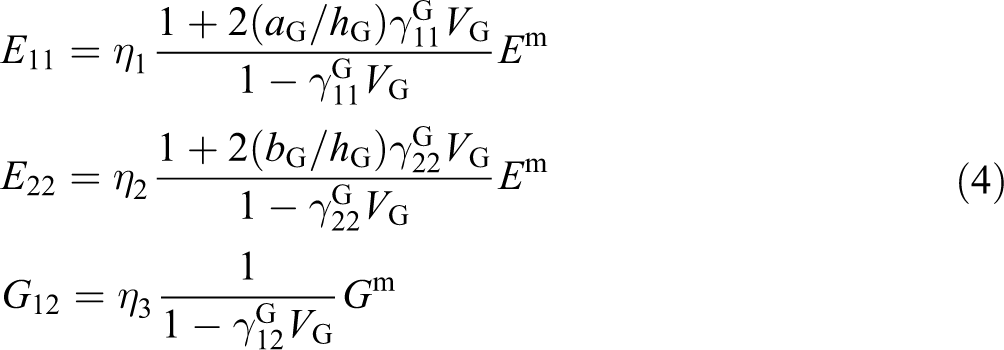
with
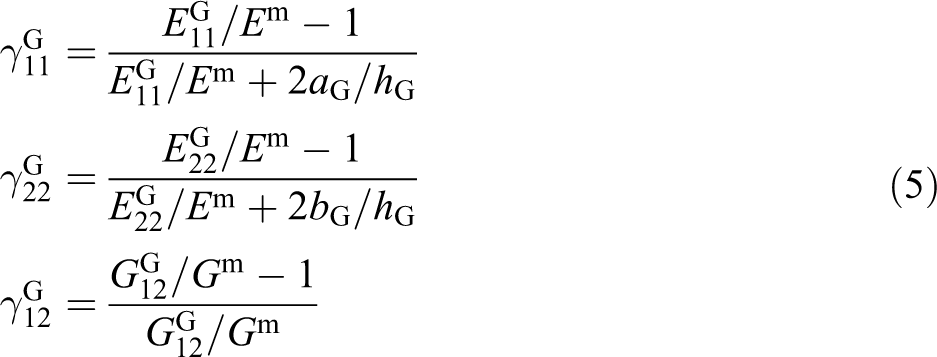
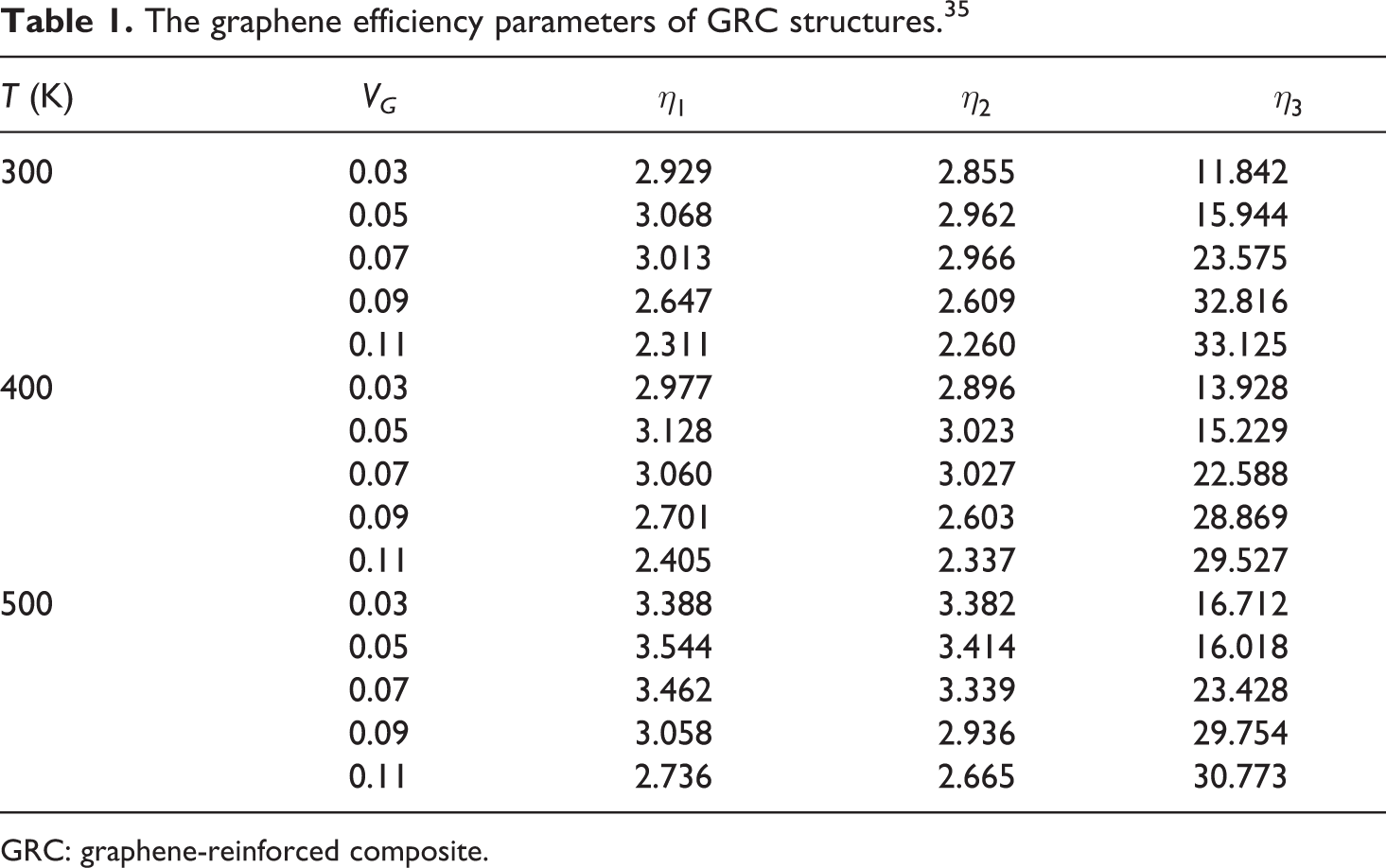
where
The graphene efficiency parameters of GRC structures. 35
GRC: graphene-reinforced composite.
Thermal expansion coefficients of GRC layer in the x and y directions are taken according to the Schapery model, as

where

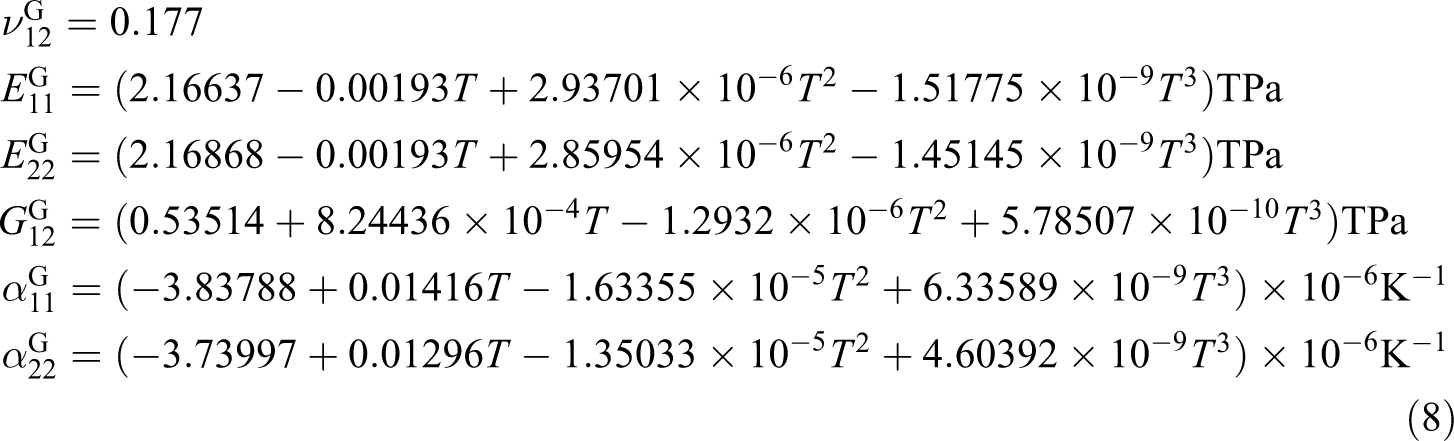
The orthotropic elastic constants and thermal expansions of graphene sheet are determined by
Fundamental equations
In the present approach, the Donnell shell theory and Stein and McElman assumption 42 are applied to establish the governing equations for nonlinear buckling and postbuckling of FG-GRC laminated toroidal shell segments subjected to uniform external pressure in thermal environment

where

where the nonlinearity terms in von Kármán sense and longitudinal curvature term are mentioned.
Note that when longitudinal radius
The deformation compatibility equation is received from equation (10), as

Stress–strain relations of Hooke’s law for FG-GRC laminated layer including thermal effects are written by

where
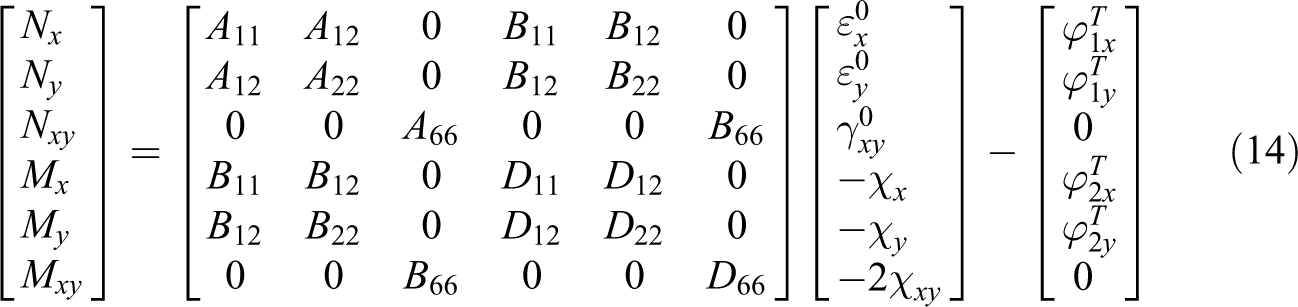
The force and moment effects of FG-GRC laminated toroidal shell segments are determined by

Substituting equations (equation (9) into equation (12) taking into account equation (6), (7), and (10), the integrals in 13) become
where
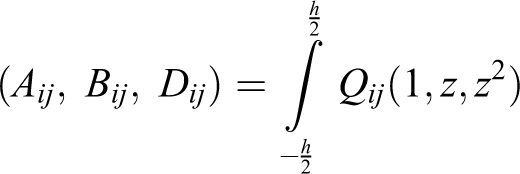
The components of stiffness matrix of the shell are calculated by numerical method and

with
The normal and shear–strain expressions at the midplane of the shell are reversely determined from equation (14), as

where the expressions of
Substituting equation (15) into moment expressions in equation (14), the moment expressions are rewritten by

where the expressions of
The equilibrium equation system of FG-GRC laminated toroidal shell segments including Pasternak’s elastic foundations (equation (3)) based on the Donnell shell theory with Stein and McElman assumption 42 (equations (1) and (2)) is presented as

Assuming that the Airy’s stress function

Substituting the proposed Airy’s stress function (equation (18)) into the first two equations of equation (17), these equations are completely satisfied.
Then, substituting equations (equation (16) and equations ((18) into the third equation of 17) and combining 9) and (10), equilibrium equations are rewritten by

Now, substituting equation (15) into the deformation compatibility equation (11) taking into account equation (18), equation (11) becomes

The nonlinear buckling and postbuckling behavior of FG-GRC laminated toroidal shell segments subjected to external pressure surrounded by two-parameter Pasternak’s elastic foundation in thermal environment is obtained using the equilibrium and compatibility equations (19) and (20).
Solution of problem
In this article, FG-GRC laminated toroidal shell segment subjected to external pressure with simply supported at the edges is considered. Thus, the boundary conditions considered in the current study are

Then, the deflection of shell satisfying the boundary conditions (equation (21)) on the approximate sense is chosen in three-term form 12,13,19

where f 0 is the prebuckling deflection amplitude, f 1 and f 2 are linear and nonlinear postbuckling deflection amplitudes, respectively, and m and n are buckling modes (number of half wave) in longitudinal and circumferential directions, respectively.
Substituting the solution form of deflection (equation (22)) into equation (20), the form of stress function may be expressed as

in which the expressions of
The deflection and stress function forms are introduced into equation (19). The Galerkin procedure is applied in the ranges

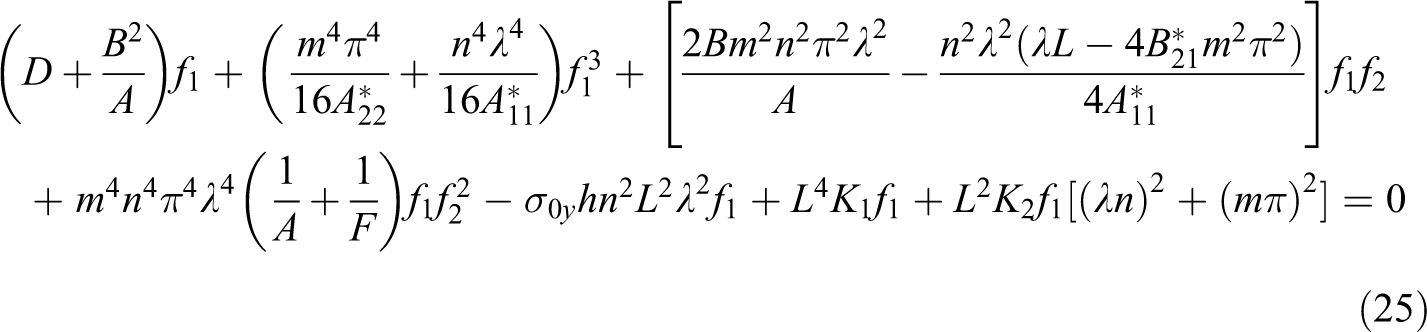
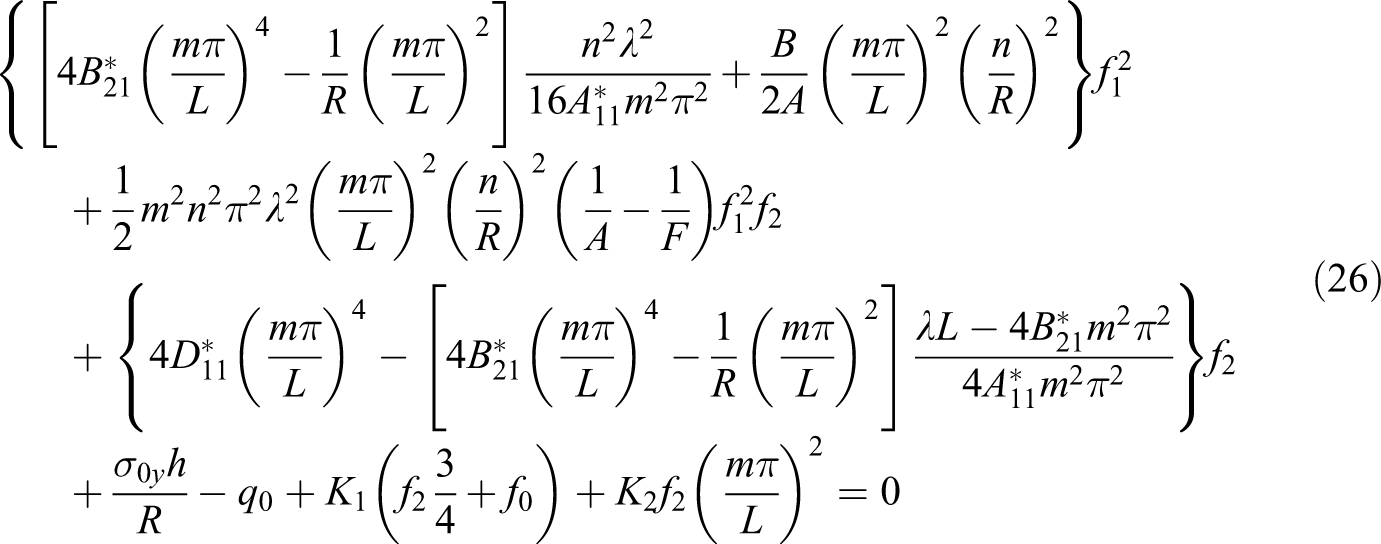
where the expression of D is shown in Appendix 1.
For all shell of revolution, the circumferential closed condition must be added in average sense, as

By combining equations (equation (15), (22), and (23), the integral (27)) leads to

Substituting



where the expressions of
Substituting f
0 and
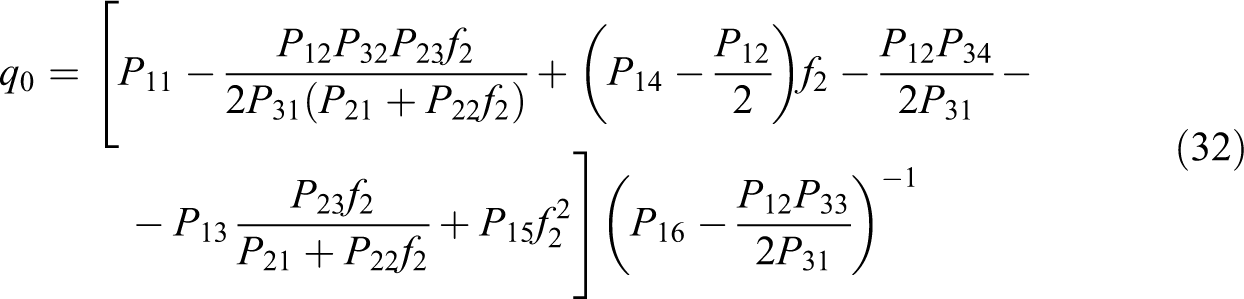
When

The critical external pressure buckling load
From equation (22), the maximal deflection of the shells is determined by

locates at
Substituting equations (equation (29) and (31) into 34), the maximal deflection is rewritten respected to f 2

As can be seen,
Numerical results and discussion
Comparison results
The validation of present approach is discussed by the comparisons of critical external pressure buckling load
Comparisons of critical buckling external pressure load
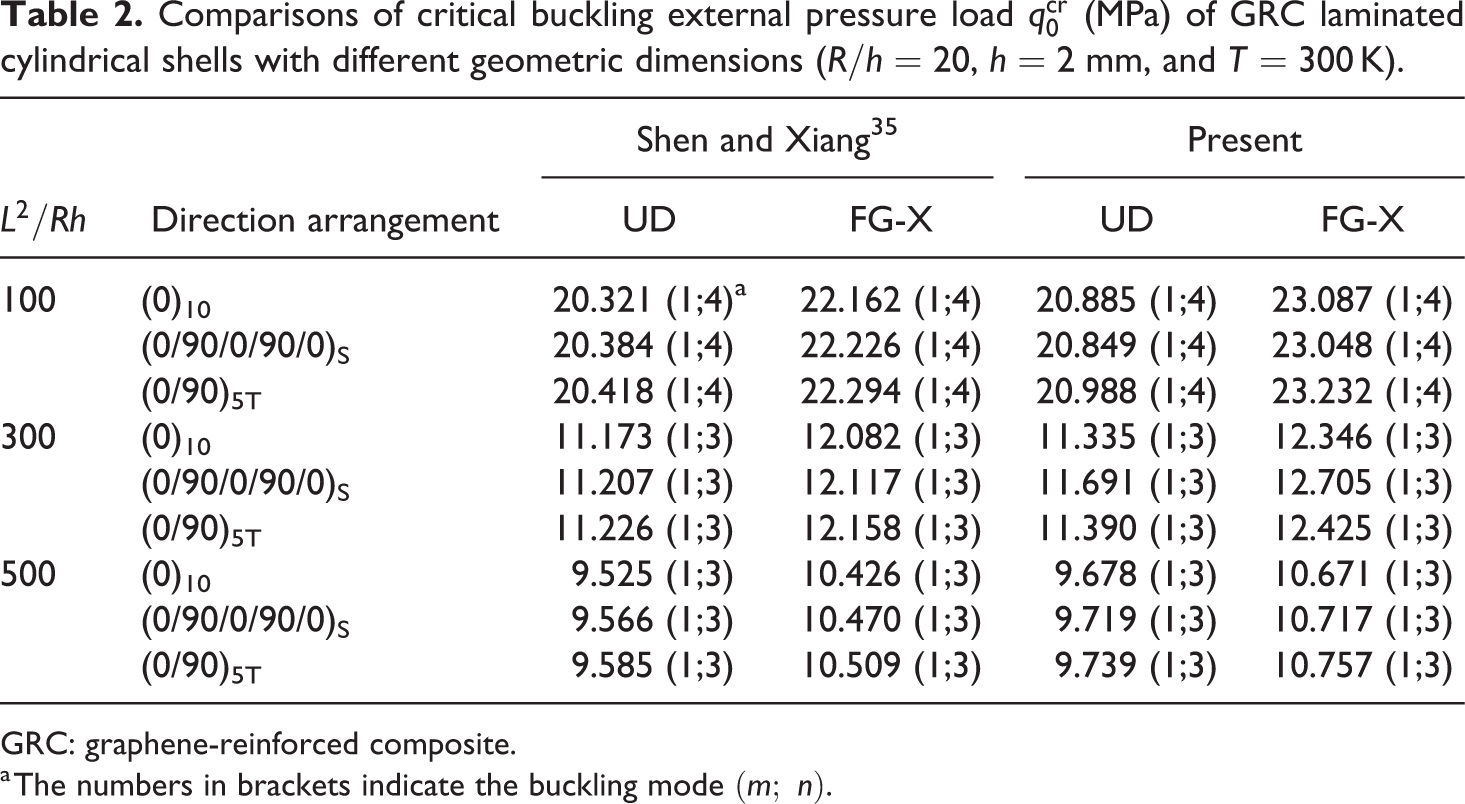
GRC: graphene-reinforced composite.
a The numbers in brackets indicate the buckling mode
Comparisons of critical buckling external pressure load
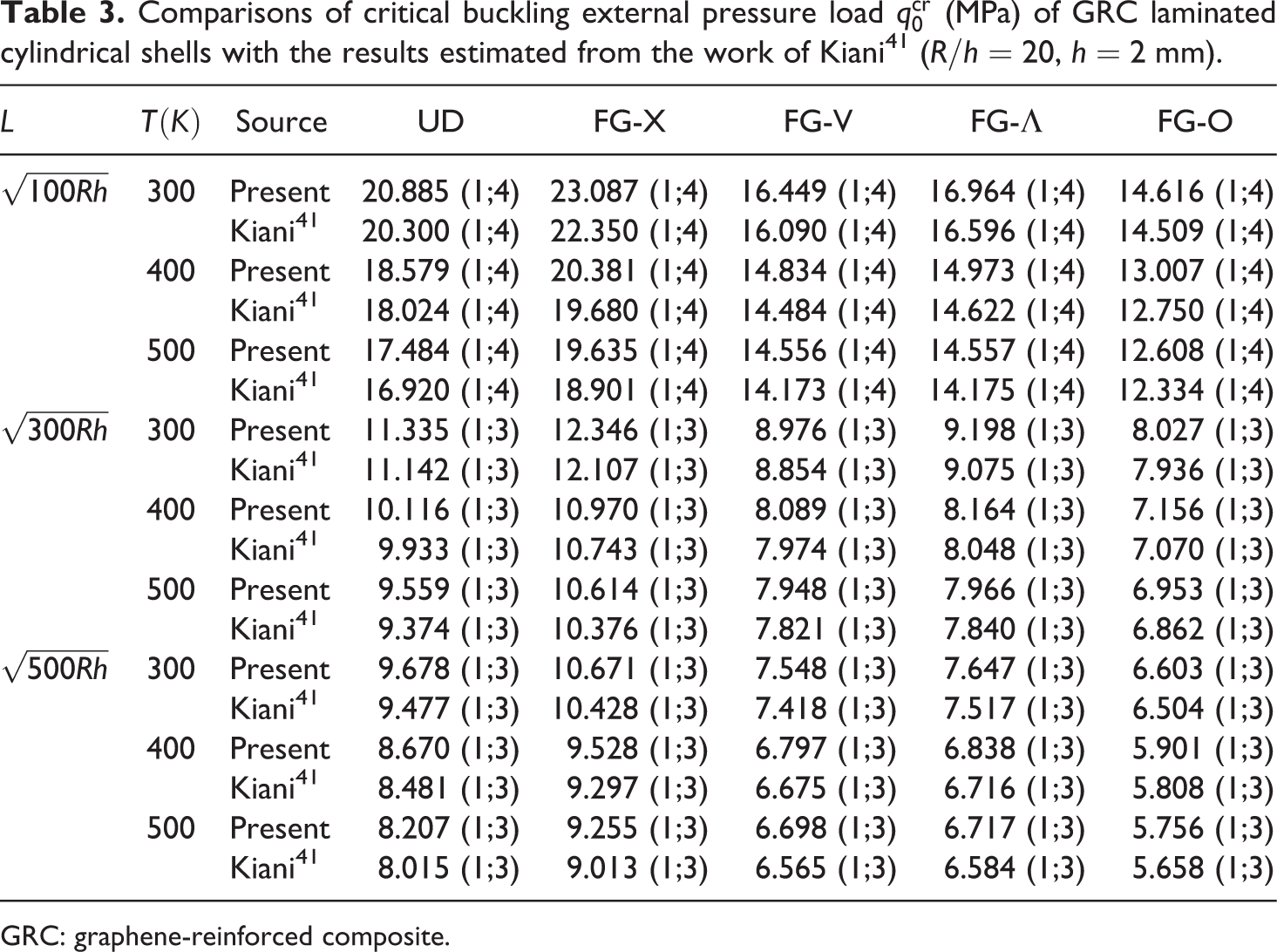
GRC: graphene-reinforced composite.
Material and geometrical parameters
In this section, the material and geometrical parameters of the considered FG-GRC laminated toroidal shell segments are given by
Effect of longitudinal curvature
The effect of longitudinal curvature on the critical external pressure buckling load
Effects of longitudinal curvature on the critical external pressure buckling load
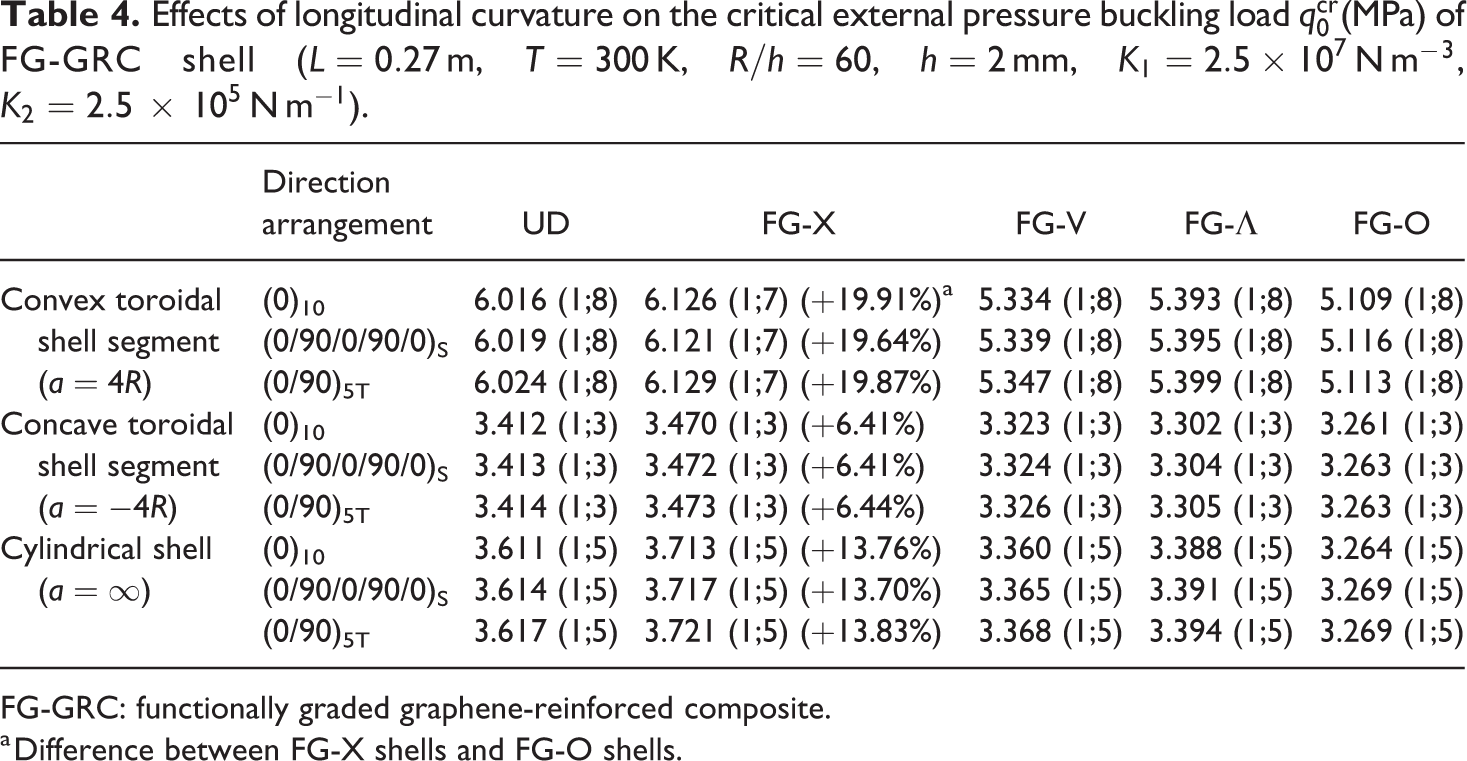
FG-GRC: functionally graded graphene-reinforced composite.
a Difference between FG-X shells and FG-O shells.
Effect of thermal environment
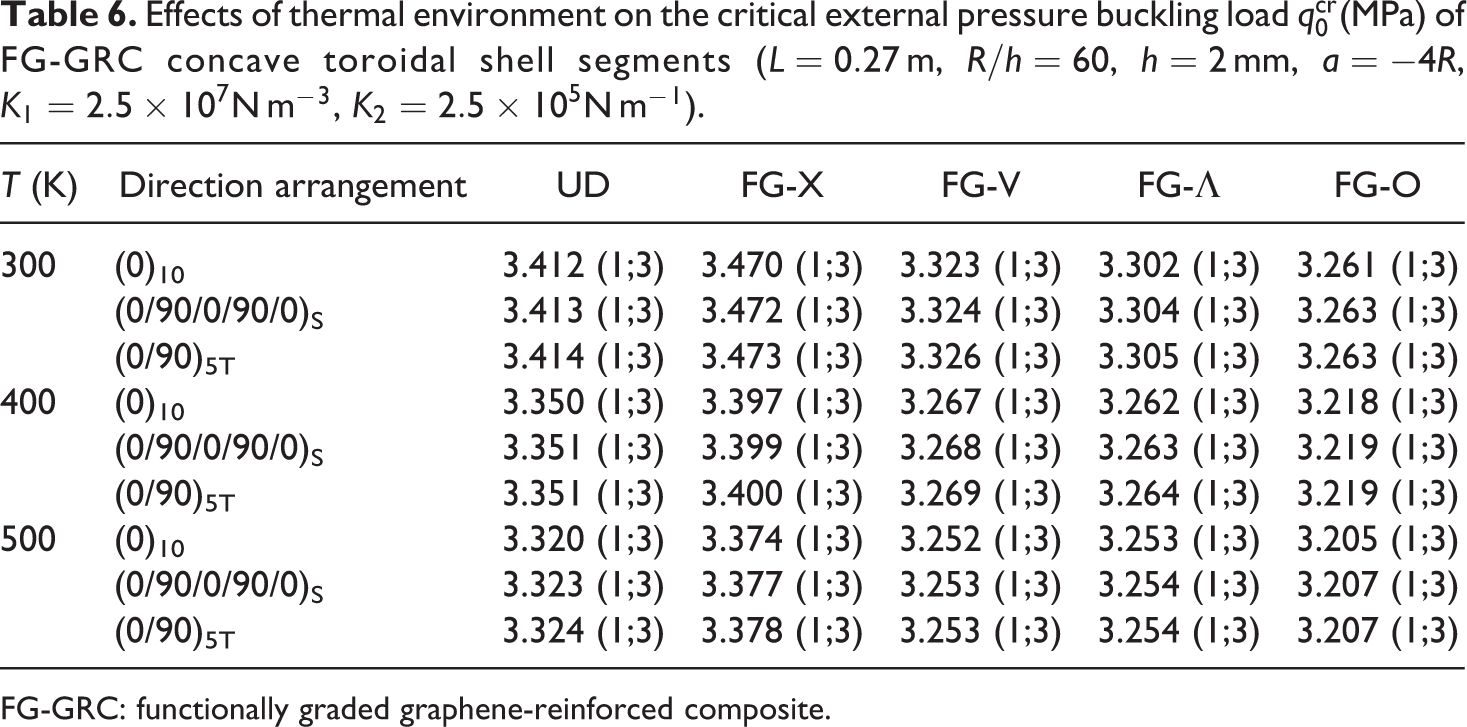
Tables 5 and 6 show the effects of thermal environment
Effects of thermal environment on the critical external pressure buckling load
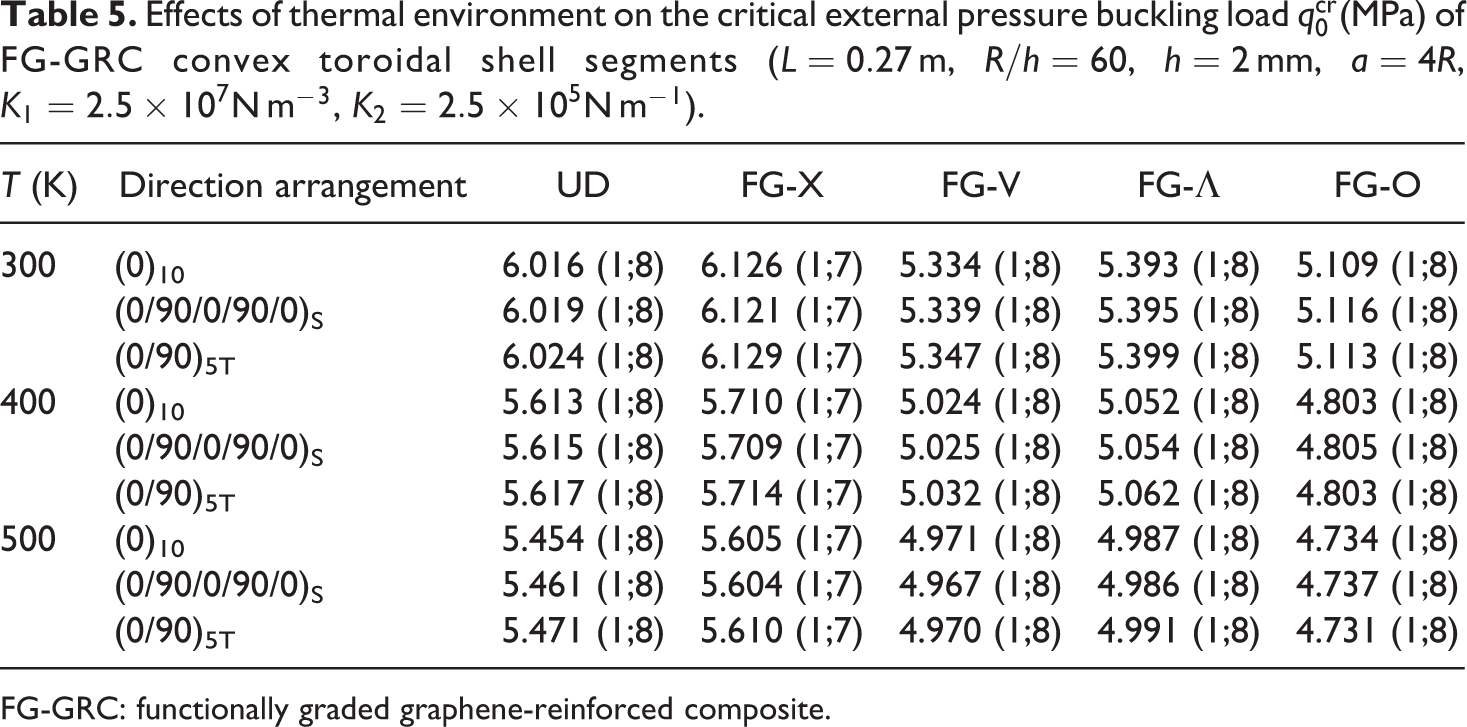
FG-GRC: functionally graded graphene-reinforced composite.
Effects of thermal environment on the critical external pressure buckling load
FG-GRC: functionally graded graphene-reinforced composite.
The effects of thermal temperature on the
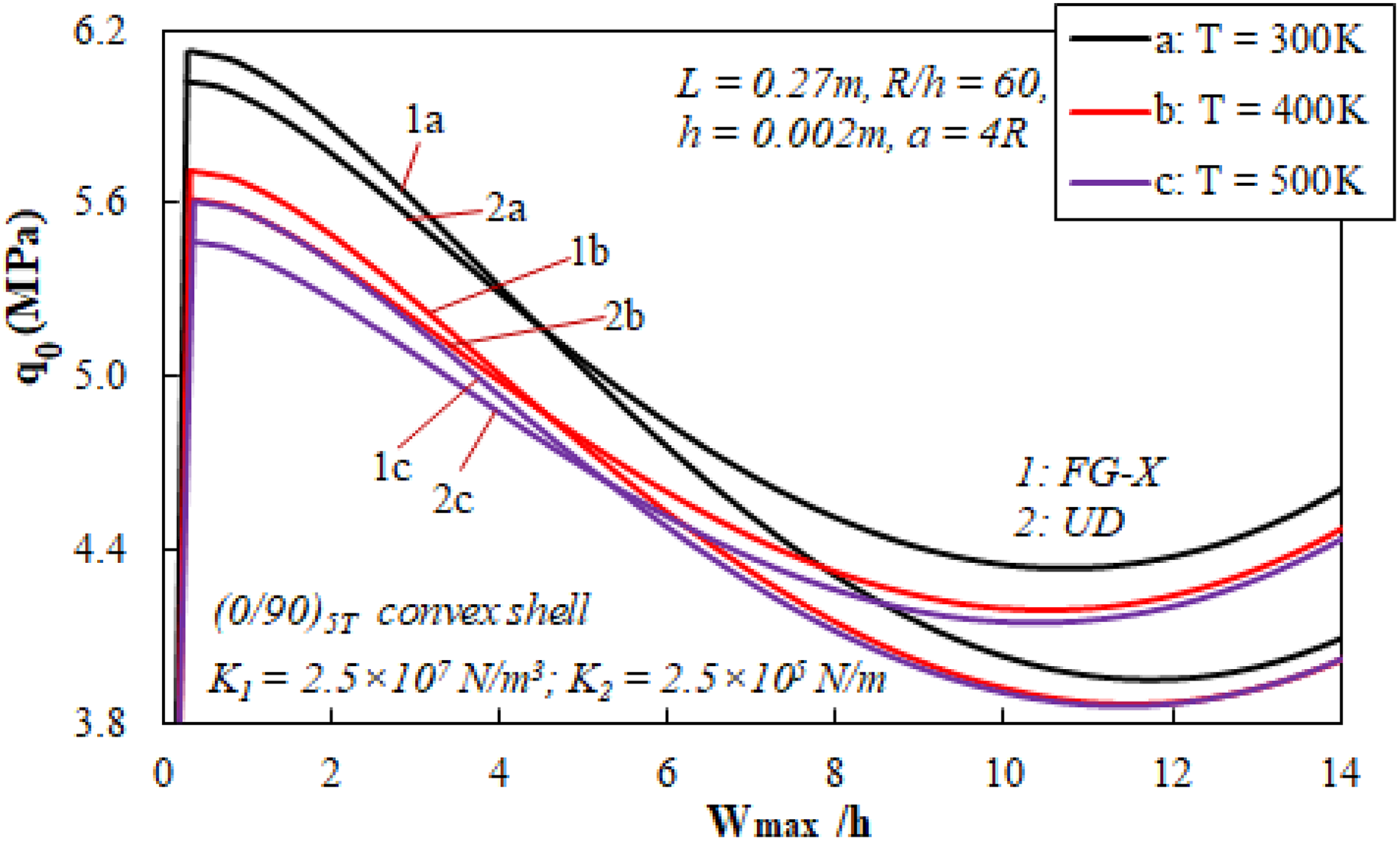
Effects of thermal environment on
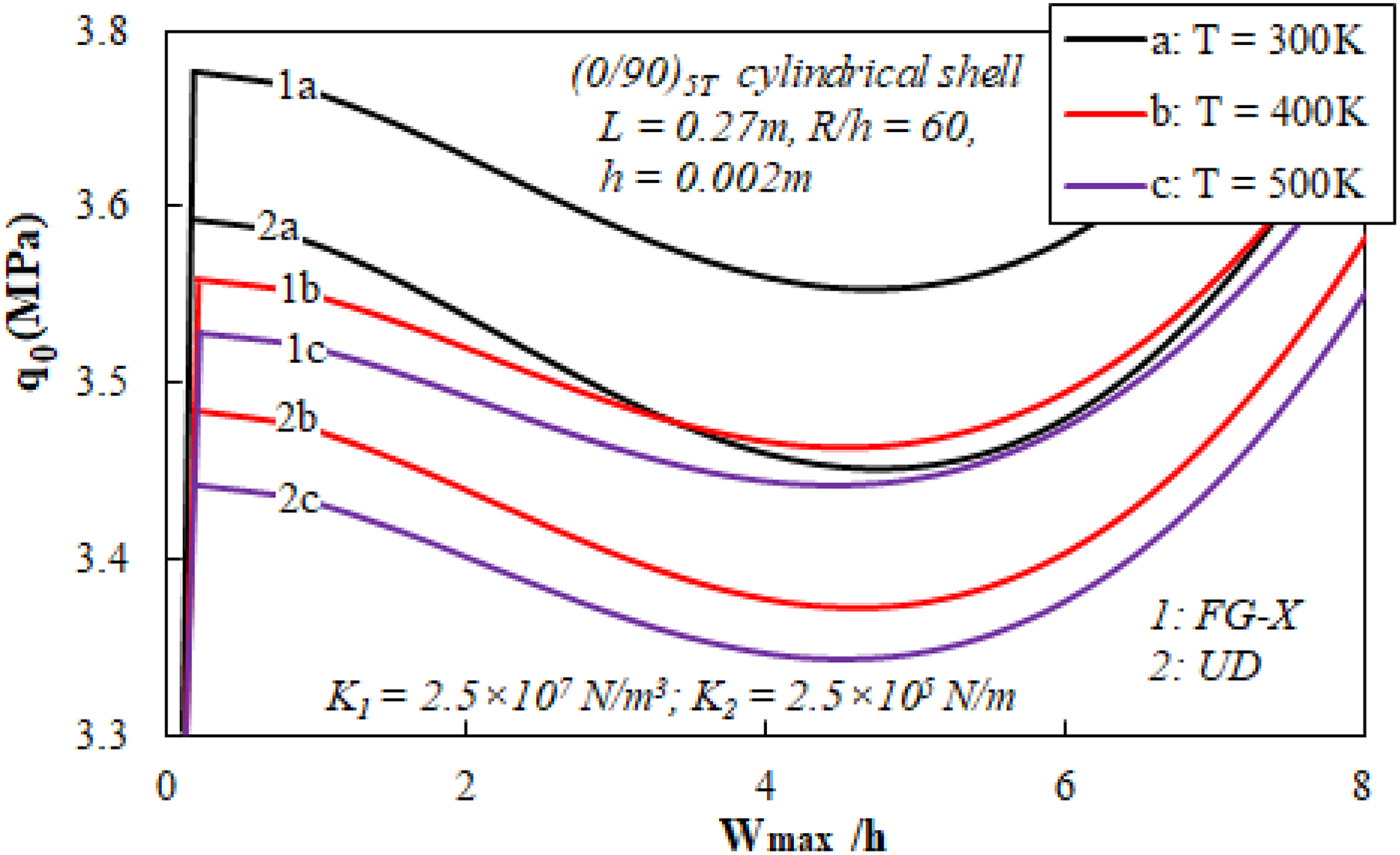
Effects of thermal environment on
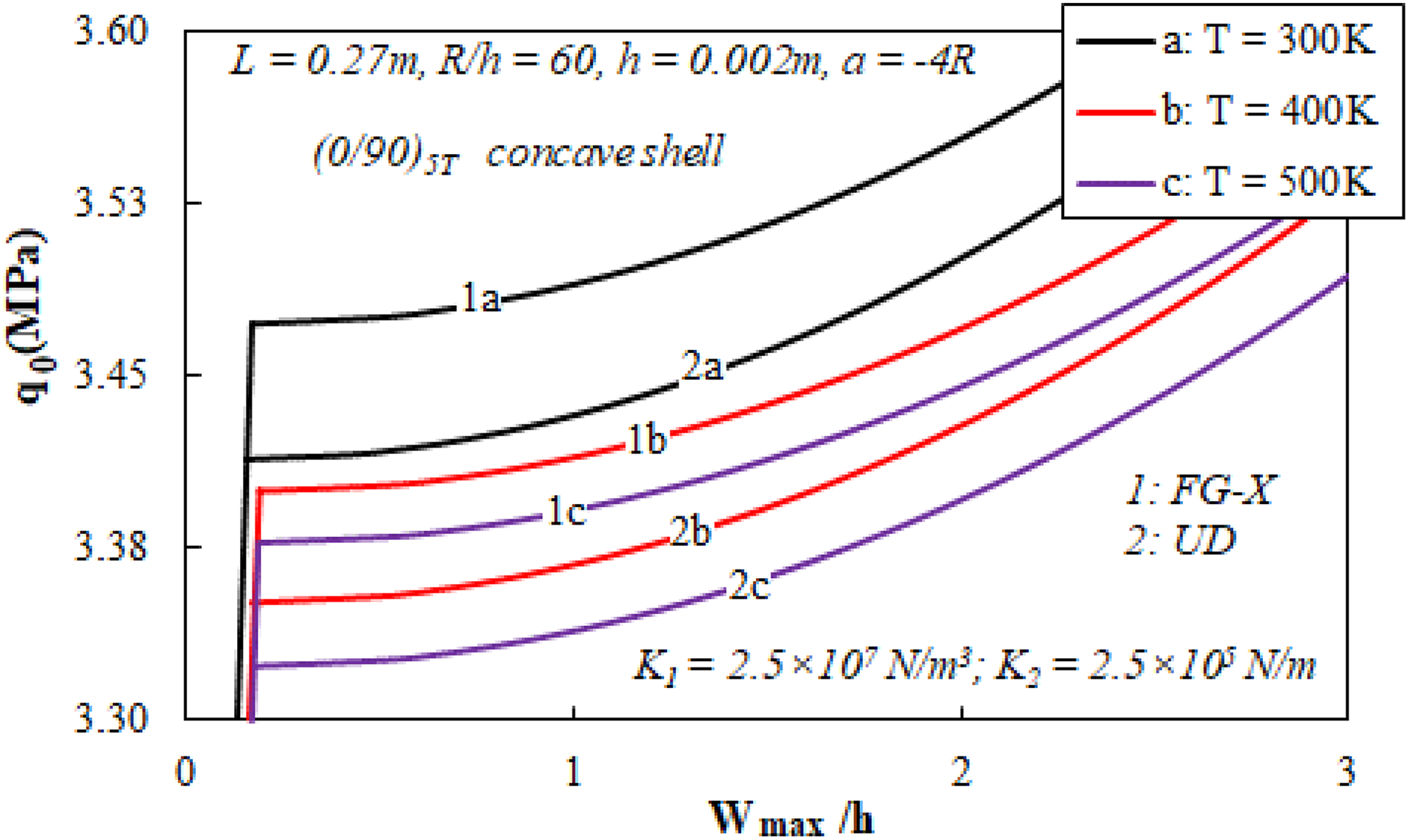
Effects of thermal environment on
Effect of geometric dimensions R/h
The effect of
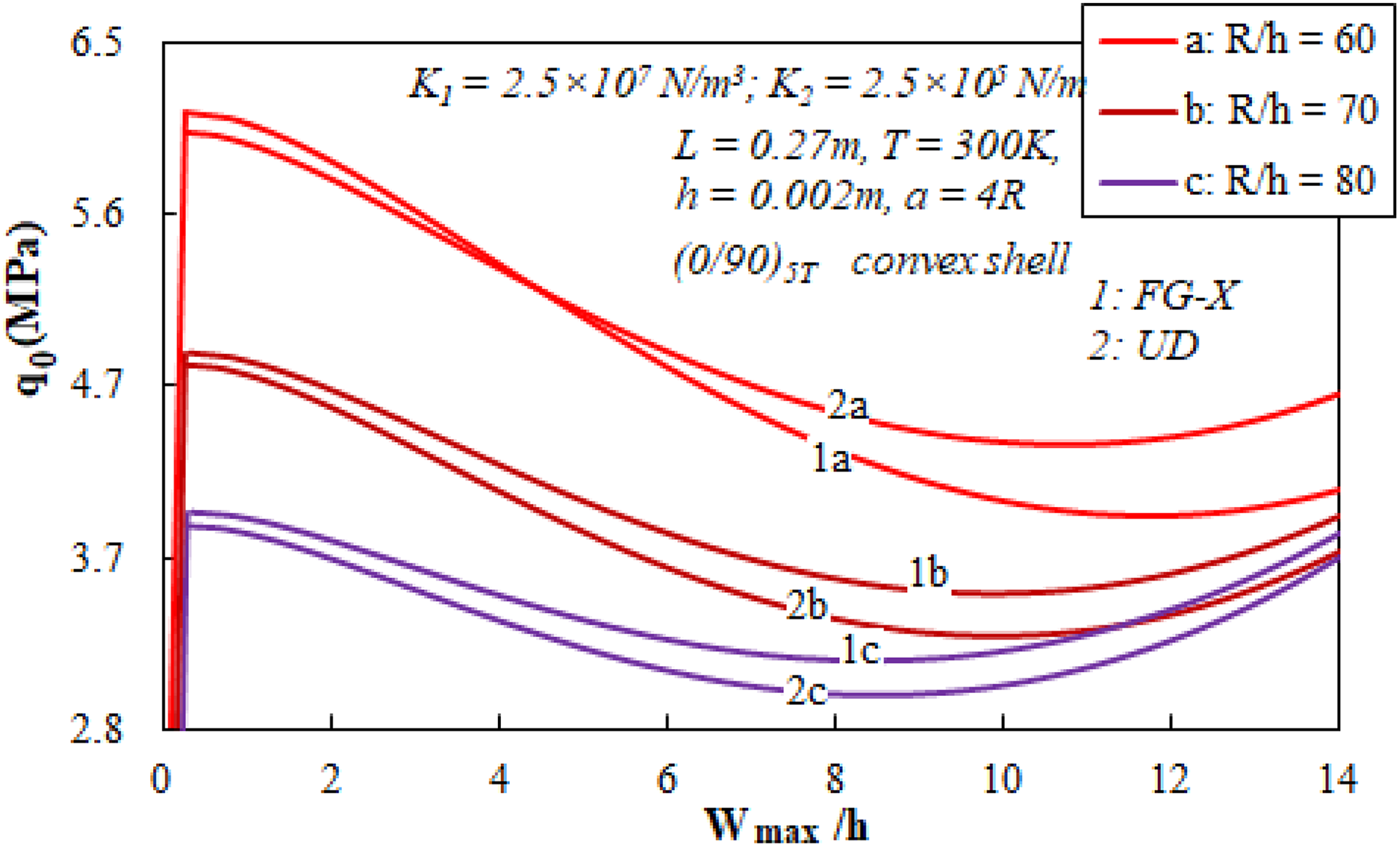
Effect of
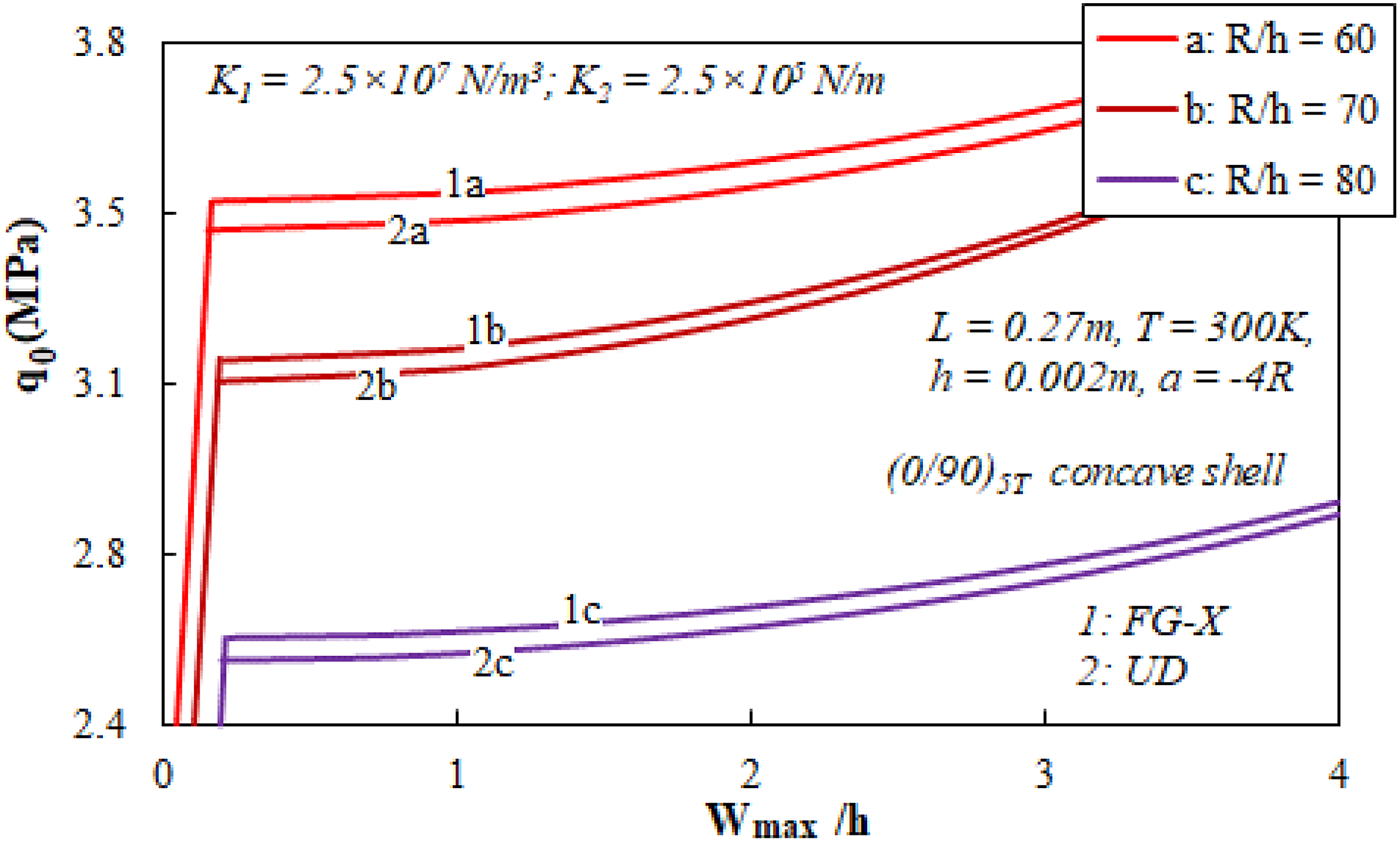
Effect of
Effect of
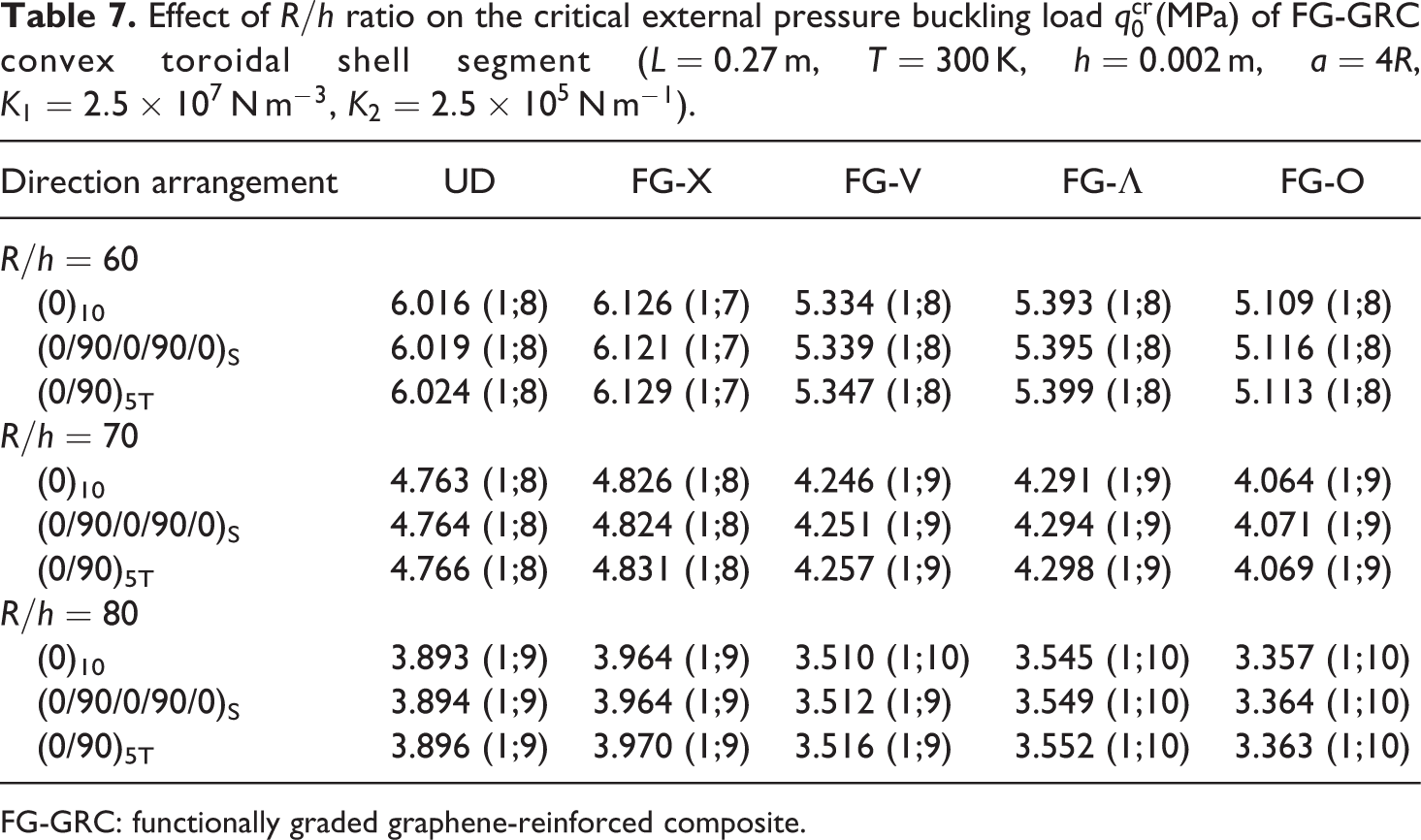
FG-GRC: functionally graded graphene-reinforced composite.
Effect of
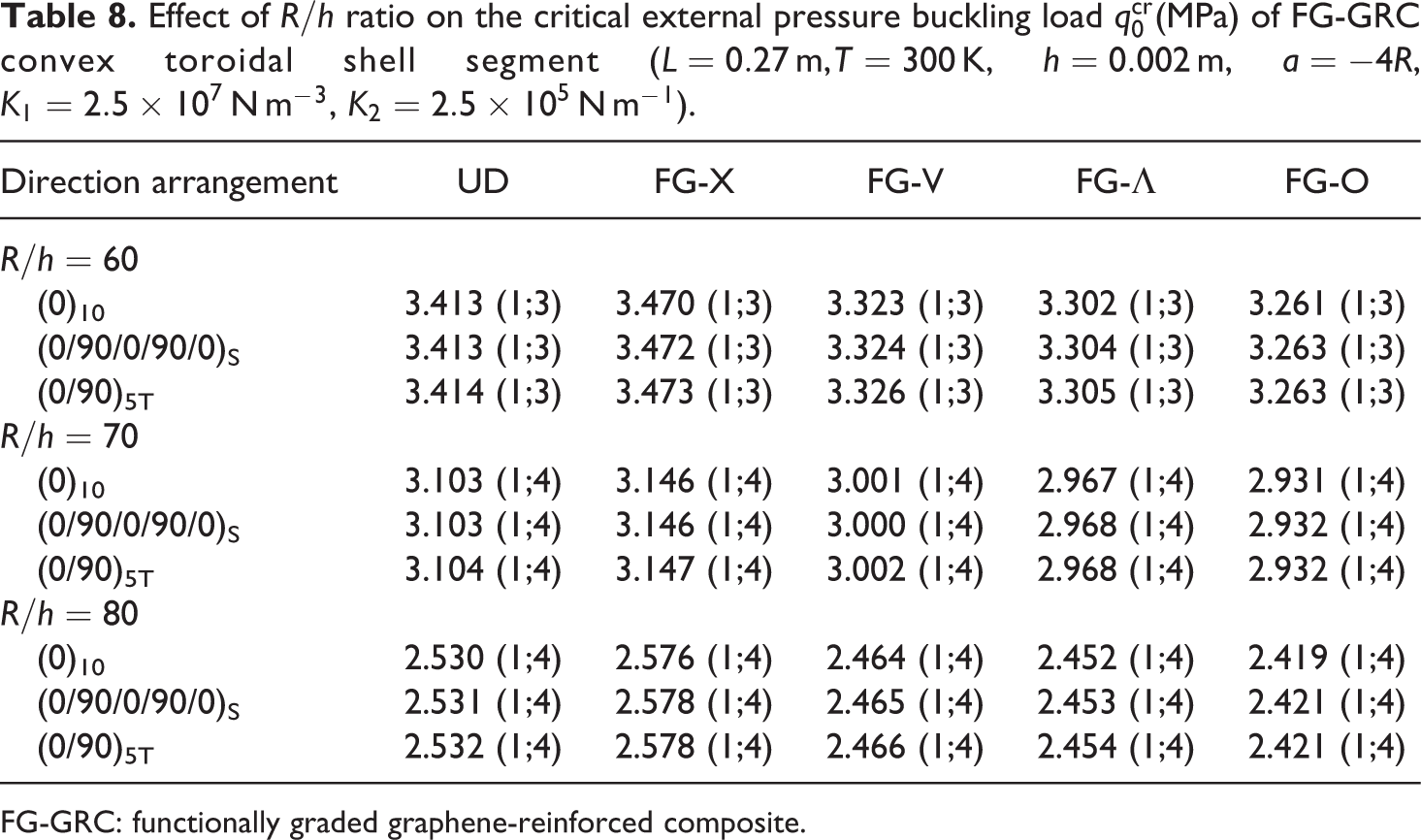
FG-GRC: functionally graded graphene-reinforced composite.
Effect of elastic foundation stiffness
Tables 9 and 10 and Figures 9 and 10 show the effects of Pasternak’s elastic foundation stiffness on the critical external pressure buckling load and postbuckling curve of FG-GRC toroidal shell segments, respectively. These tables and figures show a beneficial influence of elastic foundation on the buckling and postbuckling behavior of shells. Specifically, the capability of load carrying is enhanced and the intensity of snap-through behavior is reduced due to the presence of elastic foundations. In all numerical investigation, the snap-through phenomenon does not exist with concave toroidal shell segment.
Effect of elastic foundation on the critical external pressure buckling load
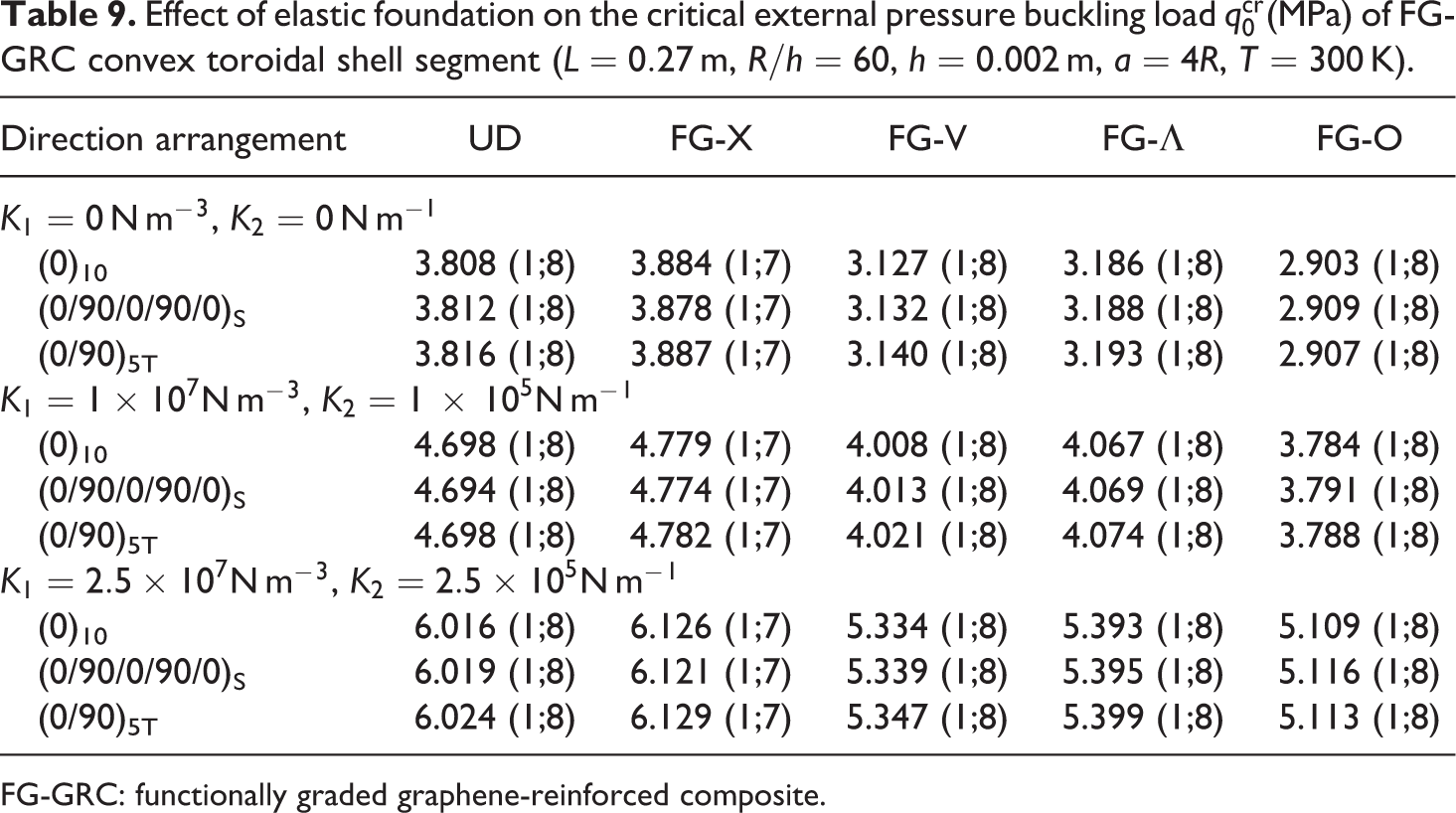
FG-GRC: functionally graded graphene-reinforced composite.
Effect of elastic foundation on the critical external pressure buckling load
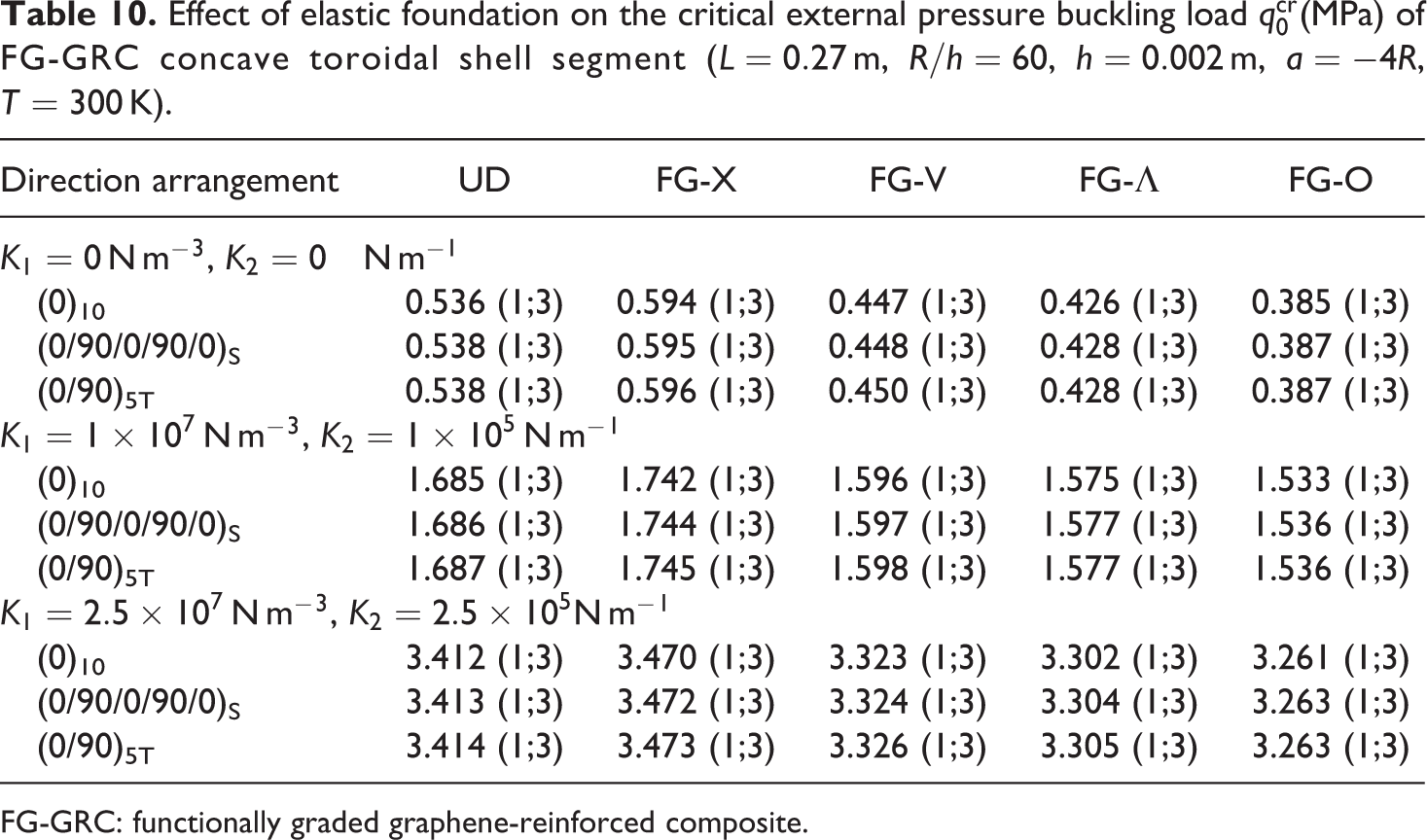
FG-GRC: functionally graded graphene-reinforced composite.
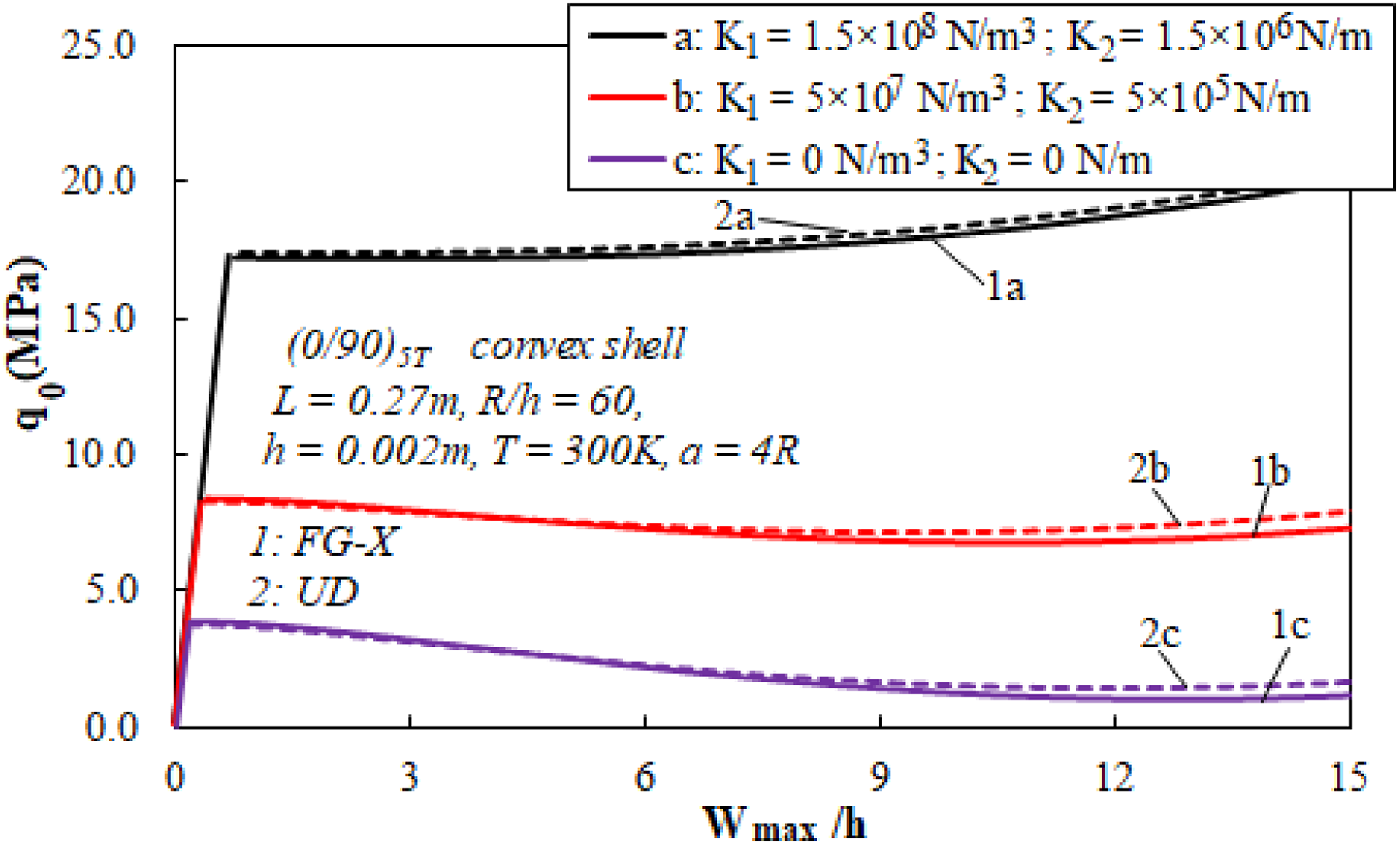
Effect of elastic foundation on
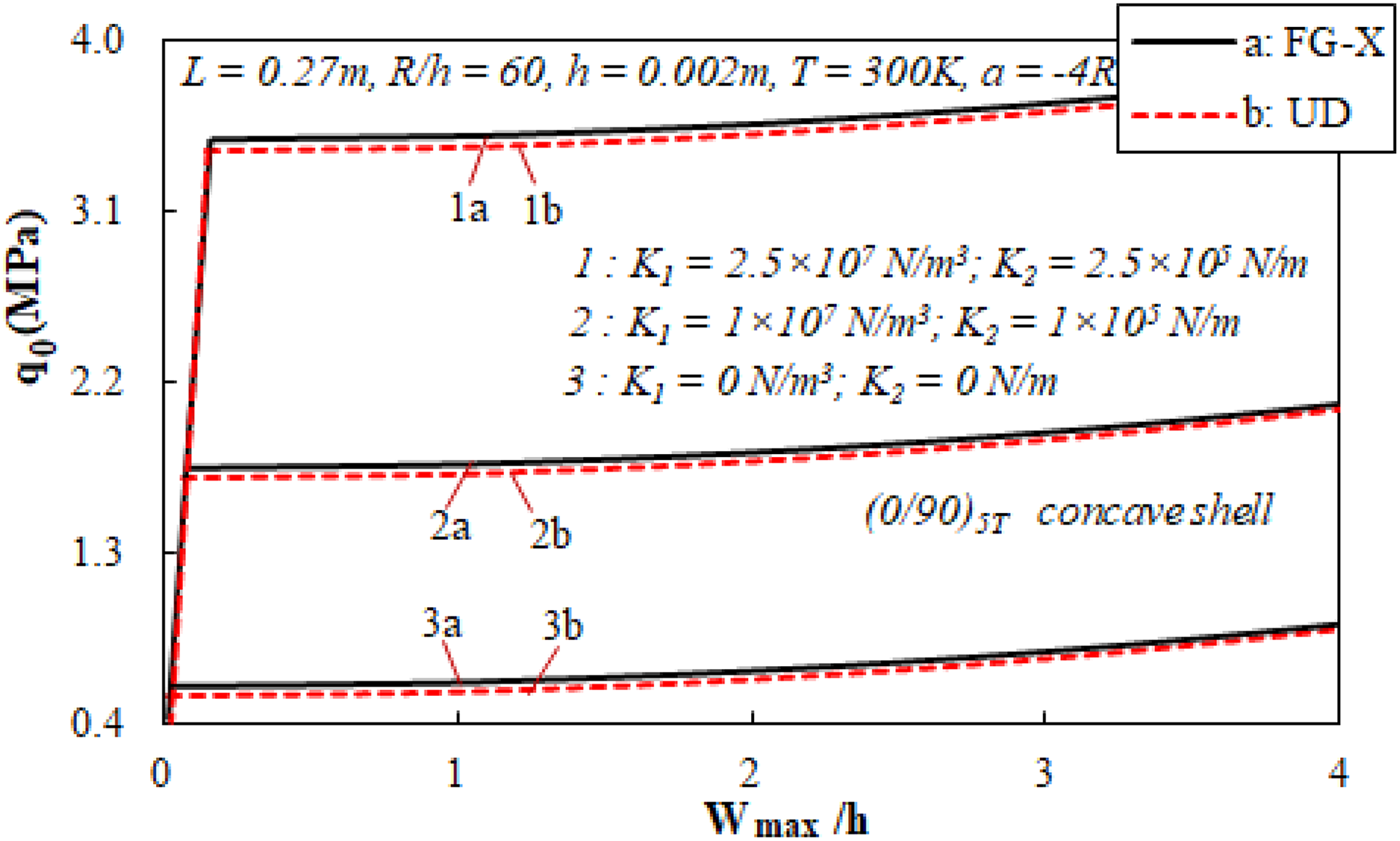
Effect of elastic foundation on
Effects of GRC direction arrangement
Figures 11 and 12 present the
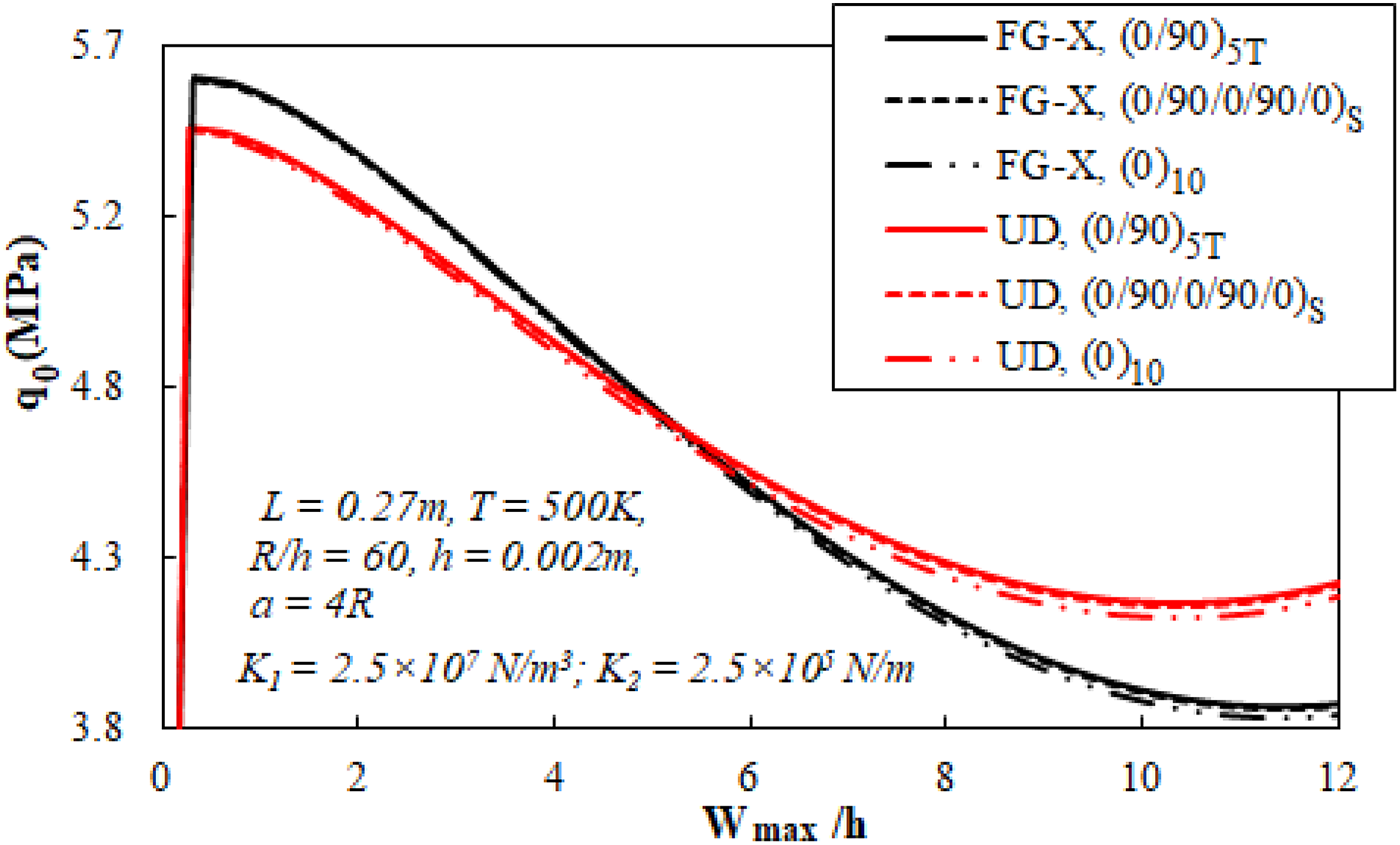
Effects of direction arrangement on
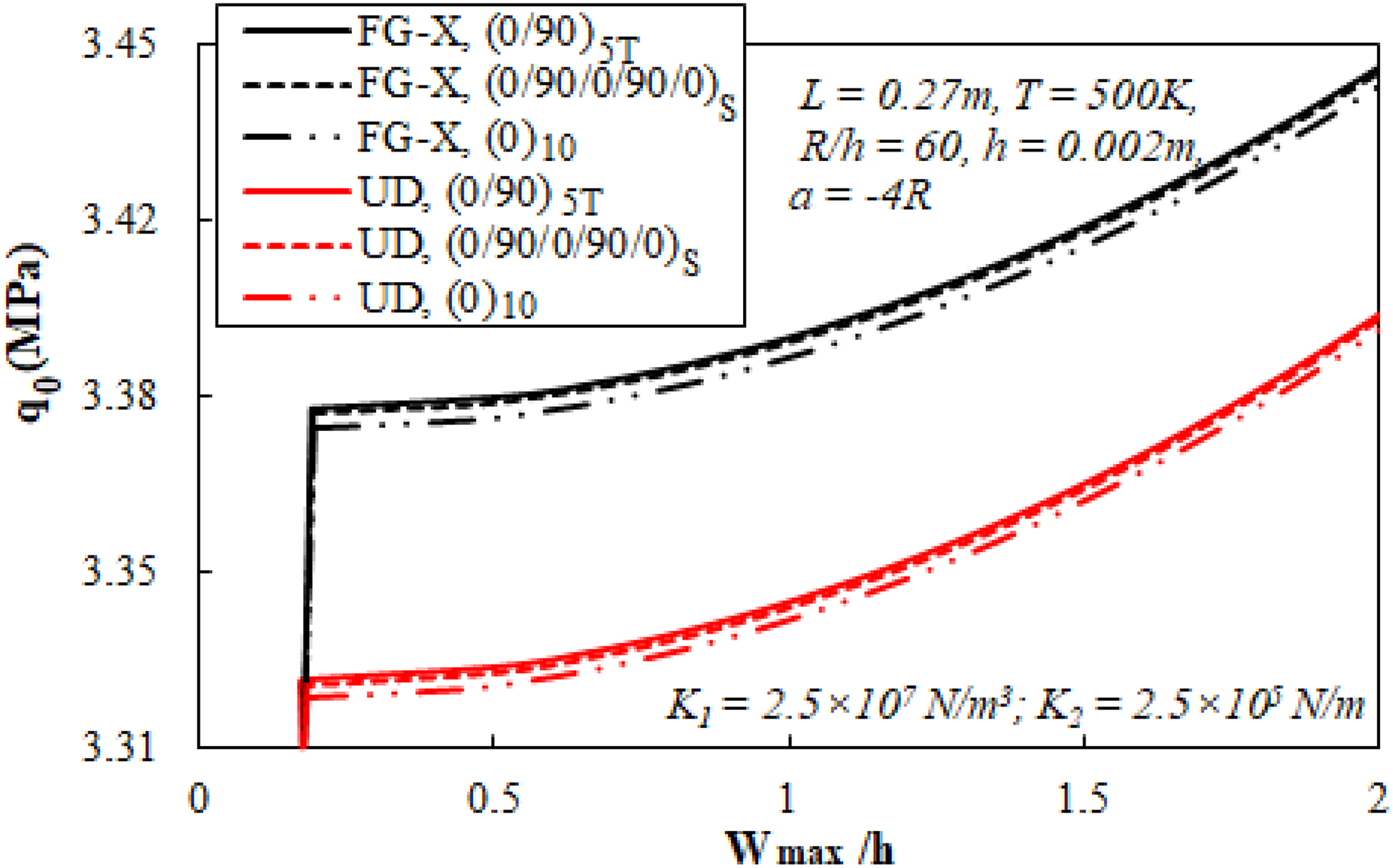
Effects of direction arrangement on
Effects of graphene reinforcement type
Figures 13 and 14 investigate the effects of graphene reinforcement type (UD, FG-X, FG-O, FG-V, and FG-Λ) on
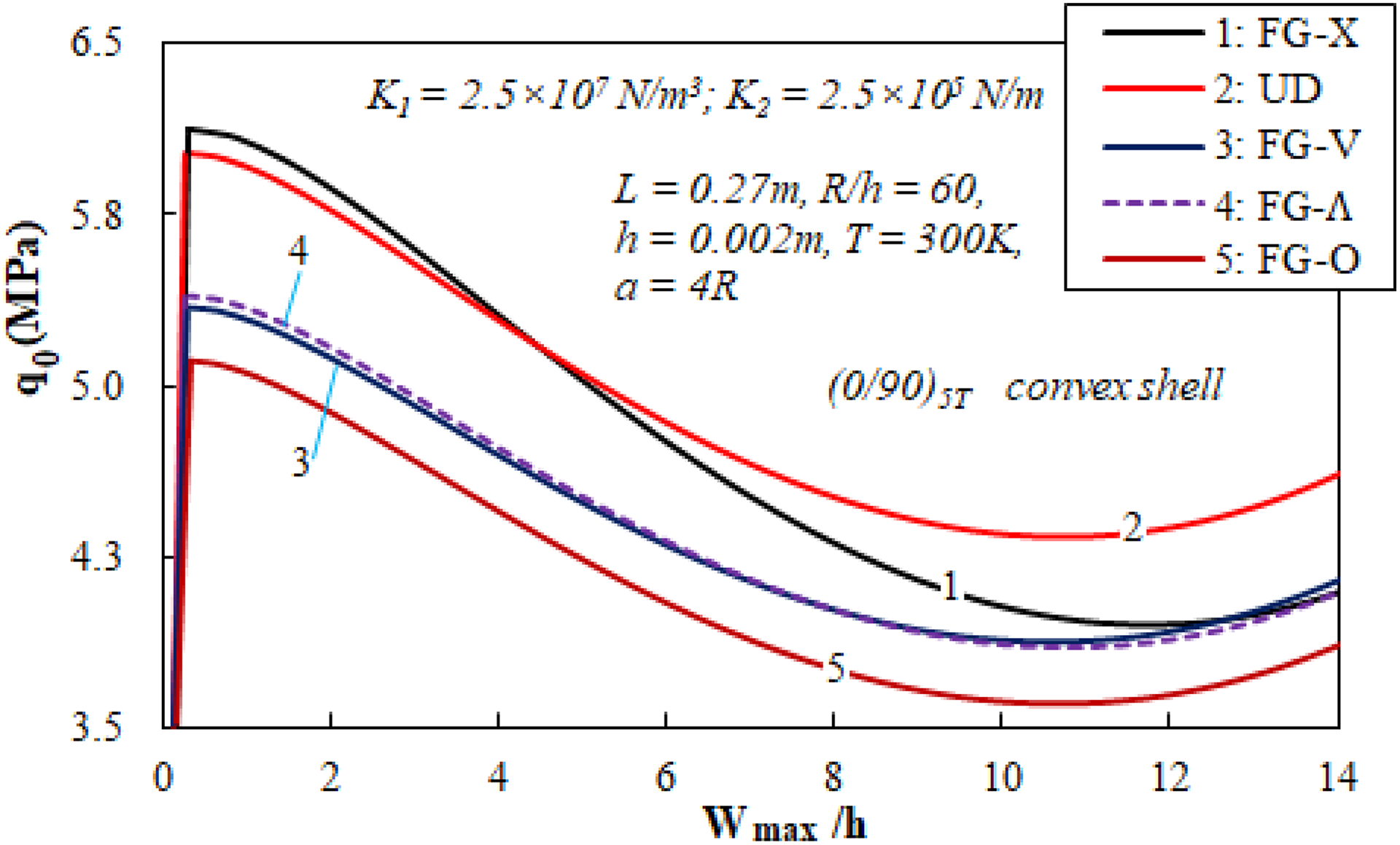
Effects of graphene reinforcement type on
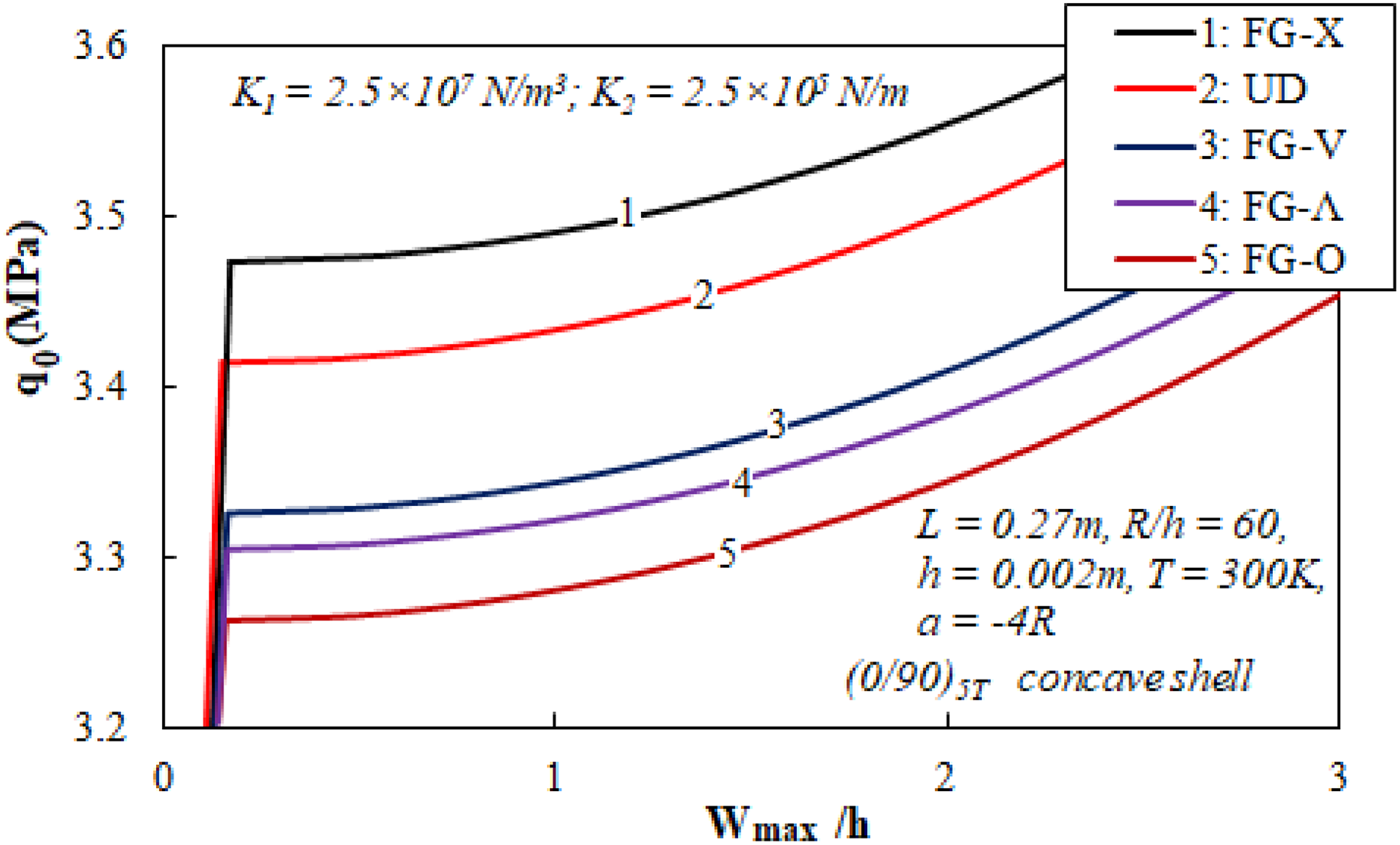
Effects of graphene reinforcement type on
Conclusions
The nonlinear buckling and postbuckling behavior of FG-GRC convex and concave toroidal shell segments exposed to thermal environments and subjected to uniform external pressure has been investigated in this article. An analytical approach with three-term solution form of deflection and Galerkin procedure is established using Donnell shell theory and von Kármán nonlinearity terms. Results show some important remarks: Direction arrangement of graphene layers lightly influences the critical buckling of toroidal shell segments. FG-X type is the most effective on critical buckling load of FG-GRC toroidal shell segments in all graphene reinforcement types. Reversely, critical buckling load of FG-O shell is the smallest. Difference between critical buckling load of FG-X shells and one of FG-O shells can be up to about 19.91% with convex toroidal shell segment, 13.83% with cylindrical shell, and 6.44% with concave toroidal shell segment. Critical buckling load of FG-GRC convex toroidal shell segment is greater than one of convex toroidal shell segment. Snap-through phenomenon is clearly observed with cylindrical shell and convex toroidal shell segment, while this phenomenon is not obtained with concave shells. As a final remark, elastic foundation and thermal environment strongly influence the nonlinear buckling behavior of FG-GRC toroidal shell segments subjected to external pressure.
It can be seen that the FG-GRC toroidal shell segment is the complex structure, and the present analytical approach is the effective solution to analyze its thermomechanical behavior in practical applications.
