



Abstract
In this article, we have studied thermal and dielectric conductivity and morphology of polycarbonate (PC)/ethylene–propylene copolymer (EPC)/multiwalled carbon nanotubes (MWCNTs) nanocomposites. Transmission electron microscopy has been used to investigate the localization and migration of MWCNTs within the matrix. The MWCNTs were located in the PC phase and at the interface of PC and EPC. The results showed that the thermal conductivity of the PC decreased with the increasing content of EPC elastomeric particles. However, at the same time, one could observe an increase of the thermal conductivity in the polymer blends along with an addition of MWCNT. The electrical conductivity of the PC/EPC blends containing 10 wt% of EPC increased with the incorporation of MWCNTs, and the conducting paths were formed at additive content less than 0.5 wt% of MWCNT.
Introduction
Carbon nanofillers-based polymer nanocomposites (NCs) have been recommended for electronic conductors and semiconductors due to their flexibility, printability, and low-cost.1–3 The performance, efficiency, and life-time of these polymer NCs depend on the physical characteristics of the host polymer matrix. On the one hand, the new structure of polymer matrices with advantages can be innovated with changes in the polymeric chains 4 or incorporation of the second polymer phase. 5 On the other hand, thermally and electrically conductive polymers can be obtained with incorporation of carbon nanofillers within nonconductive polymers.6,7 Among the carbon nanofillers, multiwalled carbon nanotubes (MWCNTs) have attracted much attention in the field of polymer electronics systems, due to their intrinsic high thermal and electrical conductivity in according to 3000 W/K m and 109 A/cm2,8,9 respectively. The MWCNTs were added into the polycarbonate (PC) by Potschke et al.10–17 to study the capacity of these polymer NCs for application in the electronic systems. Moreover, in the case of thermoplastic elastomer-based NCs, modification of PC with rubber and MWCNTs has been performed as a recent trend to create toughened and electrically conductive polymers.18,19 Therefore, there is a great interest of study on electrical and thermal behavior of embedded PC polymer-based NCs into the electronic devices.20–22 Accordingly, González et al. 23 proposed a tough semiconductor of PC/MWCNTs NCs combined with maleated styrene/ethylene–butylene/styrene rubber, in which the electrical percolation threshold equals to 0.5 wt% of MWCNTs. Moreover, in an immiscible poly(lactic acid) (PLA)/poly(ε-caprolactone) (PCL) polymer blend, the electrical percolation threshold increased by 2 orders of magnitude because of controlling the presence of MWCNTs at the interface of PLA and PCL phases. 24 The selective localization of carbon nanotubes (CNTs) inside the polymer blends has been discussed in the literature by Shi et al. 25 In an immiscible PLA/maleic anhydride-grafted polypropylene blend, the electrical conductivity as well as storage modulus and thermal properties were increased with the increment of the MWCNTs content. 26 Furthermore, thermally conductive poly(vinylidene fluoride) (PVDF)/polyvinylpyrrolidone (PVP)/treated CNTs NCs has been produced by Zhang et al. 27 They reported that the CNTs can improve the thermal conductivity of the NCs, while the PVDF polymers which incorporated with PVP treated CNTs indicated higher thermal conductivity that those of PVDF/CNTs NCs. 27
Cross-linked ethylene–propylene copolymer (EPC) under the trade name of Vistamaxx belongs the group of polyolefin, which is primarily composed of isotactic propylene repeated units with random ethylene distribution. The idea of compounding EPC elastomeric particles with PC was first proposed by Taraghi et al., 28 in which the 335% increment for the impact strength appeared with mixing 10% EPC in the PC matrix. In this article, the influence of CNTs on thermal and electrical conductivity, rheological behavior, and thermal stability of PC/EPC immiscible blends is studied. The main objective of our experiments is to clarify the capability of PC/EPC/MWCNTs NCs for thermal and electrical resistance as a substrate in electronic devices.
Experimental methods
Materials
Polycarbonate type PC-1100 was supplied by Lotte Chemical with a density of 1.2 g/cm3 and melt flow index (MFI) of 10 g/10 min. Cross-linked EPC Vistamaxx 6202 propylene-based elastomer with an ethylene content of 15 wt% was purchased from ExxonMobil Chemical Company, Houston, USA. Density and MFI of Vistamaxx 6202 were 0.863 g/cm3 and 9.1 g/10 min, respectively. The Young’s modulus, yield stress, elongation at break, and volume resistivity of EPC were studied and presented elsewhere. 28 MWCNTs (US3302) were purchased from US Research Nanomaterials, Inc, Houston, USA. The MWCNTs were produced by chemical vapor deposition method. The inside diameter of CNTs was 5–10 nm and the outside diameter was 10–20 nm; the lengths of CNTs were 10–30 μm. 29
Sample preparation
A detailed study about the composition of PC/EPC blends and PC/EPC/MWCNTs NCs has been presented in the previous study. 28 Herein, first the PC and MWCNTs were dried in a vacuum oven at 80°C for about 24 h. The PC/EPC blends were prepared by mixing of dried PC with different contents (10, 20, and 30 wt%) of EPC. For the production of the NCs, the PC and EPC were weighed to the ratio of 9:1, while the concentrations of MWCNT were 0.5, 1, and 1.5 wt%. The mixing materials were fed into a Brabender (Germany) DSE25 intermeshing, corotating twin-screw extruder with a length/diameter ratio of 30. The melting temperature and the screw speed of extruder were set at 290°C and 40 r/min, respectively. The extruded blends and NCs were cooled at room temperature and then they were pelletized using Wieser mill machine to be ready for compression molding.
Characterization
Morphological evaluation
The dumbbell-shaped NCs were cryogenically fractured into the liquid nitrogen to be prepared for scanning electron microscopy (SEM) analysis. The morphology and the state of dispersion of CNTs in the polymer blend were demonstrated via a KYKYEM3200 SEM system. To investigate the selective localization of MWCNTs inside the polymer blend, the NCs were first cryogenically fractured in liquid nitrogen, and the surface was etched in acetone solvent to remove the PC phase from the blend. Moreover, the morphological study of the NCs based on polymer blends has been carried out by means of transmission electron microscopy (TEM). The ultrathin sections of the specimens (50 nm) were provided at room temperature using Reichert Ultracut R ultramicrotome equipped with a diamond knife. TEM investigations were carried out at JEOL JEM-1200 Electron Microscope, Massachusetts, USA at an acceleration voltage of 80 kV.
TGA measurements
Thermo-oxidative stability of the obtained NCs was performed by thermogravimetry (TGA 92-16.18 Setaram) using the system to measure the simultaneous thermogravimetry-derivative thermogravimetry (TG-DTG). Measurements were carried out in oxidizing atmosphere, that is, dry, synthetic air (N2:O2 = 80:20 vol%). The study was conducted in the temperature range of 20–700°C at the heating rate of 10°C/min. Measurements were performed in accordance with the principles of PN-EN ISO 11358:2004.
Dielectric spectroscopy measurements
Dielectric measurements were performed on the compression molded thin sheets of NCs (thickness of 100 μm). The granules of NCs were pressed at 290°C for 5 min under the pressure of 0.5 MPa, and then the samples were cooled down to ambient temperature under the same pressure condition. The electrical characterization of the NCs was conducted by means of a Novocontrol broadband dielectric spectrometer in the frequency range from 10−2 Hz to 107 Hz, at room temperature. The complex dielectric permittivity ε* = ε′ − iε″, where ε′ represents the permittivity and ε″ represents the dielectric loss, was measured as a function of frequency (F) of the applied electric field. Electrical conductivity was calculated from equation: σ(F) = ε02πFε″, where ε0 is the vacuum permittivity. 30
Thermal conductivity methods
To determine the thermal conductivity coefficient of the polymer materials, the transient plane source (TPS) method, the Hot Disk TPS 2500 S (Uppsala, Sweden), and the Hot Disk thermal constants analyzer were used according to ISO 22007-2. The measurements were performed on the middle part of the sample sheet with the penetration depth of 3.5
Results and discussions
Morphological results
Figure 1(a) to (f) shows the SEM images of fracture surface of the PC/EPC blend enhanced by 0.5, 1.0, and 1.5 wt% of MWCNTs, respectively. The CNTs were well-dispersed in the PC/EPC blend in Figure 1(a) to (d), where the weight concentrations are 0.5 and 1.0 wt% of MWCNTs, respectively. Along with the increase in MWCNTs content up to 1.5 wt%, some parts of agglomeration have been observed, as shown in Figure 1(e) and (f). Moreover, the morphology of PC/EPC (10%) blend was changed by the increase in the content of MWCNTs, as shown in Figure 1(a) to (f). It is obvious that by adding a small amount of MWCNT (0.5 wt%) into the fixed ratio of 90/10 (PC/EPC), the NC shows typical sea-island morphology (Figure 1(a) and (b)). By the increase in the content of MWCNTs to 1%, the morphology changes from sea-island to co-continues like structure, as shown in Figure 1(c) and (d). As the MWCNT content increased to 1.5%, the morphology came back to sea-island structure with increased domain size of EPC droplets, as shown in Figure 1(e) and (f). The TEM images of the NCs samples provide information on the morphology and spatial distribution of multiple systems. Figure 2(a) to (c) shows the TEM images of PC/EPC/MWCNTs NCs reinforced with 0.5, 1.0, and 1.5 wt% of MWCNTs, respectively. In these images, the dark regions represent the EPC phase and the brighter ones show the PC phase. This phenomenon confirms the immiscibility of the PC and EPC phases. Moreover, the MWCNTs are uniformly distributed and localized in the amorphous PC and at the interfaces of PC and EPC phases, as shown in Figure 1(c). The enhanced interfacial interaction between immiscible PC and EPC phases is the main reason for the previously reported improvement of the mechanical properties. 28 Moreover, MWCNTs are homogenously dispersed in the blend when the content of MWCNTs is lower than 1 wt%. Thus, the highest mechanical properties are obtained with the incorporation of 1 wt% MWCNTs. Only, local agglomerates are observed at the MWCNTs concentration of 1.5 wt%. The MWCNTs are fully connected to each other and thus created a conductive network through the insulating polymer. Furthermore, the thermal stability and thermal and electrical conductivity of the PC/EPC (10%) have been improved by the well-distributed MWCNTs. In fact, the interconnected network structure of MWCNTs throughout the polymer matrix restricted the polymer chains motions, and consequently, the thermal and electrical properties of the PC/EPC (10%) are improved. 31 Moreover, Figure 3 confirms that MWCNTs have tendency to selectively localize in the PC phase of the PC/EPC blend and at the interface of PC and EPC immiscible polymers. The distribution of MWCNTs in one phase within the blended polymer or at the interfaces of two immiscible PC and EPC phases leads to a homogenous material. The electrical conductive NCs were obtained using the incompatibility between the polymers, the difference of affinity of the polymers to MWCNTs, an optimum processing condition, and a proper manufacturing method.
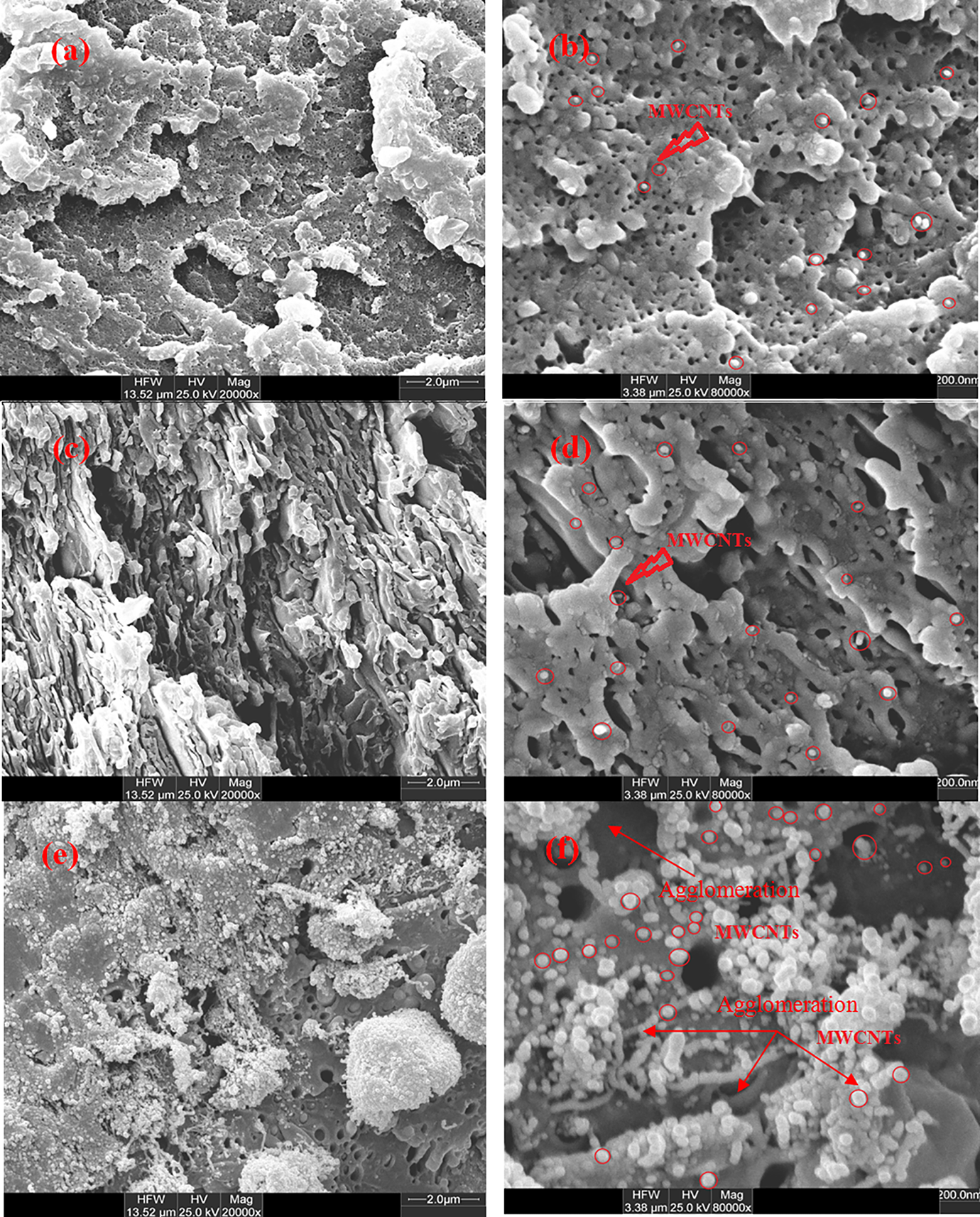
SEM images of cryo-fractured surface of nanocomposites: (a and b) PC/EPC (10%)/MWCNT (0.5%), (c and d) PC/EPC (10%)/MWCNT (1.0%), and (e and f) PC/EPC (10%)/MWCNT (1.5%). (Left: 2 µm, right: 200 nm).
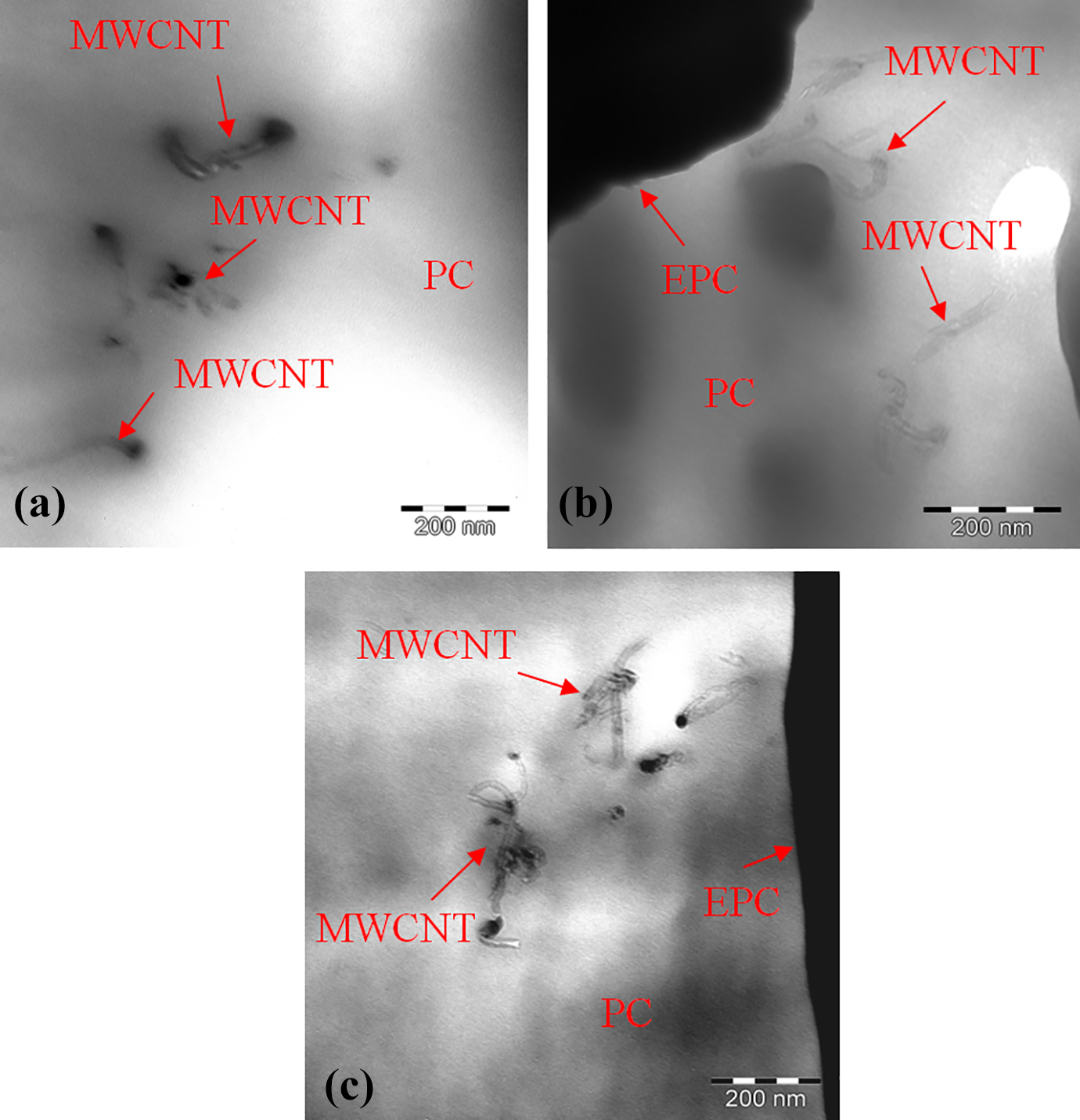
TEM micrographs of PC/EPC (10%) blend reinforced with different weight percentage: (a) 0.5 wt%, (b) 1.0 wt%, and (c) 1.5 wt% of MWCNTs.
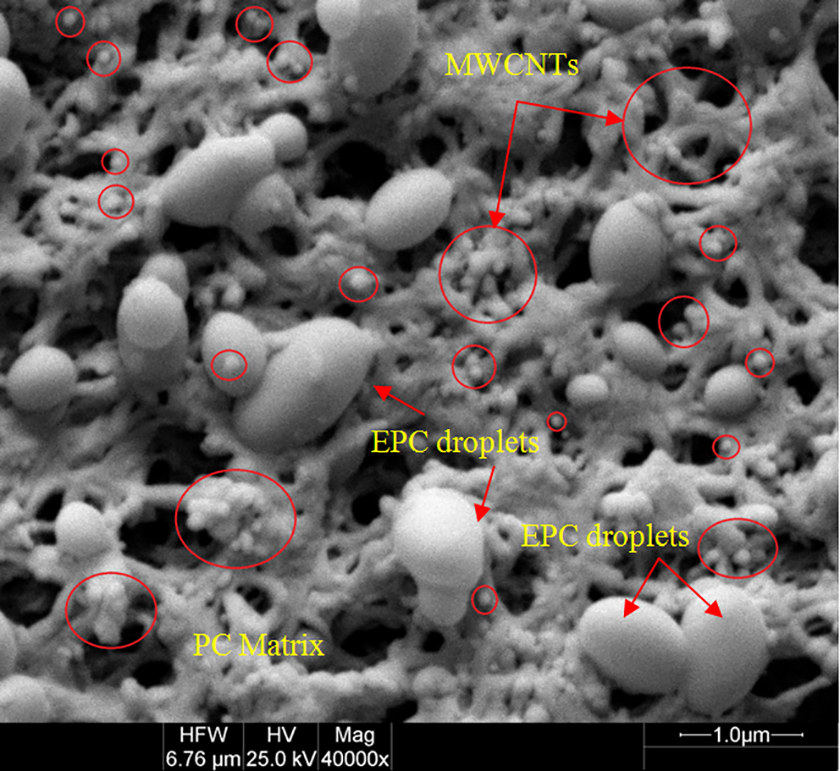
Selective localization of multi-walled carbon nanotubes inside PC/EPC polymer blend.
Thermal stability
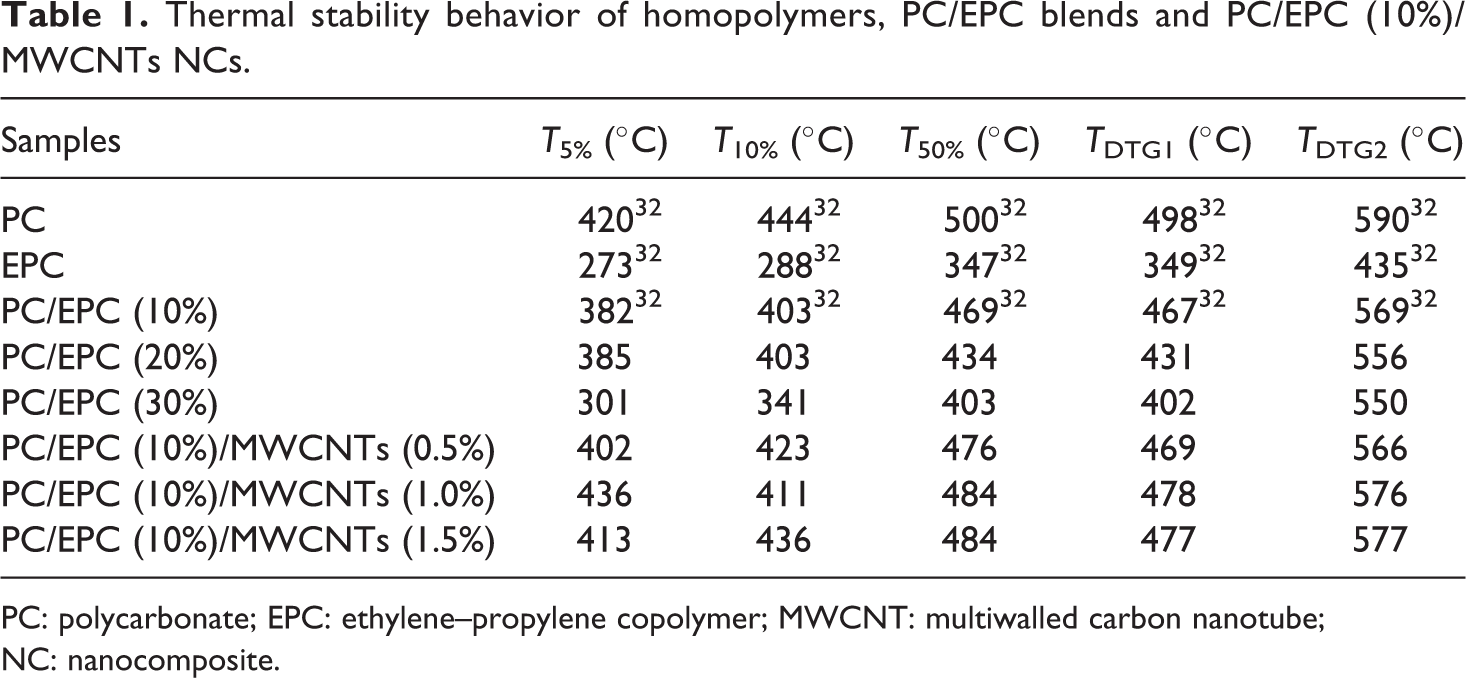
The weight loss and its derivative parameters for the PC, EPC, and PC/EPC (10%) blend in the oxidizing atmosphere have been measured and well discussed in the previous study. 32 Herein, the influence of different content of EPC and MWCNTs on the thermo-oxidative stability of PC has been studied. In this case, the weight loss and its derivative curves for the PC, PC/EPC blends, and PC/EPC (10%)/MWCNTs NCs have been shown in Figure 4(a) and (b), respectively. PC is more thermally stable than PC/EPC blends (containing different compositions of EPC), since the rapid degradation of PC/EPC blends is due to the thermal decomposition of EPC phases. The PC/EPC blends show two degradation steps, and the amount of mass loss corresponds to the respective amounts of EPC in the blends, which confirms the immiscibility of the blends. 33 In the first step of weight loss, the PC/EPC (10%) blend decomposes within the temperature range of 340–540°C comparing to those of PC/EPC (20%) and PC/EPC (30%) blends in which the specimens decompose at 300–450°C and at 250–430°C, respectively. In addition, the MWCNTs cause an increase of the thermal stability of PC/EPC (10%) blend. The same trend for improvement of the thermal stability of aforementioned blends was reported with the incorporation of SiO2 nanoparticles within the polymer. 32 Herein, the increase in the thermal oxidative stability of the PC/EPC blends with the addition of MWCNTs is due to the intrinsic thermal stability and thermal conductivity of the nanotubes and their barrier effects. 34 Moreover, the thermal stabilization effect of CNTs could be attributed to the enhanced interfacial interactions between MWCNTs and the blend matrix. 35 The temperatures corresponding to the different stages of thermo-oxidative decomposition for the specimens are listed in Table 1. The degradation temperatures at 5%, 10%, and 50% of weight loss shifted to higher values, that is, 411°C, 436°C, and 484°C for the PC/EPC (10%)/MWCNTs (1%) in comparison with those of PC/EPC (10%) which are 382°C, 403°C, and 469°C, respectively. It can be concluded that with incorporation of MWCNTs, the thermal oxidation process of PC/EPC blends is significantly delayed. 36
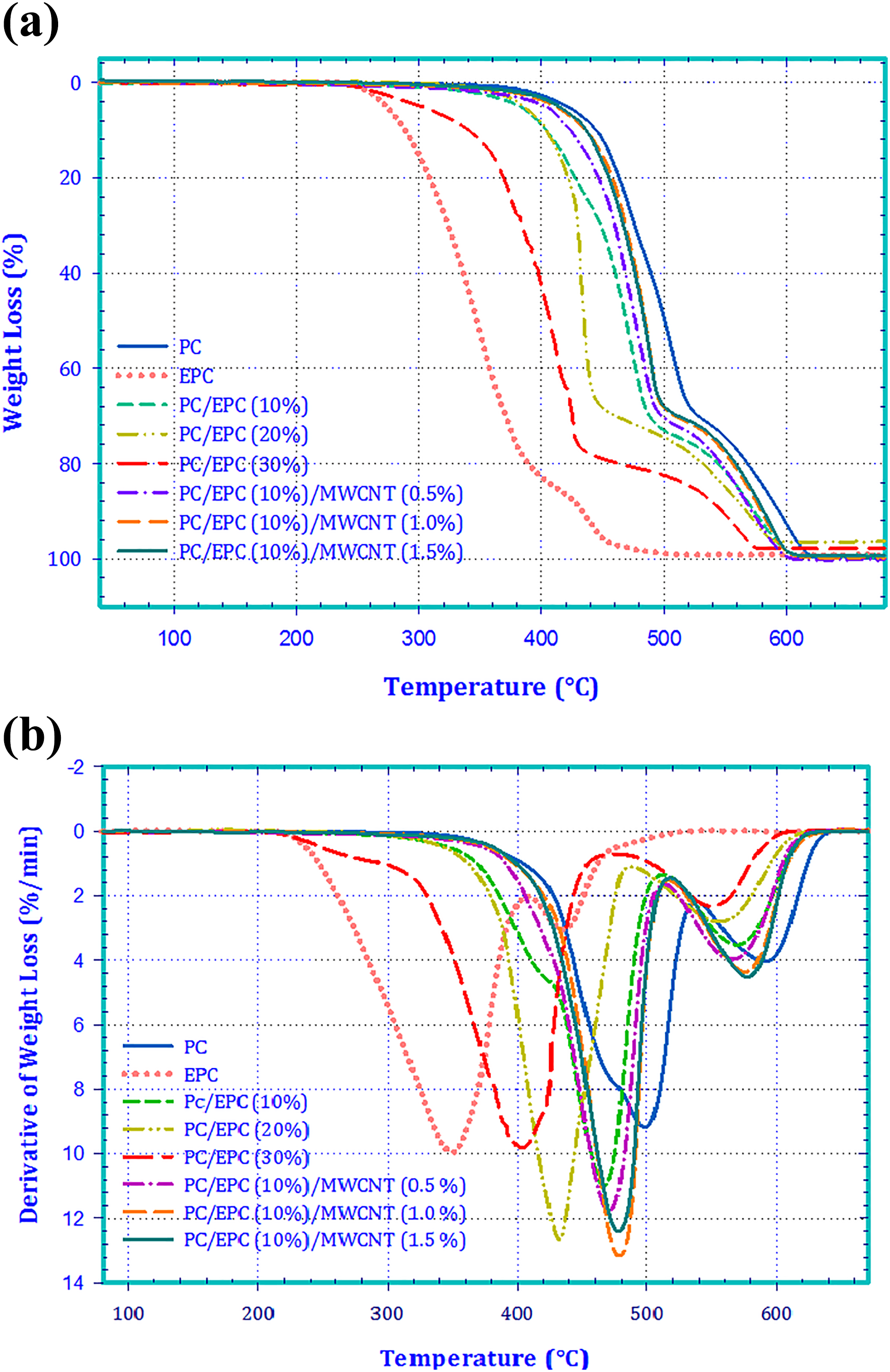
The thermal gravimetric analysis curves for the PC, EPC, PC/EPC blends and their NCs with different weight percent of MWCNTs at air: (a) weight loss (%), and (b) derivative of weight loss (%/min).
Thermal stability behavior of homopolymers, PC/EPC blends and PC/EPC (10%)/MWCNTs NCs.
PC: polycarbonate; EPC: ethylene–propylene copolymer; MWCNT: multiwalled carbon nanotube; NC: nanocomposite.
Broadband dielectric spectroscopy
Figure 5 illustrates the electrical conductivity, σ(F), as a function of frequency, F. For PC and PC/EPC blends, containing various amounts of EPC particles, the dependence of the conductivity, σ, in the entire range of the frequency, F, is a linear function and indicates the nonconductive behavior of these systems. However, for NCs with MWCNTs, the conductivity becomes independent of frequency in a wide range, until a critical value, Fc (which depends on the nanoadditive content). These systems present a percolating behavior in such a way that at a critical concentration (ϕc), named percolation threshold, it is assumed that the nanoadditive forms a continuous network and the conductivity exhibits a sudden insulator–conductor transition. In our case, the percolation threshold is supposed to be below 0.5%wt. of MWCNTs. Above this critical concentration, the electrical properties of the composites are dominated by conductive paths formed by the well-dispersed MWCNTs through the insulating polymer matrix. Moreover, the presence of MWCNTs at the interface of PC and EPC polymers promotes conductive tunnels through the two immiscible phases. On the other hand, an improvement in electrical conductivity is observed with increasing nanoadditive content. Further increase in the MWCNTs concentration above the percolation threshold (1.0 and 1.5 wt%) causes a slight increase in conductivity (about one order of magnitude). At these contents, the fully connected MWCNTs or agglomeration of MWCNTs are the main factors to pass the electric current through the polymer blends. It has been reported that the conducting mechanism depends on the distribution of MWCNTs in the polymer blends. 30 Moreover, higher nanofiller contents increase the heterogeneity of the system and produce extended interfaces and thus enhance the electrical conductivity of the polymer blends. It is worth mentioning that these results of conductivity for the PC/EPC/MWCNTs NCs are in agreement with the direct current conductivities reported in the previous study. 28 Furthermore, Figure 6(a) shows the permittivity (ε′) as a function of frequency. Homopolymers and their blends present the typical value of dielectric materials. One observes that NCs exhibit higher values of dielectric permittivity in comparison to neat PC/EPC blends. This suggests that there are many connections between nanoadditive particles, with small gaps of polymer chains between them, which promotes polarization phenomena. On the other hand, for the samples with high electrical conductivity, the permittivity at low frequency exhibits extremely high values due to such polarization effects, which are out of the limits of the equipment. Therefore, the dielectric permittivity in these cases is accurate above 1 Hz. In relation to dielectric loss (Figure 6(b)), at low frequencies and high MWCNTs content, a conductivity phenomenon is observed, which can be also attributed to the existence of above-mentioned polarization effects due to the presence of extended interfaces.
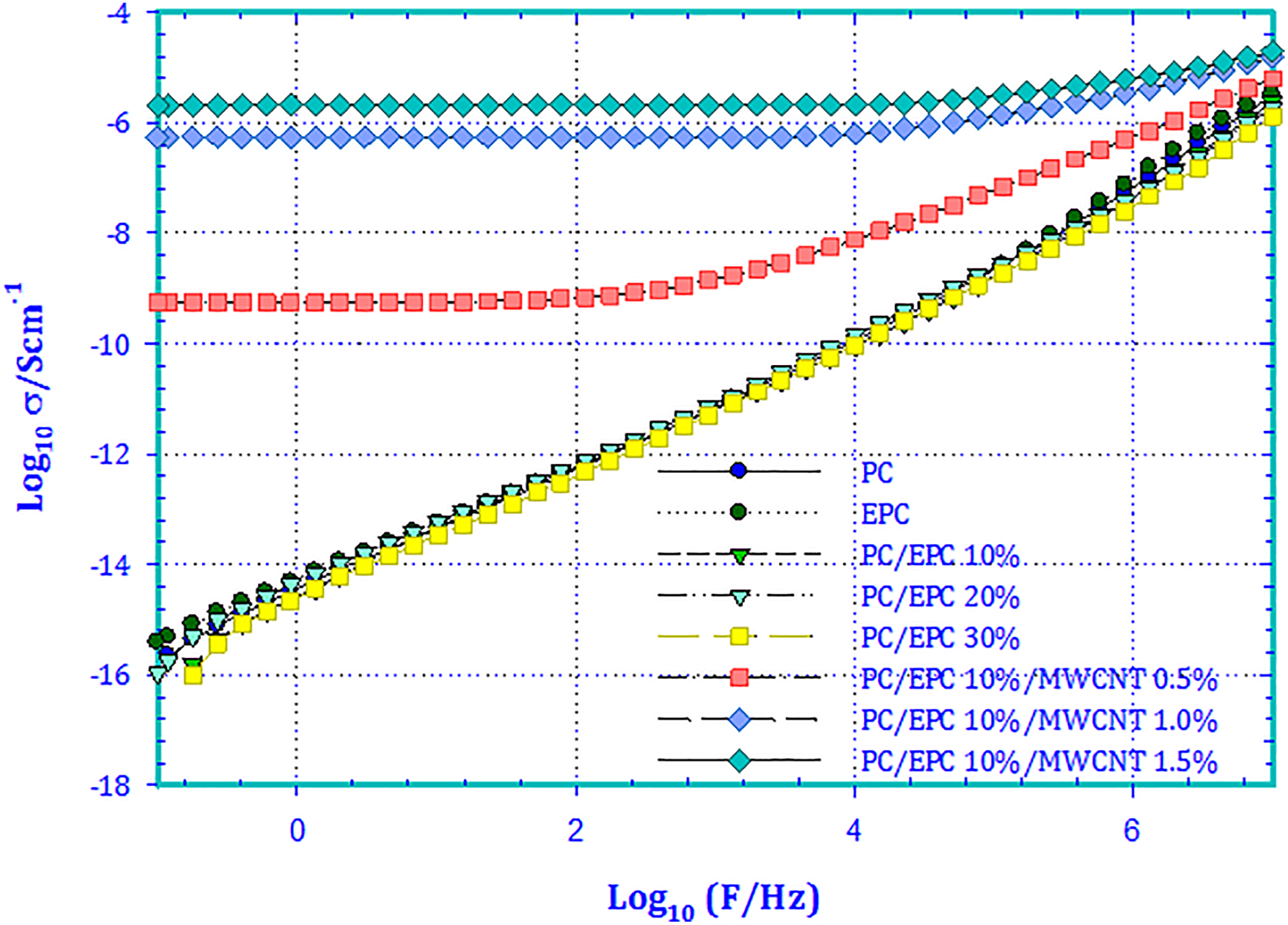
Alternating electrical conductivity as a function of the frequency for the PC, PC/EPC blends, and its NCs.
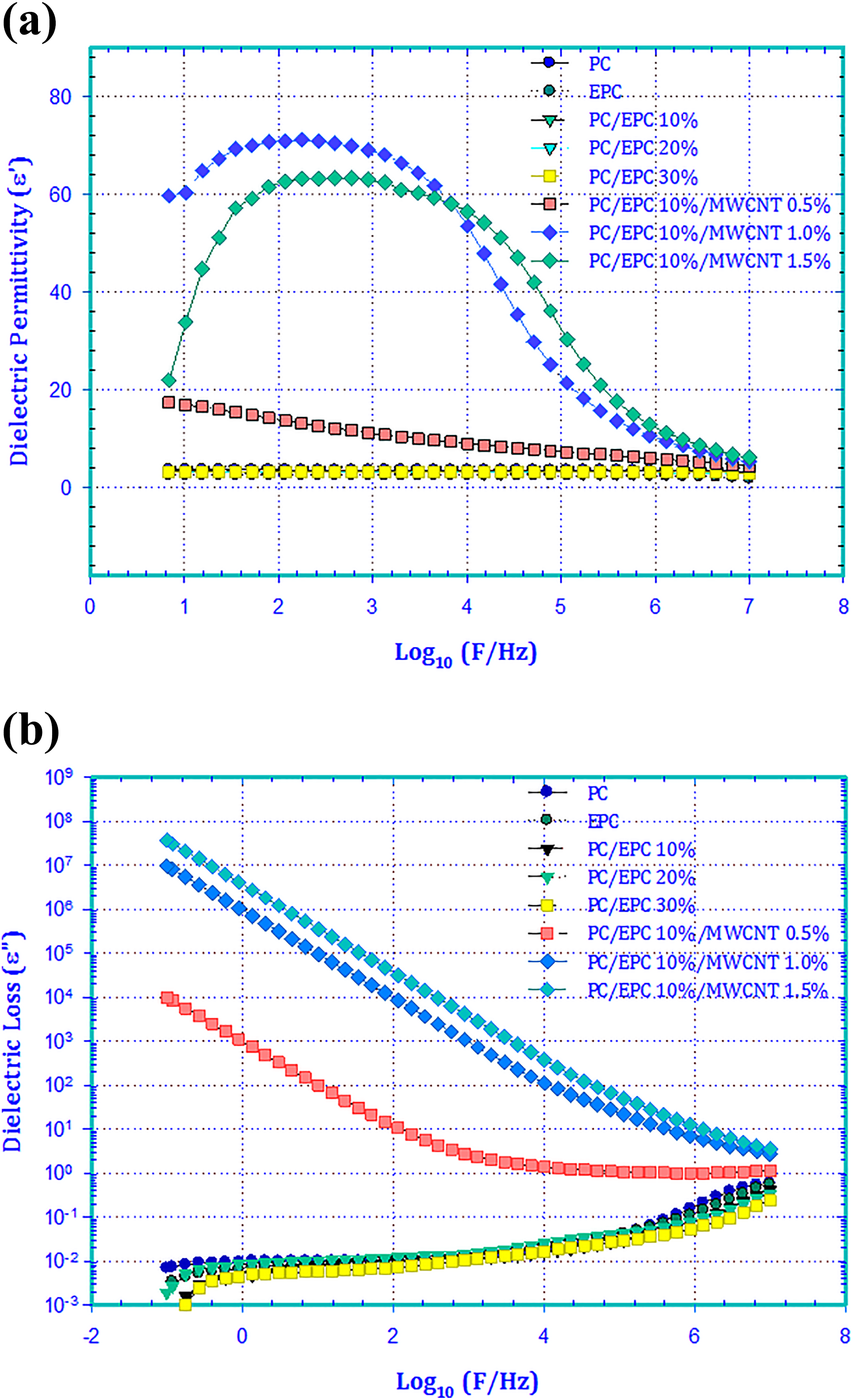
Dielectric permittivity (ε′) and dielectric loss (ε″) as a function of frequency.
Thermal conductivity
The thermal conductivity, thermal diffusivity, and specific heat capacity of PC, EPC, and PC/EPC blends and PC/EPC/MWCNTs NCs are shown in Figure 7(a) and (b). As can be seen in Figure 6(a), the thermal conductivity and thermal diffusivity of PC decrease with the incorporation of EPC elastomeric particles. This reduction might be due to several factors. Firstly, the spherical EPC droplets in the PC can act as the main barrier against the thermal current. Secondly, the phase separation between the two immiscible PC and EPC phases causes a heat transfer reduction.37–39 The addition of thermally conductive nanofillers can lead to an improvement of heat transport through the polymer blends because the heat can be rapidly transferred by the nanofillers. Therefore, further improvement in thermal conductivity of the PC/EPC blends was observed with incorporation of MWCNTs. In this case, the aspect ratio, dispersion state, and distribution of MWCNTs are the main factors on the thermal conductivity of the polymer blend NCs.40,41

(a): () thermal conductivity, ( ) thermal diffusivity. (b): (
 ) specific heat capacity of PC, EPC, PC/EPC (10%) blend and PC/EPC/MWCNTs nanocomposites reinforced with different contents of MWCNTs.
Another important factor that can affect the thermal conductivity is the interfacial adhesion between CNTs and polymer matrix. 42 The MWCNTs can localize at the interface of the immiscible phases, thus the nanofillers create thermal pathways through the polymer matrix. In fact, the MWCNTs act as heat conductive paths between the two immiscible polymer phases. 27 Moreover, when the content of MWCNTs is 1.5 wt% the interaction of the MWCNTs is higher, giving rise to the formation of aggregates responsible for the increase in the thermal conductivity of the polymer blends. In Figure 7(b), the specific heat capacity of polymer blends decreased with the addition of MWCNTs. For polymer NCs containing nanofillers such as MWCNTs, the specific heat capacity follows the rule of mixtures based upon weight fraction of each component. 43 In the rule of mixtures, the total property value is the sum of the fractional presence of each component times to its property values. In the prepared NCs, the MWCNT as conductive metallic nanofiller has lower specific heat capacity than the polymer matrix. From the above observations, one can conclude that the specific heat capacity of polymer decreased in the presence of MWCNTs.
Conclusion
This study presents the influence of the addition of simultaneous EPCs and MWCNTs on thermal conductivity and electrical conductivity of PC. The results showed that the thermal conductivity and thermal diffusivity of PC decreased dramatically with an addition of 10 wt% of EPCs and further addition of MWCNTs into the polymer blends increased the thermal properties. This increment can be attributed to the strong interfacial interaction between CNTs and polymer matrices, since the MWCNTs were located at the interface of the two immiscible PC and EPC phases. The transition from insulating PC/ethylene propylene copolymer blends to electrically conducting materials has been observed with the addition of MWCNTs.
Footnotes
Acknowledgement
Prof. Tiberio A Ezquerra and Dr Amelia Linares thank MINEICO for the fund.
Funding
The author(s) disclosed receipt of the following financial support for the research, authorship, and/or publication of this article: This work was financially supported by the MINEICO (Grant No. MAT2015-66443-C02-1-R).
