



Abstract
Ceramic rubber composites made of natural rubber (NR) loaded with various concentrations of barium titanate (BaTiO3) particles were prepared by mixing and hot pressing. A silane coupling agent (KH-570) was utilized to modify the BaTiO3 particles surface. The successful attachment of the coupling agent to the BaTiO3 particles was confirmed by Fourier transforms infrared spectroscopy. The influence of surface modified BaTiO3 (SMBT) particles concentration on the morphological, cure, mechanical, and electrical properties of the resulting samples was explored. The elongation at break and the tensile strength decreased with the addition of SMBT particles, while the hardness of composites increased. An enhancement of the dielectric constant (ε′) of the composites was observed by incorporation of SMBT particles. The measured ε′ of the composites was modeled using the theories of a heterogeneous medium. The dielectric loss showed a clear peak at high frequency, indicating the relaxation process of the orientational polarization.
Introduction
Ferroelectric ceramics are inorganic materials which have a high dielectric constant, low dielectric loss, and high piezoelectric coefficient. 1 They can be utilized in many applications including transducers, actuators, ceramics capacitors, piezoelectric sensors, and microelectromechanical systems. 2 –4 Nevertheless, these ceramic materials are difficult to fabricate and have a low breakdown strength. 5 –7 Natural rubber (NR), on the other hand, is an attractive flexible material with a renewable character and low dielectric constant 8 –10 The rubbery and flexibility characteristics are attributed to the geometry of the cis configuration of 1,4-polyisoprene that does not allow a close fit between chains. Many attempts have been made to mix NR with ferroelectric ceramics in order to make use of the combined properties of these materials. 11,12 These types of flexible ferroelectric ceramic rubber composites are useful for various electronic applications such as sensors, piezoelectric devices, and flexible capacitors. 13 –15
Extensive research has been carried out to probe the properties of rubber/ferroelectric ceramic composites. 16 –18 Salaeh et al. reported the enhancement of the dielectric constant of epoxidized natural rubber (ENR) as the function of the loading level of the ferroelectric ceramics. 1 In addition, he detected fast scorch, cure times, and cure rate index (CRI) in ENR composites with ceramic particles. Panomsuwan et al. noticed a sudden rise in the permittivity of the composites from 3.56 to 13.2 when the concentration of the ferroelectric ceramic reaches 70%. 19 It has been reported that the incorporation of ferroelectric ceramic with the NR enhanced the tensile strength and hardness of the entire structure. 20 Popielarz et al. 21 studied the dielectric properties of the relevant composites in a wide frequency and temperature ranges and reported that the dielectric constant scales linearly with the volume fraction of the ferroelectric filler.
Among the ferroelectric ceramics, barium titanate (BaTiO3) is a “perovskite” inorganic material with high dielectric constant, environment-friendly, and low breakdown strength. 22 –25 In this work, the synthesis of NR/BaTiO3 composites is reported. The structural, mechanical, cure, and dielectric properties of NR filled with BaTiO3 particles are investigated. The sensitivity of these properties to the concentration of BaTiO3 particles is explored.
Experimental procedure
Materials
NR was obtained from the Rubber Research Institute of Malaysia. BaTiO3 with a particle size of 1 μm and density of 6.08 g/ml at 25°C were purchased from Sigma-Aldrich, Chemie GmbH, Germany. Silane coupling agent (γ-methacryloxypropyltrimethoxysilane, KH-570) was obtained from Sinopharm Chemical Reagent Co., Ltd, Shanghai, China. Stearic acid and zinc oxide used as cure activators were obtained from Kij Paiboon Chemical Ltd (Bangkok, Thailand). The accelerator (sulfur) and curing agent (mercaptobenzothiazole, MBT) was manufactured by Bayer (M) Ltd (Petaling Jaya, Malaysia).
Sample preparation
Surface modification of BaTiO3
Silane coupling agent (KH-570) was employed to modify the surface of BaTiO3 particles. First, KH-570 (7.0 g) was added to absolute ethyl alcohol (1000 ml) for 25 min to achieve a homogeneous solution of pH 11. Then, BaTiO3 (100 g) was gradually added to the solution with continuous stirring. A further stirring for 45 min after adding the remaining BaTiO3 particles was conducted to prevent their precipitation and make them in contact with the coupling agent. The resulting solution was inserted for 8 h at 90°C in a vacuum oven. Finally, the BaTiO3/KH-570 particles were extracted for 36 h by refluxing ethanol in an extractor to remove the excess coupling agent. The physically adsorbed KH-570 was washed away by refluxing with ethanol.
Preparation of rubber compounds
The rubber composites were formed using a laboratory two-roll mill. The sequence of adding the ingredients was activators, filler, accelerators, and then sulfur as listed in Table 1. The formed rubber compounds was taken and sheeted through a laboratory mill at a 2 mm nip setting and kept at room temperature before testing and vulcanizing.
Compounding formulation used to prepare NR composites filled with UMBT and SMBT particles.
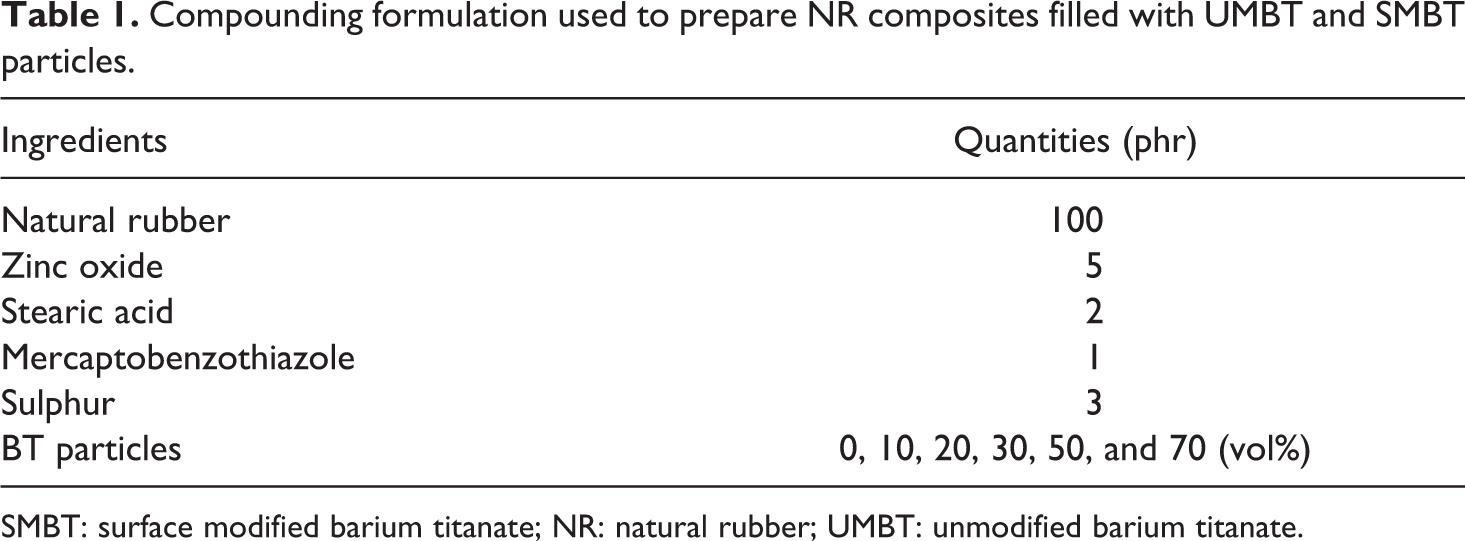
SMBT: surface modified barium titanate; NR: natural rubber; UMBT: unmodified barium titanate.
Characterization
Vulcanization and rheometer test
Curing characterization of the composites was determined at a temperature of 157°C and for 60 min using the oscillating disc rheometer MDR 2000, Alpha Technology, UK. The scorch time (ts1), optimum cure time (tc90), maximum torque (MH), minimum torque (ML), CRI, and delta torque (MH − ML) were estimated from the curing curves. The compounds were then molded at a temperature of 160°C which corresponds to the optimum curing time (tc90). 1.0 mm thick sheet was used to investigate the different properties of the formed composites.
Fourier transforms infrared spectroscopy
Fourier transforms infrared (FTIR) spectra were collected using a spectrometer (FTIR-Nexus 670, Thermo Nicolet Corporation, USA). The spectra were collected at room temperature in the wavenumber range of 4000 to 400 cm−1 with a resolution of 2 cm−1.
Morphological analysis
The microstructure of the composites was investigated using scanning electron microscopy (SEM) (Quanta FEG 250, FEI, and Netherlands). The composites were coated with a gold layer to avoid the charging effect.
Mechanical analysis
The tensile properties were measured using a universal tensile testing machine (Hounsfield Tensometer, Model H 10KS, UK). The samples were suitably fixed in the grips of the machine to ensure uniform tension distribution over the cross section. The Shore A hardness of the samples was tested by a durometer (Zwick Digital Shore Hardness Tester, Germany). The measured hardness is taken as the average of five different measurements on the sample.
Electrical measurements
Dielectric constant (ε′), dielectric loss (ε″), and AC conductivity (σAC) were measured for the composites at room temperature within the frequency range of 10−1–107 Hz using LCR (Hioki Hitester-3532-50). The thickness and the diameter of the measured composites were 1.5 and 20 mm, respectively. ε′ and ε″ were calculated from the relationships 26,27


where d is the composite thickness, C is the capacitance, and tan δ is the loss factor. The AC conductivity (σAC) was estimated from the relation

where ω is the angular frequency, εo is the free space permittivity (8.854 PF/m).
Results and discussion
Structural characterization
FTIR is a nondestructive analysis utilized to obtain the absorption spectrum of BaTiO3 particles. It is known that BaTiO3 particles tend to aggregate when they are placed individually in the rubber matrix and this would influence properties of formed composites. 28 In order to solve this problem, a suitable coupling agent is essential to modify its surface and avoid the aggregation. 29 In this study, a silane coupling agent (KH-570) was utilized to achieve such a surface modification. The mechanism of loading the coupling agent to BaTiO3 particles is displayed in Figure 1(a). Figure 1(b) displays the FTIR spectra of unmodified BaTiO3 (UMBT), as purchased, and surface modified BaTiO3 (SMBT) particles. Compared to the UMBT particles, the spectrum of SMBT particles shows five additional absorption bands at 1723, 935, 1035, 1126, and 1165 cm−1. The sharp band at 1723 cm−1 is attributed to the C=O stretching mode of KH-570. 28 The absorption spectrum of the BaTiO3 particles bands at 935 and 1035 cm−1 can be ascribed to the Si–OH and Si–O–C stretching vibration, respectively. 30 The existence of 1126 and 1166 cm−1 bands are linked to stretching vibration of Si–O–Si from KH-570. 30 Besides, the spectrum of UMBT particles exhibits a peak at 3440 cm−1 which confirms the presence of hydroxyl groups (–OH) on the surface. 31 Alkoxy groups (OCH3) can alcoholize with the hydroxyl groups on the surface particle and produce strong interactions between the KH-570 and BaTiO3 particles. This indicates the good adherence of KH-570 to the surface of BaTiO3 particles. FTIR spectra of NR loaded with different amounts of SMBT particles are depicted in Figure 1(c). All spectra show a broad absorption band existing from 3000 to 2850 cm−1, which can be attributed to the C–H stretching vibration of CH3 of NR. In addition, two bands are shown at 1340 and 1670 cm−1, which can be attributed to C–H bending of CH3 and C=C stretching vibration, respectively. 32 The main band of SMBT particles at 1723 cm−1 for C=O appears in the spectra of the composites. The intensity of this band increases as the concentration of SMBT increases. 33 Furthermore, additional absorption bands are present due to the expected free radical reaction that occurs during the milling process.
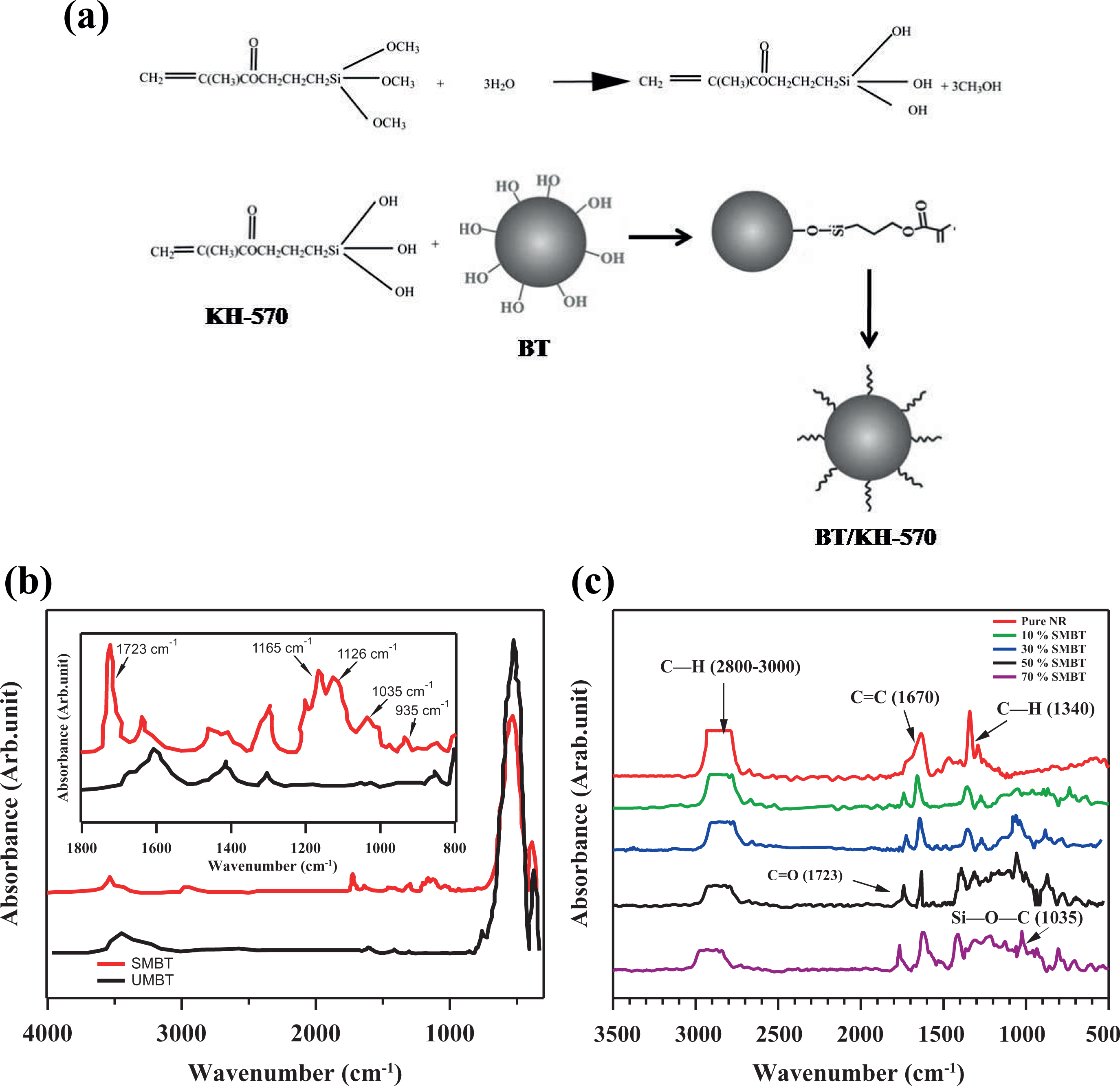
(a) Schematic mechanism of modifying the surface of BaTiO3 particles with a silane agent (KH-570). (b) The FTIR spectra of UMBT and SMBT particles. (c) The FTIR spectra of NR composites filled with various contents of SMBT particles.
Figure 2 displays the SEM images of NR filled with different concentrations of SMBT particles. As the concentration of SMBT particles increases, the thickness of the NR matrix layer decreases. At lower concentrations of SMBT particles of 10 and 30 vol%, a distinct dispersion is obtained without apparent agglomeration (Figure 2(b), (c)). At higher loading level of 50 vol%, the agglomerations of SMBT are observed (Figure 2(d)). Further increase of concentrations to 70 vol% forms a network of aggregated particles as shown in Figure 2(e) due to the weak adhesion between the ceramic particles and the NR matrix.
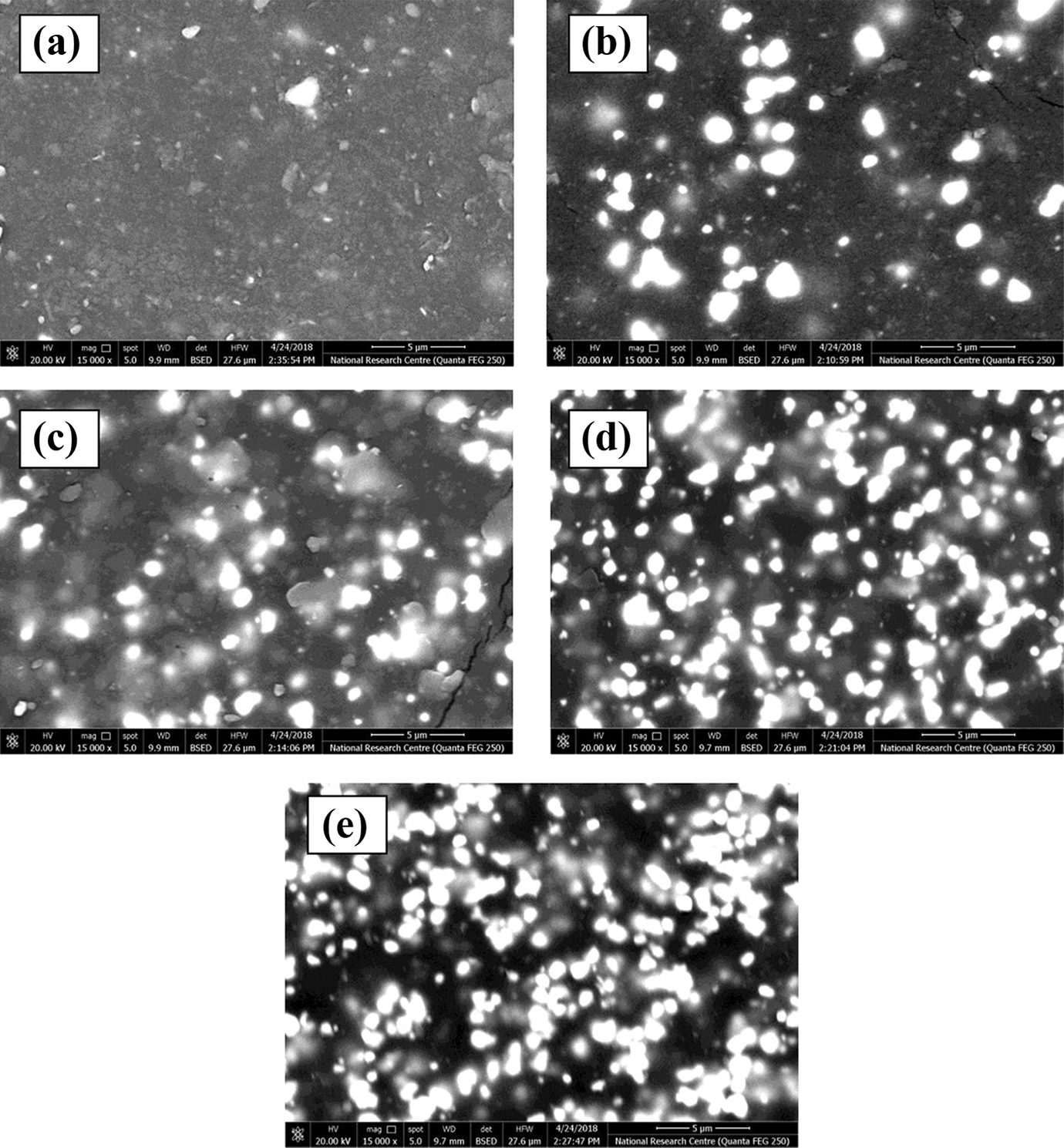
SEM micrographs of NR filled with variable contents of SMBT: (a) 0 vol%, (b) 10 vol%, (c) 30 vol%, (d) 50 vol%, (e) 70 vol%.
Cure test
Table 2 lists the curing characteristics at 157°C of plain NR and loaded with different contents of SMBT as obtained from the rheography measurements. The minimum torque (ML) dictates the viscosity of the uncured compound, whereas the maximum torque (MH) is linked to the level of cross-link reaction and the interaction in the vulcanized rubber. 34 As the SMBT loading increases, the ML and MH increased due to the reduction of the mobility of the rubber chains and the (SMBT-NR) and (SMBT-SMBT) interactions. 35 Such interactions are of the physical and chemical types. The difference between torques, Δ torque, (MH − ML) of uncured rubber and fully cross-linked rubber increases with the increase of the SMBT particles loading level. Both cure and scorch times decreases as SMBT content increases because of the enhancement of the reaction rate of vulcanization. A reduction in the CRI with the enhancement in SMBT particles concentration can be ascribed to the cross-link density of NR.
Cure characteristics of NR/SMBT particles composites.
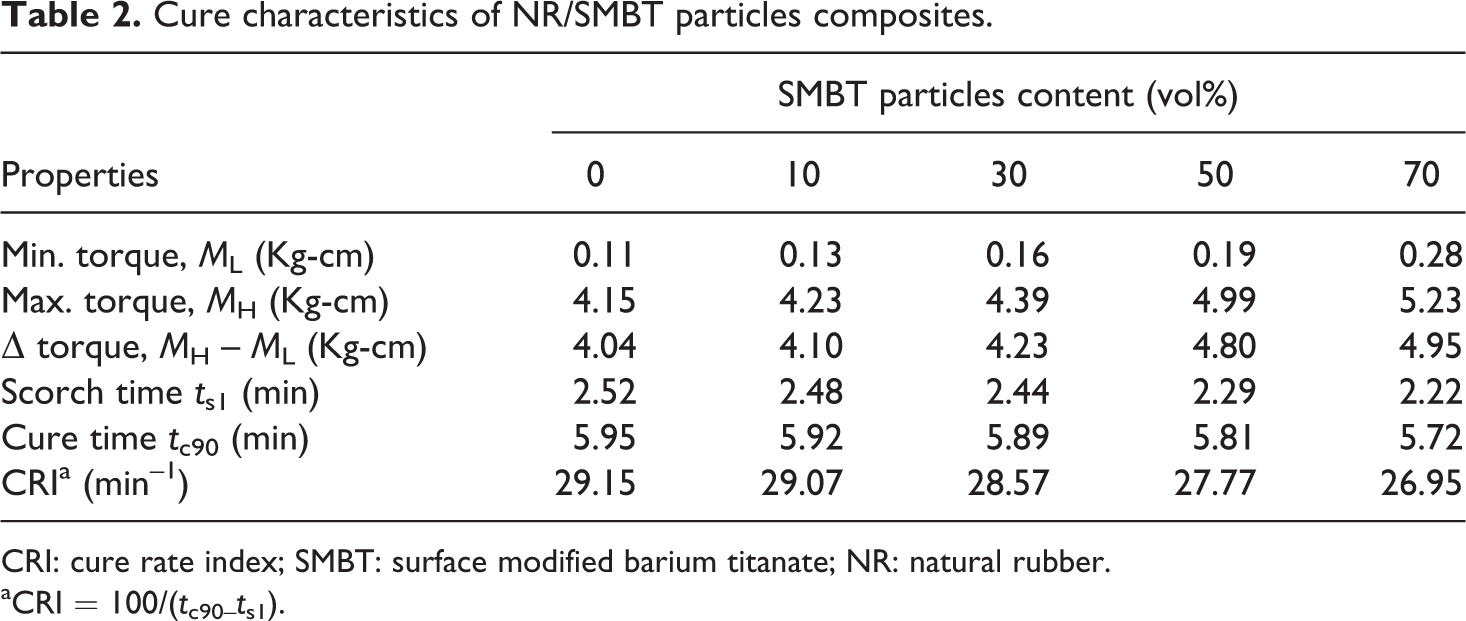
CRI: cure rate index; SMBT: surface modified barium titanate; NR: natural rubber.
aCRI = 100/(tc90–ts1).
Mechanical properties
The hardness curve of NR vulcanizate filled with different contents of UMBT and SMBT is shown in Figure 3. The plain NR vulcanizate exhibits small hardness and better flexibility because of the orientation of NR molecules. It is clear that the hardness of composites filled with UMBT is smaller than that of composites filled with SMBT particles. The presence of SMBT particles in NR enhances the stiffness due to the poor mobility of the molecular chains. 36 A linear relationship is obtained between the hardness and the concentration of SMBT particles. This is attributed to the expected interactions that limit the mobility of the composites. This finding agrees with the observed behavior of MH − ML (Table 2). The elongation at break and the tensile strength of the composites as a function of UMBT and SMBT particles content are shown in Figure 4. A gradual increase in the contents of BaTiO3 particles leads to the decrease of both the tensile strength and the 100% elongation at break. The composites maintain good flexibility at a loading level of 30 vol%. At a loading content of 50 vol% and 70 vol%, the flexibility becomes poor and the composite is brittle. At high concentration of BaTiO3 particles loading cavities was observed in the composite (Figure 2(e)). This is due to the weak adhesion between NR and BaTiO3 particles, which causes the observed poor mechanical properties. The addition of SMBT particles shows greater tensile strength and elongation at break compared to the composites filled with UMBT.
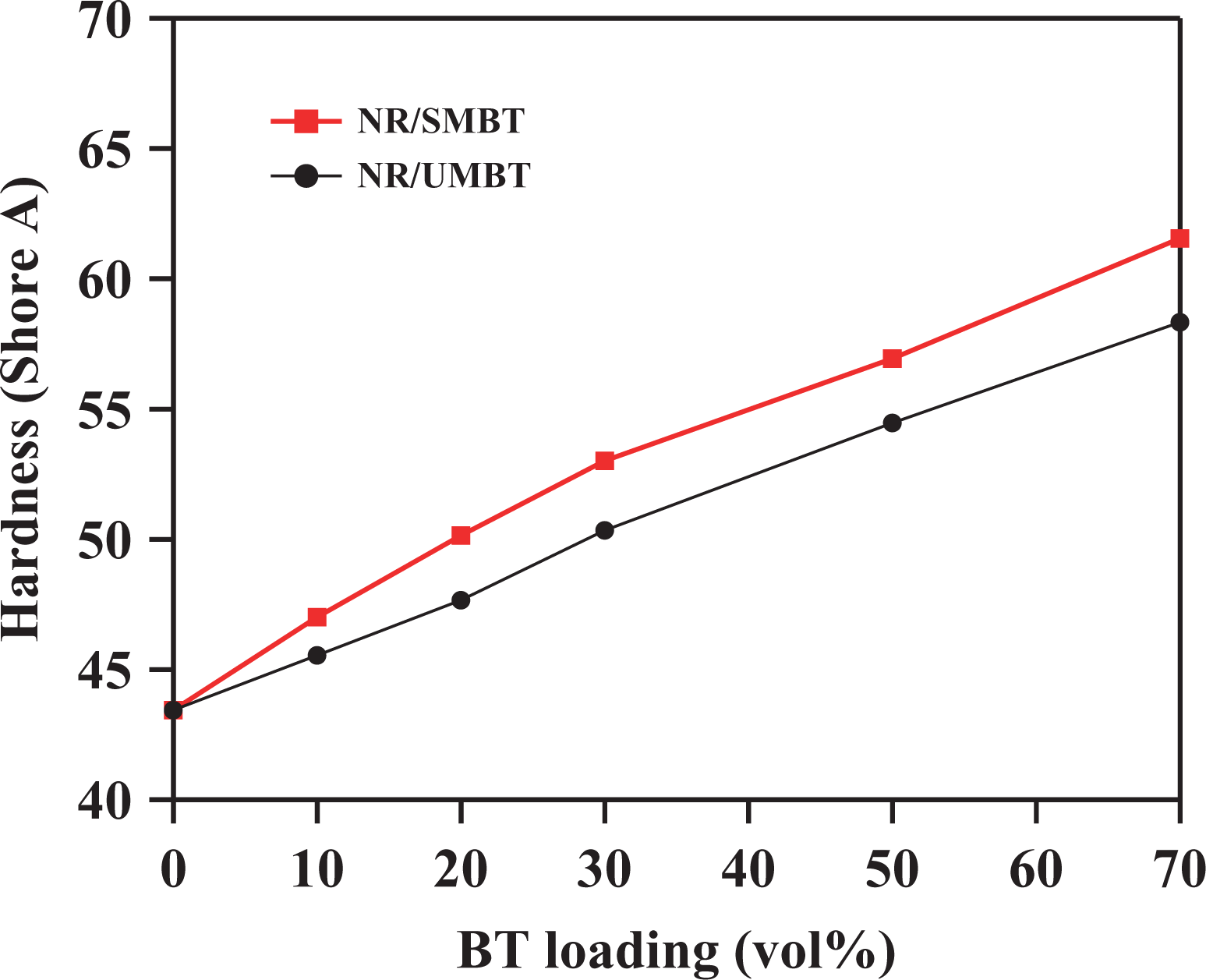
Hardness of NR composites as a function of different loading of UMBT and SMBT particles.
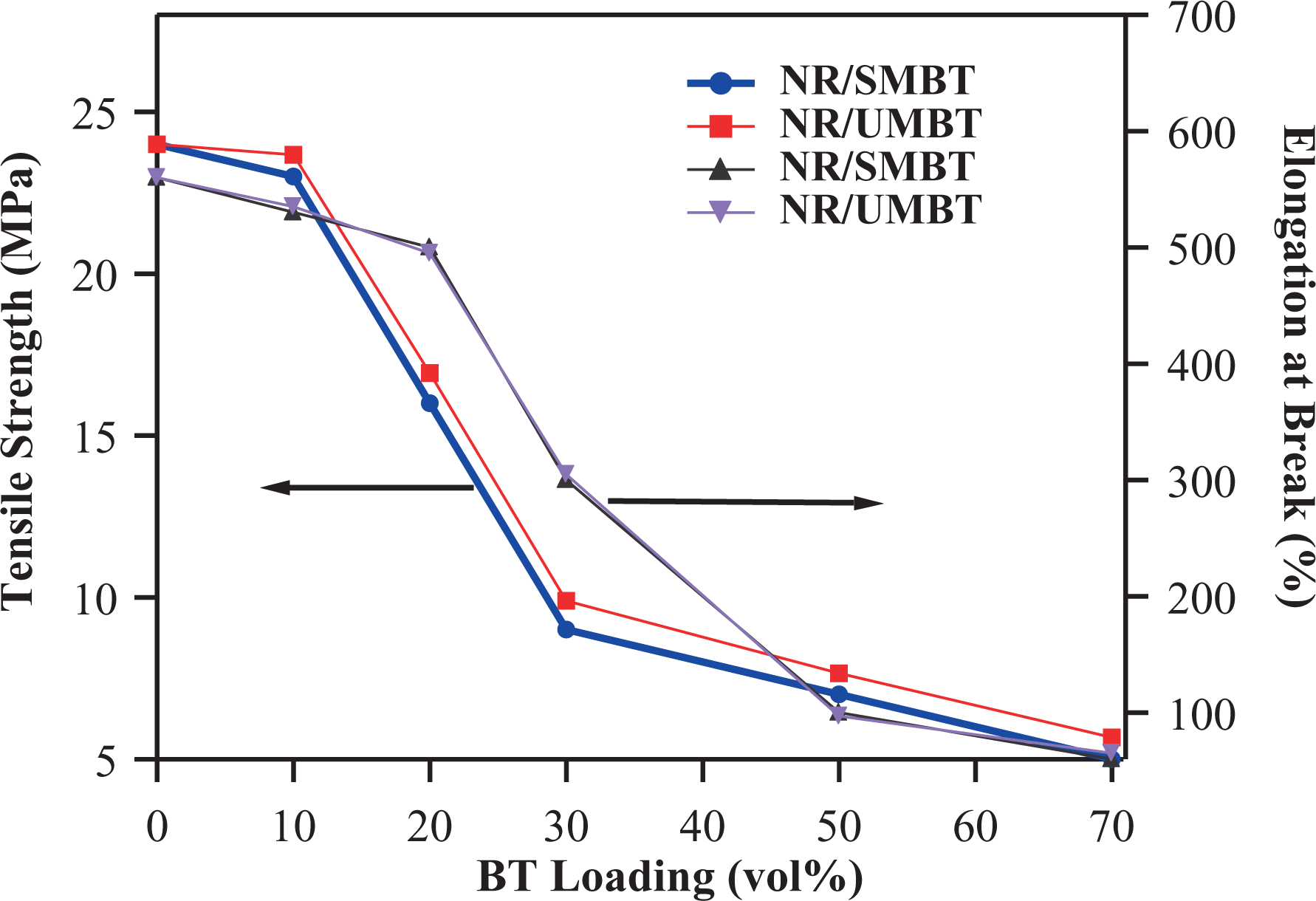
Tensile strength and elongation at break of the NR composites as a function of UMBT and SMBT particles loading.
Dielectric response
Dielectric constant is a well-known parameter representing the polarization in the composites. Basically, the dielectric constant, ε′, of a composite arises from the polarization of its ingredients. Figure 5 represents the room temperature real part of the dielectric constant ε′ of plain NR and that with different concentrations of UMBT and SMBT particles at frequencies from 10−1 Hz up to 107 Hz. The dielectric constant becomes slightly higher upon the addition of SMBT particles compared to the composites filled with UMBT particles. It is noticed that the dielectric constant of the plain NR is lower than that of the NR/BaTiO3 composites. This can be ascribed to the intrinsic characteristics of BaTiO3 which maintains its tetragonal crystal structure and the ferroelectric character exhibiting at room temperature a spontaneous polarization. In addition, the dielectric constant of the plain NR and NR/BaTiO3 composites decreases as the frequency increases. In the low frequency regime, ε′ was relatively large due to the presence of Maxwell–Wagner interfacial polarization. This polarization arises in a heterogeneous medium of different phases. Therefore, charges accumulate at the boundaries of the existing phases. 37 –39 The decrease in ε′ at the high frequency region is ascribed to the response time of orientation polarization. It was observed that the incorporation of BaTiO3 particles increases the dielectric constant of the composites slightly. A similar finding was observed for other polymer-ferroelectric ceramic composites. 40,41
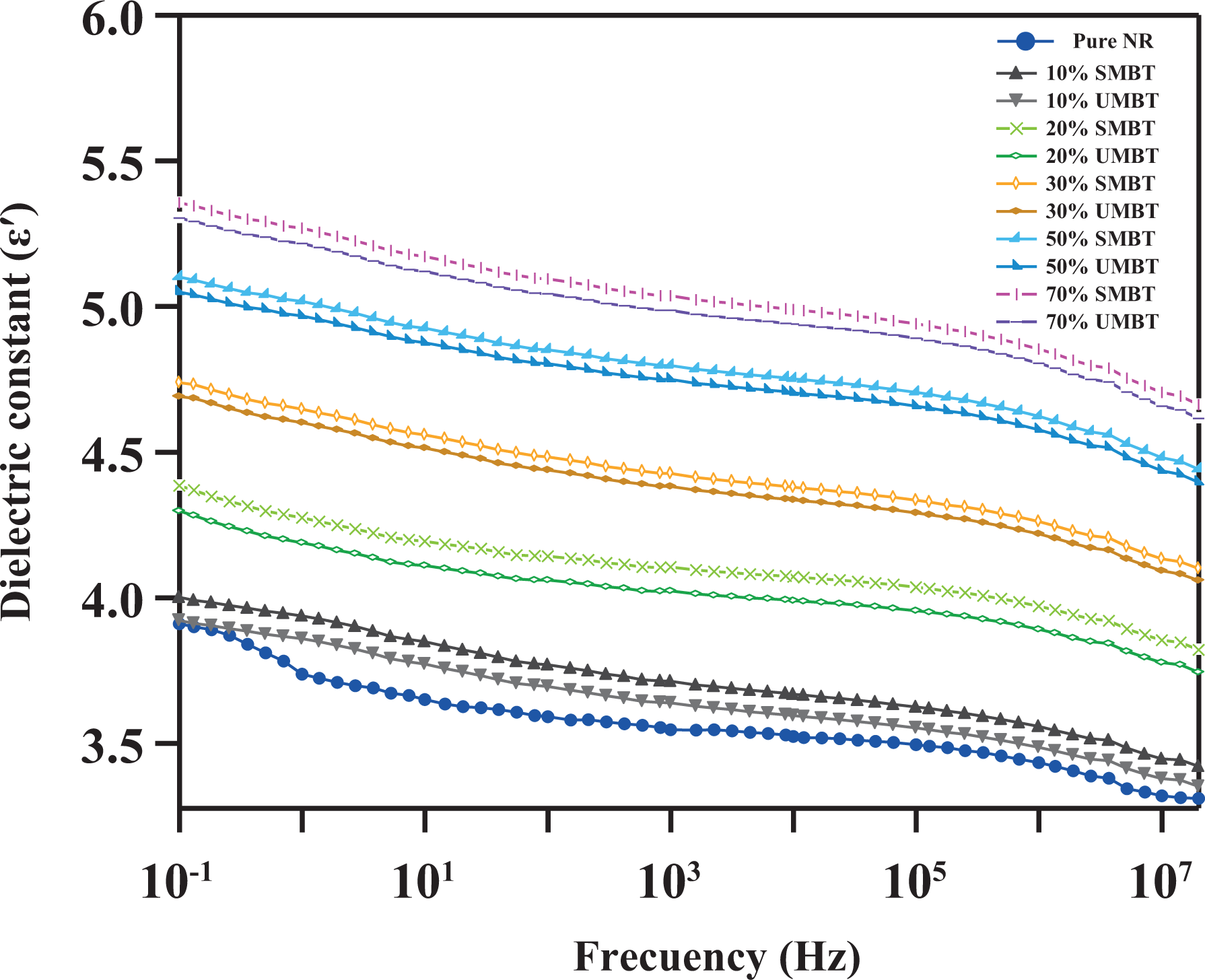
The frequency dependence of the dielectric constant (ε′) of pure NR and filled with the different content of UMBT and SMBT particles at 300 K.
Figure 6 shows the frequency dependence of the dielectric loss (ε″) of the NR/SMBT composites. The dielectric loss is a physical parameter representing the dissipation of electromagnetic energy. A large dielectric loss was noticed in the low frequency region due to the sluggishness in the interfacial polarization which comes from the migration and the entrapment of charge carriers at the interfacial area. 28 The interfacial polarization response time is long compared to other types of polarization. The interfacial polarization was difficult to detect in the curves of the dielectric constant because the response time exceeds the time used in the measurement in this work. Because the SMBT particles bonded strongly with the NR matrix at low loading, the molecular networks in the NR restrict the mobility of molecular chains. This is attributed to the apparent relaxation peaks at high frequency. The energy dissipation is emitted in air as a thermal energy. A clear loss peak, on the other hand, was observed in the high frequency region. This peak corresponds to the sluggish orientation polarization due to the segmental motion of the chains of the rubber. Before this frequency, the orientation polarization follows the applied field. The dielectric loss associated with the orientation polarization is relatively small.
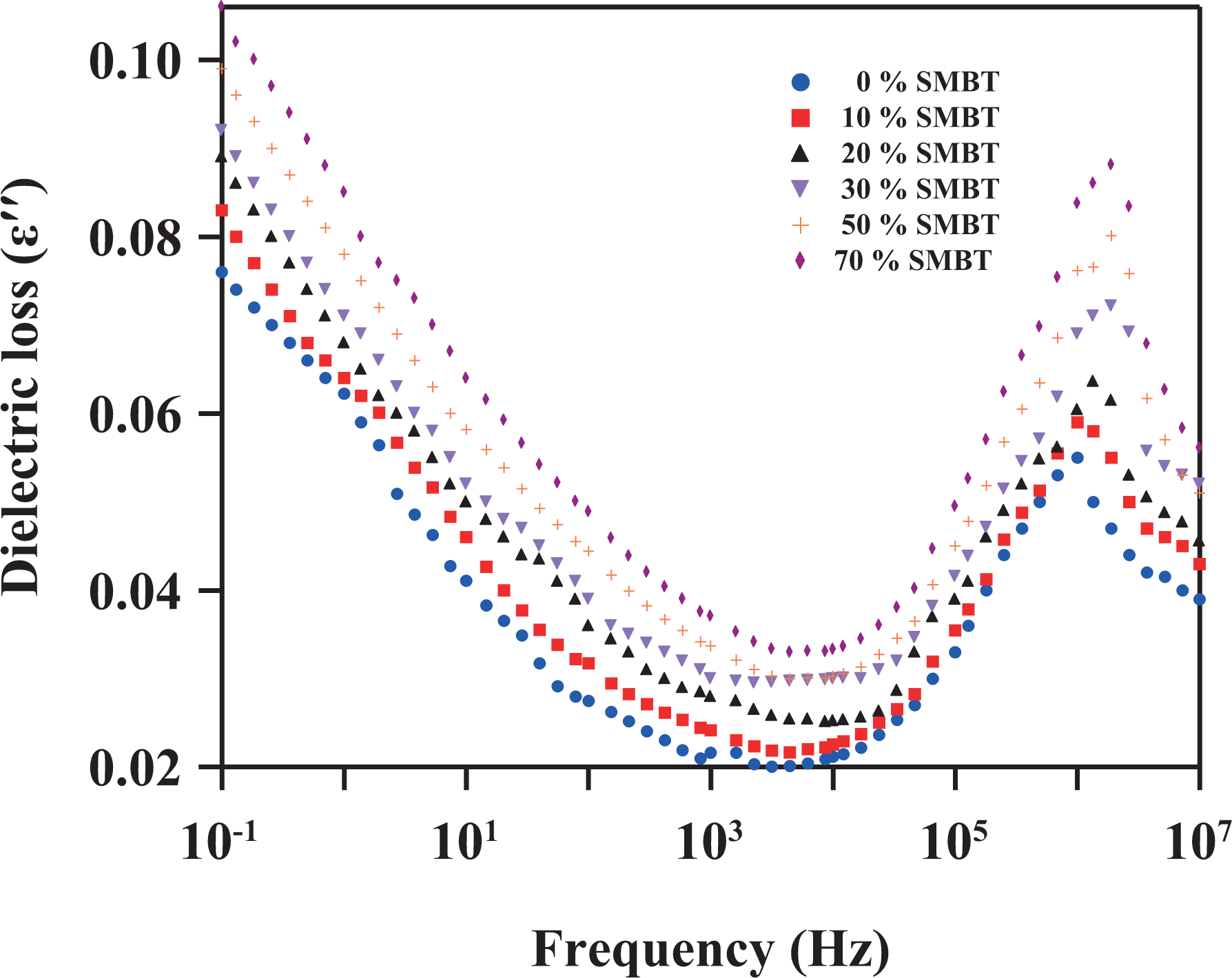
The variation of the dielectric loss (ε″) with the frequency of pure NR and filled with the different content of SMBT particles at 300 K.
Several numerical relationships can be proposed to predict the dielectric constant (ε′) of NR/SMBT composites. 42 –44 Such a heterogeneous medium can be analyzed using the Lichtenecker logarithmic model or the effective medium theory (EMT) or Jayasundere and Smith equation (J-S). The Lichtenecker model considers the composite as randomly oriented spheroids that are uniformly distributed in a continuous matrix. 45 The effective dielectric constant, εeff of the composite can be modeled using the relation

where εc is the dielectric constant of SMBT particles, εp is the dielectric constant of NR, and υc is the volume fraction of SMBT particles impeded in the NR matrix. The EMT, on the other hand, treats the composite as an effective medium whose dielectric constant is estimated by adding up the dielectric constant of the ingredients. 46 In this theory, the effective dielectric constant is given by

where n is the correction factor used to compensate for the shape of SMBT particles. When the interaction among neighboring SMBT particles is taking into consideration, and εc ≫ εp Jayasundere–Smith equation (J-S) would play an important role. 47 The effective dielectric constant estimated by this equation is given by

where

and

Figure 7 displays the calculated and the experimental dielectric constant at 1 KHz for NR/SMBT composites. The experimental dielectric constant of the composites is in agreement with the Lichtenecker equation at low SMBT particles loadings. However, the dielectric constant at higher SMBT particle loading is well described by Jayasundere–Smith equation. The deviation at high filler loading may be due to the strong interaction among the particles which is included in this equation.
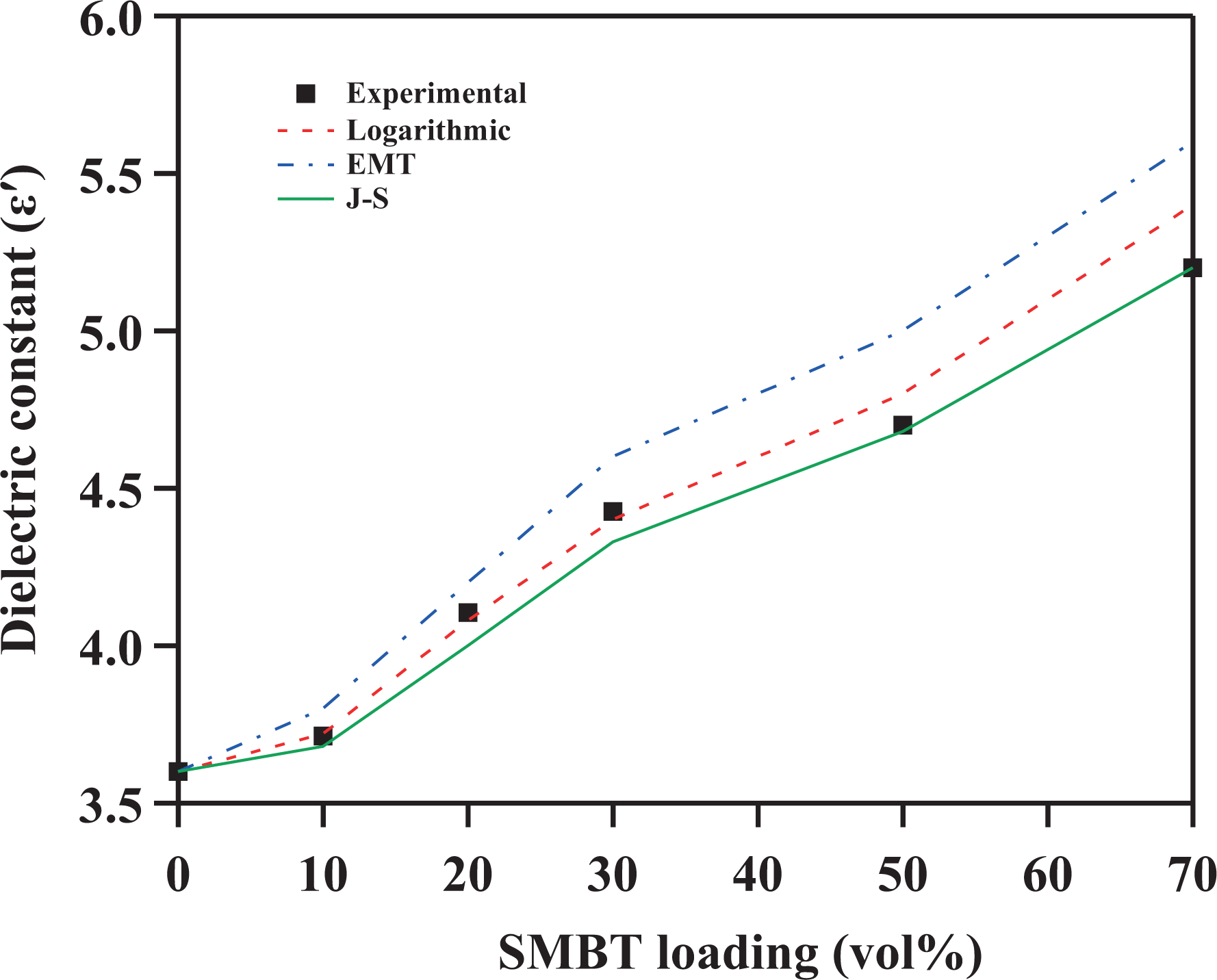
Experimental and calculated of dielectric constant at 1 kHz of NR/SMBT composites.
Figure 8 shows the room temperature AC conductivity, σAC of the composites as a function of SMBT particles contents. Basically, the frequency dependence of the conductivity obeys Jonscher’s formula

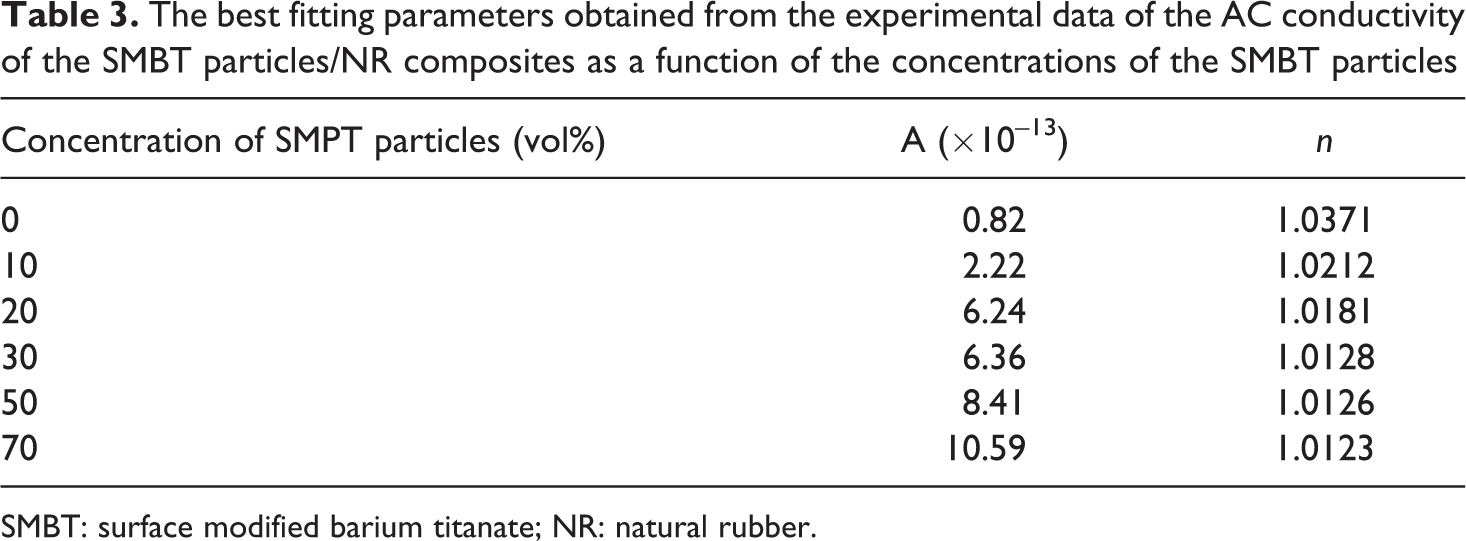
where A is a constant which determines the strength of the polarizability, and n is a dimensionless frequency exponent. This dependence represents the degree of interaction between the SMBT particles and the rubber matrix. The experimental AC conductivity spectrum is fitted to equation (9). The fitting results are summarized in Table 3. It is clear that the value of A increases as the concentration of SMBT particles increases. This is attributed to the observed increase of the dielectric constant with an increase of the SMBT particles content (Figure 5). At all concentrations of SMBT particles, the value of n is lower than unity. This is attributed to the tunneling conduction of mobile charge carrier over the barrier between two sites which is similar to that observed in amorphous semiconductors and glasses.
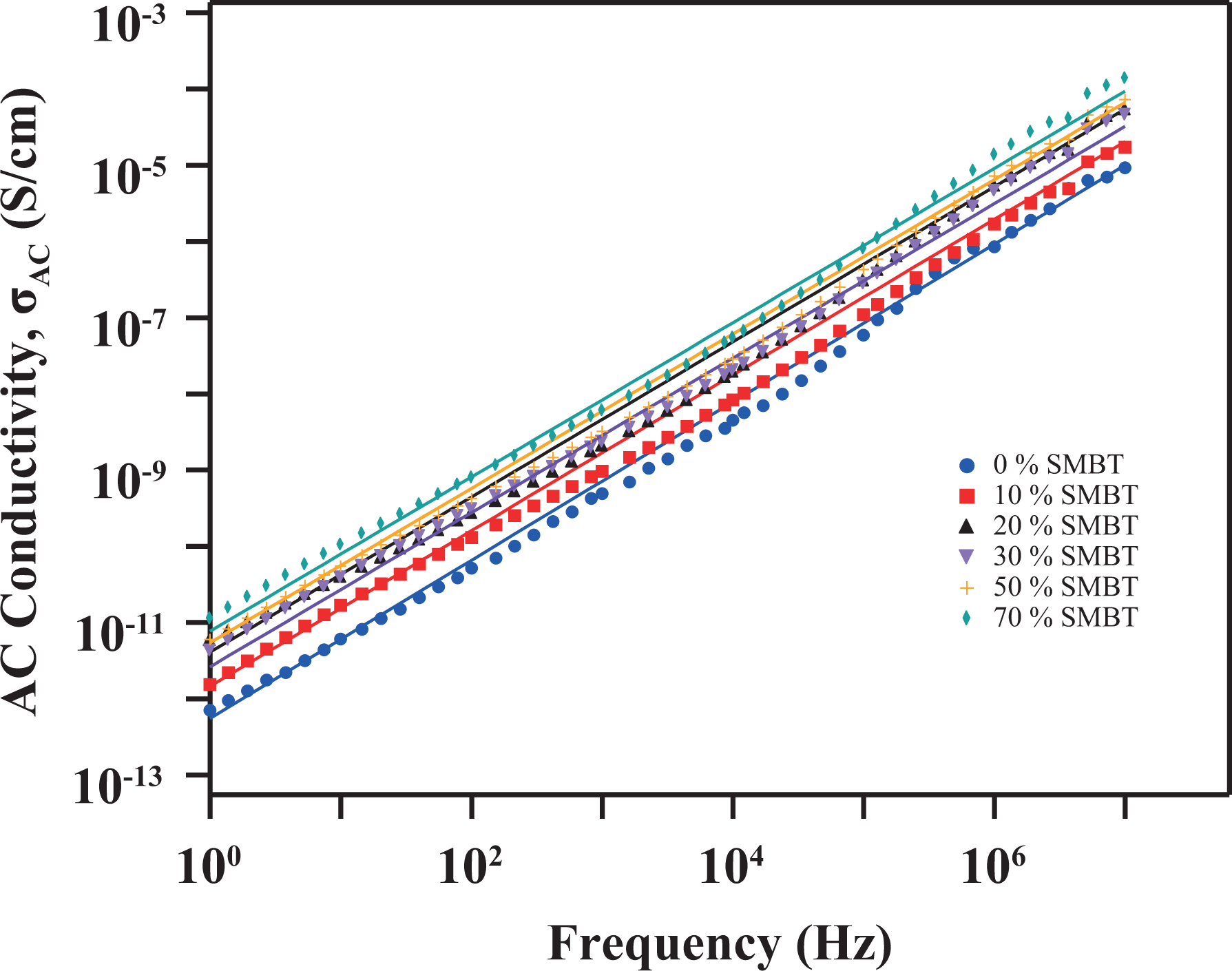
The measured AC conductivity (σAC) as a function of frequency of pure NR and filled with different content of SMBT particles at 300 K. The continuous lines represent the fitting.
The best fitting parameters obtained from the experimental data of the AC conductivity of the SMBT particles/NR composites as a function of the concentrations of the SMBT particles
SMBT: surface modified barium titanate; NR: natural rubber.
Conclusions
NR filled with SMBT particles were formed by mixing and hot pressed. The concentration of SMBT particles in the rubber matrix has a significant impact on the morphological, cure, mechanical, and electrical properties of the composites. The dielectric constant was slightly enhanced upon the incorporation of SMBT particles to NR. The quantum mechanical tunneling among the SMBT particles was proposed as a suitable conduction mechanism in the composites at room temperature. The composites showed an orientational relaxation peak at which dielectric losses decreased as the concentration of SMBT particles increased. The surface modification of BaTiO3 (SMBT) particles slightly improved the mechanical and dielectric properties of NR composites.
