




Abstract
Herein, we detailed the distributions and distortions of residual stresses in amine-grafted multiwalled carbon nanotubes (MWCNTs)/binary resin composites under complex thermomechanical loadings suffered in practical processing or operation, by means of finite element simulation. First, distributions and distortions of residual stresses under coupled extensional–shear loadings were studied. Subsequently, thermal residual stresses were deducted from the thermal analysis, followed by a sequentially structural analysis. It is found that the heat flux has an influence on the magnitude of the thermal residual stresses, but it cannot alter the distribution of the thermal residual stresses. In order to render deep understanding of the microscale behavior in amine-grafted MWCNTs/binary resin composites under thermal loading, for exploring the nature of residual stress variation, the corresponding microscale model is expected to be developed using atomistic simulation, in which the microstructural features of amine-grafted MWCNTs and resin matrix are taken into consideration. The total energy, potential energy, and kinetic energy at different temperature were analyzed as well as the radial distribution function g(r). Weak van der Waals interaction between amine-grafted MWCNTs and resin matrix is indicated and the interactions between amine-grafted MWCNTs and resin matrix reduce and the mobility of chain segments of resin matrix increases with the decreasing temperature.
Keywords
Introduction
Carbon nanotube (CNT)-reinforced resin systems hold great promise of delivering superior composite materials with high mechanical strength, light weight, and multifunctional features, demonstrating a wide range of technological application. 1 –3 To achieve high performance of CNTs/resin composites, uniform dispersion of CNTs in resin matrix is the first step. In our earlier efforts, 4 –7 we reported a facile synthetic scheme for producing amine-grated multiwalled CNTs (MWCNTs) using silane coupling agent; our strategy enabled the homogenous distribution/dispersion and excellent compatibility in resin matrix. The resulted composites exhibited great potential for application in thermal pyrolytic graphite/Al sandwich radiator derived from the greatly enhanced thermal conductive and mechanical properties. However, lucid understanding of thermal behavior and mechanical response, especially the residual stress response under complex thermomechanical loadings suffered in practical processing or operation is still absence, acting as a limit of further progress.
As is known, when the composites subjected to external forces and heat sources, they may experience substantial variations on the properties, resulting in residual stresses. The existence of residual stresses may lead to an unexpected stress field and raise risks to structural performance, 8 such as causing geometrical distortions, 9 triggering microscale cracking, 10 and exacerbating stress corrosion cracking. 11 Therefore, the ability to understand and estimate the distributions and distortions of residual stresses under complex thermomechanical loadings in amine-grafted MWCNTs/binary resin system is critical. The residual stresses under complex thermomechanical loadings have been investigated by means of mathematical, experimental, and numerical methods. For example, in the recent works, 12 –15 nonlinear mathematical model was derived using the higher-order shear deformation theory and Green–Lagrange nonlinear strains, in which the structure is exposed to nonuniform temperature field combined with the transversely distributed mechanical load. To characterize residual stress, many destructive and nondestructive methods are proposed, that is, X-ray diffraction, 16 Raman spectroscopy, 17 and neutron diffraction. 18 Alternatively, the finite element method has been demonstrated as an effective tool to predict the residual stress in response to complex thermomechanical loadings, that is, evaluation of the values and distribution of residual stress, 19 influence of the machining sequence 20 on residual stress redistribution and improvement, and relief of residual stress. 21 Compared to the traditionally mathematical and experimental methods, the numerical simulation using finite element analysis can more efficiently and accurately predict the development of residual stresses to find the improved structures design in terms of lower residual stresses 22 because the mathematical model was established based on some essential assumption and experimental methods are time-consuming and expensive. However, in finite element analysis, the microstructural features of amine-grafted MWCNTs/binary resin system are neglected. Hence, combining finite element analysis with atomistic simulation is essential because atomistic simulation is an effective tool to evaluate the microscale behavior, taking into account the microstructural features of CNTs and resin matrix.
In this contribution, we focus on the dependence of residual stresses with respect to coupled thermomechanical loadings. External force-induced stresses and thermal residual stresses were, respectively, calculated by finite element simulation for characterization of their contributions to the total residual stresses under coupled thermomechanical loadings. Afterward, in order to explore the nature of residual stress variation, atomistic simulation was applied for evaluating the microscale behavior in amine-grafted MWCNTs/binary resin composites under thermal loading, taking into account the microstructural features of amine-grafted MWCNTs and resin matrix. Information obtained from finite element simulation and atomistic simulation will contribute to improved process parameters and conditions with reduced residual stresses and lower distortion by controlling the coupled thermomechanical loadings, providing theoretical guidance for experimental research and practical applications of resin-based composites.
Simulation details
Finite element procedure
The amine-grafted MWCNTs/binary resin (polyamide resin and epoxy resin) composites were prepared by conventional solution blending method and the corresponding material parameters can be obtained in the literature. 4 –6 In generating the mesh, all the volume entities in the model were meshed with 10-node tetrahedral element to achieve better mesh quality and the converging rate. As a consequence of this, the complex geometry was discretized using approximately 6852 tetrahedral elements and 11,978 nodes. First, external force-induced stresses were studied in static-structural simulation. The external force was defined as coupled extensional–shear loadings. In our previous study, 7 distinct generations of force loading were defined with the magnitude of resultant force restricted to constant for identifying the coupling between extensional and shear loading. Here, we refer to coupling 2 for characterization of residual stresses and the magnitude is reduced to 1/100 of original value. The displacement boundary was constrained to zero in three directions (X, Y, and Z). Then, temperature distributions as well as thermally induced stresses were evaluated in the thermal–structural simulation in which the temperature distribution was also regarded as the initial condition.
Atomistic simulation
At first, the MWCNTs/binary resin composites were packed with the Amorphous Cell Program of Materials studio 8.0. Then, 5000 steps energy minimization was accomplished using Forcite module to eliminate the local nonequilibrium by smart minimization method. The Ewald summation method was applied for electrostatic interaction and the atom-based summation method was adopted for van der Waals interaction. In order to further relax local hot spots and achieve equilibrium, a 10-circle annealing from 300 to 600 K was subjected with 50 K interval. Thereafter, dynamics simulation was performed under constant pressure and temperature (canonical particle number [N], pressure [P] and temperature [T] [NPT] ensemble) at a pressure of 0.0001 GPa.
Results and discussion
Direct measurements or calculations of the total residual stresses will lead to significant errors because of inaccurate measurements of the unstrained parameters of the samples. 23 Therefore, it is important to measure various contributions first and then add them together to get the total residual stresses. 24 Separation of different contributions to the total residual stresses offers deep insight to the residual stress. 25 First, external force-induced stresses were studied for characterization of distributions and distortions of residual stresses under coupled extensional–shear loadings. Plastic deformation caused by coupled extensional–shear loadings decreases progressively along Z-direction as seen in Figure 1(a) and the highest plastic deformation occurs at point 1. Figure 1(b) shows the variation of residual stresses under coupled extensional–shear loadings colored by the von Mises stress. The color range (from blue to red) corresponds to a Mises stress range of 0.07–2.29 MPa. The residual stresses induced by coupled extensional–shear loadings vary strongly along Z-direction. The highest rate of stress increase occurs at edge point leading to the highest residual stress of 2.29 MPa, which is lower than the yield strength of amine-grafted MWCNTs/binary resin composites (approximately 4.02 MPa).
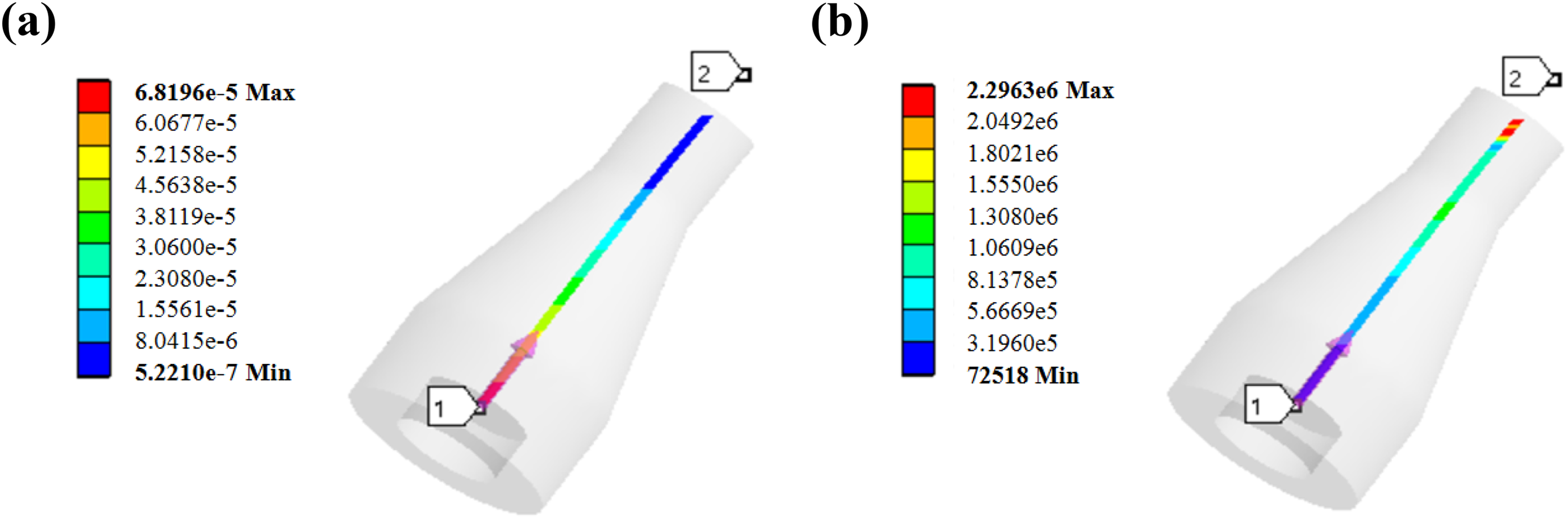
The plastic deformation (a) and (b) residual stress contour under coupled extensional–shear loadings.
Based on thermal analysis, the temperature gradients can be obtained. Thermal residual stresses can be deducted from the thermal analysis followed by a sequentially structural analysis. The differential shrinkage resulting from the highly uneven temperature distribution leads to the generation of thermal residual stresses, which are governed by heat flux. The temperature distribution and plastic deformation under differential heat flux are analyzed in this section. Figure 2(a) and (b) presents the temperature distribution and plastic deformation along Z-direction, respectively. Simultaneously, it provides a more quantitative assessment of the temperature variation under differential heat flux ranging from 200 to 1000 W/m2. The temperature variation plays an important role in controlling the development of thermal residual stresses generation. The temperature increases slowly from 60°C to 110°C with the heat flux ranging from 200 to 1000 W/m2, which is followed by a sharp drop in the temperature yielding a high-temperature gradient at a high heat flux. The resulting residual stresses identified by von Mises stresses as a function of heat flux are then investigated, as shown in Figure 2(c). Due to the temperature difference, a large thermal residual stress is produced. It is observed that the thermal residual stress distribution in XZ plane varies nonlinearly with distance in Z-direction and the maximum stress increases from 0.75 to 3.35 MPa with the heat flux increasing from 200 to 1000 W/m2. Figure 2(d) gives the total residual stresses subjected to complex thermomechanical loadings. Compared with thermal residual stresses, they exhibit a similar variation trend within the distance of 0–0.6 m, while the maximum stress varies as heat flux lower than 600 W/m2 where mechanical loading (coupled extensional–shear loading) is dominated. That is to say, thermal loading is dominated in case of heat flux higher than 600 W/m2.
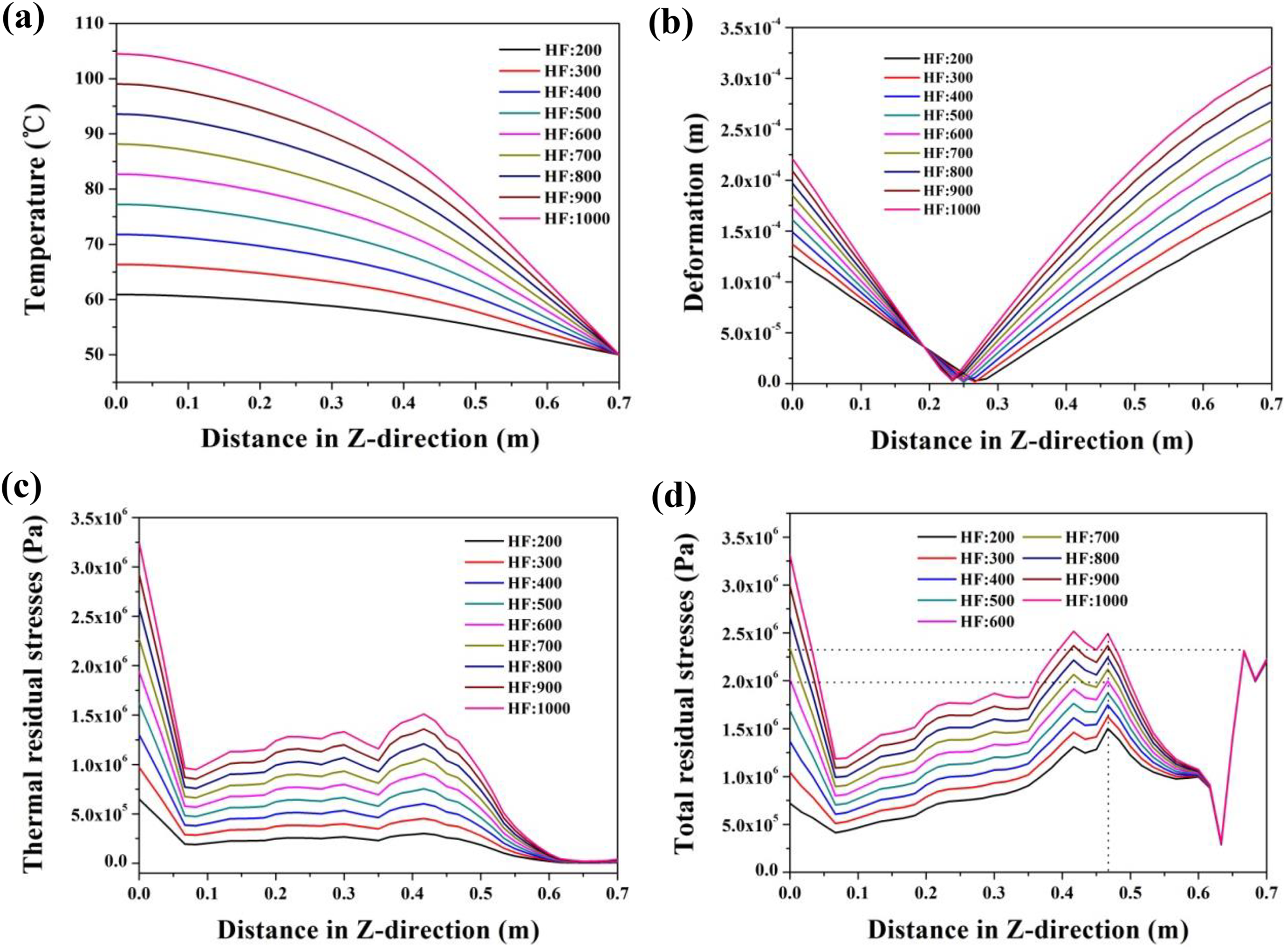
(a) The temperature distribution, (b) plastic deformation, (c) thermal residual stresses, and (d) total residual stresses variation as a function of heat flux.
To provide a keen insight on the microscale behavior in amine-grafted MWCNTs/binary resin composites under thermal loading, microscale model was constructed in consideration of their microstructural features. Figure 3 illustrates the amorphous cell of amine-grafted MWCNTs/binary resin composites, where a (6, 6) CNT of length 53 Å is placed at the center of the resin matrix.
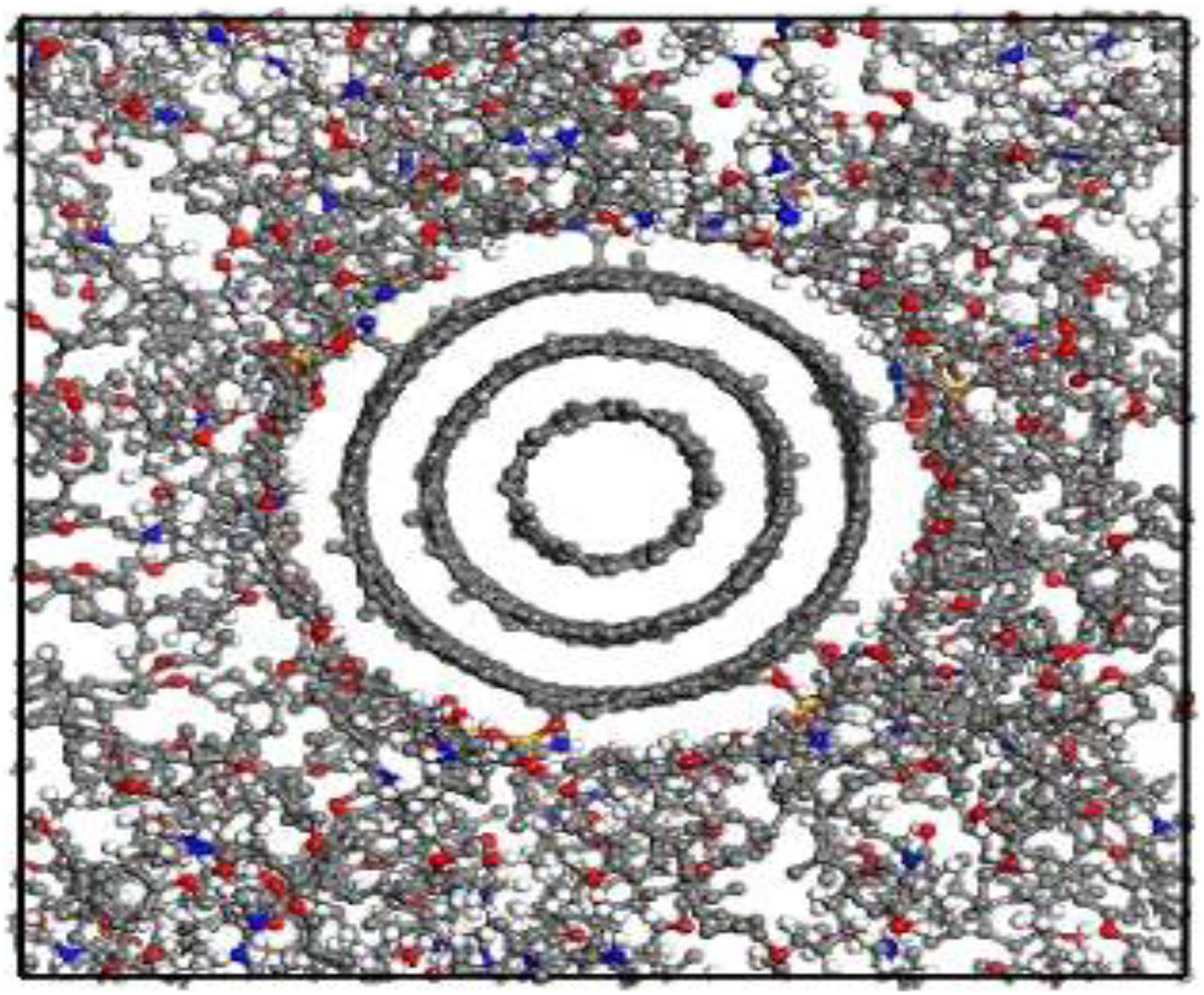
Amorphous cell of amine-grafted MWCNTs/binary resin composites. MWCNT: multiwalled carbon nanotube.
The system was heated from 333 to 383 K (60–110°C) in a stepwise manner at the interval of 10 K under the same condition. The total energy, potential energy, and kinetic energy at different temperatures are plotted in Figure 4. In this case, the main contribution of potential energy was identified in the total energy. All three kinds of energies increase with increasing temperature.
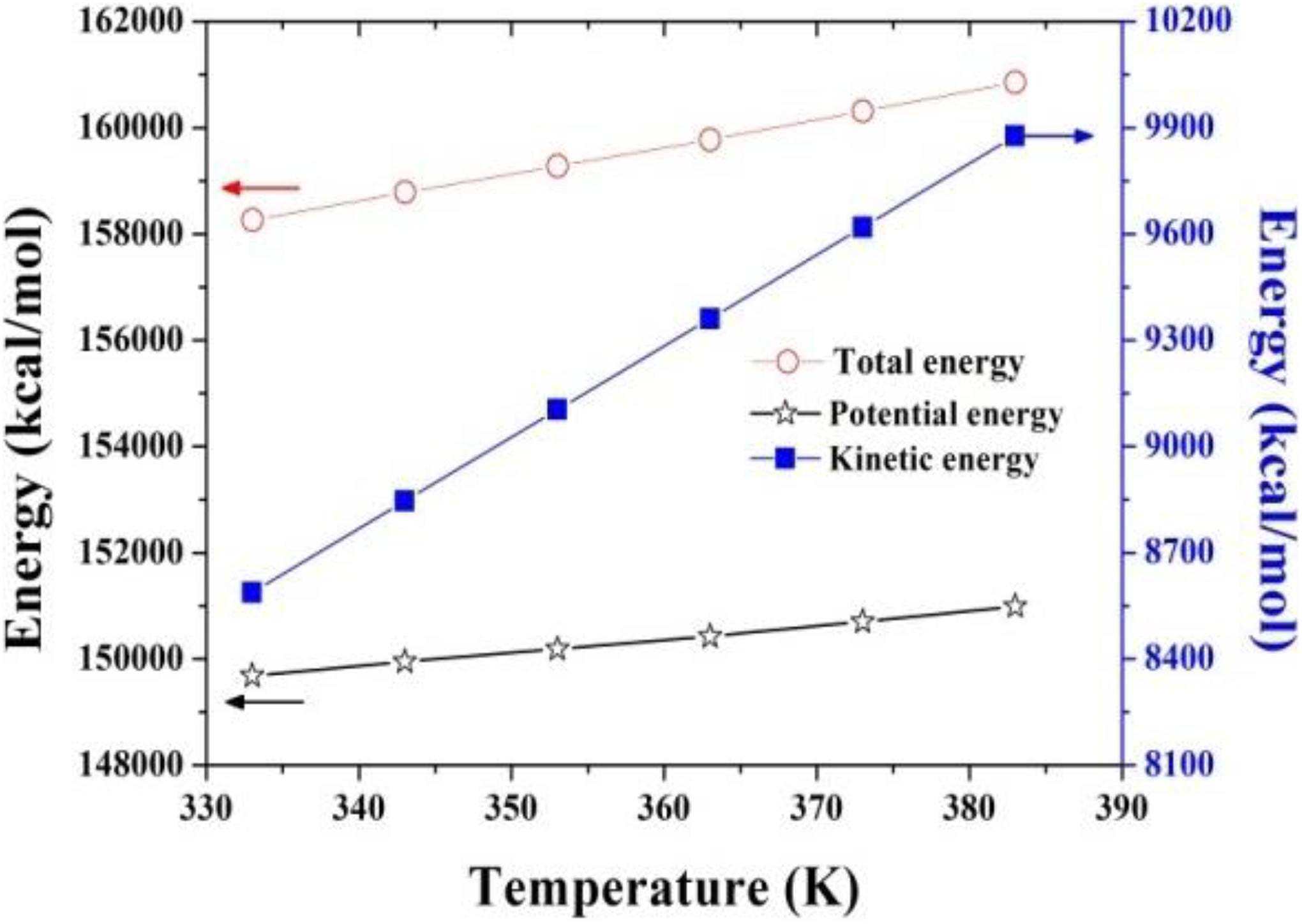
The energy changes with temperature.
Radial distribution function g(r) is commonly used to characterize molecular structure, which represents the probability of finding a pair of atoms at a distance r with respect to the bulk phase in a completely random distribution. The g(r) may afford insights on the relative distribution and strength of interaction, regarded as a helpful tool to predict the binding energy of the two chemical compounds. It can be defined as follows 26
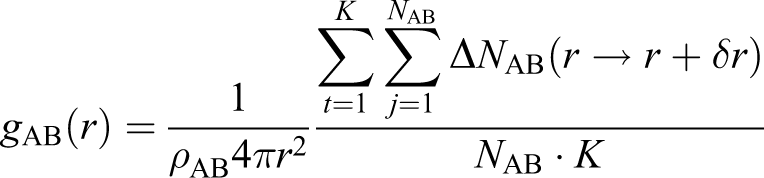
where NAB is the total number of atoms of A and B in the system, K is the number of time steps, δr is the distance interval, ΔNAB is the number of B (or A) atoms between r and r + δr around an A (or B), and ρAB is the bulk density.
Figure 5 plots the g(r) curves between amine-grafted MWCNTs and resin matrix in mixed system at different temperatures. In general, the distance between atoms corresponds with the different interaction types, respectively: hydrogen bonding (0.26–0.31 nm), strong van der Waals (0.31–0.50 nm), and weak van der Waals (above 0.50 nm). 27 For the amine-grafted MWCNTs/binary resin system at 383 K, the first distance peak at about 4.2 nm can be observed and the value of g(r) is located at about 0.70. That indicates weak van der Waals interaction between amine-grafted MWCNTs and resin matrix. With the temperature decreased, the first distance peaks are located at the similar position, while there is a slight difference on the value of g(r) in variation of 0.70–0.65, which indicates that the interactions between amine-grafted MWCNTs and resin matrix reduce and the mobility of chain segments of resin matrix increases with the decreasing temperature.
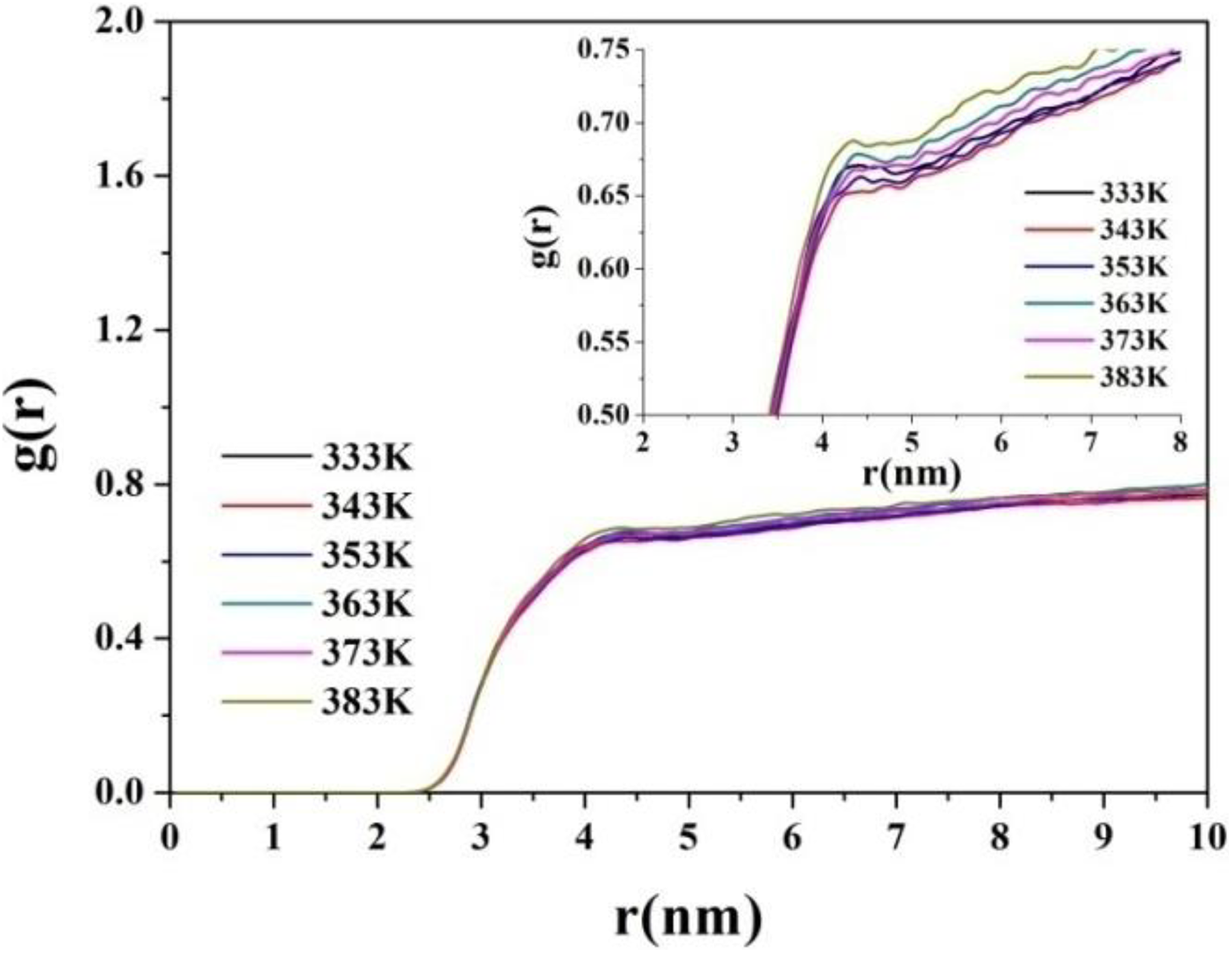
The g(r) curves between CNTs and epoxy resin in mixed system at different temperatures. CNT: carbon nanotube.
Based on the above discussions, it can be concluded that the heat flux can influence the magnitude of the thermal residual stresses but cannot alter the distribution of the thermal residual stresses. When the heat flux is too high, the large thermal residual stresses add the possibility of distortion. Most important of all, it can be deduced that the nature of residual stress variation is the weak van der Waals interactions between amine-grafted MWCNTs and resin matrix and the mobility of chain segments of resin matrix. The residual stress distribution can assist in determining the process parameters and conditions that can reduce distortion by controlling the coupled thermomechanical loadings. All these results will guide the extensive experimental investigation and practical application of resin-based composites under complex thermomechanical loadings.
Conclusions
In summary, the residual stresses in amine-grafted MWCNTs/binary resin composites under complex thermomechanical loadings have been investigated. The influence of heat flux on temperature distribution and thermal residual stresses has also been discussed and microscale model has been developed to deeply understand the microscale behavior under thermal loading, taking into account their microstructural features. Some important and useful results can be obtained as follows: The distributions and distortions of residual stresses under coupled extensional–shear loadings were studied. The maximum residual stress of 2.29 MPa occurred at edge point with the highest rate of stress increase, which is lower than the yield strength of amine-grafted MWCNTs/binary resin composites (approximately 4.02 MPa). The temperature gradients and thermal residual stresses were obtained from the thermal analysis related to a sequentially structural analysis. With the heat flux ranging from 200 to 1000 W/m2, the temperature increases slowly, resulting in a high-temperature gradient associated with a large thermal residual stress at a high heat flux. The total residual stresses have a similar variation trend within the distance of 0–0.6 m in comparison with thermal residual stresses and it is dominated by thermal loading compared with mechanical loading as heat flux higher than 600 W/m2. We described a microscale model to reflect the microscale behavior under thermal loading in amine-grafted MWCNTs/binary resin composites, taking into account their microstructural features. The weak van der Waals interactions between amine-grafted MWCNTs and resin matrix reduced and the mobility of chain segments of resin matrix increased with the decreasing temperatures.
Based on the atomistic simulation, it was deduced that the nature of residual stress variation is the weak van der Waals interactions between amine-grafted MWCNTs and resin matrix and the mobility of chain segments of resin matrix.
Footnotes
Funding
The author(s) disclosed receipt of the following financial support for the research, authorship, and/or publication of this article: This work was financially supported by the National Key R&D Program of China (2016YFB0302301) and the Science and Technology Planning Project of Guangzhou (201704020008).
