




Abstract
Cylindrical shells are usually buckled under complex and combined loading conditions. This article presents an analytical approach to investigate the buckling and postbuckling behaviors of cylindrical shells reinforced by single-walled carbon nanotubes, surrounded by an elastic medium, exposed to thermal environments, and subjected to combined axial compression and lateral pressure loads. Carbon nanotubes (CNTs) are imbedded into matrix phase by uniform distribution or functionally graded distribution along the thickness direction. The properties of constituents are assumed to be temperature dependent, and effective properties of CNT-reinforced composite (CNTRC) are determined by an extended rule of mixture. Governing equations are based on the classical shell theory (CST) taking von Karman–Donnell nonlinearity and surrounding elastic foundations into consideration. Three-term form of deflection is assumed to satisfy simply supported boundary conditions, and Galerkin method is applied to obtain nonlinear load–deflection relations from which buckling loads and postbuckling equilibrium paths are determined. Numerical examples are carried out to show the effects of CNT volume fraction, distribution types, thermal environments, preexisting nondestabilizing lateral pressure and axial compression loads, and elastic medium on the buckling and postbuckling behaviors of CNTRC cylindrical shells.
Keywords
Introduction
Structural components in the form of circular cylindrical shells are widely used in engineering applications. Since cylindrical shells are usually subjected to complex loading conditions, their stability is an important problem and should be addressed for the sake of accurate prediction and safe design. Bagherizadeh et al. 1 used adjacent equilibrium criterion and analytical solution to study linear buckling behavior of functionally graded material (FGM) cylindrical shells surrounded by Pasternak elastic foundation. Huang and Han 2 –4 used an analytical approach based on Ritz energy method to investigate buckling and postbuckling behaviors of thin FGM cylindrical shells under external pressure, axial compression, and combined loading. Nonlinear static stability, vibration, and dynamic buckling of thin FGM cylindrical shells with stiffeners and surrounding elastic medium have been treated in works of Dung and coworkers. 5,6 Buckling, postbuckling, and geometrically nonlinear responses of FGM plates with various shapes have been addressed in works 7 –10 based on numerical approaches.
Carbon nanotubes (CNTs) have been attractive subject of many science fields since first work of Iijima in 1991. 11 No previous material has possessed extraordinary mechanical, thermal, and electrical properties attributed to CNTs. There are two main types of CNTs: single-walled carbon nanotubes (SWCNTs) and multi-walled carbon nanotubes (MWCNTs). The former is rolled seamlessly from a single sheet of graphene to form a cylinder with diameter of order of 1 nm and length of up to centimeters, and the latter consist of an array of such cylinders formed concentrically and separated about 0.35 nm. 12 –14 Due to superlative properties and very large aspect ratio, CNTs are used as ideal filler into polymer matrix to form carbon nanotube-reinforced composite (CNTRC), an advanced class of nanocomposite.
The concept of functionally graded carbon nanotube reinforced composite (FG-CNTRC) was first presented in work of Shen 15 in which CNTs are reinforced into polymer matrix in such a way that their volume fraction is a linear function of thickness variable. This proposal of Shen has motivated subsequent studies on static and dynamic responses of structural components made of FG-CNTRC. Based on IMLS-Ritz method, 16,17 Zhang et al. 18,19 and Zhang 20 analyzed the nonlinear bending of thick FG-CNTRC plates resting on Pasternak elastic foundations and nonlinear response of FG-CNTRC plates with elastically restrained edges and internal supports. Geometrically nonlinear analyses of skew, quadrilateral, and triangular FG-CNTRC plates have been carried out by Zhang and Liew 21,22 and Zhang et al. 23 Lei et al. 24 and Zhang et al. 25 used meshless methods to study the free vibration of rectangular FG-CNTRC plates without and with elastic restraints of edges, respectively. Static response and free vibration of laminated FG-CNTRC plates have been analyzed in works of Lei et al. 26 and Zhang and Selim. 27 The effects of in-plane loads and piezoelectric patches on the vibration response of FG-CNTRC plates with various shapes have been examined in works of Zhang and coworkers. 28 –31 Linear buckling of FG-CNTRC rectangular and skew plates under mechanical loads has been investigated in works of Lei et al. 32 and Zhang et al. 33 making use of first-order shear deformation theory and numerical methods. Using analytical and semi-analytical solutions, mechanical buckling behavior of FG-CNTRC rectangular plates has been studied in works of Mehrabadi et al. 34 and Wang et al., 35 respectively. Zhang 36 made use of IMLS-Ritz method for buckling analysis of nanocomposite plates of polygonal planform. Zhang and Liew 37 and Zhang et al. 38,39 studied the postbuckling behavior of FG-CNTRC plates under compressive loads taking into account elastic foundations 37 and elastic constraints of boundary edges. 39 Shen and Zhang 40 presented a study on buckling and postbuckling of FG-CNTRC plates under two types of thermal loading. Kiani 41 used Ritz method with shape functions as Chebyshev polynomials to examine postbuckling of FG-CNTRC plates under uniform temperature rise. Tung 42 considered effects of elastic foundations and tangential edge constraints on the buckling and postbuckling behaviors of FG-CNTRC plates under two types of thermal load. Dynamic behavior of FG-CNTRC plates in supersonic airflow and subjected to dynamic loading has been considered in previous works. 43,44
Linear buckling of FG-CNTRC cylindrical panels with piezoelectric layers under axial compression has been treated in analytical work of Nasihatgozar et al. 45 Macias et al. 46 made use of numerical simulation based on shell finite element to analyze linear buckling behavior of FG-CNTRC cylindrical panels under axial compression and shear. Liew et al. 47 researched postbuckling behavior of FG-CNTRC cylindrical panels under axial compression using a meshless approach. Based on a semi-analytical approach with a higher order shear deformation theory and a perturbation technique, Shen 48 and Shen and Xiang 49 –51 presented investigations on postbuckling behavior of FG-CNTRC cylindrical panels subjected to external pressure, axial compression, uniform temperature rise, and combined loads. Recently, Tung and Trang 52,53 used Galerkin method to investigate the nonlinear postbuckling response of thin FG-CNTRC cylindrical panels under external pressure and axial compression taking effects of elastic foundations and tangential edge constraints into consideration. Lei et al. 54 used the element-free kp-Ritz method to analyze the dynamic stability of FG-CNTRC cylindrical panels.
Based on theory of elasticity, static analysis of FG-CNTRC cylindrical shells imbedded in piezoelectric layers under thermo–electro–mechanical load has been carried out by Alibeigloo and Pasha Zanoosi. 55 Shen and Xiang 56 investigated nonlinear vibration of FG-CNTRC cylindrical shells in thermal environments using an improved perturbation technique. Employing a numerical approach based on two different shear deformation theories, Song et al. 57 analyzed linear vibration of FG-CNTRC cylindrical shells with temperature effects. Zhang et al. 58 investigated the impact responses of FG-CNTRC cylindrical shells. Based on asymptotic solutions and a perturbation technique, Shen and his coworker have performed investigations on postbuckling behaviors of higher order shear deformable FG-CNTRC cylindrical shells subjected to axial compression, 59 external pressure, 60 combined mechanical loads, 61 thermal load, 62 and torsional load. 63 Utilizing a Ritz energy approach, Ansari et al. 64 presented an analytical study on postbuckling behavior of thin FG-CNTRC cylindrical shells under electromechanical loads. Making use of Galerkin method, Ninh 65 dealt with postbuckling problem of thin FG-CNTRC cylindrical shells under torsional load. Both works of Ansari et al. 64 and Ninh 65 used three-term form of deflection and considered the effects of piezoelectric layers on postbuckling behavior of FG-CNTRC cylindrical shells. Jam and Kiani 66 used adjacent equilibrium criterion and numerical method to examine the linear buckling of FG-CNTRC conical shells under external pressure.
The present article analytically investigates the buckling and postbuckling of CNTRC cylindrical shells with surrounding elastic foundations exposed to thermal environments and subjected to combined action of axial compression and external pressure. CNTs are reinforced into matrix phase by uniform distribution (UD) or functionally graded (FG) distribution. Material properties of constituents are assumed to be temperature dependent, and effective properties of CNTRC are estimated by an extended rule of mixture through a micromechanical approach. Formulations are based on the CST taking into account von Karman–Donnell nonlinear terms. Three-term solution of deflection and stress function are assumed to satisfy simply supported boundary conditions and Galerkin method is applied to obtain nonlinear load–deflection relations from which buckling loads and postbuckling paths are determined. Numerical examples are carried out to analyze the effects of CNT volume fraction, distribution patterns, thermal environments, preexisting nondestabilizing loads, and elastic foundations on the buckling and postbuckling behaviors of FG-CNTRC cylindrical shells.
CNTRC cylindrical shell surrounded by an elastic medium
Consider a CNTRC cylindrical shell of length L, mean radius R, and thickness h. The cylindrical shell is surrounded by an elastic medium and is referred to a coordinate system
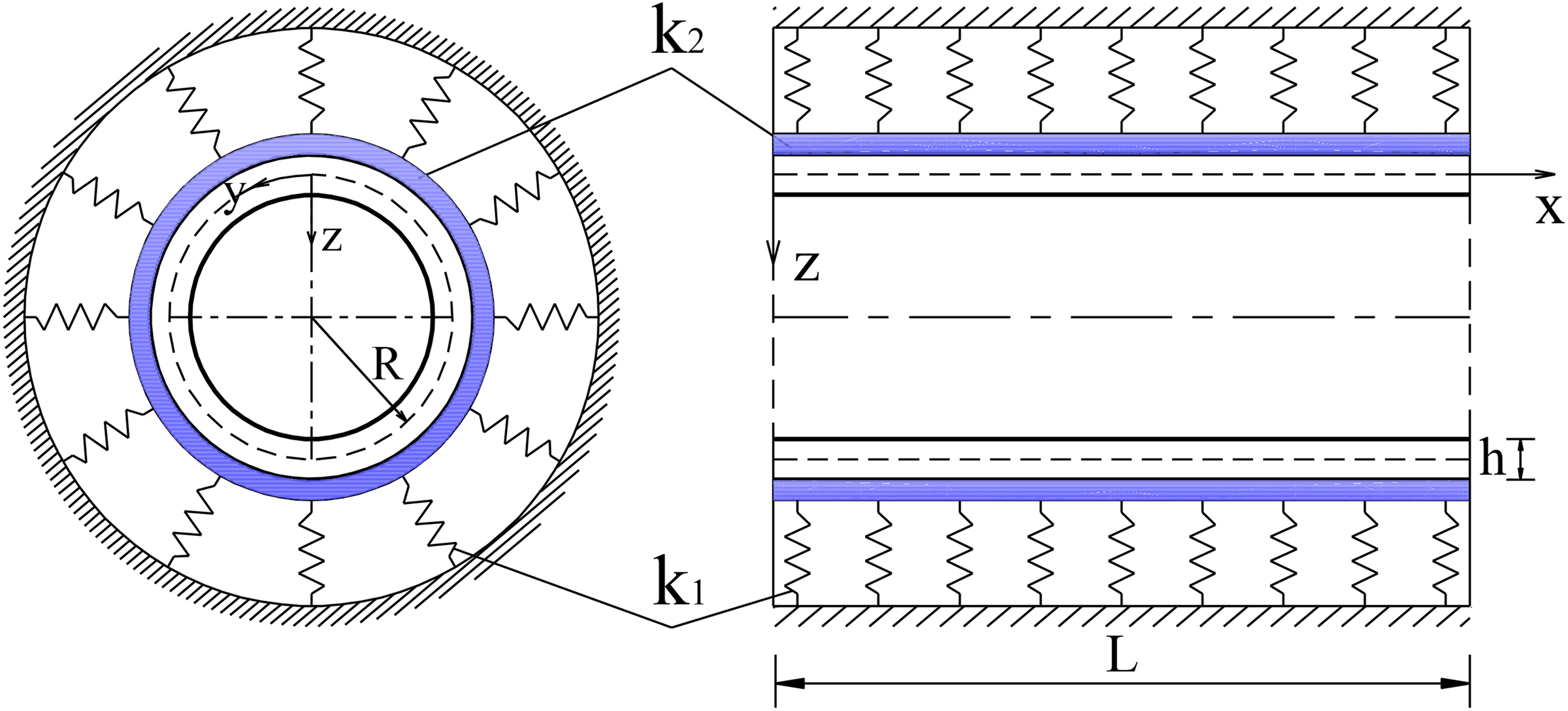
Configuration and coordinate system of a cylindrical shell surrounded by an elastic medium.
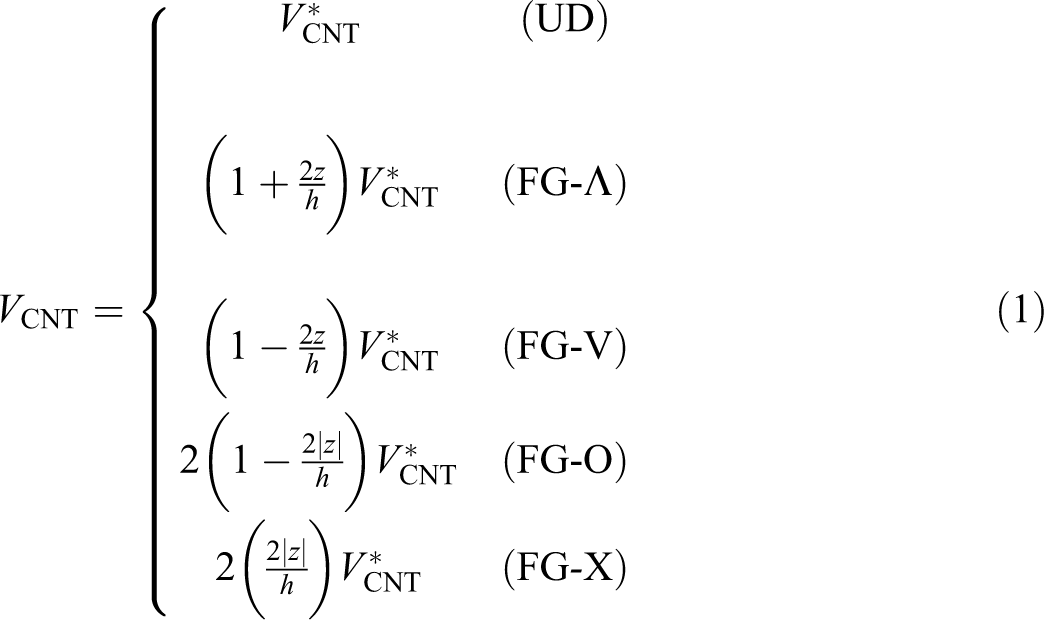
where

in which



where
Effective Poisson ratio weakly depending on temperature and position is determined by

where


where
Formulations
Based on the CST, strain components at a distance z from the middle surface of the cylindrical shell are expressed as

where strains

where subscript prime indicates partial derivative and von Karman–Donnell nonlinear terms are maintained. Stress–strain relations of a CNTRC cylindrical shell in a thermal environment are expressed as

where

and
Force and moment intensities in the CNTRC cylindrical shell are related to the stresses by the equations

and these intensities are expressed in specific form through equations (6) and (8) as



where coefficients
Based on the CST, nonlinear equilibrium equations for a geometrically perfect cylindrical shell surrounded by an elastic medium are



where q is the lateral pressure having positive and negative values in cases of external and internal pressures, respectively, and qf is surrounding elastic medium-cylindrical shell interactive pressure represented by Pasternak model as

in which k1 is modulus of Winkler springs, k2 is stiffness of shear layer in Pasternak model and
From equations (7) and (11), equilibrium equation of a geometrically perfect CNTRC cylindrical shell is rewritten in the form as


where

and coefficients
By virtue of equations (7), (11), and (15), the strain compatibility equation of a geometrically perfect CNTRC cylindrical shell is expressed as

where coefficients
The present study considers simply supported CNTRC cylindrical shells with freely movable edges subjected to a combined action of uniform lateral pressure q and uniform axial compression pressure P at two ends. The associated boundary conditions are

where


where
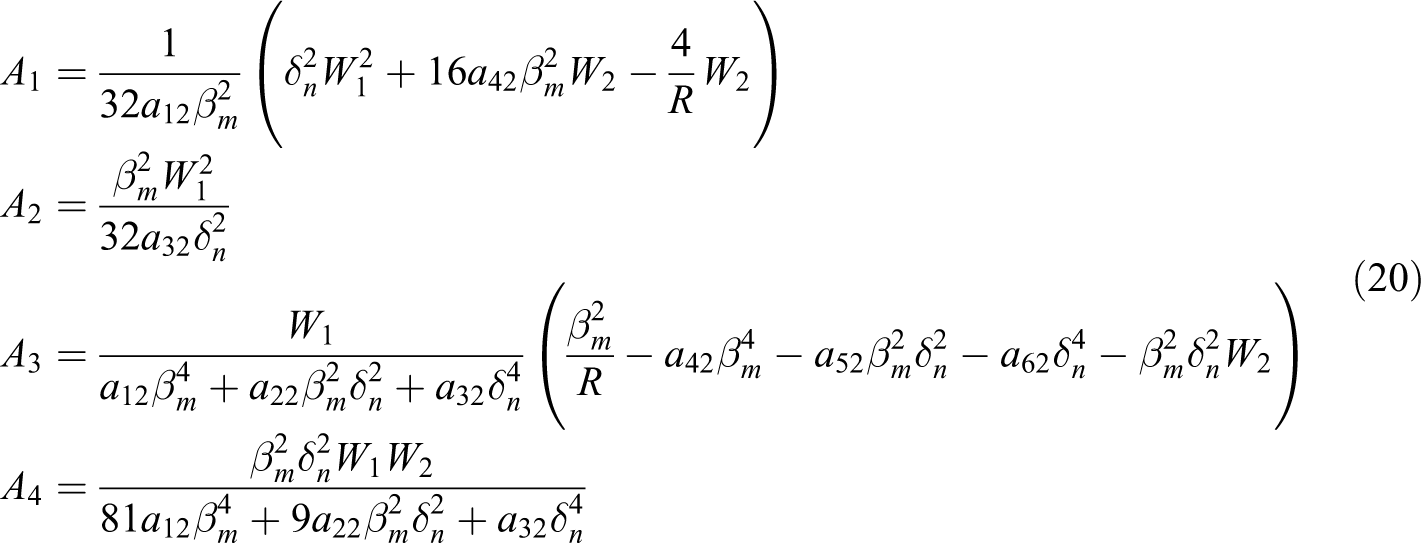
Subsequently, solutions (18) and (19) are introduced into the equilibrium equation (14), then applying Galerkin method on whole region of the cylindrical shell (



where coefficients
Next, for the cylindrical shell, the following circumferential closed condition must be satisfied

From equations (7), (11), and (15),

Now, introduction of



where the details of coefficients
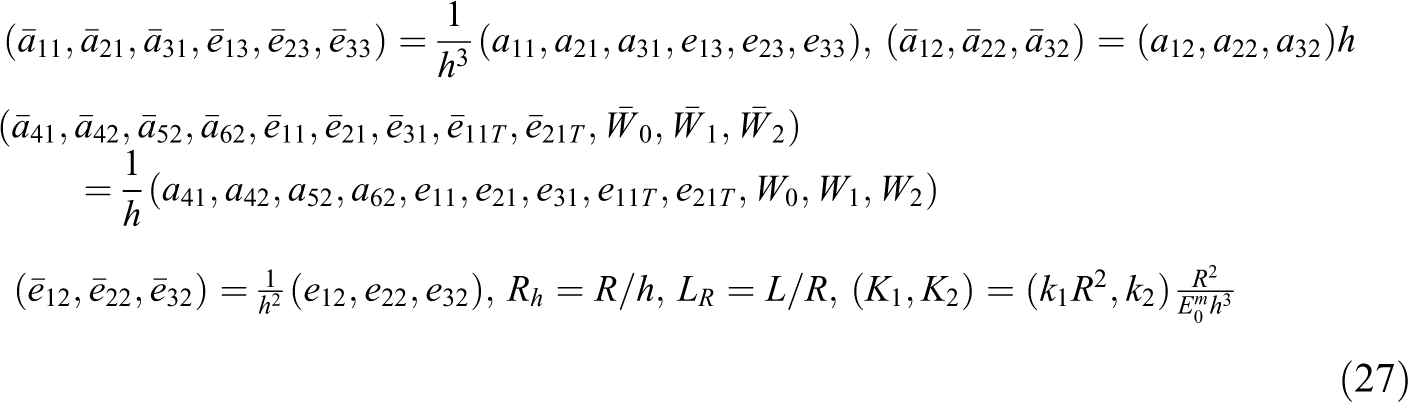
and
It is deduced from equations (24) and (25) that


where coefficients
In what follows, two cases of combined mechanical loads will be considered. Case 1: CNTRC cylindrical shell is subjected to a preexisting nondestabilizing (internal or external) lateral pressure and then under uniform axial compression.
In this case, it is assumed that

where

where coefficients

It is obvious from equation (18) that maximum deflection of the cylindrical shell is

A combination of equations (28), (29), and (32) gives non-dimensional maximum deflection as

Equations (30) and (33) are used for postbuckling analysis of CNTRC cylindrical shells under high values of axial compression combined with relatively low lateral pressure. Case 2: CNTRC cylindrical shell is subjected to a preexisting nondestabilizing axial compression and then under uniform lateral pressure.
In this case, it is assumed that

where

where

Buckling pressures of axially pre-compressed CNTRC cylindrical shells are obtained from equation (35) by setting

Non-dimensional maximum deflection of the cylindrical shell in this case of loading is deduced from equations (28), (32), and (34) as

Equations ( 35) and (38) are used for postbuckling analysis of CNTRC cylindrical shells under high values of lateral pressure combined with relatively low axial compression load.
Results and discussion
This section presents numerical examples of buckling and postbuckling analyses for cylindrical shells made of poly(methyl methacrylate), referred to as PMMA, as matrix material and reinforced by (10,10) SWCNTs. The temperature dependent properties of the PMMA are
To validate the proposed approach, the buckling behavior of simply supported CNTRC cylindrical shells without elastic foundations under combined mechanical loads are considered. Critical buckling loads of CNTRC cylindrical shells with different values of load proportional parameter
Comparisons of critical buckling loads
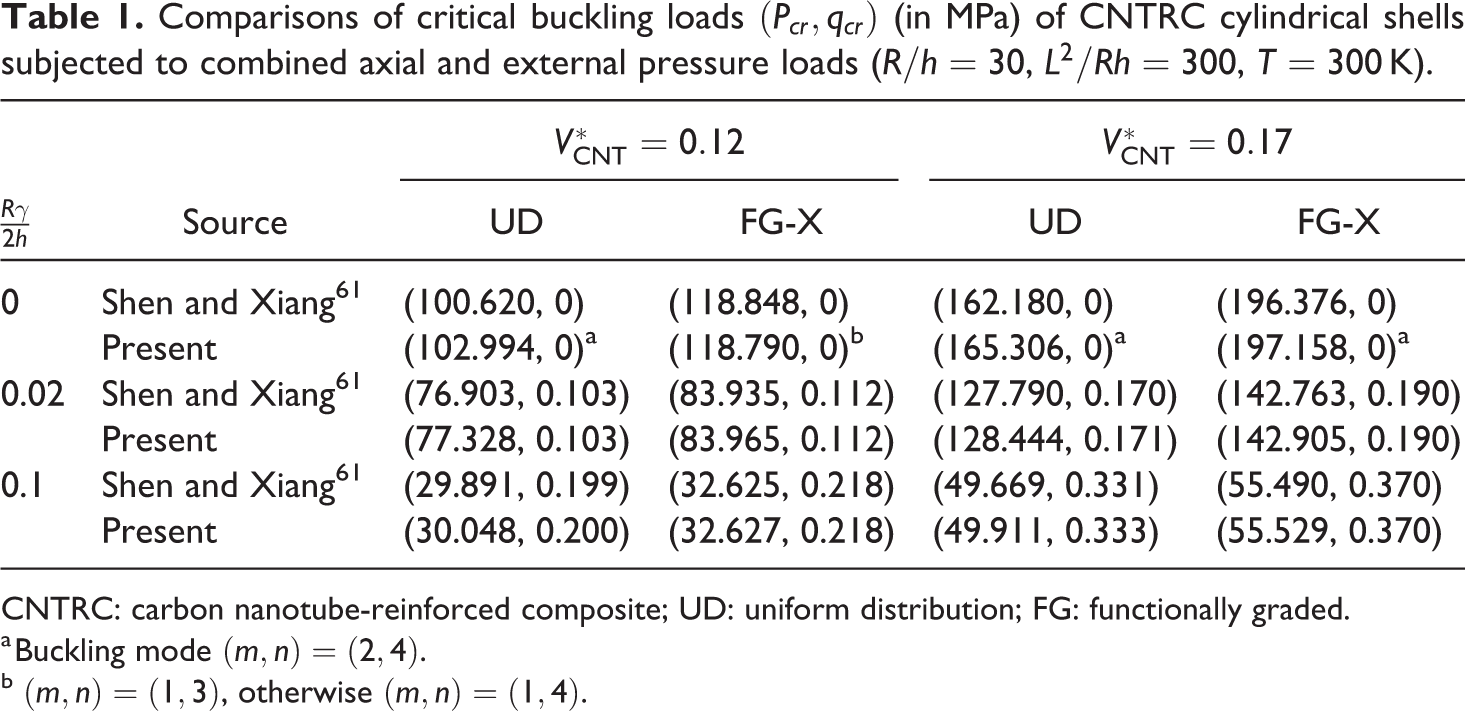
CNTRC: carbon nanotube-reinforced composite; UD: uniform distribution; FG: functionally graded.
a Buckling mode
b
In what follows, buckling and postbuckling behaviors of CNTRC cylindrical shells under combined mechanical loads in thermal environments will be analyzed. For the sake of brief expression, CNTRC cylindrical shells are assumed to be placed at room temperature (
Buckling analysis
Table 2 considers the effects of CNT volume fraction
Critical buckling loads
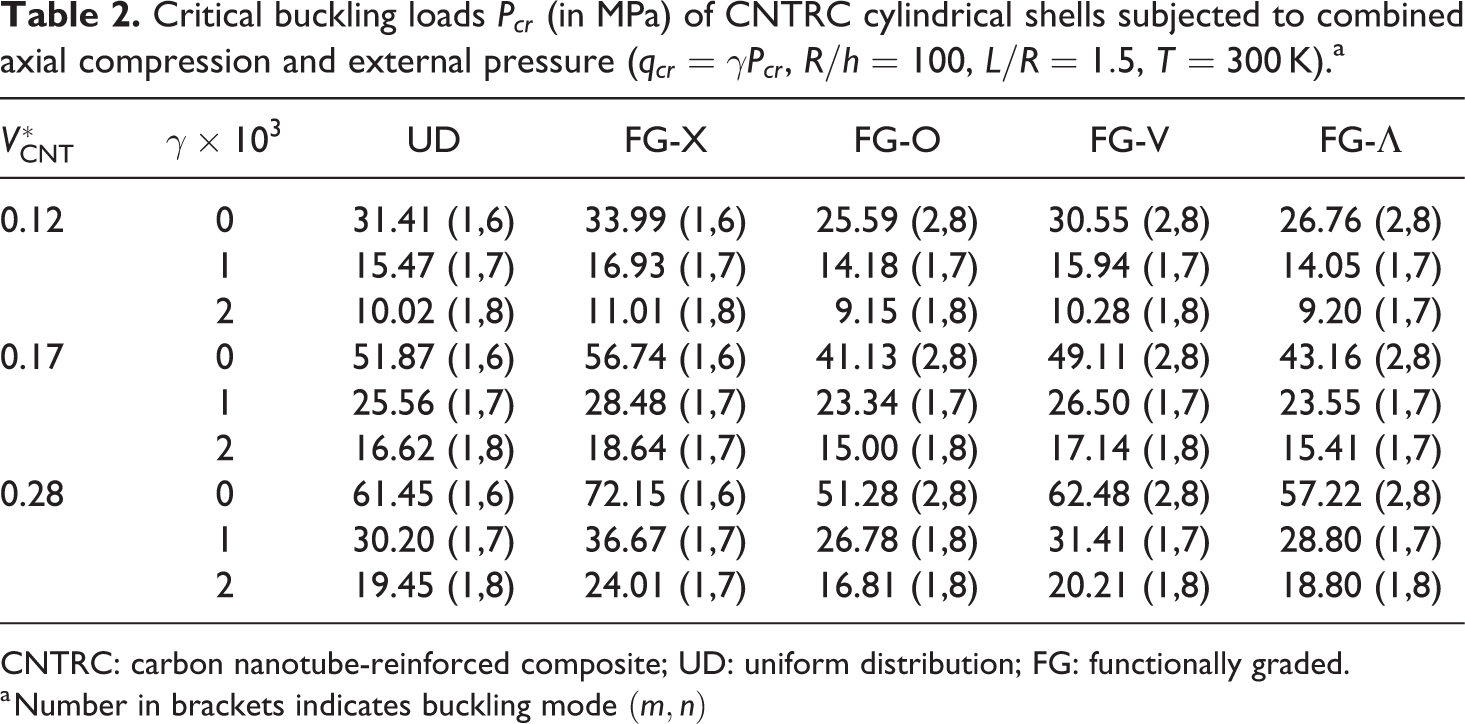
CNTRC: carbon nanotube-reinforced composite; UD: uniform distribution; FG: functionally graded.
a Number in brackets indicates buckling mode
Next, effects of CNT volume fraction, distribution type, thermal environment, and elastic foundation on the interaction buckling curves of CNTRC cylindrical shells subjected to combined axial compression and external pressure are shown in Figures 2 to 5. Figure 2 demonstrates that the interaction buckling curve of FG-V CNTRC shell is slightly higher than that of UD CNTRC shell and that the stable regions of FG-X and FG-Λ shells are the largest and smallest, respectively, among four distribution types of CNTRC cylindrical shell. Figure 3 shows that the stable region of CNTRC cylindrical shell become smaller when environment temperature is increased. Subsequently, Figure 4 indicates that the interaction buckling curve of CNTRC cylindrical shell is considerably enhanced as CNT volume fraction is increased. As final illustration for buckling analysis, Figure 5 considers effects of surrounding elastic foundation on the interaction buckling curve of CNTRC cylindrical shells under combined loads. It is clear that the stable region of the shell is significantly broadened when the shell is surrounded by elastic foundation, especially Pasternak type foundation.
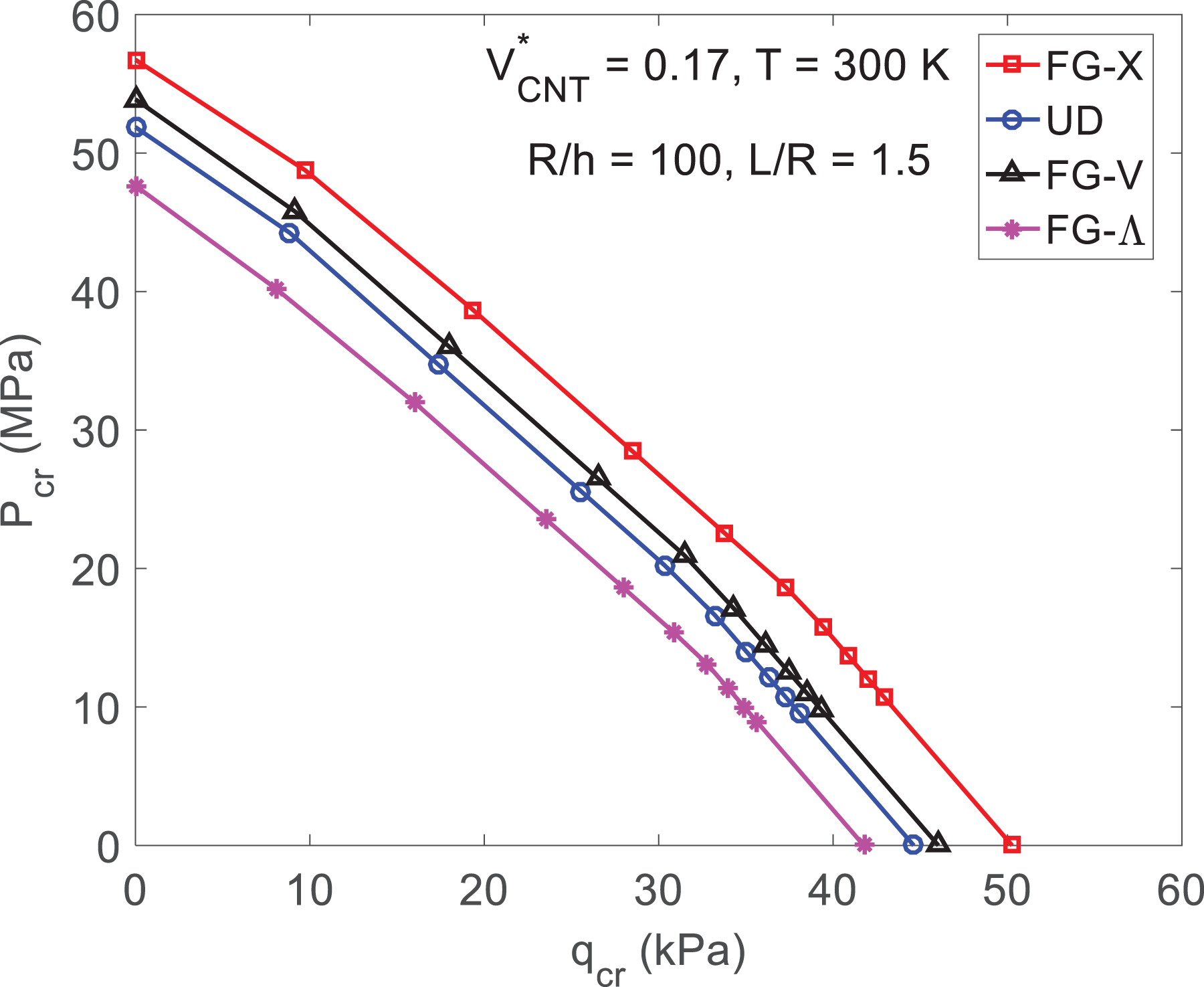
Effects of CNT distribution types on the interaction buckling curves of CNTRC cylindrical shells under combined axial compression and external pressure.
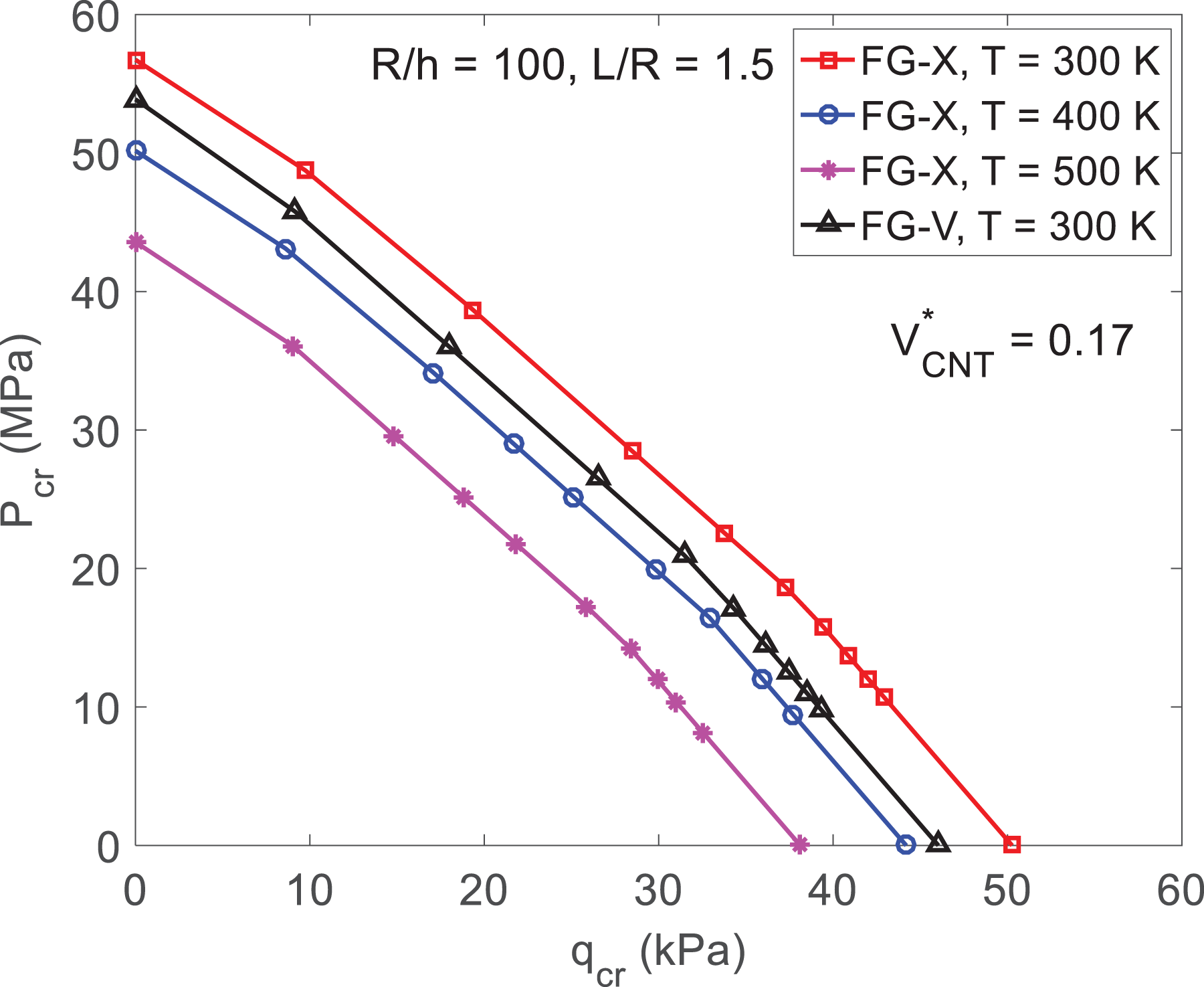
Effects of thermal environments on the interaction buckling curves of CNTRC cylindrical shells under combined axial compression and external pressure.
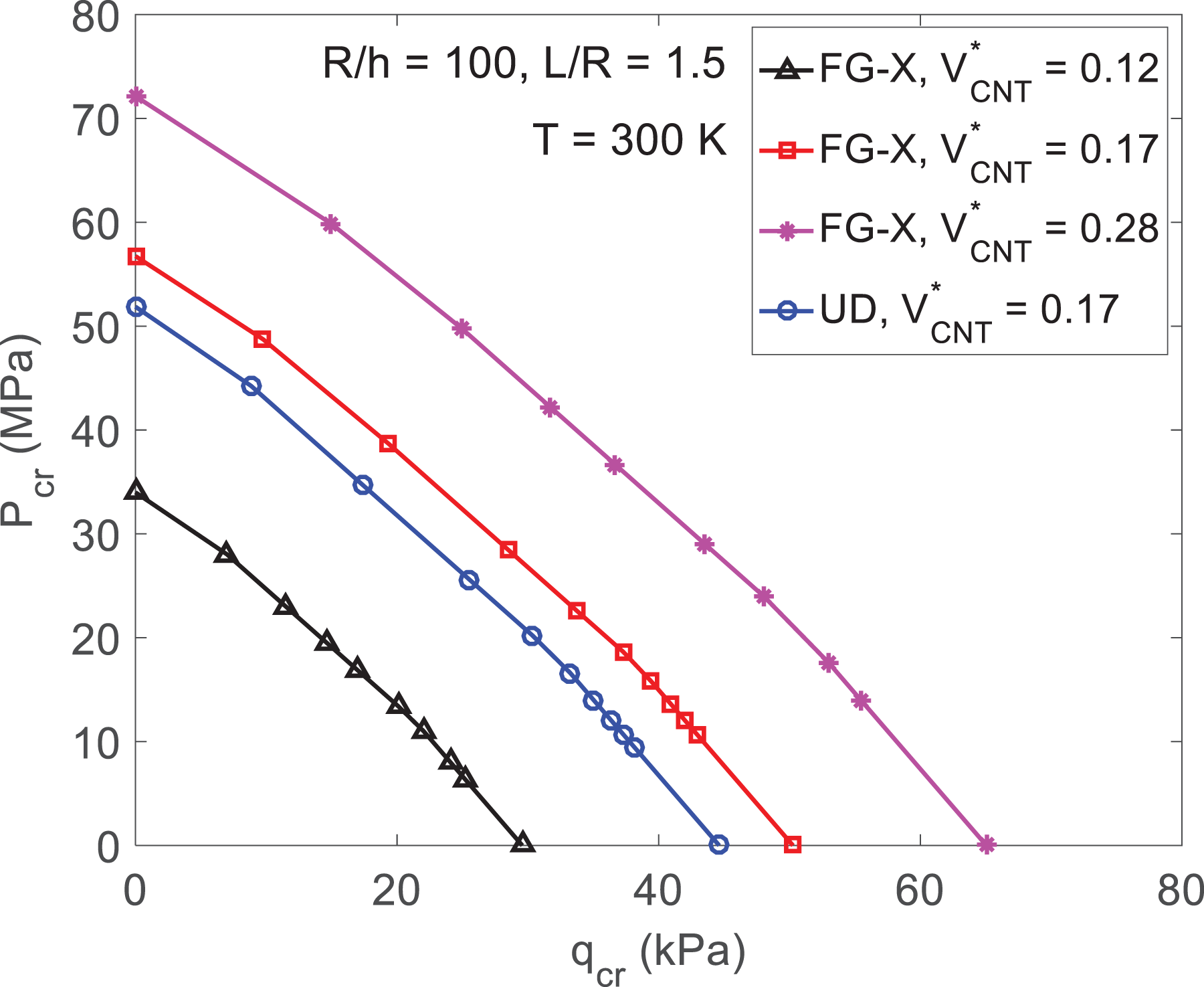
Effects of CNT volume fraction on the interaction buckling curves of CNTRC cylindrical shells under combined axial compression and external pressure.
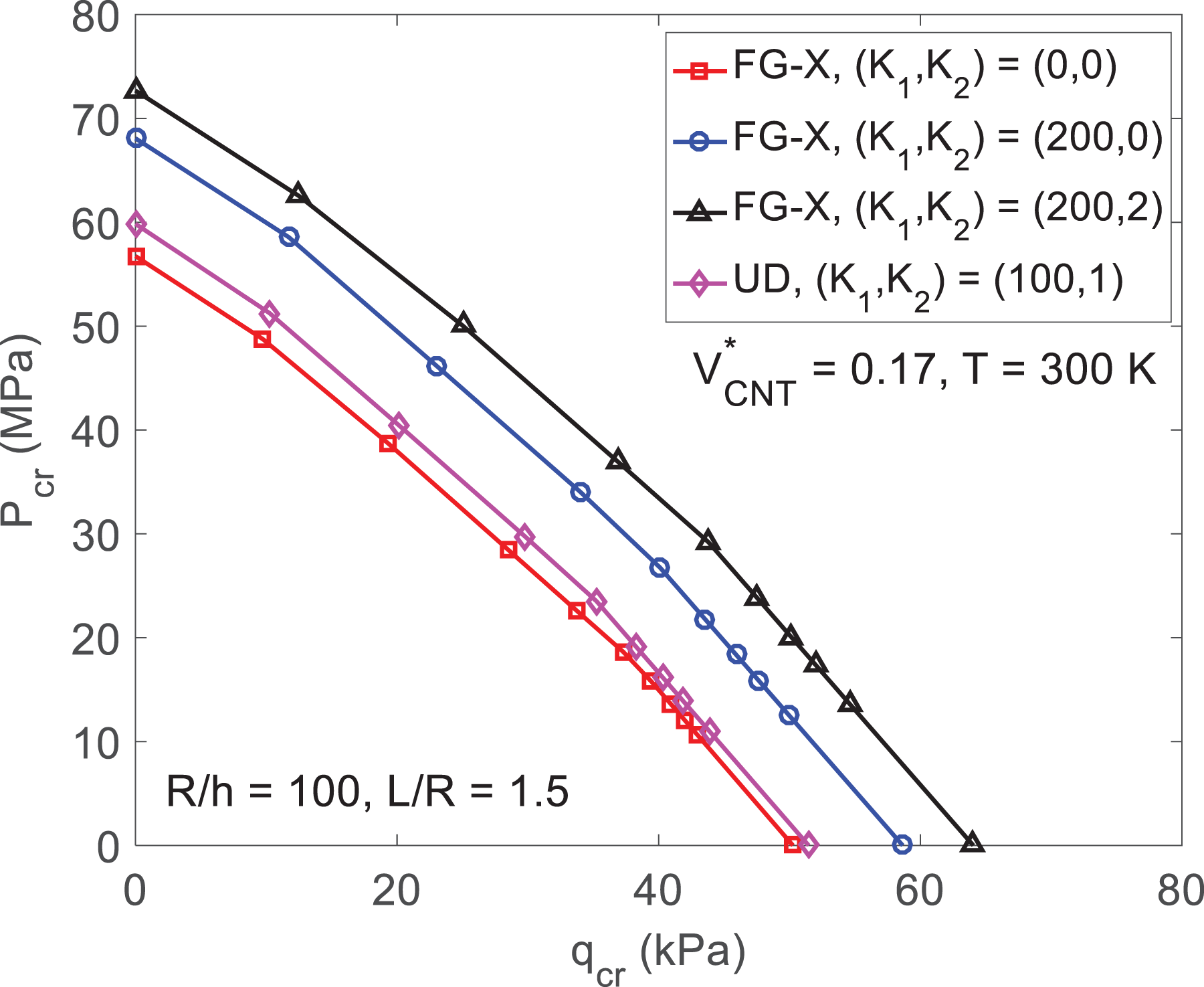
Effects of surrounding elastic foundations on the interaction buckling curves of CNTRC cylindrical shells under combined axial compression and external pressure.
Postbuckling analysis
As first example for postbuckling analysis, Figure 6 analyzes the effects of preexisting nondestabilizing external pressure (i.e. four different values of
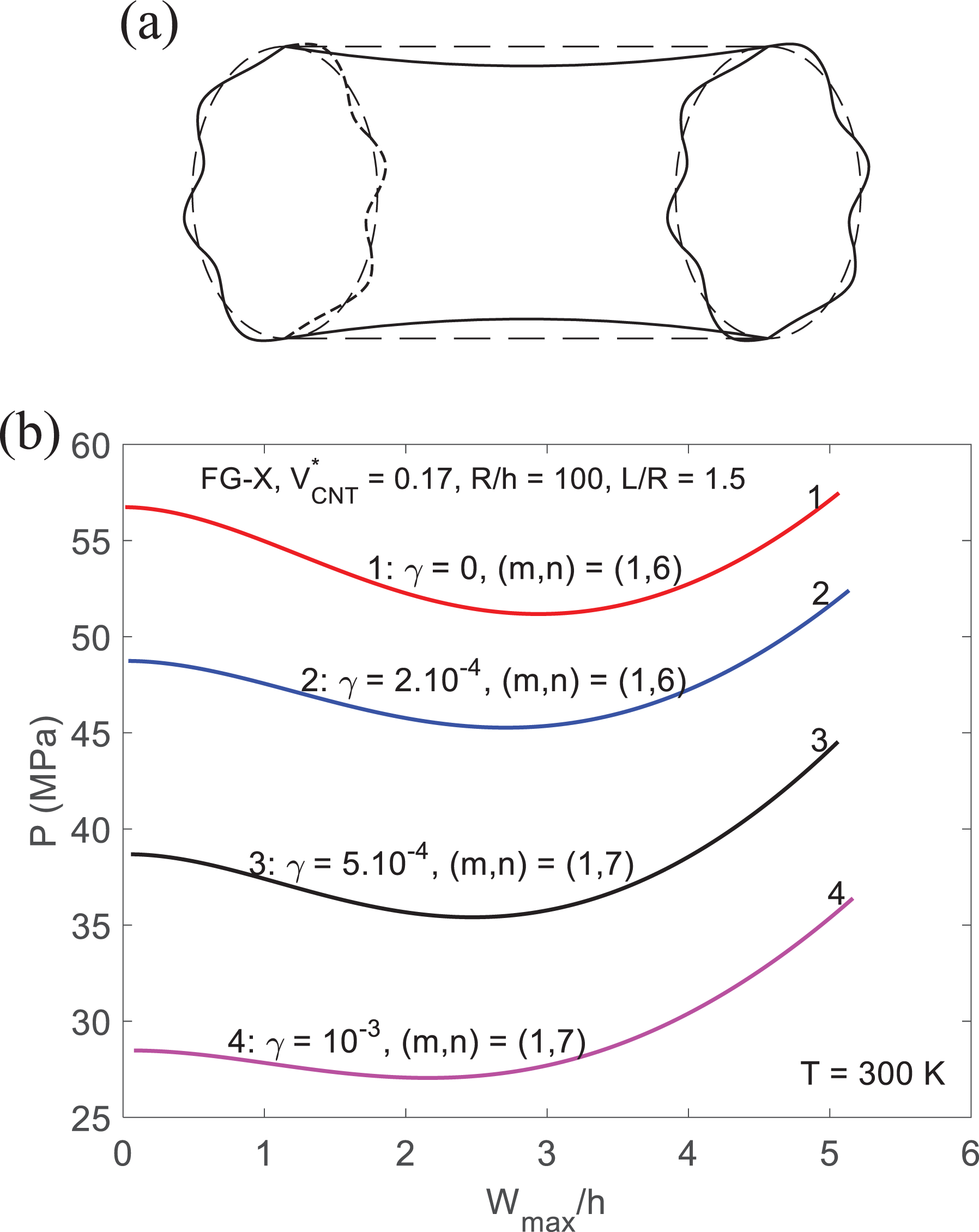
Illustrative shape of buckling mode
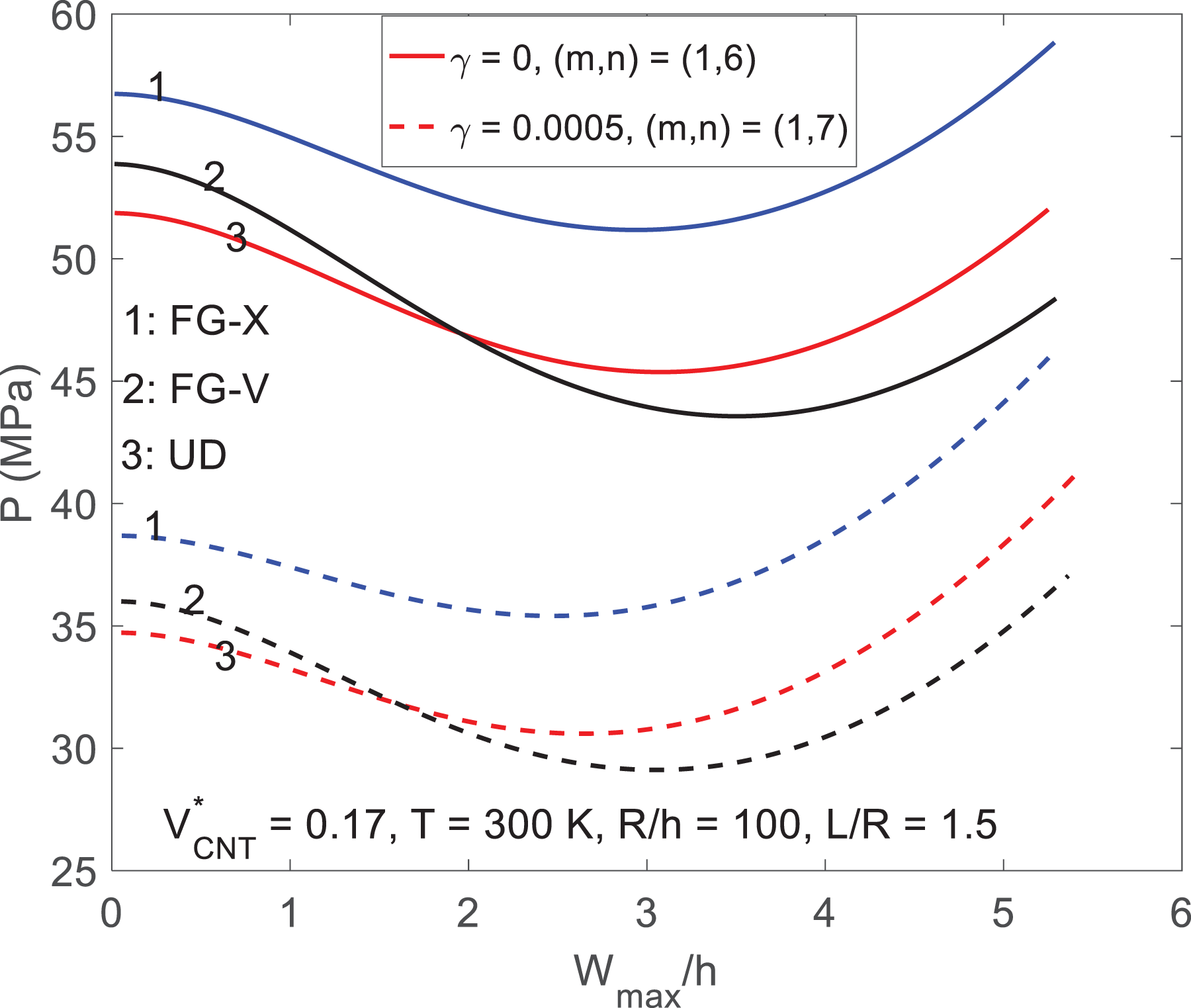
Effects of CNT distribution types on postbuckling behavior of CNTRC cylindrical shells subjected to axial compression combined with preexisting external lateral pressure.
Next, Figure 8 plotted with three different values of CNT volume fraction shows that the postbuckling strength of CNTRC cylindrical shell is considerably higher and difference between equilibrium paths corresponding to values
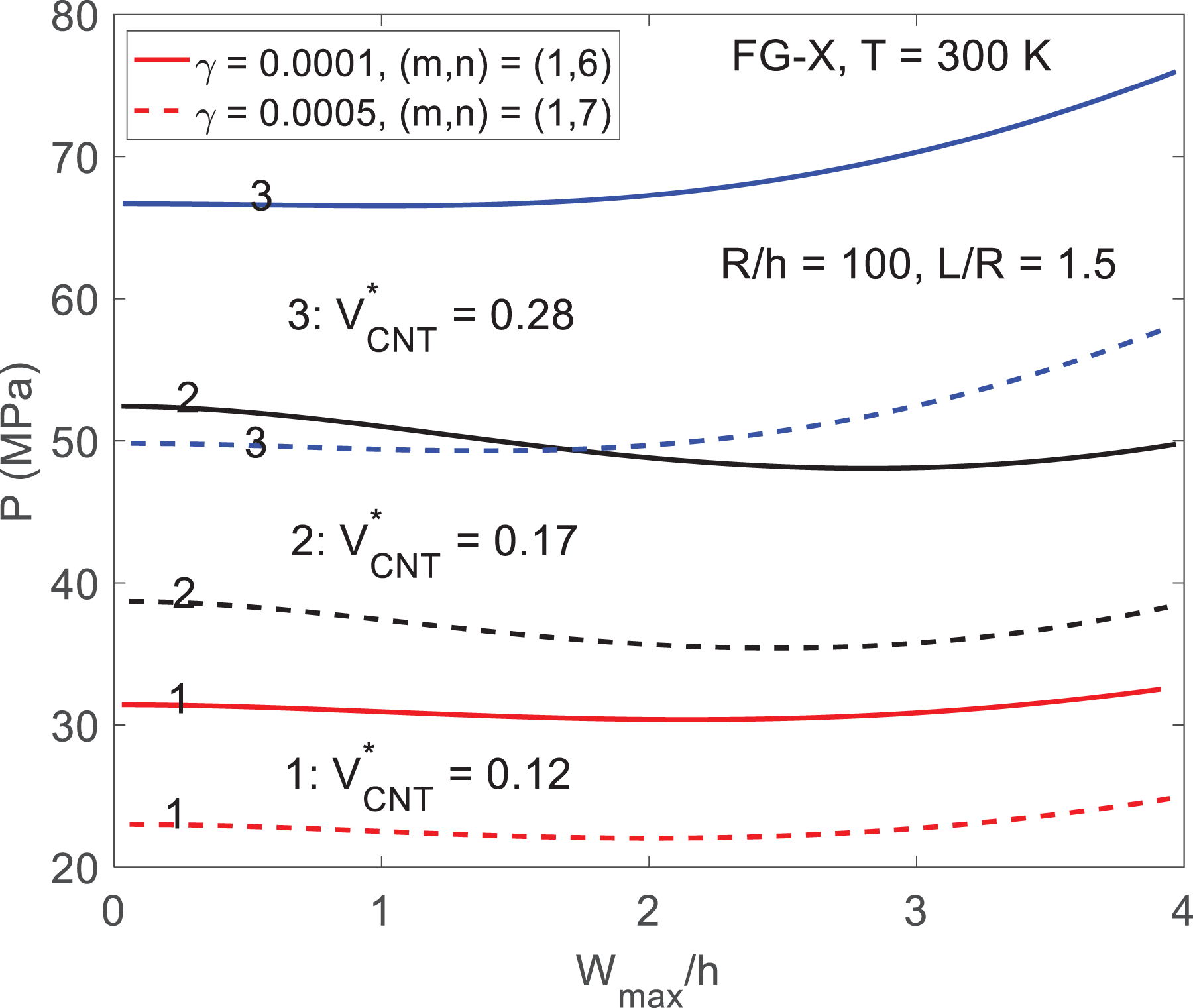
Effects of CNT volume fraction on postbuckling behavior of CNTRC cylindrical shells subjected to axial compression combined with preexisting external lateral pressure.
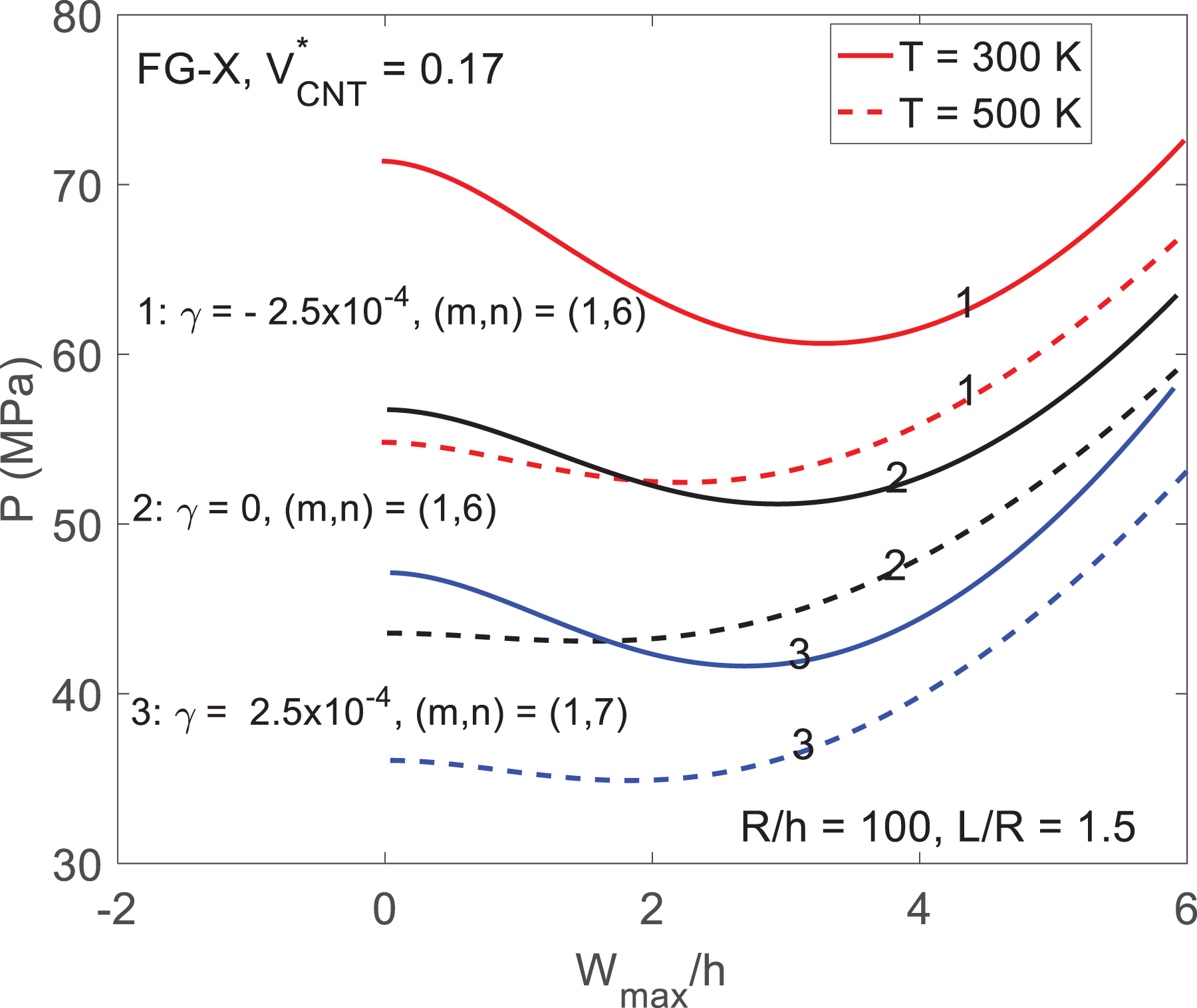
Effects of thermal environments on postbuckling behavior of CNTRC cylindrical shells subjected to axial compression combined with internal and external lateral pressures.
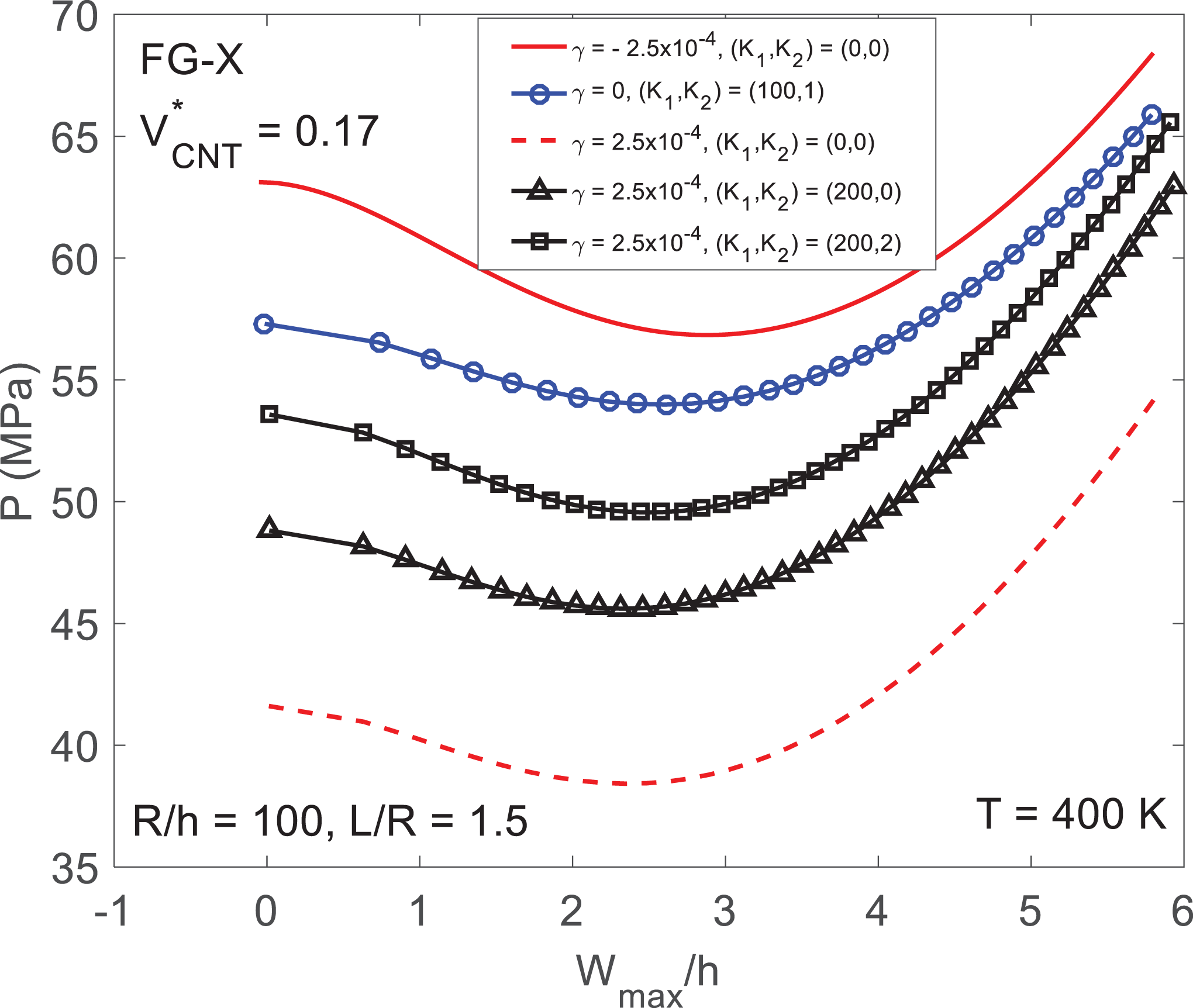
Effects of elastic foundations on postbuckling behavior of CNTRC cylindrical shells under combined loads in a thermal environment (
The remainder of this section presents numerical examples of postbuckling analysis for CNTRC cylindrical shells subjected to external pressure combined with preexisting nondestabilizing axial compression. Figure 11, plotted with four different values of load-proportional parameter
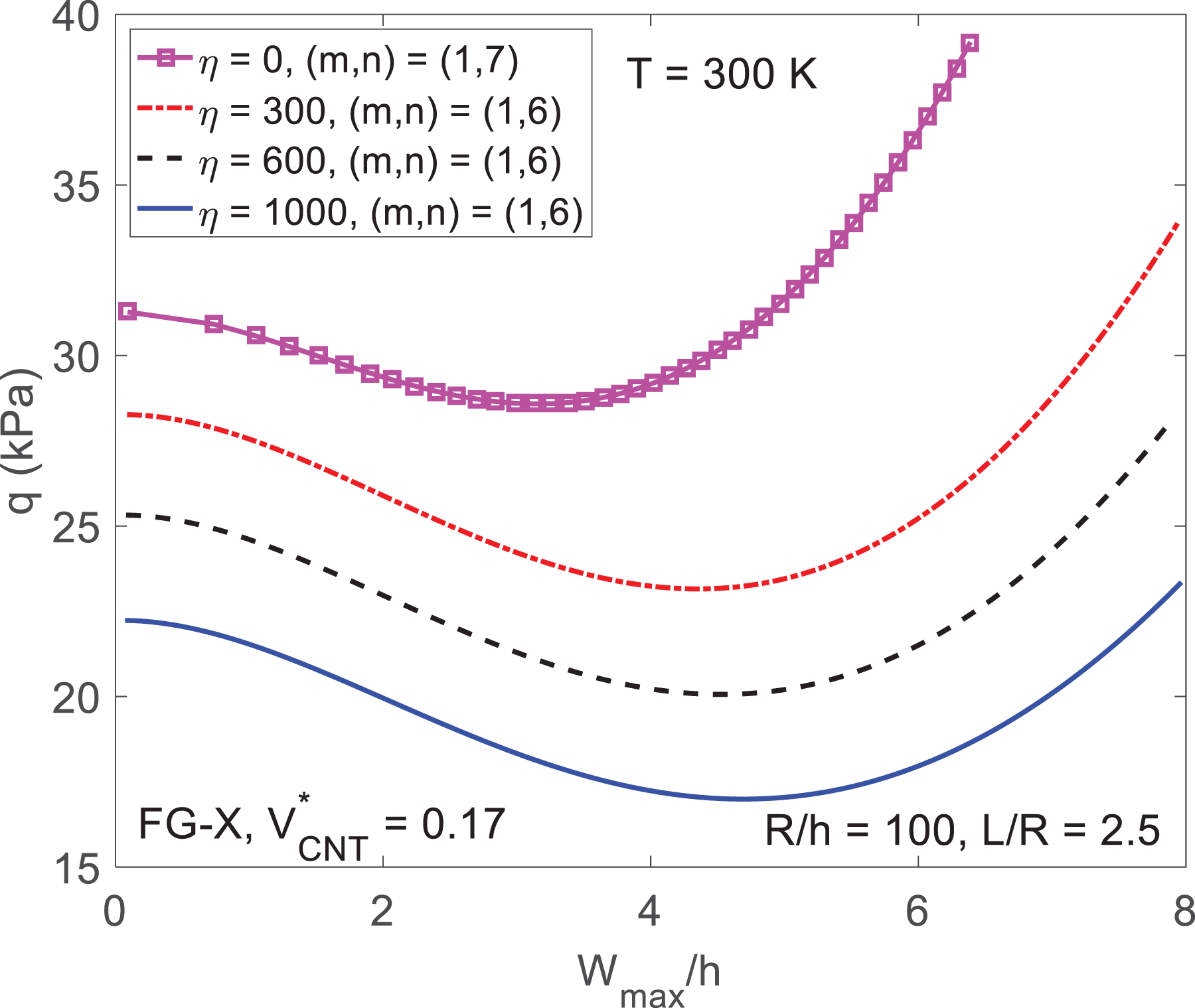
Postbuckling behavior of CNTRC cylindrical shells subjected to external lateral pressure combined with preexisting axial compression.
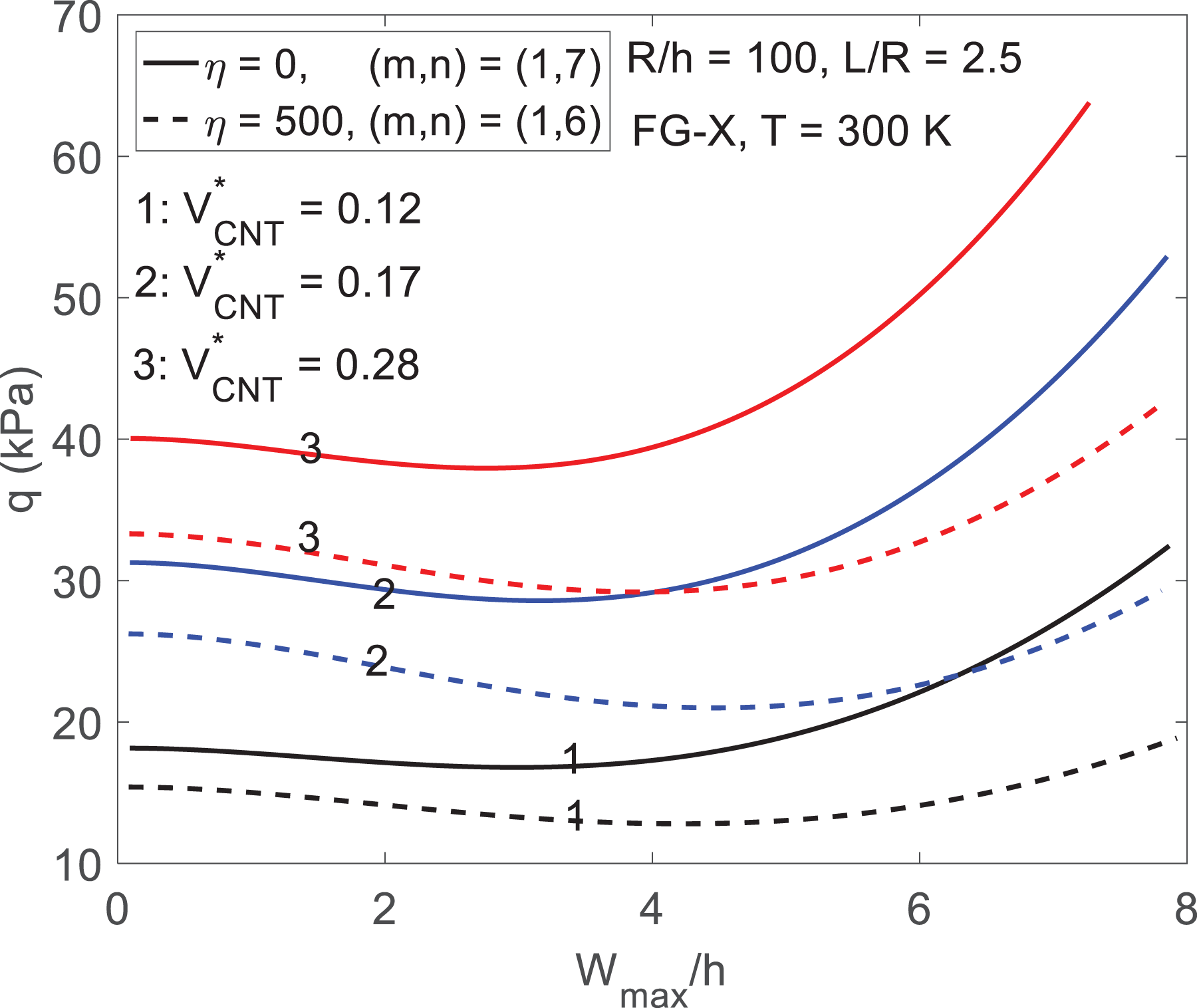
Effects of CNT volume fraction on the postbuckling behavior of CNTRC cylindrical shells subjected to external lateral pressure combined with preexisting axial compression.
The interactive effects of thermal environments and preexisting axial load on the postbuckling behavior of CNTRC cylindrical shells under external pressure are examined in Figure 13. Obviously, increases in parameter
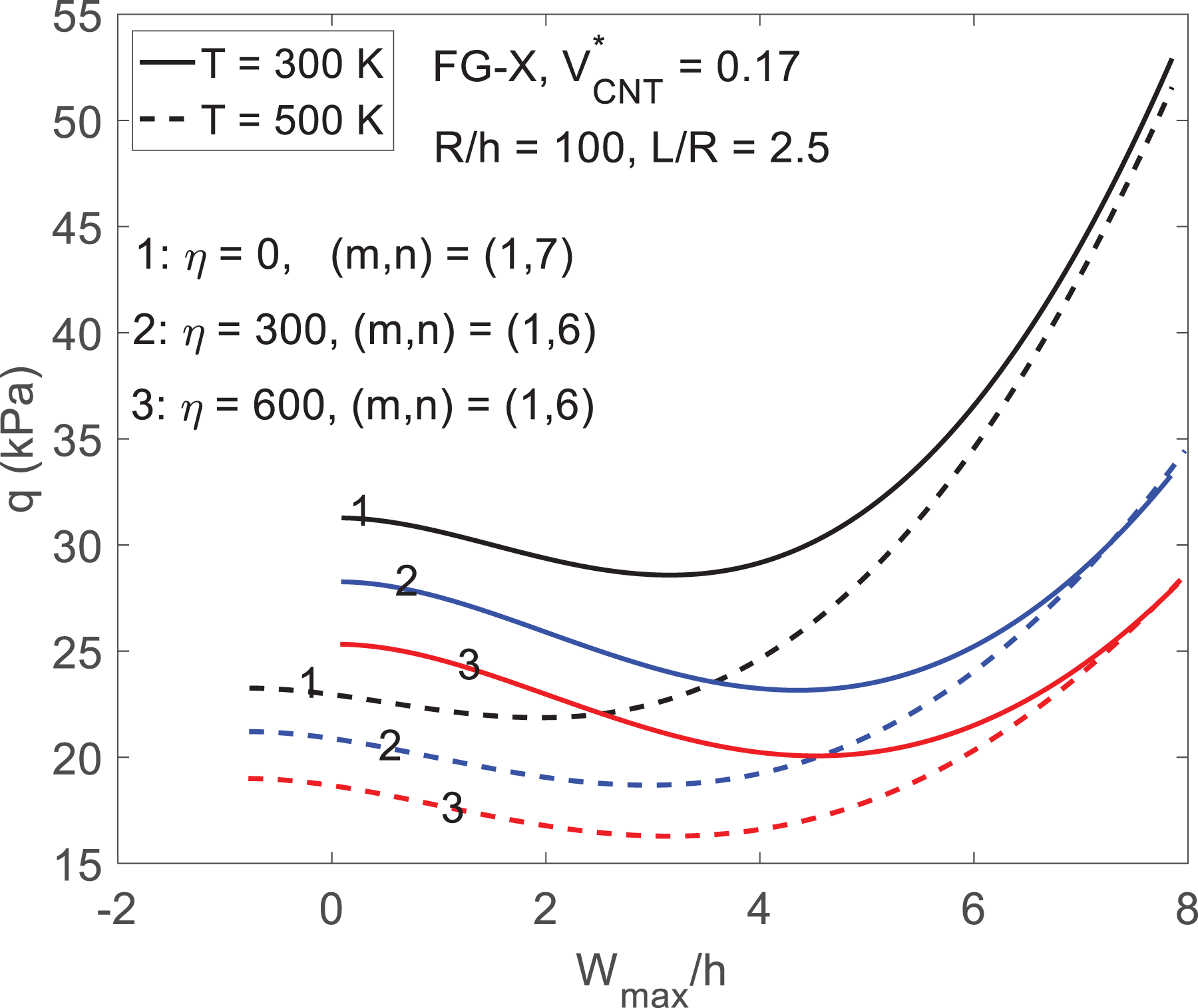
Effects of thermal environments on the postbuckling behavior of CNTRC cylindrical shells subjected to external lateral pressure combined with axial compression.
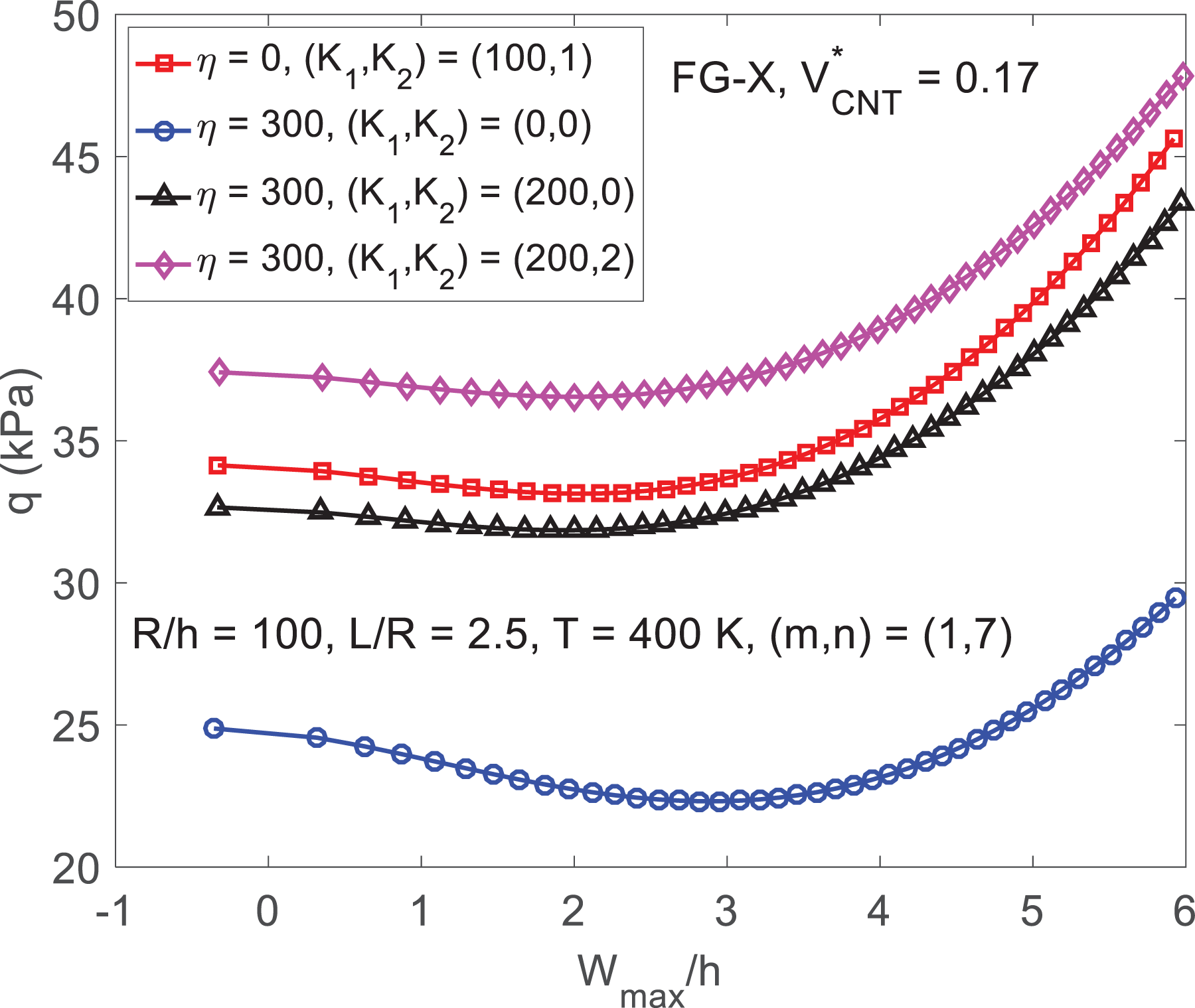
Effects of elastic foundations on postbuckling behavior of CNTRC cylindrical shells under external pressure combined with axial compression in a thermal environment.
Concluding remarks
An analytical investigation on the buckling and postbuckling behaviors of thin CNTRC cylindrical shells surrounded by elastic media, exposed to thermal environments, and subjected to combined action of axial compression and lateral pressure has been presented. Above analysis results suggest the following remarks: The interaction buckling curves are higher (i.e. stable regions are larger) for CNT-richer shells and/or due to surrounding elastic media, especially for FG-X CNTRC shells, and are lower as temperature is elevated. Postbuckling equilibrium paths of axially compressed CNTRC cylindrical shells are considerably lower and more stable through increase in preexisting nondestabilizing external pressure. In contrast, preexisting internal pressure leads to higher axial load–deflection curves and more intense snap-through response. Preexisting nondestabilizing axial compression load detrimentally influences on the postbuckling behavior of pressure-loaded CNTRC cylindrical shells because pressure–deflection curves are significantly dropped and snap-through response is more severe through increase in axial compression. Postbuckling equilibrium paths are lower and snap-through response is more benign when CNTRC cylindrical shells under combined mechanical loads exposed to an elevated temperature. Detrimental effects of preexisting external pressure (axial load) on the postbuckling behavior of CNTRC cylindrical shells subjected to axial load (external pressure) are more remarked for CNT-richer shells. Postbuckling response of CNTRC cylindrical shells under combined loads is pronouncedly improved through surrounding elastic foundations, especially Pasternak type foundations.
Footnotes
Funding
The author(s) disclosed receipt of following financial support for the research, authorship, and/or publication of this article: This research is funded by Vietnam National Foundation for Science and Technology Development (NAFOSTED) under grant number 107.02-2017.11.