



Abstract
Polyphenylene sulfide (PPS)/multiwalled carbon nanotube (MWCNT) composites were prepared by melt blending and injection molding. The nonisothermal crystallization behavior, morphology, and mechanical properties of the nanocomposites were systematically investigated as a function of MWCNT content. For nonisothermal process, the presence of MWCNTs possesses both acceleration and retardation effect on the crystallization of PPS without affecting the ultimate degree of crystallinity. Due to the interfacial interaction between MWCNTs and PPS, the MWCNTs can be uniformly dispersed in PPS. The interfacial crystallization of PPS on the surface of nanotubes was observed by scanning electron microscopy and transmission electron microscopy. A reinforcing effect of MWCNTs on the mechanical properties of PPS is found, which is considered to be relevant with the uniformly dispersed MWCNTs and the interfacial crystallization.
Keywords
Introduction
Carbon nanotube (CNT) has gained tremendous interest since it was discovered due to its particular microstructure and exceptional physical properties. One of the most promising research focus on CNT is polymer/CNT composite such as polyethylene/CNT, 1 polypropylene/CNT, 2 epoxy resin/CNT, 3 and so on. CNTs have very high aspect ratios and huge surface areas; therefore, the strong surface interactions between CNTs and polymer molecules can be built, as a consequence CNTs are widely used as fillers to improve the mechanical properties of polymer with only a small amount of CNTs. 4 –6 On the other hand, CNTs generally exist in the form of aggregation due to the high interface energy, which play a negative role in the improvement of properties. To obtain high-performance polymer/CNT composites, CNTs must be uniformly dispersed and establish strong interfacial interactions with polymer matrix. Besides aiming at the enhancement of mechanical properties, crystallization behaviors of polymer/CNT composites attract great attention because crystallizations of the polymer matrix inevitably affect not only mechanical properties but also other properties. Previous studies suggested CNTs could be used as nucleating agent to accelerate the crystallization rate or even induce interfacial crystallization for crystalline polymer. 7 –10 Li et al. found that CNTs could be periodically decorated with polymer lamellar crystals, resulting in nano-hybrid shish kebab structures. 11
Polyphenylene sulfide (PPS), composed of benzene rings linked by sulfur atoms alternately, is a semicrystalline thermoplastic engineering plastic which possesses excellent mechanical properties, good stability at high temperature, outstanding chemical resistance, and inherent flame resistance. As a highly promising engineering material, the applications of PPS have been somewhat limited unfortunately because of its relatively low glass transition temperature (approximately equal to 80°C) compared to its high melting temperature (approximately equal to 285°C) and its inherent brittleness. In this case, PPS was mostly blended with microscale and nanoscale fillers to overcome these disadvantages and extend their applications. 12,13 For the purpose of preparing high-performance PPS-based composites, many researchers have investigated the surface modification of micro/nanoscale fillers to improve their dispersions in PPS.
Among these selectable nanofillers to fill PPS, CNTs have gained particular interest because of their instinctive compatibility and interaction with PPS. Previous researches have pointed that aromatic structure in polymers could build strong interaction with CNTs via π–π stacking during melt mixing. 14 In this case, surface modification of CNTs which mostly treated by strong oxidizer will be needless, thus the specific microstructures and the intrinsic excellent features of CNTs are fortunately reserved 15 ; hence, introducing CNTs into PPS may be a promising work to manufacture high-performance engineering plastic.
Previous studies about PPS/CNT nanocomposites have concentrated on their rheological properties, electrical properties, mechanical properties, and so on. 16 –18 The crystallization properties of PPS/CNT composites were also investigated mostly by differential scanning calorimeter (DSC); however, few studies have paid attention to the crystallization morphologies of PPS/CNT composites compared with other polymer/CNT composites. 19 –21 In this study, PPS/MWCNT composites were prepared via melt blending and injection molding, and the focus was on investigating the effect of MWCNT on the crystallization behavior and mechanism of PPS by DSC and X-ray diffraction (XRD). In addition, the crystallization morphologies of PPS/MWCNT composites were observed by both scanning electron microscopy (SEM) and transmission electron microscopy (TEM). At last, the mechanical properties of composites were studied to confirm the reinforcement effect of MWCNT on PPS matrix.
Experimental
Materials
The PPS (Philips QC-160N, density 1.34 g ml−1, mass melt flow rate 45 g/10 min, molecular weight approximately 5 × 10⁶ g mol−1) in a pellet form was provided by Deyang KeJi High-Tech Material Company (Sichuan, China). The CNTs were FT7000 nanotubes produced by Cnano Technology Company (Zhenjiang, China). FT7000 are MWCNTs having a tap density of 0.026 g cm−3 (theoretical density about 2.2 g cm−3); the diameter and length of these MWCNTs are about 20–30 nm and 5 μm.
Composite preparation
Prior to melt blending, the mixtures of PPS pellets and MWCNTs with different contents (0.1, 0.5, 1, 2, and 5 wt%) were added in ethanol and then dispersed by ultrasonication for 30 min. Subsequently, the predispersed mixtures were separated by filtration and dried in an oven at 80°C for 2 h to ensure the solvent was completely eliminated. Melt blending and pelleting were performed in a twin-screw extruder (SJZS-10; Ruiming, Wuhan, China), with screw speed maintaining at 120 r min−1. The processing temperatures were set at 245°C, 270°C, 310°C, and 300°C along the extruder barrel. Mechanical test specimens were directly prepared in an injection molding machine (TSMP2; Ray-Ran, UK); the barrel temperature and mold temperature were, respectively, set at 300°C and 150°C. For comparison, neat PPS was treated and processed in the same way. PPS and PPS/MWCNT composites with different MWCNT contents were abbreviated as PPS, PPS/0.1NT, PPS/0.5NT, PPS/1NT, PPS/2NT, and PPS/5NT, respectively.
Microstructure examination
The microstructures of the MWCNTs and fracture surfaces of PPS/MWCNT composites were observed with SEM (JEOL 7500F, Japan); before observation, the samples were coated with a fine gold layer by ion-sputtering.
A TEM (JEOL 2100F, Japan) was also employed to characterize the interior microstructures of PPS/MWCNT composites, operating at 200 kV. Prior to observation, samples were cut into ultramicrocuts using an ultramicrotome.
Thermal characterization
A DSC (Q10 V9.4, TA Instruments Ltd [New Castle, Delaware, USA]) was employed to investigate the crystallization behavior of PPS and PPS/MWCNT composites. Samples of approximately 8–10 mg were measured under a nitrogen atmosphere at a flow rate of 50 ml min−1. For nonisothermal crystallization, the samples were heated from room temperature to 320°C at a heating rate of 10°C min−1 and hold there for 5 min to eliminate previous thermal history. Subsequently, they were cooled from 320°C to 60°C at different cooling rates of 5, 10, 15, 20, and 25°C min−1. Finally, the same samples were reheated to 320°C at 10°C min−1 to investigate the melting behavior. The relative crystallinity (Xc ) of the samples was calculated from the DSC data according to below equation

where W MWCNT is the weight fraction of MWCNT in PPS/MWCNT composite, ΔH indicates the enthalpy of melt crystallization from the DSC data, and ΔHf indicates the enthalpy of fusion for a 100% crystalline PPS, taken as 76.5 J g−1. 30
XRD analysis
The lattice characteristics of PPS and PPS/MWCNT composite obtained by injection molding were detected by XRD (X’Pert MPD PRO model, PANalytical, the Netherlands) with Cu-Kα line, and the scanning rate was set as 5° min−1.
Mechanical properties
The tensile properties of PPS and PPS/MWCNT composites were measured by an electronic universal testing machine (Instron-5567 [Norwood, Massachusetts, USA]) according to standard ASTM D 638 at a testing speed of 1 mm min−1. Five specimens for every sample were measured.
Results and discussion
Crystallization and melting behavior
To many semicrystalline polymers, the crystallization behavior has significant effect on their properties and applications. Except as optimizing the processing conditions, the addition of nucleating agents is an important way to improve their crystallization behaviors. MWCNTs have been proved to be an effective nucleating agent in previous studies. 22,23 Figure 1 shows the crystallization and melting behavior of PPS and PPS/MWCNT composites at cooling rate and heating rate of 10°C min−1. As shown in Figure 1(a), the crystallization peaks of PPS/MWCNT composites shift to high temperature zone and appear to be narrower and taller than that of neat PPS, which prove the induced crystallization effect of MWCNTs on PPS. When the MWCNT content in the composite is less than 0.5 wt%, the crystallization temperature (T c) obviously increases with increasing MWCNT content, reaching 243.4°C at 1 wt% MWCNT loading, 4.8°C higher than T c of pure PPS. As the MWCNT content continues to grow, the crystallization temperature shows a gradual decrease. It is concluded that the MWCNTs have two opposite influences on the crystallization of PPS: one is promoting the nucleation, while the other is impeding the growth of crystal. When the MWCNT content is below 0.5 wt%, the acceleration effect is greater than the retardation effect, presenting as the T c increases; afterward, the acceleration effect starts to wane and the retardation effect appears to be evident as the MWCNT content continues to increase above 1 wt%. An analogous phenomenon is found that the melting temperature of PPS/MWCNT composites increases at less than 0.5 wt% MWCNT loading and decreases subsequently.
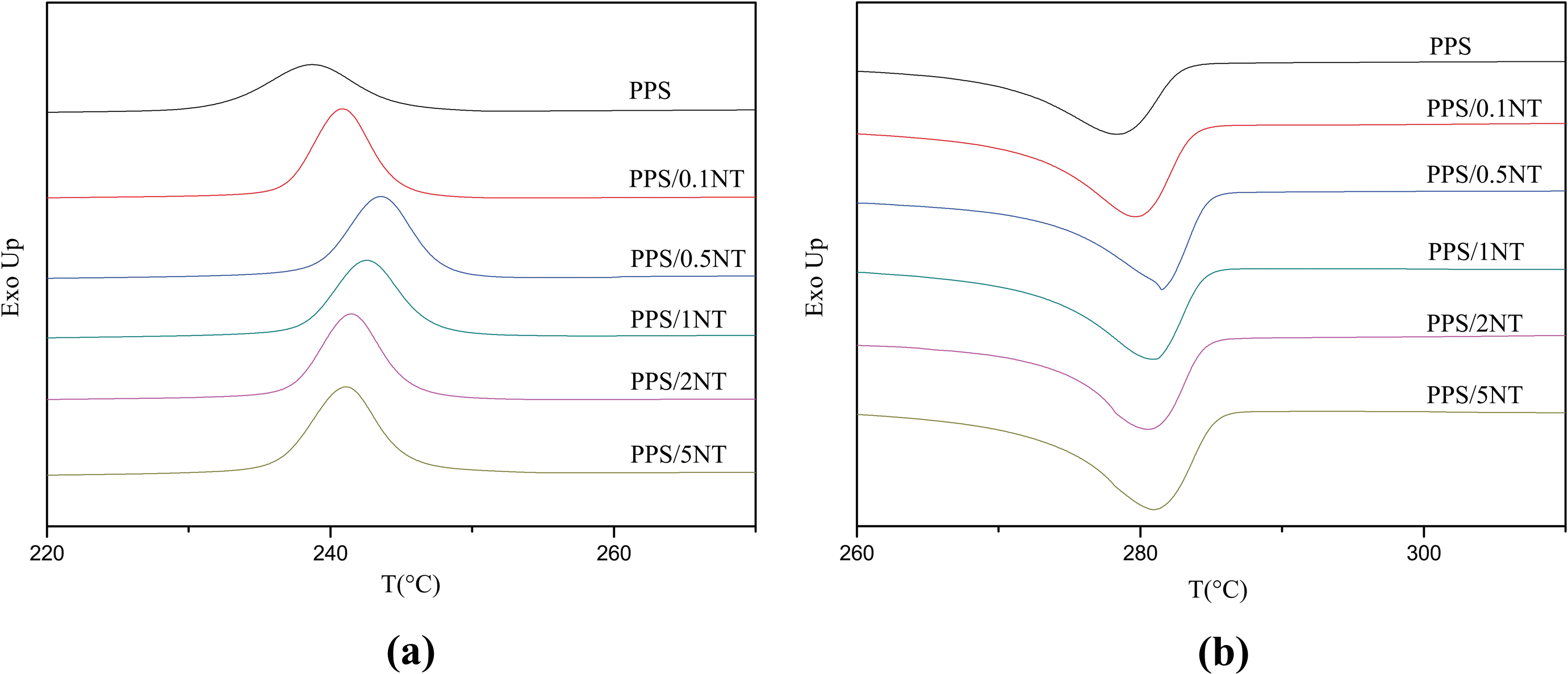
DSC crystallization (a) and melting (b) thermograms of PPS and PPS/MWCNT composites with different MWCNT contents. DSC: differential scanning calorimetry; PPS: polyphenylene sulfide; MWCNT: multiwalled carbon nanotube.
Crystallization mechanism
To further analyze the influence of the MWCNTs on the crystallization of PPS, crystallization mechanism of composites was researched. Figure 2 shows the relative crystallinity (Xc ) as a function of crystallization time with different MWCNT loadings. The values of crystallization half time (t 1/2) are listed in Table 2. Compared to neat PPS, all the t 1/2 of PPS/MWCNT composites are short, proving the accelerating effect of MWCNTs on PPS crystallization once again.
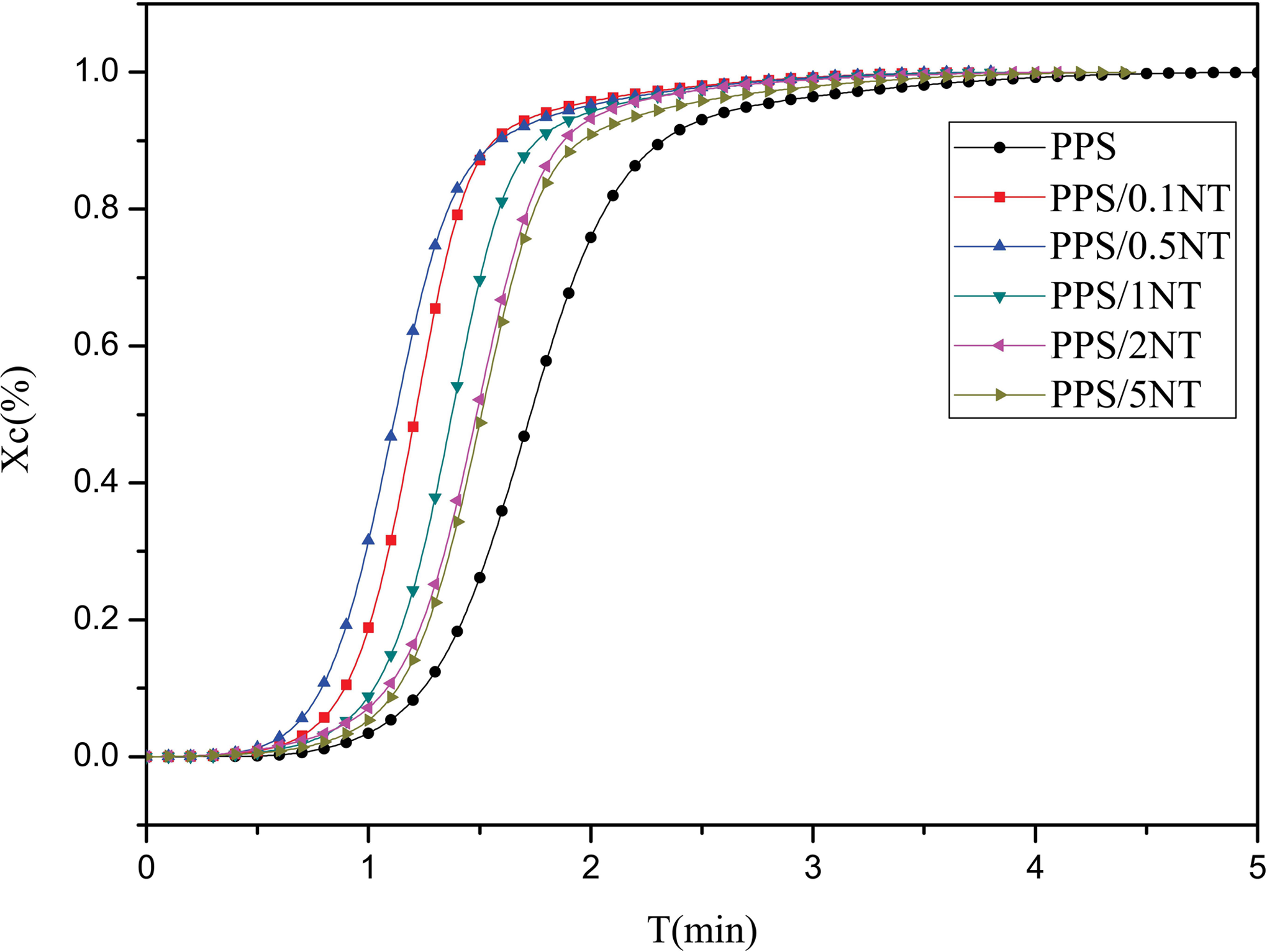
Curves of relative crystallinity versus crystallization time for PPS and PPS/MWCNT composites with different MWCNT contents. PPS: polyphenylene sulfide; MWCNT: multiwalled carbon nanotube.
The Avrami equation is often employed to describe nonisothermal crystallization


where X(t) is relative crystallinity at time t, n is the Avrami exponent generally decided by crystallization mechanism, and k is a constant describing the overall crystallization rate.
As we all know, crystallization nucleations normally occur at early stage of crystallization process; subsequently, crystals grow at relative high speed ending in contact and extrusion with each other. Curves of log[−ln(1-X(t))] versus logt for pure PPS and PPS/MWCNT composites with different MWCNT contents are shown in Figure 3. All curves can be divided into three regions according to the change of the slopes, corresponding to the three stages of PPS crystallization, respectively, mentioned above. The middle region is magnified at the value of relative crystallinity from 10% to 90%, which mostly represents the process of crystal growth, showing a very good linear characteristic. The fitting results of n and k are shown in Table 1. As can be seen, the k increases with increasing MWCNT content less than 0.5 wt%, then decreases as the MWCNT content continues to increase, according to the variation tendency of T c shown above. These results show that the MWCNTs can be used as an effective nucleating agent for the crystallization of PPS. According to the variation of Xc (%) in Table 1, it can be concluded that the presence of MWCNTs has little effect on the ultimate degree of crystallinity of PPS/MWCNT composites, which mostly depends on the intrinsic crystallization ability of PPS molecule. Moreover, the Avrami equation is suitable for describing the process of crystal growth during nonisothermal crystallization for PPS/MWCNT composites.
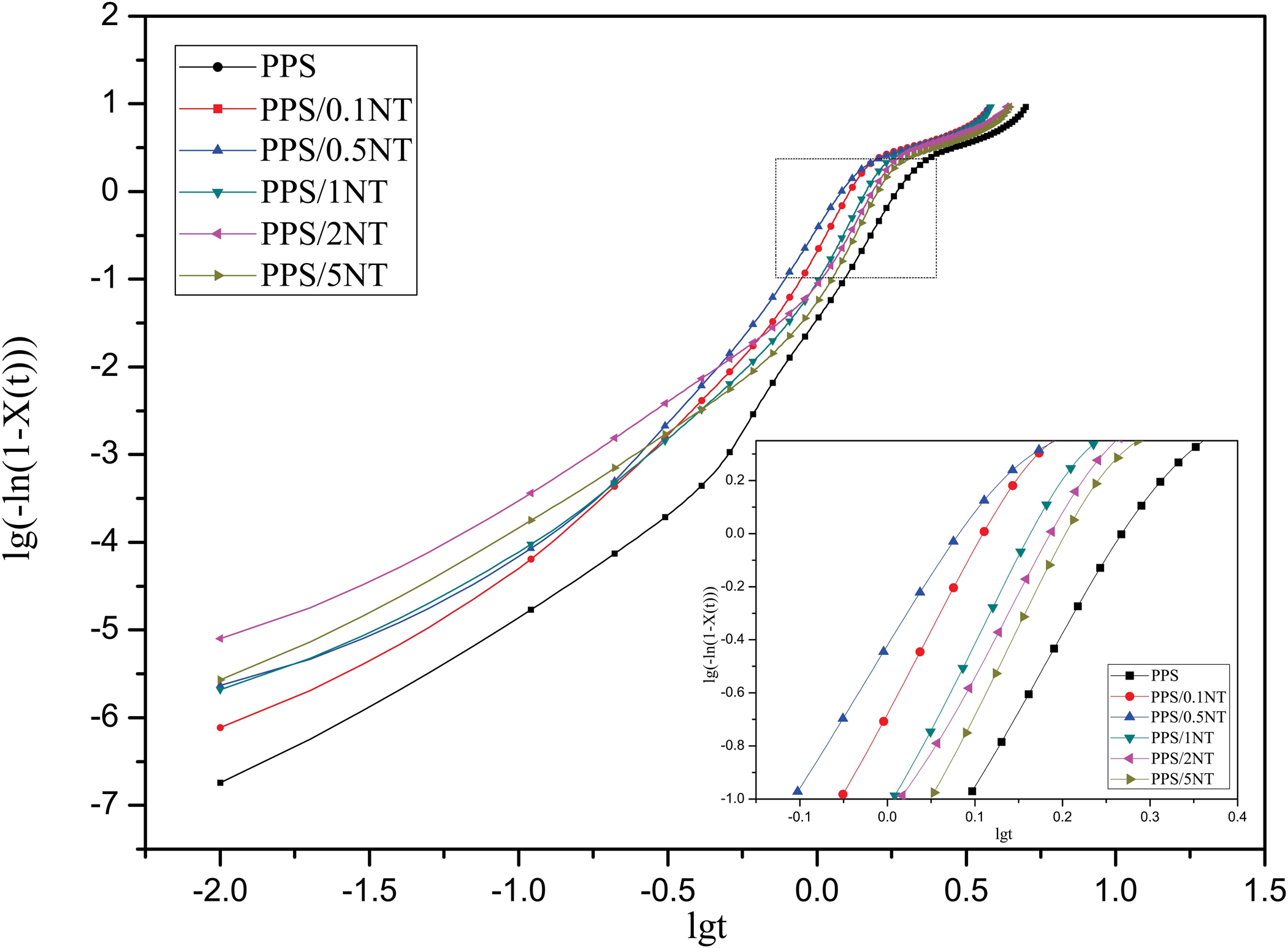
Curves of log[−ln(1−X(t))] versus logt for pure PPS and PPS/MWCNT composites with different MWCNT contents. PPS: polyphenylene sulfide; MWCNT: multiwalled carbon nanotube.
Crystallization parameters for PPS and PPS/MWCNT composites obtained from DSC and Avrami equations.
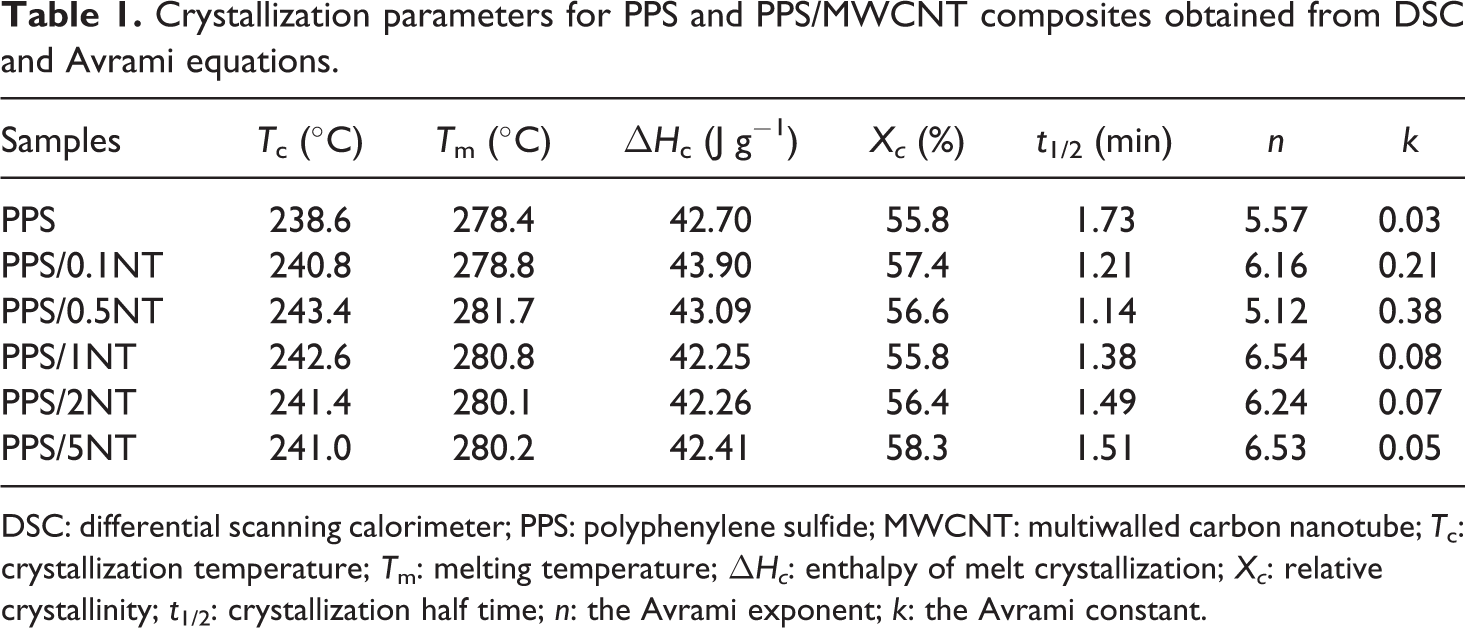
DSC: differential scanning calorimeter; PPS: polyphenylene sulfide; MWCNT: multiwalled carbon nanotube; T c: crystallization temperature; T m: melting temperature; ΔHc : enthalpy of melt crystallization; Xc : relative crystallinity; t 1/2: crystallization half time; n: the Avrami exponent; k: the Avrami constant.
For nonisothermal crystallization, the calculated exponent n is often considered to be the apparent Avrami exponent for qualitative analysis because it has lost physical meaning at constantly changeable temperature. Until now, several modified methods have been developed mostly based on the Avrami equation such as the Ozawa model, 24 the Jeziorny equation, 25 and Mo method. 26 Previous studies proved that Mo method provided a fairly satisfactory description for nonisothermal crystallization. 27,28 Mo method can be given in the form of double-logarithmic as follows:

where Φ is the cooling rate and t is the crystallization time. The parameter F(T) possesses specific physical meaning, indicating the necessary cooling rate for the system to reach a certain degree of crystallization at unit crystallization time. The smaller F(T) implies better crystallization ability for the system. The parameter a is the Mo exponent, which can be formulated as the ratio of apparent Avrami exponent n to Ozawa exponent m. 26 The Ozawa exponent during nonisothermal process has the same physical meaning as the Avrami exponent during isothermal process.
Figure 4 shows the plots and linear fitting results of logΦ versus logt for PPS and PPS/MWCNT composites at given degrees of crystallinity (20%, 40%, 50%, 60%, and 80%). It can be seen that all the points at different MWCNT loadings can be fitted to linear equations, indicating an accurate description to the nonisothermal crystallization of PPS and PPS/MWCNT composites by Mo method. The parameters F(T) and a are obtained from the intercept and slope of these straight lines, respectively, which are shown in Table 2. The Ozawa exponent m calculated from the ratio of the Avrami exponent n to a is also listed in Table 2. Just as mentioned above, the parameter F(T) has more specific physical meaning compared with k in the Avrami exponent, which can be used to investigate the crystallization ability of PPS with different MWCNT contents. It can be seen in Table 2 that the value of F(T) for pure PPS to achieve 20% degree of crystallization is 14.78, while the values are 11.25, 8.42, 11.56, 12.88, and 12.90 for PPS/0.1NT, PPS/0.5NT, PPS/1NT, PPS/2NT, and PPS/5NT, respectively, consisting of above results and analyses. Due to taking into account the influence of the cooling rate on crystallization, the Ozawa exponent m is more suitable for identifying the crystallization mechanism than the Avrami exponent n. As shown in Table 2, the values of Ozawa exponent m for PPS, PPS/0.1NT, and PPS/0.5NT are 4.49, 4.24, and 3.91, respectively. We all know that polymer molecules usually fold and stack to form spherulites during cooling process of polymer melt, that is, the crystals of pure PPS prefer to grow in a three-dimensional way. As the introduction of MWCNTs, the PPS molecules may be induced to wrap around the MWCNTs mainly due to π–π interactions and subsequently form crystals on the surface of the MWCNTs in a one-dimensional way, appearing as the reduction of the value of Ozawa exponent m. However, for PPS/1NT, PPS/2NT, and PPS/5NT, the values of Ozawa exponent m increase to 4.30, 4.80, and 4.95, respectively, which can be explained that the excess MWCNTs constitute a stereoscopic network and the PPS molecules form a tridimensional crystal structure based on this network at macro level.
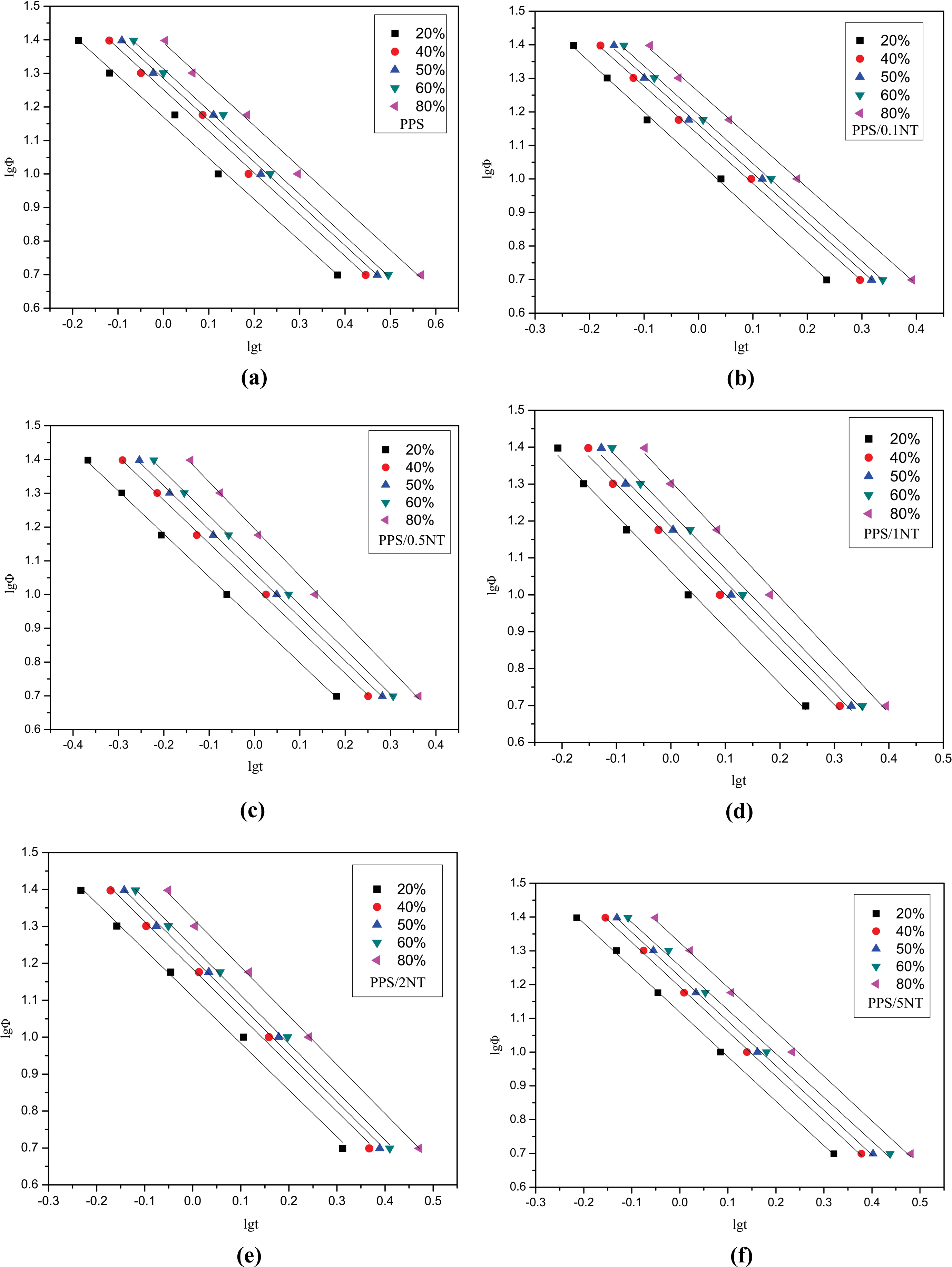
Plots and linear fitting results of logΦ versus logt for PPS and PPS/MWCNT composites with different MWCNT contents at different degrees of crystallinity. PPS: polyphenylene sulfide; MWCNT: multiwalled carbon nanotube.
Crystallization parameters for PPS and PPS/MWCNT composites with different MWCNT contents obtained from Mo methods and Avrami equations.
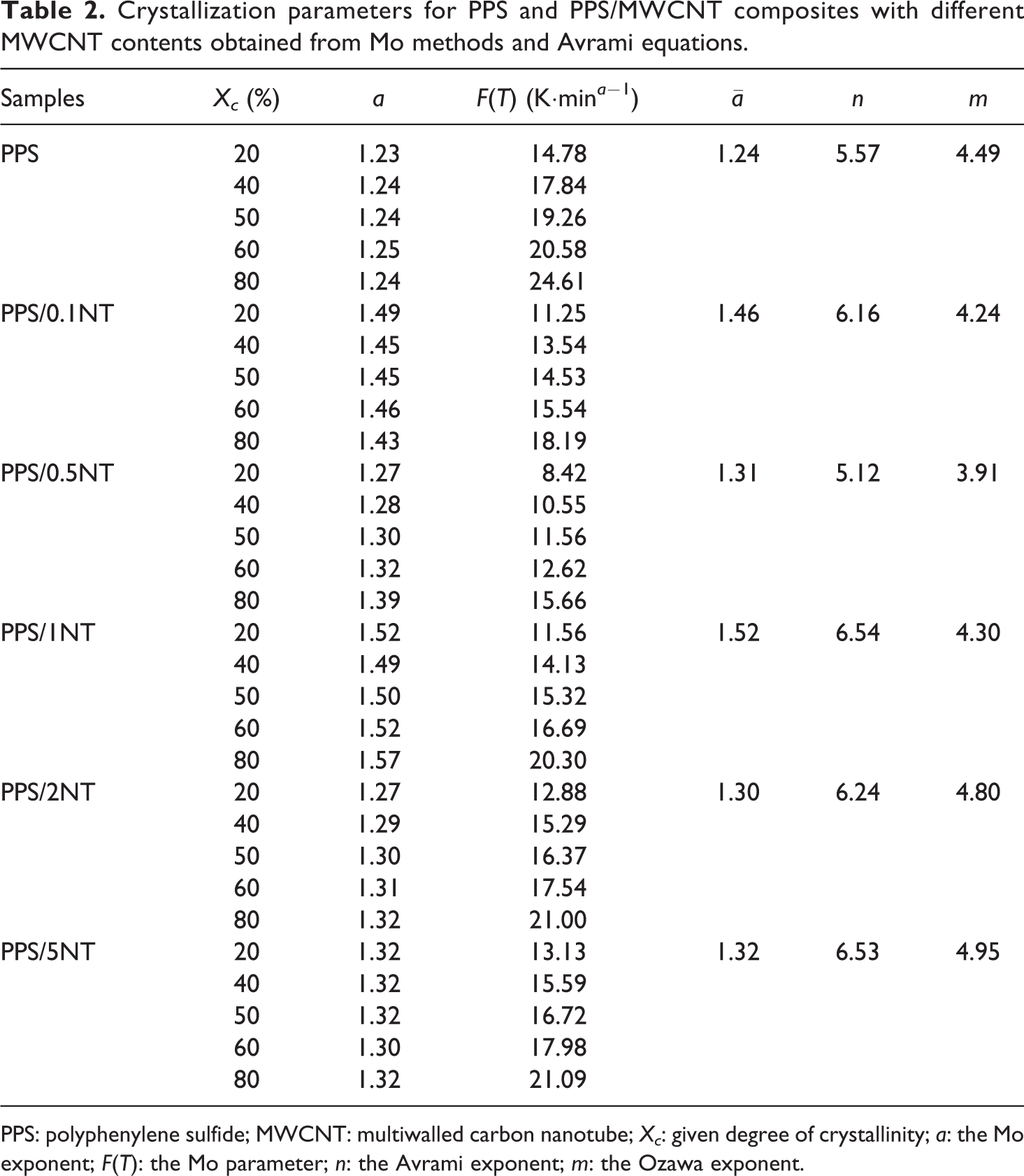
PPS: polyphenylene sulfide; MWCNT: multiwalled carbon nanotube; Xc : given degree of crystallinity; a: the Mo exponent; F(T): the Mo parameter; n: the Avrami exponent; m: the Ozawa exponent.
XRD analysis
Figure 5 represents the XRD spectrograms of PPS, MWCNT, and their composites with different MWCNT contents. The XRD peak of the PPS reveals a major characteristic peak at 2θ = 19° and a secondary peak at approximately 2θ = 28°, indicating an amorphous structure for unfilled PPS specimen via injection molding at 150°C, 29,30 similar phenomenon is found for PPS/0.1NT and PPS/5NT. Meanwhile, the XRD peak of the MWCNT shows characteristic peaks at 2θ = 26° and 43.5°, which are assigned to the graphitic (002) and (100), (101) diffraction planes of MWCNT, respectively. 31,32 It is interesting to note that the XRD peaks of PPS/0.5NT, PPS/1NT, and PPS/2NT reveal extra shoulder peak at 2θ = 20.5° compared with amorphous PPS, implying that the PPS molecular arranged and stacked to form relative perfect crystals induced by MWCNTs. Compared with previous work, 29 the lattice parameters of the PPS crystal have no change in the presence of MWCNTs, which demonstrates that the PPS/MWCNT composites have the essentially identified lamella structure with pure PPS. Combining with above analysis, the addition of MWCNTs changes the crystallization morphology and mechanism of PPS; however, it does not affect the lattice parameters of PPS.
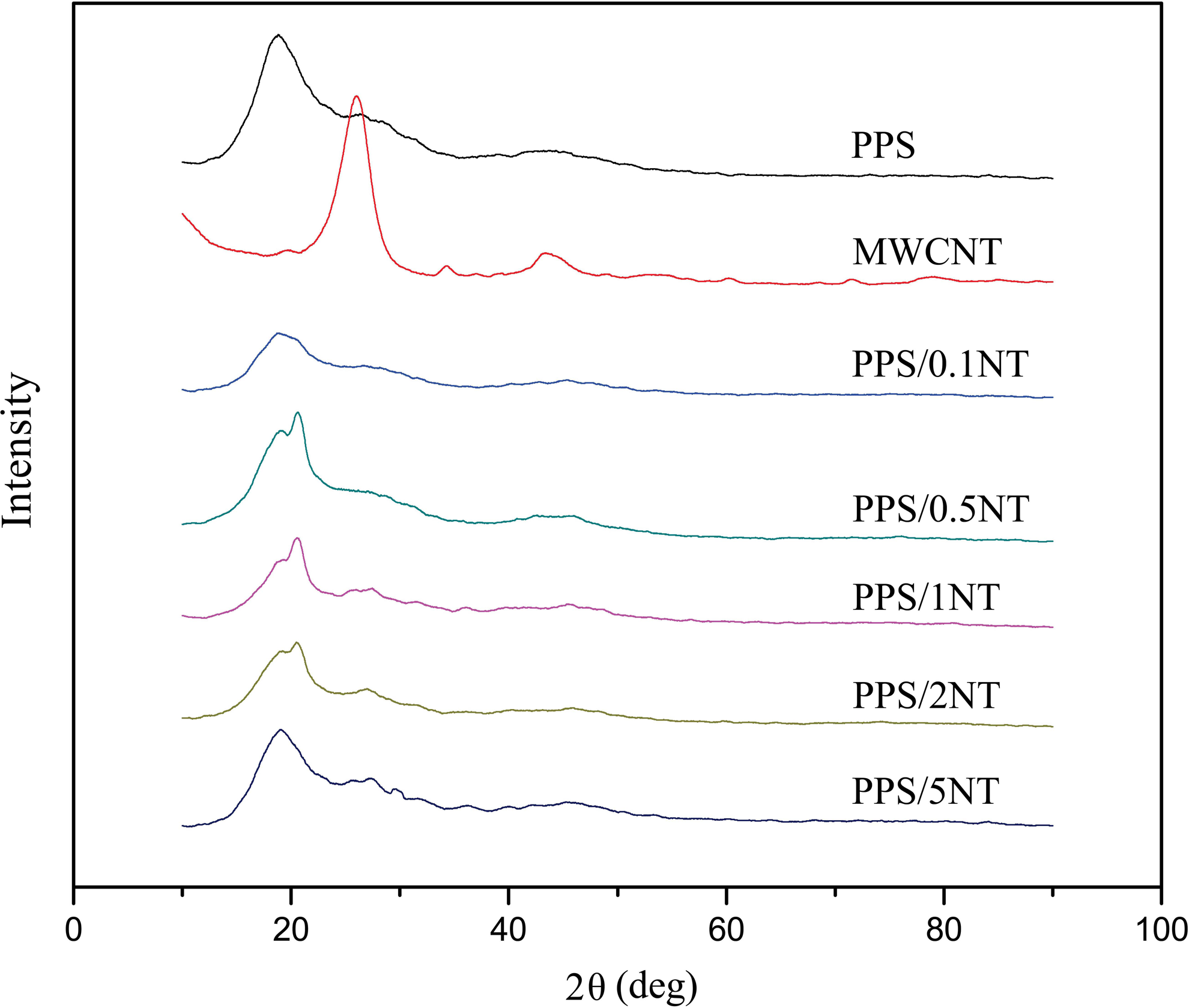
XRD peaks of PPS, MWCNTs and PPS/MWCNT composites with different MWCNT contents. XRD: X-Ray diffraction; PPS: polyphenylene sulfide; MWCNT: multiwalled carbon nanotube.
Nevertheless, the transformations of crystallization morphology for polymer/nanofiller composites are difficult to be proved due to the limit of test resolution. For instance, polarized optical microscopy (POM) technology can be utilized to observe the major process of polymer crystallization, while the resolution is limited to 2 μm. Therefore, it is suitable for observing the crystallization processes of polymer/microfiller or polymer/fiber composites. Zhang et al. demonstrated that the presence of glass fiber obviously promoted the bulk crystallization rate of PPS and changed the crystalline morphology of PPS from the spherulite to transcrystallization by DSC and POM technology. 33 However for CNT-reinforced polymer composites, POM technology is adequate for the characterization analysis only when the CNT content is fairly low 34 ; in addition, the microstructure is difficult to observe.
In this study, the crystallization morphologies of PPS/MWCNT composites can be observed by SEM and TEM with relative high MWCNT contents.
Microstructure characterization
Microstructure of fracture surfaces and internal microstructure characterization of PPS/MWCNT composites were, respectively, observed by SEM and TEM shown in Figure 6, it is worth to illuminate that Figure 6(h) is the TEM image, and the other images are obtained in SEM observation. Figure 6(a) and (c) shows the dispersion of MWCNTs in PPS/0.5NT and PPS/5NT at relative low magnification, respectively. Most nanotubes in these images can be clearly recognized with precious little agglomeration, indicating a good homogeneous dispersion in the PPS matrix at both low and high MWCNT loading levels. As we all know, MWCNTs generally bundle together and form agglomeration due to the high interface energy, and it can be deduced that the interaction between PPS and MWCNTs shields the high interface energy of MWCNTs. Figure 6(b) and (d) show the detailed morphological characterization of PPS/0.5NT and PPS/5NT at relative high magnification. Some nanotubes completely inset in matrix and some other nanotubes stretch out of the failure surface, indicating a hybrid fracture behavior for PPS/MWCNT composites. Figure 6(e) shows the morphological characterization of pure MWCNTs; the diameters of nanotubes in Figure 6(d) and (e) are found to be similar after measurements, approximately 20–30 nm, matching with the result provided by the manufacturer. While the nanotubes in Figure 6(b) seem to be thicker than that in Figure 6(d), reaching about 60–70 nm, which were probably caused by the adhesion and even crystallization of PPS on the nanotube surface deriving from strong interaction between PPS and MWCNTs. It should be noted that Figure 6(a) to (d) was obtained at an acceleration voltage of 5 kV. Figure 6(f) shows the morphological characterization of PPS/2NT at high magnification; moreover, at an acceleration voltage of 8 kV, it is unexpected to find that each MWCNT is coated by other material, which is most probably the PPS matrix. It can be explained that if the electron beam focused and passed through the surface of sample at high acceleration voltage and big magnification simultaneously, then the internal structure was visible. We can notice that Figure 6(e) was also taken at 8 kV for comparison to eliminate the influence of MWCNTs themselves, in which the coating layers were not discovered. It can be concluded that the coating layers on the surface of MWCNTs are built by PPS, which demonstrates the compatibility between MWCNTs and PPS, and the coating layers are most likely to be the interfacial crystallization induced by MWCNTs. In order to avoid the influence of testing equipment, the morphological characterization of PPS/2NT was also observed by another SEM (Hitachi S4700, Japan), as shown in Figure 6(g), thus an analogous phenomenon is found. In order to further determine the conclusion as mentioned above, Figure 6(h) is a TEM image of PPS/2NT, which shows the morphological characteristic of one single MWCNT in PPS matrix. The discontinuous dark areas may prove the presence of periodical crystallization structure of PPS on the surface of MWCNT, which has been considered to be the hybrid crystalline structures, such as transcrystallinity (TC), 19 hybrid shish-kebab, 21 and hybrid shish-calabash. 35 It has been explained that the morphological characteristics of hybrid crystalline structures depend on the density of active nuclei on the surface of filler. 9 We can conclude that the coating layers outside the MWCNTs in SEM images are TC structures, and the induction factors may be the strong interfacial interaction between PPS and MWCNTs and intensive active nuclei on the surface of MWCNTs, shown as the dark areas in TEM image. Furthermore, the induced effect will be remarkable when the content of MWCNTs is moderate.
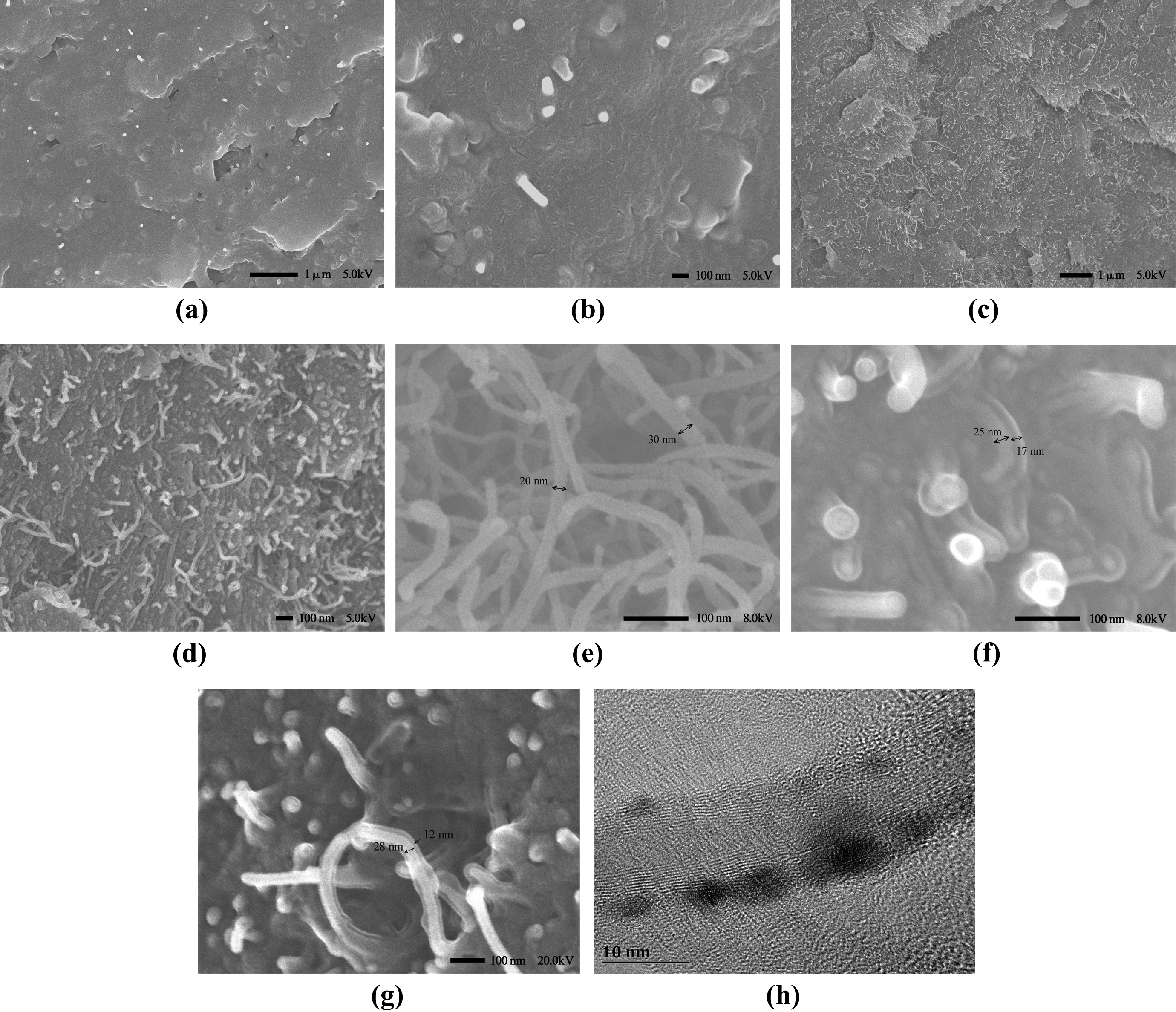
SEM and TEM images of MWCNTs and PPS/MWCNT composites with different MWCNT contents. SEM—(a) and (b) PPS/0.5NT at 5 kV, (c) and (d) PPS/5NT at 5 kV, (e) MWCNTs at 8 kV, and (f) and (g) PPS/2NT at 8 kV. TEM—(h) PPS/2NT. SEM: scanning electron microscopy; TEM: transmission electron microscopy; PPS: polyphenylene sulfide; MWCNT: multiwalled carbon nanotube.
Mechanical properties
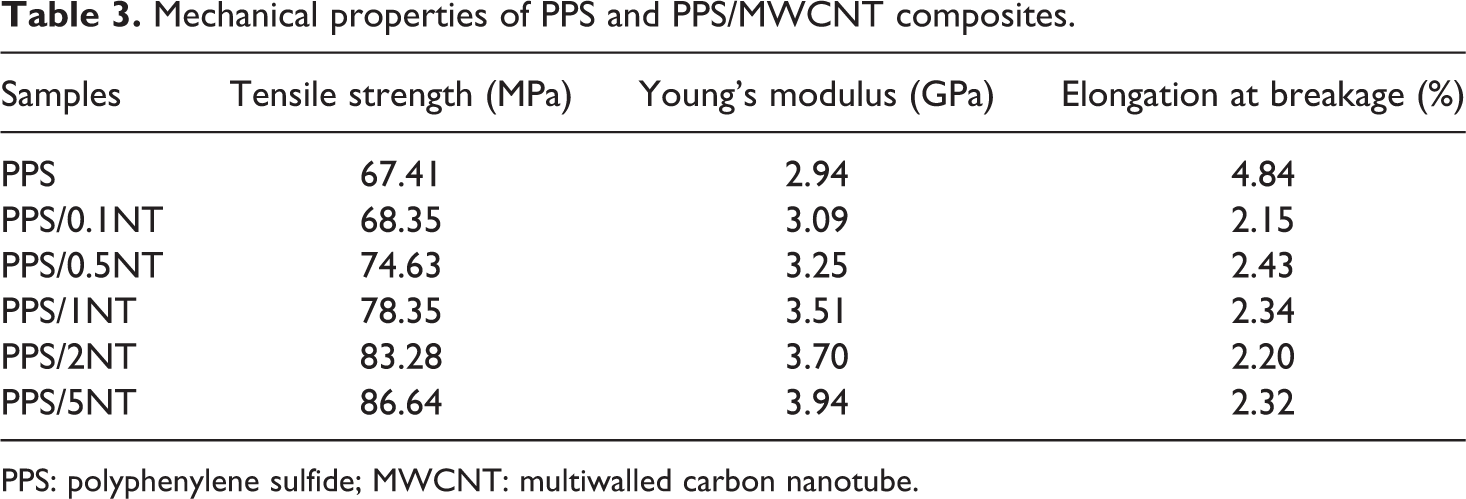
Until now, many studies have concentrated on the mechanical properties of CNT-reinforced polymer composites, whereas the reinforcing effect varied in a wide range. 15 To improve the mechanical properties of polymer matrix, it is well know that CNTs should be uniformly dispersed in the matrix, meanwhile the interface bonding between CNTs and polymer should be consolidated. Table 3 shows the tensile properties of PPS and PPS/MWCNT composites. One can clearly see that the tensile strength and Young’s modulus sustainably increase with increasing the content of MWCNTs. For PPS/MWCNT composites in this study, the interfacial crystallization plays a positive role in transmitting the stress from polymer matrix to nanotubes, meanwhile the homogeneous dispersion of MWCNTs has a pivotal effect on the dispersion of stress, resulting in the improvement of the mechanical properties. For instance, the tensile strength and Young’s modulus of PPS/0.5NT are 74.63 MPa and 3.25 GPa (increase by 10.7% and 10.5% compared with neat PPS, respectively), indicating an obvious reinforcing effect of MWCNTs.
Mechanical properties of PPS and PPS/MWCNT composites.
PPS: polyphenylene sulfide; MWCNT: multiwalled carbon nanotube.
Conclusions
PPS-based composites filled with different MWCNT contents were fabricated via melt blending followed by injection molding. The test results show that the MWCNTs have two opposite influences on the crystallization of PPS, with the increase of MWCNT loading, the crystallization rate of PPS first increases (0–0.5 wt%) and subsequently decreases (1–5 wt%). However, the presence of MWCNTs has little influence on the ultimate degree of crystallinity. In addition, the crystallization morphology of PPS transformed from spherulite to transcrystallization due to strong interfacial interaction and intensive active nuclei on the surface of MWCNTs; however, the lattice parameters of PPS are not changed. In the presence of the forceful interfacial interaction, a homogeneous dispersion of MWCNTs in PPS is obtained. The tensile strength and Young’s modulus of PPS/MWCNT composites are continuously improved as the MWCNT content increases mainly because of the uniformly dispersed MWCNTs and the interfacial crystallization.
Footnotes
Declaration of Conflicting Interests
The author(s) declared no potential conflicts of interest with respect to the research, authorship, and/or publication of this article.
Funding
The author(s) disclosed receipt of the following financial support for the research, authorship, and/or publication of this article: The project was supported by the Innovation Foundation of Aviation Industry Corporation of China (2014E62136).