



Abstract
Enhanced atmospheric pressure corona-based weakly ionized plasma was investigated to modify surface properties of wood materials. The plasma was generated using a point-to-point bare electrode geometry without dielectric barriers. The gas-phase admixture used in this work was argon and acetylene. Wood fibers were processed in the post-discharge region outside of the harsh corona environment. Return corona emanating into the high-voltage gap from the grounded screen was utilized to effectively activate acetylene molecules near the substrate. Scanning electron microscopy was used to study the surface morphology of the treated and untreated substrates. The treated wood material was observed to contain on their surface nano- and micro-nodules of plasma-polymerized acetylene. Capillary rise measurements confirmed changes in the surface wettability of the substrates. The water capillary rise rate and diffusion coefficient were reduced by about 37% and 57%, respectively, for a 15-min treatment of ponderosa pine wood flour.
Introduction
Natural fibers are seen as potential resources for reinforcement materials in plastic composites due to its wide availability, low cost, impressive physico-mechanical properties, and eco-friendliness. 1 –4 For example, the European auto industry has experienced a rapid growth in natural fiber usage in recent times. 5,6 Polymer matrices, such as polypropylene used in composites, are devoid of polar functional groups and hydrophobic in nature. Natural wood fibers are rich in functional groups, such as hydroxyls which make their surface hydrophilic. The interfacial adhesion in fiber-reinforced plastic composites between the cellulose-based fillers and polymer matrices is poor due to their incompatible surface properties. Important challenges for obtaining higher quality fiber-reinforced plastic composites 7 –9 include (1) improved interfacial adhesion between fibers and polymer matrices and (2) enhanced dispersion of fibers in matrices.
Some studies investigated adding chemical coupling agents to improve interfacial adhesion between wood fibers and matrices in plastic composites. 10 –15 Many traditional chemical surface modifications produce hazardous materials and raise the issue of proper disposal of affiliated effluent. Plasma processing has been used to treat natural fibers and some of these treatments are regarded as environment friendly technologies. 16 –19 For example, Yuan et al. 16 studied the influence of air and argon plasma treatments on wood fibers to enhance the performance of wood fiber–polypropylene composites using low-pressure plasma systems. Low-pressure plasma systems have been primarily used for treating natural fibers; however, atmospheric pressure plasma technology has important advantages including the absence of expensive vacuum systems and less complicated substrate handling systems.
Atmospheric pressure plasma–treated fibers 20 –23 have already shown improved compatibility with polymer matrices in composite materials. Kim et al. 23 showed improved bonding and dispersion of treated wood flour in polypropylene using glow discharge plasma. Many studies used dielectric barrier discharge as a plasma generation technique and processed fibers directly in the plasma discharge zone. 23 –25 Processing of fibers directly in the discharge zone for extended duration often results in degradation of fiber quality and lowered tensile strength due to plasma heating and etching. 17–24 For example, Baltazar-y-Jimenez et al. 24 reported lowered tensile strength and formation of weak boundary layers in lignocellulosic fibers for extended treatment in atmospheric pressure plasma. Plasma generated with bare electrode corona discharge has not been typically investigated for treating natural fibers. Lekobou et al. 26 demonstrated surface modifications of various lignocellulosic fibers using argon/acetylene plasma generated with corona discharges similar to our work. His method showed potential for modifying surface properties of the fibers in the post-discharge region without exposing the fibers directly to the plasma discharge region. This technique eliminates the possibility of lowered tensile strength resulted from direct plasma exposure and does not damage the fibers. Downstream processing of the fibers requires longer a duration to modify the surface properties compared to direct exposure to the plasma. This has been a drawback from the perspective of commercializing downstream corona technology. For this work, we tested a newly developed reactor geometry to improve the processing time of the fiber treatment. The newly developed geometry facilitated an enhanced corona discharge (return corona is the enhanced plasma feature) with concomitant increased plasma discharge power. 27 We chose acetylene as a monomer for our plasma-polymerization work since bond scission of acetylene yields activated chemical species that readily engage in plasma-polymerization at the surface of the substrate and at the surface of material already deposited on the substrate. We consider acetylene a “surrogate working gas” with which we study and optimize the atmospheric pressure weakly ionized plasma (APWIP) reactor. In the future, after developing an understanding of the APWIP reactor, we will investigate the wide array of other monomers (or admixtures of monomers) that will be used as the final working gas that will optimize the surface properties of the plasma-processed wood material.
In this article, we present the surface modifications of lignocellulosic fibers at atmospheric pressure using corona discharges that included enhanced return corona. We processed the fibers downstream outside of the plasma discharge zone and evaluated the surface morphology and surface wettability for treated and untreated substrates.
Experimental part
Wood specimen
The lignocellulosic wood materials used for this study were ponderosa pine wood flour from American Wood Fibers, Baltimore, Maryland, USA, and southern yellow pine wood fibers from Masonite Corporation, West Chicago, Illinois, USA. The ponderosa pine was rated 60 mesh and the southern yellow pine fiber was in the form of clusters similar in appearance to commercial cotton balls. Figure 1 shows the typical appearance of the wood materials used for this work.
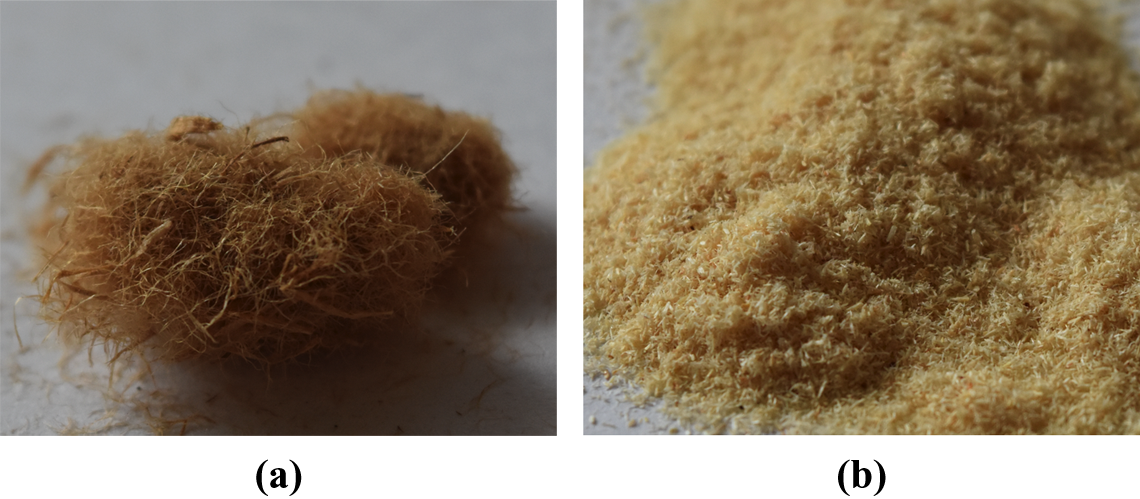
Typical appearance of the wood material. (a) Southern yellow pine wood fibers and (b) ponderosa pine wood flour.
Plasma treatment
The lignocellulosic wood material was exposed inside the reactor setup depicted in Figure 2(a). An array of sharp high-voltage (HV) needles was separated by a gap from an array of blunt protrusions placed over a grounded screen mesh giving a point-to-point electrode geometry for an enhanced corona discharge. The corona discharge was enhanced by the return corona that formed near the blunt protrusions associated with the bottom electrode. The electrodes were bare and contained no dielectric barriers, unlike dielectric barrier discharge setups. Figure 2(b) shows the visual observation of corona discharge that illustrated significant return corona generation near the blunt protrusions. The electrodes were energized with a 0–120 V RMS 60 Hz AC power supply that energized an HV 100:1 transformer (type: JVW5, from General Electric, USA) stepped up the supply voltage as required. A detailed description of the reactor has been published elsewhere [27].
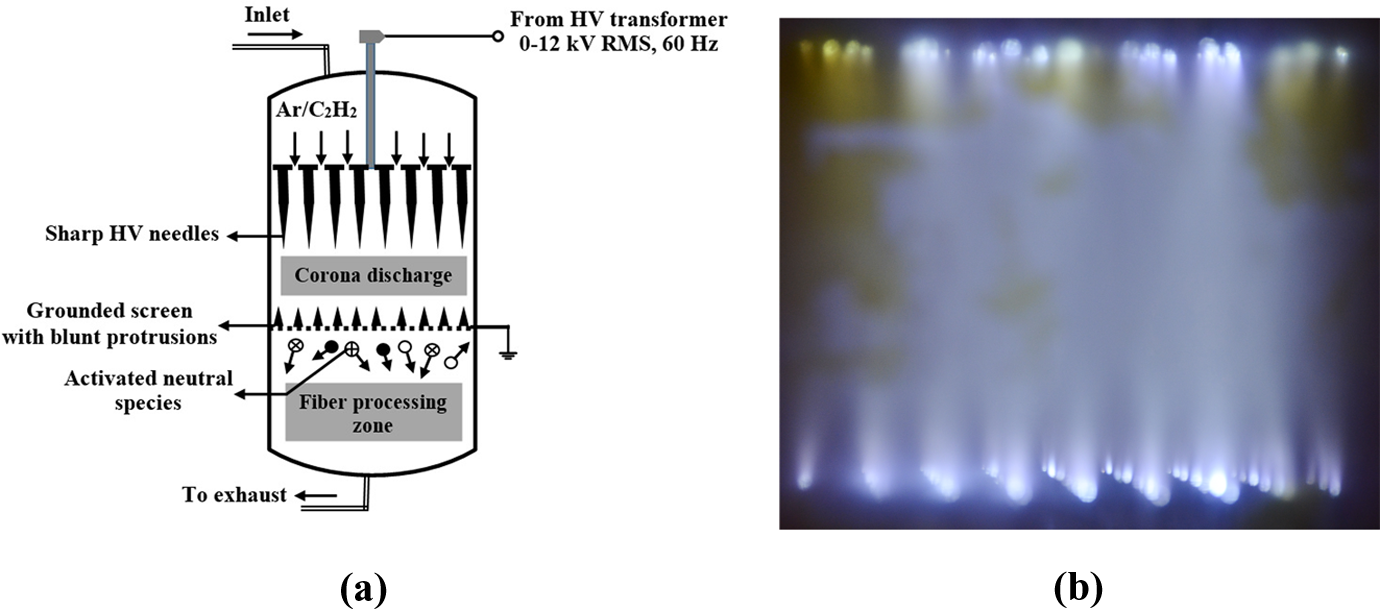
(a) Simplified schematic of the experimental setup and (b) corona discharges in the gap spacing between HV needle tips and protrusion tips. HV: high voltage.
Wood fibers and wood flour were exposed downstream below the grounded screen in the post-discharge region. Acetylene (98.0% pure) was used as the precursor molecule, and argon (99.99% pure) was used as the carrier gas. The admixture contained about 1.9% acetylene. The lower concentration of acetylene in our admixture was used primarily to control gas-phase chemical reaction and minimize growth of macroscopic “dust” particles. Argon was found to be an effective carrier gas while mixed with acetylene. The high partial pressure of inert argon effectively diluted the working gas thus minimizing gas-phase reactions. Argon’s metastable species and ultraviolet photons were effective at sustaining stable corona glows and streamers. Being an inert gas, argon did not directly provide activated chemical radicals that were incorporated into the plasma-polymerized material deposited onto the substrates. The needle-array-to-protrusion-array gap was set to 8 cm and the fibers were accommodated about 1 cm below the grounded screen. Two different substrate holders were used to support substrates that consisted of the wood flour and the wood fiber clusters. The substrate holders were different for two different materials primarily due to the physical appearance of the material (Figure 1). The ponderosa pine was flour in physical appearance and the flour was placed in a pan-shaped aluminum disc that was vibrating at the time of treatment. The gentle vibration helped to treat the wood flour uniformly. Southern yellow pine fibers were fiber-clusters with physical appearance similar to commercial cotton balls. A stainless steel mesh was used to hold the fiber clusters while processing. The reactor was flushed with argon for 5 min and allowed to mix argon and acetylene homogeneously inside the reactor vessel for 5 min more before energizing the HV electrodes. The argon/acetylene feed gas stream entered with flow rates of 1.986/0.037 SLPM and exited freely through the bottom exhaust port into a fume hood keeping the inside reactor environment nearly at atmospheric pressure.
Coating analysis
Physical characterization
Scanning electron microscopy (SEM) was performed to analyze surface morphology of the lignocellulosic fibers before and after the plasma treatment. The SEM observations were performed using an environmental scanning electron microscope (ESEM) from FEI Company (model: Quanta 200F). The ESEM allowed sample observation without metal sputter coatings applied to the sample. The treated and untreated wood fibers were observed under the ESEM without sputter coatings on them.
Capillary rise measurements
Capillary rise experiments were performed to measure the weight gain of the capillaries packed with ponderosa pine flour. The analysis was based on Washburn’s equation 28 which is commonly expressed as

where h is the height of the liquid rising through the porous materials in time t, r is the equivalent capillary pore radius, λL and η are the surface tension and viscosity of the liquid, respectively, and θ is the contact angle. For our work, the height of the liquid front was replaced by weight gain (w) of the wicking columns 29 giving

where ρ is the density of the liquid and c is the geometrical factor that depends on the porosity and tortuosity of the capillaries. The parameter c is approximated as constant for similar particle size and packing procedures applied to similar wicking columns.
A simplified form of equation (2) is

Here, De is the effective diffusion coefficient that depends on the physicochemical properties of the liquid and porous medium, as well as the size of the capillaries.
We used Kimble™ disposable serological glass pipettes with an inner radius of 1.48 mm as our wicking columns. The slender ends of the pipettes were removed to make the entire length of the pipettes cylindrical with uniform radius. The packed bed columns were prepared by inserting untreated and treated ponderosa pine flour into the pipettes. The bottom end of each pipette was equipped with a fine stainless steel mesh screen to captivate the wood flour. Each pipette was filled with equal amount of wood flour (45 mg treated/untreated).
All the pipettes were then bundled together and impacted at the bottom ends to form packed bed columns. The bundled pipettes were impacted at least 300 times for a compact filling of the wood flour. This ensured that the geometrical factor of the capillaries remained nearly homogeneous for all packed bed columns.
The wetting liquid was deionized water. The wicking column experiments were conducted using deionized water that was effective in determining whether the wood flour became hydrophobic after treatment. In the earlier work from our group, methanol was used as a wetting liquid to test the hydrophobicity of the treated flour [26]; however, methanol saturated the wicking column very rapidly. The wicking columns were placed vertically with the help of a pipette stand and the fine mesh at the bottom end touched the water front contained in a petri dish. The petri dish was seated over a digital scale in ambient condition. The water evaporation rate was estimated during the experiments by measuring weight loss of water from an identical petri dish exposed to ambient conditions and incorporated into the data analysis.
The weight gain approach of the capillary rise measurements was more precise and accurate than visual wetting front observations in our case. We assumed that the hydrostatic pressure of water in the capillaries was insignificant and considered the weight loss from the columns into the water was negligible. Geometry of the pores in the capillaries was considered unaffected by the wetting of the wood flour.
Results
Influence in surface morphology
SEM analysis was performed to observe the surface morphology of the treated and untreated lignocellulosic fibers. The SEM micrographs in Figure 3 show the two types of wood fiber used in this work. In both cases, fiber diameters were less than 100 μm; however, no attempts were made to fully characterize the distribution of fiber scale lengths in either the axial or transverse directions.
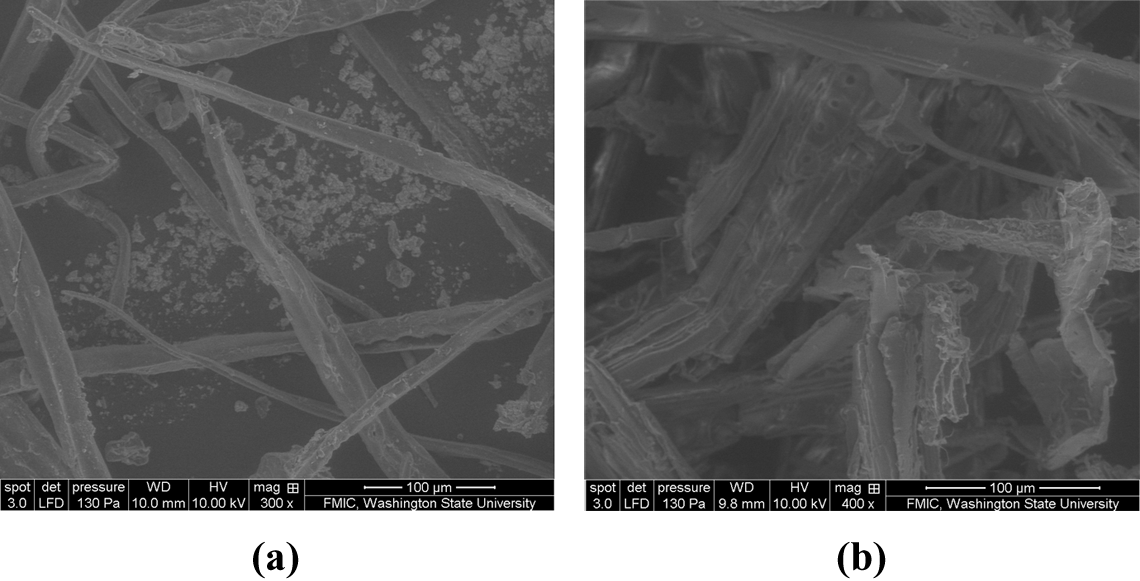
SEM micrographs of the wood fibers. (a) Southern yellow pine wood fibers and (b) ponderosa pine wood fibers. SEM: scanning electron microscopy.
SEM micrographs show a significant change in the morphology of the wood fibers before and after plasma processing. The treated fibers are observed with nano- and micro-spherical nodules of plasma-polymerized acetylene. Figure 4 shows a comparison among surface morphology of the treated and untreated southern yellow pine fibers. The untreated fiber in Figure 4(a) has fairly smooth surface topography. The 10-min treated fiber (Figure 4(b)) shows polymerized nodules growing intermittently on the fiber surface, while the 20-min treated fiber (Figure 4c) shows densely populated nodules sitting adjacent to each other and distributed throughout the fiber string.
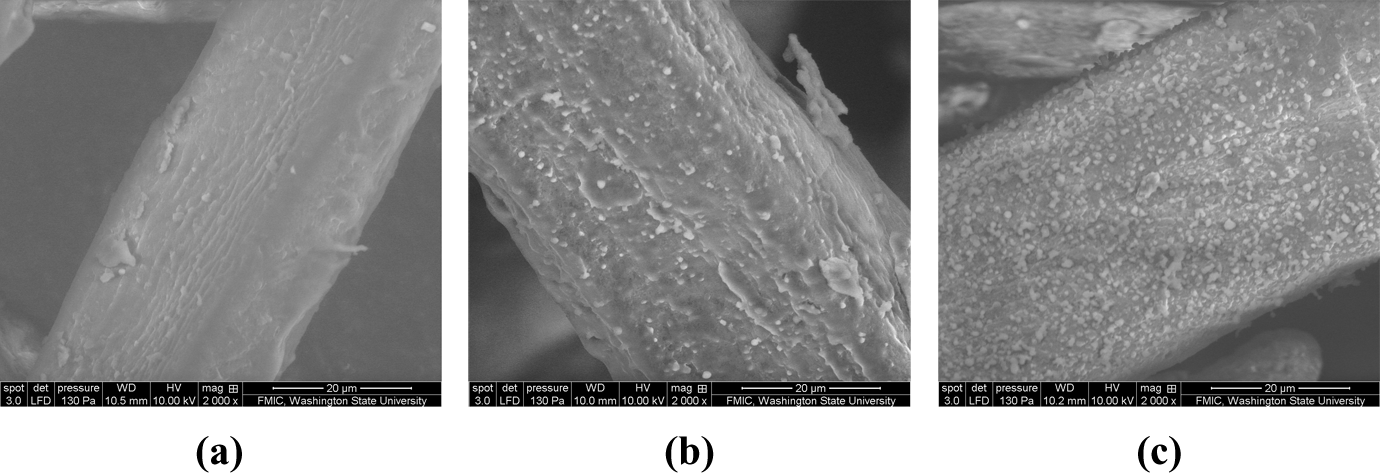
SEM micrographs of southern yellow pine fibers: (a) without exposed to plasma, (b) treated for 10 min, and (c) treated for 20 min. SEM: scanning electron microscopy.
The effect of plasma treatment on ponderosa pine fibers was similar to what we observed for southern yellow pine fibers. The fibers without exposure to plasma contained no nodules as shown in Figure 5(a). The 10-min treated fiber (Figure 5(b)) shows formation of a few nodules on the surface, while the 20-min treated fiber (Figure 5(c)) shows a denser distribution of nodules.
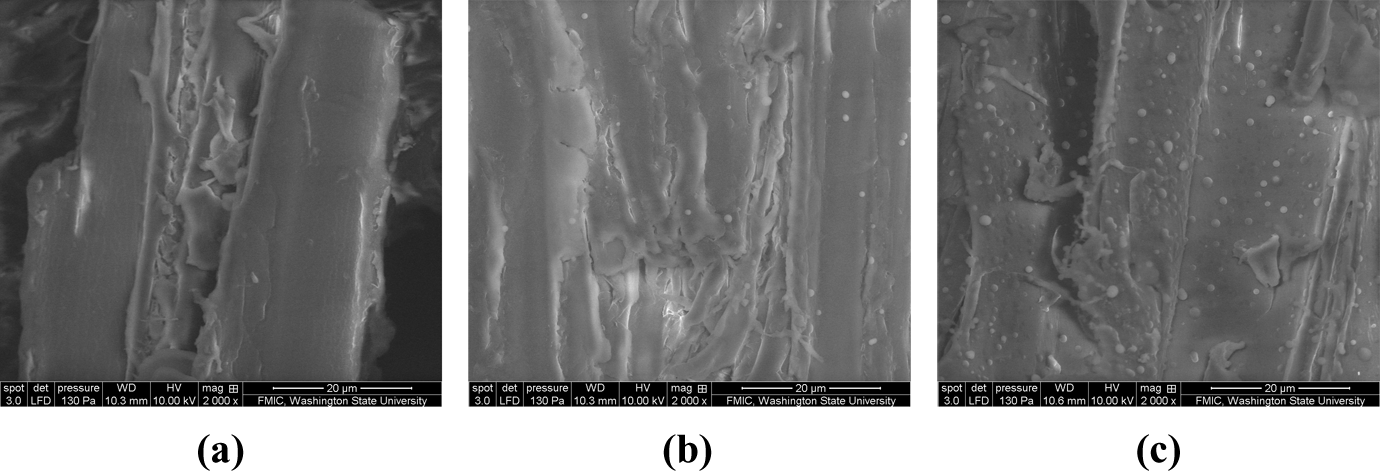
SEM micrographs of ponderosa pine fibers: (a) without exposed to plasma, (b) plasma treatment for 10 min, and (c) plasma treatment for 20 min. SEM: scanning electron microscopy.
The distribution of plasma-polymerized nodules varied locally on the surface and for these treatment times and conditions there was no uniform film. Figure 6 shows a 20-min treated southern yellow pine fiber with dense nodules merging together. The southern yellow pine fibers were observed with heavily overlapping aggregated nodules compared to the ponderosa pine fibers with a similar exposure time.
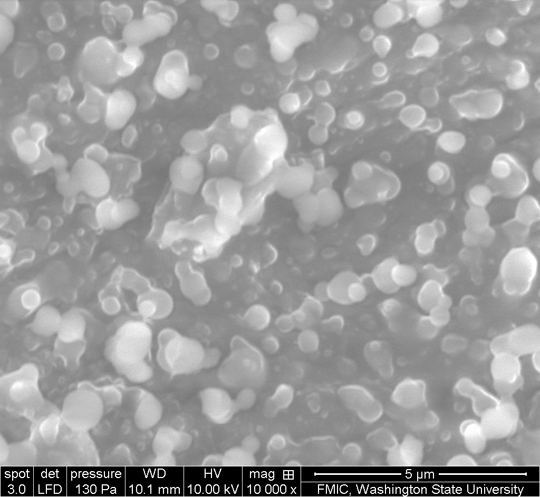
The plasma-polymerized nodules are coalesced and aggregated together in a 20-min treated southern yellow pine fiber.
Influence in surface wettability
Capillary rise measurements were recorded for ponderosa pine wood flour to observe the wetting phenomena before and after plasma treatment. The wettability experiments were carried out about 48–72 h after the fibers were plasma treated. The treated fibers were stored in closed petri dishes; however, extraordinary steps were not taken to protect samples from laboratory air. The water weight gain, w, of the capillaries was measured each 30 s until the rising water front reached nearly the top of the wicking columns. Figure 7(a) shows plots of w2 versus t, depicting the diffusion of water through the capillaries of treated and untreated pine wood flour. The plots show a reduction in water affinity of treated fibers when the exposure time is 10 min or more. Treatment times of 5, 10, and 15 min were utilized because Figure 7(a) shows that this sequence of processing times (5, 10, and 15 min) yielded substantial separation between the various curves when error bars were considered. A treatment time of 15 min was sufficient to give a high surface density of nodules but not a continuous film.
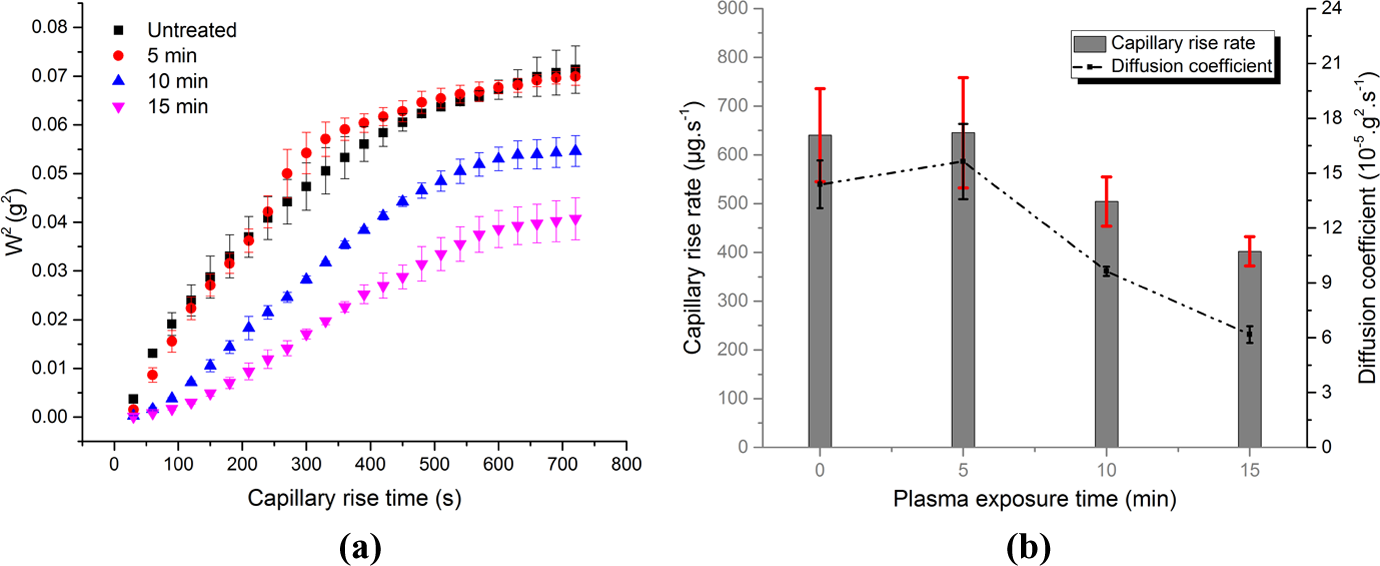
(a) w2 versus time plots depicting the diffusion of water through capillaries for untreated and treated (5 min, 10 min, and 15 min) ponderosa pine flour and (b) capillary rise rates and diffusion coefficients of water in the capillaries as a function of plasma exposure time.
Equation (3) predicts a linear relationship between w2 and t. However, the empirical plots in Figure 7(a) show an approximate linear region between 150 s and 500 s. The plots deviate from linear relationship initially at the very beginning and decay exponentially later at the end. Capillary rise studies with other porous materials have reported similar observations in the literature. 29 –33
We did not attempt to record the time when the wetting front arrived at the top of the packed bed as the visual observation of height to the unaided eye was not precise. However, the approximate time for that event was about 15 min (900 s). The weight gain of the packed bed was observed for more than an hour. The capillary rise rates and diffusion coefficients of water in the capillaries were calculated using the data that fall within the linear region. The R2 (coefficient of determination) numbers of the data sets used in calculation of capillary rise rates and diffusion coefficients are equal to 0.93 or above. Figure 7(b) illustrates the capillary rise rate and diffusion coefficient data in a graphical representation to delineate how surface wettability changed with plasma exposure times.
Discussion
As described earlier in the “Results” section, Figures 4 and 5 show surface density of nodules was larger for the southern yellow pine fibers than for the ponderosa pine fibers, with similar exposure times. Phenomena that could account for this asymmetry include (1) asymmetry in the nature of the two different substrate holders; (2) asymmetry in the surface density of nucleation sites on the two fiber types; and (3) substrate surfaces that might have spent substantial time in the shadow of adjacent fibers. The local surface composition of the wood ingredients (lignin, cellulose, and hemicellulose) varies in different species which influences the molecular structure and surface density of nucleation sites. We observed continuous film from acetylene deposition on 10-mm potassium bromide (KBr) disc substrates. However, the surface area of the wood fibers was larger compared to the 10-mm KBr discs making it difficult to get a continuous surface coverage on our wood fibers. We did observe regions of some fibers with densely populated nodules but we did not observe the formation of a continuous film covering a fiber. Longer processing times might yield a continuous film but such data must be collected in future work.
The distribution of plasma-polymerized acetylene nodules in the fiber surface altered surface free energy of the fibers and hence influenced the surface wettability of the fibers. The 5-min treated fibers did not show significant change in surface wettability compared to the untreated fibers. This suggests that the nodule-free wood surface area dominated the surface area covered by the small population of nodules. Significant changes in surface wettability were observed after a 10-min plasma exposure time. Plasma exposure of fibers for 15 min reduced the water diffusion coefficient by about 57% and capillary rise rate by about 37%. Reduction of capillary rise rates and diffusion coefficients of water in the capillaries demonstrates modification of surface free energy of the fiber surface. Inclusion of return corona yielded an improvement of processing time by 50% compared to the earlier corona plasma work that did not emphasize return corona. 26
According to Zhmud et al., 34 the dynamics of capillary rise in a complex porous media can be modeled with Washburn’s equation when the capillary force is compensated by gravity and viscous drag. However, this classical equation becomes inadequate to govern capillary rise at the initial zero-time limit and late long-time limit conditions. Initially at zero-time limit, the liquid drawn into the capillary is accelerated by capillary force due to negligible viscous effect; however, soon the viscous effect compensates the capillary force to achieve a quasi-steady state. This quasi-steady-state regime yields a linear h2 versus t relation in equation (1). The rise of the liquid decays exponentially after the quasi-steady-state regime at long-time limit condition. The w2 versus t plots in Figure 7(a) show similar exponential decay after about 500 s when the wetting front reaches nearly the top of the packed bed.
FTIR and XPS analysis from earlier work 35 showed the presence of double and triple carbon bonds in the deposition and confirmed the presence of C and H. The analysis also showed the presence of O-based functional groups that probably resulted from residual air/moisture in the reactor and perhaps resulted from samples being exposed to air. An important caveat is that FTIR and XPS work was conducted on substrates placed within the corona region rather than downstream from the corona region as for the current work. We hypothesized that the grounded screen intercepts most charged species thus our material is assembled mostly from the flux of neutral radicals arriving at the substrate (perhaps also augmented by gap-grown macroscopic particles).
Substrate regions with no deposition (no nodules) are assumed to be void of nucleation sites for material deposition. Such pristine regions are exposed to ultraviolet light originating in the corona discharge and such pristine regions also transport to growing nodules (via solid-state diffusion) adsorbed mobile chemical species that participate in nodule growth. We have not studied adsorbed chemical species that might etch the surface of the pristine substrate and we do not know if such etching chemical species are present in our argon/acetylene plasma reactor. Future work will use a working gas of dry air along with a carrier gas so that etching behavior from oxygen-containing chemical species can be studied explicitly, similar to the work by Szabo et al. 36
Conclusion
Corona-based weakly ionized plasma was used for surface modifications of lignocellulosic fibers at atmospheric pressure using a point-to-point discharge that included return corona. The method showed deposition of plasma-polymerized nano- and micro-spherical nodules on the fiber surface. Capillary rise measurements demonstrated change in surface wettability of the plasma-treated fibers. This method shows the viability of corona-based plasma to process natural fibers for use in fiber-reinforced plastic composites. Corona-based plasma with return corona has potential to become cost-effective when compared with other commercially available plasma systems.
Footnotes
Declaration of Conflicting Interests
The author(s) declared no potential conflicts of interest with respect to the research, authorship, and/or publication of this article.
Funding
The author(s) received no financial support for the research, authorship, and/or publication of this article.