



Abstract
Structural, mechanical, and thermal properties of polyphenylene sulfide (PPS) filled with Al-Cu-Fe quasicrystals particles were studied. It was shown that the introducing of quasicrystalline fillers into the polymer matrix results in the increase in Young’s modulus, hardness, and toughness of the polymer. Quasicrystalline fillers can improve thermal properties of PPS, including heat resistance index, Vicat softening temperature, thermal diffusivity, and thermal conductivity.
Keywords
Introduction
Nowadays, polymer composites are widely used in various applications. Almost any type of polymers can be used as a matrix material in such composites, and wide variety of inorganic materials can be used as fillers. Particular interest is paid to search for new polymer–filler combinations, allowing to obtain new composite materials with improved combinations of functional properties.
Polyphenylene sulfide (PPS) is a high-performance thermoplastic polymer with unique properties and a cost/performance balance unmatched by other engineering thermoplastics. Due to its excellent mechanical and thermal properties, PPS is often used as matrix material to produce new composite materials. Various fillers, such as carbon, 1,2 glass 3 and aramid fibers, 4 carbon nanotubes, 5,6 ceramic, 7 –11 and metal 12,13 particles, were used as fillers for PPS. The present work is devoted to the study of structure and properties of PPS filled with disperse quasicrystals (QC) particles. It is known that alloys with quasicrystalline structure have unique properties, including stability up to the melting temperature, 14 high hardness, 15,16 high corrosion resistance, 17 low friction coefficient, 18 and high wear resistance. 19 However, because of high brittleness and low plasticity at room temperature, 20 industrial application of QCs as independent structural materials is almost impossible. These drawbacks can be overcome by the design of polymer and metal matrix composites filled with QCs. 21 –24 Polymer/QCs composite materials with improved mechanical, thermal, and tribological properties can be used in various kinds of applications such as bearings, gears, and so on. Moreover, corrosion resistance of such composites allows their using in corrosive and aggression environment. Low thermal conductivity and improved dimensional stability open up new possibilities of application of composites filled with QCs as insulating materials in a wide operating temperature range. 24 –32
Up to now, only few papers related to Al-Cu-Fe QC-filled polymers are published. Epoxy resin, 25,27 ultra-high molecular weight polyethylene, 24,28,29 and polyamide (PA) 30 were used as polymer matrix in these investigations. In 26 mechanical and wear resistance properties of PPS-based composites filled with Al-Cu-Fe QC were studied briefly, significant increase in mechanical and tribological properties in relation to unfilled PPS was observed. In this article, we report the structural, mechanical, and thermal properties of PPS—Al-Cu-Fe QC composites.
Experimental
DIC DSP B100C (Japan) PPS powder was used as a matrix material. Al65Cu23Fe12 quasicrystalline powder with icosahedral phase content over 95% and density of 4.53 g cm−3 was obtained, as it was reported previously, 33,34 by mechanical alloying of elemental powders in APF-3 (Russia) water-cooled planetary ball mill for 2 h at carrier rotation rate of 450 r min−1 and ball-to-powder ratio of 10:1 with subsequent annealing at 700°C. Structure of Al65Cu23Fe12 quasicrystalline powders obtained by the route mentioned above was reported and discussed in detail previously. 35 –38 Fritsch Pulveresette 5 (Germany) planetary ball mill was used to obtain milled PPS and PPS/QC composite powder. Steel balls with a diameter of 10 mm were used as the grinding media. The weight ratio of the milled material and the balls was about 1:10 (50 g of powders and 500 g of balls). Rotation rate was of 200 r min−1, milling time was of 30 min, and treatment was carried out at ambient temperature. QC content in composite powders was varied from 1 to 20 wt%. Optimization of milling parameters to produce PPS/QC composition is described in detail by Chukov et al. 39 The bulk samples of PPS-based materials were obtained by compression molding at a temperature of 315°C and a pressure of 60 MPa.
To study structural, mechanical, and thermal properties of the composites, various methods were used. Structure of composites was studied using Hitachi TM-1000 (Japan) low-vacuum scanning electron microscope (SEM) in backscattered electron image mode. A uniaxial tensile test and a three-point flexure tests were carried out using a universal testing machine Zwick Z020 (Germany) at rates of 2 and 5 mm min−1, respectively. Flexure tests were carried out to achieve 10% strain values, and destruction of experimental samples is not occurred. Charpy impact strength was investigated using a Zwick/Roell pendulum impact tester (Germany), and the distance between the supports was found to be 60 mm. For testing, we used unnotched samples of composite materials. Brinell hardness measurement was carried out using a hardness tester Zwick/Roell ZHU 2.5 (Germany) with a steel ball of 5 mm diameter, applied load of 358 N, and the holding time under load of 60 s.
Thermogravimetric analysis of composite materials was carried out using TA Instruments TGA Q500 analyzer (USA). Heating of the samples was carried out under air atmosphere at a rate of 10 K min−1 up to a 700°C. To study of Vicat softening point, Instron Ceast HDT 3 VICAT tester (USA) was used. Vicat softening point is defined as a temperature at which a steel needle penetration at load of 10 N and heating rate of 120°C h−1 into the sample reached 1 mm. NETZSCH LFA 447 Nanoflash analyzer (Germany) were used to study thermal diffusivity at the temperature range from 25 to 250°C. To calculate the thermal conductivity of samples, their density was measured by hydrostatic weighing using A&D GR-202 (Japan) analytical scales with the density measurements console. The specific heat capacity, Cp, was obtained using NETZSCH DSC 204 F1 (Germany) differential scanning calorimeter under argon atmosphere using a method of relations when the heat capacity of the experimental sample was compared with the heat capacity of the standard sample (sapphire).
Result and discussion
Structure and mechanical properties of PPS/QC composites
Figure 1 shows SEM images of the structure of unfilled PPS and PPS/QC composite materials. The presented images were obtained on fracture surfaces of the samples after uniaxial tensile tests.
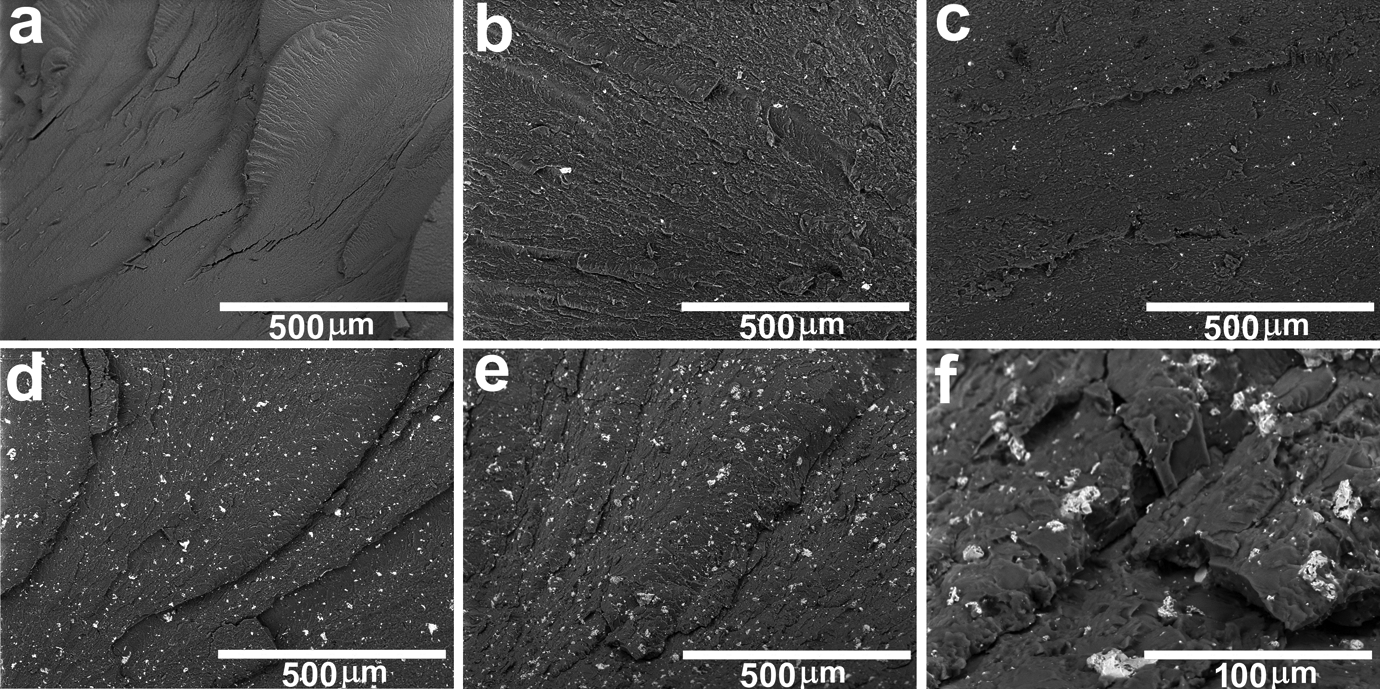
(a) SEM images of unfilled PPS, (b) PPS/2 wt% QC, (c) PPS/5 wt% QC, (d) PPS/10 wt% QC, and (e) and (f) PPS/20 wt% QC composites. PPS: polyphenylene sulfide; QC: quasicrystal; SEM: scanning electron microscope.
It is seen that both unfilled PPS and as PPS/QC composites have the same shape of fracture surface. Destruction of the material proceeds via the quasi-brittle fracture mechanism. Crack propagation front together with relatively little visible cracks was observed in the micrographs. This indicates that the fracture mechanism of the obtained composite materials occurs via microcracking. Further increase in the applied load results in merging of small cracks into larger ones, which leads to the formation of main crack with further fracture of the material. Analysis of the SEM images shows that the microstructure of composite materials is nearly homogeneous, no defects, and porosity was observed. Figure 1(d) and (e) show uniform distribution of the fillers through the body of the polymer matrix. Figure 1(f) shows good adhesion between the polymer matrix and QC fillers, which is confirmed by the absence of visible pores and voids formed by the ejection of the filler during mechanical test in the fracture surfaces structure. As it will be shown later, formation of such structure results in the increase in the mechanical characteristics of obtained composites because introduction of rigid QC particles into soft polymer matrix increases the stiffness of the obtained composite materials.
Obtained data show that increase in the QC content has nearly no effect on the tensile strength of composites. Tensile strength of the obtained materials lies at the range of 81–82 MPa over all QC content range (from 0 to 20 wt%). Figure 2 shows the concentration dependences of Young’s modulus and elongation at break after tensile tests of PPS/QC composites. Young’s modulus gradually increases from 2894 MPa for the unfilled PPS up to 3414 MPa for the composite filled with 20 wt% of QC. This indicates that the introduction of QCs in the polymer matrix results in the increase in the toughness of material, and higher QC content results in higher Young’s modulus values. Increase in toughness is accompanied by a decrease in the plasticity of PPS/QC composites, which is confirmed by decrease in values of elongation at break with increase in the QC content. As it is seen from Figure 2, if up to 5 wt% of QC drop in the elongation is almost unnoticeable, increase in QC content up to 10 and 20 wt% results in drastically reduce in the elongation at break. Elongation at break of unfilled PPS sulfide is of 10.3%, whereas for the PPS/10 wt% QC composites, elongation is dropped down to 6.5%, and further increase in QC content up to 20 wt% leads to insufficient decrease in elongation value, which is equal to 6.3% in this case.
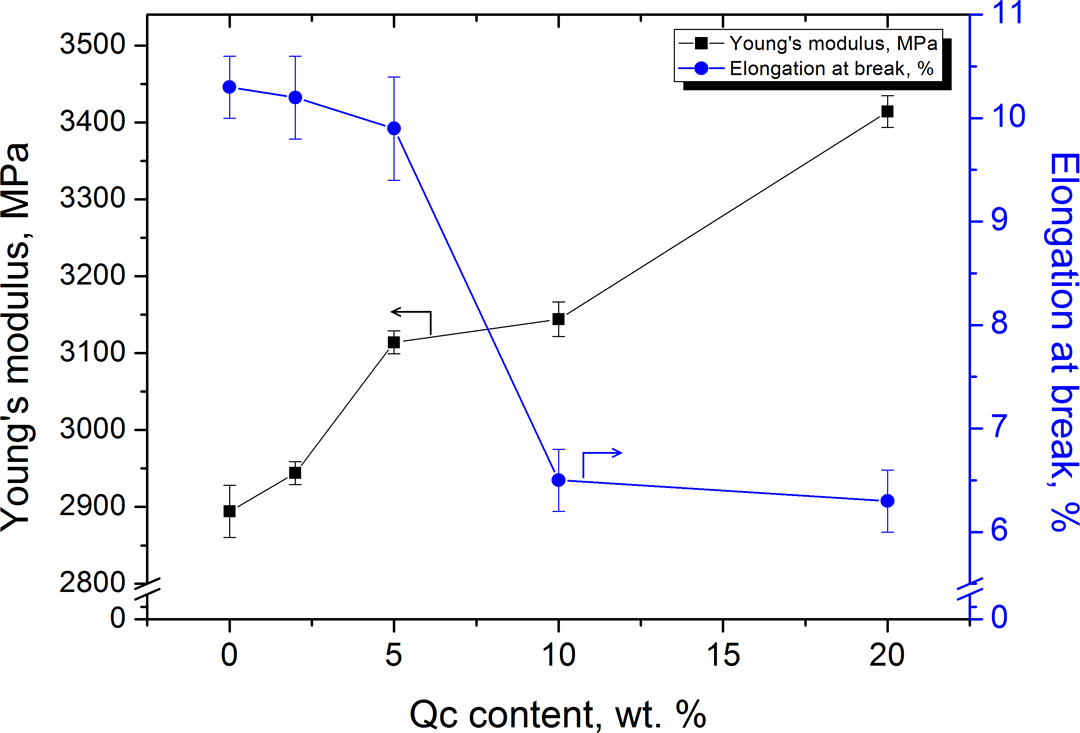
Young’s modulus and elongation at break of the PPS/QC composites after tensile tests. PPS: polyphenylene sulfide; QC: quasicrystal.
Figure 3 shows the flexural strength and Young’s (flexural) modulus of PPS/QC composites after three-point flexure tests. It was found that the flexural strength increases from 81.7 MPa for unfilled PPS up to 97.7 MPa for PPS/20 wt% QC composite. Flexural modulus, as in the case of a uniaxial tensile test, increases with increasing of QC content from 2630 MPa for unfilled polyphenylene up to 3280 MPa for PPS/20 wt% QC. Increase in the mechanical properties of QC-filled composites in relation to unfilled PPS is caused by high mechanical properties of QC and good interfacial interaction between QC filler and polymer matrix.
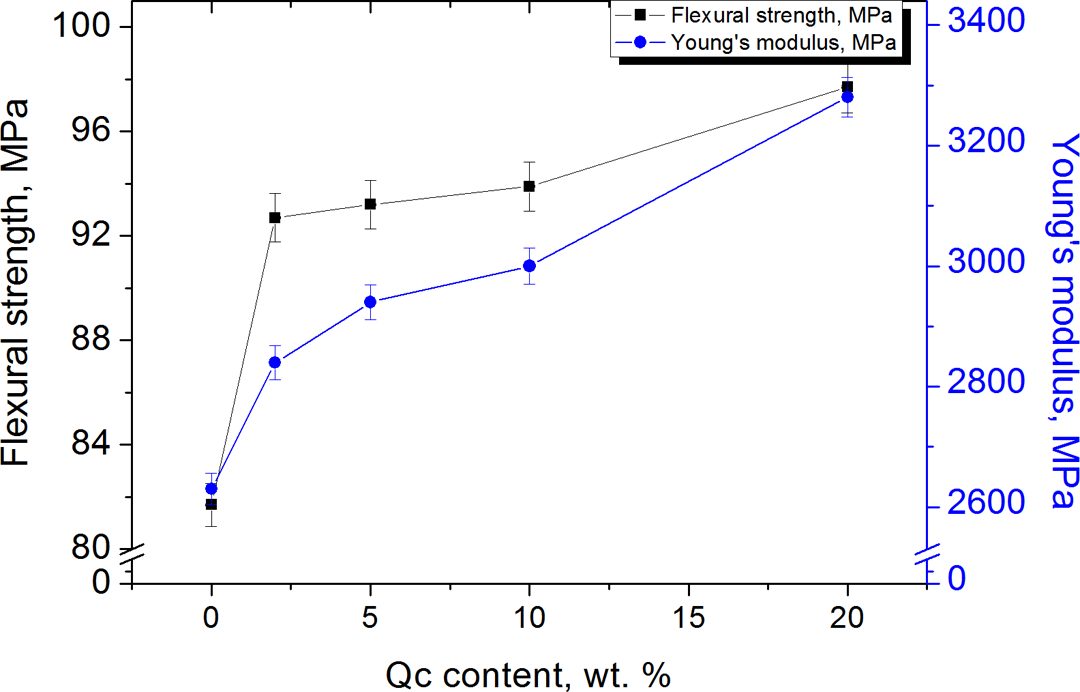
Mechanical properties of the PPS/QC composites after three point flexure tests. PPS: polyphenylene sulfide; QC: quasicrystal.
Polymers due to the significant stress relaxation times often have a significant difference in the brittleness under static and impact loads. Impact strength is one of the most important mechanical properties of the polymers and polymer composites. Impact strength of PPS-based composites with different QC content is shown in Figure 4(a). It was found that samples with QC content up to 5 wt% were not broken during impact tests, and it was observed increase in impact strength values, for example, typical value of impact strength for unfilled PPS is 105.2 kJ m−2, whereas reinforcing with 2 wt% of QC results in the increase of impact strength up to 111.3 kJ m−2. For PPS/5 wt% QC composites, impact strength value increases up to of 128.5 kJ m−2. Further increase in QC content up to 10 and 20 wt% results in the breaking of the samples during the tests, and an embitterment of the composites at high degrees of filling occurs. This is accompanied with a decrease in impact strength values, and at a maximum filling degree of 20 wt%, minimum value of impact strength equal to 83.8 kJ m−2 was observed.
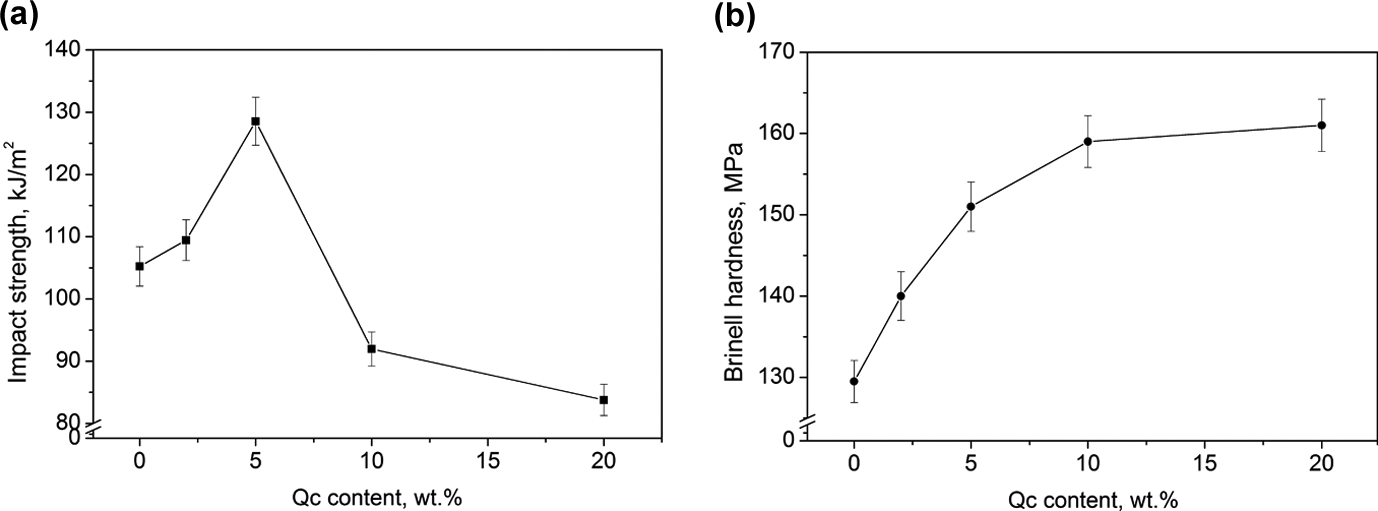
(a) Impact strength and (b) Brinell hardness of the PPS/QC composites. PPS: polyphenylene sulfide; QC: quasicrystal.
Concentration dependence of PPS/QC composites Brinell hardness is shown in Figure 4(b). Hardness of unfilled PPS is 129.5 N mm−2, and reinforcing with 2 wt% of QC leads to noticeable increase in hardness up to 140 N mm−2. Further increase of QC content leads to further increase in hardness, maximum value of hardness 161 N mm−2 is observed for the PPS/20 wt% QC. Gradual increase in hardness with filler content is typical for PPS/metal composites. 12 Observed increase in hardness of the composite materials with the introduction of QCs caused by the very high QCs hardness, which can reach values of 8–10 GPa, 26 and in thin films up to 14 GPa at room temperature. For comparison, the hardness of hardened steel does not exceed 8 GPa. Hence, the introduction of QC fillers with high hardness in relatively soft polymers results in an increase in hardness of obtained composite materials, which can provide a positive effect in terms of the developed composites application.
Thermal properties of PPS/QC composites
Figure 5(a) shows typical curves of weight loss and derivative weight loss curves obtained by thermogravimetric analysis of PPS/QC composites. It can be seen that intensive weight loss, and, correspondingly, the degradation processes of PPS-based composite materials starting at temperatures above 500°C.
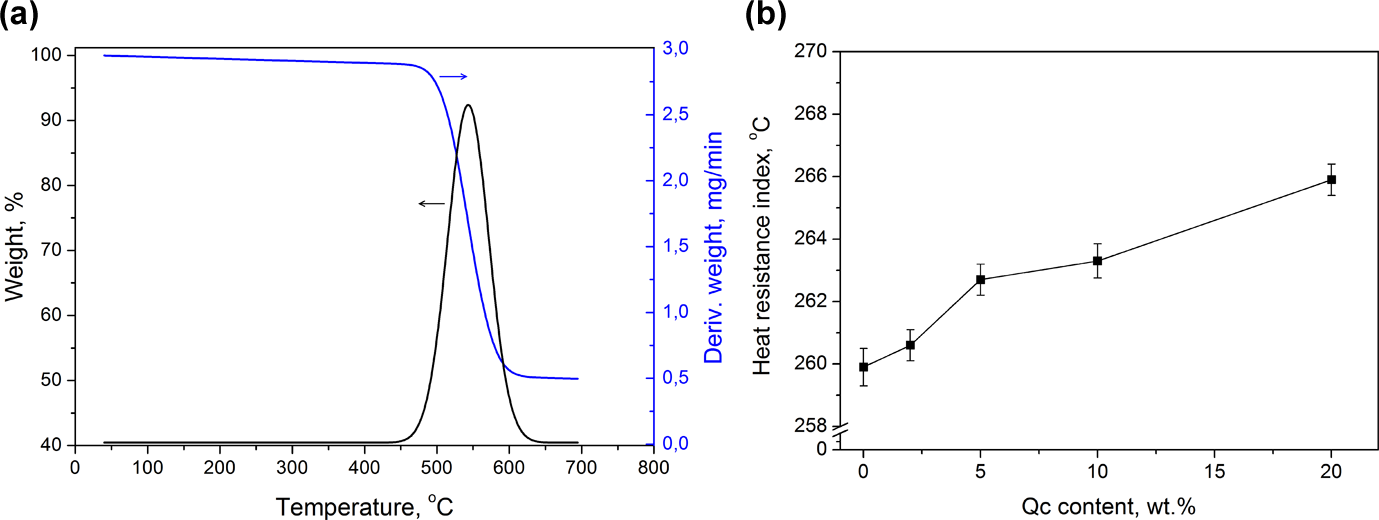
(a) Typical weight loss and derivative weight loss curves and (b) heat resistance index of the PPS/QC composites. PPS: polyphenylene sulfide; QC: quasicrystal.
To evaluate the heat resistance changes of the PPS-based composites, the heat resistance index (HRI) was calculated using the following equation:

where T5 and T30 are corresponding temperatures of 5% and 30% weight loss, respectively. 40
Concentration dependence of HRI, calculated by equation (1), is shown in Figure 5(b). Heat resistance of the obtained composites increase with increase in QC content from 259.9°C for the unfilled PPI up to 265.9°C for composite filled with 20 wt% of QC. Obtained results indicate that the introduction of QC increases the heat resistance and the thermal stability of PPS-based composites. It is known that particulate filler can act as physical interlock points, which restricts chain mobility and results in the increasing of the barrier effect. That is why the thermal stability of obtained composites is higher than of initial PPS. Increase in the thermal conductivity of composites also results in the increase in heat resistance and the thermal stability of PPS/QC composites. 41 –44
Vicat softening temperature measurements allow to obtain the softening point of polymer materials. Vicat softening curves of PPS/QC composites with various QC content are shown in Figure 6.
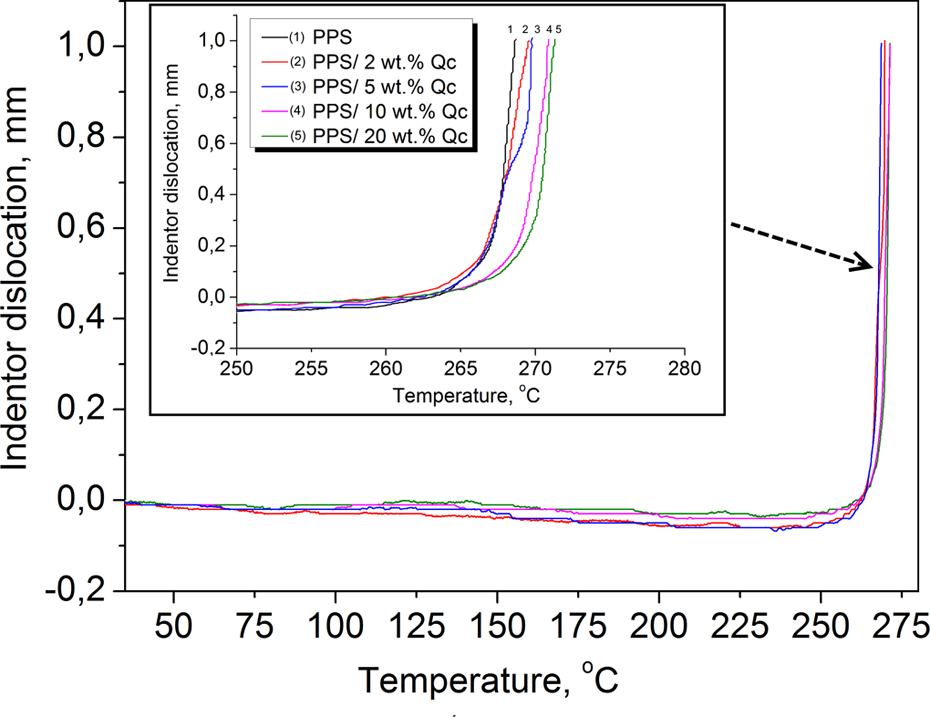
Vicat softening curves of the PPS/QC composites. PPS: polyphenylene sulfide; QC: quasicrystal.
It is found that PPS-based composites show complex behavior of the indentation depth with increasing temperatures during Vicat tests. At the initial stage, negative indentation depth was observed due to the thermal expansion of the PPS and PPS-based composite materials. Further increase in temperature results in steel needle penetration into the polymer, and at temperatures of above 260°C, the softening of PPS polymer matrix occurs, which leads to sharp increase of the indentation depth. The temperature at which indentation depth is equal to 1 mm characterizes the Vicat softening point of polymer matrix (Figure 7(a)). It was found that softening of PPS/QC composites occurs at a temperature range of 265–275°C with a slight increase in the softening point with increase in QC content. The minimum value of Vicat softening point was found for the unfilled PPS (268.6°C) and the maximum ones for the PPS/20 wt% QC composite (271.3°C). Increase in Vicat softening point is typical for introducing of inorganic particles into polymer matrix. 45 Such increase may be associated with restrictions on polymer chains movements due to the interaction of fillers with polymer chains and/or with thermal stabilizing effect of fillers on the polymeric matrix. 46
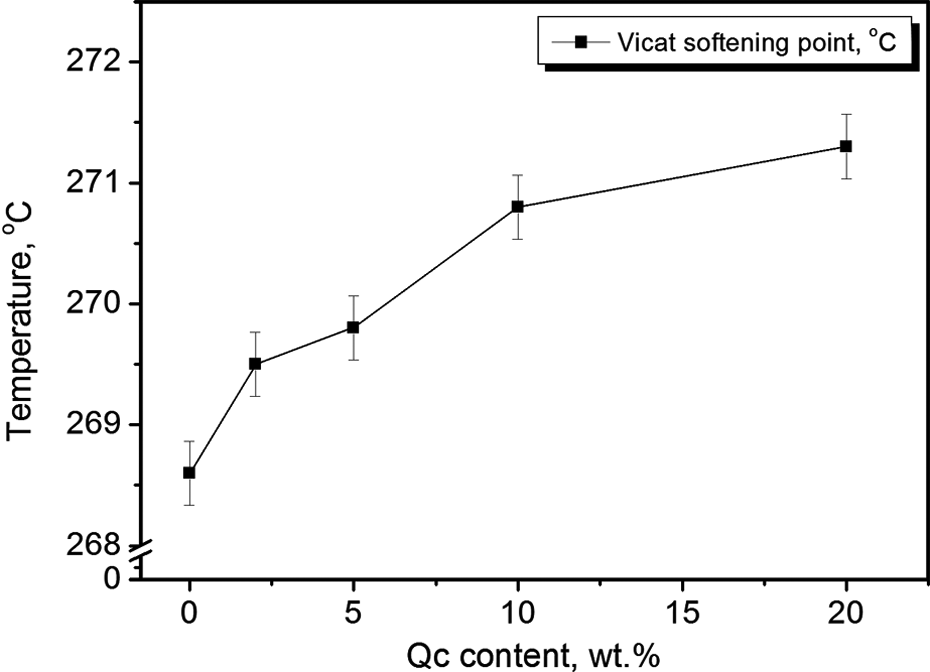
Vicat softening point of the PPS/QC composites. PPS: polyphenylene sulfide; QC: quasicrystal.
Figure 8 shows the temperature dependences of PPS/QC composites thermal diffusivity. PPS thermal diffusivity decreases with increase in temperature due to more efficient heat dissipation at higher temperatures, such behavior is typical for most metals and polymers. 47 –49 It was found that the thermal diffusivity of composites is higher than of unfilled PPS in the whole temperature range. This suggests that despite the lower thermal diffusivity values of QCs as compared with other metal materials, their thermal diffusivity is higher than of PPS. Therefore, increase in QC content in polymer matrix, as it is usually observed for metal fillers, 45,47 leads to the increase in thermal diffusivity, and the introduction of 20 wt% of QC leads to approximately 15% increase in thermal diffusivity value in relation to the unfilled PPS.
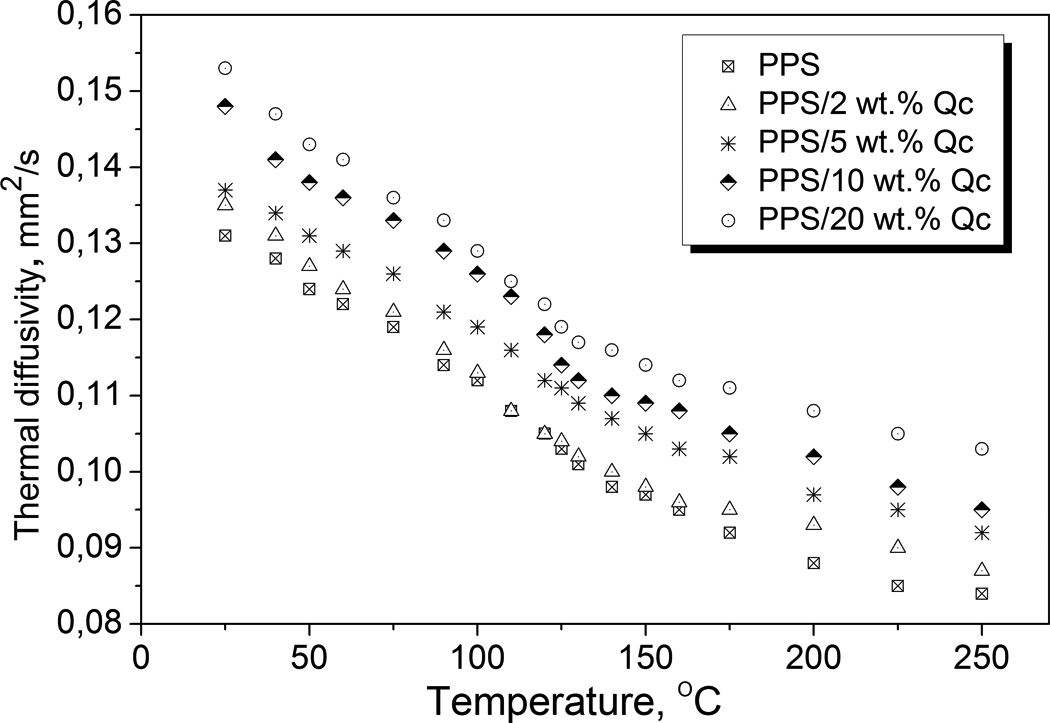
Temperature dependence of thermal diffusivity of the PPS/QC composites. PPS: polyphenylene sulfide; QC: quasicrystal.
It should be noted that for unfilled PPS, as well as for PPS/QC composite materials, change of thermal diffusivity curves inclination angle at temperatures about 120°C was found, which is caused by glass transition of PPS. Glass transition of polymers can result in some decrease in thermal diffusivity values around transition temperature. 50
Thermal conductivity λ of composite materials was calculated as following:

where a is the thermal diffusivity, Cp is specific heat capacity, and ρ is density.
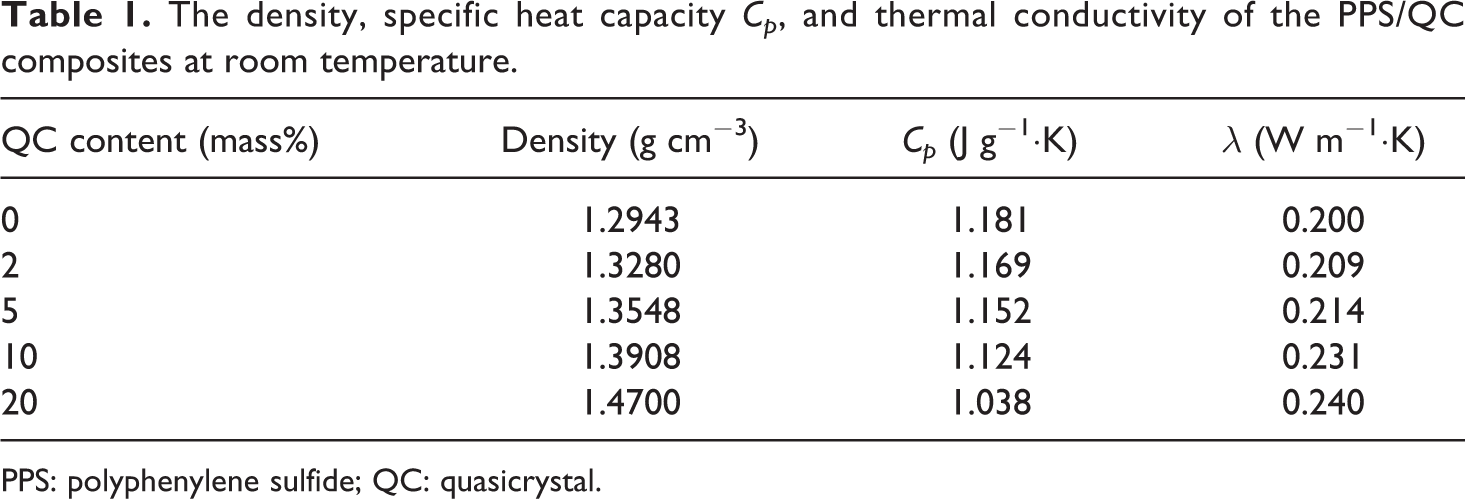
The room temperature values of the obtained composites density, specific heat capacity, and thermal conductivity are shown in Table 1.
The density, specific heat capacity Cp, and thermal conductivity of the PPS/QC composites at room temperature.
PPS: polyphenylene sulfide; QC: quasicrystal.
It is obvious that increase in QCs content leads to increase in the density of the obtained composite materials. Analysis of the specific heat capacity values shows that the introduction of QCs leads to decrease in the heat capacity of composites. Observed trends are expected for polymers filled with inorganic particles. 45,46,51 It was found that the heat capacity of the composite materials obeys the rule of mixtures and since the heat capacity of QCs is less than the heat capacity of PPS polymer matrix, the total heat capacity of composites is decrease with increase in QC content. For PPS composites, leap in heat capacity at temperatures about 120°C was found, which caused by the glass transition of polymer. Thermal conductivity of PPS-based composites slightly increases with increase in QC content from 0.2 W m−1·K for unfilled PPS up to 0.24 W m−1·K for PPS/20 wt% QC composite.
Conclusions
The influence of the disperse Al-Cu-Fe QC particles on the structural, mechanical, and thermal properties of PPS-based composite materials was investigated. It was shown that the introduction of QCs in the polymer matrix results in an increase in toughness of the composites, thus the higher QC content leads to higher values of Young’s modulus of the composites measured by both tensile and three-point flexure tests. Increase in composites toughness is accompanied with a decrease in plasticity. Introduction of QCs in the PPS leads to an increase in the impact strength and Brinell hardness. Thermal properties, such as heat resistance, Vicat softening point, thermal diffusivity, and thermal conductivity, tend to increase with increase in QCs content. The thermal conductivity values of PPS/QC composites lie at the range of 0.2–0.25 W m−1·K, which means that obtained composite materials has good heat-insulating properties. This study has shown that the Al-Cu-Fe QCs possess a good potential as fillers for creating high-performance composite materials.
Footnotes
Declaration of Conflicting Interests
The author(s) declared no potential conflicts of interest with respect to the research, authorship, and/or publication of this article.
Funding
The author(s) disclosed receipt of the following financial support for the research, authorship, and/or publication of this article: This work is supported by the Federal Targeted Program “Research and development in priority directions of development of scientific technological complex of Russia in 2014–2020 years”, with the financial support from the Ministry of Education and Science of Russian Federation: agreement no. 14.578.21.0003 (05 June 2014); Unique identifier of applied scientific researches: RFMEFI157814X0003.