




Abstract
High aspect ratio multi-walled carbon nanotubes (MWCNTs) having an average length of 4.23 μm and an average diameter of 9.5 nm have been melt mixed with immiscible polystyrene/poly(methyl methacrylate) (PS/PMMA) blends in mass ratio 80:20 and 20:80, respectively. The carbon nanotubes (CNTs) reside in the PMMA phase, and length analysis after melt mixing indicates that when PMMA was the minor phase (20 wt%), little or no CNT breaking occurred during mixing. On the other hand, when PMMA was the major phase (80 wt%), the average length of the CNTs was reduced to 2.78 μm, approximately 70% of their original length. Mixing the CNTs with neat PMMA under the same mixing conditions resulted in a reduction in CNT length to 1.02 μm, only 24% of the original length. Electrical conductivity results show that less CNT breakage leads to a reduction by a factor of 2.5 in the electrical percolation threshold in the 20:80 PMMA/PS blend polymer, which is much larger than a simple volume fraction argument would suggest. This article shows for the first time that relatively long MWCNTs break less in polymer blends than in the neat polymer with concomitant reductions in percolation threshold.
Introduction
One of the most interesting properties of carbon nanotubes (CNTs) is their cylindrical shape and high aspect ratio. 1 When CNTs are mixed with polymers, the electrical conductivity of the composites depends significantly on the aspect ratio of the nanotubes because conductive networks form at lower volume fractions for long CNTs. With increasing aspect ratio, the conductivity increases and the percolation threshold reduces, 2 –9 while other properties, that is, the mechanical properties 4,5,9,10 and thermal conductivity, 2,3 slightly depend on the length of CNTs. Russ et al. 2 loaded two CNTs with aspect ratios 50 and 500 in the epoxy matrix via sonication mixing and found that the electrical conductivity was strongly enhanced for the sample with longer nanotubes, with a modest increase of thermal conductivity when increasing the length of CNTs in the polymer. Similar results were also observed by Wang et al. 3 Recently, our group 4,5 incorporated polycarbonate with seven CNTs having aspect ratios ranging from 50 to 500 via melt mixing and found that the electrical conductivity was significantly affected by changing the length of nanotubes. Further, the mechanical and thermal properties of the polymers slightly depended on CNT length. For CNTs with an aspect ratio up to approximately 150, the electrical conductivity of the composites increased with increasing initial length of the CNTs. Percolation thresholds in electrical conductivity of the composites as a function of aspect ratio were reasonably described by an empirical equation: pc = D/2L, where pc is the percolation (vol%), D is the diameter, and L is the length of the CNT. 4 However, with aspect ratios from 250 to 474, the electrical percolation of the composites was independent of the initial length of the CNT due to its severe breakage during melt mixing, resulting in long nanotubes breaking to the same length, even though they have different initial length before melt mixing. 5
Breakage of CNTs during melt mixing with polymers has also been found by other groups, 11 –15 leading to a reduction in the properties of the composites, especially for longer CNTs. Therefore, when using long CNTs for improving the properties of polymer composites, an optimal set of conditions exists to balance dispersion and nanotube breakage. 5 For example, Pötschke et al. 15 studied the influence of mixing conditions on the properties of poly(caprolactone)/CNT composites and found that although increasing the mixing speed in a twin-screw extruder to 400 rpm reduced the agglomerate size of the CNTs, the length of CNTs decreased with increasing rotation speed. They further compared the electrical and mechanical properties as a function of mixing speed and found that a mixing speed of 75 rpm gave the best balance among dispersion and nanotube breakage, with a resulting improvement in properties for the polymer composites. 15
While the length reduction for CNTs seems to be inevitable during melt mixing due to the severe mixing conditions necessary for achieving high dispersions of CNTs, we recently demonstrated that when the CNTs were melt mixed with immiscible polystyrene/poly(methyl methacrylate) (PS/PMMA) blends, length reduction was minimal. 16 In the study, we found that the CNTs preferred to locate in the PMMA domain of the blends and while the PMMA was the minor domain (PMMA/PS = 20/80 in wt%), the length of the CNTs barely changed after melt mixing. For example, the length of the longest CNTs we used in the study only reduced from 4.23 μm to 4.12 μm (diameter approximately 10 nm) after melt mixing at 190 °C and 150 r min−1 for 5 min, less than 5% reduction was observed. To the best of our knowledge, this was the first time that breakage barely occurred for such long CNTs during melt mixing presumably due to the fact that the PMMA droplet protects the CNTs during mixing. In this article, we will change the concentration of PMMA in the PS/PMMA blends mixed with the CNTs with aspect ratio 474 to study the influence of the PMMA content on the CNT length reduction during melt mixing and finally on the electrical conductivity of the polymer composites.
Experimental
Materials
PS having average Mw approximately 210 kg mol−1 was provided by Dow Chemical Company and the PMMA having average Mw approximately120 kg mol−1 was purchased from Sigma-Aldrich (St. Louis, MO, USA). Multi-walled carbon nanotubes (MWCNTs) having average length 4.23 μm and average diameter 9.5 nm were provided by SouthWest Nano Technologies (Norman, Oklahoma, USA) and have commercial name SWeNT® SMW200. Analyses for the length and diameter of the as-received CNTs were described elsewhere. 4,16 The viscosity of the two polymers was approximately the same at the conditions of interest; proprietary software with the microcompounder at the same shear rate (375 s−1) gave viscosities of 738 Pa·s and 955 Pa·s for pure PS and pure PMMA at 1% NT content averaged over the last 30 s of mixing.
Composites preparation
Composites were prepared using a DSM twin-screw microcompounder having volume 5 cm3 (DSM Xplore; MD Geleen, the Netherlands). Before melt mixing, samples were dried at 80 °C under vacuum overnight. CNTs were premixed with PS/PMMA blends in a glass vial. The mixtures were then fed into the compounder with mixing conditions: 5 min at 190 °C and a mixing speed of 150 rpm under nitrogen atmosphere, and the extruded strands were used as described below. The weight percentage of nanotubes was varied between 0% and 3%, while the PMMA:PS weight ratios prepared were 1:0, 4:1, 1:4, and 0:1.
Length measurements
To measure the CNTs lengths after melt mixing, a procedure similar to Krause et al. was used. 12 First, 100 mg of the polymer blend was loaded in a vial of 20 ml of dimethylformamide (DMF). The vial was heated at 60 °C and mixed with a magnetic stir bar to dissolve the polymer. The solution was then filtered with a 0.22 μm poly(tetrafluoroethylene) (PTFE) filter to isolate the nanotubes. While the CNTs were still on the filter, an additional 200 ml of DMF was used to rinse the CNTs and to remove any residual polymer. The filter was then placed in 50 ml of DMF and bath sonicated for 30 s. This step was done to dislodge the CNTs from the filter. On a silicon (Si) wafer, 0.25 ml of the DMF solution with the CNTs was deposited on a 2 × 2 cm2 Si wafer and allowed to dry overnight in a fume hood. For as-received nanotubes, approximately 3 mg of CNTs were dispersed in 20 ml of DMF using bath sonication for 30 min, followed by depositing a 0.25 ml drop on a 2 × 2 cm2 Si wafer and drying overnight in the fume hood. To measure the length of the CNTs, a Zeiss (Oberkochen, Germany) NEON 40EsB scanning elctron microscope was used and the average length for each nanotube sample was calculated based on the results of approximately 100 tubes.
Electrical conductivity
Bulk resistivity of the composites having resistivity higher than 107 Ω cm was measured using an Agilent (Santa Clara, California, USA) 4339B High Resistance Meter with an Agilent 16008B resistivity cell. Samples (90 × 60 × 0.3 mm3) were measured at least three times at different voltages applied, and the average resistivity value was obtained. For samples having resistivity lower than 107 Ω cm, four-point probe measurements were carried out using a Keithley (Cleveland, Ohio, USA) 2000 Multimeter. Three strips were made for each sample, and the average value was calculated based on three measurements for each Agilent (Santa Clara, California USA) strip. Electrical conductivities were then calculated from the resistivities. To obtain electrical percolation thresholds (pc), data were plotted as a function of MWCNT concentration and fitted using the power law function as shown as follows:

where δ(p) is the conductivity, B is a constant, pc is the electrical conductivity threshold, and t is the critical exponent.
Results and discussion
The length distributions of the CNTs before and after melt mixing with PS/PMMA blends and PMMA neat polymer are shown in Figure 1. When the nanotubes were melt mixed with PMMA/PS (20/80 in mass) blends, the length distribution of the CNTs barely changed comparing to the as-received nanotubes. For the CNTs in PMMA/PS (80/20), most of the CNTs were broken to a length shorter than 4 μm. While the nanotubes were incorporated into the neat PMMA via melt mixing under the same conditions used for producing the blends, the length of CNTs reduced the most, and the majority of the nanotubes have a length less than 1.5 μm. Normal, log-normal, most-probable, and Weibull distributions were fit to the distribution of lengths. The only distribution that gave a reasonable fit to any of the data was the Weibull distribution, and the results are shown in Figure 1.
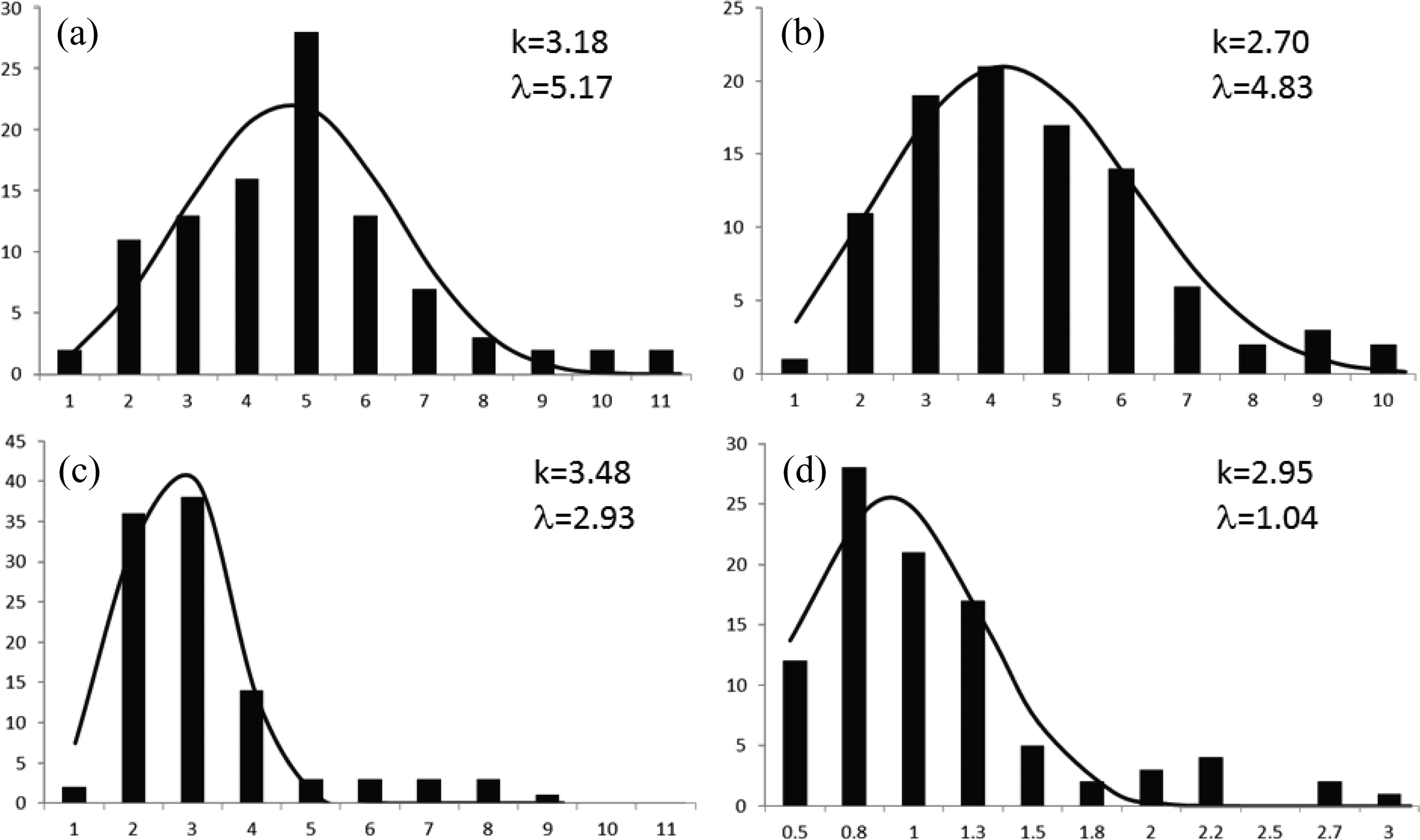
Length distributions of the as-received CNTs and the CNTs after melt mixing with PS/PMMA blends and neat PMMA as indicated: (a) as-received CNTs, (b) CNTs after melt mixing with PMMA/PS (20/80 in mass), (c) CNTs after melt mixing with PMMA/PS (80/20), and (d) CNTs after melt mixing with neat PMMA. The solid lines represent the best fit of a Weibull distribution to the data where k is the shape parameter and λ is the scale parameter.
Average lengths of nanotubes before and after melt mixing with PS/PMMA blends and PMMA neat polymer are shown in Figure 2. Also shown are schematic diagrams of the dispersion state of CNTs during melt mixing with PS/PMMA blends and neat PMMA. The schematic diagrams were drawn based on the morphology development of the polymer blends with CNTs as a function of PMMA content in our previous article. 16 In the PMMA/PS (20/80 in mass) blends, CNTs aggregate in PMMA droplets and the length of CNTs barely reduced during melt mixing. The average nanotube length only reduced from 4.23 μm for the as-received tubes to 4.12 μm for the tubes after melt mixing with PS/PMMA (80/20) blends, a difference within the range of experimental uncertainty. For nanotubes in PMMA/PS (80/20) blends, where PMMA was the continuous phase in the blends and CNTs were well dispersed in the PMMA, the average nanotube length reduced to 2.78 μm, approximately 70% of the average for the as-received nanotubes. When CNTs were melt mixed with neat PMMA resin under the same conditions as those mixed in blends, the average length of nanotubes reduced to 1.02 μm, only 24% of the as-received CNT length. The observation of severe length reduction of the CNTs during melt mixing with neat polymer is in agreement with our previous study, 5 where the same nanotubes were melt mixed with neat polycarbonate at 280 °C and 200 rpm screw rotation speed for 5 min, and their length reduced from 4.23 μm to 0.51 μm, only 12% of the original length. Both results suggest that severe breakage occurred for the CNTs during melt mixing with neat polymers.
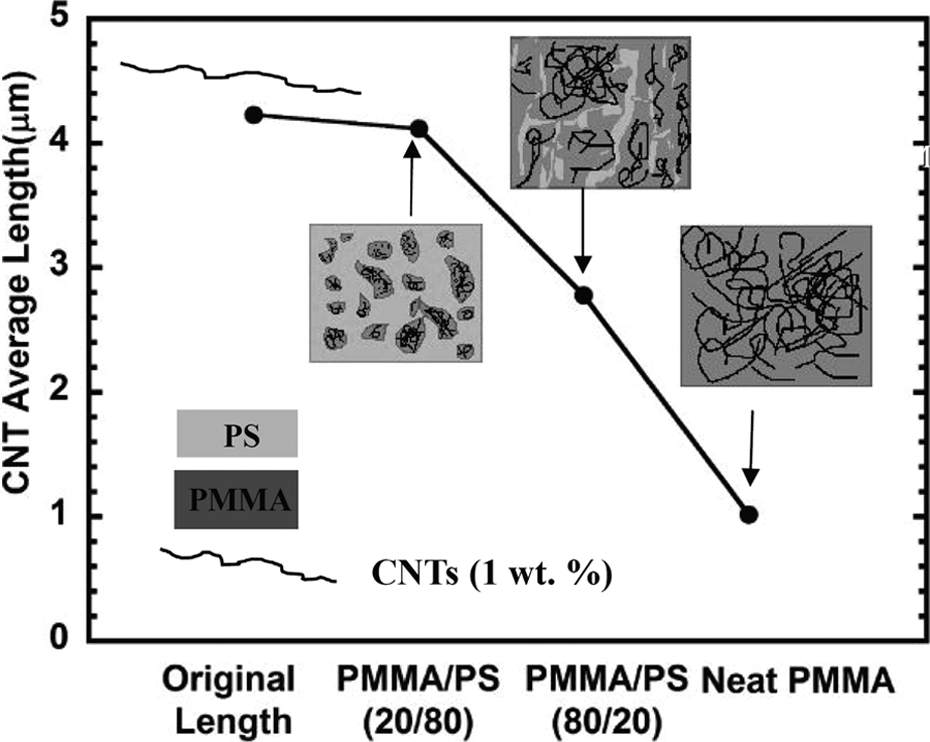
Average length for the as-received CNTs and the CNTs after melt mixing with PS/PMMA blends and neat PMMA as indicated in the figure. The insets indicate the morphology of PS/PMMA blends based on our previous study 16 and neat PMMA with CNTs during melt mixing (no length indication for the CNTs in the insets). CNT: carbon nanotube; PS: polystyrene; PMMA: poly(methyl methacrylate).
We were very surprised that the CNTs experience much less breakage during melt mixing with the immiscible polymer blends than with the neat polymer, especially for the case where the neat polymer was the continuous phase. Cutting processes of CNTs in melt mixing have been proposed to be due to the inter-collision at an interface. 17,18 The interface could be nanotube–nanotube, nanotube–polymer, and nanotube–screws, but the collision at the interface of CNTs and the screws is thought to be the dominant one causing breakage for the CNTs. 17 When CNTs were confined to PMMA droplets and the collisions between nanotubes and the screws presumably barely occurred, the average length of CNTs only slightly reduced from 4.23 μm to 4.12 μm. Increasing the ratio of PMMA to 80 wt% led to the formation of a co-continuous phase and the collisions of the nanotubes between screws also increased, resulting in increasing the length reduction for the CNTs. The surprising result was that with only 20 wt% of a phase that contains little if any nanotubes, nanotube breakage reduced substantially from an average length of 1.02 μm with pure polymer to 2.78 with 20 wt% PS.
Especially for long CNTs, the final goal of mixing CNTs with polymers is not only to achieve a good dispersion but also to reduce nanotube breakage in order to take advantage of the high aspect ratio of the CNTs, in particular to increase the electrical conductivity and reduce the nanotube fraction necessary to achieve high conductivities. Electrical conductivities of PS/PMMA (20/80) blends and the neat PMMA as a function of CNT weight fraction in the blend are shown in Figure 3. The percolation threshold for the polymer blends with nanotubes is 0.5 wt% by fitting the experimental data to equation (1), whereas the percolation for the neat PMMA composites is 1.25 wt%. The so-called double-percolation effect 19 in the polymer blends would be expected to reduce the percolation threshold from 1.25 wt% to approximately 1 wt%, a factor of 2 greater than our experimental result. Therefore, the lower percolation threshold in the polymer blends/CNT composite versus the neat PMMA/CNTs composites is mainly due to the fact that the nanotubes broke less when they were mixed in the blend. PS/PMMA (80/20 in mass) blends where the PMMA is the minor phase have no percolation threshold occurring in the entire sample since nanotubes prefer to locate in PMMA and the PMMA phase is discontinuous as shown in our previous article. 16
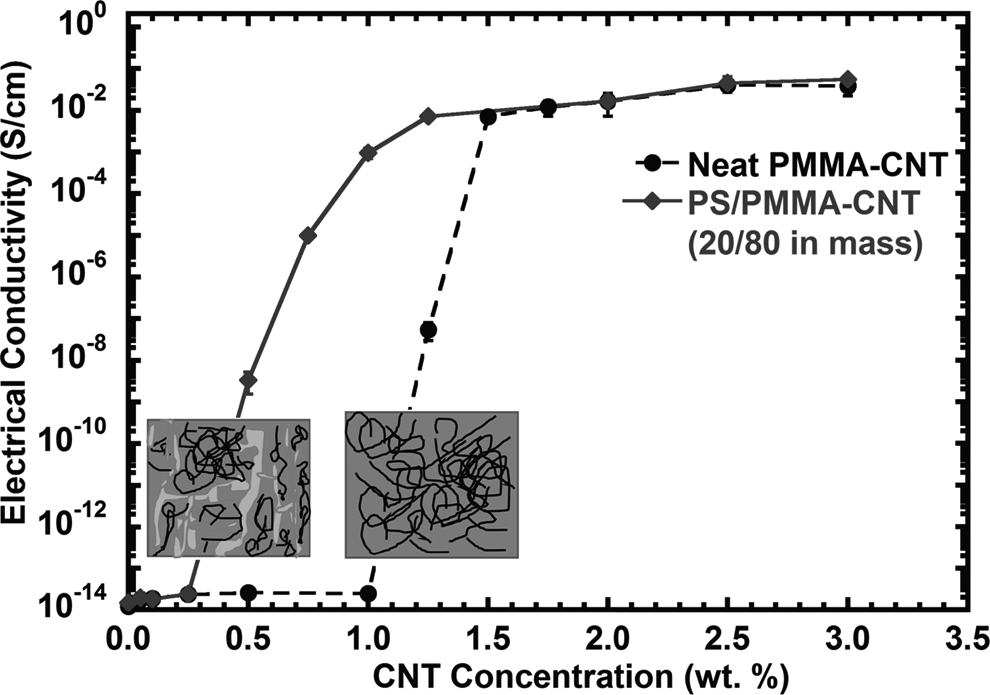
Electrical conductivity as a function of nanotubes concentration for the PS/PMMA (20/80 wt%) and neat PMMA with CNTs composites. The insets indicate the morphology of PS/PMMA blends based on our previous study 16 and neat PMMA with CNTs during melt mixing. CNT: carbon nanotube; PS: polystyrene; PMMA: poly(methyl methacrylate).
Conclusions
The length of the CNTs having average diameter 9.5 nm and average initial length 4.23 μm was studied after they were melt mixed with PS/PMMA blends and neat PMMA. CNTs were found to prefer to locate in the PMMA phase in the blends. When the PMMA was the minor domain and formed droplets, the nanotubes barely broke during melt mixing. When the PMMA is 80 wt% in the blends, PMMA was a continuous phase and the average length of the nanotubes reduced to 2.78 μm. CNTs broke even more in the neat PMMA with length 1.02 μm after melt mixing. Less breakage occurring for the CNTs during melt mixing in the blends was presumably due to less collisions between the nanotubes and the twin screws. The electrical conductivity percolation threshold of the polymer blends where the PMMA phase is continuous is much less than that in the neat PMMA due to less length reduction of the nanotubes in the blends. This finding provides an excellent opportunity to reduce the breakage of CNTs melt mixed with polymers by adding a small amount of an immiscible second polymer and to reduce the amount of nanotubes required to achieve percolation in a polymer.
Footnotes
Acknowledgements
The authors greatly acknowledge the help from Dr. Preston Larson from Samuel Roberts Noble Microscopy Laboratory at University of Oklahoma for the SEM measurements. The authors would also like to thank Southwest Nanotechnologies Inc. (Norman, OK) for supplying the nanotubes used in this study.
Declaration of conflicting interests
The author(s) declared no potential conflicts of interest with respect to the research, authorship, and/or publication of this article.
Funding
The author(s) disclosed receipt of the following financial support for the research, authorship, and/or publication of this article: This work was supported by a grant from the National Science Foundation (Grant CMMI-1436532).