




Abstract
Use of organic biomass, industrial waste lignin, was considered interesting due to its easy availability, polymeric nature, and ample scope to modify with an aim to replace conventional metal oxides to achieve improved properties of the blend when blended with polyolefins. To study the effect of chemical modification of lignin on the thermal, structural, and mechanical properties of polypropylene (PP)/modified lignin blends, purified industrial waste lignin was modified by two different chemical methods and blended in various proportions in PP matrix. The thermal stability of the blends was studied by thermogravimetric analysis, whereas melting and crystallization behavior of blends was studied by non-isothermal differential scanning calorimetry. The results show improved thermal stability of blends with increasing modified lignin proportion in the PP matrix. More depression in melting point was observed in PP/alkylated lignin blends than PP/arylated lignin blends, whereas addition of alkylated lignin shows polymorphism in PP matrix. Intermolecular interactions between blend components have been evaluated by applying several mathematical models to experimental mechanical property data. In most of the cases, good agreement has been obtained between the predictions made by using mathematical models and interpretations done on the basis of experimental data, showing the suitability of these models for predicting the mechanical properties of PP/modified lignin blends.
Keywords
Introduction
Lignin is one of the most abundantly available biomaterials next to cellulose and performs the functions of water and mineral transportation. It combines with cellulose to form lignocelluloses complexes providing total strength to the plant. 1 Chemically lignin is a complex, amorphous polymeric material, and its structure is based upon phenylpropane derivative, which is composed of three basic monomers: syringol, guiacol, and p-hydroxyphenol. It is a by-product of pulping processes used in pulp and paper industries. Approximately 50 million metric tons of industrial waste kraft lignin is been produced annually, 2 of which only 2–3% of lignin is utilized for commercial purposes and remaining vast amount of kraft lignin is burnt out as a low-grade fuel in pulping boilers. 3
Currently, very few significant techniques are available for commercial utilization of industrial waste lignin. A number of researches have been underway for its complete utilization worldwide in order to replace the petroleum-based polymers (polyolefins) by industrial waste lignin. 4 –13 On blending kraft lignin as it is (without modification) with polyolefin materials shows lesser compatibility with polymer matrix and results in considerable deterioration in mechanical properties. 2,14 –16 With regard to the enhancement of lignin compatibility with the polymer matrix, researchers are trying to modify the properties of lignin by different chemical methods. 17 –21 Chemical modification of lignin is another area of significant scientific work. 22 Chemical modification of lignin is being used to improve polymer–lignin compatibility and to introduce reactive sites. The chemical modifications of these reactive nuclei result in an effective alteration of the lignin solubility behavior. 23,24 Willer and Glasser in their study chemically modified lignin and reported that, by manipulating the network structure and substituents in lignin, the physical properties of lignin-based materials could be manipulated. 25 Polypropylene (PP) is the one of the important thermoplastic materials widely used for various applications. In spite of its outstanding properties, it has comparatively low mechanical properties. Researchers are working toward the enhancement of its mechanical properties for various applications. 26 –31
In the present study, to enhance the compatibility of lignin with polymer matrix, we have modified the industrial waste kraft lignin by two different chemical methods and then blended in different proportion with commercial-grade PP. The effect of different modifications and its different proportions on the thermal, structural, and mechanical properties (i.e. impact, tensile strength, strain, and Young’s modulus) of PP/modified lignin blends has been studied. To study the intermolecular interactions between blend components, various well-established mathematical models have been applied to the obtained experimental results.
Experimental
Materials
Kraft lignin was isolated from the Kraft black liquor provided by Simplex Paper Mills, Gondia, Maharashtra, India, whereas bagasse obtained from sugar industry is used as a raw material for pulping process. Commercial-grade PP was supplied by Bajaj Polymer, Nagpur, Maharashtra, India, with melt flow index (MFI) of 4.26 g/10 min at 210°C and a load of 2.16 kg. All other reagents were purchased from Merck Mumbai, India.
Methods
Modifications of lignin
Alkylation using dichloromethane (CMLig)
Twenty-five grams of purified lignin was taken in a 500-ml round-bottomed flask and mixed with 250 ml dichloromethane along with 20 g of anhydrous aluminum chloride and refluxed for 1 h. After 1 h, the reaction mixture was cooled, filtered, and washed with plenty of water to remove excess of aluminum chloride. The reaction product was then dried in oven at 80°C for 8 h.
Arylation using chlorobenzene (CBLig)
Purified lignin (50 g) was taken in a 500-ml round-bottomed flask and mixed with 250 ml chlorobenzene in the presence of 25 g anhydrous aluminum chloride and placed at room temperature for half an hour and then refluxed at boiling temperature for 2 h when hydrogen chloride gas ceased to emit from the condenser. The reaction mixture was allowed to cool, and the organic layer was separated by using separating funnel. The reaction product was washed repeatedly with plenty of distilled water to remove unreacted aluminum chloride, followed by heating in an oven at 80°C for 6 h to remove traces of moisture.
Preparation of PP/modified lignin blends
Polymer blends (PPCBLig and PPCMLig) were prepared by melt mixing of modified lignin in different proportions (w/w) with commercial-grade PP at 190°C for 10 min at 60 r min−1 in a Brabender Electronic Plasticorder (HAAKE AEV 153 mixer, Germany) to obtain respective PP/modified lignin blends as shown in Table 1. Pure PP processed under similar condition was used as the control. During the process, dry nitrogen was continuously purged into the mixing chamber to ensure minimum thermo-oxidative degradation. The obtained extrudates were cut into pieces of less than 10 mm diameter by a granulator. Dumbbell-shaped specimens were then prepared by injection molding according to ISO 527-2 specifications (type 1BA), which was used for the analysis of mechanical properties (tensile properties) of blends and pure PP. Whereas rectangular-shaped specimens were used to determine the impact strength of blends.
Compositions of PPCMLig and PPCBLig blends.
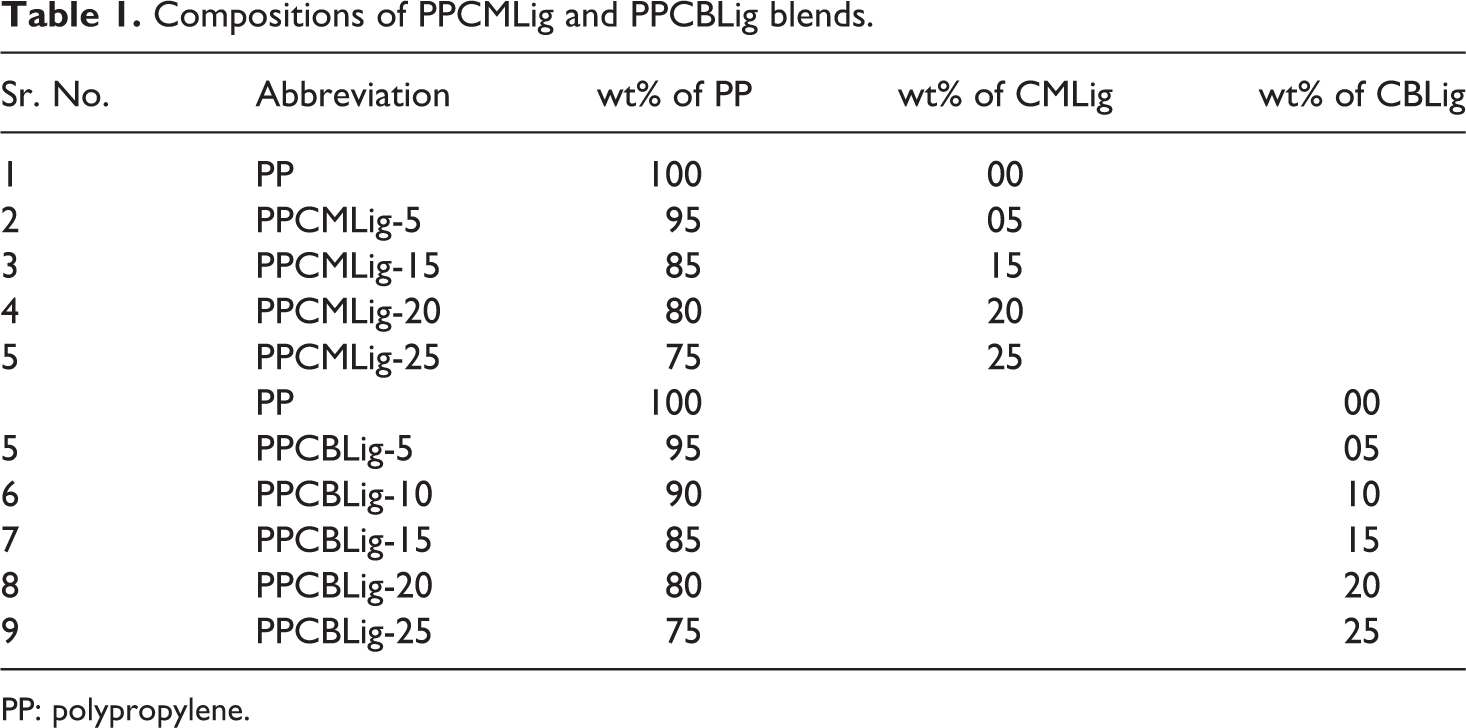
PP: polypropylene.
FTIR spectroscopy
Fourier transform infrared (FTIR) spectra were recorded on Shimadzu 100 (Japan) and Perkin Elmer (Spectrum one, Waltham, Massachusetts, USA) spectrophotometer using potassium bromide pellets in the scan range from 4000 to 400 cm−1 with a resolution of 4 cm−1.
Thermal analysis
Thermogravimetric analysis
Thermogravimetric analysis (TGA) was performed on Shimadzu TGA–50 and Perkin Elmer (Diomand module) instrument with platinum pan, using 5–6 mg of material sample in each case. The samples were heated at 10°C min−1 under nitrogen atmosphere with a flow rate of 20 ml min−1 up to 800°C.
Non-isothermal DSC
Non-isothermal crystallization and subsequent melting behaviors of PP and all blends of various compositions were investigated by differential scanning calorimetry (DSC), using Shimadzu 60-A differential scanning calorimeter. All tests were performed under nitrogen atmosphere (nitrogen flow 30 ml min−1) to avoid oxidative thermal degradation of blends during heating with a sample mass of around 4 mg. All samples were first heated from room temperature to 250°C at the heating rate of 10°C min−1, and then the samples were subsequently cooled down to 40°C at the cooling rate of 10°C min−1, followed by reheating to 250°C at the heating rate of 10°C min−1. More reliable second run with erased earlier thermal history of sample was considered.
Wide-angle XRD
X-Ray diffraction (XRD) patterns have been recorded using an X’Pert PRO PANanalytical diffractometer (Netherlands). Nickel-filtered copper Kα radiation (λ = 1.5418 Å) was used for recording XRD pattern. The X-ray tube was operated at 20 mA/30 kV, and the XRD patterns were recorded at the scanning rate of 2° min−1 at 2θ angle.
Scanning electron microscopy
The surface morphology of pure PP and all blends was examined using a JSM-6380A scanning electron microscope (JEOL, Japan), equipped with an electron probe analyzer system with an accelerating voltage of 30 kV. All samples were coated with palladium in order to have good conductivity.
Mechanical properties of blends
The tensile properties like relative tensile strength (RTS), relative elongation at break (REB), and relative Young’s modulus (RYM) were obtained by testing the dumbbell-shaped specimens on a universal testing machine (model UK232, Instron, Norwood, Massachusetts, USA) with a load of 1 N at a strain rate of 50 mm min−1 at room temperature. Relative impact strength (RIS) of unnotched specimen was tested on an Izod impact tester (CEAST-6545, serial-11036) at room temperature. The dimension of the Izod specimens was 62 × 11.5 × 3.1 mm3. At least five specimens were tested for each sample. The impact and tensile tests were performed according to ASTM D-256A and ASTM D-1708 methods, respectively.
Relative mechanical properties (RTS, REB, and RYM) of blends were determined by dividing the mechanical property value of the respective blend with the mechanical property value of pure PP.

Rheological properties and processing stability of prepared blends were measured on a MFI tester (model D4059, Dynisco, Germany) according to ASTM D-1238 standard at 230°C and 2.16 kg weight.
Results and discussion
FTIR analysis
Figure 1 shows the FTIR spectra of purified lignin and CMLig. FTIR spectra of pure lignin is already discussed in detail in our previous publication. 32 Referring to spectra of lignin, the absorbance at 3400 cm−1 is due to stretching of hydroxyl group. The absorbance at 2923 cm−1 arises from C–H stretching and a small group of peaks at 1511, 1462, 1421, and 1327 cm−1 correspond to aromatic skeletal vibration and β-0-4 ether bond at 1117 cm−1 respectively. As shown in Figure 1, due to modifications, small shift in peaks were observed, whereas relative peak intensities of all peaks related to the C–H (methylene group) stretching was found to be increased considerably. Figure 2 shows the FTIR spectra of lignin modified by chlorobenzene with regard to all peaks related to lignin. In addition, peaks at 744.7, 834.35, 700.63, and686.56 cm−1 correspond to the attachment of aryl ring at ortho, para, and meta positions in a lignin molecule.
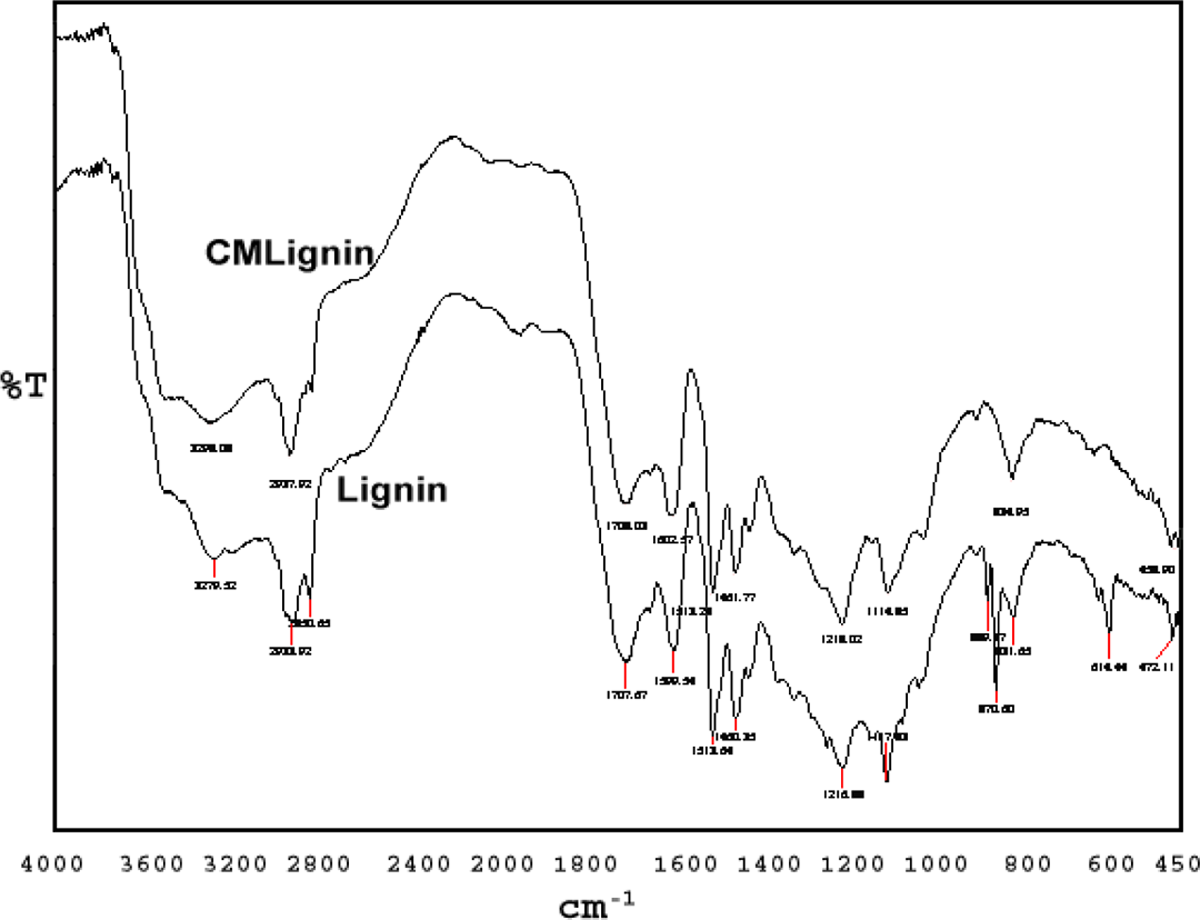
FTIR spectra of pure lignin and CMLig. FTIR: Fourier transform infrared.
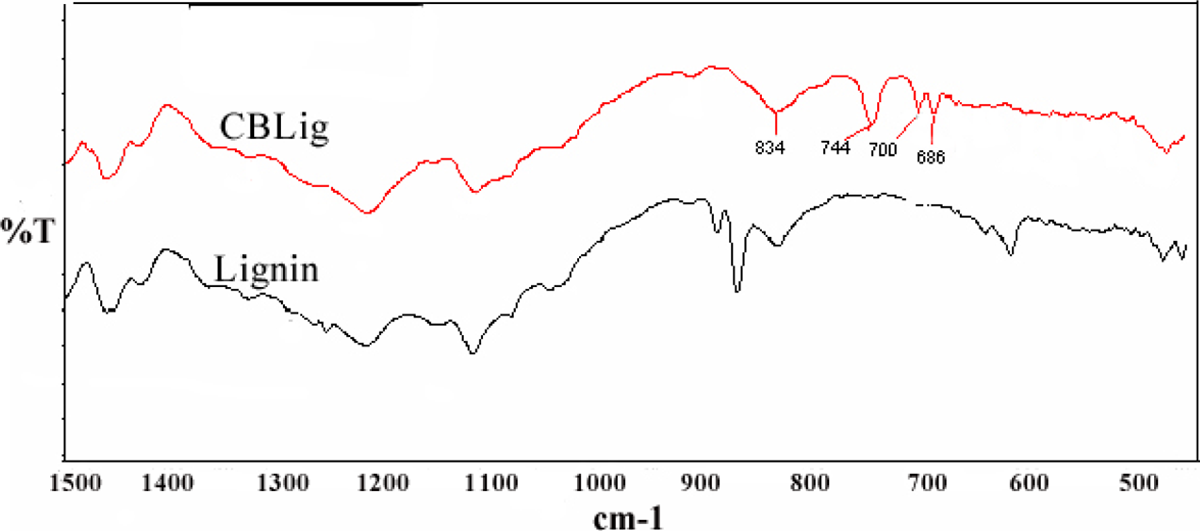
FTIR spectra of pure lignin and CBLig. FTIR: Fourier transform infrared.
TGA of blends
The effect of change in temperature on weight loss of pure PP, modified lignin, and PPCMLig and PPCBLig blends was studied by TGA (thermograms are shown in Figures S1 and S2, supplementary materials), while corresponding thermal stability data are listed in Table 2. PP shows one-step degradation process from 373.3°C to less than 440°C with maximum weight loss at 403°C. PPCMLig and PPCBLig blends also show similar trends of decomposition, but all blends show comparatively higher thermal stability than PP, which is mainly due to the antioxidant property of modified lignin that resists polymer network from thermal degradation and provides higher thermal stability to the blends. As presented in Table 2, the thermal stability and % residue obtained at the 550°C for blends was found to be increased with the increasing weight% loading of the modified lignin in both the types of blends. Comparatively, PPCMLig blends show more thermal stability than PPCBLig blends. More thermal stability in PPCMLig blends may be due to more solublization/miscibility of CMLig in PP matrix than CBLig. Due to better solubilization, CMLig got distributed homogeneously in a polymer matrix and shielded it from thermal decomposition.
Thermogravometric results for pure lignin, modified lignin, pure PP, and PPCMLig and PPCBLig blends.
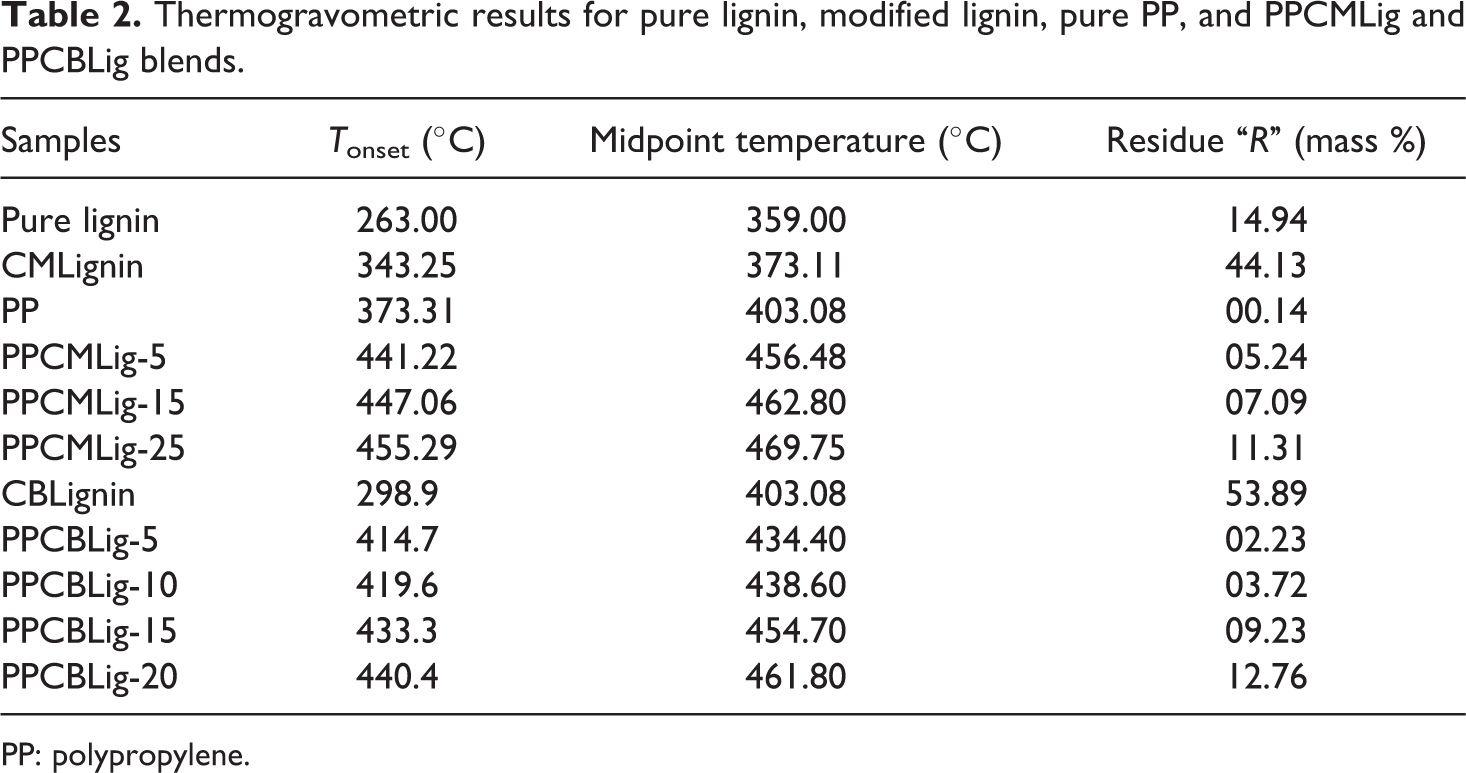
PP: polypropylene.
DSC analysis
Non-isothermal crystallization and subsequent melting behavior of PP and prepared blends were investigated by DSC in an inert nitrogen atmosphere. (The DSC cooling scan for pure PP and PPCBLig blends are summarized in Figures S3 and S4, supplementary data.) Non-isothermal crystallization parameters of DSC thermograms are presented in Table 3. With the addition of different proportion of modified lignin (CBLig and CMLig), the crystallization peak width increased (Table 3), as crystallization starts (Tonset) at slightly lower temperature and crystallization peak temperature (Tc) was also found to be increased in all the blends. Increase in crystallization peak width shows lower rate of crystallization for blends than that for PP. Comparatively, PPCBLig blends show slightly higher Tc than PPCMLig blends. Amount of heat (enthalpy of fusion (ΔHm)) liberated during crystallization was found to be decreased with increasing modified lignin proportion in PP matrix. This shows that, due to the presence of modified lignin in PP matrix, the crystallization process is slightly slowed down, and the crystallinity is also affected.
Crystallizations and melting parameter of pure PP and PPCMLig and PPCBLig blends.
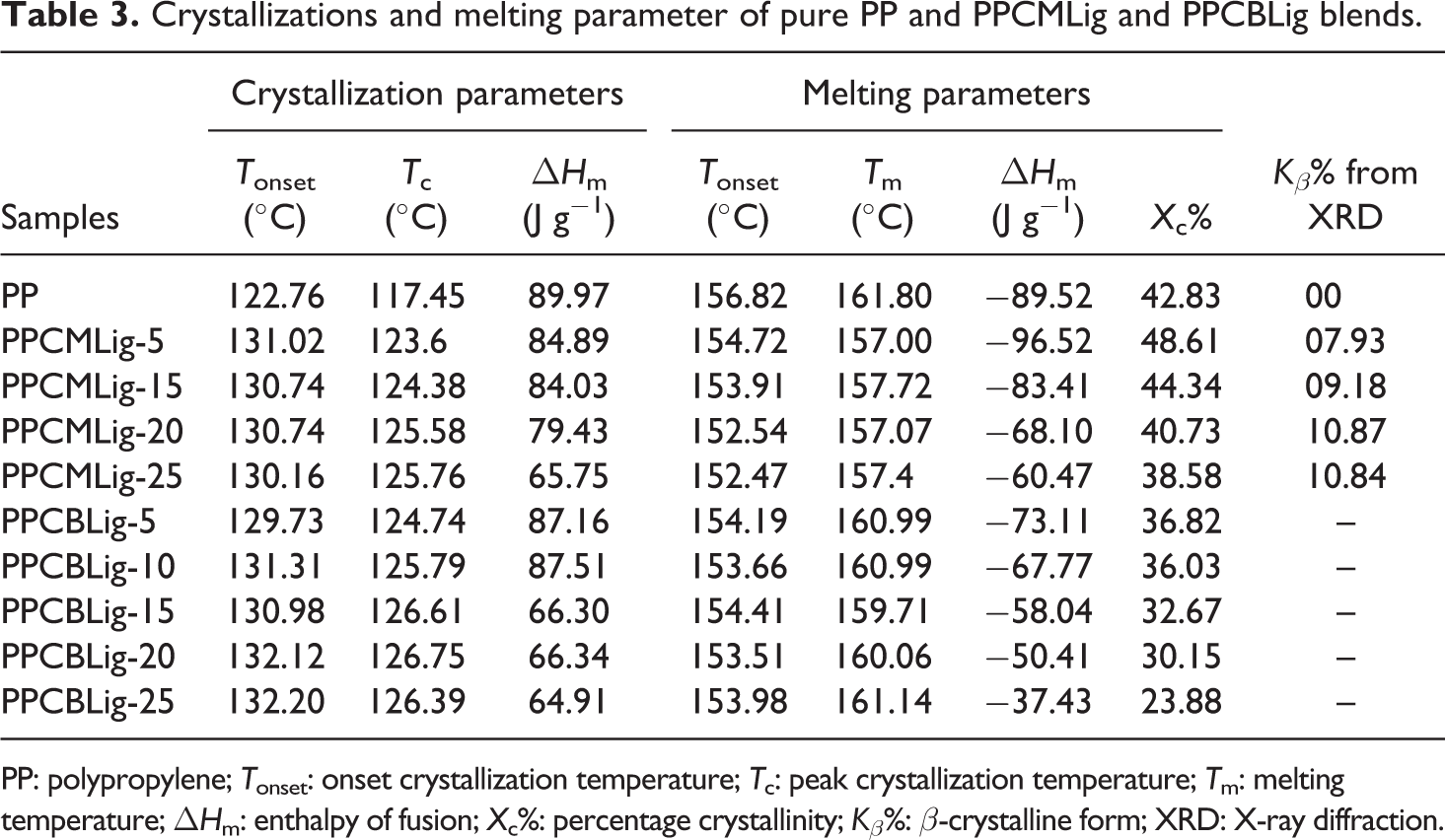
PP: polypropylene; Tonset: onset crystallization temperature; Tc: peak crystallization temperature; Tm: melting temperature; ΔHm: enthalpy of fusion; Xc%: percentage crystallinity; Kβ%: β-crystalline form; XRD: X-ray diffraction.
Melting parameters (melting temperature (Tm) and ΔHm) are summarized in Table 3. (The reheating thermograms of pure PP, PPCMLig and PPCBLig blends are shown in Figures S5 and Figure S6, respectively, in Supplementary material). As shown in Table 3, Tonset of blends start at slightly lower temperature than PP. The melting peak width was found to be decreased slightly in all blends. Tm decreased considerably in the case of PPCMLig blends only, whereas such decrease in Tm was not much more prominent in PPCBLig blends. The more decrease /depression in melting point in PPCMLig blends show more compatibility/interaction of CMLig in PP matrix than PPCBLig.
The percentage crystallinity (Xc%) of PP, PPCBLig, and PPCMLig blends was calculated according to equation (2), and the data are listed in Table 3.

where w is the mass fraction of the PP in PPCMLig and PPCBLig blends, ΔHm is enthalpy of fusion of the PP or PPCMLig and PPCBLig blends,
Structural analysis of blends by WAXD
The wide-angle X-ray diffractrograms of PPCMLig and PPCBLig are shown in Figures 3 and 4, respectively. PP may crystallize in three crystalline forms, namely monoclinic α, trigonal β, and triclinic γ, and the ratio among these depends on crystallization conditions. 36 As shown in Figure 3, PP crystallize only in α monoclinic form via reflections at 2θ of 14.1°, 16.8°, 18.5°, 21.1°, and 22.0° corresponding to 110, 040, 130, 111, and 041 planes. PPCMLig blends show all peaks related to monoclinic α form, in addition to that it also shows an additional peak at 2θ = 16° due to trigonal β form of PP, which is totally absent in PP. This shows that PP in the presence of CMLig shows the polymorphism and crystallizes in trigonal β form in addition to α monoclinic crystalline form. The peak related to trigonal β form at 2θ = 16° is totally absent in the PPCBLig blends as shown in Figure 4.
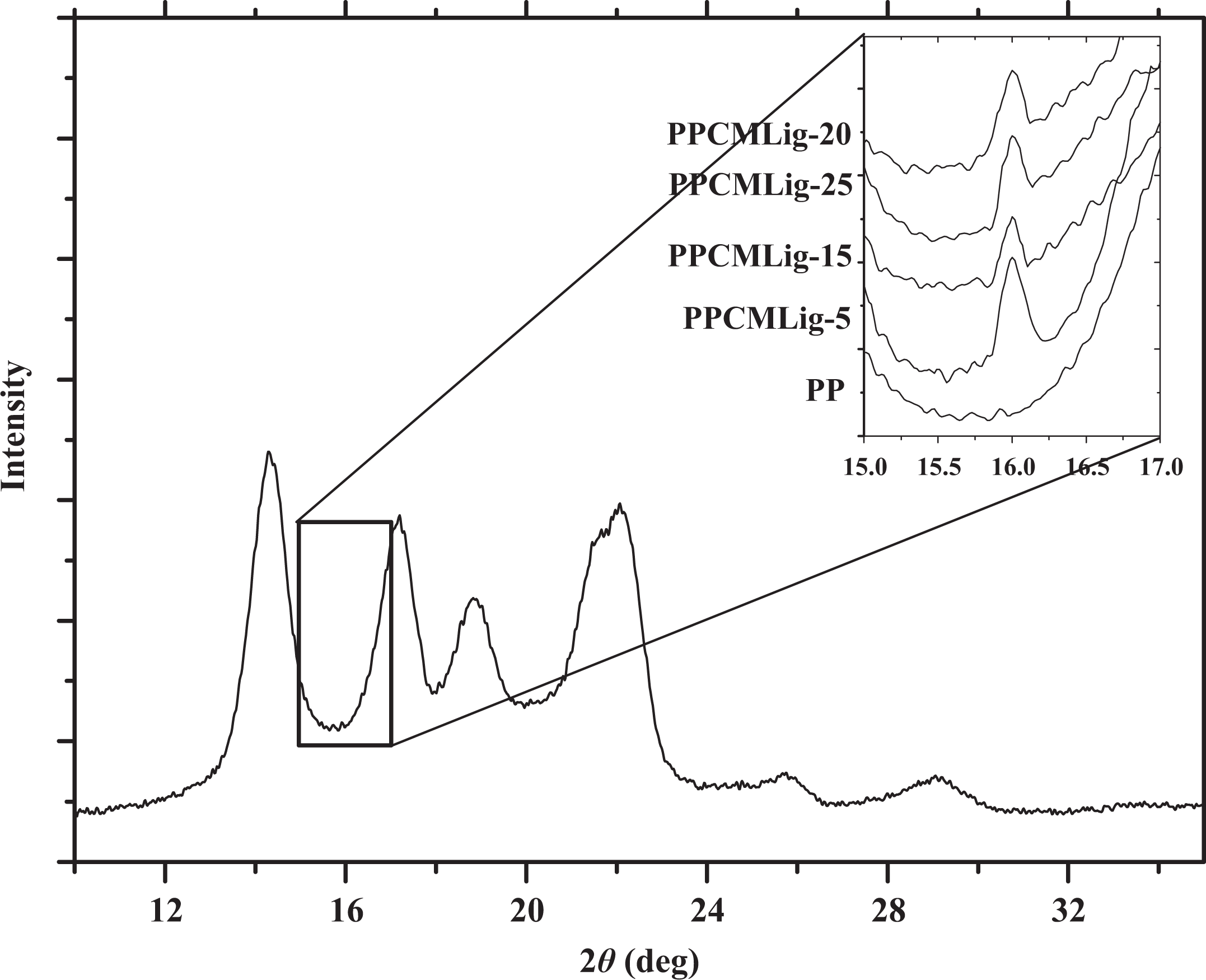
X-Ray diffractogram of PP and PPCMLig blends. PP: polypropylene.
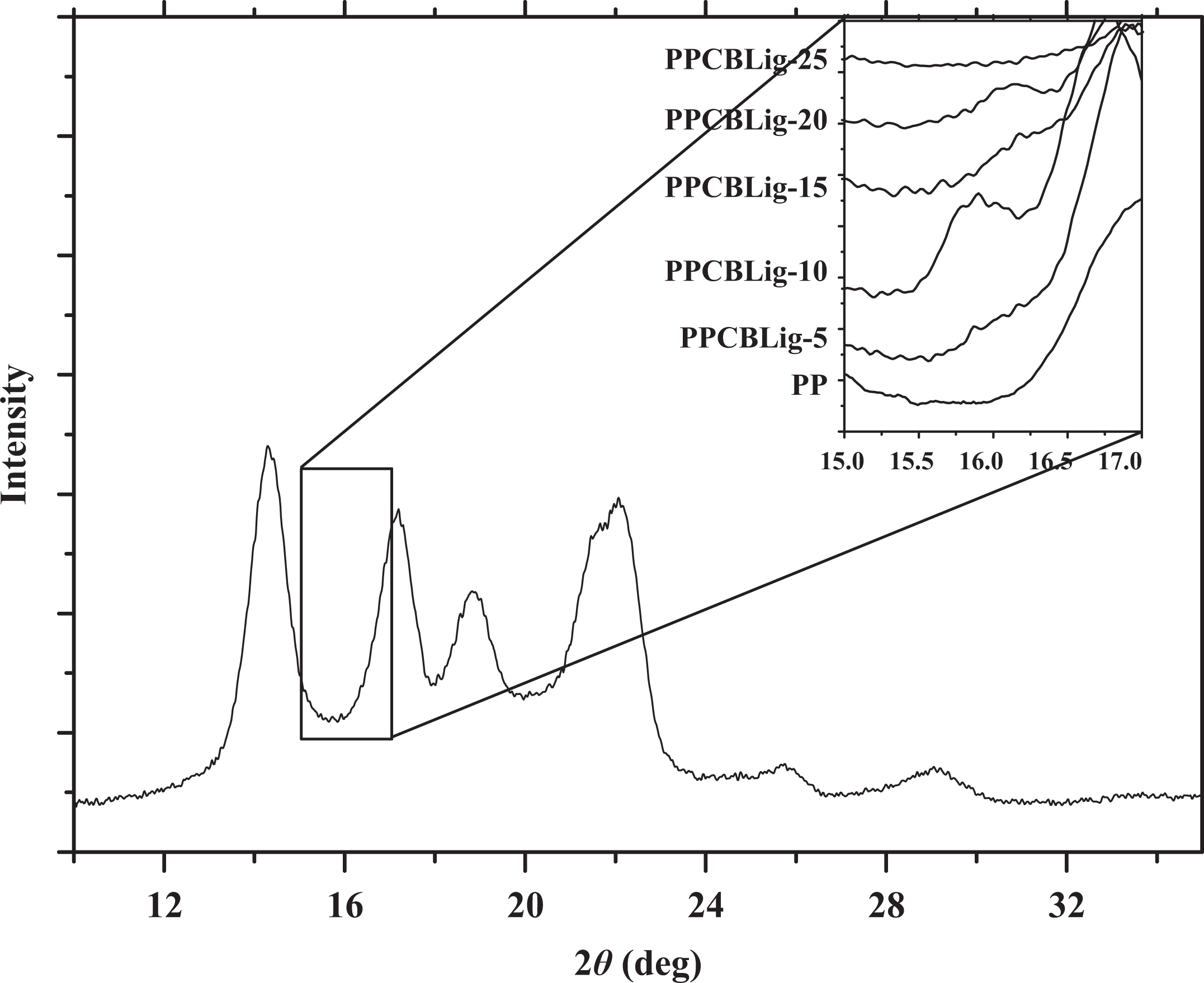
X-Ray diffractogram of PP and PPCBLig blends. PP: polypropylene.
The peak related to trigonal β crystalline form appears with the addition of 5 wt% of CMLig in PP matrix and increases with increasing CMLig proportion which shows that CMLig may act as β nucleating agent. The relative proportion of β-crystalline form (Kβ) percentage was determined using equation (3) 32 :

where Iβ is the intensity of 300 peak and Iα1, Iα2, Iα3, and Iα4 are intensities of 110, 040, 130, and 111 peaks of α form, respectively.
As shown in Table 3, the Kβ% increases with increasing CMLig proportion in the blends. The results show that the formation of β crystalline form in PPCMLig blends is mainly due to partial dissolution of CMLig molecules in PP matrix, not merely due to its presence. This indicates that the CMLig is more soluble/compatible than CBLig. Similar conclusion was also made by Zhou et al. 36 in polyhedral oligomeric silsesquioxane-PP blends. As discussed in DSC analysis, in both the cases, Tm shifted to lower temperature. The order of Tm is PPCMLig < PPCBLig < PP. The lowest Tm in PPCMLig blends is mainly due to polymorphism of PP, as the β-crystalline form has lower melting point than α-crystalline form.
Morphological analysis of blends
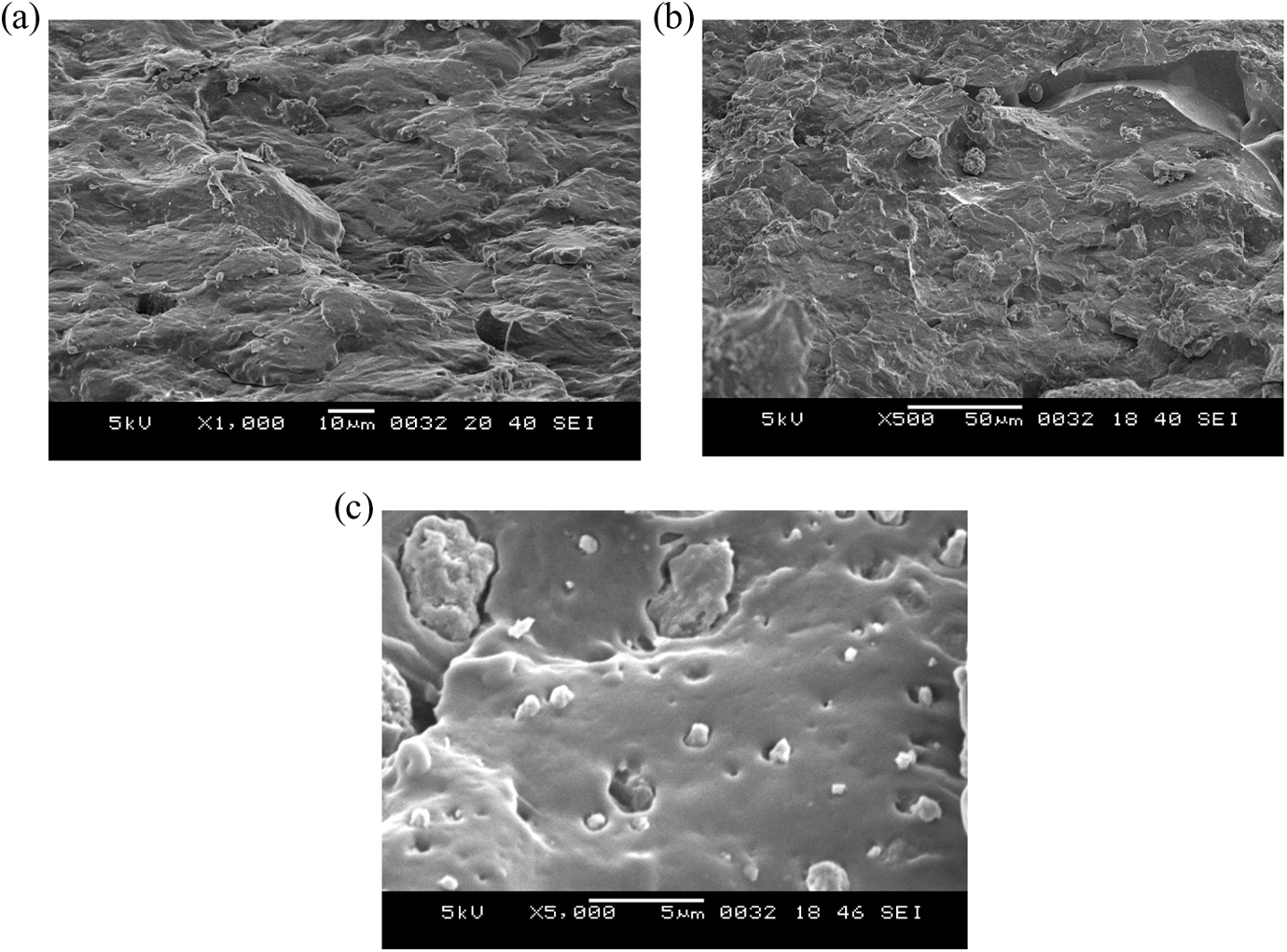
In order to study the dispersion/dissolution of modified lignin in PP matrix, the morphological analysis of all blends was carried out by SEM. Figure 5(a) to (c) shows the SEM micrographs for fracture surface of PPCMLig blends with different proportion of CMLig. As shown in Figure 5, the CMLig is seen to be well dispersed in PP matrix even at 15 wt%, on further increasing CMLig loading, that is, 25 wt%, the agglomeration of CMLig in PP matrix started. The SEM micrographs of PPCBLig show that the CBLig is homogeneously mixed in PP matrix up to 5 wt% of CBLig loading as shown in Figure 6(a) and does not show any agglomeration of CBLig in PP matrix. Whereas the blend with 15 wt% and 25 wt% of CBLig (Figure 6(b) and (c)) shows considerable agglomeration of CBLig, which may be due to saturation resulting in lesser compatibility of CBLig in PP matrix.
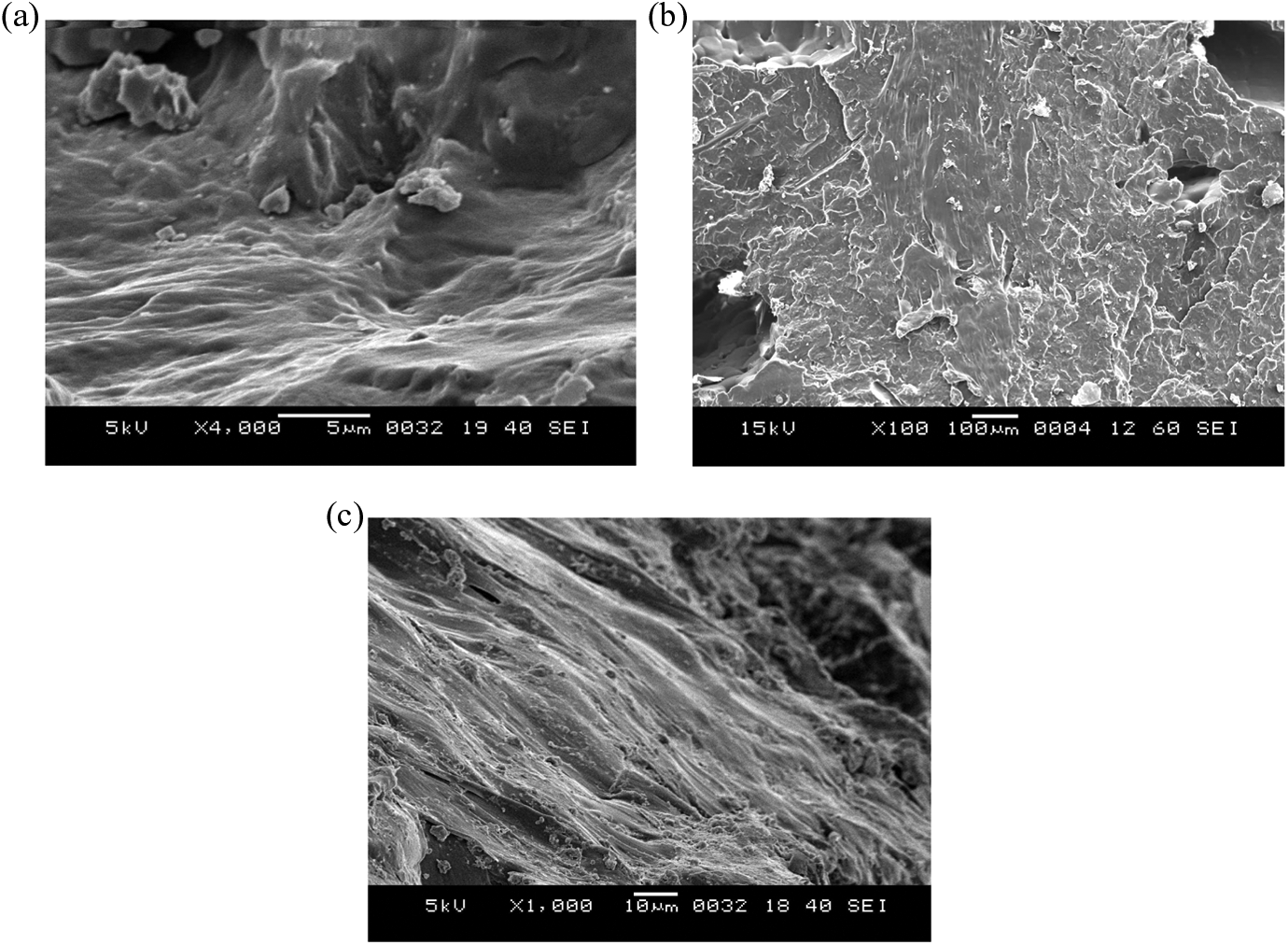
SEM micrographs of PPCMLig blends: (a) PPCMLig-5, (b) PPCMLig-15, and (c) PPCMLig-25. SEM: scanning electron microscopic.
SEM micrographs of PPCBLig blends: (a) PPCBLig-5, (b) PPCBLig-15, and (c) PPCBLig-25. SEM: scanning electron microscopic.
Mechanical properties
Relative impact strength
The effects of different proportions of CMLig and CBLig on the Izod impact strength of unnotched samples of the PPCMLig and PPCBLig blends are shown in Figure 7. The impact strength of the blends decreases with increasing modified lignin proportion in the blends. Comparatively, PPCMLig blends show higher RIS (RIS = impact strength of blend/impact strength of pure PP) values than PPCBLig blends. In the case of PPCMLig blends decrease in impact strength value is very less up to 15 wt% of CMLig loading, whereas on further increasing CMLig loading in the PP matrix considerable deterioration in impact strength was observed. In PPCBLig blends, the decrease in RIS value is very less for 5 wt% loading of CBLig. With increasing the CBLig content, that is, 10 and 15 wt%, the rate of decrease is very high and for 20 and 25 wt%, CBLig loading RIS values remained almost constant.
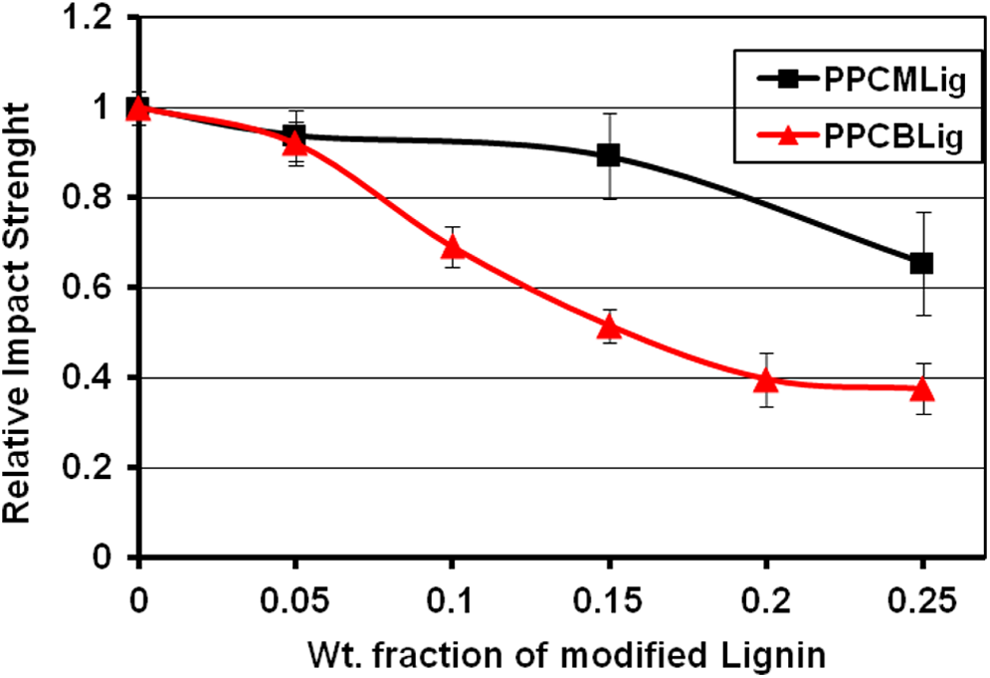
Effect of weight fraction of CMLig and CBLig on relative impact strength of PPCMLig and PPCBLig blends.
The sample thickness was equal for all samples; therefore, the energy required to fracture a sample was decreased with increasing modified lignin proportion in the polymer matrix. The present findings seem to be consistent with those of Sailaja et al., 37 wherein they reported a strong relationship between increased filler loading and decreased RIS in polyethylene-esterified lignin blends. The decrease in RIS value may be explained by the fact that the addition of modified lignin in PP made the blends more flexible and less strong.
Relative tensile strength
The RTS value versus volume fraction (φ) of modified lignin in PP/modified lignin blends is shown in Figure 8. (the value of φ was calculated from the density of modified lignin and PP). The RTS values for both types of blend show similar trend with that of impact strength values. The tensile strength of both the types of blends was found to decrease with increasing the modified lignin proportion in the blends. Up to 15 wt% of modified lignin loading, rate of decrease in RTS value was very less, whereas for 20 and 25 wt% loading, RTS values remained almost constant. Comparatively, PPCMLig blends shows lesser deterioration in RTS than PPCBLig blends. For 15 and 25 wt% loading of CMLig in PP matrix, around 15% and 28% deterioration in RTS was observed, whereas for PPCBLig blends, these values were 23% and 38% for 15 and 25 wt% loading, respectively.
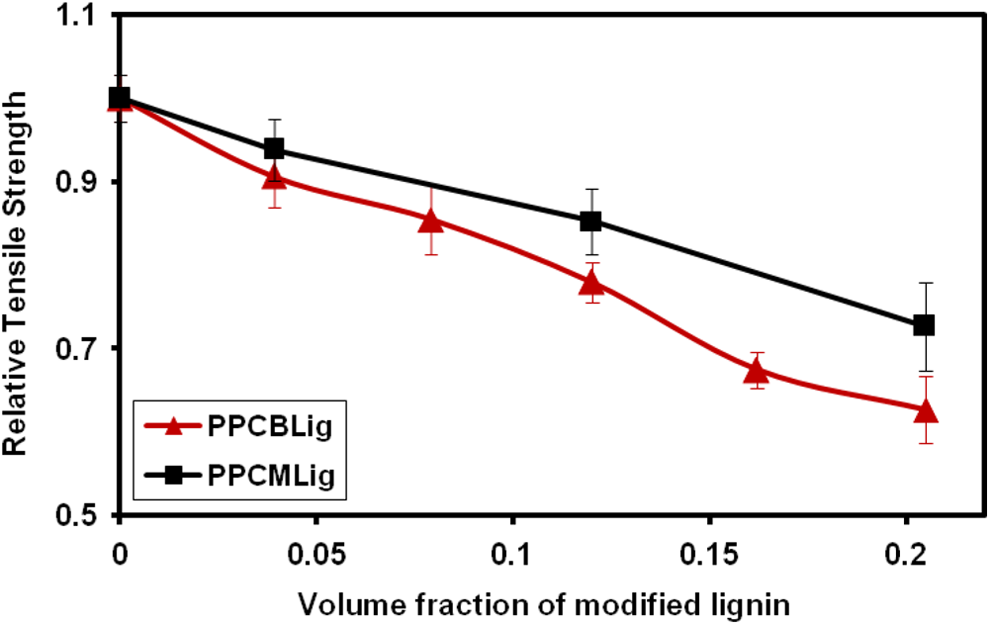
Effect of volume fraction of CMLig and CBLig on relative tensile strength of PPCMLig and PPCBLig blends.
To study the intermolecular interaction/adhesion between blend components (i.e. modified lignin (CMLig, CBLig) and PP matrix), some theoretical semiempirical mathematical models were applied to experimental data, and the corresponding fitting curves obtained from all models are shown in Figures 9 and 10 for PPCMLig and PPCBLig blends, respectively.
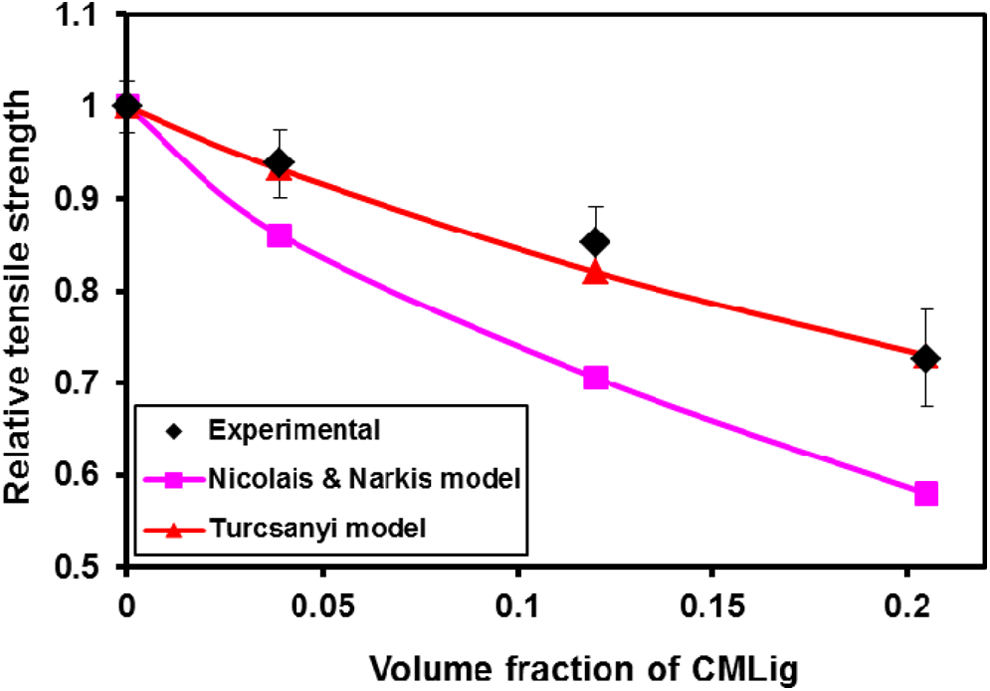
Effect of volume fraction of CMLig on relative tensile strength of PPCMLig blends.
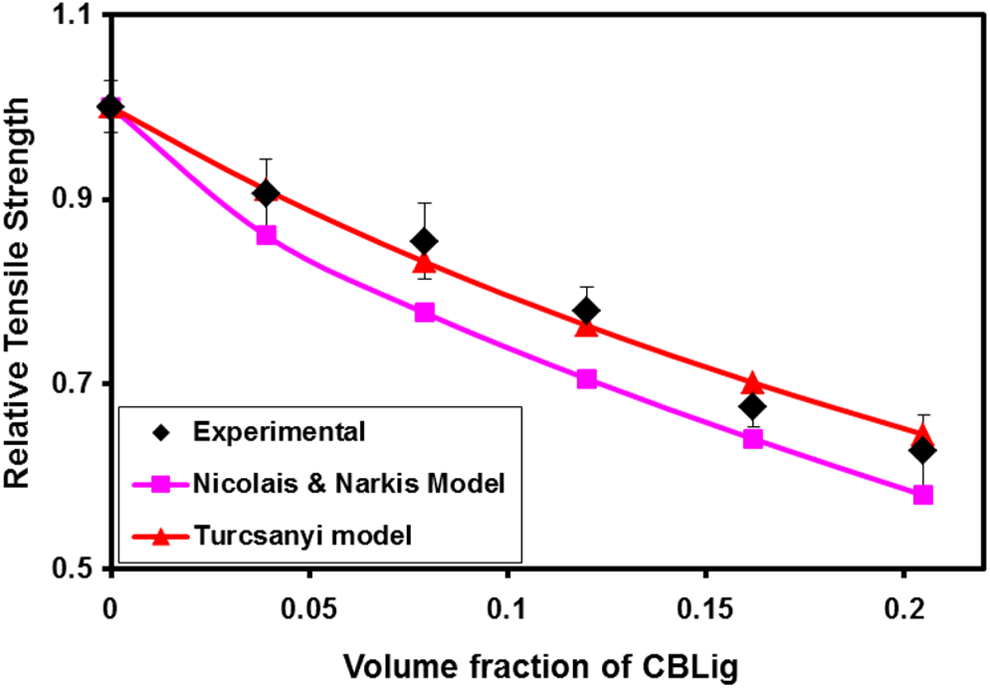
Effect of volume fraction of CBLig on relative tensile strength of PPCBLig blends.
The Nicolais and Narkis model (equation (4)) gives the tensile strength of composites with uniformly distributed filler particles of equal radii. 38,39 This model assumes no stress transfer from matrix to filler, and thus, there exists no polymer filler interaction.

where σb and σPP is the tensile strength of the blend and pure PP, respectively, and φ is the volume fraction of modified lignin calculated using equation (5):

In equation (5), wi and Pi are the weight fraction and density of “i” component. The densities for pure CMLig, CBLig, and PP used were 1.18, 1.39, and 0.913 g cm−3, respectively. Theoretical data obtained from Nicolais and Narkis model are presented in Figures 9 and 10. As shown in Figures 9 and 10, the theoretical data do not match with the experimental results. This lack of fitting indicates the existence of some adhesion/interaction between the blend components, as the model is based on the principle of no adhesion between the matrix and filler particles. As shown in the figures, in the PPCMLig blends, more deviation is observed between the experimental data and theoretical data obtained from model in comparison with PPCBLig blends, which show possibility of more interaction in blend components in PPCMLig blend.
The empirical model given by Turcsanyi (equation (6)) for strong particle matrix interfacial bonding was applied to experimental results. 38,40

In Turcsanyi model, the term 1 − φ / 1 + 2.5 φ corresponds to the reduction in the occupied area of the PP matrix due to the presence of modified lignin in the blends and B is empirical constant, which is connected with interfacial properties of system and yield stress of matrix, whose value was calculated on trial and error basis to match theoretical data with the experimental results. The obtained value of B indicates the extent of adhesion/interaction between the blend components. The value of B is equal to 0.246, shows no adhesion between the blend components, and the value increases with improved adhesion. The value of B for PPCMLig and PPCBLig blends was found to be 1.6 and 1.0, respectively. Comparatively, PPCMLig blend shows greater B value than PPCBLig blends. This indicates more adhesion/intermolecular interaction between PP matrix and CMLig than CBLig. When applied to both the models, better adhesion/interaction is observed in PPCMLig blends than PPCBLig blends, thereby resulting in greater RTS values, which are concurrent with the experimental results.
Relative elongation at break
Figure 11 shows the relation of REB versus φ of CMLig and CBLig in PPCMLig and PPCBLig blends, respectively. At 5 wt% of CMLig loading, there was a slight increase in REB value , whereas on increasing the CMLig loading in PP matrix to 15 and 25 wt%, the REB values decreased. This shows that at lower concentration (i.e. 5 wt%), the CMLig shows elastic nature in PP matrix, which is responsible for higher REB value for PPCMLig blends compared with the pure PP.
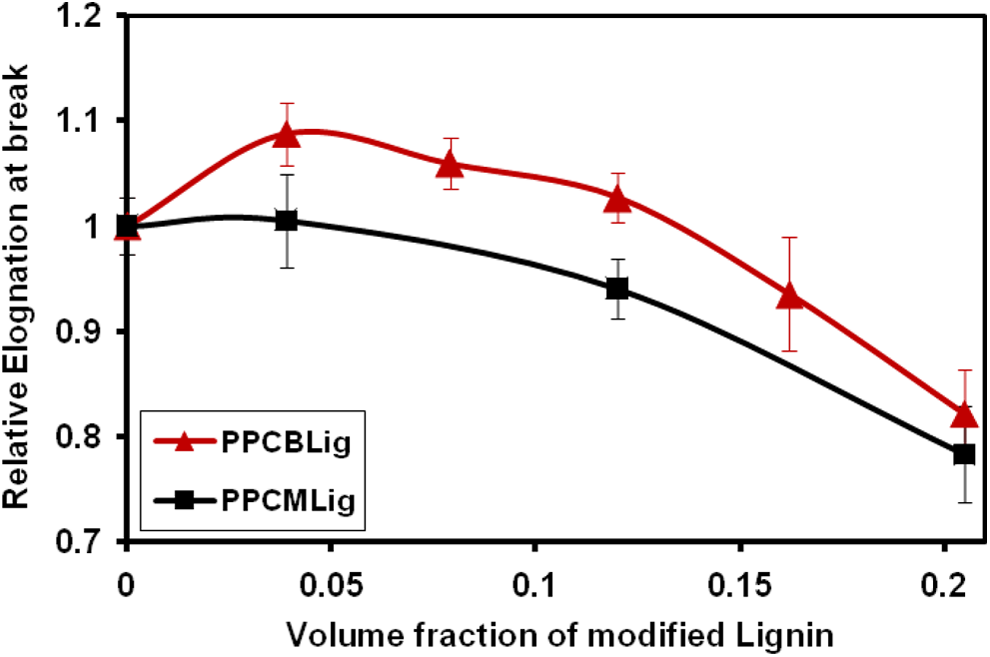
Effect of volume fraction of CMLig and CBLig on relative elongation at break of PPCMLig and PPCBLig blends.
In the case of PPCBLig blends, with the addition of up to 15 wt% CBLig in PP matrix, the REB values increased considerably compared to pure PP. On further increasing the CBLig loading from 20 to 25 wt%, the REB values slightly decreased compared to the pure PP. The REB values for 5, 10, and 15 wt% of CBLig loadings were 1.088, 1.059,l and 1.027, respectively. Relatively, the PPCBLig blends show more elastic nature or reduction in stiffness than PPCMLig blends. To some extent, the formation of coiled structures in arylation process due to successive joining of next incoming chlorobenzene to the already attached benzene ring at the para position may be attributed to this observation.
Relative Young’s modulus
To study the effect of modified lignin and its different proportions on the stiffness of blends, the Young’s modulus of pure PP and PPCMLig and PPCBLig blends was determined. Figure 12 shows the relation of RYM versus φ of CMLig and CBLig in PPCMLig and PPCBLig blends, respectively. All blends show comparatively higher RYM value than pure PP. In the case of PPCMLig blends, RYM continuously increases with increasing CMLig proportion. For PPCBLig blends, increase in RYM is quite low up to 15 wt%, followed by a sharp increase for 20 and 25 wt%. This may be due to the reduction in stiffness of PPCBLig blends, resulting in higher proportion of CBLig in PP matrix due to lower interaction between blend components.
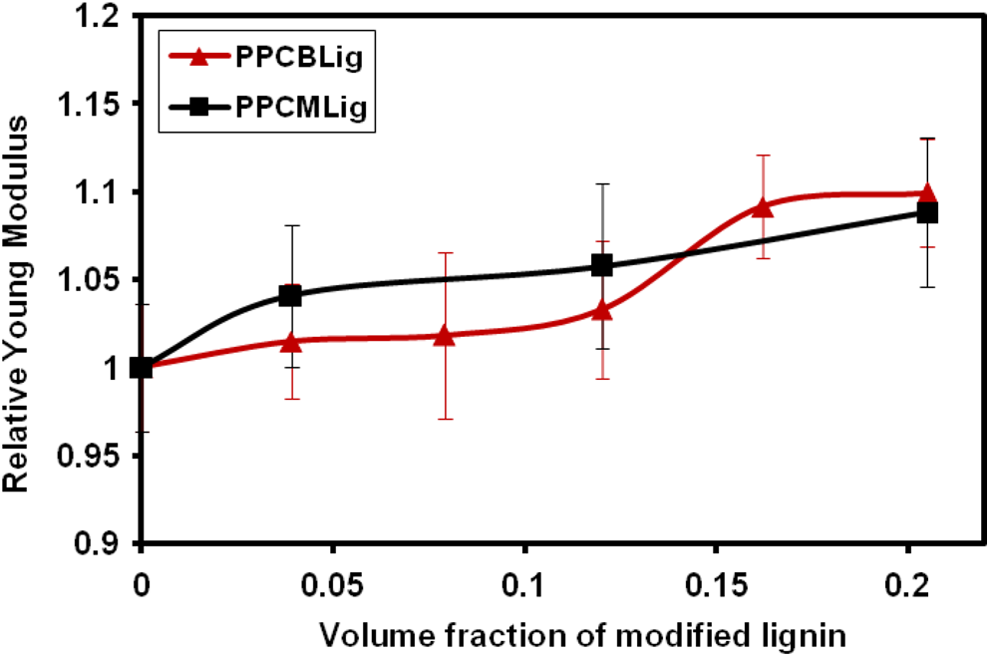
Effect of volume fraction of CMLig and CBLig on relative Young’s modulus of PPCMLig and PPCBLig blends.
To investigate the extent of adhesion/interaction between the blend components, the theoretical models given by Sata-Furukawa (equation (7)) was applied to experimental Young’s modulus results of the blends. 37,38,40

where

In equation (7), ψ is the constant whose value can be calculated using equation (8). The value of ξ is the adjustable parameter whose value was obtained on trial and error basis to match theoretical data with the experimental results and shows the extent of adhesion between the blend components, and its value is supposed to be 0 for perfect adhesion and 1 for no adhesion. The value of ξ for PPCMLig was found to be 0.01, which shows a good amount of adhesion between the CMLig with polymer matrix, and the corresponding value of ξ obtained for PPCBLig blends was 0.14, which shows relatively weaker adhesion/intermolecular interaction between the blend components. This result is consistent with the values of constants obtained from the tensile strength study.
To determine the Young’s modulus of modified lignin, the mathematical model given by Halpin-Tsai (equation (9)) was applied to the experimental results. 41,42

where

In equation (10), the value of G is the constant, which was calculated using the following equation: G = (7 − 5 υ)/(8 − 10υ), where υ is Poisson’s ratio.
In this model, the value of Rm is the ratio of filler modulus to PP matrix modulus and gives the information about Young’s modulus of modified lignin. The value of Rm was calculated on trial and error basis to match the theoretical values with the experimental results. A good fitting was obtained between experimental results and the calculated theoretical data. The value of Rm was found to be 1.81 for PPCMLig blends and 1.99 for PPCBLig blends, and therefore, the tensile modulus for CMLig and CBLig will be 3.403 GPa and 3.741 GPa, respectively.
Both the PP/modified lignin blends show comparatively better properties than PP/unmodified lignin blends reported earlier by Kharade and Kale. 43 This approves the significance of chemical modification of lignin, which we have already discussed in detail in our earlier publication. 38
Processing stability
To study the effect of different proportion of CMLig and CBLig on melt viscosity of prepared blends, the MFI of pure PP and blends were determined according to ASTM D-1238 standard at 190°C. The complex viscosities of PPCMLig and PPCBLig blends are shown in Figure 13. The rheological properties of all blends were found to be changing dramatically with the addition of modified lignin in the blends. For both types of blends, the MFI values initially increase for 5 wt% of loading, followed by a continuous decrease with increasing modified lignin proportion in PP matrix. The drop in viscosity of blends seemed to be an additive effect and was dependent on the amount of modified lignin. The effect could be interpreted due to the competing mechanism taking place in the blends.
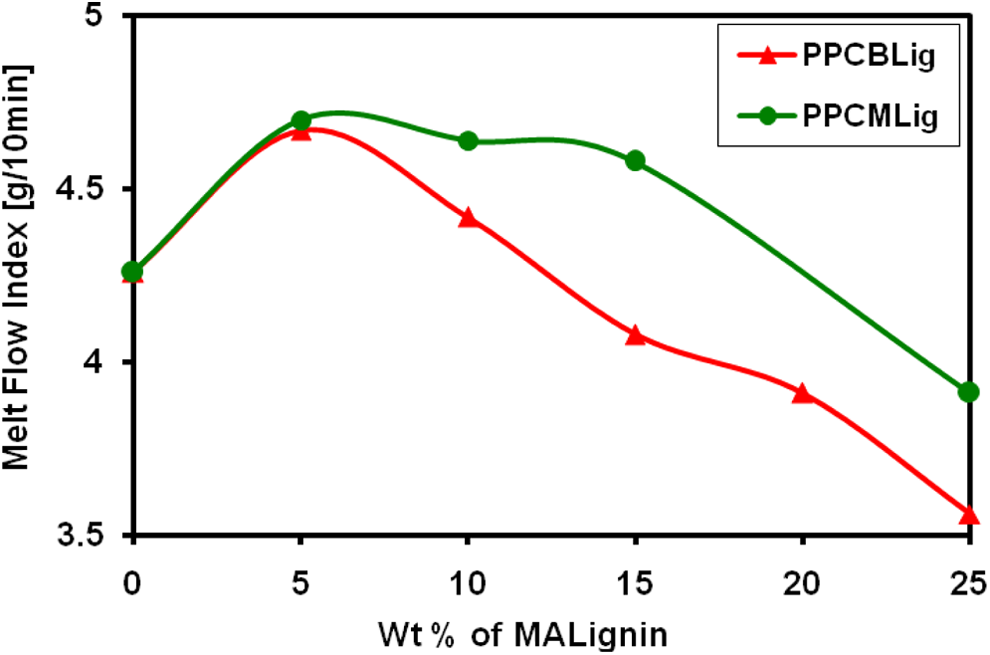
Effect of wt% of CMLig and CBLig on MFI of blends. MFI: melt flow index.
To study the effect of CMLig and CBLig addition on processing stability of PPCMLig and PPCBLig blends, the pure PP and blend with 10 wt% of CMLig and CBLig was extruded repeatedly for five times as shown in Figure 14. The processing stability was determined as MFI dependence on the number of successive extrusions. The MFI value for pure PP increases rapidly with the increasing number of processing cycles, whereas in the both types of blends the value of MFI varied slightly with the increase in the number of processing cycles. This shows that both CMLig and CBLig can work as effective processing stabilizers.
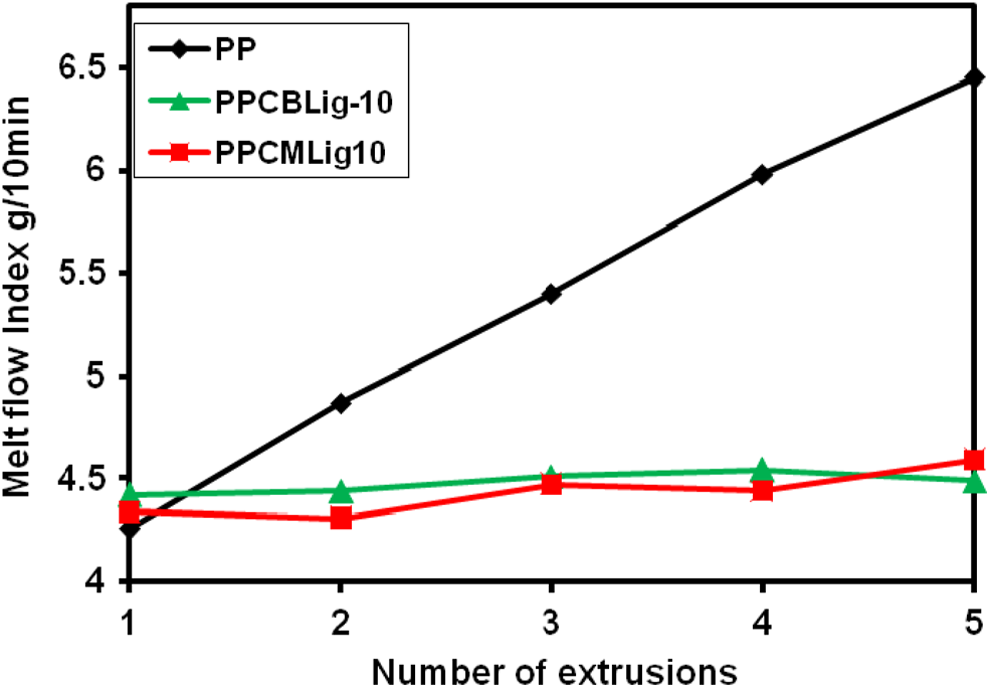
Dependence of MFI on number of extrusions for PP and PPCMLig and PPCBLig blends. PP: polypropylene.
Conclusion
To utilize waste resource and reduce the cost of polymer blend, industrial waste kraft lignin has been modified by two different methods and blended in different proportions with commercial-grade PP. The effect of different modifications and proportions on thermal, structural, and mechanical properties of the prepared blends has been studied. The obtained results show that the alkylation of lignin is responsible for more compatibility/solubility of modified lignin in PP matrix, which was concluded on the basis of the following assumptions: (a) more thermal stability of PPCMLig blends than PPCBLig blends, (b) more depression in melting point, (c) polymorphism of PP in the presence of CMLig, and (d) comparatively better mechanical properties of PPCMLig blends than PPCBLig blends. The higher intermolecular interaction of CMLig than CBLig with PP matrix is also confirmed from the various constants obtained by applying well-established mathematical models to the experimental mechanical properties data. But the addition of modified lignin in the PP matrix was found to be useful only up to 15 wt% and not beyond that. Both types of modified lignin act as effective processing stabilizers in PP matrix.
According to the testing results of PP/modified lignin blends, we can clearly see that the compatibility of all modified lignin with PP was greatly improved, but they did not act as a reinforcing agent for PP due to less compatibility/solubility of lignin in the PP matrix, which strongly resists its miscibility in matrix beyond certain percentage and get saturated. Nevertheless, using this waste resource can significantly reduce the cost of the resultant lignin/PP blends.
Footnotes
Declaration of Conflicting Interests
The author(s) declared no potential conflicts of interest with respect to the research, authorship, and/or publication of this article.
Funding
The author(s) received no financial support for the research, authorship, and/or publication of this article.

References
Supplementary Material
Please find the following supplemental material available below.
For Open Access articles published under a Creative Commons License, all supplemental material carries the same license as the article it is associated with.
For non-Open Access articles published, all supplemental material carries a non-exclusive license, and permission requests for re-use of supplemental material or any part of supplemental material shall be sent directly to the copyright owner as specified in the copyright notice associated with the article.
