




Abstract
The polyfluorinated ethylene propylene (FEP)/polypropylene (PP) blend was compounded at melt state in a twin-screw extruder. The melt dynamic viscoelasticity of FEP/PP blends was measured using a Bohlin rheometer with the extended temperature option under experimental conditions with temperature scope from 270°C to 280°C and shear frequency (ω) varying from 10−2 to 101 s−1. The results showed that the shear storage modulus (G′) and shear loss modulus (G″) increased nonlinearly, while the dynamic complex viscosity (η*) decreased slightly with increasing ω. The G′ and G″ were an exponential function of ω. The G′, G″, and η* of the blend melts decreased with an addition of the PP weight fraction
Introduction
Dynamic rheological properties are one of important characterizations of physical properties during processing of polymeric materials, especially for viscoelasticity. 1 –5 One can obtain more information on macromolecular structure–rheological property of polymer melts under dynamic rheological conditions, such as stored energy modulus, loss modulus, complex viscosity, and so on. For polymer blends and polymer composites, the factors affecting the melt viscoelasticity are complicated, such as compatibility between phases, blending ratio, and the viscoelasticity difference between components, filler size, shape, and its dispersion in the matrix, surface treatment, and so on. 6,7 Souza and his colleagues 6 studied the structure and rheological and thermal properties of synthetic organofluoromica/poly(lactic acid) nanocomposites and found a pronounced shear thinning with values of the n exponent varying between −0.63 and −0.85.
As an engineering resin, polyfluorinated ethylene propylene (FEP) is widely used in industries including petroleum industry, chemical industry, spinning and weaving industry, papermaking industry, medicine industry, and power industry (e.g. electric cable and wire) due to its outstanding mechanical and physical properties, such as good chemical and thermal stability, self-lubrication, flame retardance, low friction coefficient, and so on. 8 –12 However, some applications may be limited due to its poor processing properties and expensive cost. Therefore, one of the research hot points in recent years has been how to modify FEP resin so as to expand its applications in recent years. Bhuvanesh et al. 12 prepared ion exchange membranes by radiation grafting of acrylic acid on FEP films and studied the conductivity of the modified FEP films. Saneto and his colleagues 13 fabricated polymer electrolyte fuel cell (PEFC) membrane based on polytetrafluoroethylene (PTFE)/FEP polymer–alloy using radiation–grafting. They found that the thickness of this PEFC membrane might be further thinned and the properties were better. Blanchet and Peng 14 noted that irradiated FEP has good wear resistance and might manufacture an irradiated FEP/unirradiated PTFE blend with low friction coefficient. Polypropylene (PP) is a kind of thermoplastic used extensively in industry and life, such as automobile, electronic appliance, vessel and tube, spinning and film, and so on, 15 owing to its good performance in process and practical applications as well as low price. If FEP is modified by blending with PP, one might fabricate a new kind of polymeric material with good processing and low cost. In the past 20 years, there have been relatively few studies on the structure–property of FEP/PP blends, especially about rheological properties of FEP resin and its blend melts.
Melt rheological properties are important for polymer processing. 16 –18 However, there have also been relatively few studies on the melt rheological behavior of FEP and its blend melts, 19 especially for the melt dynamic viscoelasticity, including storage modulus, loss modulus, complex viscosity, and mechanical loss factor (i.e. mechanical loss tangent). The objectives of this study are to investigate the dynamic viscoelasticity behavior and its mechanisms of PP and FEP/PP blend melts under the experimental conditions.
Experimental
Materials
The FEP resin with trademark of FEP6100 was supplied by DuPont Company (Wilmington, Delaware, USA), the melt index was 30 g/10 min, and the melting point temperature and density of the resin were 264°C and 2140 kg m−3, respectively.
The PP resin with trademark of CJS-700G was supplied by Guangzhou Petrochemical Works (Guangdong province, People’s Republic of China), and the density in solid state and the melt flow rate were 910 kg m−3 and 10 g 10 min−1, respectively.
Preparation
Firstly, the FEP resin was compounded with the PP resin, and then they were blended in molten state in a twin-screw extruder under conditions with temperature range from 180°C to 280°C and screw speed of 100 r min−1, and the extrudate of the FEP/PP blends was granulated. The diameter and length–diameter ratio (L/D) of the screw were 35 mm and 40, respectively. The weight fractions of PP
Apparatus and methods
The dynamic experiments were conducted using a Bohlin rheometer with the extended temperature option (model Gemini200) supplied by Malvern Instruments Limited (UK), as shown in Figure 1. The melt dynamic properties of the FEP/PP blends were measured under experimental conditions with temperature range from 270°C to 280°C and shear frequency varying from 10−2 to 101 s−1.
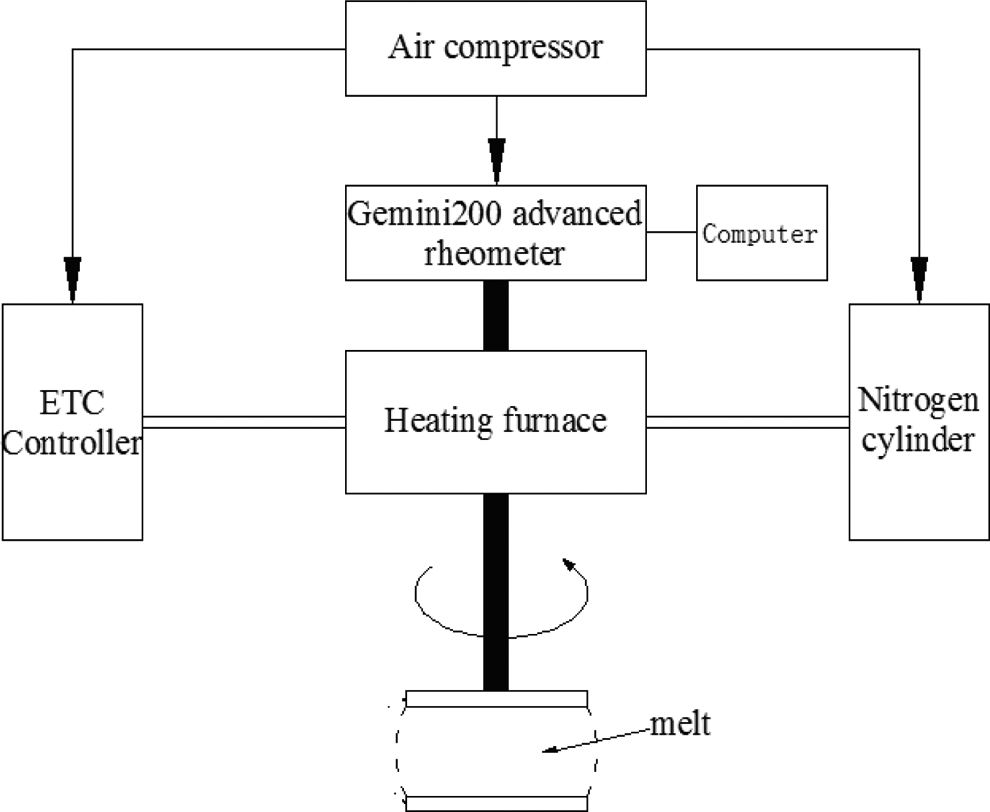
Sketch of a Bohlin rheometer with the extended temperature option.
Results and discussion
Dependence of melt dynamic viscoelasticity on shear frequency
Storage modulus is an important parameter characterizing the viscoelasticity of polymer melts, and it describes the ability of storing elastic deformation energy of the melts under oscillation load. Figure 2 displays the dependence of the melt storage modulus
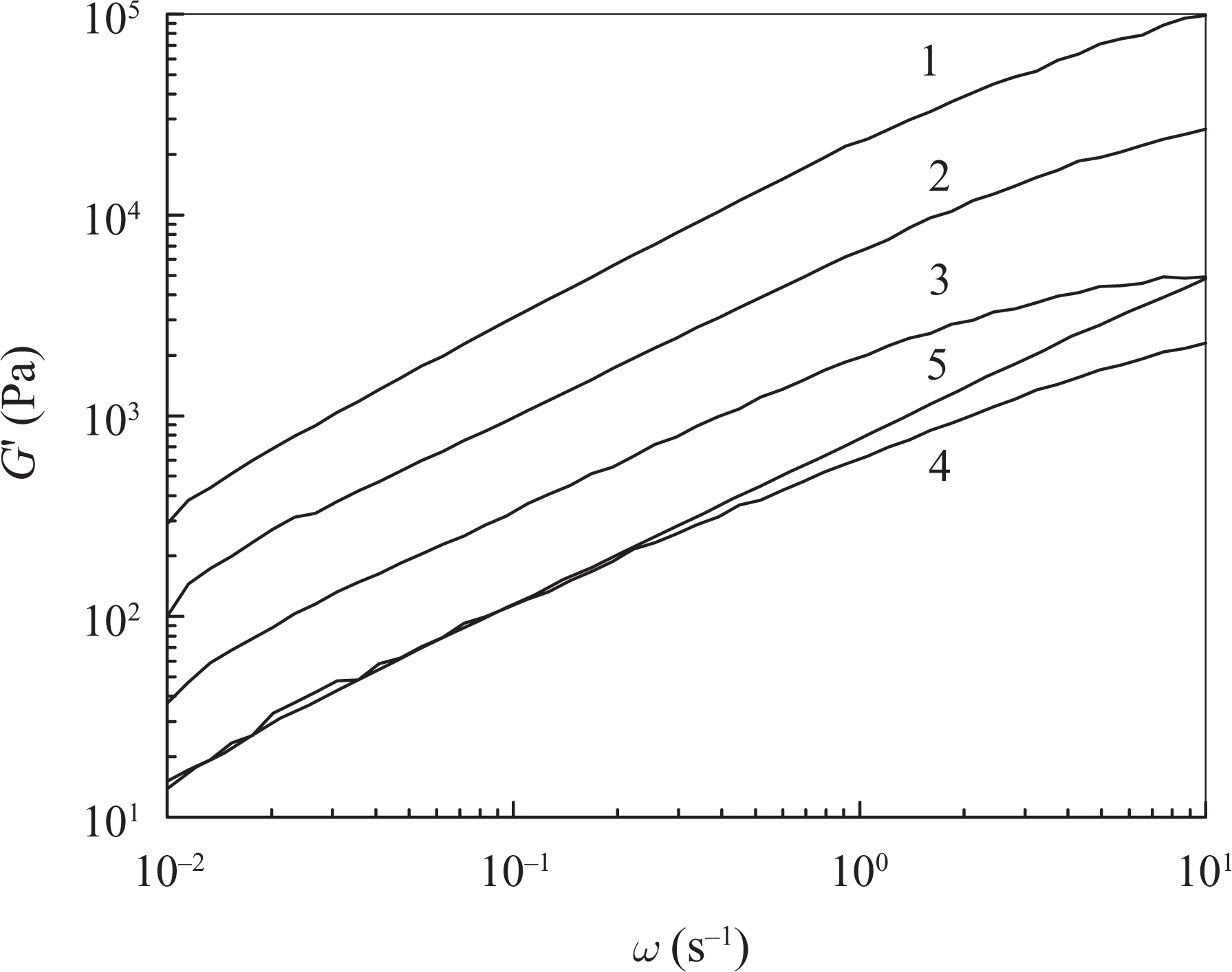
Dependence of storage modulus on shear frequency at 280°C. (1) φPP = 0%; (2) φPP = 10%; (3) φPP = 20%; (4) φPP = 30%; (5) φPP = 40%.
It can be found through further analysis that the relationship between the storage modulus and shear frequency in this case can be expressed as follows:

where α and β are the coefficients related to the melt viscoelasticity. The values of the α and β of the blends can be determined from the testing data showed in Figure 2 using a linear regression analysis method, and the results are summarized in Table 1. It can be found that the values of α and β decrease roughly with increasing the PP weight fraction except to individual data point, and the correlation coefficient (R) is more than 0.99.
The values of α and β of the FEP/PP blends.
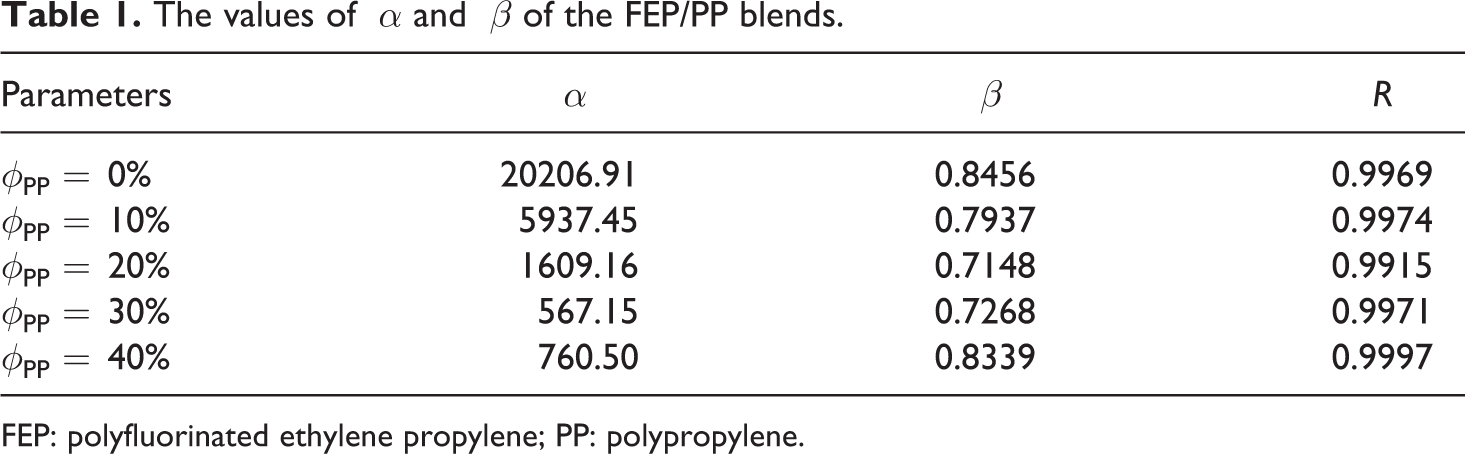
FEP: polyfluorinated ethylene propylene; PP: polypropylene.
Loss modulus is one of the important parameters characterizing the viscoelasticity of polymer melts, and it describes the phenomenon when energy dissipation is changed as heat in the case of the deformation of the melts under oscillation load. Figure 3 illustrates the dependence of the melt loss modulus
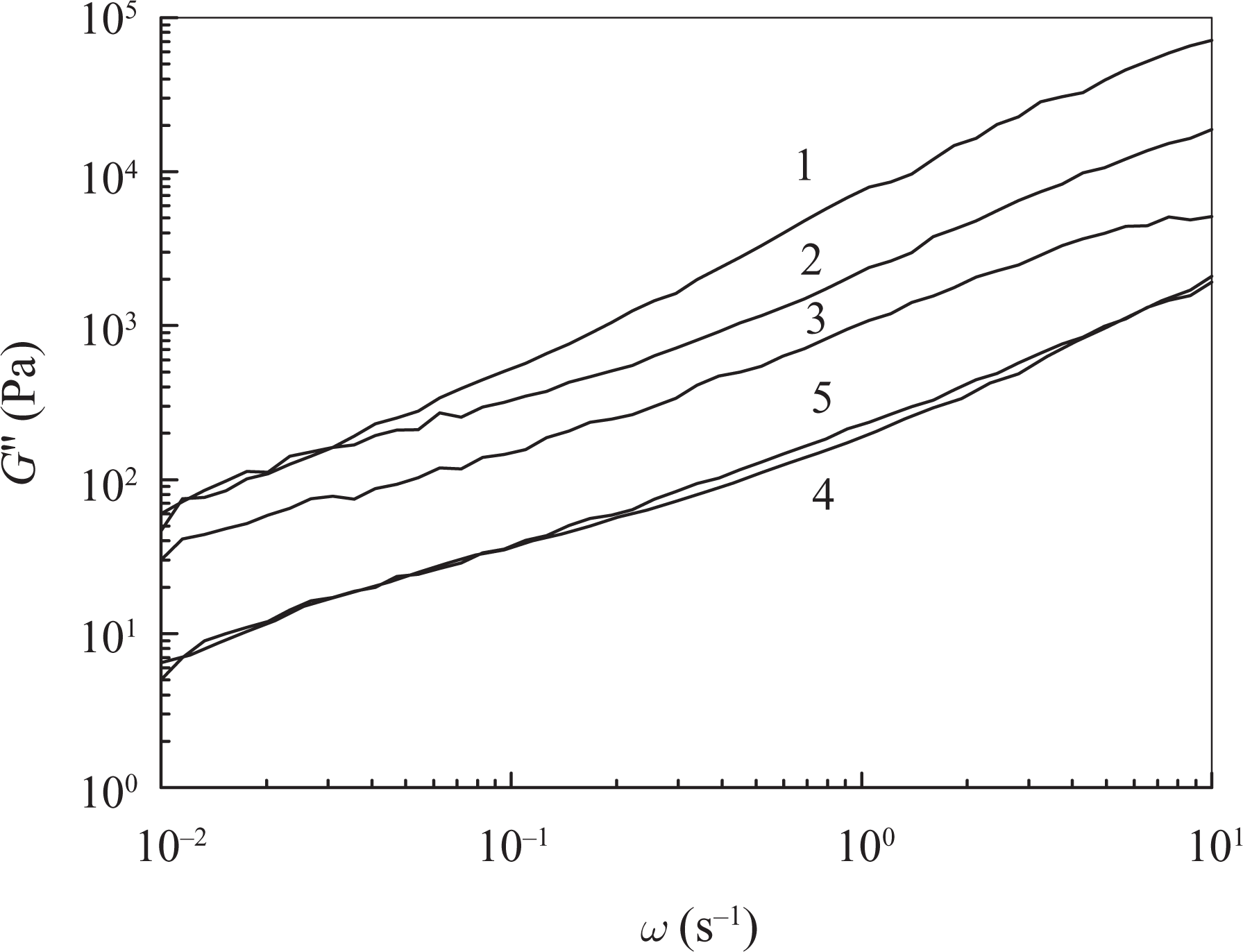
Dependence of loss modulus on shear frequency at 280°C. (1) φPP = 0%; (2) φPP = 10%; (3) φPP = 20%; (4) φPP = 30%; (5) φPP = 40%.

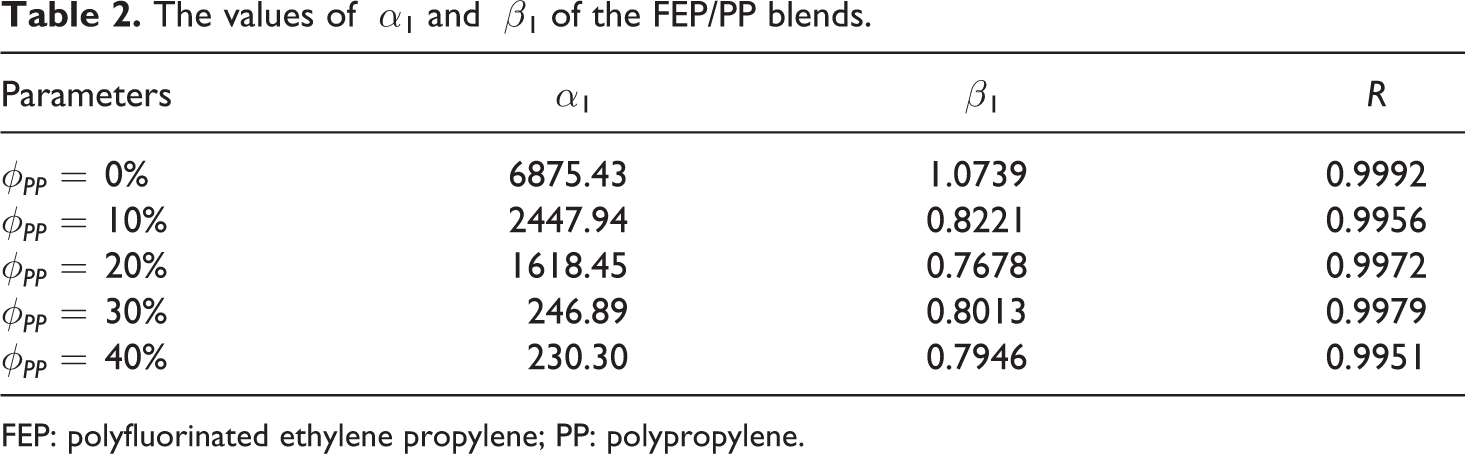
where α1 and β1 are the coefficients related to the melt viscoelasticity. The values of α1 and β1 of the blends can also be determined from the measurement data shown in Figure 3 using a linear regression analysis method, and the results are listed in Table 2. It can be observed that the values of α1 and β1 decrease roughly with an addition of the PP weight fraction except to individual data point, and the correlation coefficient (R) is also more than 0.99.
The values of α1 and β1 of the FEP/PP blends.
FEP: polyfluorinated ethylene propylene; PP: polypropylene.
In general, the effect shear flow filed on polymer melts would be enhanced with increasing shear frequency, both the shear deformation and the viscous dissipation of deformation energy would increase correspondingly. As a result, the loss modulus would increase with increasing shear frequency.
Complex viscosity is also one of important parameters characterizing the viscoelasticity of polymer melts. Figure 4 shows the dependence of the melt complex viscosity
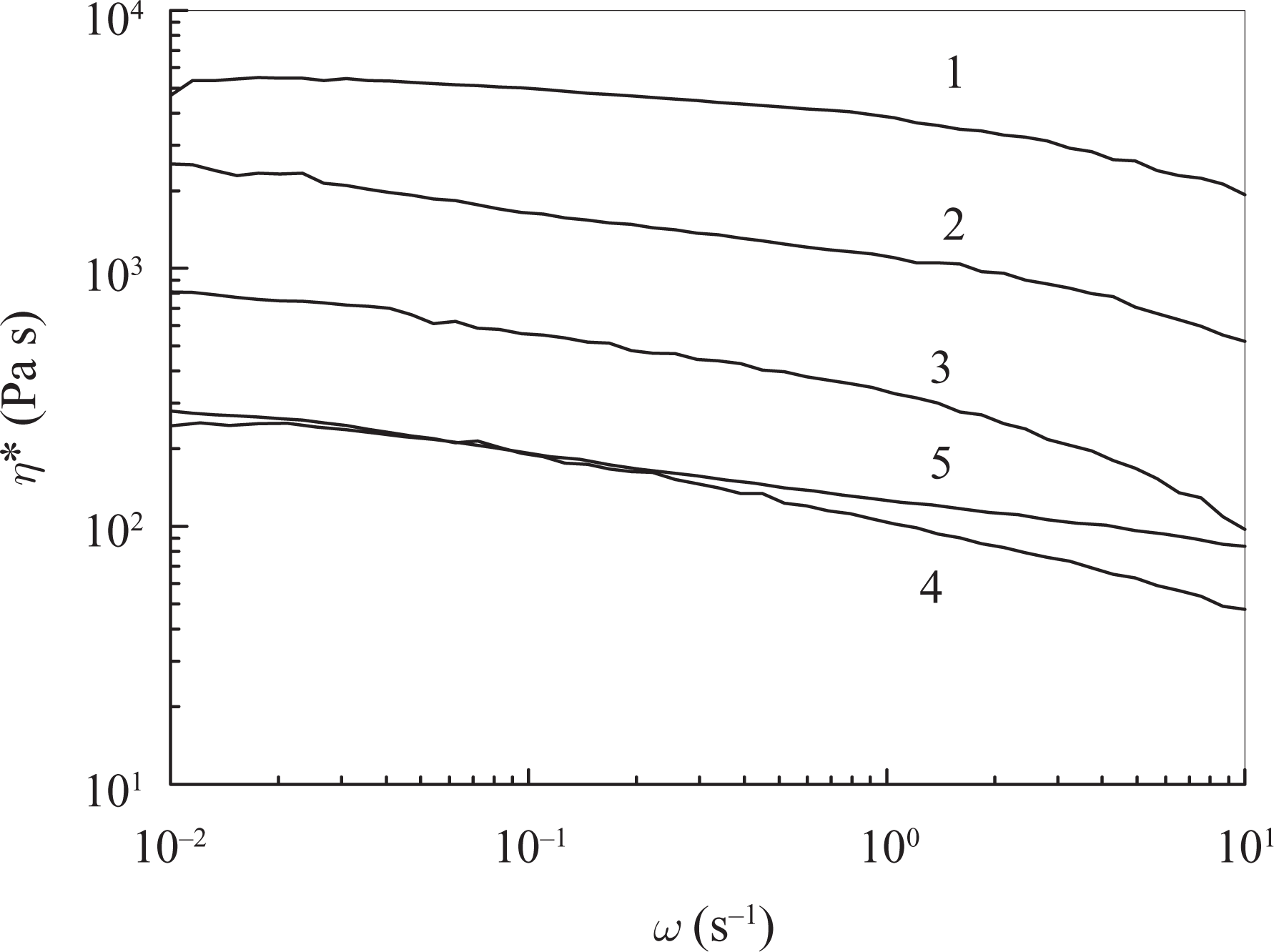
Dependence of complex viscosity on shear frequency at 280°C. (1) φPP = 0%; (2) φPP = 10%; (3) φPP = 20%; (4) φPP = 30%; (5) φPP = 40%.
Relationship between melt dynamic viscoelasticity and PP content
Figure 5 illustrates the relationship between the storage modulus of the FEP/PP blend melts and the PP content at different shear frequency. It can be found that the value of G′ for the FEP/PP blend melts decreases nonlinearly with an addition of the PP weight fraction. This is because that the storage modulus of the PP resin is lower than that of the FEP resin, leading to reduction of the storage modulus of the blend melt with increasing the PP weight fraction, especially in the case of low PP concentration. In addition, the relationship between the G′ and φPP can be expressed as follows,
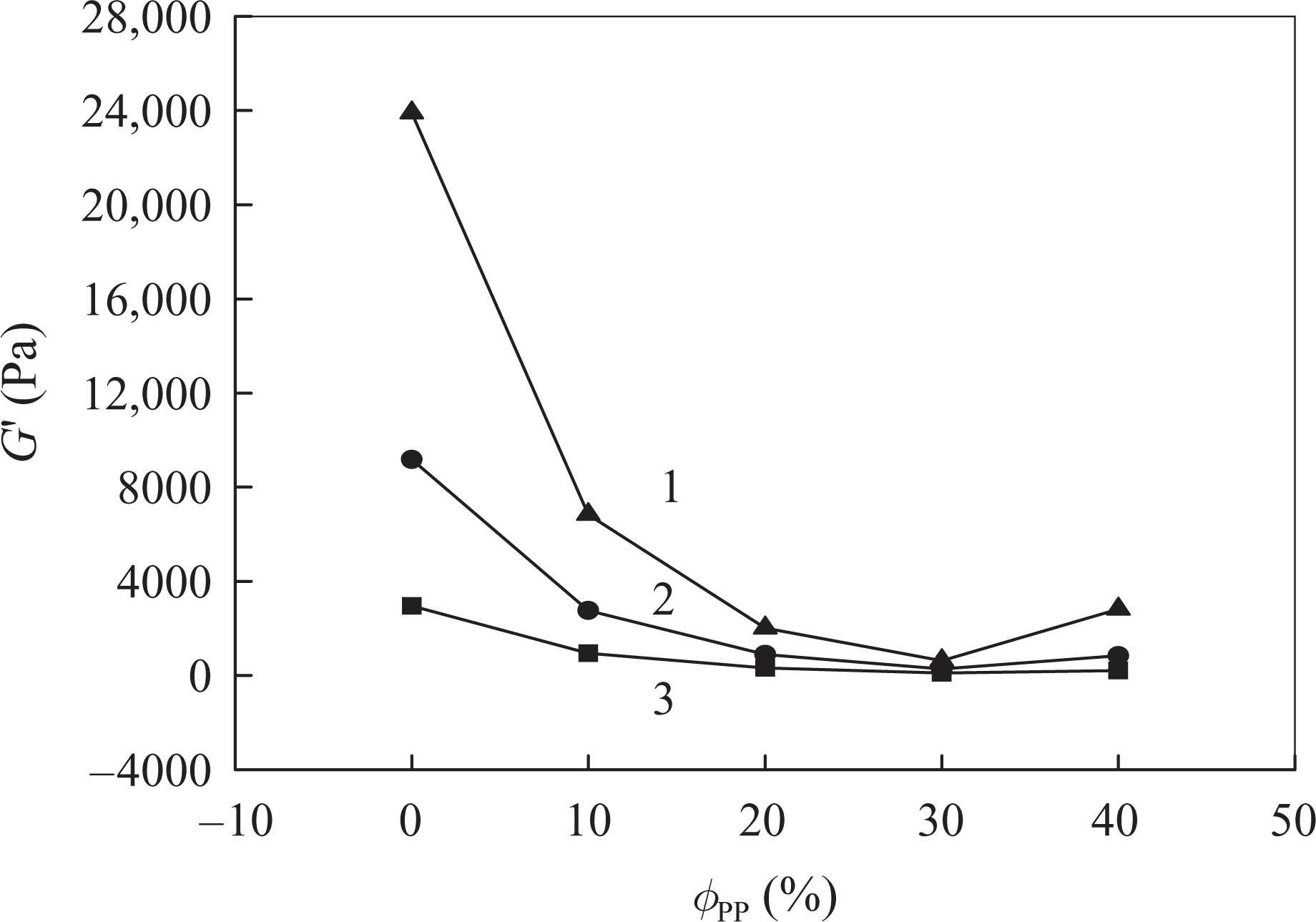
Relationship between storage modulus and PP weight fraction at 280°C. (1) ω = 10−1 s−1; (2) ω = 10−0.5 s−1; (3) ω = 100 s−1. PP: polypropylene.

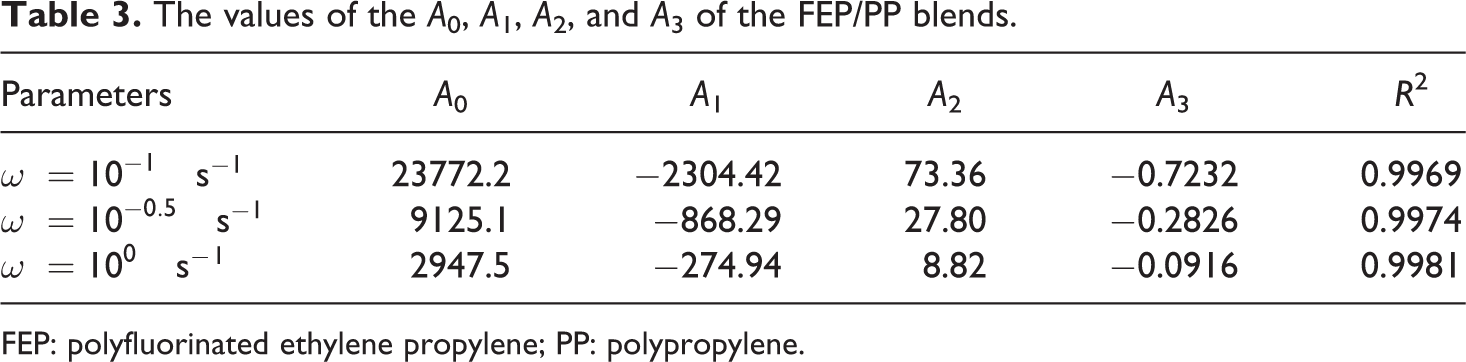
where A0, A1, A2, and A3 are the coefficients related to the melt viscoelasticity. The values of the A0, A1, A2, and A3 of the blends may also be determined from the measurement data showed in Figure 5 using a regression analysis method, and the results are summarized in Table 3. It can be found that the values of A0, A1, A2, and A3 decrease roughly with an increase of shear frequency, and the correlation coefficient (R2) is more than 0.99.
The values of the A0, A1, A2, and A3 of the FEP/PP blends.
FEP: polyfluorinated ethylene propylene; PP: polypropylene.
Figure 6 shows the relationship between the loss modulus of the FEP/PP blend melts and the PP content at different shear frequency. Similarly, the value of G′ of the FEP/PP blend melts decreases nonlinearly with an addition of the PP weight fraction. The reason should be that that the loss modulus of the PP resin is lower than that of the FEP resin, resulting in reduction of the loss modulus of the blend melt with increasing the PP weight fraction, especially in the case of low PP concentration. Furthermore, the relationship between the G″ and φPP can be expressed with a three-order polynomial equation which is similar to equation (3). That is,
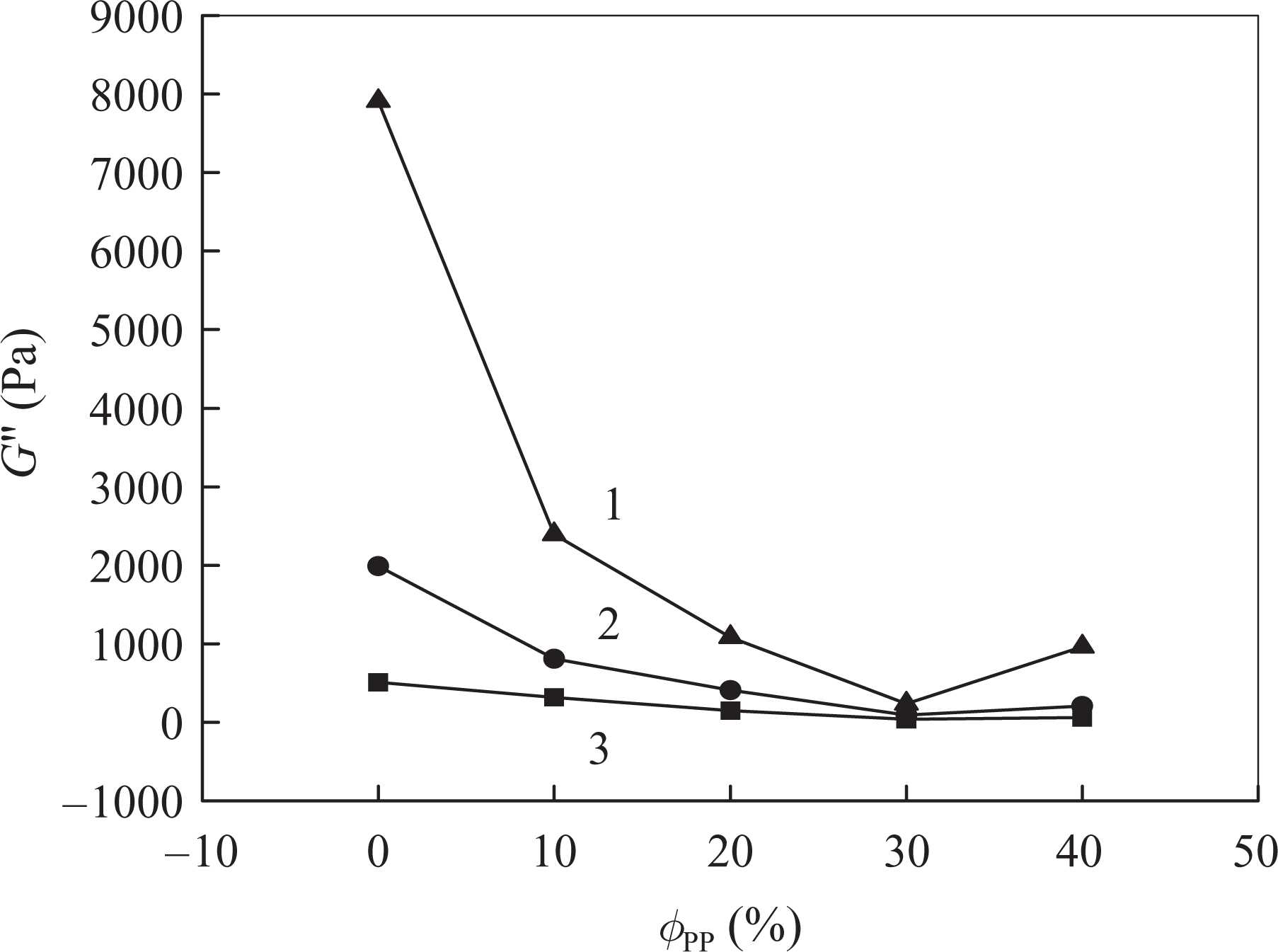
Correlation between loss modulus and PP weight fraction at 280°C. (1) ω = 10−1 s−1; (2) ω = 10−0.5 s−1; (3) ω = 100 s−1. PP: polypropylene.

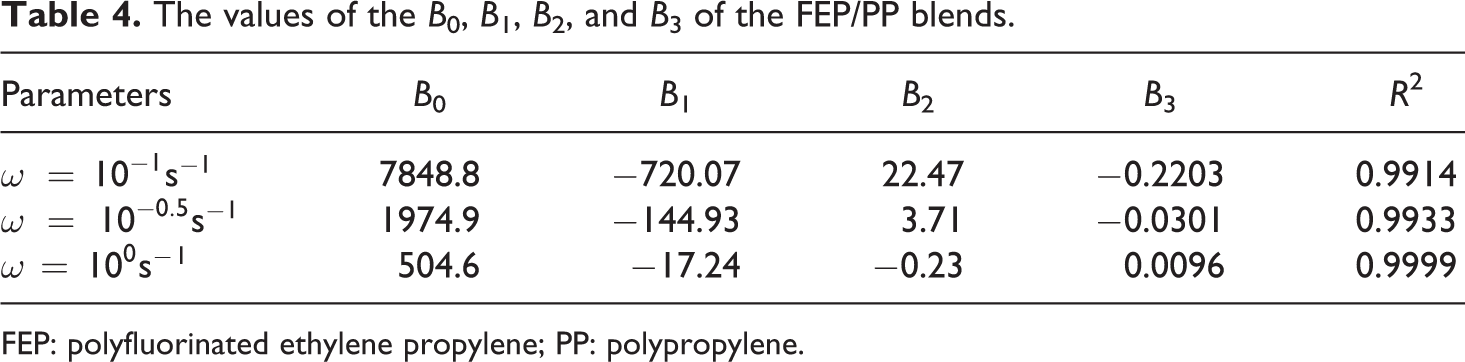
where B0, B1, B2, and B3 are the coefficients related to the melt viscoelasticity. The values of the B0, B1, B2, and B3 of the blends may also be determined from the measurement data showed in Figure 6 using a regression analysis method, and the results are summarized in Table 4. It can be seen that B0, B1, B2, and B3 decrease roughly with an increase of shear frequency, and the correlation coefficient (R2) is also more than 0.99.
The values of the B0, B1, B2, and B3 of the FEP/PP blends.
FEP: polyfluorinated ethylene propylene; PP: polypropylene.
Figure 7 displays the relationship between the dynamic complex viscosity of the FEP/PP blend melts and the PP content at different shear frequency. Similarly, the
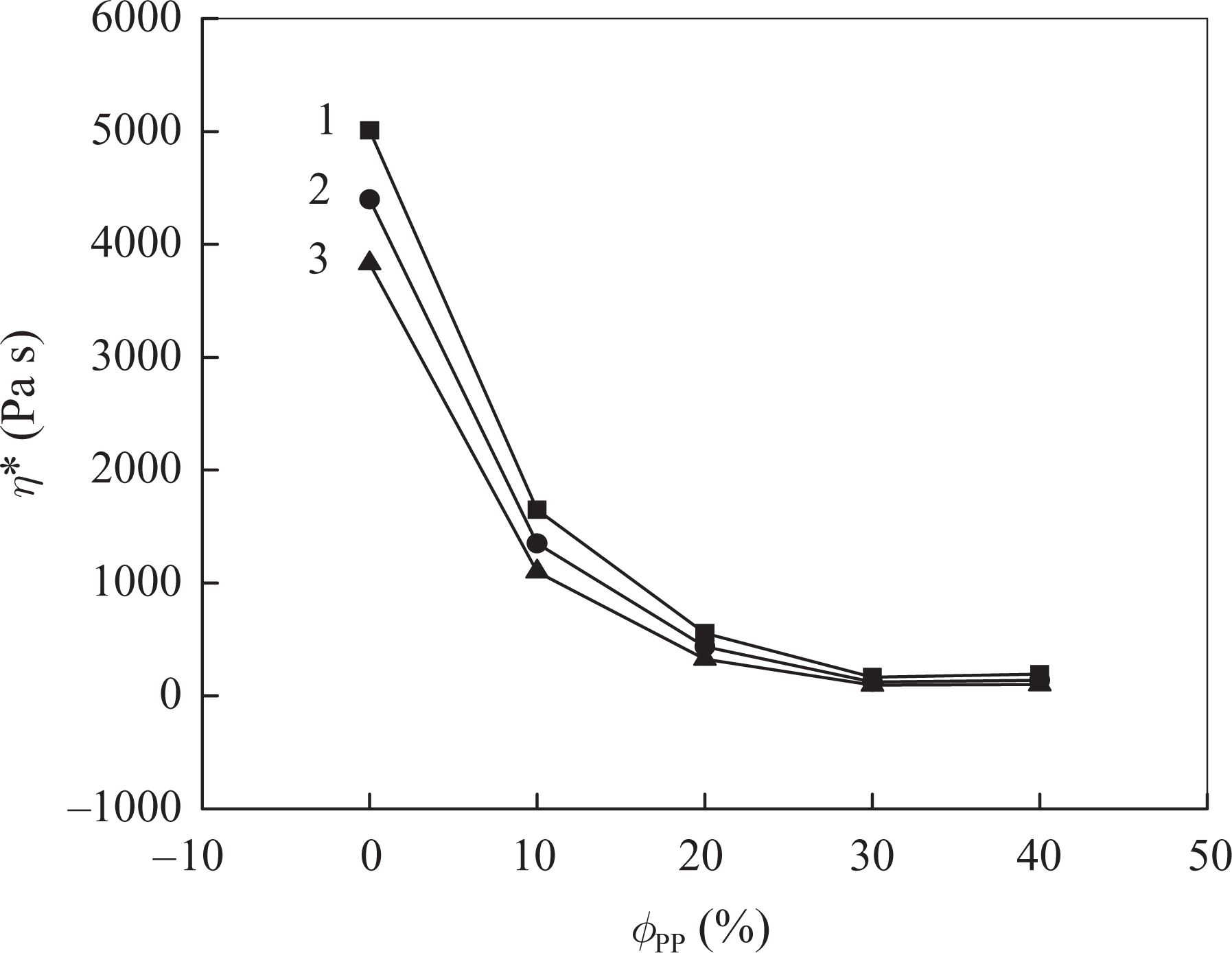
Relationship between complex viscosity and PP weight fraction at 280°C. (1) ω = 10−1 s−1; (2) ω = 10−0.5 s−1; (3) ω = 100 s−1. PP: polypropylene.

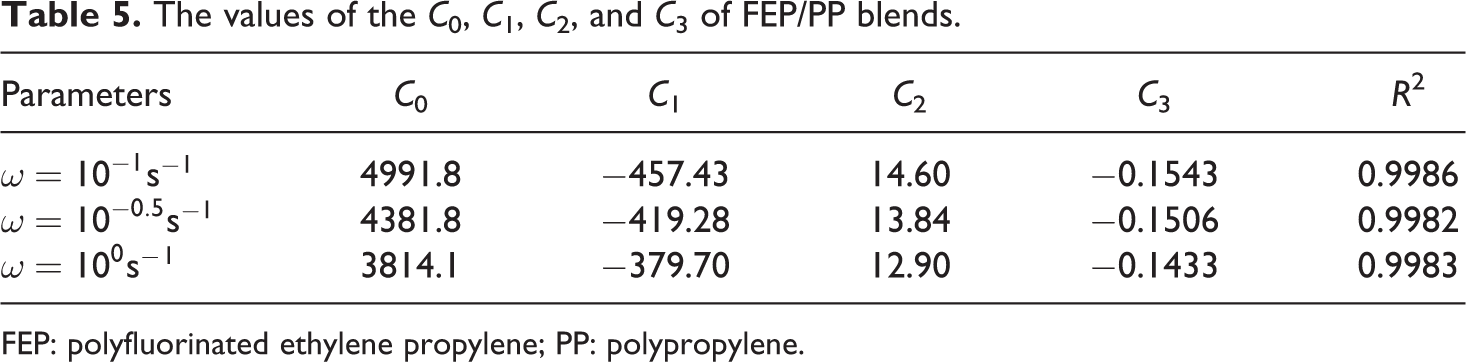
where C0, C1, C2, and C3 are the coefficients related to the melt viscoelasticity. The values of the C0, C1, C2, and C3 of the blends may also be determined from the measurement data shown in Figure 7 using a regression analysis method, and the results are summarized in Table 5. Similarly, C0, C1, C2, and C3 decrease roughly with an increase of shear frequency, and the correlation coefficient (R2) is also more than 0.99.
The values of the C0, C1, C2, and C3 of FEP/PP blends.
FEP: polyfluorinated ethylene propylene; PP: polypropylene.
Influence of shear frequency on mechanical loss factor
The mechanical loss factor (tan δ) is the measurement of the energy dispassion of material under vibration condition, which is defined as the tangent of phase difference angle between stress and strain, that is:

Obviously, the lower the tan δ value is, the stronger is the viscosity effect, while the weaker is the elastic effect. Therefore, tan δ can also characterize the viscoelasticity of the polymer melt. Figure 8 shows the relationship between the mechanical loss factor of the FEP/PP blend melts and shear frequency as the temperature is 270°C. The tan δ of the FEP/PP blend melts increases quickly with increasing ω when ω is less than 100 s−1 and then decreases, especially when the PP weight fraction is 40%.
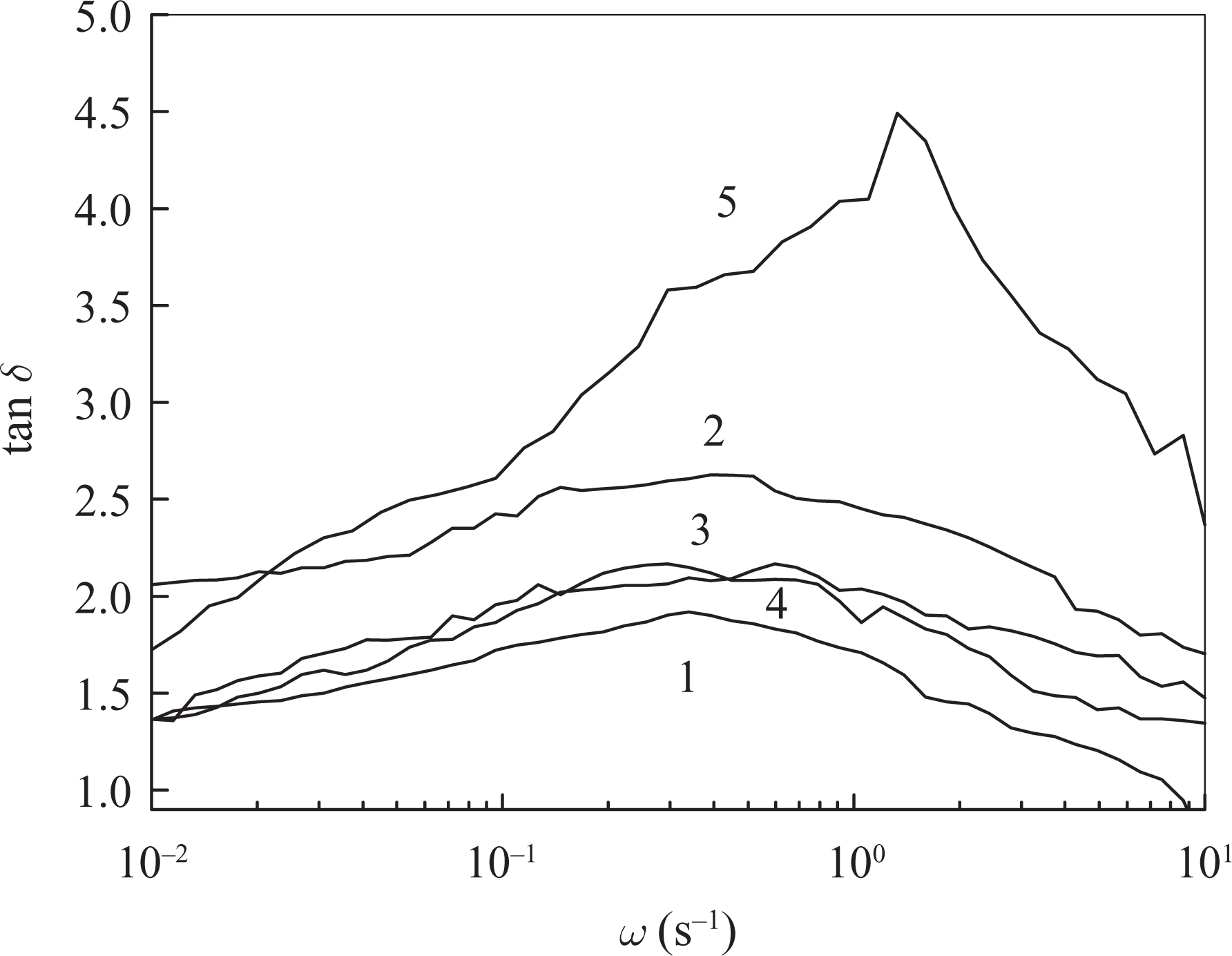
Dependence of tan δ on shear frequency of FEP/PP blend melt at 270°C. (1) φPP = 0%; (2) φPP = 10%; (3) φPP = 20%; (4) φPP = 30%; (5) φPP = 40%.
Discussion
In general, the shear stress and deformation increases with increasing shear frequency during shear flow of polymer melt under oscillation load. In this case, the deformation energy stored in the melt would increase correspondingly, leading to the increase of the storage modulus. Consequently, the storage modulus of the FEP/PP blend melts increases with an addition of shear frequency (see Figure 2). It is found by further researching that the shear storage modulus of the FEP/PP blend melts is an exponential function of shear frequency in the shear frequency range from 10−1 to 101 s−1 (see equation (1)).
On the other hand, the dissipation of deformation energy would occur at the same time during dynamic shear flow of polymer melts owing to the melt viscoelasticity, and this energy dissipation increases also with the increase of shear frequency. Therefore, the loss modulus of the FEP/PP blend melts increases with an addition of shear frequency (see Figure 3). It is also found by further researching that the shear loss modulus of the FEP/PP blend melts is an exponential function of shear frequency in the ω range from 10−1 to 101 s−1 (see equation (2)).
The dynamic complex viscosity is a function of the storage modulus, loss modulus, and shear frequency for a given polymer melt, and the relationship between them is expressed as follows:

At the same temperature, the dynamic complex viscosity is close to steady shear viscosity. 15 In general, the molecular chain orientation degree is relatively low, and the melt shear thinning effect is insignificant in the case of low shear strain rate, thus the dependence of the shear viscosity of polymer melts on shear rate is not obvious. Consequently, the dynamic complex viscosity of the FEP/PP blend melts reduces slightly with an increase of shear frequency within shear frequency from 10−1 to 101 s−1 (see Figure 4).
Viscoelasticity ratio is a key factor affecting the melt viscoelasticity of polymeric blends when temperature and flow rate are constant. In general, the melt viscoelasticity of the blend would reduce with an addition of the component with low viscoelasticity under given conditions. It is found from Figures 2 to 4 that the shear storage modulus, shear loss modulus, and dynamic complex viscosity of the FEP/PP blend melts decrease nonlinearly with an addition of the PP weight fraction. This indicates that the viscoelasticity of the FEP melt is higher than that of the PP melt.
Conclusions
The effects of shear frequency and the PP content on the dynamic rheological behavior of the FEP/PP blend melts were significant in the shear frequency range varying from 10−1 to 100 s−1. It was found that the shear storage modulus and loss modulus of the FEP/PP blend melts increased with increasing shear frequency, and they were an exponential function of shear frequency. The dynamic complex viscosity decreased slightly with an increase of shear frequency.
The shear storage modulus, loss modulus, and complex viscosity of the FEP/PP blend melts decreased with an addition of the PP weight fraction, and the relationship between them could be expressed by a three-order polynomial equation. This phenomenon should be attributed to the difference in viscoelasticity between the FEP melt and PP melt.
The value of tan δ of the FEP/PP blend melts increased quickly with increasing ω when shear frequency was less than 100 s−1, and then it decreased, it achieved the maximum at about ω of 100 s−1, especially when the PP content was 40% and temperature was 270°C.
Footnotes
Declaration of Conflicting Interests
The author(s) declared no potential conflicts of interest with respect to the research, authorship, and/or publication of this article.
Funding
The author(s) disclosed receipt of the following financial support for the research, authorship, and/or publication of this article: The authors would like to thank for the support from the National Natural Science Fund of China (no.: NSFC 51073021).