




Abstract
In this work, the downward flame spread of flame of flexible polyurethane (FPU) foam with a different width was studied in an external radiant heat source. The effects of external radiation heat flux on the main parameters of flame spread, such as the flame height, mass loss rate, flame spread rate and flame pulsation frequency were investigated. The experimental results show that the flame spread of the FPU is an accelerating process when there is an external radiation condition and is a steady one without it. As the flame spread over board, the amount of pyrolysis gases involved in the combustion process showed a positive relationship with the external radiation heat flux. The flame height is under a combined effect of width and external radiation heat flux. However, the flame pulsation frequency shows a negative correlation with the fuel width and the radiation heat flux. Finally, an empirical equation approximation of linear pool fire is introduced to analyze the flame spread behavior of FPU as well as the validation with experiment data.
Introduction
Building energy saving is more and more important for society development and earth protection, especially for developing countries, such as China. Flexible polyurethane (FPU) foam, as a kind of normal heat insulation material for buildings, has been widely used since its good energy-saving properties and low prices. However, the potential fire hazards of these kinds of material are relatively challenging because of the melting flow in combustion process and poor fire protection systems outside of buildings. Therefore, it is important to conduct research on fire risk of FPU foam. On the other hand, it has been observed that the fire of some materials, which will not keep spreading upward by themselves even after ignition, will do spread fast when exposed to an external radiation source, 1 which is a normal fire phenomena in engineering applications. Therefore, the flame spread behaviors of FPU foam under simulated surrounding fire conditions should be taken into consideration during the design of fire protection systems.
Most of the previous works on this topic paid their attention on mechanism for heat and mass transfer. Of the many mechanisms for the heat transfer ahead of the flame, radiation heat transfer is significant in large turbulent flames. 2 Some of the standard tests, such as ASTME 162 for horizontal flame spread 3 and ASTME 648 for downward flame spread, 4 indicate that materials that are normally considered safe may behave unacceptably under an actual fire situation. Brehob and Kulkarni 5 obtained experimental data for upward flame spread with applied external radiation on practical wall materials, the materials that normally display upward flame spread will exhibit significant enhancement in flame spread and fire growth in the presence of external radiation. De Ris 6 developed the first analytical model for flame spread in a forced convection environment with an exact solution in the thick limit and an approximate solution in the thin limit. Tu and Quintiere 7 analyzed the relationship between flame heights, spread rate, and external radiation heat flux through small-scale experiment in order to measure the flame heights as a function of heat release. Hirano and Tazawa 8 presented that external radiation heat fluxes show an influence on the gas velocity and temperature profiles near the leading edges of downward-spreading flame over paper by changing not only the temperature of the initial unburned material temperature but also the rate of gas phase heat transfer from the flame zone to the unburned material. An, Huang and coworkers 9 –11 studied the effects of sample width and inclined angle on flame spread across expanded polystyrene surface in plateau and plain environment. Rangwala et al. 12 confirmed that the width of the fuel plays an important role in flame propagation and presented that as the width decreases the lower flame height may be attributed to a reduction in excess pyrolyzate due to diffusion of fuel to the sides of the sample. Honda and Ronney 13 classified the flame spread in two regimes, namely, convectively stabilized and radiatively stabilized. They assumed that for narrow fuel beds, flame length is limited by lateral heat and/or momentum losses, while for wide fuel beds, it is limited by surface radiation losses. Zhao and Zhang 14 analyzed the width effect on flame spread of rigid PU (RPU) when the fuel was ignited by the linear ignition source in the middle of the fuel and proposed the fitting correlation between flame height and width of fuel.
A considerable body of research concerning other materials has been conducted. Nevertheless, their conclusions are not consistent. To date, the characteristics of downward FPU foam flame spread have not been sufficiently studied. Previous studies are mainly focused on opposed flow, various pressures, infinite width, thermally thin materials and angular orientation, and so on. However, the studies described above show that the radiation flux and width are the important factors to the flame spread. It is not practical to use the proposed simplified models in estimating the flame spread rate for thermally thick fuels exposed to external radiation heat flux, which is believed to have significant effects on the pyrolysis fuel concentration, air entrainment mechanism, induced velocity near the leading edge, and the flame spread velocity.
This article reports the experimental results of downward flame spread behavior of FPU foam under various external radiation heat fluxes. The correlations between combustion characteristics of diffusion flame and external radiation heat flux are obtained. Further, the effects of sample widths on FPU foam flame spread behaviors were identified. To the best of our knowledge, these correlations will provide suggestion for research on flame spread process over FPU foam, which is vital to fire safety design of building energy conservation system.
Experimental setup and procedures
The experimental combustion apparatus consists of a vertical sample of the flexible PU fuel with a thickness of 2 cm, height of 100 cm, and width of 5/10/15/20 cm mounted on an insulation board, respectively. As shown in Figure 1, insulation board, extending 5 cm on each side of the sample, allows only the front surface of the fuel to ignite and burn. The solid fuel was in a freely burning downward spread configuration. An electronic balance with precision of 0.01 g was used to record the mass change of the fuel over time. A wick soaked with ethanol was placed in an iron slot as the linear ignition source for the solid fuel. Reference lines with a space distance of 10 cm on the fuel surface provide a visual indication of the extent of flame spread at a given time. Eight thermocouples are located in the middle of the fuel surface. The time of arrival of the pyrolysis front at each thermocouple location is defined by the time at which the temperature recorded by the thermocouple reaches the nearly constant vaporization temperature of the fuel. An external radiation source equipped with a baffle plate was placed in front of the FPU fuel. The baffle plate to prevent radiation was raised by the electric machine after the fuel was ignited, and the fuel surface will be heated by irradiance. The radiation heat flux was almost uniform along the surface and calibrated by radiometer. The radiation heat fluxes of 2.5 and 5.0 kW/m2 were respectively adopted in this work. A digital camera was used to obtain a front view of the flame propagation process.
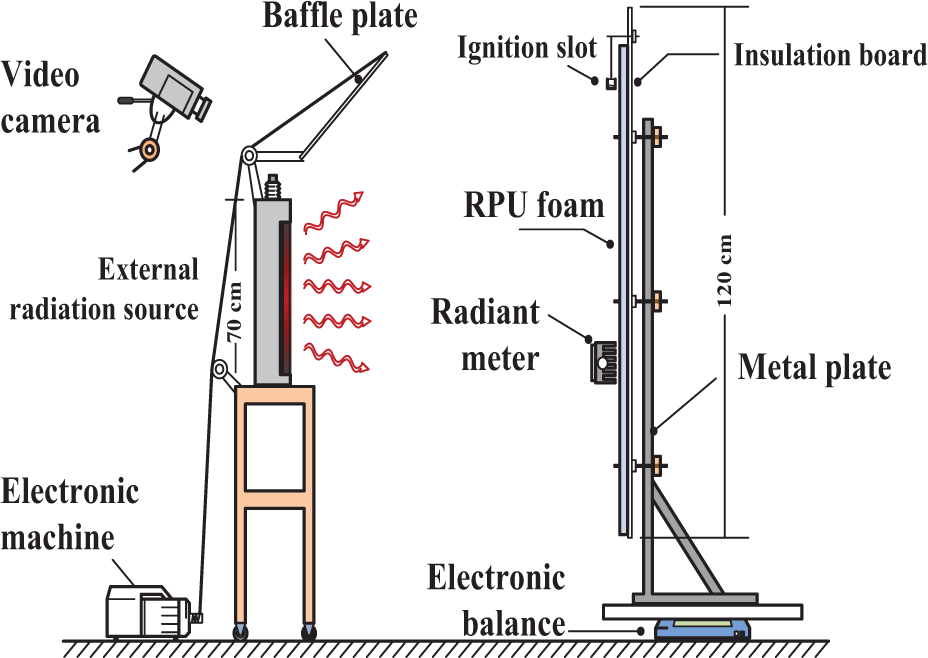
Schematic of experimental setup for downward flame spread with external radiation source.
The focus of the experiment is the steady-state stage of the combustion process. The mass loss rates, spread rates, flame heights, and flame pulsation frequency are mainly selected in the steady-state zone. All the data were recorded at a frequency of 1 Hz. The experiments were repeated several times and verified to be superior in reproducibility.
Results and discussions
Schematic of flame spread
Figure. 2 shows the thermal models of downward flame spread over FPU foam with and without external radiation. The fuel is burned out over region xb and pyrolyzed over region xp, and the flame height is expressed as xf.
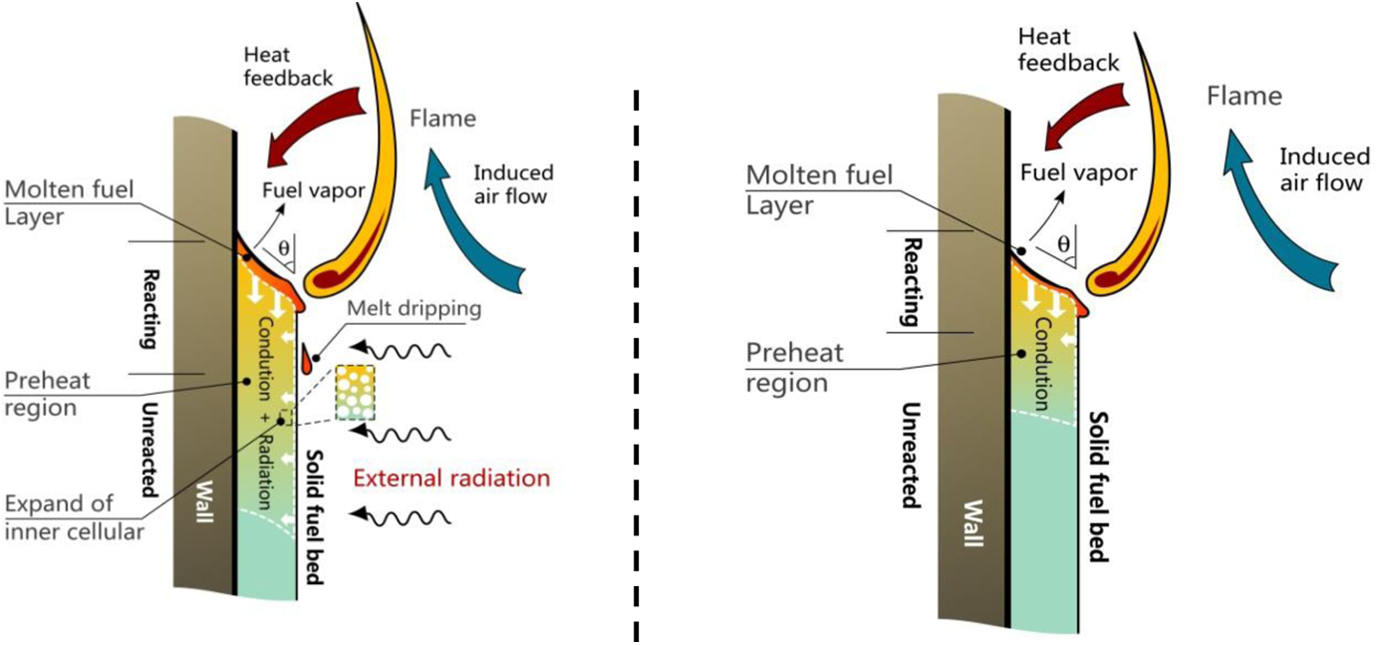
Schematics of downward flame spread over FPU foam with and without external radiation. FPU: flexible polyurethane.
In terms of the downward spreading of flame over thermally thick fuels, a primary mechanism of heat transfer is developed in solid phase so that the virgin materials are preheated. Then the heat transfer from pyrolysis region to the virgin fuel leads to the downward flame spread. The phenomenon of partial melting which like liquid film is observed in our experiment belongs to pyrolysis zone greatly. Due to the good heat-insulating property of FPU foam, solid-phase heat conduction through FPU foam is relatively small. However, the heat conductivity of liquid film is much larger than that of solid foam. Therefore, solid-phase heat conduction should not be ignored. The solid-phase heat conduction occurred near the pyrolysis front, where the molten fuel accumulated. The heat conduction of the liquid film and external radiation to the unreacting region provided the main heat for the FPU foam downward flame spread. External radiation heat flux preheating the sample raises the surface temperature near the molten fuel layer, therefore, less energy was needed to achieve the surface temperature required for pyrolysis to begin. As the presence of external radiation, the two cases from the experiments observation show distinct differences in the following four aspects: (1) flame height, (2) molten fuel layer area, (3) reacting region, and (4) preheating to the virgin material. Meanwhile, the higher mass loss rate under radiant condition would release more pyrolysis gas and generate higher flame height. The external radiation and flame heat flux will positively feedback to the molten fuel layer region and make the combustion region larger, which in turn causes higher flames.
Combustion phenomenon
The downward flame spread over FPU with a width of 10 cm under variable radiation heat flux is shown in Figure 3. Flame spread differed according to the circumstances. After the FPU foam was ignited, the flame frontier region was heated, softened, melted, and changed into liquid. The formed multiphase region was to sustain the downward flame spread. As shown in Figure 3, it takes 460 s, 216 s, and 133 s for the flame to reach the end of the fuel under 0 kW/m2, 2.5 kW/m2, and 5.0 kW/m2 external radiation heat flux, respectively. It is shown that the downward fire development is an accelerated process under external radiation heat flux condition. The reason is suggested that enough energy must be supplied to the sample to heat the spreading front up to the melting temperature to maintain the flame propagation downward. Preheating the sample (by external radiation) raised the surface temperature, therefore, less time and/or energy was needed to achieve the surface temperature required for melting to begin.
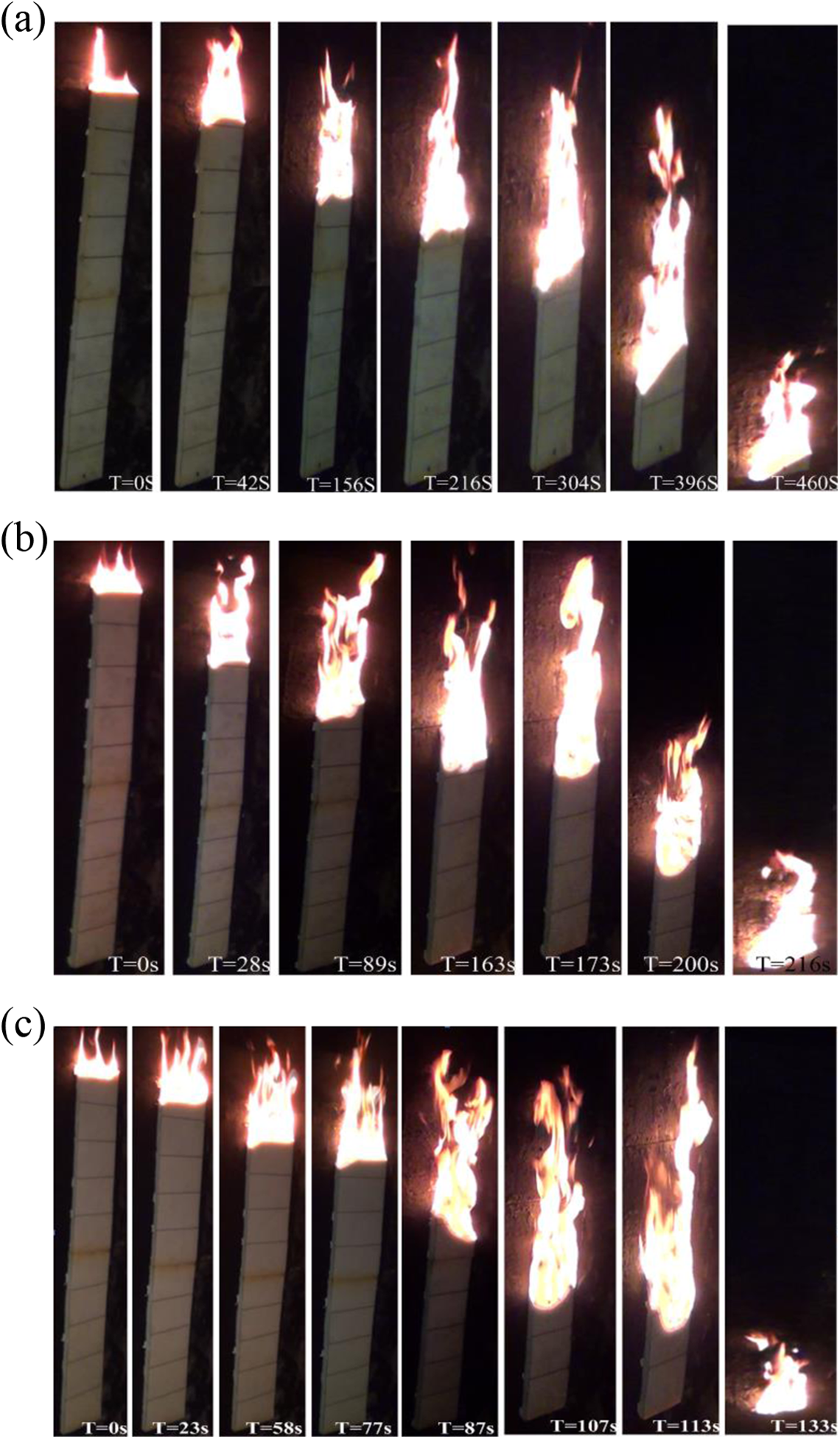
Downward flame spread over FPU with a width of 10 cm under variable external radiation heat flux. FPU: flexible polyurethane.
For all samples, the flame shape became more irregular with an increasing sample width. This demonstrates that air entrainment during flame spread is fiercer among wider samples. Additionally, with the increase of external radiation heat flux, the burning of the fuel was more sufficient and the flame spread rate was faster. This would lead to an increase in mass loss rate and the subsequent increase in energy release rate, which corresponds to larger flame.
Burning rate
The burning rate of downward flame spread
Figure 4 depicted the mass change of FPU sample under variable heat flux. It is shown the average mass loss rate
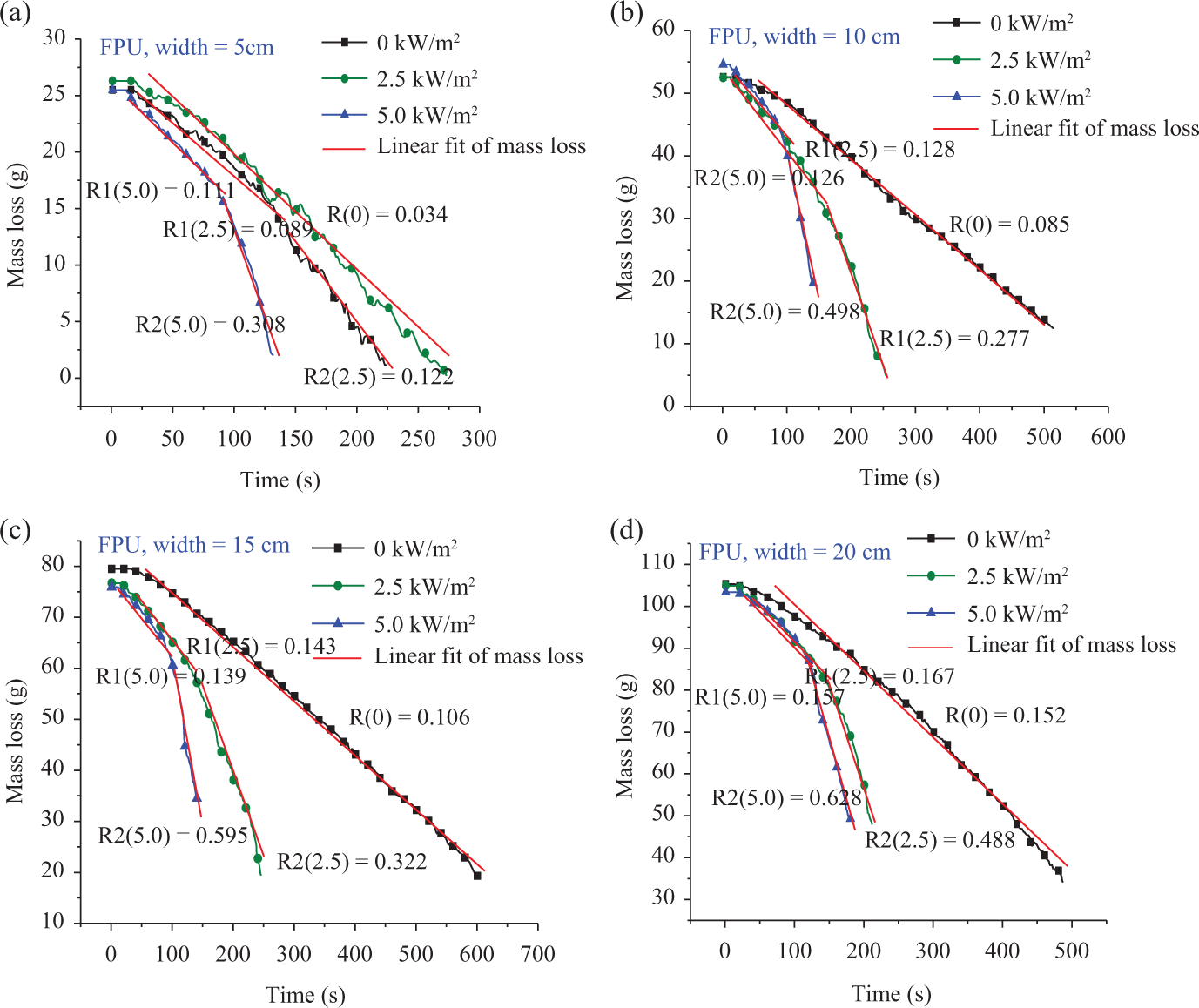
Mass loss rate of FPU sample under variable radiation heat flux. FPU: flexible polyurethane.
Additionally, the mass loss rate was also attributed to the physical structure change of the FPU foam. The surface of FPU was of an irregular honeycomb cellular structure as shown in Figure 2. After the preheating region received irradiance, the cellular filled with air expanded upon heating and formed many bubbles on the surface. As the external radiation heat flux increased, the surface area became larger and received more heat, accelerating the rate of flame spread. As a result, more vaporized fuel was released from the fuel surface and thus higher mass loss rate.
Flame spread rate
The extended simplified theory by Bhattacharjee and West
16
proposed the following correlations for spread rate for forced opposed flow in the thick:

where CBC is a constant, kg is the thermal conductivity in gas, ρg is the density of the gas, cp,g is the specific heat in gas, Tg,c is an appropriate characteristic gas temperature, ks is the thermal conductivity in solid, ρs is the density of the solid, cp,s is the specific heat in solid, and Ts is the solid surface temperature. The flame temperature Tf, or the vaporization temperature Tv, can be hypothesized as the appropriate characteristic temperature in evaluation of spread rate.
Since the flame spread downward at most situations, the angle between the flame sheet and sample surface was large. Thus the radiative heat transfer from the flame to the sample surface was small. Most of the radiative heat was transferred to the sample cross section. The preheat effect of the pool fire front was mainly determined by the external radiation heat flux. Figure 5 gives the shape of flame frontier under various radiation heat flux. It shows that as the radiation heat flux increases, the molten liquid layer region become larger which induced by increasing flame front spread rate. Figure 6 shows the average downward flame spread rate. It is found that the flame propagation is an accelerated process when FPU is exposed to external radiation source, and the effect of radiation is more obvious compared with the fuel width, which had has little effect on it. As shown in equation (1), the numerator is the heat feedback to the sample surface. Since the heat feedback term is a squared growth, the flame spread velocity shows much dependence on the external radiation. The heat feedback increased with the increasing of the external radiation. The term
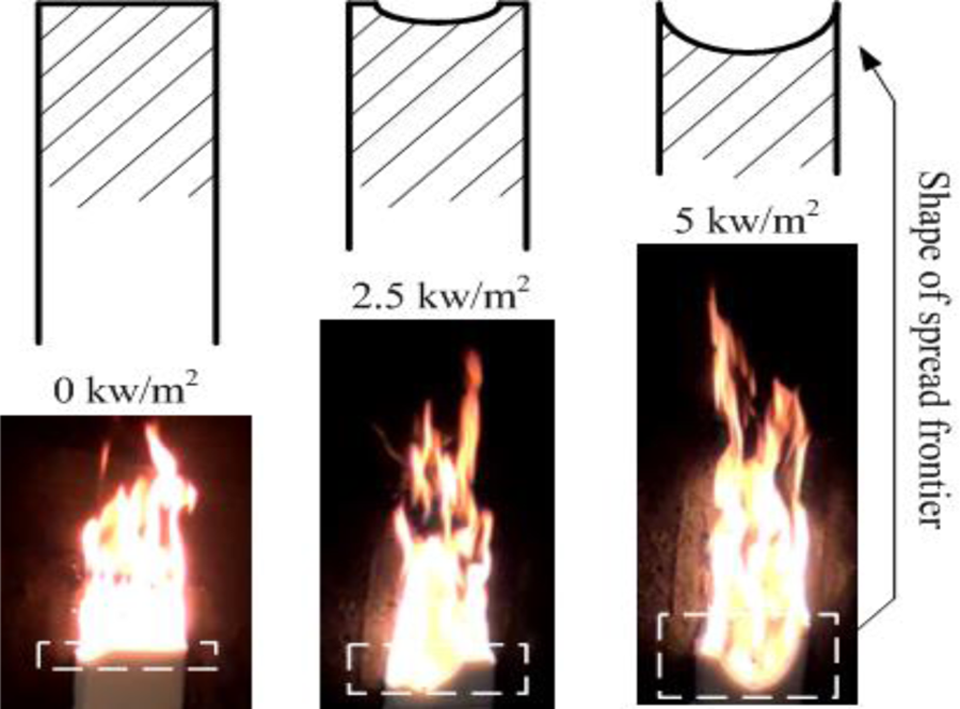
Shape of spread frontier of downward flame over FPU with a width of 10 cm under variable external radiation heat flux. FPU: flexible polyurethane.
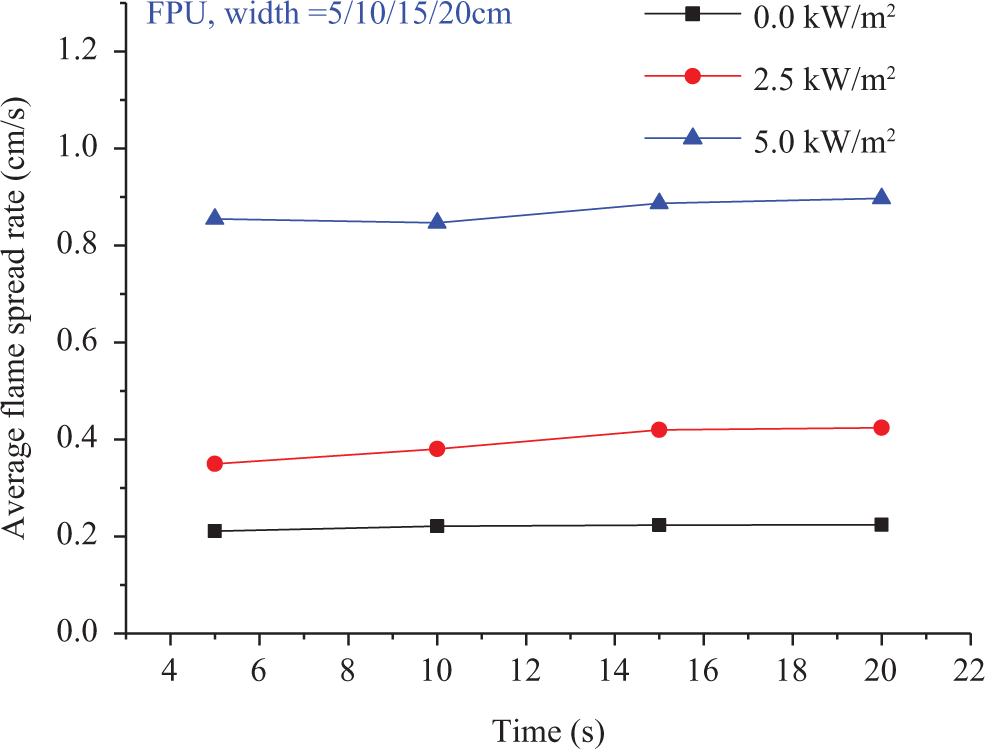
Average flame spread rate under variable radiation heat flux.
Flame height
Flame height is obtained by digital image processing with 60-s sequenced flame images from the steady burning state, which is based on the mean flame height definition of Zukoski et al.
17
Delichatsios et al.
18
proposed a correlation to predict the flame height:
Figure 7 shows the correlations between experimental flame height and external radiation heat flux. It shows that the flame height is influenced by the combined effect of external radiation heat flux and width of fuel. With the increase of external radiation and width of fuel, the amount of air entrainment increases as well. The subsequent increase of initial air momentum in the pyrolysis in turn drives up the upward movement rate of air vaporized fuel mixture. In addition, the temperature near the combustion area goes up with the presence of external radiation effect and the flame height stretches further because of the buoyancy effect, which occurs when the inside and outside of the combustion region are different in density. Firstly, when the external radiation heat flux is negligibly small, the flame height is mainly affected by fuel width. The fuel diffusion and heat conduction to the board side will be less strong as the fuel becomes wider. Therefore, compared with the narrower fuel, the wider fuel contains a higher level of heat at the middle line. Secondly, when the external radiation heat flux exceeds a certain level, the relative influence on flame height is significant, which is mainly due to the result of more complete combustion of fuel.
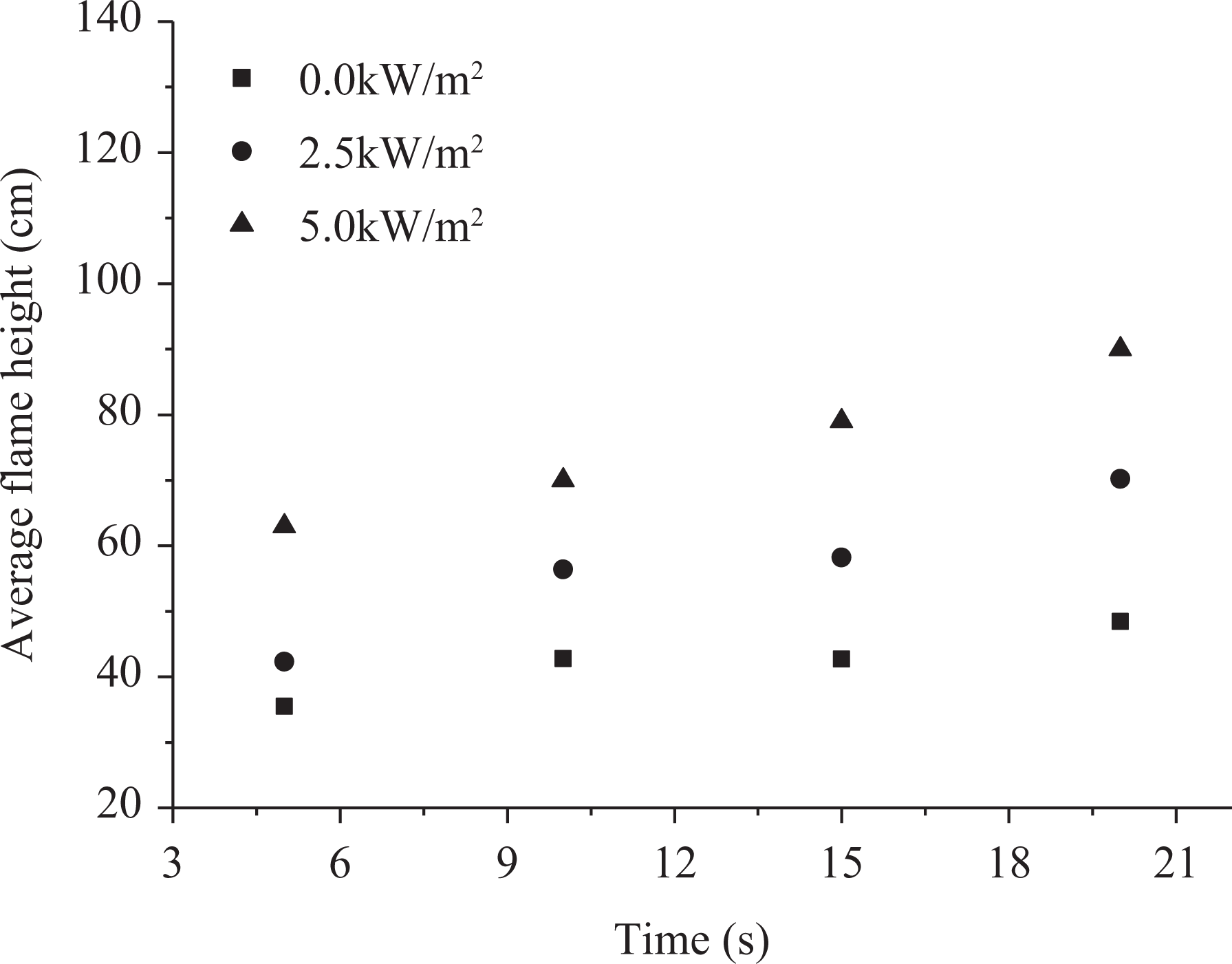
Correlations between flame height and external radiation heat flux.
It is observed that combustion cross section of the molten layer is similar to linear pool fire. The flame height of pool fire has been predicted by Hasemi and Nishihata.
23
The flame height of an axisymmetric pool fire is typically expressed in equation (2).
24
The typical correlation of H for a rectangular pool fire was expressed using equation (3).


where D is the equivalent burner diameter, l is the width of the fuel, δ is a coefficient based on experimental data, where approximately δ = 0.77–1.18. Considering the reasonable similarity, the flame height of FPU board here is predicted using equation (3).
Figure 8 shows the correlations between ratio
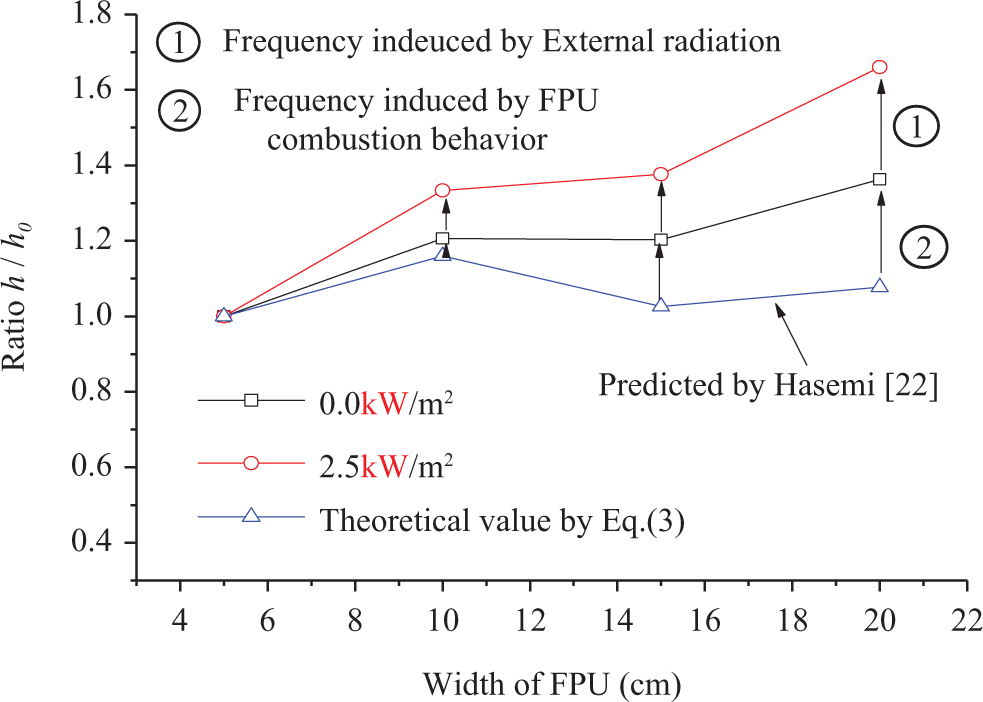
Correlations between ratio h/h0 and width of FPU. FPU: flexible polyurethane.
Flame pulsation frequency
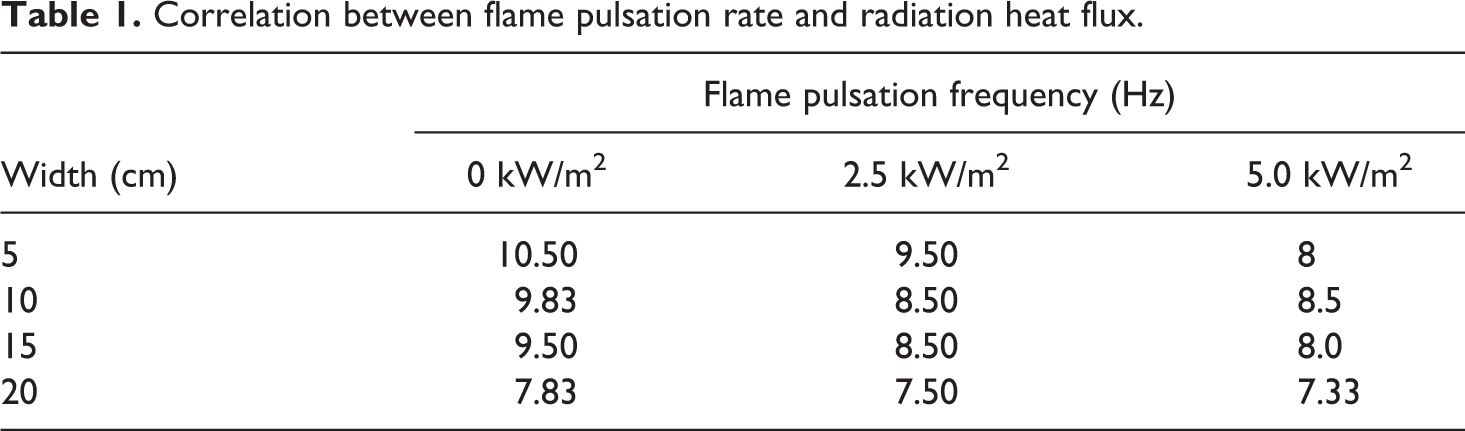
Correlation between flame pulsation rate and radiation heat flux.

where C is a proportion factor. As the external radiation increase, the flame frequency f induced by the decreased density
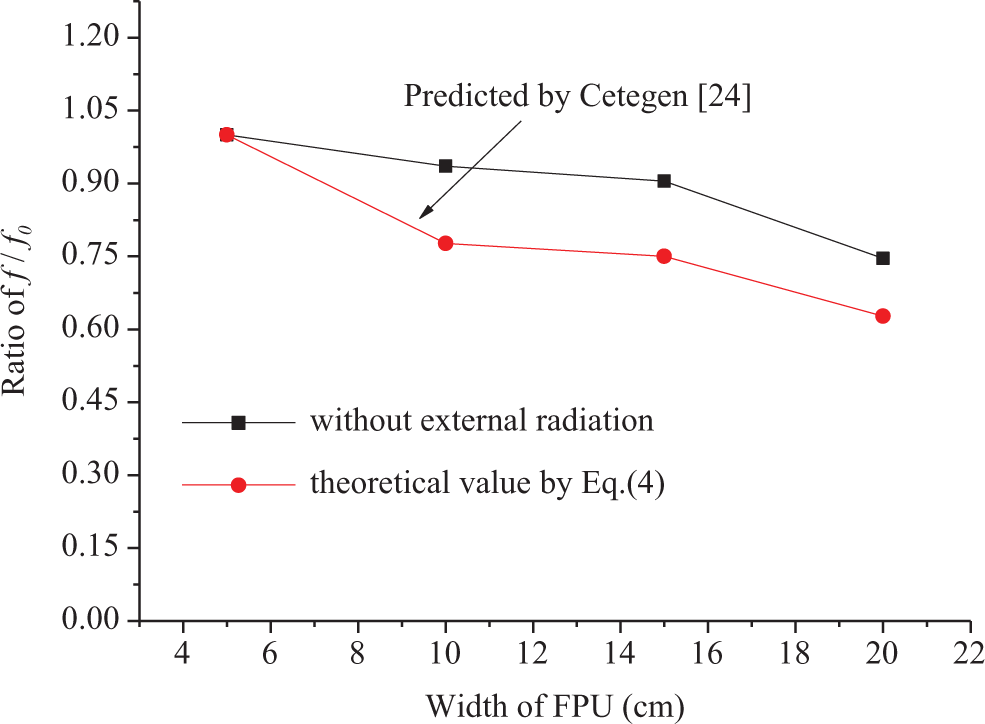
Correlations between ratio f/f0 and width of FPU. FPU: flexible polyurethane.
Conclusions
Experiments were conducted to investigate on the influence variable external radiation heat flux on FPU flame spread behaviors through a flame spread setup with electrical heater. The downward flame propagation characteristics of FPU samples are analyzed based on the experimental data. The conclusion remarks are as following:
The downward flame rates of FPU will increase for the larger external heat flux. The mass loss rate of downward burning FPU are also larger when exposed to external heat flux. Both external radiation heat flux and width of fuel play an important role in the flame height during the flame spread of FPU. The flame height will increase with the radiation heat flux and fuel width. The theoretical prediction data on the flame height of FPU using linear pool fire is a little smaller than the experimental data. The flame spread rate is influenced by the heat conduction from the pyrolysis region. The presence of external radiation drives the surface temperature to reach the ignition temperature faster and accelerates the flame spread process. External radiation has a more significant influence on downward flame spread than fuel width. The flame pulsation induced by increasing density difference is weakened for smaller external radiation heat flux and fuel width. The experimental results fit well with the flame frequency calculated with theoretical rectangular pool fire equations.
Footnotes
Declaration of Conflicting Interests
The author(s) declared no potential conflicts of interest with respect to the research, authorship, and/or publication of this article.
Funding
The author(s) disclosed receipt of the following financial support for the research, authorship, and/or publication of this article: This work was supported by National Natural Science Foundation of China (51106147, 51476157, 51120165001), National Basic Research Program of China (973 Program: 2012CB719701), and Huaqiao University Scientific Research Foundation (14BS305). The authors thankfully acknowledge all these supports.