




Abstract
Poly(4-methyl-1-pentene) (PMP)/elastomer (ethylene–propylene–diene monomer (EPDM), polyolefin elastomer (POE), and styrene–butadiene–styrene (SBS)) blends with various mass fraction were prepared using a twin-screw extruder in the melt state. Mechanical properties, the fracture morphology, melting and crystallization behavior, and melt flow rate of PMP and PMP/elastomer blends were investigated by universal testing machine, differential scanning calorimeter, scanning electron microscopy, and melt flow indexer. The effect of elastomer and their content on the microstructure and properties of the PMP/elastomer blends were discussed. The results showed that EPDM, POE, and SBS all had good effect on PMP toughening. Therein, PMP/POE blends had the best comprehensive property, which was attributed to the comprehensive effects of phase morphology, molecular chains tangle, and the degree of crystallinity of PMP phase.
Keywords
Introduction
Isotactic poly(4-methyl-1-pentene) (PMP) is widely used in many industry and medical applications such as automotive parts, separating membrane, and sterile containers because of its special properties such as high transparency, low density, high chemical stability, high melting temperature, low dielectric constant, and high permeability. 1 –6 However, for many applications such as cables and wires, its flexibility and toughness is deficient.
Up to now, the crystallization behavior and theory of PMP have been well studied, 7 –10 whereas there are very few reports about the practicable properties of PMP modified by other polymers such as toughness. In our previous study on PMP/polypropylene (PP) blends, we have found that PMP and PP have a good compatibility. 11 There was no obvious phase-separated morphology on the notched impact cross section of PMP/PP blend. Due to the similar molecular chains structure and the good compatibility of PMP and PP, we took the toughening modification of PP as reference to modify PMP with various thermoplastic elastomers.
A great deal of research has been carried out to improve the impact strength of PP by blending with elastomer such as ethylene–propylene–diene terpolymer (EPDM), polyolefin elastomer (POE), and styrene–butadiene–styrene block copolymer (SBS). 12 –15 Because of the similar molecular structure with PP, EPDM has been widely used in PP toughening. In order to improve the interfacial adhesion of EPDM and PP, Byoung 16 synthesized a kind of triblock copolymer, (PP-g-MAH)-co-[PA-6,6]-co-(EPDM-g-MAH), which brought about a physical interlocking between the blend components and imparted a compatibilizing effect to the PP/EPDM blends. It can notably improve the low-temperature impact strength of PP with 0.5 wt% triblock copolymer. Shen et al. 17 improved the interfacial adhesion of EPDM and PP via dynamically vulcanization with dicumyl peroxide (DCP). Their results showed that PP/EPDM-grafted copolymer formed during the process. And, the number of EPDM particles was increased, accompanied with a reduction of particles size and uniform dispersion, which lead to the increasing of the fracture toughness of PP/EPDM. Ying et al. 18 indicated that POE and PP are partially compatible. Shen et al. reported that even dispersion of POE in PP matrix could improve the impact strength remarkably. 19 Chen and Ye 20 found that addition of high-density polyethylene (HDPE) resulted in an increasing wide stress plateau and more ductile fracture behavior. The elongation at break and impact strength could increase to 780% and 63 kJ m−2 at 20 wt% HDPE loading, respectively. Shashidhara and Devi showed that PP/SBS blends had much higher impact strength and elongation at break than pure PP. 21 Dynamically vulcanized PP/SBS shows a noticeable rise on both toughness and elongation at break. 22 From all above, these elastomers can strongly improve the impact strength of PP, in which POE comes to be a better choice because of its noticeable cost performance advantages and more efficiency of toughness. 23 Till date, to the best of our knowledge, so far no studies have been published on the system of toughening PMP with thermoplastic elastomers.
This work focused on the blends of PMP with EPDM, POE, and SBS. The influences of these elastomers on the morphology, crystallinity, mechanical properties, and processability of the blends were investigated.
Experimental
Materials
The isotactic PMP (RT-18, Mitsui Petrochemical Industries, Japan) was used as the matrix polymer. POE (ethylene–octene copolymer, ENGAGE™ 8150, Dow Chemical Company, Midland, Michigan, USA), EPDM (3745P, DuPont, Front Royal, Virginia, USA), and SBS (oil-extended YH-792, Sinopec Baling Petrochemical Corporation, Uniontown, Ohio, USA) were selected as the modifiers.
Specimen preparation
PMP/elastomer blends of various mass fraction (5, 10, 15, and 20 wt%) were prepared by melt blending in a twin-screw extruder with a screw of 21.7 mm in diameter and length/diameter ratio of 36. The extrusion temperature of the feeding zone/transporting zone/melting zone were set as 180°C/245°C/245°C. The rotor speed is 100 r min−1. The extrudates were subsequently pelletized.
Mechanical tests and characterization
Differential scanning calorimeter
The crystallization behaviors and miscibility of the blends were measured with a TA DSC Q20 DSC (TA Instruments, New Castle, Delaware, USA) equipped with a liquid nitrogen cooling system. About 5 to 10 mg of each sample was encapsulated in aluminum pans and heated up to 260° for 20 min. For nonisothermal crystallization, the melt were then cooled to 30°C with a cooling rate of 10°C min−1 for crystallization behavior study; the second heating were set to 260°C with a heating rate of 10°C min−1 to study the melting behavior. The melting transition temperature (T m) and the crystallization temperature (T c) were determined as the maximum of the corresponding transition peaks. All measurements were carried out in a nitrogen atmosphere with an intercooler connected to keep stable control.
Mechanical tests
Tensile, flexural, and notched impact bars were molded at 250°C using a single-screw horizontal injection-molding machine (SHJ-20). Tensile properties were measured with a universal testing machine (Zwick/Roell Z005, Zwick Roell Testing Machines Zwick Roell Testing Machines, Chennai, Tamil Nadu , India) according to ASTM D638 standard at a crosshead speed of 100 mm min−1. Standard flexural tests (ASTM-D790) were carried out at a crosshead speed of 2.0 mm min−1 and with a span length of 64 mm. Notched Izod impact strength was measured with a universal impact testing machine (ZBC-50, China Shenzhen SANS Testing Machine Co. Ltd). The thickness of the Izod impact specimens was 4 mm, and the impact energy was 5.5 J. All tests were carried out at room temperature. Six measurements were carried out for each data point in all mechanical property tests.
Scanning electron microscopy
The blend morphology was characterized with a model 505 scanning electron microscopy (Philips, Holland). After the notched impact test, fractured samples were remained for morphological observation. The fractured surfaces were coated with gold–palladium alloy in order to make samples electric conductive before observation.
Melt flow rate
The melt flow rates of blends were measured with a melt flow indexer (Shenzhen Sans Testing Machine Co. Ltd, Shenzen, China). The pelletized sample was heated to 240°C with 3800 g loaded and a 2.095 mm die diameter.
Results and discussion
The SEM images of notched impact fractured surfaces of PMP/elastomer blends with different mass fraction are illustrated in Figure 1, in which all elastomers formed the dispersed phase as particles and the major composition (PMP) formed the continuous phase as matrix. Interfacial tension has great affection on morphology of the blends. 24 The distinct biphasic morphology in all graphs reveals the poor adhesion of the interfaces between PMP and elastomers. The particle size of elastomers in blends with the 5 wt% elastomer content is smaller (1–2 μm) than that of the blends with 10 wt% of elastomers. When compared with PMP/POE, the size of particles in the blends of PMP/EPDM is relatively larger, which demonstrate that the POE is easier to disperse in PMP than EPDM. For the blends of PMP/SBS, the dispersed elastomer particle is much larger and more irregular, probably because of the worse dispersion and compatibility between PMP and SBS.
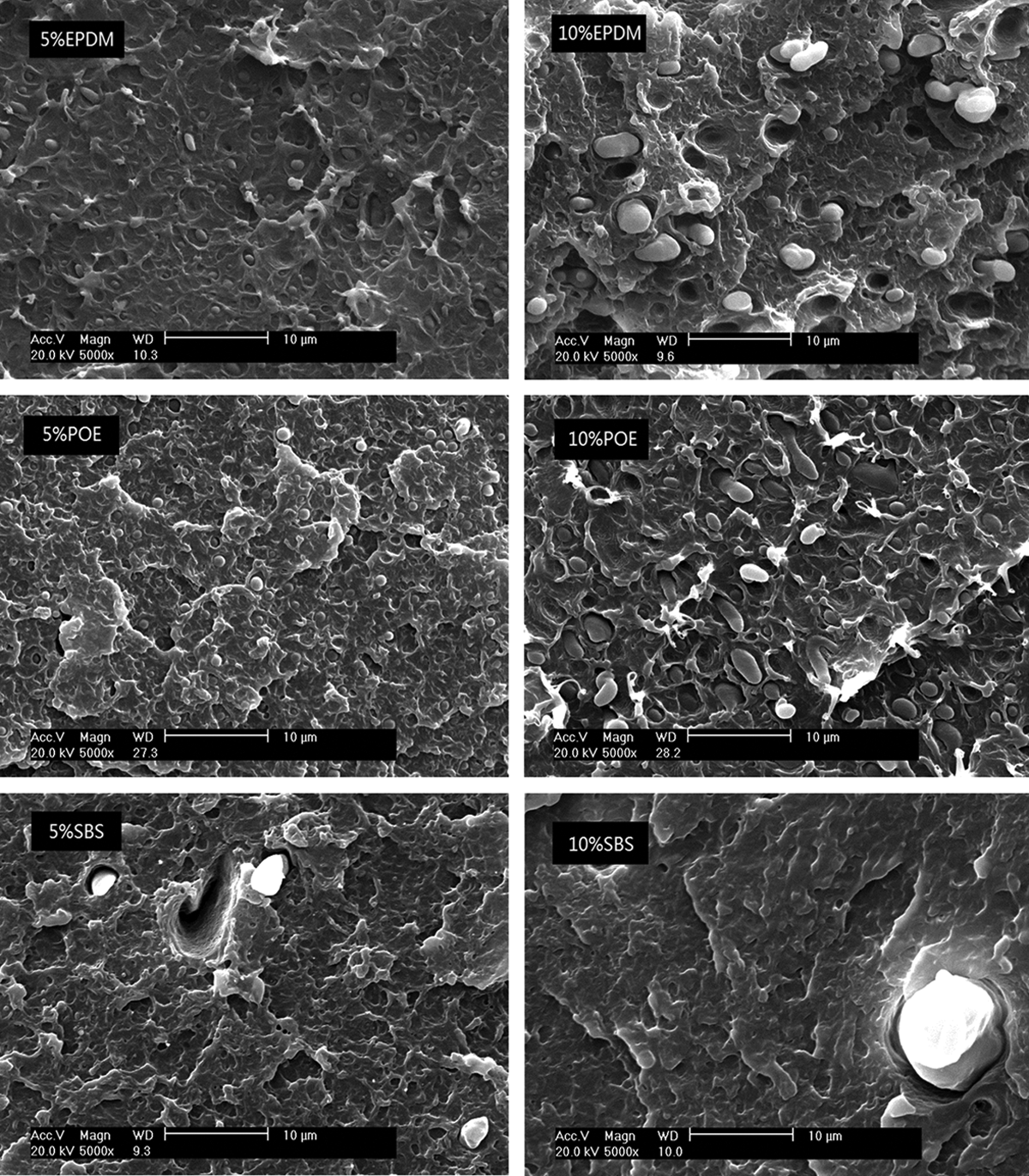
SEM images of PMP/elastomer blends. SEM: scanning electron microscopy; PMP: poly(4-methyl-1-pentene).
There is a large number of reports that as long as the majority of particles are greater than such a critical size of 0.5 μm for craze initiation and well below 2 μm, a smaller average elastomer particle size would imply a larger number of potential craze initiation sites, comparing with the same volume fraction of elastomer phase. 25 The more the craze initiation sites, the more energy of impact will be dispersed. It is also well accepted that the most efficient energy dissipative processes during fracture are those involving large plastic deformation before craze initiation. 26 In the images of the blends in Figure 1, most elastomer particles in PMP/EPDM and PMP/POE blends were 1–2 μm in size, while they were much bigger in PMP/SBS blend. We could deduce that the impact strength of PMP/EPDM and PMP/POE might be better than PMP/SBS.
Figures 2 and 3 show the cooling and heating curves of neat PMP and PMP/elastomer blends, respectively. The corresponding transition temperatures, enthalpies, and crystallinities are shown in Table 1. The blends with both EPDM and POE have higher crystallization temperatures than neat PMP, while PMP/SBS blends presented oppositely. The possible reason is that the flexible segments of POE and EPDM are beneficial to the movement and arrangement of PMP molecular chains to crystallize, resulting in acceleration of PMP crystallization. The crystallization peak of PMP in PMP/SBS blends decrease to 210.55°C when the content of SBS is 10 wt%. In Figure 3, we can also observe a distinct trend in heating thermogram corresponding to the crystallization. The more the SBS is contained, the more departure of PMP melting peak appeared. The melting temperature of PMP (T m, PMP) with 10 wt% SBS shifted to 231.25°C, lower than 233.27°C of neat PMP, which might be resulting from the lower perfection of crystal structure and lower crystallinity of PMP. This phenomenon might probably be caused by poor compatibility between SBS and PMP. On the contrary, the melting temperatures of PMP in blends with both EPDM and POE only have a little change to the higher temperatures, which shows that PMP in the blends have relatively more perfect crystal phase.
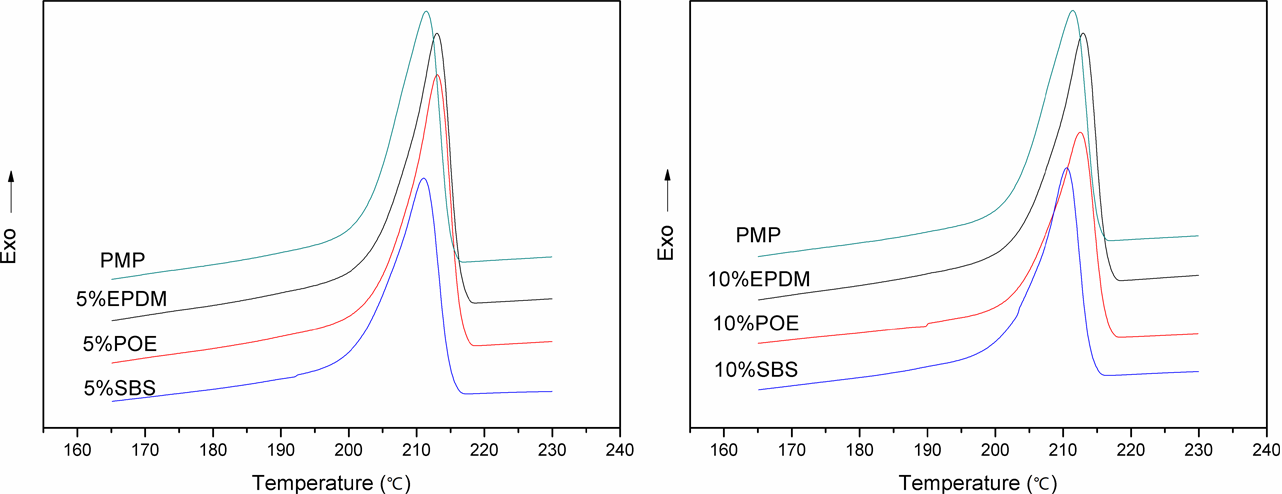
DSC cooling curves of neat PMP and PMP/elastomer blends. DSC: differential scanning calorimetry; PMP: poly(4-methyl-1-pentene).
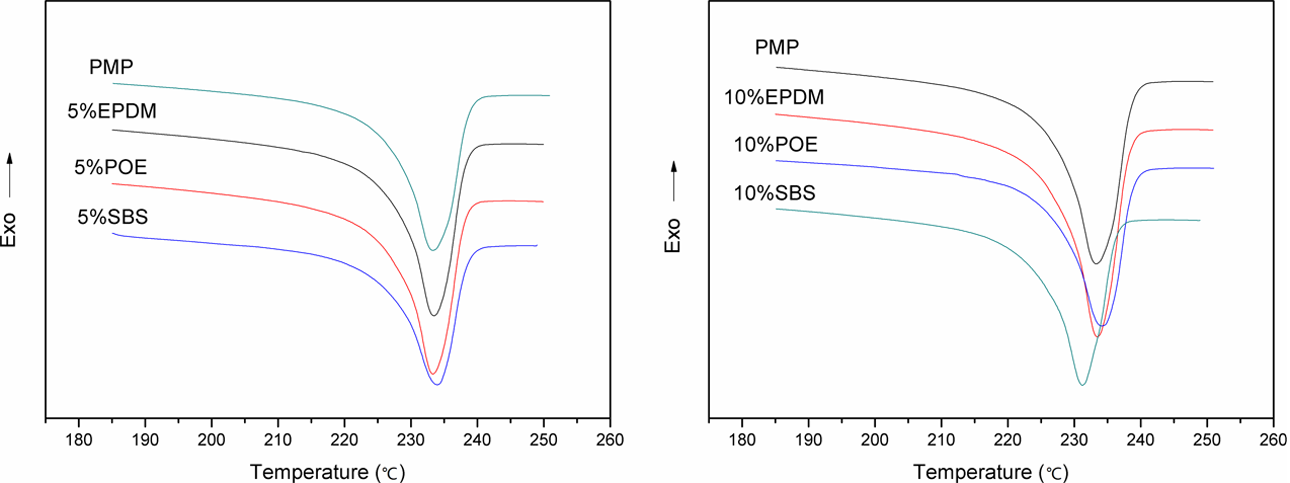
DSC heating curves of neat PMP and PMP/elastomer blends. DSC: differential scanning calorimetry; PMP: poly(4-methyl-1-pentene).
DSC data of PMP and PMP/elastomer blends.
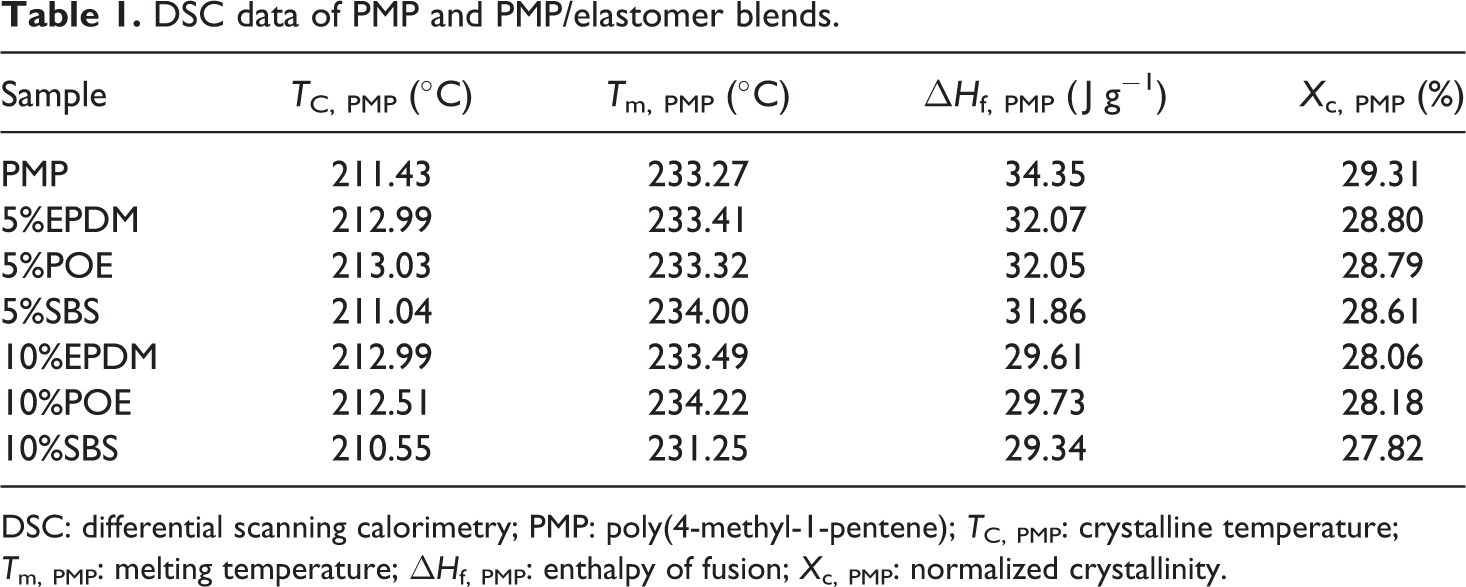
DSC: differential scanning calorimetry; PMP: poly(4-methyl-1-pentene); T C, PMP: crystalline temperature; T m, PMP: melting temperature; ΔH f, PMP: enthalpy of fusion; X c, PMP: normalized crystallinity.
The normalized crystallinity (X
c, PMP) of neat PMP and the blends are calculated with the DSC curves using the following formula
27
:

where
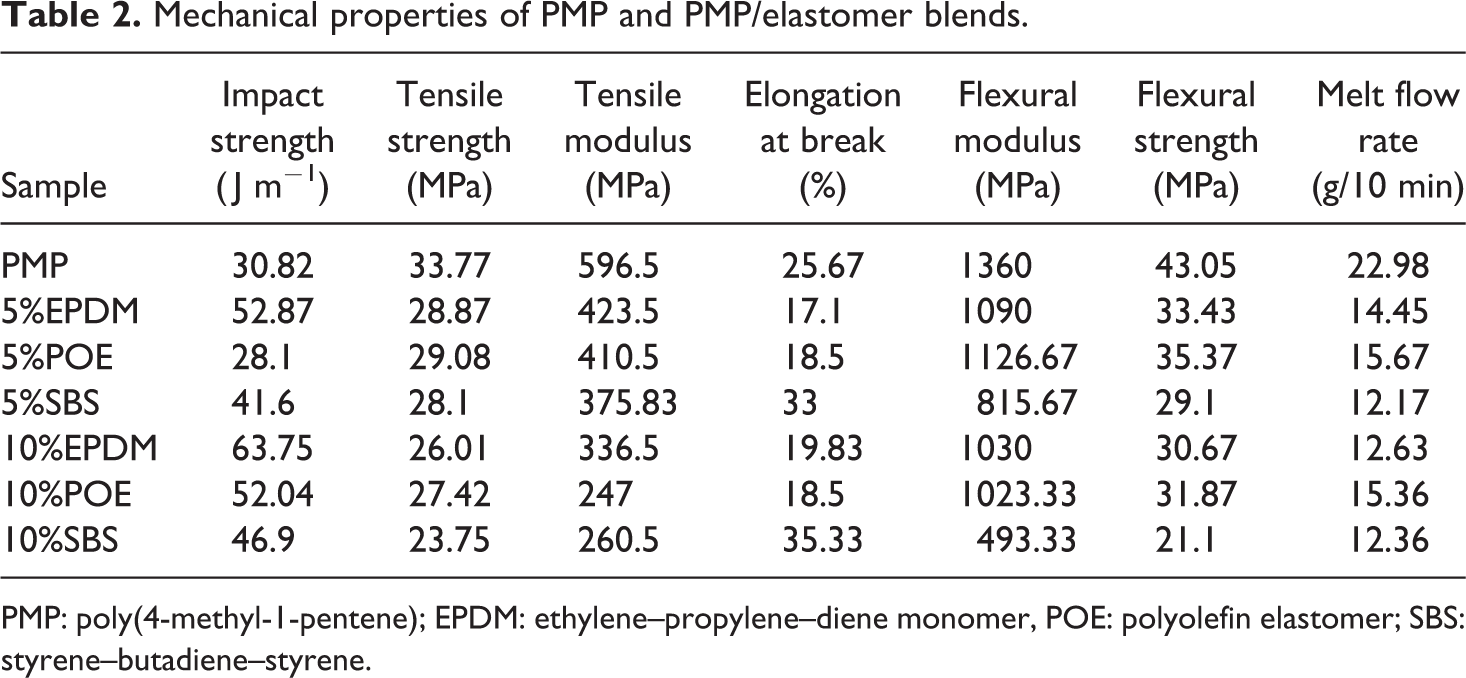
Table 2 shows the mechanical properties of neat PMP and PMP/elastomer blends with 5 and 10 wt% elastomers. It shows that all the elastomers have improved the impact strength of PMP, which reaches the highest value of 63.75 J m−1 in the blend with 10% EPDM, 107% higher than pure PMP. The reason is that dispersed elastomer phase absorbed most of the impact energy and induced large amount of crazes, which prevented other crazes to develop greater. 29 Besides the enhanced impact strength, the elongation at break of blends is another important parameter to evaluate the toughness. But except for PMP/SBS blends, all the other blends have shown lower elongation at break values than that of neat PMP, even increasing the content of POE or EPDM. The poor values of elongation at break might be caused by the weak interface adhesion between PMP and EPDM or POE we observed in Figure 1 and then generated the stress concentration during the tensile deformation and eventually resulted in fracture. The higher elongation at break of PMP/SBS blends might result from the lowest Shore hardness at 48 of SBS and the fewest stress concentration points in the blends. The Shore hardness of POE and EPDM are 70 and 82, respectively.
Mechanical properties of PMP and PMP/elastomer blends.
PMP: poly(4-methyl-1-pentene); EPDM: ethylene–propylene–diene monomer, POE: polyolefin elastomer; SBS: styrene–butadiene–styrene.
The tensile and flexural strength, tensile and flexural modulus, and melt flow rate of all blends were decreased compared with that of pure PMP. The more the elastomers, the lower the modulus of blends was. Among them, the reduction degree of PMP/SBS is the greatest, especially for the flexural modulus, which reduced to 493.33 MPa when SBS content is 10%, which also caused by the low Shore hardness of SBS. These results showed that ether blends became more flexible with more and softer elastomer.
Conclusions
Mechanical, thermal, melt flow properties, and morphology of PMP/elastomer blends have been studied. Morphological studies showed that compatibility of EPDM and POE with PMP is better than SBS. The particle size of POE in the blends was the smallest. DSC analysis shows that the POE and EPDM promoted the crystallization of PMP, while SBS hindered it. PMP/EPDM and PMP/POE blends have higher impact strength because of better dispersion of elastomers in PMP than that of PMP/SBS. While lower flexural modulus and higher elongation at break of PMP/SBS showed that softness of elastomers have greater effect on the flexibility of the blends. We deduce that the PMP/SBS blends will have good property of toughening if the dispersion of SBS in PMP is improved, which will be studied in the future.
Footnotes
Funding
This research received no specific grant from any funding agency in the public, commercial, or not-for-profit sectors.