




Abstract
Polyolefin elastomer-grafted multiwalled carbon nanotubes (POE-MWCNTs) were incorporated in a polyimide (PI) matrix. The POE shell formed on the MWCNTs improved the dispersion of MWCNTs and enhanced the interfacial adhesion between the PI matrix and MWCNTs, leading to improvements in storage modulus and the glass transition temperature of the composites and enhancement of the electrical properties of PI. Thus, composites with 4–5 wt% POE-MWCNTs showed increased electrical properties by about 60–70% and retained the high impact strength when compared with the neat PI.
Introduction
Polyimide (PI) is widely used in the fabrication of aircraft structures, microelectronic devices, and so on, owing to their special chemical, thermal, and mechanical characteristics. Its insulating nature is a major drawback as electrostatic charge may accumulate on the surface of PI. In addition, the heat generated in electronic devices cannot be easily removed, leading to premature degradation of the material. A surface resistivity in the range of 106–1010 Ω/cm2 can be achieved by adding single-walled carbon nanotubes (CNTs) to PI in order to mitigate the buildup of electrostatic charge. 1,2 In this article, we study an in situ polymerization process of PI with polyolefin elastomer-grafted multi-walled CNTs (POE-MWCNTs) for fabricating composite films in order to study the electrical properties. Their impact properties were also investigated.
The extraordinary properties of CNTs such as electrical conductivity, mechanical strength, thermal conductivity in combination with their high aspect ratio, and low density make them lucrative fillers in polymers especially for conductive polymers and electrostatic dissipative applications. 3
CNTs are excellent conductors, and this makes the CNTs the central elements in composite materials for many electronic applications. They also have high impact strength, which makes them preferable as the composites with desired mechanical properties. 4 The MWCNTs have been used in composite materials to improve the electrical properties while reinforcing the impact performance of the composites. 5 –8 Also, many efforts have been made in exploiting the electrical and mechanical properties of CNT-polymer composites by controlling the orientation of MWCNTs and polymer molecular chains. 9,10 There are two common processing techniques for fabricating the composites. One is to mix CNTs with epoxy which is then cured to form the composite. The other is to disperse CNTs into a polymer solution and casting the solution, and then, removing the solvent to obtain the composite. Melt processing and in situ polymerization are also used. To the best of our knowledge, it is difficult to draw definite conclusions from the literature on electrical conductivity. This is due to the reported level of CNT loading as the percolation threshold varies widely, ranging from less than 1% to over 10%. Two reasons were thought to account for these discrepancies: the CNT bundles were not well dispersed in the polymer matrix and experimental difficulties resulted in an erroneous detection during the onset of electric conduction. 11
It is important for the concentration values admitted by the new compound for which initial values of the polymer’s dielectric properties are acceptable to enable them to be used in various industrial applications. 12 –15 Homogeneous dispersion of CNTs in a polymer matrix reduces interfacial phonon scattering and forms a uniform, electrical conductive network, leading to greatly increased electrical property of polymer/CNT composites. An effective method to promote the dispersion of CNTs in polymer matrix is through chemical functionalization via covalent grafting modification of CNTs. Recent molecular dynamics simulation results indicated that the interfacial electrical resistance is reduced with increasing length and density of the grafting chains. POE is known to have a compact shape, high solubility, low viscosity in bulk and solution, multifunctional groups, and no entanglements compared with linear polymers. It is expected that POE grafted on CNTs increase the electrostatic charge transfer at the polymer matrix-CNT interface, owing to their high grafting densities and good compatibility with the polymer. However, to date, there are very few experimental and/or theoretical studies focused on the effects of POE polymer-grafted CNTs on the electrical property of polymer composites. Furthermore, electrical insulation is an important requirement for electronic packaging materials. Methods to impart high electrical resistivity to polymer/CNT composites are very challenging for relatively high loading of MWCNTs above the electrical percolation threshold.
In this study, we fabricate POE-MWCNT/PI composites and investigate their impact and electrical properties. The effects of the POE shell grafted on the MWCNTs will be evaluated and discussed.
Experimental
Preparation of POE-MWCNT/PI composites
POE-MWCNTs were placed in acetone and dispersed ultrasonically for 1 h at room temperature. Polyimide (PEOT) was subsequently added, and the mixture was ultrasonicated for 1 h, followed by vigorous stirring at 80°C for 1 h to ensure good homogeneity and to allow the acetone to vaporize. The blend was then mixed with N-100 (molar ratio of [OH]:[NCO] was 1:1.2) and dibutyltin dilaurate was added as the catalyst; The solution was degassed to remove the trapped air bubbles. Finally, the mixture was cast in steel molds and cured at 90°C for 24 h. Disc-like specimens with a diameter of 100 mm and thickness of 2 mm were prepared. The amount of the POE-MWCNTs added was 4 and 5 wt%, that is, the loading of MWCNTs in the PI matrix was 4 and 5 wt% since the grafted-POE on the surface of MWCNTs is 4–5 wt%. For the control experiments, neat PI and POE-MWCNT/PI composites were prepared under the same conditions, and the loading of MWCNTs in PI was kept at 4 and 5 wt%, respectively.
Measurements
The measurements were observed using a transmission electron microscopy (Tecnai G220 electron microscope; FEI Co., the Netherlands) at 20.0 kV. Scanning electron microscopy (SEM) was conducted to observe the composite surface fractured in liquid nitrogen on a Quanta 200 environmental scanning electron microscope (FEI Co., the Netherlands) to examine the dispersion of MWCNTs in the composites. Dynamic mechanical analysis was measured using a Q800 dynamic mechanical analyzer (DMA, TA Instruments Co., New Castle, DE, USA) in the dual-cantilever mode at a frequency of 1 Hz, oscillation amplitude of 5 μm, and temperature range of 50–250°C at a heating rate of 5°C/min. Samples measuring 33 × 10 × 2 mm3 were directly cut from the disk-like specimens. Thermogravimetric analysis (TGA) was performed on a Pyris1 TGA (Perkin-Elmer Inc., Santa Clara, California, USA) instrument heated from room temperature to 600°C at a heating rate of 10°C/min in argon (flow rate of 20 mL/min). Cast disc-like specimens with a diameter of 100 mm and thickness of 2 mm were used to test the thermal conductivity and volume electrical resistivity with a HC-074 heat-flow meter (EKO Instrument Co., Japan) according to ASTM C518–02, and a plate electrode type ZC36 high resistance meter (Shanghai Cany Precision Instrument Co., China) according to GB/T 1410–2006. The reported results represented the average values from five samples.
Results and discussion
Tensile and impact strengths
Tensile properties were measured on a universal testing machine SANS-CMT5105 (Shenzhen Sans Testing Machine Co. Ltd, China), according to GB/T1040.2/1A-2006 (ISO527-2/1A). The impact strength of unnotched specimens (5.0 × 0.6 × 0.4 cm3) was studied on a Charpy tester (Shenzhen Kaliqiang Testing Instuments Co. Ltd., China), according to GB/T1043-93(ISO179). In the tensile and impact tests, five specimens were tested for each sample composition.
The impact resistance of a composite is the measure of the total energy dissipated in the material before final failure occurs. Figure 1 shows the impact strengths of MWCNT-reinforced PI composites. The MWCNT fiber-reinforced laminate showed a substantial improvement compared with the control. This is attributed to the MWCNTs that enhanced the interlocking ability of the fiber matrix interface, allowing for improved energy absorption during impact loading. It was observed that the impact properties of the MWCNT fiber-reinforced composite were 30% greater than the neat PI.
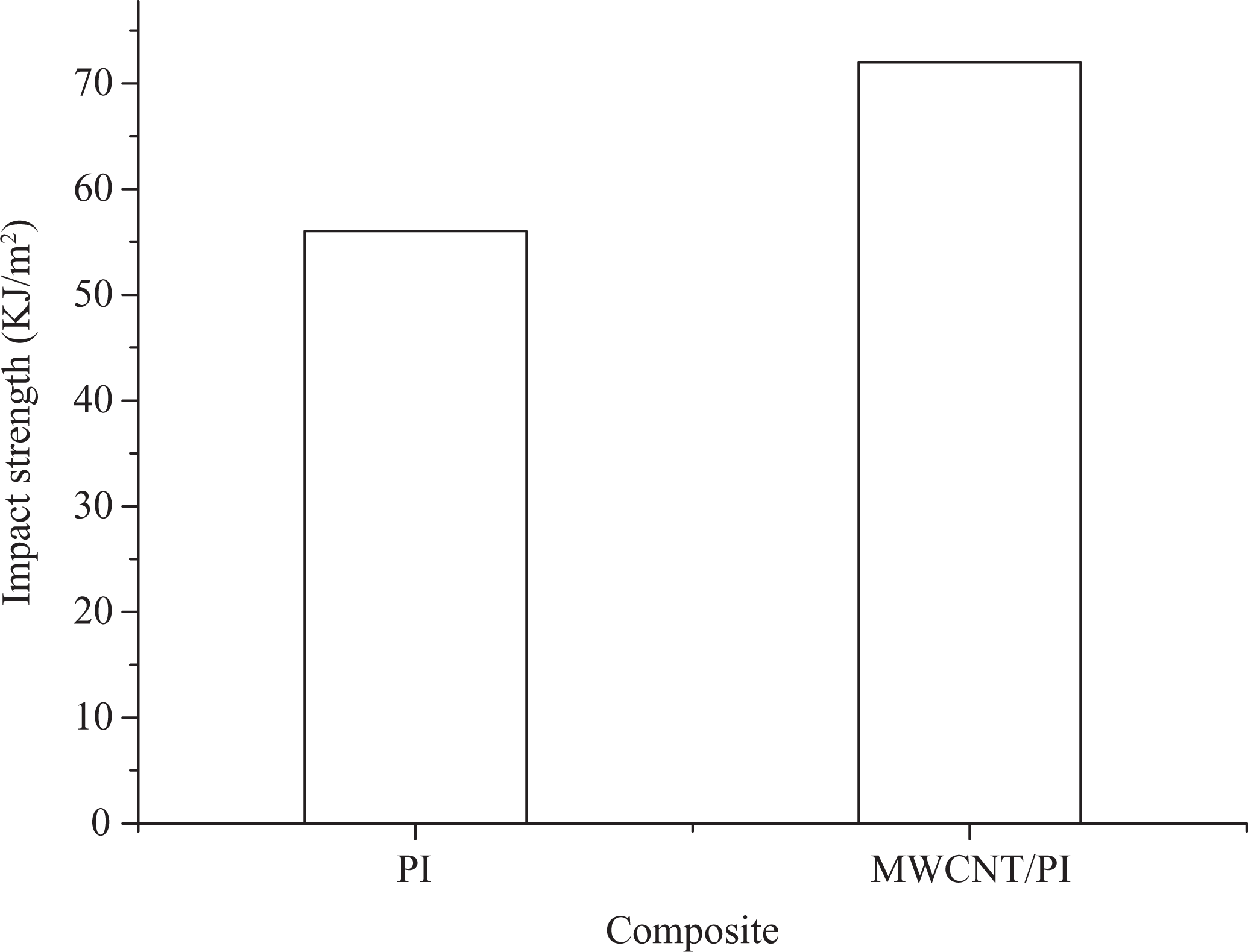
The impact strength of MWCNT /PI composite. MWCNT: multiwalled carbon nanotube; PI: polyimide.
Figure 2 shows the impact strength of POE-modified MWCNT/PI composites. Generally, the impact strength was significantly improved by the introduction of POE. The best impact performance was observed when the POE content was 5%, with the impact strength improved by approximately 249%. The spherical POE particles can absorb energies by deformation and mutual movement with the matrix. When the impact force is applied, they absorb energy and have a synergistic effect with the matrix. In addition, because of the strong mutual interaction between the POE particles and the MWCNT/PI matrix, obvious plastic deformation existed in the fracture surfaces of POE-modified MWCNT/PI composites (Figure 3), which further improved the impact strength. Similar to the tensile strength, a maximum existed for impact strength at a POE content of 5%, which indicated that a small quantity of POE could improve the mechanical strength significantly.
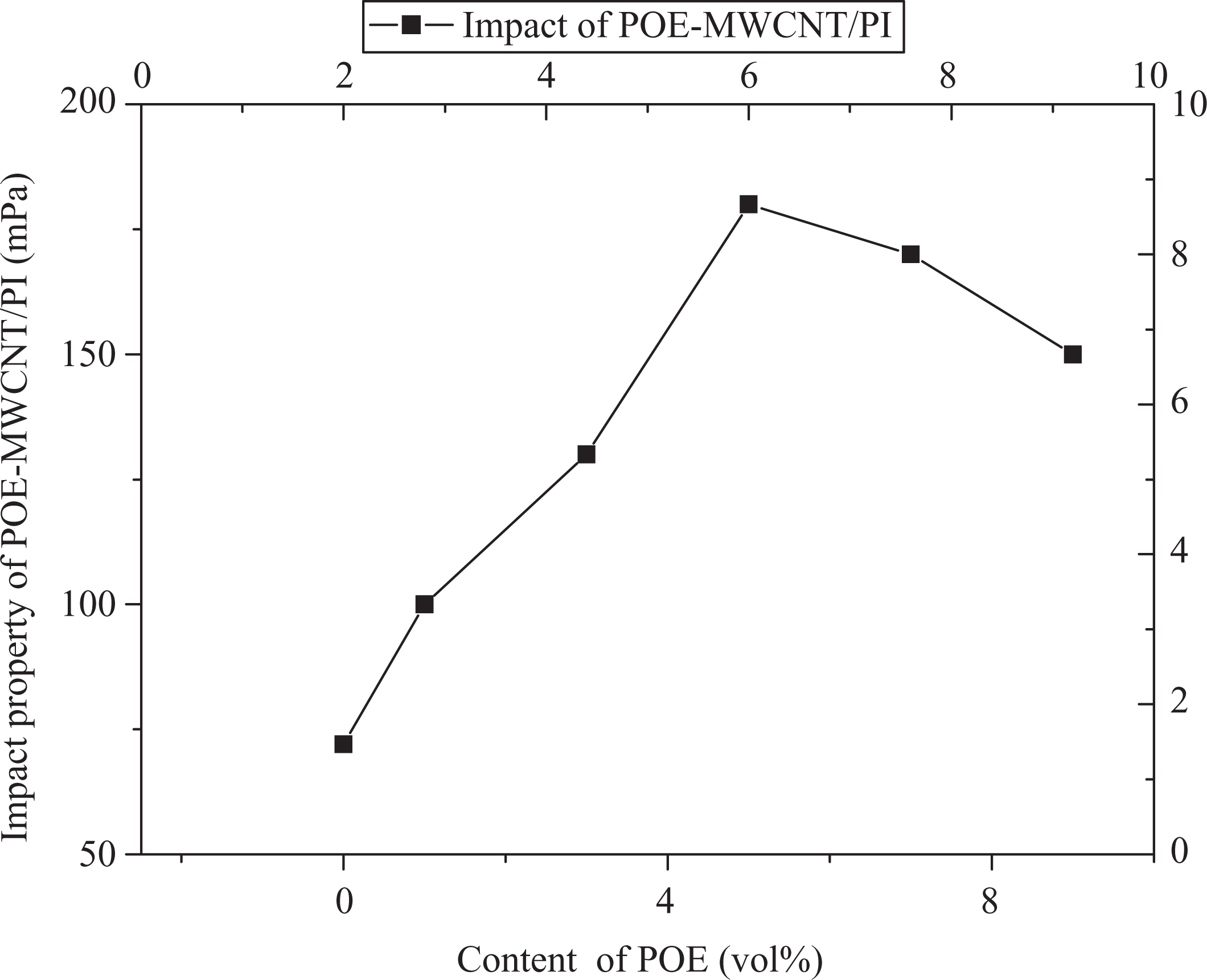
The impact property of different contents of POE-grafted MWCNT/PI. POE: polyolefin elastomer; MWCNT: multiwalled carbon nanotube; PI: polyimide.
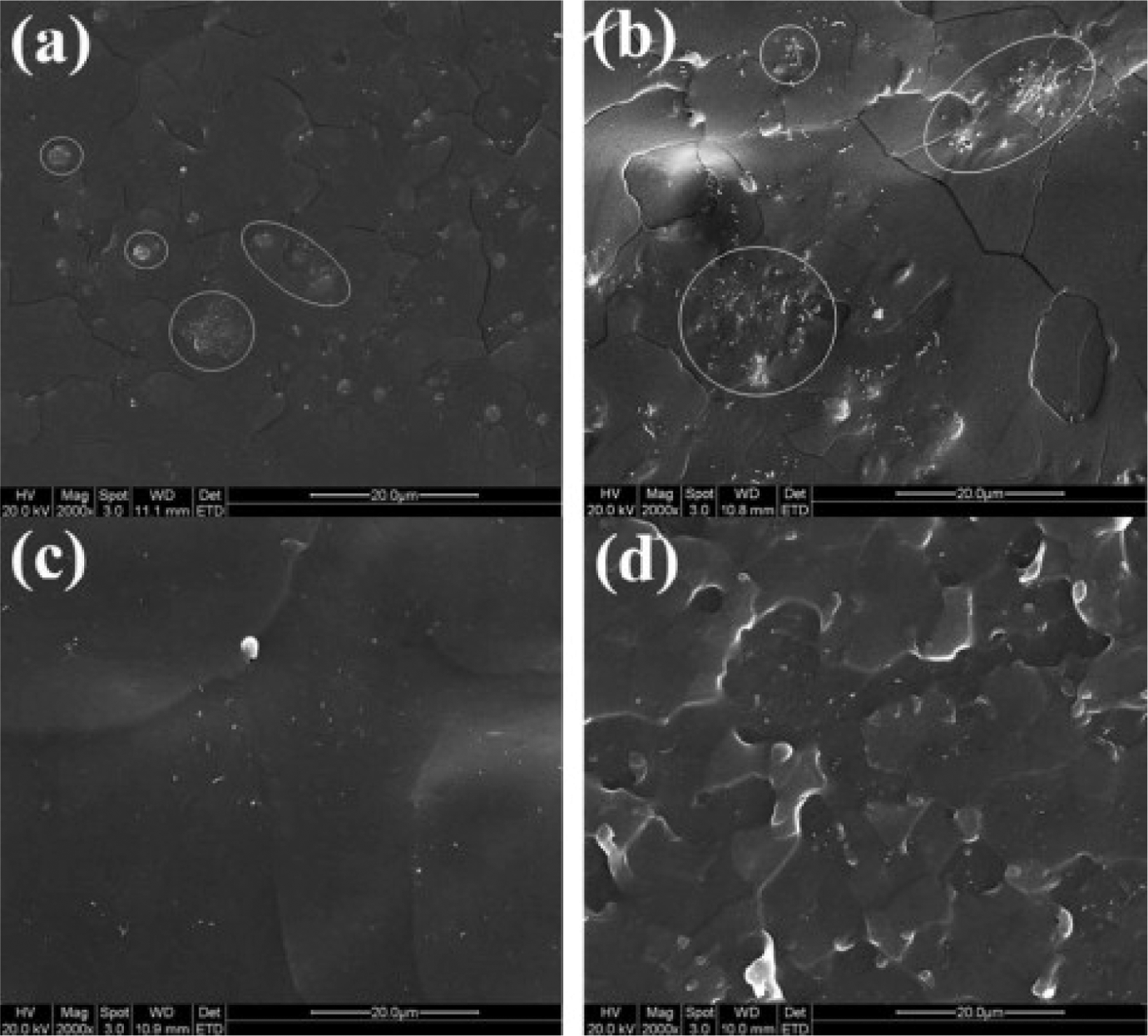
The fracture surfaces of POE-modified MWCNT/PI composites. POE: polyolefin elastomer; MWCNT: multiwalled carbon nanotube; PI: polyimide.
Morphology and interfacial interaction of POE-MWCNT/PI composites
Figure 3 shows the SEM morphologies of the impact fractured composite surfaces. It can be seen that the unmodified MWCNT/PI surface was relatively smooth, on which limited plastic deformation can be observed (Figure 1(a)). However, two distinct phases and obvious plastic deformation were found on the surfaces of MWCNT/PI composites modified with various amounts of POE (Figure 1(b) to (d)). The POE-MWCNTs particles were relatively uniformly distributed throughout the matrix. In the two-phase system, the size of the spherical POE polymer particles is almost proportional to the amount of POE.
MWCNTs tend to aggregate in the PI matrix, and the interfacial adhesion between PI and MWCNTs is weak owing to the high surface energy and chemical inertness of MWCNTs (Figure 3(a) and (b)). However, POE-MWCNTs are uniformly dispersed in the PI matrix as shown in Figure 3(c) and (d). This is because the nanosized POE shell on the surface of MWCNTs enhances the compatibility between PI and POE-MWCNTs, owing to the similar structure of POE and PI. So, it leads to strong interfacial adhesion between MWCNTs and the PI matrix.
In contrast, a nanometer-thick POE shell on the surface of MWCNTs, as in this work, enhances the confinement effect of MWCNTs on the mobility of PI segmental chains. This is a direct result of the homogeneous dispersion of POE-MWCNTs in PI matrix and the improvement in interfacial interaction between PI and POE-MWCNTs.
Electrical resistivity of POE-MWCNT/PI composites
The percolation network formation responsible for low resistivity values is strongly connected with the dissolution of primary agglomerates and a good dispersion and distribution of the MWCNT. Agglomerates not dispersed during the mixing procedure reduce the amount of individualized MWCNT available for the network formation.
Figure 4 shows the electrical resistivity values of neat PI and its composites. The volume electrical resistivity of neat PI is 2.5 × 10¹⁴Ω cm. Only 2 wt% MWCNTs decreases sharply its volume electrical resistivity by 5–6 orders of magnitude. With further loading to 5 wt%, the electrical resistivity of POE-MWCNT/PI composite decreases very slightly. This indicates that an electrical percolating network is formed at a loading less than 5 wt%.
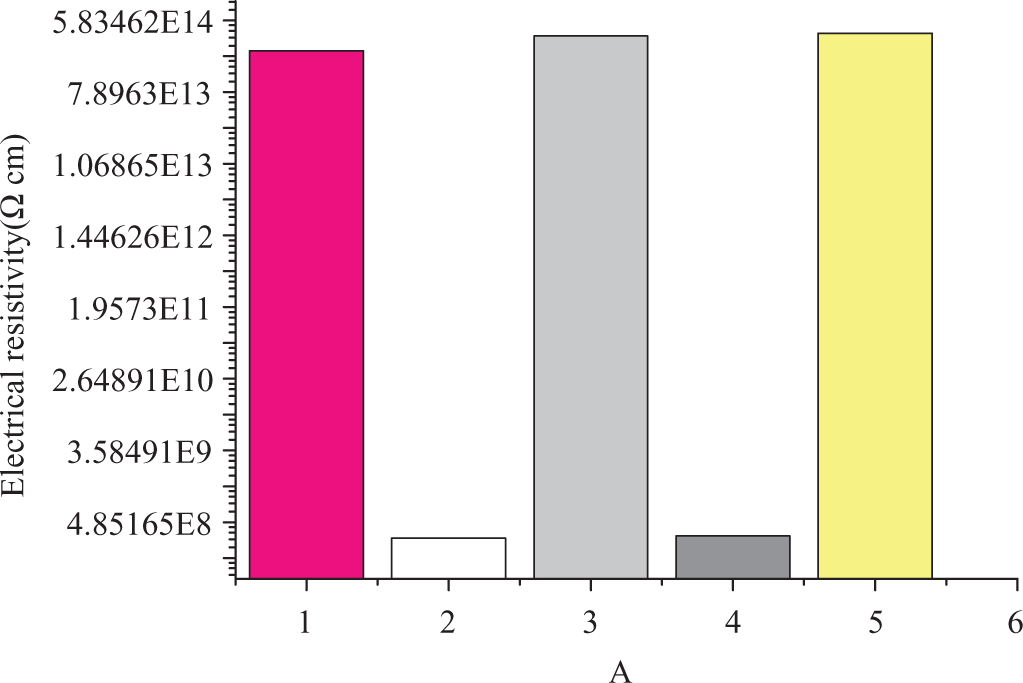
Electrical resistivities of neat PI and its composites. 1: neat PI; 2: MWCNT/PI (2 wt%); 3: POE-MWCNT/PI (2 wt% MWCNTs); 4: MWCNT/PI (5 wt%); 5: POE-MWCNT/PI (5 wt% MWCNTs). PI: polyimide; POE: polyolefin elastomer; MWCNTs: multiwalled carbon nanotubes.
However, the volume electrical resistivity of POE-MWCNT/PI composites with 2 and 5 wt% MWCNTs are 4.23 × 10¹⁴ and 7.91 × 10¹⁴Ω cm, respectively, and increased 50–60% than that of neat PI. The high electrical resistivity of the POE-MWCNT/PI composites may be explained by the following reasons: The polymer molecules coating the CNTs could be acting as insulation, but it is most likely that CNT agglomeration is playing a role with the CNTs clumping together in large bundles. If the CNTs are bound together in bundles, then it would not be possible for current to flow since the current would need the CNT to form a three-dimensional lattice throughout the composite (the percolation point). It is most likely that this is the reason why although theoretically the current should flow, the tendency for the CNT to clump together means that the composite remains nonconducting.
Conclusions
POE-MWCNT/PI composites were fabricated with PEOT and N-100 in the presence of POE-MWCNTs. The 9- to 12-nm thick POE shell on the surface of MWCNTs has enhanced the dispersion of POE-MWCNTs in PI and improved their interfacial interaction. Consequently, the impact strength of POE-MWCNT/PI composites is higher than the neat PI. In addition, the strong interface adhesion provides high impact strength, and the POE shell on MWCNTs also helps to impart high electrical resistivity to these POE-MWCNT/PI composites.
Footnotes
Funding
This research received no specific grant from any funding agency in the public, commercial, or not-for-profit sectors.