




Abstract
This study examined the effect of titanium dioxide (TiO2) dispersion on the tribological properties of carbon fiber (CF)-reinforced–polyimide (PI) matrix (CF/PI) composites. Nanocomposites were prepared through compression molding as milled CF/PI mixtures without further melt mixing. The incorporation of TiO2 leads to a significant improvement in friction and wear properties of the CF/PI composite. The scratches on the worn surface of the CF/PI composite filled with TiO2 are considerably reduced. We can see a relatively smooth, uniform, and compact worn surface, which is in good agreement with the considerably increased wear resistance of the CF/PI composite.
Introduction
Tailored polymeric composites, such as short fiber-reinforced engineering polymers (SFRPs), have been widely used as dry sliding materials, in particular as lower weight alternatives to metal materials, with the attractive advantages of self-lubrication and superior cleanliness. 1 –3 The beneficial effect on the tribological behavior of polymer composites by short fibers has been attributed to the reduced ability of plowing, tearing, and other nonadhesive components of wear. 4,5 Moreover, in comparison with continuous fiber-reinforced polymers, SFRPs have the advantage of rapid, lower cost processability by injection/compression molding or by extrusion. 6
Polymers possess many advantages, that is, lightweight, ease of manufacturing, excellent corrosion resistance and self-lubricating effect, and so on, so they are desirable materials of frictional components, such as bears, gears, piston rings and soft seals, and so on. 7 To realize the expected enhancement in properties, it is necessary to have a very good fiber–matrix interface to ensure the load transfer from one fiber to another effectively through the matrix. 8
The application of carbon fibers (CFs)/polymer composites has continuously risen during the last decade, especially in car and aerospace industry, due to the improvement in the electrical conductivity and mechanical stiffness. 9 CFs possess exceptional specific strength and stiffness, and hence they find important applications in structural composites. The performance of such composites depends on the properties of the fibers due to the manufacturing process and the surrounding matrix and also on the interface between them. 10,11
Efforts have been taken and many techniques have been applied to improve the interlaminar performance of composite laminates (e.g. include the use of a toughened matrix, interlaminar toughening through the incorporation of organic and inorganic particles into the matrix or the addition of toughened polymer layers). 12,13 Polyimide (PI) and its composites attract extensive concern from tribological scientists worldwide because of their high mechanical strength, acceptable wear resistance under certain conditions, good thermal stability, high stability under vacuum, good antiradiation, and good solvent resistance. 14
The objective of the present study is to investigate on the tribological behavior of PI composites filled with short CF and titanium dioxide (TiO2) particles. Moreover, the wear mechanism for the synergistic effect of the TiO2 particle fillers and CF was also studied based on the scanning electron microscopy analysis.
Experimental
Materials
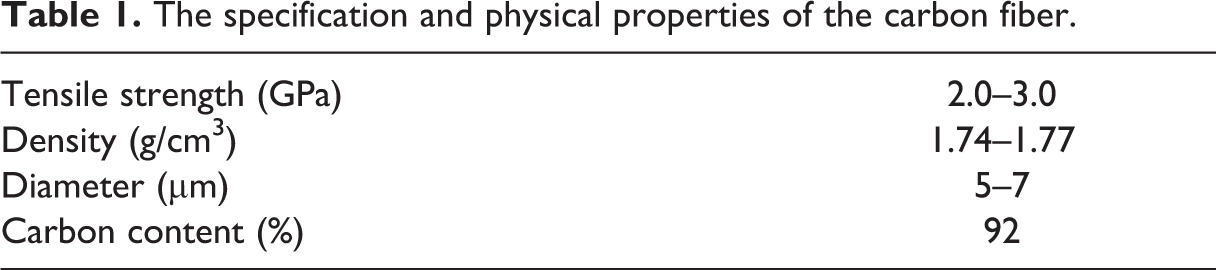
CF was obtained from Shanghai Sxcarbon Technology Co. (Shanghai, China). The specification and physical properties of the CF are given in Table 1. GE plastics, Columbus, USA, supplied the PI material as granules. The commercialized nanosized TiO2 particles were obtained from Shanghai Agent. The size of TiO2 particles was between 2 and 30 nm, with a mean particle size of 15 nm.(Tables 1 and 2). Table 2 listed its main physical and mechanical properties.
The specification and physical properties of the carbon fiber.
Main properties of PI (GCTPTM).
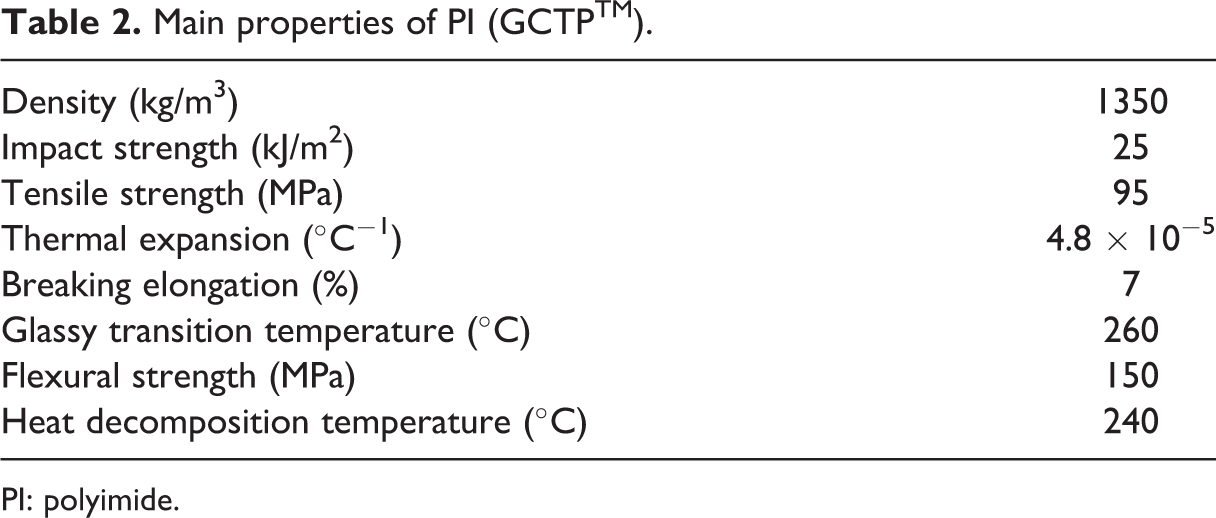
PI: polyimide.
Specimen preparation
The composites were developed by impregnation technique followed by compression molding. The plies (280 mm × 260 mm) cut from the carbon fabric roll were immersed in viscous solution of PI (prepared in dichloromethane) for 12 h in a sealed container. The plies were taken out carefully to avoid the misalignment in weave followed by drying in oven. Twenty prepregs were used to attain the desired thickness in the range of 3.5–4 mm and were stacked in the mould and compression molded at 385–390°C under an applied pressure of 10 MPa. For the specimens of a three-component PI/CF/TiO2 composite, carbon fabrics were blended with TiO2 particles before they were immersed in viscous solution of polyethyleneimine. The composites were allowed to cool under ambient conditions under pressure.
Friction and wear
Friction and wear tests were carried out with an M-200 model (Jinan Shunmao Company, Jinan, China) block-on-wheel friction and wear tester under dry sliding conditions. GCr15 bearing steel wheel, whose composition is carbon 0.95–1.05 wt%, silicon 0.15–0.35 wt%, manganese 0.20–0.40 wt%, chromium 1.30–1.65 wt%, and iron balance, with a bulk hardness of HRC65 ± 5 used as the counterpart. The sizes of specimen and steel wheel are 10 mm × 10 mm × 14 mm and Φ40 mm × 10 mm, respectively. The rotating speed of the steel wheel was 200 rpm, which resulted in a sliding speed of 0.42 m/s in the wear track. The wearing time was 120 min.
Results and discussion
Friction and wear
Figure 1(a) and (b), respectively, shows the friction coefficients and wear rates of composites filled with CF and TiO2 at a normal load of 100 N and a sliding speed of 0.42 m/s for the PI composite. The composites exhibited a lower coefficient of friction compared to PI with increasing CF reinforcement. At the preliminary stage of friction, the friction coefficient of the composites increased a little. The reason for this phenomenon was that the surface of the metal ball was not very smooth and the ploughed function on friction test caused by the bulge on the surface of the ball was large. At the beginning, the transfer film was not formed between the metal counterpart and the composites.
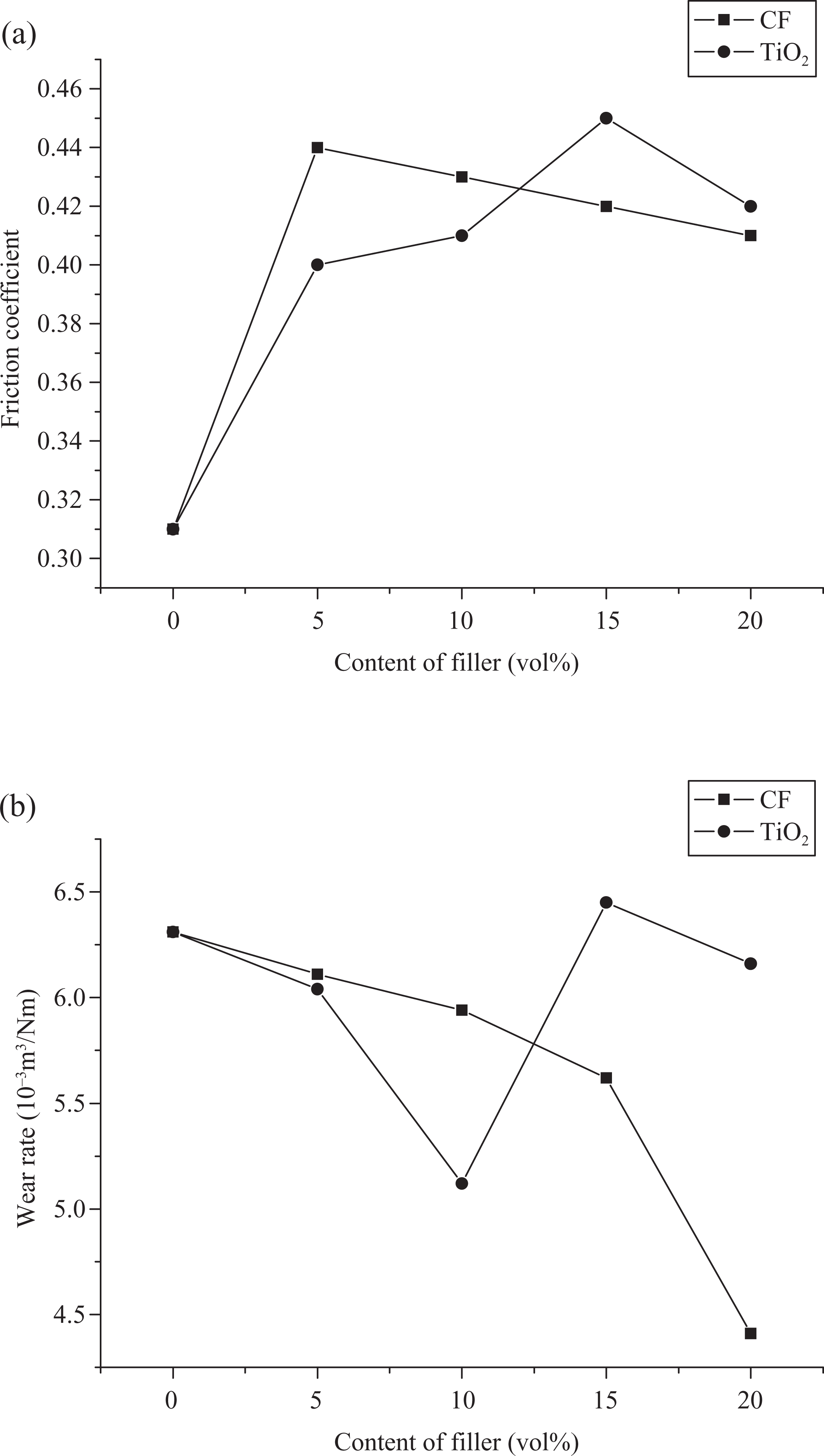
The friction coefficients and wear rates of PI composites filled with CF and TiO2. CF: carbon fiber; PI: polyimide; TiO2: titanium dioxide.
The friction coefficients of TiO2-filled composites and CF-filled composites were nearly the same, and they sharply increased from about 0.31 for pure PI to about 0.44 and 0.4 for the composites including 5 vol% fillers. Then they fluctuated between 0.4 and 0.44. It can be seen in Figure 1(b) that the wear rates of composites filled with CF decreased with an increase in the CF content. Composites including 20 vol% CF exhibited a rate almost 1.8 times lower than that of pure PI. When the TiO2 particle content was less than 10 vol%, the wear rates of TiO2-filled composites decreased with increasing TiO2 filler content, which were lower than that of composites filled with the same content of CF. With further increase in the TiO2 filler content, the wear rate of TiO2-filled composites sharply increased close to that of pure PI and higher than that of composites filled with CF.
A comparison of the friction coefficient and wear values of CF/PI and CF/TiO2/PI composites is shown in Figure 2. Wear mechanisms and the friction coefficient were correlated. It should be noted that friction coefficient and the wear of CF/TiO2/PI composites is lower compared with CF/PI composite. Due to the viscous fluid flow of the surface layer, the friction coefficient at this time was controlled. The material surface viscosity decreased mainly because of the strong bonding. The formation of a lubricant film protected the materials and decreased the friction coefficient. Thus, the wear of the surface layer would decrease, leading to the decrease in the friction coefficient. The possible reason could be due to the variation in attack angle, showing that there is a transition of wear mechanisms from ploughing for a small attack angle to cut for a big attack angle.
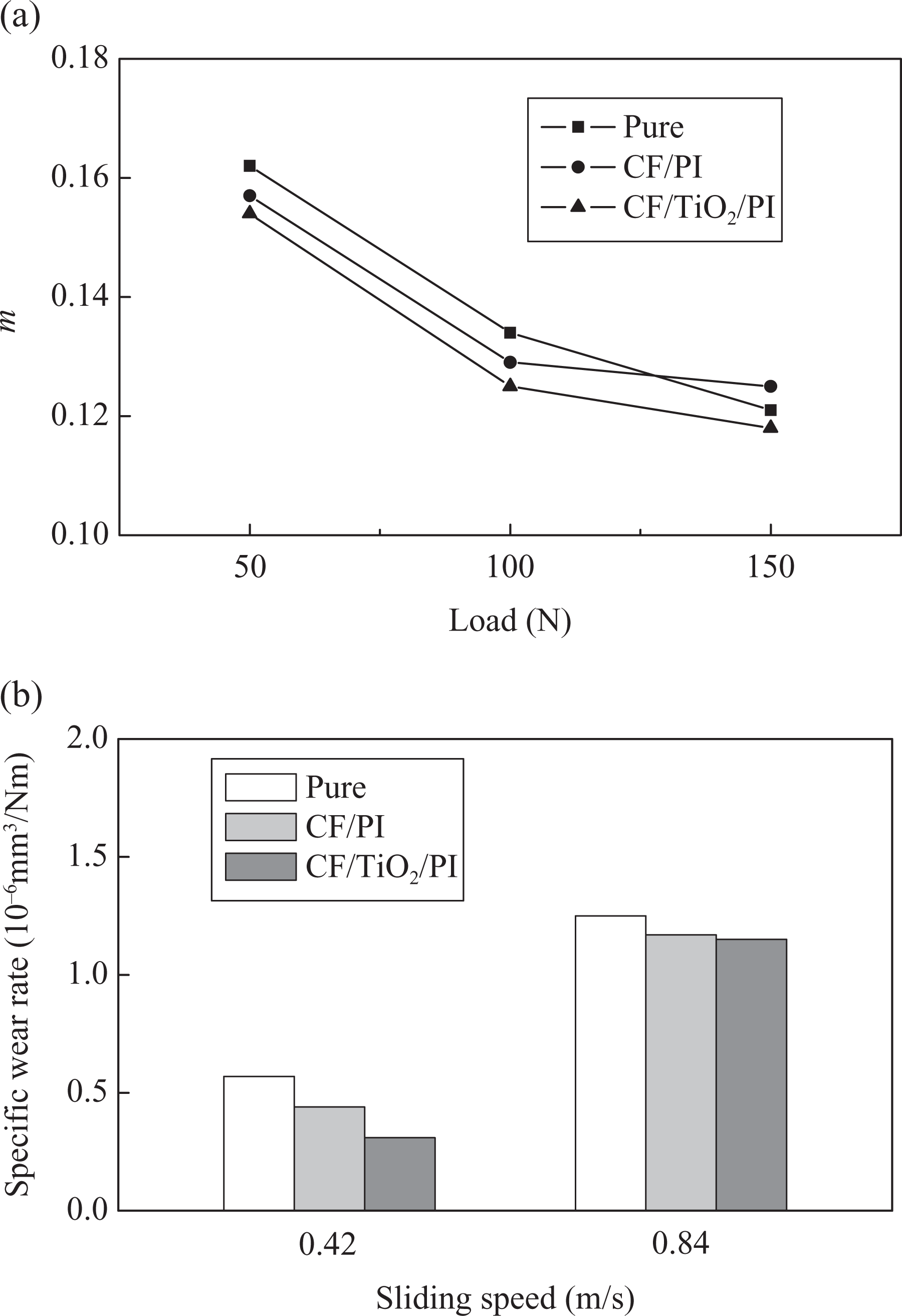
The influence of sliding speed on the friction coefficient and wear. (a) Variations in friction coefficients with sliding speed for the composites under dry sliding condition. (b) Variations in specific wear rate with sliding speed for the composites under dry sliding condition.
The pictures presented in Figure 3 show the worn surfaces of pure PI and its composites. Figure 3(a) shows the adhered debris and slight deformation flow that occurred on the worn surface of the CF/PI composite. This indicated that adhesion was the main wear mechanism of the CF/PI composite. For the composites filled with TiO2 (Figure 3(b)), ploughing was the main characterization on their worn surface. And the composites filled with TiO2 showed wider and deeper ploughings than the composites filled with CF. Slight plastic flow was seen on the smooth worn surface of CF-filled composite. Shreddings were also observed on the worn surface of the composites besides some exposed CF. It can be concluded that adhesion was the main wear mechanism of the composites filled with CF.
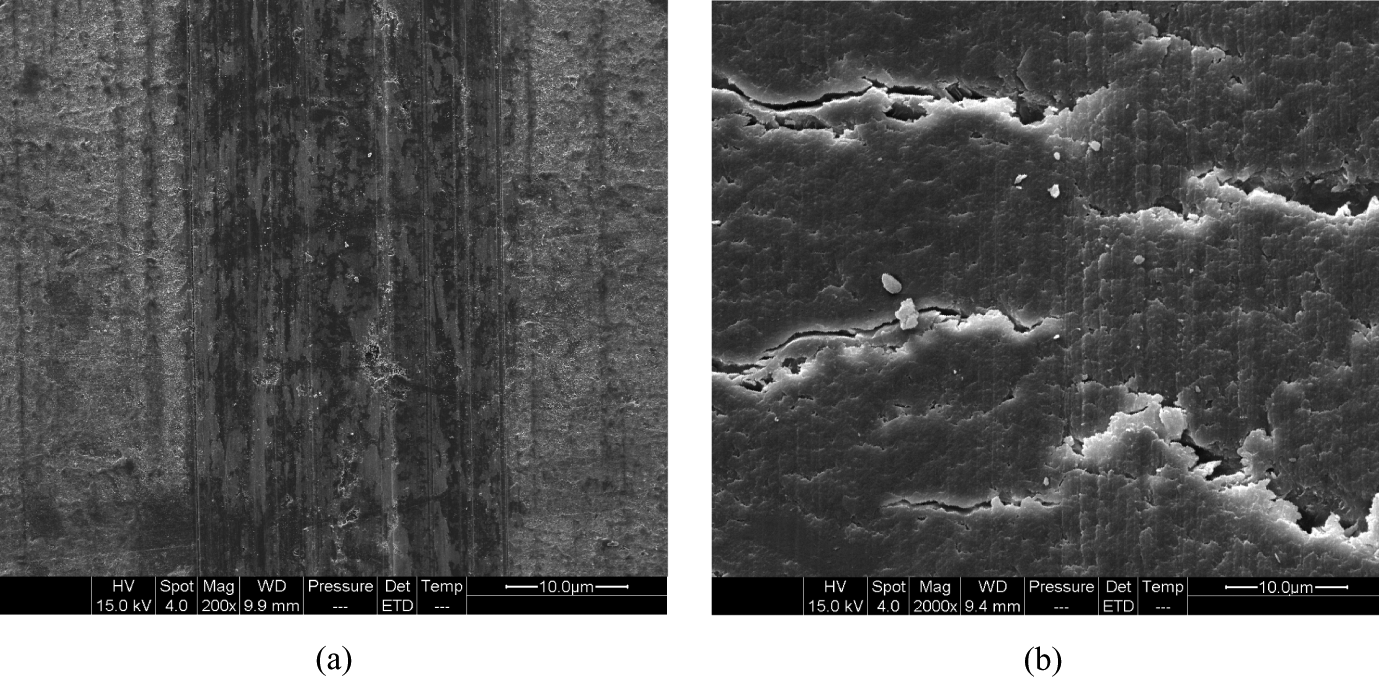
The worn surfaces of pure PI and its composites. (a) CF/PI and (b) CF/TiO2/PI. CF: carbon fiber; PI: polyimide; TiO2: titanium dioxide.
The scratches on the worn surface of the CF/PI composite filled with TiO2 are considerably reduced. We can see a relatively smooth, uniform, and compact worn surface, which is in good agreement with the considerably increased wear resistance of the CF/PI composite. Additionally, we also find that there are some cavities on the surfaces of the PI composite that might be caused by the solvent evaporation from the matrix and the poor adhesion between the filler and the PI.
Conclusions
The incorporation of TiO2 leads to a significant improvement in matrix stiffness. When the TiO2 particle content was less than 10 vol%, the wear rates of TiO2-filled composites decreased with increasing TiO2-filler content, which were lower than that of composites filled with the same content of CF. With further increase in TiO2-filler content, the wear rate of TiO2-filled composites sharply increased close to that of pure PI and higher than that of composites filled with CF.
Footnotes
Funding
This research received no specific grant from any funding agency in the public, commercial, or not-for-profit sectors.