




Abstract
Disposal of Chinese herbal residues (CHRs) during Chinese herbal medicine production and processing has become a problem that requires attention. In this study, CHRs were pretreated by steam explosion or pulverization and composites were prepared by mixing pretreated CHRs with polylactic acid. The mechanical properties of composites of CHRs pretreated by two different methods were compared, the main compositions of CHRs were analyzed, and the morphology of various CHRs and brittle fracture surfaces of composites were observed by scanning electron microscopy. The results show that the mechanical properties of the composites are closely related to the herbal species and pretreatment methods. The mechanical properties of CHR composites pretreated by steam explosion are superior to those pretreated by pulverization. Choosing CHRs with large fiber cell wall–lumen ratio, high lignin and cellulose contents, low contents of hetero cells and hemicellulose are helpful in making composites with good comprehensive performance.
Introduction
Chinese herbal residues (CHRs) are a by-product of the Chinese medicine industry, such as production of Chinese patent medicines, Chinese herbal medicines, and light chemical products that contain Chinese herbal medicine compositions. The production of Chinese patent medicines results in most of the CHRs, almost 70% in total. Chinese herbal medicine is composed of plant medicinal materials and occasionally small amounts of animal and/or mineral medicinal materials. The main ingredient of Chinese herbal medicines is plant medicinal materials, comprising more than 87%. The annual generation of residues from plant medicinal materials is more than 650,000 tons in China, and this continues to increase annually. However, the effective ingredient content of Chinese herbal medicines is normally very low. Take Pogostemon cablin for example, the extraction of patchouli essential oil with supercritical CO2 at 14 MPa and 40°C gave the best yield (5.07%), which was higher than that of the usual methods such as steam distillation (1.50%). 1 After the extraction and decoction procedures, abundant CHRs are produced. With the development of Chinese medicine, production of CHRs during the processing of Chinese herbal medicines has increased. Because CHRs contain significant moisture and readily decay, if they cannot be disposed in time, it may get moldy and stinky, causing serious environmental pollution. The current methods for dealing with CHRs include landfill, incineration, and stacking in a designated area. However, such methods not only involve high cost but also cause the wastage of resources and serious environmental pollution. Therefore, the problem of effective CHR disposal has become one of the most pressing issues for researchers in the field.
During the past few years, much research on natural fiber–reinforced thermoplastics has been carried out.2–6 Commonly used natural fibers are jute, flax, hemp, sisal, kenaf, and so on. However, there has been little research on CHRs. Composites prepared from CHRs and biodegradable plastics can reduce costs and pollution. Meanwhile, compared with other natural fiber–reinforced composites, composites reinforced by CHRs may have certain additional medicinal effects.7,8 Usually, highly polar plant fibers must be properly pretreated to improve the compatibility between fibers and the nonpolar matrix. At present, the most commonly used methods to modify fibers are alkali treatment,9,10 thermal treatment,11–13 interface modification using coupling agent,13–15 steam explosion,16,17 and surface grafted processing.18,19
The mechanism of steam explosion begins with water vapor that infiltrates hemicellulose, lignin, and the amorphous area of cellulose by virtue of high temperature and pressure. The fiber bundles thus swell and the hemicellulose is degraded into soluble sugars. The lignin within the intercellular layer is plasticized and some are degraded, resulting in a weakening of the cohesion between fiber cells. After remaining under pressure for a certain period of time, the reactor pressure is rapidly reduced, allowing a portion of the water in the fiber bundles to vaporize and do work through expansion. The energy released can break hydrogen bonds and even covalent bonds in the fiber bundles and facilitate the degradation of amorphous hemicellulose and lignin. Thus, the tissue structure of the original fiber bundles is destroyed and fiber bundles dissociate from the intercellular layer into individual fiber cells. This completes the preparation of plant fibers with a large aspect ratio that can be used as reinforcements in thermoplastic materials that have superior enhancement effects than the powdered materials currently employed in wood plastic composites (WPCs).
This study used the extraction residues of Helicteres angustifolia (HA), Euodia lepta (Spreng.) Merr (ELM), and Pogostemon cablin (Blanco) Benth (PCB). These CHRs were pretreated by steam explosion (SECHRs) or pulverization (PCHRs). The mechanical properties of composites and the main compositions of CHRs were analyzed, and scanning electron microscopy (SEM) was used to observe the pretreated CHRs and the brittle fracture surfaces of composites.
Experimental
Materials
Polylactic acid (PLA) (3051D) was supplied by NatureWorks LLC (Blair, NE, USA). The melt flow rate of PLA is 55 g/10 min (210°C, 2.16 kg). CHRs were purchased from Dayuan Pharmaceutical factory, Guangzhou, China (as shown in Figure 1).
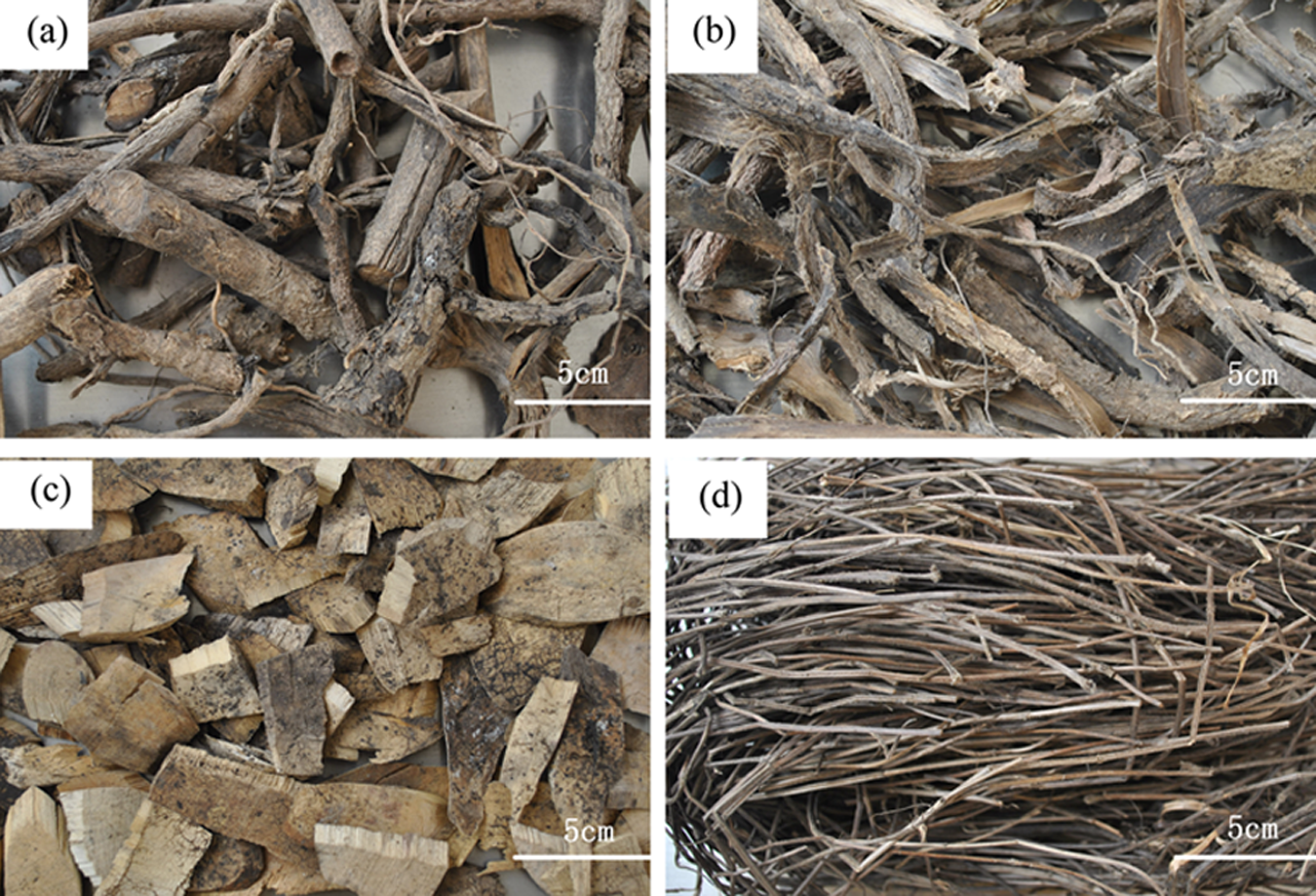
Photos of CHRs used. (a) HAR; (b) HARB; (c) ELM; (d) PCB. CHRs: Chinese herbal residues; HAR: Helicteres angustifolia root; HARB: Helicteres angustifolia root bark; ELM: Euodia lepta (Spreng.) Merr; PCB: Pogostemon cablin (Blanco) Benth.
HA is an undershrub and subordinate to family Sterculiaceae. Usually, the root or the whole plant can be taken as a medicinal material. The phloem is broad and the phloem fiber bundles are lignified. The xylem and the pith are wide, as shown in Figure 2(a). HA root (HAR) was used in this investigation and was divided into two parts: the cortex part called H. angustifolia root bark (HARB), as shown in Figure 1(b); and the remainder called H. angustifolia root xylem (HARX).
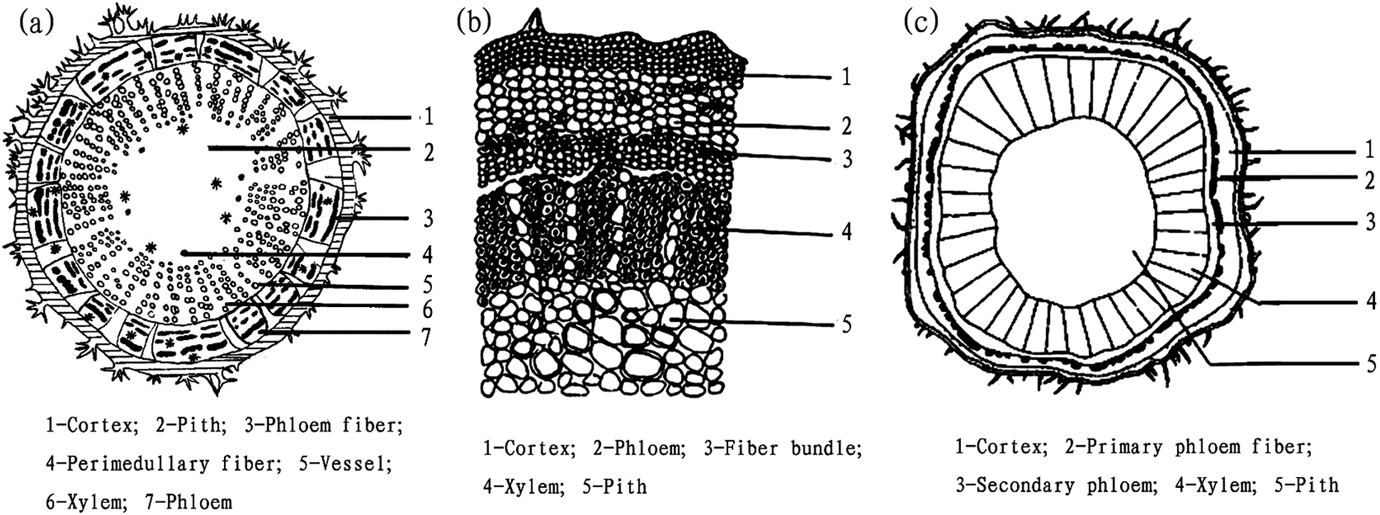
The sketch maps of the cross-sections of CHRs. (a) HAR; (b) ELM; (c) PCB. CHRs: Chinese herbal residues; HAR: Helicteres angustifolia root; HARB: Helicteres angustifolia root bark; ELM: Euodia lepta (Spreng.) Merr; PCB: Pogostemon cablin (Blanco) Benth.
ELM belongs to the family Rutaceae, and the medicinal portion is root, which is hard and brittle. The cortex and phloem are thin but the xylem is broad, as shown in Figure 2(b).
PCB belongs to family Labiatae. The medicinal part is stem, which is brittle and breaks easily. The phloem is narrow. The xylem is slightly lignified. The pith is wide, accounting for about 3/5 of the radius, as shown in Figure 2(c).
CHR pretreatment
Two pretreatment methods were used, steam explosion and pulverizing. Water was sprayed on the four types of CHR and their moisture content adjusted to 50% before they were steam exploded. The CHRs were then steam exploded in a continuous steam explosion device (method 1, M1), producing SECHR fibers. PCHR fibers were obtained by pulverizing (method 2, M2) the CHRs into 60 mesh size.
Biocomposite preparation
All SECHR fibers and PCHRs were dried in an oven at 80°C for 8 h. PLA was also dried in an oven at 90°C for 8 h. Composites of PLA and SECHR fibers (fiber content: 50 wt%) were first mixed with a two-roll mixing mill for 5 min at 230°C, then the mixtures were hot pressed at 185°C under 10 MPa pressure for 5 min using a flat-plate sulfide machine model QLB-25D/Q (Wuxi No.1 Rubber and Plastics Plant, Wuxi city, Jiangsu province, China)) to obtain composite sheets. The composites of PLA and PCHRs were prepared using the same method as described above.
Testing mechanical properties
To test the mechanical properties, the composite sheets were cut into samples according to standard methods used to elucidate material tensile and flexural properties. Tensile and flexural tests were performed using an Instron Universal Testing Machine model 5566 (Instron Corporation, Canton, Massachusetts, USA) at room temperature, according to the Chinese Standard GB/T1040.2-2006 (General Administration of Quality Supervision, Inspection and Quarantine of the People’s Republic of China), with a crosshead speed of 2 mm/min, and Chinese Standard GB1449-2005, with a crosshead speed of 1 mm/min. All tests were performed at room temperature and all values reported are the average of five individual measurements. These test standards were issued by the General Administration of Quality Supervision, Inspection and Quarantine of the People’s Republic of China and Standardization Administration of the People’s Republic of China.
Composition analysis
The composition of SECHRs was measured by automatic fiber determination (Gerhardt, Germany). Acid detergent fiber (ADF), neutral detergent fiber (NDF), and acid detergent lignin (ADL) are traditionally analyzed according to the method proposed by Van Soest.20,21
Scanning electron microscopy
The morphologies of the SECHR fibers and PCHRs were observed with a Hitachi S-3700 scanning electron microscope (Hitachi, Japan). The samples were sputter coated with gold prior to scanning.
Results and discussion
Mechanical properties
Figure 3 shows the mechanical properties of CHR/PLA composites. As shown, the mechanical properties of HARX/PLA composite were the best for both M1 and M2 methods. Under the conditions of M1, the mechanical properties of PCB/PLA composite were the worst among all the composites, while the mechanical properties of HARB/PLA and ELM/PLA composites were medium and the mechanical properties of HARB/PLA composite were superior to those of the ELM/PLA composite. Under the conditions of M2, the mechanical properties of HARB/PLA composite were the worst, the mechanical properties of PCB/PLA and ELM/PLA composites were middling, and the mechanical properties of PCB/PLA composite were better than those of the ELM/PLA composite. From Figure 3(a), it can be seen that the tensile strengths of all the SECHR/PLA composites were at least 30% higher than those of corresponding PCHR/PLA composites, especially for the steam exploded HARX (SEHARX) composite and pulverized HARX (PHARX) composite, the tensile strengths of the former is 69% higher than that of the latter. As shown in Figure 3(b), the tensile moduli of all SECHR/PLA composites were 15% higher than those of corresponding PCHR/PLA composites, except for the steam exploded PCB (SEPCB) composites and pulverized PCB (PPCB) composites, the two tensile moduli which showed a small difference. As can be seen from Figure 3(c), the flexural strengths of the composites reinforced by SECHR fibers were close to those of corresponding PCHR composites, except for the HARX composites, the flexural strength of SEHARX composite was 32% higher than that of PHARX composite. As shown in Figure 3(d), the flexural moduli of other PCHR composites were superior to those of corresponding SECHR composites, except for HARX. As a whole, steam explosion is a feasible pretreatment method for improving the mechanical properties of CHR/PLA composites.
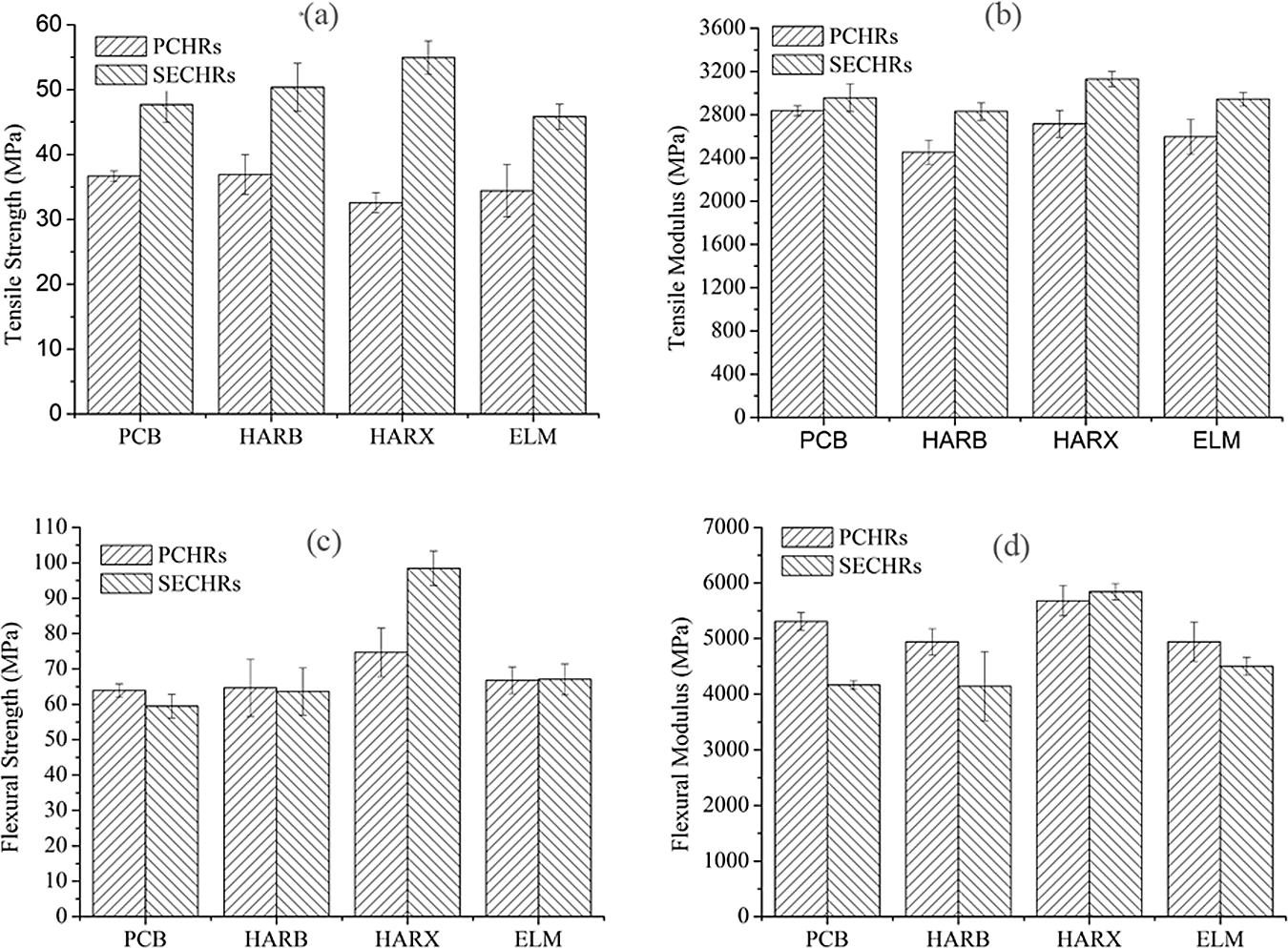
Comparison of mechanical properties of SECHR and PCHR composites: (a) tensile strength; (b) tensile modulus; (c) flexural strength; (d) flexural modulus. SECHR: steam explosion Chinese herbal residue; PCHR: pulverization Chinese herbal residue.
Composition analysis of SECHRs
Table 1 shows the composition analysis results of SECHRs. HA and ELM are subordinate to xylophyta, and PCB is an herbaceous plant. It can be seen from Table 1 that HARX is rich in lignin, with the highest lignin content, as high as 41.7%. Because of the three-dimensional network structure, lignin not only can glue the cells together but is also important to confer rigidity and mechanical strength for plants. 22 Therefore, the flexural properties of HARX/PLA composite were the best. The medicinal part of ELM is root, for which the hemicellulose content is the highest and cellulose content is the lowest among all the SECHRs. Hemicellulose is of low polymerization degree, is noncrystalline, and has poor mechanical properties, so the strength of ELM fibers is weak and this has a negative influence on the mechanical properties of composites. HARB has a high content of cellulose and low content of lignin. However, external to the phloem, there exists a cortex in HARB, mainly comprising dead hetero cells. Therefore, although the phloem fibers in HARB had a positive effect on the mechanical properties of the HARB/PLA composite, the existence of dead hetero cells had negative effects. The medicinal part of PCB is stem, the cellulose content of which is the highest among all the CHRs, but the lignin content is the lowest. Compared with xylophyta HARX, the degree of lignification and fiber strength of PCB is lower, so the overall mechanical properties of PCB/PLA composite were lower than those of the HARX/PLA composite. On the other hand, because the cellulose content of PCB is the highest, the tensile strength of the PCB composite was higher than that of the xylophyta ELM composite, while the flexural strength of the composite was worse than that of ELM composite, due to its low lignin content.
Composition analysis of SECHRs.
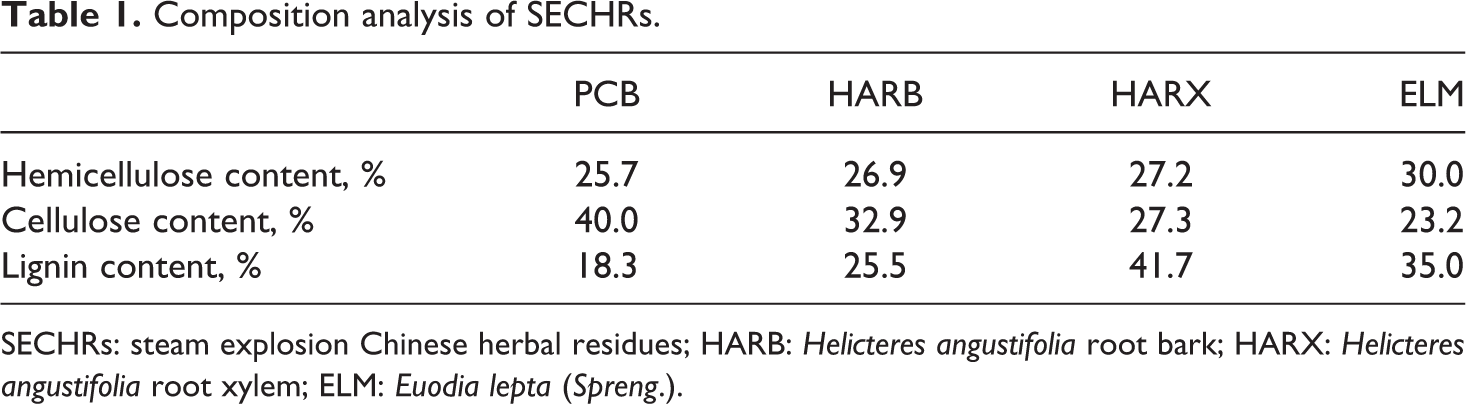
SECHRs: steam explosion Chinese herbal residues; HARB: Helicteres angustifolia root bark; HARX: Helicteres angustifolia root xylem; ELM: Euodia lepta (Spreng.).
Electron microscopy of CHRs
Figure 4 shows the microstructure morphologies of pretreated CHRs. It can be seen that the morphologies of all the pretreated CHRs are different. Figure 4(a) shows the morphology of pulverized ELM (PELM) produced by mechanical disruption. It can be seen that the ELM has been converted into random fiber bundles, and the average aspect ratio of PELM is very low. It can be seen from Figure 4(b) to 4(e) that the SECHRs were mainly composed of fiber cells disintegrated from the original CHRs by steam explosion. The specific surface area and aspect ratio of SECHR fibers were much larger than those of PCHR, which can help to achieve a better enhancement effect. Therefore, the tensile properties of SECHR composites were superior to those of corresponding PCHR composites. It can also be seen from Figure 4(b) to 4(e) that the average aspect ratio of steam exploded ELM (SEELM) fibers is the largest among these four SECHR fibers and that of the SEHARX fibers is the smallest. Generally, increasing fiber length has beneficial effects on the tensile and flexural properties of WPC. 23 However, in this work the comprehensive mechanical property of SEELM composites was worse than that of the SEHARX composites, which indicates that the composition of CHRs influences the mechanical property of composites strongly.
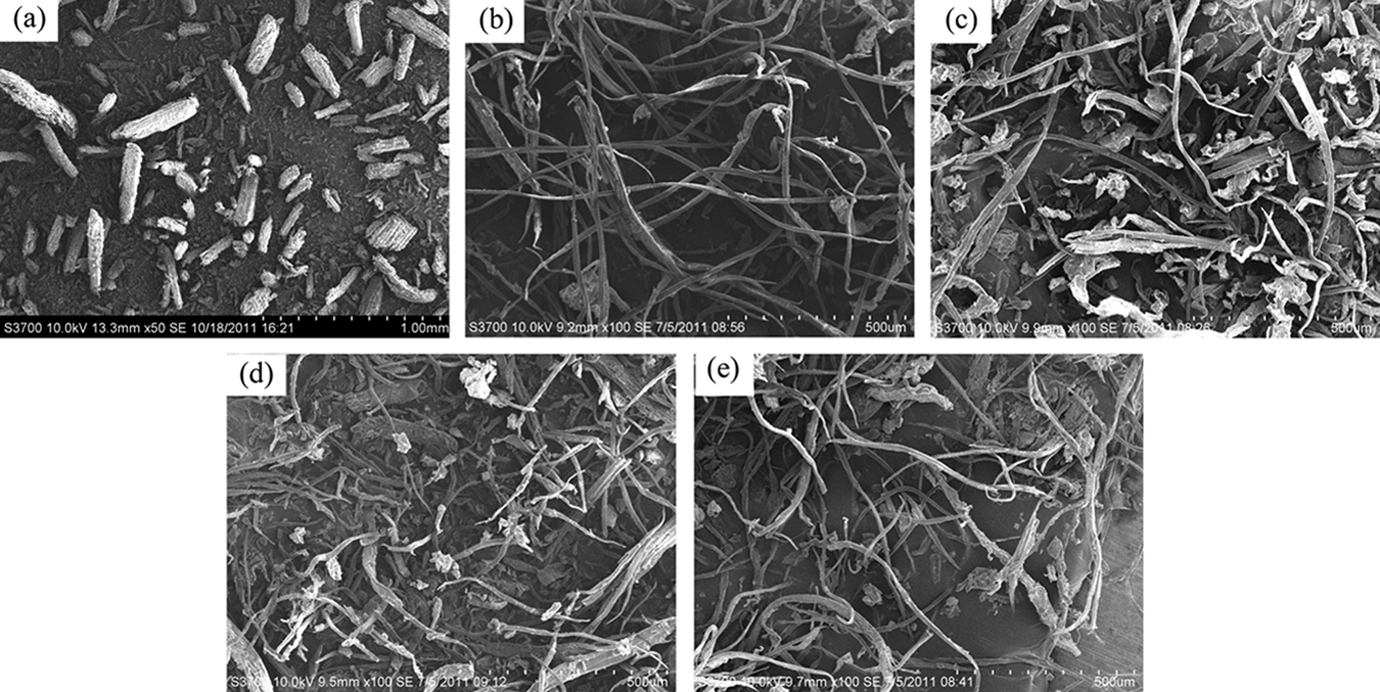
Microstructure morphology of CHRs: (a) PELM (50×), (b) SEELM (100×), (c) SEPCB (100×), (d) SEHARX (100×), (e) SEHARB (100×). CHRs: Chinese herbal residues; PELM: pulverized Euodia lepta (Spreng.) Merr; SEELM: steam exploded Euodia lepta (Spreng.) Merr; SEPCB: steam exploded Pogostemon cablin (Blanco) Benth; SEHARX: steam exploded Helicteres angustifolia root xylem.
Electron microscopy of biocomposites
SEM micrographs of the liquid nitrogen brittle fracture surfaces of biocomposites reinforced by various fibers are shown in Figure 5. Figure 5(a) shows a fractured SEHARX/PLA composite. From Figure 5(a), it can be seen that the disassociated HARX fiber cells were dispersed in the PLA matrix and the HARX fiber cells had a thick cell wall and a large cell wall/lumen ratio. Figure 5(b) shows the fractured surface of the PPCB/PLA composite. In Figure 5(b), one can see the fracture surface of a PPCB fiber bundle. Comparing Figure 5(a) and 5(b), it can be seen that the cell wall of PCB fiber cell was much thinner and the cell wall/lumen ratio was smaller than that of HARX, as marked by black rectangles. This is one of the reasons why the overall mechanical performance of the PCB/PLA composite was inferior to that of the HARX/PLA composite. Figure 5(c) shows the fracture surface of the SEPCB/PLA composite. A fiber bundle that was not separated completely by steam explosion can be seen in Figure 5(c) which is marked with a black rectangle. By comparing Figure 5(b) and 5(c), it can be seen that the SEPCB fibers were crushed by the molding pressure as marked by white rectangles in Figure 5(c), but the PPCBs still maintained their original shape under the same molding pressure as marked by a black rectangle in Figure 5(b), which indicates that during continuous steam explosion, hemicelluloses and lignin partly decomposed, the rigidity of fiber cell wall decreased, and fiber cells collapsed easily under pressure. Therefore, the flexural moduli of PCHR composites were superior to those of corresponding SECHR composites, apart from the HARX/PLA composite.
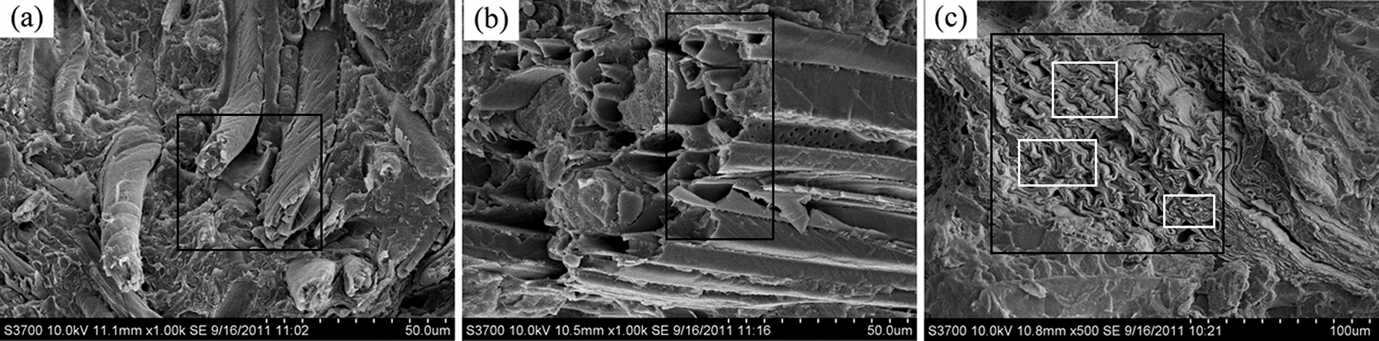
SEM micrographs of biocomposites reinforced by (a) SEHARX (1000×), (b) PPCB (1000×), (c) SEPCB (500×). SEM: scanning electron microscopy; SEHARX: steam exploded Helicteres angustifolia root xylem; PPCB: pulverized Pogostemon cablin (Blanco).
Conclusions
Considerable effort has been devoted to recycle CHRs. Producing composites between thermoplastics and CHRs is a new approach to decreasing environmental pollution and waste of resources.
The mechanical properties of the CHR composites are related to the type of CHR. Among the four types of CHR, the comprehensive mechanical properties of HARX/PLA composites were the most promising. Raw materials with high lignification, a large fiber cell wall/lumen ratio, and low contents of hetero cells and hemicellulose enable composites to have good overall performance.
The mechanical properties of the composites are also closely related to the pretreatment methods of CHRs. The tensile properties of the SECHR composites are superior to those of the corresponding PCHR composites. However, the flexural modulus of SECHR composites may be slightly inferior to that of the corresponding PCHR composites.
Footnotes
Funding
The authors acknowledge the National Nature Science Foundation of China (contract grant numbers: 50903033, 11272093 and 50973035), the National Key Technology R&D Program of China (contract grand numbers: 2009BAI84B05 and 2009BAI84B06), Program for New Century Excellent Talents in University(contract grand number: NCET-11-0152), Pearl River Talent Fund for Young Sci-Tech Researchers of Guangzhou City (contract grand number: 2011J2200058), and Opening Project of Technology Development Center for Polymer Processing Engineering of Guangdong Industry Technology College (contract grand number: 2010001) for financial support.