




Abstract
Composites including short and randomly arranged Phormium tenax fibres in a polypropylene (PP) matrix (fibre content of 20, 30 and 40 wt%) were produced by twin-screw compounding and injection moulding. They have been characterised by tensile testing, scanning electron microscopy (SEM), thermogravimetric analysis (TGA) and differential scanning calorimetry (DSC). The results indicated that tensile modulus has been increased by reinforcing the matrix with growing amounts of fibres, whilst the effect on tensile strength had lower evidence. Fracture surface characterisation by SEM indicated that debonding and pull-out are prevalent, which suggests the need to optimise the interfacial bonding. Thermal characterisation results have shown that the main degradation peak for PP was slightly shifted to higher temperatures with the increasing fibre contents, thus improving the thermal stability of the composites. The introduction of fibres did not result in a significant variation in the position of the peaks for calorimetric analysis, except for the melting peak, which appeared lower for the composites with respect to the neat matrix. A slight increase in crystallinity was also measured.
Keywords
Introduction
The depletion of petroleum resources coupled with the adoption of stricter environmental regulations is stimulating the search for materials and products with the lowest possible environmental ‘footprint’. In this regard, biocomposites made from natural fibres and oil-derived thermoplastic polymers, for example, polypropylene (PP) and polyethylene (PE), can represent a suitable alternative to glass fibre-reinforced composites, providing potential value-added source of income to the agricultural community, without extensively modifying the fabrication processes for the composites. 1,2 In this field, the use of thermoplastic composites offers several advantages compared with that of thermosetting ones, normally including high impact resistance, damage tolerance, low price and easier recyclability of the polymer matrix. Currently, the main areas of application of thermoplastic natural fibre composites are packaging, transportation and building industries. The use of non-biodegradable thermoplastic polymers as matrix for natural fibre composites can also be intended as a step towards the application of natural and biodegradable polymers, such as poly(lactic acid), 3 polycaprolactone 4,5 and poly(β-hydroxybutyrate-co-valerate), 6 which are being considered as matrices for the next generation of ‘green’ composites.
PP is perhaps the most commonly used polymer to produce thermoplastic natural fibre composites, even though other synthetic polymers, such as PE, polystyrene and polyamides, are also common in natural fibre composites. Of all thermoplastics, PP shows the highest potential benefits when combined with natural fibres for making composites of industrial value. 7 Several types of natural fibres have been investigated in PP, including bast fibres such as flax, 8 hemp, 9 kenaf, 10 jute, 11 ramie, 12 abaca, 13 vetiver, 14 leaf fibres (sisal, 15 date palm 16 and pineapple 17 ) and coconut fruit skin fibres (coir 18 ). The resulting composites and properties have also been recently reviewed. 19 Amongst natural fibres, leaf fibres appear promising for obtaining long stretches of aligned fibres. In case of the most used leaf-extracted fibres, that is sisal, PP matrix resulted particularly suitable to the fabrication of composites: a number of aspects were investigated in the literature, which included mechanical properties and effects of fire retardants 20 and rheological behaviour. 21
In recent years, a renewed interest has been shown for fibres extracted from the leaves of the Phormium tenax, 22,23 commonly known as harakeke or New Zealand flax, a monocotyledonous plant which is endemic to New Zealand. Harakeke is a significant source of fibre that has a traditional use by the Maori people as a fibre for weaving mats and ropes. 24 The use of Phormium fibres as reinforcing system in plastics has often been proposed, in thermosets, 25 –28 thermoplastics 29 and biodegradable thermoplastics. 30 –32 Thermoset-based composites are well characterised; however, limited data are still available on non-biodegradable thermoplastic-reinforced composites. In order to extend the potential applications of P. tenax fibres, a detailed mechanical and thermal characterisation of these composites is needed.
To this purpose, this experimental work is aimed at investigating the use of untreated P. tenax fibres as reinforcement in PP matrix. This is considered preliminary to the application of possible compatibilisation treatments, such as maleic anhydride, to the matrix and is aimed in particular at the comparison of the composite properties with what has been obtained using untreated P. tenax fibres in thermosetting matrices. 28 Several properties including mechanical and thermal properties were studied. The morphologies of the fractured specimens were also investigated using a scanning electron microscope (SEM).
Materials and testing methods
Materials
PP homopolymer (Moplen HP 501-L) was supplied by Lyondell Basell (Ferrara, Italy). As per supplier’s data, HP 501-L has the following properties: melt flow rate is 6 g/10 min (230°C/2.16 kg), density is 0.9 g/cm3, tensile stress at yield is 34.0 MPa, tensile modulus is 1500 MPa and tensile strain at break exceeds 50%. P. tenax fibres were collected from New Zealand. Leaves were stripped and the hanks of fibres were washed and then paddocked and scutched, according to the typical procedure followed for these fibres. 23 The fibres were cut to a length of 2–3 mm.
Composites manufacturing
PP composites were manufactured using a twin-screw microextruder (DSM Explore 5&15 CC Micro Compounder), and the mixing process parameters (100 r/min screw speed, 1 min mixing time and the temperature profile would be: 170–180–190°C) were modulated in order to optimise the final properties of material. To obtain the desired specimens for the characterisation, the molten composite samples were transferred after extrusion through a preheated cylinder to a mini injection mould (T mould = 25°C, P injection = 8 bar). Composites were prepared with different amount of Phormium fibres: specifically, a masterbatch containing 40 wt% of Phormium fibres was prepared (PP40PH), whilst the other compositions (20 and 30 wt%, designed as PP20PH and PP30PH, respectively) were obtained diluting the master with neat PP.
Tensile tests
Tensile tests were performed in accordance with the UNI EN ISO standard 527/2: the type IBA (ISO 527-2 type 1BA tensile test specimens) sample was used for tensile testing with an initial grip length of 5 mm. Loading was applied in displacement control, using a load cell of 30 kN by means of a digital Lloyd Instrument LR 30K (Segensworth West, Foreham, UK) with a crosshead speed of 5 mm/min. Average tensile strength, percentage deformation at break and elastic modulus were calculated from the resulting stress–strain curves. The measurements were performed at room temperature and at least five samples were tested, expressing the results as mean value and SD.
Thermal and morphological characterisation
Thermogravimetric analysis (TGA) was performed on a 10-mg sample on a Seiko Exstar 6000 TGA quartz rod microbalance (Seiko Instruments, Inc., Chiba, Japan). The tests were carried out in nitrogen flow (250 ml/min) from 30 to 900°C with a 10°C/min heating ramp.
Differential scanning calorimetric (DSC TA Q200,TA Instruments, Vimodrone, Italy) measurements were performed in the temperature range from −25 to 250°C, at 10°C/min, performing two heating and one cooling scans. The peak temperatures for melting and crystallisation were evaluated and the degree of crystallinity of the sample was calculated taking as reference 191.3 J/g as heat of melting of the fully crystalline sample according to the following equation
33

where ΔH
m is the enthalpy of melting (Joules per grams (J/g)),
A Philips XL40 SEM (Eindhoven, The Netherlands) was used to investigate the fracture surfaces of the composites. Prior to observation, the specimens were gold coated.
Results and discussion
To allow a sound comparison with strength and stiffness of the composites, it is noteworthy recalling the values obtained elsewhere in a study on the tensile properties of Phormium fibres. 22 To summarise the results obtained in De Rosa et al.’s study, 22 average strength was progressively reduced, passing from 20 to 40 mm grip length, from a value of 770.68 to 465.96 MPa, whilst average Young’s modulus increased from 23.89 to 27.59 GPa, in both the cases with substantial coefficients of variation, in the region of 40%.
Figure 1 and Table 1 show typical tensile curves and properties for neat PP and PP/Phormium composites, respectively. The results indicate that Young’s modulus increases with increasing Phormium content. Tensile modulus has been consistently increased by reinforcing the composite with growing amounts of fibres, whilst the effect on tensile strength is less evident, as is the case in a large number of lignocellulosic fibre composites. This increment in the modulus is in agreement with the findings from the literature, 26,27 where adding fibres to a thermoplastic polymer restrains the movement of its chains, thereby increasing the stiffness. The addition of Phormium fibres did not largely improve the tensile strength: this is also a common trend for natural fibre-reinforced composites. It needs to be noted, however, that the addition of a 20% of short untreated Phormium fibres to a thermosetting matrix resulted elsewhere in a considerable reduction in tensile strength. 28
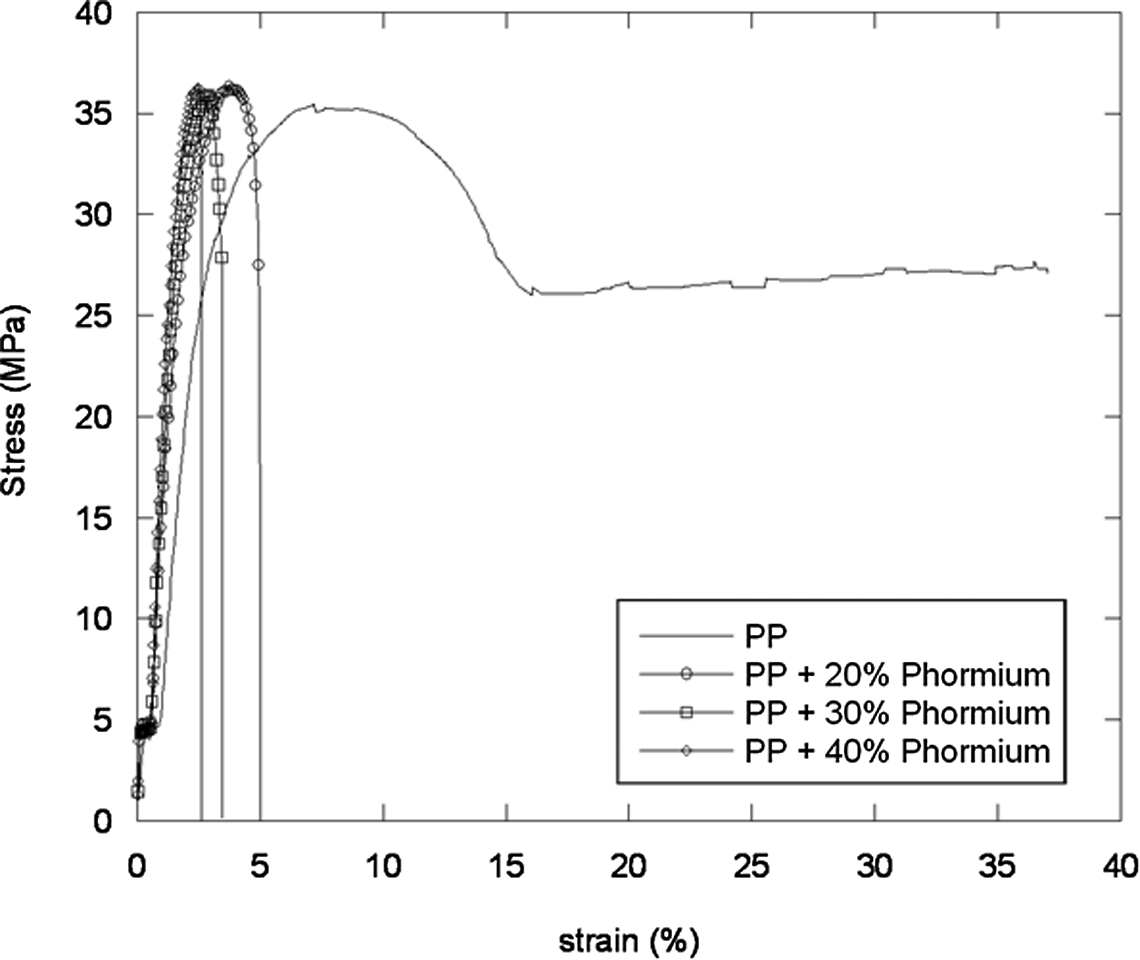
Typical tensile curves for neat PP and PP/Phormium composites. PP: polypropylene.
Summary of mechanical properties of neat PP and PP/Phormium composites.
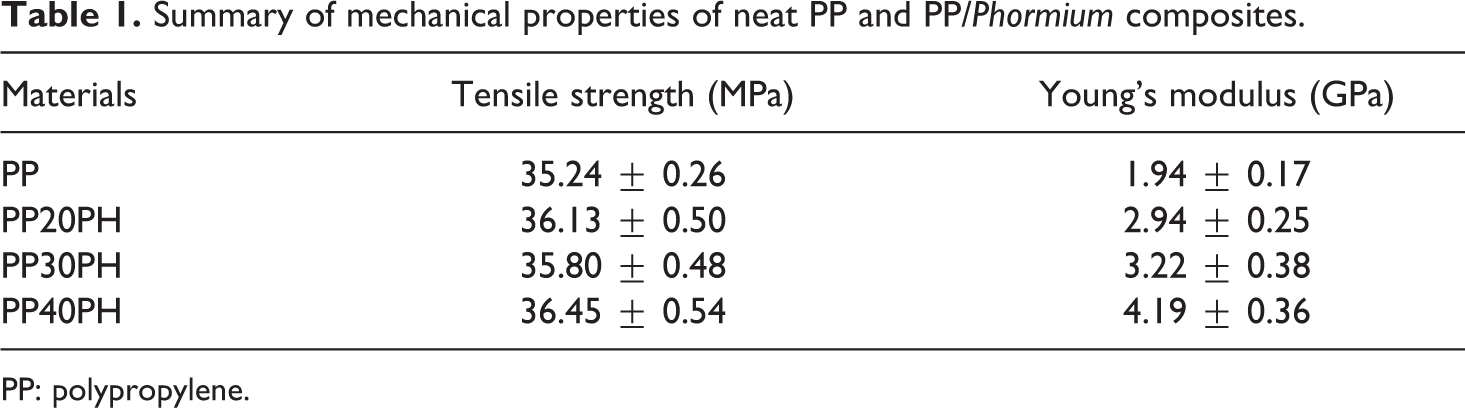
PP: polypropylene.
This behaviour is usually an indication of poor adhesion between natural fibres and polymers and, as a consequence, of not very effective stress transfer across the interface. Generally, tensile strength is much more dependent on the interfacial adhesion than the Young’s modulus is. 27
The morphology of the fracture surface of the injection-moulded specimens resulting from the tensile tests was investigated using SEM to characterise the fracture behaviour of PP/Phormium composites (Figure 2(a) to (f)).
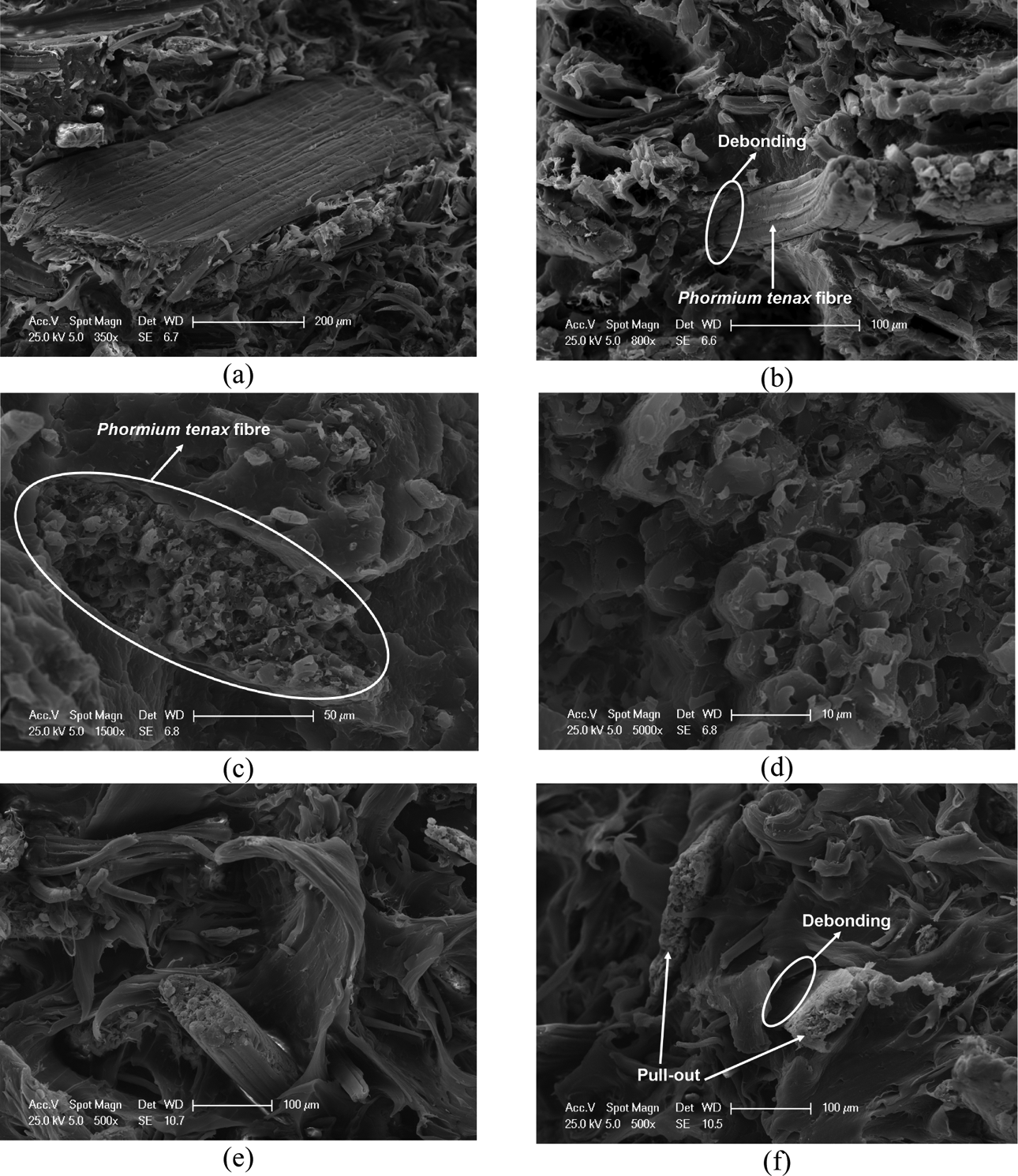
Scanning electron micrographs of (a–d) PP 40 wt% Phormium composites; (e and f) PP 30 wt% Phormium composites. PP: polypropylene.
From micrographs, it is evident that debonding and pull-out (Figure 2(a), (b), (e) and (f)) dominate the fracture surface, thus confirming the poor interfacial bonding as proposed in the discussion. Phormium fibres show a surface with no clear signs of resin or resin particles adhering to it (Figure 2(a)) and finite gaps near the interfacial region are present (Figure 2(b), (e) and (f)): both these evidences indicate a poor adhesion between filler and matrix. It is also to be noted that a number of lumens appear to be completely filled (Figure 2(d)) and the occurrence of some fibre breakage in the plane of fracture (Figure 2(c) and (d)) suggest that some degree of adhesion has been achieved. Despite this, as a general comment, the interface would need to be optimised for a more effective use of the composite.
This is also a common trend of PP composites including lignocellulosic fibres, which was also revealed using aspen fibres, 34 using jute fibres 35 and using coir fibres 36 ; the effect of poor wettability of the fibres 36 becomes more severe for higher fibre contents. In this respect, the results obtained with untreated Phormium fibres in PP do appear quite promising for the further application of a limited amount of chemical treatments.
The thermal stability of neat PP- and PP-based composites was investigated in terms of weight loss as a function of temperature by TGA. In Figure 3(a), TGA thermograms and in Figure 3(b) DTG curves are reported for PP and PP/Phormium composites. An enlarged view of TGA of the Phormium fibres is also provided between 150 and 200°C (Figure 3(c)), which indicates that the mass decrease is very limited, so as to show that the fabrication of the composite, involving the application of a 190°C heating process for 1 min, does not lead to a substantial degradation of the Phormium fibres.
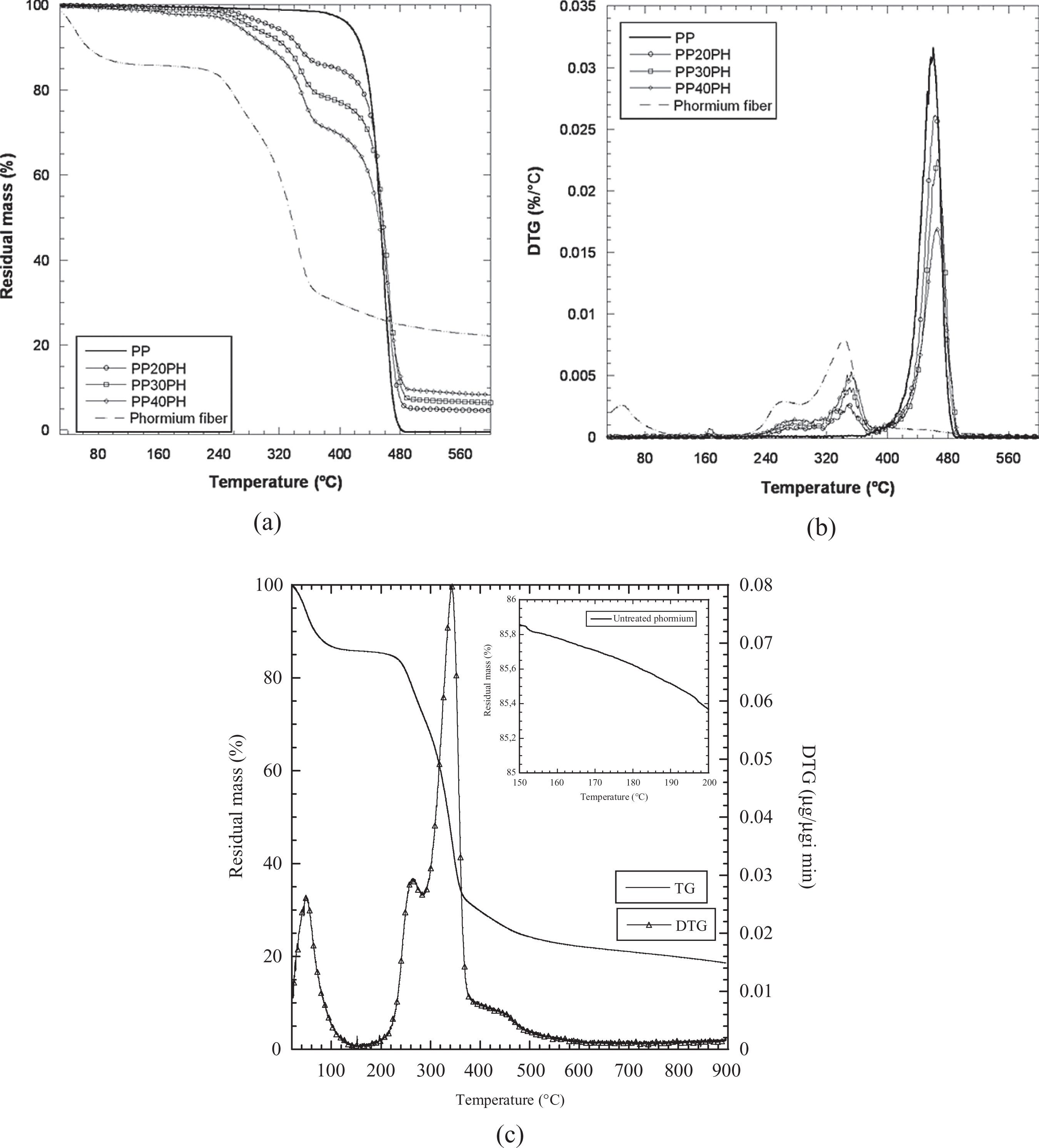
Residual mass (a) and differential residual mass (b) obtained from the TGA analysis for neat PP and PP–Phormium composites and (c) Phormium fibres. TGA: thermogravimetric analysis; PP: polypropylene.
In P. tenax fibres, the decomposition occurs in two main stage processes as shown in Figure 3(b). 11 The first stage process (200–305°C) is the thermal depolymerisation of hemicellulose, pectin and the cleavage of glycosidic linkages of cellulose; 11 the second stage process (305–370°C) is attributed to the decomposition of the α-cellulose, 11 whilst the decomposition of lignin occurred slowly within the whole temperature range. This was attributed to the complex structure of lignin. According to the TGA curve of the fibre and not considering the moisture loss at the beginning of the test, the char residue at 600°C of the fibre is approximately 33 wt%. Neat PP has the degradation peak at 460°C: this was shifted to higher temperatures for the 20, 30 and 40 wt% PP/Phormium composites (Figure 3(c)). Therefore, the system fibre–matrix degrades later than the neat resin. As a consequence, the thermal stability of the composite is slightly higher than that of fibre and matrix. It is also evident from Figure 3(a) that residual mass at the end of the test increases with the fibre content, since the char residue of the Phormium-based composites at 600°C is higher for the PP40PH system with higher fibre content. The char value at this temperature for the composites is comparable with the theoretical char residue obtained from the combustion of the fibre at different weight contents in the same test condition.
From the point of view of DSC characterisation, the introduction of fibres did not result in a significant variation in the position of the peaks, except for the melting peak, which appears lower for the composites with respect to the pure matrix. A slight increase in crystallinity was also measured, as detected from the measurements of crystallinity in the second heating scan (X c ranged from 47.3% to 58.4% for the neat resin and PP 40 wt% Phormium composites, respectively). In Figure 4, which shows DSC thermograms obtained from the cooling scan, the nucleating effect of fibres is evident.
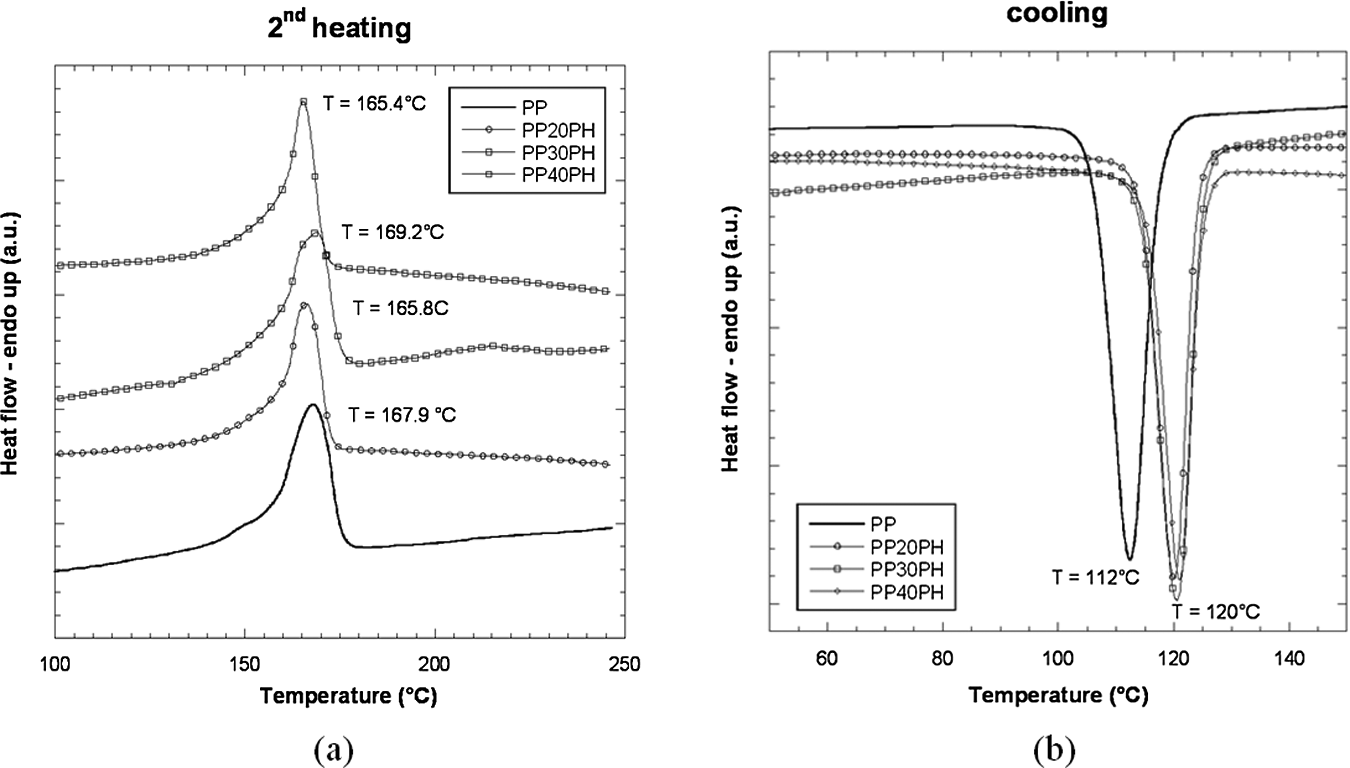
Heat flow for the second heating (a) and the cooling cycle (b) obtained from the DSC for neat PP- and PP-based composites. DSC: differential scanning calorimetry. PP: polypropylene.
In general, the introduction of short-untreated P. tenax fibres in PP composites does compare well with that of other lignocellulosic fibres in non-biodegradable thermoplastic matrices, which indicates some potential for their use in semi-structural large volume applications. This is suggested by the fact that the mechanical properties of the composite do not decrease with respect to the neat polymer, despite the fibres are not compatibilised to provide a sound interface with PP.
Conclusions
This work on composites obtained introducing P. tenax fibres in a PP matrix gives promising results for the applicability of these composites, where a larger stiffness and increased thermal stability are required. In general, using short Phormium fibres in a randomly oriented arrangement did result in a highly positive effect on composite tensile modulus and thermal stability and in a limited modification of tensile strength and of the thermal profile of PP. The main area of concern for these composites appears to be represented by the need to improve the interface strength, since at higher fibre content, a weak fibre–matrix link leads to diffuse fibre pull-out and debonding. Future studies will involve a comparison of these results with those obtained by compatibilising the matrix with the fibre, for example, by maleic anhydride grafting.
Footnotes
Acknowledgement
The authors acknowledge the contribution of Dr Antonio Iannoni to the manufacturing of the composites tested in this work.
Funding
This research received no specific grant from any funding agency in the public, commercial, or not-for-profit sectors.