




Abstract
The properties of injection-moulded polylactic acid (PLA) and recycled carbon fibre composites are examined in this study. Measurement of tensile, flexural, and impact resistance properties quantify the mechanical properties of the composites with increased fibre loading. Tensile strength and modulus of PLA and 30 wt% carbon fibre composite were found to increase by 73% and 438%, while flexural strength and modulus of carbon fibre composite increased by 53% and 400% compared to neat PLA. Consequently, storage modulus measured by dynamic mechanical analysis also improved with the addition of carbon fibre. Mechanical properties were correlated with the Hirsch model. Composite morphological study through scanning electron microscopy (SEM) showed pullout and partial wetting of fibre by matrix along with agglomeration. Differential scanning calorimetry study of the composites showed minor increase in relative crystallinity and crystallization temperature, while melting and cold crystallization temperatures were found to decrease due to the high-thermal conductivity of carbon fibre.
Introduction
The production and integration of bioplastics to markets and industries started to see an increase in the recent years. Most bioplastics were specialty polymers in the prior decades and only found uses in a handful of applications. 1 The two main reasons for the lack of market in bioplastics are high production costs and instability for long-term applications. 1,2 A recent shift has been observed from petroleum-based plastics to renewable resource-based plastics mainly caused by volatile oil costs and environmental concerns. Additionally, technological advances have allowed for large increase in production of bioplastics, leading to reduction in market prices. Starches and cellulose esters are predicted to reach an annual production of 668 million kg by the year 2013, which doubles the production capacity in a time span of only 4 years. 2 The annual production of polylactic acid (PLA) was 229 million kg in the year 2009 and predicted to reach an annual production of over 800 million kg in the near future, allowing the price of PLA and other bioplastics to compete with conventional petroleum-based polymers such as polypropylene and polyethylene.
PLA has a relatively high modulus and strength when compared to most conventional polymers; however, low toughness and sensitivity to heat leaves it much to be desired in high value applications. 1,3 Presently, PLA is extensively used in food packaging applications, which exploits its recyclability and biodegradability. Addition of reinforcing materials may remedy some of its shortcomings and even further enhance its strengths for high-value applications.
Research of PLA as a matrix in a number of different fibre-reinforced composites has been extensively studied. The addition of natural and synthetic fibres was found to increase the modulus of PLA due to the movement restricting characteristic of fillers. 1,4,5 On the other hand, strength is not always improved in these composites. The improvements in mechanical properties will depend on the property of the fibres in itself and the extent of interaction between fibre and PLA matrix.
Carbon fibre is a very strong and lightweight material, which has found its niche in many different areas from aeronautics to automotives to bicycle frames. The weakness in utilization of carbon fibre comes from its high price and limited production. 6 Traditionally, carbon fibre is derived from polyacrolynitrile (PAN), rayon, and petroleum pitch. Ongoing research is conducted on cheaper and more environmentally friendly material such as lignin and polyolefins to create carbon fibre precursors, reducing the cost of raw materials and dependency on petroleum-based materials. 7 On the other spectrum, research has been done to reclaim carbon fibre from carbon fibre-reinforced polymers (CFRPs) utilized in various applications. Conventional methods of processing CFRP include adding woven carbon fibre into an epoxy matrix to produce a material with high strength, modulus, and ability to withstand high temperatures. 6 Due to the high degree of thermal stability in the thermoset matrix, reclaiming these fibres require extreme temperatures in order to separate fibre from matrix. Methods to recycle include pyrolysis, oxidation in fluidized bed, and chemical treatment. Depending on the recycling method, recycled carbon fibre generally retains most of its virgin properties except for the fibre length due to preprocessing methods. 6 These shortened fibres require for a secondary application to be developed.
A number of studies on the combination of PLA/carbon fibre composite have been conducted. 8 –12 The PLA/carbon fibre composites were utilized in biomedical applications where the biodegradability and biocompatibility of PLA is exploited for temporary orthopaedic devices. 8,12 Long fibres, meshes, and three-dimensional fibre arrangements have been studied for such applications. Other studies were also conducted on utilizing PLA-based CFRP for use in electronic housings. The thermal conductivity of specifically arranged carbon fibre allows for heat to be dissipated from inside the case to outside, lowering the heat accumulated, therefore, lowering the heat deflection temperature (HDT) requirement for electronic cases. 9,10 The study of PLA with short carbon fibre, however, has not yet been conducted as far as the knowledge of the authors.
Recycled carbon fibre has been used as reinforcing filler in polyethylene, 13 polypropylene, 14 poly(trimethylene terephthalate), 15 poly-ether-ether-ketone, 16 and epoxy 17 matrices. It was found that the loss of mechanical properties of the composites created from virgin and recycled fibres varies with the method of recycling but is generally low to non-existent with fibres reclaimed through pyrolysis and chemical treatment. 6 It was also suggested that reclamation of carbon fibre from a thermochemical process produces fibres with polar groups on its surface most probably from its epoxy matrix. 13 Such polar groups might interact with newly added matrices to increase the surface adhesion between fibre and matrix.
The areas where bioplastics find its application are seeing a rapid increase. Bioplastics being the renewable and more environmentally friendly alternative to traditional petroleum-based plastics are expanding its reaches from low-value and disposable applications into higher valued applications. Similarly, carbon fibre is seeing increased uses outside the aeronautics industry. The study conducted in this article will study the properties of injection-moulded PLA and recycled short carbon fibre composite. The fabricated composite will be characterized by mechanical testing, fibre alignment analysis, HDT, dynamic mechanical analyzer (DMA), and differential scanning calorimetry (DSC).
Materials and methods
Materials
Injection grade PLA Ingeo 3251D (specific gravity 1.24, melt flow rate 35 g/10 min at 190°C and 2.16 kg loading, and a relative viscosity of 2.5) resin was purchased from Natureworks LLC, Minnetonka, Minnesota, USA. Recycled carbon fibre was obtained from Materials Innovation Technologies – Recycled Carbon Fibre Division LLC, Lake City, South Carolina, USA. The carbon fibre has an average length of 7.3 mm and a diameter of 5.2 µm with specific gravity of 1.78. 18 Recycled carbon fibre was recovered from Hexcel IM-7 PAN-based carbon fibre through the method of pyrolysis.
Preparation of composite
Prior to processing, PLA was dried in a convection oven at 80°C for 6 h to remove moisture from the resin, for a moisture content of less than 100 ppm (0.010%). Injection moulding of the composite was conducted using DSM Xplore 15 mL Micro-Compounder and 12 mL Injection Moulding Machine. Compounding of the fibre and polymer material was done with co-rotating twin-screw extruder with a processing temperature of 183°C for all three processing zones, screw speed of 100 r/min, and processing time of 2 min. Injection moulding was done with a holding temperature of 183°C, mould temperature of 25°C, injection pressure of six bars for 6 s, and holding and packing pressures of eight bars for 6 s each. Carbon fibre was compounded with PLA at a fibre weight loading of 0%, 10%, 20%, and 30%.
Mechanical testing
Conditioning of the samples was done for 48 h following injection moulding at temperature of 23°C and 50% relative humidity. Tensile and flexural information were obtained using Instron Instrument Model 3382 (Instron, Norwood, Massachusetts, USA). The tensile and flexural analysis were performed employing ASTMD638 and D790 standards respectively. Due to the brittleness of PLA, the cross head speeds of 5 mm/min for tensile tests and 1.40 mm/min for flexural tests were used as recommended by the respective standards. Notched Izod impact strength of the composite was measured based on ASTM D256 using TMI 43-02 Impact tester (Testing Machines Inc., New Castle, Delaware, USA) using a 5-ft-lb pendulum.
Differential scanning calorimetry (DSC)
Melt temperature (T m), crystallization temperature (T c), glass transition temperature (T g), melting enthalpy (ΔH m), and crystallization enthalpy (ΔH c) of the composites were determined using TA Instrument DSC Q200. The samples were prepared by placing 5–10 mg of composite sample in an aluminum pan. The DSC sample then undergoes a heat/cool/heat cycle at a ramp rate of 10°C/min from −50°C to 200°C under a nitrogen flow rate of 50 mL/min. Analysis of data obtained from the unit was done using Universal Analysis 2000 software (TA Instruments, New Castle, Delaware, USA).
Dynamic mechanical analysis (DMA)
HDT, storage modulus, loss modulus, and tan δ of the composites were all acquired using TA Instruments DMA Q800, a DMA. HDTs were obtained using a three-point bending clamp with temperature ramp/controlled force mode where a constant amount of force of 0.455 MPa is applied on the sample by the clamp with a temperature ramp rate of 2°C/min. Storage modulus, loss modulus, and tan δ of the composites were obtained using a dual cantilever clamp with multifrequency strain/temperature ramp mode, measuring the modulus while temperature is constantly increasing at a constant rate of 3°C/min. The experimental method for obtaining HDT was done by following the guidelines outlined by ASTM D648, while the storage modulus, loss modulus, and tan δ of the composites were obtained with guidelines taken from ASTM D4065.
Scanning electron microscopy (SEM)
A SEM, HITACHI S-570 (Tokyo, Japan), was utilized to examine the fracture surfaces of tensile and impact samples to observe the interaction of fibre and matrix following the respective tests. The tensile and impact samples were prepared by sputtering gold particles in order to increase the electron conductivity on the surface of the sample, preventing heat accumulation. Furthermore, due to the sensitivity of PLA to heat, the electron beam was shot at an intensity of 10 kV to reduce the deformation on the sample surface.
The dispersion of fibre in the matrix was observed by polishing an injection-moulded flexural test sample with LECO Spectrum System 1000 with a series of polishing papers with decreasing grit sizes. Polishing was done on a surface normal to the direction of injection moulding which is parallel to the length of the sample. Periodical application of liquid nitrogen was done on the polished surface of the sample to reduce the temperature, thereby reducing the amount of deformation from shear forces and heat produced by friction. SEM analysis of the polished surface was then conducted to observe the cross section of the injection-moulded sample. No coating was applied on the polished surface, and SEM analysis was conducted under low vacuum in the presence of water.
Results and discussion
Mechanical properties
The results for mechanical testing are presented in Figure 1. Figure 1(a) shows both flexural strength and modulus to be increasing with carbon fibre loading. Flexural modulus was found to increase linearly by 400% from 3.7 to 18.3 GPa at 0% and 30% fibre loadings, respectively. Strength was found to increase by 53% from 96 to 147 MPa at the same interval of fibre loading. The increase in modulus is expected as the addition of a filler material would restrict the movement of the polymer chains, increasing the stiffness of the composite. 5,13,19 The increase in strength indicates that fibres are assisting in the dissipation of forces, however, the reduction in incremental increase in flexural strength between 20 and 30 wt% fibre loading indicates weakening. This weakening may be caused by a combination of various factors that have been observed and well documented with composites containing high fibre concentration. Some of these factors include fibre agglomeration and reduction in proper mixing which could be seen in Figures 3 and 4. 20 Additionally, fibre breakage due to shear and fibre–fibre contact during processing caused shortening of average fibre length. 19 –21 Another well-documented cause is the reduction in fibre alignment and the shift in preferential fibre alignment which may cause reduction in observed modulus along the flow direction. 22
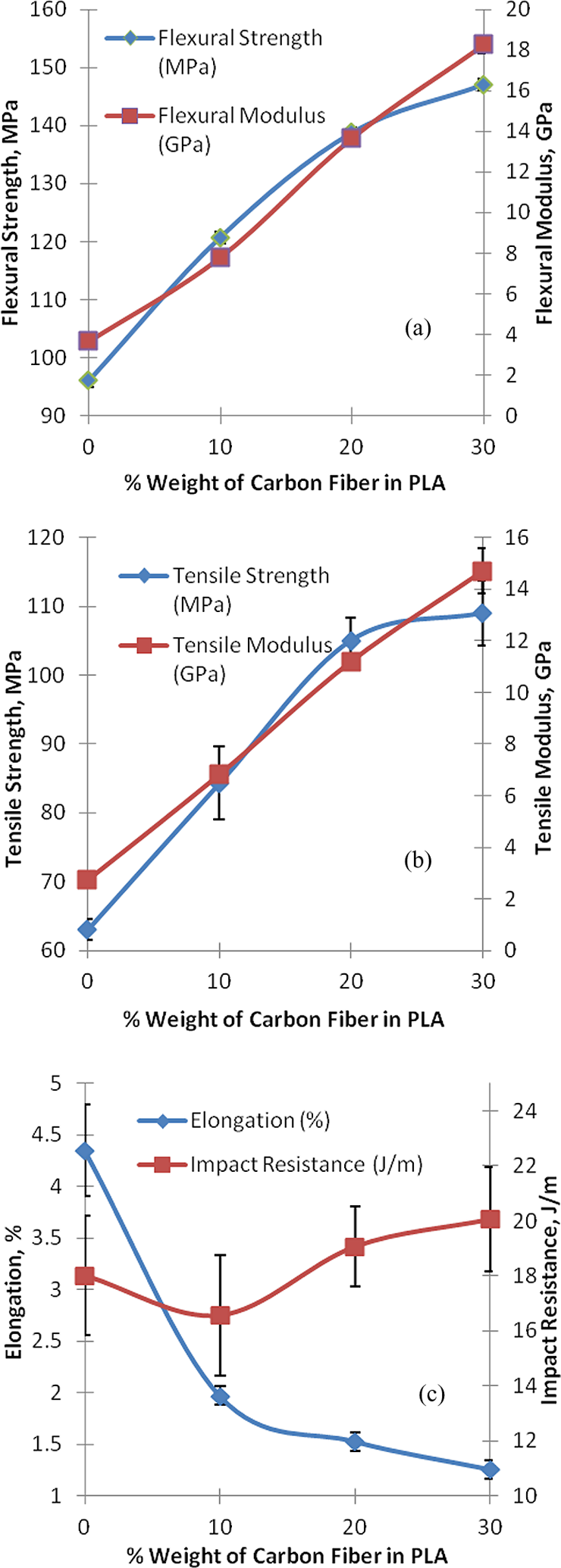
Mechanical properties of PLA and recycled carbon fibre composite with increased fibre loading. (a) Flexural properties, (b) tensile properties, and (c) impact resistance and elongation at break. PLA: polylactic acid.
Tensile results presented in Figure 1(b) show a similar trend as the flexural results. Tensile modulus is found to be linearly increasing from 2.7 to 14.7 GPa at 0% and 30% carbon fibre loading, a 438% increase; while tensile strength increased from 62 to 109 MPa, an increase of 73%. Similar to the flexural data, the increase in tensile strength and modulus indicates that the carbon fibre added into the matrix acts as reinforcement which assists in dispersing force being applied to the composite. 19 The decrease in tensile strength gain between 20% and 30% fibre loading is due to the same phenomena observed with the flexural data.
The elongation at break and impact resistance of the composites can be seen in Figure 1(c). As specified in ASTM D256, toss corrections were included in the impact resistance measurements since the average impact resistance before toss correction was found to be near 27 J/m. PLA was found to have an elongation of 4.4% which was reduced with the addition of carbon fibre. This decrease in elongation and increase in modulus indicates that the composite is consistent with the increase in stiffness due to the polymer chain movement inhibiting effect of high modulus fillers. 19 Minor changes were observed with the impact resistance data. Impact resistance was found to initially decrease with the addition of 10% carbon fibre but slightly increases at 20% and 30% carbon fibre loading. The decreasing trend observed between 0% and 10% might be due to the cracks formed at the fibre ends, 20 however, load transfer slightly improved at higher fibre loadings.
Theoretical approximation of mechanical properties
Theoretical approximation of the composite moduli was carried out using the Hirsch model
23
seen below:

where E f and E m are the fibre and matrix moduli while V f and V m are the fibre and matrix volume fractions. The Hirsch model is a combination of the parallel and series model modified by the χ function. The χ function ranged from 0 to 1, where the model becomes the parallel model at a χ value of 1 and series model at a value of 0. Physically, the χ function is a value that determines stress transfer between fibre and matrix affected by fibre length, orientation, and stress amplification at fibre ends. 23
The results of the approximation can be seen in Figure 2. The parallel and series models show the extremes of the Hirsch model where the stress transfer coefficient is 1 and 0, respectively. By determining the best fit value, χ was found to be 0.2, which perfectly fits the data points at 0, 10, and 20% fibre loading. At 30% fibre loading, however, the experimental value deviates from the model. This deviation indicates weakening of the composite as previously discussed.
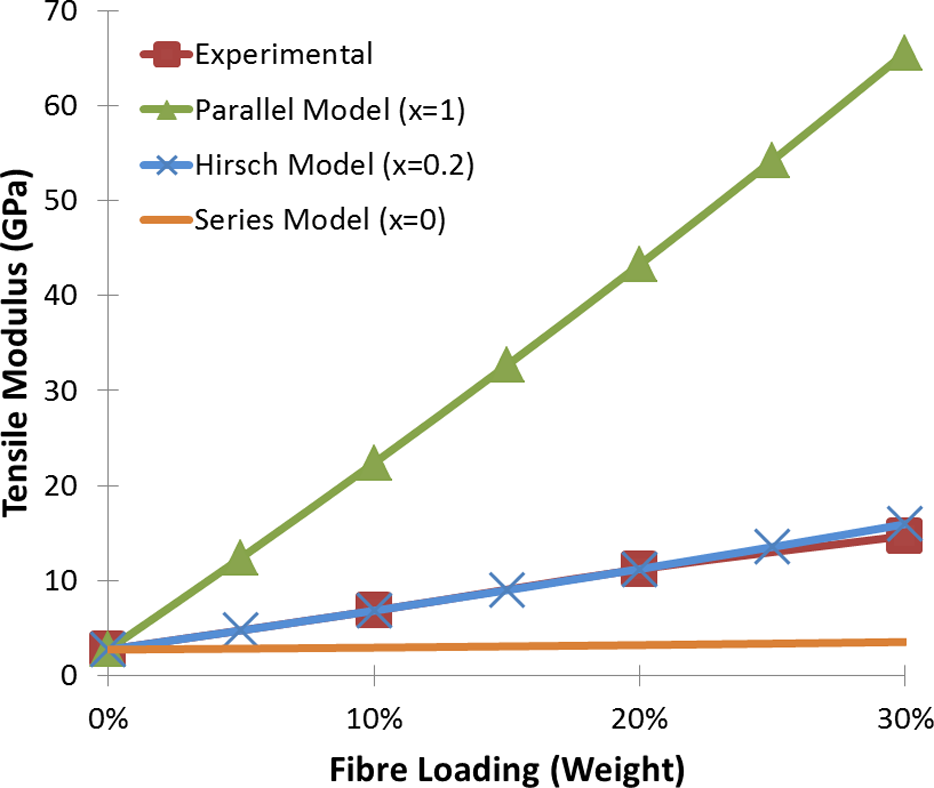
Experimental data and theoretical approximation data for tensile modulus of PLA and recycled carbon fibre composites. PLA: polylactic acid.
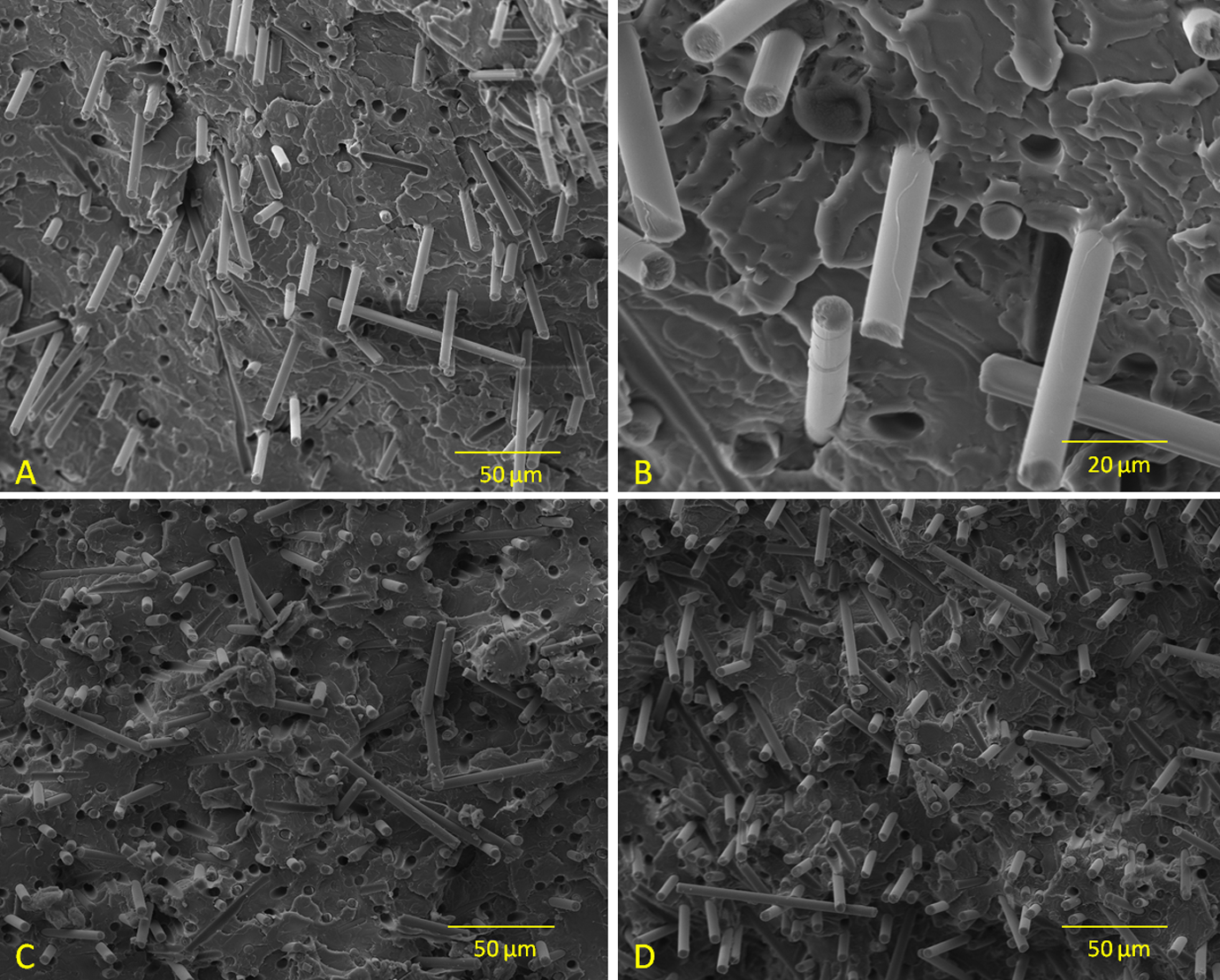
Scanning electron microscopic images of PLA and recycled carbon fibre composite. (a) and (b) = tensile fracture surface of 10% carbon fibre loading, (c) = impact fracture surface of 20% carbon fibre loading, and (d) = impact fracture surface of 30% carbon fibre loading. PLA: polylactic acid.
Scanning electron microscopy and fibre alignment study
SEM images of the carbon fibre reinforced composites are presented in Figure 3. Figure 3(a), (c) and (d) show the image of PLA with 10%, 20%, and 30% carbon fibre loadings, respectively at 1000 times magnification, while Figure 3(b) shows a 4000 times magnified surface of the 10% fibre loaded composite. From images a, c, and d, it can be seen that the fibres are dispersed throughout the matrix relatively evenly. Some bundling of the fibres is observed such as the one seen in the right half of Figure 3(d), which is most likely caused by incomplete separation of fibre tows. Fibre breaks and pullouts were also observed in the SEM images. The mechanisms for both fibre breaks and pullouts for glass fibre composites have been previously explored. 20 Figure 3(b) shows a shear band created by fibre pullout, indicating the presence of surface interaction between fibre and matrix. 15
Figure 4 shows the SEM image of the polished composite cross section at increasing fibre loadings. The black dots are the cross sections of carbon fibre, while the white background is the PLA matrix. It can be seen that at 10% fibre loading, the fibres are dispersed relatively well. On the other hand, the composite with 30% carbon fibre loaded showed clusters of fibre due to fibre agglomeration and low dispersion of fibre tows.
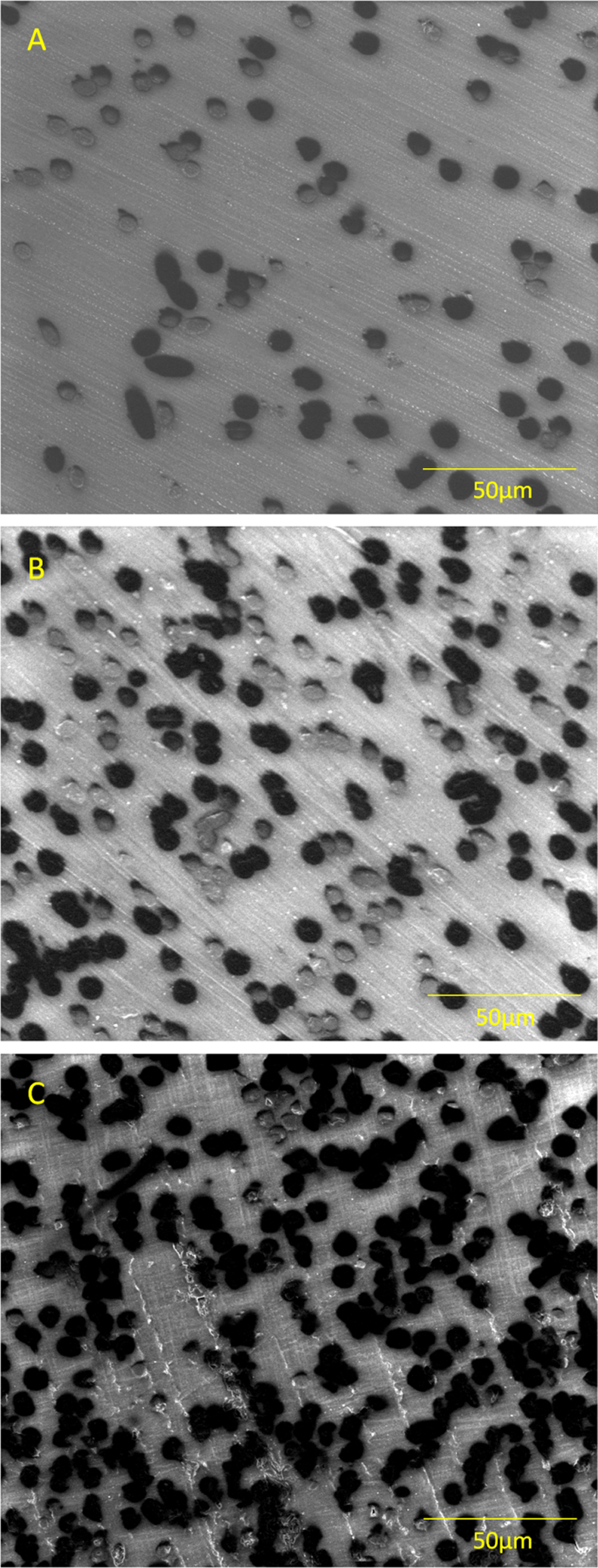
Scanning electron microscopic images of polished PLA and recycled carbon fibre cross sections. (a) = 10% carbon fibre loading, (b) = 20% carbon fibre loading, and (c) = 30% carbon fibre loading. PLA: polylactic acid.
Crystallization and melting behaviour of composite
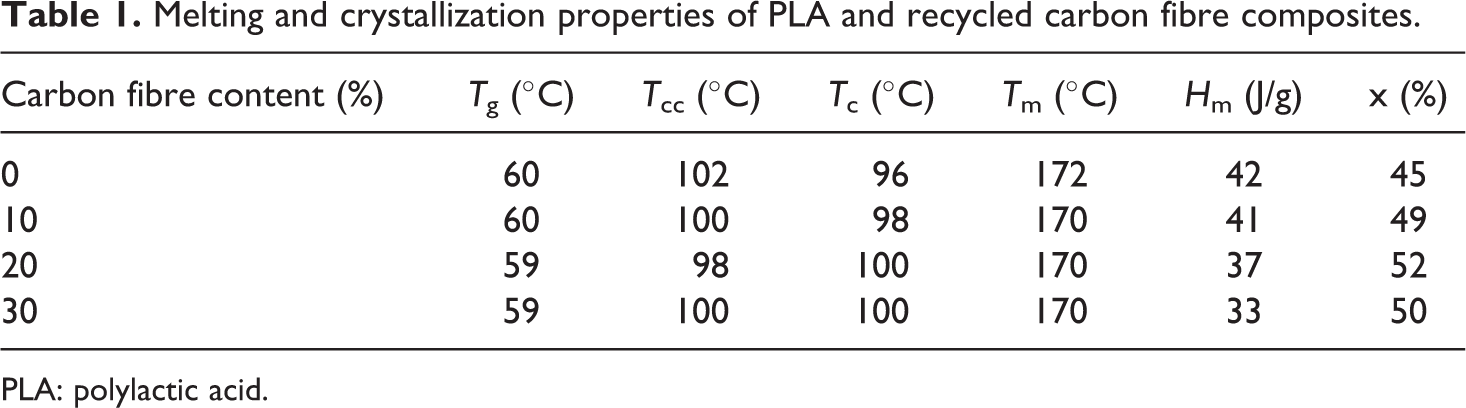
Summary of the thermal properties of the composite obtained from DSC analysis including glass transition temperature (T
g), crystallization temperature (T
c), cold crystallization temperature (T
cc), melting temperature (T
m), and melting enthalpy (ΔH
m) and crystallinity (χ) can be seen in Table 1. Even though the changes observed in the thermal properties were very minor, a trend can still be identified. From Table 1, it can be seen that the cold crystallization, which is caused by the movement of PLA molecules at temperatures past its T
g to rearrange and produce highly ordered formation,
3
have been reduced by approximately two degrees, similar to the changes observed with the melting temperatures. On the other hand, the crystallization temperature increased from 96 to 100°C, while relative crystallinity increased by approximately 7% with the addition of carbon fibre. Relative crystallinity, χ, can be measured with the equation below:
5

Melting and crystallization properties of PLA and recycled carbon fibre composites.
PLA: polylactic acid.
Where f is the weight fraction of the polymer,
Carbon fibre and PLA composites has been shown to be a thermally conductive material by Nakamura and Iji, 9 with its thermal conductivity increasing based on fibre length and fibre alignment. The highest thermal conductivity was seen with carbon fibre having a length of 6 mm and aspect ratio of 600 with alignment parallel to heat flux. 9 The same composite with long fibres measured with fibre alignment perpendicular to the direction of heat flux shows almost no change with regard to its thermal conductivity when compared with neat PLA. 9 This increase in thermal conductivity might also increase the rate of heat transfer into the polymer matrix, which would affect the thermal properties of the composites.
Dynamic mechanical analysis
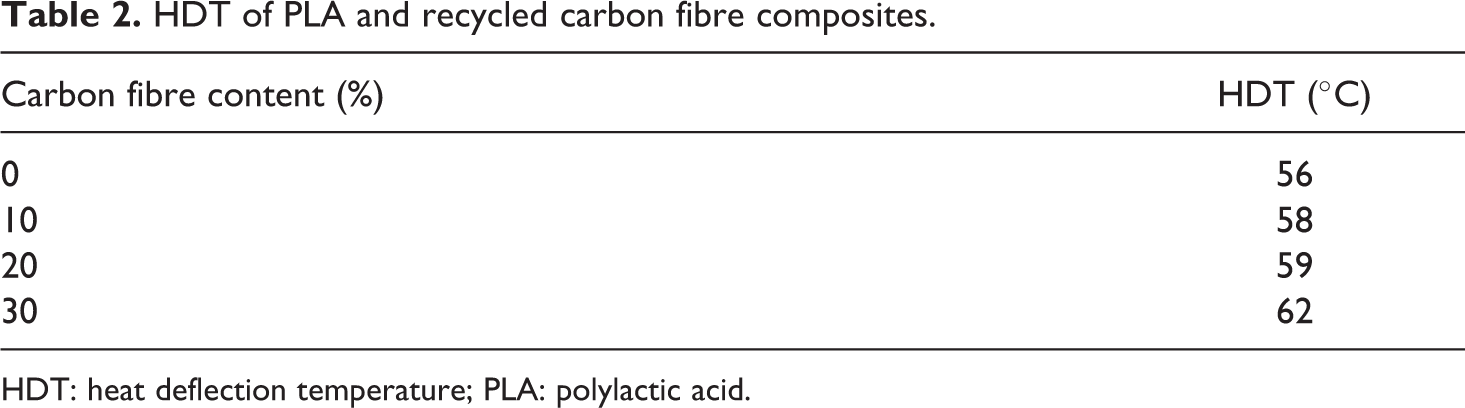
Table 2 shows the changes in HDT with increased fibre loading. The data show that temperature at which failure occurs increased almost linearly from 56°C for neat PLA to 62°C for PLA with 30% carbon fibre loading. Since DSC analysis showed no change in thermal properties, the increase in HDT is likely due to the effect of mechanical properties. This linear trend is similar to the one observed with flexural data, which might suggest the increase in HDT is mostly due to the increase in modulus from the addition of the stiff fibres. 4 The HDT of the composites is mostly influenced by the low HDT of PLA.
HDT of PLA and recycled carbon fibre composites.
HDT: heat deflection temperature; PLA: polylactic acid.
Figure 5 presents the viscoelastic properties of the composites. The storage modulus data, as seen in Figure 5(a), shows a gradual increase in modulus which is uniform with the tensile and flexural data. This observed trend indicates that the addition of carbon fibre gives a significant effect to the elastic property of the composite. 4,5,26 As the temperature rises, the storage modulus slowly decreases until the T g of the composite is reached where the material begins to soften and the storage modulus begins to rapidly decline from 60°C to 70°C which is where the loss moduli (Figure 5(b)) of the composites begin to climb and peak, which is in agreement with data obtained from DSC. 4
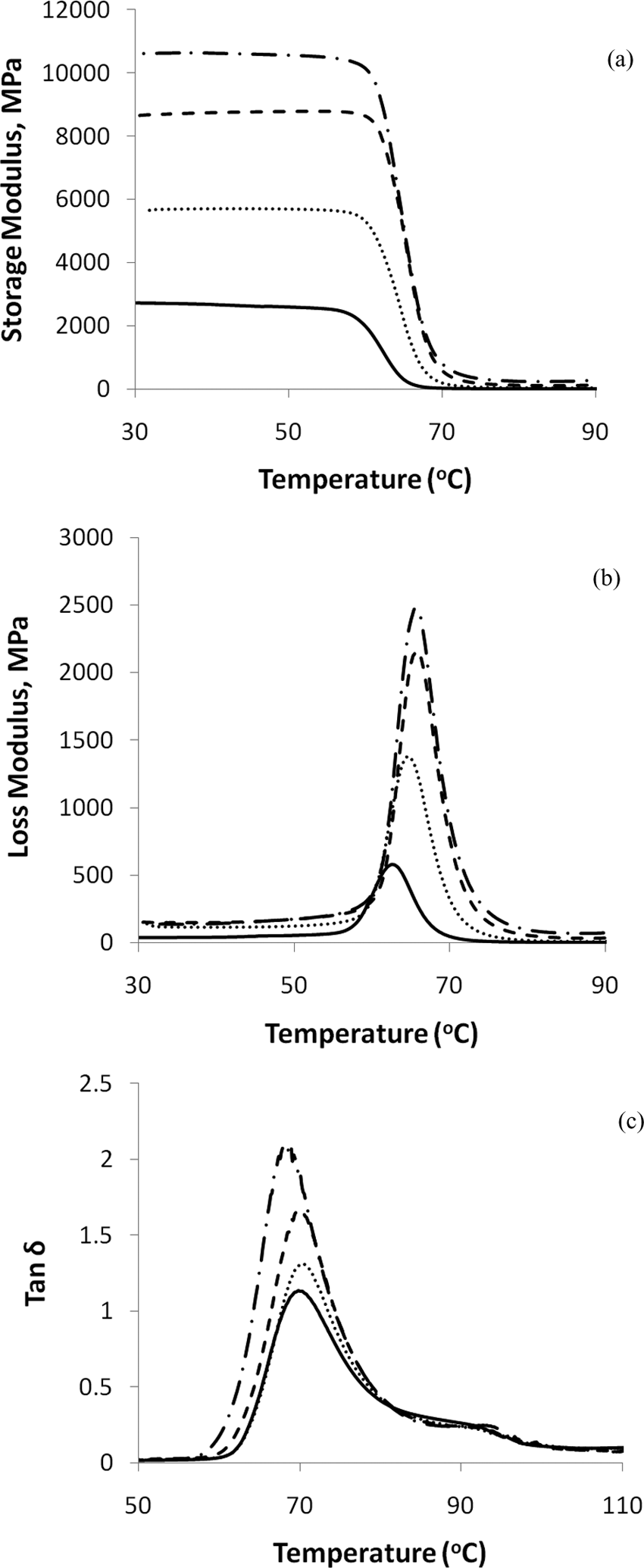
Storage modulus (a), loss modulus (b), and tan δ (c) of PLA and recycled carbon fibre composite. PLA: polylactic acid.
The loss modulus graph also showed that the initial softening temperature is the same for all loading, which indicates no significant improvement in thermal stability. 4,26 However, an increasing trend in peak loss modulus is observed with increasing loading, which is uniform with the increase in crystallization temperature and relative crystallinity, which may indicate an effect of crystallization on loss modulus.
The tan δ data shown in Figure 5(c) indicates that the peak is not significantly altered from the addition of carbon fibre. It has been shown that intensity of the tan δ peak is not sensitive to interfacial effects but is strongly affected by fibre orientation and fibre loading. 26 The area under the curve of the tan δ data shows a decreasing trend with increased carbon fibre loading. This trend may indicate that carbon fibre reduces the movement of polymer chains in the composite by interacting with the polymer chains. 26 This trend is uniform with the increase in flexural and tensile modulus and the decrease in elongation at break of the composite.
Conclusions
This article investigated the various physico-chemical performance of injection-moulded PLA and recycled carbon fibre-reinforced composite. Mechanical testing of the composite has shown the reinforcement of PLA by recycled carbon fibre. Tensile strength and modulus were significantly increased by the addition of recycled carbon fibre. SEM analysis shows the existence of slight interaction between fibre and matrix which contributes to the increase in composite properties. Additionally, tests conducted on the thermal properties of the composite by DSC have shown that the carbon fibre acts as nucleation sites within the composite, which increased the relative crystallinity of PLA while the thermal conductivity of carbon fibre is most likely the cause of a slight decrease in melting temperature.
Overall, the addition of short recycled carbon fibre showed an increase in mechanical properties, however, very little effect was observed with thermal properties of the composite. This study has given the opportunity for optimization of the various processing parameters in order to produce a marketable high-performance biocomposite. Further studies could be conducted on surface treatment and compatibilization of fibre and matrix in order to improve the properties of the composite to allow for a wide range of applications to be reached.
Footnotes
Funding
The authors would like to acknowledge the NSERC Biomaterials and Chemicals Research Network for financial support necessary for this project.