




Abstract
The objective of this study was to reveal flame spread characteristics of the insulation material, expanded polystyrene (EPS) with different thicknesses under different environmental conditions (pressure and oxygen concentration). Experiments were carried out in small-scale flame spread experimental benches in the Tibetan plateau and Hefei, respectively, with EPS sample sheets inclined horizontally. Changes in the flame spread speed, average length of the pool fire, average maximum flame height, and maximum flame temperature in the surface flame zone were used to determine the effect of the plateau and plain environments on flame spread characteristics. The results showed that with the increase in sample thickness, the values of these parameters increased both in Lhasa and Hefei. The values of flame spread speed, average length of the pool fire, and average maximum flame height in Hefei were all larger than those in Lhasa, while the maximum flame temperature in the surface flame zone in Hefei was less than that in Lhasa for the EPS of the same thickness.
Introduction
The colorful steel sandwich panel with rigid embedded closed-cell expanded polystyrene (EPS) foam is a new light building insulation material, which is very popular around the world, especially in China. 1 When the EPS core material is subject to a heat source or a fire, it is prone to combust and produces orange flame on the surface of the burning zone. The flame will spread fast to the other parts of the core material, resulting in the other core material softening, shrinking, melting, and dripping, which will form the dripping fire and flooding fire in the air and on the ground, respectively. Therefore, a lot of heat, smoke, and poisonous gases are generated, which are difficult to put out and very dangerous to the fire fighters. For example, on October 3, 2007, a fire occurred in the Xintuo market, Turpan city, Xinjiang (China). It burned 1383.4 m2 and caused one death. The ignited material was EPS color steel sandwich panel, with very poor fire resistance. Therefore, it is necessary for us to reveal the flame spread characteristics of insulation materials.
According to the relationship between thermal penetration depth δ and the thickness L of the insulation material during the surface flame spread, the insulation materials can be divided into two types: thermally thick materials (δ<L) and thermally thin materials (δ>L). 2 Blasi 3 studied the influence of the thickness of the material on the flame spread by numerical simulation and classified the material into three regimes, namely, chemical kinetic, thermally thin, and thermally thick regimes, according to the relationship between the thickness of the material and the flame spread characteristics.3,4 In chemical kinetic regime, the material is very thin, finite chemical kinetics control the flame spread speed, which increases with the thickness of the material, and both the flame and pyrolysis lengths are very short. In the thermally thin regime, the material is thin and the flame spread speed decreases with the increasing thickness. Moreover, in the thermally thick regime, the thickness of the material is relatively thick and the flame spread speed basically does not change with the increasing thickness. Bhattacharjee et al. 5 studied the critical thickness of the flame extinction of poly(methyl methacrylate) (PMMA). The result shows that in a quiescent microgravity environment, all fuels are thermally thin if a steady flame spread is possible. Meanwhile, the critical thickness of the material of the steady-state flame spread from the loss of reradiation of solid surface was studied. If the material thickness is greater than the critical thickness, or dimensionless radiation number of the material is >0.25, the flame will extinguish. Mamourian et al. 6 experimentally studied downward flame spread of three thicknesses of the vertical PMMA sheets in the quiescent environment. The dependence of the flame spread rate on the thickness of sheets is obtained by one-dimensional heat transfer model, which means that the flame spread rate decreases with the thickness and finally, tends to a constant. As the density of EPS is small, during the flame spread process, the material shrinks and melts, which makes the flame spread more complicated, and until now, the research ofthe thickness of the insulation material on the flame spread characteristics is relatively rare. At the same time, the research of flame spread of different thicknesses of insulation materials at high altitude (hypobaric hypoxia) is almost blank, and only a few research on the carbonized solid material in the plateau area are available. So, it is necessary to study the flame spread characteristics of different thicknesses of the insulation material under different environments.
In this study, small-scale EPS flame spread experiments were conducted in a plateau area in Lhasa and a plain area in Hefei. The selected four thicknesses of the material were 2, 3, 4, and 5 cm, with width 4 cm, and length 80 cm. The flame spread speed, average length of the pool fire, average flame height, and the maximum temperature in the surface flame zone were analyzed.
Experimental
Experimental System
Experiments were carried out using a small-scale flame spread setup as shown in Figure 1, which includes a rotating support of gypsum board and a measurement system. Insulation materials could be placed at different angles on the gypsum board to perform one-sided flame spread experiments. The measurement system included thermocouples, a radiation heat flow meter, camera, data acquisition system, and heat flux acquisition device. The gas temperature was measured by the thermocouples during the flame spread process. The heat flux meter was used to measure radiation heat flux. The camera recorded the flame spread process. The data were used to establish the relationship between insulation material pyrolysis front and flame spread time.
Small-scale experimental system used to study flame spread on insulation materials. (a) Rotary experimental stent system: (1) rotary stent, (2) gypsum board, and (3) insulation material; (b) measurement system of flame spread characteristics: (1) thermocouples, (2) data acquisition system, (3) heat flow meter, (4) heat flux acquisition device, (5) PC, and (6) camera.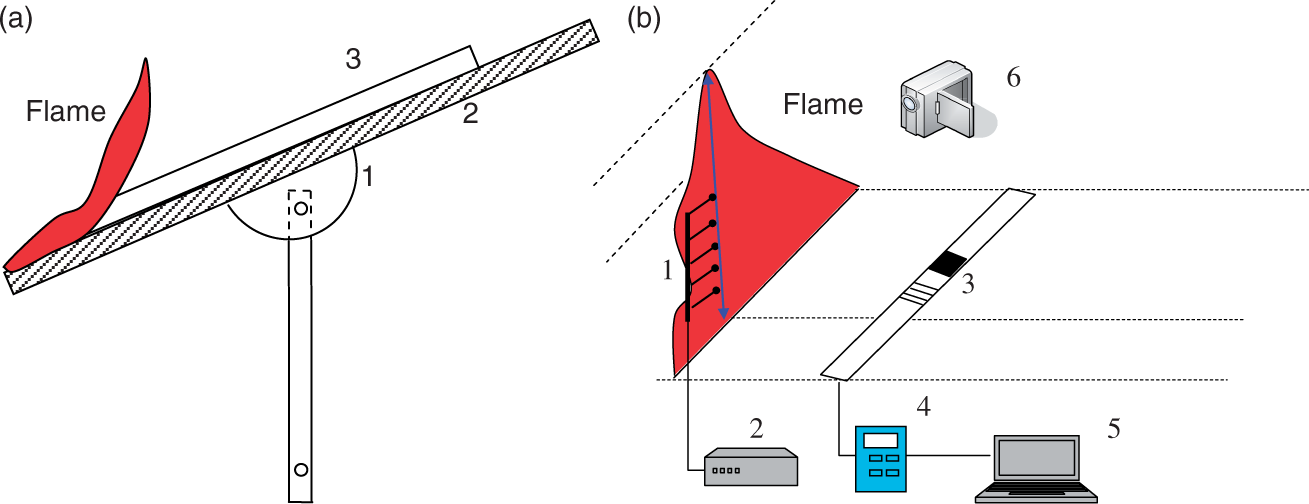
Sample Preparation and Experimental Measurement
The standard thickness of building insulation material EPS is usually 5 cm. 7 The selected thicknesses of EPS in this experiment were 2, 3, 4, and 5 cm, with length 80 cm, and width 4 cm. The density is 18 kg/m3. The bottom surface of each sample was wrapped with aluminum foil to prevent molten polystyrene from flowing onto the gypsum board. A set of parallel lines were drawn at 5 cm intervals on the upper surface of each sample sheet to facilitate instantaneous recording of the position of the pyrolysis front during flame spread.
Before the experiment, the sample sheet was placed on the gypsum board and a row of thermocouples was positioned vertically above the upper surface of the 2, 4, 6, 8, 10, and 12 cm EPS sheets in the middle to measure gas temperature during the flame spread process.
Experimental results and analysis
Geographical and meteorological conditions in Lhasa and Hefei (China)
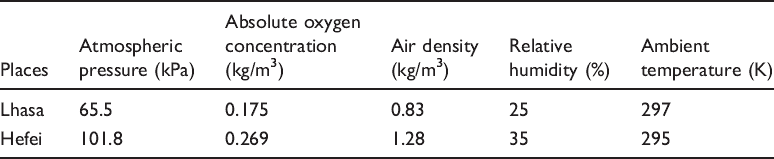
The flame spread speed, average length of the pool fire, average flame height, and the maximum temperature in the surface flame zone for the different thicknesses of EPS in two places were obtained.
Characteristics of Flame Spread of Insulation Material EPS with Different Thicknesses
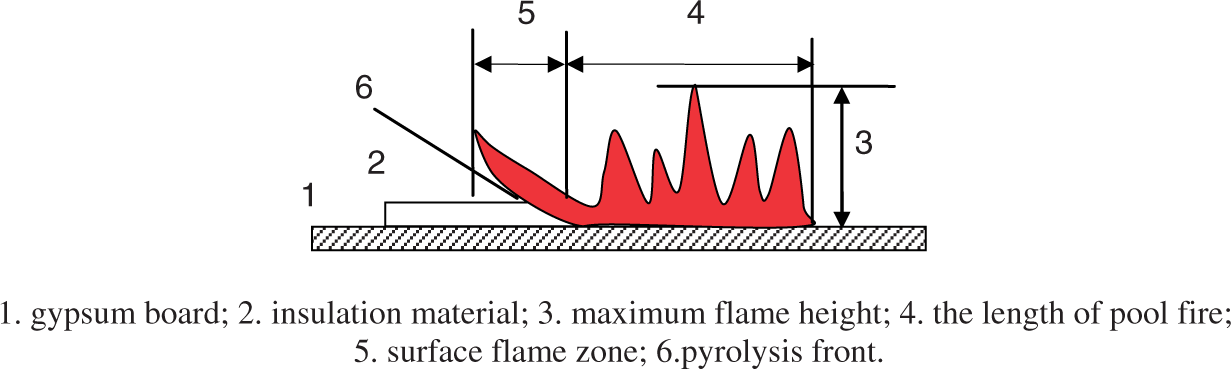
Figure 2 shows the EPS flame shapes of EPS material with thicknesses d = 2, 3, 4, and 5 cm in Lhasa. The starting time t = 0 s is defined as the moment at which the EPS material with different thicknesses is ignited. The schematic structure of the flame is shown in Figure 3. As shown in Figure 2, it is found that for different thicknesses of EPS during the flame spread process, pyrolysis front locations are different at the same time. This means that the flame spread speeds of EPS with different thicknesses are different. Meanwhile, the average length of the pool fire, maximum flame height in the pool fire zone, and the maximum temperature in the surface flame zone are also different. Similarly, in Hefei, these characteristic parameters have the same change trend as those in Lhasa.
Flame shapes at different flame spread time on the different thicknesses of EPS sample sheets in Lhasa. Schematic representation of flame spread on thermoplastics of EPS.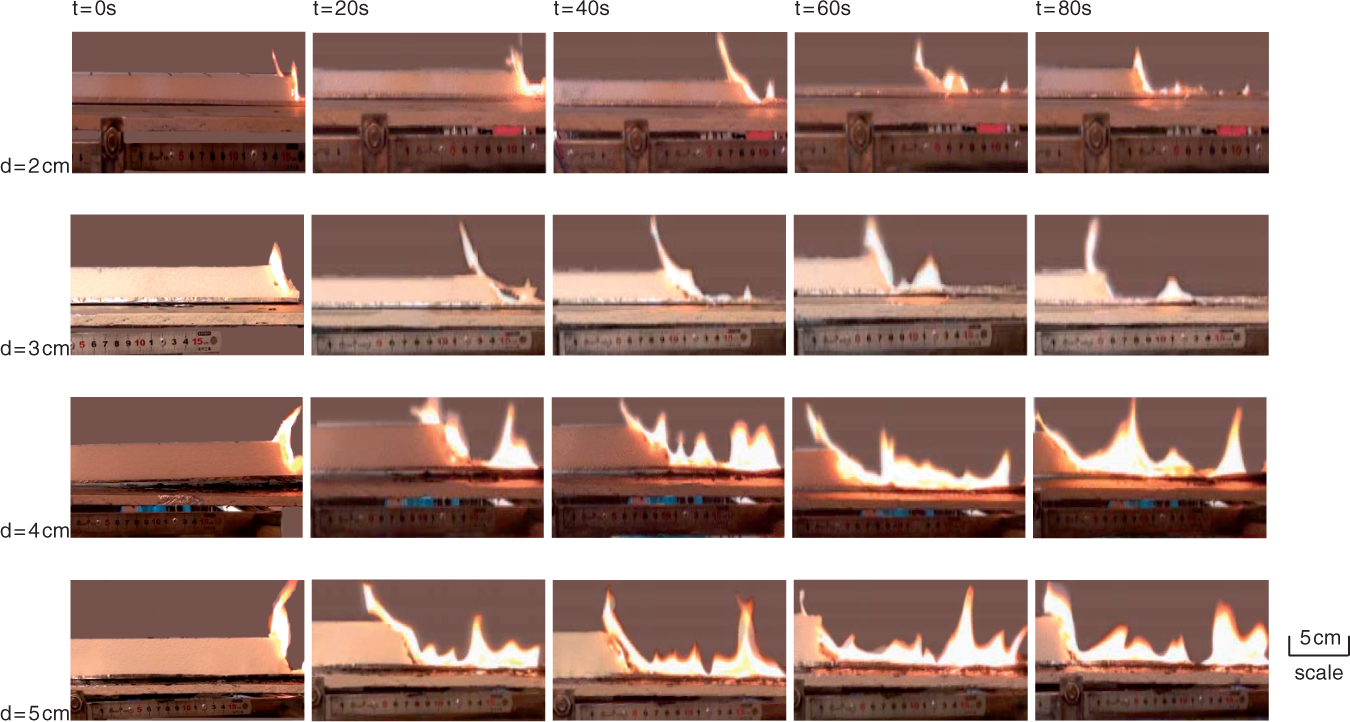
Flame Spread Speed of EPS with Different Thicknesses
As shown in Figure 4, both in Lhasa and Hefei environments, the pyrolysis front positions of EPS in four thicknesses during the flame spread process have a linear relationship with the flame spread time. This means that the flame spread speed is a constant in every case and the linear slope presents the flame spread speed. It can also be seen from Figure 4(a) that for the different thicknesses of EPS in Lhasa (a hypobaric hypoxia environment), the flame spread speed slightly increases with the increasing thickness, and this increase is not very large. In the case of the 2-cm thick EPS sheet, the flame quenches eventually in Lhasa. This is mainly because, in the process of flame spread, the melting mass of EPS becomes lesser and lesser along with the flame spread time, making the preheat zone receive lesser and lesser heat, and therefore, the flame extinguishes eventually. In Hefei (a normal environment), as shown in Figure 4(b), the flame spread speed increases gradually with the increasing thickness, and the level of increase in flame spread speed is significantly higher than that in Lhasa, showing that in a higher pressure and oxygen concentration environment, the flame spread speed of insulation material EPS has a greater sensitivity to material thickness. Moreover, for the 2-cm thick EPS, in Hefei, the extinguishment phenomenon does not appear during the flame spread process. This is mainly due to the fact that the atmospheric pressure and absolute oxygen concentration are correspondingly larger in Hefei, which easily promotes the burning of EPS. Meanwhile, for the EPS of same thickness, the flame spread speed in Lhasa is smaller than that in Hefei, demonstrating that the increase in atmospheric pressure and absolute oxygen concentration will promote the flame spread speed of EPS.
Positions of pyrolysis front of different thicknesses of EPS with time in (a) Lhasa and (b) Hefei.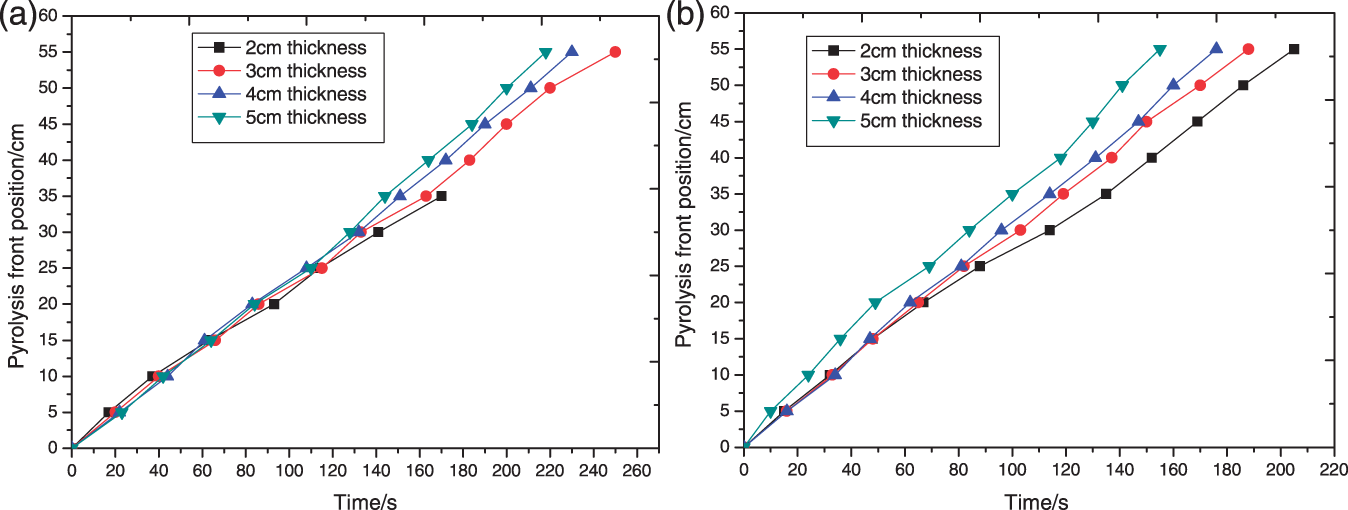
The surface flame spread speed of insulation material of EPS follows the formula:
8


Pool Fire’s Length and Maximum Flame Height
For the EPS with thicknesses of 2, 3, 4, and 5 cm, the length of the pool fire and the maximum flame height in the pool fire zone were measured from 0 to 80 s in Lhasa and Hefei, respectively. Figure 5 shows the lengths of the pool fire of 3-cm-thick EPS in Lhasa and Hefei.
Length of pool fire during the flame spread process in 3-cm-thick EPS in (a) Lhasa and (b) Hefei.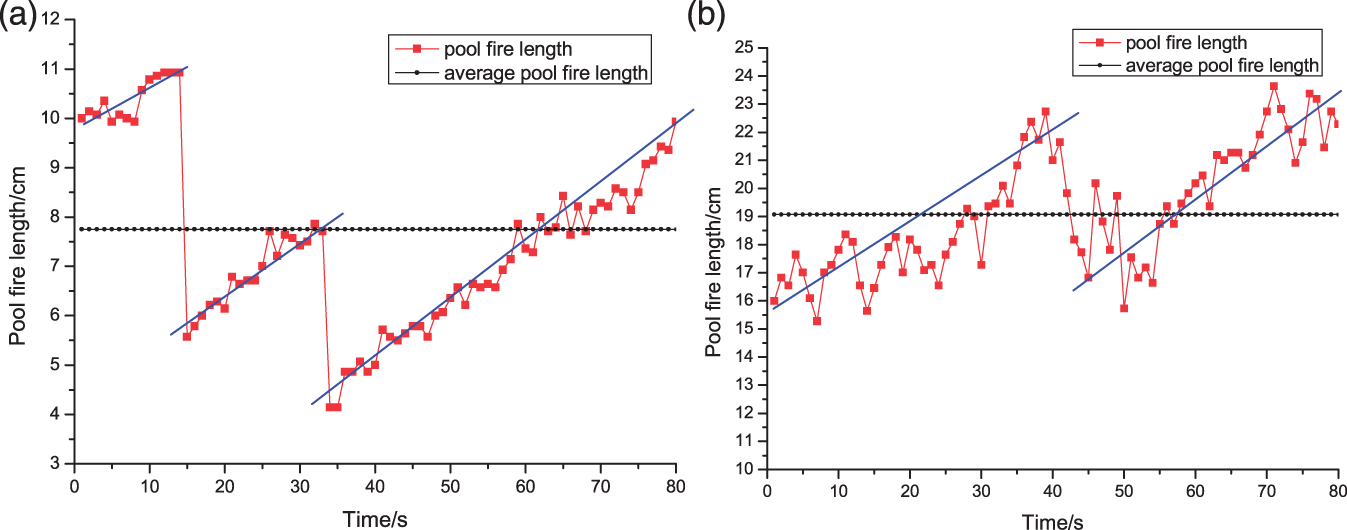
As can be seen from Figure 5, in Lhasa, the average length of the pool fire of 3-cm-thick EPS (7.75 cm) is much lower than that in Hefei (19.07 cm). The result illustrates that the atmospheric pressure and oxygen concentration have effect on the length of the pool fire. At the same time, the lengths of the EPS pool fire in both Lhasa and Hefei display cyclical increase. This means that these cycles involve an initial increase in the length of the pool fire to a certain point, which is followed by a rapid decrease and an increase again. In Lhasa, flame eventually extinguished for the 2-cm-thick EPS during the flame spread process. That is, the flame spread cannot be maintained; therefore, the length of the pool fire gradually decreases to zero. Whereas in Hefei, for the 2-cm-thick EPS, the flame spread can be maintained, and the length of the pool fire also displayed cyclical increase. Meanwhile, for the 4-cm-thick EPS, the length of the pool fire also shows the characteristics of cyclical increase in both places. For the 5-cm-thick EPS, with increasing thickness, the lengths of the pool fire show a gradual increase in characteristics and not a cyclical increase in two places. This is mainly because the unit length of the EPS fueling the pool fire is gradually increased with thickness, which makes the pool fire burn for a longer time during the process of flame spread. Therefore, in this experiment, for the 5-cm-thick EPS, the length of the pool fire shows a gradual increase.
Figure 6 shows the measured average length of pool fire of EPS in the four thicknesses during flame spread process in two places. As can be seen from Figure 6, with increasing thickness, in both Lhasa and Hefei, the average lengths of pool fire have an increasing trend. When the thickness is >4 cm, the increasing trend of the pool fire’s length becomes smaller. Meanwhile, for the same thickness of the EPS, the average length of pool fire is larger in Hefei than that in Lhasa. The results show that for the smaller thickness of EPS, the atmospheric pressure, oxygen concentration, and thickness affect the average length of the pool fire together, whereas if the thickness is relatively larger, the effect of thickness on the length of the pool fire is weak, and at this time, the atmospheric pressure and absolute oxygen concentration are the main influences on the average length of the pool fire.
The average length of pool fire of different thicknesses of EPS in two places.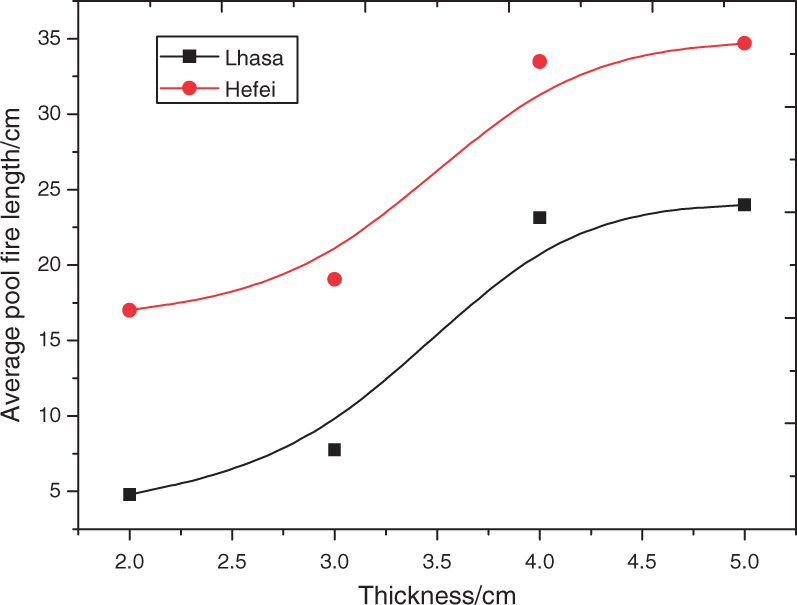
Meanwhile, the maximum flame height in the pool fire zone was measured for the four thicknesses of EPS during flame spread process in both places. Figure 7 presents the maximum flame height with flame spread time for the 3-cm-thick EPS in Lhasa and Hefei, respectively.
Maximum flame height during flame spread on the 3-cm-thick EPS in (a) Lhasa and (b) Hefei.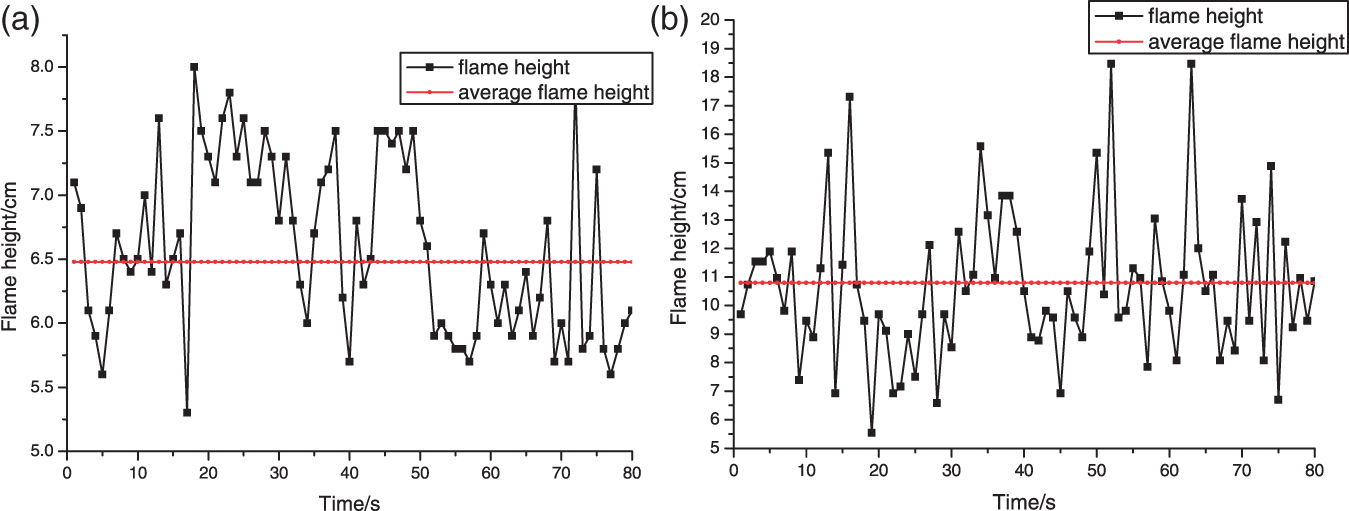
As can be seen from Figure 7, the average maximum flame height is 10.08 cm in Hefei, which is larger than that in Lhasa (6.48 cm). This difference comes from the combustion mechanism that involves diffusion flame. Under normal pressure, oxygen is supplied to the diffusion flame by natural convection and diffusion. 9 Moreover, Lhasa has a hypobaric, hypoxic environment, having a lower air density than that of Hefei (Table 1). This reduces the buoyancy of the air and consequently reduces natural convection. The result is a decreased oxygen supply and lower maximum flame height than that in Hefei.
According to the above method, the maximum flame height in the pool fire zone was measured for four thicknesses of EPS during flame spread process in both places. These average maximum flame heights are shown in Figure 8.
The average maximum flame height of different thicknesses of EPS in Lhasa and Hefei.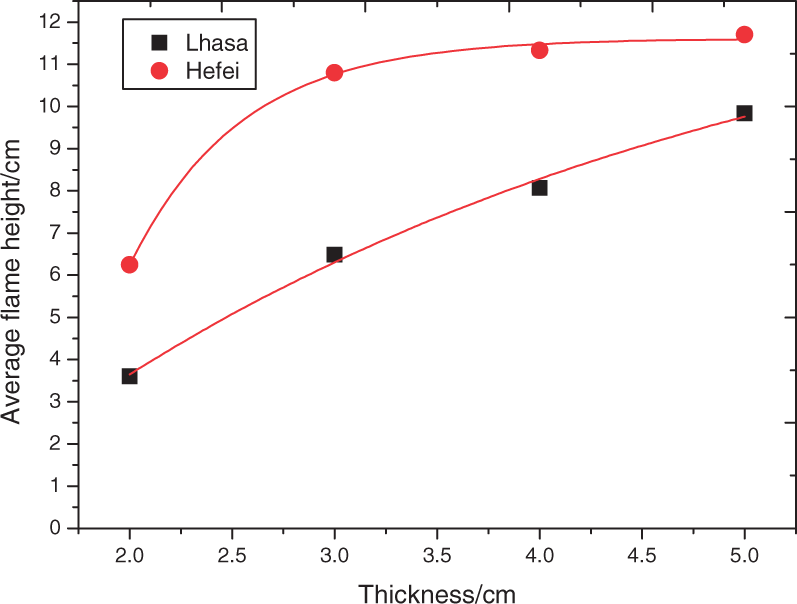
As can be seen from Figure 8, the average maximum flame height of the same thickness of EPS in Hefei is higher than that in Lhasa. In Lhasa, the average flame height almost linearly increased with the thickness. However, in Hefei, when the thickness of EPS is increased from 2 to 3 cm, the maximum flame height increases sharply, whereas from 3 to 5 cm, the height increases slowly. The results show that in Lhasa (a hypobaric, hypoxic environment), the thickness of EPS has a large effect on the average maximum flame height, whereas in Hefei (a normal environment), only when the thickness of EPS is below 3 cm, the average maximum flame height is significantly affected by its thickness.
Maximum Flame Temperature in the Surface Flame Zone
A row of thermocouples were positioned vertically above the upper surface of 2-, 4-, 6-, 8-, 10-, and 12-cm-thick EPS in the middle to measure flame temperature in the surface flame zone during the flame spread process. The temperature was measured by thermocouples, and the maximum flame temperature in the surface flame zone was used for further analysis. Figure 9 represents the maximum flame temperatures in the surface flame zone for the four thicknesses of EPS in Lhasa and Hefei.
The maximum flame temperature in the surface flame zone for the different thicknesses of EPS in Lhasa and Hefei.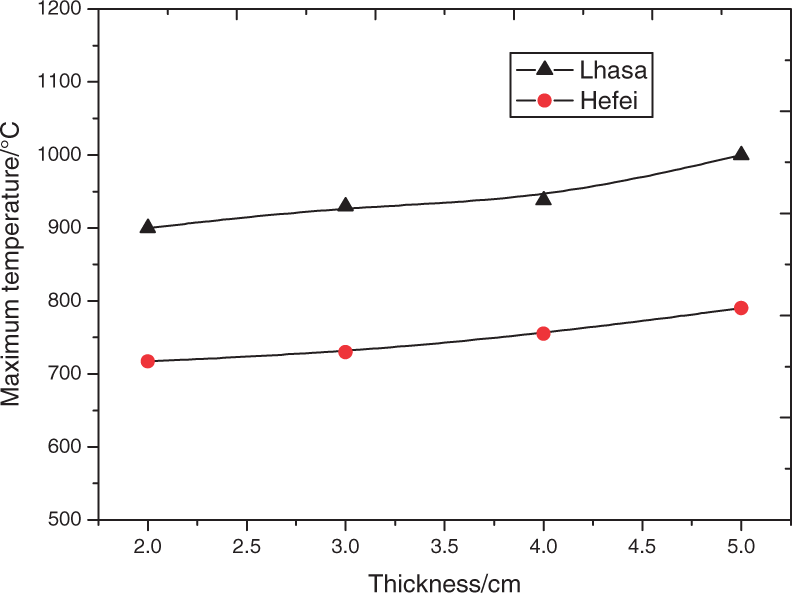
As can be seen from Figure 9, the maximum flame temperatures increase slightly both in Lhasa and Hefei with the thickness. This is because, in both Hefei and Lhasa, as the thickness increases, the flame spread speed of EPS is slightly higher. According to Formula (1), the heat flux of pyrolysis front
During the flame spread process, the maximum flame temperature in Lhasa is about 200°C higher than that in Hefei for the same thickness of the EPS. When the atmospheric pressure and absolute oxygen concentrations are higher, the maximum flame temperature shows a decreased trend. This is mainly because high pressure contributes more to the formation of carbon particles than a low pressure. The production of carbon particles affects the maximum flame temperature in turn. Gaydon et al. 11 studied the effect of pressure change on the formation of carbon particles in a homogeneous flame in a large range of pressure. The results showed that in the diffusion flame, when the pressure decreases, the production of carbon particles is decreased, and when the pressure increases, the production of carbon particles also increases significantly. Li et al. 12 studied the volume fraction of carbon particles in the n-heptane flame of the same size of oil pan in Lhasa and Hefei. The results showed that the volume fraction of carbon particles in Lhasa is lower than that in Hefei. The burning flame of EPS is the diffusion flame type during flame spread process. For the incomplete combustion and thermal decomposition effects, a variety of pyrolysis products are produced, and the thick black smoke is formed. 13 In Hefei, atmospheric pressure is about 1.56 times higher than that in Lhasa, more likely to promote EPS to generate more smoke when burning, significantly reducing the flame temperature. Meanwhile, the absolute oxygen concentration in Hefei is about 1.7 times higher than that in Lhasa, which makes the EPS incompletely combust easily in Lhasa. However, EPS combustion itself is incomplete, and we can assume that the oxygen concentration is not very significant to flame temperature. Hence, mainly due to the influence of atmospheric pressure, the maximum temperature in the surface flame zone in Lhasa is higher than that in Hefei for the same thickness of EPS during flame spread process.
Conclusions
Small-scale flame spread experiments were conducted in Lhasa and Hefei using common insulation material EPS with thicknesses of 2, 3, 4, and 5 cm, with length and width of 80 and 4 cm, respectively. The flame spread speed, average length of pool fire, average maximum flame height, and the maximum flame temperature in the surface flame zone were measured on a horizontally inclined EPS and the following conclusions were drawn:
With increasing thickness, the flame spread speed of EPS shows an increasing trend in both places, and in Hefei, the atmospheric pressure and absolute oxygen concentration are larger and the increasing trend is more obvious. The flame spread speed is larger in Hefei than that in Lhasa for the same thickness of EPS. For different thicknesses of EPS during the flame spread process in two places, the heat flux of the pyrolysis front is dominated by the surface flame zone and the pool fire has little effect on it. In both Lhasa and Hefei, with increasing thickness, the average length of the pool fire and average maximum flame height show an increasing trend, and the average length of the pool fire and average maximum flame height in Hefei are greater than those in Lhasa for the same thickness of EPS. In both Lhasa and Hefei, with increasing thickness, the maximum temperature in the surface flame zone increases slightly and the maximum temperature in Hefei is lower than that in Lhasa for the same thickness of EPS.
Footnotes
Acknowledgment
The authors thankfully acknowledge the support of the National Natural Science Foundation of China (50976110) and the National Basic Research Program of China (973Program, 2012CB719700).