



Abstract
Quality assurance (QA) is often considered a crucial step towards development in educational organizations and constitutes a staple of the current reform movement towards standardization and local quality management in the Swedish system. While shown to be implemented disparately within various educational contexts, challenges in implementation are especially apparent in those that lack standardized or clear assessment criteria. This study explores the perceptions of principals and deputy principals in relation to what enables and constrains their organizing towards QA in Swedish school-age educare (SAEC) – an extended education program facing these challenges. The results show that principals play a crucial role in shaping the outcomes of the implementation of QA practices in SAEC. Outcomes appear to depend on how they make sense (or don’t make sense/make nonsense) of external demands in relation to their internal practices – resulting in a lack of shared meaning, i.e. organizational dischronization.
Introduction and background
The global educational reform movement in recent decades has resulted in a wide-spread, decentralized and standards-based reform environment that promotes evaluation and external monitoring in local educational practices towards boosting student achievements (Sahlberg, 2016). The Swedish educational system has not been an exception, experiencing what can be considered a re-centralization movement in which the government increases its power within the otherwise decentralized system, with the aims of quality development and equivalence (Adolfsson, 2024; Andersson, 2023). This also entails a requirement for local schools in Sweden to organize and enact a model of quality management, with efforts towards the identification of criteria and continuous organizational improvement of quality outcomes in educational practice and in relation to the goals of the educational system. The practice of quality assurance (QA) within the larger framework of quality management in schools, although framed in several ways depending on context and purpose (Elassy, 2015), often encompasses how quality is assessed or diagnosed within the organization to enact actions towards development. This practice is not without its problems in education (Allais, 2009), sparking debates regarding issues such as being too product/outcome focused with regard to educational purposes (ignoring processual aspects of quality), who should audit or assess quality (i.e. competing perspectives), and the problems of assessing quality in parts of the educational system that lack standardized or clear assessment criteria, such as preschools (Bäckström et al., 2024).
School-age educare (SAEC) in Sweden has faced the same external and government-imposed demands as the larger system-change explained in the introduction, as well as the challenges tied to quality management and assurance following this development. The SAEC is an educational program where pupils aged 6–12 years spend their time before and after school and during holidays when their parents are working or studying. Although the activity is not compulsory, a large proportion of pupils are enrolled in SAEC; 57.1 percent aged 6–12 years (Skolverket, 2022). SAEC activities are regulated by the Education Act (SFS, 2010: 800) and the Swedish curriculum (Skolverket, 2022). In SAEC, trained SAEC-teachers with a government issued teacher certification, together with other groups of personnel, are responsible for the activities and curricular goals to be achieved. The principal, often in collaboration with deputy principals within the same management structure as the compulsory school, is responsible for providing the conditions for the SAEC to implement qualitative teaching within and complementary to the larger framework of the compulsory school (Skolverket, 2023).
QA and management, as a systematic practice, has been regulated as a mandatory task in Swedish schools, preschools and SAEC since 2011 (SFS, 2010: 800). Prior studies of quality management practices in the Swedish SAEC have revealed that teachers’ evaluation of teaching and learning is guided by different institutional logics, resulting in variations of evaluation practices. Ackesjö (2022) showed that teachers were guided by a range of logics, such as a market logic (customer/parent/child focus), professional logic (learning activities, SAECs’ pedagogical tradition and organizational aspects) and a bureaucratic state logic (national governance, goal fulfilment and standardization). This variation also illuminates potential vagueness (and sometimes contradictory factors) in how and what should be evaluated in relation to learning and teaching within SAEC. Lager (2024) shows that the general factor behind the variation of systematic evaluation and articulated goal fulfilment in SAEC is due to the educational program's institutional shadow regarding evaluation and inadequate conditions in SAEC-practice. The institution's history of constraints in practice, such as a lack of professional competence, enabling conditions and instructional leadership, coupled with present day absence of institutional critical thinking related to planning for evaluation of teaching under these conditions, has created negative feedback loops which make teachers unable to find possible solutions, and in turn prevent the possibility of change implementation in relation to evaluation and quality management.
While the studies above highlight how evaluation as an important step of quality management and QA is conditioned within SAEC, less is known regarding the role of principals in the overall organizing of these processes. The role of principals in leading instructional practice and development in SAEC, a field of study relevant to understanding management towards QA in the educational program, is somewhat divided within prior literature. On one hand, principals are shown to lack the proper knowledge, tools, leadership approaches, competencies and motivation for direct or effective leadership in relation to the SAECs’ mission, dimensions of teaching and potential collaborative structures to the compulsory school (Glaés-Coutts, 2023; Haglund and Glaés-Coutts, 2023). This in turn challenges and constrains important development factors within the program, such as policy implementation, teacher collaboration and effective leadership towards improvement. On the other hand, studies illustrate that the leadership role of principals in relation to the opportunities and challenges of managing the educational program is more nuanced. This line of research highlights how principals appear to problematize and critically evaluate possibilities within their own leadership approach and vision for the SAEC between themselves and the changing reform and curricular environment (Boström and Elvstrand, 2024; Jonsson, 2023). They are also shown to be gatekeepers for external change initiatives, and make sense and act on contextual cues and factors (both internal and external) enabling or constraining organizing for improvement, collaboration/cooperation and quality development within the SAEC (Andersson, 2022; Andersson and Wernholm, 2025).
Combined, these lines of research highlight how the relationship between conditions in practice, change implementation and educational leadership is conceptualized on a spectrum between a unilateral leadership-oriented relationship between the individual principal and SAEC-practice, or a multilateral, organizational relationship between systemic or state governance actors, the principal and SAEC-practice. Through this, they offer important insights for exploring how organizing towards QA is conditioned and made possible in the SAEC from the point of view of principals.
Purpose and research questions
Following the literature presented above, the purpose of the present study is to explore principals’ and deputy principals’ perceptions regarding what enables and constrains their organizing towards QA in the Swedish SAEC. Through this exploration, the study contributes important knowledge to future implementation of quality management in similar educational establishments as well as providing additional theoretical perspectives to the relationship between external demands for QA and the local, managerial context. The study is guided by the following research questions:
Q1: What enables principals and deputy principals organizing towards QA in the Swedish SAEC? Q2: What constrains principals and deputy principals organizing towards QA in the Swedish SAEC? Q3: Following these enabling and constraining factors, what are the possible implications for QA-implementation in SAECs within Swedish school organizations?
Organizational dischronization
Following the institutional, organizational and individual-focused circumstances shaping SAEC-leadership practice and change management in prior literature, the theoretical point of departure of this study is grounded in Alvesson and Jonsson's (2022) conceptualization of organizational dischronization. The utilization of institutional logics (Thornton et al., 2012) and organizational sensemaking (e.g. Weick and Weick, 1995), both common perspectives in the study of management in education, tend to rely on two theoretical assumptions: a) that institutions and organizations are organized based on shared understandings or (although sometimes competing) ‘logics’ (e.g. Ackesjö, 2022), and b) that the shared beliefs, values and knowledge provided by the institutional logics is construed as plausible by and between the actors of a particular institution/organization through individual or shared sensemaking. The logics, in this sense, provide the cultural, symbolic and material prerequisites for actors to make sense of, and organizing to take place. In the study of principals and school organization, the underlying assumption that institutions provide a sense of order, formal structure or ‘logic’ can be found in a wide pallet of current studies, covering areas such as principals’ problem solving (Bridwell-Mitchell and Yurkofsky, 2023), perceptions of governance (Nordholm and Andersson, 2019), external accountability (Dulude and Milley, 2021) and implementation of discipline policies (Golann and Jones, 2024). The other underlying assumption, that sensemaking follows as actors try to construct and enact order within the complex and ambiguous reality of organizational life (e.g. Weick, 1995) is equally prevalent in current studies on principals and school organization, such as reform implementation (Ganon-Shilon and Schechter, 2021), organizing for deputy principalship (Andersson and Sälj, 2024), and leadership for instructional improvement (Liljenberg, 2025).
The theoretical frame of organizational dischronization, although sharing its foundation with the points of departure explained above, provides an additional, conceptual perspective to these prior studies. According to Alvesson and Jonsson (2022), the path between external pressures of legitimacy and conformism and internal logics may not always be as ‘meaningful’ as these perspectives might appear. In other words, the outcomes are not always filled with meaning, structural order or sense of rationality by the actors involved. The lack of (or inconsistent) shared meanings and mutual sense of logic within and between organizations is here understood as organizational dischronization, where institutional logics (external and macro in this particular study) are, in some cases, transformed into organizational illogics (Alvesson and Jonsson, 2022: 748): Organizational illogics is then a counter-position to ideas such as institutional logics or institutional myths (…). This means that what starts as a logic appears as an illogic at the ‘receiving end’, i.e. local practice.
The theoretical perspective provides a lens to understanding a wider variety of local responses to overall institutional logics, which in this study is constituted by quality management and assurance in the Swedish educational system and the institutional context of the SAEC. Besides situations in which actors make sense of their situation and find it meaningful, the perspective offers counter concepts encompassing organizational illogics such as no sensemaking (where sensemaking fails), nonsensemaking (where ‘sense’ is reached but arrives at a negative meaning) and mindlessness (routinized behaviour bypassing sensemaking). Following the addition of these concepts, sensemaking can be conceptualized as less domesticated, institutionally defined and offering more pluralistic explanations to variations in change management in school organizations. In relation to the theoretical positioning of the prior studies explained above, the theoretical framework of the study assists in explaining instances where there is a lack of (or failure at reaching) sensemaking, negative meaning-making or ‘no meaning’; or where institutional logics does not appear to provide a shared sense of order (and might lead to organizational illogics). Organizational dischronization, in this sense, goes ‘beyond ambiguity’ (Alvesson and Jonsson, 2022: 749) in organizational sensemaking, which we argue could be a beneficial perspective for understanding the cases involved in the present study, as well as providing a valuable tool for future research.
Methodology
A qualitative interview study
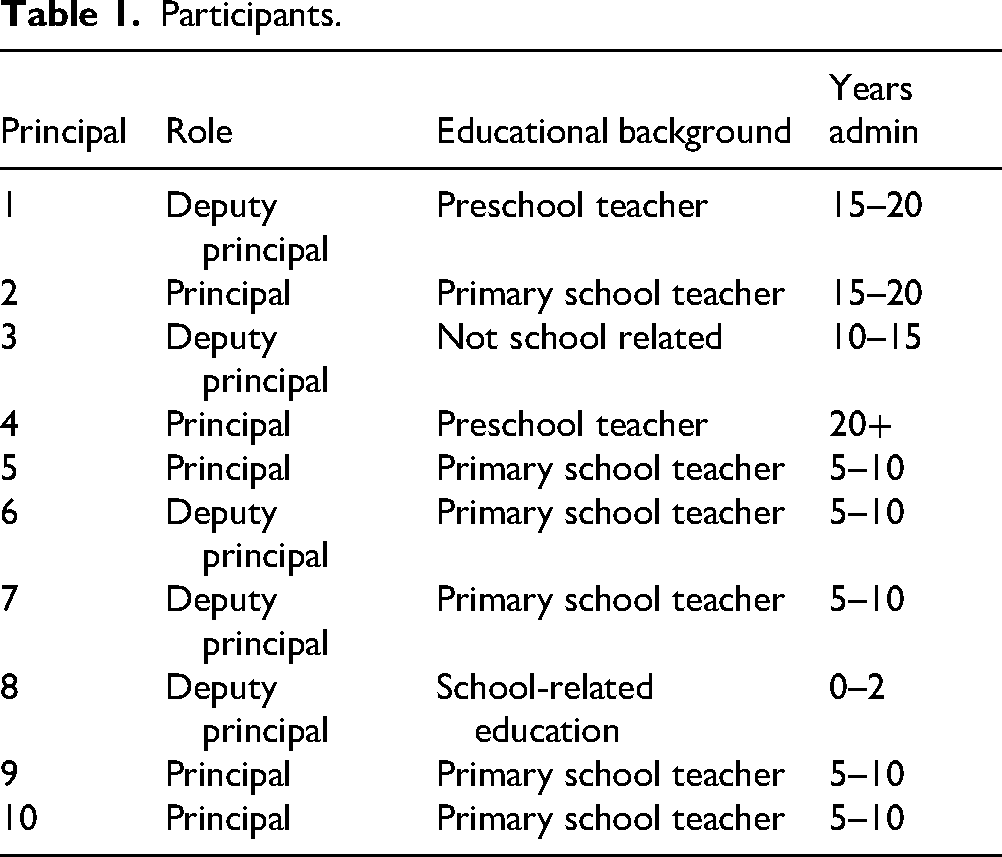
The present study was designed as a qualitative interview study to attain principals’ perceptions and experiences connected to the research problem. The informants were chosen through a judgement sample (Marshal, 1996), encompassing principals and deputy principals within the framework of a collaborative research program between researchers and four Swedish municipalities concerning the SAECs’ contribution to students’ goal fulfilment. A request was sent through email to all potential participants which included information about the purpose of the study, ethical considerations, information around consent and request for participation. All steps of the study were carefully carried out in line with the ethical guidelines for research by the Swedish Ethical Review Authority (CEPN, 2023). Ultimately, five principals and five deputy principals agreed to participate (see Table 1).
Participants.
All empirical data were collected during the spring of 2024. The interviews were performed using an intense interviewing technique (Charmaz, 2014), utilizing open-ended questions encompassing the principals’ perceptions regarding QA in SAEC and qualitative teaching in the educational program. This technique allowed for follow-up questions regarding the principals’ sensemaking concerning these issues. The interview questionnaire was sent to all informants prior to the interview and all interviews were conducted and recorded via Zoom after each person had once again confirmed that they gave consent to the recording. After interviews were completed, only the audio file was saved, and the film recording was deleted. The interviews were subsequently transcribed and translated from Swedish to English. Coding and data analysis followed steps from constructivist grounded theory (Charmaz, 2014), starting with initial coding to more focused codes and categories that emerged through constant comparison between interviews until a sense of theoretical saturation was reached. The study was also executed in accordance with a set of data sensitizing principles (Thornberg, 2012), utilizing alternative theoretical approaches and peer debriefings with senior researchers in the wider research group as tools for reflection throughout data analysis.
Results
In regard to the purpose of the study, which is to explore principals’ and deputy principals’ perceptions regarding what enables and constrains their organizing towards QA in Swedish SAEC, the results are structured as three main categories: a) When QA makes sense, b) When QA does not make sense, and c) QA as nonsensemaking. The following section details these categories with empirical examples from the qualitative interview study.
When quality assurance makes sense: professional assessment and evaluation in day-to-day activities
Principals describe their QA-practices in relation to SAEC in terms of assessing, assuring and improving a set of different qualities. QA, as a practice, makes sense when these qualities are possible to assess and evaluate in relation to specifics of SAEC-teaching, its curriculum, the actors involved and its connection to the school's wider quality-system. One common example can be found in how the principals conceive SAEC-teachers’ abilities to evaluate and document their own teaching practice, and the assurance and development of the tools and practices involved, as a cornerstone for structural quality in teaching: Assuring the quality of the SAEC is a very, very difficult objective, but also very, very interesting. I think, based on my way of doing things, that it is important to create an organization where there is a will and a driving force among the staff to be self-regulating. That they should be able to look at themselves and their own practice. You have to provide them with the tools to look at themselves and their own teaching − and that is my responsibility. P3
As seen in the quote above, the principals also see it as their own responsibility to assess these qualities and to enable teachers to successfully realize QA within practice. Aside from the structural quality factors, assessment and evaluation of teaching in day-to-day practice of the SAEC is often also perceived in terms of processual qualities emanating from goal fulfilment in relation to local and curricular objectives tied to the educational program. This is achieved through interviews with students concerning their perceived security within the SAEC, documentation of teaching activities, systematic QA at the school-level or ocular assessment during day-to-day events: Part of it is, of course, that you can get feedback from the school, with whom you collaborate. Then you see things in the SAEC, you can observe and see the soft abilities of the students yourself. We have a planned activity now at the SAEC with grades 2 and 3 based on values, and that they should find some new social constellations. They need to be mixed a little more and make new friends. And you will see that later, if they find some new constellations. You can see that with the naked eye if you go in, if we evaluate it a couple of weeks afterwards. DP1
Similar structural and processual qualities are also evident in principals’ perceptions regarding how well the SAEC complements the goals and practices of the compulsory school, which according to principals are often evaluated based on cooperative structures between the different practices, and indirectly through grades and other quantifiable measurements within compulsory school. The qualities and QA practices explained appear to make sense to the principals based on a large variation of internal quality control measures, which stem from professional, organizational and curricular aspects of what quality in SAEC ‘is’. This variation in the principals’ responses appears to echo some of the problems of QA-implementation raised by Allais (2009) – in this case resulting in evaluative measures that, although extracted from internal practice, are assured in relation to a wide variation of assessment criteria. This also mirrors prior findings from Ackesjö (2022), as multiple logics seem to guide how evaluation and QA should be performed, coupled with the active role of principal leadership in acknowledging and shaping the SAECs’ organizational practice (e.g. Boström and Elvstrand, 2024).
When quality assurance does not make sense: data-use, measurability and organizational culture
Following the above instances when aspects of QA in the SAEC make sense to the principals, there are instances of organizational illogics (Alvesson and Jonsson, 2022), where external demands for QA, its implementation in relation to perceived ambiguities and/or contradictions in practice are interpreted as not making sense. In some instances, this is a consequence of the principals’ lack of knowledge and experience related to teaching within the SAEC: In the municipality, there is a lot of talk about such good teaching … but what? What defines good teaching in SAEC? Because I have no background at all there. I mean, I think it's really hard to understand. P2
However, the most common organizational illogic expressed in relation to QA of SAEC-teaching concerns measurability, which in turn prevents possibilities of (externally mandated) systematic evaluation and development within the educational program. Principals within the study often make sense of QA of teaching in terms of government mandated processes of internal QA and local quality management, which entail systematic assessment, evaluation, analysis and implementation of change initiatives. A common factor expressed by several principals that hinders this process is that of lacking cues of data extraction (or quantifiable measurements) due to the SAEC not having a curricular foundation of grades or knowledge-oriented goals, but rather having a teaching mission with a foundation in values and social learning. In other instances, sensemaking fails due to principals attributing the lack of quantifiable measurements to the organizational culture of SAEC or SAEC-teachers’ lack of knowledge regarding the processes of internal QA and their implementation in practice, i.e. not being able to find suitable strategic solutions: Yes, because the SAEC has a culture of being like: “The children thought it was fun – and it went well.” And from then to systematically actually looking at things or testing and bringing us into the systematic development work … there, we currently have a slightly bigger step to take. And it is important to take the right step in this staff group so that we sort of work forward. In a way that you understand why you should take it into this entire learning cycle. We need to work on the last part there. We are not quite at home yet, I think. It's difficult because I haven’t figured it all out myself in a good way. DP3
Like Alvesson and Jonsson's (2022) definition of no sensemaking, the principals here fail to comprehend how the external logic of systematic or local quality management makes sense in relation to the internal organizational logic of the SAEC and its curriculum. Although putting effort into make sense of the consolidation of these logics, the principals’ nonetheless express confusion and ambiguity.
Quality assurance as nonsensemaking: a decoupled relationship between organizational and external logics
Another organizational illogic apparent in the empirical material is that of QA of SAEC-teaching as nonsensemaking (Alvesson and Jonsson, 2022). Instead of confusion and ambiguity, the actors reach a sense of negative meaning, ascribing a notion of ‘nonsense’ to the outcome of the sensemaking-process. What is attempted to be made sense of ‘entirely lacks meaningfulness’ (Alvesson and Jonsson, 2022: 741), and guides actors towards mindless (tick-off exercises) or no action (resistance). One clear instance of nonsensemaking was apparent in how some principals described their use (or non-use) of externally mandated surveys from municipal organizers in the SAEC: It's a student survey, and there I've reflected on the fact that the students don't view activities in the SAEC as learning in the same way as in compulsory school. So no matter how explicit teachers are with the goals towards students; in the survey, there will never be high numbers for learning in SAEC. That eight-year-olds think that way, that's not something I put a lot of emphasis on. It might sound stupid, but I don't put any great value on any of those numbers - it's more about seeing the children develop and learn in practice. DP3
Some of the principals described the use of mandated user surveys as part of the wider local quality management within the municipality, with clear expectations from municipal organizers of their enactment for QA and development. When trying to make sense of how the user survey should be utilized in QA in SAEC, the principals appear to draw from an organizational logic rather than the perceived standardized logic of the survey. In some cases, the surveys are perceived, like the description from Alvesson and Jonsson (2022: 741), ‘as a tick exercise’, with little to no bearing regarding QA. In other instances, the principals simply refuse to use the survey: Well, regarding the municipality's user survey, we don't use it because it doesn't say much. We need to have our own interviews with students, our own safety surveys and things like that. First of all, not everyone responds to that kind of user survey. And then it could also be that it's carried out once a year and at that particular time, it might not be a good idea to use it. It's a bit of a watered-down basis and it doesn't feel that qualitative. You need to find other ways to capture what the students actually think. P5
Since the survey does not appear to capture the qualitative aspects of teaching within the educational program, principals ascribe negative meaning to its implementation. Aside from instances of principals lacking proper knowledge related to the SAEC mission (e.g. Glaés-Coutts, 2023; Haglund and Glaés-Coutts, 2023), no sensemaking and nonsensemaking (Alvesson and Jonsson, 2022) seem to stem from principals experiencing an illogic in the meeting between external demands and governance towards standardization and assessment/evaluation of quality teaching enforced by national or local decision-makers (Adolfsson, 2024; Andersson, 2023), and the internal, cultural, professional and organizational logics associated with SAEC-practice. This appears to lead to either failure in the congregation of these logics, or disregard for and resistance to the implementation of externally mandated practices, prompting principals to find solutions within the immediate, organizational logic that make sense to them.
Concluding discussion and implications for practice and future research
Focusing on the implications of the principals’ organizing efforts for QA-implementation in Swedish SAECs, based on the enabling and constraining factors highlighted in the results section, two interrelated, key conclusions can be drawn from this study. The first concerns the fundamental role played by principals and deputy principals in shaping the outcomes of QA implementation in SAEC. As seen in the results, there appears to be a lack of mindlessness (Alvesson and Jonsson, 2022) and thoughtless routinization in principals’ responses, indicating active managerial participation in the organizing and direction of outcomes concerning these practices. This result is in line with prior studies showing how principals in SAEC tend to act as gatekeepers in local organizing efforts towards external change demands and reform initiatives (Andersson, 2022; Andersson and Wernholm, 2025). An implication for managerial practice following these results, and in relation to prior results highlighting the SAECs’ institutional shadow (Lager, 2024) constraining change within practice, is that principals in SAEC should consider and reflect on their position within these processes and their own sensemaking (or construction of illogics) in the consolidation of external, internal and organizational logics of QA. Future research could also benefit from exploring these processes from both an inter- and intra-organizational perspective – illuminating how sensemaking (and illogics) are shared or inconsistent across different layers of management and practice, and how outcomes are affected by negotiations between different actors.
The second conclusion is that although not constituting an illogic based on the relationship between the external and internal logics of QA within individual practices, the variation and lack of cohesion in organizational logics that emerge between individual practices exhibits a clear case of organizational dischronization (Alvesson and Jonsson, 2022). An implication following this is that while principal sensemaking shapes the organizing of local QA practices, it might result in macro variations of execution in different SAECs following the lack of standardized implementation and shared consensus of educational quality criteria (e.g. Allais, 2009). In summary, it appears that logics are perceived as more illogical (or nonsensical) when attained externally to SAECs’ internal practice. This could result in localized assurance strategies that assess different iterations of quality – depending on the discretion of the individual principal or deputy principal. This result adds to prior studies concerning the vagueness and variation in institutional logics in relation to evaluation in SAECs (e.g. Ackesjö, 2022), illuminating how this might also be assisted by the sensemaking, construction of illogics and managerial decisions by the principals. This conclusion has implications for policy makers. If QA and quality management practices are to be standardized and nationally equivalent through reform measures (i.e. Adolfsson, 2024; Andersson, 2023), coupling principles and linkages between national reform, then municipal organizers and managerial actors at the school and specific SAEC-level need to be taken in to consideration. Future research could usefully further investigate these systemic aspects of QA-implementation in SAEC, which might benefit from focusing on forms of coupling and decoupling between national reform and local practice.
Footnotes

Funding
The authors disclosed receipt of the following financial support for the research, authorship, and/or publication of this article: This work was supported by the Ifous (Innovation, research and development in schools and preschools),
Declaration of conflicting interests
The authors declared no potential conflicts of interest with respect to the research, authorship, and/or publication of this article.
Author biographies