



Abstract
This study explores the underexamined role of students in shaping the enactment and sustainability of teacher leadership (TL) in K-12 schools. While research has traditionally emphasized the roles of principals, middle leaders, and peers, students—the central stakeholders in education—have been largely overlooked. Drawing on semi-structured interviews with 15 teachers across six Arab countries, the study identified five themes through thematic analysis: engagement and participation, feedback and influence, collaboration and culture, authority and recognition, and emotional and relational dynamics. Findings reveal that students can both validate and challenge TL, with their behaviors functioning as critical feedback mechanisms that compel teachers to adapt, refine, and sustain leadership practices. By positioning students as “hidden players” in leadership ecologies, this research contributes a new dimension to TL scholarship and calls for more inclusive frameworks that recognize students as active co-constructors of educational change.
Keywords
Introduction
Teacher leadership (TL) is commonly defined as a process by which teachers influence their colleagues, principals, and other members of the school community to improve teaching and learning practices with the aim of enhancing student learning (York-Barr and Duke, 2004). Over the past two decades, there has been growing interest in TL as a critical lever for school improvement and educational change (Wenner and Campbell, 2017). Researchers and policymakers increasingly view empowering teachers as leaders as a way to tap into teachers’ instructional expertise and commitment to student success, thereby bridging the gap between top-down reform mandates and classroom-level practice (Harris and Jones, 2019). This heightened attention reflects a shift from seeing leadership as the sole domain of principals toward a more distributed leadership model that includes several players including teachers in decision-making and innovation (Ghamrawi, 2013a, 2013b; Printy and Liu, 2021). As a result, TL has become associated with whole-school reform efforts and is credited with fostering improvements in teaching and learning at scale (Nguyen and Hunter, 2018).
Mounting evidence indicates that TL can yield numerous positive outcomes for both schools and students. For example, a meta-analysis conducted by Wu and Shen (2022) found that strong TL is significantly associated with higher student achievement. The influence of teacher leaders frequently extends beyond the confines of their individual classrooms, as they engage in mentoring relationships and collaborative practices with colleagues (Fairman and Mackenzie, 2015; Wenner and Campbell, 2017). Such peer influence contributes to building a professional community and positive school climate, as teacher leaders facilitate trust, collegial support, and shared goals among staff (Ghamrawi et al., 2024a, 2024b; Gningue et al., 2022; Pan and Chen, 2024). Evidence suggests that TL not only helps counter isolation and burnout (Kulick, 2025), but that empowering teachers in leadership roles is also associated with greater job satisfaction and a heightened sense of efficacy, both of which mitigate stress and reduce burnout (Engle et al., 2024; Naccache et al., 2025). These benefits underscore why TL is viewed as a vital component of sustainable school improvement initiatives.
The existing literature on TL has tended to examine how various organizational and developmental factors enable teachers to step into leadership roles. A substantial body of research highlights the critical role of school principals in advancing TL. Principals who delegate authority, encourage teacher initiative, and provide supportive conditions can effectively empower teacher leaders (Nguyen et al., 2020; Sebastian et al., 2016). In fact, principal support and a school culture of shared decision-making are frequently cited as necessary conditions for TL to flourish (Cilek et al., 2025). Moreover, studies have also explored formal teacher leader positions—such as grade-level chairs, subject department heads, or instructional coaches—as a top-down strategy to distribute leadership in schools (Al-Jammal and Ghamrawi, 2013, 2015; Ghamrawi et al., 2025a, 2025b; Wenner and Campbell, 2017). Similarly, researchers have examined teacher-led professional development models and collaboration structures that cultivate leadership from the ground up (Ghamrawi et al., 2024b). Approaches like peer mentoring, professional learning communities, and teacher networks are shown to not only improve practice but also build teachers’ leadership capacity as they learn to coach and influence colleagues (Nguyen et al., 2020). In short, prior studies have predominantly focused on how school leadership and organizational structures can promote TL—whether through supportive leadership, designated roles, or collaborative professional learning opportunities.
Despite the extensive body of scholarship on TL, the role of students in shaping and sustaining this form of leadership remains conspicuously underexamined. To date, no empirical study has directly investigated how students may contribute to the enactment or long-term sustainability of TL within K-12 schools. Existing research has predominantly centered on the actions and perspectives of adults—principals, subject leaders, and teachers—while students, who are the primary stakeholders of the educational process, have been largely overlooked in this discourse (Holquist et al., 2023). This omission is noteworthy, given that the ultimate purpose of TL is to enhance student learning and engagement. Attending to the student dimension offers the potential for a more holistic conceptualization of how TL is enacted, reinforced, and sustained over time. Accordingly, this study is guided by the following research question: How do students influence the enactment and sustainability of teacher leadership in K-12 schools?
Literature review
Teacher leadership: Dynamics and conditions
Research on TL reveals a field marked by both promise and ambiguity. Broadly defined as the influence teachers exert to improve teaching, learning, and school development (Wenner and Campbell, 2017; York-Barr and Duke, 2004), TL has been interpreted in divergent ways—from formal positions such as department heads to more distributed, relational, and practice-based accounts. This plurality allows TL to adapt across contexts but also generates fragmented definitions that complicate theoretical clarity (Fairman and Mackenzie, 2015; Nguyen et al., 2020).
Despite such tensions, scholarship consistently demonstrates the systemic significance of TL. Teacher leaders mediate reform by translating top-down agendas into practice while amplifying teacher expertise (Nguyen and Hunter, 2018). Empirical studies show that TL enhances student achievement, fosters pedagogical innovation, and strengthens professional cultures and school climate (Engle et al., 2024; Fairman and Mackenzie, 2015; Gningue et al., 2022; Pan and Chen, 2024). It also supports teacher wellbeing by boosting job satisfaction, reinforcing professional identity, and mitigating burnout (Ghamrawi et al., 2024c, 2025c; Gningue et al., 2022).
The sustainability of these impacts depends on enabling conditions. Principals play a critical role in legitimizing teacher agency through distributed authority and trust (Nguyen et al., 2020; Sebastian et al., 2016). Middle leaders—including subject coordinators and grade-level chairs—act as intermediaries, aligning senior leadership priorities with classroom realities and legitimizing teacher-led initiatives (Stone and Stone, 2024; Abu-Shawish and Ghamrawi, 2025). Lateral structures such as professional learning communities and peer coaching also extend teacher influence (Fairman and Mackenzie, 2015; Grimm, 2024).
At the same time, persistent barriers constrain TL: time pressures, resource limitations, and role overload (Angelle and Schmid, 2007; Berry, 2014), alongside unsupportive cultures marked by mistrust or resistance to change (Muijs and Harris, 2007; Pan and Chen, 2024).
Taken together, TL offers substantial benefits for student learning, teacher growth, and school culture, yet its enactment is contingent on organizational ecology. Research has emphasized supportive principals, middle leaders, and peer networks, but little attention has been given to students—arguably the central stakeholders—whose influence on TL remains underexplored (Holquist et al., 2023). Addressing this gap requires frameworks that capture the full relational dynamics of TL, including the role of student agency.
Student voice, agency, and the missing role in teacher leadership
Student voice has gained traction in educational research, policy, and practice, recognizing students as active participants whose insights can shape learning environments (Cook-Sather, 2006; Ghamrawi, 2018; Mitra, 2008). When given meaningful opportunities to express perspectives and co-construct schooling, students become powerful agents of change (Gillett-Swan and Baroutsis, 2024), enhancing engagement, fostering democratic cultures, and improving learning outcomes (Conner et al., 2015; Fernández-Terol and Domingo-Segovia, 2025; Fielding, 2011; Quaglia and Corso, 2014). These contributions reinforce calls to position students not only as beneficiaries but as stakeholders whose agency is vital to school improvement (Bae et al., 2025; Ye et al., 2025).
Yet the intersection of student voice and TL remains underexplored. Most TL research focuses on principals, middle leaders, and teachers (Nguyen et al., 2020; Wenner and Campbell, 2017), rarely addressing how students—the very individuals whose learning leadership aims to enhance—might shape or sustain it. As Holquist et al. (2023) note, leadership research often treats student voice as peripheral, overlooking its potential as a core contributor to leadership ecologies.
Existing studies nevertheless suggest how students could indirectly advance TL. Classroom voice practices, such as feedback and collaborative engagement, can prompt teachers to innovate and reflect (Leung et al., 2022; Toshalis and Nakkula, 2012). Schoolwide mechanisms like councils or participatory forums also show that students’ perspectives can inform teacher development and improvement planning (Flutter and Rudduck, 2004; Mitra, 2009; Roxå et al., 2022). These findings suggest that students may validate, sustain, and amplify TL, though such possibilities remain largely absent from TL theory.
This omission is concerning given the shared aims of both fields. TL is recognized as a driver of improved learning and reform (Shen et al., 2021; Gningue et al., 2022), while student voice highlights learners’ agency in shaping their education (Bae et al., 2025; Fernández-Terol and Domingo-Segovia, 2025; Mitra, 2008). Ignoring their overlap risks reinforcing hierarchical models of schooling (Rudduck and Fielding, 2006). Conversely, integrating student agency into TL frameworks could reconceptualize leadership as reciprocal and co-constructed, expanding both its scope and sustainability.
Method
Research design
This study employed a qualitative design within the interpretive paradigm to examine how students influence the enactment and sustainability of TL in K-12 schools. While prior scholarship has focused on principals, middle leaders, and teachers, this study broadened the scope by investigating how students—as central stakeholders—affect teachers’ leadership practices through teachers’ own perspectives. The interpretive paradigm was appropriate as it emphasizes meaning-making, context, and co-construction of understanding (Omodan, 2024). Semi-structured interviews were the primary method, providing a flexible yet structured framework for exploring how teachers perceive and interpret student influence. Open-ended questions encouraged reflection on how students validated, sustained, or challenged leadership and how such interactions shaped practice. The format also allowed adaptation to emergent insights, fostering reflexivity and openness (Adams, 2015; Kallio et al., 2016), and thus supported a holistic exploration of the “hidden” role of students in advancing TL.
Participants
The study drew its participants from an established regional online community of practice for teachers across the Arab States. This community regularly organizes professional webinars on topics of educational relevance, followed by interactive polls and discussion boards that enable members to reflect collectively on the themes presented. After one webinar focused on teacher leaders and their roles within schools, the research team collaborated with the community's administration board to create a dedicated discussion board. Teachers were invited to share reflections on the factors that most strongly shape their TL within their respective contexts. The discussion entries were monitored over the course of one month. All teachers who explicitly mentioned the role of students—whether in enabling, influencing, or sustaining their leadership—were subsequently invited to participate in the study. Each invitation included a consent form and outlined the voluntary nature of participation.
From a pool of 48 teachers contributing to the discussion board, 16 expressed willingness to participate in semi-structured interviews. One later declined due to scheduling constraints, resulting in a final sample of 15 participants. These teachers represented six Arab countries: Lebanon (3), Jordan (3), Qatar (2), the United Arab Emirates (3), Oman (2), and Egypt (2).
Finally, participants included 10 females and 5 males, with an average age of approximately 32 years. Their teaching experience ranged from 5 to 15 years, reflecting both early-career and more seasoned teachers. All participants were classroom teachers working across different K-12 school levels and subject areas, which ensured that the perspectives captured were grounded in the realities of daily instructional practice.
Data collection and analysis
Data were generated through semi-structured interviews of approximately 40–50 min each, designed to elicit participants’ perceptions of how students influence TL and, more specifically, the ways in which students may contribute to its enactment and long-term sustainability.
The schedule was organized around four thematic clusters. The first cluster invited participants to describe their professional background, teaching contexts, and pathways into TL, thereby situating their narratives within broader professional trajectories. The second cluster explored concrete instances of leadership enactment, with prompts focused on how student engagement, feedback, or responses had shaped teachers’ decisions, practices, and influence. The third cluster probed participants’ interpretations of sustainability, asking how students might contribute to the endurance or amplification of teacher-led initiatives within their schools. The final cluster invited reflective and forward-looking perspectives, encouraging teachers to articulate challenges, opportunities, and imaginaries regarding students’ role as “hidden players” in advancing TL. The interviews were conversational in nature, allowing participants to bring forward critical incidents or reflections beyond the structured prompts.
The analysis process was iterative and comparative. Interview transcripts were segmented into smaller meaning units and assigned codes, which were continuously compared and contrasted to identify similarities and differences across participants (Charmaz, 2021). Axial coding was then undertaken, whereby codes were grouped into broader categories and linkages were constructed among them (Flick, 2009). The final stage involved selective coding, which enabled the researchers to refine and extend the axial coding at a higher level of abstraction in order to formulate the overarching narrative of the study (Charmaz, 2014; Flick, 2009). Throughout this process, meaning was progressively constructed by moving between data segments, categories, and emergent interpretations. To enhance validity and trustworthiness, coding decisions and theme development were regularly cross-checked among the research team, with discrepancies discussed until consensus was reached.
Findings
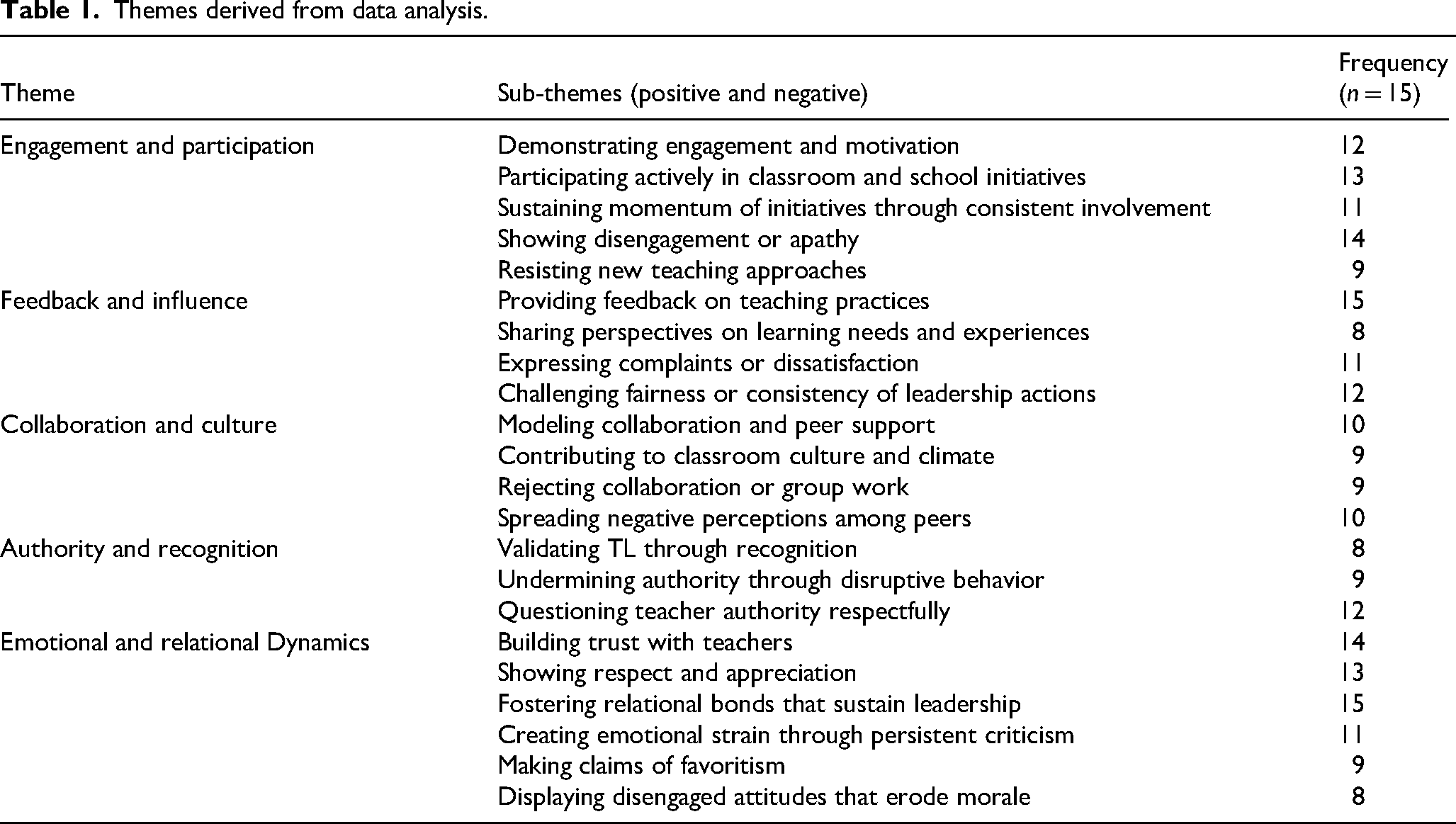
The analysis identified five overarching themes that capture how students shape the enactment and sustainability of TL in K-12 settings. As shown in Table 1, these themes encompass both positive and negative behaviors reported by teachers. Importantly, negative behaviors were not merely disruptive; they proved consequential by prompting teacher leaders to adapt, reflect, and refine their practices, thereby contributing to the overall strengthening of leadership over time.
Themes derived from data analysis.
Theme 1: Engagement and participation
Participants highlighted how student engagement and participation shaped their leadership practices. Several teachers described how students’ motivation and willingness to participate encouraged them to lead with greater confidence. As P1 explained, “When students show genuine excitement about the lesson, it pushes me to keep trying new things and leading initiatives in class.” Similarly, P3 noted, “Active participation in activities makes me feel my leadership is valued and needed.”
Teachers also emphasized the role of consistent involvement in sustaining initiatives. P6 remarked, “When students regularly participate, it keeps the momentum going and makes the leadership effort feel worthwhile.” P9 added, “Consistency from students helps us see the long-term effect of our leadership.”
At the same time, disengagement and apathy were reported as frequent challenges. Yet teachers explained that such behaviors also shaped their leadership by compelling them to adjust their practices. P4 commented, “Some students simply withdraw, and that forces me to rethink how I am leading.” Likewise, P7 shared, “Apathetic attitudes drain the energy of the whole class, but they make me consider different strategies to keep leadership efforts alive.”
Another sub-theme that emerged was resisting new teaching approaches. Teachers noted that students’ reluctance to accept new methods also shaped their leadership. P8 explained, “When I try something different and students push back, I have to reflect on how I present change.” Similarly, P12 stated, “Resistance challenges me, but it also makes me refine my leadership to introduce innovations more effectively.”
Theme 2: Feedback and influence
Participants reported that student feedback played a central role in shaping their leadership practices. Teachers noted that feedback often served as a direct guide for improvement. P2 stated, “When students tell me what helps them understand better, it immediately influences the way I lead lessons.” Similarly, P8 shared, “Feedback from students gives me clarity on what works and what needs change.”
Students also shared perspectives on their learning needs and experiences, which teachers perceived as shaping their leadership. P5 commented, “They explain what they struggle with, and this makes me adjust my leadership to be more supportive.” P11 echoed this by saying, “Hearing their side of the story gives direction to my leadership decisions in class.”
Teachers acknowledged that complaints and dissatisfaction, while challenging, also contributed to their leadership practices. P6 explained, “When students complain, I cannot ignore it—I have to think of how my leadership is being received.” P10 similarly remarked, “Dissatisfaction is difficult, but it pushes me to check my own consistency.”
Challenging fairness or leadership actions was also reported as significant. P12 stated, “When students question fairness, it forces me to examine how I am leading.” Likewise, P14 noted, “They sometimes challenge my decisions, and that shapes my leadership to be more transparent.”
Theme 3: Collaboration and culture
Teachers highlighted how student collaboration and contributions to classroom culture influenced their leadership roles. Several participants explained that when students supported one another, it reinforced TL. P1 stated, “When students collaborate, it strengthens the environment I am trying to lead.” Similarly, P9 remarked, “Peer support in class reflects back on me as a leader—it makes leadership easier to enact.”
Participants also noted that students actively contributed to the overall classroom climate, which shaped how leadership was sustained. P7 explained, “A positive class culture gives me the energy to continue leading.” P13 added, “When students take responsibility for the classroom atmosphere, it helps me focus my leadership on growth rather than control.”
Negative behaviors were also reported as influential. Rejecting collaboration was perceived as challenging but formative for leadership. P3 commented, “When students refuse to work together, I have to rethink how I guide them.” Similarly, P6 observed, “Some groups collapse because of rejection of teamwork, and that makes me reconsider my leadership style.”
Spreading negative perceptions among peers was also described as shaping TL. P11 stated, “A few students can spread negativity, and I must find ways to counter that through my leadership.” P14 echoed this, saying, “Their negative talk forces me to step up and rebuild the culture of the class.”
Theme 4: Authority and recognition
Teachers reported that authority and recognition from students played a key role in shaping their leadership practices. Several participants noted that validation from students reinforced their sense of leadership. P3 explained, “When students recognize the effort I put in, it gives me strength to lead more confidently.” Similarly, P9 shared, “Their appreciation shows me that my leadership is meaningful.”
At the same time, teachers described how disruptive behaviors tested their leadership authority. P5 stated, “When students challenge authority through misbehavior, I have to reassert my leadership in different ways.” P11 added, “Disruption pushes me to think of new strategies to maintain respect and order.”
Teachers highlighted the importance of questioning teacher authority respectfully, which shaped leadership by encouraging reflection and openness. P6 noted, “When they question me in a respectful way, it makes me consider how I lead and communicate.” Likewise, P15 explained, “Respectful challenges from students don’t threaten my leadership; they make me think more carefully about my decisions and how I justify them.”
Theme 5: Emotional and relational dynamics
Teachers described how emotional and relational dynamics between themselves and students shaped their leadership practices. Building trust with teachers was frequently mentioned as foundational. P1 explained, “When students trust me, it makes my leadership easier to carry out.” Similarly, P8 shared, “Trust creates a bond that allows my leadership to grow naturally.”
Teachers also pointed to the importance of showing respect and appreciation. P4 noted, “When students show respect, I feel valued as a leader.” P10 added, “Their appreciation motivates me to keep leading with commitment.” Another sub-theme was fostering relational bonds that sustain leadership. P2 commented, “When there is a strong relationship with students, leadership becomes more sustainable.” Likewise, P12 stated, “Relational bonds help me maintain leadership even during difficult times.”
Negative relational dynamics were also described as shaping leadership. Creating emotional strain through persistent criticism was seen as challenging but impactful. P6 explained, “Constant criticism makes me rethink how I act as a leader.” P14 noted, “It is stressful, but it forces me to examine my leadership more carefully.” Making claims of favoritism emerged as another influence. P9 shared, “When students accuse me of favoring others, I have to step back and review how I am leading.” Similarly, P11 remarked, “Such claims push me to be more transparent in my leadership decisions.”
Finally, teachers pointed to displaying disengaged attitudes that erode morale as significant. P5 commented, “When students disengage, it lowers the spirit of the whole class and makes me question my leadership.” P7 added, “Their lack of interest drains energy, but it also forces me to look for new ways to re-energize my leadership.”
Discussion
This study set out to explore the underexamined role of students in shaping the enactment and sustainability of TL in K-12 settings. Analysis revealed five themes—engagement and participation, feedback and influence, collaboration and culture, authority and recognition, and emotional and relational dynamics—that together illustrate the multifaceted ways students contribute to, and sometimes complicate, TL. Notably, both positive and negative student behaviors were shown to have formative effects: while encouragement, recognition, and collaboration clearly nurtured leadership, disengagement, resistance, or criticism prompted teacher leaders to adapt, reflect, and refine their practice. These findings suggest that students function as dynamic actors in the leadership ecology of schools, exerting influence in ways that have been overlooked in the TL literature.
In more details, this study suggests that students’ engagement and participation could be central to sustaining TL. When students demonstrated motivation, initiative, and consistent involvement, teachers reported feeling more confident and empowered to lead. This finding resonates with research showing that TL thrives in contexts of reciprocal trust and active participation (Fairman and Mackenzie, 2015; Gningue et al., 2022). Yet this study adds nuance by positioning student engagement not merely as an outcome of TL—as prior research often emphasizes (Shen et al., 2021)—but as a one driver of its enactment. One possible explanation is that students’ involvement may validate teachers’ efforts, sustaining momentum and signaling that leadership is meaningful. Conversely, disengagement and resistance could function as feedback, prompting teachers to reconsider strategies and adapt their approaches. In this way, participation and resistance alike may serve as catalysts for leadership growth and refinement.
Closely related to participation, student feedback also appeared to play a critical role in shaping leadership practices. Teachers explained that feedback, whether expressed as constructive suggestions, dissatisfaction, or challenges to fairness, compelled them to adjust and refine their practices. This finding aligns with the student voice literature, which highlights the role of students’ perspectives in enriching pedagogy and contributing to school improvement (Cook-Sather, 2006; Mitra, 2008). However, unlike earlier work that situates student voice mainly within governance or curricular design (Fielding, 2011; Flutter and Rudduck, 2004), the present study demonstrates that feedback could directly influence the professional agency of teacher leaders. Perhaps even negative feedback gives teachers insight into how their leadership is perceived, prompting greater transparency and responsiveness. In this way, feedback can be both a challenge and an opportunity, serving as an underacknowledged loop that sustains leadership practices.
The role of students in shaping collaboration and classroom culture further reinforces this argument. Teachers reported that when students engaged in collaborative learning and supported one another, their leadership was strengthened and more easily sustained. Conversely, when collaboration was rejected or negativity spread among peers, teachers were compelled to recalibrate their leadership approaches. This mirrors findings from broader studies of school climate (Ghamrawi et al., 2024b), yet this study highlights that students themselves may be the ones generating the cultural conditions that enable or constrain TL. One reason for this may be that collaborative student behaviors may reinforce trust and collective responsibility that underpin TL, while refusal or negativity can push teachers toward more directive roles. Thus, students act as cultural architects directly shaping the ecology of TL.
Equally significant were findings related to authority and recognition. Teachers described how acknowledgment from students bolstered their confidence, while disruption, accusations of favoritism, or challenges to authority destabilized leadership and required recalibration. Prior scholarship has often treated authority as a hierarchical resource vested in teachers (Wenner and Campbell, 2017). However, these findings suggest that authority may instead be co-constructed, with students playing an active role in either legitimizing or undermining it. Respectful questioning of authority was particularly influential, perhaps because it encouraged teachers to reflect on their decision-making processes and modes of communication. In this sense, students may not only comply with authority but actively shape how it is enacted and sustained, echoing Fielding's (2011) argument that teacher–student relationships should be understood as dialogic rather than hierarchical.
Emotional and relational dynamics proved pivotal: trust, respect, and appreciation sustained leadership, while criticism, favoritism claims, and disengagement strained it. TL thus appears not only professional but deeply relational, with trust reinforcing identity and motivation, and disengagement prompting reflection and recalibration. Leadership emerges as continuously negotiated in teacher–student exchanges. These findings extend student agency literature (Mitra, 2008; Rudduck and Fielding, 2006), suggesting that students shape not only school culture but also classroom leadership. Their engagement, feedback, and relationships may compel teachers to adapt, indicating that sustainable leadership cannot be understood without recognizing students as co-constructors of educational change.
A key contribution of this study is identifying students as “hidden players” in TL. While prior research highlights the roles of principals, middle leaders, and peers (Fairman and Mackenzie, 2015; Abu-Shawish and Ghamrawi, 2025; Sebastian et al., 2016), the role of students has been largely overlooked, reflecting an adult-centric bias (Holquist et al., 2023). By showing that students can validate, challenge, and refine leadership, the study advances a more relational view of enactment. Limitations include the small cross-national sample and reliance on teachers’ accounts only. Future research should incorporate student voices and adopt multi-perspective, cross-cultural designs to better capture how students shape leadership.
Limitations and future research
This study has several limitations that should be acknowledged when interpreting its findings. First, the research relied solely on teachers’ accounts of how students influence TL, without direct consultation of students themselves. While this design offered valuable insights into teachers’ reflective interpretations, it limits triangulation and excludes the firsthand perspectives of the very stakeholders whose influence is under study. This limitation was largely methodological and ethical in nature: conducting research with minors across six Arab countries entails extensive, country-specific approval procedures that remain ongoing. A complementary study focusing directly on students’ voices is currently in progress, though its realization has been delayed by these procedural requirements. We view the present study as conceptual groundwork for that forthcoming, multi-perspective inquiry.
Second, the study's sample—fifteen teachers from six Arab countries—provided rich cross-national diversity but a modest scale. While qualitative research seeks depth rather than generalizability, the small and contextually varied sample constrains the transferability of findings. The interpretations offered here should therefore be understood as exploratory rather than representative, illuminating patterns and mechanisms rather than universal claims. Future research should employ larger, context-specific, and multi-actor designs to test and refine these insights within particular school systems.
Third, the study's data were derived from self-reported interviews, which may have been shaped by recall bias, selective reflection, or social desirability. Future work could integrate classroom observations, student focus groups, or mixed-method approaches to capture the reciprocal dynamics of teacher and student interactions more fully.
Taken together, these limitations open promising directions for further research. Comparative studies could examine how students’ agency interacts with TL across cultural and governance contexts, particularly in systems transitioning toward participatory and distributed leadership models. Longitudinal and cross-level analyses might also reveal how students’ sustained engagement contributes to the endurance of teacher-led initiatives. Addressing these avenues will advance a more holistic and dialogic understanding of TL —one that recognizes students not merely as recipients of leadership but as active partners in shaping its sustainability.
Conclusion
This study reframes TL as a relational ecology in which students are not merely recipients but consequential “hidden players” who can validate, challenge, and ultimately refine teachers’ leadership in K-12 settings. Across five themes—engagement and participation, feedback and influence, collaboration and culture, authority and recognition, and emotional–relational dynamics—student actions emerged as drivers of leadership enactment and sustainability, with both supportive and resistant behaviors functioning as meaningful feedback that prompts teacher adaptation. By making students’ influence visible, the study extends adult-centered accounts of TL and offers a more holistic lens for theory and practice.
Practically, the findings suggest that schools seeking durable TL should intentionally cultivate structures that invite authentic student participation (e.g., feedback cycles, co-design routines, and classroom culture-building) and prepare teachers to interpret student resistance as diagnostic data rather than disruption. The study opens a research agenda that integrates multi-actor perspectives and comparative contexts to map when and how student agency most effectively sustains TL. Overall, recognizing students as co-constructors of leadership advances both scholarship and improvement efforts, pointing toward leadership designs that are more responsive, dialogic, and therefore more likely to endure.
Footnotes

Funding
The authors disclosed receipt of the following financial support for the research, authorship, and/or publication of this article: Open Access funding provided by the Qatar National Library.
Declaration of conflicting interests
The authors declared no potential conflicts of interest with respect to the research, authorship, and/or publication of this article.
Author biographies