




Abstract
This article examines educational continuity in distance learning guidance documents developed by the Ministry of Education, Culture, Science and Technology in Belize during school closure for the 2019–2020 school year. Documents that were purposefully developed as part of the ministry's response to school closure because of the pandemic were collected and analyzed. The four themes that emerged from the analysis—access to technology, home-based learning and resources, continuing professional development, and adjustments to instructional planning and academic policies—describe how the ministry's guidance documents on distance learning supported educational continuity in Belize during school closure for the 2019–2020 school year. The analysis also reveals that the ministry’s reachability effort relied heavily on low or no-tech modalities to ensure educational continuity in response to the pandemic.
Keywords
Introduction
This article examines educational continuity in distance learning guidance documents developed by the Ministry of Education, Culture, Science and Technology (MoECST) in Belize during school closure for the 2019–2020 school year. Documents that were purposefully developed as part of the ministry's response to school closure because of the pandemic were collected and analyzed. The four themes that emerged from the analysis—access to technology, home-based learning and resources, continuing professional development (CPD), and adjustments to instructional planning and academic policies—describe how the ministry's guidance documents on distance learning supported educational continuity in Belize during school closure for the 2019–2020 school year. The analysis also reveals that the ministry’s reachability effort relied heavily on low or no-tech modalities to ensure educational continuity in response to the pandemic.
The Belizean education system is organized into four levels: preschool, primary, secondary, and tertiary. However, this article focuses on educational continuity only at the preschool, primary, and secondary levels. According to a 2020 report from the Ministry of Education, there are 229 preschools, 310 primary schools, and 61 secondary schools in Belize. These schools have three types of administrative and financial governance systems: those that are owned, funded, and managed by the Government of Belize; those that are government-aided and receive public grants but that are owned and managed by religious or community groups; and those that are owned and administered by private individuals or entities and receive little or no public funding (Ministry of Education, 2020).
A 2021 report by the Inter-American Development Bank reveals that Belize does not have a culture of online learning and access to the internet is limited in rural areas. In addition, only about 57.2% of households have access to internet, and 46.2% have access to cable television (Statistical Institute of Belize, 2019, as cited in Chadwick et al., 2021: 33). This implies that when schools closed in Belize on March 20, 2020, a fully technology-enabled online learning environment would disengage a large number of students (Chadwick et al., 2021). Since traditional education was no longer accessible, the educational resilience of the Belize education system relied on the leadership of the MoECST to continue the delivery of education and to ensure children were engaged in learning during the pandemic. Although there was little time to prepare, the MoECST developed and issued guidance documents to school leaders and managing authorities on how to ensure educational continuity and provide educational services for all students during the pandemic.
The issuance of guidance brings to mind the importance of instructional communication during crisis or chaotic situations (Sellnow et al., 2012). Because of the demands to generate crisis knowledge and inform stakeholders what to do to establish order, instructional communication is crucial when responding to a crisis (Coombs, 2020). As it relates to the Belize context, the school leaders and managing authorities were to understand and act upon the communication from the ministry's guidance documents.
Literature review
Transition to distance learning modalities
When schools shut down during COVID-19, education systems transitioned to distance learning modalities to ensure educational continuity. Given the unequal access to remote learning, many education systems implemented various policies and strategies to ensure that students, especially vulnerable and marginalized students, were not disproportionally affected. For example, Chang et al. (2021) reported that 92% of low-income countries used broadcast media when compared to 25% of high-income countries. On the other hand, 96% of high-income countries used online platforms for at least one education level when compared to 58% of low-income countries. Notably, not all students were consistently engaged in the various remote learning strategies (Reimers and Schleicher, 2020). In fact, the effectiveness of remote learning was rarely assessed. Chang et al. (2021) revealed that only 73% of countries reported having assessed the effectiveness of at least one strategy. This statistic is concerning because policymakers need access to data that reflect their context. With this information, they can address the reduced learning opportunities experienced by this generation of COVID-19 students and implement learning recovery program(s) that target contextual needs (OECD, 2021; UNICEF, 2021).
The Belize context
Globally, governments face numerous challenges as they transition to distance learning; Belize is no exception. The matter of insufficient funds to provide devices to support distance learning to all levels of education and access to reliable internet, especially for those in rural areas of the country, poses significant challenges for the ministry (Chadwick et al., 2021). As a result, the ministry relied heavily on low or no-tech modalities to ensure educational continuity as a response to the pandemic.
Nagesh et al. (2021) categorize remote learning modalities as high tech such as phone applications, online digital platforms, and live video classes. According to those scholars, technology can also be low-tech, such as radio and television broadcasts, phone calls, and text messages, or no-tech, such as textbooks or printed packages. Low- or no-tech modalities, although not as interactive or engaging, are important tools to reach most marginalized students, especially those who experience significant adversities in accessing electricity, devices, and connectivity (Nagesh et al., 2021).
A review of the related literature demonstrates initiatives from the MoECST to support educational continuity in Belize during the pandemic. The literature shows that the ministry provides resources to schools, students, and families. For example, the ministry uploaded learning resources on its online portal, printed booklets, delivered lessons broadcast on local radio and television (Guardian, 2020), and provided video resources for schools and families. A 2021 report from the MoECST reveals the following:
Exactly 82% of preschools and 91% of primary schools integrated the Ministry's printed resources into their learning continuity plans, 65% of preschools and 77% of primary schools used the radio resources, and 43% of preschools and 44% of primary schools integrated electronic resources. The video resources were used by 37% of preschools and 39% of primary schools. Printed resources were provided to 52% of high schools, all of these indicating the need for such assistance (Ministry of Education, Culture, Science and Technology, 2021a: 13).
Despite the ministry's efforts, the remote learning modalities were unsustainable; as a result, the ministry decided to discontinue the approach for the next academic year (Ministry of Education, Culture, Science and Technology, 2021a: 13). At the secondary level, most schools used a blended approach to distance learning. Figure 1 shows the distance learning modalities at secondary schools across the six districts in Belize.
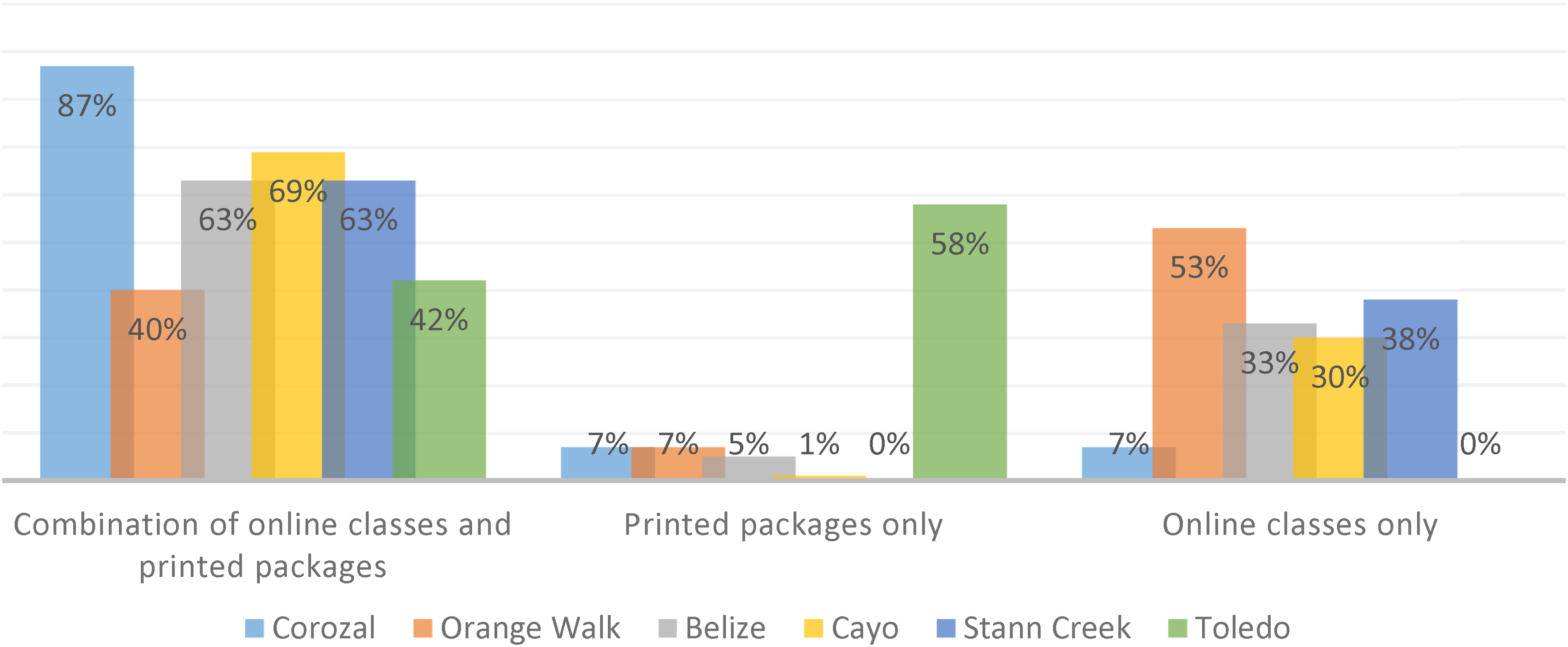
Distance learning modalities at secondary schools across the six districts in Belize.
According to a 2020 report from the Ministry of Education, there are 61 secondary schools in the country of Belize: 18 in the Belize district, 17 in Cayo, eight in Orange Walk, and six each in the Corozal, Stann Creek, and Toledo districts. While the majority of the 61 secondary schools used a blended approach to learning, as demonstrated in Figure 1, none (0%) of the six schools in the Toledo district provided online classes; instead, the district relied heavily on printed packages while other districts had a low percentage or 0% used of the packages.
According to the Ministry of Education, Culture, Science and Technology (2021a), secondary schools where students’ access to the internet and digital devices was limited relied heavily on printed packages; therefore, those schools used a blended approach to learning. This approach also had its set of challenges as reported by a school teacher in Belize: There is a percentage of our students who don't have access to the internet. There's a larger portion of them who will have access to the internet but mainly on their smartphones; they don't have a computer or they don't have a tablet to access, so it's only mobile data (…) So, our school maintains communication with our parents mainly through regular text messages and the use of WhatsApp chat groups (classroom groups). We engage them with printed packages on a weekly basis for the parents (…) they explain different small projects that the students will work on and do presentations on. They do 30 s to 60-s video clips of themselves presenting their work, and then they WhatsApp those videos back to the teachers (as cited in Parker and Alfaro, 2022: 16).
The MoECST acknowledges that the pandemic has made access to technology even more essential for teaching and learning in the 21st century (Ministry of Education, Culture, Science and Technology, 2021a). Arguably, the pandemic offers an opportunity for investment in education in Belize. This implies that the ministry can redesign the education system by using technology to benefit each student and build on the partnerships that emerged during the pandemic. This also means that the ministry can expand on capacity-building opportunities so educators can develop or sharpen their pedagogical digital competence to deliver in remote learning environments (D’Orville, 2020). Through this process, educators can foster the relevant mindset and skillset to explore and integrate e-learning effectively into the teaching/learning process and thereby provide quality online experience for students (Ewing and Cooper, 2021).
Student engagement
This study draws on the construct of student engagement to conceptualize educational or learning continuity in the country of Belize during the pandemic. Cuéllar et al. (2021) describe learning continuity as a “multidimensional approach to remote education during school closures and [it] involves a learning scenario in which the educational system implements conditions conducive to learning for every child” (46). This multidimensional approach to remote education explains why a variety of alternatives to teaching and learning emerged during the pandemic (McBurnie et al., 2020; Reimers and Schleicher, 2020). The immediate need to transform teaching and learning to a different kind of instructional environment that supports learning continuity left ministries of education scrambling for and adopting the most appropriate technologies for their particular context (Cuéllar et al., 2021). Notably, many of these alternatives depend on the use of interactive online modalities, which further amplify the digital divide and educational inequalities between the most advantaged and least advantaged students (McBurnie et al., 2020; OECD, 2021).
While scholars agree that engagement is critical to students’ success, research shows challenges to learning continuity and general student engagement during the pandemic (Blackman, 2022; Ferri et al., 2020). Oana and Mitrea (2021) examined this phenomenon and discovered the abrupt change to online learning created new disparities in perceived levels of student engagement. They reported the decrease in student engagement was due to a lack of distraction-free spaces for study, unreliable internet connectivity, and conflict with home responsibilities. Agreeably, a number of factors could have contributed to low student engagement, but students should have benefitted from more education initiatives during the crisis (D’Orville, 2020). However, it can be concluded that the sudden move to online learning and the focus on ensuring learning continuity left little space to consider how students would engage with learning during the pandemic (Bray et al., 2021).
Ahshan (2021) investigated a framework that implemented strategies to ensure active student engagement in distance/online teaching and learning during the pandemic. He reported that combining educational technologies, synchronous teaching, active learning activities, and a learning management system was an effective, interactive, and practical approach for active student engagement. Barron et al. (2021) concurred and stated this approach can help teachers to better support student learning and enhance engagement with students. However, the learning context needs to be redesigned (Stenman and Pettersson, 2020). The problem is that most teachers are trained in traditional methods of teaching, which means they may not have the relevant mindset and skillset to provide quality online experiences (Ewing and Cooper, 2021). This suggests that teacher training must be reimagined and the capacity of teachers to develop pedagogical digital competence to deliver in remote learning environments must be augmented (D’Orville, 2020). It also means that institutional and organizational structures must be developed or strengthened to support conditions for teachers to design and sustain high-quality teaching in digital learning environments (Stenman and Pettersson, 2020).
Theoretical perspective
Guided by Weick's (1995) sensemaking theory, this paper examines educational continuity in distance learning guidance documents developed by the MoECST in Belize during school closure for 2019–2020. Scholars agree that sensemaking refers to how people work to understand novel, unexpected, or ambiguous events that interrupt normal routines, cause disequilibrium, and have ethical implications for themselves and others (Brown et al., 2015; Kundra and Dwivedi, 2023; Maitlis and Christianson, 2014). According to Weick et al. (2005), “explicit efforts at sensemaking tend to occur when the current state of the world is perceived to be different from the expected state of the world, or when there is no obvious way to engage the world” (409). Weick's statement describes the impact the pandemic has had on the world and the education system. Therefore, it can be conceived that the disruption caused by the unplanned and unprecedented COVID-19 crisis forced the MoECST into a sensemaking zone.
Sensemaking theory is appropriate for this study because it can be used to understand how the MoECST made sense of and responded to the impact of the COVID-19 crisis as well as how the ministry used cues from the environment to chart a way to ensure educational continuity in Belize. Smith and Riley (2012) defined a crisis as “an urgent situation that requires immediate and decisive action by an organization and, in particular, by leaders of the organization” (58). Therefore, it can be argued that the MoECST used a sensemaking perspective to understand the impact of the COVID-19 crisis on the Belize educational system and to answer the questions, “What's the story here?” and “Now what should I do?” (Weick et al., 2005: 410).
Sensemaking involves noticing what is going on, making interpretations, and engaging in action for the sensemaker's environment (Maitlis and Christianson, 2014). Plausibly, the MoECST engaged in sensemaking and built “a schematic mental mode for decision-making” (Brock et al., 2008: 451) by making sense of global policies, guidelines and regulations, the Belize context, and other information about the evolving crisis surrounding COVID-19. According to Brock, this sensemaking process often leads to a decision or action. Therefore, it can be concluded that MoECST used a sensemaking perspective to develop and issue guidance documents to school leaders and managing authorities on how to ensure educational continuity and provide educational services for all students during the pandemic. As stated by Kundra and Dwivedi (2023), “sensemaking is active during a surprise event or a crisis” (130).
Methodology
This qualitative study uses documentary analysis (Bowen, 2009) to examine how the MoECST guidance documents on distance learning supported educational continuity in Belize during the 2019–2020 school year. The documentary analysis is guided by the following question: In what ways do the MoECST guidance documents on distance learning support educational continuity in Belize during school closure for the 2019–2020 school year?
With Belize on lockdown, the ministry's communication was mainly via press releases and social and broadcast media. To access data, the ministry's website, its Facebook page, and that of primary and secondary schools in Belize were searched for documents in which the ministry provided guidance about distance learning (other terms used are hybrid learning, remote learning, learning continuity plan, and home-based learning) and how to ensure educational continuity during the pandemic. To narrow the search, only documents that were purposefully developed as part of the ministry's response effort to school closure because of the pandemic were used. Web searches on official websites of local, regional, and international government bodies; social media; and academic research online databases were also conducted for empirical studies and reports conducted about Belize on the issues of school closure, resiliency, and distance learning during COVID-19.
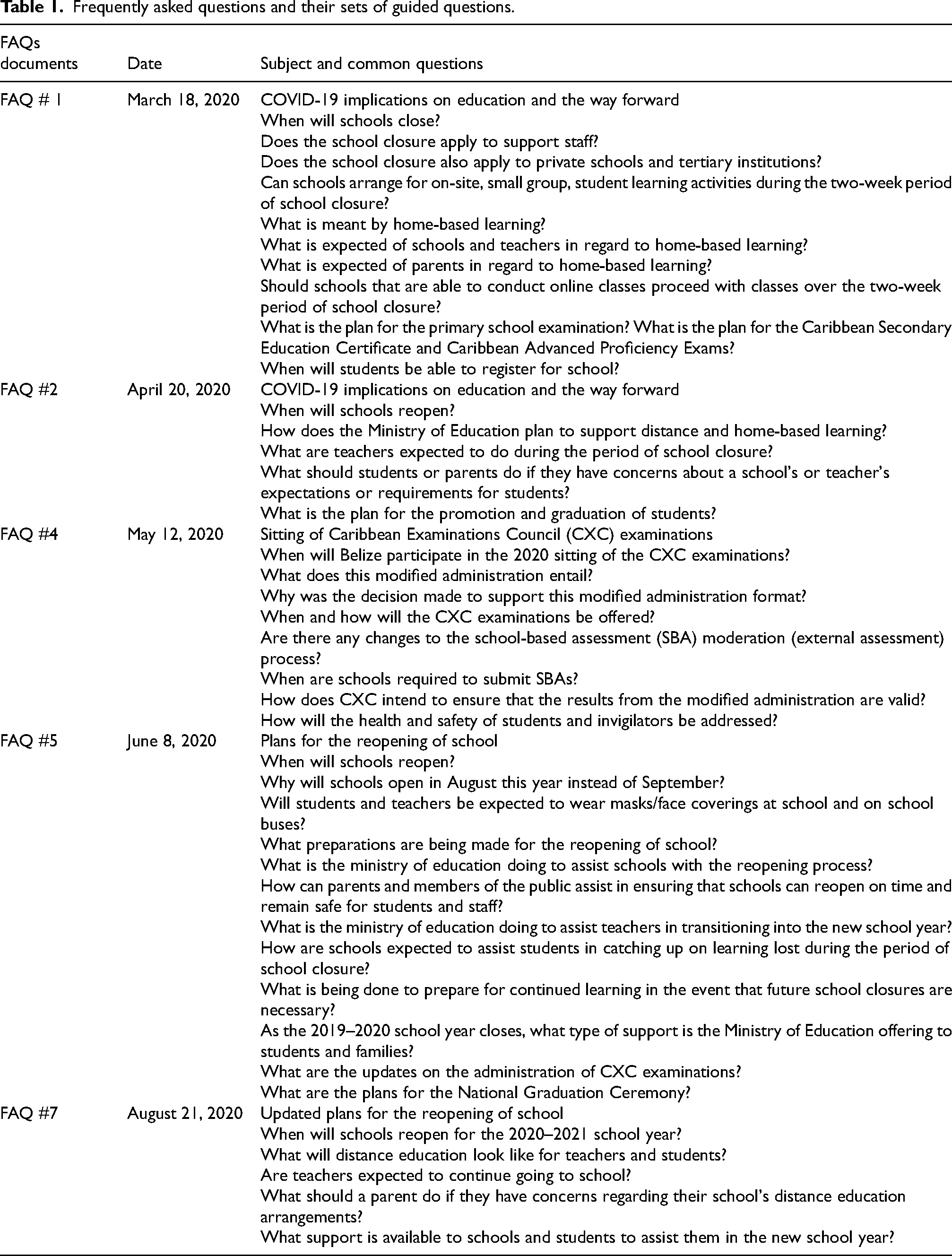
The data collection process revealed that the ministry developed two primary types of guidance documents as its response to school closure because of COVID-19: frequently asked questions (FAQs) and memorandum. Table 1 illustrates information pertaining to five different FAQ documents relevant to this study. The table shows that each FAQ addresses a particular subject and related questions. The ministry's role in this effort was to coordinate the flow of information among educational stakeholders and provide guidance regarding learning continuity during the pandemic. Further, each FAQ provided easy-to-understand answers regarding the way forward for the 2019–2020 school year.
Frequently asked questions and their sets of guided questions.
One document that provided advisory on instructional planning was found. The purpose of the document was to advise managing authorities and educators on instructional planning for primary schools so they can comply with the regulations set forth by the ministry in the context of COVID-19. The memorandums were designed for school leaders, managing authorities, the national teacher's union, and other key educational stakeholders. Those documents provided specific guidance and instruction on matters pertaining to school closure, adjustment to school policies, instructional planning, returning to school, and other key areas of schooling. Permission was sought and granted via email from the chief education officer in the MoECST to use these data sources for the purpose of the study.
The data for this study were also retrieved from local e-newspapers, local news stations, websites, academic journals, local government publications, social media, and local government communications such as FAQs and memorandums. The documents were appropriate because they provided contextual richness and elucidated findings that led to an understanding (Bowen, 2009) of the ministry's approach to support educational continuity in Belize during school closure for the 2019–2020 school year. As recommended by Bowen, documents that were aligned to the research question were selected, made sense of, and synthesized; this was an iterative process as the documents were read and interpreted for the presence or absence of reference to educational continuity in Belize during school closure for the 2019–2020 school year.
Data analysis was ongoing and began during the data collection phase. Patton's (2015) content analysis was used to reduce, interpret, categorize, and code key phrases and significant statements that were consistent with the research question. The data were also inductively analyzed to identify recurring patterns of meaning in the data. The data were compared to the codes generated for accuracy and completeness.
Findings and discussions
The four themes that emerged from the analysis—access to technology, home-based learning and resources, CPD, and adjustment to curriculum and academic policies—describe how the MoECST guidance documents on distance learning supported educational continuity in Belize during school closure for the 2019–2020 school year. While the findings may not be representative of the entire school population of Belize, they can provide data to assist policymakers and other educational stakeholders in directing the next steps in a changing education system.
Access to technology
The MoECST collaborated with the Inter-American Development Bank and the Caribbean Development Bank to purchase 15,500 tablets to support distance learning at the primary and secondary levels (Breaking Belize News, 2020a). Chadwick et al. (2021) confirmed that while some secondary schools received devices, funding was insufficient to provide for all primary school students.
Regarding access to Google Workspace, the ministry advised school administrators to complete an online form to facilitate the setup process. The results indicate that several schools signed up for the ministry's Google Workspace while others used an open-source learning platform such as Moodle.
Home-based learning and resources
The results show that the Chief Education Officer (personal communication) wrote to schools and asked schools to finalize their home-based learning plans. In doing so, she provided guidance on how to develop the plan. In FAQ #1 (Ministry of Education, Youth, Sports & Culture, 2020a), the ministry defined home-based learning as educational activities that students can engage in at home to build knowledge and skills. Schools were also reminded about their responsibility to prepare and share a home-based learning plan with parents; parents and caregivers were encouraged to ensure that children engaged in activities provided by schools, the ministry's website, or other resources.
FAQ #2 (Ministry of Education, Youth, Sports & Culture, 2020b) reveals that the ministry collaborated with international partners and key local educational stakeholders to develop and broadcast daily audio lessons for preschool and primary school students. The lessons were uploaded on the ministry's website. In addition, the ministry printed learning activities based on the audio lessons for students who did not have access to other resources.
The findings indicate that different people had different experiences interacting with the ministry's website. For instance, an individual posted the following on the ministry's Facebook page: I got my son to listen but it was standard 1 and my son is in standard 3. (Ich, 2020)
A second person wrote, “Ministry website www.moe.gov.bz has also been very useful in accessing these resources, including the radio broadcast, online lessons and the electronic copy of the newsletter. Kudos!” (Burke, 2020).
A third individual posted: I feel that if a video were added to the TV broadcast it would be more fun and interactive. But all and all, it is a great work you guys put in [sic], and I just hope parents are working with their kids because it will benefit them. (Eilesor, 2020)
Yet another commented: “This was a great session. My 4-year-old washed her hands about 5 times during the program! The only setback was we did not have enough time to gather the materials for the ‘estimate’ activities” (Castaneda, 2020).
The Facebook comments indicate that some parents utilized the ministry's resources and that their children were engaged. The ministry's use of broadcast audio aligns with Nagesh et al.'s (2021) purpose for low- or no-tech modalities and Maitlis and Christianson's (2014) description of sensemaking. According to Nagesh et al. (2021), low-tech such as radio and television broadcasts are important learning tools, especially for those students and families who have limited access to electricity devices and connectivity. Given that Belize does not have a culture of online learning and access to the internet is limited in certain areas (Inter-American Development Bank, 2021), it can be argued that the ministry's use of low-tech technology was informed by the ministry's sensemaking perspective. This means that the ministry observed what was occurring globally because of COVID-19, interpreted the occurrence, and then took actions to suit the Belize context to ensure learning continuity during the pandemic.
To support secondary schools, the ministry collaborated with several educational institutions to produce the Learners Link, an activity-based newsletter designed to engage students with home-based learning opportunities in various subject areas. According to Breaking Belize News (2020b) counselors contributed to the production of the newsletter by including life skills activities. This suggests the publication contained both academic and some form of psychosocial support. Given students in Belize faced significant adversities during school closure, including natural disasters and related socio-economic hardships because of the pandemic, psychosocial support was critical to protect students’ learning and well-being (Chadwick et al., 2021).
The ministry's ongoing effort to provide access to resources was clearly stated in FAQ #5 (Ministry of Education, Youth, Sports & Culture, 2020d). Here, the ministry committed to continuing to provide new editions of print and digital materials as well as radio and video lessons. Because the ministry was also concerned about the well-being of families, FAQ #5 informs of the ministry's collaborative effort with UNICEF to launch a new TV/Radio program named “In it Together.” Tomassini (2020) describes this program as a flexible, fun, and interactive home-based learning approach to ensure educational continuity in Belize.
Parker and Alfaro (2022) found that the ministry further encouraged psychosocial support by uploading workbooks and activities on its Facebook page to reinforce positive mental health activities. Arguably, this encouragement occurred because the ministry recognized that psychosocial practices were absent from school curricula and held value in the context of the pandemic (Chadwick et al., 2021). In the postpandemic reality, an assessment of the life skills curricula is warranted to inform an integrated approach to support stakeholders’ well-being during the crisis and promote the development of social-emotional skills as well as healthy coping strategies. Importantly, as schools navigate and adapt to the “new normal,” educators must be empowered to meet their colleagues’ psychosocial needs.
A few concerned individuals had difficulty accessing some of the online resources provided by the ministry and therefore registered their concerns on the ministry's Facebook page. For example, one person asked: Will the ministry make the broadcasts available? Sometimes streaming is off and on or the time might not be available or a blackout, etc. We would still want to be able to review with our kids after the live lesson has passed. (Local, 2020)
Another inquired: “Am I the only one having trouble accessing these voice clips? They keep stopping and stopping! So frustrating to work like this” (Essa, 2020).
A third person said: “Thank you, teachers. Great work! Please post the links of the lessons daily for working parents to have access to do it with their child after work” (Magaña, 2020).
The registering of the concerns on the ministry's Facebook page could arguably mean several things such as:
The ministry's support is reaching its intended audience, in spite of the difficulties; Some families do not have access to reliable internet; The ministry has provided an accessible platform for families to lodge their concerns; and Families care about learning, learning lost, and distance education arrangements during the period of school closure.
Continuing professional development
The ministry offered online CPD sessions for all teachers (News 5, 2020a). Two of those CPDS were thriving in uncertain times and digital learning. It was reported (Amandala, 2020) that the CPDs occurred in May 2020 and more than 3000 teachers registered for the courses. The ministry encouraged teachers and school leaders to visit the ministry's website and register for courses or any other preapproved online CPDs. One such course was offered by the Belize School Counsellor Association under the theme helping students navigate a changing world (Parker and Alfaro, 2022).
Further, some teachers received training to support educational continuity via school radio. Kirshner (2020) explored the use of school radio to reach distance learners in villages in Belize that had no internet. She found that delivering instruction through radio was a new way of teaching; therefore, teachers who volunteered to record the lessons were at first apprehensive because they felt challenged and pressured. Nonetheless, following the virtual training they received from the ministry, those feelings changed, and the teachers immersed themselves in planning and implementing the lessons to reach students via school radio.
Adjustments to instructional planning and academic policies
In FAQ #2 (Ministry of Education, Youth, Sports & Culture, 2020b), the ministry shared that all secondary schools were to develop a learning continuity plan, which is a plan that ensures the continuation of education during school closure. The ministry committed to assist those schools to develop the plan, provide printed materials for students who have no access or limited access to technology, and monitor and support the implementation of the plan. Further, the ministry reminded high school leaders of their responsibility to develop said plan and to inform students of its details.
The ministry advised school leaders, managing authorities, and teachers to comply with the regulations in the context of the pandemic. This meant teachers were to teach from the ministry's abridge curriculum that was published in response to COVID-19. Further, schools were to provide guidelines to parents of what children would be learning.
In FAQ #7 (Ministry of Education, Youth, Sports & Culture, 2020e), the ministry describes distance education at the preschool and primary school levels as primarily paper-based. Parents retrieved the instructional package from the school and returned completed assignments and assessments to the school. Regarding this approach, Parker and Alfaro (2022) discovered the following: “Each week, the teachers prepared the packages for the next week and reviewed the previous week's packages, which had been returned by the students for teachers to provide them with feedback and support” (19).
In the case of several schools in Belize, this distance education strategy caused an increase in teachers’ workload. Considering some teachers have additional responsibilities such as schooling their own children, caring for vulnerable family members, managing their own well-being, and fulfilling the nonteaching aspects of their job (Kim and Asbury, 2020), this practice was described as challenging and led to stressful situations for some teachers. In fact, findings indicate the instructional packages had low completion and the ministry was very concerned regarding low student engagement (Chadwick et al., 2021).
As discussed in FAQ #7 (Ministry of Education, Youth, Sports & Culture, 2020e), distance education at the secondary level was to be primarily online. To meet this need, the ministry distributed tablets to high school students (News 5, 2020b); however, the total distribution was insufficient. In addition, Belize does not have a culture of online learning and access to the internet is limited in rural areas (Inter-American Development Bank, 2021). Therefore, secondary schools where students’ access to the internet and digital devices was limited relied heavily on printed packages and used a blended approach to learning.
In light of the pandemic, the ministry adjusted some policies. In an interview with 7News (2020), the then-Minister of Education stated the following: Those first-year preschool students, that is those children who are 3 years old, should be promoted to the 4-year-old year and those students who are 4 years old, we are recommending should receive their preschool certificates and transition into primary school. For primary school students and in accordance with education rule 128-2: all students from infant 1 to standard 5 are expected to be promoted and schools are asked to provide special assistance for those students who require such during the upcoming school year. All standard six students who have met their school's standards for primary certification and those who have reached 14 years old age are expected to graduate from primary school in accordance with education rule 128-3.
Regarding secondary school students, the minister said the following: Our schools are encouraged to provide all 1st-3rd form students with sufficient opportunities to advance to the next level of education and to provide where it is necessary remedial support of the re-opening of school. In other words, promote these students from 1st to 2nd form if they are in 1st, 2nd to 3rd form if they are in 2nd, and 3rd to 4th form if they are in 3rd form. Once they get into that new class the remedial work of bringing them up to speed ought to be done post-haste in order to ensure that they can cope with what is being taught at the new level, which they have been promoted to. (7News, 2020)
Promotion and graduation at the secondary level were not automatic because secondary schools are governed by managing authorities. As the chief education officer (personal communication) addressed the challenges experienced during the COVID-19 pandemic, she appealed to managing authorities to be reasonable and compassionate by adjusting school policies and practices as necessary. Further, she urged them to provide students with the opportunity for promotion and provide special assistance and remedial support for those students when school reopened.
Guidance was also provided regarding the sitting of local and regional examinations (Ministry of Education, Youth, Sports & Culture, 2020c, 2020d). The chief education officer (personal communication) informed school leaders of the suspension of the Primary School Examinations (PSE). The PSE is a school-leaving examination designed for students in the eighth grade and covers concepts from the national curriculum. In FAQ #2 (Ministry of Education, Youth, Sports & Culture, 2020b) the ministry stated that the PSE would be administered to incoming first-form students as a preassessment and teachers should use the results to provide targeted academic support to those in need. In FAQ #7 (Ministry of Education, Youth, Sports & Culture, 2020e), the ministry reminded secondary school leaders to administer the PSE to all incoming first-year students and use the results to identify students’ weaknesses and design the appropriate remedial support for them. Teachers were to administer similar diagnostic assessments at each level of secondary school so that appropriate learning recovery programs could be crafted and executed to support students’ learning needs.
In FAQ #4 (Ministry of Education, Youth, Sports & Culture, 2020c), the ministry discussed Belize's participation in the modified administration of the Caribbean Examinations Council (CXC) Examinations in accordance with local health authorities and the CXC. The ministry provided further updates on the sitting of all other regional exams—CXC, Caribbean Secondary Education Certificate, Caribbean Advanced Proficiency—in FAQ #5 (Ministry of Education, Youth, Sports & Culture, 2020d).
Conclusion
This article examines educational continuity in distance learning guidance documents developed by the MoECST in Belize during school closure for the 2019–2020 school year. Two main conclusions resulted from the study. One, the MoECST distance learning guidance documents support educational continuity in Belize during school closure for the year 2019–2020. This occurred through access to technology, home-based learning and resources, CPD, and adjustment of instructional planning and academic policies. Those four approaches were used to ensure learning continuity and to provide psychosocial support to students and families during the pandemic. Noteworthy is that whether all schools followed the ministry's guidance documents or not is beyond the scope of this study.
Two, to reach all students and to mitigate learning loss, the MoECST's reachability efforts rely heavily on low or no-tech modalities such as radio and television broadcasts and printed learning packages. Nagesh et al. (2021) contend that low or no-tech modalities, although not as interactive or engaging, are important tools to reach most marginalized students, especially those who experience significant adversities to accessing electricity, devices, and connectivity. While this may be true, Barron et al. (2021) argued that: No matter the type of channel used (radio, TV, mobile, online platforms, etc.) teachers need to adapt their practices and be creative to keep students engaged as every household has become a classroom—more often than not—without an environment that supports learning. (para. 2)
Barron et al.'s (2021) statement brings to light one of the main shifts caused by the pandemic: pedagogical adaptation. The ministry seems to be cognizant of this shift and therefore, launched a teacher “tech training for e-learning” during the period March through April 2021. According to the Ministry of Education Culture, Science and Technology (2021b), more than 1000 teachers were trained in the use of six platforms, including Zoom, Google Classroom, Kahoot, ClassDojo, Khan Academy, and Quizlet. The ministry can use the results of this training to create a digital toolbox with pedagogical resources for teachers.
Notably, the effectiveness of the ministry's approach to support educational continuity during the period of school closure is not part of the study. In fact, Chang et al. (2021) contend that the effectiveness of remote learning was rarely assessed. Therefore, a follow-up to this study is merited to investigate the reach and effectiveness of distance learning strategies during school closure. The results can inform improvement in pedagogical approaches; strategies to nurture home–school relationships; the use of psychosocial support as an intervention strategy; methods for supporting school leaders, teachers, students, and parents’ resiliency and well-being during crisis; and others. These areas are in alignment with the themes that emerge from the study and reflect contextual value for the ministry.
A key lesson from the pandemic is for the ministry to keep track of the effectiveness of education responses and successful learning recovery measures locally, regionally, and globally. The ministry can also build on the innovations and partnerships that emerged as a response to the pandemic. The ministry can then create an evidence-based education management system for effectively responding to crisis or chaotic situations, emerging opportunities, and possible future challenges. Such a framework would be relevant for data gathering to address gaps in the system and to support continuous improvement.
Implications for practice
Educational continuity was at the heart of the ministry's distance learning guidance documents for responding to the COVID-19 pandemic in Belize during the 2019–2020 school year. This examination of the ministry's guidance documents highlights two particular issues that policymakers should focus on to prepare for continued learning in the event of similar crises and crisis-driven school closures. The first is the overdue expansion of distance education, which has existed in several forms but only at selected schools within certain districts. The second is access to digital infrastructure and connectivity, without which the expansion of distance learning across all six districts in Belize, especially rural communities, would be impossible. The expansion of distance learning in Belize should focus on five critical areas: (1) collaborating and partnering with local and international partners to revolutionize the distance learning landscape in Belize; (2) equipping all schools and teachers at the primary and secondary levels with reliable digital infrastructure, campus-wide connectivity, and devices; (3) training teachers, school leaders, students, and parents to use the equipment and devices effectively; (4) empowering teachers and school leaders to apply design thinking when selecting educational technologies to support distance learning; (5) and integrating distance learning with additional student learning support creatively into the teaching and learning process. The COVID-19 pandemic has demonstrated that these factors are crucial to promote digital learning skills, support learning continuity, and mitigate learning loss in the event of a crisis and a crisis-driven school closure in Belize.
Footnotes
Declaration of conflicting interests
The author declares no potential conflicts of interest with respect to the research, authorship, and/or publication of this article.
Funding
The author received no financial support for the research, authorship, and/or publication of this article.

Author biography