




Abstract
Since the election of the Coalition government in 2010, an increasing number of primary schools in England have converted to academy status. This article explores how executive leaders working in primary academies construct academy freedoms and their attitudes towards their local authorities. Interviews with four executive leaders working in two contrasting Multi-Academy Trusts were analysed using critical discourse analysis. Findings show that in these primary academies, leaders chose to discursively distance themselves from other academy schools, and instead construct themselves as continuing the best traditions of local authority support. The findings indicate that the professional identities of academy leaders, as key policy actors, have an impact on how national policy is interpreted and enacted. The discourse of these academy leaders suggests that primary academisation has led to school leaders appropriating methods of strategic redefinition, to navigate the new post-2010 education landscape and construct new professional identities.
Introduction
In 2010, the formation of the Conservative-Liberal Democrat ‘Coalition’ government led to rapid and extensive changes to the English school system. In one of the most significant changes, primary schools were allowed to gain academy status for the first time. This article reports on how executive leaders working with and for these new primary academy schools position their professional identities.
The context of post-2010 academisation
The first academies opened in 2002 under the Labour government and were primarily aimed at secondary schools in inner cities where educational provision was judged to be ‘weak and failing’ (Balls, cited in Long, 2015: 6). 1 Following the Coalition government’s 2010 Academies Act, academy status was expanded to primary and special schools, as well as schools which were judged to be high performing. Although presented by government ministers as an extension of the policy of previous Labour administrations (see, e.g. Gove, 2012), the policy of academisation post-2010 involved a restructuring of the English school system, which went far beyond the intentions of the original academies programme and reflected different ideologies and motives (Ball, 2009; Chapman and Salokangas, 2012; Rayner et al., 2018).
Following the 2010 Academies Act, high-performing schools were encouraged to become ‘converter academies’, gaining autonomy from local authorities and given responsibility for supporting underperforming schools by developing Multi-Academy Trusts (MATs) or other federated management models (Department for Education (DfE), 2010). Schools judged to be in need of intervention were compelled to become ‘sponsored academies’, in many cases managed by a MAT. This process of ‘forced academisation’ prompted many school leaders to convert before they were forced, in the hope that this would bring them more freedom to choose a MAT which suited their values and ethos and allow them to retain a degree of autonomy (Greany and Higham, 2018; Keddie, 2016; Wolfe, 2013). This combination of policy initiatives was highly successful in creating an academised school system (Rayner et al., 2018). Before 2010, 203 schools had academy status, but by February 2020, over 9000 schools in England were academies, accounting for 42% of the total number of state-funded schools (DfE, 2020).
Independent state-funded schools are a global phenomenon, originally intended to increase choice and diversity within local education markets and, theoretically, drive up school standards as a result (Adonis, 2012; Budde, 1996). US Charter Schools and Swedish Free Schools (or Friskolor) were both commonly cited in Coalition policy documentation to justify post-2010 policies of wider academisation (see, e.g. DfE, 2010).
A major part of system restructuring post-2010 involved a change in the relationship between schools and local authorities. Academy schools are owned and managed by non-profit private trusts, which receive funding directly from the government (West and Wolfe, 2018), unlike maintained schools which receive their funding through local authorities. The 2010 Academies Act facilitated a shift in power, replacing the previous hierarchical and democratic system of local authority control with a heterarchical and fragmented system, in which private interests had more power and authority (Greany and Higham, 2018; Miller, 2011). Combined with ‘severe cuts in local authority funding’ (Granoulhac, 2017: 437), this led to the role of local authorities being reconfigured (Greany, 2015; Greany and Higham, 2018; Hatcher, 2014).
Academy leaders: Identities, values and policy enactment
Prior to 2010, school leaders were drawn to work in academies because they believed that they could have a greater impact on children’s educational outcomes with more autonomy over their school’s curriculum, finances and staffing (Astle and Ryan, 2008; Coldron et al., 2014; Gunter and McGinity, 2014; Kulz, 2015). For these individuals, the academisation project sat comfortably with their identities as ambitious leaders. These leaders approached academisation as an opportunity to play ‘a key part in the reconfiguration of the local field, aiming for the best possible position for themselves’ (Coldron et al., 2014: 397) and planning to build a ‘good empire’ (Kulz, 2015: 11). Leading an academy school was associated with social prestige and particularly appealed to secondary head teachers (Coldron et al., 2014).
However, post-2010, academisation was a policy project to which all school leaders – including those in the primary sector – had to respond. Policymakers argued that ‘those who are doing well within LAs can do even better outside’ (Gunter and McGinity, 2014: 302), and as a result of local authority cuts and policy incentives, school leaders who had previously avoided working in academies felt compelled to consider academisation. For leaders who were content with local authority support, the post-2010 policy of academisation required them to ‘set aside personal beliefs and commitments and live an existence of calculation’ (Ball, 2003: 215). Commitments to the traditional public service model of education needed to be renegotiated as leaders were faced with the possibility of forced academisation or financial difficulty (Keddie, 2016). Post-2010 policy changes therefore provide an example of sociopolitical changes, which challenge teachers’ ‘core, relatively permanent values based upon personal beliefs, images of self, role and identity’ (Day et al., 2005: 563).
For some leaders, post-2010 academisation policy required the enactment of policies which seemed antithetical to their professional identities as public servants. In response to the post-2010 dismantling of public education, school leaders assumed a range of positions from acceptance and leadership to resistance, refusal and attrition (Hughes et al., 2019). The enactment of policy is a ‘more fragile and unstable process than is sometimes imagined’ (Maguire et al., 2015: 498), and those required to enact and embody policy directives in schools do so in complex and multifaceted ways. Enactment of policy at ‘street level’ often differs from how it is presented in political discourse (Henig and Stone, 2008).
Policy requirements to ‘break with the past’ (Gunter and McGinity, 2014: 302) through the policy of academisation generated particularly difficult decisions for leaders of primary schools. The smaller size of primary schools meant they were unable to convert as stand-alone academies and, as a result, needed to join a MAT to retain financial viability (Hill et al., 2012). Primary leaders were generally more positive about the role of the local authority than secondary leaders and were concerned about being taken over by academy chains following a forced academisation (Greany and Higham, 2018). Some MATs appear to be pedagogically attached to standardised schemes of work (Keddie, 2017), whereas some have introduced standardisation processes to meet national accountability demands (Greany and Higham, 2018). Concerns of school leaders often, therefore, centred on losing school autonomy (Keddie, 2016); it has been argued that the existence of MATs ‘undermines rather than enhances school autonomy’ (Wilkins, 2017: 172).
Current research on primary academisation has recognised the ambivalence of many primary leaders’ attitudes towards becoming an academy. This article contributes to this emerging field by exploring how four executive leaders working in primary MATs discursively positioned themselves and their academies. Research interviews revealed ‘the complexity of inside/outside dynamics’ (Bamberg and Andrews, 2004: x) as leaders discursively resisted being associated with other MATs that they perceived as acting improperly, and constructed alignments between their practices and those of local authorities. These were leaders who had made a ‘success of themselves’ (Ball, 2003: 215) by converting their schools into academies. However, they vocalised concerns about the academisation project, even from their positions as insiders. Their voices indicate the ‘strategic redefinition’ (Lacey, 1977) undertaken by primary academy leaders as they attempted to negotiate post-2010 academy policy.
Theoretical framework
Positioning theory (Harré and van Langenhove, 1999) was used as a theoretical framework to guide the interpretation of interview data. According to positioning theory, social language or discourse opens up various identities, which individuals use during conversations to ‘position’ themselves in relation to others. These positionings are dynamic and fluctuating according to context. Positioning theory provided a useful framework for understanding how MAT executive leaders identified with their role and how they positioned their schools and MATs. Research interviews provided opportunities for MAT leaders to self-position but also to position others in the educational field.
Method
The data presented in this article was drawn from a larger research study, which involved semi-structured interviews with MAT executive leaders. Contextual information about the two participating MATs is provided in Table 1 and information about participants in Table 2. Initial analysis of the transcripts of interviews with executive leaders revealed common themes regarding local authorities and academies, which form the basis of this article. The research focus, which was inductively generated from the data, explored how executive leaders discursively positioned their schools and MATs in relation both to other MATs and to local authorities.
Characteristics of sampled MATs.
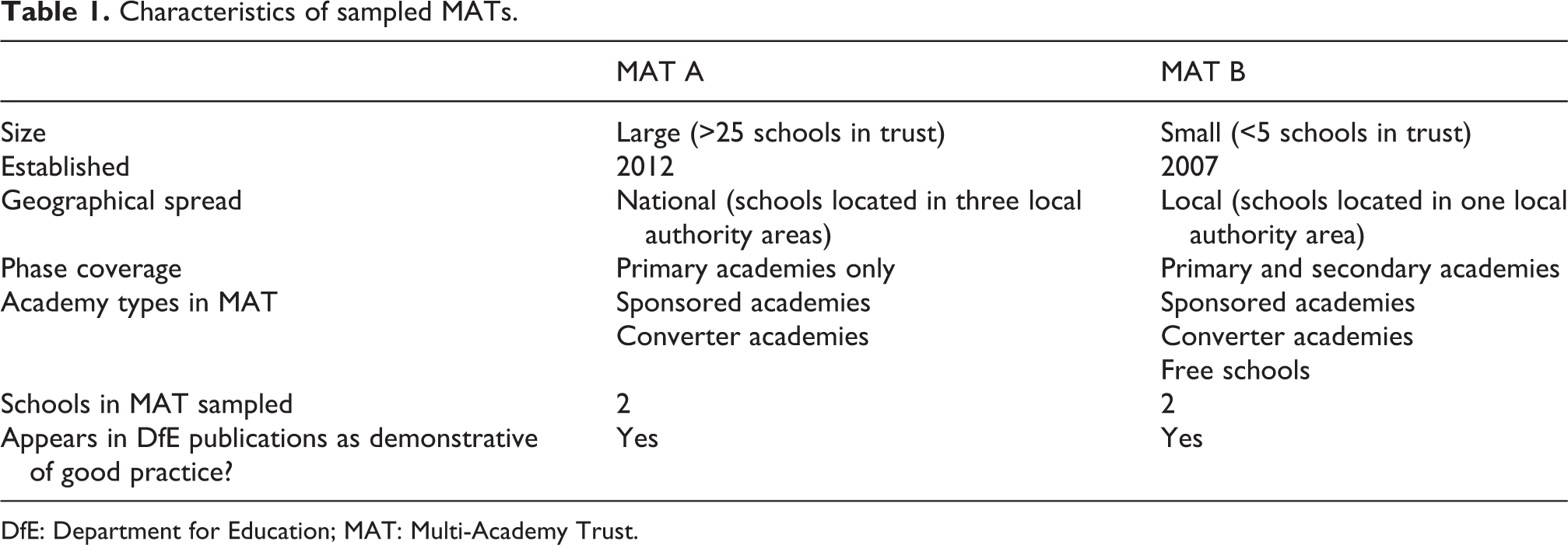
DfE: Department for Education; MAT: Multi-Academy Trust.
Contextual information about participating executive leaders.
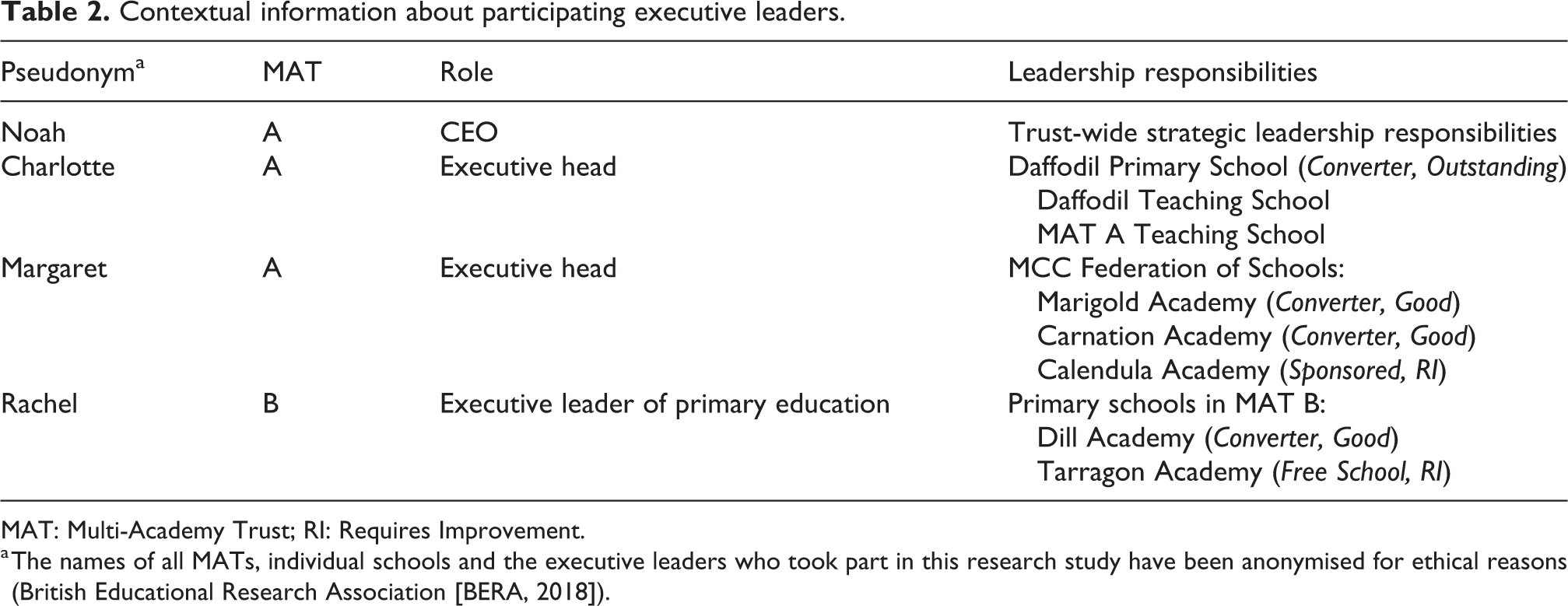
MAT: Multi-Academy Trust; RI: Requires Improvement.
a The names of all MATs, individual schools and the executive leaders who took part in this research study have been anonymised for ethical reasons (British Educational Research Association [BERA, 2018]).
Sample
A comparative case study was employed for this research study. Multiple case studies are useful when researching a generalisable phenomenon rather than a specific case (Stake, 2005). Furthermore, as Yin advises, ‘[a]nalytic conclusions independently arising from two cases […] will be more powerful than those coming from a single case’ (2009: 60–61). I sought to recruit two contrasting MATs to participate in the study to attend to the diversity within the MAT landscape (Hill et al., 2012).
I wrote to the CEOs of 32 MATs inviting them to participate in the research, inviting MATs in my locality to take part, as well as MATs that had been mentioned in DfE texts 2 as representative of good practice. I had a positive response rate of 13%, with two MATs finally committing to the project. CEOs acted as gatekeepers to individual academy schools.
Data collection and analysis
Four executive leaders participated in the research project (Table 2). Each participant had over 5 years experience in their current role. The participants took part in a semi-structured interview lasting between 45 min and 90 min. Questions posed to executive leaders included asking them to explain their MAT and academy’s vision, to talk about their role within the MAT, and to discuss how the primary landscape had changed since the 2010 Academies Act.
Interviews were analysed using Fairclough’s framework for critical discourse analysis (CDA) (Fairclough, 1992). CDA methods involve describing texts at a micro level, attending to the specific vocabulary used in conversations and the ways that individuals and institutions are grammatically constructed as either agential or passive. CDA is a tool for finding out how individuals discursively position themselves in the social world, rather than an attempt to reach an objective ‘truth’.
Findings
Positioning academies
Leaders interviewed across both MATs made efforts to discursively distance their MATs from other MATs using three distinct discursive strategies: temporal, moral and geographical. Each of these strategies constructed a discursive divide between different types of MATs, which then opened up a discursive space within which the school leader was able to positively position their own institution.
Temporal distancing
The first discursive strategy, of temporal distancing, was used by academy leaders to negatively construct early academies while positioning newer academies in a more positive light: I think the original academisations were sort of power things you had chief, big chief execs who wanted their empire and they’d swallow up lots of schools and actually it wasn’t really about the children and the education. (Rachel, executive leader, MAT B) At the beginning our schools were the and if I’m really self-critical or cynical um the lion’s share of our schools I suspect did not want to become academies. […] So we were, and I think MAT A was very much in its early days, a less unpalatable alternative. (Noah, CEO, MAT A)
Both Rachel and Noah used metaphorical language to negatively position early academy trusts. The word ‘empire’, as employed by Rachel, has a negative connotational value, emphasising her construction of the leaders of early academy schools as concerned with their own power and status rather than ‘the children and the education’. By using the term ‘swallow up’, Rachel constructed early MATs as predatorial and schools as vulnerable victims. Similarly, Noah’s use of the idiomatic expression ‘the lion’s share’ constructed his own MAT as a predator, and the schools he worked with as victims – he admits they ‘did not want to become academies.’ These lexical choices construct the early period of academisation as a period of chaos or violence, with powerful MATs able to oppress schools who were more vulnerable. Noah constructs his MAT as a ‘less unpalatable alternative’; by using the double negative, he places an emphasis on the unpalatability of most MATs, rather than the palatability of his own. The discursive strategy employed by Noah and Rachel in these statements uses a temporal narrative structure to distinguish past academies from present academies, enabling new academies to be positioned more positively than their predecessors. The metaphors used by Noah and Rachel indicate the charged emotional climate during the beginnings of post-2010 academisation and give an indication of the fear and anxiety that school leaders felt during this period (Greany and Higham, 2018; Keddie, 2016). Both Noah and Rachel resist being associated with the cause of this fear and anxiety.
Rachel and Noah’s attempts to construct a clear divide between ‘new’ academies and ‘old’ academies indicate a reticence on the part of executive leaders to be associated with pre-2010 academies, some of which expanded and became MATs that ‘sponsored’ (thereby enabling) the forced academisations. This negative positioning of other MATs – and concomitant attempts to disassociate from them – could reflect an awareness by executive leaders that MATs have a negative reputation in the education community which these leaders are attempting to negotiate.
Moral distancing
The second discursive strategy employed by MAT leaders to distance themselves from other academy trusts was to construct a moral difference between academies, centring on following national pay and conditions for teachers. In this way, Margaret differentiated her school from other academies: So at MAT A we follow national terms and conditions so that’s nice and straightforward. But, you know if you’re in one of those [MATs] that don’t then each time you move, they make it very difficult for you to, for you to move because they take, you know you start again, and they don’t transfer your time across and your maternity’s really difficult and things so people tend to kind of get locked in or women tend to get locked in because they can’t afford to go to another trust or whatever, or go back to a local school and not have their time counted for […] And it’s mean, and we fought a long time to get all those rights, and it shouldn’t be happening. (Margaret, executive head teacher, MAT A)
Margaret used emotive language, including the evaluative adjective ‘mean’ and the modal verb ‘should’ to emphasise a moral difference between her academy, which abides by national pay and conditions, and other academies who chose not to. Again, Margaret’s core values as a leader enable her to discursively negotiate policy demands. By foregrounding the importance of paying teachers fairly, Margaret justified her role as an academy leader, positioning herself as fair in comparison with other academy leaders who decided to undermine nationally agreed pay and conditions.
Rachel in MAT B also talked about how academies were said to undermine national pay and conditions: And all these I think these urban myths about well you’ll have to work till five and you’ll get shorter holidays. No it’s all on teachers’ pay and conditions which is exactly the same as it is anywhere else and there isn’t any difference. (Rachel, executive leader, MAT B)
Like Margaret, Rachel distanced her MAT from such practices. For Rachel, statements about academies acting unfairly towards their teachers had a negative truth value, and she positioned these stories as immoral scaremongering.
Rather than embracing the freedom to alter pay and conditions for teachers, executive leaders in both MAT A and MAT B worked to reject any claims that they might do so. Rachel and Margaret positively positioned themselves as leaders by claiming to retain teachers’ pay and conditions, rather than offering something different or new. In this way, they morally distanced themselves from academies who chose to alter nationally agreed terms and conditions for teachers, despite this being one of the core freedoms afforded to academy schools.
Geographical distancing
Rachel worked in a small MAT, based within one large town. This enabled her to draw on a further strategy for distancing her MAT from others, by distinguishing between large MATs and small, local MATs: I think reasons people worry about joining an academy trust is because they think they’ll lose the autonomy of their school and they’ll lose the school will become cloned and et cetera. But then it depends on the trust, which trust you join. Some trusts, some of the bigger trusts do do that they do clone, and they do it all the same way. Other trusts like us, and other local trusts we don’t do it like that. (Rachel, executive leader, MAT B)
By positioning her MAT as a ‘local trust’, Rachel was able to construct a discursive division between her MAT and other ‘bigger trusts’. She constructs these larger trusts as removing school autonomy. The term ‘clone’ was used by Rachel to emphasise the extent to which such MATs control their schools.
Rachel’s construction of larger trusts as denying school autonomy was unique among the research participants, reflecting her status within the sample as working within a small, local trust. Rachel’s attempt to justify her MAT in such a way may indicate an unease in working within a MAT and an attempt to make her decision to work within a MAT appear palatable to those who may be critical. Rachel’s construction of large, national MATs as completely different from her own, small and local MAT also indicates the fragmentation caused by the post-2010 academisation policy. MATs were not only separated from the local authority but also constructed themselves as distinct and different from one another in various ways, contributing to the fragmentation of the school system following the 2010 Academies Act.
Positioning local authorities
The MAT leaders who participated in this research study not only distanced themselves from other academies and academy practices which they considered to be negative but also sought to construct a continuity between their practices and those of local authorities.
Rachel argued that there was no difference between the support of a local authority or the support of a MAT: [In a MAT] you have that central team who support you so, there – if you like the central team are your local authority but they’re there all the time. So I don’t think in terms of demands, standards anything I don’t think it’s any different. Because you’ve either got the Trust saying come on, you need to work at these things you need to improve or you’ve got your local authority saying it. (Rachel, executive leader, MAT B)
Rachel argues that working under a local authority is the same as working under a MAT because both play the role of continually requiring school improvement. In this way, Rachel constructs academies as similar to local authorities, rather than different and distinct.
Noah and Charlotte, who both worked in MAT A, showed an even keener desire to align themselves with local authorities: If we’ve done our job well, a teacher shouldn’t notice any significant difference. between being in a MAT A academy from being in a well-run maintained school with a supportive local authority. (Noah, CEO, MAT A) this local authority had some fantastic advisors that were often in schools, often teaching, and I’m really missing that side of things. (Charlotte, executive head teacher, MAT B)
Noah constructed the aim of schools within MAT A to be indistinguishable from maintained schools ‘with a supportive LA’. Charlotte painted a very positive picture of her local authority, using the evaluative adjective ‘fantastic’ to indicate a positive affective stance towards local authority employees and stating that she was ‘really missing that side of things.’
In these research conversations, the support provided by the local authority was constructed in a positive manner. Whereas these executive leaders were quick to negatively position other MATs, they were more complementary about local authorities. This suggests that leaders in this study did not identify as lone crusaders, desperate to escape local authority control to bring about school improvement. They worked to discursively associate their practices with those of local authorities, constructing local authorities as valued.
Discussion
Academisation entailed a ‘break’ (Ball, 2007: 177) from previous structures of schooling in England. This disruption opened up new identity positionings to school leaders which were complex and various, existing on a continuum from engagement to resistance (Hughes et al., 2019). The present research study has explored the identity positionings of four executive leaders based in the primary academy sector, a sector which was previously found to be resistant or ambivalent towards academisation (Coldron et al., 2014; Greany and Higham, 2018; Keddie, 2016). It shows that primary academy leaders are developing an approach of ‘strategic redefinition’, allowing them to maintain their core values and sustain commitment to the profession in the wake of policy change.
In his 1977 research on new teachers, Lacey defined several ways in which new teachers adjust to the socialisation requirements of their new schools. New teachers who practised strategic redefinition were able to negotiate the constraints of their demands by changing the situation around them to better meet their values and beliefs. Executive leaders in the present study appeared to strategically redefine the situation of post-2010 academisation they had been forced to confront, changing what it meant to be an academy leader. They highlighted the continuities in practice from previous times of local authority management and discursively distanced themselves from the practices of academies which they rendered abject. In doing so, they strategically refined the possibilities of academy leadership.
The primary executive leaders in this study differed from secondary leaders detailed in other studies, who were keen to remove themselves and their schools from local authority management (Coldron et al., 2014; Kulz, 2015; Salokangas and Ainscow, 2018; Smith and Abbott, 2014). These secondary leaders positioned themselves as determined, ambitious and autonomous individuals who saw academisation as an opportunity to make a success of themselves and build an ‘empire’ (Kulz, 2015: 11). In contrast, the primary executive leaders interviewed as part of the present study rejected this identity positioning.
It is unclear from these limited findings why the primary teachers interviewed in this study positioned themselves so differently from secondary leaders in other studies. Reticence to identify as ambitious and autonomous academy leaders may reflect the ‘natural conservatism’ that has been identified in primary school governance (Hill et al., 2012: 33) or a commitment by primary leaders to sustaining positive relationships within the local community (Keddie, 2016) and with local authorities (Greany and Higham, 2018; Keddie, 2016; 2017). Further research which specifically explored the differences between primary and secondary academy leadership would provide further insight into these issues.
Primary executive leaders in this study discursively distanced themselves and their academies from the practices of other academy chains. For Rachel, academies could be local and flexible; for Margaret, supportive of their staff. Behind these identity positionings, these leaders appear to display a deep-seated unease with the academisation project and a concomitant attempt to ‘explain, justify and make sense of themselves in relation to others’ (Maclure, 1993: 311).
Attempts to discursively align their practices with those of local authorities also suggest that these executives, who on the surface appeared to be conforming with policy mandates, were in fact redefining what it meant to lead an academy. When Charlotte claimed to be ‘really missing’ working with local authority advisors, she positioned herself as regretting the demise of local authority support, despite being a successful academy leader responsible for managing an outstanding primary academy. Charlotte could have highlighted her capacity to perform without local authority support; instead, she chose to foreground how keenly she felt the loss of local authority structures. In doing so, Charlotte not only took on the position of ‘complaining’ (Hughes et al., 2019), but strategically redefined how a successful academy leader could talk and behave.
Previous research has shown that post-2010 education policies led primary school leaders to believe that academisation was inevitable (Keddie, 2016). The present research study suggests that the way primary school leaders responded to academisation could be agential rather than passive, involving strategic redefinitions of what it meant to lead an academy school. This agency did not involve complete compliance. These leaders resisted and rejected the behaviours of some academies. They presented academy leadership as being compatible with previously held beliefs and values; they renegotiated what it meant to work in an academy, rather than changing their attitude to leadership. In line with previous research undertaken on policy enactment (Ball et al., 2012; Henig and Stone, 2008), the interviews discussed in the present article reveal how school leaders’ professional identities are an enabling factor in allowing national policy to be mitigated and transformed within school spaces.
Conclusion
This study was small, involving only four executive leaders working across two MATs, limiting the generalisations that can be drawn from the findings. Furthermore, this study has focused on the ways that leaders discursively position themselves and their practices but has avoided investigation into the extent to which their discursive positionings actually correlate to their leadership practice. Nevertheless, the findings contribute to the growing field of research focused on the primary academy sector (and independent state-funded schools more widely), providing further evidence of the complex and multiple ways in which school leaders position their emergent identities in autonomous school settings.
Independent state-funded schools may ‘represent the influence of a particular set of ideas about the provision of education’ (West, 2014: 330). However, this influence does not fully determine the professional values or identities of the teachers or leaders who work within them. This research project isolated examples of academy leaders who were on the ‘inside’ but who looked out in different ways to those previously acknowledged. Becoming an academy leader, for these executives, meant strategically redefining the role of the academy leader. This practice of strategic redefinition allowed these leaders to present a positive identity as an academy leader, while retaining attachments to previous structures. Their voices indicate the successes of the academisation project but also some of its failures. They show that leaders are not completely limited by policy structures, as Hatcher and Troyna (1994) would argue, but instead are ‘policy actors’ (Maguire et al., 2015) who actively negotiate policy in their professional spaces. Research into primary academisation has previously focused on the reticence of primary leaders to convert to academy status (Greany and Higham, 2018; Keddie, 2016). This research indicates there is scope to further research the ways in which leaders within the primary sector are responding to academisation.
Footnotes
Declaration of conflicting interests
The author(s) declared no potential conflicts of interest with respect to the research, authorship, and/or publication of this article.
Funding
The research presented in this paper was conducted as part of a University of Worcester PhD Studentship.
