




Abstract
Families are a key institution that reproduce and resist gender inequalities. For instance, families can maintain or challenge cisnormativity—a gender structure that erases, marginalizes, and harms trans people. However, beyond studying highly supportive parents of trans children, scholars lack a full understanding of how family members divest from cisnormativity. Furthermore, overfocusing on parents ignores how children and youth, including siblings, also challenge gender norms within families. Using interviews with 52 trans youth, who are mainly trans youth of color, this article examines how siblings of trans youth divest from cisnormativity and help trans youth achieve gender recognition when parents are unsupportive or ambivalent. We find that siblings recognize and support trans youth’s gender through both passive (such as nonchalantly accepting their trans sibling) and active (such as using correct names and pronouns) gender-supportive practices. We also introduce the concept of counterhegemonic accountability to describe how siblings hold accountable family members who misrecognize trans youth’s gender. Together, siblings and trans youth challenge cisnormativity at home and within the broader society. To understand the complex ways gender norms change in and through families and within society, gender scholars need to study sibling relationships.
Families are a key institution in reproducing dominant understandings of gender (Stacey 2021) and in reproducing cisnormativity—the structures and practices that privilege people who identify with their assigned birth gender and whose gender expressions are gender conforming (Robinson and Stone 2024). For instance, parents often feel accountable for their children’s gender performance through social pressures to be a “good parent”—defining successful parenting as raising heterosexual, cisgender, and gender-conforming children (Kane 2012; J. A. Martin, Abreu, and Goldberg 2025; Stacey and Padavic 2021). For trans people, then, family is often a fraught area of life (McGuire et al. 2016; Reczek and Bosley-Smith 2022). Robinson and Stone (2024) developed a trans family systems framework to examine how processes around gender shape family life for trans people. More specifically, a trans family systems framework documents how cisnormativity is reproduced and resisted within families and how these processes also intersect with race, class, religion, culture, and other social categories (Robinson and Stone 2024). This framework also helps to illuminate how families can resist oppressive gender norms via cisgender divestments. For instance, some parents help their gender-expansive children achieve gender recognition from others (Meadow 2018). Families invest in and divest from cisnormativity; therefore, studying families is crucial to capturing how dominant notions of gender are both reproduced and challenged.
Notably though, most literature on gender and families focuses on the parent–child relationship (Reczek 2020; Stacey 2021), which overlooks how other family members, such as siblings, shape gender processes. Centering parents, though, limits gender scholars’ understanding of how cisnormativity and gender norms are reproduced, and this approach often privileges White, middle-class understandings of family life. To address this limitation, we intervene in this literature by considering how siblings of trans youth divest from cisnormativity by using a trans family systems framework (Robinson and Stone 2024). That is, we examine how siblings disrupt and resist cisnormativity and “expand the possibilities of how gender is performed, accepted, and accomplished within families” (Robinson and Stone 2024, 11).
Examining siblings of trans youth can elucidate how social change around gender occurs within families and society, because these cisgender divestments can illuminate how oppressive gender norms are challenged. Both trans and cisgender children can prompt social change in families and can push parents to think about gender differently (Darom 2023; Meadow 2018; Rahilly 2020; Travers 2018). Moreover, siblings’ shared or proximate generational status with trans youth may facilitate support for the trans youth’s gender identity, because siblings may have more similar exposure to LGBTQ people and cultural knowledge than other older family members (Jones 2024). Given that they often co-reside, siblings may be important resources of gender recognition within trans youth’s natal home. Additionally, siblings may be particularly important for LBGTQ youth of color (McCandless-Chapman et al. 2025). Siblings play a more central role in Black, Latinx, Asian, Indigenous, and low-income family life compared with White and middle-class family life, as they contribute to racial-ethnic identity formation and solidarity within family life (Cardwell et al. 2020; Gerstel 2011; Sarkisian and Gerstel 2012; Stack 1975; Su-Russell and Finan 2022). We ask, then, how do siblings of trans youth divest from cisnormativity?
Drawing on interviews with 52 trans youth, we demonstrate how trans youth perceive and understand how their siblings divest from cisnormativity while prioritizing the trans sibling’s safety within their family of origin. This study draws on the voices of trans youth and their understandings of their siblings—not the voices of the siblings themselves. Nonetheless, studying how trans youth perceive their siblings illuminates practices that affirm the trans youth’s gender and sense of safety at home.
In grounding trans youth’s voices, we find that siblings passively and actively divest from cisnormativity. First, we find that siblings passively support trans youth’s gender identity through nonchalant responses to and acceptance of trans youth’s gender identity disclosures. Second, we show how siblings actively recognize trans youth’s self-determined gender by using their chosen name and gender-affirming language without outing the trans youth to unsupportive family members. Last, when others attempt to hold trans youth accountable to cisnormative gender expectations, siblings use what we call counterhegemonic accountability to direct others to recognize trans youth’s gender, thus encouraging family members to be less cisnormative. Through showing how siblings preserve trans youth’s safety and comfort within their families with these gender-supportive practices, this study demonstrates how siblings divest from cisnormativity and prompt social change around gender. We thus call on gender scholars to continue to study a range of family relationships, including siblings, especially if we want to more fully understand how gender norms can change in and through the institution of the family.
Literature Review
Families and Gender
The family is an important site where gender is produced through routine social interactions, as children’s gender “comes into being in the world through intricate processes of social assignment, recognition, and regulation” by family members (Meadow 2018, 44). That is, the family is a gender factory wherein family members play a role in developing and shaping children’s gender and sexuality (Fenstermaker-Berk 1985; Stacey 2021). For example, parents direct their children’s behavior to encourage conforming to dominant ways of “doing gender” (Kane 2012; West and Zimmerman 1987). A trans family systems approach contends that these family interactions often reproduce and naturalize—that is, invest in—cisnormativity (Robinson and Stone 2024).
This investment in cisnormativity is buttressed by the ways parents are held accountable for their children’s gender. People “do gender” with attention to their accountability, or how they may be assessed by others, and this accountability typically centers the alignment of gender with dominant social structures, such as cisnormativity (West and Zimmerman 1987). Most work has studied how accountability reinforces these dominant social structures. For example, parents are often held accountable not just for their own gender, but also how their child does gender (Robinson and Stone 2024). Thus, parents often encourage their children’s interests, appearance, and behaviors to conform to their assigned birth gender (Kane 2012). Moreover, due to racism and/or homophobia, parents of color and other marginalized parents such as LGBTQ parents face additional surveillance, risk having their fitness as parents negatively evaluated, and feel extra pressure of accountability for how their children do gender (Moore 2011). Even if families choose to resist gender expectations—such as by cultivating gender-nonconforming children’s diverse gender identities (Meadow 2018) or by providing children with a “gender buffet” of toys and clothes (Averett 2016)—these parents still may experience external pressure to do gender and do parenting “correctly” according to cisheteronormativity (West and Zimmerman 1987, 2009). Accountability, then, is unavoidable and a central component to how families do gender.
Nevertheless, despite these accountability pressures, families are also important sites for social change and resistance to cisnormativity. Indeed, if doing gender makes the gender structure appear natural or inevitable, then the gender structure can be contested through interactions (Connell 2009; West and Zimmerman 1987). Within the context of families, studies have documented how stepparents (Stacey and Padavic 2021), aunts (Robinson, Stone, and Webb 2023), parents of trans children (Meadow 2018; Rahilly 2020; Travers 2018), grandparents (McCandless-Chapman et al. 2024; Rahilly 2024), LGBTQ parents and relatives (Averett 2016; McCandless-Chapman et al. 2025), and trans youth themselves (Robinson and Schmitz 2021) have all divested from cisnormativity. For example, nonparental relatives, such as aunts, challenge cisnormativity by providing emotional and housing support for trans youth, which can enhance youth’s sense of safety and security within their families and which can disrupt the transphobia within the natal home by showing how to love, support, and accept a trans youth within the family unit (Robinson, Stone and Webb 2023). Moreover, some Latinx grandparents support their trans grandchild through buying them gender-affirming clothing, and this support reinforces cultural bonds around familismo within the grandparent–grandchild relationship (McCandless-Chapman et al. 2024). Nonparental family members can expand the possibilities of how gender is performed, accomplished, and recognized within families through cisgender divestments. Yet little gender scholarship examines how children, youth, and young adult family members divest from cisnormativity in families. Siblings often do not have resources available to provide trans youth with money or alternative housing, but they can provide important forms of support for trans youth, especially gender recognition within the natal home.
This study intervenes by illuminating how siblings divest from cisnormativity by both actively and passively recognizing trans youth’s gender. Our findings bring attention to how gender (mis)recognition is a dynamic process and how accountability is an important part of how families reproduce and resist cisnormativity. That is, we move the concept of accountability away from its predominant focus on maintaining and reproducing dominant gender norms to examine how accountability is used as a mode of resistance to expand gender, challenge cisnormativity, and lead to social change.
Sibling Relationships
Although gender scholarship on families largely emphasizes the parent–child relationship, siblings are important to everyday family life (McHale, Kim, and Whiteman 2006). However, sociologists tend to center adults and downplay the agency and social influence of children. As a result, children and youth remain unexamined in family gender-recognition processes outside of the person who is gendered, despite scholars acknowledging that children and youth are agentic actors, especially in gender processes in schools (Ferguson 2020; Pascoe 2011; Thorne 2024). Building on scholarship understanding children and youth as gender actors in schools, we turn to the family to examine how siblings affirm and recognize the gender of trans youth and, hence, divest in cisnormativity.
Importantly, studying siblings in the construction of gendered selves and norms can direct gender scholars to understand the influence of families in cultivating and performing gendered selves while also challenging the dominance of the parent–child relationship in research on families (Mitchell 2003). As social partners, siblings are an important component in how families cultivate young people’s social identity and sense of self (Davies 2015; McHale, Kim, and Whiteman 2006). Similar to the importance of siblings for positive racial and ethnic identity formation (Cardwell and Soliz 2020; Padilla et al. 2021; Su-Russell and Finan 2022), sibling relationships are sites of social learning that shape how children reproduce femininity, masculinity, and gendered power (Edwards, Mauthner, and Hadfield 2005; McHale et al. 2001). For example, norms about masculinity and femininity shape sibling closeness, as sisters’ relationships center talking and brothers’ relationships are strengthened by shared activities; but relationships between sisters and brothers operate on brothers’ terms through bonding with shared activities, suggesting that children can learn about gendered power relations in sibling relationships (Edwards, Mauthner, and Hadfield 2005). Although often understudied, sibling relationships are an important interactional relationship in understanding how gender norms can be reproduced. Furthermore, using a racially diverse sample to study the role that siblings play in how families “do gender” can help to illuminate some of the particularities and nuances of cisgender divestments that may be lost by the predominantly White samples found in trans family scholarship. Indeed, as family members within families of color often help each other to navigate racism and other structures of oppression within society, examining how families of color—and in this case, siblings—help to support trans youth of color can show that families of color can be crucial to both racial and gender affirmation for certain trans youth.
Studying siblings can also reveal how children influence social change around gender within families. Research on immigrant families has described children as “agents of cultural innovation” who use their cultural expertise to tutor, interpret, and broker social knowledge to parents (Foner and Dreby 2011, 546). Darom (2023) contends that cisgender children in progressive locales similarly use cultural fluency around emerging gender knowledge to acclimate parents to changing gender norms, teaching parents about how gender is a fluid and self-determined identity rather than a binary and biological trait. Children have power to resist cisnormativity and prompt parents to adopt new ideas about gender. However, siblings’ importance in family gender processes has been largely ignored in gender scholarship. Ignoring siblings risks reproducing top-down logics about the relationship between families and gender by obscuring children’s agency and influence in family gender processes. Moreover, because the whole family is involved in accomplishing gender, studying sibling relationships is essential to understanding how gender is produced, sustained, and contested through family relationships, and can illuminate how families reproduce and resist gender norms such as cisnormativity.
Methods
We use qualitative interviews with 52 transgender, nonbinary, genderqueer, questioning, and other non-cisgender (trans) youth (16–19 years old) from the Family, Housing, and Me (FHAM) Project. The FHAM Project is a longitudinal study of family and housing for 83 LGBTQ youth in South Texas and the Inland Empire of California, two areas with large Latinx and working-class populations (U.S. Census Bureau, n.d.). The interviews were conducted in the first wave of the study in the summer of 2022. The broader study examines the family life and experiences of LGBTQ youth’s housing, support, and sense of safety. This research was approved by the Institutional Review Board at Trinity University. All participants provided informed consent before being interviewed, and youth who are 16 and 17 years old at the beginning of the study were allowed to participate without parental consent. Studying mature minors without parental consent is a common practice in the study of LGBTQ youth to protect them from their gender and/or sexual identity being revealed to parents (Macapagal et al. 2017; Sims and Nolen 2021).
Recruitment and Sample
Potential participants were recruited through an online prescreening survey distributed via social media, paid social media ads, and local LGBTQ organizations’ mailing lists. Potential participants took a short prescreener survey assessing sociodemographics, current housing situation, and parental support using three questions modified from the Multidimensional Scale of Perceived Social Support (MSPSS) (Dahlem, Zimet, and Walker 1991; Zimet et al. 1988). Research team members selected youth from the survey based on the following criteria: residence in Inland Empire or South Texas, ages 16 to 19 years old, being housing dependent (answered “No” to the question “Do you pay rent or contribute to household expenses in your current housing?”), and having low or ambivalent parental support (answered “Strongly Disagree,” “Disagree,” or “Neither Agree nor Disagree” to the MSPSS questions). The research team recruited 41 youth in South Texas and 42 youth in the Inland Empire, most of whom were transgender and/or nonbinary youth of color who were in high school.
We examine interviews with 52 trans youth who reported having a full, half, step, or adoptive sibling (Table 1). In addition to conducting this study in two areas with high populations of Latinx people, we also oversampled for race during recruitment to capture the diverse experiences of LGBTQ youth. Therefore, among these 52 youth, 81% of the youth are Latinx, Black, Asian, Indigenous, or another racial identity that is not non-Latinx White. When we introduce each participant, we use the identities and pseudonym the participant selected to describe themselves.
Sample Characteristics
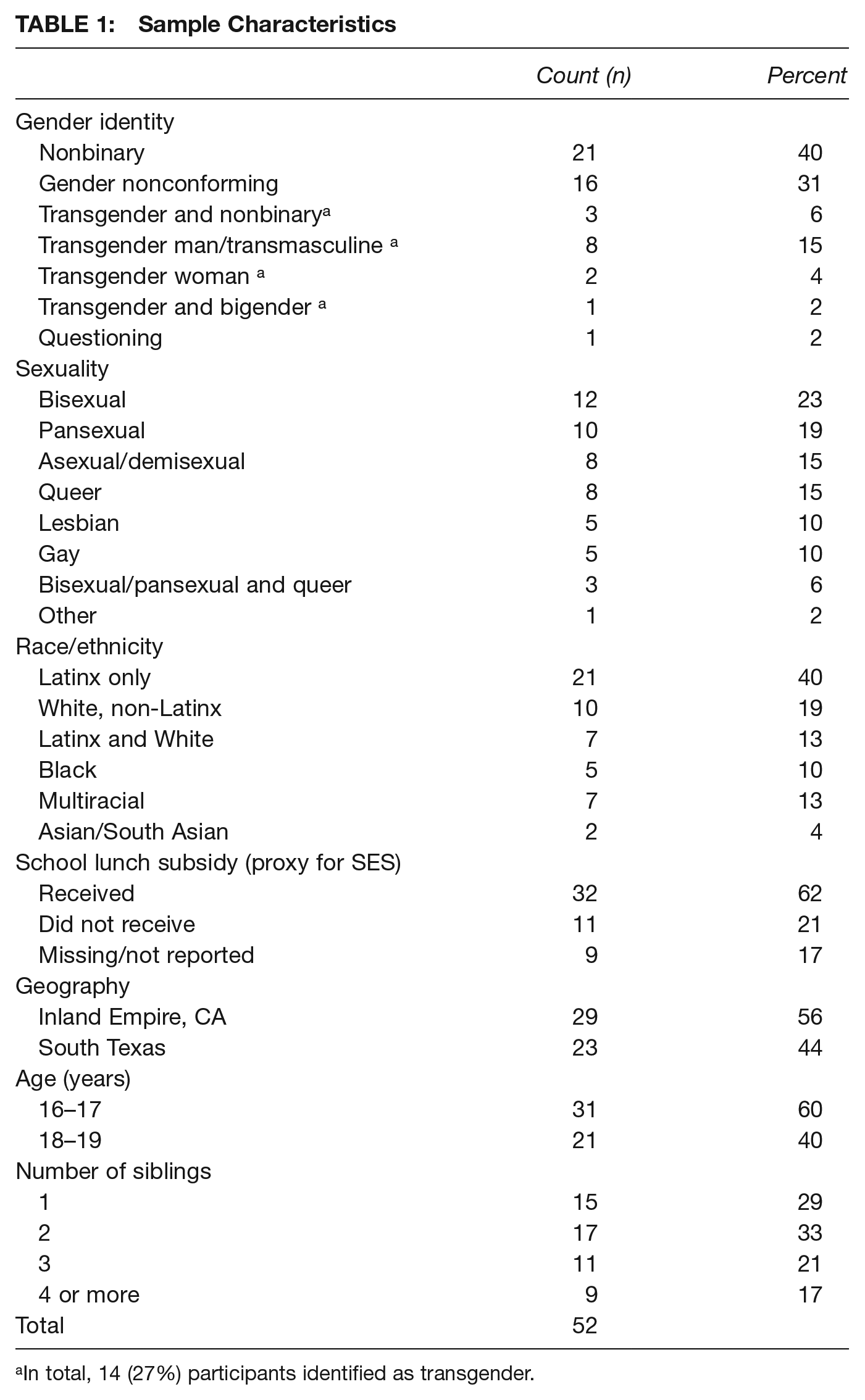
In total, 14 (27%) participants identified as transgender.
Data Collection and Analysis
The interviews mapped out youth participants’ family connections. Participants were asked about their feelings of safety, housing security, and support in their current home. All interviews were semi-structured and conducted over Zoom by a research team member, primarily undergraduate research assistants. Interviews lasted 1 to 3 hr, and the majority lasted 90–120 min. Each participant received a $40 Amazon gift card. The interview questions most relevant to this article were the following: “How would you describe your relationship with your sibling(s)?” and “Which of your family members are supportive about your gender/sexual identity? What do they do that’s so supportive? Can you give me an example of a time when they supported you?” Interviewers asked probing questions to develop responses to each of these questions.
The data were professionally transcribed through a transcription service and cleaned by a team member. Transcripts were entered into NVivo and coded using flexible coding techniques (Deterding and Waters 2021). Flexible codes were developed by the original research team. The research team coded for which members of the family (e.g., siblings) participants referenced. The first author performed axial coding by combining the sibling code with other prominent codes, such as “emotional support,” “supporting gender and sexual identity,” and “family attitudes” to examine the specific practices siblings engaged in that participants identified as meaningful for recognition of their gender. Using these codes, the first author developed an analytical matrix including data on participants’ siblings; the supportive gender practices youth perceived from their siblings; and participants’ parental relationships, mental health, housing, gender, and sexuality. In the process of developing the analytical matrix, the first author was able to move between the data and literature on gender recognition and family gender processes in an abductive manner to refine theories that explained the patterns emerging in the data (Tavory and Timmermans 2014; Vila-Henninger et al. 2024). This coding allowed us to understand how trans youth’s siblings divest from cisnormativity in trans youth’s family of origin.
Siblings’ Gender Supportive Practices
Overall, trans youth described their siblings as important family members who supported their gender and/or sexuality. Trans youth described 71 of 126 reported siblings as supportive of their gender and/or sexuality (the remainder were either described as unsupportive [19]; neither supportive nor unsupportive, unsure, or too young [9]; or not reported gender/sexuality support [27]), and 42 of 52 participants had at least one supportive sibling. We find that trans youth perceive siblings as supportive and divesting from cisnormativity within family interactions in three key ways. First, trans youth described nonchalant reactions from siblings when they came out as trans, which quelled trans youth’s fears of family rejection. Second, siblings support trans youth by using gender-affirming names, pronouns, and language in strategic and intentional ways, which help to recognize and bolster their self-determined gender identity. Finally, siblings help trans youth achieve gender recognition from others by demanding that others divest from cisnormativity via what we call counterhegemonic accountability. Through these actions and processes, siblings were active agents in family life, working to bolster trans youth’s safety and comfort within their family of origin and natal home.
Gender Nonchalance and Accepting Transness
A unique way that siblings divest from cisnormativity is by treating gender diversity as a relatively unremarkable part of everyday life. Fifteen participants recalled how their siblings had nonchalant reactions to their gender identity disclosure, which was not a feature of their trans identity disclosures to other family members. For example, Lorren (18, Chicana, nonbinary, they/he/she) considers his sister their most supportive family member, explaining: She knows who I am and she doesn’t care. She doesn’t care about it in, like, in the way that, like, she doesn’t care that I’m this, she doesn’t care that I’m that. As long as that I’m me, it’s fine . . . [When] I, like, came out to her, it’s like, “nonbinary,” and she’s like, “Oh cool.”
For Lorren, their sister’s nonchalance around her gender conveyed the insignificance of Lorren’s gender identity to their sibling relationship. Rather than suggesting contempt for their nonbinary gender identity, the impression that Lorren’s sister “doesn’t care” about their gender identity conveyed support. Like Lorren, some trans youth specifically recalled their siblings—particularly LGBTQ siblings—saying “okay” or “cool” when they disclosed their gender identity. Margo (17, Hispanic, nonbinary, she/they) only told her lesbian sister they are nonbinary, and her sister was “pretty cool about it,” explaining “she didn’t ask a lot of questions. She just kind of accepted it, which is nice.” The trans youth whose siblings were nonchalant when youth disclosed their trans identity to them generally interpreted this reaction as supportive, as opposed to ignoring or sweeping their gender “under the rug” (Reczek and Bosley-Smith 2022, 104).
Furthermore, participants often interpreted siblings’ nonchalant reactions as supportive by contrasting siblings’ nonchalance to parents’ disclosure responses and conflict over youth’s gender identity. For example, Leaf (18, Asian American, trans man, he/him) recalled that his oldest sister was “completely chill” since he told her he is a man, whereas he felt his parents treated him differently. Leaf’s mom rejected his gender when he first came out to her, insisting ‘“No, you’re not. You’re a girl.’ Like get over it.” In contrast to his mom refusing his gender and his dad’s apprehension, Leaf’s sister was supportive and “completely chill. She’s like, ‘Oh yeah, cool.’ It’s like telling her, ‘Oh yeah, I dye my hair this color.’ ‘Okay.’” Even though his sister had never met any other trans people before and “didn’t really understand the concept of it,” Leaf described nonchalance in her initial reaction and then unconditional love and support after gender identity disclosure. Notably, LGBTQ Asian American youth may uniquely fear familial conflict around their gender and/or sexual identity (Shen et al. 2023), because collectivism and family cohesion are often highly valued within many Asian American families. Participants such as Leaf often described relief or surprise because nonchalance contradicted their fears of familial conflict, rejection, or strain. Because being trans does not challenge their belonging in the family, the relief likely contributes to youth’s feelings of safety and comfort in their natal home.
Disclosing a transgender identity to family members is often distressing (Catalpa and McGuire 2018), and fear of familial rejection and housing loss contributes to trans youth’s anxieties around coming out (Robertson 2018). Trans youth in this study were often pleasantly surprised by siblings’ nonchalant reactions to their gender identity disclosures. Because poor trans youth and trans youth of color may be more likely to experience homelessness (Page 2017), this nonchalance can take on significant meaning in helping trans youth of color feel accepted within their natal homes. Youth participants generally believed that such responses indicate siblings’ support for their gender identity, especially in contrast to how disclosing a trans identity to parents was often met with heightened reactions, including grief, shock, and rejection (Miseo 2022). Nonchalant reactions divest from cisnormativity by accepting transness and disrupting the assumption that everyone is cisgender. Nonchalant reactions also demonstrate that understandings of gender and families are expanding, because such reactions passively communicate that families do not exclusively believe that they are—and should be—composed of cisgender and gender-conforming people.
Recognizing Gender
Participants regarded siblings as supportive when siblings made an intentional effort to use their chosen name and gender-affirming pronouns. For 19 participants, siblings were the only or primary family members who consistently recognized their gender. For example, Vivian (16, Hispanic, nonbinary, they/them) regarded their brother as their most supportive family member because “he’s the only one in my family that actually knows my name and pronouns and has tried to make an effort into actually using them” since Vivian came out to him as nonbinary. Similarly, Blaise’s (17, Hispanic, nonbinary, they/he) sister “got it immediately” when Blaise came out as nonbinary: Once I came out as trans, she asked a couple of questions and then she was like, “Okay.” And then we moved on and now she treats me like a sibling, not a sister anymore. If she messes up on pronouns, which she hardly ever does, she immediately corrects herself. And I feel like that’s the kind of support that I’m looking for with all my family, but I can only get it with her.
Treating Blaise as a sibling—and not as a sister—was an important aspect of how Blaise’s sister recognizes Blaise’s gender. Indeed, for many youth in this study, using trans youth’s chosen gender-affirming name was a key cisgender divestment: This divestment respected the self-determined gender identity of the trans youth, even though this identity challenged the cisnormativity of the family home. For Mark (17, Latina, agender, they/them), their sister made “it clear that while it was a change . . . she was going to adjust and be respectful” when Mark first came out to her as agender, and “recently, she did start calling me by my preferred name instead of, like, a nickname.” Thus, siblings bolster trans youth’s gender identity through recognizing their self-determined gender as authentic by using gender-affirming names, pronouns, and language.
Some participants suggested that siblings’ previous knowledge about trans and nonbinary genders eased siblings into recognizing trans youth’s gender. Jax (19, Black, nonbinary, they/them) noted that their relationship with their younger brother had not changed since they came out as nonbinary because “he’s young, pretty liberal. He goes to high school and all of his friends are queer, whatever. So nothing’s really changed between us. He’s still an annoying little brat. He just uses the correct pronouns now.” When a sibling is already familiar with LGBTQ identities, either because they have LGBTQ friends or are LGBTQ themselves, they may be able to embrace their trans siblings’ gender and provide gender recognition more easily. Eddy (19, White, transmasc, he/they) similarly believed that their nonbinary sibling accepted that he is trans and recognizes their gender “a lot easier than my parents did or than my brother did I think mainly because they’re also a part of the community.” Recent Gallup data find that more than one in five Gen Z adults and one in ten Millennial adults in the United States identify as LGBTQ (Jones 2024), suggesting that young people have more exposure than older generations to LGBTQ people and knowledge. Shared or proximate generational status among siblings may facilitate cisgender divestments within families because of this exposure.
Family context also shaped siblings’ cisnormative divestments, primarily whether trans youth had disclosed their gender identity to their parents. Participants who had not disclosed their gender identity to one or more of their parents often feared that coming out as trans would cause parental conflict or rejection. In many of these cases, however, youth had at least one sibling who provided gender recognition and support. For example, Clay (16, Hispanic/White, trans man, he/him) told everyone in his immediate family about his gender identity except for his dad, recalling his dad mumbled “What a freak” under his breath, when they saw another trans man at a restaurant. After that incident, Clay explained he was “trying to hold [coming out to dad] off as long as I can.” When Clay came out to his siblings and mom, he requested they deadname—use his name assigned at birth—and misgender him around their dad. However, his siblings recognize his gender by using his name and pronouns when their dad is not around. Clay shared he liked this strategic arrangement because “they know the truth” and “we’re trying to keep it on a down-low. But if I’m wearing something good, they’re like, in Spanish, using the masculine, the pronunciation.”
Trans people strategically navigate identity disclosures to avoid violence and cultivate safety (Kade 2021). We find siblings also strategically navigate gender (mis)recognition to cultivate their trans siblings’ safety within the family of origin. Siblings do this work by taking on cognitive labor to code-switch around audiences whom trans youth are not out to (Ward 2010). By strategically using trans youth’s self-determined name and pronouns and celebrating diverse gender expressions by giving, for example, compliments with gender-affirming language—which may be racially or ethnically specific, as in the case for Spanish-speaking trans youth like Clay—siblings help to actively recognize and cultivate trans youth’s gender and racial identity. Notably, siblings engage in these supportive practices even if trans youth’s gender identity is not constantly expressed or recognized as trans youth move in and out of unsupportive family contexts. Trans youth and siblings strategically maneuver in and out of (mis)recognition, suggesting they prioritize the trans person’s safety over consistent gender recognition.
Siblings support trans youth through cisgender divestments such as referring to trans youth through names, pronouns, and gendered language according to their self-determined gender identity. Because youth participants had unsupportive or ambivalent parental ties, many noted that their siblings were the only family members who affirm their gender and help them achieve the gender recognition they long for in their families. Within families of color, this gender recognition can take on unique meaning of affirming a youth’s cultural, racial, and gender identities, challenging the notion that transness is linked only to Whiteness. Understanding processes of gender (mis)recognition is key to understanding trans family life and relationships, as family is often fraught for trans people (Pfeffer 2016; Reczek and Bosley-Smith 2022). Examining how trans youth receive gender recognition through sibling relationships demonstrates how trans youth’s gender is collectively produced and sustained in family interactions, even as youth and their siblings move in and out of (mis)recognition to preserve the trans youth’s safety and comfort.
Counterhegemonic Accountability
Many siblings mediated trans youth’s relationships with other people by encouraging other people, including other family members, to be less cisnormative and more supportive of trans youth. Specifically, siblings promote cisgender divestments by correcting individuals who misrecognize trans siblings’ gender by deadnaming or misgendering them. For example, Blaise explained that their sister would correct their “homophobic transphobic” cousin “literally all the time, whenever they said the wrong pronouns or deadnamed me or anything, she would always correct them and always tell them, ‘Say that. Call them Blaise. Call them a them [sic]. Use they/them pronouns.’” Similarly, Devon’s (18, Hispanic, nonbinary, they/them) sisters would correct others who misgender them: When I was first starting to kind of come out to more people, it’s always hard for people to use they/them pronouns. But my cousins and my sisters are very adamant about correcting people on my behalf. I don’t like correcting people because I’m a little shy. But they’ll be like, “Oh, it’s not she, it’s they,” or like, “they.” And people would be like, “I’m sorry?” They’ll be like, “It’s they. They’re nonbinary. It’s they.”
Trans people such as Devon may self-silence when people misgender or deadname them due to their awareness of cisnormative expectations for how interactional gender attribution should unfold (Shuster 2017). By interrupting everyday interactions where people use binary gendered language to refer to nonbinary youth, siblings confront cisnormativity through counterhegemonic accountability to correct and critique how others refer to their trans, and especially nonbinary, siblings. This adapted accountability process disrupts hegemonic gender expectations and practices by challenging the taken-for-granted assumption that gender is binary and that everyone is cisgender. When siblings pressure others to alter their actions gendering trans youth, siblings affirm gender as a self-determined identity. Whereas accountability is typically used to uphold dominant gender norms, such as cisnormativity and heteronormativity (Shuster 2017; West and Zimmerman 1987), siblings adapt gender accountability processes to sustain trans youth’s gender through demanding others recognize trans people’s gender.
Siblings use their relative power to adapt accountability processes to disrupt rather than enforce cisnormativity. For example, Aslan (18, Hispanic, nonbinary, they/them) explained that their sister is “really aggressive about it sometimes” when she corrects people who use the wrong pronouns for Aslan. Similarly, JC (16, Black/African American, nonbinary, they/them) explained that their sisters correct and critique people who misrecognize JC’s gender: They use my pronouns and then my preferred name. They do correct people when people do mess up and stuff like that. I call that supportive even though it’s the bare minimum. But I do say that is supportive. When people do try and chastise me for it, they say something about it.
Because JC’s sisters benefit from cisgender privilege and power, they can “say something” to challenge cisnormative compliance (Robinson and Stone 2024) without the same risk of being “chastise[d]” that JC and other trans youth experience as they are made vulnerable by the cisnormative gender structure. Access to this privilege allows cisgender siblings to more fervently correct people who misrecognize trans youth’s gender.
In addition to directing others how to speak when referring to trans youth, siblings also used counterhegemonic accountability to discourage gender policing and, in particular, parents’ attempts to control trans youth’s gender expression. Alister (17, Hispanic and White, bigender, any pronouns), whose siblings are also trans, explained that their mom has issues with their younger sibling’s gender expression that she does not have with Alister’s, such as not being bothered when Alister wanted to shave their hair “but when it comes to [younger sibling’s] hair, my mom loves his hair.” Alister and their other sibling tried to convince her to let their younger sibling shave their head “because it will feel good for them, and not just not having hair, but the gender identity too.” Because gender is embodied and expressed through hair styles, makeup, and clothing, these nonconforming gender embodiments and expressions were common topics of conflict between youth and parents. Notably, Latina mothers may police their sexually nonconforming child’s gender to protect them from discrimination in the public sphere (Acosta 2013). In this study, siblings got involved in these conflicts to discourage parents from gender policing and to respect trans youth’s authority over their gender expression. Siblings used counterhegemonic accountability to challenge parents’ cisgender investments and to make family members more supportive, or at least tolerant, of gender diversity.
Beyond providing emotional support to help trans youth cope with cisnormativity, siblings—particularly sisters and LGBTQ siblings—use counterhegemonic accountability to buffer relationships between trans youth and other people, including other family members, to foster cisgender divestments. Because cisgender people tend to occupy positions of power in everyday interactions due to their position in the gender structure (Shuster 2017), some cisgender siblings of trans youth use their interactional power to disrupt everday cisnormative interactions. These siblings adapt social control processes such as accountability to challenge and change gender norms by directing others how to speak when referring to trans youth and encouraging parents to respect trans youth’s autonomy. However, even if siblings can access cisgender privilege to, in Goffman’s terms, “define the situation” of their siblings’ gender (Goffman 1956), engaging in counterhegemonic accountability opens them up to censure from others, much like some LGBTQ parents of trans kids experience (Meadow 2018). Rather than acting as passive bystanders, siblings who challenge misgendering and deadnaming therefore risk being held accountable to cisnormativity when they actively divest from cisnormativity. Trans youth and their siblings could elect, then, to maneuver in and out of gender (mis)recognition, but some actively challenge cisnormativity when others misrecognized their trans siblings’ gender. Children and youth are not powerless in families. They reshape family relationships by encouraging family members to respect youth’s independence and personal authority over their gender. By supporting trans youth within their family of origin, siblings reveal that families have diverse reactions to cisnormativity.
Conclusion
Family is a central set of relationships and an interactional setting where gender is accomplished. As a “gender factory” (Fenstermaker-Berk 1985; Stacey 2021), the family is often fraught for trans people (McGuire et al. 2016; Reczek and Bosley-Smith 2022; Stone, Nimmons, and Salcido 2024) but also an important source of gender recognition (Meadow 2018; Pfeffer 2016; Ward 2010), depending on how family members invest in or divest from cisnormativity (Robinson and Stone 2024). We argue that siblings are an important part of how families collectively accomplish gender, because they divest from cisnormativity while prioritizing the trans sibling’s safety within their family of origin. Our findings demonstrate that gender processes within families are complex and dynamic. Even though children and youth are often seen as not as agentic as adults or as holding relatively less power within families, siblings divest from cisnormativity and encourage others to resist cisnormative gender expectations and practices. Our focus on sibling relationships further challenges the notion that gender flows from parents to children, suggesting that gender scholars should continue to examine how peer relationships, especially among siblings, shape gender processes.
Furthermore, our findings elucidate how gender norms such as cisnormativity are actively and passively contested within families. If the family is a gender factory (Fenstermaker-Berk 1985; Stacey 2021), then it is one in which actors have diverse and at times competing investments in what the factory produces. In families where parents are invested in cisnormativity or ambivalent toward their trans child’s gender, we find that siblings and trans youth are often unionized against cisnormativity and, at times, challenge parents’ cisgender investments. Participants noted that many siblings had nonchalant reactions or responses when youth disclosed their transgender identity—a sharp contrast to youth’s heightened conflict with parents around their gender. Nonchalant reactions challenge ideas that there are only active ways to support youth and challenge gender norms, as siblings divest from cisnormativity simply by just accepting trans youth’s self-determined gender as authentic. Moreover, nonchalant reactions do not put the burden on the trans youth to educate their siblings about trans people or engage in conflict work to maintain the sibling tie (Reczek and Bosley-Smith 2022). Our findings suggest that gender norms such as cisnormativity can be challenged via passive processes, which should be explored more in future scholarship.
This study also provides further insights into how gender is a collective accomplishment by demonstrating the importance of siblings’ labor in helping trans youth achieve gender recognition in their family of origin. Apart from research on the parents of gender-diverse children (Meadow 2018; Rahilly 2020; Travers 2018), there is very little research examining how families recognize gender identity. Furthermore, children’s agency is often obscured by scholars’ methodological and theoretical focus on parents (Reczek 2020; Stacey 2021), which risks reproducing notions that gender flows from parents to children. However, as sociological research on children and youth in schools has shown (Ferguson 2020; K. A. Martin 1998; Pascoe 2011; Thorne 2024), youth are active participants in constructing and recognizing gender in interaction. Our study highlights the need to understand children and youth as active gender agents in families too, as siblings recognize trans youth’s gender and challenge cisnormativity. And while previous research on parents of trans kids has found that siblings had difficulty “coming to terms” with their sibling’s trans identity (Kuvalanka, Weiner and Mahan 2014, 368; Meadow 2018), our sample consists of youth who mainly came out as teenagers. The trans youth in this study have experiences that are quite different from trans children whose parents realized their child was trans at a young age and who affirmed the identity of the trans child. In particular, the life stage at which our participants realized and disclosed their trans identity may mean their adolescent and adult siblings had previous exposure to gender diversity than the young siblings of prepubescent trans children in earlier research. Studying youth, siblings, and peer relationships can further enhance our understanding of the influence that family relationships have on changing and reproducing gender norms.
Our findings also show how siblings challenge family gender norms through counterhegemonic accountability. We introduce the concept counterhegemonic accountability to capture how siblings direct others to refer to their trans siblings in ways that recognize and respect gender as a self-determined identity. Whereas accountability has been conceptualized largely as a mechanism that maintains gender norms, such as heteronormativity and cisnormativity (Kane 2012; Shuster 2017), counterhegemonic accountability flips accountability on its head: It reveals how social control processes are used to enforce emerging gender practices by changing how gender is (mis)recognized, attributed, and produced in interactions. That is, accountability not only restricts gender categories, but it can be used to account for the proliferation of gender categories and to account for trans people as being within gender categories (Meadow 2018). Youth exercise bottom-up power through counterhegemonic accountability to hold others accountable for failing to see gender beyond the binary. Building on Darom’s (2023) findings that cisgender children “school” mothers on how to speak in new ways about gender that are supported by existing structures in progressive areas, our concept of counterhegemonic accountability captures how interactions are transformed when accountability processes are adapted to change how gender is recognized beyond the binary (Hollander 2013). Without widespread agreement that gender is a self-determined identity in their families or local communities, cisgender and trans siblings exercise collective power to demand cisgender divestments and gender recognition from others who misgender, deadname, or gender-police trans youth. Counterhegemonic accountability, then, is a tool for resisting dominant social expectations and encouraging others to recognize the need to change. Moreover, by focusing on trans youth and their siblings, our findings bring attention to how gender is relational in that it is displayed for and in collaboration with an audience. Because gender is an interactional accomplishment, and not merely a performance, examining how siblings use counterhegemonic accountability to challenge cisnormativity reveals how gender is collaboratively constructed within interactions. Counterhegemonic accountability reveals how accountability is not just about enforcing gender on others or oneself but how it is a process that can also challenge dominant ideas about gender.
Importantly, these processes take on unique meanings within families of color and for trans youth of color. As noted, this study was conducted in two areas that have a high Latinx population, and during recruitment, the researchers oversampled on race; therefore, this study does not try to reinforce any assumptions that people of color or parents of color are more homophobic or transphobic than White people or parents—a claim that has been already challenged in literature on LGBTQ youth and families (Robinson 2018, 2020). Instead, the high percentage of people of color in this study is not a product of having more homophobic or transphobic parents but just a product of oversampling on race and studying areas that have high populations of people of color. Indeed, the fact that the siblings in this study are supportive further debunks the notion that people of color are more homophobic or transphobic. As this study shows, a sibling’s gender recognition of their trans sibling can affirm not only the youth’s gender identity but also their trans identity along with their racial and cultural identities. This gender recognition can challenge the idea that being trans is linked just to Whiteness or that only White people are trans (Eisenman and Rogers 2024). Moreover, LGBTQ youth of color experiencing homelessness often come from backgrounds of instability and weak family ties (Robinson 2020). Siblings of color engaging in counterhegemonic accountability can help to restrengthen these potential fragile family ties and keep trans youth of color within their natal homes. The findings of this study, then, can take on unique and significant meaning for trans youth of color.
There are some limitations that readers should consider when interpreting these results. Because the broader study investigates the family relationships of LGBTQ youth, our analysis captures trans participants’ perception of siblings’ support for their gender. Future research should consider how siblings themselves view and interpret their trans sibling’s gender and how and why siblings divest from cisnormativity. Relatedly, because siblings were one of many family relationships examined in the study, the data on siblings were not as deep as a study specifically on trans youth and their siblings would produce. Some participants spent little time discussing their sibling relationships, whereas others gave extensive information about their siblings and their relationships with them. Additionally, ethnographic observation could capture further insights into how siblings help trans youth achieve gender recognition in family interactions. Future studies should consider how ethnographic methods can capture interactions among siblings while not limiting samples to highly supportive parents of trans youth. Nevertheless, this study demonstrates the importance of siblings in family gender processes and compels gender scholars to examine siblings and cisgender divestments.
This study advances research on trans youth family life and the sociology of gender in important ways. We reveal how trans youth receive gender recognition within their families of origin through siblings despite parental investment in cisnormativity. By capturing how gender norms are contested within families, this study demonstrates that cisgender divestments occur in deeply interactional ways—through gender recognition, counterhegemonic accountability, and gender nonchalance. Furthermore, these findings compel scholars to reconsider how families accomplish gender. By centering siblings to investigate family gender processes, this study provides insights into how queer genders are recognized and sustained through peer-like family relationships such as those between siblings. Studying siblings captures the complex ways in which families (mis)recognize children’s gender, change gender norms, and invest in and divest from cisnormativity.
Footnotes
Authors’ Note:
We thank Drs. Bridget Gorman, Miranda Waggoner, Anna Rhodes, and Jenifer Bratter for their support and suggestions on early versions of this paper. We are grateful for the anonymous reviewers of this manuscript and the opportunity to present this paper at the American Sociological Association and the Southern Sociological Society meetings. This research was funded by the National Science Foundation (#2148933, #2148934), a UCR Academic Senate Committee on Research Grant, a UCR Opportunities to Advance Sustainability, Innovation, and Social Inclusion Grant, a Trinity University Murchison Research Fellowship, and the Mellon Foundation Initiative.

Katherine Alexander (she/her) is a graduate student in the PhD program at Rice University. Her research examines gender, health, medicine, and family, with attention to how LGBTQ+ people experience and resist cisnormativity and heteronormativity.
Brandon Andrew Robinson (they/them) is Associate Professor of Gender and Sexuality Studies at the University of California, Riverside. They are the author of Coming Out to the Streets and the coauthor of Race & Sexuality.
Amy L. Stone (they/them) is Professor in the Department of Sociology and Anthropology at Trinity University and author of books about LGBTQ life, including Queer Carnival: Festivals and Mardi Gras in the South and Cornyation: San Antonio’s Outrageous Fiesta Tradition.