




Abstract
Scholars have studied the mundane reproduction of heteronormativity in everyday life. What happens when heteronormativity is disrupted? We shed light on this question using data from in-depth interviews with 34 heterosexual women (tongqi) in China who are unwittingly married to men who have sex with men (MSM). Our analysis reveals four ways in which tongqi draw upon heteronormativity to rework their identities in response to the disclosure of their husbands’ sexuality: oppositional identity work to restore an unblemished identity, relational identity work to distance oneself from other tongqi, maintenance identity work to sustain the marriage, and subversive identity work to challenge heteronormativity. The ways in which tongqi negotiates gender and sexual hierarchies in relational power dynamics show the inherent link between gender and sexuality in the maintenance of gender order. More broadly, we highlight how identity provides a crucial link between individuals’ management of the contradictions in the dominant sexual binary and the reproduction of heteronormativity.
I feel it’s essential to protect our family and children by not disclosing my husband’s condition to others. . . . The rumors spread dramatically, with sensationalized stories like a mosquito bite being able to transmit the condition [homosexuality] if bitten repeatedly. These are completely demonizing.
The above passage is from Pan, a 50-year-old woman who, after ten years being married and giving birth to two children, found out that her husband is gay. Pan’s account reflects the sociocultural landscape surrounding homosexuality in China. Despite the decriminalization of homosexuality in 1997 and its subsequent removal from the list of mental illnesses in 2001 (Kong 2016), the LGBTQ+ community remains largely invisible in most parts of the country (Y. Wang et al. 2020) and faces hostile public opinion (Lin 2023; Lin and Wang 2021). The immense pressure to marry and carry on family lineage often leads to situations where gay men enter marriages with heterosexual women without disclosing their sexual orientation, a practice that has given rise to the phenomenon of tongqi (an abbreviation for “wives of gay men” in Chinese). It is estimated that there are 13.6 million tongqi (Dalin Liu and Lu 2005)—a staggering number that reflects the complex social reality surrounding homosexuality, stigma, and the institutions of family and marriage in China.
The phenomenon of tongqi has recently received media and scholarly attention. Research has highlighted the challenges tongqi face, including their unsatisfactory sex lives (C. Song et al. 2023), heightened vulnerability to sexually transmitted infections (Xiufang Li et al. 2017; S. Wang et al. 2015), mental health issues (Wu et al. 2021), and domestic violence (Y. Wang et al. 2020). Another strand of literature focuses on tongqi’s resilience, showcasing their agency in negotiating marital decisions (Dong Liu 2017; Zhou, Xie, and Song 2022), constructing communication strategies (Tang, Meadows, and Li 2020), and resisting being perpetually marginalized by state omission (Tsang 2021). We contribute to this growing body of scholarship foregrounding the concept of identity to better understand the link between the challenges tongqi navigate and their agency in responding to these dilemmas. Identity is conceptualized as the self-concept derived from individuals’ perception of their membership in social groups (Tajfel 1972). It is through the enactment of a certain identity that individuals simultaneously reproduce the social structure that gives meanings to these identities in the first place (Giddens 1984). Thus, a focus on tongqi’s identities provides a novel framework to understand the disruption and reproduction of heteronormativity.
How do tongqi make sense of their experiences after finding out about their husbands’ same-sex behaviors? We answer this question using data from in-depth interviews with 34 tongqi in China. Our analysis reveals four types of identity work: oppositional, relational, maintenance, and subversive identity work. Tongqi may choose to redirect stigma to their husbands and the gay community (oppositional) or to other tongqi (relational), or they may work to align themselves with feminine ideals (maintenance) or advocate for institutional change (subversive). The different processes of identity reworking illustrate the complex dynamics behind the reproduction of heteronormativity as individuals sustain, navigate, and interrogate the contradictions in the dominant heterosexual–homosexual binary.
Compared with research on straight-identifying men who have sex with men (MSM) (Carrillo and Hoffman 2018; Silva 2017, 2021; Ward 2015), the identity disruptions experienced by women partners of MSM when homosexuality is unexpectedly revealed are often overlooked. We argue that far from being passive adherents to heteronormative ideology, tongqi actively and strategically engage with gendered ideals of femininity and wifehood to repair their blemished identities, “work[ing] heteronormativity into their everyday lives” (Rosenfeld 2009, 634). Leveraging gender and sexual hierarchies in personal and relational power dynamics, tongqi’s diverse identity reworking strategies highlight another site in social life—relationships—where we can examine the inseparability of gender and sexuality in constituting the gender order (Connell 1992; Hamilton et al. 2019).
Heteronormativity and Identity
Disruption of Heteronormativity
Marriage and intimate relationships are key sites of the reproduction of heteronormativity (Ingraham 1999; Kimport 2012). As the current “hegemonic form of heterosexuality” (VanEvery 1996, 40), marriage “presents an idealized and standard package for sociosexual relationships, one that naturalizes, reproduces, and intertwines existing gender power dynamics (masculine superiority) and heterosexual desire” (Wolkomir 2009, 494). The unexpected revelation that a spouse in a heterosexual marriage is not heterosexual—at least not as imagined by the other spouse—has the potential to disrupt one’s deeply held heteronormative ideals in which only the attraction between oppositionally sexed and gendered bodies is legible. Wolkomir (2009) finds that when heterosexual spouses in the United States discover their partners’ same-sex affairs, they experience the ubiquitous emotions of disbelief, anger, sadness, and shame. The introduction of such desires and identities into their marriage left “spouses with no script to follow and no immediate way to make sense of their marriages or themselves” (Wolkomir 2009, 504).
Research has documented various responses from individuals coping with such disruptions. Minimization, or framing same-sex behaviors as inconsequential, effectively preserves the “naturalness” of heterosexuality and its superiority over homosexuality. Individuals who struggle to have their queer identities recognized by social others, such as the cis women partners of transgender individuals, can attest to the centrality of this strategy in sustaining the everyday heteronormativity (Pfeffer 2012). This strategy has been used by heterosexually identified men who have sex with men as well. The latter group frame and present homosexual acts as “childish” (Ward 2015, 27), “opportunistic” (Ward 2015, 99), “nonromantic” (Silva 2017, 64), “insignificant” (Silva 2017, 67), and therefore less serious than heterosexual encounters. Similar reactions can be observed among the wives of MSM: By framing same-sex behavior as a disease to be treated, detached from their husbands’ emotional loyalty and subjective valuing of their heterosexual marriage, women minimize the significance of same-sex acts (Wolkomir 2004).
In the wake of discovering one’s intimate partner’s gender and/or sexual nonconformity, individuals may also accentuate highly gendered scripts. For instance, Schilt and Westbrook (2009) find that men resort to violence and emphasize their masculinity to breach the threat to heteronormativity upon finding out that their sexual partner is transgender. Because essential to heteronormativity is the construction of an oppositional yet hierarchical gender/sex/sexuality system (Jackson 2013), interactionally reinstating gender and sexual binaries restores heteronormative orders.
Whether by downplaying the significance of homosexuality or exaggerating adherence to gendered standards, these responses often wittingly or unwittingly reinforce heteronormative orders. This resilience of heteronormativity then calls into question the nature and effectiveness of resistance. In Wolkomir’s (2004) study, Christian wives of gay men leverage the pathologization of homosexuality within conservative Christianity, alongside mutual support from women in their community, to challenge the heteronormative ideal that wives should submit to their husbands’ authority. This case illustrates that although agentic resistance to one part of heteronormativity—asserting that women should not be inferior to men—is possible, it remains highly constrained because such acts of resistance sustain the heteronormative hierarchy that constructs homosexuality as inferior to heterosexuality.
In general, existing literature focuses predominantly on individuals’ strategies and outcomes. However, a deeper understanding of these actions requires a closer examination of how identities often lie at the heart of the disruption. Men, for example, experience a challenge to their masculinity when they find out their sexual partners were trans (Schilt and Westbrook 2009). Similarly, wives’ femininity is challenged when they find out that their husbands are attracted to men (Wolkomir 2004). These challenges can be further compounded by the dissolution of marriage and the shifting beliefs about the traditionally accepted gender and sexuality system, as seen in the case of tongqi.
Identity Work
Tongqi is not an exception to the rule of heteronormative coherence, but rather one of countless examples of the contradictions inherent in the sexual binary itself. As other scholars have demonstrated, mending transgressions and restoring coherence are not spontaneous processes but require substantial work, whether it is restoring the naturalness of an immutable hetero/homo binary (Ward 2015; Wolkomir 2009) or recreating one’s sexual identity in relation to one’s partner (Pfeffer 2016; Ward 2010). Although the theme of reworking one’s gendered selves through negotiating heteronormativity is a common thread throughout the sociological research on mixed-orientation marriages, conversation with the theoretical tradition of identity and identity work has been sporadic and dispersed. Snow and Anderson (1987, 1348) define identity work as “the range of activities individuals engage in to create, present, and sustain personal identities that are congruent with and supportive of the self-concept.” Empirical studies have offered a rich exploration of how marginalized individuals construct positive meanings of their sense of selves and negotiate stigma (Bell 2019; Ezzell 2009). Introducing the framework of identity work enriches the discussion of the disruption of heteronormativity in gender and sexualities scholarship in three ways.
First, an identity work approach emphasizes the use of existing symbolic resources, including predominant ideologies, in the (re)construction of identities. As a result, often hegemonic social orders remain stable even when personal identities rooted in these orders are continually challenged and rebuilt. For instance, Rosenfeld’s (1999) study demonstrates that heteronormativity is not purely repressive but can inform survival strategies in navigating heterosexism. By evoking homonormativity as a practical resource in constructing both sexual selves and public identities, lesbian and gay elders inadvertently sustain heteronormativity in their everyday lives. Similar lessons can be learned from research on Black women’s identity maintenance. Controlling images such as the “Strong Black Woman” have been a central cultural resource for Black women with disabilities to signify resilience, independence, and selflessness. However, this image is embedded in an ableist ideology that marginalizes those who do not conform to its standards, perpetuating societal neglect of Black women with disabilities (A. L. Miles 2019). In short, these works demonstrate that identity is created through a process of bricolage with the limited symbolic and material resources accessible (Schwalbe and Mason-Schrock 1996), and that the reproduction and reworking of existing ideologies may occur simultaneously in the process.
Relatedly, an identity work approach provides a lens through which to understand and explain the spectrum of resistance possible to heteronormativity. The availability of identity repertories to individuals is shaped by the structural locations they occupy. For instance, Grundetjern (2018) demonstrates that the intra-group variations in maternal identity negotiation among women in the illegal drug economy are shaped by structural factors such as positions in the drug market hierarchy and timing of pregnancy. At the same time, identity transition contingent on social resources points to the potential for more radical ruptures to heteronormativity. Individuals may shift from the restoration of self-identity to the active adoption of subversive strategies such as education and activism when they go realize the nature of oppression and develop collective identification (Thoits 2011). The connections among structural positions, available resources, and tactics of resistance is crucial for explaining the range of reactions from heterosexual women in mixed-orientation marriages.
Finally, identity work highlights the relational nature of identity construction, thus inviting us to examine how group dynamics matter to the negotiation of heteronormative disruption. Individuals may subvert stigma by reworking oppositional group identities in order to “transform discrediting identities into crediting ones” (Schwalbe and Mason-Schrock 1996, 141). The negotiation of power relation is especially relevant in the case of tongqi, who, in contrast to their husbands, navigate a complex interplay between unmarked heterosexuality and marked gender subordination. At the same time, individuals might also distance themselves from other members in the community as a strategy to manage a stigmatized identity. In the study by Snow and Anderson (1987), homeless individuals employ associational distancing as an identity strategy to differentiate themselves from others within the group, thereby constructing a positive self-image in the face of the stigmas attached to homelessness. Similarly, selective association is used by some immigrant women who disidentify themselves from stereotypical images of immigrants based on their higher socioeconomic and educational levels (Killian and Johnson 2006). The theoretical frame of identity work thus invites us to give greater analytical attention to relational dynamics outside the dyad of intimate partnership when studying heterosexual individuals in mixed-orientation marriages.
Contextualizing Tongqi in Contemporary China
Marriage, Love, and Reproduction
The distinctiveness of tongqi must be understood in relation to marriage as an organizing institution of Chinese society informed by culturally specific configurations of heteronormative ideals and practices (Adamczyk and Cheng 2015; Guo 2022). In the context of Anglo-American culture, the notion of romantic love and companionate partnership undergird the foundation of marriage ideals (Wolkomir 2009). While young and urban middle-class individuals in China today are increasingly exposed to romantic love ideals (Pimentel 2000), traditional Confucian values such as filial piety, female obedience, and the emphasis on male progeny remain deeply entrenched in Chinese society (W. Wang 2005).
The urgency of marriage and the compulsory nature of reproduction are inextricable from the gender inequality that contributes to women’s disempowerment. The common label of “leftover women” exemplifies the stigma attached to unmarried women (Gui 2023). Societal and familial pressure often rush women into marriages, sometimes before they can even get to know their husbands. Within families, women’s subordinated position is reflected by the prevalence of domestic violence, especially in rural households, and the silencing of women’s voices after abuse takes place (Y. Song, Zhang, and Zhang 2021). The legal system offers women little protection from domestic oppression, in the name of sustaining familial and social harmony (Michelson 2022). Finally, women encounter substantial obstacles not only in initiating divorce but also in securing equitable property division and child custody. The nonrecognition of homosexuality by the law presents significant challenges for women seeking divorce because they are unable to use their husbands’ homosexual behavior outside the marriage as grounds to seek compensation (Danqing Liu 2016). Divorced women widely face economic hardship and social stigmatization, and their outlook for remarriage is dim (Gu 2013). Given these ideological and institutional disadvantages, many women may choose to stay in marriages they find problematic, a situation that requires substantial identity work of reconciliation and maintenance. The significant disadvantages women face in divorce also deepens the antagonism in the relationship, shaping the identity work of tongqi in culturally unique ways.
Marriage and the Experiences of LGBTQ+ Individuals
Exclusively recognized as a union between a man and a woman, marriage retains significant normative power in the Chinese cultural context (J. Song and Lai 2022). Brownell (1995, 217) underscores the instrumental function of marriage as oriented primarily toward the imperative of reproduction and social alliance in China: Marriages are often “contracted based on considerations of social alliance and attempts to ‘marry up.’” The concepts of gender, sex, and sexuality can sometimes become indistinguishable, given their central focus on reproduction.
Non-normative sexual desires, practices, and identities remain heavily stigmatized in China. Among them, homosexuality is relatively more widely recognized than bisexuality and others. Using homosexual as a term to refer to all individuals who are attracted to or have sexual experiences with the same sex is common (see Miles-Johnson and Wang 2018). Bisexual individuals are sometimes viewed as homosexuals in disguise or simply confused about their sexual identity. Same-sex behavior can evade social scrutiny as long as one fulfills the familial obligation to marry and reproduce. A common practice for gay men and lesbians is to seek marriages of convenience or xinghun as a means to conform to norms while managing their non-normative sexualities (Choi and Luo 2016; Huang and Brouwer 2018). However, finding a consensual partner can be challenging (M. Liu 2013), and lesbians face greater disadvantages in xinghun than do gay men due to the burden of reproduction (T. Liu and Tan 2020). Thus, many LGBTQ+ individuals choose to enter traditional marriages and hide their sexual orientation.
Homosexuality was regarded as a behavior and not an identity in traditional Chinese society, but the shift toward an identity-based understanding gained traction with the globalization of Western modernity since the 1980s (Cao and Lu 2014). While an identarian interpretation of homosexuality is now more prevalent in the West, in contemporary China censorship and the invisibility of non-normative sexualities contribute to the fragmented understanding of what same-sex behavior means. The uneven knowledge of homosexuality underlies the divergent ways tongqi make sense of their experiences and rework their identities.
Methods
We draw from semi-structured in-depth interviews with 34 tongqi in China. From November 2018 to April 2019, the second author did face-to-face interviews and online WeChat (a Chinese multipurpose platform) audio interviews. The recruitment criteria are cisgender, heterosexual women who self-identify as tongqi. By definition, only women who believed their husbands to be homosexual and came to learn about this after marriage are represented in our sample.
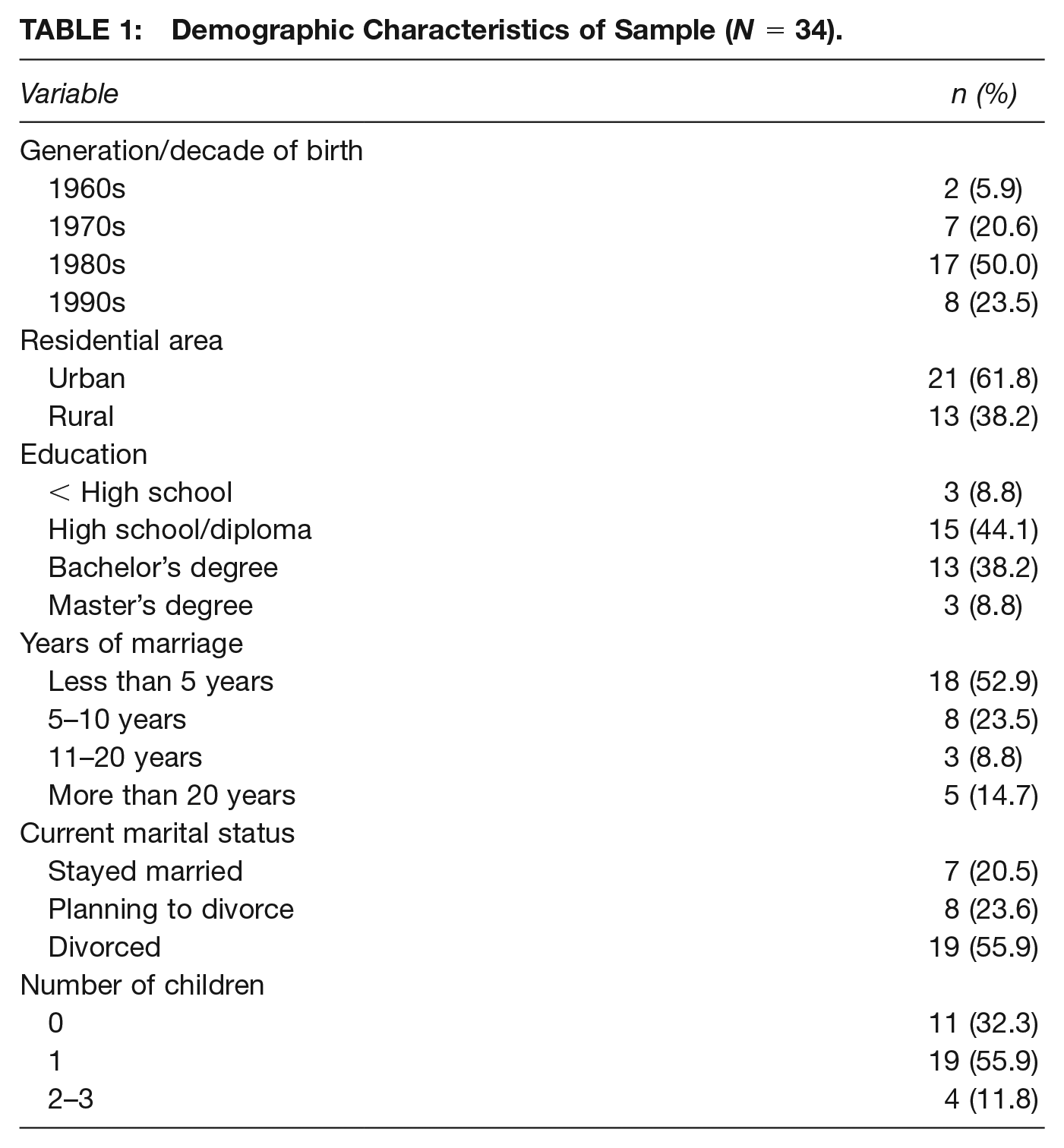
The second author recruited potential respondents using a combination of snowball sampling and convenience sampling through different stakeholders, key organizations, peer support groups on WeChat, and activist online groups. To avoid interviewing respondents within a single network, the second author accessed multiple networks and referrals within the different groups (as well as from the respondents). Various grassroots and online organizations such as Quanzhou Chengbao Charity, Langman Zhuanshen LGBT Union in Handan, West Coast Common Heart LGBT League in Fuzhou, and PFLAG China in Guangzhou were used as starting points to access different networks of individuals. Table 1 shows the demographic characteristics of the sample.
Demographic Characteristics of Sample (N = 34).
The interview protocol consisted of four parts: understanding of marriage, marriage experiences before and after the revelation of the husband’s sexuality, the decision-making process concerning the continuation or dissolution of the marriage, and perspectives on homosexuality and the institution of marriage. All interviews were audio-recorded and transcribed verbatim. Quotations were selectively translated into English for data presentation.
The first author used MAXQDA2020 to analyze the transcript line by line, moving back and forth between theoretically grounded and inductive codes that captured locally resonant experiences, metaphors, and recurring narratives (Ryan and Bernard 2003). This retroductive coding scheme (Ragin 1994) is best suited to theorize complex social relations and changing contexts (Meyer and Lunnay 2013). From here, she identified patterns and themes, clustering large quantities of individual observations into conceptual categories (M. B. Miles and Huberman 1994). She employed thematic analysis to visualize patterns (Attride-Stirling 2001) related to identity revelation, interpretative frameworks, and sense of selves in the narratives of tongqi. Finally, she grouped these patterns into four “global themes” (Attride-Stirling 2001, 389) according to the type of identity work respondents employed: (1) oppositional identity work, (2) relational identity work, (3) maintenance identity work, and (4) subversive identity work.
In presenting our findings, we made the deliberate choice to emphasize qualitative depth. A focus on how women make sense of their experiences necessitates thicker narratives with select participants who provide a representative magnifying glass that can reveal shared processes, mechanisms, and core theoretical claims. This analytical approach allows us to foreground the voice of our respondents to provide a deeper understanding of the nuanced ways they interpret and navigate their situations.
Results
In this study, we draw attention to the self as a critical site where negotiation, agency, and the production of meanings take place. Examining the process by which individuals interpret their experience and restore a sense of coherent self brings to the forefront the dialectic interplay between identity and heteronormativity: how heteronormativity informs individuals’ sense of self and, simultaneously, how it is reproduced when individuals rework their identities in response to disruptions. Therefore, we bring in the concept of identity work to highlight the complex process by which tongqi navigate the often drastic disruption under the unique configurations of heteronormativity characterized by institutionally enforced gender inequality and invisibility of non-normative sexualities in China.
Onset of Disruption
All respondents highlighted the shock and trauma upon finding out about their husbands’ same-sex behaviors. The foreignness of homosexuality, the lack of institutional recognition or social support, and the stigma attached to non-normative sexualities together compounded the impact of disruption. Pan, whom we introduced at the beginning of this article, detailed how her husband’s confession of homosexuality wreaked havoc: I’ve truly experienced spiritual devastation, not just on the surface level, but deep within. . . . I just collapsed that year, I was in constant despair, battling depression for a year. I attempted suicide repeatedly. I locked our second child at home and went out to end my life, attempted to jump off buildings, drink alcohol, and take sleeping pills. My hands still show many scars from self-harm now. I feel so wronged, so helpless. I didn’t know what to do, I was trapped, unable to leave, unable to stay, and I couldn’t talk to anyone about it.
Pan’s account stands as a powerful testament to the extent of crisis many tongqi experienced. A study finds that 59.8 percent tongqi had suicidal ideation and 10 percent attempted suicide (Xianhong Li et al. 2016). While research has established how significant life events such as divorce often accompany heightened psychological stress (DeGarmo and Kitson 1996), the experiences of most tongqi point to a more radical disruption.
Lin, a 42-year-old woman, realized she was a tongqi from online research. After confronting her husband and confirming her suspicions, Lin described her profound disorientation: “I no longer understand how a normal heterosexual man should behave in a relationship. . . . I felt so lost. My sense of morality has become confused, and I can’t distinguish right from wrong anymore.” This realization not only disrupted her views on relationships but also led to significant moral disorientation. Heterosexuality is thus revealed not merely as an identity or a mode of relationship; its constitutive role in providing scripts that shape one’s worldview and sense of self become evident in “unsettled times” (Swidler 1986). In what follows, we outline four patterns of identity work that tongqi undertake in response to these profound disruptions.
Oppositional Identity Work: Restoring an Unblemished Identity
The first strategy to shift oneself out of a blemished category is to redirect the stigma to others—in this case, to their husbands. The construction of opposition emerges in the process of restoring an unblemished identity when the woman is more vulnerable to blame for problems in a relationship.
Ting, a 34-year-old woman, confirmed that her husband is gay from his ex-girlfriend. When they fought for divorce, her husband attempted to shift the blame: “He spoke ill of me, leading many people to believe that I was unreasonable and that’s why he wanted a divorce . . . . He spread rumors everywhere, claiming I’m lazy because I didn’t cook or do laundry.” Infuriated by his attempt to stigmatize her, Ting diligently garnered evidence “to prove that he was lying all the time, that he was a downright scoundrel, a deceitful gay man.” Reflecting on her divorce, she said: I made a very wise decision. I definitely won’t be together with a faggot . . . . It’s unimaginable. What if one day he contracts HIV . . . [when] you quarrel, and if he uses his blood to stab you, what can you do? It’s simply unavoidable. Plus, living together, if he poisons your food, you wouldn’t even know. You could end up dead without realizing it.
Due to the lack of legal protection, among the respondents who chose divorce, many described themselves as “leaving with nothing” (jingshenchuhu). Oppositional identity work is intensified when women make the major decision to divorce. In Ting’s case, it involves constructing her ex-husband as a dangerous figure, turning the future of cohabitation into a matter of life and death. Similarly, Fang, a 40-year-old woman, expressed her resolve to divorce, contending that “no matter how horrible my life turned out to be, it’s better than being stuck with a faggot (ji lao).” She continued, “He is attracted to men but still married a woman. This is deception. I can’t tolerate being deceived. It’s despicable when gay people deceive us. If we didn’t have children, I would even want to kill him.”
Oppositional identity work is a means of symbolic retribution to cope with aggravation in a systemically disadvantaged position. After outing her ex-husband in the workplace, Ting received moral support from her friends and colleagues. She recounted, “The unanimous response from my coworkers was like ‘He’s too terrible! Such a person really deserves to die—how does he still have the right to stay here? It’s really shameful, tarnishing our reputation!’” As Fang and Ting show, oppositional identity work involves marking their husbands as deviant. In doing so, they restore an innocent and unblemished tongqi identity to garner social support from a marginalized position.
Rather than explicitly constructing them as morally corrupted, seeking to take advantage of straight women, an alternative form of opposition involves the juxtaposition of the predicaments of gay men with the plights of tongqi. Rui, a 39-year-old woman who has been divorced for a decade, observed: Many people talk about how hard it is to be gay, how much suffering there is . . . . However, once they find their way into the community . . . their lives become carefree in comparison. They don’t suffer as much as we do. We live a lifetime of sexlessness, raising children alone. It’s more painful for us. But once they enter their community, look, take my family’s case: bars, KTVs, endless travel, domestic and international . . . . Every evening he’s out with his friends. Their lives are truly carefree.
She contrasts the ostensibly “carefree” lives of gay men who are connected to their communities with the lifetime suffering of tongqi. Notably, at the interview’s outset, when queried about her sexual identity, Rui’s response was succinct: “normal” (zhengchangde). By casting tongqi as the quintessential victim (Dunn 2010) and framing her identity within the realm of the “normal,” Rui invokes “a tacit sense of rightness and normalcy” (Berlant and Warner 1998, 554) instrumental in upholding the structures of heteronormativity.
Oppositional identity work thus draws on a set of binary constructs: gay versus straight, deceitful versus innocent, and abnormal versus normal. By pitting innocent, heterosexual women against gay men, the strategies to counter a blemished individual identity at the same time work to restore the gender and sexual status quo.
Relational Identity Work: Distancing from other Tongqi
Whereas oppositional identity work involves the husband–wife dynamics, tongqi also position themselves in relation to other women in similar situations, most of whom are encountered through online groups after respondents searched for information and support. Research typically underscores that connections with the broader community of similarly marginalized others provide essential support in developing a positive identity (e.g., Battle 2021). However, many respondents described negative perceptions of tongqi groups. For instance, in talking about why she was unwilling to seek support from other tongqi, Jia, a 55-year-old woman, elaborated: They not only have lovers, but they also mess around (luangao). They mess around so indecently. Oh my goodness! It’s like they meet someone new young guys every single day. . . . It’s profitable to stay married, do you know that? Just like some members in the group . . . they are living a comfortable and privileged life. Their husbands can make money. They are all playing around outside, having multiple affairs, and they are not loyal. They all live in villas and cheat on their husbands behind their backs.
By depicting other tongqi who stayed in marriage as reaping financial benefits while being disloyal and sexually promiscuous, Jia constructs a morally superior sense of self rooted in chastity. The moral underpinnings of heteronormative femininity continue to serve as an important interpretative resource in sustaining her sense of identity despite her traumatizing marriage. In distancing herself from those who “mess around,” Jia reaffirmed her identity as a good tongqi.
For others, the arduous process of accepting the tragedy of their relationship and stay in the marriage requires more than drawing moral boundaries: also distancing from the affective ambience of the tongqi community. Pan, whom we introduced earlier, explains why she did not seek help: I understand things more clearly than anyone else . . . seeking help is futile now. It won’t change anything for me! In the tongqi group, they think it’s strange that I don’t hate my husband as intensely as they do. But they’re wrong. I’ve been through the phase of hating. Time has passed, and now I’ve come to terms with it. What good does hatred do? Can it change anything? Can it give me a new life? No, it can’t. Hatred only goes so far, right? I might as well stop hating. Just let it be.
Like Pan, some respondents chose to distance themselves from other tongqi because they “complain a lot” and “are full of negative energies.” When they find the emotionally charged group interactions to be counterproductive in aligning their identities to the reality of the marriage, distancing from the other tongqi is an essential element in the process of reworking.
Relational identity work is also common among those who decided to divorce. Speaking of tongqi who remain married, Ting commented: They’ve given up on themselves, they never think about making progress, never bother to study or self-improve. They just leech off their partners, leading a careless and self-sabotaging life, allowing themselves to deteriorate and be subjected to abuse. . . . They’re easily deceived, and once that happens, their lives are ruined, and they feel trapped forever. Simply as that. Those who truly have the courage to step out of a marriage are usually very independent, have jobs and income.
As Ting points out, financial independence undeniably influences a woman’s marital choices, However, her account introduces a class-inflected distinction, categorizing those who have the means to initiate divorce yet refrain from doing so as “careless and self-sabotaging.” This framing constructs a self premised on choice, agency, and self-reliance (Gershon 2011; Rose 1998), thereby subtly judging those who follow alternative paths.
While relational identity work helps to justify one’s response to mixed-orientation marriage and buttress a positive self-identity through othering, it also shores up gendered norms such as chastity and resignation and cast the plight of tongqi as individual problems. This reworking of identity comes at the cost of developing a collective consciousness to challenge heteronormativity.
Maintenance Identity Work: Sustaining the Marriage
Patterns of identity work discussed so far focus on deflecting stigma. An alternative response is to strive for a positive gendered identity from the outset. Maintenance identity work involves first situating the husbands’ same-sex affairs within a heteronormative frame by interpreting it as similar to heterosexual infidelity. Due to the societal and cultural norms that place undue responsibility on women for maintaining the relationship, women strive to embody the gendered ideals of a good wife to win their husbands back. However, realizing that such efforts rarely alter their husbands’ behaviors, many ultimately embark on a journey of acceptance.
Xin, a 42-year-old woman who has been married for ten years, explained her rationale in maintaining the relationship: To me, a man being involved with another man is no different from having an affair with another woman. It’s just that his object of infidelity is a man, whereas for a straight man, it would be a woman, right? With a woman, he might even become more entangled and eventually divorce to marry his mistress. However, with a man, it likely won’t go that far.
According to Xin, a mixed-orientation marriage is somewhat better than heterosexual infidelity because the formality of the marriage can be maintained. Same-sex affairs would remain secretive and pose less threat. As another women claims, “Men who lack capability don’t mess around with others outside, but capable men, they will have mistresses, one after another.” If heterosexual infidelity can be condoned, then living with the knowledge of their husbands’ same-sex affairs is, paradoxically, equally if not more tolerable.
Behavioral adjustments often follow these interpretations of same-sex affairs. Pan reflects on what she believed led to her failed marriage: I felt deeply humiliated and blamed myself, that I wasn’t good enough. I’m two years older than him, and I thought maybe it was due to my age, or my bad temper, so I kept reflecting on myself. Even my father said so, advising me to treat him better, to act more like a good woman, and be kind to his parents. I tried so hard to change myself.
Upon discovering her husband’s absence of attraction to her, Pan reflexively blamed herself, questioning her adequacy instead of attributing it to the sexual orientation of her husband. The promise of love and happiness compels Pan to persistently strive for self-improvement, a form of cruel optimism (Berlant 2011) that tightly binds the fragile threads of their marriage.
As Pan suggests about the attitude of her father, the process by which tongqi make sense of their husbands’ same-sex affairs is a social undertaking. The husbands often co-construct the meaning of their same-sex behaviors by coming up with explanations that draw on gendered repertoires to conceal their sexuality and maintain the marital facade. Gu, a 36-year-old woman, described her initial confrontation with her husband after inadvertently coming across his online chat history with a man: “Back then, I had no idea about homosexuality. . . . He told me it was because I couldn’t satisfy him. But he couldn’t do it with a woman or he would be betraying me, so he chose men instead. At the time, I actually thought he was very kind, a nice person.” The justification offered by Gu’s husband minimizes the threat posed by same-sex behaviors to heterosexuality (Silva 2021) and shore up heteronormativity by framing his homosexual pursuits not as an expression of his sexual orientation but rather as a thoughtful measure to remain loyal while seeking sexual fulfillment he could not find with his wife. 1
The settlement of blame initiates a prolonged effort by women to verify the “good wife” identity. One of the strategies respondents take is to outperform their role identity by fulfilling both the traditional gender expectations of chastity as well as assuming roles typically attributed to the husband, such as providing for the family. Hua talked about her husband: You’re gay, you’re still a human being, not a bastard. I work so hard here, and I’m a woman, right? I’m working to support both of us and make our lives better. I bought him a luxury car and everything. I just wanted him to change, to know that his wife is doing legitimate work. . . . Every day, I don’t have time to think about seeking other men or doing anything like that. I focus on how to make more money, how to secure this family’s future, and I just wanted him to say something good about me.
In her relentless pursuit of validation, Hua diligently shoulders the financial responsibilities of her entire family and emphasizes her avoidance of extramarital relationships. The deeply ingrained gender ideology shapes her marital expectations and her evaluation of her own role within a heteronormative family structure. Despite her sacrifices, the approval and change she seeks from her husband remain elusive.
Perhaps unsurprisingly, even the most extensive reworking of the “good wife” identity seldom succeeds in changing the husbands. Hua, after decades of struggle and still married at the time of the interview, suggests that acceptance is the last resort. She explained, “Why haven’t I divorced my husband? Well, if he weren’t seeking relationships with men and instead had affairs with different women every day, wouldn’t you still have to go on with life? If he finds pleasure in that, just let him do it, right?” Again, Hua interprets her situation in relation to heterosexual infidelity, where the very capacity to condone is also seen as crucial to the “good wife” identity. As she reflects, “I believe a good wife is one who can endure. Really, after experiencing this, if there’s an afterlife, I might act differently—I could pretend I didn’t see anything.” Hua’s narrative is emblematic of many women who remain married for years as tongqi. Emphasizing the necessity of “letting go” and “living on” with the formality of the marriage barely intact, they showcase how the maintenance of heteronormativity involves a tumultuous identity work for the women.
The identity reworking of some tongqi shows considerable similarities to those undertaken by women whose husbands engage in heterosexual extramarital affairs. The expressed sense of self-blame and perceived failure in marriage is thus not unique, highlighting the durability of heteronormativity in absorbing potential breaches and minimizing disruptions. Unique to tongqi, however, is the key step of meaning restoration and the interpretation of events that fall outside the grid of intelligibility dictated by heteronormativity (Butler 1990). The framing of same-sex affairs as similar to heterosexual infidelity, which should be condoned, decisively guides the identity work that ensues.
The ways in which many respondents restore the legibility of something they cannot understand back to a heteronormative frame, one that holds the woman responsible for mending the relationship regardless of the actual cause of the marital problem, illustrates the constitutive power of heteronormativity as a deeply entrenched meaning system demanding maintenance identity work. Adhering to the “good wife” ideal to patch a failed identity thus simultaneously restores heteronormativity and perpetuates gender inequality.
Subversive Identity Work: Advocating for Change
While most identity work presented so far keeps heteronormativity intact, there are exceptions to the bleak outlook. Some respondents viewed their marriage as a catalyst for recognizing the structural inequality at play rather than attributing their situations to individual faults. This realization was accompanied by a redefinition of their self-identity and a renewed understanding of institutions responsible for the phenomenon of tongqi.
One of the most extraordinary examples is Lan’s story. A 37-year-old woman with a college education, Lan was a vocal advocate for tongqi rights at the time of the interview. Initially wanting to become a Catholic nun, Lan was coerced into marriage by her parents. After discovering her husband’s sexuality, she engaged with an organization supporting the families of LGBTQ+ individuals and began participating in activism. Lan articulates the cultural and social factors at play: I hope to challenge the deeply ingrained tradition of continuing the family line . . . It is difficult, but I believe change can start with the people around us. I cannot stand idly by and watch another woman become the next victim of this situation like me. There are already too many tongqi in China—estimates suggest nearly twenty million, and even that number might not fully capture the reality. . . . I’m considering addressing straight marriages involving gay individuals as just the first step in my advocacy work. My subsequent goal is to influence legislative changes, particularly in two areas: the repeal of marriage laws that are unjust to LGBTQ+ individuals and the introduction of laws against deceptive marriages.
Although not all respondents shared Lan’s fervor for collective action, many emphasized how their experiences catalyzed a renewed self-understanding. Gu, a 36-year-old woman who, at the time of the interview, was still negotiating with her husband in filing for divorce, developed empathy based on the shared oppression, concluding that “in fact, we are all quite pitiable—no one is truly at fault.” She added, “Regardless of whether one is homosexual or heterosexual, one’s sexuality should not determine whether they should be respected.” Acknowledging their situation as a consequence of the lack of social and legal support for homosexuality, Gu felt the need to advocate for heightened public consciousness. At the same time, she noted the empowerment she felt emerging from the past: This relationship actually helped me a lot in the end. It allowed me to grow as a person, as I recognized many of my shortcomings and started to learn and improve myself. I became stronger, both internally and in terms of my understanding of life. I’ve become a much more rational person now. My inner world has broadened, and I can accept more things.
Gu framed her marriage as a learning journey. Her research on homosexuality as an effort to understand her husband’s same-sex affairs led her to learn more about psychotherapy on her own. For Gu, this intellectual venture not only facilitated a career transition but also marked a significant personal evolution.
Research suggests that activism and education are powerful strategies to counter stigma (Marcussen, Gallagher, and Ritter 2021). However, only a small group of respondents adopted this path. The availability of social support plays a crucial role in the process of reworking identities. Lan identified the support both from her church and the local chapter of PFLAG to be crucial. Gu has received help from a tongqi group.
While the women’s family can serve as the initial support system upon discovering their husbands’ sexuality, it is institutionalized heterosexuality that packs a punch in binding these women to their marriages. For example, Hua explains how, having supported her husband throughout their years together and facilitated his economic prosperity, she was reluctant to dissolve the marriage and walk away empty-handed. Hua depicted her choice to stay in the marriage as both “selfish” and “despicable,” even after her husband repeatedly abused her physically and emotionally. Institutional inequalities severely limit the resources available for interpreting and managing one’s identity, making some forms of identity work more prevalent than others. Reconstructing a positive identity that builds on a renewed understanding of marriage thus is contingent upon both immediate social network and institutional support.
Conclusion
Research has attested to the enduring tenacity of heteronormativity in the face of contradictions and crises (Kitzinger 2005; Schilt 2011; Ward and Schneider 2009). In this article, we move identity to the forefront of gender and sexualities scholarship to better understand the microsociological processes behind the disruption and restoration of heteronormativity. Using the case of tongqi in China, we show how individuals draw on heteronormative interpretive resources and meaning structures to reconstruct their threatened identities as they find out about their partners’ same-sex affairs. At the same time, in reworking their identities, individuals simultaneously restore or, under certain circumstances, confront institutions that reinforce heteronormativity.
Our findings detail four types of identity work tongqi undertake in response to the disruptive situation. Some mobilize the hetero/homo binary as oppositional and hierarchical, a central feature of heteronormativity (Jackson 2013), to restore their unblemished identity as victims of gay men. Heterosexuality and homosexuality become essentialized identities with moral underpinnings. Highlighting experiences of exploitation by their husbands, these tongqi reference a heteronormative ideal of femininity that is passive, precious yet pregnable to betrayal in their claims to true victimhood. This understanding of heteronormativity bears some resemblance to scholarly observation that shoring up heterosexual ideals requires active vigilance and abjection to keep the specter of homosexuality at bay (Butler 1990; Pascoe 2011). Othering and distancing can also be applied to other tongqi with different identity reworking strategies. Relational identity work establishes normative standards of a “good” tongqi, which can undermine the possibility of shared understanding and collective identity. This challenge is prevalent among other marginalized groups who seek to maintain positive personal identities (Emirbayer 2024; Snow and Anderson 1987).
What we call maintenance identity work involves interpreting homosexuality in behavioral terms parallel to heterosexual infidelity, striving to be good wives and accepting the reality of the marriage. The erasure of homosexuality as an identity is not an individual act but a confluence of complicity by the law, cultural beliefs, and immediate social network. The same strategy of erasure can be deployed to curtail or silence transgender and bisexual identities (Alarie and Gaudet 2013; Namaste 2000), while also contributing to the invisibility of tongqi as a group. Finally, tongqi who opted for subversive identity work recognize the current institutions of marriage as oppressive for both women and gay men. While these women strive to change the sociocultural conditions underlying the tongqi phenomenon, they still operate within the context of heterosexual ideals, precluding more radical and substantive identity reconstitutions.
Our study bears important implications for the tongqi phenomenon. We caution against a reductive rendering of tongqi to binary and essentialized narratives of either victim or perpetrator (see C. Song, Ding, and Xie 2024), because overemphasizing the attribution of blame obscures how heteronormativity is constituted through meaning negotiations and active reworking of identities. Identity work as a crucial piece of the puzzle enables a better understanding of the full spectrum of responses beyond simple conformity/resistance under institutionally buttressed gender and sexual oppression as in the context of China.
The focus on the links between identity and heteronormativity opens up new research avenues. We invite researchers to explore under what conditions heteronormativity is more likely to be destabilized. Sociologists often highlight the role of social movements in driving collective changes. Research can examine the link between individual identity work and collective identity to better understand tongqi activism. In addition, our discussion of identity work draws attention to the interplay between structure and the negotiation of meaning. Although we did not advance a conclusive discussion of the mechanism through which social locations affect tongqi’s interpretation, future studies could benefit from employing comparative designs to systematically explore the relationship between patterns of identity work and factors such as educational level and social capital.
More broadly, the diverse processes of identity reworking in the case of tongqi offers a compelling case for using moments of disruption as an analytical device to unravel the mechanisms that uphold the gender and sexual order, which prevails despite inherent instabilities and ubiquitous crises (Butler 1990; Pascoe 2011). Strategies to shore up disruptions show that heteronormativity is not a monolithic construct that individuals internalize in uniform ways. Instead, they rework heteronormativity through deploying culturally specific interpretive repertoires to make sense of their experience and reconstruct their identities in times of crisis. We also contribute to the identity literature by explicating the complex process of reworking stigmatized identities from the margin, expanding identity theory’s conventional focus beyond positive identities (Stets and Serpe 2016). Integrating insights from theories of gender and power into identity theory, we further demonstrate how identity processes can and should be studied in the context of gender hierarchy and relations of domination.
Footnotes
Authors’ note:
For their intellectually generous comments on earlier drafts, the authors would like to extend their gratitude to Amy Hanser, Tony Silva, and Rima Wilkes.

Funding
The author(s) disclosed receipt of the following financial support for the research, authorship, and/or publication of this article: This study is supported by Young Scholars Project in Humanities and Social Science Research of Ministry of Education of China (No. 23YJC840017).
Notes
Tori Shucheng Yang is a PhD candidate in Sociology at the University of British Columbia. Her research interests include international migration, gender, sexuality, and social theory.
Changhui Song is a faculty member at the College of Social Affairs, Henan Normal University, in Xinxiang, China. His research interests include gender and sexuality, hospice, and social work.
Hui Xie is a PhD candidate in public health at the University of Wisconsin-Milwaukee. Her research focuses on social determinants of health disparities in minoritized populations, including immigrants, LGBT populations, and racial/ethnic minorities.