




Abstract
This paper examines the context dependency of attitudes toward maternal employment. We test three sets of factors that may affect these attitudes—economic benefits, normative obligations, and child-related consequences—by analyzing data from a unique survey experimental design implemented in a large-scale household panel survey in Germany (17,388 observations from 3,494 respondents). Our results show that the economic benefits associated with maternal employment are the most important predictor of attitudes supporting maternal employment. Moreover, we find that attitudes toward maternal employment vary by individual, household, and contextual characteristics (in particular, childcare quality). We interpret this variation as an indication that negative attitudes toward maternal employment do not necessarily reflect gender essentialism; rather, gender role attitudes are contingent upon the frames individuals have in mind.
Keywords
Although the proportion of working mothers and dual-earner couples has increased over recent decades in wealthy democracies (Hook and Paek 2020), the transition to parenthood is still a critical juncture that leads many couples to adopt a traditional division of paid and unpaid work (e.g., Cooke 2011; Dunatchik 2023; Grunow, Schulz, and Blossfeld 2012). Whereas men tend to continue to work full time when starting a family, women tend to take primary responsibility for the household and family work, often interrupting their careers and reducing their working hours (Frodermann, Müller, and Abraham 2013; Grunow, Schulz, and Blossfeld 2012).
These divergent work patterns between men and women after the birth of a child are partly attributable to cultural norms that discourage mothers from pursuing (full-time) employment (e.g., Boeckmann, Misra, and Budig 2015; Lietzmann and Frodermann 2023). In their cross-country comparative study, Boeckmann and colleagues (2015), for instance, found that supportive gender role attitudes go hand in hand with lower gaps between mothers and nonmothers in labor force participation rates and weekly working hours. They find employment gaps of approximately 20 percentage points in countries in which people are least supportive of the statement that “a woman should work full-time when the youngest child is preschool aged/school aged” (e.g., Australia, West Germany, Britain) but only 6 percentage points in countries with the most supportive attitudes (e.g., Israel). Another indication of the relevance of gender role attitudes in maternal employment is that parents would not considerably alter their division of labor even if policy conditions were more favorable: for example, if high-quality, affordable childcare was accessible or if better leave options for fathers were available (Bünning and Hipp 2022).
To measure gender role attitudes, survey respondents are typically asked how they assess the consequences of mothers’ full-time employment for (pre)school-age children and how men and women should divide paid and unpaid work (Inglehart et al. 2022). Although these and similar indicators of gender role attitudes have been used widely in sociological research on gender inequality (e.g., Boeckmann, Misra, and Budig 2015), they do not tell us anything about why respondents agree or disagree with these statements. Nor do they reveal whether (full-time) maternal employment is detrimental to children only under certain circumstances (e.g., when the father also works full time or when high-quality nonmaternal childcare is not available).
In this paper, we therefore examine the motives underlying the (dis)approval of maternal employment and heterogeneities in attitudes toward maternal employment by job, maternal, household, and childcare characteristics. Our study focuses on Germany, which is an especially suitable context for addressing these questions. First, Germany has work–family policies that both promote and discourage maternal employment, leading to diverse constellations of care and paid work among mothers. Second, Germany’s history as a “male breadwinner” society (e.g., Charles and Cech 2010) allows us to examine the degree to which attitudes toward maternal employment are driven by gender essentialism—the belief that mothers should not work per se or should only work reduced hours. Third, as Germany shares many structural and economic features with other rich democracies, particularly in terms of ambivalence toward maternal employment (von Gleichen and Seeleib-Kaiser 2018), the findings of this study are also relevant for other countries.
Our experimental findings from 17,408 observations of 3,498 respondents of a large-scale household panel survey show that it is primarily the financial benefits associated with employment that lead respondents to recommend that mothers either accept or not accept a job. Respondents are most likely to recommend that mothers accept a job offer when the mothers are from low-income families and their paid employment significantly increases the household’s marginal utility. The results also suggest that gender-essentialist beliefs about mothers being the best caregivers for young children continue to play a role in attitudes regarding maternal employment, albeit they are subordinate beliefs: Respondents are less likely to recommend that mothers should take a job when children are very young and when the job has long working hours. Finally, respondents are less likely to recommend that mothers work if the quality of available childcare is poor. Taken together, the results provide limited support for the idea that gender-essentialist beliefs are the only driver of attitudes regarding maternal employment. Rather, weighing the costs against the benefits plays a crucial role. Measures of gender role attitudes should therefore take the context specificity of maternal employment into account.
The contributions of our study are theoretical, empirical, and practical in nature. With respect to theory, we disentangle the different motives that drive gender role attitudes. Distinguishing among economic benefits, normative obligations, and child-related considerations allows us to draw conclusions about whether respondents hold essentialist attitudes toward maternal employment or weigh the costs and benefits of mothers working versus staying at home. We theorize that gender role attitudes are not necessarily a reflection of innate and unchangeable beliefs, but that beliefs about what men and women ought to do are themselves the result of cognitive frames and contextual characteristics. Empirically, our findings add to the critique of established measures of gender role attitudes. Most surveys on gender role attitudes ask respondents, in very general terms, whether they think mothers of young children should work. We show, however, that attitudes toward maternal employment depend heavily on the specific context that respondents have in mind. Moreover, by conducting the study in Germany, we extend the insights from previous experimental work done in the United States (Jacobs and Gerson 2016) to another welfare state setting. Finally, our study provides important policy advice. By showing that attitudes toward mothers’ employment are malleable and subject to change when women’s involvement in paid labor is economically beneficial, we highlight the importance of structural forces for shaping cultural beliefs about gender and hence potentially also reducing gendered labor market inequalities. For policy makers and employers, this points to money as the most effective means by which to incentivize and normatively legitimize maternal employment.
Background
Measuring Attitudes Toward Maternal Employment With Survey Data
Gender role attitudes are beliefs about the social roles best suited to men and women (Deaux and LaFrance 1998; Valentova 2013). These beliefs have different dimensions that are rooted in ideas about inherent differences between sexes with regard to public roles and care behaviors, about the primacy of the breadwinner role, or about working women and motherhood (Davis and Greenstein 2009).
Prevailing measures of gender role attitudes typically ask respondents how much they agree with a battery of statements (e.g., “A working mother can have just as warm a relationship with her children as a mother who is not employed”). These statements are used in studies such as the International Social Survey Programme (ISSP), the European Values Study (EVS), or the British Household Panel Survey (BHPS) and tend to be very broad; only some scales differentiate between life course stages (e.g., preschool vs. school-age children) and types of employment (full time, part time, not working; see Treas and Widmer 2000). Nevertheless, researchers have either summarized these items into indices and obtained reasonable scale properties or used them to identify latent classes (e.g., Perales, Jarallah, and Baxter 2018; Scarborough, Sin, and Risman 2019).
A large body of literature has focused on how gender role attitudes have changed over the last few decades (e.g., Grunow, Begall, and Buchler 2018), and a trend toward increasingly egalitarian gender role attitudes has been identified (Grunow, Begall, and Buchler 2018; Knight and Brinton 2017; Lee, Alwin, and Tufis 2007; Scarborough, Sin, and Risman 2019; Woo, Goldberg, and Solt 2023). Moreover, highly educated respondents and respondents whose mothers worked when they were young are more likely to hold egalitarian gender role attitudes (e.g., Boehnke 2011; Lietzmann and Frodermann 2023). Being a parent, however, is associated with more traditional gender role attitudes (Lietzmann and Frodermann 2023; Perales, Jarallah, and Baxter 2018).
Measures of gender role attitudes have been subject to debate in recent research (Constantin and Voicu 2015). Although consistent item wording helps to analyze gender role attitudes over time and across countries, item development dates back to the late 1970s; thus, the wording of some items has been criticized as outdated and reflective of the social roles that were dominant at that time (Lomazzi and Seddig 2020). Moreover, researchers have voiced concern about social desirability bias; with increasing female employment rates, respondents may find it “less socially acceptable to publicly denounce working women” and may therefore choose to report more gender-egalitarian attitudes than they actually hold (Hamilton, Geist, and Powell 2011). Furthermore, the general nature of the items implicitly assumes essentialist views on child-rearing—above all, the idea that women are inherently better suited to care for children than men—and disregards the fact that attitudes may depend on the specific context under which decisions about work are made; they simply ask about mothers “in general.” However, when answering questions about whether mothers should work, individuals may weigh the costs and benefits of each option, which may depend on a variety of characteristics of work, family, and childcare, as various studies from different countries and contexts have shown (Hamilton, Geist, and Powell 2011; Jacobs and Gerson 2016; Oh 2018).
When asked to evaluate typical survey items about maternal employment, respondents cannot consider the complex interplay of factors that may affect their decision-making situations about whether a person should take a job in a real-life context. In practice, however, it is important to know contextual information, for instance, about the family’s financial circumstances and childcare situation. Recent literature, for instance, reveals that higher levels of formal childcare provision—in terms of availability, affordability, and quality—are correlated with less traditional gender ideologies and a greater probability of female employment (Kangas and Rostgaard 2007; Sjöberg 2004; Zoch and Schober 2018). Hence, when contextual information is not explicitly provided, we do not know what types of jobs and family situations the respondents have in mind (Jacobs and Gerson 2016). In the absence of specifics, some respondents may assume that their jobs pay well, whereas others may assume that their jobs pay poorly.
Recent work has illustrated some of the shortcomings of established items on gender role attitudes. Currently, most Germans hold egalitarian gender role attitudes with regard to maternal employment, women’s financial independence, and the relationship quality of working mothers with their children (Lois 2020; Woo, Goldberg, and Solt 2023). At the same time, however, they agree with the statements that mothers should be home in the afternoon to help their children with homework (Bujard 2017) and that mothers should work full time only after their children have started school (Lietzmann and Wenzig 2017). These findings reveal traditional attitudes toward maternal employment and do not align with the results of attitudinal surveys showing that Germany has become more gender egalitarian (Lois 2020; Woo, Goldberg, and Solt 2023).
Theoretical Background and Hypotheses
To reconcile the inconsistent findings on gender role attitudes from previous research, we theorize that people may draw on different cognitive frames and contextual cues when thinking about what mothers ought to do (Esser 2009; Kroneberg 2014). The underlying argument of such model frame selection is that the framing of a certain situation leads individuals to interpret the same situation differently and that different framings can lead to evaluations ranging from consciously weighing costs and benefits to unquestioned, routine thinking (Esser 2009; Kroneberg 2014). People’s attitudes toward mothers’ employment may therefore hinge on how they perceive and evaluate the context in which mothers work.
To examine the idea of gender role attitudes being context dependent and contingent on the cognitive frame that people activate, we use an experimental design to assess the conditions under which survey respondents recommend that mothers should accept a job (see Jacobs and Gerson 2016 for a similar study of the United States). This approach allows us to consider whether gender-essentialist attitudes rather than a rational weighing of options drive respondents’ views about maternal employment.
Gender essentialism suggests that mothers of young children in general should not pursue paid work (see Baron-Cohen 2004 or Goldberg 1993, for instance). Research on this theoretical perspective has shown that attitudes toward maternal employment result from beliefs about inherent, quasi-natural differences between sexes (e.g., Gaunt 2006). Many people have internalized ideals about intensive mothering (Hays 1996) and regard mothers as the best caregivers for their children who should thus stay home—particularly when the children are still young. In a similar vein, conservative feminism argues that women and their families will be happier if they assume stereotypical gender roles (Crompton and Lyonette 2005). If people indeed hold essentialist views on motherhood, their attitudes toward maternal employment should not differ substantively according to individual-level or contextual characteristics.
Alternatively, views on whether mothers should or should not work may result from weighing the costs against the benefits of maternal employment. From such a cost–benefit perspective, whether mothers pursue paid employment and whether others think that they should or should not work depend on a variety of contextual and individual-level characteristics. Arguments in favor of maternal employment center around the economic and nonmaterial benefits, as well as normative obligations of pursuing paid work. Arguments against maternal employment center around its potentially adverse effects on children and the family. Based on these lines of argumentation, we derive a series of hypotheses (H).
First, from an economic perspective, financial considerations should be central to maternal employment decisions. The pursuit of paid work increases both households’ available income and women’s financial autonomy and independence (see Mavrikiou and Angelovska 2020, for example). Hence, when the (subjective) return on paid work is greater than the value of time spent at home, mothers should pursue paid employment—particularly for individuals and households at the lower end of the income distribution.
Likewise, from a human capital perspective (Becker 1985), minimizing time out of the labor market is most beneficial to the highly educated—not only from their individual perspective but also from a macroeconomic point of view. Income gains are highest for the highly educated, and the economy as a whole benefits most when highly educated—and hence presumably highly productive—individuals are employed. In line with this argument, highly educated mothers in particular should try to avoid human capital depreciation by returning to the labor market faster (Bredtmann, Kluve, and Schaffner 2009).
Second, the welfare state and labor market reforms in recent years have increased the pressure to pursue paid work. In addition to cutting benefits to “activate” the unemployed (Fleckenstein 2008 for Germany), policy makers have also sought to increase the incentives for mothers to reenter the labor market after childbirth by providing state-subsidized childcare and shortening paid parental leave periods (Frodermann, Wrohlich, and Zucco 2023; Hipp, Schlüter, and Molina 2022; Zoch and Hondralis 2017). Normative pressures on mothers to pursue paid work and avoid dependence on welfare benefits may have increased; furthermore, there may be a perception that employment is a normative obligation for mothers—especially for those who are seen as weakly integrated into society, such as welfare recipients and migrants (Geerdink et al., 2022; Ishizuka 2021; Vandoninck, Meeusen, and Dejaeghere 2018).
Third, arguments against maternal employment, especially in the case of mothers with young children, focus on the adverse consequences of children’s well-being when mothers work. Even in the absence of gender-essentialist convictions, maternal employment may be regarded as detrimental to children’s well-being when children are very young, when viable childcare options are unavailable, or when the number of hours spent in outside care are very long (e.g., because of parents’ long working hours).
The German Context
We tested our (preregistered 1 ) hypotheses in Germany, which is an especially suitable context for examining the considerations that underlying attitudes toward maternal employment. Germany is characterized by institutional ambivalence in work–family policies (von Gleichen and Seeleib-Kaiser 2018), which allows us to examine different motives for and against maternal employment. Policies that promote (full-time) employment among all adults independent of gender and parental status make it normatively appropriate for mothers to pursue paid employment and hence elicit progressive gender role attitudes. Policies that encourage task specialization in married couples and reinforce mothers’ roles as caregivers and secondary earners, by contrast, delegitimate mothers’ employment and increase the likelihood that people express traditional gender role attitudes. An example of an employment-promoting policy is universal access to state-subsidized childcare for children older than 12 months (Schober and Spiess 2014). Given the great variation in childcare availability, hours covered, costs, and quality (Schober and Spiess 2014), daycare attendance is much lower among younger children than older children (34 percent among children ages 0–3 vs. 92 percent among children ages 3–6 in 2021; Statistisches Bundesamt 2021). An example of a policy that inhibits maternal employment and incentivizes the male breadwinner model is Germany’s joint income taxation of married couples and the free access of nonworking family members to the main earner’s public health care plan (Dingeldey 2001; Trappe, Pollmann-Schult, and Schmitt 2015). Especially for low-income earners and couples with large income differences, pursuing (full-time) employment is not financially beneficial for either partner.
Despite major policy reforms and increases in maternal employment in recent years, women in Germany still seem to face major normative and cultural barriers when reentering the labor market after childbirth, which suggests that gender-essentialist attitudes against maternal employment prevail at least to some extent. The fact that most mothers in Germany work part time (Statistisches Bundesamt 2022b), that they are less likely to be invited to a job interview than nonmothers (Hipp 2020), and that they have more difficulty finding employment after layoffs (Frodermann and Müller 2019) may indicate normative barriers to maternal (full-time) employment. The continued use in Germany of the disparaging term “raven mother” (Rabenmutter) to vilify mothers who are not constantly available to their children provides an anecdotical illustration of the prevailing norms of “intensive mothering” and male breadwinning (Collins 2019).
The ambivalent institutional and normative context for mothers’ employment that characterizes Germany is also typical for other rich democracies. As in Germany, other “latecomers” in work–family policy reforms, such as Austria, Japan, and South Korea, have also adopted work–family reconciliation policies (von Gleichen and Seeleib-Kaiser 2018). Likewise, Eastern European countries, where mothers are still expected to contribute to household income, have been characterized by declining work–family support with the transition to market economies (Billingsley and Duntava 2017). The normative ambivalence regarding women’s (especially mothers’) employment in these countries has been well illustrated in recent studies on multidimensional gender ideologies, which show great diversity in attitudinal constellations of care and paid work vis-à-vis women (e.g., Grunow, Begall, and Buchler 2018; Knight and Brinton 2017).
Data and Method
In our empirical analyses, we draw on unique data from a factorial survey experiment that we implemented in the 15th wave of the panel study “Labour Market and Social Security” (PASS; see Trappmann et al. 2019). 2 The PASS is a large-scale annual household panel survey and one of the major German data sources for research on the labor market, the welfare state, and poverty dynamics. The survey uses a dual-frame probability sampling design that combines a sample of Germany’s residential population drawn from official population registers with an oversampling of households receiving welfare benefits. 3 In 2021, the data for this study were collected, and a total of 8,223 respondents were targeted to participate in the experimental study. Of the 6,903 respondents who provided their email addresses, which was a necessary requirement for participation in the vignette module, a total of 3,797 respondents actually participated. For 3,656 respondents, we have data with no missing information on the outcome variable, and for 3,494 respondents, we have no missing data on any variable. The data do not show selective participation based on income, employment status, or marital status; rather, women, particularly those with higher education levels, as well as older respondents, were more likely to participate in the vignette module.
In factorial survey experiments, respondents evaluate hypothetical descriptions of situations (vignettes) instead of single-item questions (Rossi 1979). By independently varying the dimensions of the vignettes, we can estimate the causal effect of each dimension on respondents’ judgments. In our experiment, we asked respondents to read five short descriptions of fictitious mothers who were currently not working to take care of their youngest child and who had received a job offer. We experimentally varied nine individual-level, job-related, and childcare-related characteristics to understand the conditions under which individuals recommend that mothers pursue paid work (see Table 1 for an overview of experimental dimensions, levels, and associated hypotheses, and Figure 1 for an example vignette). The dependent variable in our analyses was whether the respondent recommended that the mother accept a certain job offer. Answers were collected on an 11-point rating scale ranging from 0 (do not agree at all) to 10 (totally agree) (see Online Appendix Figure A1 for the distribution of the rating scale).
Overview of Vignette Dimensions and Levels
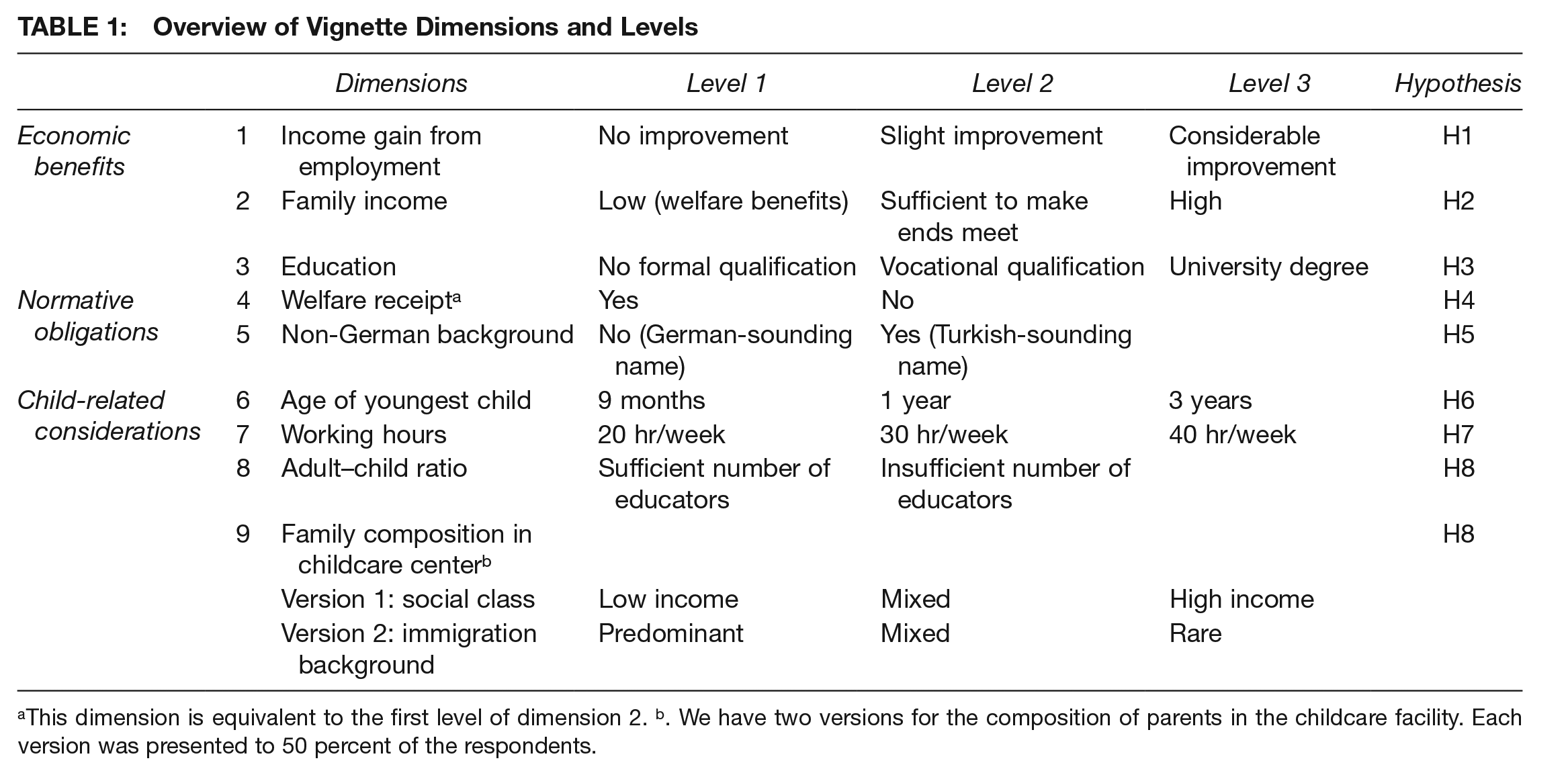
This dimension is equivalent to the first level of dimension 2. b. We have two versions for the composition of parents in the childcare facility. Each version was presented to 50 percent of the respondents.
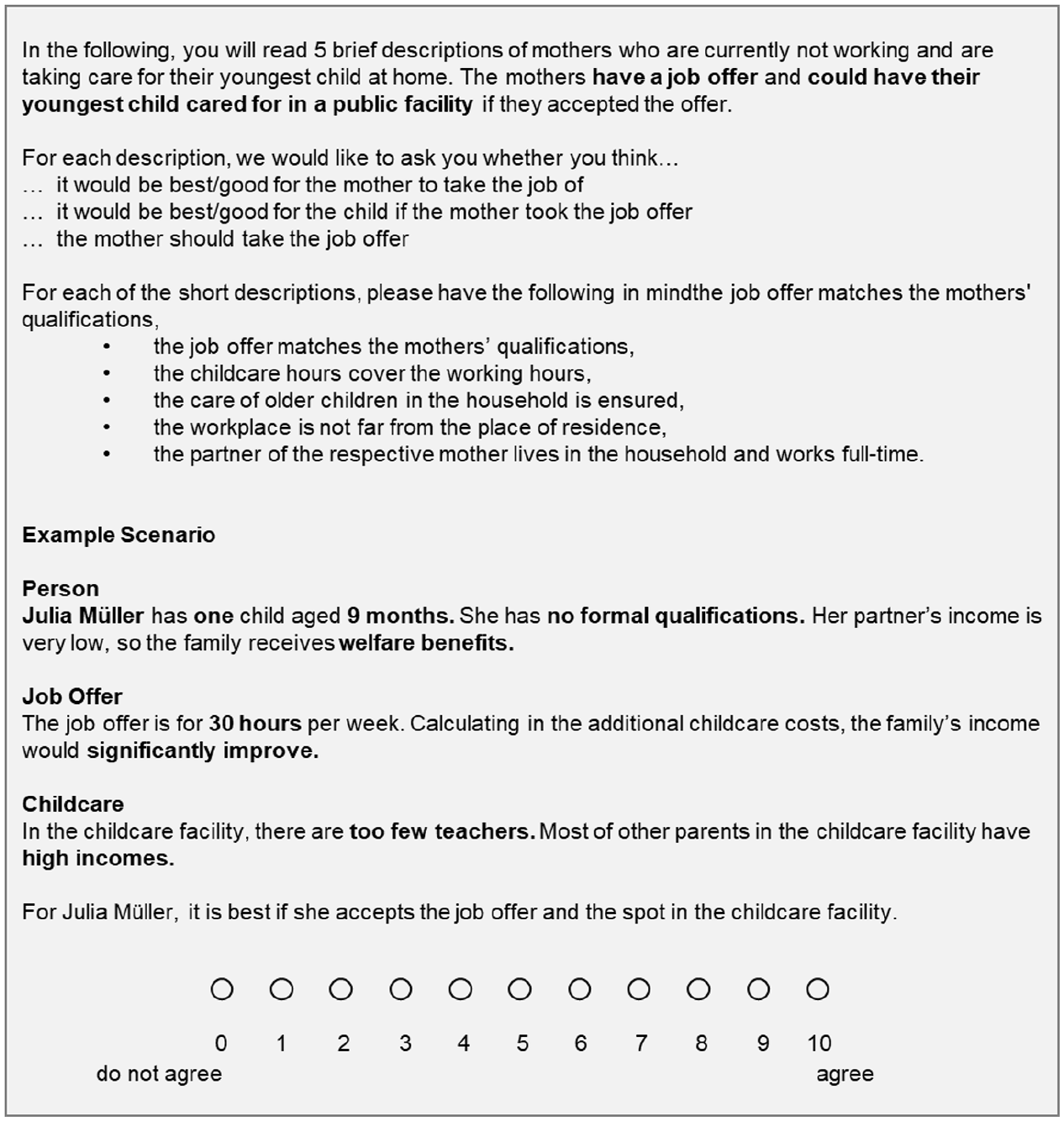
Introductory Framing Text and Example Vignette, Along With Answer Options
To test H1 through H3, we varied the financial gains associated with taking the job (no improvement; slight improvement; considerable improvement), the household’s overall financial situation (partner’s income is very low, and therefore the family receives welfare benefits; partner’s income is just sufficient to make ends meet; partner’s income is high, and therefore the family has a good living standard); and the education of the mother (no formal qualifications; vocational qualifications; or university degree).
To test H4 and H5, we varied whether the household received welfare benefits (equivalent to the first level of the vignette dimension family income) and whether the mother had an immigration background. The immigration background was manipulated by randomly assigning mothers either a German or Turkish name common among women in their 30s (Rodríguez 2010). We used Turkish names because Turkey is the most important country of origin for migrants in Germany (Statistische Bundesamt 2022a) and because migrants of Turkish descent face pronounced labor market discrimination and show a particularly high cultural value distance from Germans without any recent immigration history (Koopmans, Veit, and Yemane 2019).
To test H6 through H8, we varied the age of the youngest child (9 months; 1 year; 3 years), the working hours at the potential job (20 hours; 30 hours; 40 hours), and the childcare-related consequences for children’s well-being if the mother takes the job. To capture the latter, we varied two dimensions. The first is the adult–child ratio (a sufficient or insufficient number of childcare educators per number of children), which is an established, easily retrievable, and accessible measure of childcare quality (e.g., Thomason and La Paro 2009). Second, the sociodemographic composition of parents in childcare facilities has been shown to influence parents’ schooling choices (Boterman 2013; Jähnen and Helbig 2023). To capture the sociodemographic composition, we worked with two versions. Version 1 varied the social class of the other parents (most other parents had high incomes; some of the other parents had high incomes; some had low incomes; and most of the other parents had low incomes). Version 2 varied the immigration background of the other children (many children with an immigration background; some children with an immigration background and some without; and very few children with an immigration background). Assignment to one of the two versions was random (in our empirical analyses, we use a fourth category in the respective dimensions: “other version” to model the missing values).
The vignette sample consisted of a fractionalized, D-efficient resolution V design of 360 different vignettes out of the total vignette universe of 8,748. This design minimized correlations among the vignette dimensions and two-way interaction terms, which enabled the estimation of their independent influences. The vignettes were blocked to decks consisting of five vignettes each, and these decks were randomly assigned to survey participants.
We analyzed the data collected from these vignettes by running OLS (ordinary least squares) regressions with clustered standard errors (Huber–White correction). Accounting for the clustering of the data was necessary because individual respondents provided recommendations on multiple vignettes (Hox, Kreft, and Hermkens 1991). All analyses were adjusted for the number of children the fictitious mother in the vignettes had, 4 as well as for the relevant respondent characteristics: respondent sex (dichotomous variable), 5 age (<26; 26–35; 36–45; >45 years), immigration background (no immigration background; first-generation immigrant; second-generation immigrant), employment status (dichotomous variable), having children age 17 years and younger (dichotomous variable), living with a partner (dichotomous variable), individual income (metric, in Euro), education (no school certificate; lower school certificate; intermediate school certificate; upper secondary school certificate), place of residence (East/West Germany), welfare benefit receipt (dichotomous variable), and duration for evaluating the vignettes (Table A1 in the Online Appendix provides a detailed overview of the characteristics of the weighted and unweighted analytic sample).
Results
We hypothesized that three sets of factors should affect attitudes toward maternal employment: economic benefits, normative obligations, and child-related considerations. Figure 2 plots the coefficients for these three sets of factors and shows that individuals’ assessments of whether a mother should accept a job vary considerably depending on both the mother’s job and the family’s circumstances (see Online Appendix Table A2 for the full regression table). As a robustness check, we also present weighted results (Model 5), which do not differ substantially from the unweighted results. With regard to the economic benefits associated with the pursuit of paid work (H1–H3), we find that financial considerations are central to the recommendation that a mother should accept a job offer. We hypothesized that people would be more likely to recommend that mothers in low-income families pursue paid work than mothers in high-income families, and that they would also be more likely to recommend that mothers whose employment considerably increases the household’s income pursue paid work than mothers whose additional income only marginally improves the household’s financial situation (H1). Our analyses confirm these predictions. We observe large, positive effects for the levels of our vignette dimension income gain. Individuals are significantly more likely to recommend that mothers accept jobs that provide considerable income gain than jobs without any income gain (reference category). Even with small improvements in household income, recommendations to accept a job offer increase by 1.4 points on an 11-point scale. When a job offers substantial income improvements, recommendations to take the job increase by 2.2 scale points, making income gain the most important factor.
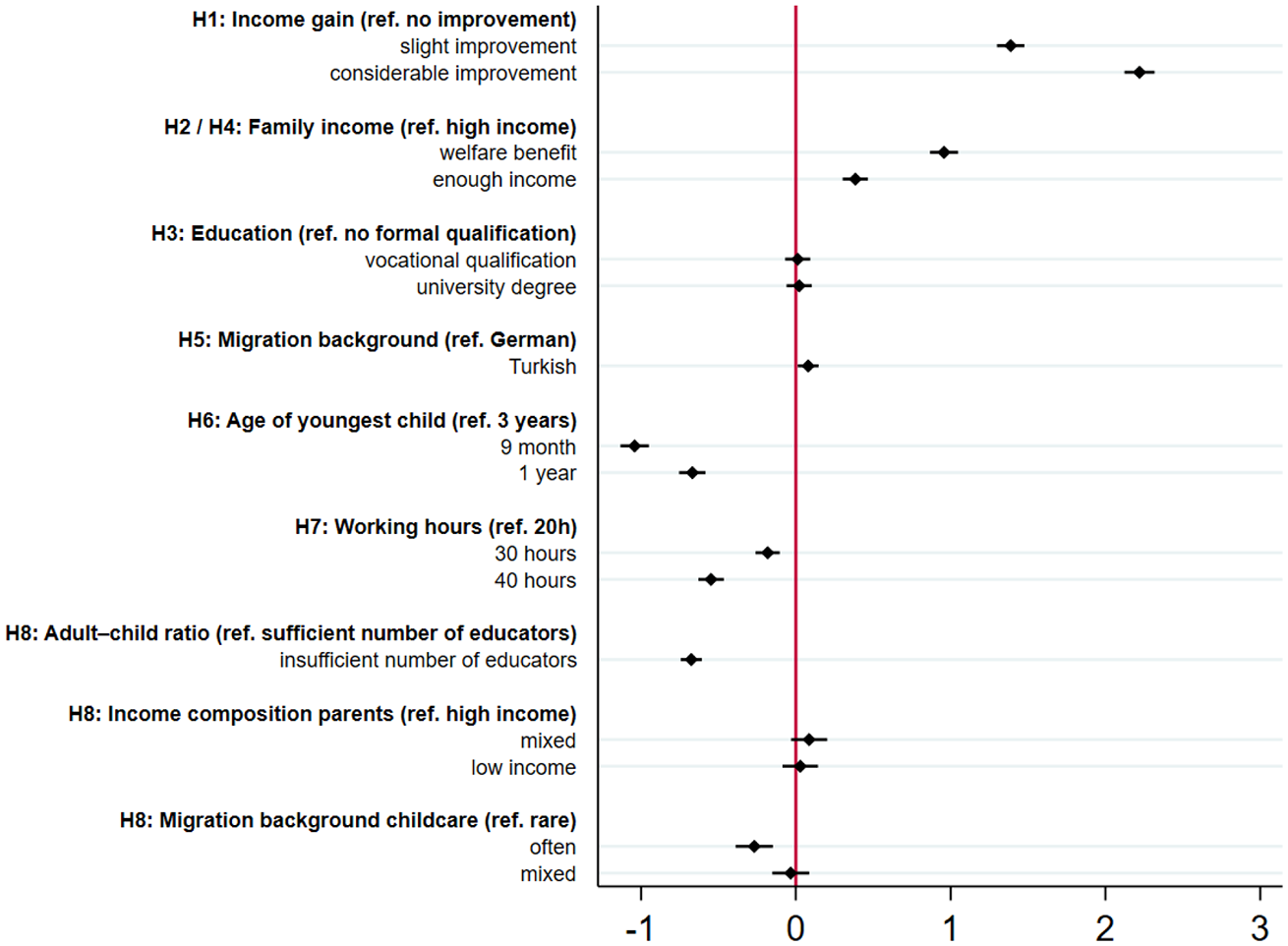
Coefficients of Regression Results, With 95 percent Confidence Intervals
In addition, we hypothesized that people would be more likely to recommend that mothers accept a job if the family’s available income were low (H2). Here again, the data confirm our prediction, but the effect sizes are smaller than the effects of potential income gains. Mothers in families with just-sufficient income are 0.4 scale points more likely to be recommended to accept the job offer than mothers in high-income families were (reference category). This effect is—as expected—stronger for mothers in families who receive welfare benefits (increase by almost 1 scale point). In terms of effect sizes, the family’s available household income is the third most important factor guiding the recommendation to accept a job offer.
Surprisingly, we do not find any confirmation of H3, according to which people would be more likely to recommend that mothers with higher levels of education accept a job. We assumed from a human capital perspective that highly educated mothers would be expected to return to the labor market particularly quickly to avoid human capital depreciation. However, the multivariate models reveal that a mother’s education level has no substantial or statistically significant influence on whether respondents expect her to accept a job.
In our derivation of H4 and H5, we argued that recommendations about pursuing paid work may vary for different groups of mothers. We assumed that labor market participation may be seen as more obligatory for mothers who are considered to be weakly integrated into society, such as mothers on welfare and mothers with an immigration background. It was already clear in the results pertaining to H2 that mothers in families receiving welfare benefits are more likely to be encouraged to accept a job offer than mothers in families not receiving benefits. To better illustrate this effect, we combined the dimensions of sufficient income and high income and tested them against the dimension of welfare benefit receipt (see Online Appendix Table A2, Model 2). Turning to the effect of immigration background, Figure 2 shows that the coefficient for Turkish mothers compared with German mothers is positive and only marginally significant at the 10 percent level. This finding suggests that having an immigration background is not as relevant as expected for considerations about maternal employment.
The third set of hypotheses drew on child-centered arguments. We argued that maternal employment may be considered to conflict with being a good mother and that such concerns should particularly apply to mothers with very young children. The empirical test of this hypothesis (H6) is in line with our theoretical expectations. Compared with mothers with 3-year-old children (reference category), mothers with 1-year-old children are 0.7 scale points less likely to be encouraged to accept a job offer. This effect becomes more negative when the youngest child is 9 months old (minus one scale point vs. the reference category). Hence, in terms of effect sizes, child age is the second most important factor guiding individuals’ recommendations that mothers accept a job offer. This result reflects the relatively traditional gender role attitude in Germany that mothers should stay home with their children, at least when the children are very young.
H7 posited that concerns about children’s well-being with parents’ increasing working hours may also affect recommendations of whether mothers should work. In the vignettes, fathers were always described as working full time. Previous literature investigating gender role attitudes has provided evidence that full-time maternal employment is considered incompatible with mothers’ caregiving responsibilities, regardless of the partner’s working hours (Albrecht, Edin, and Vroman 2000; Kanji 2011). Our analyses support H7. Compared with those in the reference category (jobs with 20 working hours per week), mothers are 0.2 scale points less likely to be encouraged to accept a job requiring 30 hours per week and 0.5 scale points less likely to be recommended for jobs requiring 40 hours/week.
Finally, we hypothesized that maternal employment may be considered detrimental to children’s well-being—even in the absence of gender-essentialist beliefs—if the available childcare options are not considered high quality (H8). We tested this hypothesis with two different vignette dimensions: changes in the adult–child ratio and in the sociodemographic composition of the childcare facility. For the adult–child ratio, we find a significant negative effect of 0.7 scale points when there are too few compared with enough educators. This means that mothers’ expectations of accepting a job are weaker when their children’s well-being might suffer due to a poor adult–child ratio. The demographic composition of the childcare facility, in contrast, does not seem to be relevant for recommending that the mother work. While the financial background of the parents seems to be irrelevant, we do see a statistically significant though very small effect for the immigration background of the other children in the childcare facility (0.3 scale point difference between childcare facilities with a small vs. high proportion of children with an immigration background, and no significant effect when the composition of children in childcare is mixed).
Hence, our results suggest that the recommendation to accept a job offer is driven by financial considerations. Taking a job is recommended most often in low-income families when such employment would improve household income. Moreover, child-related considerations also play a role—although they are subordinate. Maternal employment is less likely to be recommended when children are very young, the working hours are high, or the available childcare quality is poor. Hence, mothers are expected to work to improve their family’s financial situation and to stay at home when their children are young. Given that these factors were found to vary independently from each other in our study due to the experimental design and because jobs with longer hours usually yield higher incomes, the ambivalence mothers face in reality is likely to be even greater.
To further corroborate our conclusion that money trumps essentialists (and, to a lesser degree, child-related considerations), we estimated models that included interaction terms between variables capturing financial gain and child-related considerations. These analyses show that the effect of income gains on recommending that a mother accept a new job is independent of the age of the (youngest) child (Online Appendix Figure A2), the number of working hours required by the potential job (Online Appendix Figure A3), and the adult–child ratio in the childcare facility (Online Appendix Figure A4). Although the expectations that mothers will work will always be lower when their children are younger, when their working hours are longer, and when the quality of childcare is lower, the expectations to work increase to a similar extent as the potential income gain from a job increases—regardless of the age of the children, type of employment, or level of childcare quality.
Discussion
In this paper, we asked to what extent attitudes toward maternal employment are essentialist in nature and to what extent they are structured by economic considerations, perceived normative obligations, or child-related considerations such as the quality of childcare. The established items on gender role attitudes are very general in nature and implicitly assume that gender role attitudes are structured by essentialist beliefs about what is appropriate behavior for mothers (with children of a certain age). However, drawing on economic and sociological theories about maternal employment, we argue that different cognitive frames and contextual cues shape people’s thinking about what mothers ought to do and that attitudes toward maternal employment result from weighing the costs against the benefits in a specific situation. Arguments in favor of maternal employment center around the economic and nonmaterial benefits of pursuing paid employment, as well as normative obligations. Arguments against maternal employment center around the potentially adverse effects that a mother’s employment may have on her children and family.
To test whether views on maternal employment reflect essentialist beliefs and what role cost–benefit considerations play, we implemented a factorial survey experiment in a large-scale probability survey in Germany. Here, we presented respondents with short descriptions of nonworking mothers who differed in background characteristics but all had a job offer and access to childcare. After reading these descriptions, respondents were asked to indicate how strongly they recommended that the mothers take the respective job. Our findings showed that most people based their recommendations on cost–benefit considerations rather than essentialist beliefs. Economic aspects were particularly decisive (i.e., the amount of additional income provided by the new job, as well as the family’s current income situation), and mothers’ levels of education did not matter. We found little evidence that people regard certain groups of mothers (migrants, welfare recipients) as being normatively obliged to work. However, we found that people were less likely to recommend that mothers accept a job when they had young children at home, as well as when the job involved long working hours, which suggests that beliefs about mothers as the best caregivers for young children prevail. In addition, childcare quality—in the form of the adult–child ratio—also matters. Maternal employment may be regarded as detrimental to children’s well-being when no other viable childcare options are available. These findings underscore that attitudes depend on the cognitive frames and contextual cues people have in mind when evaluating maternal employment and illustrate the limitations of using very broad and general items.
The findings of our study are in line with findings from a U.S. study (Jacobs and Gerson 2016) showing that economic considerations and childcare quality structure shape attitudes toward maternal employment. Even though the welfare state characteristics of the two countries differ considerably (Aisenbrey, Evertsson, and Grunow 2009; Hook 2015; Sainsbury 1999), people in the United States and Germany seem to base their recommendations on similar cost–benefit calculations. Likewise, a qualitative study from South Korea (Oh 2018) suggested a similar weighing of costs and benefits when determining whether a mother should work. Thus, our findings once again illustrate the importance of economic considerations for attitudes toward maternal employment and generalize this insight to another country context. Germany differs in important ways from both Korea and the United States (e.g., on the level of welfare state support) but is comparable with many other European Union countries due to its policy ambivalence with regard to maternal employment (von Gleichen and Seeleib-Kaiser 2018).
Although the experimental data are unique in their capacity to shed light on the context dependency of attitudes toward maternal employment, there are certain limitations that need to be discussed. First, even though this study has provided much more detailed information on mothers’ employment situations and personal backgrounds than items conventionally used for assessing attitudes toward maternal employment, we had to restrict ourselves to a limited number of dimensions to avoid cognitive overload among respondents and problems of statistical power (Auspurg and Hinz 2014). For instance, we included only one immigrant group and did not manipulate mothers’ work orientation or partnership status. Furthermore, we did not vary their partner’s working hours, which is a decision that supports external validity, as full-time employment is still the norm for fathers in Germany (Bünning 2020). However, reduced working hours and greater use of fathers’ leave are discussed intensively in policy as potential channels through which to support mothers’ return to work and a more egalitarian division of labor; this is why it would certainly be interesting in future research to study how people evaluate mothers’ employment opportunities when they live with a spouse who works either part time or not at all.
Also, we acknowledge that we only examined the recommendations of whether a particular currently nonworking mother should take up a certain job. However, our study says nothing about evaluations of mothers who are currently working (full time) while having young children. In light of the findings on intensive maternal norms (e.g., Ennis 2014; Forbes, Lamar, and Bornstein 2021; Verniers Bonnot, and Assilaméhou-Kunz 2022), it is plausible that people come to other assessments and harshly judge working mothers. This, again, is a valuable and important avenue for further research.
Finally, our data were collected during the COVID-19 pandemic. As the reconciliation of paid work and childcare was a particularly salient and highly discussed topic during this time, our results most likely provide a lower point estimate of Germans’ attitudes toward mothers’ employment. Replication studies during nonpandemic times, however, are needed to consolidate our findings. Moreover, such a replication would be useful because it was not possible to conduct face-to-face interviews when our data were collected, and the response rate for the vignette module was less than it would have been at other times (however, our robustness checks indicate that this did not distort the results).
Conclusion
Despite advances in gender equality in paid and unpaid work in recent decades, the transition to parenthood often leads couples to adopt traditional gender roles, with mothers cutting back on work and becoming the primary caregivers at home. Such patterns of “retraditionalization” are often attributed to prevailing gender norms and expectations that the mother be the primary care provider (Boeckmann, Misra, and Budig 2015). The established survey items on gender role attitudes do not tell us anything about the underlying attitudes for or against maternal employment, and they tend to ask about mothers and employment “in general” rather than about specific groups of mothers or types of jobs. This information is needed, however, to understand the cultural impediments to maternal employment and hence to gender equality.
Our analyses of unique survey experimental evidence from Germany show that the economic benefits associated with paid work are the most important predictor of attitudes supporting maternal employment. Families’ and children’s material well-being are the most valued, and all the other aspects associated with mothers’ employment, including other child-related considerations, are considered less important. Money seems to trump essentialist and child-related considerations, which supports the conclusion from other research that most people do not hold essentialist beliefs about maternal employment but instead weigh costs and benefits when forming their recommendations (e.g., Hamilton, Geist, and Powell 2011, for similar findings). We therefore conclude that attitudes are strongly contingent upon the frames people may have in mind when voicing their opinions on gender role attitudes (see Kroneberg 2014 for a more general argument on the importance of cognitive frames). Researchers using quantitative items to study attitudes toward maternal employment need to be aware of and reflect this fact.
Moreover, our findings offer important policy guidance. Because employment not only is a source of income for women but also promotes their autonomy, integration, and fulfillment and serves as an indicator of gender equality, women should be encouraged politically to work. However, even if policies support women’s labor market participation and even though there are signs of modernization of gender roles, there is still substantial inertia due to societal expectations: As soon as women become mothers, they face different, sometimes ambivalent attitudes and play different roles. On the one hand, mothers are expected to pursue paid work. On the other hand, they are often still perceived as the best caregivers for children and face skepticism about the desirability and morality of taking a job and putting their children in daycare. This ambivalence leaves modern mothers contending with a “damned if you do and damned if you don’t” set of options (Jacobs and Gerson 2016).
Family policies can either foster gender role specialization in couples through conservative regulations or reduce specialization and promote an egalitarian division of domestic and paid work through progressive reforms. This political influence on organizing family and working life leads to broader debates on how family policies should be designed. Knowing the conditions under which maternal employment is normatively supported can help to design effective policies and free mothers from these double standards. As our findings suggest that people generally approve of maternal (full-time) employment if such employment improves the family’s economic well-being, money comes to the fore as the most important factor that organizations and policy makers can use to incentivize and normatively legitimize maternal employment. In this regard, the findings of our study point to the usual suspects that have previously been identified as fostering maternal employment: the availability of high-quality, affordable childcare and the introduction of an individual instead of a joint income taxation system to increase the financial benefit that couples have for every additional hour the second earner works (e.g., Bach et al. 2011). Similarly, the employment of mothers in low-income families is likely to increase when additional income is not deducted from welfare benefits (e.g., Bruckmeier, Mühlhan, and Peichl 2018). Finally, comparable worth initiatives that foster equal pay in male- and female-dominated occupations are also a promising way to increase the financial attractiveness for mothers to pursue paid employment. This may consequently be a way to effectively reduce the detrimental effects of child-related employment interruptions and part-time work on mothers.
Supplemental Material
sj-docx-1-gas-10.1177_08912432241252601 – Supplemental material for Money Matters! Evidence From a Survey Experiment on Attitudes Toward Maternal Employment Across Contexts in Germany
Supplemental material, sj-docx-1-gas-10.1177_08912432241252601 for Money Matters! Evidence From a Survey Experiment on Attitudes Toward Maternal Employment Across Contexts in Germany by Corinna Frodermann, Lena Hipp and Mareike Bünning in Gender & Society
Footnotes
Authors’ note:
We thank Mark Trappmann and the PASS team for supporting our research, Kristin Kelley for her valuable comments on a previous version of the manuscript, and Armin Sauermann for his help creating the figures. Funding for this project was provided by the German Federal Ministry of Education and Research (Grant # 01UG1806 Who Cares?) and the German Federal Ministry of Labor and Social Affairs.

Supplemental Material
Supplemental material for this article is available online.
Notes
Corinna Frodermann is a researcher at the Institute for Employment Research in Nuremberg. Her main research interests include gender inequalities in labor market participation, the impact of family status and gender role attitudes on labor market decisions, and how social policies affect labor market inequalities over the life course. Her work has appeared in European Sociological Review, Work, Employment and Society, Survey Research Methods, and International Journal of Epidemiology.
Lena Hipp is a research professor of Work, Family, and Social Inequality at the WZB Berlin Social Science Center and full professor of Social Policy and Social Inequality at the University of Potsdam (Germany). Using different methodological approaches, she studies the micro-sociological foundations of social inequalities related to work, family, and gender, and examines how public and organizational policies shape and mitigate these inequalities. Her work has been published in Journal of Marriage and Family, European Sociological Review, Social Forces, Work and Occupations, Journal of European Social Policy, and Socio-Economic Review.
Mareike Bünning is a sociologist and senior researcher at the German Centre of Gerontology. Her research focuses on family relations and social integration, gender inequalities, and associations between gainful employment and unpaid care work. Her work has been published in Journal of Marriage and Family, European Sociological Review, Journal of European Social Policy, Work, Employment and Society, and Journals of Gerontology: Series B.
References
Supplementary Material
Please find the following supplemental material available below.
For Open Access articles published under a Creative Commons License, all supplemental material carries the same license as the article it is associated with.
For non-Open Access articles published, all supplemental material carries a non-exclusive license, and permission requests for re-use of supplemental material or any part of supplemental material shall be sent directly to the copyright owner as specified in the copyright notice associated with the article.
