



Abstract
In this study, we conceptualize and provide novel empirical evidence on norm-setting effects of family policies by investigating how priming with parental leave policy–related information may alter normative beliefs regarding the gender division of parental leave in Germany. We implemented a survey experiment in two waves of the representative German GESIS Panel in 2019 and 2020. Respondents received one of three short evidence-based information primers about (1) long-term income risks of maternal employment interruptions, (2) nonsignificant paternal wage penalties, or (3) increasing rates of paternal leave usage in Germany, or were allocated to the control group that received no further information before rating the division of parental leave in fictitious couples. We apply ordinary least squares regression models with lagged dependent variables to a sample of 5,362 vignette evaluations nested in 1,548 respondents. Remarkably, we find that the effects of all three priming conditions vary significantly depending on whether respondents are asked to judge situations for couples where women earn more or less than their partners. Our findings mostly point to stronger effects of priming with information on income risks compared with paternal leave usage trends and to more pronounced changes in normative beliefs among childless respondents.
Keywords
Despite significant changes over the past decades, large differences persist in time spent on employment and childcare between mothers and fathers with young children in postindustrial societies (Hook 2006; Kan et al. 2022). The transition to parenthood remains a critical juncture for the reproduction of gender inequalities in the labor market (e.g., Grunow and Evertsson 2016). Mothers tend to take longer periods of parental leave than fathers and frequently work part-time after their return (Organisation for Economic Co-Operation and Development 2010). This has significant long-term consequences for women in terms of lower lifetime earnings and pensions (Bettio, Tinios, and Betti 2013; Sigle-Rushton and Waldfogel 2007). However, men are also affected after becoming fathers: They frequently perceive greater risks of career penalties than mothers if they use family policy measures such as parental leave (Bernhardt, Hipp, and Allmendinger 2016; Samtleben et al. 2019). To reduce these gender inequalities and offer more genuine choice between varying work–care arrangements, many high-income countries have implemented statutory family policy measures with the aim of facilitating work–family balance, speeding up maternal labor market return and increasing paternal childcare involvement (see Ferragina 2020).
Studies in various countries have corroborated the influence of parental leave policies on maternal employment behavior (see Ferragina 2020) and paternal involvement in childcare (e.g., Boll, Leppin, and Reich 2014; Hook 2006). While many of these have concentrated on financial incentives as mechanisms, public policies, including family policies, have also been suggested to shape citizens’ belief systems by institutionalizing and legitimizing social norms (Kremer 2007; Kumlin and Stadelmann-Steffen 2014). Family policies convey normative assumptions of what is desirable regarding the division of paid work and family care (e.g., Kremer 2007; Pfau-Effinger 2004) and shape the institutional level of the gender structure of a society (Risman 2004, 2018). Thus, parental leave reforms explicitly aimed at promoting greater gender equality in paid and family work might change gender relations by supporting citizens in challenging prevalent normative assumptions and practices (Kremer 2007; Sullivan 2006). Several cross-nationally comparative studies provide evidence that parental leave policies supporting dual-earner/dual-carer families are associated with more egalitarian gender norms (Heymann et al. 2019; Omidakhsh, Sprague, and Heymann 2020; Sjöberg 2004).
The concept of (normative) policy feedback effects captures how such policy changes influence the public’s attitudes and ideologies (Kumlin and Stadelmann-Steffen 2014), but in empirical studies, the mechanisms often remain unclear. To deepen our understanding of the normative influences of family policies, we investigate whether providing information about parental leave policies, for instance, in the form of media reports, might function as a channel for normative policy feedback and contribute to changes in gender norms among the wider public. Altered norms and beliefs among current and future parents are likely to also promote gradual shifts in the practiced gender division of labor in families (e.g., Nitsche and Grunow 2016).
Germany is an interesting case because it has expanded its support for dual-earner/dual-carer families through several parental leave and day care reforms since the mid-2000s. Accompanying media campaigns may have additionally promoted changes in gender norms. A search in the online archives of two of the largest national newspapers in Germany (Frankfurter Allgemeine Zeitung and Süddeutsche Zeitung) shows that these published around 200 articles per year on parental leave and related terms around the time of a policy reform in 2007, often specifically addressing employment- and income-related consequences of parental leave use (see Table A1 in the Online Appendix). In this study, we therefore examine how mentioning parental leave entitlements, usage rates, and income risks of taking leave may trigger changes in personal normative beliefs regarding the gender division of parental leave. We apply a rigorous methodological design combining an information priming experiment based on scientific evidence from Germany with a vignette study across two waves of the representative German GESIS Panel. The experimental design allows us to draw causal inferences on changes in normative judgments regarding the gender division of parental leave within a relatively short time frame.
Theoretical Background and Previous Evidence on Normative Policy Feedback
From a sociological perspective, gender can be understood as a social structure embedded at the individual, interactional, and macro levels of society (Risman 2004). At the macro level, gender is embedded in cultural logics and institutional regulations (Risman 2004, 2018), such as family policies that promote certain ideals of work and care (Kremer 2007). Gendered cultural logics are dynamic and intertwined with the other levels of the gender structure. They influence gendered expectations and stereotypes that individuals encounter in interactions and further affect internalized social norms through socialization, thereby enabling or constraining certain preferences and behaviors and eventually affecting the division of labor within couples (Risman 2004, 2018).
Gendered cultural logics at the macro level are influenced by family policy reforms conveying changing normative assumptions of what is desirable regarding the gender division of employment and family care (Kremer 2007; Pfau-Effinger 2004). These policy reforms and co-occurring changes in gendered cultural logics are likely to also affect gendered expectations and internalized social norms and thus have the potential to alter couples preferred and practiced gender division of labor.
The literature on (normative) policy feedback effects has identified two main mechanisms of how policy, such as parental leave policies, can change gender norms at different levels of the gender structure. First, at the micro level, family policies provide incentives for certain parental work and care practices, and individuals adjust their gender beliefs through psychological preference adaptations as they are exposed to these practices during parental leave usage (Gangl and Ziefle 2015). Second, at the macro level, family policies can induce normative feedback effects through norm-setting and cultural diffusion (Bicchieri 2017; Gangl and Ziefle 2015). Cultural diffusion refers to preference adaptation over time via altered perceptions and expectations within social networks based on observable changes in other mothers’ and fathers’ work–care arrangements in the wake of a policy reform. Norm-setting builds on the assumption that family policies convey cultural logics regarding work–care arrangements and function as legitimizing “normative anchors” in the process of individual preference formation and change around major life course transitions (Gangl and Ziefle 2015, 519).
Single-country case studies provide partial support for normative feedback effects of parental leave reforms. In an interrupted time-series design based on German panel data, Gangl and Ziefle (2015) found that the extension of parental leave entitlements in 1992 led to a temporally lagged decline in subjective work commitment in mothers of minor children compared with younger women and women with completed fertility. The authors suggest that preference adaptation through the lived experience of a full-time caregiver was an important mechanism, as mothers’ work commitment declined with increasing duration of parental leave usage. However, the reform effect was found for all mothers, regardless of their employment-related entitlement to parental leave, thus pointing to a norm-setting effect beyond the policy’s target group. Similarly, reform evaluation studies have shown that the introduction of leave reserved for fathers in Germany and in Quebec, Canada, increased involvement in childcare not just among fathers who took leave but among fathers in general (Patnaik 2019; Schober 2014; Wray 2020). Kotsadam and Finseraas (2011) did not find significant long-term differences in gender ideologies among parents who had their child just before compared with just after the introduction of parental leave reserved for fathers in Norway in 1993, which may also be attributable to broader norm-setting and cultural diffusion effects that were not limited to the policy’s target group. These observational and quasi-experimental studies overall suggest that parental leave reforms changed gender norms and expectations around maternal employment and fathering behavior. Except for Gangl and Ziefle (2015), however, they did not attempt to distinguish norm-setting from other mechanisms, such as altered lived experiences or cultural diffusion.
Experiments might be better suited to investigate specific mechanisms of normative policy feedback. In light of the substantial media attention placed on family policies, it is interesting to examine how providing short policy-related media report–like information may affect gender norms in the very short term. This mechanism can be referred to as priming and might function as a channel for norm-setting, because the provided information is likely to strengthen the norm-setting effects by drawing attention to existing policy entitlements, usage rates, and consequences of leave taking, thereby legitimizing specific divisions of parental leave. Two recent survey experiments from the United States tested the effect of priming young childless adults with hypothetical supportive work–family policies on their work–care preferences (Pedulla and Thébaud 2015; Thébaud and Pedulla 2016). When receiving the priming, women more often preferred egalitarian work–care arrangements, whereas men’s preferences were affected only if they believed that their male peers also preferred gender-egalitarian arrangements (Pedulla and Thébaud 2015; Thébaud and Pedulla 2016). Recently, Bünning and Hipp (2022) showed that in the context of a hypothetical increase in the individual and nontransferrable paid parental leave entitlement from 2 to 4 months in Germany, fathers increased their preferred leave length, whereas mothers preferred shorter leaves. By examining specific, existing family policies and related scientific evidence on consequences of leave taking instead of hypothetical family policy contexts, our study offers a novel, yet policy- and practice-relevant extension to our understanding of norm-setting effects of policies.
We extend the literature on normative policy feedback effects in three ways. First, we explore a rarely studied mechanism of policy-related priming as a channel for normative policy feedback. More specifically, we conceptualize and empirically investigate whether priming respondents with different evidence-based information stimuli about parental leave policy, usage rates, and economic consequences in Germany may affect their normative beliefs regarding the division of parental leave between parents in the short term. Germany is a particularly interesting case, given that policies support a wide range of work–care arrangements, increasing the potential of our information priming to change normative beliefs. Second, to draw more causal conclusions between priming information and changes in normative judgments over time, we rely on a randomized survey experiment implemented in the representative German GESIS Panel. By combining the priming experiment with a vignette study on couples with different income constellations, we are able to examine how changes in normative judgments about the division of parental leave are interdependent with relative earnings of partners within families. Considering differences in earnings between partners is particularly relevant in the German context, where family policies support a relatively wide range of work–care arrangements. Finally, the large representative sample allows us to test for heterogeneous priming effects by respondents’ parenthood status, because respondents likely differ in their affectedness and attention to the policy-related information.
Institutional Context
Before the mid-2000s, parents in Germany were entitled to a job-protected leave and a means-tested parental leave benefit for the first 3 years of the child’s life. The ideal of maternal care (Kremer 2007) for young children was the dominant social norm in West Germany, whereas maternal employment and use of formal care arrangements for infants was and still is more widely accepted in Eastern Germany (Stahl and Schober 2018). In 2007, the German government substantially reformed the parental leave system, creating a shorter but better-paid earnings-related parental leave benefit to encourage faster maternal labor market return and greater paternal involvement in childcare. The parental leave benefit offers a 65 percent income replacement (capped at €1,800 per month) for 12 months for one parent or 14 months if both parents take at least 2 months of leave. All parents are eligible to parental leave benefits. Replacement rates are calculated based on the income earned over the last 12 months. Parents who were not employed in the year before the birth of the child receive the minimum parental leave benefit of €300 per month. This parental leave reform was accompanied by major expansions in publicly subsidized day care for children younger than 3 years starting with the Day-care Expansion Act in 2005. This was followed by the 2008 Child and Youth Welfare Act, which stipulated a legal right to a day care place for all children age 1 year or over from August 2013. Whereas fees for parents have been mostly income-dependent and relatively low in international comparison, quality remains variable and mediocre (Stahl, Schober, and Spiess 2018). Availability of affordable day care slots and attendance rates increased substantially as a consequence of the introduction of the legal right (Stahl and Schober 2018). In 2021, about 28.9 percent of children ages 0–3 years attended day care institutions (Federal Statistical Office 2021).
Despite this shift toward a dual-earner/dual-carer model, Germany’s current social and family policy still includes familialistic elements supporting the male breadwinner model, such as additional unpaid parental leave until the child’s third birthday and joint taxation for married couples (Stahl and Schober 2018). Overall, Germany moved from a model of supported familialism (Hook 2015) toward a model of optional familialism (Stahl and Schober 2018), supporting a relatively large range of potential work–care choices for parents, which may increase the importance of financial considerations for decisions around parental leave.
The share of fathers who take parental leave has increased substantially after the parental leave reform from only 3 percent in 2006 to around 21 percent in 2008 and to 42 percent in 2018. Yet the majority of fathers take no more than 2 months of parental leave (Bundesministerium für Familie, Senioren, Frauen und Jugend [BMFSFJ] 2021). Most fathers cite financial and workplace constraints, fear of negative career consequences, as well as the mother’s desire to take 12 months of parental leave as reasons for not taking (longer) leave (Bernhardt, Hipp, and Allmendinger 2016; Samtleben et al. 2019). Widespread fears of negative career consequences contradict recent findings that most fathers who have taken leave thus far did not face significant career or wage penalties (Bünning 2016; Samtleben et al. 2019) or disadvantages in perceived job competencies and hypothetical hiring probability (Fleischmann and Sieverding 2015). Our empirical design examines whether providing evidence-based parental leave policy-related information may partly correct for overestimated expectations of career penalties for men and underestimated financial consequences for women.
Experimental Design and Empirical Predictions
We use data from the GESIS Panel, which is part of GESIS—Leibniz Institute for the Social Sciences, and is funded jointly by the German Federal Government and the Länder. A detailed description of the GESIS Panel can be found in Bosnjak et al. (2018). We implemented a survey experiment in two waves in 2019 and 2020 (GESIS 2021). The GESIS Panel includes more than 5,000 respondents 18 years and older at the time of recruitment in 2013, 2016, and 2018. Respondents in our final sample ranged from 24 to 76 years of age during the first wave of our experiment. Respondents are interviewed six times per year, with the majority participating online (Minderop, Schwerdtfeger, and Weyandt 2021).
In both waves, respondents received the same four descriptions of hypothetical situations (vignettes) depicting a fictitious full-time working couple expecting their first child (see Figure A1 in the Online Appendix). First, respondents were informed about Germany’s current parental leave policy. The four vignettes varied on two dimensions, the absolute income level and the relative income constellation between the fictitious partners. Afterward, respondents were asked to indicate the number of months of paid parental leave the expectant mother and father, respectively, should take. This vignette design allows for testing for variations in normative leave judgments depending on the relative income constellation of the couples.
In the second wave of the study, we additionally implemented a priming experiment, just before respondents evaluated the vignettes for the second time. Respondents were randomly assigned to one of the three priming conditions C1, C2, or C3 (for the wording of the three priming conditions, see Figure A2 in the Online Appendix) or to a control group. All priming conditions were based on scientific evidence of parental leave policy effects in Germany or other European countries. The first priming condition (C1) provides information about frequent negative long-term financial consequences of long parental leave for mothers in terms of lower lifetime earnings and increased risk of old-age poverty (Bettio, Tinios, and Betti 2013; Boll 2011; Sigle-Rushton and Waldfogel 2007). In the German context, where mothers frequently took up to 3 years of leave per child in the past, shorter parental leave and earlier return to the labor market is likely to improve mothers’ financial situation (Kluve and Schmitz 2018). The second condition (C2) presents evidence showing that the consequences of taking parental leave for fathers’ wages are generally neutral (Bünning 2016; Evertsson 2016), and penalties appear to be roughly the same or lower for fathers than for mothers (Ondrich, Spiess, and Yang 2003; Ziefle 2004). The third condition (C3) describes a trend of increasing parental leave usage among fathers in Germany, but also states that most fathers take only 2 months of paid parental leave, compared with the maximum allowable period of 12 months (BMFSFJ 2021; Trappe 2013). The experiment was approved by an ethics committee of the University of Tübingen and by the scientific committee of the GESIS Panel.
Empirical Expectations
We study how priming respondents with evidence-based leave policy–related information influences normative judgments regarding parental leave usage by mothers and fathers. Normative judgments refer to individuals’ judgments of “what ought to be” (Jasso 2006, 336)—in this case, how parents should or are normatively expected to divide their parental leave. Through priming, (media) information can affect individuals’ personal normative beliefs by altering the criteria on which they base their overall evaluations of a certain topic (Druckman and Holmes 2004).
Following social norm theory (Bicchieri 2017), legislative interventions and educational and media campaigns might be a tool for increasing individuals’ awareness and inducing a critical evaluation of their beliefs and social expectations—a prerequisite for changing gender norms. High-quality evidence-based information about parental leave usage and its economic consequences should affect individuals’ factual beliefs regarding patterns of parental leave division and its consequences as well as their personal normative beliefs about how parental leave should be divided. Priming with information might alter individuals’ empirical expectations of how they themselves and others would divide parental leave as well as their normative expectations about what others think and expect regarding the division of parental leave (Bicchieri 2017), eventually changing gender norms at the interactional level.
Priming increases the salience of specific issues, bringing them “into the foreground of people’s thinking” (Miller and Krosnick 1996, 82). Following dual-process and priming theories of human reasoning (Evans and Stanovich 2013; Miller and Krosnick 1996), after receiving the priming, individuals should be more likely to engage in more controlled thinking and reflective reasoning instead of automatic processes. When primed with evidence-based information on parental leave usage, wage penalties and gendered economic risks and inequalities resulting from an unequal division of parental leave might become more salient for individuals’ normative judgments. Thus, they might engage in more detailed reasoning on the economic costs and benefits of different leave options. This is assumed to reduce cognitive gender biases and implicit stereotypes, such as in the German context, where the assumption is that the mother should stay at home with her newborn child for about a year, while for fathers the emphasis is on whether or not the father takes the individual entitlement of 2 months of leave. As a result, we expect all three experimental conditions, compared with the control group, to lead to less traditional normative judgments of the division of paid parental leave by shortening leaves for mothers and extending leaves for fathers (Hypothesis [H]1a).
Priming conditions 1 and 2 explicitly address gender inequality issues and make information on evidence-based economic consequences and risks of parental leave usage for mothers and fathers directly accessible. These conditions thus have greater potential to induce reflection on gender inequalities than C3, which describes usage trends among fathers and is more likely to shape individuals’ empirical expectations about how other fathers behave. Because C3 also acknowledges the implicit new norm of only 2 months of leave for fathers, the potential for changing personal normative beliefs is further reduced. In sum, we expect that priming with economic consequences of leave usage for mothers and fathers (C1 and C2) will induce a stronger shift in personal normative beliefs toward greater support for a less traditional division of parental leave between mothers and fathers than priming with usage trends among fathers (C3) (H1b).
Interdependence With Relative Earnings in Couples
Because German family policies support a relatively wide range of work–care arrangements for parents with young children, differences in earnings between partners may be particularly influential for the division of parental leave. The priming effect on normative judgments might therefore depend on the economic conditions of the fictitious families described in the experiment. Neoclassical economic theory and resource-bargaining approaches (Becker 1991; Lundberg and Pollak 1996) predict a more traditional gender division of labor when the woman earns less relative to her partner. Most German studies indeed suggest that fathers are more likely to take any and longer leave when the mother has a higher share of the couple’s total earnings (e.g., Reich 2011; Trappe 2013). We therefore also expect the priming effects of the three conditions to be stronger if the provided policy information seems more relevant to the relative income constellation of the couple. To maximize household income from an economic perspective, shorter leaves are likely to be recommended for mothers who out-earn their partners. As main breadwinners of their families, these mothers are financially less dependent on their partners and may be perceived as less vulnerable or at risk of poverty than mothers who earn less than their partners. Hence, the first condition (C1) regarding negative financial consequences of a long parental leave for mothers is more relevant for the latter and expected to induce a stronger shift toward greater support for a more egalitarian division of parental leave if the woman earns less than her partner (H2a).
The second priming condition (C2), which stresses the absence of negative financial consequences of leave usage for fathers’ compared with mothers’ wages, is likely to be considered more relevant for families where mothers earn more than fathers. In the latter constellations, most fathers take some leave, and respondents are more likely to consider that fathers may also take more than their individual leave entitlement of 2 months. Fears of wage penalties are probably more salient with respect to such longer leave periods. Hence, the priming information may increase the salience of mothers’ higher earnings, incentivize longer leaves for fathers, and counteract any fears of negative career consequences for fathers after taking longer parental leave. C2 is thus assumed to increase support for fathers taking a larger share of the leave to a greater extent if the woman earns more than her partner (H2b).
The loss of income for the household in families where fathers earn more than mothers continues to be the most frequently reported reason why fathers did not take any or longer parental leave (Bernhardt, Hipp, and Allmendinger 2016). Therefore, the third priming condition (C3) on increasing usage rates among fathers is likely to increase the normatively accepted length of fathers’ leave more strongly for couples where a longer paternal leave would not incur any income loss for the household because the mother earns relatively more than the father (H2c).
Personal Relevance and Previous Reflective Reasoning of the Policy-Related Information
Normative policy feedback theory supposes that effects of priming with parental leave policy–related information vary among population subgroups depending on the personal relevance of and previous knowledge or reflective reasoning about the policy (Ellingsæter, Kitterød, and Lyngstad 2017). Following dual-process and priming theories (Evans and Stanovich 2013; Miller and Krosnick 1996), the personal relevance and limited previous knowledge about a policy and about consequences of usage are likely to increase the salience of the information and the likelihood of more reflective reasoning, potentially inducing normative change.
At first glance, the priming with information on income-related consequences and rates of parental leave might be more relevant for parents than for childless respondents. However, parental leave policies refer to a rather short time period directly after childbirth and do not directly affect parents with older children. Childless respondents who may want to have children in the future might show more interest in the parental leave policy and financial consequences of leave usage.
Furthermore, childless respondents may not have thought much about parental leave before and might be more open to changing their normative beliefs. Most parents were probably already better informed about these issues and might be influenced by their own past experience of parental leave usage and perhaps more resistant to normative change. In sum, we expect all three priming conditions to increase support for a less traditional division of parental leave more strongly among childless respondents than among parents (H3).
Variables and Method
Variables
Dependent Variables
We analyzed the effects of the priming with information on three dependent variables. The first two dependent variables measured respondents’ judgments as to how many months of paid parental leave the mother and father, respectively, should take. By law, each parent can take a maximum of 12 months. We additionally constructed a variable for respondents’ judgments about the mother’s relative length of parental leave within the couple, ranging from 0 to 100 percent. At wave 1, mothers were assigned 8.3 months of parental leave on average, while fathers were assigned 5.4 months. There were no significant differences in means across the control and priming groups (see Table 1). The most frequently preferred division of leave was 12 months of leave for the mother and 2 months of leave for the father (35 percent of vignettes), in line with the “12+2” norm (Trappe 2013). Overall, respondents preferred a longer leave for the mother in about 58 percent of the vignettes; indicated that the parents should divide the parental leave equally (i.e., each parent should take 7 months of leave) in about 18 percent of the vignettes; and assigned fathers longer leaves than mothers in about 24 percent of the vignettes. The more equal distribution of leave months between mothers and fathers in the fictitious couples is attributable at least partly to the vignette design with an equal probability of couple cases in which women earn more compared with couples where women earn less than their partners.
Respondents’ Characteristics and Lagged Dependent Variables Across Control and Treatment Groups
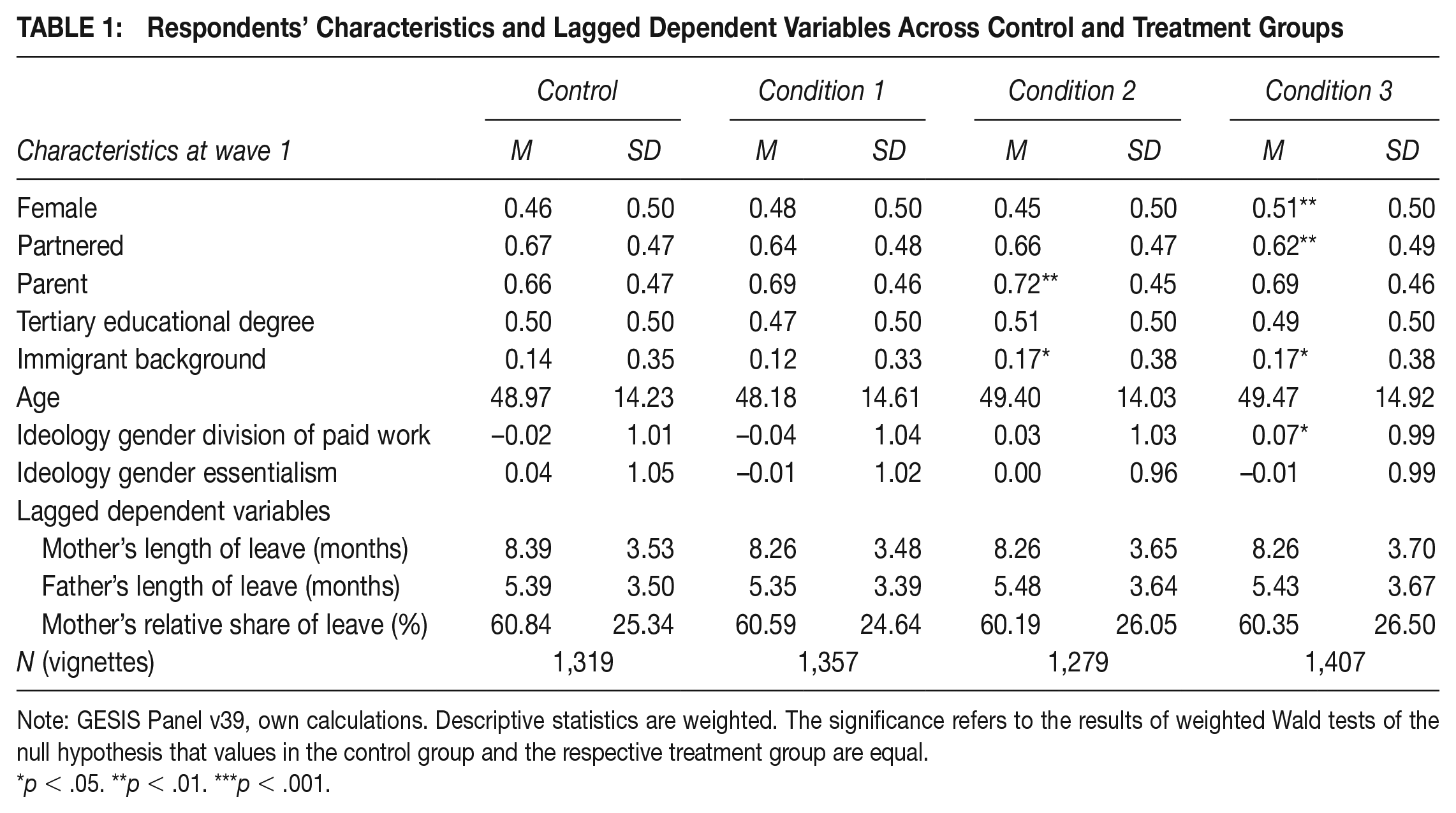
Note: GESIS Panel v39, own calculations. Descriptive statistics are weighted. The significance refers to the results of weighted Wald tests of the null hypothesis that values in the control group and the respective treatment group are equal.
p < .05. **p < .01. ***p < .001.
Independent Variables
The key independent variable with four categories indicates whether respondents were part of the first, second, or third priming group or the control group.
We further considered the financial situation of the vignette couples. The vignettes presented respondents with the mother’s and father’s current earnings in absolute terms as well as the hypothetical parental leave benefits each would receive based on these earnings. These varied on two income dimensions: the relative income constellation within the couple and the absolute income level. In terms of relative income, the women earned either 40 or 60 percent of the couple’s total income. The couple’s net household income as the sum of both partners’ earnings amounted to either €2,350 or €3,700 a month (representing the 25th and 75th percentiles of the pre-birth income distribution in a representative sample of new parents from the German Socio-Economic Panel).
Another independent variable captures respondents’ parenthood status. The GESIS Panel allowed us to distinguish only between respondents who at some point in their life had a biological or adopted child and those who have not (yet) had children. Although this measure does not differentiate parents by the age of their child(ren), it still captures whether respondents have experienced work–care conflicts in the past and have reflected on the issue of taking parental leave.
Respondent-Level Control Variables
We control for various sociodemographic characteristics of the respondents because although the experimental groups were generally similar with respect to respondents’ sociodemographic characteristics, we found small compositional differences in parenthood status, gender, partnership status, and immigrant background between experimental groups C2 and C3 compared with the control group (see Table 1). In addition, the design weights included in our data set do not take into account nonrandom panel attrition. Gender, age, education, and immigrant background have been shown to relate to attrition in the GESIS panel (Struminskaya 2014; Struminskaya and Bosnjak 2015).
We distinguish between male and female respondents. For respondents’ partnership status, we constructed a dichotomous variable indicating whether they have a partner (living together or apart) or not. Respondents were defined as having an immigrant background if they or at least one of their parents were born abroad. We calculated respondents’ age in years using their year of birth and the respective survey year. We also controlled for whether respondents have a tertiary educational degree or not. In addition, based on five gender ideology items, we constructed two factors in polychoric factor analyses capturing respondents’ ideologies toward the gender division of paid work (three items: e.g., “All in all, family life suffers when the woman has a full-time job.”; Cronbach’s alpha = 0.79); and gender essentialism (two items: e.g., “Women are innately more nurturing than men.”; alpha = 0.59) and z-standardized these two factors for further analyses. All respondent-level characteristics were measured before or during the first wave of our study.
Sample Selection and Analytical Approach
We kept only observations with valid answers on the mother’s and father’s length of parental leave at both waves, resulting in 5,493 evaluated vignettes from 1,590 respondents who provided a valid answer to at least one of the four different vignettes at both waves. We further excluded 127 observations with missing information on our respondent-level control variables. We dropped another four observations because of missing design weights. The resulting analytical sample consists of 5,362 vignette evaluations nested in 1,548 respondents.
For the analysis, we applied ordinary least squares (OLS) regression models with lagged dependent variables, which allowed us to estimate changes in the dependent variables between the two waves in the primed groups compared with the control group. We applied cluster-robust standard errors to account for the clustering of the vignettes within respondents as well as wave-specific design weights to account for nonrepresentative sampling in terms of age and East/West Germany (Kolb et al. 2021). The analysis is structured in three steps: First, we estimated the main effects of our three experimental conditions on the three dependent variables measuring normative judgments regarding the division of parental leave. Then we estimated the priming effects separately for two subgroups of couple vignettes in which the women earned more versus less than their partners. Finally, for each of these relative income constellations, we estimated interaction effects between the experimental conditions and respondents’ parenthood status. Respondent-level control variables were included in all analyses. All data preparation and analyses were conducted in Stata16.
Results
Priming Effects and Interdependence With Couples’ Relative Income Constellations
We expected that all three priming conditions would lead to less traditional normative judgments regarding the division of parental leave compared with the control group (H1a) and that this change would be more pronounced for the priming on income-related consequences of leave usage for mothers and fathers, as presented in C1 and C2, than for C3, which documented usage trends among fathers (H1b). As shown in Table 2, all three experimental conditions did not significantly change normative judgments regarding the division of leave in the full sample. We further find that a higher net household income and higher relative maternal earnings of the vignette couples are associated with greater acceptance of a less traditional division of parental leave (results for the control variables are shown in Table A2 in the Online Appendix).
Ordinary Least Squares Regression Model With Lagged Dependent Variable of Normative Judgments Regarding the Division of Parental Leave on the Experimental Conditions
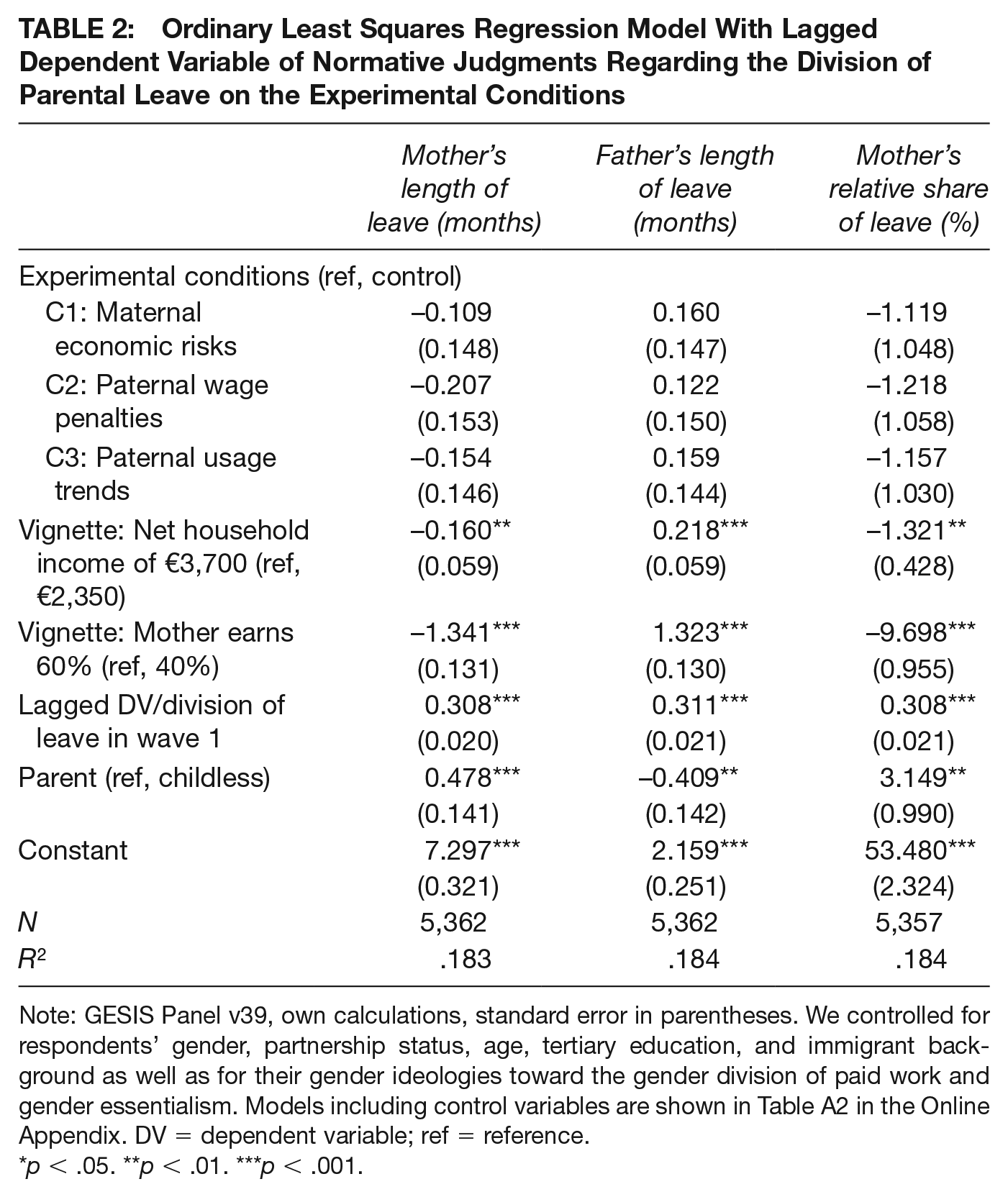
Note: GESIS Panel v39, own calculations, standard error in parentheses. We controlled for respondents’ gender, partnership status, age, tertiary education, and immigrant background as well as for their gender ideologies toward the gender division of paid work and gender essentialism. Models including control variables are shown in Table A2 in the Online Appendix. DV = dependent variable; ref = reference.
p < .05. **p < .01. ***p < .001.
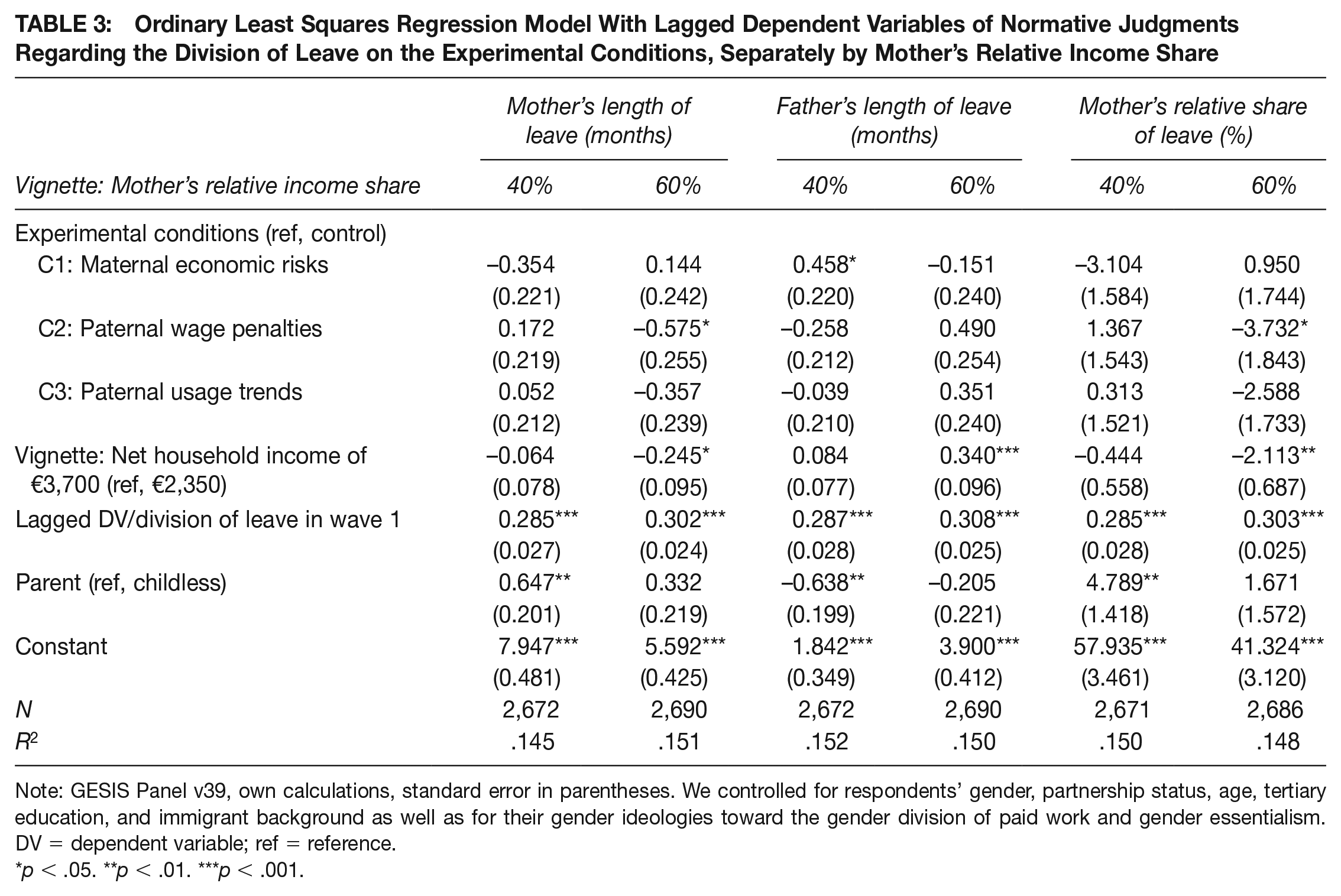
In a next step, we tested whether the effects of the priming on normative judgments depended on the couple’s relative income constellation described in the vignettes. For the first experimental condition, we expected stronger effects in the direction of greater support for a less traditional division of leave if the mother earns relatively less than her partner (H2a). For the other two experimental conditions C2 and C3, we expected stronger effects in the direction of greater support for longer leave for fathers if the mother earns more than her partner (H2b and H2c). Table 3 presents subgroup analyses of priming effects by relative maternal earnings.
Ordinary Least Squares Regression Model With Lagged Dependent Variables of Normative Judgments Regarding the Division of Leave on the Experimental Conditions, Separately by Mother’s Relative Income Share
Note: GESIS Panel v39, own calculations, standard error in parentheses. We controlled for respondents’ gender, partnership status, age, tertiary education, and immigrant background as well as for their gender ideologies toward the gender division of paid work and gender essentialism. DV = dependent variable; ref = reference.
p < .05. **p < .01. ***p < .001.
In line with H2a, in couples where the mother earns 40 percent of the total income the first experimental condition (C1) on maternal income risks increased support for a longer paternal leave by 0.5 months (p < 0.05). The effect on the mother’s absolute length of leave and her relative share was not statistically significant. This finding is broadly in line with our expectation that the priming information on the income risks of a long parental leave for mothers is considered more relevant and therefore affects parental leave usage norms more strongly when the woman earns less than her partner—although, unexpectedly, the priming affected only the father’s and not the mother’s absolute leave length. Complementary analyses examining interaction effects in the full sample confirm that the effect of the first experimental condition on normative judgments regarding the father’s length of parental leave differs between the two relative income constellation subgroups, but the difference was only close to statistically significant (p < 0.1, not shown).
In support for H2b, for couple constellations where the mother earns more than the father, the second condition (C2) on the rather neutral consequences of leave usage for fathers’ versus mothers’ wages reduced the mother’s parental leave length by 0.6 months (p < 0.05) and her relative share of leave by 4 percentage points (p < 0.05). The positive effect on the length of leave allocated to the father was only close to statistically significant. This result suggests that the information successfully reduced widespread fears of negative career consequences of leave taking for fathers and highlighted the more negative consequences for mothers’ wages, but altered parental leave usage norms only if the couple’s financial constellation also favors a nontraditional division of leave. Complementary analyses with interaction effects confirm that the effect of the second experimental condition on mother’s leave length significantly differs between the two income constellation subgroups (p < 0.05).
The third experimental condition on parental leave usage trends among fathers in Germany did not induce any significant change in normative judgments regarding the division of parental leave regardless of the couple’s relative income constellation, leading us to reject H2c.
For C1 and C2, these results provide evidence that priming with family policy–related information has the potential to alter normative beliefs regarding parental leave usage when the information provided matches the couple’s relative income constellation (see Figure 1), lending at least partial support to H1a. The effects of C1 on couples in which the woman earns less than her partner were significantly stronger than the effects of C3. This provides partial support to H1b, which assumed a stronger effect of priming with evidence-based income risk information compared with reports on paternal usage trends.
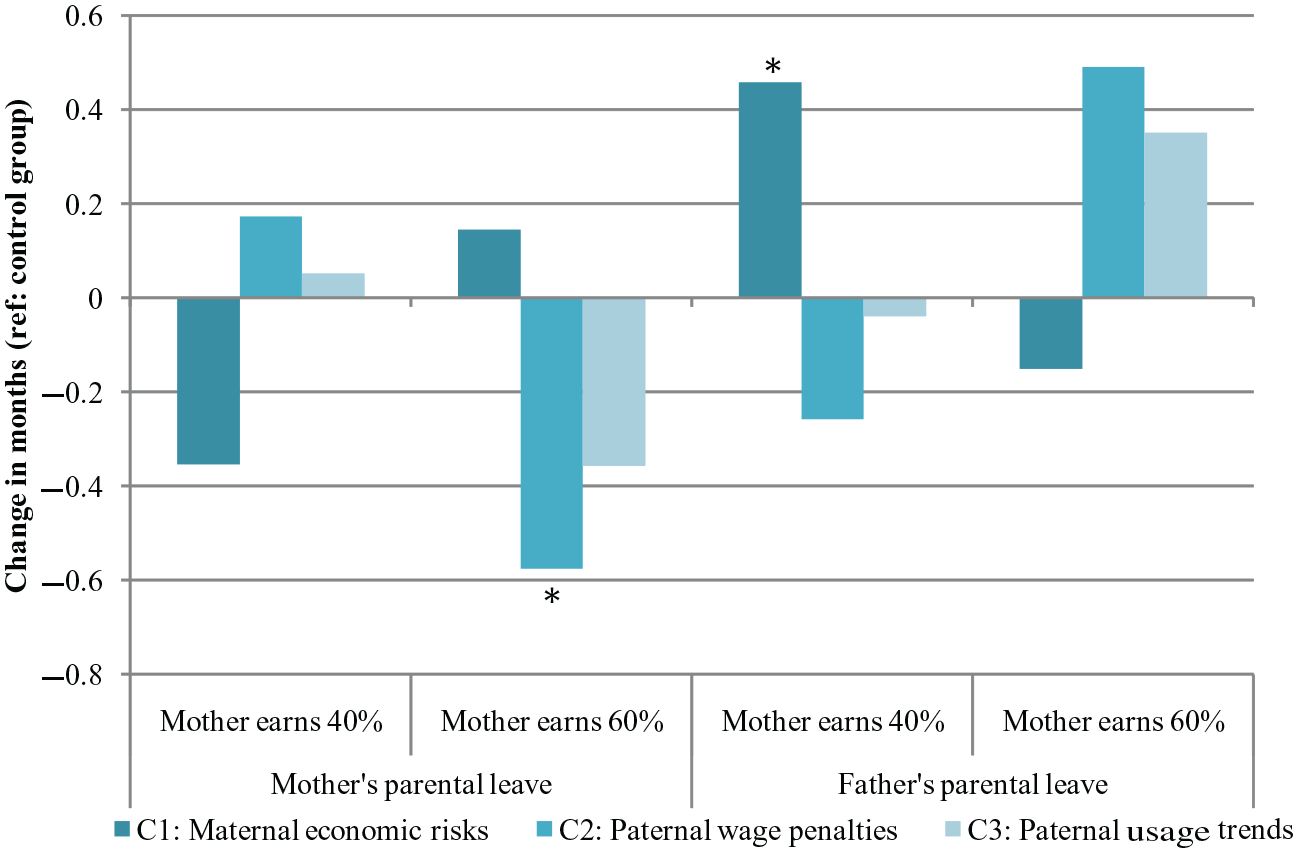
Bar Chart of the Priming Effects on the Mother’s and Father’s Absolute Length of Parental Leave by Income Subgroups
Personal Relevance and Previous Reflective Reasoning of the Policy Information
Next, we examined whether any of the priming conditions altered normative judgments regarding the division of parental leave more strongly among childless respondents than among parents (H3).
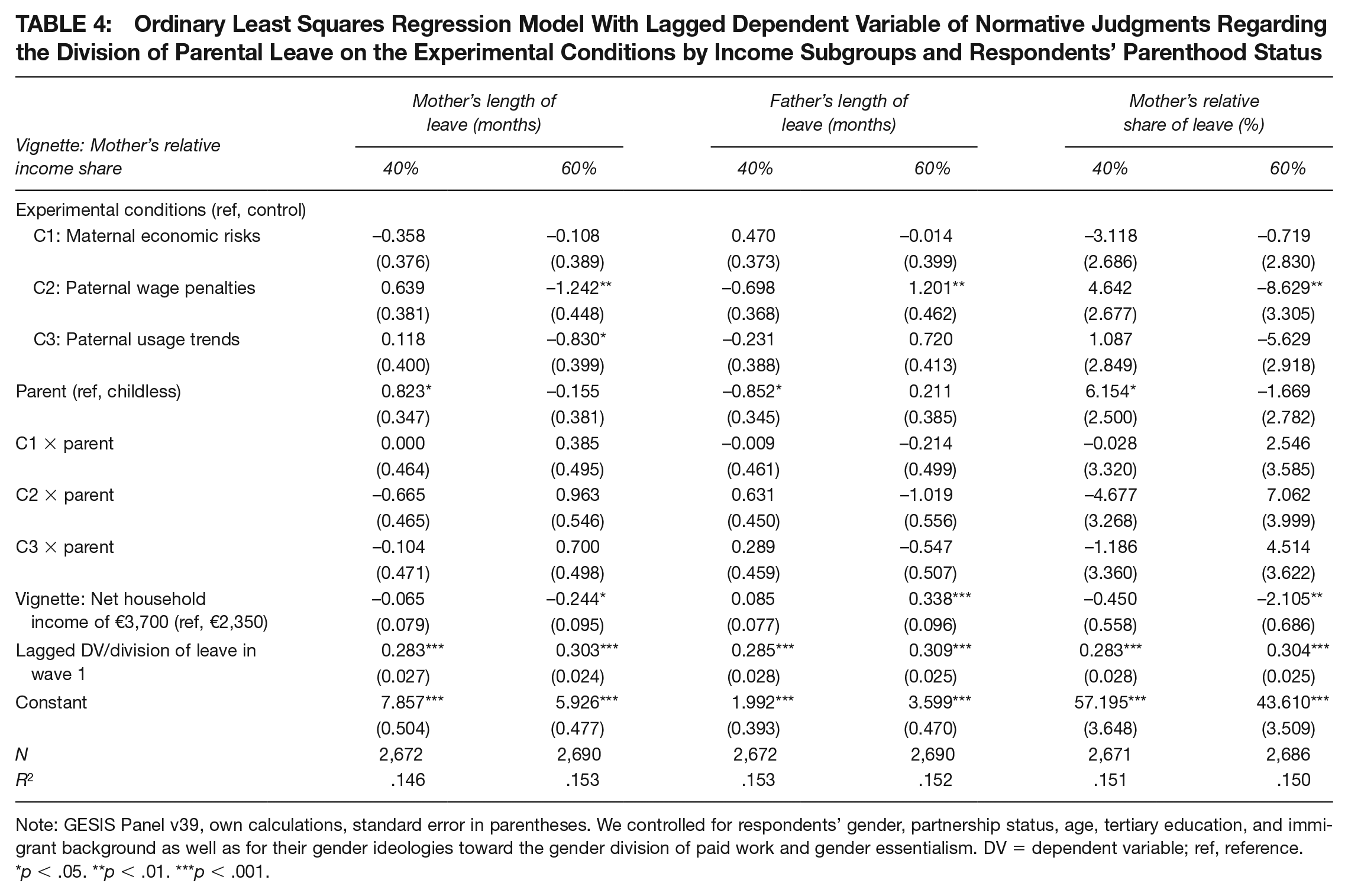
In Table 4 (see also Figure 2), we estimated interaction effects between the experimental conditions and respondents’ parenthood status, separately by relative income subgroups. Whereas we find no significant interaction effects, changes in the main effects of C2 and C3 point to stronger priming effects among childless respondents, in line with Hypothesis 3 (see Figure A3 in the Online Appendix). After the priming on paternal wage penalties (C2), childless respondents increased their support for a less traditional division of parental leave significantly with respect to constellations where the mother earns more than the father. Effect sizes are considerable, as the supported length of the mother’s parental leave decreased by 1.2 months on average (p < 0.01), whereas it increased by 1.2 months for fathers (p < 0.01). The suggested share of leave taken by the mother decreased by nearly 9 percentage points (p < 0.01). However, these differences between childless respondents and parents were only close to significant at the 5-percent level (p < 0.1).
Ordinary Least Squares Regression Model With Lagged Dependent Variable of Normative Judgments Regarding the Division of Parental Leave on the Experimental Conditions by Income Subgroups and Respondents’ Parenthood Status
Note: GESIS Panel v39, own calculations, standard error in parentheses. We controlled for respondents’ gender, partnership status, age, tertiary education, and immigrant background as well as for their gender ideologies toward the gender division of paid work and gender essentialism. DV = dependent variable; ref, reference.
p < .05. **p < .01. ***p < .001.
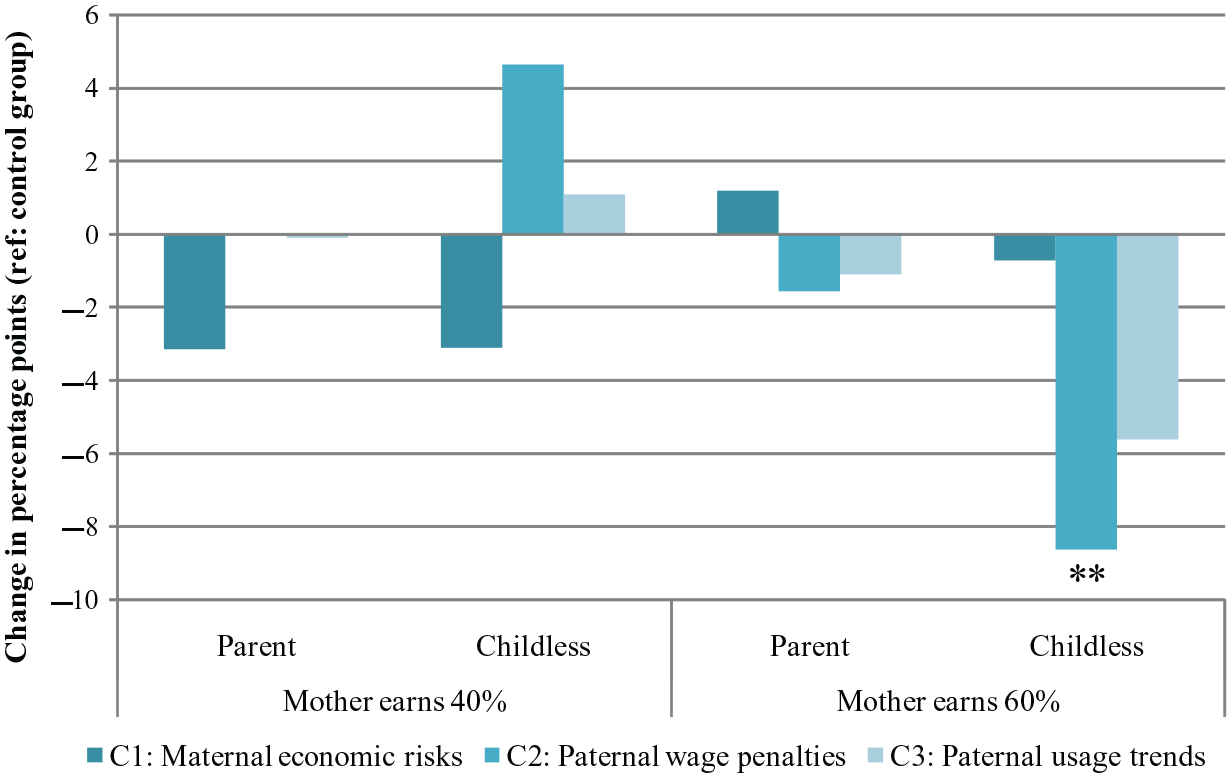
Bar Chart of the Priming Effects on the Mother’s Relative Share of Parental Leave by Income Subgroups and Respondents’ Parenthood Status
When including an interaction term with parenthood status for the priming on paternal usage trends (C3), the main effect representing the reference group of childless respondents turns statistically significant for the constellation in which the woman earns more than her partner. After receiving C3, childless respondents shortened the leave duration allocated to the mother by 0.8 months (p < 0.05). The changes in their normative judgments of the father’s absolute parental leave length and the mother’s relative share of parental leave were only close to statistically significant.
Increasing the visibility of current parental leave policies in Germany, the financial consequences of fathers’ leave usage and trends thus seems to have changed normative judgments regarding the division of parental leave among childless respondents, for whom the issue was probably not very salient before. Moreover, considering that the median age for childless respondents in our sample is 33 years—meaning that these respondents might still become parents in the future—the provided information on parental leave policies and consequences of leave usage might be more relevant for their lives than for respondents who already have children. These results partly support H3 for C2 and C3 and suggest that the previous reflection on as well as the personal relevance of a policy might be relevant mechanisms of changing normative beliefs.
Sensitivity Analyses
We tested logistic regression models measuring whether the mother should take less than 12 months and the father more than 2 months of parental leave. They provided very similar results as those in Tables 2 and 3 (see Tables A3 and A4 in the Online Appendix).
Because the autonomy perspective (Gupta 2007) emphasizes the relevance of absolute earnings for the division of labor, we also tested interaction effects with the absolute couple income in the vignettes, which were never statistically significant (see Table A5 in the Online Appendix). This may also suggest that the interdependence of the effects of the experimental conditions with partners’ relative earnings in the vignettes is not driven purely by the greater emphasis placed on income considerations.
Because the personal relevance and previous reflection on parental leave policies might also vary by respondents’ gender or level of education, we tested interaction effects with the experimental conditions by relative income subgroups, which were mostly not significant (see Table A6 in the Online Appendix). C1 and C2 produced greater support for a less traditional division of parental leave among respondents with a tertiary degree only in situations where the mother earns relatively more than the father.
Finally, we ran some data quality checks and excluded respondents with monotonous responses across all four vignettes and individuals who took a relatively short time to answer the vignette module. We further controlled for the presence of third persons as well as interruptions during the interview. In all cases, our results remained stable.
Discussion
This study provided a theoretical conceptualization and empirical investigation of how priming with brief information on parental leave policies and income-related consequences of usage might function as a channel for altering normative judgments about the gender division of parental leave across the wider population. Our study is set in Germany, which, like many high-income countries, has introduced several policies over the past 15 years designed to facilitate the combination of paid work and family care and promote greater gender equality (Ferragina 2020). We combined a survey priming experiment with a vignette study based on a large representative panel.
Our findings indicate that providing information on income-related consequences of parental leave for mothers and fathers based on scientific evidence from Germany and other European countries increased support for a less traditional division of parental leave in specific couple income constellations. In vignettes where the woman earned relatively less than her partner, the priming on maternal income risks increased acceptance of a longer leave of the father. This is likely attributable to increased salience and reflective reasoning about the consequences of the division of parental leave for mothers’ long-term financial situation. The nonsignificant reduction in mothers’ absolute leave length may relate to the fact that mothers in Germany still widely desire to take parental leave for at least 12 months (Bernhardt, Hipp, and Allmendinger 2016), so respondents may be reluctant to allocate less than 12 months to mothers. In vignettes where the woman out-earned her partner, receiving information on the absence of significant wage penalties of leave usage for fathers seemed to reduce widespread fears of career penalties for fathers while also highlighting the more negative consequences for mothers’ wages, and therefore led to less traditional judgments regarding the division of parental leave. This effect was found only for couples for whom income considerations already favored the mother taking a shorter leave and the father a longer leave.
The priming regarding wage penalties and leave usage trends among fathers particularly affected leave usage judgments among childless respondents. After the priming, they were more likely to consider couples’ economic resources in their judgments, whereas parents’ normative judgments were more resistant to change. Our study therefore suggests that priming with evidence-based policy-related information might induce more reflective reasoning regarding economic consequences of leave usage and changing trends among younger, childless cohorts. It seems that these cohorts are more open to normative change based on economic arguments, perhaps because they have not yet been significantly exposed to traditional norms related to parenthood. Ideally, we would have liked to further differentiate parents’ responses by the age of their child(ren) and previous policy-related knowledge, but unfortunately our data did not contain this information.
Conclusion
Our main finding that the situational effects of how information is received depends on the couple’s income constellation is in line with the relevance of partners’ relative earnings for the practical division of leave (Reich 2011; Trappe 2013). In Germany, family policies in general do not coherently promote either a traditional or an egalitarian division of paid and unpaid work, but support a relatively wide range of work–care arrangements (“optional familialism”; see Stahl and Schober 2018). In such a case, income considerations and situational characteristics seem to be particularly important for judgments on parental leave usage. This may point to a general weakening of gender norms regarding parental leave and may suggest that providing information relating to different policy options and the consequences of using parental leave may have a greater potential for changing social norms in contexts that offer genuine choices among different ways of combining work and family.
The stronger priming effects among childless respondents have important implications, because younger, childless respondents might someday become parents and might benefit from receiving parenthood-related information before personally facing the question of how to divide their parental leave and organize breadwinning and family care in the longer term. Such altered normative beliefs are likely to contribute to slightly more egalitarian personal preferences and practices, hence pointing to the relevance of norm-setting effects through information provision to challenge traditional patterns of the gender division of labor.
The rather modest strength of the priming effects on normative judgments regarding parental leave usage of mothers and fathers is in line with previous priming survey experiments regarding family policies more generally (Bünning and Hipp 2022; Pedulla and Thébaud 2015) and is probably attributable partly to the fact that our priming information was very short. Providing more detailed and more interactive information might encourage more reflection and yield stronger effects. However, we extend these previous priming and quasi-experimental studies (Gangl and Ziefle 2015) by providing first evidence of a novel mechanism of normative policy feedback effects. We show that priming with information related to parental leave policies and their income-related consequences can alter especially childless individuals’ normative judgments regarding the gender division of parental leave in couples when that information is judged relevant to the couple’s relative income constellation. Such effects, however, hinge on high levels of trust in the information-providing institutions, such as governments, and on the high quality and credibility of the evidence that the information is based on. Furthermore, providing evidence-based policy-related information may be particularly relevant in country contexts where gender norms and work–care practices are in flux and show considerable variations or inconsistencies with constraints set by policy reforms or economic transformations. Providing balanced and unbiased information regarding different policy options and work–care arrangements is more feasible in these contexts, whereas it would be more difficult in country contexts where policies or economic constraints clearly limit the range of feasible or favored work–care arrangements (e.g., Sweden, Poland).
Moreover, these insights have practical implications for policy makers and media, as they point to the relevance and potential of the availability, accessibility, and diffusion of policy-related evidence-based information. Evidence-based policy-related information, if repeatedly diffused even among groups that are not (yet) the target of family policies, might have the potential to shape gender and care cultures among the wider public over time. Especially younger, childless cohorts appear to be open to changing their normative beliefs when provided with perhaps novel policy-related evidence. Yet given the frequent media coverage on parental leave and consequences of its usage in German newspapers, respondents might have been exposed to the information provided in the priming conditions before the experiment, and we might have underestimated the priming effects, especially for parents. This applies most to the information on paternal usage trends and possibly also to maternal income risks, whereas the absence of paternal wage penalties has rarely featured in media reports. To examine these mechanisms in more detail, future studies should assess respondents’ prior knowledge and beliefs about the policy and consequences of leave usage as well as its perceived personal relevance.
Because this study focused only on short-term effects, it would be crucial to explore whether and under which conditions priming can induce longer-lasting normative changes. To further enhance our understanding of how policy-related information—for instance, in the form of media reports—might change gendered work and care norms among the wider public, future research needs to investigate in more detail the influence of other persons’ social expectations on changes in individuals’ personal normative beliefs. A promising avenue for future research would be to explore how respondents’ responses to priming depend on their empirical and normative expectations about what relevant others consider an appropriate division of parental leave. This might influence individuals’ actual division of parental leave at least as strongly as their own personal normative beliefs (e.g., Thébaud and Pedulla 2016).
Supplemental Material
sj-docx-1-gas-10.1177_08912432231176084 – Supplemental material for Parental Leave Policies, Usage Consequences, and Changing Normative Beliefs: Evidence From a Survey Experiment
Supplemental material, sj-docx-1-gas-10.1177_08912432231176084 for Parental Leave Policies, Usage Consequences, and Changing Normative Beliefs: Evidence From a Survey Experiment by Marie-Fleur Philipp, Silke Büchau, Pia S. Schober and C. Katharina Spiess in Gender & Society
Footnotes
Authors’ note:
We thank Caroline Berghammer for her helpful comments and Keri Hartman for proofreading. This work was supported by the German Research Foundation (grant ref: SCHO1770/2-1, project no: 430968755).

Supplemental Material
Supplemental material for this article is available online.
Marie-Fleur Philipp is a doctoral candidate in sociology at the University of Tübingen. She is interested in gender relations and inequalities within the family, particularly in the interplay between work–family policies and social norms as well as in the role of family structure in gender socialization.
Silke Büchau is a research associate and doctoral candidate at the Department of Sociology at the University of Tübingen. Her research focuses primarily on gender inequalities in employment and family work as well as family policies in relation to preferences and norms toward the gender division of labor.
Pia S. Schober is professor of sociology at the University of Tübingen. Recently, she has been the principal investigator of two research projects on “Family policy information, gender ideologies and normative judgements of the gender division of labour” and “Parental gender socialization across diverse families,” funded by the German Research Foundation (DFG). She is also a principal investigator of two DFG-funded research training groups: “Doing Transitions” and “Women’s mental health across the reproductive years.” Her main research interests are gender and social inequalities in employment and family work, childcare and child outcomes, and family and early childhood education policy.
C. Katharina Spiess is Director of the Federal Institute for Population Research (BiB) and professor for population economics at the Johannes Gutenberg University Mainz. Her research focuses on issues in education and family topics and other issues related to population studies. She is a member of various research networks and expert groups and commissions, including the Scientific Advisory Board for Family Issues at the Federal Ministry for Family Affairs or the European Research Council. Her work has been published in multiple academic journals including Journal of Marriage and Family, Journal of Population Economics, and Journal of Health Economics. She has also edited several books and special issues.
References
Supplementary Material
Please find the following supplemental material available below.
For Open Access articles published under a Creative Commons License, all supplemental material carries the same license as the article it is associated with.
For non-Open Access articles published, all supplemental material carries a non-exclusive license, and permission requests for re-use of supplemental material or any part of supplemental material shall be sent directly to the copyright owner as specified in the copyright notice associated with the article.
